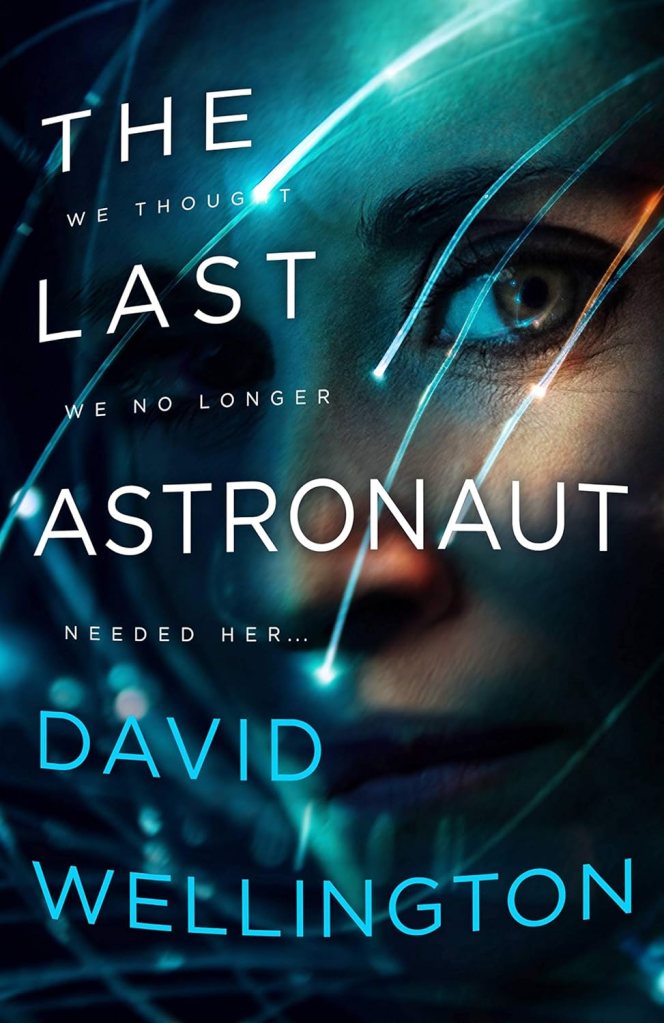
I don’t read many science fiction novels nowadays. I prefer SF short stories. I just don’t read as many books as I used to. However, after my friend Laurie told me about The Last Astronaut by David Wellington, I decided to give it a try. The Last Astronaut is the kind of science fiction thriller that Michael Crichton used to write — fast pace, lots of physical action, and basically fun. The Last Astronaut reminded me how entertaining reading a novel used to be. I wouldn’t call it great, but it does have that page-turning quality.
Now I do have some things to say about it, but what I have to say is full of spoilers. I recommend you go read the novel and then come back here, if you can remember. The Last Astronaut made me think about how science fiction novels change over the years, and how each generation retells old themes in new ways.
The Last Astronaut is about a Big Dumb Object. That’s the official name of a specific science fiction plot device. When I started reading The Last Astronaut, I immediately thought of Rendezvous with Rama. In 2020, The Last Astronaut was nominated for the Arthur C. Clarke Award. Wikipedia even says, “Edward Guimont and Horace A. Smith propose that the origins of the Big Dumb Object trope can be found in H. P. Lovecraft’s novellas At the Mountains of Madness and The Shadow Out of Time, both of which feature human expeditions to immense ancient alien cities in remote parts of our world, and both of which were early influences upon Arthur C. Clarke.”
Funny that they mention H. P. Lovecraft. Because I also thought of Lovecraft while reading The Last Astronaut. Wellington’s novel features horror. Horror like the film Alien, but also horror like Lovecraft’s monstrous alien gods.
The setting, inside the vast alien spacecraft, is dark. Having a story set almost completely in darkness reminded me of Jules Verne’s Journey to the Center of the Earth and The Night Land by William Hope Hodgson.
I’m finally reminded of another story/movie, Fantastic Voyage by Isaac Asimov, along with “Finisterra” by David Moles. This last reminder should give you one huge clue to what’s happening in The Last Astronaut. But I did warn you about spoilers.
My point in this essay is that science fiction is seldom original anymore. The Last Astronaut feels like David Wellington took several of his favorite science fiction themes and blended them into a new SF novel. It succeeds well. I had a lot of problems with the characters because I felt their psychological motivations were too contrived. However, Wellington does use those contrived motivations to wrap up his novel. The ending does make sense and is satisfying.
I was entertained by how Wellington told his story. Wellington places himself in the book as an author in the future, writing a historical novel, but a history that hasn’t happened yet. It’s amusing that one of his characters criticizes the future Wellington for getting his facts wrong. Since we know the story is based on history, there are clues as to who survives and who doesn’t. The audiobook is especially nice because they rig up the audio so that interviews of characters taken after events sound different.
In the 40s and 50s, science fiction writers aimed to create new ideas and themes, but their stories were told without sophistication. In the 60s and 70s, SF writers added literary techniques to their stories. In the 80s and 90s, SF writers upped the ante by going epic. Hyperion is a great example. In the 21st century, SF writers have had to constantly find new ways to tell stories that have already been told.
If you haven’t read old science fiction, new science fiction seems novel. If you have read old science fiction, new science fiction feels recycled. That’s not a bad thing, but it makes the stories feel baroque when you cram so many old ideas into one story. Wellington does streamline his novel, so it feels action-packed like old science fiction. In some ways, his storytelling is as speedy as Edgar Rice Burroughs’ stories or pulp fiction.
My library constantly discards science fiction from its holdings. I know that because I see those books in the Friends of the Library book sale stamped DISCARD. Often, they are books I would consider SF blasts from the past. Evidently, if they aren’t checked out for a certain period, they get discarded. I used to believe libraries were supposed to preserve the past, but I don’t think that’s true anymore.
But that’s not my only clue that science fiction has a shelf life. At the used bookstore I visit every week I see the same old books week after week – no one is buying them. It’s the newer books that come and go so quickly.
For years now, I’ve been watching people review science fiction books on YouTube. I can sense that many authors and their books are falling out favor over time. A major example is Robert A. Heinlein. When I was growing up, he was considered the #1 science fiction author. He was my favorite SF writer. I still love his books published before 1960, but the ones after that haven’t aged well with me. Reviewers generally pan Heinlein nowadays. I often see critical comments about Heinlein on Facebook. He’s just not popular anymore. I see many of his books at the used bookstore, but only a couple at the new bookstore.
Whitney at the YouTube channel Secret Sauce of Storycraft has been reviewing old Hugo winning novels by decades. She didn’t like over half of the winners. Five of the ten (The Wanderer, Stranger in a Strange Land, The Moon is a Harsh Mistress, This Immortal, and Lord of Light) have stopped working for me too.
If I gave the Hugo Award now for the 1960s, my list would be:
1960 – STARSHIP TROOPERS by Robert A. Heinlein
1961 – ROGUE MOON by Algis Budrys ( for A CANTICLE FOR LEIBOWITZ)
1962 – STRANGER IN A STRANGE LAND by Robert A. Heinlein
1963 – THE MAN IN THE HIGH CASTLE by Philip K. Dick
1964 – THE MAN WHO FELL TO EARTH by Walter Tevis (for WAY STATION)
1965 – THE MARTIAN TIME-SLIP by Philip K. Dick (for THE WANDERER)
1966 – DUNE by Frank Herbert
1967 – FLOWERS FOR ALGERNON by Daniel Keyes (THE MOON IS A HARSH MISTRESS)
1968 – no award
1969 – STAND ON ZANZIBAR by John Brunner
I thought there would be hundreds of science fiction books that would be Hugo worthy from the 1960s, but there weren’t. I used CSFquery.com and ISFDB.org to look at each year 1960-1969 and there just was’t that many older books that’s being read today that people still admire.
I love A Canticle for Leibowitz still, but it’s a fixup novel, and I mostly love it for the first story. And reviewers aren’t as wowed as they used to be for it. I kept Stranger on the list even though I no longer like it, because it’s so ambitious for the times, and historically, it is the standout novel of the year. I love Way Station, but I don’t think people still read it much. The Man Who Fell to Earth has grown in popularity since 1963. The Martian Time-Slip is way better than The Wanderer, and people still read it. I definitely think Flowers for Algernon has aged better than Mistress. I’d give No Award over Lord of Light, or any other novel I remember from 1967.
All the books on my list are in print, and all are available as audiobooks. That’s a good indicator that they are still being read.
I was shocked by how few science fiction books from the 1960s I still admire. Twelve years ago I wrote a series about the best SF books from each decade. Looking at my essay for the 1960s shows damn few books that people still read.
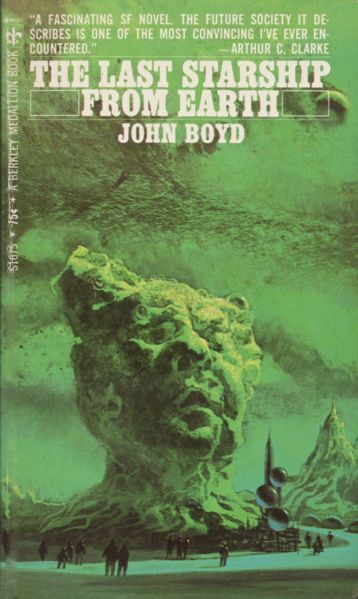
I remember back in the 1960s when old guys would gush about E. E. “Doc” Smith books from the 1920s and 1930s. I tried them, and they were horrible. I guess today’s young readers would feel the same about most of the books I loved back in the 1960s. Is anyone still reading Keith Laumer, John Boyd, Mack Reynolds, A. Bertram Chandler, etc.
What are the best science fiction books from the 1960s that you still read and think young people should try?
You might like to read An Information History of the Hugo Awards by Jo Walton. This was first published at Tor.com and many of the comments from readers are included.
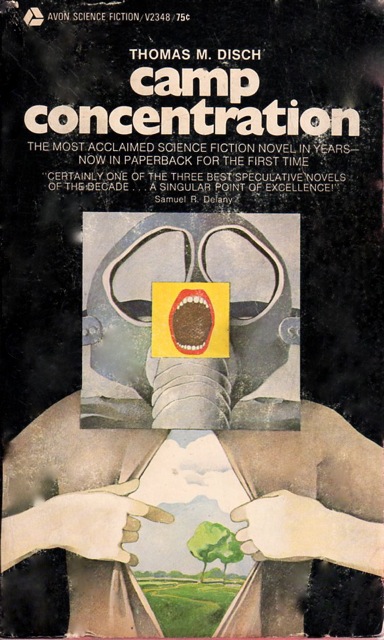
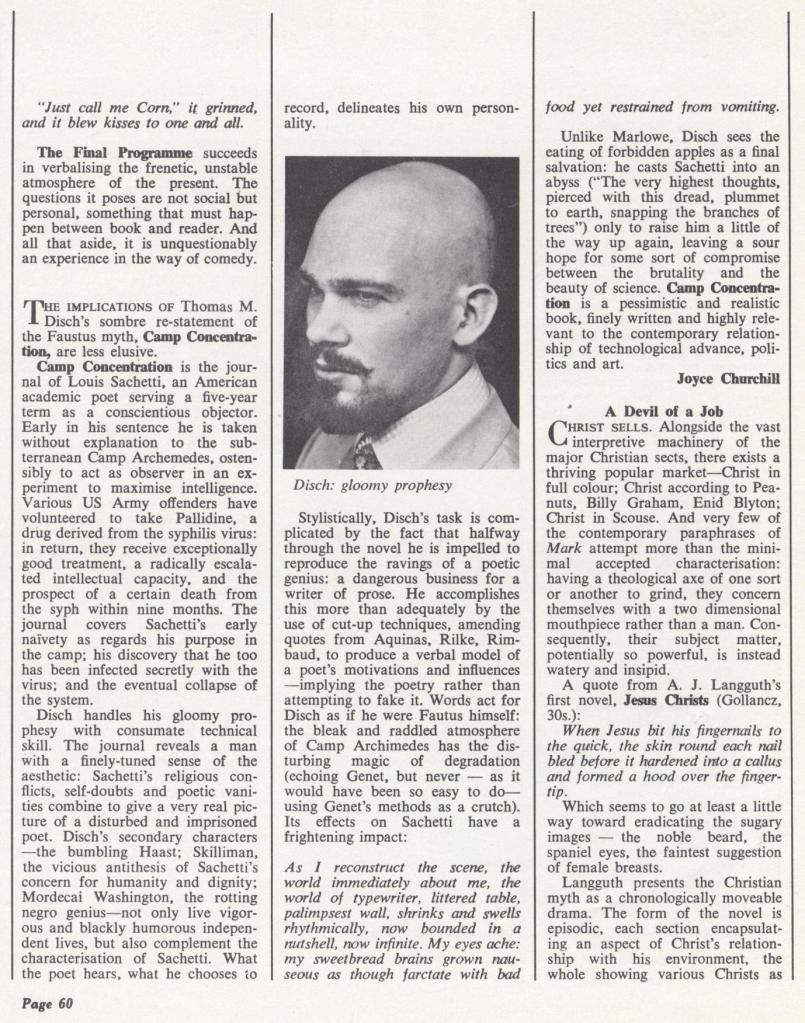
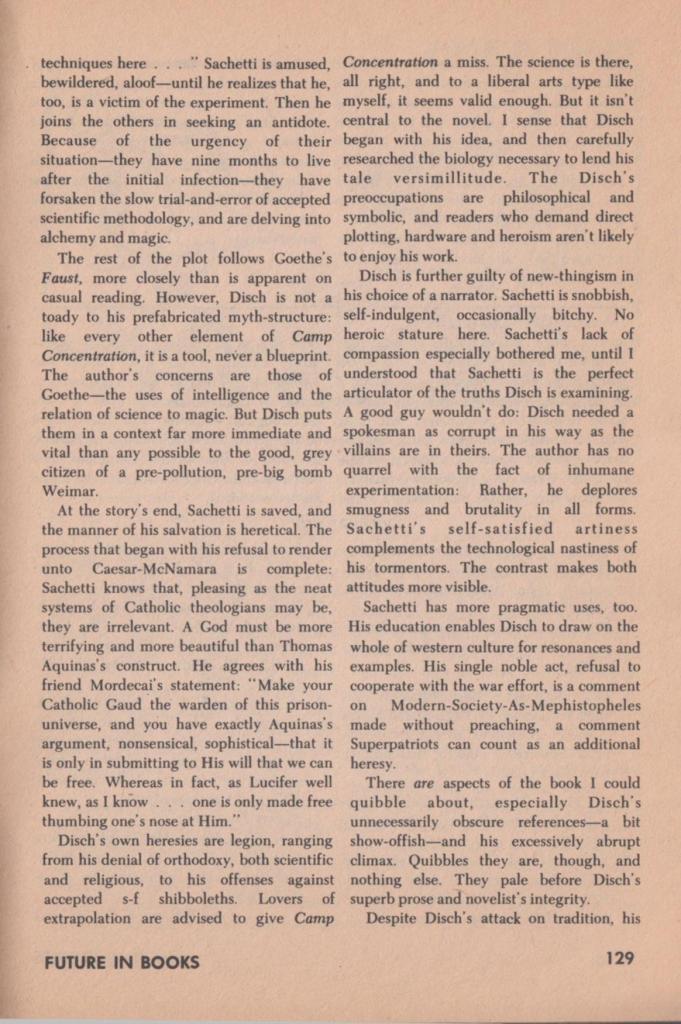
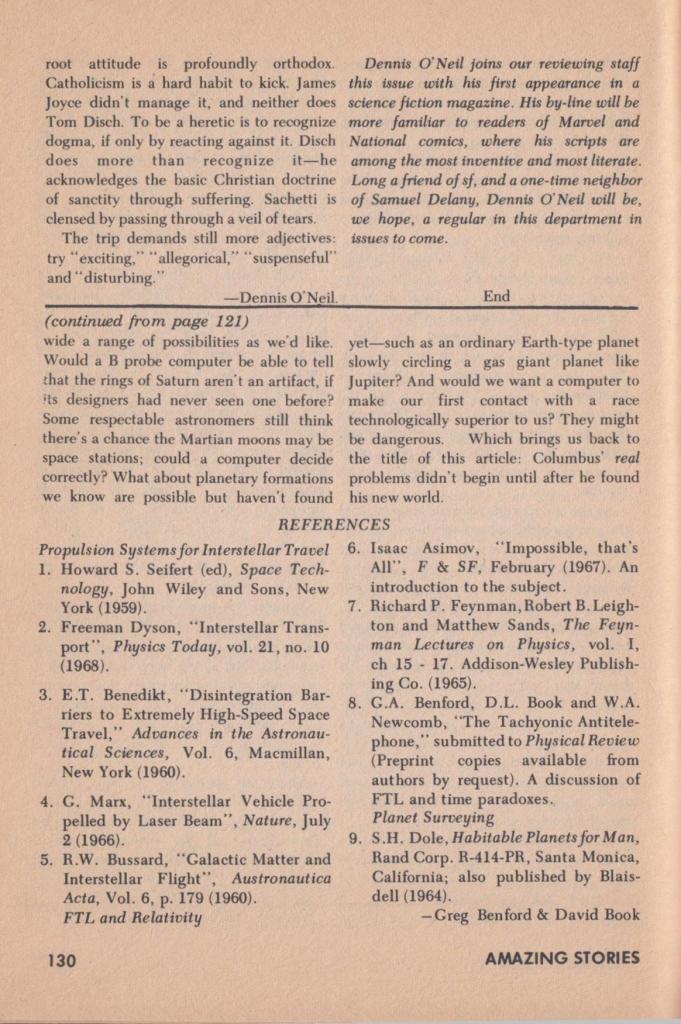
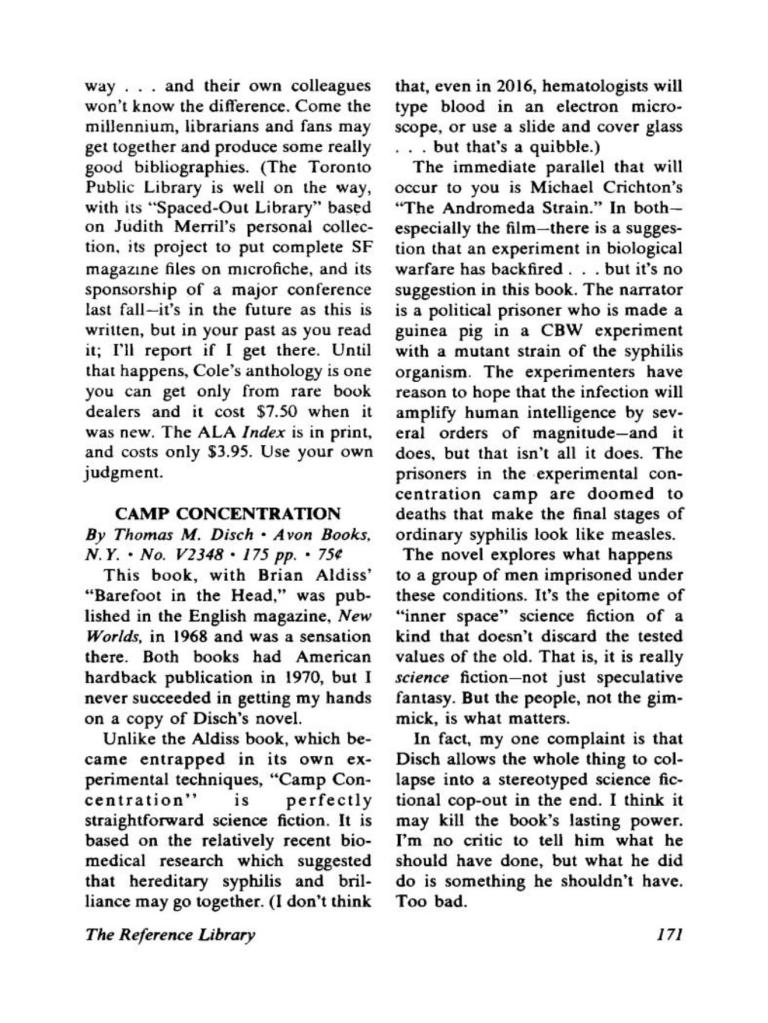
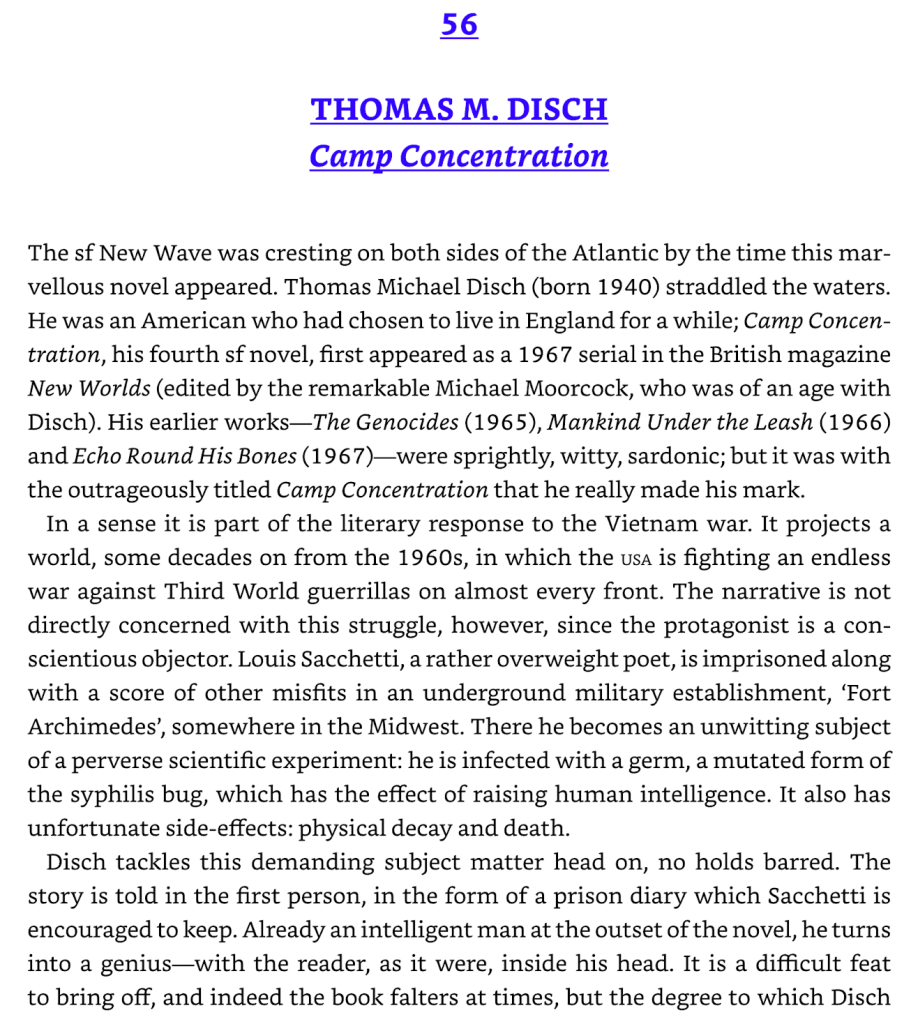
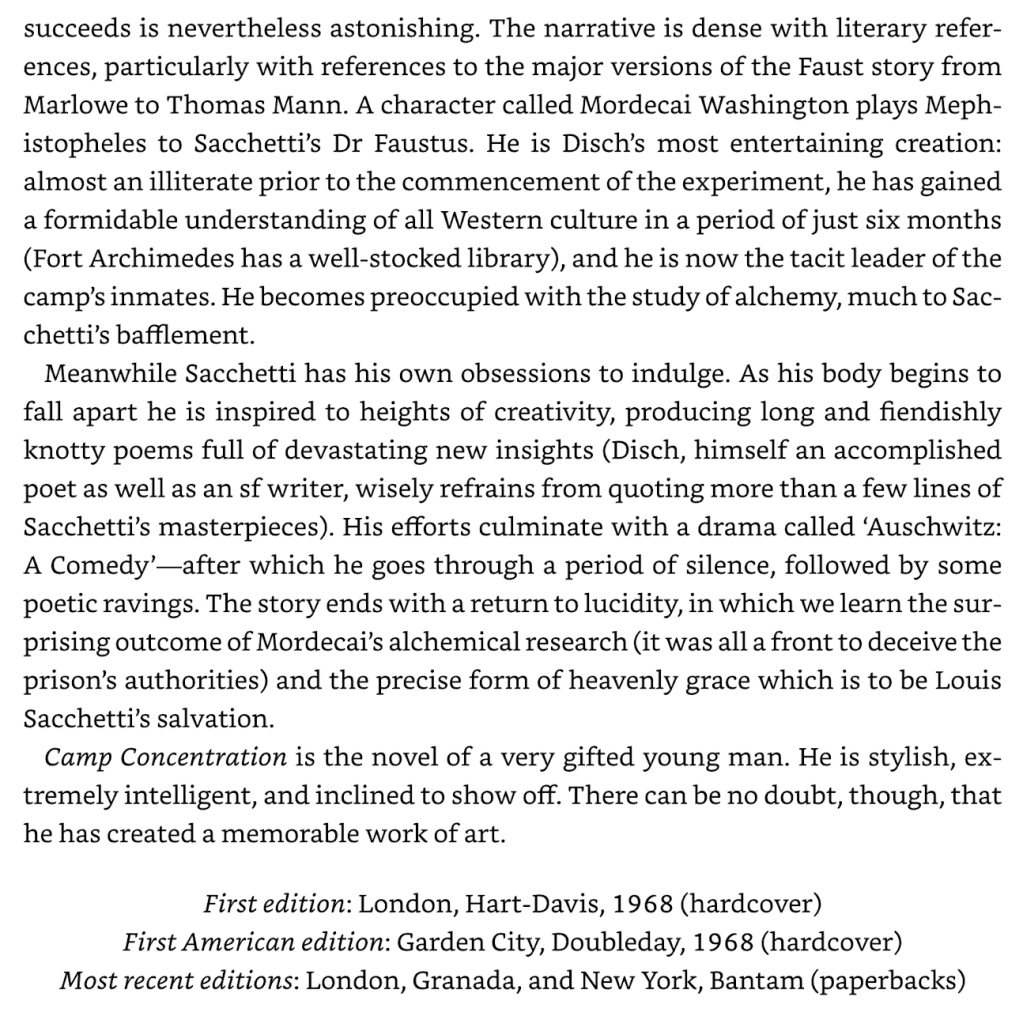
The first time I read Camp Concentration by Thomas M. Disch, I was around 20 and proud of myself for reading one of those New Wave science fiction novels I had been reading about in fanzines. It wasn’t much fun to read. It was overly intellectual – well beyond my level of comprehension. After reading thousands of other books over the last fifty-plus years, Camp Concentration made much more sense. I actually enjoyed the story. I enjoyed it a lot. But please, don’t buy a copy without carefully reading this review.
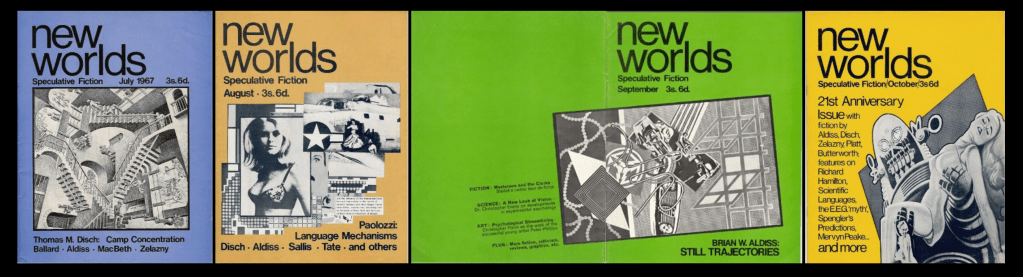
It’s important to know that Camp Concentration first appeared in the July, August, September, and October 1967 issues of New Worlds. It suggests it was written in 1966 or early 1967 and published first in England, in a magazine that promoted the New Wave. To fully appreciate this novel, you must remember when it was written and what happened in the United States in 1966 and 1967. The first hardback came out in England in 1968, and it wasn’t until 1969 when it was published in America. I didn’t read it until after the 1971 Avon paperback, cover shown above.
I’d love to hear an audiobook version of Camp Concentration. However, a highly skilled narrator would be needed to handle all the accents, poetry, foreign language quotes, and characterizations. It would also make a wonderful movie. Unfortunately, the audience for either the audiobook or film would be small.
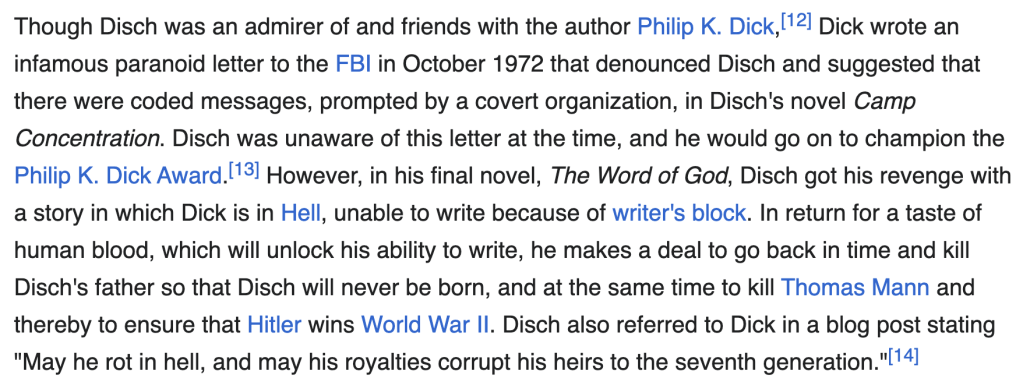
Back in the 1970s Camp Concentration was greatly admired. Philip K. Dick loved the book so much he promoted to friends and suggested it be made into a movie to a producer interested in his own work. But there’s a bizarre story here. Dick, who was paranoid, started seeing things in Camp Concentration and wrote a letter to the FBI claiming it had secret intel. You can read that letter here. Eventually, Disch found out about this and didn’t take it kindly. Wikipedia describes what happened:
I mention this early in the review because it helps set up how strange Camp Concentration is as a novel. It’s quite readable, but it has so many references to literature, music, philosophy, poetry, etc., that you might feel it has some deeper message. Even though I just finished the novel, I’m already looking forward to rereading it again. However, before I can do that, I need to study first. At minimum I should read Christopher Marlowe’s play Doctor Faustus, and Thomas Mann’s novel Dr. Faustus. In fact, I need to go through Camp Concentration, make a list of all the works Disch mentions, and at least read their Wikipedia pages about them.
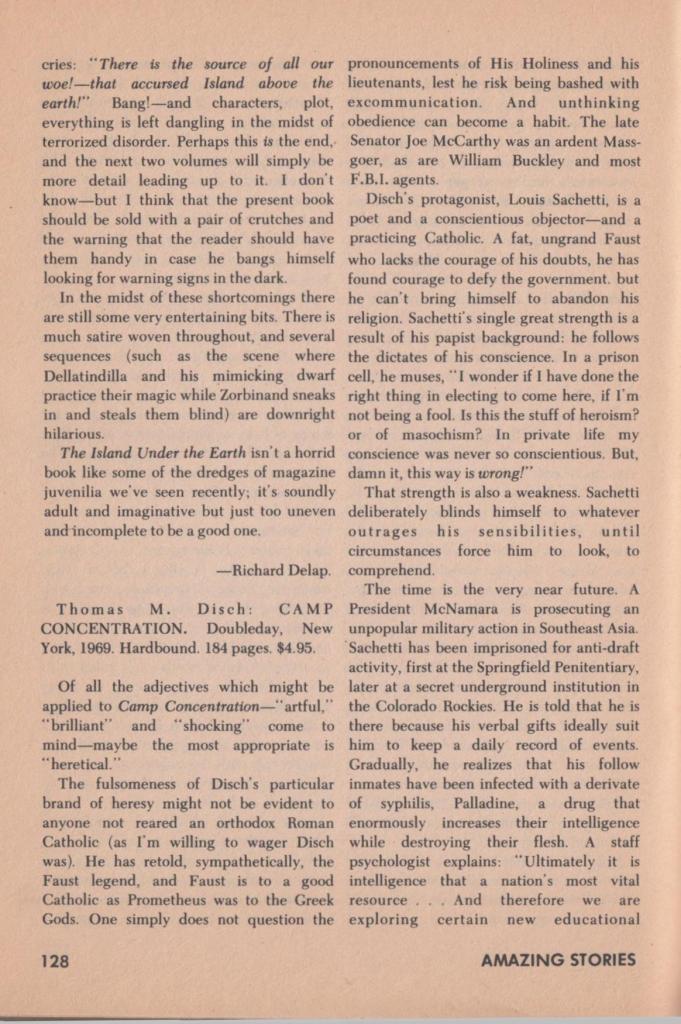
Louis Sacchetti is a conscientious objector, and Camp Concentration is the journal he writes while imprisoned in two locations. Disch wrote the novel while LBJ was president, and before Nixon. The story is set somewhat in the future, and Robert McNamara is President. McNamara was the Secretary of Defense under JFK and LBJ. McNamara played a major role in promoting the Vietnam War. To get the fullness of Camp Concentration, you need to read the Wikipedia link to McNamara. It also helps to see The Fog of War: Eleven Lessons from the Life of Robert S. McNamara, a 2003 Academy Award winning documentary.
Camp Concentration is a deeply cynical view of the United States in 1967. Louis is a war resister, at first imprisoned in an ordinary prison. He accepts that. But the novel is about when he is transferred to another prison, a military prison, where an experimental drug is used on the inmates by the U.S. Army. Most of the prisoners had committed crimes while in the Army, but Louis is a special civilian prisoner. The army believes it has synthesized a drug that will enhance intelligence. It was derived from a strain of syphilis.
The U.S. Army conducted experiments with LSD from 1955 to 1967. From 1932 to 1972, the U.S. government studied the effects of syphilis on black people after telling them they were being treated. These are just two examples of unethical experiments by our government. It’s not hard to believe the setup for Camp Concentration.
Camp Concentration reminds some readers of Flowers for Algernon because it’s about a treatment that makes people smarter. Over one hundred journal entries, we see Louis and the other prisoners change and become brilliant. I felt the characters did change, but my friend Mike, who got me to reread the novel, says he didn’t. Writers find it hard to describe humans with superintelligence. I’ve written about that recently. I thought Disch pulled it off, Mike didn’t.
Most of the novel is intellectual discussions about art, literature, poetry, theater, music, religion, philosophy, Alchemy, and other medieval beliefs. Mike thought all this discussion was boring, I was fascinated. I feel it helps to have a classical education to appreciate Camp Concentration. I don’t, but I’ve read enough to wish I had.
While reading Camp Concentration I was reminded of another book I read in the 1970s, Where the Wasteland Ends: Politics and Transcendence in Post Industrial Societyby Theodore Roszak. I’m not saying the two books are about the same things, but as the characters evolve intellectually, they start sounding like Roszak.
Read Disch’s Wikipedia entry, you’ll see that Thomas M. Disch and Louis Sacchetti have much in common. Louis is a poet, and Disch wrote The Castle of Indolence: On Poetry, Poets, and Poetastes.
In the novel, the drug makes the test subject smarter, but it also kills them within months. As the characters grow more brilliant, they realize they have much more to live for and become bitter. Disch appears to equate higher IQ with depression and cynicism.
Disch does not suggest that superintelligence leads to super-powers. The test subjects only become more academic in their communication with each other. As they evolve mentally, their use of intellectual ideas to express themselves becomes more dense. This is subtle, and it may be hard to believe they are more intelligent. It seems that most of their references are to ideas covered in Classical studies or Medieval studies.
If you are prone to depression, I would not read this novel. If you are among the faithful, I would not read this novel. If you prefer tightly plotted stories, that are easy to read, and enjoy action, don’t buy this book.
On the other hand, if you’re into the history of science fiction, the New Wave, or the 1960s, Camp Concentration might be a good one to read. Science fiction changed in 1967-1968. I believe several young prodigies like Disch and Delany took the genre in new directions, and older writers like Silverberg, Brunner, and Ellison decided they were tired of where science fiction was going too.
In Ted Chiang’s impressive overview of human superintelligence in science fiction, he mentions that John W. Campbell Jr. rejected a story by Vernor Vinge about a character with human superintelligence because no one can write such a story. (Vinge had proposed a sequel to “Bookworm, Run!“) The implication: since none of us know what being superintelligent is like subjectively, we can’t describe it. That’s silly. Campbell had been publishing a magazine describing space travel decades before NASA, or atomic bombs before 1945, or robots long before Roombas.
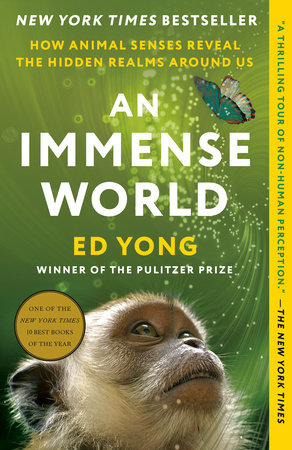
British journalist Ed Yong describes the umwelt of many species in his book An Immense World. How each organism views reality from its collection of sense organs is called umwelt. We might not be able to imagine being a dog, but we can analyze a dog’s senses and speculate what they can perceive.
Shouldn’t we assume science fiction can speculate on a human being with superintelligence by what it’s capable of perceiving and what it does with those perceptions? I’m guessing John W. Campbell assumed that a dog couldn’t imagine what it’s like to be a human. But is that really true? A dog might not comprehend humans reading a book, but I’m sure they understand much about us in their own special way. In fact, they might observe qualities about us that we’re unaware of.
Astounding Science Fiction in the 1950s was full of stories about ESP and other psychic abilities. Campbell called such abilities psionics. Throughout the history of science fiction, writers have speculated that superhumans would have god-like powers. I’ve written about science fiction and human superintelligence before and described many of the most famous of these stories. See: “Science Fiction and Human Evolution” and “The Origins of Higher Intelligence in Science Fiction.” The genre has a long history of attempting what Campbell supposedly told Vinge he couldn’t.
Strangely, hard science fiction writer Arthur C. Clarke wrote two classic novels about superhumans: Childhood’s End and 2001: A Space Odyssey. Clarke gave no scientific explanation of how people might transform into next-stage humans. Clarke’s new humans were almost impossible to imagine. They are god-like to us. This is fun but gives us little to speculate about realistically.
Greg Bear imagines a new strain of virus affecting pregnant women causing a mutation in Darwin’s Radio. Children born of these women are more intelligent, have greater disease resistance, and can communicate non-verbally. This isn’t hard to imagine. Current humans show a tremendously wide spectrum of intelligence and physical health. And some humans are far better at communicating than others, especially via body language and empathy.
Nancy Kress imagines genetic engineering creating a new species of humanity in Beggars in Spain. Their key feature was needing less sleep. This gave them more time to learn, work, and compete. It’s easy to imagine this adaptation and how these new humans would do better than ordinary humans.
The movie Gattaca imagined a future society where normal humans competed with humans with carefully selected genes. The improved humans had the same human frailties, but out-competed normal humans for the better jobs. They were better-looking, smarter, more athletic, and had greater discipline. That’s not hard to imagine.
In Flowers for Algernon by Daniel Keyes, Charlie Gordon undergoes an operation that advances his IQ. At the beginning, Clarlie works as a janitor and is cognitively challenged. The operation allows him to learn new things, and eventually become a super-genius. His new attributes are not beyond belief. Charlie learns new languages, achieves great academic success, and becomes tremendously productive. Charlie doesn’t develop ESP or godlike powers, but achieves the maximum levels of current human skills and traits. This is believable and easy to imagine.
Homo sapiens are only slightly improved over Neanderthals, but those improvements let us do so much more. For us to describe Homo superior we only need to imagine slight enhancements to our species and speculate about what impact they would have.
Some humans have tetrachromacy, which means they can detect four primary colors rather than three. Other people have eidetic memory. Stephen Wiltshire, an autistic savant, can draw detailed images of cities from memory after just a helicopter ride. All the traits that Human 2.0 might have are already showing up in us now. Conversely, all the traits that won’t emerge are those we lack precursors for now.
That’s why I think it’s silly to imagine humans evolving to have telepathy or be able to teleport at will. Those are comic book ideas. Campbell was both too hopeful and too naive about human evolution. He expected “The Man Who Evolved” by Edmond Hamilton. At best, I think we’ll get Gattaca.
One problem with evolving our current abilities is that we often see cognitive issues associated with people with extreme examples of those abilities. Can a perfect memory be imperfect? Can we be too smart? I’ve known many people far ahead of me in many skills. I can’t fathom general and special relativity. Does that mean Albert Einstein was a 2.0 human?
Until recently, I thought the human race was evolving slowly on average. But current events make me think we’re regressing. Some people already have superintelligence compared to others. It could be the evolution of our species won’t be by quantum leaps, but slow adaptation of biological trial and error. Much of science fiction is just fun bullshit speculation. We need to distinguish between fantasy and scientific possibilities.
Personally, I feel our role in evolution was to evolve machine intelligence. I don’t believe humans will ever become giant brains with tiny bodies, nonphysical beings, or something like Q from Star Trek: The Next Generation. It’s interesting that Greg Bear and Nancy Kress in their novels, had normal humans wanting to wipe out the new humans before they got established.
Lester del Rey summed us up nicely in “For I Am a Jealous People!” Our creator and descendants need to watch out.
I don’t see why Campbell rejected Vernor Vinge’s idea of writing a sequel to “Bookworm, Run!” Campbell had already published Slan by A. E. van Vogt and many other stories featuring human superintelligence.
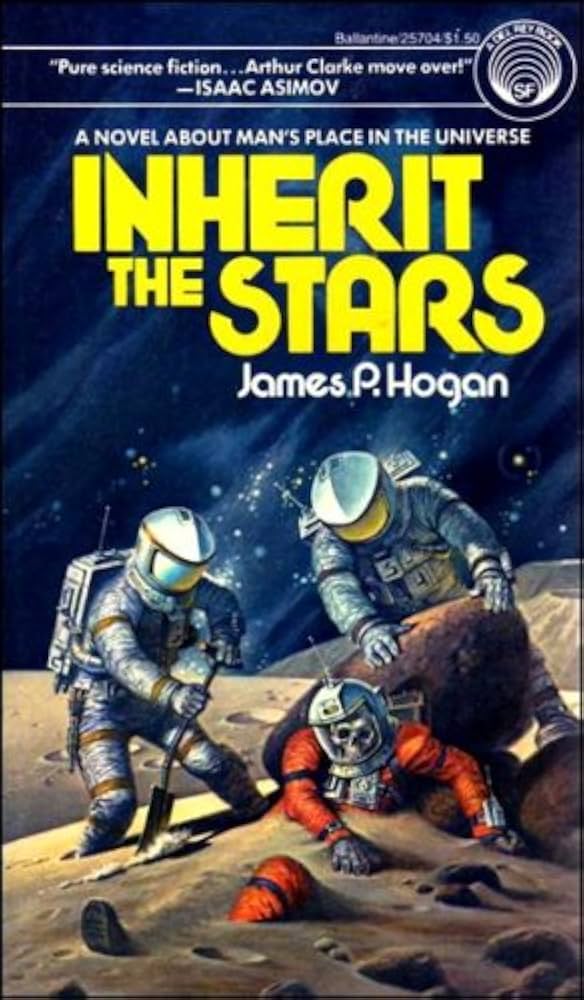
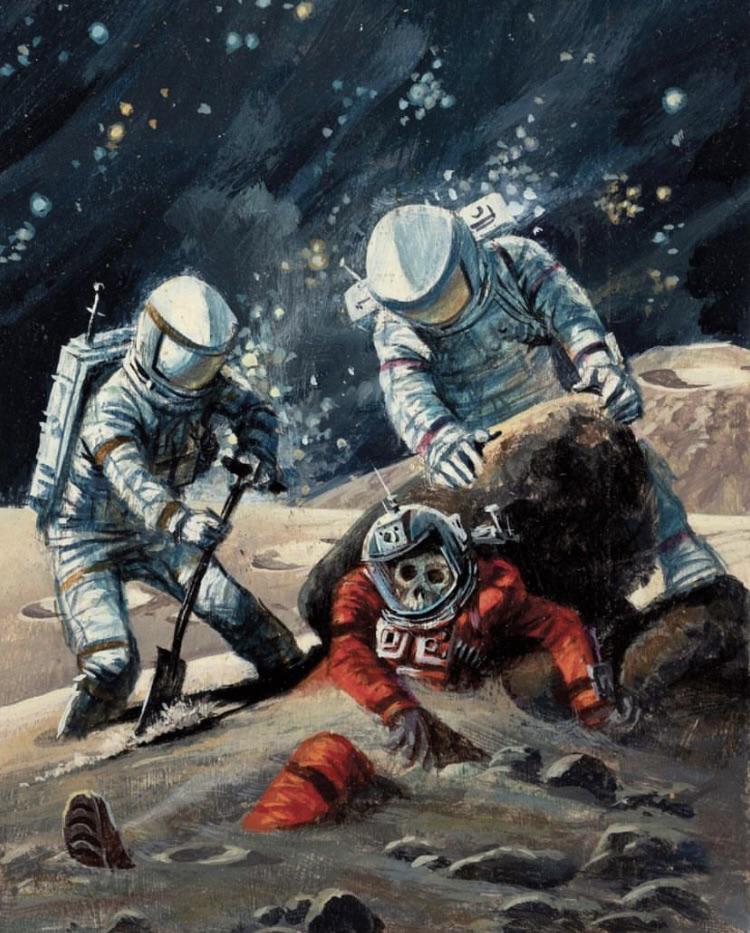
The original paperback, Inherit the Stars by British writer James P. Hogan (1941-2010), had a terrific cover – the kind that made you buy the book. The artwork appears to show astronauts on the Moon finding a dead astronaut, but that is deceptive. Hogan creates a scientific mystery because the dead astronaut has been there for 25,000 years.
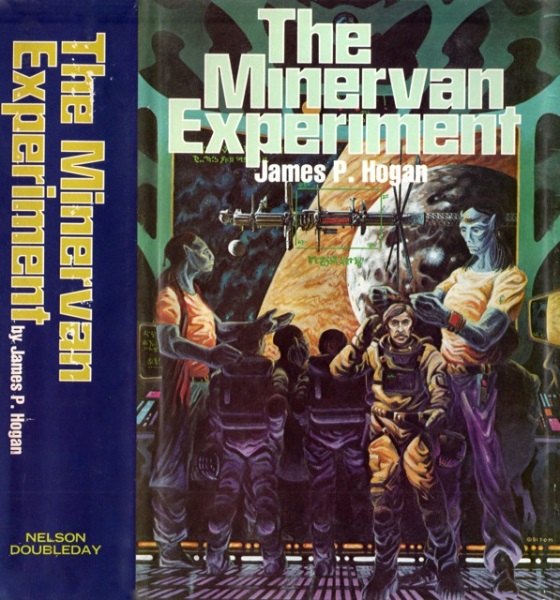
I first read Inherit the Stars in 1992 but after seeing Whitney’s review on YouTube, I wanted to reread the story. I went to Amazon but couldn’t find the book. Was it out of print? I did find it on Audible. Later, I discovered that Inherit the Stars and its sequel The Gentle Giants of Ganymede are now being sold together as The Two Moons for the Kindle. A bargain for $6.99, especially since Whitney also praised the second book. It turns out that there are five books in the series being sold as three Kindle editions. The series is called Giants. Only the first three novels are available on Audible. The Science Fiction Book Club once published the first three novels as The Mirnervan Experiment. Ballentine also published a paperback called The Giants Novels that contains all three.
Before anyone rushes out to buy Inherit the Stars, I need to describe it more, but not enough to give spoilers. Hogan’s story is the kind you want to figure out for yourself. It kept me guessing for the entire novel even though I had read it before. That worried me. Why wasn’t it more memorable? Was that an indication it was a bad book? I don’t think so. How the story is told isn’t very memorable, but the ideas are big-time fun. I did remember some of those, but not connected to the book.
Inherit the Stars is basically scientists talking about one mystery after another. There’s no real plot. A lot happens, but it’s not dramatic. With each discovery, there’s a new puzzle, which makes you think and try to guess what caused each mystery. Inherit the Stars is science fiction focused on ideas and not storytelling. I’ve told you the first mystery, but I don’t want to give away any others.
However, I will give you some fun clues. Inherit the Stars reminds me a lot of Rendezvous With Rama by Arthur C. Clarke. Hogan’s prose is similar to Clarke’s. At one point, the story reminded me of the classic short story “Omnilingual” by H. Beam Piper. The novel also triggered memories of Gateway by Frederik Pohl. At other times it reminded me of the Winston Science Fiction, a series of young adult SF that came out in the 1950s, especially the entries where the protagonists find relics of ancient alien technology. If you love alien archeology stories, you might like Inherit the Stars.
I call Inherit the StarsPre-NASA Science Fiction, by which I usually mean science fiction written before Mariner 4 photographed Mars in July 1965. Until NASA started exploring the solar system with robotic probes, many people hoped that we would find life, even intelligent life somewhere on other planets in our solar system. For example, Heinlein’s Stranger in a Strange Land from 1961 imagines Mars being inhabited by a dying race. However, after Mariner 4, serious science fiction assumed we were alone in the solar system. (I must admit, that I still love Pre-NASA science fiction. Growing up in the 1950s and 1960s, I desperately wanted us to find Martians.)
I consider Hogan’s 1977 Inherit the Stars Pre-NASA Science Fiction because Hogan maintains the hope that we had neighbors. However, some readers might feel Hogan’s ideas might come across like those of Erich von Däniken, who wrote Chariot of the Gods? Another reviewer dismissed this book as unbelievable. Personally, I find Erich von Däniken’s theories to be insulting to humanity. But I consider Hogan’s speculation to be great science fictional fun.
Most science fiction stories seem to go stale after a couple decades. This week, I listened to The Heads of Cerberus by Frances Stevens, initially published 106 years ago. The story had passed its expiration date decades ago, but I still found it mildly enjoyable as a historical curiosity.
If you’re not fascinated by the evolution of science fiction, I’ll understand you leaving this essay now. The Heads of Cerberus is not a forgotten classic. It gets points for being an early example of time travel and dystopian fiction written by a woman, but it’s not a good example. At best, it’s a sample from 1919, the kind that MIT Press is reprinting in its Radium Age science fiction series.
Gertrude Barrows Bennett (1884-1948) published several fantasy and science fiction stories between 1917 and 1923 as Francis Stevens. This makes her a pioneering author in the pre-Amazing Stories era, especially as a woman writer, but she is practically forgotten today. I just learned about Francis Stevens by reading a two-part review of “Sunfire” on Science Fiction and Fantasy Remembrance (Part 1, Part 2) by Brian Collins. That review inspired me to research her, and what I learned inspired me to read The Heads of Cerberus.
The Heads of Cerberus was first serialized in five 1919 issues of The Thrill Book. It was first printed in hardback in 1952. It’s been reprinted at least a dozen times since.
I listened to a free copy on LibriVox. There are several public-domain ebook editions available, here is one at Gutenberg Australia. Lisa Yaszek who edited The Future is Female! series for theLibrary of America recently published a collection of Francis Stevens’ stories at MIT Press Radium Age series called The Heads of Cerberus and Other Stories. Gertrude Barrows Bennett is getting rediscovered. However, she’s been rediscovered before, it just never sticks.
The Heads of Cerberus is about three people from 1918 Philadelphia traveling to Philadelphia in 2118. Bob Drayton is a disbarred lawyer. Terry Trenmore is his Irish friend who is a powerfully built giant. And Viola Trenmore, Terry’s beautiful little sister, and just seventeen. In 2118 they find a dystopian society run by a handful of weird characters. The story is painfully simple, although I enjoyed it somewhat. The fun in reading these old science fiction tales is not the storytelling, but seeing how people imagined science fictional ideas before the concept of science fiction was invented.
The 19th century had several tales of people traveling to the future that could have inspired Bennett, each with a unique method of time travel. In “Rip Van Wrinkle,” Washington Irving has his title character sleep for twenty years after drinking potent liquor. Edward Bellamy had Julian West sleep for 113 years via hypnosis in Looking Backward. Frances Stevens has her characters jump ahead two hundred years by sniffing grey dust from a vial of mysterious ancient origins. The vial’s stopper is shaped like Cerberus.
As I said, The Heads of Cerberus isn’t very sophisticated. Its tone reminded me of the Oz books by L. Frank Baum, which were for children. Those books were often about ordinary people meeting extraordinary beings in strange places. Bennett’s imagined future is minimalistic, and somewhat goofy, reminding me of Alice’s Adventures in Wonderland. However, Stevens lacks the creative imagination of Baum and Carroll.
Edward Bellamy created a complex economic system for his future society that inspired many readers in the 19th century to form over five hundred Nationalist Clubs based on socialist ideas in Looking Backward. Francis Stevens imagines an economy based on the number of hours worked. Her society was ruled by an elite called The Superlatives. Ordinary people didn’t have names but numbers, and the Superlatives had names based on cardinal virtues like the Loveliest, The Bravest, the Fastest, the Strongest, etc.
The main problem with Stevens’ science fiction is her future society isn’t a philosophical idea she believed in or promoted, but merely conjured up quickly to fit a plot. Bennett was a young widow, with a child and mother to support after her dad died. She was a stenographer but made extra money by writing for the pulps. She quit writing after her mother died. The Thrill Book that serialized The Head of Cerberus was a low-paying market, but Stevens sold three novels to Argosy, a much-admired pulp after it. They were Claimed, The Citadel of Fear, and Possessed: A Tale of the Demon Serapion. Even though they are dark fantasies, a genre I’m uninterested in, I should try one to see if her writing improved. Her first serial, The Labyrinth, was to All-Story in 1918, another legendary pulp.
Parable of the Sowers by Octavia E. Butler is a classic post-apocalyptic science fiction novel from 1993. It’s one of the best stories to read if you want to contemplate America collapsing from economic inequality. Most post-apocalyptic novels begin during the collapse or a short time after and are about the characters struggling to survive. The Parable of the Sowers is different. It starts in the early stages of collapse, so it’s technically a pre-apocalyptic novel. The rich still have civilization, but chaos is moving up from the poor, into the middle class. It begins with the fear of the coming apocalypse.
The Parable of the Sowers should offer a great panel discussion topic at a preppers’s convention. Most preppers picture themselves surviving when others don’t. They imagine grabbing their bug-out bags and heading to the hills where they own a private redoubt to make their last stand. Many post-apocalyptic novels start with tens of millions dying, making more room for those struggling to survive. Octavia Butler’s book imagines a collapse without a huge population die-off. Her scenario has millions clogging the highways fleeing collapsing cities.
Owning an AR-15 and backpack stuffed with survival food and gear won’t get you far. In fact, anyone with anything will be a target. That was also true in Cormac McCarthy’s The Road. Reading Parable of the Sower is about as depressing as reading The Road. However, Butler adds one twist that’s different from other post-apocalyptic novels.
The Parable of the Sower is the journal of Lauren Olamina who wants a reason to survive when all around her are dying. She redefines God to explain the horrors she’s experiencing. In fact, she begins writing a book that will eventually be called Earthseed:The Books of the Living. Lauren quotes from Earthseed to head her journal entries. Lauren decides God is change and our purpose is to shape God. Don’t get turned off by the religious angle of the book, most of the story is about survival. There is a sequel called Parable of the Talents. The story was planned as a trilogy, with additional books, but Butler died before finishing it.
Parable of the Sower begins with Lauren a teenager living in a gated community. Her father is a black Baptist minister, and her mother is a deceased drug addict. Her father has remarried and Lauren has three step-brothers. The novel begins in 2024 when Lauren is 15 and ends in 2027 when she is 18. The first half of Parable of the Sowers is about how the people in Lauren’s gated community survive while watching the world outside their walls fall into chaos and violence.
Butler’s book was written thirty years before the time it describes, which happens to be our now. Butler describes living under a president named Donner who has many similarities with Donald Trump. The reason this novel is so powerful is because it feels relevant and all too relatable. It’s exactly the kind of science fiction I consider serious speculation.
Lauren’s father is a leader of the community populated by white, black, and Hispanic people. He teaches both spiritual hope and how to use guns. Lauren doesn’t believe in his God and creates a science fictional religion to give her hope for the future. By the time the poor finally overrun her gated community, Lauren is 18, and the sole survivor of her family. She must survive alone among the hordes fleeing southern California. People survive any way they can, often by robbing each other. The most desperate set fires to force people out of their homes, robbing and killing them as they flee.
Any successful work of science fiction must tell a compelling story about a character or characters we care about who overcome their limitations. The act of reading the story should feel transcendent. Butler succeeds very well at this level.
A great work of fiction will also have its own ontology and epistemology, and Butler puts that into her story. I’m just not sure how well it works. But I give her credit for trying. At least she recognizes that living through an apocalypse will inspire deep existential thoughts.
The best fiction is about surviving reality, but great fiction is about confronting God or the absence of God. I also believe Butler was aiming that high. Again, I’m not sure she succeeds. But it feels close.
I do have one major disappointment with the novel. Lauren’s mother was a drug addict using one of many new designer drugs. As a byproduct of her addiction, Lauren is born with psychic empathy. That makes fighting to survive in a dog-eat-dog world difficult. This affliction jazzes up the plot but detracts from the realism Butler paints.
Octavia Butler spent an afternoon with our Clarion West class in 2002. At the time, I had not read anything by her, but I had read about her. I wish I had read the works I’ve since read so I could have asked her many questions. Just another regret on my giant pile of regrets.
I haven’t been reading science fiction lately. After years of gorging on the genre, I’ve suddenly had enough. I still have the urge to read SF, but I’m having trouble finding science fiction I want to read. I have quite a large TBR pile but none of its titles interest me. I’m in the mood for something different, but after reading thousands of science fiction novels and short stories, finding something different isn’t easy.
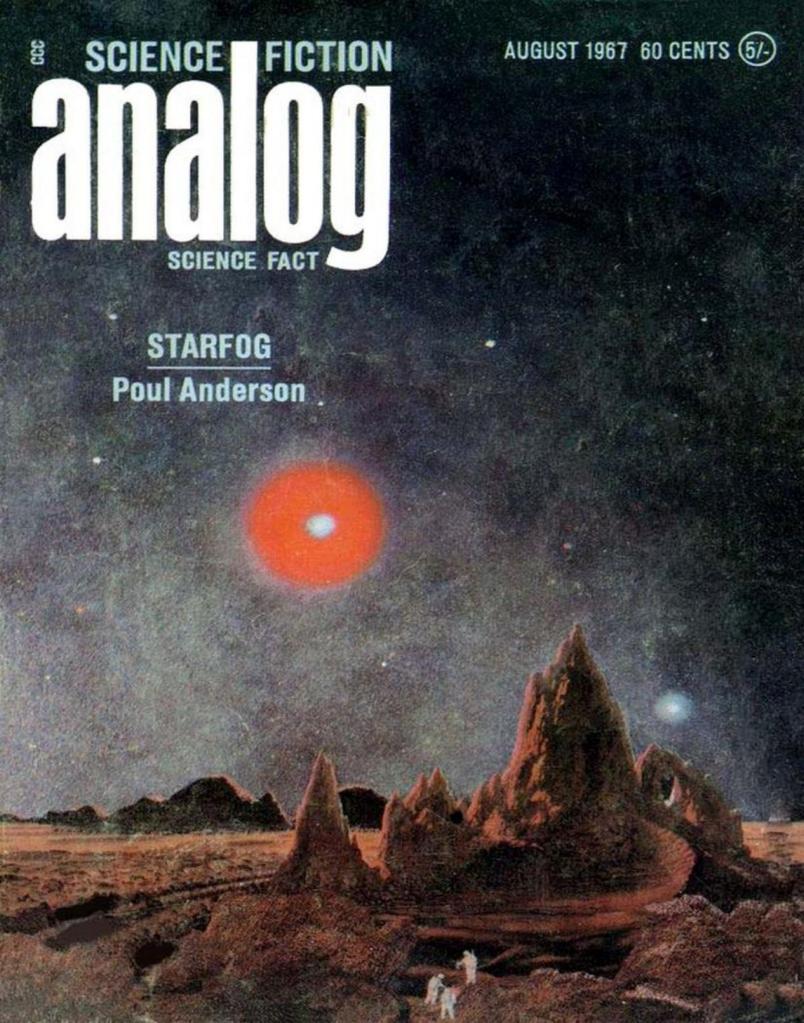
Has anyone read the Technic Civilization books by Poul Anderson? Yesterday, I was testing out a program to view old pulp magazines on my Mac and I randomly picked the August 1967 issue of Analog. It had a cover story for “Starfog” by Poul Anderson. I started reading it. I’ve only read a handful of Anderson’s novels and short stories and always avoided his book series. I avoid series books in general. I started reading “Starfog” and decided it was exactly something I’ve always avoided, so maybe it will be different.
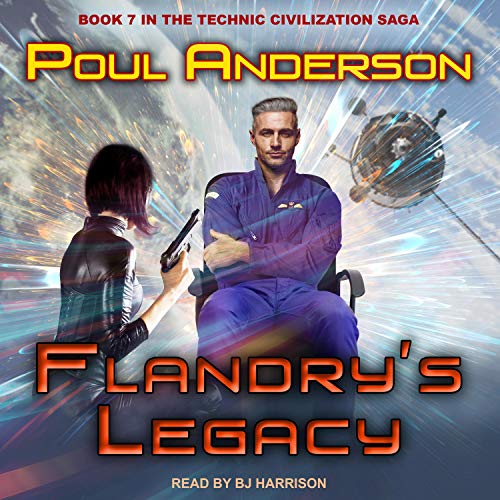
But I wanted to hear the story. After some research on ISFDB.org, I discovered “Starfog” was included in Flandry’s Legacy, Book 7, the last volume of the Technic Civilization series. I only had three Audible credits left, but what the heck, I decided to give it a try. “Starfog” is a novella, but Book 7 includes three novels, three novellas, and one novelette of stories in the series. This could be a tremendous bargain if I like the series.
I’ll let you know what I think — hopefully soon. The other inspiration I had to find something different came from a YouTube video. Bookpilled had a moving account of discovering the books of Barry Malzberg just before he died. I have read a couple of Malzberg books and they were so-so. But he was very prolific and Bookpilled has convinced me I should give Malzberg another try. So I’m reading about his novels. I did have a few emails from Barry, and he recommended his horse racing novels and a couple science fiction novels. I’ve always found Barry’s books about science fiction more interesting. He was a sharp-tongue critic.
Maybe between Anderson and Malzberg, I’ll get back into science fiction. But things might be slow around here for a while. To be honest, I think the real world has gotten more science fictional than science fiction.
If you’ve read a science fiction story you feel is radically different from any science fiction you’ve read before, leave a comment below.
I imprinted on science fiction in the early 1960s. At that time, I considered science fiction to be PR for the space program. I fell in love with science fiction concurrently with Project Mercury and Project Gemini. I mostly read books by Robert A. Heinlein for the first few years, so colonizing the solar system seemed like humanity’s true purpose to me.
In 1968, I discovered Do Androids Dream of Electric Sheep? by Philip K. Dick on the new book shelf at the Coconut Grove Library in Miami, Florida. His science fiction wasn’t about promoting space exploration. By then I had discovered the counter-culture, and PKD made a different kind of sense.
I started college in 1969, but in the fall of 1970, I dropped out because the university I was attending required ROTC, which I was willing to take, but the ROTC insisted I cut my hair, which I wasn’t willing to do. In 1971 I switched to a two-year technical school to study computers.
I was uncertain about my future and the future in general. My indecision led to reading 479 science fiction paperbacks in 1971 and 1972. That was another kind of education. I made friends at the local science fiction club and started publishing fanzines and going to cons. However, by the end of 1975, I was tired of science fiction and gafiated from fandom.
I just finished reading Eye in the Sky, an early novel by Philip K. Dick that was first published in 1957 as a cheap ACE paperback. It was vaguely familiar, and when that happens I assume it’s because it was one of those SF novels I read back in 1971-1972. Back then I consumed SF paperbacks like a stoner eating a bag of chocolate chip cookies. Each book was a momentary distraction from my confused life of not wanting to grow up. Each book provided escapism until I finished it and started the next one.
I spend more time thinking about what I read at seventy-three. Also, my world is very different than it was fifty years ago. In some ways, I’m no different, I’m still trying to figure out what I’m supposed to do with my life, but it is different because the perspective of the future at 23 and 73 is drastically different. I’ve thought a lot more about Eye in the Sky this time.
In the 1970s, I judged science fiction on how well it speculated on the near future, especially regarding space exploration and technology. I thought Philip K. Dick was so poor at this that I didn’t consider him a real science fiction writer. I classified him with Ray Bradbury and Kurt Vonnegut.
In the 2020s, I value Philip K. Dick for insights I never could have imagined back in the 1970s. Eye in the Sky asks us to imagine reality being shaped by subjectivity. In the story, eight people are involved in an accident. When they come to, the world is similar, but religion works instead of science. Eventually, they discover that the world is controlled by the thoughts of one of the eight. When the person controlling reality dies, they find themselves in another world but shaped by the mental perspective of another member of the eight.
This setup gives Dick a chance to explore the idea of subjective reality. What amazed me in this reading, is Dick covers all the themes in this early novel that he would later explore in all his other novels. I’ve always divided PKD’s books into three periods. The 1950s and early 1960s, the 1960s, and the 1970s novels. For example, Dick’s Valis novels of the 1970s explore Gnosticism. Well, Dick might not have known about Gnosticism in 1957, but Eye in the Sky reflects its ideas. Eye in the Sky also anticipates his paranoid reality-bending novels of the 1960s.
On the whole, I enjoyed Eye in the Sky, but it’s not without flaws. The story seems to promise eight stories about eight different realities because of the eight characters involved, but we only get to visit four realities. PKD skipped out on the four perspectives I wanted to see the most. We’re shown the realities of Arthur Sylvester, Joan Reiss, Edith Pritchet, and Charlie McFeyffe.
Our protagonist is Jack Hamilton. We never get his take on reality. But since he’s the main character should we assume the overall story is told from his perspective? It would have been fun to see how his subjective perspective differed from the external reality. I also wanted to see Marsha Hamilton’s reality, Jack’s wife. And most of all, I wanted to see Bill Laws’s reality because he’s African American and a Ph.D. student in physics. Black characters were rare in 1950s science fiction. And it would have been interesting to see David Pritchett’s reality since he was a young teen.
The reason why Eye in the Sky is so much better in my seventies is I see that reality is fought over by many different subjective perspectives in the 2020s. We were just as politically polarized back in the 1970s, but I was young and less aware of how other people thought. Back then I thought everyone was basically the same but with slightly different ideas about reality. Now, I realize that the umwelt of everyone is quite different.
Both then and now, I believe there is an external reality. I’m not one of those woo-woo people who think reality is unreal. I could be wrong, but I’m betting on an external reality and people are crazy. I really don’t want reality to be crazy. I do believe our view of reality is subjective. That we can never perceive the fullness of the external order.
Philip K. Dick in Eye in the Sky imagines reality is mutable, shaped by minds. I hope this doesn’t give anything away, but the eight characters do return to the reality they were in before the accident. Is that PKD affirming my idea that we live in an external reality that is universal? PKD wrote over forty more novels and over a hundred short stories that keep suggesting otherwise. At the end of his life, Dick seemed to believe in a gnostic view of reality, where we lived in a reality created by an evil god, and there’s a higher reality beyond this one, maybe ruled by a kinder diety.
Strangely, in my seventies, I find stories by Philip K. Dick to be comfort reads. His stories are compelling, told with prose that has the right mixture of dialog and detail for a pleasant reading pace. I find it interesting how his characters bash around in reality, struggling to find meaning.
Back in 1970 when I dropped out of the university, my father had died that May, the draft was looming over me, and my mother was nagging me to go to work if I wasn’t going to go to school. I was living in a new city and had no friends. Each science fiction book I read was an escape into a different reality.
Of course, reading science fiction in my seventies might be about trying to escape another reality, of getting old and dying.
Looking back I wonder what life would have been like if I hadn’t gotten addicted to science fiction. I could have cut my hair, finished a four-year degree in physics and astronomy (my childhood fantasy), and joined the Air Force as an officer (my father’s fantasy). Or I could have kept my hair and focused on computers and gotten a job at a Unix site with other long-haired computer geeks. Instead, I read science fiction and fantasized about going to Mars, which was just as crazy as the folks in Eye in the Sky.
Of course, thinking about what could have been, or could be, leads to the madness of PKD.
Science fiction writers can’t predict the future but some aim to speculate on times to come by extrapolating current trends. One of the most famous SF novels to do this was Stand on Zanzibar by John Brunner, his 1968 novel that anticipated the world of 2010. Bruce Sterling’s 1996 novel Holy Fire tries to imagine life in 2096 via speculation and extrapolation. Do I recommend it? That’s hard to say, even at the current Kindle price of $1.99.
How self-aware are you regarding the selection of the science fiction you read? Does your mind crave a tightly plotted story? If so, Holy Fire by Bruce Sterling might not be for you. Or do you love reading novels with characters you care about, even identify with, and want to vicariously live their fictional adventures? Again, Holy Fire might not be your cup of tea. If you are the kind of science fiction reader who resonates with dense science fiction speculation, reading Holy Fire should definitely be for you.
We judge such speculative fiction in two ways. Does it jive with our own efforts to imagine the future, and now that the novel is almost thirty years old, how well has it done so far? Evidently, back in 1996, Sterling saw that medical technology, changing trends in family size, and population demographics would lead to a world where there were far more old people than young people. The exact opposite of the Baby Boom generation I grew up with. All the current 2024 demographics point to such a future.
Sterling solved the overpopulation problem that many science fiction writers before him saw by having a great pandemic in the 2020s. And he imagined that networks, artificial reality, and artificial intelligence would reshape society. Instead of predicting gloom and doom like so many science fiction novels from the late 20th century, Sterling imagines a near-liberal utopia and a post-scarcity society. The problems faced by the characters in this novel divide between the old and young. The old strive to find purpose with an ever-lengthening lifespan, while the young feel crushed under the weight of a gerontocracy that advises the youth to learn from their experience and live longer.
Because humans have been trying out medical life-extension procedures for decades, a growing percentage of the population is old. These elders have the wealth and power and dominate politics with their gerontocracy. Mia Ziemann, Holy Fire’s protagonist, is 94 at the start. Because she has led such a cautious life and is in such good shape, the medical establishment offers her the latest life extension treatment, one that goes way beyond any previous effort. The procedure is so arduous, that it can be fatal. Mia comes through the process and now looks 20, although some of her memories are gone.
Mia’s doctors consider her an expensive experiment and legally bind her to them for years of research. Mia runs away to Europe and hides as an illegal alien, living among a youthful bohemian crowd of revolutionaries. She changes her name to Maya. On nearly every page of Holy Fire, Sterling speculates about the future evolution of society, technology, and politics. Strangely, climate change is never brought up. But then, Holy Fire came out a decade before An Inconvenient Truth.
Sterling doesn’t focus on space flight, but it happened. The focus of the story is finding meaning in everyday living on Earth. Dogs and other animals have been uplifted, and talk with computer-aided voices. Governments take care of the needy. People use public transportation. People engineer their minds with designer hormones and neural transmitters. And the net and virtual reality is everywhere. Holy Fire makes me think that Bruce Sterling had abundant optimism for the future in the 1990s. I used to have such liberal optimism but it was crushed in 2016.
Sterling’s future is not quite a utopia, because segments of the population are discontented, especially the young who are too brilliant for their own good. That’s the crowd Mia/Maya, embraces. They want the freedom to fail.
Sterling calls Mia/Maya and others in this book posthumans, and that’s where this story shines. His posthumans aren’t silly comic-book superheroes like in many 21st-century SF books. Virtual reality is toned down too from 21st-century SF stories of people downloading themselves into virtual realities. Sterling tries to stay reasonably realistic and scientific. Holy Fire reminds me of the dense speculation in John Brunner’s Stand on Zanzibar. Sterling doesn’t take it to narrative gonzo extremes like Brunner.
Holy Fire is a somewhat picaresque novel, with one reviewer comparing it to Candide. Of course, Candide is considered a broad satire, and I’m not sure that’s true of Holy Fire. I didn’t read it that way, but I could see how a filmmaker could present Holy Fire as a satire. The novel attempts to be transcendental, you might have guessed that from the title. The youth rebellion in Sterling’s 2090s is like the 1960s involving art, music, drugs, and mind-expansion — adding networking, AI, and AR.
The problem with picaresque novels is they are episodic. The hero is exposed to a series of people and subcultures, and that’s what happens to Mia/Maya. There are so many different characters it’s hard to keep up with them or even care about them. Most of the story is about how they impact Mia/Maya, whereas I believe a novel about a 94-year-old woman becoming 20 again should be about her inner transformations.
Mia is an uptight old lady who protects herself by hiding from life, and Maya is a free-spirit young woman giving everything a try and throwing all caution to the wind. We are told that Mia lost some of her memories, but would she lose all wisdom from living to 94?
Response to Holy Fire is all over the place. Hundreds at Goodreads gave it five stars, a few more hundred gave it four stars, but plenty of folks just didn’t care for the story.
Reviews were also mixed. Tom Easton in “The Reference Library” for the March 1997 issue of Analog has this to say:
Norman Spinrad’s “On Books” from the August 1997 issue of Asimov’s Science Fiction also compares Holy Fire to William Gibson’s Idoru but comes to a different conclusion. Both novels are later cyberpunk works from the two leading founders of the cyberpunk movement, so it was logical to review them together. Spinrad is the more insightful of the two reviewers.
That Damien Broderick and Paul Di Filippo would recommend Holy Fire as one of the best SF novels from 1985-2010 is high praise. But why don’t I hear more about this novel after all these years? My assumption, is most science fiction readers don’t particularly care for serious speculation about the future and would prefer to read stories that compel you to turn the pages because of tight plots and characters they care about.
This is my second reading of Holy Fire. I first read it when it came out from the Science Fiction Book Club. I bought it then because its plot sounded similar to a 1926 novel I was trying to find, Phoenix by Lady Dorothy Mills. That book was also about an old woman undergoing a rejuvenation process and then running off to Europe to join a bohemian crowd. I finally found Phoenix several years ago and it’s more of a love story than science fiction. I need to reread it and compare the two.
For my second reading, I listened to it on audio. I’ve started rereading it again with my eyes. I never developed an emotional bond with Holy Fire like I have with the novels I consider my favorites. However, I admire it intellectually. It could have had the emotional impact of Flowers for Algernon because Mia/Maya goes through a similar arc of intellectual development. We just don’t see her experiences as tragic.
I think Sterling tried though. Throughout the novel, Mia/Maya experiences epiphanies that should have had a deep emotional impact. To me, they were just intellectually interesting. The ending should have been profoundly spiritual, like something from Hermann Hesse. Instead, it just seemed like a logical way to end the story. The choices Mia/Maya and her former husband, Daniel made in the end are vivid, even dramatic in concept. That just didn’t make an emotional impact on me. I assume Bruce Sterling wanted the ending to be an emotional epiphany. The ending does say a lot about how a posthuman would react to becoming posthuman.
Please leave a comment if you’ve read Holy Fire. I’m curious if you had an emotional response to the story. I found it intellectually exciting. I would recommend it on that level. However, it didn’t touch me, so I’m hesitant to say it’s good. I gave it four stars on Goodreads.