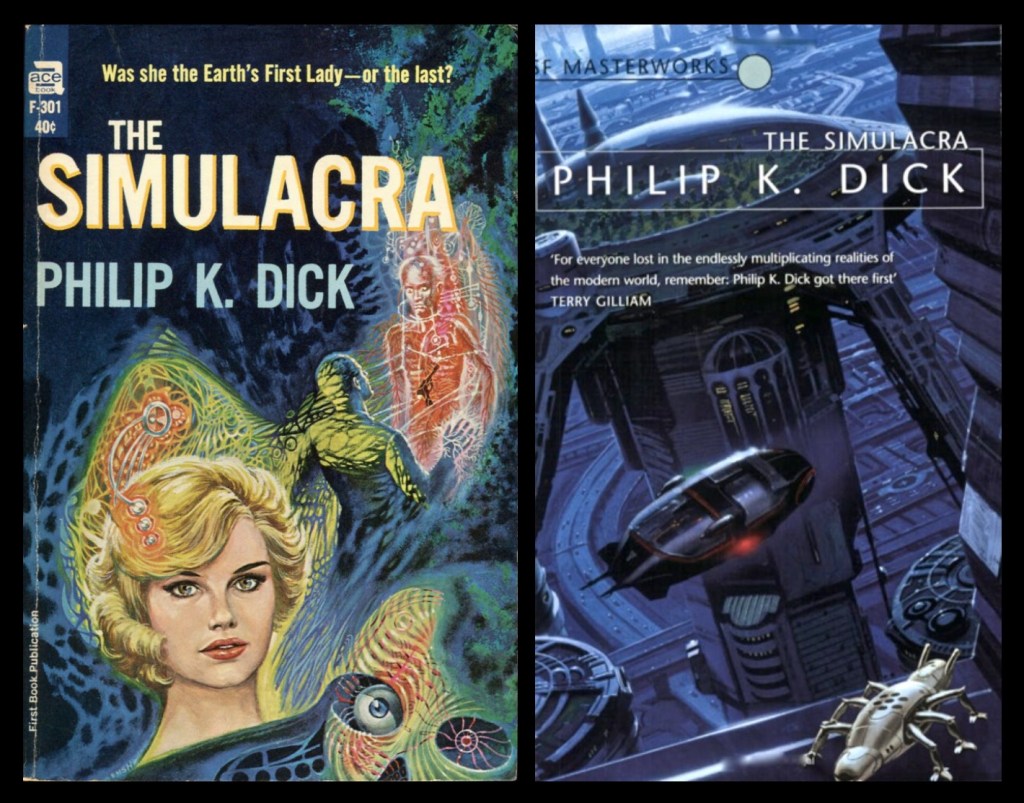
The Simulacra by Philip K. Dick

How do literary scholars of Philip K. Dick’s fiction determine which of his novels are masterpieces and which are his hackwork? They all seem equally bizarre, and even confusing. Library of America selected four novels for their first volume in 2007 devoted to PKD. The years given are when they were (written, published).

  • The Man in the High Castle (1961,1962)
  • The Three Stigmata of Palmer Eldritch (1964,1965)
  • Do Androids Dream of Electric Sheep? (1966, 1968)
  • Ubik (1966, 1969)

The second volume came out in 2008 recognized:

  • The Martian Time-Slip (1962, 1964)
  • Dr. Bloodmoney (1963, 1965)
  • Now Wait for Last Year (1963, 1966)
  • Flow My Tears, the Policeman Said (1970, 1974)
  • A Scanner Darkly (1973, 1977)

The third volume in 2009 highlighted:

  • A Maze of Death (1968, 1970)
  • VALIS (1978, 1981)
  • The Divine Invasion (1980, 1981)
  • The Transmigration of Timothy Archer (1981, 1982)

Are we to assume these are Dick’s best novels? My personal favorite, Confessions of a Crap Artist wasn’t included. Neither was The Simulacra which I just read and found fascinating and fun. I think some of the Library of America selections are better than The Simulacra, such as The Man in the High Castle, The Martian Time-Slip, and VALIS, but I’d also claim The Simulacra is not a lesser novel to the others. However, using our citation database system, it gets only one citation. Twelve of the twenty-seven PKD novels in our database only got one citation. The novels in the first LOA volume received 9 to 32 citations, which supports the LOA editors.

The only reason The Simulacra received one citation is because it was part of the SF Masterworks series. All the science fiction magazine reviewers ignored it when it came out. As far as I can tell, none of the reprint editions got reviewed either. The Simulacra just isn’t well-known. It’s often disliked when I see it mentioned.

I liked it. And I want to make a case that it’s worth reading. However, it will be hard to even describe. I’m afraid most readers will be turned off by The Simulacra because it has multiple plot lines with over a dozen main characters. And I can imagine many readers calling it stupid too — but that could be true for a lot of readers coming to PKD work. However, if two of the five novels Dick wrote in 1963 made it into the Library of America, why shouldn’t the other three? What divides them? What makes one novel “good” and another “bad?”

The Simulacra‘s complexity might keep readers from liking it, but that complexity might hide many novelistic virtues. Just because I admired this novel, doesn’t mean others will. I’m writing this essay hoping people will read The Simulacra and give me their opinion. I’m curious if I’m a total outlier. I got a big kick out of the story.

According to Samuel Johnson, “No man but a blockhead ever wrote, except for money.” Dick complained in several 1963 letters found in The Selected Letters of Philip K. Dick: Volume One: 1938-1971, that his wife Anne constantly hounded him to make more money. On the other hand, Dick wrote eleven literary (non-genre) novels from 1952-1960 hoping to become a recognized mainstream writer. All were rejected. He then wrote The Man in the High Castle in 1961 which bridges the literary and science fiction world and won a Hugo award for best novel. Dick then wrote twenty-one science fiction novels from 1962 to 1969, five of them in 1963 alone. He obviously needed money and had to crank out the manuscripts.

After 1970, Dick only published six more novels before he died in 1982. Five of which are included in the Library of America editions. That suggests that the novels he took more time writing fared better with the critics. So, the five novels written in 1963 were among the fastest he wrote, suggesting they shouldn’t be as good. Yet, two were selected for the Library of America.

As much as I like The Simulacra, I do see that it’s flawed. It doesn’t have a main character which most readers prefer. Nor does it jump back and forth between two main characters, which can be quite successful with some readers. And it’s not even one of those experimental stories where we follow several unrelated characters that all come together in the end. Readers find that structure confusing but forgive it if the ending brings everyone together in a satisfying way. I’m not sure The Simulacra wraps up nicely.

We might call the plotting of The Simulacra an example of characters doing parallel play. Dick might have aimed for creating a collage of future American scenes. My guess is Dick banged away on his typewriter, vomiting up The Simulacra onto typing paper. The results are fascinating because the novel is one big pile of imagery from PKD unconscious mind — and what a mind! It begs to be psychoanalyzed. And I’m sure, it parallels his personal life, especially regarding insanity, psychoanalysis, and troubling wives and women.

The Simulacra is not satire even though it often feels like the film Dr. Strangelove, nor is it a fantasy even though everything is unbelievable. And I wouldn’t call it surreal or dreamlike, or avant-garde even though it was written in 1963 when trendy artists were creating pop art and post-modern fiction. It’s straight science fiction, meant to be taken as realistic, even though it’s bonkers. The Simulacra has the existential absurd horror of The Tin Drum or The Painted Bird. I don’t even think Dick was making fun of science fiction with its comic book level wild ideas. Dick had crazy ideas, and he saw the world being just as crazy.

The Simulacra pictures future America where psychic abilities are accepted as real, that time travel has been perfected, where people and animals can be artificially created and the results indistinguishable from real people and animals, that colonies exist on Mars and the Moon, and alien lifeforms can be commercialized. In other words, all the crap ideas that science fiction fans and fans of the occult believed in the 1950s. Everything they thought possible, became possible.

The hardest part of this essay is describing what happens in The Simulacra. I wrote about that trouble already for my Auxiliary Memory blog, where I explained I had to read the book and listen to the audiobook to get the most out of The Simulacra. In fact, I’m still picking up the book, or putting on the audiobook, and enjoying random parts of the novel. I can’t seem to leave this story. I’m still finding new insights into whatever scene I stumble upon. I’ve decided the best way to describe the story is by mind mapping the characters. The number given is the number of times the character is mentioned in the story.
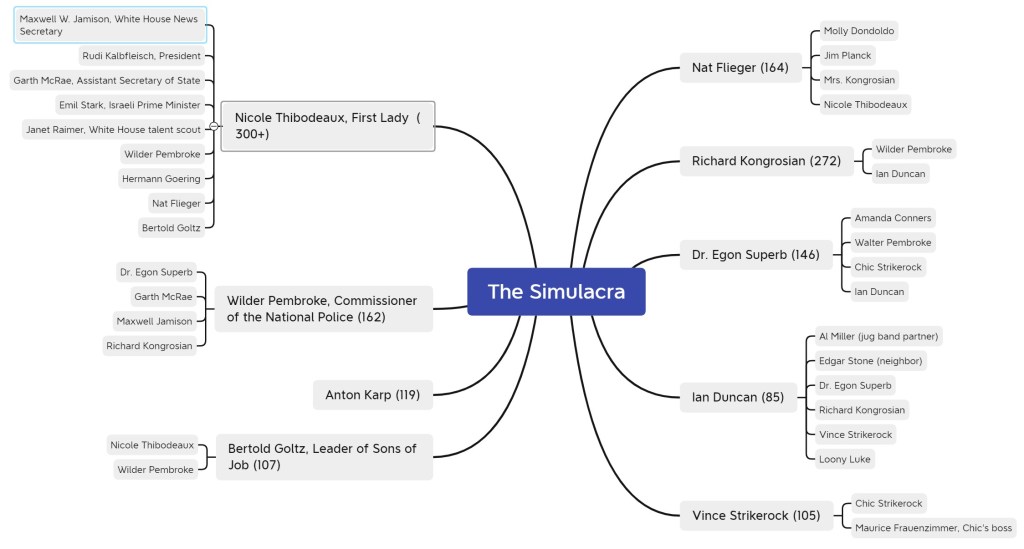
I’m trying not to give away too much of the plot. Each of the first level characters involves a subplot. For example, Dr. Egon Superb is the last legally practicing psychiatrist after the pharmaceutical industry pushed through the McPhearson Act that made drug therapy the only legal form of treatment for mental illness. One of his patients is Richard Kongrosian, a psychic pianist who uses telekinesis to play the piano instead of using his hands. Nat Flieger is a sound engineer who wants to record Kongrosian, but he and his crew of Molly Dondoldo and Jim Planck can never track down the man. Ian Duncan and his old friend Al Miller want to perform classical music as a jug band at the White House for Nicole Thibodeaux. Nicole Thibodeaux, the First Lady, but maybe the true ruler of The United States of Europe and America (USEA) wants to negotiate with Hermann Goering via a time machine to get the Nazis to not kill the Jews. Vince and Chic get involve with making the next president, an android, which will replace Nicole’s current husband. Wilder Pembroke, Anton Karp, and Bertold Goltz all vie for power behind the scenes.

If the novel has a main character, it could be Nicole Thibodeaux. Dick’s original draft was called The First Lady of Earth. Since this book was written in the summer of 1963, I assume Dick was inspired by Jackie Kennedy because Nicole spends most of her time charming people, decorating the White House and gardens, and putting on nightly cultural events. Everyone loves Nicole. Yet, out of the public eye, Nicole is also ruthless enough to have people summarily executed. Evidently, she wields unlimited power because of her access to time travel.

The novel is set in a post-apocalyptic future, decades after China attacked the U.S. with missiles with atomic warheads. This gave rise to a population of mutants, similar in appearance to Neanderthals. People ride in self-driving cars. Ads are living creatures that can invade your home and car and must be killed. Richard Kongrosian believes he has a terrible body odor because a deodorant ad infected him with a jingle. The Sons of Job are a neo-fascist political party. People live in giant communal apartment complexes and are required to take civics tests to stay in them. Many people want to escape this totalitarian society by immigrating to Mars. People buy android nuclear families just to have normal friends.

I could go on. There are several layers of political and corporate intrigue in The Simulacra. Dick evidently thought there were conspiracies everywhere. Later in life, Dick would get into Gnostic religion, which is a very paranoid belief system. This novel has many traits of Gnosticism. The Simulacra was written after The Man in the High Castle, We Can Build You, Dr. Bloodmoney, and The Martian Time-Slip, and before The Three Stigmata of Palmer Eldritch and Do Androids Dream of Electric Sheep? There are many similar themes and obsessive ideas that run through all of them. I wish I had the time and energy to study all those novels and plot all the connections. Why did PKD fixate on certain ideas repeatedly? Was it a lack of imagination to explore unfamiliar territory, or were they ideas PKD just could let go of?

James Wallace Harris, 1/5/24

Has Science Fiction Left Me Behind?

The above books were the finalists for the 2023 Hugo Awards. I have not read any of them. Nor do they look interesting to me. Each year the Hugo and Nebula award finalists seem further and further away from what I want to read.

The other day I went into a new bookstore for the first time in many months. I went up and down the aisles of the science fiction section and I was shocked by how many books were by authors that were unknown to me.

I turn seventy-two next month and I wonder if I’ve gotten too old for science fiction. Or, has the genre left me in the dust? I can accept that I might be too old to keep up. Could the genre have changed, and I’ve just lost interest? Who knows?

In the 20th century I’m sure I read at least a thousand science fiction books, probably many more. Here’s a list of the 69 SF&F books I’ve read in the 21st century:

  • 2000 – Harry Potter and the Goblet of Fire by J. K. Rowling (Hugo winner)
  • 2000 – Calculating God by Robert J. Sawyer (Hugo finalist)
  • 2001 – American Gods by Neil Gaiman (Hugo winner)
  • 2001 – Perdido Street Station by China Miéville (Hugo finalist)
  • 2002 – Altered Carbon by Richard K. Morgan
  • 2003 – The Time Traveler’s Wife by Audrey Niffenegger
  • 2004 – Cloud Atlas by David Mitchell
  • 2004 – Jonathan Strange & Mr. Norrell by Susanna Clarke (Hugo winner)
  • 2004 – The Plot Against America by Philip Roth
  • 2005 – Spin by Robert Charles Wilson (Hugo winner)
  • 2005 – Old Man’s War by John Scalzi (Hugo finalist)
  • 2005 – Never Let Me Go by Kazuo Ishiguro
  • 2006 – The Road by Cormac McCarthy
  • 2006 – Life As We Knew It by Susan Beth Pfeffer
  • 2007 – The Yiddish Policeman’s Union by Michael Chabon (Hugo winner)
  • 2008 – The Hunger Games by Suzanne Collins
  • 2008 – Little Brother by Cory Doctorow (Hugo finalist)
  • 2008 – Flood by Stephen Baxter
  • 2008 – Marsbound by Joe Haldeman
  • 2009 – The City & The City by China Miéville (Hugo winner)
  • 2009 – The Windup Girl by Paolo Bacigalupi (Hugo finalist)
  • 2009 – Boneshaker by Cherie Priest (Hugo finalist)
  • 2009 – Julian Comstock by Robert Charles Wilson (Hugo finalist)
  • 2009 – Catching Fire by Suzanne Collins
  • 2009 – Wake by Robert J. Sawyer
  • 2010 – Feed by Mira Grant (Hugo finalist)
  • 2010 – Mockingjay by Suzanne Collins
  • 2010 – Watch by Robert J. Sawyer
  • 2010 – Hull Zero Three by Greg Bear
  • 2011 – Among Others by Jo Walton (Hugo winner)
  • 2011 – Leviathan Wakes by James S. A. Corey (Hugo finalist)
  • 2011 – The Martian by Andy Weir
  • 2011 – Ready Player One by Ernest Cline
  • 2011 – Wonder by Robert J. Sawyer
  • 2012 – Redshirts by John Scalzi (Hugo winner)
  • 2012 – 2312 by Kim Stanley Robinson (Hugo finalist)
  • 2012 – The Dog Stars by Peter Heller
  • 2012 – The Age of Miracles by Karen Thompson Walker
  • 2012 – vN by Madeline Ashby
  • 2014 – The Three Body Problem by Cixin Liu (Hugo winner)
  • 2014 – Annihilation by Jeff VanderMeer
  • 2014 – Station Eleven by Emily St. John Mandel
  • 2014 – The Girl with All the Gifts by M. R. Carey
  • 2014 – The Book of the Unnamed Midwife by Meg Elison
  • 2014 – Yesterday’s Kin by Nancy Kress
  • 2015 – Seveneves by Neal Stephenson (Hugo finalist)
  • 2015 – Children of Time by Adrian Tchaikovsky
  • 2015 – Binti by Nnedi Okorafor
  • 2015 – Aurora by Kim Stanley Robinson
  • 2015 – The Water Knife by Paolo Bacigalupi
  • 2016 – All the Birds in the Sky by Charlie Jane Anders (Hugo finalist)
  • 2017 – New York 2140 by Kim Stanley Robinson (Hugo finalist)
  • 2017 – All Systems Red by Martha Wells
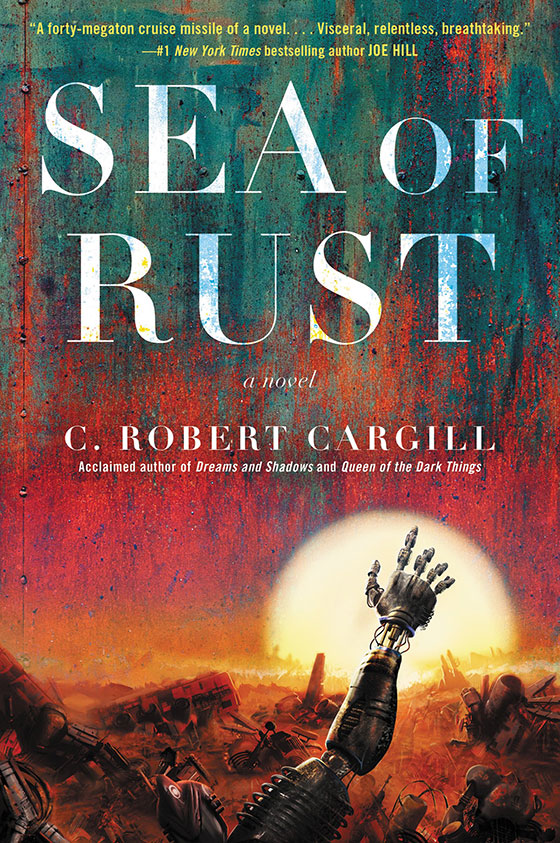
  • 2017 – Sea of Rust by C. Robert Cargill
  • 2017 – Under the Pendulum Sun by Jeanette Ng
  • 2017 – Noumenon – Marina J. Lostetter
  • 2018 – The Calculating Stars by Mary Robinette Kowal (Hugo winner)
  • 2018 – Semiosis by Sue Burke
  • 2018 – The Fated Sky by Mary Robinette Kowal
  • 2018 – The Feed by Nick Clark Windo
  • 2019 – Children of Ruin by Adrian Tchaikovsky
  • 2019 – Machines Like Me by Ian McEwan
  • 2020 – The Ministry for the Future by Kim Stanley Robinson
  • 2020 – The Midnight Library by Matt Haig
  • 2021 – Project Hail Mary by Andy Weir (Hugo finalist)
  • 2021 – Klara and the Sun by Kazuo Ishiguro
  • 2022 – Babel by R. F. Kuang
  • 2022 – The Mountain in the Sea by Ray Nayler
  • 2022 – Sea of Tranquility

That’s an average of 2.8 SF&F books a year. Assuming I read a thousand SF books from 1963-1999, means I averaged 27.78 SF books a year. I think I could have easily read 1,500 SF books, or 41.67 SF books a year. In other words, I don’t read SF like I used to. And my 21st century list includes quite a few fantasies. I rarely read fantasy in the 20th century. I really don’t like fantasy books. I only read them when they reach a certain pop culture status.

One reason for the shift is I read more literary works and nonfiction books. Another reason is after reading thousands of science fiction books, I seldom read reviews of new science fiction books that sound different enough to be appealing.

I used to keep up with the genre by belonging to the Science Fiction Book Club, which offered two new titles a month. I subscribed to several science fiction magazines and fanzines that reviewed new books. And I would visit one or two new bookstores a week.

Fanzines disappeared, and I stopped having time for the prozines even though I still subscribed. After Amazon and Audible, I stopped shopping in new bookstores, and they eventually disappeared. Back in the 1970s I went to conventions and even published fanzines. In the 1980s I ran a BBS devoted to science fiction. Since the 1990s I’ve run websites and databases devoted to SF. Once upon a time all my friends were SF readers. But active participation in fandom ended when I got married and settled down to work in 1978. I became a different person socially.

Since 2002, I’ve been rereading the science fiction I first read in the 20th century by listening to audiobook editions from Audible.com. It’s a kind of nostalgic trip. I also caught up on a lot of 20th century science fiction I missed. That also kept me from reading many new SF books.

But in all honesty, I prefer old science fiction to new science fiction. There’s been some great exceptions, but I think that’s the real reason I’ve let the genre pass me by.

I wish the Science Fiction Writers of America never embraced fantasy. I wish the Hugo Awards had focused exclusively on science fiction. Fantasy should have their own fan-based award. I can’t help but wonder if the science fiction genre would be more vibrant today if it hadn’t been married to the fantasy genre. Even books marketed as science fiction often feel like fantasies. Looking back, I would have preferred a smaller, focused SF genre, one I could have kept up with.

Science fiction used to have some realism, or at least some speculative integrity. Now, any old wild idea works. Science fiction used to be inspired from reality, now new writers are inspired mostly by science fiction movies. It’s as if all science fiction is recursive science fiction.

Who knows, maybe I left science fiction behind.

James Wallace Harris, 10/22/23

Sea of Rust by C. Robert Cargill

I’ve been craving a new science fiction novel, at least something less than ten years old. I admit, I’ve been stuck in mid-20th century science fiction, and I’m mostly out of touch with 21st century science fiction. I have read forty or more science fiction novels that were published after 2000 — the more famous ones — but there’s been thousands of science fiction novels published since then. I’m feeling out of touch with current science fiction. I keep hoping to find a new science fiction novel that will dazzle me like the science fiction novels I discovered as a kid in the 1960s. I’m beginning to feel that won’t ever happen again.

Sea of Rust as Sci-Fi

Sea of Rust by C. Robert Cargill came out in 2017. I picked it to read because I watched a couple YouTubers review it positively, and because it’s about robots after humans have gone extinct. I love that concept. It’s slowly growing into a mini-sub-genre. One of the earliest stories on this theme is “Rust” by Joseph E. Kelleam from 1939. (See my short review.) Another is “Who Can Replace a Man?” by Brian W. Aldiss from 1958. Of course, the real classic is City by Clifford D. Simak, but the theme is only used in the fictional intros that tie stories together. Those intros describe a world without men occupied by robots and intelligent dogs. There’s also “Three Robots” an episode in the Netflix series Love, Death + Robots based on a John Scalzi short story, and the more famous film, Wall-E. And Rudy Rucker’s Ware Tetralogy eventually gets into this theme too. There are many more.

Sea of Rust is a fun adventure story about a cadre of armed robots helping a robot, Rebekah, on an important mission to save free robots from an OWI (One World Intelligence – think Borg for bots). Their destination is in a wasteland called Sea of Rust, formally, the American Rust Belt. That’s the territory were crazy robots go, and where poachers go to kill the crazy robots and harvest their parts. Sea of Rust feels a bit like a Mad Max film, but instead of people surviving a harsh desert post-apocalyptic environment, it’s robots. It especially reminded me of Mad Max Fury Road, only because it becomes an endless race of good guys being chased by bad guys.

The main POV character is Brittle, who started out as a caregiver robot for humans, but after their extinction, becomes harden, surviving by killing other robots for their parts. Her nemesis is Mercer, another caregiving robot who is also a poacher. They want to kill each other to survive. When the OWI, CISSUS, attacks a holdout for free individualistic robots, these two joins up with Rebekah, 19, Herbert, One, Two, Doc, and Murka. At first Brittle goes along to survive another day, but eventually believes in Rebekah’s mission too.

Sea of Rust also feels like a western, with parallels to The Magnificent Seven, because of a group of diverse misfits, some of which aren’t so nice, work together for a noble cause. Each has their weapon of choice. Sea of Rust also remind me of many war movies where a squad of soldiers are on a suicide mission, and one by one get killed off.

I recommend Sea of Rust to readers who like action-oriented science fiction like what they see on television or at the theater. It’s fun. It’s nowhere near as fun as We Are Legion (We Are Bob) by Dennie E. Taylor or Hail Mary by Andy Weir. But it’s like them in that Sea of Rust is breezy and entertaining.

When I ask myself why We Are Legion (We Are Bob) and Hail Mary are better books, it’s because I admire their main characters, and envy their skills. They are positive. Brittle is a mass murderer of humans, and robot con artist and murderer. It’s strange how much modern fiction features heroic bad guys.

— Beyond Here Lie Spoilers —

Don’t read beyond here because I’ve going to be critical of Sea of Rust, but most of my criticism doesn’t apply to the average science fiction reader, especially those who only read for fun and don’t want to get overly analytical. It might seem like I’m attacking Sea of Rust but I’m using it as an example, to explain the kind of science fiction I want to read.

Sea of Rust as Speculative Fiction

I like science fiction that speculates about real possibilities. Very few science fiction novels do this. Most science fiction takes a fun theme and produces a new variation. Sea of Rust is about robots, but the robots in science fiction aren’t like the robots we see in the real world. Nor are fictional robots anything like what current robots will evolve into. I find that disappointing.

In Sea of Rust all the robots act like humans wearing robot suits. There is some minor speculation, but science in the novel seemed inspired by the average PC user, and not computer scientists. The technical terminology doesn’t go beyond CPU, RAM, memory, hard drive, and core. It’s just a fun story, a light-hearted thriller with lots of guns, and gun battles. Similar visually to what people see in video games.

All the robots in this story have human qualities, and that’s my main critical issue. I’m disappointed that science fiction writers don’t or can’t imagine robots with non-human qualities. I can’t think of any robot story where the robot isn’t anthropomorphized. Is that some kind of barrier writers just can’t break through?

The idea of intelligent robots existing after humans is extremely fascinating. What kind of civilization would they build? I can’t believe it would be a cliche Mad Max post-apocalypse. I doubt robots will ever have gender or even be able to comprehend it. I doubt robots will have emotions or be able to comprehend them. None of the experiences we get from being biological creatures will be understandable by AI minds.

I’m waiting for science fiction writers to imagine states of mind that robots will evolve. I’m waiting for science fiction writers to speculate how robots will think differently from us. Sure, this will be hard, as hard as humans imagining the umwelt of octopuses.

Now that I’m an old science fiction fan, I’m beginning to see the limits of what science fiction can achieve. What I want probably needs to come from speculative nonfiction, and not speculative fiction.

My other major problem with Sea of Rust is its use of guns. We live in a culture that has a lust for guns. It’s a kind of pornography. But the use of guns in fiction is a kind of crutch, at least to me. Too much fiction is based on gun violence. Too much plotting and plot motivation centers around gunplay.

Conflict is vital to fiction, but too many writers depend on gunplay as their basis of conflict. Consumers of books and movies can’t seem to get enough of fiction with gunplay, so it might be silly to criticize the use of it. But I’m bored with gunplay-based conflict. I’m also reading Raymond Chandler books this summer, and they have extraordinarily little gunplay in them, and they are considered the gold standard for hardboiled detective mysteries.

Sea of Rust would have impressed me if Cargill had imagined robots involved in some kind of conflict that was realistic for evolved AI minds, and that didn’t involve guns or kill or be killed. I’m guessing robots won’t be violent like us because they won’t have our genetic disposition for xenophobia, greed, reproduction, and territory.

It could be, at 71, I’m finally outgrowing science fiction. I don’t want that to happen. I’m like a religious person that’s lost all their faith, and should be an atheist, but I can’t give up my upbringing. What I want is science fiction that will validate my belief in science fiction again, but Sea of Rust didn’t provide that. I know many young people consider this a 5-star read, and I do recognize it has the qualities that would appeal to many readers. So, don’t take my reaction as a buyer’s guide.

I wrote this review using Sea of Rust to explain where I’m at and what I want from science fiction. Thinking about novels about robots, I’m not sure science fiction has ever dealt with them in a realistic way. Asimov, Williamson, and Simak certainly did not. Neither did Philip K. Dick.

Living in the 2020s has brought us real robots and Artificial Intelligence, as well as commercial space exploration. Reality is leaving science fiction in the dust. I keep waiting for science fiction to catch up to reality and leap into the future again. I’m starting to think that might not even be possible.

Yes, I hunger for new science fiction that realistically speculates about the rest of the 21st century, but I just can’t find any. I’m beginning to wonder if science fiction has ever realistically speculated about the future.

James Wallace Harris, 7/25/23

“A Sign in Space” by Italo Calvino

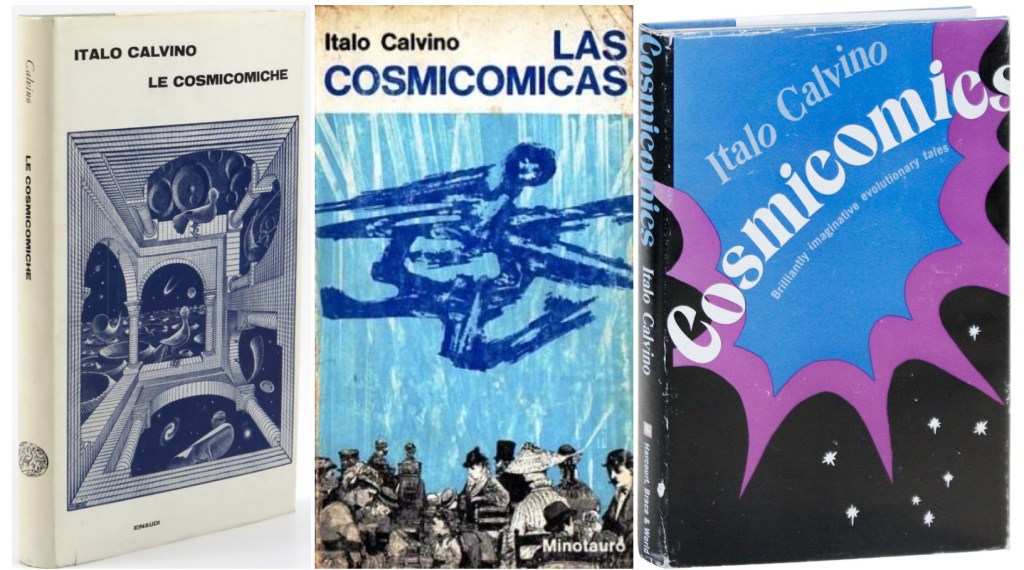
“A Sign in Space” by Italo Calvino is story #25 of 52 from The World Treasury of Science Fiction edited by David G. Hartwell (1989), an anthology my short story club is group reading. Stories are discussed on Tuesdays, Thursdays, and Saturdays. “A Sign in Space” first appeared in Le Cosmicomiche, a collection of the author’s stories first published in Italy in 1965. It was later translated and published in English in 1968 as Cosmicomics.

“A Sign in Space” is not science fiction. I won’t go into my rant again about how I dislike science fiction editors poaching literary works and calling them science fiction. I assume they do it to inflate the reputation of our genre, but I don’t want our genre to gain recognition for the wrong reasons. If Italo Calvino was really considered a science fiction author his success and fame would not have happened.

Be that as it may, let’s discuss “A Sign in Space” as a literary story. As soon as I started reading it I heard the voice of Mel Brooks doing his 2000 Year Old Man routine. Is it possible that Calvino could have heard this 1960 record? Great discoveries are often made at similar times around the world.

I did find a couple audio readings of the story, but none of the readers read it like Mel Brooks. I was disappointed. But here’s a nice narration.

This is a creative work that’s reasonably entertaining. It’s meant to be humorous and clever, but that really depends on the reading and delivery. That’s why I ached to hear Mel Brooks do it as a comedy routine. I did think it was too long.

I imagined the narrator being God when he was a youngster, just figuring things out. Did God create all of reality, or just Earth and its vicinity? Imagine being a conscious being that could ride around the Milky Way as it spun like a record. Imagine that being not having a language and needing to develop one. Making a sign could be the very beginning of the process. There are interesting philosophical points in this story.

Another thing I thought about while reading “A Sign in Space” was wondering how an observer could track the rotation of our galaxy? We see the Earth orbiting the sun through the changing background of the constellations throughout the year. The celestial sphere seems fixed to us when we realize we are moving. Would there be a larger sky outside our galaxy that would seem fixed too?

Just because a writer tells a fantastic story about outer space doesn’t mean we can pin a sign on their back that says SCIENCE FICTION WRITER. Marketing fiction as science fiction is a publishing technique to get certain kinds of stories to certain kinds of readers. It’s often bad for writers. And it’s unfair to writers who have developed a reputation outside of our genre. Some science fiction writers have learned that being labeled a science fiction writer has hurt their career potential. But it doesn’t help them or the genre to go around tagging certain famous writers as science fiction writers.

I wish David Hartwell could have found a genuine science-fiction story from Italy.

James Wallace Harris, 7/1/23

“Mockingbird” by Walter Tevis

If you’re an old movie fan, either from being old or just because you love old movies, you might know Walter Tevis from his first novel, The Hustler (1959). It was made into a stunning Paul Newman movie. Jeez, that’s a helluva start for a young novelist. Wait, that happened to Larry McMurtry too. (Note to self, see how many young novelists were made famous by Paul Newman, it might be worth a blog.) Tevis’ last novel, The Color of Money (1984) was also made into a movie starring Paul Newman. I’m sure the first and last thing is unique.

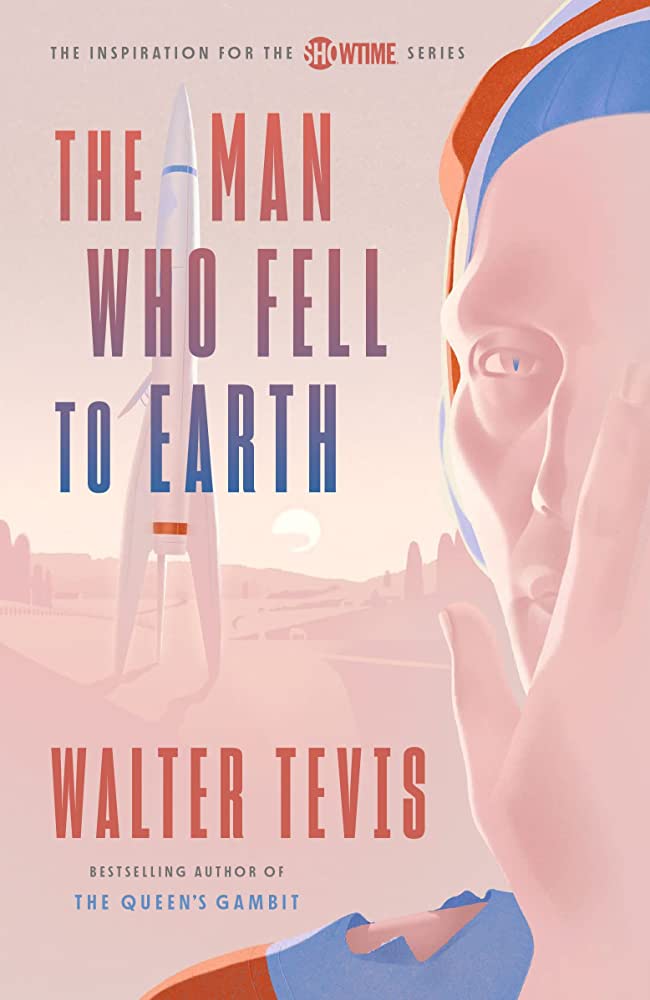
Tevis was forgotten for a while until David Bowie made his second novel, The Man Who Fell to Earth (1963), into a weird quirky flick in 1976. Don’t rush out and watch that movie though, they ruined the book, but do read the novel, it’s quiet and lovely and should resonate with your soul. (You can watch the film afterward to see what Bowie does in the role, and there is another film version and a Showtime TV series to check out too.)

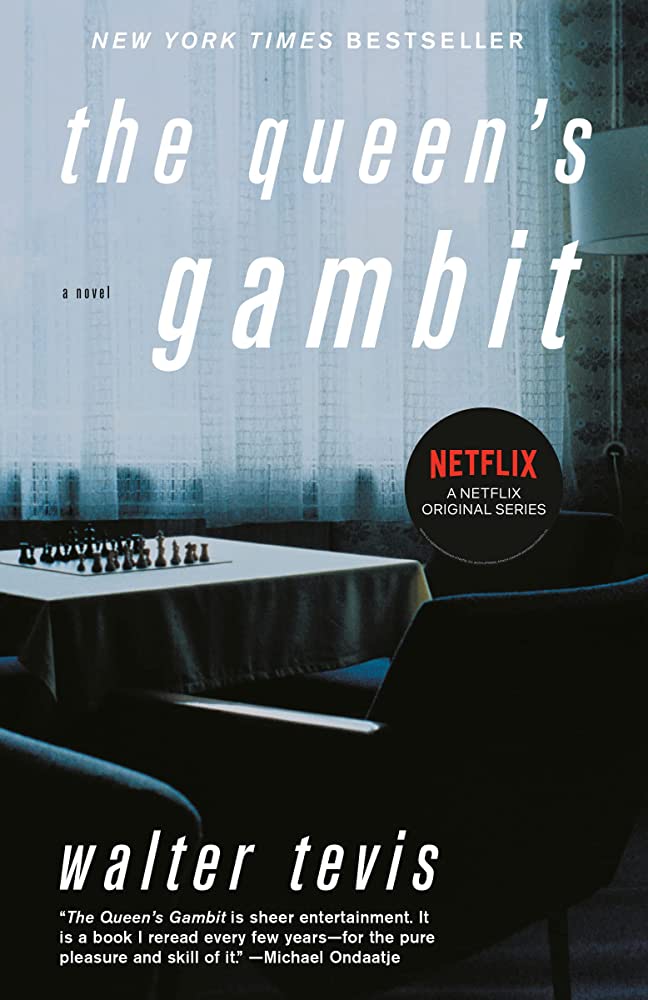
Most young people today will know of Walter Tevis if they read the credits or reviews of Queen’s Gambit (1983), the hit series on Netflix. The TV show is excellent but the book is better. All this media exposure has made Tevis (1928-1984) a minor forgotten writer with some fame.

You might have figured out by now that I’m a fan of Walter Tevis. That’s even more true now that I just finished his 1980 novel Mockingbird. What a strange trip it was. I thought it a perfect novel for the 2020s because it is about artificial intelligence and the decline of the human race and our civilization. Mockingbird is set in the 25th century but I don’t think it will take us that long.

I don’t want to give any spoilers to this novel because it‘s the kind of story that you should just unfold slowly as you read. But I do need to say enough to get you to read Mockingbird. Mockingbird has over two thousand customer ratings on Amazon with a 4.5 average.

For most of the novel Tevis tightrope walks between existentialism and nihilism and has a brush with Christianity. I will tell you the ending made me happy because of how Tevis ties up the story and his philosophical speculations. Tevis doesn’t stick to any one philosophy. He appears to be extrapolating on the decline and corruption of liberal thought but what he projects for conservatives isn’t any better. Walter Tevis was one of those tortured souls that tried mightily to figure out reality in his fiction.

The story opens with Robert Spofforth, a robot who looks like a black man but has an artificial brain. Later in the novel, Spofforth is described as the most beautiful object humans ever created. Bob is a level 9 robot, the most advanced of his kind, but the only unit of this model that hasn’t destroyed himself. He has been programmed so he can’t commit suicide. Currently, he is the Dean of New York University, but he might be the most intelligent and most powerful being left on the planet.

Spofforth hires Paul Bentley to come to New York because he’s the only human being he can find that can read. Bentley’s narrative is the main part of the novel. Paul then meets Mary Lou, an iconoclast living among the sheep, and teaches her to read. But Bob didn’t hire Paul to teach people to read but to translate the intertitles in silent films. Bob doesn’t want humans to learn to read again.

The human population has shrunk from billions to just a few million. Robots care for all their needs, but very poorly because robots are also a declining species. Humans routinely consume drugs, have a lot of casual sex, and pursue inner development.

There are elements in Mockingbird that will remind you of Brave New World and Nineteen Eighty-Four, with a slight hint of The Road. And if you’ve read The Long Tomorrow by Leigh Brackett, Mockingbird reminded me of it too. And there’s a little bit of Cool Hand Luke in the story. (Another Paul Newman connection).

And if that’s not enough to get you to read Mockingbird there’s a cat named Biff. I’m off to read The Steps of the Sun (1983) but it hasn’t gotten kind reviews. I also bought The King is Dead (2023) which reprints his 1981 collection Far from Home and adds many unpublished works.

James Wallace Harris, 5/20/23

What Would You Do If You Were Among The Last Humans on Earth?

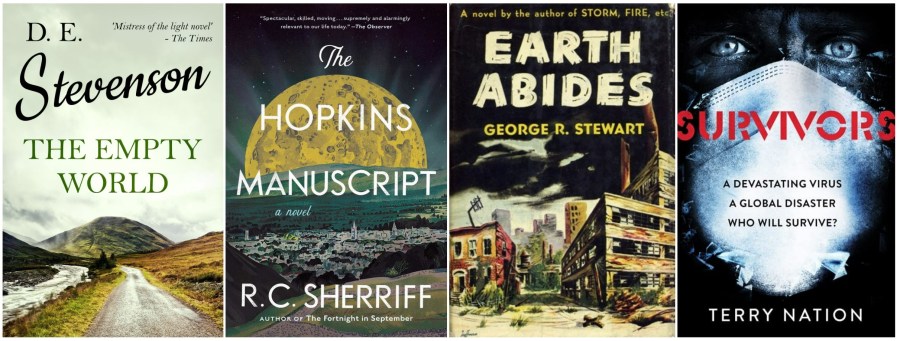
Once again I’m gorging on post-apocalyptic novels where a few people survive a horrific civilization-destroying catastrophe. Usually, they hope to rebuild civilization. But not always. I recently finished The Hopkins Manuscript by R. C. Sherriff first published in 1939 which I’ve already reviewed. And I just finished The Empty World by D. E. Stevenson first published in 1936. This has gotten me to think about all the books, movies, and television shows I read or watched because of this theme. I’ve listed and rated all that I can remember in the table below. But what I want to talk about first is the appeal and common plot elements of this sub-genre of science fiction. I have written about this a number of times before and have linked to those essays at the end — just in case this essay got you interested. I do know that other science fiction fans love this theme too.

[HBO just started a new series based on this theme. It appears people never get tired of it.]

There are many kinds of post-apocalyptic novels. See the long comprehensive overview on Wikipedia on Post-Apocalyptic fiction The ones I like best are those that focus just on a few survivors. You might call this version of the theme the Robinson Crusoe Post-Apocalypse. Some people also call them Cozy Catastrophes — but the exact definition is often argued over. For example, I disagree with many of the choices in “Jane Rogers’s top 10 cozy catastrophes” from The Guardian.

Here are my favorite elements in a cozy catastrophe:

Few Survivors

I like stories that follow just a few characters who survive the end of the world and try to rebuild. I would even enjoy it if it was just one person, which happens in Mary Shelley’s The Last Man, but usually, these stories start with one survivor who eventually finds a few more.

How They Survive

I also love the details of how they survive, whether it’s raiding grocery stores, becoming a hunter, or starting a garden. I love seeing how people start over from scratch and accomplish all the things we depend on civilization to give us now. This appeals to my younger self who wanted to move back to nature and subscribed to Mother Earth News. I loved the idea of being self-sufficient on five acres.

Social Dynamics

I also love reading about how people get along. In American fiction written by men, the stories can get rather violent. American guys believe the collapse of civilization means no laws, grab your guns, and everyone out for themselves. Think Mad Max or The Postman. Female Americans see starting over as a lot less violent. Consider Station Eleven. English writers of either gender, see post-apocalyptic affairs as being much less violent.

I just read The Empty World by D. E. Stevenson, first published in 1936. D. E. is for Dorothy Emily, and her books were light romances aimed at shop girls. The Empty World did have some violence. Right after the catastrophe we are told two-thirds of the surviving group of men are civilized and one-third are not, and the civilized men must get the few surviving women away from the uncivilized. Stevenson seemed to enjoy showing how the brutish lower-class Englishmen would fight and kill to possess a woman. Stevenson’s early cozy catastrophe anticipated many of the common elements that would emerge in this sub-genre, but her focus seemed to be on the women finding the right husband. Her premise for how civilization was wiped out was mumbo-jumbo science but that didn’t seem to hurt the story. Jo Walton gives a short review of the novel in her Tor.com column. I wonder if Stevenson had read London’s The Scarlet Plague?

My all-time favorite novel of this theme, Earth Abides (1949) by George R. Stewart tells about how Ish, the protagonist wants to educate the first generation after the collapse. He was a college professor who wanted to preserve knowledge but realized the vastness of human learning couldn’t be passed on. My favorite TV show that covers this theme, Survivors (1975 BBC) focuses on how a few people can work together to start a farm, and eventually, build coalitions between survivor groups. Survivors the TV show has an excellent novelization by Terry Nation. It’s currently for sale at Amazon for the Kindle for just $1.99. The complete series on DVD is just $22. But a warning, the production was low-budget and modern TV watchers might not like it. Episodes of the show are available in low-resolution on YouTube, but not streaming anywhere else.

How Would You Do It

Probably the most fun aspect of this genre is picturing myself in the same situation as in the story and fantasizing about how I would have dealt with it. I have to admit, those fantasies have changed over the years. When I was younger, I pictured a post-apocalyptic world as more of an adventure. As I got older, it became more about how to farm and take care of myself. Now that I’m old, I realize if I found myself becoming one of the last people on Earth, my solutions for how to live would be much different. I don’t have the strength to farm. I now see myself just hiding out, scrounging for preserved food, and reading books, while contemplating the end of the world.

Hope for the Future

Another thing I love about this theme is seeing how the characters hope to rebuild things. I believe part of the appeal of this genre comes from disliking the way things are now. And readers love to imagine a better society. One thing I was very impressed with in Sherriff’s The Hopkins Manuscript is how he predicted that people don’t change and we’d just quickly go back to our bad ways. That’s depressing but I believe philosophically correct.

Some stories, like On the Beach by Nevil Shute and The Road by Cormac McCarthy imply there is no hope for mankind.

MisanthropicA Subconscious Urge For Fewer People

I also believe these stories appeal to us because deep down we wish there were a lot fewer people on Earth. The question is how fewer? Would you want to be the last person? Just a few friends? A small community? Maybe a world where the total population is just ten million? And do we want to bring back civilization?

Post-Apocalyptic Stories I Remember

Rating Year Title
*** 1826 The Last Man by Mary Shelley
tbr 1885 After London by Richard Jefferies
**** 1901 The Purple Cloud by M. P. Shiel
**** 1912 The Scarlet Plague by Jack London
**** 1913 Goslings by J. D. Beresford
*** 1936 The Empty World by D. E. Stevenson
***** 1939 The Hopkins Manuscript by R. C. Sherriff
***** 1949 Earth Abides by George R. Stewart
***** 1951 The Day of the Triffids by John Wyndham
***** 1955 “A Canticle for Leibowitz” by Walter M. Miller, Jr.
**** 1956 The Death of Grass by John Christopher
***** 1957 On the Beach by Nevil Shute
***** 1959 Alas, Babylon by Pat Frank
***** 1959 On the Beach U.S. film
***** 1959 The World, the Flesh, and the Devil MGM
**** 1962 The Drowned World by J. G. Ballard
***** 1975-1977 Survivors BBC
***** 1976 Survivors by Terry Nation
***** 1985 The Postman by David Brin
**** 1985 The Quiet Earth New Zealand film
**** 2006 Life As We Knew It by Susan Beth Pfeffer
***** 2006 The Road by Cormac McCarthy
**** 2008-2010 Survivors BBC remake
**** 2012 The Age of Miracles by Karen Thompson Walker
** 2012-2014 Revolution NBC
***** 2014 Station Eleven by Emily St. John Mandel
*** 2015-2018 The Last Man On Earth Fox TV
**** 2021 Y: The Last Man FX on Hulu

Essays About Post-Apocalyptic Fiction I’ve Written Before

James Wallace Harris 1/17/23

The Hopkins Manuscript by R. C. Sherriff

Short Review: If you loved George R. Stewart’s 1949 classic novel Earth Abides then there’s a good chance you’ll love to read R. C. Sherriff’s forgotten 1939 novel The Hopkins Manuscript.

I bought the new Scribner audiobook edition that came out on January 6, 2023, because of Alec Nevala-Lee’s review in The New York Times. Right now, the Scribner edition is only available as an ebook and audiobook edition. An older, 2018, Penguin trade paper edition is still for sale. This apocalyptic novel first appeared in 1939 and has been reprinted a number of times since, yet it’s never achieved much notice.

I listened to The Hopkins Manuscript and thought it a science fiction masterpiece. However, I’m reluctant to recommend you buy it because it does not have even one citation in our Classics of Science Fiction database. If I believe The Hopkins Manuscript is so incredible why wasn’t it cited by any of the dozens of sources we used to build the database, including recommended reading lists from science fiction writers, polls from fans voting for their favorite novels, or lists of books admired by critics and scholars?

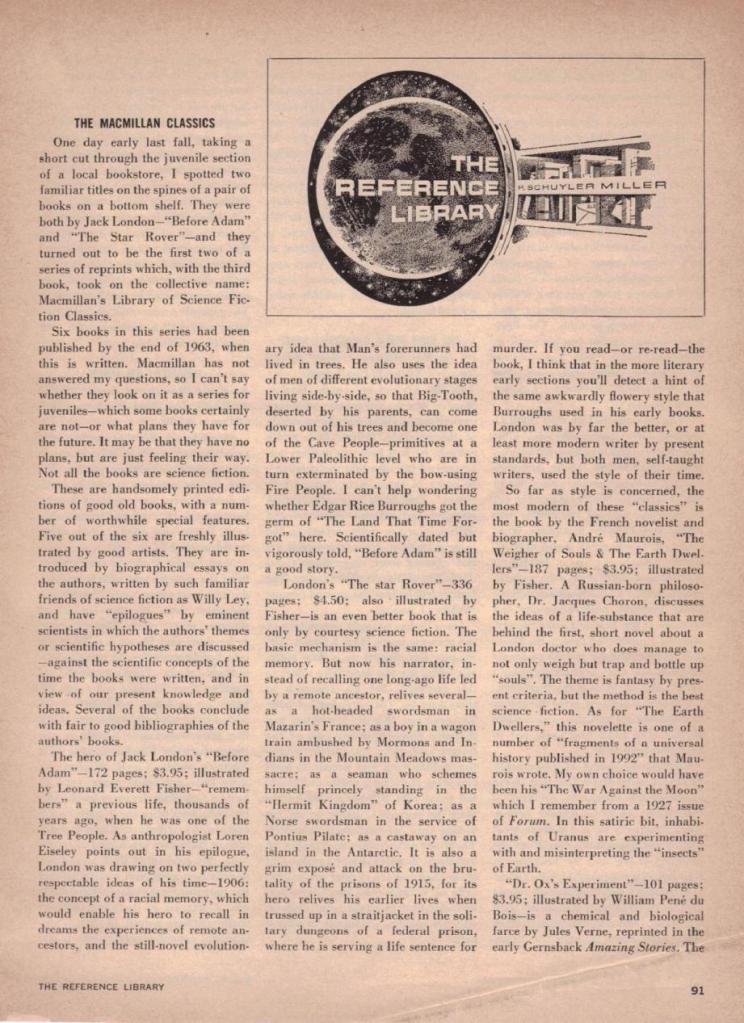
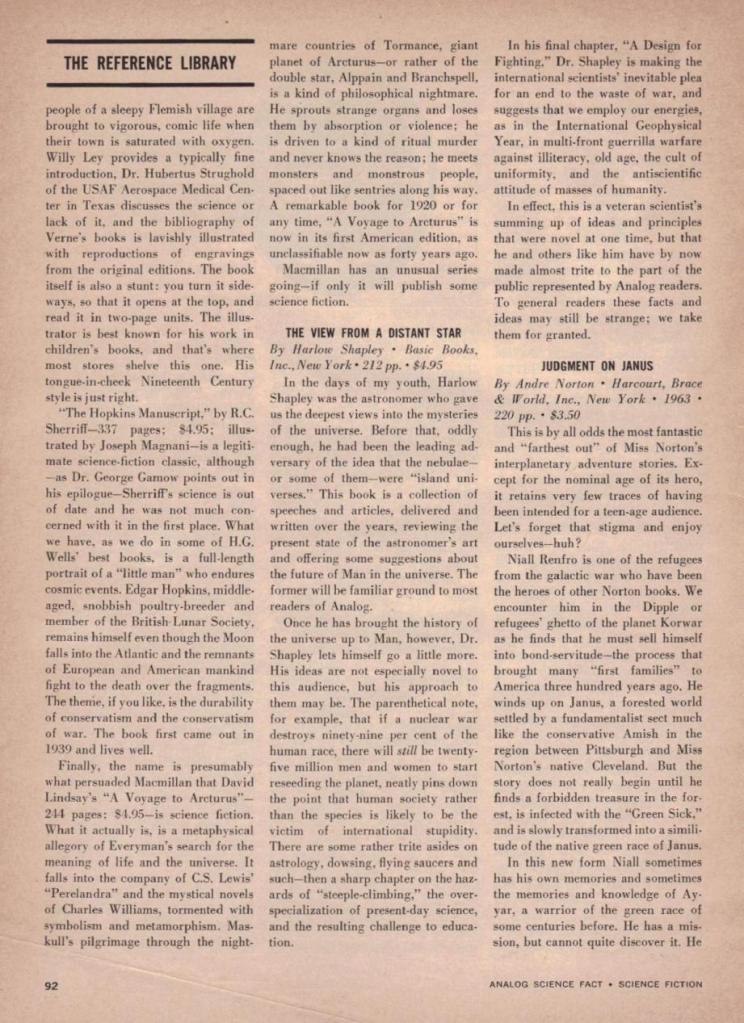
I loved The Hopkins Manuscript and can’t understand why it isn’t a well-known classic of science fiction. See the scans below from various reviewers in the past. I’d love to read what Michael Moorcock said about The Hopkins Manuscript in the September 2005 issue of The New York Review of Books (#205) if anyone has a copy. But in Thrilling Wonder Stories, from January 1940, H. K. recommended readers put it on their “Must” list. But in the April 1940 issue of Astonishing Stories, Donald A. Wollheim concluded the novel conveyed nothing new, nothing hopeful, and nothing very real. I disagree completely. Avram Davidson in the January 1964 issue of F&SF said the novel was first-rate and ended with “Don’t just read it — buy it.” P. Schuyler Miller damns it with faint praise in the April 1964 issue of Analog, concluding “The book first came out in 1939 and lives well.” Finally, Neil Barron did not recommend The Hopkins Manuscript in his library resource book Anatomy of Wonder.

Nevala-Lee spends most of his review talking about cozy catastrophes, giving Sherriff’s biography, and describing the story. I felt he told too much, but then I consider almost everything in a story to be spoilers. Nevala-Lee’s most positive statement is “Reissued this month, this wonderful novel should powerfully resonate with readers whose consciences are troubled by inequality and climate change. As Aldiss wrote, ‘The essence of cozy catastrophe is that the hero should have a pretty good time … while everyone else is dying off.” I disagree with by Nevala-Lee and Aldiss. This novel isn’t just for the woke and poor Edgar Hopkins suffers tremendously.

The Hopkins Manuscript is my kind of science fiction. I deeply resonated with Edgar Hopkins’ story, even though he is stodgy, vain, and frequently seeking to prove his self-importance. His memoir gives us a quiet and personal account of what was almost the end of the world. And I love stories about a few people trying to survive a worldwide catastrophe. If you loved the 1970s British TV shows Survivors, you might to get this book. I recommend the audiobook because the narration is pitch-perfect for the story. If you loved The Day of the Triffids by John Wyndham, also consider reading The Hopkins Manuscript. (Survivors is available on YouTube for free in low resolution. It doesn’t seem to be streaming anywhere. Amazon sells a complete series DVD set for $22. It’s one of my all-time favorite TV shows.)

The Hopkins Manuscript is what some call a cozy catastrophe – a first-person account of the end of the world. The story is set in rural Britain before WWII and imagines the fall of Western civilization due to impending celestial events. Edgar Hopkins, a never-married retired teacher who raises show hens describes a very personal account of the end of the world. What made his story great is he’s a flawed but very realistically drawn character, and Sherriff’s philosophical take on humanity follows my own philosophy – especially that we don’t change. And that’s the tragedy of the novel, we don’t change even when faced with epic incentives.

The novel opens with a Forward from The Imperial Research Press, Addis Ababa telling us how the Hopkins manuscript was discovered two years earlier by the Royal Society of Abyssinia. It is assumed to be over 700 years old. The Forward also tells us how Western Europe is a dead civilization and the Hopkins manuscript is one of the very few artifacts left of the English Empire. The others are an iron tablet that says KEEP OFF THE GRASS, and a stone inscribed with PECKHAM 3 Miles. Except for old Roman roads, the entire history of England is gone. Since I read a three-volume history of the world last year, this felt very real. Civilizations come and go and we can’t expect ours to last forever.

American post-apocalyptic novels tend to involve a lot of violence and guns. British post-apocalyptic novels are genteel and quiet. If you’re looking for Mad Max, read elsewhere. The first half of the novel deals with how the British faced the coming doom. If you like stories about Britain between the wars, that’s another indicator you might want to buy The Hopkins Manuscript. That’s a big interest of mine. I’m not sure you need to be an Anglophile to enjoy this story but it might help. If you read Brian Stableford’s New Atlantis, a four-volume history of scientific romance, he shows how British science fiction evolved differently from American science fiction. I agree with him, and I’m partial to British science fiction. That’s probably another factor in explaining my love of The Hopkins Manuscript. Unfortunately, Stableford doesn’t cover The Hopkins Manuscript. That disappoints me. That’s just more evidence that my love of this novel might be unique to me. I hope not.

Even though The Hopkins Manuscript remains a mostly forgotten work, and has little critical support, I hope people rediscover it with the new Scribner edition. If you read it, please leave a comment below.

James Wallace Harris, 1/9/23

“Blowups Happen” by Robert A. Heinlein

Only dumbasses, egotists, and the delusional think they can predict the future, although there are a number of professions that try. I do believe Robert A. Heinlein was smart and sane enough to know he couldn’t see beyond the horizon of the moment, but he wrote plenty of stories that tried. “Blowups Happen” is one that stands out. Heinlein’s 1940 novelette imagines the dangers of commercializing atomic energy in peacetime. That was five years before Hiroshima.

I grew up being taught that atomic research during the war was an extremely well-guarded secret. What I didn’t know, and I assume most other people didn’t either, was how much atomic energy was widely discussed before the war. John W. Campbell, Jr. liked to brag about how the FBI came to his offices in 1944 because of Cleve Cartmill’s story “Deadline,” implying the G-men thought it gave away some of the secrets of the atomic bomb. I thought Heinlein’s story felt far more knowledgeable. I now have to assume the well-educated public before WWII knew far more than I ever imagined regarding atomic physics.

“Blowup Happens” is set in the near future from 1940 in the Astounding Science Fiction magazine version, and from 1950 as it was rewritten for the collection, The Man Who Sold The Moon. Those two dates are important because the story is about atomic power, and the magazine version was written before Hiroshima and the book version afterward.

The setup of the story is the United States has come to depend on atomic power even though a breeder reactor in Arizona could theoretically destroy the country or even the planet. The General Superintendent of the plant, King, has to hire one psychiatrist for every three engineers to monitor their work with the reactor because engineers have nervous breakdowns after a short career and must be continually replaced. King brings in Dr. Lentz, one of the country’s top psychiatrists to find ways that allow engineers to handle the stress.

Later in the story, Superintendent King learns that mathematical models that previously showed the reaction in the breeder reactor is probably controlled are wrong. New mathematics prove the reactor could go into a runaway reaction that would destroy the planet. If they bring down the breeder reactor the country would lose a good portion of its industrial power and ruin the economy. King knows the corporation that owns the plant won’t accept the new research because it would be financial ruin for it.

The solution to the problem has been emerging all along in a tangential subplot about two engineers, Erickson and Harper, developing atomic power for rockets.

“Blowups Happen” has a great deal of infodumping where Heinlein tries to educate his readers about the science behind atomic energy. Reading those passages today is tedious unless you are researching early speculation about atomic energy. So, how do we judge “Blowups Happen” as a story in 2022?

We want science fiction that is visionary. We want the future to be exciting. Ultimately, most, if not all science fiction becomes historical curiosities. Time has a way of eroding our genre. I didn’t like “Blowups Happen” when I first read it as a teen back in the 1960s. It was already too dated. Now that I’m rereading it in my seventies in 2022 I have to admire Heinlein’s speculation. “Blowups Happen” is an ambitious story. I’m starting to think science fiction writers are at their most ambitious when they are working closest to the present.

In “Blowups Happen” Heinlein explores the impact of atomic energy before the world is startled by the reality of Hiroshima. Sure, the idea of atomic power had been around since Einstein’s most famous equation. The reason why the science fiction of the 1950s had been so exciting is it just preceded NASA of the 1960s. And the reason why cyberpunk was so exciting in the 1980s is that it just preceded the World Wide Web in the 1990s. Science fiction writers get the details wrong, but they still anticipate the wonder and the chaos. This thought makes me rethink Heinlein’s Stranger in a Strange Land anticipation of the 1960s.

When we judge an old science fiction story for its visionary qualities I think it’s important to look at the story’s original publication. “Blowups Happen” was first published in September 1940. It was first reprinted in The Best of Science Fiction edited by Groff Conklin in 1946, and then in 1950, it was rewritten for The Man Who Sold the Moon. However, for that edition, Heinlein rewrote the story to include the knowledge of the bombing of Hiroshima in 1945. By 1950 the public and science readers knew much more about atomic energy. I’m guessing “Blowups Happen” was already outdated even in 1950.

Ten years makes a lot of difference in a science fiction story, although I doubt anyone in 1940 could have imagined what the next five years would bring, much less ten. Science fiction writers do not and cannot predict the future, but we do have to admire Heinlein for imagining the political implications of a country having atomic energy in 1940, and what the dangers might be for developing peacetime uses of atomic power. He gets the details wrong, but what he gets right is the essence of great science fiction. By the way, in the 1940 version, the power plant is called a bomb, but in 1950 the label was changed to pile. I’m guessing Heinlein imagined the power plant as being a controlled explosion.

Within the 1940 version, Heinlein described a nuclear explosion as “forty million times as explosive as TNT. The figure was meaningless that way. He thought of it, instead, as a hundred million tons of high explosive, two hundred million aircraft bombs as big as the biggest ever used.” To give his readers a better picture, Heinlein has his character say to himself about ordinary big bombs, “He had once seen such a bomb dropped when he had been serving as a temperament analyst for army aircraft pilots. The bomb had left a hole big enough to hide an apartment house. He could not imagine the explosion of a thousand such bombs, much, much less a hundred million of them.”

Then in the 1950 version, the same character thinks of it as “a hundred million tons of high explosive, or as a thousand Hiroshimas.” Heinlein didn’t need to write anything more. By then, readers had seen films about atomic explosions. They knew exactly what that meant, but in 1940 I doubt readers could imagine anything close to reality.

Psychiatry and psychology are so commonly talked about today that we also forget that it was new at one time. I’m an old movie fan, and psychiatry became a hot subject matter for films after WWII and into the 1950s. I’m guessing Heinlein was doing just as much speculation about the future impact of psychiatry as he was doing for atomic energy in “Blowups Happen.” But how sophisticated his Heinlein’s expectations about the field? Heinlein loved popular scientific speculations published in popular books of the 1930s. But he also was a fan of many pseudo-scientific works too, stuff we’d consider New Age today. In his Future History stories, Heinlein seemed just as interested in the soft sciences as the hard sciences.

Heinlein describes Dr. Lentz, the top psychiatrist of the day this way:

Notwithstanding King’s confidence, Lentz did not show up until the next day. The superintendent was subconsciously a little surprised at his visitor’s appearance. He had pictured a master psychologist as wearing flowing hair, an imperial, and having piercing black eyes. But this man was not overly tall, was heavy in his framework, and fat—almost gross. He might have been a butcher. Little, piggy, faded-blue eyes peered merrily out from beneath shaggy blond brows. There was no hair anywhere else on the enormous skull, and the apelike jaw was smooth and pink. He was dressed in mussed pajamas of unbleached linen. A long cigarette holder jutted permanently from one corner of a wide mouth, widened still more by a smile which suggested non-malicious amusement at the worst that life, or men, could do. He had gusto.

Heinlein, Robert. The Man Who Sold the Moon and Orphans of the Sky (p. 131). Baen Books. Kindle Edition. 

Is Heinlein serious about giving us a shrink that goes around in public in his pajamas? Is Heinlein just imagining a colorful future with odd fashions? Or is this satire? Would 1940 science fiction readers believe the fashions we see on TV today? Heinlein had his sociological speculations too. There is another scene at a bar where the atomic energy scientists go to unwind, that features a B-girl who is also a prostitute. Such women were common in the 1930s, but it was a lower-class thing. I got the feeling that Heinlein expected society would change its attitudes toward these women in the future.

But, we’re back to my original question. Is “Blowups Happen” a fun science fiction story to read in 2022? I don’t think so. Scientific lectures can slow a story, or even ruin it, but scientific lectures about out-of-date science are even harder to endure. Would “Blowups Happen” read better today if he had left out all the lectures? They weren’t needed for the story. Lester del Rey’s “Nerves” is another story about atomic energy from the 1940s that’s outdated, but it still works dramatically. It has problems with length, and some plotting, but overall, I remember it being a better story. I don’t know if Heinlein wanted to be educational, show off his knowledge, or provide evidence for his speculation, but I don’t think the story needed those infodumps.

“Blowups Happen” does offer one lesson for would-be science fiction writers. Speculating about the near future will have the greatest impact on current readers, but you risk writing a story with a limited shelf life. Most stories never become classics anyway, so I think Heinlein boosted his career significantly in 1940 by writing “Blowups Happen.” And there is a downside to writing far-future science fiction that’s pure storytelling. I find science fiction that feels like fantasy fiction far less appealing. Although “Blowups Happen” is now just a historical curiosity I still admire it for Heinlein’s ambition. I seldom find science fiction stories with that kind of ambition being written today.

Near-future SF stories with serious speculation do show up but are rare. I am impressed with The Mountain in the Sea by Ray Nayler, and even though it just came out, I’ve already heard good things about it from several readers. There’s something exciting about science fiction that speculates about the near future with ideas that could come true.

James Wallace Harris, 12/12/22

“Misfit” by Robert A. Heinlein

“Misfit” (Astounding, Nov. 1939) was Heinlein’s second published story and his first about space travel. It’s also his first work of juvenile fiction, or what we call YA today. Heinlein renamed FDR’s New Deal Civilian Conservation Corps (CCC) the Cosmic Construction Corps for this future space adventure. I thought that was a really neat idea. And Heinlein created one of his favorite characters, Andrew Jackson Libby, who would reappear in Methuselah’s Children in 1941, and yet again in four of Heinlein’s 1970s and 1980s novels. Eventually, Libby would become a woman, Elizabeth Andrew Jackson Libby, but we won’t get into that for a very long time. Some fans even consider Max Jones of Starman Jones a repackaging of the Libby character, but I don’t.

I never liked the way Heinlein reused his characters because he eventually turned characters I loved into characters I hated. But that’s another subject to deal with in future essays.

The plot of “Misfit” isn’t very complicated. Libby is a young man who we follow into space. Like many of the boys on the ship, Libby experiences space sickness at first but eventually adapts to living in free fall. His crew arrives at a small asteroid called HS-5388, or just Eighty-Eight. Their job is to build habitats and rocket engines into the rock. Their goal is to reposition the asteroid into an orbit between Earth and Mars to make it into an emergency shelter for space travelers.

There’s little conflict or drama in the story. The only surprise in the story is we learn that Libby has a savant’s ability for mathematics, and saves the day when their “computer” conks out. Heinlein calls Libby a lightning calculator and gives him the nickname “Slipstick” – a slang term for a slide rule. In this1939 story, the word computer was not used. They called their computer an “integral calculator.” Boy, wouldn’t Heinlein have wowed us today if he had imagined a handheld calculator instead of a slide rule? (I loved using my slide rule in my math classes back in the 1960s and 1970s. I wish I had kept it.)

This is why I said in my review of “Life-Line” that I thought “Life-Line” was a much better story than “Misfit.” In “Life-Line” Heinlein gets us hooked right away on whether or not Hugo Pinero’s invention is real, and the whole story focuses on that plotline. “Misfit” is a story where this happens, then this happens, and then another thing happens until we reach an end. It’s still a good story, but it doesn’t have a tight plot. Even the dramatic scene of Libby saving the day when putting the asteroid into its new orbit isn’t done with much drama. Still, the “Misfit” is readable and likable, but its deadpan style makes me think of the old TV show Dragnet.

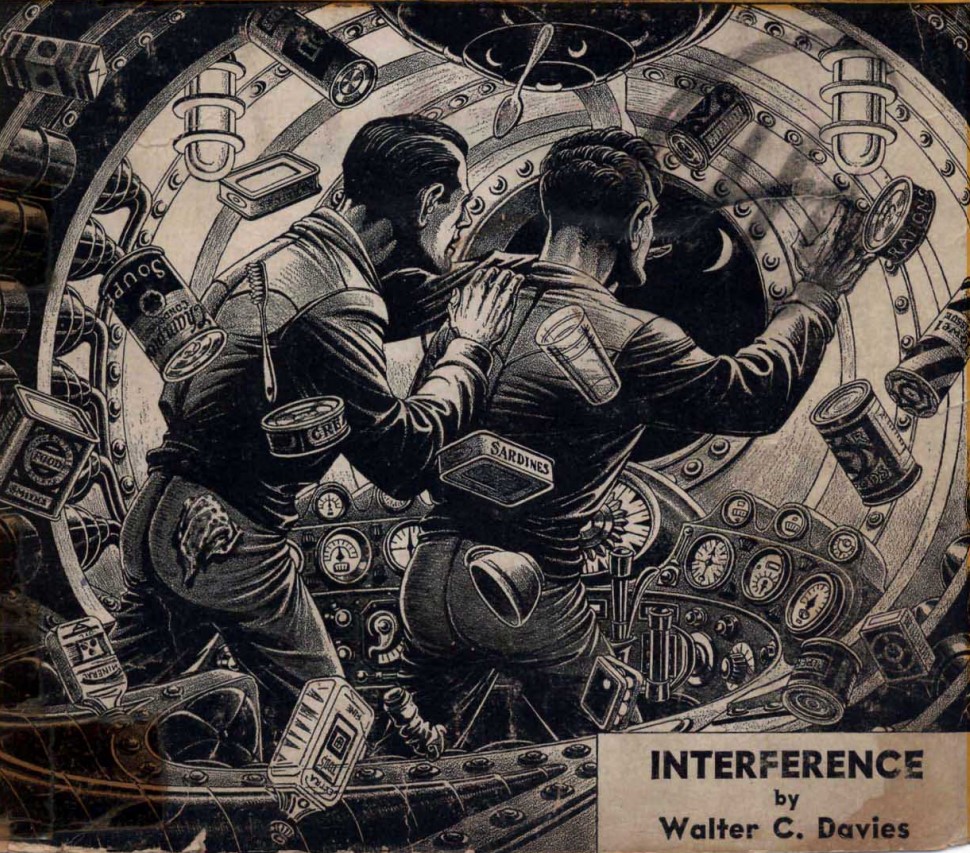
Heinlein had a side to him that just enjoyed explaining how things worked. My favorite part of the story was Heinlein showing us what weightlessness would be like. I thought he got it very right for 1939. And I checked to see if he hadn’t updated the story later, but he hadn’t. I don’t know if any writer back then worked out what living in microgravity would be like. I was very impressed. They call Libby Pinky, I guessed because of his red hair and complexion.

The ship’s loudspeaker blatted out, “All hands! Free flight in ten minutes. Stand by to lose weight.” The Master-at-Arms supervised the rigging of grab-lines. All loose gear was made fast, and little cellulose bags were issued to each man. Hardly was this done when Libby felt himself get light on his feet—a sensation exactly like that experienced when an express elevator makes a quick stop on an upward trip, except that the sensation continued and became more intense. At first it was a pleasant novelty, then it rapidly became distressing. The blood pounded in his ears, and his feet were clammy and cold. His saliva secreted at an abnormal rate. He tried to swallow, choked, and coughed. Then his stomach shuddered and contracted with a violent, painful, convulsive reflex and he was suddenly, disastrously nauseated. After the first excruciating spasm, he heard McCoy’s voice shouting. 

“Hey! Use your sick-kits like I told you. Don’t let that stuff get in the blowers.” Dimly Libby realized that the admonishment included him. He fumbled for his cellulose bag just as a second temblor shook him, but he managed to fit the bag over his mouth before the eruption occurred. When it subsided, he became aware that he was floating near the overhead and facing the door. The chief Master-at-Arms slithered in the door and spoke to McCoy. 

“How are you making out?”  

“Well enough. Some of the boys missed their kits.”  

“Okay. Mop it up. You can use the starboard lock.” He swam out.  

McCoy touched Libby’s arm. “Here, Pinkie, start catching them butterflies.” He handed him a handful of cotton waste, then took another handful himself and neatly dabbed up a globule of the slimy filth that floated about the compartment. “Be sure your sick-kit is on tight. When you get sick, just stop and wait until it’s over.” Libby imitated him as best as he could. In a few minutes the room was free of the worst of the sickening debris. McCoy looked it over, and spoke: 

“Now peel off them dirty duds, and change your kits. Three or four of you bring everything along to the starboard lock.” 

At the starboard spacelock, the kits were put in first, the inner door closed, and the outer opened. When the inner door was opened again the kits were gone—blown out into space by the escaping air. Pinkie addressed McCoy, “Do we have to throw away our dirty clothes too?” 

“Huh uh, we’ll just give them a dose of vacuum. Take ’em into the lock and stop ’em to those hooks on the bulkheads. Tie ’em tight.” 

This time the lock was left closed for about five minutes. When the lock was opened the garments were bone dry—all the moisture boiled out by the vacuum of space. All that remained of the unpleasant rejecta was a sterile powdery residue. McCoy viewed them with approval. “They’ll do. Take them back to the compartment. Then brush them—hard—in front of the exhaust blowers.” 

The next few days were an eternity of misery. Homesickness was forgotten in the all-engrossing wretchedness of spacesickness. The Captain granted fifteen minutes of mild acceleration for each of the nine meal periods, but the respite accentuated the agony. Libby would go to a meal, weak and ravenously hungry. The meal would stay down until free flight was resumed, then the sickness would hit him all over again. 

On the fourth day he was seated against a bulkhead, enjoying the luxury of a few remaining minutes of weight while the last shift ate, when McCoy walked in and sat down beside him. The gunner’s mate fitted a smoke filter over his face and lit a cigarette. He inhaled deeply and started to chat. 

“How’s it going, bud?” 

“All right, I guess. This spacesickness—Say, McCoy, how do you ever get used to it?” 

“You get over it in time. Your body acquires new reflexes, so they tell me. Once you learn to swallow without choking, you’ll be all right. You even get so you like it. It’s restful and relaxing. Four hours sleep is as good as ten.” 

Libby shook his head dolefully. “I don’t think I’ll ever get used to it.” 

“Yes, you will. You’d better anyway. This here asteroid won’t have any surface gravity to speak of; the Chief Quartermaster says it won’t run over two per cent Earth normal. That ain’t enough to cure spacesickness. And there won’t be any way to accelerate for meals either.” 

Libby shivered and held his head between his hands.

Heinlein, Robert A.. Revolt in 2100 (pp. 191-193). Spectrum Literary Agency, Inc.. Kindle Edition. 

You can compare the current Kindle edition to the 1939 magazine edition:

This is pretty amazing when you think that most Americans at the time only knew science fiction from Buck Rogers and Flash Gorden newspaper comic strips, radio shows, and serials. But even in the hardcore science fiction of Astounding Science-Fiction, I just don’t remember reading anything from that era that dealt with this kind of realism. Over the years I’ve paid attention to illustrations of free fall in old science fiction magazines, and one of my favorites is the July 1941 cover of Cosmic Stories.

A fun essay to write for the future would be chronicling the history of how writers imagined weightlessness in space. I think even 19th-century writers knew about it, but I just don’t think any writer dealt with space sickness before. If you know otherwise, leave a comment.

Another example of Heinlein just explaining things is when he tells us how they found the asteroid:

Locating one asteroid among a couple of thousand is not as easy as finding Trafalgar Square in London—especially against the star-crowded backdrop of the galaxy. You take off from Terra with its orbital speed of about nineteen miles per second. You attempt to settle into a composite conoid curve that will not only intersect the orbit of the tiny fast-moving body, but also accomplish an exact rendezvous. Asteroid HS-5388, ‘Eighty-eight,’ lay about two and two-tenths astronomical units out from the sun, a little more than two hundred million miles; when the transport took off it lay beyond the sun better than three hundred million miles. Captain Doyle instructed the navigator to plot the basic ellipsoid to tack in free flight around the sun through an elapsed distance of some three hundred and forty million miles. The principle involved is the same as used by a hunter to wing a duck in flight by ‘leading’ the bird in flight. But suppose that you face directly into the sun as you shoot; suppose the bird can not be seen from where you stand, and you have nothing to aim by but some old reports as to how it was flying when last seen?

Heinlein, Robert A.. Revolt in 2100 (p. 193). Spectrum Literary Agency, Inc.. Kindle Edition. 

Where did Heinlein learn this? Were there popular science books that speculated on space travel back then? Or did he just imagine it? Later on in the story, when they are trying to position the asteroid in its new orbit, we get a lesson on celestial mechanics. I believe Heinlein was a ballistics officer when he was in the Navy, so that makes sense. And I believe he was an amateur astronomer. Heinlein loved to have his characters use mathematics, and I remember Heinlein in interviews telling how he and his wife would get out butcher paper and calculate orbits for his stories.

As a kid, Heinlein made me want to study math and science. I wished I could have been like Kip Russell in Have Space Suit–Will Travel who applied himself vigorously with disciplined self-study. I can say Heinlein made me wish that about myself, but I never did. I took a bunch of math classes, but I only applied myself in a half-ass fashion. I also bought a telescope and read popular science books, but I just never worked hard at learning what Heinlein expected of his characters. As I got older, I even wished I could live my life over so I could be more like the characters in Heinlein’s juveniles. When I retired, I even planned to study math again, and go back to college and get a master’s in computer science. I didn’t. I bought a bunch of math books and realized I had forgotten nearly everything I had once known about mathematics. I got onto the Khan Academy website and started over with third-grade math. By the time I got to six-grade math, I realized it just wasn’t going to happen. But that desire came from reading the Heinlein juveniles back in the 1960s.

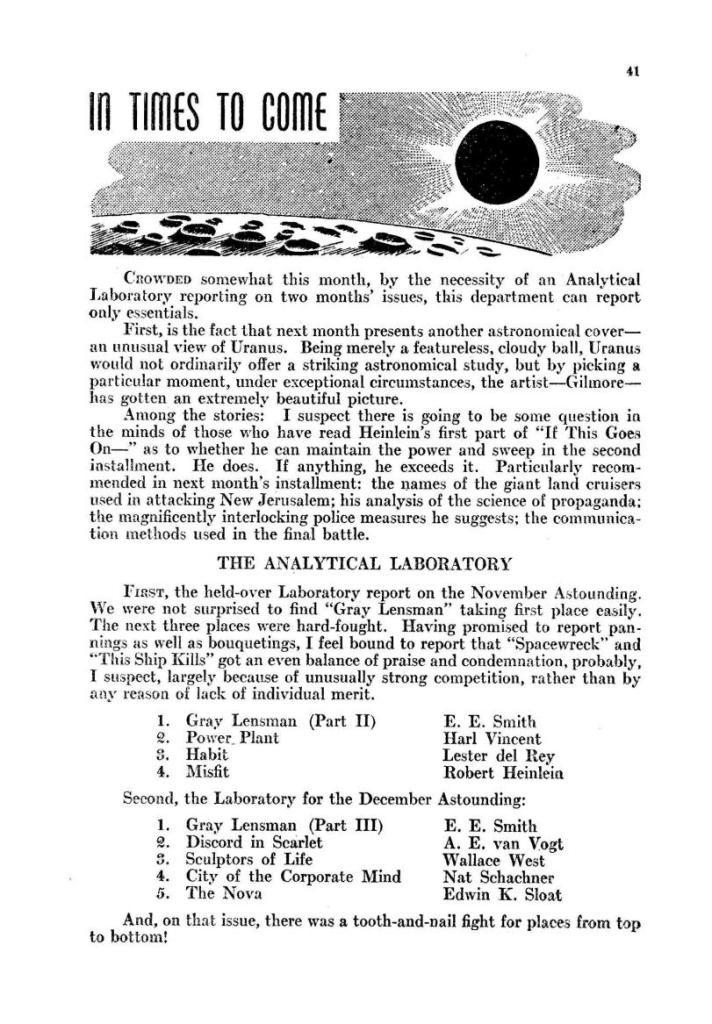
“Misfit” came in dead last in the AnLab (Feb. 1940). But “Misfit” was in an issue with the Gray Lensmen serial. Evidently, the readers back then weren’t impressed with Heinlein’s speculations about space sickness like I am now. Maybe they never imagined space sickness and didn’t want to believe it. One reader in the letter column wrote to tell Campbell there were people who could math in their heads like Libby. But I didn’t find anyone else that got excited about the story.

Campbell does push Heinlein In Times To Come for his current serial If This Goes On—. That story might be considered Heinlein’s first novel, depending on its length in the magazine. When it was revised and slightly expanded for Revolt in 2100, it was considered a novel-length by ISFDB.

James Wallace Harris, 10/1/22

“Life-Line” by Robert A. Heinlein

The contrast is striking to read “Life-Line” right after reading and reviewing For Us, The Living. Did Heinlein hitchhike over to the Iowa Writers’ Workshop for the 1939 Spring semester? “Life-Line” is a well-structured short story told dramatically, attributes sorely lacking in his trunk novel. How did he make such a quantum leap in writing?

“Life-Line” has a simple plot. Dr. Hugo Pinero invents a device that can give the date of a person’s birth and death. It’s based on the idea that every being exists in time as one long 4th-dimensional organism. Scientists think Pinero is a crackpot. When his machine works and causes havoc with the insurance industry they take him to court to get an injunction from using it. Pinero proposes to the court a scientific test which the judge accepts. One insurance CEO ordered a contract killing on Pinero. But before he dies we see one tear-jerking scene where Pinero tests a young married couple. The wife is pregnant. He refuses to tell the couple their results claiming his machine has become misaligned. He tried to keep them from leaving, but they eventually do and are killed outside his office by a speeding car. The scientists finally admit that Pinero’s technique was real when they find he accurately predicted his own death, and they destroy all the test predictions based on their own lives.

Farah Mendlesohn in her book, The Pleasant Profession of Robert A. Heinlein suggests Heinlein modeled his writing on the movies. I can believe that. The dialog in “Life-Line” feels like MGM films from the mid-1930s. It’s easy to picture Hugo Pinero played by Edward G. Robinson. Robinson sometimes played ethnic characters with accents, and Dr. Pinero has the same bellicose pugnacity that Robinson did in his movies. The gangster Mr. Bidwell of Amalgamated Insurance hired to kill Pinero comes across just like Humphrey Bogart in Kid Gallahad, even though Heinlein gives the gangster character just a couple of lines and a few words of description.

“Life-Line” also has several scenes that also remind me of 1930s movies, and they might be a clue to where Heinlein got his Public Argument writing technique I keep seeing in his stories. The story begins with Pinero arguing with a committee from the Science Academy. Next, he banters around with a group of news reporters. This reminds me of more than one Frank Capra film. Next, we see Pinero argue his case with a judge and lawyer for the insurance companies in court. I can see why he uses the Public Argument technique, it provides drama because it’s often used in movies, especially old movies from the 1930s, ones Heinlein should have seen — and studied.

I know when I first read “Life-Line” because in 1966 I bought a little Ace paperback for 40 cents, The Worlds of Robert A. Heinlein. I got the story again in The Past Through Tomorrow in 1967. It was first collected in Heinlein’s The Man Who Sold the Moon in 1950, but that was the year before I was born. By the way, my Baen Kindle edition of The Man Who Sold the Moon / Orphans of the Sky copy has an important missing section, the one where Bidwell hires the gangster. This time I listened to the Brilliance Audio edition of The Man Who Sold the Moon narrated by Buck Schirner — he did a fantastic job with 1930s-style voicing and accents.

To check the August 1939 Astounding edition to the current edition, I listened to the audio version while eye-reading a digital scan of the magazine. For the most part, the story was the same. Heinlein tweaked a few paragraphs to read better, and he changed one date from 1939 to 1951. I’ll try to use this comparison technique whenever I can. I wished I had used it on the few stories I’ve already reviewed.

The first time I read “Life-Line” I didn’t like the story. In fact, I remember being disappointed. I was used to Heinlein juveniles from Scribners and Starship Troopers and Stranger in a Strange Land from Putnam. And I just didn’t like the idea of a machine that predicts when people would die — it didn’t seem scientific. However, over the years, whenever I’ve reread “Life-Line” the story has gotten better and better. And when I listened to the audio version, with the dramatic reading, I’ve been very impressed with how well-written the story is, and how dramatic Heinlein made the scenes. I also thought the dialog was impressive too because it reminded me of MGM movie dialog. “Life-Line” isn’t James Joyce or even Ernest Hemingway, but it’s pretty damn good 1939 pulp fiction.

I just discovered there’s a student film version of “Life-Line.” It’s just now being released. This suggests the story still has impact and validity. That’s great.

“Life-Line” shows Heinlein could write. And write better than the average writer for science fiction magazines at the time. I have to wonder how much editing John W. Campbell did on the story. It seems whenever Heinlein isn’t reigned in, he pontificates. “Life-Line” does have a few short infodumps, but they are legit, fitting within the story’s logic.

I can’t tell what kind of impact Heinlein made with Astounding readers with his first story. He came in second in the AnLab poll, to a Lester del Rey story. Campbell did not single Heinlein out for any special praise in the editorial content, although in the AnLab (Oct. 1939) he did say there were three first-published writers in the August issue. I found two readers in the letter columns that mention the story. One wished for more stories like “Life-Line,” and the other said the story was well-written and dramatic and wished it had been novel length.

Isaac Asimov and Martin H. Greenberg picked “Life-Line” to include in their The Great SF Stories 1 (1939), but that was decades later. Alexei Panshin was rather hard on the story in Heinlein in Dimension. Of Heinlein’s first two stories, he thought “Misfit” the better of the two, and “Life-Line” wasn’t particularly good. I just read “Misfit,” and disagree. It’s a good story, but I think “Life-Line” is much better. It’s more unified. “Misfit” is a bit episodic.

“Life-Line” is not a favorite in the retrospective anthologies, most editors and readers prefer other Heinlein stories. I’m curious if it holds up with young readers today. It has an average of 3.91 stars out of 5 on Goodreads, with 906 readers rating it. 268 gave it 5 stars, and 338 gave it 4 stars. Not bad.

James Wallace Harris, 9/30/22