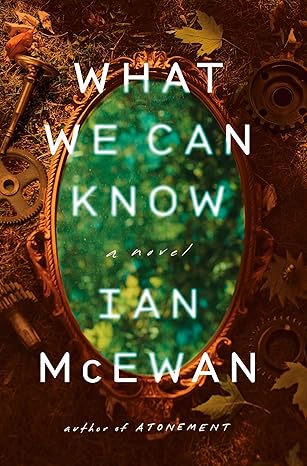
You might be wondering if the acclaimed literary writer Ian McEwan, whose most famous novel is Atonement, has become a science fiction writer. His last novel, Machines Like Me, was about a robot. His new novel, What We Can Know, is set in the year 2119. Many reviewers suggest that What We Can Know is about life after climate change. I don’t think it is, nor do I think it’s a science fiction novel. If anything, What We Can Know is a literary mystery, one that I enjoyed reading a great deal.
I think it’s perfectly fine to categorize this novel as science fiction, but many science fiction fans will be disappointed if they read it. Some reviewers call the novel dystopian. That’s bogus, too. Sure, between our times and 2119, there were nuclear wars, and worldwide flooding has left Britain an archipelago of islands. But those are inconsequential to the story.
The plot of What We Can Know is simple. Tom Metcalfe, an academic and writer living in England in 2119, is writing a nonfiction book about a lost poem that was read at a party in 2014. Metcalfe wants to write a whole history of this poem, but he can’t find a copy. He knows a fair amount about “A Corona for Vivien” because of biographical research on all the people at the party. Wikipedia defines a corona as:
A crown of sonnets or sonnet corona is a sequence of sonnets, usually addressed to one person, and/or concerned with a single theme. Each of the sonnets explores one aspect of the theme, and is linked to the preceding and succeeding sonnets by repeating the final line of the preceding sonnet as its first line. The first line of the first sonnet is repeated as the final line of the final sonnet, thereby bringing the sequence to a close.
Hell, I’d love to read such a poem too.
“A Corona for Vivien” has been missing for over one hundred years. Finding it would be a triumph for Tom’s career and make his book a bestseller.
Notice that Tom doesn’t worry about the condition of the world after drastic climate change and nuclear wars. He’s obsessed with Francis Blundy, the poet, and his wife Vivien. Like many literary scholars, he romanticises the time period of his study, the 2010s. For years, Tom has followed every clue he could find about the dinner party where the poem was read and the guests who heard the only known reading of the poem.
What We Can Know reminds me of Possession by A. S. Byatt and The French Lieutenant’s Woman by John Fowles. McEwan’s novel isn’t as complex or as delicious as those two, but it does feel like historiographic metafiction.
One of the fun aspects of this novel is that it’s about people from the future reflecting on our times. Science fiction is usually about reflecting on future people. This gives McIwan a chance to comment on us. Some of that commentary is satire, but with a deft light touch. People in Tom’s time called the changes caused by climate change the derangement. They marvel at our excesses and lack of regard for the future. But on the other hand, there are people like Tom who see us living through glory days.
What We Can Know also reminds me of the recent biography Red Comet: The Short Life and Blazing Art of Sylvia Plath by Heather Clark. I haven’t read it, but my friend Mike has been reading it for weeks and he’s been telling me about it. It’s about a literary circle of egocentric poets. Francis Blundy and his friends are also a famous literary circle of poets and writers with tremendous egos.
I loved listening to What We Can Know. Yes, it did ocassionally thrill my science fiction bent with a few asides, but it mainly entertained because it was about a literary circle. I love reading about The Beats, The Bloomsbury Group, writers of The Lost Generation, The Transcendentalists, the German Romantics, and other literary groups.
Now, if that’s your cup of tea, then get the book. But if you’re a science fiction fan who enjoys a well-imagined future, I think you will be disappointed. This novel isn’t about a post-apocalyptic world but poets and biographers.
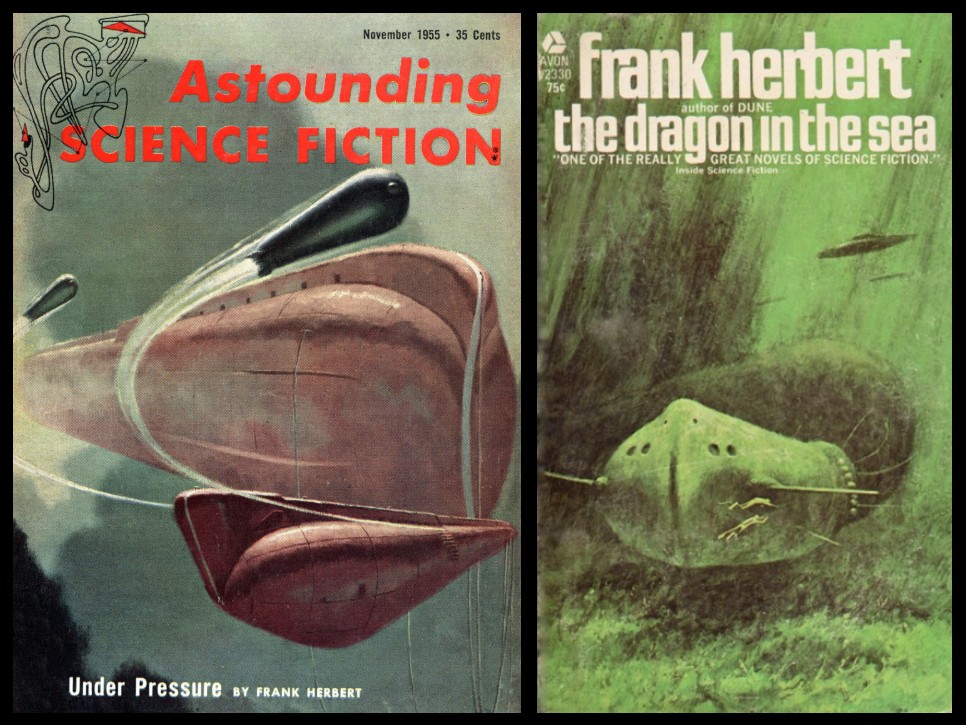
I’m not sure I can recommend The Dragon in the Sea by Frank Herbert, even though I enjoyed reading it. If Herbert had not become famous for Dune, I’m not sure it would be in print today. The story, written in the early days of the Cold War, portrays a future where the United States steals oil from the Soviets using submarine tugboats. Most of the novel takes place in one of these four-man subtugs. The plot feels more like an early political techno thriller than science fiction. It’s the kind of adventure story aimed at male readers that was usually published in men’s magazines in the 1950s. Those old nudie mags ran a lot of fiction.
The Dragon in the Sea is terribly dated on several levels. That’s ignoring the silliness of a submarine towing a giant plastic bag that holds millions of gallons of crude oil. However, the characterization was intriguing. The primary point-of-view character, John Ramsey, is an undercover psychologist studying the captain, who also knows there’s a Soviet sleeper agent aboard. Because the crew suspects the psychologist is the spy, the story is driven by paranoia.
I read The Dragon in the Sea because of a review at Science Fiction and Fantasy Remembrance (Part 1, Part 2, Part 3). Herbert’s novel was titled Under Pressure when it ran as a serial in Astounding Science Fiction (November & December 1955, January 1956). I didn’t want to read another science fiction novel at the time because I had several nonfiction books I was anxious to read. But Brian Collins’ review intrigued me. Collins is one of several bloggers who review old science fiction. His focus is on reviewing stories from science fiction magazines, something I also do. We’re part of an extremely tiny subculture that remembers a rather obscure art form.
The way Collins described the conflict between the four men in the submarine made me think of Rogue Moon by Algis Budrys. Rogue Moon is a compelling read because of the tense conflict between two ego-driven men. However, Rogue Moon is solid science fiction, dramatizing the bizarre consequences of using a matter transmitter to explore an alien artifact that killed every living thing that entered it. In other words, Rogue Moon had more than just the battle of alpha males; it had some heavy-duty sci-fi.
I can feel y’all asking, “Why are you even reviewing this book? You’re damning it with faint praise.” Well, that brings me to the theme of this essay. Why do we choose the science fiction books we read?
Most people buy The Dragon in the Sea because they loved Dune and want to see what else Frank Herbert wrote. That’s one of my main reasons. The Dragon in the Sea is Herbert’s first published novel, so it’s an interesting place to start. Dune was the breakthrough SF novel in the 1960s. How did Herbert get there? I liked The Dragon in the Sea well enough that I now want to read one of Herbert’s novels that he wrote after Dune.
I’m also the kind of science fiction reader who prefers older science fiction, even if it’s dated. It’s not that I dislike current science fiction. I just enjoy the science fiction I grew up with more. Especially, from the era when science fiction books were under 300 pages. I don’t like trilogies and series, or giant novels. I love a standalone story that paints a great science-fictional idea quickly. I read this sentiment fairly frequently online.
I have two other reasons for reading old forgotten science fiction that are less commonly expressed. I love reading old science fiction because I enjoy exploring the history of science fiction. And I love searching for old science fiction I missed in my youth, that might turn out to be a forgotten gem.
The Dragon in the Sea is no lost masterpiece. Brian Collins said he’s never seen a Frank Herbert novel for sale that wasn’t part of the Dune series. I have seen many over the decades, but have never tried reading one before. I’ve read Dune twice but not the sequels. It’s hard to imagine the man who wrote The Dragon in the Sea writing Dune. I will say that Herbert has a flair for drama and dialogue that was uncommon in science fiction in the 1950s. His first novel showed no talent for the kind of sense of wonder that made science fiction famous. To have an overabundance of that talent ten years later is amazing.
Interestingly, Herbert makes religion an essential aspect of his first novel. Religion made Dune epic. Herbert portrays Captain Sparrow in The Dragon in the Sea somewhat like Captain Ahab. The plot has the crew facing death time and again. They must kill or be killed. Captain Sparrow sees God as guiding and protecting them. The other two crewmen, Bonnett and Garcia, have become true believers because Captain Sparrow has always brought them home. Ramsey has a religious upbringing, but is not a believer. Yet, even though he’s a psychologist, Sparrow starts to get to him.
The story kept me reading because of the conflict between the characters and how Ramsey slowly became one with the crew. You end up liking all the men, even when they do unlikable things.
The men are under tremendous pressure. The previous twenty missions have failed. They expect to die unless they can uncover the secrets of the sleeper agent. But how can there be a spy among the three men who have worked together for years and are so dedicated to each other? They all profess to love their wives, but in reality, they love their job, their ship, their captain, and each other.
Now that I’m writing this, I realize how much more I liked this novel. It has many flaws, but I still found it entertaining to read. So did Brian Collins. Like Collins, I struggle to write reviews. He writes about his struggle in a post published after reviewing part 1 and before part 2, Under Pressure. (Remember, the links to all three parts of his review are above.) Collins does a much better job than I of describing the story.
It takes a lot of mental work to pinpoint why you like or dislike something. It’s easy to say, “I hate this” or “I love this,” but those statements are meaningless. You have to say why, and that’s hard, especially when you have to cite the context.
I could list a hundred novels and say, “If you haven’t read these yet, don’t waste your time on The Dragon and the Sea.” It’s not that good. But if you’re an old, jaded science fiction fan and are looking for something that might feel like good old-timey SF, then The Dragon and the Sea might be worth giving a try.
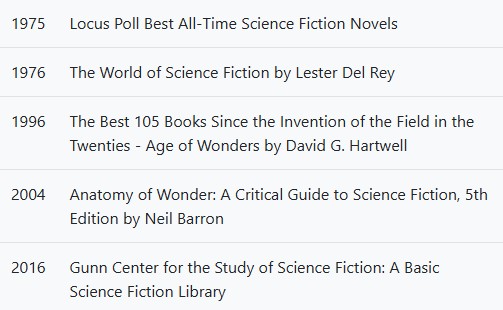
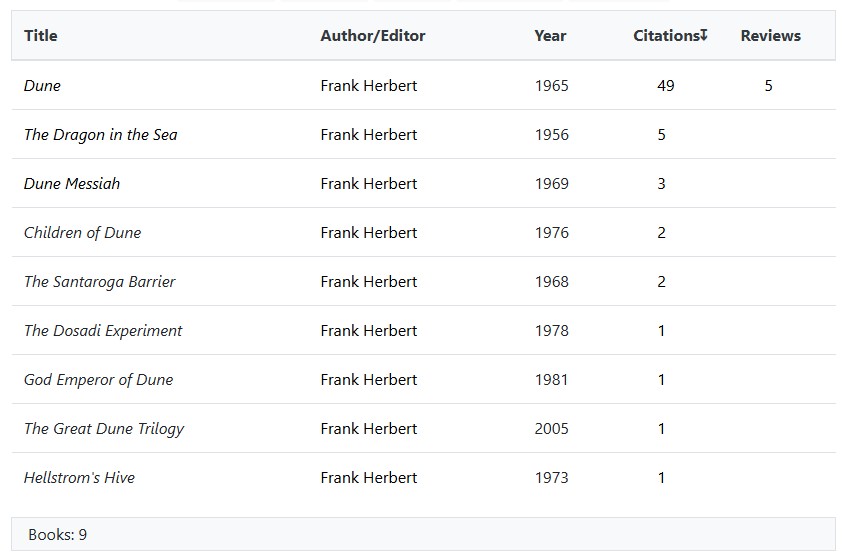
Checking our database, The Dragon in the Sea received five citations, the second most of Herbert’s novels. The citations were from:
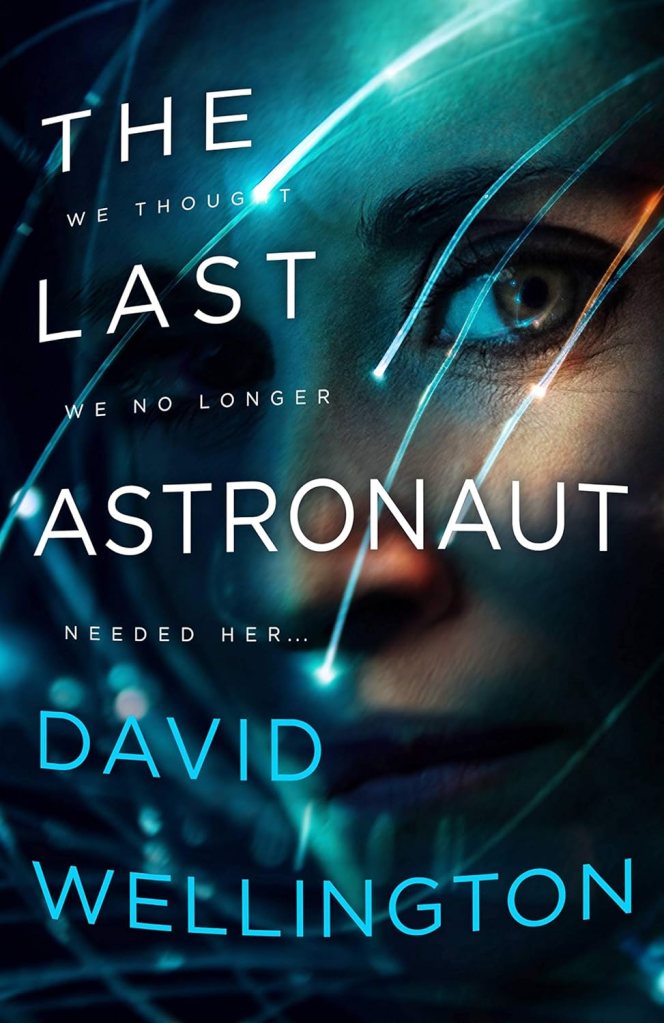
I don’t read many science fiction novels nowadays. I prefer SF short stories. I just don’t read as many books as I used to. However, after my friend Laurie told me about The Last Astronaut by David Wellington, I decided to give it a try. The Last Astronaut is the kind of science fiction thriller that Michael Crichton used to write — fast pace, lots of physical action, and basically fun. The Last Astronaut reminded me how entertaining reading a novel used to be. I wouldn’t call it great, but it does have that page-turning quality.
Now I do have some things to say about it, but what I have to say is full of spoilers. I recommend you go read the novel and then come back here, if you can remember. The Last Astronaut made me think about how science fiction novels change over the years, and how each generation retells old themes in new ways.
The Last Astronaut is about a Big Dumb Object. That’s the official name of a specific science fiction plot device. When I started reading The Last Astronaut, I immediately thought of Rendezvous with Rama. In 2020, The Last Astronaut was nominated for the Arthur C. Clarke Award. Wikipedia even says, “Edward Guimont and Horace A. Smith propose that the origins of the Big Dumb Object trope can be found in H. P. Lovecraft’s novellas At the Mountains of Madness and The Shadow Out of Time, both of which feature human expeditions to immense ancient alien cities in remote parts of our world, and both of which were early influences upon Arthur C. Clarke.”
Funny that they mention H. P. Lovecraft. Because I also thought of Lovecraft while reading The Last Astronaut. Wellington’s novel features horror. Horror like the film Alien, but also horror like Lovecraft’s monstrous alien gods.
The setting, inside the vast alien spacecraft, is dark. Having a story set almost completely in darkness reminded me of Jules Verne’s Journey to the Center of the Earth and The Night Land by William Hope Hodgson.
I’m finally reminded of another story/movie, Fantastic Voyage by Isaac Asimov, along with “Finisterra” by David Moles. This last reminder should give you one huge clue to what’s happening in The Last Astronaut. But I did warn you about spoilers.
My point in this essay is that science fiction is seldom original anymore. The Last Astronaut feels like David Wellington took several of his favorite science fiction themes and blended them into a new SF novel. It succeeds well. I had a lot of problems with the characters because I felt their psychological motivations were too contrived. However, Wellington does use those contrived motivations to wrap up his novel. The ending does make sense and is satisfying.
I was entertained by how Wellington told his story. Wellington places himself in the book as an author in the future, writing a historical novel, but a history that hasn’t happened yet. It’s amusing that one of his characters criticizes the future Wellington for getting his facts wrong. Since we know the story is based on history, there are clues as to who survives and who doesn’t. The audiobook is especially nice because they rig up the audio so that interviews of characters taken after events sound different.
In the 40s and 50s, science fiction writers aimed to create new ideas and themes, but their stories were told without sophistication. In the 60s and 70s, SF writers added literary techniques to their stories. In the 80s and 90s, SF writers upped the ante by going epic. Hyperion is a great example. In the 21st century, SF writers have had to constantly find new ways to tell stories that have already been told.
If you haven’t read old science fiction, new science fiction seems novel. If you have read old science fiction, new science fiction feels recycled. That’s not a bad thing, but it makes the stories feel baroque when you cram so many old ideas into one story. Wellington does streamline his novel, so it feels action-packed like old science fiction. In some ways, his storytelling is as speedy as Edgar Rice Burroughs’ stories or pulp fiction.
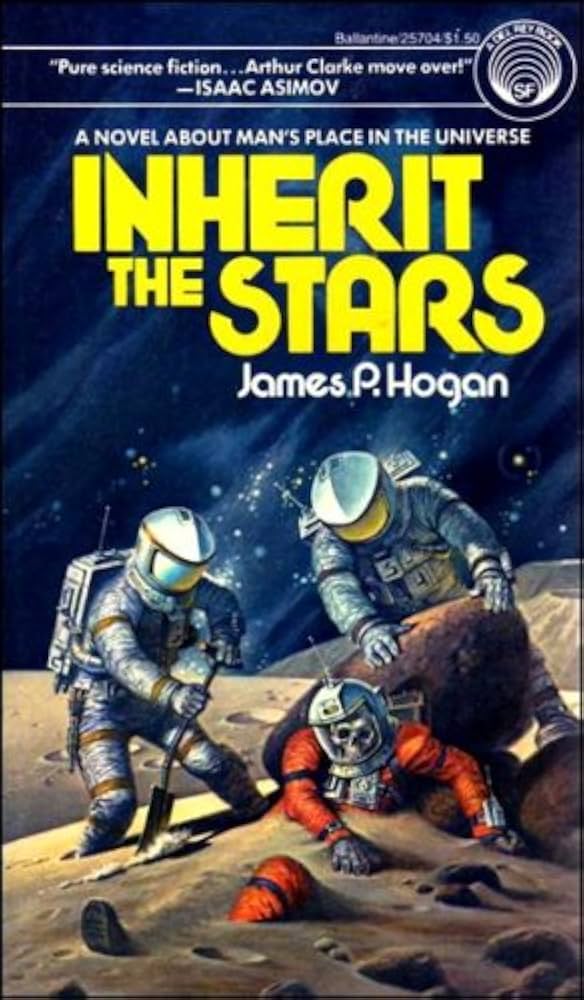
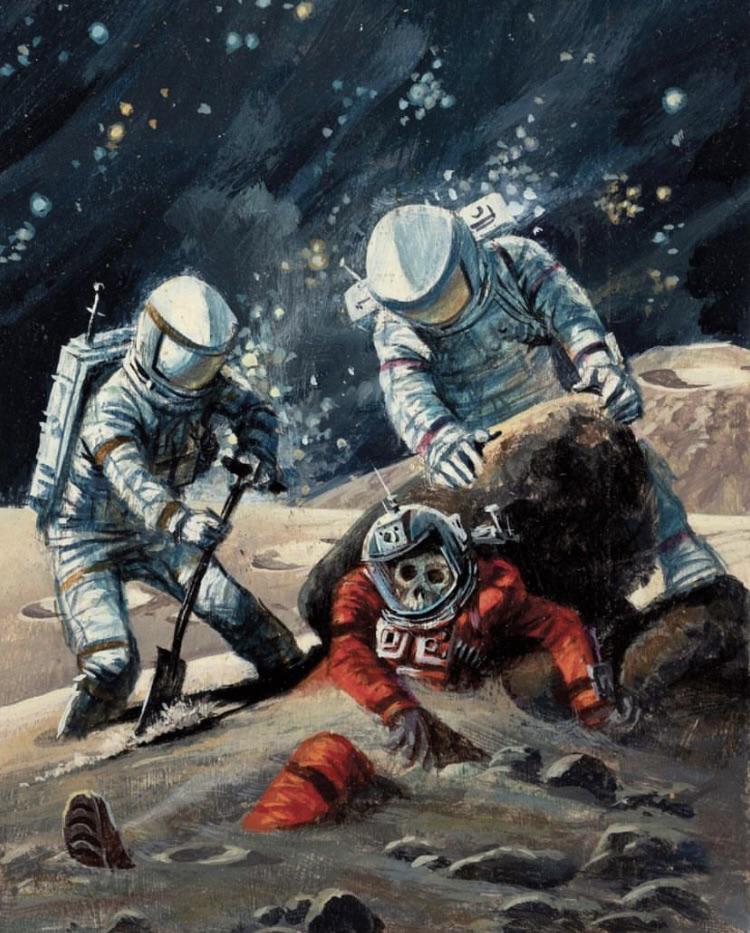
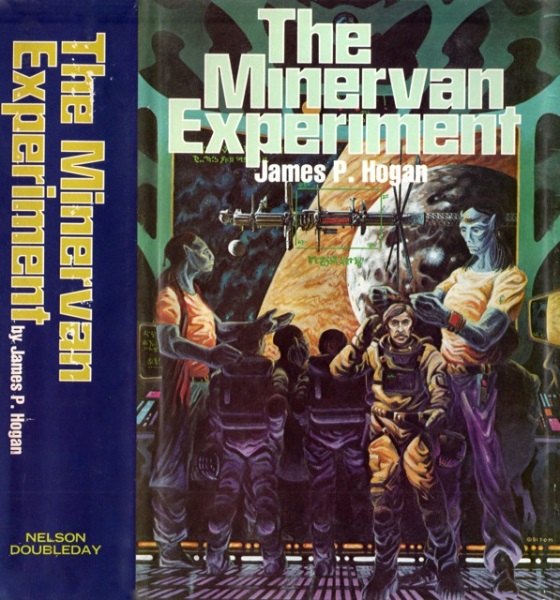
The original paperback, Inherit the Stars by British writer James P. Hogan (1941-2010), had a terrific cover – the kind that made you buy the book. The artwork appears to show astronauts on the Moon finding a dead astronaut, but that is deceptive. Hogan creates a scientific mystery because the dead astronaut has been there for 25,000 years.
I first read Inherit the Stars in 1992 but after seeing Whitney’s review on YouTube, I wanted to reread the story. I went to Amazon but couldn’t find the book. Was it out of print? I did find it on Audible. Later, I discovered that Inherit the Stars and its sequel The Gentle Giants of Ganymede are now being sold together as The Two Moons for the Kindle. A bargain for $6.99, especially since Whitney also praised the second book. It turns out that there are five books in the series being sold as three Kindle editions. The series is called Giants. Only the first three novels are available on Audible. The Science Fiction Book Club once published the first three novels as The Mirnervan Experiment. Ballentine also published a paperback called The Giants Novels that contains all three.
Before anyone rushes out to buy Inherit the Stars, I need to describe it more, but not enough to give spoilers. Hogan’s story is the kind you want to figure out for yourself. It kept me guessing for the entire novel even though I had read it before. That worried me. Why wasn’t it more memorable? Was that an indication it was a bad book? I don’t think so. How the story is told isn’t very memorable, but the ideas are big-time fun. I did remember some of those, but not connected to the book.
Inherit the Stars is basically scientists talking about one mystery after another. There’s no real plot. A lot happens, but it’s not dramatic. With each discovery, there’s a new puzzle, which makes you think and try to guess what caused each mystery. Inherit the Stars is science fiction focused on ideas and not storytelling. I’ve told you the first mystery, but I don’t want to give away any others.
However, I will give you some fun clues. Inherit the Stars reminds me a lot of Rendezvous With Rama by Arthur C. Clarke. Hogan’s prose is similar to Clarke’s. At one point, the story reminded me of the classic short story “Omnilingual” by H. Beam Piper. The novel also triggered memories of Gateway by Frederik Pohl. At other times it reminded me of the Winston Science Fiction, a series of young adult SF that came out in the 1950s, especially the entries where the protagonists find relics of ancient alien technology. If you love alien archeology stories, you might like Inherit the Stars.
I call Inherit the StarsPre-NASA Science Fiction, by which I usually mean science fiction written before Mariner 4 photographed Mars in July 1965. Until NASA started exploring the solar system with robotic probes, many people hoped that we would find life, even intelligent life somewhere on other planets in our solar system. For example, Heinlein’s Stranger in a Strange Land from 1961 imagines Mars being inhabited by a dying race. However, after Mariner 4, serious science fiction assumed we were alone in the solar system. (I must admit, that I still love Pre-NASA science fiction. Growing up in the 1950s and 1960s, I desperately wanted us to find Martians.)
I consider Hogan’s 1977 Inherit the Stars Pre-NASA Science Fiction because Hogan maintains the hope that we had neighbors. However, some readers might feel Hogan’s ideas might come across like those of Erich von Däniken, who wrote Chariot of the Gods? Another reviewer dismissed this book as unbelievable. Personally, I find Erich von Däniken’s theories to be insulting to humanity. But I consider Hogan’s speculation to be great science fictional fun.
Most science fiction stories seem to go stale after a couple decades. This week, I listened to The Heads of Cerberus by Frances Stevens, initially published 106 years ago. The story had passed its expiration date decades ago, but I still found it mildly enjoyable as a historical curiosity.
If you’re not fascinated by the evolution of science fiction, I’ll understand you leaving this essay now. The Heads of Cerberus is not a forgotten classic. It gets points for being an early example of time travel and dystopian fiction written by a woman, but it’s not a good example. At best, it’s a sample from 1919, the kind that MIT Press is reprinting in its Radium Age science fiction series.
Gertrude Barrows Bennett (1884-1948) published several fantasy and science fiction stories between 1917 and 1923 as Francis Stevens. This makes her a pioneering author in the pre-Amazing Stories era, especially as a woman writer, but she is practically forgotten today. I just learned about Francis Stevens by reading a two-part review of “Sunfire” on Science Fiction and Fantasy Remembrance (Part 1, Part 2) by Brian Collins. That review inspired me to research her, and what I learned inspired me to read The Heads of Cerberus.
The Heads of Cerberus was first serialized in five 1919 issues of The Thrill Book. It was first printed in hardback in 1952. It’s been reprinted at least a dozen times since.
I listened to a free copy on LibriVox. There are several public-domain ebook editions available, here is one at Gutenberg Australia. Lisa Yaszek who edited The Future is Female! series for theLibrary of America recently published a collection of Francis Stevens’ stories at MIT Press Radium Age series called The Heads of Cerberus and Other Stories. Gertrude Barrows Bennett is getting rediscovered. However, she’s been rediscovered before, it just never sticks.
The Heads of Cerberus is about three people from 1918 Philadelphia traveling to Philadelphia in 2118. Bob Drayton is a disbarred lawyer. Terry Trenmore is his Irish friend who is a powerfully built giant. And Viola Trenmore, Terry’s beautiful little sister, and just seventeen. In 2118 they find a dystopian society run by a handful of weird characters. The story is painfully simple, although I enjoyed it somewhat. The fun in reading these old science fiction tales is not the storytelling, but seeing how people imagined science fictional ideas before the concept of science fiction was invented.
The 19th century had several tales of people traveling to the future that could have inspired Bennett, each with a unique method of time travel. In “Rip Van Wrinkle,” Washington Irving has his title character sleep for twenty years after drinking potent liquor. Edward Bellamy had Julian West sleep for 113 years via hypnosis in Looking Backward. Frances Stevens has her characters jump ahead two hundred years by sniffing grey dust from a vial of mysterious ancient origins. The vial’s stopper is shaped like Cerberus.
As I said, The Heads of Cerberus isn’t very sophisticated. Its tone reminded me of the Oz books by L. Frank Baum, which were for children. Those books were often about ordinary people meeting extraordinary beings in strange places. Bennett’s imagined future is minimalistic, and somewhat goofy, reminding me of Alice’s Adventures in Wonderland. However, Stevens lacks the creative imagination of Baum and Carroll.
Edward Bellamy created a complex economic system for his future society that inspired many readers in the 19th century to form over five hundred Nationalist Clubs based on socialist ideas in Looking Backward. Francis Stevens imagines an economy based on the number of hours worked. Her society was ruled by an elite called The Superlatives. Ordinary people didn’t have names but numbers, and the Superlatives had names based on cardinal virtues like the Loveliest, The Bravest, the Fastest, the Strongest, etc.
The main problem with Stevens’ science fiction is her future society isn’t a philosophical idea she believed in or promoted, but merely conjured up quickly to fit a plot. Bennett was a young widow, with a child and mother to support after her dad died. She was a stenographer but made extra money by writing for the pulps. She quit writing after her mother died. The Thrill Book that serialized The Head of Cerberus was a low-paying market, but Stevens sold three novels to Argosy, a much-admired pulp after it. They were Claimed, The Citadel of Fear, and Possessed: A Tale of the Demon Serapion. Even though they are dark fantasies, a genre I’m uninterested in, I should try one to see if her writing improved. Her first serial, The Labyrinth, was to All-Story in 1918, another legendary pulp.
I haven’t been reading science fiction lately. After years of gorging on the genre, I’ve suddenly had enough. I still have the urge to read SF, but I’m having trouble finding science fiction I want to read. I have quite a large TBR pile but none of its titles interest me. I’m in the mood for something different, but after reading thousands of science fiction novels and short stories, finding something different isn’t easy.
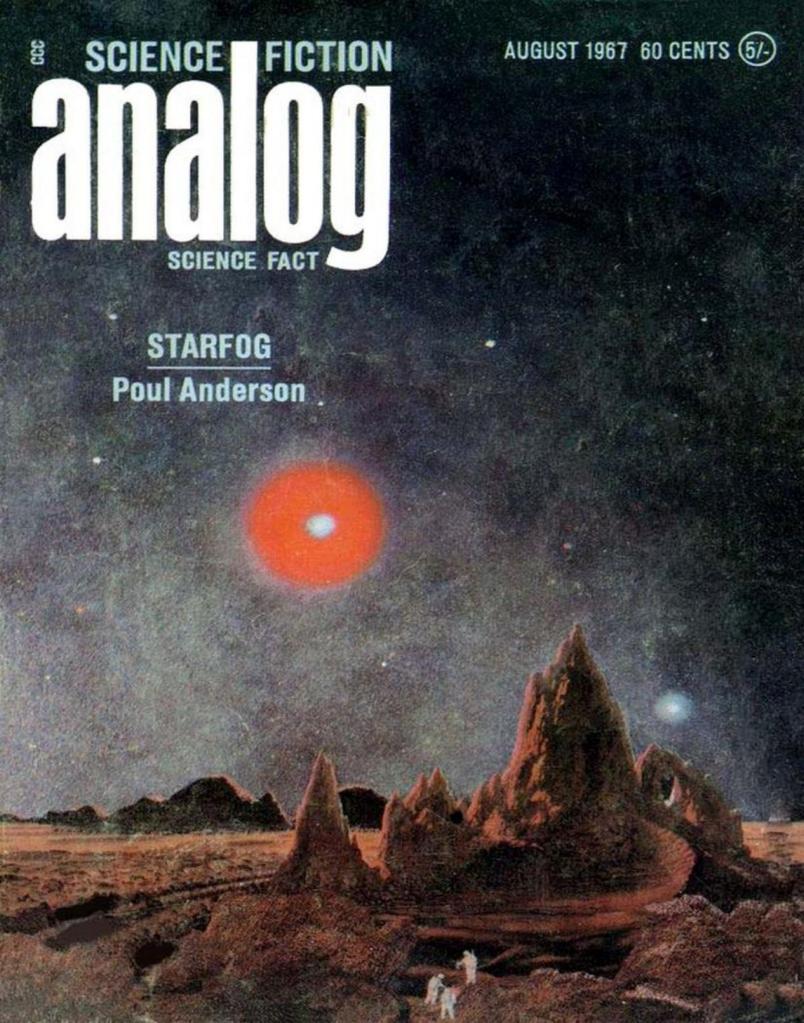
Has anyone read the Technic Civilization books by Poul Anderson? Yesterday, I was testing out a program to view old pulp magazines on my Mac and I randomly picked the August 1967 issue of Analog. It had a cover story for “Starfog” by Poul Anderson. I started reading it. I’ve only read a handful of Anderson’s novels and short stories and always avoided his book series. I avoid series books in general. I started reading “Starfog” and decided it was exactly something I’ve always avoided, so maybe it will be different.
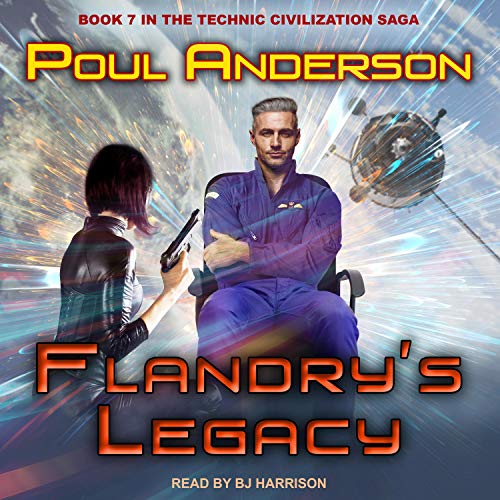
But I wanted to hear the story. After some research on ISFDB.org, I discovered “Starfog” was included in Flandry’s Legacy, Book 7, the last volume of the Technic Civilization series. I only had three Audible credits left, but what the heck, I decided to give it a try. “Starfog” is a novella, but Book 7 includes three novels, three novellas, and one novelette of stories in the series. This could be a tremendous bargain if I like the series.
I’ll let you know what I think — hopefully soon. The other inspiration I had to find something different came from a YouTube video. Bookpilled had a moving account of discovering the books of Barry Malzberg just before he died. I have read a couple of Malzberg books and they were so-so. But he was very prolific and Bookpilled has convinced me I should give Malzberg another try. So I’m reading about his novels. I did have a few emails from Barry, and he recommended his horse racing novels and a couple science fiction novels. I’ve always found Barry’s books about science fiction more interesting. He was a sharp-tongue critic.
Maybe between Anderson and Malzberg, I’ll get back into science fiction. But things might be slow around here for a while. To be honest, I think the real world has gotten more science fictional than science fiction.
If you’ve read a science fiction story you feel is radically different from any science fiction you’ve read before, leave a comment below.
Science fiction is best when it’s full of wonder. When I first read The Time Machine by H. G. Wells, I was awed by the idea of time travel, but two other ideas wowed me even more. Wells got me to imagine future human evolution and posthumans, and he introduced me to the idea that the Earth would someday end. It was easier to imagine the Earth being created, but it was overwhelming to think about it dying.
Hothouse by Brian W. Aldiss is one of the great works of the Dying Earth subgenre of science fiction. There are various ideas about what constitutes a dying Earth setting. Some people consider it to happen when humanity dies off. I like to think it’s when the Earth is about to be destroyed. That’s the approach Aldiss takes in Hothouse. He tells us the Sun will go nova in a few generations, but Aldiss doesn’t quite take us to Earth’s death
Jack Vance’s famous novel The Dying Earth (1950) is set in the far future, too. The sun is nearing the end of its life, and the Earth and humanity have drastically changed. In The Time Machine, the Time Traveler visits the far future just before the sun, as a red giant destroys the Earth. In The Night Land (1912) by William Hope Hodgson, the Sun Is going dark, and humanity is almost gone.
Only Wells and Aldiss imagined the final productions of evolution. Olaf Stapledon pictures eighteen more species of humans coming after us in Last and First Men (1930). Aldiss imagines a variety of descendants for humanity in Hothouse, all exceedingly small. He also imagines the plant kingdom going bonkers, which reminded me of The Forgotten Planet (1954) by Murray Leinster. That novel was based on three stories, first published in 1920, 1921, and 1953. It was about a world we had colonized. Those explorers eventually evolved becoming tiny beings, competing with giant plants and insects for survival.
I reread Hothouse by Brian W. Aldiss because it was recently released in an audiobook edition on October 15, 2024. It’s a novel I’ve been waiting years to hear. I first read Hothouse in 1996 and thought it was an amazing story full of colorful imagery and adventure. I wanted to see it as a movie because of Aldiss’ powerful visual imagination. After I got into audiobooks in 2002, I wanted to reread all my favorite science fiction books by listening to them. I finally got my wish with Hothouse, with excellent narration by Nick Boulton.
In this fix-up novel, the sun is swollen, and Earth’s rotation is locked so only one side faces the Sun. The Moon trails the Earth’s orbit in a Trojan orbit that keeps it stationary in the sky. Earth is a riot of vegetation that has supplanted most of the animal kingdom. Humans have evolved into tiny beings one-fifth our size, while insects have grown monstrously large. Plants have mutated into countless strange configurations, including those that traverse between the Earth and the Moon on giant webs.
Hothouse is a fixup novel composed of five stories that appeared in The Magazine of Fantasy & Science Fiction in 1961.
“Hothouse” (novelette)
“Nomansland” (novelette)
“Undergrowth” (novella)
“Timberline” (novelette)
“Evergreen” (novella)
Hothouse was originally published in the United States as The Long Afternoon of Earth in a slightly abridged format. At the 1962 Worldcon, the five stories as a series won the Hugo Award for best short story. I prefer the forgotten American title, it’s more poetic.
I thoroughly enjoyed listening to this novel, but it didn’t have the impact it had on first reading. (Imagine watching The Sixth Sense for a second time.) Aldiss produces some wonderful science fictional ideas in this story, ones I won’t mention because that might spoil the story. This is one of those tales you should experience without knowing too much. The story feels like a children’s fantasy with all the funny names for evolution’s new creations, but I believe Aldiss was serious in trying to make it science fiction.
Think of the writing challenge of describing an impossible-to-imagine far future. Jack Vance pictured humans with magical powers as if evolution would eventually create them. Magic makes his Dying Earth stories fun, but not realistic. William Hope Hodgson imagined Earth in darkness where humanity clings to one giant city. I guess Clarke did that too. Aldiss imagines species descendants from us living in another kind of Garden of Eden, a very violent one. We could call it Darwin’s Eden, rather than God’s.
Hothouse is mostly a forgotten classic. I seldom meet people who have read it. Brian W. Aldiss’s reputation and back catalog aren’t well-remembered in today’s popular culture. Now that several of his books have been republished in audio, I’m giving him another chance. I hope other SF fans do too.
My favorite work by Aldiss is “An Appearance of Life” which I’ve reviewed three times. I keep hoping to find more Aldiss stories that impress me as much. Hothouse comes close. So does “The Saliva Tree.” Greybeard isn’t on the same level as those tales, but it’s still thought-provoking.
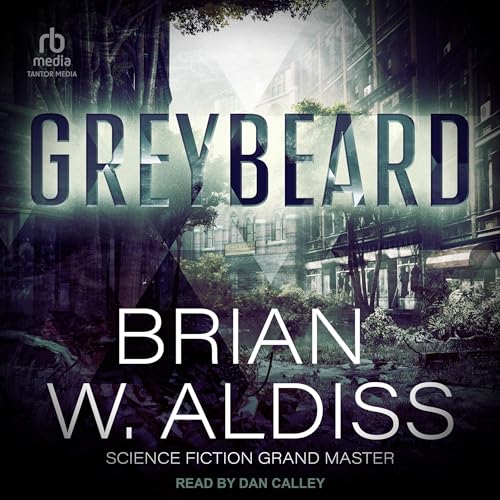
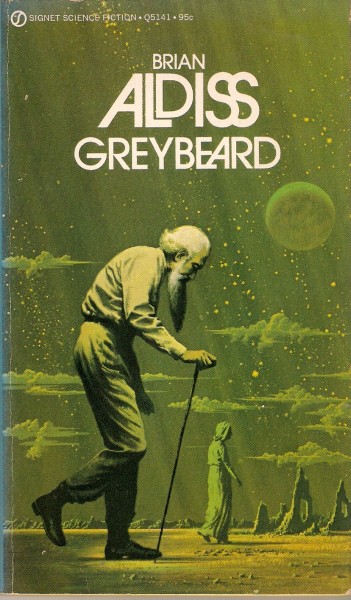
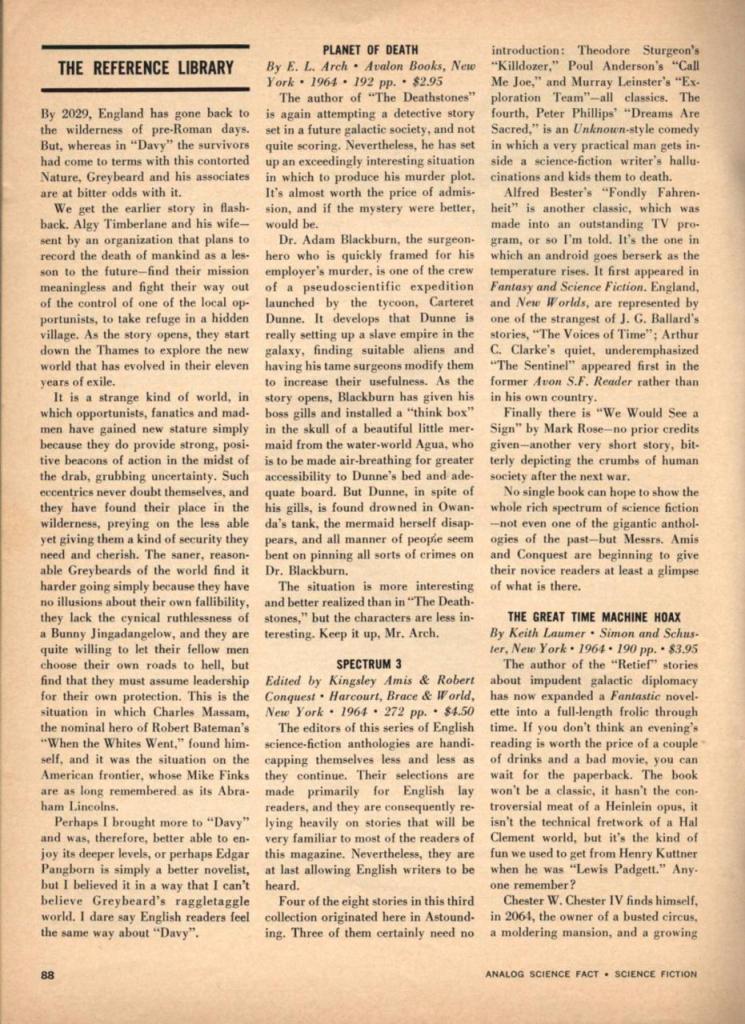
Greybeard is a 1964 post-apocalyptic novel by Brian W. Aldiss. It was reprinted as an audiobook by Trantor Media on October 15, 2024, read by Dan Calley. The ebook version is currently available for the Kindle for $1.99 in the U.S. Greybeard has an extensive reprint history. I heard about this novel back in the 1960s, but I’ve only become an Aldiss fan in the last few years, so I was excited when the audiobook edition showed up on Audible.com. Greybeard was one of the novels David Pringle admired in his Science Fiction: The 100 Best Novels (1985). That book is available for $1.99 for the Kindle too.
Greybeard is set in the 2020s, and is about the aftermath of atomic bomb testing in space in 1981, when the explosions altered the Van Allen radiation belt. Eventually, people learned “the accident” caused the human race to become sterile, along with certain other animals. In the story, everyone is old, waiting to die, and wondering what will happen after humanity is gone. This is a different premise for a post-apocalyptic novel, but Aldiss uses his tale mostly to toss out a ideas. The story lacks a compelling plot.
The characters are never developed to the point where you care about them. That’s a common problem of older science fiction, where characters were created mainly to present far-out science fictional thoughts.
The story’s main focus is on Algy and Martha Timberlane as they travel around England after the collapse, along with flashbacks of how they got together. Algy, short for Algernon, is called Greybeard because of his long beard. After the accident, during a period when kids were born with genetic defects, but before they stopped coming altogether, the world economies collapsed, which led to wars. As Aldiss points out, a lot of consumerism is targetted to babies, children, and young people, so certain businesses quickly went bust. But also, as people realized they had no future, many gave up on their ambitions, or even committed suicide.
The book is divided into seven chapter, each a different time and setting:
Chapter 1 – The River – Sparcot
Chapter 2 – Cowley (flashback)
Chapter 3 – The River Swifford Fair
Chapter 4 – Washington (flashback)
Chapter 5 – The River – Oxford
Chapter 6 – London (flashback)
Chapter 7 – The River – The End
The novel begins with rampaging stoats (ermine, short-tail weasel). This setting of England being taken over by nature reminded me of After London by Richard Jefferies, but Jefferies did a much better job describing how nature would overrun decaying cities, towns, and roads. After London is a superior post-apocalyptic novel, and one of the earliest
We first meet Greybeard and Martha who have been living for years in a tiny village, Sparcot, ecking out an existing through fishing and gardening. They live near a river surrounded by a barrier of brambles. When two boats arrive with refuges from another village, they hear about how the stoats are attacking everything including people. This reminded me of the stobors in Heinlein’s Tunnel in the Sky. Algy, Martha, and a few friends, flee in a boat Algy had hidden. They plan to float down the river to the sea.
The novel is about what they see along the way. It might be called a picaresque novel. Algy/Greybeard is a bit of a rogue, and we follow his episodic travels. At each stopping place along the river they meet folks living under different conditions. Swifford Fair seemed like something out of the Middle Ages. When they get to Oxford, they find a certain level of civilization has maintained itself around the old university. But in every location, there are wild beliefs about how things are, including lots of charlatans, thieves, and con artists preying on ignorant people. Rumors abound about children still being born, strange mutant beings living in the woods, or even fairy creatures of old returning.
Algy and crew meet a crazy old man on the river who tells them to find Bunny Jingadangelow in Swifford Fair because he can make them immortal. Bunny Jingadangelow shows up several times during this novel running different scams, including one as a messiah.
Greybeard isn’t a bad science fiction novel, but it’s not that great either. If I had read it back in 1968 when I first heard about it, I would have been impressed. But over the decades I’ve read a lot of post-apocalyptic fiction, and Greybeard just isn’t up to the standard of Earth Abides by George R. Stewart or The Road by Cormac McCarthy. I’d say The Hopkins Manuscript by R. C. Sherriff as one of the great post-apocalyptic novels about England to read first. In other words, there are a lot of post-apocalyptic novels you should read before spending time on Greybeard.
It’s a shame that Aldiss didn’t spend more time writing Greybeard because his premise is so good. I just finished the four-volume novel series by Elena Ferrante that begin with My Brilliant Friend. This is a true masterpiece, and future classic. Greybeard and most science fiction feel like starvation rations compared to that novel. Of course, Ferrante used 1,965 pages to tell her story, and Aldiss only used 237 on his story. Aldiss tried to develop the characters with flashbacks, but those flashbacks were mainly used to describe the world during the initial stages of collapse.
Ferrante created a compelling novel by showing how two girls evolve psychological and intellectually over a lifetime. That anchored the novel and gave it a page-turning plot. Aldiss never moors us in the story with anything we can anchor our attention. Richard Jefferies handled his post-apocalyptic London by using the first part of the book to explore ideas around the collapse, and then used the second half with a well-plotted adventure story. I enjoyed Greybeard enough to read it, but just barely.
I wish Aldiss had expanded his story to 400-500 pages and developed Algy and Martha, and found something to give the book a clear purpose. I can only recommend Greybeard to folks who read a lot of post-apocalyptic novels and enjoy studying them.
Aldiss imagines radiation causing a world of only old people. But we’re currently facing a depopulation crisis because most countries around the world aren’t producing enough babies. A country needs every woman to have 2.1 children to grow. Many women don’t want to have any, and one child is common. Theoretically, countries like South Korea can become like the world of Greybeard by the end of this centry. I wonder if any current writers are exploring that idea?
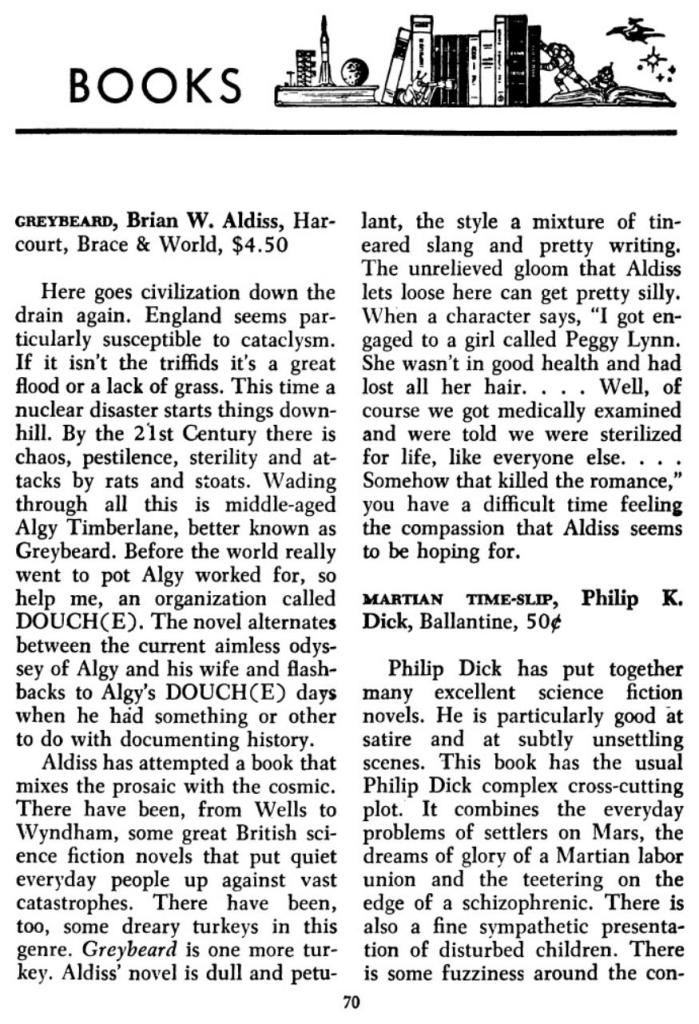
Ron Goulart didn’t like the story in his F&SF (Dec. 1964) review.
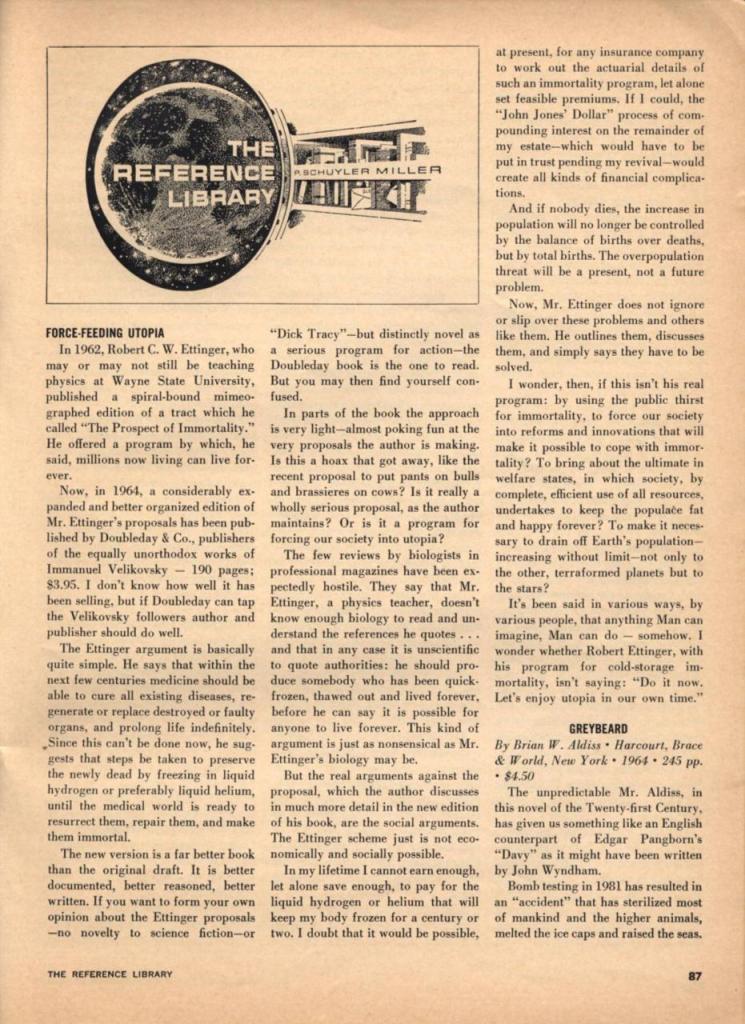
P. Schuyler Miller liked it a bit better, but not much, in his Analog (Feb. 1965) review.
Judith Merril in 1966, pointed out to F&SF readers that the original American hardback lacked some of the flashback scenes, and might like the story better in the Signet paperback, which included the full British edition.
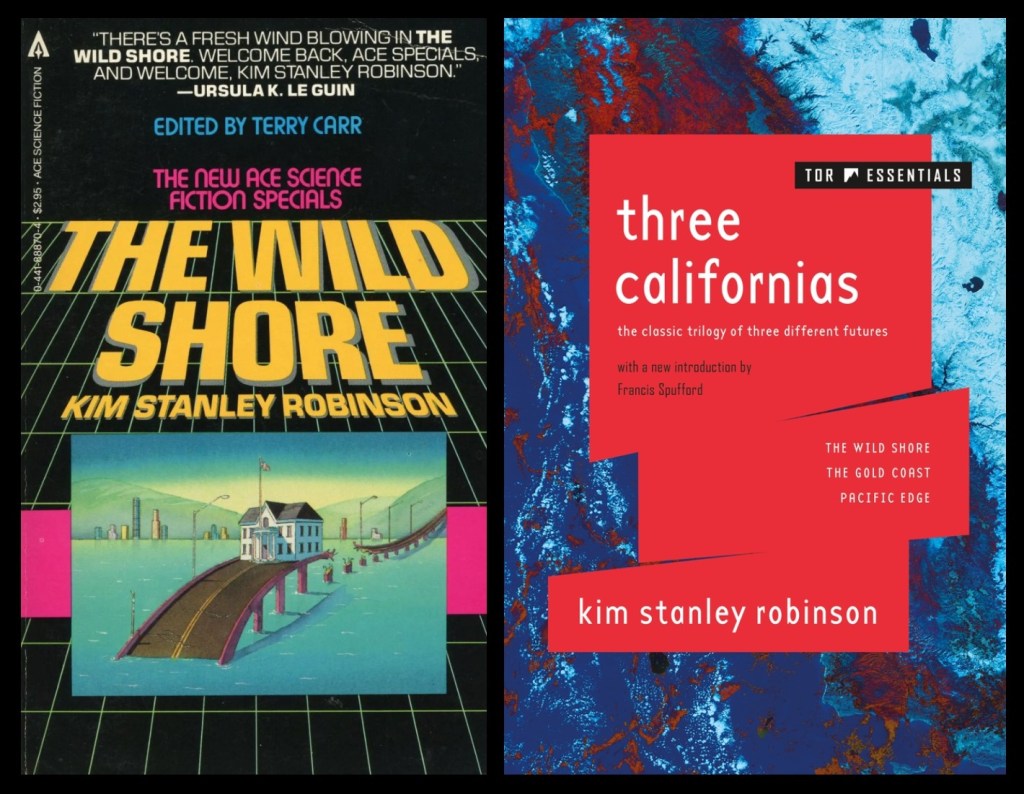
Unless you’ve recently become a fan of Kim Stanley Robinson, it’s unlikely you’ll be thinking about reading The Wild Shore. It was Robinson’s first published book back in 1984. The Wild Shore was impressive enough to be the first volume in Terry Carr’s third series of Ace Science Fiction Specials. But still, why would you choose to read a 1984 paperback original in 2024? I can’t claim it’s become a science fiction classic or it’s a highly distinctive take on its theme, which is post-apocalyptic, but it is a worthy read.
I’m a great admirer of Kim Stanley Robinson’s 21st century work because he explores the forefront of science fiction. However, his books don’t compel me to turn their pages. I seldom care for his characters, and I don’t get caught up in his plots. I like Robinson’s books for his insightful philosophical takes on our evolving genre. That was not the case with The Wild Shore. I did care for Henry and Tom, and I never stopped wanting to know what would happen. This book was different. Was it because it was told in first person? Or was it because it was a somewhat realistic post-apocalyptic novel, a favorite theme of mine?
I’m not sure if any post-apocalyptic novel is ever particularly realistic. I’m only separating the silly ones with zombies, mutants, aliens, and robot overlords with those novels which describe normal human life after things fall apart.
I had not planned to read another science fiction novel so soon after reading A Heritage of Stars. (I’m trying hard to read other kinds of books.) But two events intersected that led me to read The Wild Shore. Just as I finished Clifford Simak’s 1977 novel about a post-apocalyptic America, when I caught a YouTube review of The Wild Shore, a 1984 novel about a post-apocalyptic America. I immediately wanted to compare the post-apocalyptic vision by a writer born in 1904, near the end of his career, with the post-apocalyptic vision of a writer born in 1952 publishing his first novel.
Even though the novels came out just seven years apart, they are significantly different. Simak’s book is a science fantasy, not much more sophisticated than an Oz book. Robinson’s story is a literary coming-of-age in a post-apocalyptic world tale.
I’m becoming a connoisseur of apocalyptic fiction. I’ve read so many that I divide them into works covering different time periods. These are some of my favorites:
Stories that begin before the apocalypse
One in Three Hundred by J. T. McIntosh
The Death of Grass by John Christopher
The Last Man by Mary Shelley
Stories that begin during apocalypse
“Lot” by Ward Moore
Survivors (BBC TV)
Stories that begin days after the apocalypse
The Day of the Triffids by John Wyndham
The Quiet Earth (film)
The World, The Flesh, and The Devil (film)
Stories that begin weeks or months after the apocalypse
Earth Abides by George R. Stewart
Stories that begin years after the apocalypse
Station Eleven by Emily St. John Mandel
The Postman by David Brin
Stories that begin generations after the apocalypse
The Long Tomorrow by Leigh Brackett
The Wild Shore by Kim Stanley Robinson
Stories that begin centuries after the apocalypse
A Canticle for Leibowitz by Walter M. Miller, Jr.
A Heritage of Stars by Clifford D. Simak
After London by Richard Jefferies
Stories that begin in the far future
Hothouse by Brian W. Aldiss
I think we should contemplate why post-apocalyptic stories are so popular. If I listed all the ones I knew about from books, movies, and television shows, it would be a painfully long list. Shouldn’t we psychoanalyze ourselves over this? It’s my theory that we’re attracted to post-apocalyptic settings because we feel like we’re living in pre-apocalyptic age.
There’s a telling point about most post-apocalyptic stories – the cause of the apocalypse usually kills off most of the population. Doesn’t that suggest we want to live in a world with fewer people? I believe we’ve been living through a slow developing apocalypse our whole lives caused by overpopulation. People laugh at The Population Bomb, a 1968 book that predicted famine that didn’t happen. However, back in the 1960s I remember reading about experiments with rats and overpopulation. As rats were forced to live with more of their own kind, they started going crazy, attacking each other, and causing universal stress.
Most of the problems we face today that will shape our future are due to there being too many of us. Of course, economists are freaking out now because of dropping birth rates, but that’s only because capitalism is a Ponzi scheme they desperately need to keep going. But this book review is not the place to go into details about all the detrimental effects of overpopulation. Let’s just say that the emotional appeal of reading stories where there are fewer people resonate at a deep psychological level. Just look at all the people who want to return to the 1950s, when the population was less than half of what it is today. Or they dream of rebooting society without all the people they dislike.
This begs the question: What will society be like if we had to start over? Most post-apocalyptic novels are merely action-oriented stories that let readers vicariously run wild in a lawless society. They don’t address societal collapse seriously. I think novels like Earth Abides by George R. Stewart, Station Eleven by Emily St. John Mandel, and The Wild Shore by Kim Stanley Robinson do – to a small degree.
The Wild Shore describes growing up in a small community of about sixty people in San Onofre, California, about halfway between Los Angeles and San Diego. The story is told from the point of view of a young man, Henry “Hank” Fletcher, and his friends. The setting is a small pastoral valley near the ocean where people live off small-scale fishing and farming. The year in 2047. Back in 1984, the United States was mostly destroyed by thousands of neutron bombs, which produced low radiation but caused lots of destruction. Survivors creates thousands of little communities each finding their own unique way to survive.
Henry and his teenage friends are third generation post-apocalypse, who admire an old man, Tom, who was born before the apocalypse. Tom claims to be over 100. He has become their mentor and teacher. The young men mainly fish, while the young women farm. It’s demanding work during the day, but they study with Tom after work. He has taught them to read and tells them tales about the old days. Henry’s best friend Steve Nicolin is desperate to get away from home and his domineering father. Steve pushes Henry into actions that propel the plot.
Tom is an unreliable mentor, but Henry and friends don’t know that, and neither do we at first. For example, Tom tells Henry and his friends that Shakespeare was an American, and England was part of the United States. Tom knows there were both good and bad things about the pre-apocalyptic world, but he has glorified American life before the bombs. Henry and Steve, want to rebuild that America, but don’t know how. Like most young men they are anxious for adventure, and resent the grueling work required for daily survival.
Then one day a group of men from San Diego, led by Jennings and Lee, show up and invite people from Henry’s small community to visit their large one in San Diego. They tell Henry’s community they came by train. It turns out their train is two handcars, those little cars that are people powered. In San Diego they are shown many marvels of reconstruction.
Henry is impressed with what the San Diegans have created for themselves. San Diego’s success is due to a strong man named Danforth who his followers call the mayor. Danforth even has a political slogan: Make America Great Again. (I kid you not.)
The mayor tells Henry and Tom he wants their small community to join his resistance movement. We learn that America was bombed by several countries, but not Russia, who resented our world dominance. The rest of the world have put the United States into quarantine, working to keep Americans from regrowing their power. Japan guards the west coast, Canada the east coast, and Mexico the Gulf Coast. The Japanese command is stationed on Catalina Island off Los Angeles. The mayor wants to get as many Americans as possible to fight them.
Now, this world building is not the true focus of The Wild Shore. In fact, I considered it unrealistic speculation. However, Robinson needed a reason for Henry and Steve to want to leave their community and join a big cause. The book is about growing up in a post-apocalyptic world, and to a degree it realistically speculates about such a life. For example, Robinson imagines that some people would try to survive off what was left in the cities, and others would fish, farm, herd, or ranch, and there would be a conflict between the scavengers and the back-to-the-land folks. I think that’s realistic. He also imagines that strong men like Danforth would consolidate power. And I think that’s realistic too. But the whole plot conflict with the Japanese is not something I bought.
The real value of this story is how the boys grow up. And it’s especially about how they learn from Tom. Eventually they discover that Tom doesn’t know everything, but that’s part of the story too. I feel the mentoring relationship was realistically developed, and what I admired most in The Wild Shore. However, in the end, the novel never achieved the impact of Earth Abides or Station Eleven. At least not with my first reading. It might be in the same league as The Long Tomorrow by Leigh Brackett, but I haven’t reread that one in decades.
Robinson does a lot of speculation and extrapolation that I need to think over. For example, people return to whaling because they use whale oil for lighting. We find whaling repugnant, but whale oil made a significant impact on 19th century America because it was a superior lighting source over candles. Robinson has his America with no form of mass communication. The San Diegians dream of repairing a radio, but so far can’t. Would such technology disappear in 60 years? In the story, much of what we use disappears. In this story, printing is just starting to make a comeback.
One of the most important insights from Earth Abides is we won’t be able to teach the next generation everything they need to rebuild a technological civilization immediately. Isherwood, a former university professor and the Tom of Earth Abides, realized that teaching literature and mathematics to kids who had to work hard just to eat would be nearly impossible. In the end, he understood that he had to teach the next generation things they could readily assimilate and use. So, he taught them how to make bows and arrows to help them hunt food.
Robinson tries to explore what useful knowledge Tom could convey to Henry and his friends, but that theme gets sidetracked by the boys chasing after the anti-Japanese resistance movement. I felt that plot was unrealistic. Robinson could have just kept the conflict to just between the larger San Diegan community take over Henry’s smaller community, and that would have been realistic enough for me. Or the conflict could have been between those who lived by scavenging and those who farmed and fished. He did need a larger conflict for his plot, but I thought the resistance theme too big.
One of the fascinating things about post-apocalyptic stories, is how people live without news organizations and communication systems. To suggest that most of the world was keeping America at a tribal level to protect themselves is hard to believe. But if global civilization has collapse, it’s easy to believe that we could return to a tribal society. It all depends on how many people die in the apocalypse. Europe recovered from the Black Death, which killed up to half the population in many cities, but it survived and thrived.
Realistically, unless we were hit by an asteroid, or a plague with ten percent survival rate, we’re not going to drastically reduce our populations in single apocalyptic event. We could slowly fall apart until we de-evolved into a tribal state, but that might take centuries. A realistic post-apocalyptic world might be the one that’s emerging now as countries return to authoritarian rule, economies collapse, and weather ravages everything.
The Wild Shore is about how young people adapt to a post-apocalyptic world. The book might offer some insight into how things might be if the apocalypse was overwhelming, killing off 99% of the population. What happens when the apocalypse is slow-acting, and reduces the population slowly, which slowly forgets all the technology? We can see this is many countries around the world right now. So far, they have been smaller countries like Sudan, Colombia, or Afghanistan. But Russia and China don’t look too healthy right now.
If people are reading post-apocalyptic novels because they unconsciously feel we’re approaching apocalyptic times, shouldn’t they consciously start reading realistic apocalyptic novels that might help them anticipate new ways of living? The Wild Shore isn’t that realistic, but it does explore some issues about growing up in a post-apocalyptic world that might make it a worthwhile reading. I do recommend giving it a try.
Some preppers have written post-apocalyptic novels, but they are generally about guns and surviving in the early days after the collapse. I don’t think we should expect a Mad Max society. Iraq, Syria, Haiti, El Salvidor. and Afghanistan are great examples to study if you want to write a truly realistic post-apocalyptic novel, or you want to become a prepper. Being a lone wolf with a AR-15 is as much of a fantasy as a zombie apocalypse.
Novels like The Wild Shore and The Long Tomorrow, or a TV series like the 1975 Survivors have more of a realistic ring to them, but only slightly so. The fall of Rome took centuries. A truly realistic post-apocalyptic novel would deal with a slow declining society and the apocalypse wouldn’t be so dramatic as an atomic war.
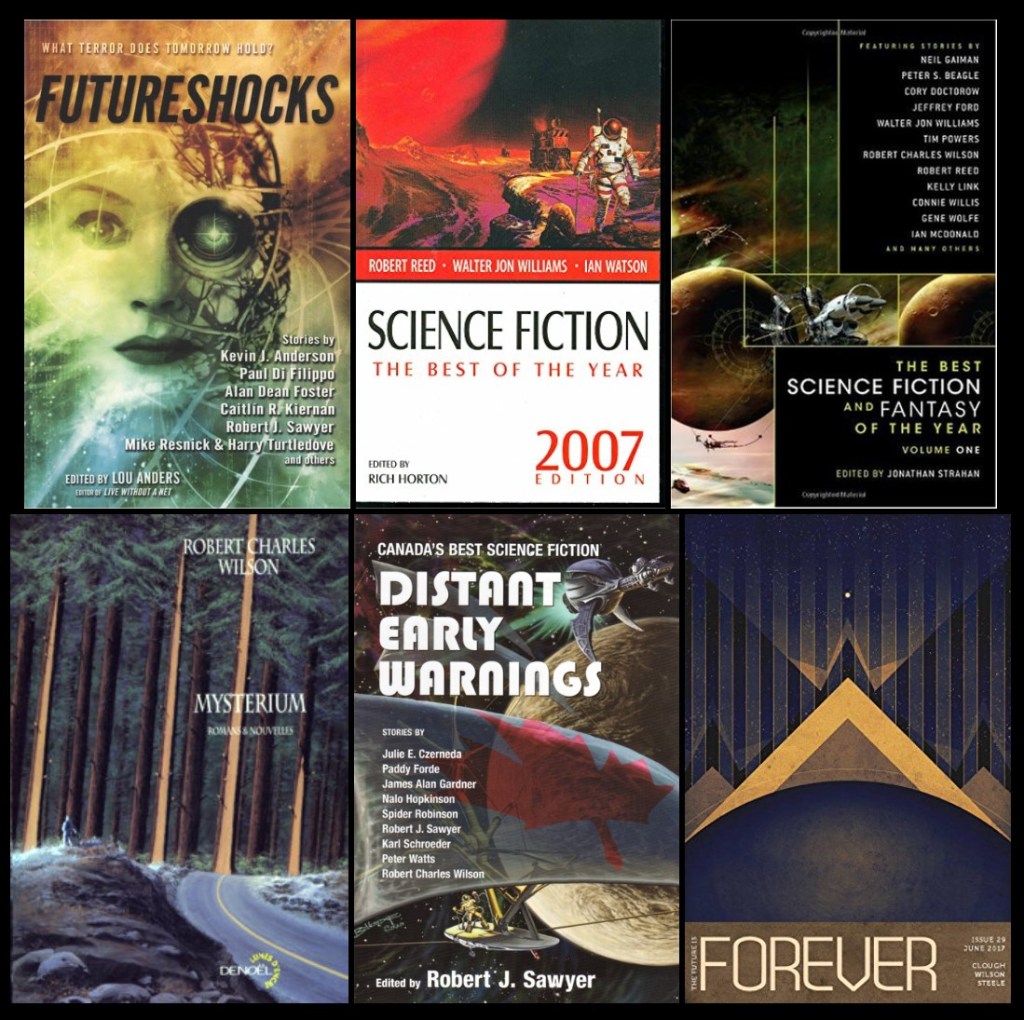
Today I read “The Cartesian Theater” by Robert Charles Wilson for our discussion group. That Facebook group is reading one story every Sunday from Science Fiction: The Best of the Year: 2007 edited by Rich Horton. I got a big kick out of “The Cartesian Theater” and wanted to hear it on audio. But when I went looking for an audiobook that included it, I couldn’t find one. Bummer.
My inner reading voice is nothing compared to the professional narrators who read audiobooks. I read “The Cartesian Theater” in Horton’s 2007 best-of-the-year anthology which I own in paperback. When I write about a story I like I want to help people find a copy to read. It’s always great when I can put a link to where it can be read or heard online. You can read the Horton anthology at Archive.org if you have set up a free account. You can read the Jonathan Strahan anthology for free if you subscribed to Kindle Unlimited. It’s $11.99 to buy that anthology for the Kindle. The one Wilson story collection shown above is a French edition. All those other editions will require tracking down used physical copies. For most people, this won’t be an easy story to find.
Most bookworms don’t read short stories, and short stories don’t make much money for publishers either. Short stories are a kind of training ground for novelists. Often when a writer becomes a success their short stories are collected, and even kept in print. And sometimes those collections have audiobook editions. If there was The Best of Robert Charles Wilson audiobook I would have bought it today. I would have also bought The Best of Charles Sheffield this week if it existed on audiobook. I did listen to my audiobook copy of The Best of Connie Willis twice this week to read “Even the Queen” and “Death on the Nile.” The narration was perfect for each, and I got so much more out of the story than when I just read them on paper.
The best narrators do voices for each character. That highlights the dramatic quality of stories that my inner voice doesn’t generate. But more than that, audiobooks are read much slower than my inner reading voice, sounding out every word, and that makes an enormous difference. When I read, I read too fast, often skipping words. I can’t help myself, I read too fast. I miss clues to what’s happening. Listening makes me pay attention to every word. And I’m very disciplined in my listening. If I miss something I hit the jump back button.
“The Cartesian Theater” is about a world where everyone lives on a guaranteed income and economic activity is driven by robots. People still make extra money, usually from creating something entertaining. (Picture everyone being a YouTuber or something like it.) In the story an anonymous rich person hires Lada Joshi to track down an elusive artist, Jafar Bloom, and offer to back a showing of his work with no strings attached. Joshi hires Toby Paczovski, an operative skilled finding people living on the dole who don’t want to be found. And then she had Toby find Philo Novembre, a retired philospher, to get him to attend the first showing of the “Cartesian Theater.” What Bloom has create is a device that proves something philosophical, something that science can’t prove. I don’t want to say too much.
Beside coming up with a nice gimmick for the premise of the story, Wilson creates an interesting setting, a setting that our world seems to be heading towards. AI and robots do most of the real work, pushing people onto the dole. The robots aren’t considered sentient. That’s the trouble with AI robots. If they ever become sentient we can’t make them our slaves. In Wilson’s society they seem to be on the cusp of awareness. Humans in this story also have a lot of smart technology that supplement their bodies. And in Wilson’s world, a certain amount of brain activity can be duplicated in machine. Toby’s grandfather is dead, but enough of his memories hang around so Toby can still talk to him. The whole story is a Cartesian theater. And it has a nice surprise ending I didn’t guess.
Is this story worth keeping in print? Should it be available for the Kindle and on Audible? I don’t know. Such publishing might be a money loser. Which short stories should be preserved? And which should we forget?
We also read “Georgia On My Mind” by Charles Sheffield which won the Hugo and Nebula awards for best novelette back in 1994. You’d think every award winner should be preserved. It is in a collection called Georgia On My Mind and Other Places which can be read on Archive.org or bought for the Kindle for $5.99. But no audiobook. It was originally published in the January 1993 issue of Analog.
I loved “Georgia On My Mind” even more than “The Cartesian Theater.” Sheffield uses a narrative structure that was common in the pulps before WWII, where a mystery is discovered in a far distant place on Earth. In this case New Zealand. The story is set in modern times. We seldom believe such mysteries are possible anymore. But in the old days, readers loved these setups where the story felt possible. In this case, in a rundown tool shed to an old farm house in a remote part of New Zealand, Bill Rigley finds pieces of Charles Babbage’s computer from the 19th century, along with old letters, and information about programming. The mystery is how did Babbage’s work get to New Zealand and why.
If you like a Weird Tales type of story, computers and computer history, and even a bit of recursive science fiction, then you should like “Georgia On My Mind.” I think Sheffield rush the story at the end. He should have kept the slow pace and followed through on the setup and made this story a novel. I dislike the title, but it fits the cutsy ending. However, I didn’t want a cutsy ending. Obviously, Sheffield didn’t want to write a whole novel, and wrapped up the story with a direct appeal to science fiction fans. I wanted a Weird Tales ending. Still, I got a big kick out of this story.
It’s sad to think these two stories will be forgotten. They just aren’t easy to find. I think what’s needed is for Audible to publish all the best-of-the-year anthologies, from 1939 to the present. That would put most great short SF in audiobook print. At least do the Asimov/Greenberg/Silverberg books covering 1939-1964. Then Wollheim from 1965 to 1990. The 14 Carr anthologies, and all the Gardner Dozois anthologies. Or get some young editor to create new anthologies for each year.
If Audible doesn’t want to keep best-of-the-year anthologies in print, I think they should at least put all the Hugo and Nebula winners and finalists in audiobook print. That would catch “Georgia on My Mind” but not “The Cartesian Theater.”
JWH
p.s. I haven’t been blogging as much lately. I’m just getting old and running out of energy. Finishing this short blog gave me a sense of accomplishment.





 Classics of Science Fiction