“Zero Hour” by Ray Bradbury

Zero Hour” by Ray Bradbury is story #30 of 52 from The World Treasury of Science Fiction edited by David G. Hartwell (1989), an anthology my short story club is group reading. Stories are discussed on Tuesdays, Thursdays, and Saturdays. “Zero Hour” was first published in Planet Stories (Fall 1947). The most famous place to read it is in Bradbury’s classic, The Illustrated Man.

I thought as I was reading “Zero Hour” this morning, “Hey, here’s a Bradbury story I haven’t read before!” Yesterday, I bought Bradbury Stories: 100 of His Most Celebrated Tales for $1.99 for the Kindle edition so I’d have his stories on my phone. That worked out well since I decided to read “Zero Hour” at 5:30am this morning while I was still in my sleeping chair. I love having a library that’s always with me.

But when I checked ISFDB.org I realized I’ve read it at least two times before. I read The Illustrated Man in 1969 when the movie version came out. I might have read it again when I bought The Illustrated Man on audio. And I read it when I read The Great SF Stories 9 (1947). Two definite times, maybe a third.

So, why didn’t I remember reading it this morning? It’s a wonderful story. “Zero Hour” has a very similar ending to “The Veldt” which is also in The Illustrated Man, and that’s a story I always remember. Maybe “The Veldt” just hogged those neurons allocated to Bradbury.

“Zero Hour” is about a little girl, Mink, under 10, who her mother thinks has an imaginary friend — a Martian. The story is told from the point of view of the mother, Mrs. Morris, watching Mink and her friends play outside. Mrs. Morris interviews Mink about the game when Mink comes in for lunch. It’s called “Invasion.” Mrs. Morris learns from Mink that only kids under 10 can play because older kids are too critical. Bradbury has often written about the enchanting time of childhood when believing was real.

I don’t want to say any more, because I don’t want to spoil your enjoyment of reading this wonderful little story.

I’ve always admired Ray Bradbury, especially when I was young. However, I never considered him a regular science fiction writer. He was always a horse of a different color. Bradbury’s sense of science is on the magic side of the spectrum. Ray Bradbury is closer to L. Frank Baum than Robert A. Heinlein. Bradbury seemed old even when he was young.

Ray Bradbury was born nostalgic. Mentally, he seemed to live in the 1930s or earlier. Even though he became famous for writing about rockets and space travel, it was from a nostalgic perspective, and not from being futuristic.

“Zero Hour” is a beautiful story about childhood and motherhood. It may have Martians invading Earth, it may have children who kill their parents, and it may have futuristic gadgets, but it’s really a view of Norman Rockwell’s America in the 1930s. Buck Rogers shaped his future, not Heinlein. Sure, “Zero Hour” has the twisted humorous horror of Charles Adams and Gahan Wilson, but essentially it’s a story about being a child of wonder.

My guess is I didn’t remember “Zero Hour” because Bradbury was prolific and many of his stories were similar in theme, so they blur together. However, after reading “Zero Hour” I wanted to read the other 99 Bradbury stories in that collection.

James Wallace Harris, 7/13/23

“The Hurkle is a Happy Beast” by Theodore Sturgeon

The Hurkle is a Happy Beast” by Theodore Sturgeon is story #29 of 52 from The World Treasury of Science Fiction edited by David G. Hartwell (1989), an anthology my short story club is group reading. Stories are discussed on Tuesdays, Thursdays, and Saturdays. “The Hurkle is a Happy Beast” appeared in the very first issue of The Magazine of Fantasy and Science Fiction (Fall 1949) when it had the title The Magazine of Fantasy.

“The Hurkle is a Happy Beast” is a cute story about a creature from another dimension thrown onto Earth. The Hurkle is blue, has six legs, and is kitten-like. It follows a theme of things discovered by humans in the present that come from other times and dimensions, however, it’s not up to the classics of this theme like “Mimsy Were the Borogoves,” “The Twonky,” or “The Little Black Bag.”

Even though “The Hurkle is a Happy Beast” is a slight effort by Sturgeon, it has been often reprinted. However, our discussion group wondered why Hartwell selected a second story by Sturgeon for The World Treasury of Science Fiction. It definitely wasn’t one of Sturgeon’s better efforts.

This listing from CSFQuery shows Sturgeon’s most recognized short stories. If Sturgeon deserved two stories in this monumental anthology, I would have picked “Thunder and Roses” or “A Saucer of Loneliness” because their lengths were close to “The Hurkle is a Happy Beast.” But why give Sturgeon two stories. Wasn’t there a better option from 1949?

Well, not exactly. However, my guess is Hartwell wanted to lighten things up by using Hurkle. To me, the obvious substitute for a cute science fiction story with an animal would be “Bears Discover Fire” by Terry Bisson, unfortunately, it came out the year after Hartwell’s anthology. Another possibility is “The Ugly Chickens” by Howard Waldrop, it came out in 1980, so it was available. Or maybe “The Star Mouse” by Fredric Brown?

“The Hurkle is a Happy Beast” is not a bad story. It’s cute enough, but it’s lightweight. This got me thinking about being a science fiction writer in 1949 and having to crank out short stories to make a living. Imagine sitting at a typewriter and knowing your survival depends on your writing a story that will impress editors and readers. I doubt Theodore Sturgeon was thinking he needed to hit one out of the park for future editors of retrospective anthologies. He just needed to sell a story to earn a penny or two a word. There were damn few science fiction writers who lived solely off selling fiction. Sturgeon may have been one since he was so prolific.

In 1949 Sturgeon sold ten short stories according to ISFDB:

  • “Farewell to Eden” – Invasion From Mars edited by Orson Welles (anthology)
  • “Messenger” – Thrilling Wonder Stories (February 1949)
  • “The Martian and the Moron” – Weird Tales (March 1949)
  • “Prodigy” – Astounding Science Fiction (April 1949)
  • “Die, Maestro, Die!” – Dime Detective (May 1949)
  • “Scars” – Zane Grey’s Western Magazine (May 1949)
  • “Minority Report” – Astounding Science Fiction (June 1949)
  • “One Foot and the Grave” – Weird Tales (September 1949)
  • “The Hurkle is a Happy Beast” – The Magazine of Fantasy (Fall 1949)
  • “What Dead Men Tell” – Astounding Science Fiction (November 1949)

Is it really fair to judge “The Hurkle is a Happy Beast” at all? We think because a story is in Hartwell’s anthology it must be one of the best SF short stories from around the world from the 20th century. But should we think that?

After our reading group has plowed through many of these gigantic SF anthologies I’m starting to wonder about their value and their goals. The Big Book of Science Fiction turns out to be a very accurate title, and by that consideration, an honest one. My problem, and for my fellow group members, I believe, is the phrase “World Treasury” gives us great expectations.

“The Hurkle is a Happy Beast” is a pleasant enough story. I would have been fine reading it in any magazine in 1949. Even though Bleiler & Dikty and later Asimov & Greenberg picked it for their annual best-of-the-year anthologies, which I’ve both read, I don’t think Sturgeon’s story was even at that level. If I had read it in a theme anthology about cute alien creatures it might have been acceptable. It was in two of those, The Science Fiction Bestiary edited by Robert Silverberg, and Zoo 2000 edited by Jane Yolen.

If you follow the links to those two anthologies you’ll find lists of not-so-famous stories. Evidently, this theme isn’t a gold mine for classic SF stories. My favorite alien pet is Willis from Heinlein’s Red Planet. Heinlein and Norton often added cute aliens to their young adult books.

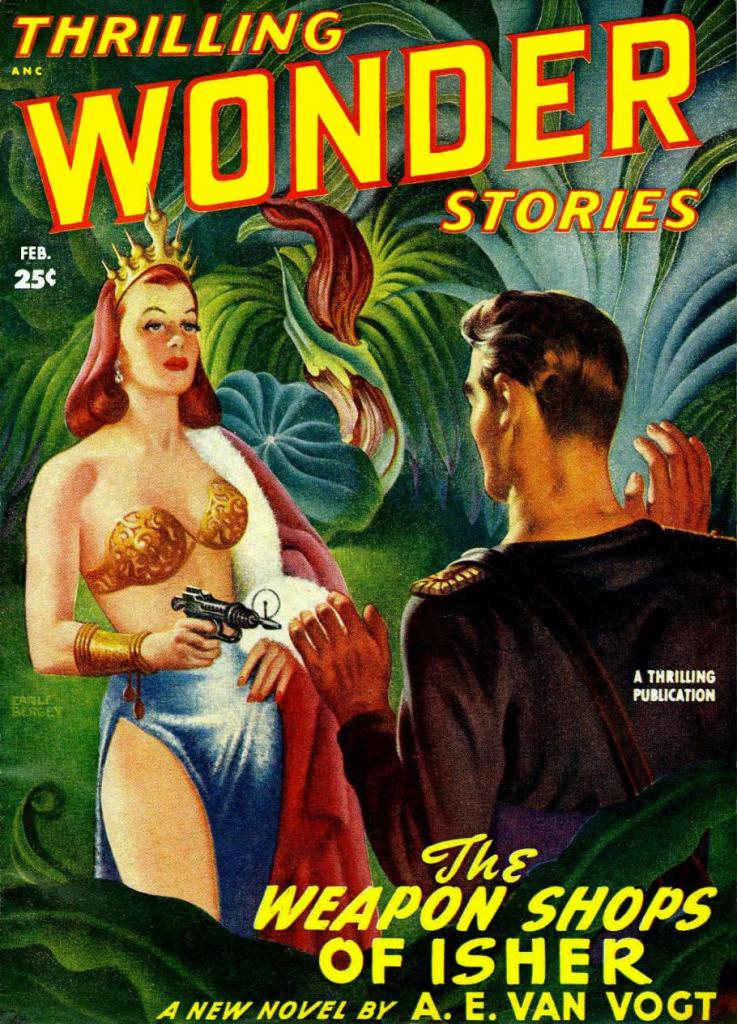
Just for grins, here are some of the covers for Sturgeon’s 1949 publications.

James Wallace Harris, 7/11/23

“The Lens” by Annemarie van Ewyck

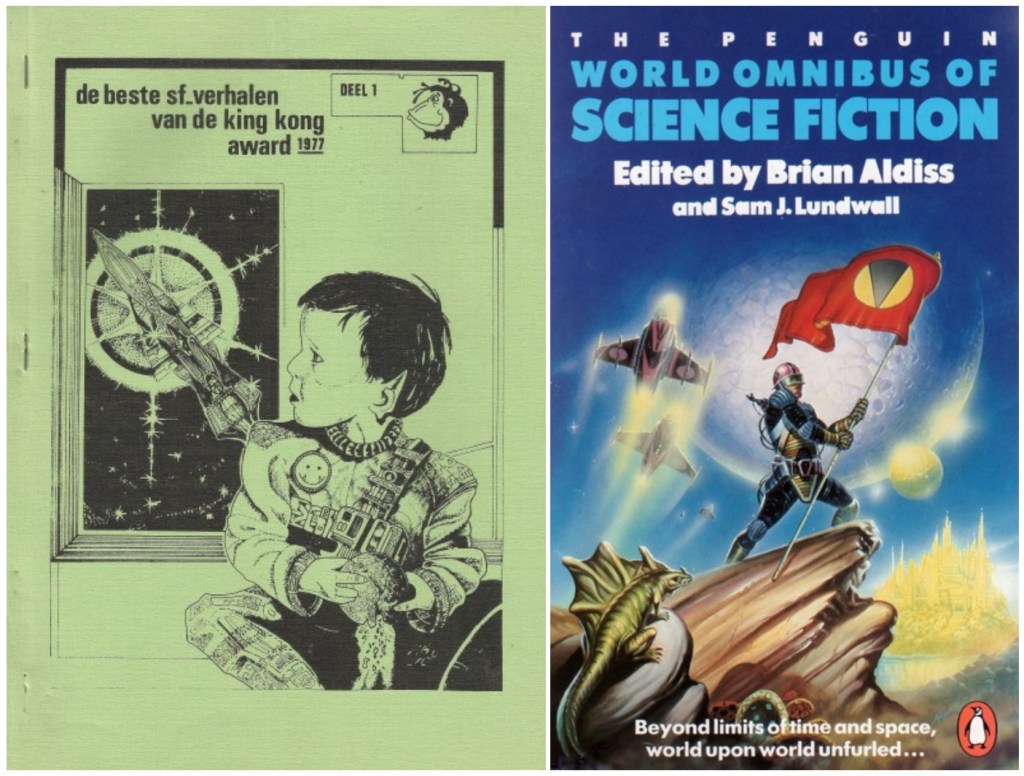
The Lens” by Annemarie van Ewyck is story #28 of 52 from The World Treasury of Science Fiction edited by David G. Hartwell (1989), an anthology my short story club is group reading. Stories are discussed on Tuesdays, Thursdays, and Saturdays. “The Lens” first appeared in Dutch in De beste sf-verhalen van de King Kong award 1977, deel 1 (Dec. 1977/Jan. 1978). In 1986 it was reprinted in English in The Penguin World Omnibus of Science Fiction edited by Brian W. Aldiss and Sam J. Lundwall.

Annemarie van Ewyck was Annemarie Pauline van Ewijck (1943-2017). She only has three short stories listed in ISFDB and was mainly an editor and columnist. The periodical above where the story first appeared looks like a fanzine to me.

Once again, I find it interesting that my take on a story is different from Hartwell’s. More and more, I’m realizing that The World Treasury of Science Fiction (1989) seems like a precursor to The Big Book of Science Fiction (2016) and that I’m out of touch with both editors. I might just be out of touch with the genre in general. However, with “The Lens” I believe it’s a perfect story for this anthology, and it’s my kind of science fiction.

Here’s Hartwell’s intro:

I thought “The Lens” was quite a nice story, especially effective for being so short, but I didn’t think “The Lens” reflected the mood, tone, or concerns of 1950s science fiction. I don’t know if that era can be generalized, and I wonder if there really is a general style to post-Anglo-American post-New Wave works. “The Lens” doesn’t feel like Bradbury, Zelazny, or Sturgeon to me at all but it does remind me of James Tiptree, Jr., but also Ursula K. Le Guin.

In other words, “The Lens” reminds me of 1970s science fiction written by women, which it is, but can we generalize on that? Is there a common denominator? I don’t think so, other than a female character in an alien society feeling the shock of otherness after undergoing an alien rite. But isn’t that theme also explored by Jack Vance in “The Moon Moth” or Downward To the Earth by Robert Silverberg?

As the years go by, I’m less inclined to believe there was much of a New Wave in science fiction, despite the efforts of Michael Moorcock, Judith Merril, and J. G. Ballard. Yes, there were some experimental efforts, like the kind we saw in New Worlds, England Swings, and Dangerous Visions, but that kind of experimentation had been going on in the literary world for a long time. I believe by the 1960s and 1970s the genre was just getting more diverse writers, and better writers in general, writers who were willing to try different ways to tell a story. By then writing programs were flourishing everywhere.

I also know people get tired of me bellyaching about some stories in these anthologies not being science fiction. That’s not because of how they were written, or by who. I believe science fiction represents a state of mind, and “The Lens” is definitely science fiction, and fits within that state of mind.

The first-person narrator, Dame Ditja, a diplomat, is returning from Earth to Mertcha after visiting their dying mother. We know things are very different when we learn her mother died at age 286. I liked how Dame Ditja described her relationship with their mother and their interaction with the other passengers on the ship. She is returning to the city of Tiel where she is the Head of Cultural Liason.

On Mertcha, the aliens have three arms and three legs, and their architecture and philosophy reflect that difference. Dame Ditja has decided to request a permanent assignment to Mertcha, which she now thinks of as home. She expected to be met at the spaceport by Mik, a local who is her driver and friend, however, a substitute driver meets her instead. That driver thinks she is an ordinary tourist and takes her to a holy place that is a main tourist attraction for people from Earth.

At the Holy Place of Tiel, Dame Ditja has a transcendental experience, one of ecstasy, one that is usually experienced by certain believers in this alien culture. While having this experience, Dame Ditja realizes that radical monks of this faith have trapped some tourists from Earth to hold hostage, and Dame Ditja comes out of her trance and carefully, but forcefully, frees them in a diplomatic coup.

This achievement gets her offered more prestige assignments, and Dame Ditja changes her mind and plans to leave, even though all through the story she wanted to stay.

The ending is strange. Because of the incident at the Holy Place of Thiel, Dame Ditja no longer feels like Mertcha is her home, and thus feels compelled to leave. It appears Dame Ditja wants to die, and she feels she can only die in a place she considers home. I’m not sure why she wants to die or is ready to die, but I wonder if it’s because people live too long in this fictional future?

After reading this story twice I feel it’s closest in style and tone to some stories I’ve read by Brian W. Aldiss. On the first reading, I would have rated this story ***+ but on my second reading, I feel it’s a **** story.

James Wallace Harris, 6/8/23

“The Dead Past” by Isaac Asimov

The Dead Past” by Isaac Asimov is story #27 of 52 from The World Treasury of Science Fiction edited by David G. Hartwell (1989), an anthology my short story club is group reading. Stories are discussed on Tuesdays, Thursdays, and Saturdays. “The Dead Past” first appeared in Astounding Science Fiction (April 1956). I can find no ebook or audiobook edition of this story.

Normally, I don’t link to the Internet Archive because I worry it’s going to be taken down. But for “The Dead Past” you can read it here in a scan of the April 1956 Astounding.

Let’s imagine that “The Dead Past” is a robot Isaac Asimov built. This robot has a specific function, to trigger certain ideas and emotions in readers. I believe we can understand this story in terms of the motors and gears Asimov used to design his robot.

  1. The first motor is Arnold Potterley, Ph.D., a Professor of Ancient History. Arnold is obsessed with ancient Carthage. He desperately wants to use a time viewer to prove that specific history about Pre-Roman Carthage is untrue, and were lies created by their enemies the Greeks and Romans.
  2. The second motor is academic control, as viewed through The Department of Chronoscopy, which has the power to view the past using the science of neutrinics, an area of physics created by a man named Sterbinski.
  3. The third motor is Jonas Foster, a new instructor in the physics department.
  4. The first gear system is a dystopian society that rigidly controls all academic research. Asimov used this feature to satirize the real-life academic bureaucracy that he had to deal with. Arnold fights against this bureaucracy to get access to the time viewer to do his research. Jonas becomes intrigued with why the bureaucracy suppresses the time viewer. The two men’s motives mess to work together secretly to build their own time viewer.
  5. The fourth motor is Caroline Potterley, Arnold’s wife. She is obsessed with the death of their child, Laurel, who died twenty years earlier at age 3. She wants the time viewer to see Laurel again.
  6. The second gear system is the mystery of Laurel’s death. Arnold is afraid that if Caroline could see the event he might be blamed. I believe Asimov added this system to his machine because he wanted an emotional component.
  7. The fifth motor is Ralph Nimmo, a popular science writer.
  8. The third gear system links Ralph and Jonas and allows Asimov to express views on science writers, as well as enable the building of a home time viewer.
  9. The sixth motor is Thaddeus Araman, Department Head of the Division of Chronoscopy. He is in charge of suppressing the technology of time viewing for a very specific reason.
  10. The last gear is between Arnold, Caroline, Jonas, and Thaddeus. The first three want to view the past, and the last wants to stop them. The why is the revelation of the story.

“The Dead Past” is one of Asimov’s better stories, even a favorite to some. I liked it quite a lot but found it clunky. The driving force behind Arnold is to prove ancient Carthage didn’t practice child sacrifice, and the driving force behind Caroline is to see her dead child again. Jonas is so intrigued by a possible conspiracy theory that he throws over his budding career in physics. I thought all three of these fictional motives were melodramatic. They do work, adding complexity and emotion to a rather dry final idea, but it’s a shame that Asimov didn’t come up with a more sophisticated emotional linkage.

I think Asimov would have shown more finesse if he had foreshadowed the ending. There is a cross-link between Arnold’s and Caroline’s desire to see the past, but neither predicts the real reason why Thaddeus wants to suppress the time viewer. This might be simplistic on my part, but if Arnold, Caroline, and Jonas each had a reason to use the time viewer, and one of their reasons should have foreshadowed the real reason why Thaddeus thought the time viewer was so dangerous. I believe the story would have been tighter if Jonas has wanted to use the time viewer to uncover the conspiracy, and Caroline wanted to use it to spy on Arnold and Jonas.

I don’t think Asimov was a very mature person. From what I’ve read about him, and from reading his stories, he comes across as a rather clever child prodigy who as an adult had trouble comprehending human relationships. This is often reflected in his stories. His fiction focuses on ideas, and his characters are constructed to present those ideas. In “The Dead Past,” Asimov tries harder than usual to present adult emotions, but they come across as contrived. Still, “The Dead Past” is a good example of Asimov trying to overcome his weakness. I give him credit for that.

Two or three years ago I read or reread all of Asimov’s robot stories. They were all hampered by this problem. I could always see how Asimov added human emotion to his stories. When I was young, that effort worked unseen, but as I got older, the stories succeeded in their ideas but felt clunky in their efforts to deal with genuine humans and relationships. In fact, I was sometimes horrified by some of Asimov’s emotional conclusions – but that’s for another essay.

“The Dead Past” is a nicely worked-out science fiction story. Asimov adds psychological depth to a neatly complex plot. Unfortunately, he uses B-movie creativity for creating the psychological drivers of this story.

Finally, regarding “The Dead Past,” I want to make a protest, or maybe a lament. This is my third reading of the story, and this time I wanted to read “The Dead Past” with my eyes, and then listen to it again from an audiobook. But I could find no audiobook edition. Nor could I find an ebook edition. This annoyed and depressed me. “The Dead Past” is one of Asimov’s best works of short fiction. You can find it in print in The Complete Stories, Volume 1. There are US and UK versions on Amazon, but they don’t have the same number of pages, so I don’t know which to recommend. However, used copies of the US edition are quite common and much cheaper.

I now prefer consuming fiction via ebooks and audiobooks. I hate that Asimov’s short fiction, as well as other science fiction writers’ short fiction, is either not available or is no longer available in these formats. A friend eventually found an epub version for me to read, and that visually easier-to-read format made reading the story far more enjoyable.

I recently noticed that all English language versions of Brian W. Aldiss audiobooks have been pulled from Audible. Classic old science fiction is slowly disappearing. There’s still plenty to buy and read, but it’s disappearing at the edges. I hate that.

James Wallace Harris, 7/6/23

.

“The Spiral” by Italo Calvino

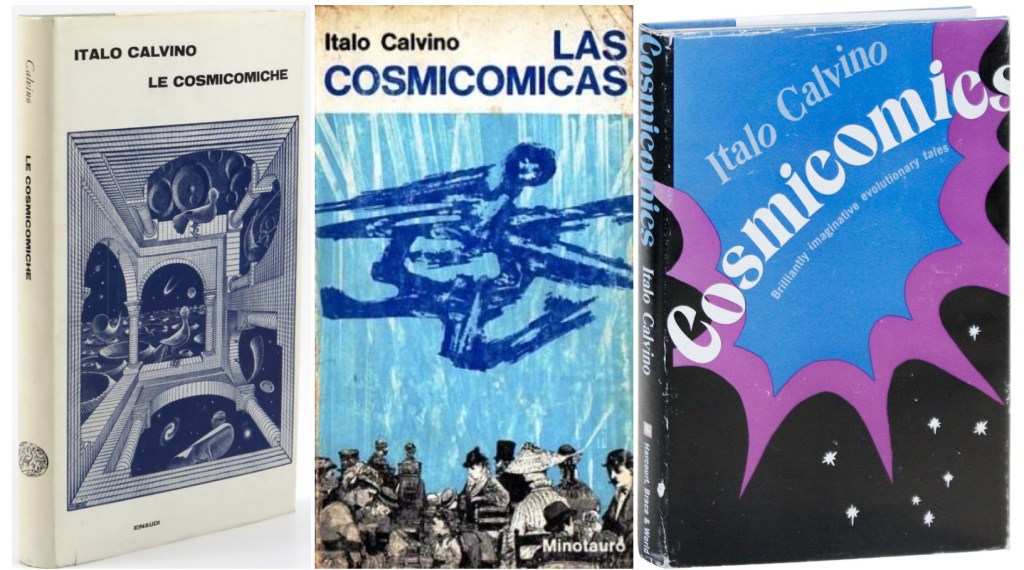
“The Spiral” by Italo Calvino is story #26 of 52 from The World Treasury of Science Fiction edited by David G. Hartwell (1989), an anthology my short story club is group reading. Stories are discussed on Tuesdays, Thursdays, and Saturdays. “The Spiral” first appeared in Le Cosmicomiche, a collection of the author’s stories first published in Italy in 1965. It was later translated and published in English in 1968 as Cosmicomics.

Calvino is growing on me. In fact, after reading “The Spiral” I decided to buy Cosmicomics. I went to Amazon and Audible and listened to the introduction to The Complete Cosmicomics. I was so intrigued that I bought the ebook for $2.99 and the audiobook for an additional $7.49. That volume contains Cosmicomics (12 stories), Time and the Hunter (11 stories), 4 stories from Numbers in the Dark and Other Stories, and 7 newly translated stories, 34 in all.

“The Spiral” continues with the character from “A Sign in Space,” Qfwfq, who reminds me of YHWH. I don’t know if Calvino intended that or not, but these stories feel like another Bible that describes the evolution of matter and life through a coevolving self-awareness. I recently read An Immense World by Ed Yong, a book about umwelt in humans and animals, including mollusks. These two books have great synergy.

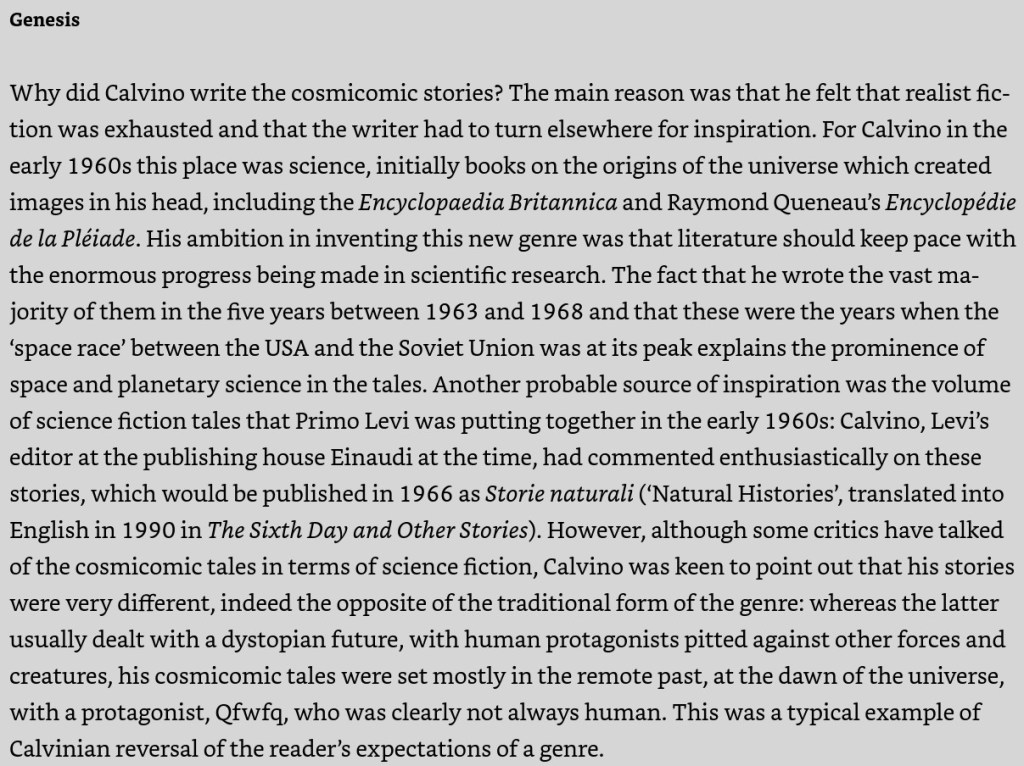
Cosmicomics stories are about science. I think it’s especially important to read Martin McLaughlin’s introduction to The Complete Cosmicomics. It’s too long to quote in its entirety, but I believe this should get you interested to maybe spring for the $2.99 Kindle edition.

With “The Spiral” I feel Calvino is trying to write a scientific description of reality using a philosophical conceit. Like McLaughlin said, Calvino thinks realistic fiction was exhausted, so he came up with this new approach.

Qfwfq is like God or Gaia, or one of an infinity of pantheistic gods who is describing the evolution of the universe and life. Although Calvino’s goal is to describe science, it also feels spiritual.

When I was young I couldn’t conceive of God or a beginning. I concluded that reality has always existed. It’s infinite in all directions and dimensions. Nothing can’t exist. Reality is the unfolding of all possible forms of non-existence.

You can listen to “The Spiral” here:

James Wallace Harris, 7/4/23

“A Sign in Space” by Italo Calvino

“A Sign in Space” by Italo Calvino is story #25 of 52 from The World Treasury of Science Fiction edited by David G. Hartwell (1989), an anthology my short story club is group reading. Stories are discussed on Tuesdays, Thursdays, and Saturdays. “A Sign in Space” first appeared in Le Cosmicomiche, a collection of the author’s stories first published in Italy in 1965. It was later translated and published in English in 1968 as Cosmicomics.

“A Sign in Space” is not science fiction. I won’t go into my rant again about how I dislike science fiction editors poaching literary works and calling them science fiction. I assume they do it to inflate the reputation of our genre, but I don’t want our genre to gain recognition for the wrong reasons. If Italo Calvino was really considered a science fiction author his success and fame would not have happened.

Be that as it may, let’s discuss “A Sign in Space” as a literary story. As soon as I started reading it I heard the voice of Mel Brooks doing his 2000 Year Old Man routine. Is it possible that Calvino could have heard this 1960 record? Great discoveries are often made at similar times around the world.

I did find a couple audio readings of the story, but none of the readers read it like Mel Brooks. I was disappointed. But here’s a nice narration.

This is a creative work that’s reasonably entertaining. It’s meant to be humorous and clever, but that really depends on the reading and delivery. That’s why I ached to hear Mel Brooks do it as a comedy routine. I did think it was too long.

I imagined the narrator being God when he was a youngster, just figuring things out. Did God create all of reality, or just Earth and its vicinity? Imagine being a conscious being that could ride around the Milky Way as it spun like a record. Imagine that being not having a language and needing to develop one. Making a sign could be the very beginning of the process. There are interesting philosophical points in this story.

Another thing I thought about while reading “A Sign in Space” was wondering how an observer could track the rotation of our galaxy? We see the Earth orbiting the sun through the changing background of the constellations throughout the year. The celestial sphere seems fixed to us when we realize we are moving. Would there be a larger sky outside our galaxy that would seem fixed too?

Just because a writer tells a fantastic story about outer space doesn’t mean we can pin a sign on their back that says SCIENCE FICTION WRITER. Marketing fiction as science fiction is a publishing technique to get certain kinds of stories to certain kinds of readers. It’s often bad for writers. And it’s unfair to writers who have developed a reputation outside of our genre. Some science fiction writers have learned that being labeled a science fiction writer has hurt their career potential. But it doesn’t help them or the genre to go around tagging certain famous writers as science fiction writers.

I wish David Hartwell could have found a genuine science-fiction story from Italy.

James Wallace Harris, 7/1/23

“The Gold at the Starbow’s End” by Frederik Pohl

The Gold at the Starbow’s End” by Frederik Pohl is story #24 of 52 from The World Treasury of Science Fiction edited by David G. Hartwell (1989), an anthology my short story club is group reading. Stories are discussed on Tuesdays, Thursdays, and Saturdays. “The Gold at the Starbow’s End” first appeared in Analog (March 1972). It’s currently available in Platinum Pohl: The Collected Best Stories. Right now the Kindle edition is only $3.99. The story is also available as a standalone novella for $2.99 for the Kindle edition, but Kindle Unlimited members can read it for free.

I was surprised to discover that I had never read “The Gold at the Starbow’s End” before, especially since it’s such a great read. I never knew how involved Frederik Pohl was in the history of science fiction until I read his memoir, The Way the Future Was. I haven’t read much of Pohl’s fiction, but whenever the reading group covers one of his stories I’m always impressed. I highly recommend his memoir.

“The Gold at the Starbow’s End” was a finalist for a Hugo and Nebula and came in #1 in the 1973 Locus Poll for best novella. It’s not widely reprinted, probably because it’s so long, but it was included in Wollheinm’s The 1973 World’s Best Annual Best. The World Treasury of Science Fiction from 1989 is the last major anthology that remembers it, which is a shame since the story is so much fun to read.

I’m disappointed there is no audiobook of this story. Before I actually discuss the story, I’d like to talk about that. I love listening to science fiction short stories read by professional narrators. A great reader can make the story come alive in ways my poor internal reading voice can’t. Unfortunately, short stories are the red-headed stepchildren of the literary world. They are lucky if they get reprinted at all.

In the science fiction world, short stories get treated better than other genres — well, it used to be that way. The best stories were often regularly reprinted in retrospective anthologies. Those anthologies don’t get published very often anymore. In times past, there was a huge retrospective anthology about every five years, so over the course of twenty years most of the best science fiction short stories from the past were reprinted. This gave each new generation of readers a chance to read the classics and gain a sense of the evolution of the genre. Unfortunately, those huge retrospective anthologies didn’t stay in print (except for The Science Fiction Hall of Fame volumes 1, 2a, and 2b).

What I would love to see is a ten-volume The Best Science Fiction Short Stories of the 20th Century that would stay in print as printed books, ebooks, and audiobooks. Those volumes should collect these 251 stories. I would buy all ten volumes in all three formats.

Like many classic science fiction stories, “The Gold at the Starbow’s End” is about transcendence, especially the kind readers of Astounding Science-Fiction in the 1940s loved. The story is told through two alternating narratives. First first, are messages sent from the first interstellar mission to Alpha Centauri, crewed by six men and women. The second follows Dieter von Knefhausen, a Dr. Strangelove-like character who advises the president on the mission. Knefhausen designed the mission so the highly intelligent crew wouldn’t have much to do during their ten-year voyage but study. He hoped such isolation and focus would cause them to leap ahead of current scientific knowledge.

While civilization on Earth delines during the ten-year period, civilization on the spaceship Constitution evolves dramatically. “The Gold at the Starbow’s End” reminds me of children in “Mimsy Were the Borogoves,” More Than Human, Childhood’s End, and Valentine Michael Smith of Stranger in a Strange Land. Knefhausen not only reminded me of Dr. Strangelove, but Henry Kissinger. The politics in the Washington side of the story devolve so greatly, that it reminded me of “The Marching Morons” by C. M. Kornbluth.

The Earth side narrative is obvious satire, but what about the spaceship side of the story? It represents the hope of SF fans. Knowing Pohl’s other work, I have to assume it’s also satire, even though it plays up to some of the most treasured ideas in science fiction.

I can’t decide if “The Gold at the Starbow’s End” isn’t Pohl preaching the gospel of science fiction or making fun of it. Science fiction fans have always wanted to be slans. It’s surprising how much Campbell and Heinlein wanted transcendence in the 1940s, and Clarke wanted it in the 1950s and 1960s. Was Pohl continuing the dream in this story, or turning on it?

“The Gold at the Starbow’s End” is so cynical that it’s hard to believe it’s aspirational. And am I being cynical when I wonder if certain science fiction writers like Pohl and Bester are secretly making fun of science fiction by pushing the very emotional buttons in their readers that they themselves are sneering at? Pohl and Bester were way smarter than most of us.

“The Gold at the Starbow’s End” is an outstanding piece of writing on Pohl’s part. Working out how to convey Human 2.0 behavior isn’t easy, and Pohl does an impressive job here. The Washington/Knefhausen side of the story is as equally worked out, revealing the egocentric madness of people in power. I wish Stanley Kubrick could have filmed “The Gold at the Starbow’s End.” It would be a combination of Dr. Strangelove and 2001: A Space Odyssey. And I have to wonder if Pohl wasn’t using both as inspiration.

James Wallace Harris, 6/29/23

“Inconstant Moon” by Larry Niven

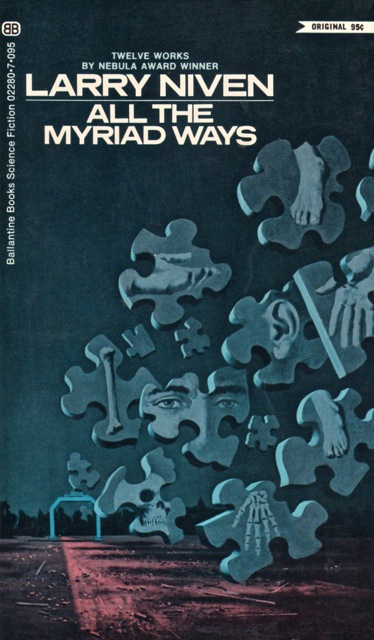
Inconstant Moon” by Larry Niven is story #23 of 52 from The World Treasury of Science Fiction edited by David G. Hartwell (1989), an anthology my short story club is group reading. Stories are discussed on Tuesdays, Thursdays, and Saturdays. “Inconstant Moon” first appeared in Niven’s 1971 collection, All the Myriad Ways. Currently, the story is available in N-Space, a retrospective collection of Niven’s work from 1990. If you want an ebook version of the story, it’s included in Masterpieces: The Best Science Fiction of the Century edited by Orson Scott Card.

Outer Limits dramatized the story – watch it on YouTube.

“Inconstant Moon” is one of those science fiction stories where the main idea sticks with you even if you don’t remember the plot or characters. “Inconstant Moon” won the Hugo for Best Short Story in 1972, and is the kind of classic SF tale I expected to see in an anthology that remembers the best science fiction of the 20th century.

Stan and his girlfriend Leslie realize something epic is happening when the Moon becomes much brighter than normal. “Inconstant Moon” is an astronomical science fiction story like “Nightfall.” I don’t know if I should tell you anymore, I wouldn’t want to spoil the fun.

“Inconstant Moon” is the kind of short story that inspires readers to ask themselves what they would do in a similar situation.

<<<Beyond Here Lie Spoilers>>>

Most science fiction is geared toward young people with romantic minds who want to fantasize about being action heroes, while “Inconstant Moon” is aimed at adults who take more wistful prosaic paths. The protagonists aren’t young or heroic, and their actions are quite ordinary and mundane. The setting is only slightly in the future from 1971, after the Apollo 19 landing. Niven didn’t know that sadly, Apollo landings would end with 17 in 1972. He even has Stan talking about getting to handle a moon rock, which I don’t know if NASA ever allowed either.

Stan goes out on his balcony one night and the Moon is several times brighter than normal. He starts wondering why and eventually concludes the Sun has gone nova. This is my third time reading this story, but I remember when I read it the first time being quite surprised that people would still be alive after such an event. Until I read “Inconstant Moon” the first time, I imagined if the Sun went nova it would instantly vaporize the Earth.

Niven gives us a more thought-out scenario. Earth is 8.5 light-minutes away from the Sun, and Jupiter is 44.2 minutes. Niven imagines the Earth itself being a barrier that protects people on the side away from the Sun, and that a shockwave travel at the speed of sound would circle the Earth. Stan rushes over to see his girlfriend, hoping to have a few good hours before the end of the world. He doesn’t tell Leslie his theory, but eventually, Stan realizes she came up with it on her own too.

I would love to see an episode of PBS’s NOVA analyze the same situation.

Stan and Leslie assume the shock wave is hours away, and it will kill them before California faces the sun. They go out for ice cream and drinks after having sex. I felt “Inconstant Moon” had an adult vibe not because of the sex, but because of the mental processes Stan and Leslie go through. My guess is young characters and readers, would think and act differently. This age-difference reaction can be seen in “The Last Day” by Richard Matheson (Amazing Stories, Apr-May 1953). Read it here.

Ultimately, Stan figures out the Sun didn’t go nova, and that it must have been a very large solar flare. It means they might live, and that changes the course of the evening.

It’s a shame we don’t get more science fiction that makes us think like this story. Some stories inspire arguments like, “The Cold Equations” by Tom Godwin, but Niven’s story makes readers think about physics and astronomy. Isaac Asimov used to write about how science fiction fans of his generation would tell their parents they were learning science from science fiction. That seldom happens, if ever. But with this story, Niven sets up a scientific situation that makes us think about science rather than science fiction.

Does anyone know what would likely happen to the Earth if the Sun went nova or there was an extremely large flare?

James Wallace Harris, 6/27/23

“Captain Nemo’s Last Adventure” by Josef Nesvadba

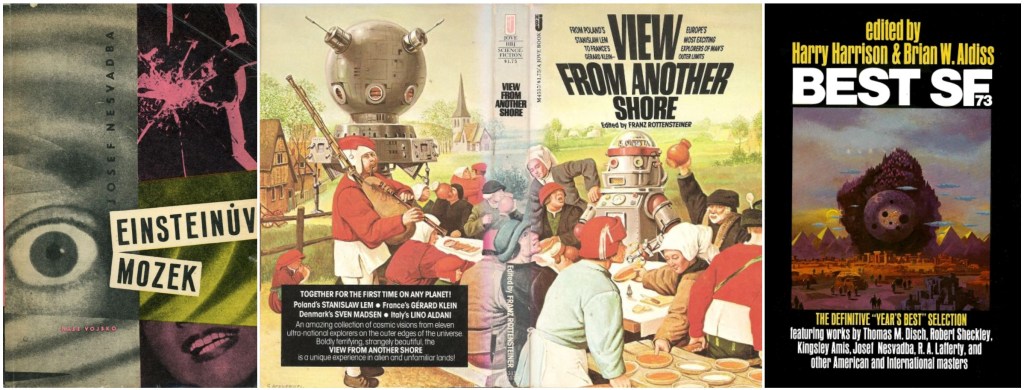
Captain Nemo’s Last Adventure” by Josef Nesvadba is story #22 of 52 from The World Treasury of Science Fiction edited by David G. Hartwell (1989), an anthology my short story club is group reading. Stories are discussed on Tuesdays, Thursdays, and Saturdays. “Captain Nemo’s Last Adventure” first appeared in Nesvadba’s 1960 collection, Einsteinův Mozek. It was translated into English for the 1973 anthology edited by Franz Rottensteiner, View From Another Shore, and it was selected in 1974 for Best SF: 1973 edited by Harry Harrison and Brian Aldiss. (Follow the link to the story title to see where it’s been anthologized if you want to find a copy to read. However, The Treasury of World Science Fiction is widely available in used copies and is probably the cheapest way to get this story, along with 51 others.)

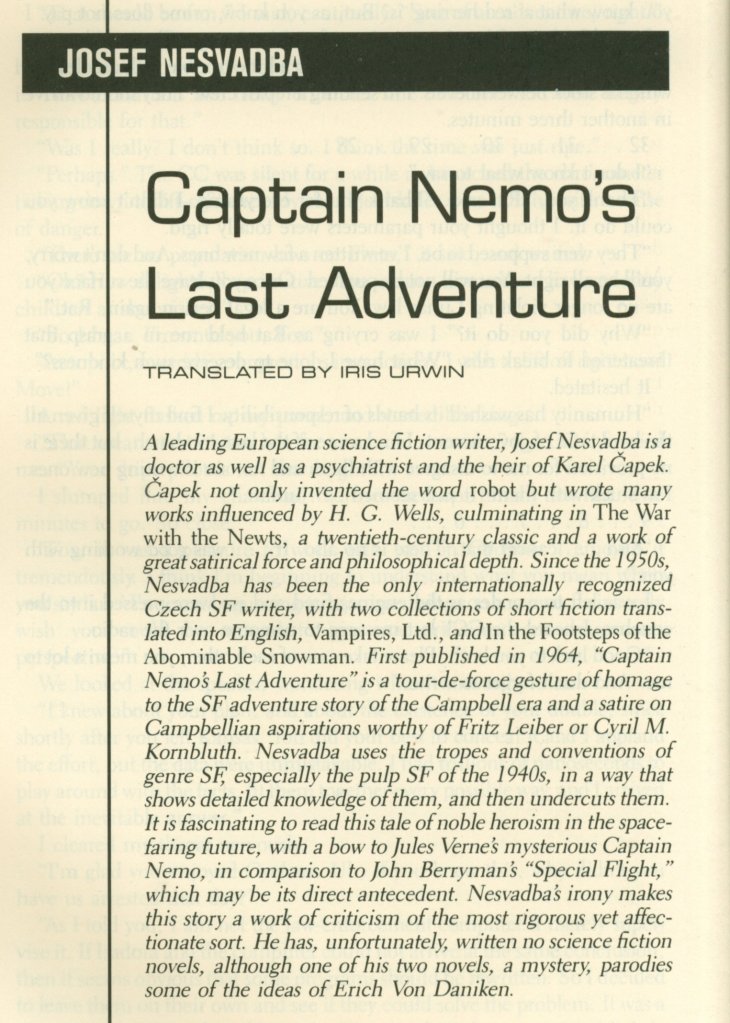
David G. Hartwell had so much to say about “Captain Nemo’s Last Adventure” in his introduction that I thought I’d just reprint it here.

I don’t know if I agree with Hartwell when he says “Captain Nemo’s Last Adventure” is a satire on stories from John W. Campbell’s era, or that Nesvadba uses the tropes and conventions of 1940s science fiction. I’m not even sure “Captain Nemo’s Last Adventure” is even an ironic work of criticism. I’m not saying it’s not, but I want to propose an alternate theory.

What if science fiction evolved separately in Czechoslovakia? And what if its evolution sometimes paralleled American pulp science fiction? Evidently, “Captain Nemo’s Last Adventure” was written after Sputnik but before Gargarin’s famous ride. Would Josef Nesvadba have access to old American pulps or even 1950s anthologies that reprinted them?

The prose of “Captain Nemo’s Last Adventure” doesn’t come across like the prose in pulp fiction. Like many of the foreign language science fiction stories we’ve been reading, it’s mostly told and not shown. However, it is longer, and that lets it become a fuller story than the shorter works we’ve read. I wonder if Nesvadba wasn’t inspired by Soviet science fiction or the Polish Stanislaw Lem?

“Captain Nemo’s Last Adventure” is about the super-heroic Leonard Feather and chronicles his feats of always needing to save the day, and eventually the Earth. Yes, we could compare him to Kimball Kinnison and the Lensman series. But Feather could just as easily be compared to Homer’s Ulysses.

I do think Nesvadba was making fun of spacemen, and the kind of macho men who need to always be on an adventure. Feather is a womanizer who makes his wife unhappy, as well as his mistresses, and he can’t understand why his son isn’t like him. Nesvadba is satirizing a certain kind of man that has existed in all genres of literature.

Nesvadba also appears to be attacking the call of the high frontier, robotics, and the never-ending quest to conquer and engineer. When Captain Feather, aka, Captain Nemo meets another intelligent race, he can’t understand what they are after. When he returns to Earth and is forced to stay put, Feather begins to see the need for philosophy and art.

There are parallels to American science fiction in this story. Heinlein, Campbell, Hamilton, and others all wrote stories about meeting super-advanced aliens back in the 1940s. The robots in “Captain Nemo’s Last Adventure” remind me of Jack Williamson’s The Humanoids. This story even reminds me just slightly of Robert Sheckley in the 1950s.

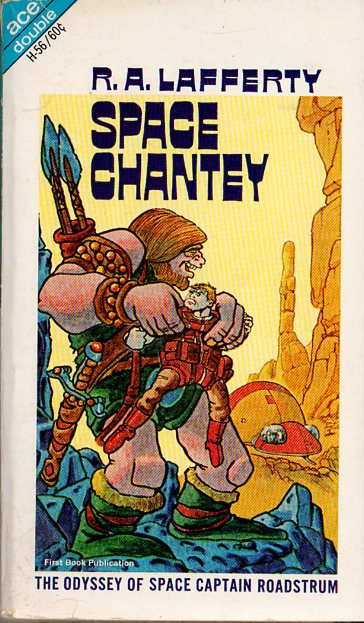
But, Captain Feather and his crew mostly remind me of Space Chantey by R. A. Lafferty, which is a science fiction parody modeled on Homer. My guess is that Nesvadba’s story was really inspired by Lem’s The Star Diaries, which came out in the 1950s?

Still, “Captain Nemo’s Last Adventure” is a good tale. It’s not told dramatically, which disappoints me, but its length allowed it to cover a number of interesting science-fictional topics that were enjoyable to me.

James Wallace Harris, 6/23/23

“The Phantom of Kansas” by John Varley

The Phantom of Kansas” by John Varley is story #21 of 52 from The World Treasury of Science Fiction edited by David G. Hartwell (1989), an anthology my short story club is group reading. Stories are discussed on Tuesdays, Thursdays, and Saturdays. “The Phantom of Kansas” first appeared in Galaxy Science Fiction (February 1976). It is currently available in The John Varley Reader: Thirty Years of Short Fiction. That collection is available on paper, as an ebook, and as an audiobook (18 stories — 26 hours and 36 minutes).

A science fiction writer is like an artist with a blank canvas, they can paint anything they can see or imagine. When you look at composing science fiction that way, you have to wonder why some authors put more on their canvas and others less, and where the images come from. With, “The Phantom of Kansas” John Varley decided to lay out his canvas with a series of related science-fictional scenes.

The setting is the Moon — after aliens have taken over the Earth and pushed humans out across the solar system — part of Varley’s Eight Worlds series. Now this image is enough to fill a whole canvas but is merely a small object in the background in this painting. Varley wisely chose not to do an elaborate alien invasion mural, those were old and tired even back in 1976. We are told it’s November 342, so I assume humanity restarted the clock when our home world was snatched away from us. This aspect of the painting does intrigue me, and I wish I could see that section of the canvas expanded.

The plot is a murder mystery. The protagonist, a woman named Fox, has just been revived in a clone body and learns she’s been murdered three times before. So she’s actually Fox 4. Because some murderers in this future like to permanently kill people, they must kill the person and destroy the memory cube that backs up their personality. This murderer has failed three times, why? Fox is told she should expect to be murdered again unless the police can find the murderer first. She doesn’t want to become Fox 5. This is a solid subject for a painting and I would have been satisfied if it was the subject of the whole canvas. However, I wouldn’t have been that impressed, not like I am with the additional imagery Varley squeezes in.

For Varley, this unique murder mystery wasn’t enough to dominate his canvas. We see Fox is an artist who engineers weather dramas. This requires quite a bit of world-building on Varley’s part. Humans who live on the Moon mainly live underground, but they crave being out in nature like humans did on Earth. So giant artificial environments are created that replicate various natural settings from old Earth. Varley calls disneylands. Fox is working on a giant storm symphony that spawns several tornadoes for a disneyland that’s a replica of the Kansas prairie.

The Kansas disneyland is a hollowed-out cylinder twenty kilometers beneath Clavius. It’s two-hundred and fifty kilometers in diameter, and five kilometers high. That’s a huge feat of super-science engineering.

Now this is interesting. Those pesky aliens got rid of humans and all our artifacts on Earth so they could enjoy nature. The human refugees in space long for the wonders of Mother Nature. What should we feel about that revealed in the painting? Back in 1976 when I was young I was dying to go into space, but now in 2023 and I’m old, you couldn’t pay me to go there. Mother nature is the place to be.

But Varley isn’t finished with adding subjects with his brush. He paints another character onto his canvas that vividly stands out, the Central Computer. Varley portrays the computer as it, which I like. Gender is a biological trait. And like Mike in The Moon is a Harsh Mistress, this computer is a quite charming and appealing image.

And there is one other aspect that reminds me of Heinlein. People can change gender. Fox has been a he in the past. And, at first, I thought this was just another added detail in Varley’s scene, but it turns out to be an essential plot element.

I’ve seen “The Phantom of Kansas” before, decades ago, and it impressed me then, except that it depends on one of my least favorite scenarios in science fiction, brain downloading and uploading. And I like that theme even less this time. However, it’s needed for the plot, so I begrudgingly accepted it.

In my judgment of art, science fiction scenes are somewhat realistic paintings, inspired by what we see in reality, whereas fantasy scenes are modern art, paintings inspired by inner visions. I liked this painting better this time because I viewed the painting as a fantasy. It’s a clever image of a murder mystery derived from an interesting series of what-if mental conjectures.

Ultimately, the painting, “The Phantom of Kansas” is elegantly symmetrical. Like any good mystery, all the clues were there, even if they were highly contrived.

James Wallace Harris, 6/22/23