I need an equivalent saying to “My eyes are bigger than my stomach” that applies to trying to read too much. My reading desires far exceed my ability to get things read. For the past year, I’ve spent most of my reading time consuming short stories. On average, I still squeeze in a book a week, but usually, it’s anthologies or nonfiction, rarely novels. Lately, I’ve been missing novels or I thought I did. Novels get all the buzz. Novels are what readers remember. Novels are what pop culture respect. So I felt I was missing something important.
One thing about getting old is letting things and pursuits you love fall away. I regret not keeping up with new science fiction novels. I’ve identified with being a science fiction fan my whole life, so I feel a pang of loss that I haven’t kept up with the genre.
I felt I should fight that aging trend. I told myself I should catch up. Last week I decided I would look for all the best science fiction novels that have come out in 2022 and read three or four of them. I quickly discovered it was like lighting a cigarette from a Raptor 2 engine. Not only are publishers launching SF novels like SpaceX launches Starlink satellites, but many are reaching orbit with reviewers and list makers, and I’m essentially grounded.
I went to Google and searched for the best science fiction of 2022 and found these lists:
Because I subscribe to Scribd.com I was able to sample several of them right away. For the others, I used the Look Inside feature at Amazon. It didn’t take me long to remember that novels aren’t like short stories, which I can read in a sitting, but each requires a week’s commitment. None of the ones I started grabbed me enough to make me want to make that commitment. I’m willing to take on some long reads, but only if the novel is great. I used to go to the bookstore every week and pick a science fiction novel out by the cover. I was willing to climb many mountains to find an El Dorado.
I needed another plan. I needed to know more about a book before I started reading, a judgment of its value. So I started going through the SF magazines and reading their book reviews.
Twenty years ago I felt I was getting out of touch with current science fiction. Going through all these reviews was like pistol-whipping myself with the truth. I’m completely out of touch. And more depressingly, I realize I’ll never catch up. If I really want to read great 2022 science fiction novels, I’ll just have to wait the years until they are universally recognized.
I probably never did keep up, even when I was reading a paperback a day back in my school days. I just had the illusion I was because so many books and authors felt familiar.
I’ve come to accept that I can’t stay current with modern science fiction. I will accidentally stumble upon a new novel now and then, probably because it gained immense popularity. I’ve also got to accept that what I really like is reading old science fiction and reading about old science fiction. I’m now more of a science fiction scholar, specializing in a period in the genre’s history. I can’t honestly call myself a science fiction fan anymore.
I just finished John Brunner by Jad Smith, a monograph on his life and work, part of the Modern Masters of Science Fiction series from the University of Illinois Press. It inspires me to read several Brunner novels I missed from decades ago. Even that urge is unrealistic, but I’m more likely for me to read one of Brunner’s older novels than to read a new novel from an unknown writer.
For me, at seventy, it’s more rewarding to understand the science fiction novels from my past that were about my generation’s imagined future than trying to read current novels about the new futures young readers are imagining today.
Science fiction isn’t really about the future at all. It’s taken me a lifetime to learn that. Science fiction is about the present and what we think about the future at that moment. Reading the science fiction I grew up with is a kind of meditation on who I was. Reading new science fiction tells me about the current generation. And I’m afraid that opens up a can of worms I can’t face. Pop culture has gotten too fast, too complex, and too prolific, to keep up with.
I’ve got to retreat to a smaller territory, to putter about in my own small land.
One of the aspects of getting old is learning to let go of who you think you are, who you wanted to be, doing what you want to do, going places you wanted to go, and things you wanted to own. That sounds depressing, but getting older requires a kind of streamlining or downsizing so you won’t get depressed. It’s just a practicality.
For a couple of days, it became depressing trying to catch up, but now I’m happier.
This review is a product of synergy and serendipity from what I’ve been reading from diverse sources over the last 40 hours. I’m going to try and reassemble all my influences before talking about my reading of “Fair” by John Brunner.
Yesterday, I got a tweet from Joachim Boaz about John Brunner (Modern Masters of Science Fiction) by Jad Smith and it intrigued me enough that I bought the Kindle edition and started reading it. I’ve read Stand on Zanzibar twice, once just after it came out, and again when it was published as an audiobook. And I’ve read a handful of Brunner’s short stories. Normally, that wouldn’t be enough to get me to read a monograph on an author, but I have a fond memory of spending an afternoon once with John Brunner. My college roommate was on the programs committee which brought in Brunner, Fred Pohl, and James Gunn for a morning panel at our school about science fiction. Greg was also their chauffeur, and I got to tag along. I mention this not out of name-dropping but because the authors took us to lunch and Greg and I sat and listened to them talk, Then afterward, we took Pohl and Gunn to the airport and Brunner asked if we’d take him down to see the Lorraine Motel. This was Memphis in the early 1970s before it was renovated into the National Civil Rights Museum. The key piece of information here is Brunner told us about being involved with the Martin Lurther King, Jr. Society in London. After, we went downtown Brunner took Greg and me out to eat at a Mexican restaurant. The impression he made on me came back when I started reading the Jad Smith monograph.
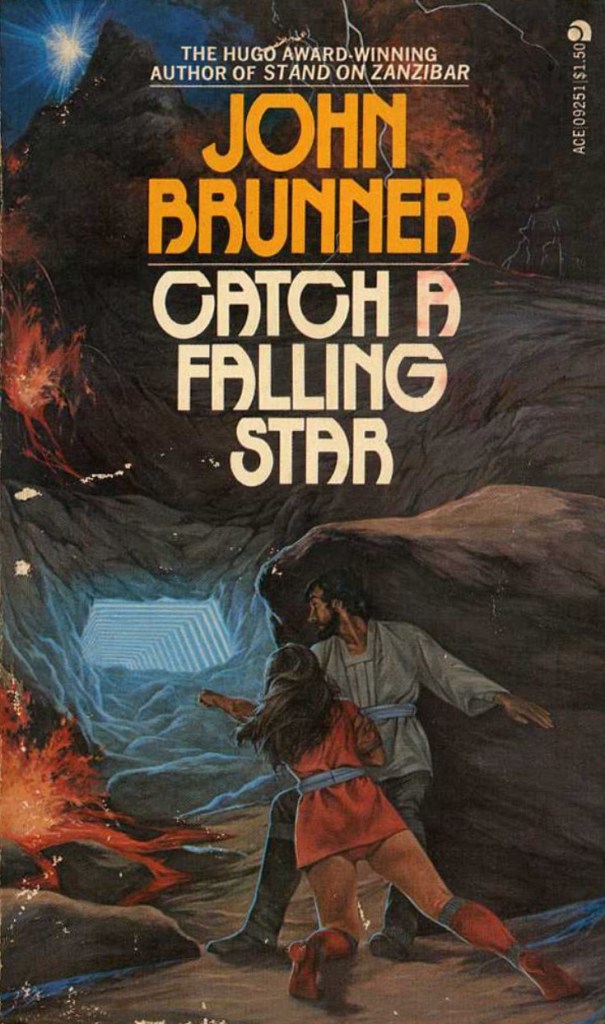
Joachim had also blogged “Future Media Short Story Review: John Brunner’s ‘Fair’ (1956)” but I wasn’t ready to read the story just yet. I was into the monograph, and the monograph inspired me to read Earth Is But a Star (1958) reprinted as an Ace Double The 100th Millenium (1959) and later expanded into Catch A Falling Star (1968). Jad Smith compared it to The Dying Earth (1950) by Jack Vance which I’ve recently read, but what really grabbed me is the inside cover blurb that quotes a passage at the beginning of the novel:
I know you’re wondering why I am digressing so much but stay with me. The sentiment of this quote is exactly what I’m worried about at the moment. But in the Jad Smith book on John Brunner, it’s what he worried about across his entire career, and in so many stories. It can be summed up by this question: What do we owe the future? My faint memories of meeting John Brunner retained an impression that he was both far more sophisticated than I was, and he was concerned about the future and mankind. He wanted us to solve our problems. It’s why he was involved with Martin Luther King, Jr. Society in London. I learned in the Jad Smith book Brunner founded that society.
Yesterday I also read “How To Do More Good” in Time Magazine. And twice yesterday I ran into reviews of What We Owe the Future by William MacAskill. Are you now getting the serendipity and the synergy of my reading? This topic was often at the core of what Brunner wrote. Like the fate of the humans in To Catch a Falling Star, we know our future too regarding climate change. Brunner could never understand why we don’t do something about all the problems we faced. In his later books he got quite cynical, and so am I. This is what draws me to him now.
All of this is important too for when I finally read his early story “Fair” an hour ago. I’ve now read 44% of the Jad Smith book on Brunner, and quite often Brunner’s plots are about saving the future. In his early stories, Smith said he would start out with a very bleak outlook but then end them with endless optimism. That applies to “Fair.”
Smith also summarized a common trait of Brunner’s where he would create an anti-hero, and that’s also what he’s done in “Fair.” Smith described how Brunner, a British author, had to write for the American markets to earn a living. Brunner grew up reading American pulps and understood how American science fiction was different from British science fiction. He tried to develop a style that merged the two. And he slowly worked toward developing a strong realistic attitude towards his subject matter even while using wild pulp conventions.
However, by the time he got to his most successful period of Stand on Zanzibar, The Sheep Look Up, and Shockwave Rider, many reviewers felt he was too realistic, too mainstream. I think we can see a hint of this in “Fair.”
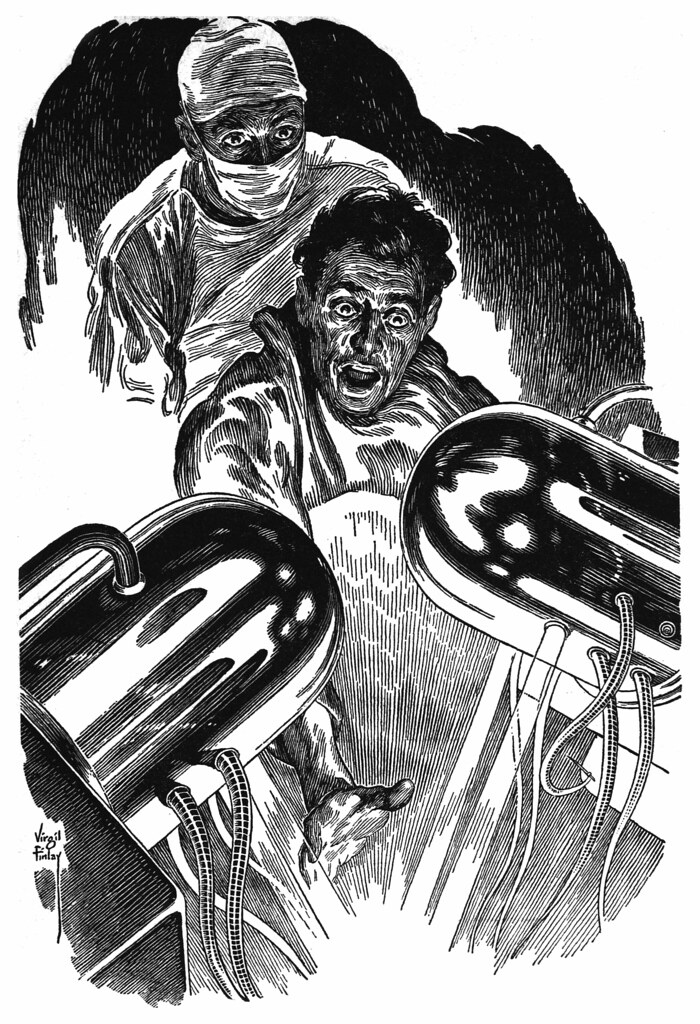
“Fair” is about a nasty future. “Fair” is about Alec Jevons, a man who has lost his job, been left by his wife, and is rejected by society because his mother wasn’t of the right nationality. It was written during the Cold War, but it’s set in the future that Jevons felt he help create. Actually, it is the future we are creating. (And isn’t Brunner always speaking to us?) The fair of the story is a sprawling science-fictional fair of the future where people go to escape their miserable lives. Jevons is older than the mostly young people at the fair and he impresses them with his physical abilities on one gigantic ride designed to throw riders off. But where he has his revelation is in a booth that provides mental experiences that feel real.
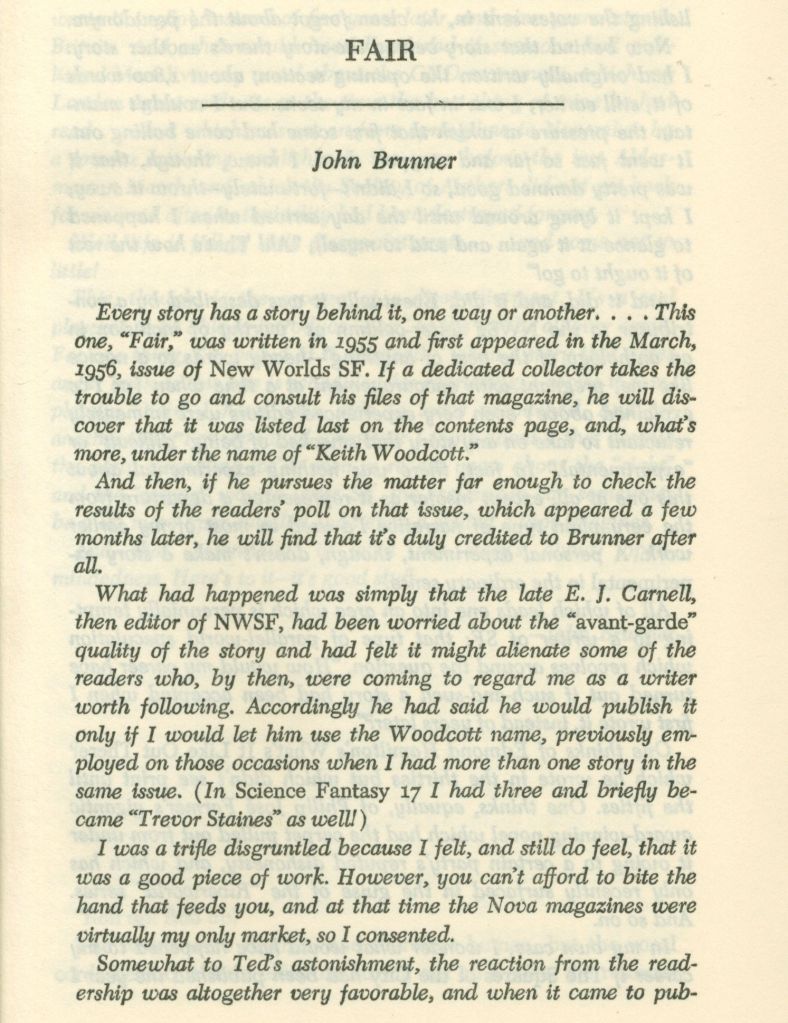
I won’t tell you anymore. By luck, my best reading copy of the story was in SF: Authors’ Choice 4 edited by Harry Harrison. I say luck because it has an introduction by John Brunner that tells us quite a bit about why and how he wrote this story. I’m going to reprint it here hoping I’m not violating copyrights too much, but these introductions are seldom reprinted, and often are very enlightening.
Read the ISFDB page for where “Fair” has been reprinted. I always enjoy it when I discover a story I’m searching for is already in one of the anthologies I’ve collected over the years. But you can also read “Fair” online in New Worlds (March 1956) where it was first published under the byline of Keith Woodcott.
I love that I’m rereading these older SF stories. I feel guilty about not reading new science fiction, and not knowing about the latest popular science fiction novels. But I’m retreading over territory I explored growing up. The first time around I read stories that appealed to the teenage me. I mainly focused on Heinlein, Clarke, Asimov, Dick, and Delany, but I read fairly widely. What I’m discovering in old age is I missed so much the first time around. There were so many writers I didn’t get to. Reading the Jad Smith monograph on Brunner tempts me to read a lot of Brunner that I just didn’t know was there.
The monograph also adds a sense of philosophy and intellectualism that I also missed in reading science fiction when I was young. John Brunner had quite a lot to say in “Fair,” and Smith is helping me see how Brunner developed as a writer.
I was an English major in college and had read A Farewell to Arms (1929) and The Sun Also Rises (1926) and a handful of Hemingway’s short stories. Other than classroom discussion I knew little about Hemingway. I’ve read several biographies since then, and more of his fiction, but at the time I didn’t know about the central inspiration of “The Hemingway Hoax,” that Hadley, Hemingway’s first wife, had lost all his early manuscripts. At the time I thought that fascinating and probably encouraged me to go read about Hemingway.
“The Hemingway Hoax” focuses on John Baird, a Boston University professor specializing in Hemingway. Baird is a vet, wounded in Vietnam, who identifies with Hemingway’s war wounds, and eventually makes a list of all the things they share. He’s married to a much younger woman, Lena. They are vacationing in the Florida Keys, but are worried about their future. Baird’s trust fund is about to run out and they are used to living a rich lifestyle. Baird is afraid of how Lena will react to living within an academic’s salary. Then Baird meets Castle, a con man who suggests a scheme for Baird to forge a lost manuscript of Ernest Hemingway. Baird is not really interested, but think’s it is an amusing idea. Lena who married Baird for his money connives with Castle to force Baird into the caper. Along the way, Castle cons a woman named Pansy into the scheme too.
The magazine version of “The Hemingway Hoax” is a long novella, which Haldeman later expanded into a short 155-page novel. (Or did he cut it down for magazine publication?) The novella won both the Hugo and Nebula awards. See Mark R. Kelly’s blog for a comparison of the novella and novel. This long story follows three main plot threads:
The Hemingway Hoax – how to forge a Hemingway unpublished manuscript. I thought this was an A+ idea for a plot both at forty and seventy. Unfortunately, Haldeman doesn’t stick with this plot. A few years ago PBS had an episode of Secrets of the Dead that told of an effort to forge a book by Galileo. It was tremendously fascinating. Baird does do a bit of work on this plot, finding typewriters and paper Hemingway would have used and starting a couple of drafts that were interesting. The old me was quite disappointed when Haldeman didn’t finish this plot, but the younger me was more than happy when Haldeman introduced the science fiction.
The Baird Con – as a counterplot, when Lena and Castle plan to con Baird into doing something illegal it could have taken the story into noir territory. The older me loves film noir and was excited by that direction. This also could have been an A+ idea too, but it was mainly used for sex and violent scenes. When I was younger I liked sex and violent scenes, but the old me hates excessive violence, and graphic sex scenes only seem suitable for hot romance novels and porn. I could understand taking the noir route with the cheating wife, skipping the science fiction, and selling it to Alfred Hitchcock’s Mystery Magazine or Ellery Queen’s Mystery Magazine. Better yet, I would have been even more impressed if Haldeman had skipped both the noir and the SF and gone the straight literary route like Possession by A. S. Byatt, another story about a literary mystery.
The Hemingway Demon – the story has one other character, a supernatural character that physically looks like Hemingway from different times in his life. I call it a demon because like Maxwell’s Demon, it guards the flow actualities between universes in a multiverse Haldeman calls the Omniverse. When I was young this was exciting stuff, but the old crotchety me considers multiverse plots much like time travel plots, easy to abuse. When anything can happen it spoils the story for me. I like my fictional universes to have limitations that reign in the plots. Haldeman goes wild with the universe hopping. That was fun at forty but tedious at seventy. It would have been mindblowing to me at thirteen if the story had been available for me to read in 1964.
You can’t expect a writer to write what you want. That’s completely unfair. But as a reader, every story creates anticipation. Stories are great when they fulfill that initial anticipation. In this reading, Haldeman got me excited about forging Hemingway and then didn’t complete the mission. I have to wonder if he felt compelled to add the science fiction thread because he’s a science fiction writer, and knows where to sell science fiction. I wonder if he would have even liked writing the story as mainstream fiction. When I was young I wanted everything to be science fiction, but as I’ve gotten older, my interests have widened. Not only do I not need everything to be science fiction, but when it is science fiction it needs to be reasonably realistic and down to Earth.
Getting old has done something to my reading tastes. My time in this life is dwindling, and my physical health also limits how much I can read. I now hate when stories are padded with extra scenes. I generally prefer science fiction at the short story or novelette length. Most novellas stretch out ideas too much. The older, impatient me, felt Haldeman was too ambitious with this story. What I really love is a story that has lots of realistic details, good characterization, a tight plot, and a compelling narrative style. But I want it focused. I don’t want any wasted words or scenes.
I’m afraid when reading “The Hemingway Hoax” Haldeman hooked me on the writing of a forged Hemingway manuscript and then distracted me with all the omniverse mumbo-jumbo. It allowed him to come up with a clever idea of what happened to the lost manuscripts, and it gave Haldeman a chance to write from Hemingway’s point of view as he lived his life backward. All that was interesting, but wasn’t part of the story that hooked me this time.
When I was young I found stories and novels that used real people as fictional characters to be neat and fun. But over a lifetime of reading biographies, I now see such a practice as exploitation – an easy way to get readers’ attention. Reading such books as The Paris Wife by Paula McLain produced a false idea of what Hadley and Hemingway were like. I wrote about this in my essay, “Why Did Ernest Hemingway Leave Hadley Out of The Sun Also Rises?“
In recent years, we’ve seen more and more best sellers and movie blockbusters that fictionalize historical people, and I’ve realized that I don’t like this trend. That has tainted my rereading of “The Hemingway Hoax.” I thought John Baird was a great idea for a character, a wounded vet who identified with Hemingway in so many ways, including his war wounds. And I thought a fictional character who is a Hemingway scholar trying to forge a lost Hemingway manuscript was a legitimate use of Hemingway’s name in fiction. Creating a supernatural demon that monitors the influence of Hemingway across the multiverse is a fun science fictional idea, but not really significant or meaningful to me at 70.
When we’re young any far-out idea is fun. But now that I’m old, I like my speculation within the realm of realism. “The Hemingway Hoax” is a case where the story was five stars when I was young, but only three stars when I’m old.
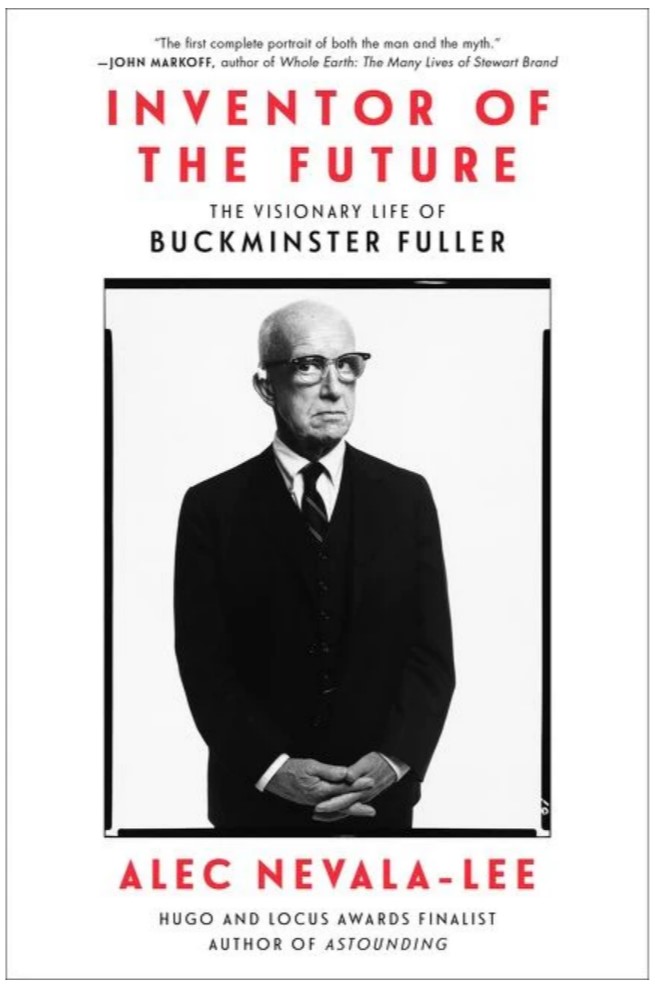
I wonder if Alec Nevala-Lee will get a reputation as a visionary killer. After his book Astounding: John W. Campbell, Isaac Asimov, Robert A. Heinlein, L. Ron Hubbard, and the Gold Age of Science Fiction came out, John W. Campbell’s name was removed from the award created to honor him, and the reputations of Asimov, Heinlein, Hubbard, and the science fiction Golden Age declined. As I read the first part of Inventor of the Future: The Visionary Life of Buckminster Fuller Nevala-Lee made me strongly dislike Buckminster Fuller by carefully chronicling Fuller’s personal faults. But by the end of the book, I was willing to overlook them. Bucky never redeems himself, but Nevala-Lee’s excellent biography brings everything into perspective. It brings closure to some of my hippie and New Age fantasies.
Inventor of the Future is a remarkable book about a remarkable person. I was constantly impressed by Nevala-Lee’s writing and research as I read Inventor of the Future but I never could stop thinking about the problems biographers must have in these woke times. How do you present a remarkable person without also throwing them under the bus of moral condemnation? Nobody is without sin, so it’s best not to be throwing stones because it might inspire a stoning by the hordes. But a great biography will always tell it like it is.
After I finished the book I watched some older documentaries about Buckminster Fuller and they left out the negatives. Maybe they didn’t even know them. Alec Nevala-Lee could have done that too, but I’m glad he didn’t. I had an epiphany the other day. I had just finished reading a history book about the first Crusade and then caught a movie about the Crusades on TCM. The difference between what happened in history and how we remember it in Technicolor was striking. In history, the Knights of Christendom slaughtered all the citizens of Antioch and Jerusalem, men, women, and children. And instead of returning the territory to the Holy Roman Empire, the crusaders claimed it for themselves.
We constantly cover up history. My epiphany revealed that is why we don’t change.
We don’t like remembering ourselves as the bad guys, so we whitewash history. It’s why the conservatives fight to keep Critical Race Theory out of education and why liberals want to erase racists from our collective memories. We don’t want to remember that our ancestors were killers, slavers, and routinely committed genocide, or even that our parents and grandparents were racists, sexual predators, and misogynists.
I’m on the third volume of a three-volume history of the world by Susan Wise Bauer and it added to that epiphany. How can we stop being evil if we keep forgetting who we really were? Buckminster Fuller was not evil, but he had enough personal failings that in our woke times many will want to dismiss him. But if we choose to forget him for the darkness in his life, we also throw out the light, the visionary insights.
When I was growing up in the 1960s Buckminster Fuller was a counter-culture hero, especially to hippies who wanted to create communes. Stewart Brand popularized Fuller with his Whole Earth Catalog. We thought Fuller was a genius. We thought Bucky was a futurist, a visionary, a seer. We thought Fuller was a prophet who would lead us into a new society. Then for decades, he was forgotten until people like Steve Jobs started talking about Buckminister Fuller again.
Nevala-Lee’s last biography painted John W. Campbell, Jr. as a racist and crackpot, and he got tarred and feathered by the genre. Buckminster Fuller is not described as a racist, but Inventor of the Future portrays him as a crackpot who used a lot of other people’s money to build inventions that didn’t work. Nevala-Lee quotes Fuller bragging about patronizing over a thousand brothels in Chicago after he was married. Nevala-Lee also writes about several of his love affairs with younger women whom he promised to marry but never did. But I was most disturbed by Bucky’s lying, it reminded me too much of Donald Trump.
However, in the second half of the book, Nevala-Lee clearly shows us how Bucky became the inspiration to more than one generation. People considered him the Da Vinci of the 20th century. And he tirelessly traveled the world promoting his philosophy about saving Earth and making it a better place. He could hold audiences spellbound for hours with his off-the-cuff talks about how the universe works.
Buckminster Fuller became a New Age guru in a dark suit and tie. I first heard about Fuller when the Montreal Expo 67 was in the news. Right after that, I encountered him again in The Whole Earth Catalog. During the 1970s I followed all the New Age, Mother Earth News, and Intentional Community movements. Fuller was a prophet to them all. But then I got married, went to work, and forgot about all those dreams. Most of my hippie and New Age friends did too. Then in the 1980s, Fuller’s name would come up again with my computer heroes. Nevala-Lee biography begins with Bucky meeting Steve Jobs. Then I went for years without hearing much about Buckminster Fuller, until the discovery of buckminsterfullerenes. For the most part, though, I had forgotten all about Bucky.
I loved Nevala-Lee’s Astounding (see my review), even though he revealed personal aspects of my heroes that disappointed me. And I’m quite taken with Inventor of the Future, which fills in many details I didn’t know. Both are well-written biographies, and I happen to be partial to biographies.
The thing is, both books revealed things about myself. I’ve consumed a lot of crackpot ideas back in the 20th century as did the science fiction fans, hippies, and New Agers that were my friends. Buckminster Fuller, John W. Campbell, Robert Heinlein, L. Ron Hubbard, and Isaac Asimov were all idealists about the future. We got so much hope from them, and those men inspired endless speculation. They are just the tip of the iceberg because there were so many other men and women with them that were also visionaries in the 20th century. Bucky knew many of them. And I’m pretty sure none of them were saints.
Those seers warned us about all the ways the sky was falling and the utopias we could build. They were our spiritual leaders, our prophets. Just because they got some details wrong, or they were assholes at times, or even psychopaths, doesn’t mean we didn’t resonate deeply with their dreams.
Early this morning, before it got light, I woke up and wondered when did I stop reading new science fiction? And why? I assume my unconscious mind had been mulling over the feeling that I’d lost touch with science fiction in the 21st century. (See yesterday’s essay.) Before I went to sleep last night, my conscious mind assumed it was natural to stop reading science fiction as one got older. Evidently, my unconscious mind objected to that assumption and I awoke with several other possibilities to consider.
I read many new science fiction books as they came out in the 1960s and 1970s because of the Science Fiction Book Club (SFBC). I was also aware of new SF books as they were published because I subscribed to the science fiction magazines and fanzines and loved reading reviews. I bought new SF paperbacks and read them because of those reviews. I think I stop regularly reading reviews back in the 1990s. That might be the main reason I got out of touch with the genre and new writers.
I got married in 1978 and started working full-time at a job I’d stay in for the next 35 years. In 1979 I became obsessed with microcomputers and shifted most of my reading to studying computers. Sometime during the 1980s, I canceled my membership with the SFBC, and let my magazine and fanzine subscriptions lapse.
However, Susan and I loved going to the bookstore at least once a week, and I always went through the science fiction section. During the second half of the 1980s and into the 1990s I’d get nostalgic for science fiction and resubscribe to the SFBC, F&SF, and Asimov’s. Sometimes I’d even subscribe to Locus Magazine, and for a short while, I wrote for Lan’s Lantern. During those periods I’d try and catch up with what was new.
When I did return to science fiction periodically, I realized science fiction had changed and changed quite a bit. Books were now bigger, often huge. And trilogies became common, or even longer series. And by the 1990s most of the writers I grew up reading had died. Long books and trilogies turned me off – I just didn’t want to make the commitment. I grew up reading SF books that were often less than 250 pages, with many with less than 200 pages. Now new novels were two and three times that size. And the thought of having to read three of them to complete a story seemed absurd.
And the SFBC kept changing too. I just didn’t know all the new authors, and the SFBC kept offering other kinds of books, fantasies, media tie-ins, gaming — books that just didn’t appeal to me, so I’d quit. For many decades the SFBC’s two monthly selections seem to zero in on the core SF books everyone was reading – and then it didn’t.
My guess is the boom in SF and fantasy gave us too many choices so it was no longer obvious what to read. At the bookstores, the SF/F section just grew and grew. It was like a tsunami of new titles and authors. Not only was it impossible to keep up with reading the popular titles it became impossible to even keep up with a sense of the genre. SF had gotten too big. There seemed to be hundreds of new writers and I just didn’t know who they were. Even reading Locus Magazine didn’t help.
When I retired in 2013 I came back to science fiction. But instead of trying to catch up on the new works, I jumped back in time to read the classics I missed the first time around. I focused mainly on books from 1950-1980. And then I got into short stories again and started my project of reading all the best-of-the-year SF anthologies from the 20th century. It was more rewarding to fill in my knowledge of a historical period than trying to keep current.
However, after years of gorging on classic science fiction, I’m back to craving new science fiction. The genre is even larger, and I’m still not interested in trilogies and book series. I read science fiction for its ideas. Following a character through endless obstacles book after book is just tedious to me. I hunger for standout standalone stories that convey a far-out concept. So far, I’ve had my best luck with Kim Stanley Robinson.
I believe one of the main reasons I don’t read new science fiction is because the genre is no longer based on new ideas. Quite often the first book in a trilogy or series will have a new idea and unique worldbuilding, but the sequels just grind that idea and setting into the ground. And sadly, I’m not sure there are that many new ideas anymore. Writers are having to rehash old themes. Sometimes they find fresh ways to present them, and that works, but all too often new stories just feel like slight variations on old tunes.
However, I haven’t given up. Breakthrough SF novels do come out. The problem is finding them. How I go about that will be a topic for my next essay.
I’ve been watching a lot of science fiction book reviewers on YouTube and quite often they make me feel completely out of touch with current science fiction. It seems like there are a thousand new science fiction books published each year, and I seldom read what people are talking about.
I feel well-read in the genre before 1980, maybe even 1990, but after that, when I hear young people talking about new science fiction I feel like I’ve been left behind. To see how unread I am I use the list builder feature and CSFquery to find any SF book that had gotten at least 3 citations published during the years 2000-2022. I created the checklist below. I marked the ones I’ve read with an R and the ones I’ve bought hoping to read with an O.
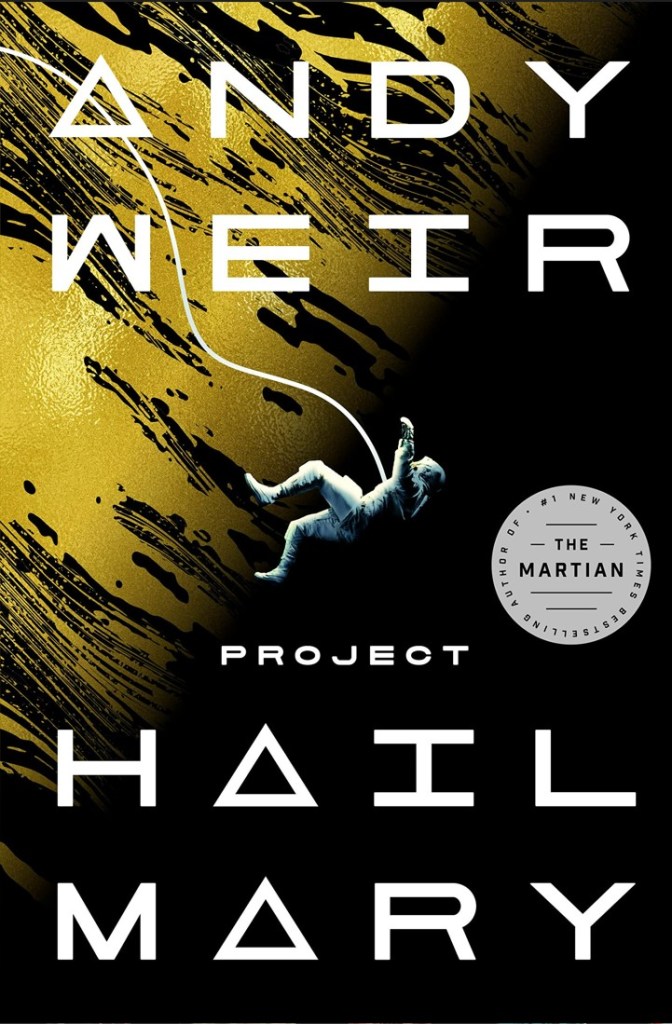
I haven’t done too bad for those books that have gotten a lot of attention, but as their recognition has fallen off, so has my rate of reading. When I was young I read one or two dozen new SF books each year, but that’s been decades. I recently read Project Hail Mary by Andy Weir, meaning I’m a year late. I don’t remember the last time I read an SF book just after it was published.
How well-read are you with 21st-century science fiction? Are you young or old? How many new SF books do you read each year? And what books do you recommend that are missing from the list?
Title
Author
Year
Citations
Read/Own
The Hunger Games
Suzanne Collins
2008
17
R
The Windup Girl
Paolo Bacigalupi
2009
17
R
The Road
Cormac McCarthy
2006
16
R
Altered Carbon
Richard K. Morgan
2002
15
R
Ancillary Justice
Ann Leckie
2013
15
R
The Martian
Andy Weir
2012
13
R
Old Man’s War
John Scalzi
2005
13
R
The Time Traveler’s Wife
Audrey Niffenegger
2003
13
R
Anathem
Neal Stephenson
2008
12
O
The City & The City
China Miéville
2009
12
R
Never Let Me Go
Kazuo Ishiguro
2005
12
R
Revelation Space
Alastair Reynolds
2000
12
O
World War Z: An Oral History of the Zombie War
Max Brooks
2006
12
Cloud Atlas
David Mitchell
2004
11
R
Embassytown
China Miéville
2011
11
R
Little Brother
Cory Doctorow
2008
11
R
Oryx and Crake
Margaret Atwood
2003
11
Station Eleven
Emily St. John Mandel
2014
11
R
Boneshaker
Cherie Priest
2009
10
R
Passage
Connie Willis
2001
10
Accelerando
Charles Stross
2005
9
Pandora’s Star
Peter F. Hamilton
2004
9
O
Ready Player One
Ernest Cline
2011
9
R
The Speed of Dark
Elizabeth Moon
2002
9
R
Spin
Robert Charles Wilson
2005
9
R
The Yiddish Policemen’s Union
Michael Chabon
2007
9
R
Air
Geoff Ryman
2004
8
Blackout/All Clear
Connie Willis
2010
8
O
Leviathan Wakes
Daniel Abraham & Ty Franck
2011
8
R
Redshirts
John Scalzi
2012
8
R
The Years of Rice and Salt
Kim Stanley Robinson
2002
8
O
Among Others
Jo Walton
2011
7
R
Ancillary Sword
Ann Leckie
2014
7
Annihilation
Jeff VanderMeer
2014
7
R
The Fifth Season
N. K. Jemisin
2015
7
O
Ilium
Dan Simmons
2003
7
Midnight Robber
Nalo Hopkinson
2000
7
Mockingjay
Suzanne Collins
2010
7
R
Rainbows End
Vernor Vinge
2006
7
River of Gods
Ian McDonald
2004
7
The Three-Body Problem
Cixin Liu
2014
7
R
Wool Omnibus
Hugh Howey
2012
7
O
Blindsight
Peter Watts
2006
6
O
The Calculating Stars
Mary Robinette Kowal
2018
6
R
Catching Fire
Suzanne Collins
2009
6
R
The Dervish House
Ian McDonald
2010
6
Hominids
Robert J. Sawyer
2002
6
O
Light
M. John Harrison
2002
6
The Scar
China Miéville
2002
6
The Separation
Christopher Priest
2002
6
All the Birds in the Sky
Charlie Jane Anders
2016
5
R
Ash: A Secret History
Mary Gentle
2000
5
The Chronoliths
Robert Charles Wilson
2001
5
Ninefox Gambit
Yoon Ha Lee
2016
5
Pattern Recognition
William Gibson
2003
5
Red Rising
Pierce Brown
2014
5
O
The Telling
Ursula K. Le Guin
2000
5
Zoo City
Lauren Beukes
2010
5
The Algebraist
Iain M. Banks
2004
4
Ancillary Mercy
Ann Leckie
2015
4
Bold as Love
Gwyneth Jones
2001
4
Chasm City
Alastair Reynolds
2001
4
The City We Became
N. K. Jemisin
2020
4
Diplomatic Immunity
Lois McMaster Bujold
2002
4
The Goblin Emperor
Sarah Monette
2014
4
How to Live Safely in a Science Fictional Universe
All people crave romance and sex, accomplishments and adventures, possessions and travel. Most of us settle for marriage and work while living our fantasies out vicariously in fiction. We use books, TV shows, movies, video games, or VR as substitutes for our desires. When fiction fails to satisfy we dine out, party, exercise, or travel. What we really want is to live a different life.
Knowing this should enlighten us about the fiction we choose. Are the stories we love most the ones we wished we were living?
Andy Weir’s latest book Project Hail Mary, left my eyes watery and my nose runny while listening to the last chapter on audio. I loved it. Is that the life I wished I was living? At 70, I know it’s an absurd fantasy and should answer that question with no. But when I was a teenager I would have said yes with great enthusiasm.
Nowadays, few science fiction books move me like that. And, I have to ask myself why. Did Project Hail Mary impact me in the same way the Heinlein juveniles did in the 1960s when I was twelve? Getting close to the end of life, I’m not sure I have much of a sense of wonder left, at least not the kind I had when reading science fiction in that golden age of being young.
When I discovered science fiction sixty years ago almost every story blew my mind with far-out ideas, giving me a tremendous sense of hope for the future, especially for the possibilities for my personal potential. Now, that I’m living in the future, with what little potential I have left, I see science fiction from a different vantage.
Project Hail Mary is one hell of a hopeful book and I enjoyed the hell out of it. I highly recommend reading it. If I had read it in 1964, or if I was 12 years old today, it would have made me a true believer in the science fiction faith. This week I read Weir’s novel and forgot about the world we see every evening on the NBC Nightly News, and I entered into a wonderful virtual reality created by Andy Weir’s skillful worldbuilding with words.
The entire time I listen to Project Hail Mary I marveled at Weir’s storytelling skills. He blended many of my favorite SF themes into an enchanting first-person narrative. Weir obviously imagined his novel as a movie, creating a lovable hero that will save the Earth. For some reason, science fiction blockbusters always seem to put Earth in final jeopardy. And many of them love having an average guy overcome an endless series of obstacles. Kurt Vonnegut gave some famous advice to would-be writers. He said: create a likable character and then do mean things to them. Andy Weir gives Ryland Grace a long series of impossible problems to solve.
The story begins with Ryland waking up in a strange hospital bed, not knowing who he is, where he’s from, or where he’s at. This is a neat storytelling trick. The novel breaks down into two tracks: the now and the past. Amnesia is the perfect excuse for creating flashbacks. Normally, I hate flashbacks, but Weir’s gimmick made me look forward to them.
I don’t want to tell you much about the novel and I want to beg you to get the audiobook version. The narrator acts out each character with a different voice, including accents for different nationalities. For the alien, Rocky, who speaks in musical tones which the audiobook plays, the narrator creates a charming accent for his English. The audiobook should have way more impact than just reading with your eyes.
Looking at reviews on Facebook, Goodreads, and Amazon, some readers loved this novel, while many others complain it’s too tedious. Weir tells this story in one long series of problems that Ryland Grace solves, many of which involve science. I assume the readers who love this story are problem solvers. If you’re not, this book might not be for you.
Ryland Grace is the ultimate competent man who can do everything. This character attribute is why I loved the Heinlein juveniles as a kid. It’s why I also loved the recent Bobiverse books. That’s one of my big personal fantasies, being a generalist that knows everything and can do anything. I’m not. I’m half-ass at doing a lot of things, and I vaguely know a little about a lot.
Ryland Grace is the modern manifestation of Tom Swift. That might be another clue for you if you’re thinking about reading this book.
Another fantasy Project Hail Mary tunes into is being alone in the world. I love the last man on Earth type stories, the Robinson Crusoe types. Ryland Grace is alone in space for a lot of this story. He even meets his Man Friday. (I hope I’m not giving too much away.)
Ryland Grace is the hero that saves Earth, and that’s one fantasy this book promotes that’s not mine. I don’t like attention. However, because of the way Andy Weir presents Ryland Grace’s achievements, I didn’t feel getting attention was a theme of this story. In flashbacks, we learn that Ryland Grace loved being a junior high school teacher who enjoyed promoting science with his students. That’s another theme that Heinlein and Weir are into that doesn’t resonate with me, but I imagine it will for teachers. Project Hail Mary would be a great book to teach in an English or science class.
Now to the negatives – which I just ignored because I was enjoying the story so much. Ryland Grace pulls a rabbit out of the hat every time, and his mental abilities are unrealistic. Plus, the invented science for this story is too good to be true. If people love Superman for his fantasy physical feats, Ryland Grace is a Superman of intellectual feats. In other words, the reality of this story is closer to a comic book than literary fiction.
That brings us back to my original psychobabble. Why do we choose the fiction we do? Why do we love some stories way better than others? Do the same themes appeal to us our whole life, or do they change as we age?
The Heinlein juveniles made the biggest impact on me of anything I read as a teen. That’s because I wanted to be like the characters in those books, and I wanted to grow up and live adventures similar to those in the stories. I wanted those fantasies to become real.
I can’t possibly believe that at 70. I’m a great deal more aware of reality now. I shouldn’t buy into anything in Project Hail Mary. I should be too old to enjoy it, but I did. A simple answer is I know too much about reality, and yet, I loved reading this book because it help me escape from reality that’s becoming all too harsh and hard. And that might have been the reason I loved science fiction as a kid too. The 1960s were tough times for anyone to grow up in, and I had feuding alcoholic parents who dragged me and my sister from state to state. That made things worse. Is it any wonder I wanted a science fictional fantasy to be real? Is it any different today?
Project Hail Mary is not a young adult novel, but it has that kind of appeal. As a kid, I knew science fiction was fantasy but reading science fiction made me hope that reality would become more like science fiction. It didn’t. We have science-fictional technology, but not science-fictional lives. That’s what we wanted. That’s what I wanted then, and now. And I can only find that life in books, books like Project Hail Mary.
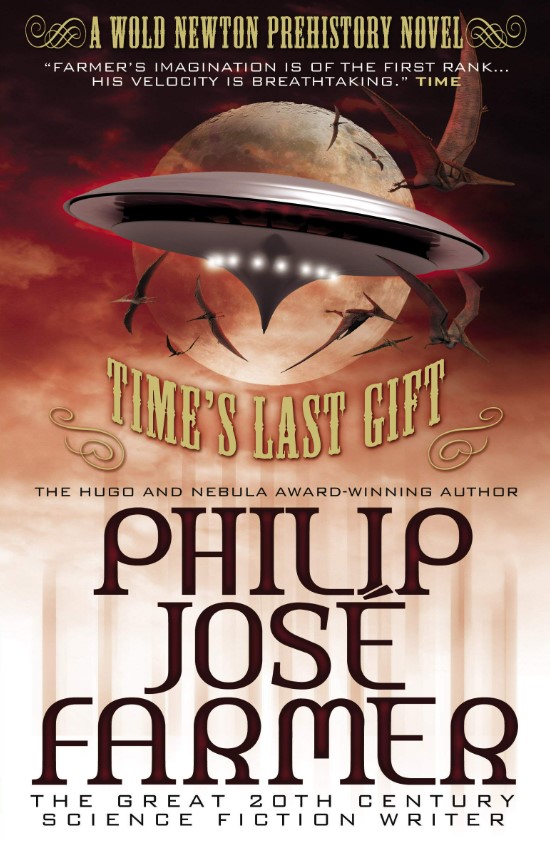
My aim is to review a time travel novel, Time’s Last Gift, by Philip José Farmer, but I need to explain my attitude towards time travel stories before I can pass judgment. I bought Time’s Last Gift because I read on the cover blurb that four scientists from the year 2070 travel back to 12,000 BC to study the Magdalenian culture. Since I’ve recently read a number of books on prehistory that plot appealed to me. I even read a large book just on locating the origin of the people who produced the proto-Indo-European language.
Within Time’s Last Gift, one character, Robert von Billmann is obsessed with finding the people who created the Proto-Indo-Hittite language. If you’re not interested in pre-history or the origins of language you might not want to bother with Time’s Last Gift – unless another factor appeals to you, but I want to wait and mention that after the spoilers warning. Let’s just say that John Gribardson, who was made leader of the expedition at the last minute has a very interesting backstory.
Does Time’s Last Gift stand on its own as a solid story and as a good addition to the time travel theme despite any details related to actual history or literary plot gimmicks? To me, a worthy time travel story has to add something different to the theme, otherwise, it’s just a romance, thriller, or historical novel that jumps around in time.
There have been countless science fiction books about time travel, but for me, I find very few of them worthy of using the theme. Most throw their characters into the past or the future and develop a story about that new setting. What I love is a time travel adventure that also explores the wonder of time and time travel. H. G. Wells set the bar very high with The Time Machine in 1895. I’m not sure any work has ever surpassed it for its sense of wonder.
There are so many time travel stories that Michael Main has created The Internet Time Travel Database. Town & Country Magazine listed their top 35 time travel books but only three of my top favorites make their list. Read This Twice found 92 favorite time travel books, and they do list many of my favorites. About Great Books lists 30-time travel books they think are great, and seven of my favorites are there, but I don’t consider many of those books really time travel stories. But that brings up another issue.
What is time travel? Replay by Ken Grimwood is one of my all-time favorite novels, but does Jeff Winston time travel? He repeats his life over and over. I call such fiction time loop stories. Stories such as The First Fifteen Lives of Harry August by Claire North, and The Midnight Library by Matt Haig are really time loop stories too, which I consider a different theme than time travel stories. I’ve written about it before.
Are such literary classics as The Time Traveler’s Wife, Kindred, Slaughterhouse-Five, A Christmas Carol, and Woman on the Edge of Time really about time travel? Don’t they just use the gimmick of time travel to reveal deep characterization or explore social issues in a clever way? These are great novels, but I don’t really want to lump them into the kind of science fiction novel I’m pointing to. Nor do I want to consider all the novels that use time travel to hook people up romantically.
Real science fiction about time travel should make us think about the nature of time travel. Time’s Last Gift does do this. Time travel has always been plagued by paradoxes, but I believe Farmer has found a neat way around them. If a time traveler goes into the past and changes the future, it’s already happened. Whatever exists now, whether affected by time travel or not, is what is. Speculations about what might be changed are no different from what was changed. If a time traveler shows up in 12,000 BCE there was never a 12,000 BCE without a time traveler. Of course, that means everything that happens is fixed. Or is it? Does this theory about time travel require predestination? It could mean everyone has free will, but whichever way history plays out it only plays out once.
Most of Time’s Last Gift is about living in 12,000 BCE. The four scientists immediately befriend a small tribe of humans and learn their language. John Gribardsun even wears their clothing and hunts with their weapons, although he often uses his rifle when necessary to help feed the tribe. The main conflict of the story deals with the two scientists who are married, Rachel and Drummond Silverstein, and their breakup. Farmer suggests that time travel has a psychological effect, like a larger case of jet lag, and it wears on three of the scientists. Gribardsun seems immune. In fact, he thrives in the past, and his vitality attracts both Rachel and the young women of the tribe. Much of the novel is about whether or not Drummond is out to kill Gribardsun because of jealousy. I didn’t care for this part of the story. It felt like a contrived conflict to move the novel along. However, the story is very readable and kept me reading.
Beyond Here Lie Spoilers
In the 1950s Philip José Farmer wrote some very innovative science fiction stories – “The Lovers,” “The Alley Man,” “Sail On! Sail On!” and others. Then he created two series that were fairly successful, the Riverworld series and The World of Tiers. Farmer won the Hugo award for best novel for the first Riverworld story, To Your Scattered Bodies Go (1971). I loved that novel when it came out because the main character was Sir Richard Francis Burton, the 19th-century explorer, and translator. And I loved the second book, The Fabulous Riverboat (1971) because it featured Mark Twain. I had read biographies of both men and that made me partial to those Farmer’s novels.
Over the decades I have come to feel that using a famous historical person as a character in a novel is a cheat, a way to sell books. But I also consider writing book series as a crutch for writers. For the rest of his life Farmer mostly churned out books for various series, and they were just so-so. He later refined the famous person gimmick by switching to writing about famous fictional characters, and this is where Time’s Last Gift comes in. John Gribardsun is Tarzan. It’s never said within the novel, but I guess it fairly quickly. If you’ve ever read a Tarzan novel, Time’s Last Gift feels like one and could have been Tarzan’s Time Machine.
There’s nothing wrong with book series, they do help writers to pay bills, but each book feels like just another episode in a TV series to me. If you love a series, that’s great. But for me, usually, only stand-alone novels can be great.
I assume Farmer didn’t use the name Tarzan in the book because of being sued by the Edgar Rice Burroughs estate, but ISFDB even lists Time’s Last Gift among the Tarzan novels. Philip José Farmer wasn’t the only writer to continue the character. More importantly, it’s part of Farmer’s Wold Newton series where he brings many famous characters from literature into the real world. If you really like this kind of publishing gimmick, then Time’s Last Gift might excite you.
I find the Wold Newton idea fascinating in conception, but lackluster in execution. It capitalizes on the readers’ love of famous books and characters and I consider that exploitation. Heinlein did the same thing in his later books bringing back his own favorite characters and tieing them into his favorite fictional worlds. The idea is neat, but again, the execution was horrible.
As a time travel novel, Time’s Last Gift is mediocre – readable and somewhat interesting. The plot moves along well enough. The John Gribardsun character is appealing but his adventures back in 12,000 BCE aren’t that significant. If you enjoy the idea that it’s an alternate origin story for Tarzan, and Farmer makes him immortal, then you might enjoy the book more.
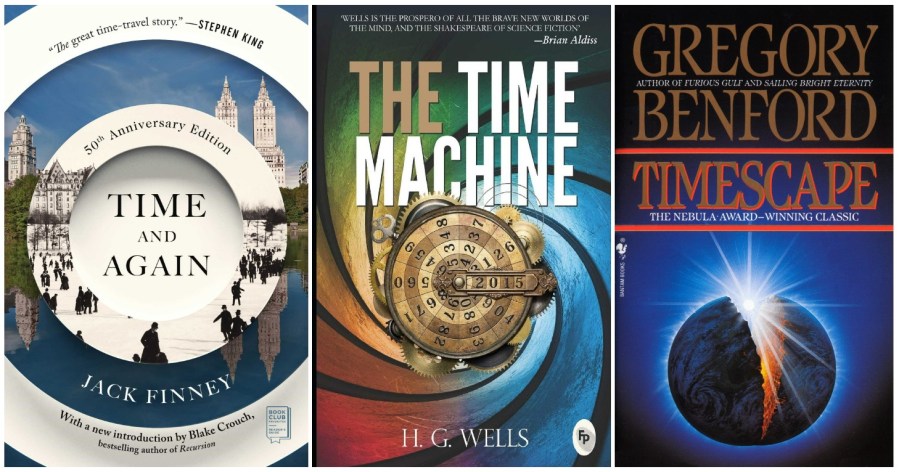
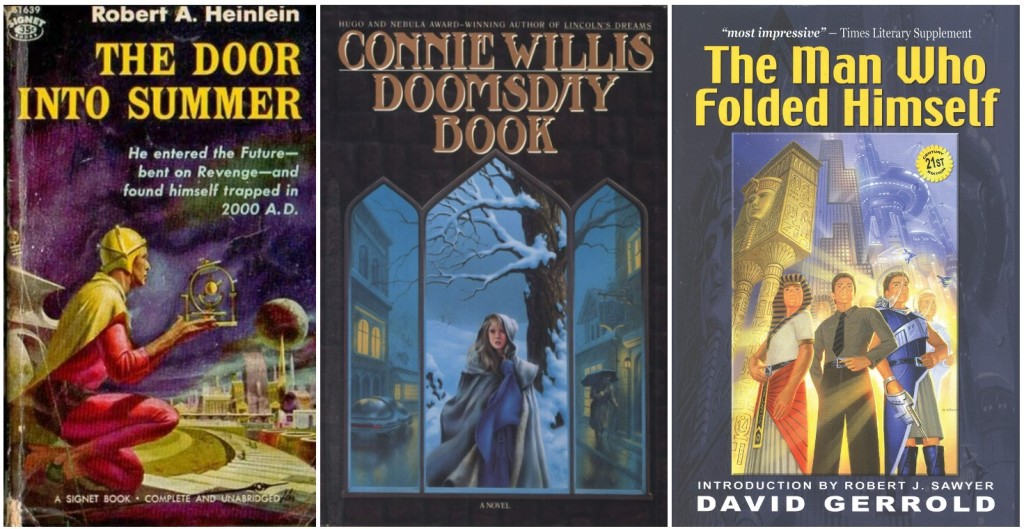
I judge time travel stories by how creative they are at dealing with time travel. For example, Heinlein’s “All You Zombies—” uses time travel and gender reassignment in a unique way. David Gerrold uses The Man Who Folded Himself to allow a time traveler to really get to know himself. Jack Finney in Time and Again used historical photographs to enhance his novel. Kurt Vonnegut combined memoir and fiction brilliantly. Connie Willis has explored both drama and comedy in her time travel novels. Of course, Wells illustrated both evolution and cosmology to his 19th-century readers. Wells inspired the Dying Earth genre and the idea that humanity will spin off different new species. Olaf Stapledon ran away with that idea with his novel Last and First Men.
With time travel stories, writers need to go big or go home. Philip José Farmer knew this. This is why he tacked on the Wold Newton afterward in a 1977 later edition. If you think Wold Newton is cool, then that might make Time’s Last Gift a good time travel story. If not, you might want to pass on it.
Here's a list of my favorite time travel stories.

1895 - THE TIME MACHINE by H. G. Wells
1934 - "Twilight" by John W. Campbell
1935 - "Night" by John W. Campbell
1941 - "Time Wants a Skeleton" by Ross Rocklynne
1941 - "By His Bootstraps" by Robert A. Heinlein
1943 - "Mimsy Were the Borogoves" by Henry Kuttner and C. L. Moore
1946 - "Vintage Season" by Henry Kuttner and C. L. Moore
1951 - "I'm Scared" by Jack Finney
1952 - "A Sound of Thunder" by Ray Bradbury
1952 - "Hobson's Choice" by Alfred Bester
1953 - "Who's Cribbing" by Jack Lewis
1956 - "A Gun for Dinosaur" by L. Sprague de Camp
1956 - "The Man Who Came Early" by Poul Anderson
1957 - THE DOOR INTO SUMMER by Robert A. Heinlein
1957 - "Soldier from Tomorrow" by Harlan Ellison
1958 - THE TIME TRADERS by Andre Norton
1958 - "Poor Little Warrior!" by Brian Aldiss
1958 - "The Ugly Little Boy by Isaac Asimov
1958 - "The Men Who Murdered Mohammed" by Alfred Bester
1959 - "All You Zombies---" by Robert A. Heinlein
1964 - FARNHAM'S FREEHOLD by Robert A. Heinlein
1964 - "When Time Was New" by Robert F. Young
1965 - "Traveller's Rest" by David I. Masson
1966 - "Behold the Man" by Michael Moorcock and BEHOLD THE MAN (1969)
1967 - "Hawksbill Station" by Robert Silverberg
1968 - THE LAST STARSHIP FROM EARTH by John Boyd
1969 - SLAUGHTERHOUSE-FIVE by Kurt Vonnegut, Jr.
1970 - TIME AND AGAIN by Jack Finney
1970 - THE YEAR OF THE QUIET SUN by Wilson Tucker
1971 - DINOSAUR BEACH by Keith Laumer
1973 - THE MAN WHO FOLDED HIMSELF by David Gerrold
1976 - "The Hertford Manuscript" by Richard Cowper
1967 - "Infinite Summer" by Christopher Priest
1980 - TIMESCAPE by Gregory Benford
1982 - "Firewatch" by Connie Willis
1985 - "Sailing to Byzantium" by Robert Silverberg
1988 - "Ripples in the Dirac Sea" by Geoffrey A. Landis
1992 - DOOMSDAY BOOK by Connie Willis
1995 - THE TIME SHIPS by Stephen Baxter
1995 - FROM TIME TO TIME by Jack Finney
1998 - TO SAY NOTHING OF THE DOG by Connie Willis
2003 - THE TIME TRAVELER'S WIFE by Audrey Niffenegger
What if our pleasure in life is wallowing in the minutiae of our favorite subject? I follow a lot of YouTubers and most of their channels are about going deeper and deeper into a beloved special interest. When we are young we pursue pleasures of the flesh, but as we get older we follow our Alice of interest down a rabbit hole. This lets us find our true tribe, our people.
I feel like I’m among a few survivors of a tribe that is dying out. I lament that our culture and language are disappearing. My tribe is those beings who grew up reading science fiction magazines in the mid-20th century. I know that tribe was never very large and that all the various tribes of pop culture eventually fade from the collective memory of the present. But this sense of passing is why I find myself enjoying recursive science fiction so much now. Recursive science fiction is science fiction about science fiction, and quite often it remembers the genre’s past. And to enjoy such stories requires either a direct experience of the past or a good education about that past.
One of the funniest recursive science fiction stories I’ve ever read is one that seems to parody/remember more of the genre than any other recursive science fiction story I’ve read. The story is “The Curse of the Mhondoro Nkabele” by Eric Norden (Eric Pelletier 1899-1979). Unfortunately, it’s been a long time since this story has been reprinted, meaning if you want to legally read it, it will require tracking down a used copy of F&SF for September 1980, The Best from Fantasy and Science Fiction 24th Series edited by Edward L. Ferman in 1982, or Inside the Funhouse: 17 SF Stories about SF edited by Mike Resnick in 1992. If you have a free account with the Internet Archive you can check outThe Best of F&SF 24th for one hour. Since this story hasn’t been reprinted in 30 years, and its author has been dead for 43 years, I hope their heirs won’t mind me offering you a pdf copy. (If you do, let me know and I’ll take it down, but I doubt if six people will read it.)
Of course, not everyone will find this story funny or meaningful. It depends on you knowing a good deal about the genre’s history. I thought I’d review the story by providing links to the pertinent bits of history that knowing will let the reader appreciate the story.
The story is an exchange of letters between Oginga Nkabele, a young man from Africa studying in America, and Edward L. Ferman, the editor of The Magazine of Fantasy and Science Fiction (F&SF). Nkabele, from the tribe of Diolas in Senegal, Africa, was educated by French and Belgian missionaries who he refers to as the Holy Ghost Fathers. One of his teachers, Father Devlin brought three steamer trunks containing over five hundred pulp science fiction magazines from 1936-1952. Nkabele has read these magazines so thoroughly that he’s even memorized some of his favorite stories. Nkabele feels he’s an expert on science fiction and decides to become a rich science fiction writer while in America.
Unfortunately, the stories he submits to Ed Ferman are modeled on the writing styles that were heavily criticized for bad writing when they were new and are now so out of fashion as to be glaringly awful. Ferman is appalled by Nkabele’s stories and rejects them immediately. Nkabele feels the rejection letter is a mistake and keeps pestering Ferman with more letters. In fact, he never accepts any rejection and keeps trying to convince Ferman his stories are brilliant and will make him famous and promises they’ll help sell more copies of F&SF.
Through the exchange of letters, two fun plots emerged. One is a horror tale for SF magazine editors which is hilarious if you’re not an editor, and the other is about how the genre has changed drastically from its past which is still wistfully nostalgic for some.
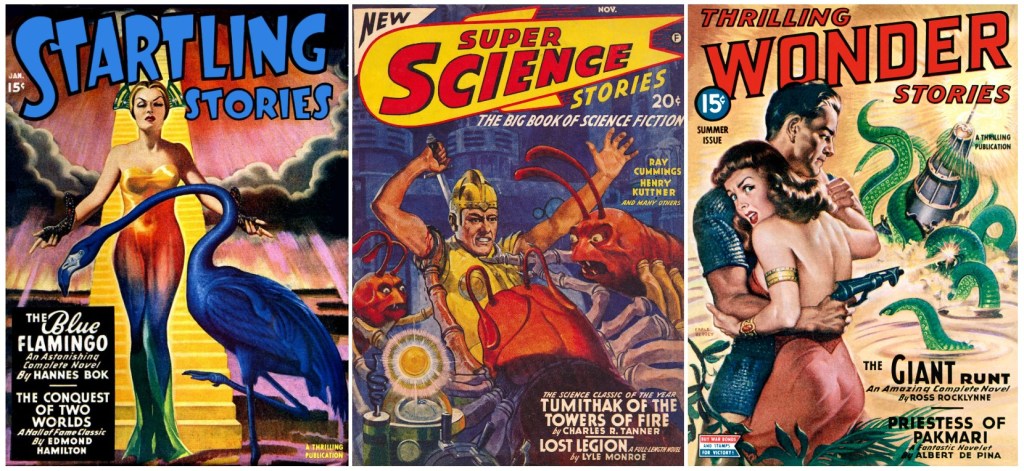
First, it’s important to know the magazines Nkabele admires. It’s notable that Father Devlin did not subscribe to Astounding Science-Fiction, the magazine revered until recent decades (another irony of this tale). Nkabele’s favorites are:
Nkabele’s favorite writers are Richard Shaver, L. Ron Hubbard, and Stanley G. Weinbaum, but is also a fan of Robert Moore Williams, E. E. “Doc” Smith, Nelson Bond, Ray Cummings, Eric Frank Russell, P. Schuyler Miller, and Raymond Z. Gallum. Although not specific to this story, if you know about The Shaver Mystery you’ll have a sense of the kind of thinking fans of these magazines pursued.
Most telling of all is that Nkabele’s favorite editor is Raymond A. Palmer. That’s quite revealing. Young science fiction writers today want to erase the memory of John W. Campbell, but when I was growing up, science fiction fans wanted to forget Ray Palmer’s impact on the genre.
To understand Nkabele’s taste in science fiction, even more, is to know the names of the three stories he keeps submitting:
“Astrid of the Asteroids”
“Slime Slaves of G’Harn”
“Ursula of Uranus”
The magazines Nkabele loved were the ones that appealed most to adolescents featuring exotic interplanetary adventure stories told in purple prose. The exact kind of science fiction John W. Campbell was fighting against in our Golden Age of Science Fiction. But Nkabele considers his science fiction the actual Golden Age of Science Fiction. Over the decades, different generations have defined their own Golden Age of Science Fiction. Youth always reject the past. Nkabele can’t fathom why Ferman is rejecting his Golden Age.
It helps to know a little about Edward L. Ferman since he’s a major character, but it’s very important to know about Harlan Ellison. Ferman panics and gives Nkabele Ellison’s address and phone number to get rid of him. Ferman tells Nkabele about Ellison’s legendary SF anthology Dangerous Visions. Now Harlan Ellison starts writing letters and Eric Norden parodies Ellison’s writing style in an over-the-top style that wasn’t far from Ellison’s own. They even rope in Isaac Asimov. Norden does a great job of making each letter writer sound like a distinct personality. Sometimes the epistolary caricatures aren’t so flattering and it’s a wonder Norden didn’t get sued by Ellison who was known for his litigious wrath.
It also helps to know about BEMs – Bug Eye Monsters – especially SF covers that showed BEMs running off with mostly naked Earth women. BEMs in SF anticipated the whole abductee theme of UFO fanatics. And Ray Palmer turned his SF magazines into UFO fanaticism.
Parodying science fiction has been around for a long time, and Norden mentions a classic, Venus on a Half Shell by Kilgore Trout. Kilgore Trout is a character in many of Kurt Vonnegut’s novels. But I’ll have more to say about such other fun novels and stories soon.
I’m not sure how many current SF readers will enjoy “The Curse of the Mhondoro Nkabele” by Eric Norden. Is the pop culture that it skewers too oldy moldy? I tend to think the people who will enjoy it most are the people of my tribe.
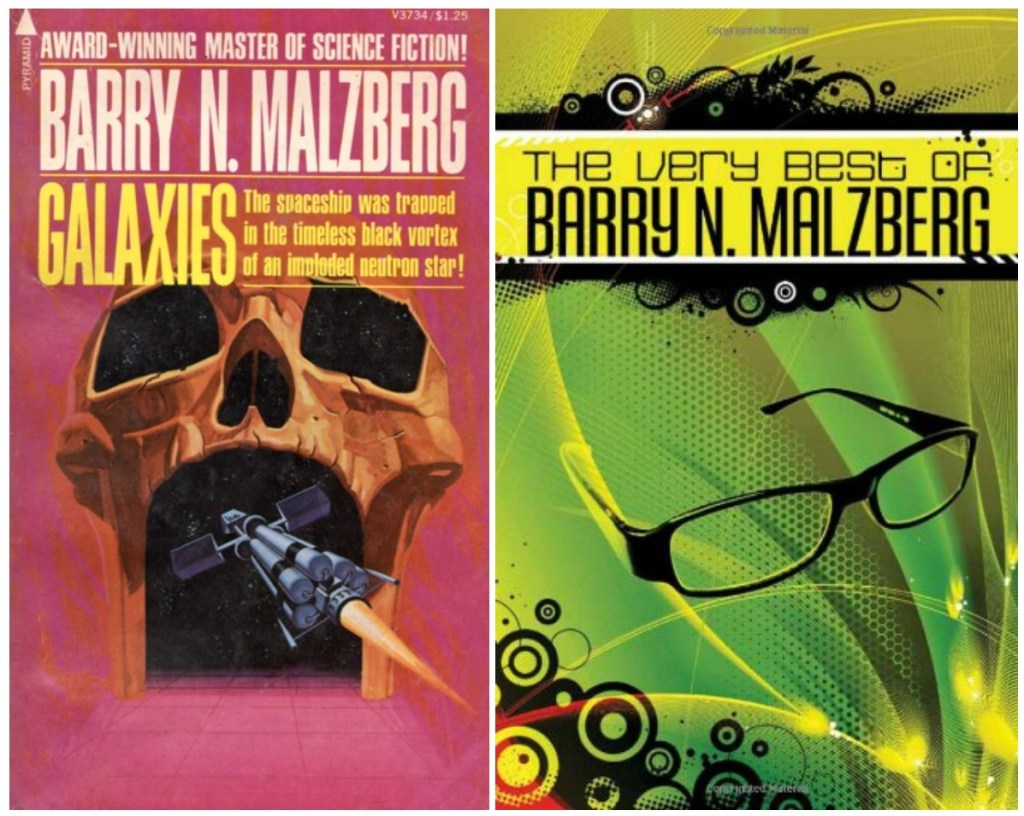
I’ve been reading recursive science fiction lately, and one of the most famous recursive science fiction stories is Barry N. Malzberg’s “A Galaxy Called Rome.” Recursive science fiction is science fiction about science fiction. Sometimes this is a story that mentions science fiction, sometimes it’s a story about science fiction writers, their fans, and science fiction conventions, and sometimes it’s in-jokes about the genre, other times recursive science fiction is about the writing of science fiction, and that’s the case with “A Galaxy Called Rome.”
Malzberg is known for his recursive science fiction, especially since he seems to have experienced a great deal of existential angst over being a science fiction writer. NESFA even came out with a collection of his recursive SF called The Passage of the Light: The Recursive Science Fiction of Barry N. Malzberg.
“A Galaxy Called Rome” is a novelette composed of 14 short chapters. It first appeared in the July 1975 issue of F&SF and has been anthologized a number of times. It is probably Malzberg’s most famous work of short science fiction.
Malzberg expanded the same story into 49 chapters for a 1975 short novel version retitled Galaxies. Malzberg gained attention for a handful of science fiction novels in the first half of the 1970s. He won the John W. Campbell Award for Beyond Apollo but got a fair amount of recognition for Galaxies, The Falling Astronauts, and Herovit’s World. He went on to publish prolifically in and outside of the genre
“A Galaxy Called Rome” and Galaxies are also works of what the literary world calls metafiction – fiction about fiction. I prefer the novelette version of the story because the novelette is my favorite length for science fiction. However, the longer version of the story, Galaxies, lets Malzberg dig deeper into the nature of writing science fiction.
I want to recommend this story, but with carefully considered restrictions. If you read science fiction for escape this story isn’t for you. Well, if you want to know why you read science fiction for escape, then you might want to read it. This story is for people who like to intellectually examine everything and take things apart. This story is for readers who love academic exercises in cleverness. This story is for readers who want to know how magic tricks work.
I alternated reading Galaxies with listening to Red Rising by Pierce Brown. It was an excellent contrast. Red Rising is exactly what most science fiction readers want to read. The story immediately sucks the reader into a fantasy reality. It’s designed for your mind to forget the real world and immerse yourself in a fantasy about Mars. The reader is expected to buy into its make-believe. Galaxies on the other hand constantly remind the reader of our reality while describing how a science fiction writer goes about their business of fooling the reader.
Reading “A Galaxy Called Rome” or Galaxies could ruin your love of science fiction. Or it could make you appreciate escapist literature all the more. I know when I would switch to Red Rising after reading a dozen chapters of Galaxies I felt like that guy in The Matrix, Cypher, who wanted to take the blue pill and enjoy the juicy steak. And that might be a good analogy. Reading Malzberg is like taking the red pill and seeing an ugly reality. It might be philosophically enlightening to know the realness of reality, but it’s still grim and gritty.
This is probably why Malzberg never became a popular sci-fi writer, he was too hung up on reality. Most of the recursive science fiction I read in Inside the Funhouse was big fun. Recursive science fiction comes in many flavors but they can be roughly divided into two kinds. One kind celebrates our addiction, and the other makes you feel like you’re withdrawing from heroin. Reading “A Galaxy Called Rome” is like learning about Santa Claus as a kid, it hurts but makes you feel grown up. Reading Galaxies can feel like the agony of soul searching before deciding on becoming an atheist.
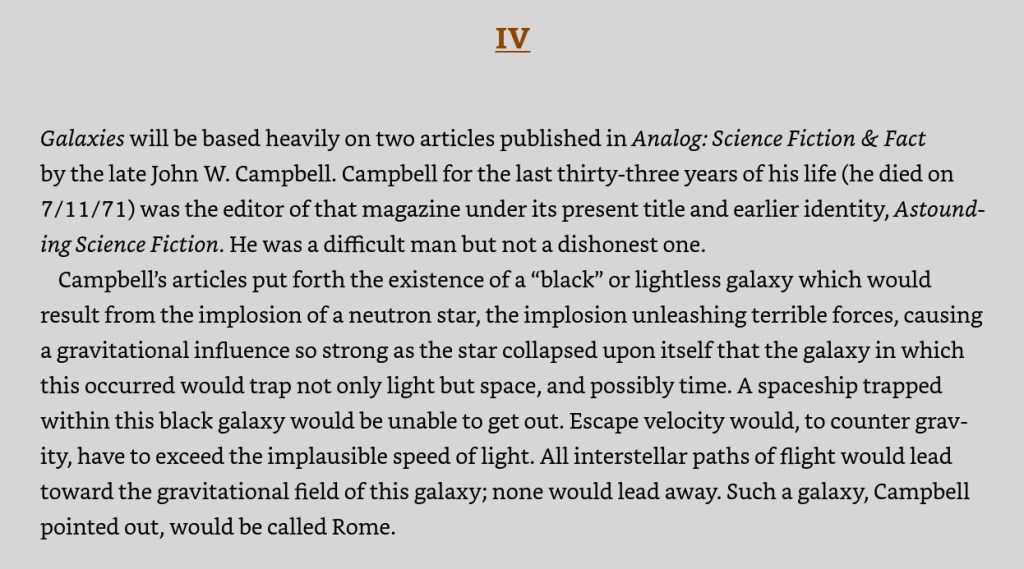
I ended up highlighting almost ten percent of Galaxies when reading the Kindle version. I won’t show all these quotes because that would probably be a copyright violation, but I do want to show enough of them to give people a chance to understand what Malzberg is doing. Malzberg is very open and straightforward with his intentions as stated in this first section.
It’s rather interesting that Malzberg tells us how the idea of the story within a story came to him. Well, the idea for the story he’s going to use to discuss writing. In the course of reading a novel about writing a novel, we will develop a whole story with characters, setting, plot, and conflict. However, we won’t experience that story like we normally do. Imagine being served a meal and instead of enjoying eating it, we put it under scientific analysis.
One thing Malzberg doesn’t do is try to imagine what we readers think while reading all of this. We readers are also part of the process. As I read Galaxies I got the idea that Malzberg both loved and hated science fiction. I got the impression he wanted to be a respected writer of hard SF, but his sense of reality conflicted with the fantasy nature of writing escapist literature.
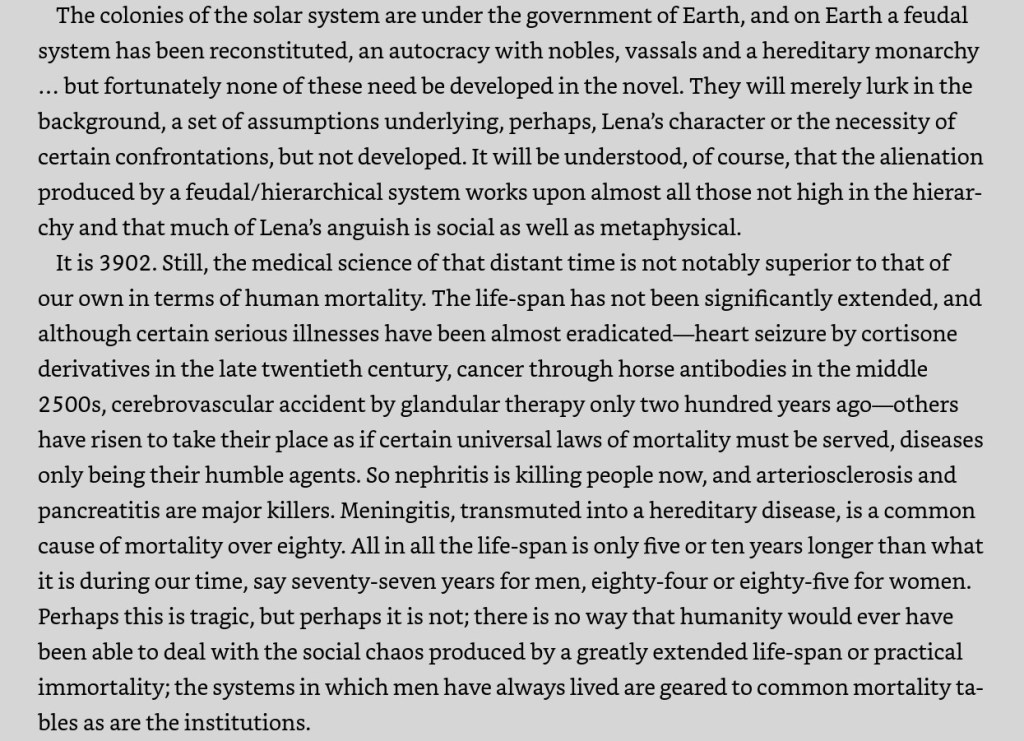
These early sections are quite seductive, but I must warn anyone considering buying Galaxies that the going will get tough. “A Galaxy Called Rome” is the light fluffy version to read for those who aren’t ready to climb a mountain. Even though Galaxies is only 154 pages long, it’s a Ph.D. dissertation on deconstructing science fiction novel writing.
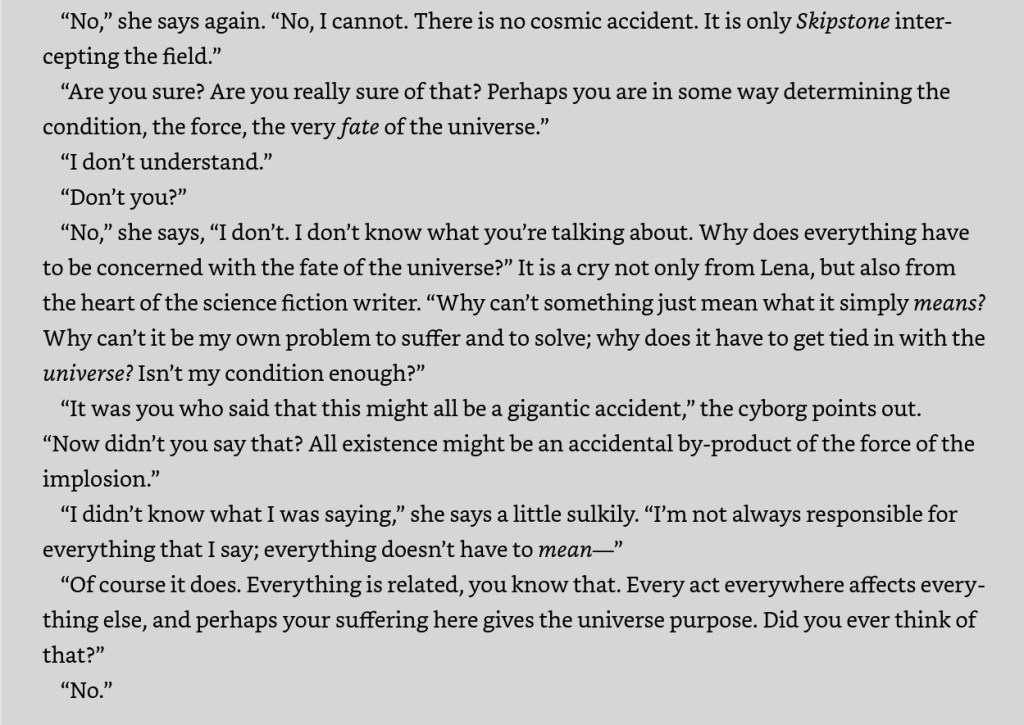
The story within this novel is about Lena Thomas who is the only living crew member of an FTL spaceship, Skipstone, that carries a cargo of 515 dead people in cryonic suspension. The year is 3902. Like in Heinlein’s novel, The Door Into Summer, rich people with diseases invest their estates and freeze their bodies in the hopes of one day being revived and cured. Those estates pay for the development of interstellar travel. Those dead people will eventually communicate with Lena like the dead in PKD’s Ubik when Lena and the Skipstone get trapped in the black galaxy. This allows Malzberg to explore metaphysical and religious themes in writing a novel. The ship also has robots programmed with human minds that help Malzberg explore other science fictional themes. His story notes get more and more extensive while getting more and more complicated. This also allows Malzberg to show how worldbuilding and plotting are developed as a writer tells their story.
Malzberg uses all this exploration in writing a science fiction novel to also speculate about the future. He imagines our civilization collapsing and being completely forgotten and a new world civilization rising in the following nineteen centuries. Malzberg imagines we’ll face limitations we can’t overcome and wild possibilities that far exceed today’s limitations.
Much of this novel is about being a writer, and specifically a writer of science fiction. You get hints along the way that Malzberg might be jealous of famous literary writers like Cheever and Updike, at other times you might feel his resentment at not being more successful at being a science fiction writer. But Malzberg is confident of his own gifts too.
In some of the actual passages of the novel, the dialog reminds me of Sheckley or Adams, or maybe even PKD, and even then Malzberg keeps making digs at science fiction.
Over time, the conflicts Malzberg provides for Lena’s story become repetitious. He knows he’s padding this novel, and even talks about how writers do pad their novels. The second half of Lena’s story becomes one long dark night of her soul struggling to escape the black galaxy. I have to wonder if such soul searching also plagues Malzberg.
Eventually, you wonder if Malzberg can find an ending to Lena’s story. Chapter after chapter he tortures the poor woman, and we can’t imagine any possible happy ending. Yet, Malzberg gives us a very strange ending that I was quite happy to read. I guess he took pity on us.
Reading Galaxies makes me doubt reading science fiction, but then I’ve doubted my addiction to our genre for decades. As a young person back in the 1960s and 1970s I thought science fiction was a wonderful tool for thinking about all the possibilities of the future, both good and bad. But after living to the year 2022, which was a very futuristic sounding year back in 1965, I know the future is everything we never imagined.
Contrasting Galaxies with Red Rising it’s quite obvious that science fiction’s purpose is escape. And the genius of writing science fiction is creating stories set in fictional worlds that are so compelling we forget this one. By Malzberg intruding into his novel and telling us everything only shows we don’t want the author intruding into our stories. Some philosophers have speculated that God invented our reality and walked away from his creation and that’s a great thing. That knowing God’s intention would ruin his/her/its art. I always felt Heinlein destroyed his career after he started poking his nose into his stories.
“A Galaxy Called Rome” and Galaxies were written as the New Wave in science fiction was fading and postmodernism fiction in the literary world was becoming old hat. It was an impressive experiment of the times, but as far as I know, readers have lost interest in such experiments. The Post Moderns of our times demand wokeness in fiction but not the metafictional kind. If anything, modern SF readers want longer voyages of fictional escape with far greater feats of worldbuilding.
It would be interesting to see someone write a version of Galaxies today that reveals what today’s SF writers go through to entertain their readers in the 2020s.













 Classics of Science Fiction