I’ve decided to assemble an anthology of my favorite science fiction short stories. I’m not going to publish it. This book will be just for me to read. Before personal computers I would have created such an anthology by xeroxing all my favorite stories and putting them into a big folder, binder, or box. Now, with computers I can create a digital file that I can read with my iPad. I’ve discovered I can convert digital magazines, e-book pages, web pages, or even scan physical books to .pdf files that are easy to read on my iPad.
This project is only practical if you’re savvy with computers.
You can read .pdf files with almost any device, but for fiction reading, it’s best to read on a tablet. My method doesn’t work well with Kindles, other e-ink readers, or smartphones because the .pdf files are a collection of .jpg images. This system works great with both iOS and Android tablets.
The next step for this project to be practical is to have a convenient way to load files onto your tablet. I save .pdf versions of stories to a folder on Dropbox and read them with the Dropbox application on my tablets. Dropbox has a built-in reader for common file formats like .pdf files.
I create the .pdf files using Abbyy Finereader 15, but you can use any program that will convert a collection of images to a .pdf file. The free PDFgear works great on Windows. However, the Mac version doesn’t allow for no margins and centers all images on a white background. That works but annoys me.
There are other cloud storage providers that work with tablets if you don’t use Dropbox. Dropbox has a free basic account with 2GB’s of space that will hold hundreds of stories. If you’re a tablet user, you probably already know which cloud drive works well with it.
If you have these technical solutions solved, the next step is to find stories to read on your computer. They can be from an ebook, web pages, or a page you scan yourself. If you look around, many old science fiction magazines have been digitized in the CBR/CBZ format. I use a CBR reader call YACreader. YACreader allows me to right-click on any page and save it to a .jpg. I name each page by the title of the story – author – page number of the original publication.
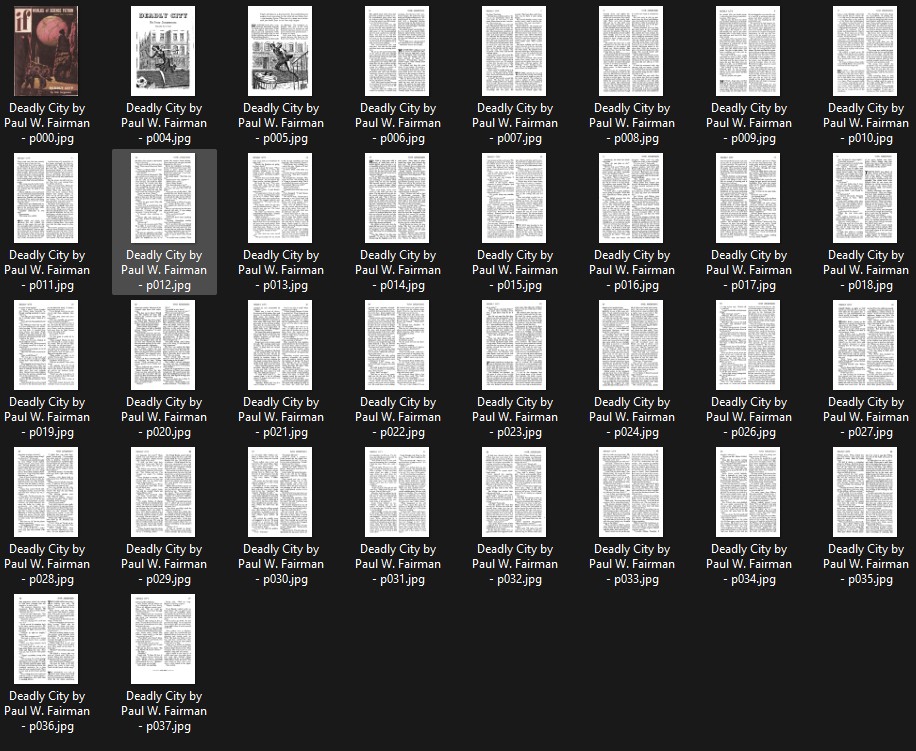
You can also use your screenshot utility to capture what you see on screen from a web page, ebook, or any program that displays stories to save as a .jpg file. I put all the .jpg pages in a folder that I name after the story. Here’s my folder for “Deadly City” by Paul W. Fairman from the March 1953 issue of If Magazine.
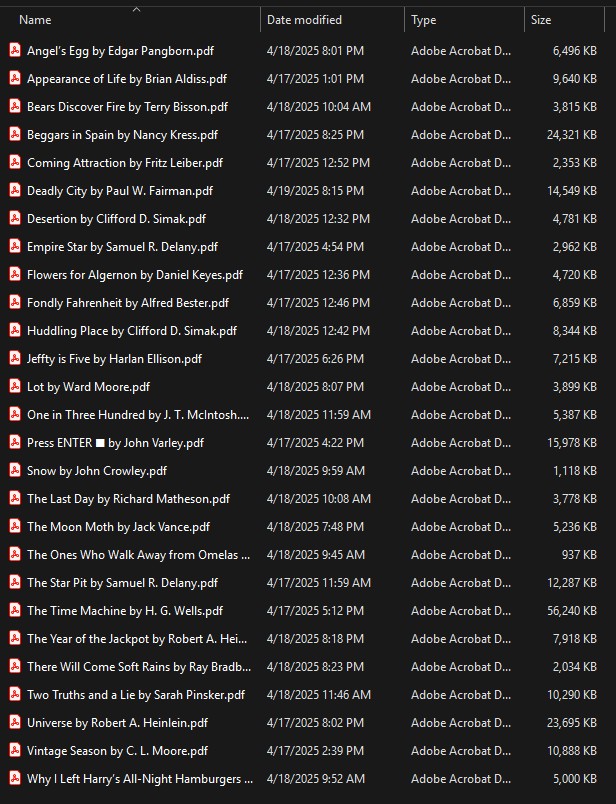
I then launch Abbyy Finereader (or PDFgear) and tell it to covert those pages to .pdf. I save the resulted file to a folder called “My Favorite SF Short Stories” and name the file by the title and author. Here are my first 27 stories. I just convert stories as I reread them and determine they are a favorite. Here’s my current folder on Windows:
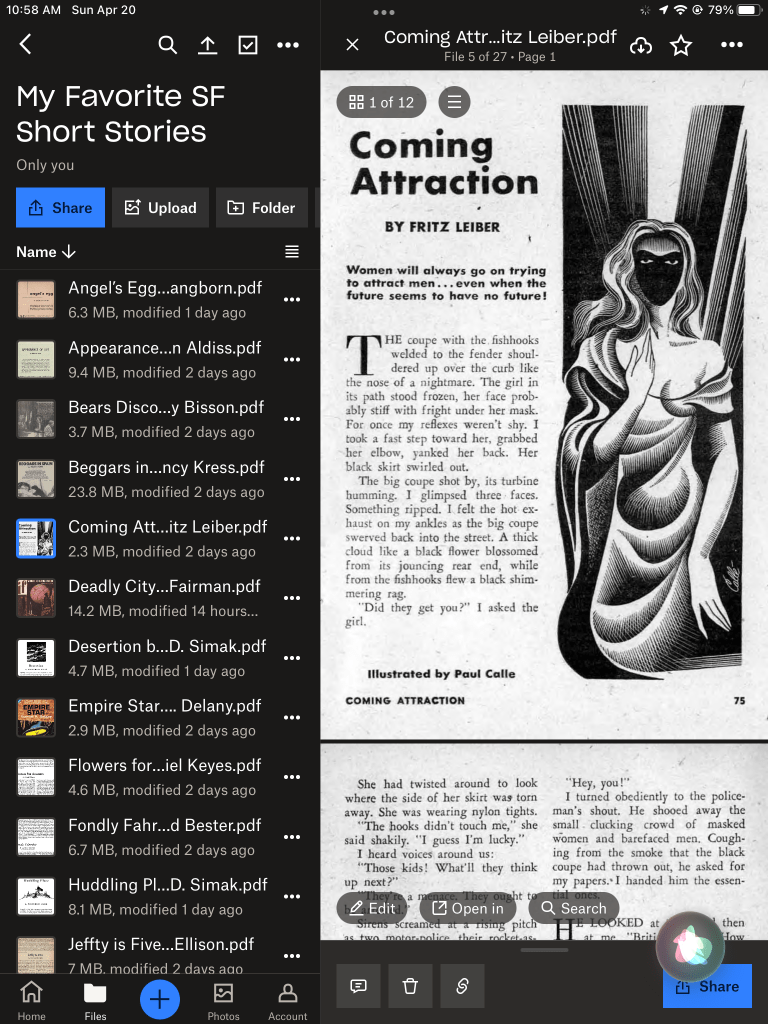
Here’s what my directory of favorite stories looks like in Dropbox on my iPad mini. The directory is on the left, and the preview is on the right. It’s very nice.
And here’s what the story looks like in the reader view of Dropbox:
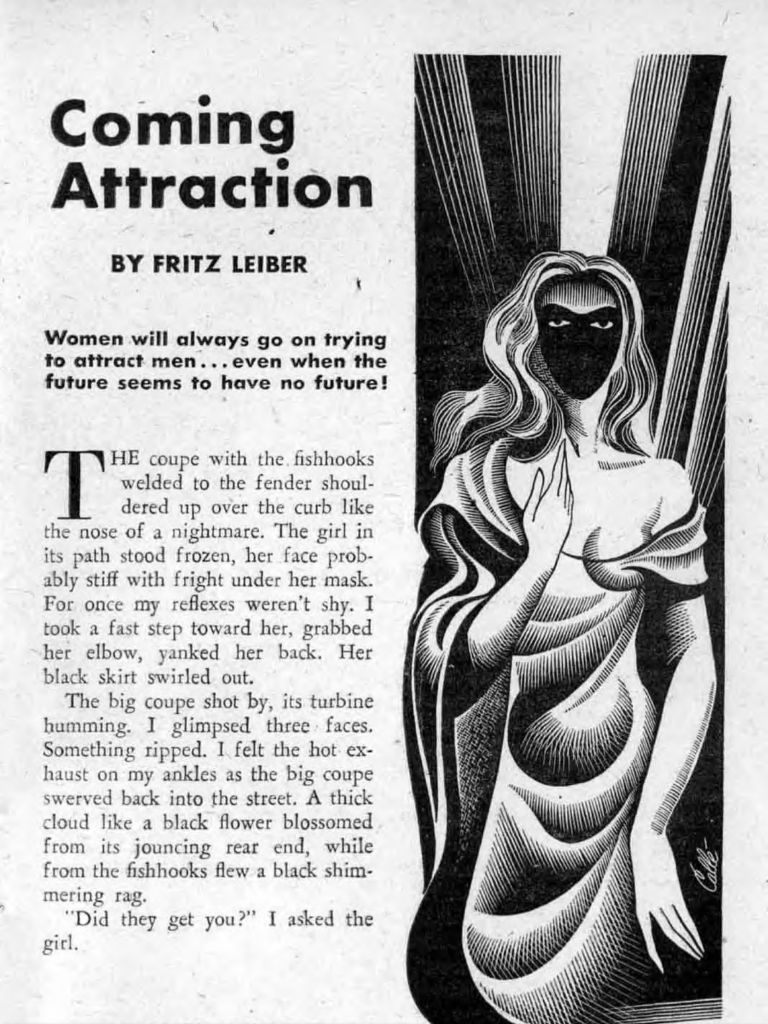
As you can see, I’ve copied the story from a scan of the original magazine. You can find scans of old magazines all over the web, such as archive.org. However, sellers on eBay and Facebook are now selling complete collections of digitized old magazines fairly cheap. I bought DVDs years ago with complete runs of my favorite SF magazines.
I do own several hundred of hardback, paperback, ebook, and audiobook science fiction anthologies. I also own several hundred physical issues of science fiction magazines from the 20th century. And I can call up nearly every issue of any science fiction magazine published in the 20th century on my iPad. So, why would I want to take the trouble to make my own anthology of favorite SF stories?
I’ve read thousands of science fiction short stories over the last sixty-three years. Some I’ve read several times. Since I’ve gotten older, I’ve discovered that there’s a depth to fiction that’s only revealed through rereading and study. I’m working to get beyond just reading and pursue understanding. Creating this anthology is my way of narrowing down the list of stories I want to study. I will add and delete to “My Favorite SF Stories” folder for the rest of my life. It’s becoming a project.
I’m focusing on the science fiction short story because I’ve always believed the science fiction magazine was the true heart of science fiction. And besides, novels are too long.
Think of fiction as a symbolic message from another person. How often in day-to-day interaction with your friends would you let one of them talk to you for hours without stopping? Usually, it’s no more than a few seconds. If your friend went on for minutes, you’d get annoyed. But we listen to what the author of fiction says for hours on end because they tell entertaining stories.
When you read a story one time it feels like you got the message and you’re done. But if you reread that story, you’ll often discover that you missed many parts of the message. Sometimes the author is saying something that requires reading the story several times before it’s understandable. You’ll discover there was a lot more to the story than you imagined. Great fiction has great depths to explore. Authors of great fiction often have many things to say but don’t say it directly. Words have severe limitations, so writers must communicate with imagery, symbolism, poetry, psychology, philosophy, and in ways that have no label.
I had a friend who died a long time ago, his name was Williamson. Before Williamson died, he started rejecting everything he loved in life until he had only two interests that kept his interest. I didn’t talk to him just before he died, but I’ve always wondered if he chose his final favorite before leaving this existence.
I’ve notice this process in others who have died. Now that I’m getting old, I understand that process. Our psychic energy dwindles away, and we can’t hang onto everything we once loved, so we start triaging out passions. I call this The Williamson Effect.
I’m in the process of identifying the science fiction stories I still care about and want to remember. My ability to remember is fading. I forget new fiction as fast as I consume it, but some older fiction has lasting power. Like Williamson, I realize I’m letting things go to focus on what I loved best. However, I’m not down to two things yet. I can still hold onto to about a hundred stories. I know the number of stories in my anthology will dwindle over time as I let some stories go.
I have several goals in mind for assembling this anthology:
- To decide on my all-time favorite science fiction short stories
- To reread short remembered stories to see if they still hold up
- To read recommended stories I haven’t read
- To collect stories I will regularly reread and study
- To collect stories that exhibit the best qualities of science fiction
- To collect stories that convey a sense of genre history and evolution
- To collect stories that were the most groundbreaking
- To collect stories that cover all the essential themes
- Hopefully find audio editions of all these stories
- To collect stories to psychoanalyze as to why I liked them
- To collect stories I feel had special messages in them by the authors
Currently, I’m contemplating how to organize this anthology. My first inclination is by date, like The Science Fiction Hall of Fame Volume One. It also occurs to me I should organize the stories by science fictional themes. Groff Conklin did that in The Best of Science Fiction.
Then, I’ve also had some ambitious ideas. Could I find a program where I could write a memoir of reading science fiction and provide links to all the stories where I could read the full text? Could a wiki or Obsidian handle that? What about feeding all my memories and texts into an AI? I once fed Google’s Notebook LM “The Star Pit” by Samuel R. Delany and it produced a podcast of two people talking insightfully about the story. That was damn neat.
One reason I’m inventing this project is because my memory is becoming unreliable. I’m hoping that working on the project will stenghten my mind. But I’m also running out of energy, so I need to keep things simple enough to get things done. Putting all my favorite stories in one anthology will be the easiest and quickest solution. Right now I remember too many favorite stories. I’ll need to create multiple volumes of this anthology at first, probably by decade.
Ultimately, my anthology of favorite stories will start to shrink as I distill the table of contents to my absolute favorites. I’m hoping, even assuming, that I will discover new insights about myself and my life-long addiction to fiction.
James Wallace Harris, 4/20/25
 Classics of Science Fiction
An ambitious project! As I look back, I seem to have read 100s if not 1000s of short stories, mostly in the ’70s and can’t even put a name to many of them. A few have really stuck in some ways, and I’d like to know what they were actually called, never mind get a chance to reread them.
Good luck
LikeLiked by 1 person