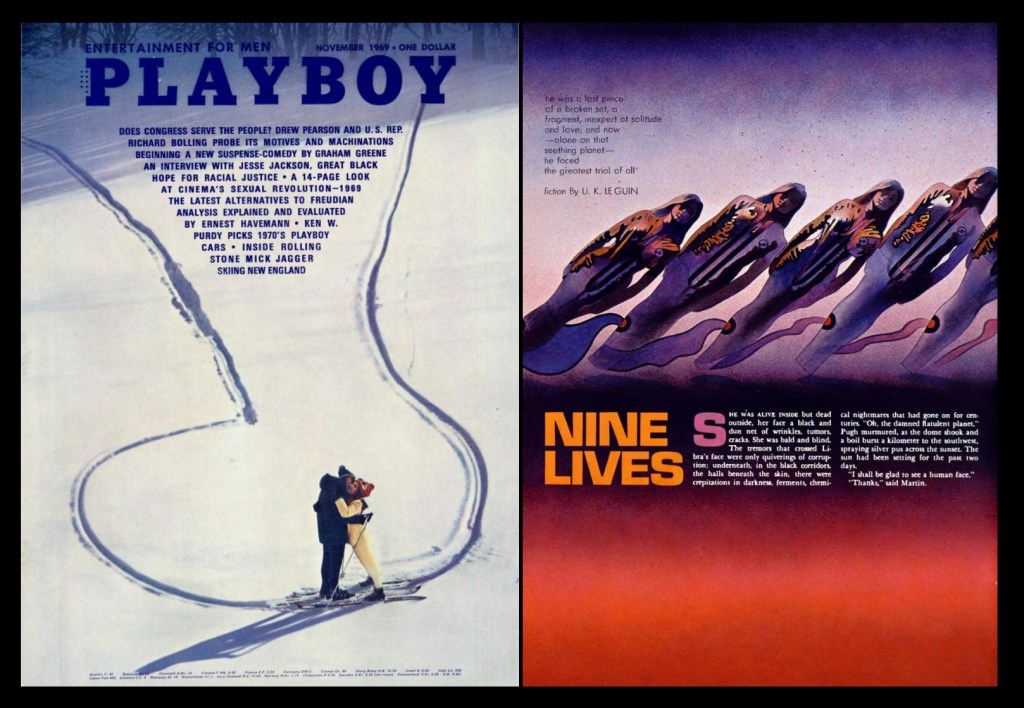
“Nine Lives” by Ursula K. Le Guin is story #31 of 52 from The World Treasury of Science Fiction edited by David G. Hartwell (1989), an anthology my short story club is group reading. Stories are discussed on Tuesdays, Thursdays, and Saturdays. “Nine Lives” was first published in Playboy (November 1969). This story has been reprinted an amazing number of times, and translated into several languages. And it has 13 citations in the CSFquery database.
“Nine Lives” is about two experienced planetary explorers, Martin and Pugh stationed at the Libra Exploratory Mission Base who are about to be relieved. Before they can, they must help a new crew from the Passerine, and Exploit Team, settle in to start mining the planet. Martin and Pugh are surprised when the mining crew turns out to be a 10-person clone — five men and five women. The clones look very much alike, work and play together as a tight unit, and pretty much ignore the old-timers. Then there is an accident, and 9 of the 10 clones are killed. The story is about the singleton struggling to survive as an individual.
Strangely, Le Guin uses up most characterization development on Martin and Pugh. I was hoping to know more about being a clone, instead, it’s really Martin and Pugh’s story.
“Nine Lives” is well done but it didn’t have the impact for me that “The Ones Who Walk Away From Omelas” or even “The Day Before the Revolution” or “Vaster Than Empires and More Slow” did. I’m used to Le Guin making a big social, political, or philosophical statement, and I just didn’t get one from “Nine Lives.”
I guess we’re supposed to contemplate the idea of clones, and in particular, the idea of a clone group. Clones don’t interest me. A DNA replica won’t be a replica of a person. I suppose ten cloned brothers and sisters should be more interesting than the Dionne quintuplets but I didn’t find that so.
I tried to imagine living with nine copies of myself and that produced a very weird sensation. Maybe I need to think about that for a while to really get into the story. In “Nine Lives” the ten clones form a utopian relationship. I’m not sure I’d get along so well with people like me.
There’s another story that explores this idea in a variant way, The Man Who Folded Himself by David Gerrold. It’s about a time traveler who gets together with different versions of himself. In both stories, all the selves get along, but I don’t know if that would be true. I might bring out the worst in myself. I’m pretty sure my wife wouldn’t want ten of me.
However, as a kid, I always wished I had been a twin. I wonder if “Nine Lines” would have had a greater emotional impact on me if there had only been two clones. It’s logical to have ten for a group of workers, but it would have been easier to relate to if the story was only about a pair. And in the story, the clones tended to pair off and work together.
David Hartwell liked “Nine Lives” so much that he included it in another one of his giant retrospective anthologies of science fiction, The Ascent of Wonder.
I think this story is for people who wish they had more friends like themselves.
James Wallace Harris, 7/16/23


I love “Nine Lives”, and I think it’s remarkably moving. It’s not about clones — it’s about people, and connection. The climactic line — when Kaph really understands Pugh — is wonderful.
LikeLike