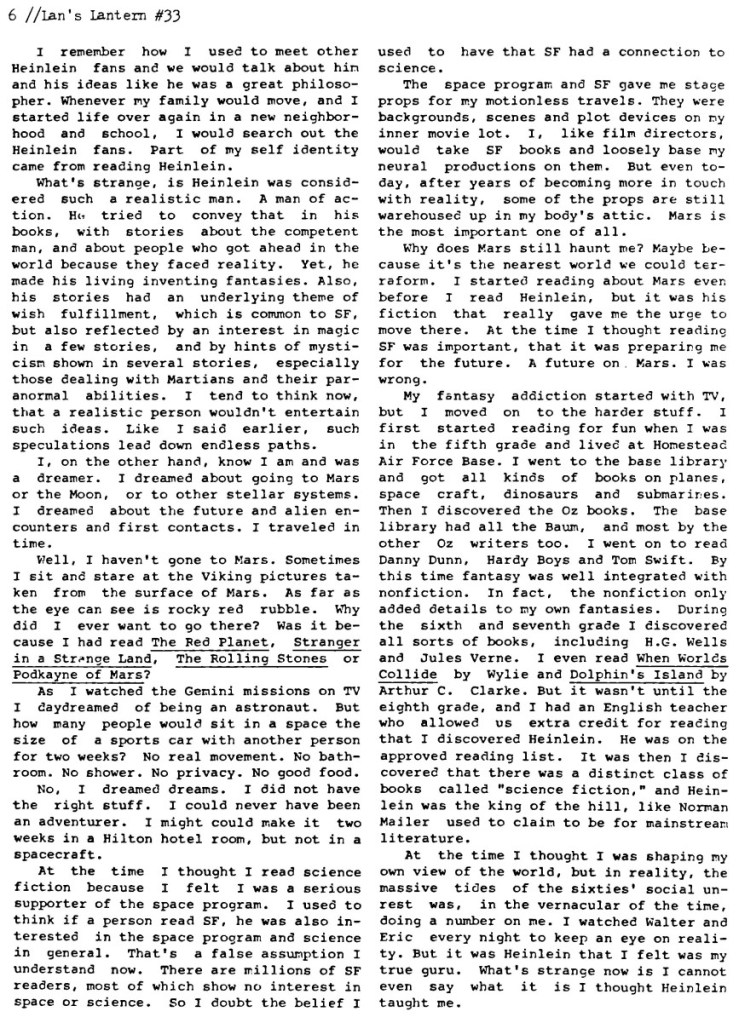
I wanted to republish an article I wrote for George “Lan” Laskowski’s fanzine, Lan’s Lantern so I could cite it for my Rereading Heinlein Project. This essay is the approach I took to Heinlein after he died in 1988. At that time I assumed I couldn’t know what Heinlein intended in his stories. That I just saw myself in their reflection. This time around, I’m going to assume Heinlein had information to convey and whether or not I can decode it.
I hope you can read the text in these images. If you can’t, you can get a copy of Lan’s Lantern #33 at Archive.org or Fanac.org.
Robert Heinlein began publishing science fiction in 1939 but by July of 1941, he was the guest of honor at the 3rd Worldcon. How did he get so famous within fandom so fast? I always imagined he blazed upon the genre right from his first publication, but looking over the 1939 and early 1940 letter columns in Astounding gave no indication that was true.
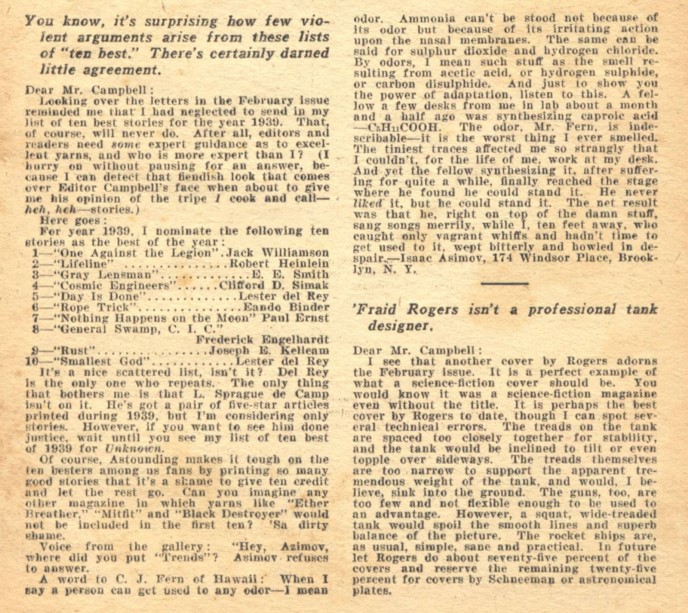
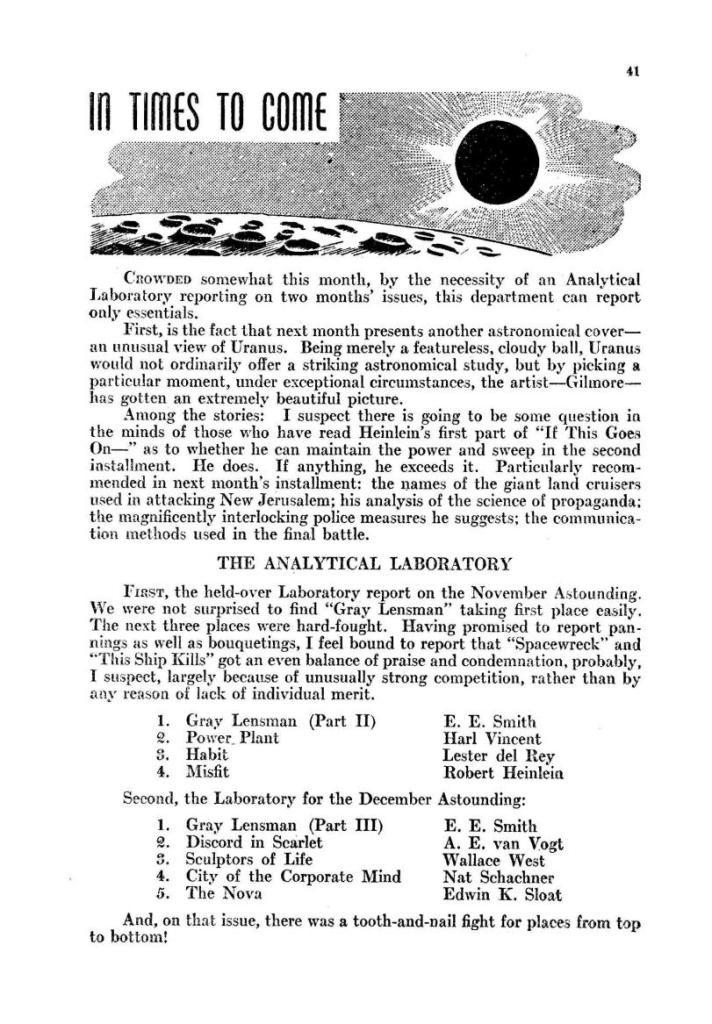
Heinlein published just two stories in 1939 (Aug. and Nov.), “Life-Line” and “Misfit.” “Life-Line” came in second in the Analytical Laboratory columns and “Misfit” last. The letter writers barely mentioned Heinlein. Not quite a stunning debut. However, in the April 1940 issue of Astounding, there’s a letter from Isaac Asimov rating all the stories for 1939, and “Life-Line” came in second — even ahead of the serial Gray Lensman. (Asimov also jokes about his own debut short story, “Trends.”)
Years later, in 1979, Isaac Asimov and Martin H. Greenberg published The Great SF Stories 1 (1939), the first in a series that collected the best science fiction short stories for every year from 1939-1963. Three of the ten stories he picked in 1940 are included, and he adds “Misfit.” Here’s the complete table of contents:
• The Strange Flight of Richard Clayton • short story by Robert Bloch
• Trouble with Water • short story by H. L. Gold
• Cloak of Aesir  • novella by John W. Campbell, Jr.
• The Day Is Done  • short story by Lester del Rey
• The Ultimate Catalyst  • novelette by John Taine
• The Gnarly Man  • novelette by L. Sprague de Camp
• Black Destroyer  • novelette by A. E. van Vogt
• Greater Than Gods  • novelette by C. L. Moore
• Trends  • short story by Isaac Asimov
• The Blue Giraffe  • novelette by L. Sprague de Camp
• The Misguided Halo  • short story by Henry Kuttner
• Heavy Planet  • short story by Milton A. Rothman
• Life-Line  • short story by Robert A. Heinlein
• Ether Breather  • short story by Theodore Sturgeon
• Pilgrimage  • novelette by Nelson S. Bond [as by Nelson Bond]
• Rust  • short story by Joseph E. Kelleam
• The Four-Sided Triangle  • novelette by William F. Temple
• Star Bright  • novelette by Jack Williamson
• Misfit  • novelette by Robert A. Heinlein
These are the stories that have survived the test of time — at least with two people very familiar with the genre in 1979. How many young science fiction readers today know of them, or even heard of the writers who wrote them? Asimov and Heinlein are still big names, well to some, but you’d have to be an aficionado of the genre to know the others.
Our CSF database contains 34 short stories from 1939, but only 8 got 3 or more citations, and only one (“Black Destroyer”) made our final list. By our criteria, “Life-Line” and “Misfit” aren’t well remembered. (But there’s another issue here, the trailing edge of pop culture memory. My guess is the 1930s and 1940s are generally being forgotten. But that’s another essay for another time.)
What stories did the fans love back in 1939-1940? Fanac.org has a treasure trove of fannish history with its archive of old fanzines but I can’t tell how they are indexed. Fanac.org has a link to Google, but I’m not sure how useful it is. I’ve looked around for a fanzine with short story reviews, but so far haven’t found one. If anyone knows of one, or how to use the archive better, let me know. However, often the content of fanzines is not about science fiction.
As far as I can tell, there has been no Retro Hugo Award for 1940 (1939).
My next source for information about the best science fiction stories of 1939 comes from A Requiem for Astounding by Alva Rogers. Of course, it only covers Astounding. Rogers discusses Heinlein, but this is long after the fact. Follow the link to read his review of 1939.
This brings me to my final source of information for the popularity of science fiction short stories that came out in 1939: The Time Machines: The Story of the Science-Fiction Pulp Magazines from the beginning to 1950 by Mike Ashley. This is a fantastic history of science fiction magazines, but I didn’t find what I was looking for. It may have more of what I want covering later years.
Years later, 1939 would be remembered as the beginning of Science Fiction’s Golden Age. John W. Campbell, Jr. will be remembered for discovering three new writers that year: A. E. van Vogt, Heinlein (August), and Theodore Sturgeon (September). Van Vogt had two stories that year and got the cover for both. Heinlein and Sturgeon would have to wait to get such recognition. Asimov is considered a protégé of Campbell’s, but he was first published by Ray Palmer (“Marooned Off Vesta”, Amazing Stories, March 1939.) “Trends” was his first story for Campbell.
However, Campbell published new writers all the time. It’s only in hindsight that he gets credit for discovering Asimov, Heinlein, Sturgeon, and van Vogt.
I’m already reading the 1940 issues of Astounding and I believe this year will be when Heinlein is discovered. However, the first Worldcon was in July of 1939, although fandom had existed for years before that. Was fandom small enough that everyone knew everyone else? Did every writer who made it onto the table of contents of a science fiction magazine encounter fandom?
Still, there are quite a few questions I’d like answered.
Why did Heinlein start writing science fiction?
Why science fiction and not the other genres?
Did he read science fiction magazines?
Did he know about fandom?
Was he a member of a science fiction club?
Did he know any science fiction writers or fans?
I just remembered I should reread Robert A. Heinlein: In Dialogue With His Century, the two-volume biography of Heinlein by William H. Patterson, Jr. Maybe Patterson has done all this work for me.
“Misfit” (Astounding, Nov. 1939) was Heinlein’s second published story and his first about space travel. It’s also his first work of juvenile fiction, or what we call YA today. Heinlein renamed FDR’s New Deal Civilian Conservation Corps (CCC) the Cosmic Construction Corps for this future space adventure. I thought that was a really neat idea. And Heinlein created one of his favorite characters, Andrew Jackson Libby, who would reappear in Methuselah’s Children in 1941, and yet again in four of Heinlein’s 1970s and 1980s novels. Eventually, Libby would become a woman, Elizabeth Andrew Jackson Libby, but we won’t get into that for a very long time. Some fans even consider Max Jones of Starman Jones a repackaging of the Libby character, but I don’t.
I never liked the way Heinlein reused his characters because he eventually turned characters I loved into characters I hated. But that’s another subject to deal with in future essays.
The plot of “Misfit” isn’t very complicated. Libby is a young man who we follow into space. Like many of the boys on the ship, Libby experiences space sickness at first but eventually adapts to living in free fall. His crew arrives at a small asteroid called HS-5388, or just Eighty-Eight. Their job is to build habitats and rocket engines into the rock. Their goal is to reposition the asteroid into an orbit between Earth and Mars to make it into an emergency shelter for space travelers.
There’s little conflict or drama in the story. The only surprise in the story is we learn that Libby has a savant’s ability for mathematics, and saves the day when their “computer” conks out. Heinlein calls Libby a lightning calculator and gives him the nickname “Slipstick” – a slang term for a slide rule. In this1939 story, the word computer was not used. They called their computer an “integral calculator.” Boy, wouldn’t Heinlein have wowed us today if he had imagined a handheld calculator instead of a slide rule? (I loved using my slide rule in my math classes back in the 1960s and 1970s. I wish I had kept it.)
This is why I said in my review of “Life-Line” that I thought “Life-Line” was a much better story than “Misfit.” In “Life-Line” Heinlein gets us hooked right away on whether or not Hugo Pinero’s invention is real, and the whole story focuses on that plotline. “Misfit” is a story where this happens, then this happens, and then another thing happens until we reach an end. It’s still a good story, but it doesn’t have a tight plot. Even the dramatic scene of Libby saving the day when putting the asteroid into its new orbit isn’t done with much drama. Still, the “Misfit” is readable and likable, but its deadpan style makes me think of the old TV show Dragnet.
Heinlein had a side to him that just enjoyed explaining how things worked. My favorite part of the story was Heinlein showing us what weightlessness would be like. I thought he got it very right for 1939. And I checked to see if he hadn’t updated the story later, but he hadn’t. I don’t know if any writer back then worked out what living in microgravity would be like. I was very impressed. They call Libby Pinky, I guessed because of his red hair and complexion.
The ship’s loudspeaker blatted out, “All hands! Free flight in ten minutes. Stand by to lose weight.” The Master-at-Arms supervised the rigging of grab-lines. All loose gear was made fast, and little cellulose bags were issued to each man. Hardly was this done when Libby felt himself get light on his feet—a sensation exactly like that experienced when an express elevator makes a quick stop on an upward trip, except that the sensation continued and became more intense. At first it was a pleasant novelty, then it rapidly became distressing. The blood pounded in his ears, and his feet were clammy and cold. His saliva secreted at an abnormal rate. He tried to swallow, choked, and coughed. Then his stomach shuddered and contracted with a violent, painful, convulsive reflex and he was suddenly, disastrously nauseated. After the first excruciating spasm, he heard McCoy’s voice shouting.

“Hey! Use your sick-kits like I told you. Don’t let that stuff get in the blowers.” Dimly Libby realized that the admonishment included him. He fumbled for his cellulose bag just as a second temblor shook him, but he managed to fit the bag over his mouth before the eruption occurred. When it subsided, he became aware that he was floating near the overhead and facing the door. The chief Master-at-Arms slithered in the door and spoke to McCoy.

“How are you making out?”

“Well enough. Some of the boys missed their kits.”

“Okay. Mop it up. You can use the starboard lock.” He swam out.

McCoy touched Libby’s arm. “Here, Pinkie, start catching them butterflies.” He handed him a handful of cotton waste, then took another handful himself and neatly dabbed up a globule of the slimy filth that floated about the compartment. “Be sure your sick-kit is on tight. When you get sick, just stop and wait until it’s over.” Libby imitated him as best as he could. In a few minutes the room was free of the worst of the sickening debris. McCoy looked it over, and spoke:

“Now peel off them dirty duds, and change your kits. Three or four of you bring everything along to the starboard lock.”

At the starboard spacelock, the kits were put in first, the inner door closed, and the outer opened. When the inner door was opened again the kits were gone—blown out into space by the escaping air. Pinkie addressed McCoy, “Do we have to throw away our dirty clothes too?”

“Huh uh, we’ll just give them a dose of vacuum. Take ’em into the lock and stop ’em to those hooks on the bulkheads. Tie ’em tight.”

This time the lock was left closed for about five minutes. When the lock was opened the garments were bone dry—all the moisture boiled out by the vacuum of space. All that remained of the unpleasant rejecta was a sterile powdery residue. McCoy viewed them with approval. “They’ll do. Take them back to the compartment. Then brush them—hard—in front of the exhaust blowers.”

The next few days were an eternity of misery. Homesickness was forgotten in the all-engrossing wretchedness of spacesickness. The Captain granted fifteen minutes of mild acceleration for each of the nine meal periods, but the respite accentuated the agony. Libby would go to a meal, weak and ravenously hungry. The meal would stay down until free flight was resumed, then the sickness would hit him all over again.

On the fourth day he was seated against a bulkhead, enjoying the luxury of a few remaining minutes of weight while the last shift ate, when McCoy walked in and sat down beside him. The gunner’s mate fitted a smoke filter over his face and lit a cigarette. He inhaled deeply and started to chat.

“How’s it going, bud?”

“All right, I guess. This spacesickness—Say, McCoy, how do you ever get used to it?”

“You get over it in time. Your body acquires new reflexes, so they tell me. Once you learn to swallow without choking, you’ll be all right. You even get so you like it. It’s restful and relaxing. Four hours sleep is as good as ten.”

Libby shook his head dolefully. “I don’t think I’ll ever get used to it.”

“Yes, you will. You’d better anyway. This here asteroid won’t have any surface gravity to speak of; the Chief Quartermaster says it won’t run over two per cent Earth normal. That ain’t enough to cure spacesickness. And there won’t be any way to accelerate for meals either.”

Libby shivered and held his head between his hands.

Heinlein, Robert A.. Revolt in 2100 (pp. 191-193). Spectrum Literary Agency, Inc.. Kindle Edition.
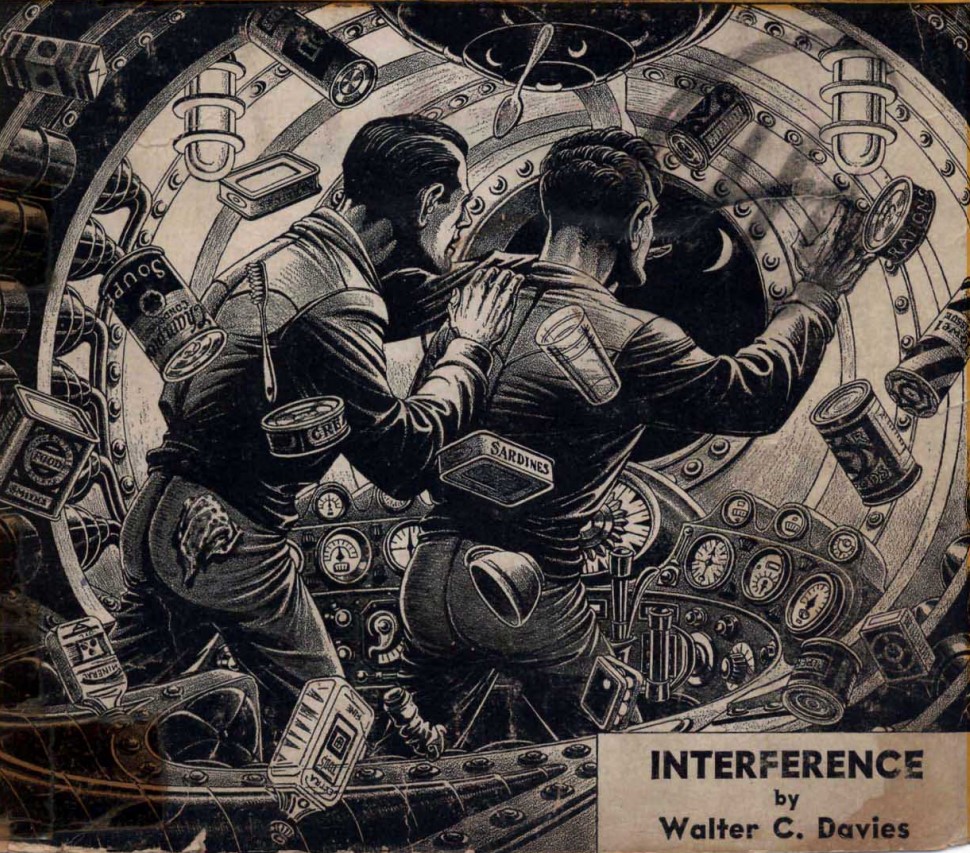
You can compare the current Kindle edition to the 1939 magazine edition:
This is pretty amazing when you think that most Americans at the time only knew science fiction from Buck Rogers and Flash Gorden newspaper comic strips, radio shows, and serials. But even in the hardcore science fiction of Astounding Science-Fiction, I just don’t remember reading anything from that era that dealt with this kind of realism. Over the years I’ve paid attention to illustrations of free fall in old science fiction magazines, and one of my favorites is the July 1941 cover of Cosmic Stories.
A fun essay to write for the future would be chronicling the history of how writers imagined weightlessness in space. I think even 19th-century writers knew about it, but I just don’t think any writer dealt with space sickness before. If you know otherwise, leave a comment.
Another example of Heinlein just explaining things is when he tells us how they found the asteroid:
Locating one asteroid among a couple of thousand is not as easy as finding Trafalgar Square in London—especially against the star-crowded backdrop of the galaxy. You take off from Terra with its orbital speed of about nineteen miles per second. You attempt to settle into a composite conoid curve that will not only intersect the orbit of the tiny fast-moving body, but also accomplish an exact rendezvous. Asteroid HS-5388, ‘Eighty-eight,’ lay about two and two-tenths astronomical units out from the sun, a little more than two hundred million miles; when the transport took off it lay beyond the sun better than three hundred million miles. Captain Doyle instructed the navigator to plot the basic ellipsoid to tack in free flight around the sun through an elapsed distance of some three hundred and forty million miles. The principle involved is the same as used by a hunter to wing a duck in flight by ‘leading’ the bird in flight. But suppose that you face directly into the sun as you shoot; suppose the bird can not be seen from where you stand, and you have nothing to aim by but some old reports as to how it was flying when last seen?

Heinlein, Robert A.. Revolt in 2100 (p. 193). Spectrum Literary Agency, Inc.. Kindle Edition.
Where did Heinlein learn this? Were there popular science books that speculated on space travel back then? Or did he just imagine it? Later on in the story, when they are trying to position the asteroid in its new orbit, we get a lesson on celestial mechanics. I believe Heinlein was a ballistics officer when he was in the Navy, so that makes sense. And I believe he was an amateur astronomer. Heinlein loved to have his characters use mathematics, and I remember Heinlein in interviews telling how he and his wife would get out butcher paper and calculate orbits for his stories.
As a kid, Heinlein made me want to study math and science. I wished I could have been like Kip Russell in Have Space Suit–Will Travel who applied himself vigorously with disciplined self-study. I can say Heinlein made me wish that about myself, but I never did. I took a bunch of math classes, but I only applied myself in a half-ass fashion. I also bought a telescope and read popular science books, but I just never worked hard at learning what Heinlein expected of his characters. As I got older, I even wished I could live my life over so I could be more like the characters in Heinlein’s juveniles. When I retired, I even planned to study math again, and go back to college and get a master’s in computer science. I didn’t. I bought a bunch of math books and realized I had forgotten nearly everything I had once known about mathematics. I got onto the Khan Academy website and started over with third-grade math. By the time I got to six-grade math, I realized it just wasn’t going to happen. But that desire came from reading the Heinlein juveniles back in the 1960s.
“Misfit” came in dead last in the AnLab (Feb. 1940). But “Misfit” was in an issue with the Gray Lensmen serial. Evidently, the readers back then weren’t impressed with Heinlein’s speculations about space sickness like I am now. Maybe they never imagined space sickness and didn’t want to believe it. One reader in the letter column wrote to tell Campbell there were people who could math in their heads like Libby. But I didn’t find anyone else that got excited about the story.
Campbell does push Heinlein In Times To Come for his current serial If This Goes On—. That story might be considered Heinlein’s first novel, depending on its length in the magazine. When it was revised and slightly expanded for Revolt in 2100, it was considered a novel-length by ISFDB.






 Classics of Science Fiction