Futures Past – Jim Emerson

There are millions of science fiction fans, but how many of those readers love to read about science fiction? Especially, about the history of science fiction way before they were born. I do, but maybe I’m an extreme outlier.

Back in the 1960s, I discovered Sam Moskowitz and loved reading his books about the history of science fiction. I also enjoyed his magazine columns profiling science fiction writers. Over the years I’ve read and collected several shelves of books about our genre. In the 1990s, I subscribed to a fanzine titled Futures Past. It was quarterly, and each issue covered one year in science fiction starting with 1926. It died after four issues and I was greatly disappointed.

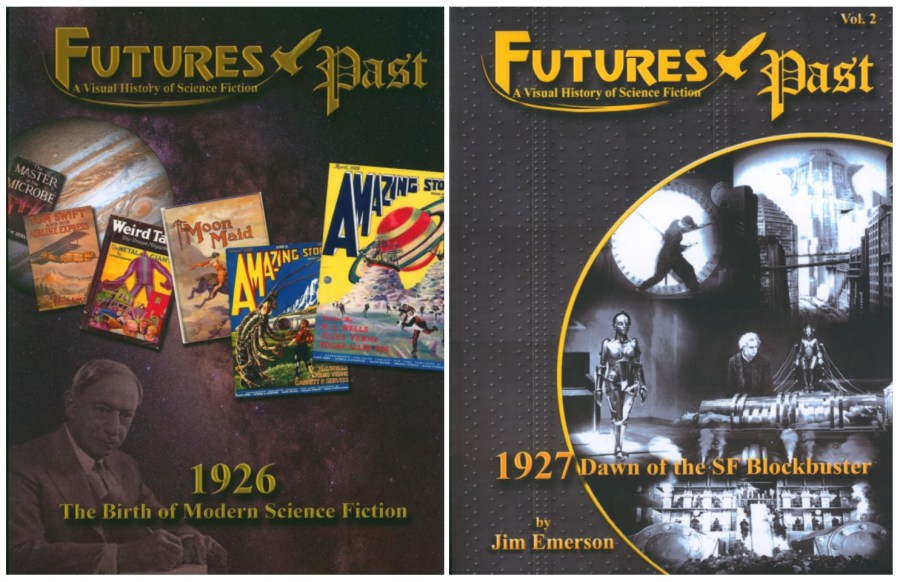
Now the creator of that fanzine, Jim Emerson is back. He’s starting over again with 1926, but this time each issue has been expanded into a book (pdf, trade paper, and hardback). To keep costs down, Emerson doesn’t sell through Amazon or bookstores. He sells direct. I bought the first two volumes, 1926 and 1927 with Paypal, but there are other purchasing options. Order from this website. Emerson offers the first volume on pdf for free to give readers an idea of what the books will be like. However, the first volume is only 64 pages, and volume 2 is 144 pages, a much more impressive entry in the series. If you want to give the series a try after looking at the pdf of 1926, I’d buy the 1927 volume first. I plan to collect them all. The home page for Futures Past is here.

Emerson is still working full-time and figures he can only produce one volume a year. He writes all the content and does all the graphic layouts. Jim hopes when he retires to produce two or more volumes per year, and eventually cover 50 years of science fiction history (1926-1975). However, this time he plans to jump around and not go year by year after 1928. I’m glad to hear that. As much as I like reading about science fiction in the 1920s and 1930s, I really want to read about the 1940s, 1950s, and 1960s. I vote for 1941, 1953, and 1968.

I’m very curious how many science fiction fans will be interested in these books. Each volume covers the science fiction magazines, books, and movies that came out during that year. What makes these books so much better than the old fanzines is the use of color printing. I’ve always loved the art on magazine and book covers and still photos and posters from movies. (I’m showing images below from 1927 because you can download the pdf to 1926 and look at it for yourself.)

Each book is a visual history, but there is also a great deal of reading content. Emerson is quite the historian of science fiction’s history, reminding me of Sam Moskowitz, Brian Stableford, and Mike Ashley. Pages 58-93 of the 1927 volume is devoted to the silent film Metropolis which I’ve seen three times over my lifetime, and look forward to seeing it again. About 80 pages of the 1927 volume are devoted to science fiction in silent films.

Both volumes spend many of their pages on science fiction in silent films, a topic I knew little about. I’ve seen fewer than 40 silent films and assumed there was just a handful of science fiction titles. Of course, Emerson includes fantasy and horror, but the number is far greater than I imagined. In one article he lists six pages of lost films.

My favorite section is Science Fiction Books of 1927 (pp.116-133). And my second favorite section is Magazines of 1927 (pp. 94-115. I especially love all the photos of the covers, but there is quite a lot to read about these forgotten books and magazines.
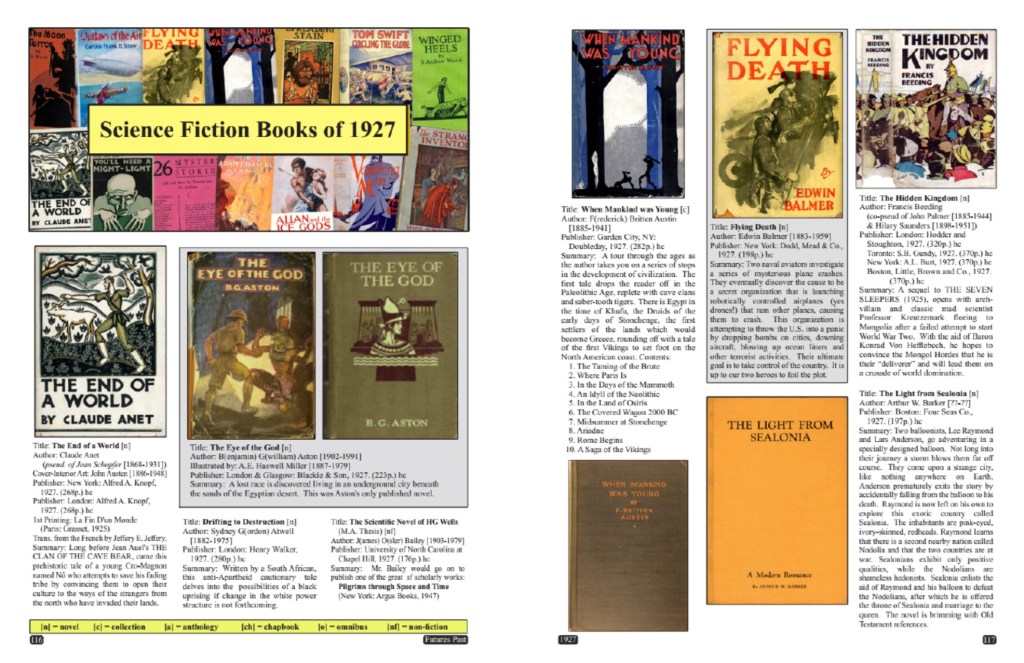
Here’s the table of contents for the 1927 volume.

The original fanzine covering 1926 inspired my interest in Lady Dorothy Mills, a forgotten travel writer from the 1920s who also wrote novels, including one science fiction title. I read about her SF novel Phoenix in the 1926 issue and spent years tracking down a copy. The one mention of a book has inspired thirty years of chasing her books and creating a website devoted to Lady Dorothy Mills. So thanks, Jim Emerson.

Like I said, I love reading about the history of the genre, but I wonder how many science fiction fans are like me? If you like to read about science fiction, leave a comment. I’ve been thinking about profiling some of my other history books on the subject.

James Wallace Harris, 2/9/22
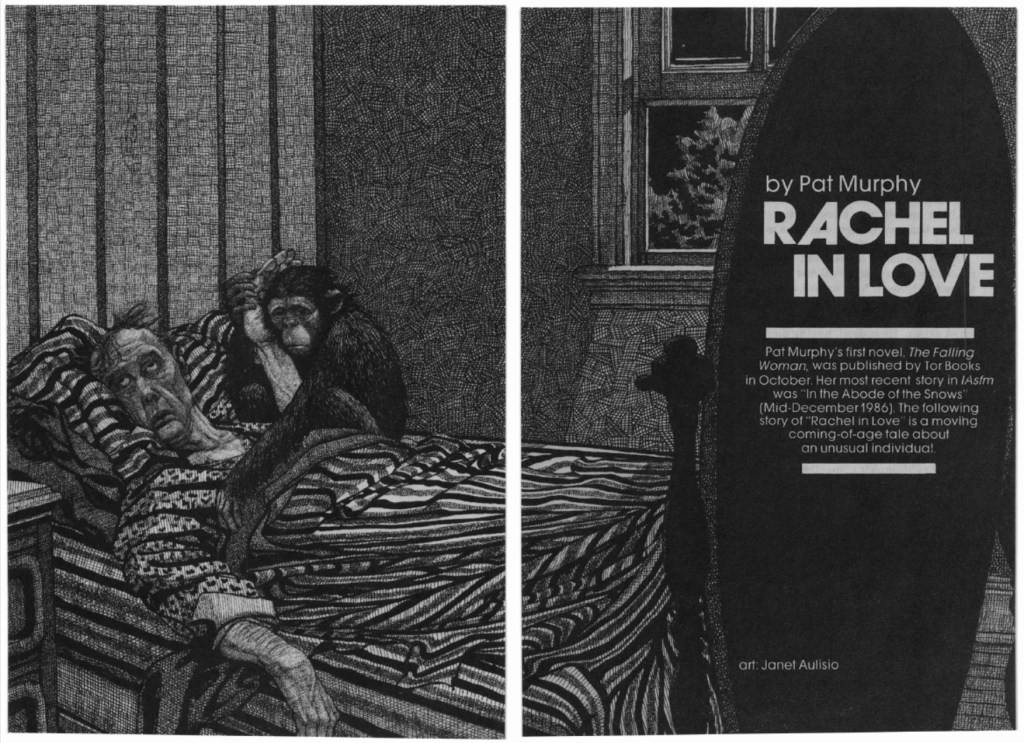
“Rachel in Love” by Pat Murphy

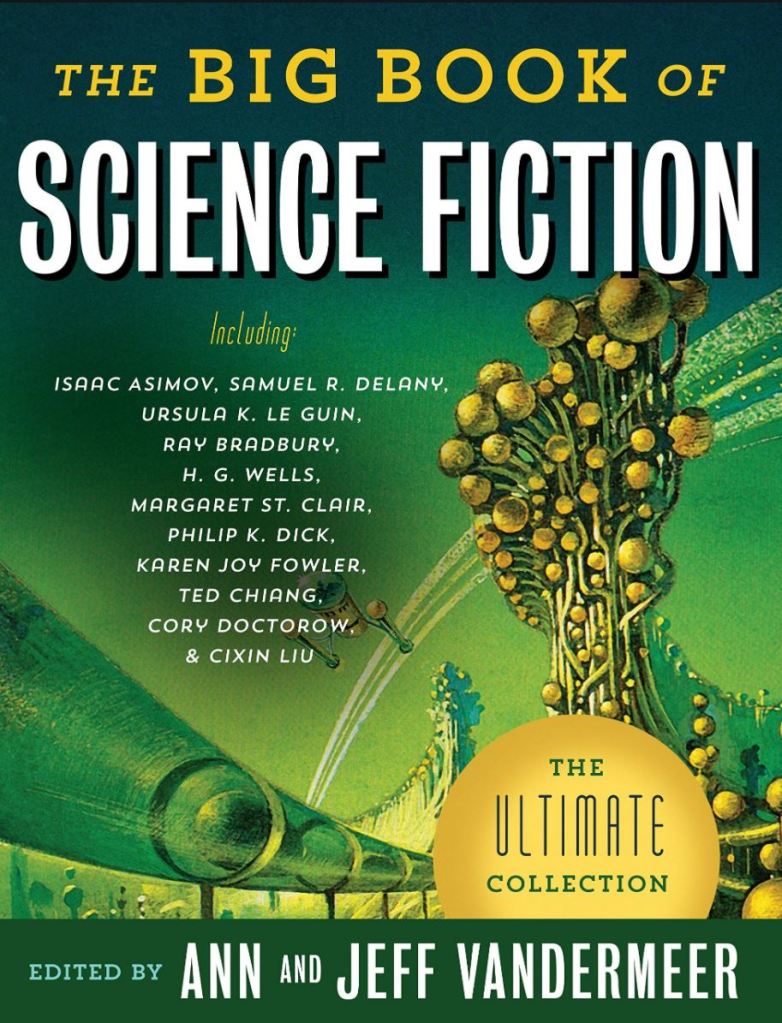
Group Read 27The Big Book of Science Fiction

Story #86 of 107: “Rachel in Love” by Pat Murphy

“Rachel in Love” by Pat Murphy is one of the great classics of science fiction. I’ve read it before, and it was a delight to read it again. Of course, I’m partial to science fiction stories about intelligent chimpanzees, and I’m not referring to The Planet of the Apes (but I enjoy those kinds of stories too).

One of the first intelligent chimp stories I can remember reading is “Jerry Was a Man” by Robert A. Heinlein. Then came “Rachel in Love.” Next was the novel, The Evolution of Bruno Littlemore by Benjamin Hale. There is another novel, but I shouldn’t mention the title because it might spoil the story. And there are other stories which I’ve forgotten at the moment. Nor I’m not talking about stories like Brin’s Uplift novels. I’m only talking about stories that are set in the present with an intelligent chimp, one that you can identify with. One that makes you think we’ve been evil to chimpanzees.

And if you want to know just how evil, watch the documentary Project Nim from 2011. Trigger warning: Project Nim is going to rip out your heart, stomped the crap out of it, and if you’re a good person, make you thankful it did. If it doesn’t make you cry in empathy and outrage you might want to see a psychiatrist.

“Rachel in Love” should also make you cry. I did. It should also make you hate what we’re doing to chimpanzees. It made me hate it again. I was thankful to read in the VanderMeer introduction there has been a law passed against using chimpanzees in research. “Rachel in Love” should also make you happy, because of its wonderful storytelling skills. The structure and narrative of this tale are perfect. Sure, it takes some kinky turns sexually, but then, so do our hormones.

Rachel is a chimpanzee who has been imprinted with personality scans of Dr. Aaron Jacob’s deceased daughter Rachel. She has two sets of memories. Her own chimpanzee childhood, and Rachel’s. Dr. Jacob named the chimp after his daughter.

By Murphy inventing the personality overlay for this story, it provides a kind of Rosetta Stone that lets humans see into the world of the chimpanzee. Rachel is neither human nor chimp, but a bridge between the two. Nim Chimpsky, a real chimpanzee raised in a human family is a tragic animal figure that we can only imagine how he thinks. We want to believe he is as intelligent as Rachel when we look into his eyes but we never know for sure. Jerry, Heinlein’s chimp has been uplifted enough for the law to consider giving him legal status. And Bruno Littlemore is really a fantasy creature created for satire, but one we side with.

I’m old enough to remember a time when people considered animals completely lacking in consciousness. Humans were God’s chosen, and the animals were just for our use. Even nature lovers like Teddy Roosevelt would shoot them all day long and never consider what the animals might perceive. Now, I think we realize that consciousness is a spectrum, and awareness, even self-awareness is not unique to us. Back in 1987 Pat Murphy knew this and wrote “Rachel in Love.” I wonder when everyone will know it.

[I’m sorry I’m behind in reviewing these stories. I had to skip #83-85. I hope to get back to them someday.]

Main Page of Group Read

James Wallace Harris, 2/7/22

“A Gift from the Culture” by Iain M. Banks

Group Read 27The Big Book of Science Fiction

Story #82 of 107: “A Gift from the Culture” by Iain M. Banks

I strongly disliked “A Gift from the Culture” by Iain M. Banks. Not because it’s badly written, but because the main character kills an untold number of people, and because he doesn’t have the courage to do the right thing. I also hate this story because its plot engine is so uninspiringly cliché that I picture Banks stealing it from an ancient film Noir B-movie.

Wrobik is coerced by mobsters into committing mass murder to pay off his gambling debts. The gambling debt plot motivation is as hoary as tying damsels in distress to the train tracks. But to make matters worse, this story is set within the Culture series, a fictional universe of the far future, where humans are now posthuman, and society is post-scarcity. I’ve read about Culture novels for years and thought it was a great theme. But when I tried one of the novels in the past, I was immediately put off because the plot was about assassins. I quit the novel in disgust. I hate stories about assassins.

If I read a novel about a utopia, I want to read about citizens of that utopia. I want a superior character to follow. In both tries at a Culture story, I get amoral characters. That’s why I hated this story. If you’re a science fiction writer creating a utopian future, I want stories that inspire hope, not make me think human failure is endless.

I assumed while reading “A Gift From the Culture” that Banks would find a clever way to allow Wrobik to escape his role as a mass murderer. But no, evidently Banks felt he promised his readers a spaceship shot down with a handgun and he had to deliver.

I also wondered why Wrobik just didn’t shoot the driver when Kaddus and Cruizell forced the gun on him, and then shoot Kaddus and Cruizell. If the gun can blow up a spaceship, it could blow up a mobster’s limo.

I don’t mind stories with amoral protagonists, but those stories have to justify our observations of evil in some way. There was nothing in Wrobik’s situation or personality to care about. He was weak and despicable. Nor was there anything interesting about the criminals in this story. They were so cardboard and cliché that they made the story cartoonish. Kaddus and Cruizell were no better than Snidely Whiplash. Wrobik is no Walter White.

I’ll have to keep trying to find a Culture novel I will like. I just hope they aren’t all about criminals at the edge of utopia.

Main Page of Group Read

James Wallace Harris, 2/1/22