“The Brains of Rats” by Michael Blumlein

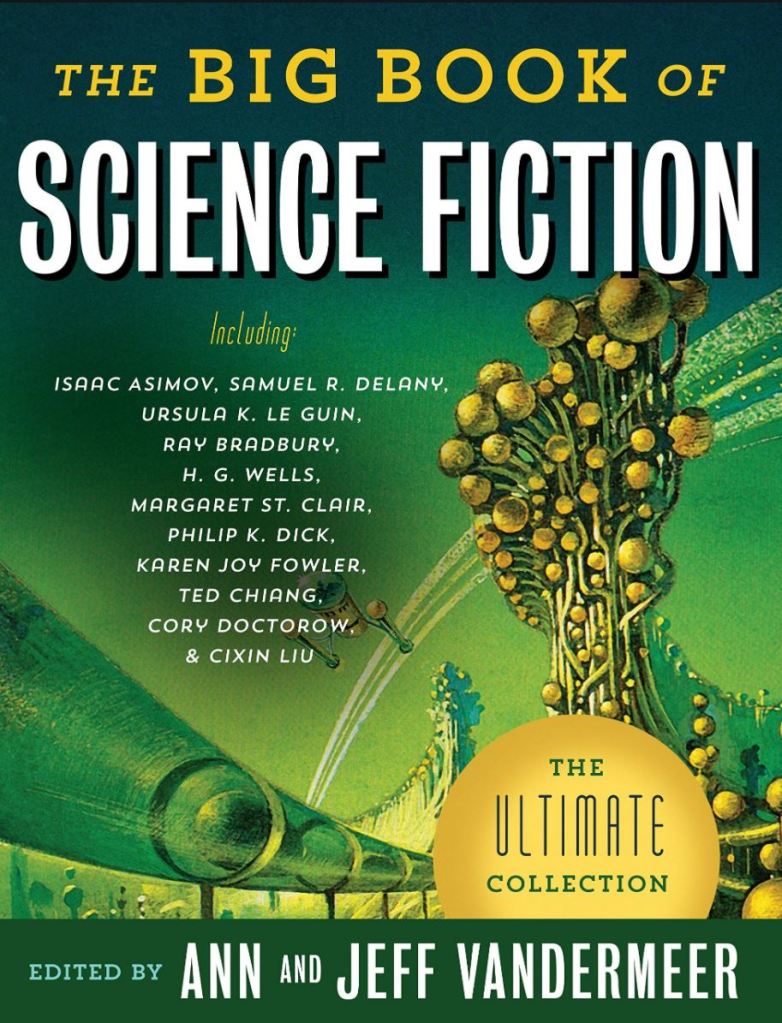
Group Read 27The Big Book of Science Fiction

Story #95 of 107: “The Brain of Rats” by Michael Blumlein

“The Brain of Rats” by Michael Blumlein is an excellent piece on gender, but not science fiction. Like Judith Merril did sixty years ago, the VanderMeers work to broaden the scope of the SF genre. But it’s like the judge’s proclamation about pornography – “I know when it when I see it.” The VanderMeers see science fiction and I don’t. There’s no way to draw a border around the genre and stake a claim. This isn’t science fiction to me, it’s genre gerrymandering.

If I had read “The Brain of Rats” in The New Yorker I would have been impressed. Reading it in The Big Book of Science Fiction, I read it with interest but was annoyed that it was included. Genre is about marketing categories of fiction to readers seeking specific categories. Many of the stories in this anthology are not what I wanted to read when I bought a giant anthology called The Big Book of Science Fiction.

I know this is narrow-minded of me. Nor, does it matter what I want. Science fiction is whatever people want it to be because things do change with the times. I guess I’m just old and don’t want to change with them. I’m just a grumpy old fart. I’ve been annoyed ever since fantasy stories began invading science fiction magazines back in the 1960s. I realize I sound like a rabid Trump supporter ranting about the border and illegal aliens. I’m actually a liberal, and all for diversifying the real world, but when it comes to science fiction, I want a gated community. Is that narrow-minded? I do read fantasy and literary fiction, but when I’m in the mood.

I feel some writers and editors want to expand on the science fiction genre because that’s what they want to read and write and the science fiction market is easier to break into. Picking up a book or magazine to read science fiction and finding stories like this is something akin to tuning into the Olympics to watch curling and seeing one of the guys drop his broom and start figuring skating around on the ice. I’m sure readers of The New Yorker would be miffed to find a space opera tale in their mag.

There are a few lines in “The Brains of Rats” that could be interpreted as speculation, but those ideas aren’t developed. I assumed they were added so the story could be sold to a science fiction market. Michael Blumlein is an interesting writer, and I might pursue his work further, but I’ll actually be seeking it out for its literary and mainstream qualities.

Main Page of Group Read

James Wallace Harris, 2/24/22

More Books for PKDickheads

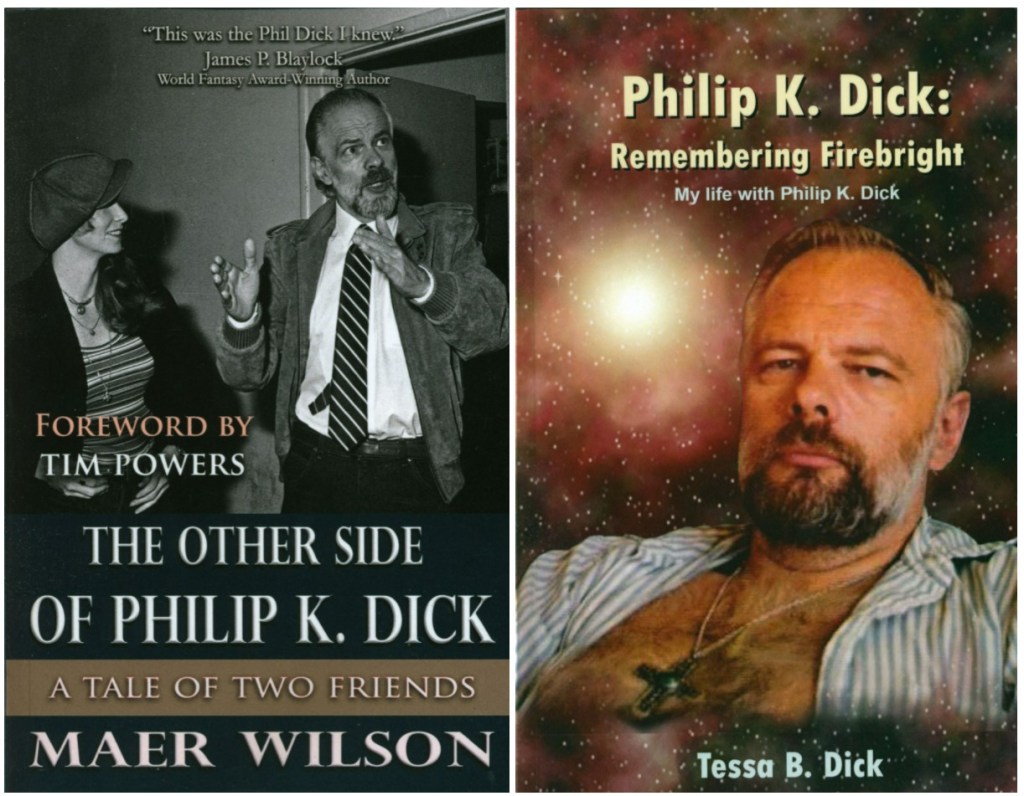
After reviewing We Can Build You and Dr. Bloodmoney on my personal blog, I thought I’d be through with PKD for a while. Nope, I’ve only fallen deeper into the PKDickian black hole. While shopping for deals on old PKD books on eBay I noticed The Other Side of Philip K. Dick (2016) by Maer Wilson, a biography I haven’t read. Turns out it was cheaper to buy new at Amazon. I got it and read it immediately. Wilson knew PKD from 1972 to 1982 – during the last decade of his life. Because I only vaguely remember reading Philip K. Dick: Remembering Firebright (2010) by Tessa B. Dick, his fifth and final wife, I decided to reread it. It’s still available at Amazon, so don’t pay inflated collector prices. Tessa Dick knew PKD over the same period of time, so we have two memoirs that remember PKD over the same time period.

Both books were published on CreateSpace, a self-publishing company owned by Amazon. Tessa Dick’s book is poorly edited and has a more basic layout, but it has more information about PKD. Wilson’s book looks better and is better written, but she spends more time talking about herself, so there’s less information about PKD. If you’re really into Philip K. Dick, you’ll want to read both. I’ve already written some about the major biographies on PKD, so I’m only going to focus on these two. I really need to do an in-depth comparison someday.

All the people writing about PKD tell a different story. Reading about PKD is like watching Rashômon. Besides the biographers that never knew PKD, there are several people that did who have written biographies, memoirs, and articles. My favorite of those is The Search for Philip K. Dick by Anne R. Dick, his third wife. She knew PKD while he was writing his mainstream novels and The Man in the High Castle. Tessa was married to PKD while he was writing A Scanner Darkly, VALIS, The Transmigration of Timothy Archer – all his last novels. Wilson knew him during the same time period but she writes little about him writing the novels. But Wilson went with him to see the early rushes of Blade Runner when Dick got to meet Ridley Scott. She also knew him before and after his marriage to Tessa. And she was supposed to go with him to Europe for five weeks and then see the premiere, but PKD died before all that. She was not his girlfriend, but just a friend. PKD was agoraphobic and depended on Wilson to keep him company and drive him places. PKD had several friends that helped him like this.

I should also mention there’s a documentary on Curiosity Stream, The World of Philip K. Dick that interviews Tessa Dick. Dick’s three children, Laura, Isa, and Christopher manage a joint trust of his works and legacy, but Tessa might be the person that publically remembers him most. From reading the two books, I don’t think Tessa and Wilson liked each other, and their two memoirs contradict each other in places. Wilson believed PKD was far saner than he is often portrayed, but from reading the two books I get the feeling Wilson saw Dick when he was being his public self, and Tessa saw PKD when he was letting all his inner self hang out.

Wilson’s book has a forward by Tim Powers, and a note by James B. Blaylock, also friends of PKD during his last decade. Their comments seem to gently endorse Wilson’s view, but Tessa Dick’s memoir is far more intimate. She got to live and work with PKD.

I don’t want to get into the details here, because they can be endless, but Philip K. Dick is known for writing very strange science fiction, but he’s also known for believing a lot of strange ideas. Some people considered him bonkers, while others believed he was putting us all on. Reading Tessa’s book leaves me believing PKD was insane. Wilson’s book left me thinking he was sane, but with some mental problems, but not major ones.

The reason I love reading about PKD is I’m looking for clues about why he wrote his stories. Tessa’s book is most revealing about that. Wilson’s book is more illuminating about being a writer and dealing with the outside world. She would go with him to interviews and try to keep him from saying things that would generate bad PR. Neither book is a quality biography. Both memoirs add information and confusion about the mystery of Philip K. Dick.

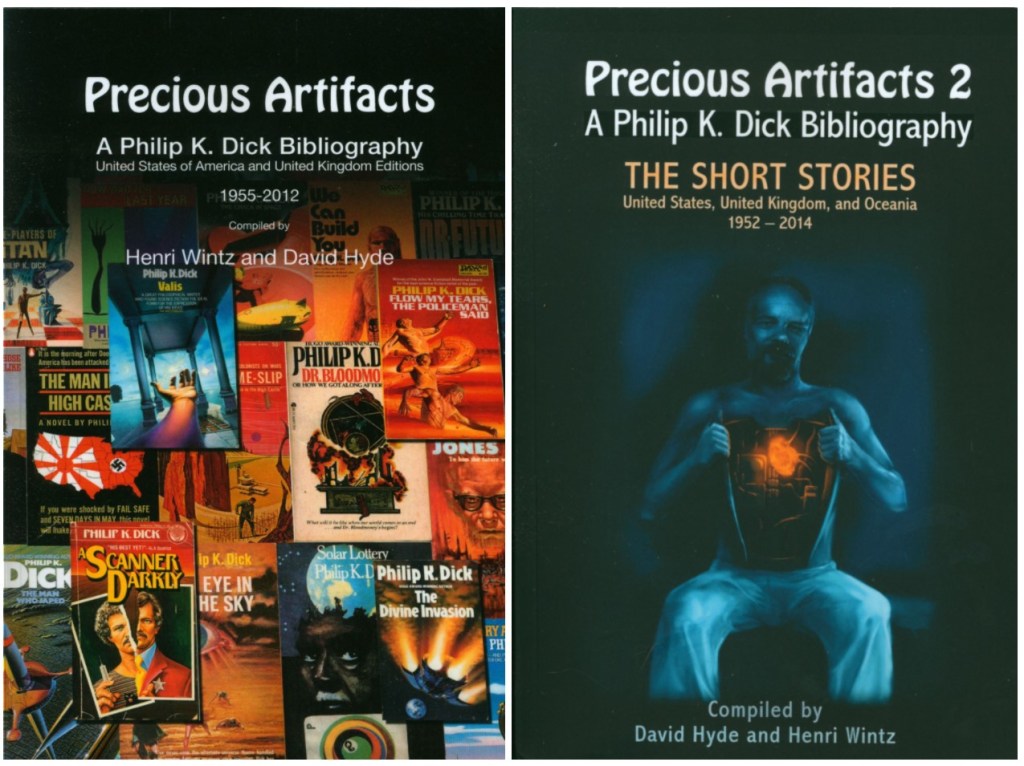
I also bought Precious Artifacts and Precious Artifacts 2 from Amazon even though the same content is online at the Philip K. Dick Bookshelf. The first is a bibliography of his books, and the second covers his short stories. I don’t actually collect to collect, but my buddy Mike and I have gathered quite a bit of PKD material over the last forty years. We’re not completists, but I’m always looking out for stuff I haven’t read. And sometimes I like buying books because of their covers. Most of the information in these two books is available at the writers’ site, but also on ISFDB. However, I like holding these books. They are well illustrated with color images of the book and magazine covers.

James Wallace Harris, 2/23/22

“Death is Static Death is Movement” by Misha Nogha

Group Read 27The Big Book of Science Fiction

Story #94 of 107: “Death is Static Death is Movement” by Misha Nogha

I wasn’t going to write about “Death is Static Death is Movement” by Misha Nogha because I’m tired of writing about stories I can’t resonate with as a reader. This was another horror story, an item on the fiction menu I just never select. Then one of the group members said I should keep my review streak going. They probably didn’t notice I had already skipped a couple stories, but I’ll go back and fill in those two also.

“Death is Static Death is Movement” isn’t a short story, but a novel excerpt, which reads like the author visualized it as a comic book or horror movie but had to put it into words. It’s full of colorful mayhem that includes quite a lot of vomit, shit, snot, and body parts. Here’s a typical sample, but not the grossest.

Who enjoys this stuff other than tweens? Putting Nogha’s words into my mind’s theater made me recall EC Comics, which were banned back in the 1950s because do-gooders thought they would corrupt children. But who but children would enjoy such ghoulish grossness?

This story would also appeal to aficionados of American International horror films. There are science-fictional elements in this novel excerpt, but the tone of the story is feminism meets H. P. Lovecraft if he had lived long enough to read William Gibson.

I know there are fans of this stuff. millions of them. I’m just not one. Sorry.

Main Page of Group Read

James Wallace Harris, 2/22/22

“Before I Wake” Kim Stanley Robinson

Group Read 27The Big Book of Science Fiction

Story #93 of 107: “Before I Wake” Kim Stanley Robinson

Once again the VanderMeers give us a science fiction horror story.

Kim Stanley Robinson came up with a neat setup for “Before I Wake,” where humanity is trapped in uncontrolled sleep cycles with confusing dreams after the solar system moved into an interstellar dust cloud. Something in the dust put people to sleep and they struggle to stay awake for short moments. Civilization is collapsing and cities are burning.

In the story, Fred Abernathy, a scientist, and Winston, his lab administrator struggle to keep a group of a dozen researchers awake long enough to study the problem and seek a way to counter the dust’s effects. Their efforts are thwarted because they can’t tell reality from dreaming. Fred and Winston use amphetamines and the pain of acid drops on their skin to keep themselves awake to work on a helmet that magnetically repels the dust.

Of course, this plot reminds me of the classic 1954 Poul Anderson novel, Brain Wave, where the solar system moves out of a dust cloud and people and animals all become smarter. That was a bright take on the idea. The dust had been hindering all intellectual development on earth for thousands of years, and moving out of the cloud allowed all animal life to be smarter. Robinson takes the horror side of the idea, moving into the dust that ruins our natural sleep patterns.

Lately, I’ve been reading the stories in The Big Book of Science Fiction twice to make sure I get everything. For some of the stories, I need to read them twice because the intent of the story is unclear from a single reading. Robinson’s tale was easy enough to understand in one reading even though Fred goes in and out of dreams and Robinson expects his readers to feel like their experiencing a bad LSD trip. There were a couple of places in the story that did confuse me. I don’t know if they’re actual mistakes or intentional points to confuse us. For example, Fred goes to rescue Jill. At one point we’re told Jill is his wife, and another she’s his sister. In Fred’s confused state Jill could be neither.

I read “Before I Wake” the first time, and listened to it the second. I so much prefer the audio version.

“Before I Wake” is a fun read based on a neat idea however it has a bummer of an ending. Reading this story reminds me just how much I prefer happy endings and dislike horror. Because there are so many science fiction horror stories, satires, literary works of cleverness in this volume, its overall vibe is cynical. The nightmare ending of “Before I Wake” left me with a sense of hopelessness.

There are stories in the anthology that are uplifting and left me feeling good, such as “A Martian Odyssey,” “Desertion,” “Surface Tension,” “The Last Question,” “Rachel in Love,” and so on, but many did not. Now, some of the somber, even horror stories were philosophically uplifting, and quite brilliant, like “Snow,” “Bloodchild,” “When It Changed,” etc. But many of the stories were only intellectually interesting, or clever, like “Before I Wake.” I can admire them for the inspiration and execution of a creative idea, but they leave me emotionally wanting more.

I suppose it is childish of me to always want stories that leave me feeling good. But think about it, how many people take drugs to feel bad? Fiction is a drug to me. I read fiction for uplift. I have nonfiction for teaching me about reality. Great fiction needs great conflicts to move the story along, but in the end, I want epiphanies that make me feel good.

Main Page of Group Read

James Wallace Harris, 2/20/22

“Burning Sky” by Rachel Pollack

Group Read 27The Big Book of Science Fiction

Story #92 of 107: “Burning Sky” by Rachel Pollack

My initial reaction to “Burning Sky” was indifference. I have no background with comics, so I find stories inspired by superhero themes unappealing. But the coda to the story intrigued me.

I remember seeing a short documentary about William Moulton Marston who wrote as Charles Moulton and was the creator of Wonder Woman. I also remember reading reviews of The Secret History of Wonder Woman by Jill Lapore in 2014. So I know just enough of Wonder Woman’s literary origin story to know it had kinky aspects. Then I wondered if Rachel Pollack knew of that history in 1989? That meant I had to reread the story and do some research.

I then wished I had a copy of Burning Sky, the Pollack collection in which the title story is gathered with 26 other stories. That’s because I read that each story has an autobiographical afterward which would probably help me. As luck would have it, that collection is available at Amazon for $1.99 for the Kindle edition. However, you don’t need to buy a copy to read the afterward to “Burning Sky.” Just use the Look Inside feature. You can also read Samuel R. Delany’s introduction to the collection where he praises Pollack highly. Here are three key paragraphs from the afterward:

This isn’t very illuminating since I already got that much from the story. I was hoping Pollack would explain the Wonder Woman connection. Delany also explained that Pollack was an authority on Tarot cards. I can see why Delany admired Pollack because his stories often deal with sexuality, and Tarot cards were part of his novel Nova.

“Burning Sky” is told by Maggie in the first person, and tells us about two other women, Julia and Louise, and about a strange group of vigilante women called The Free Women. These women wear skintight blue plastic outfits that cover everything but their faces. They attack men who attack women. “Burning Sky,” tells two stories, Julia’s run-ins with The Free Women, and Louise helping Maggie find an orgasm. Neither story really interested me. Most of the imagery deals with S&M and fetishes.

“Burning Sky” is really feminist fiction and not science fiction. For the reread I had hoped it would provide allusions to the early days of Wonder Woman comics, but I didn’t find any that I understood. I just don’t have any real knowledge of comic book history. I assumed the ceremonial hall and Free Women connected with the comic’s past. And certainly, WW was full of S&M/fetish imagery. The story had a tiny bit of the Dangerous Visions vibe, but not really, especially for 1989. Maybe the story had a bite when it was first published, but it’s rather quaint now compared to feminist fiction today.

I believe this is just a case of me being the wrong reader. I’m curious what women who enjoy S&M and loved old Wonder Women comics got out of it?

Main Page of Group Read

James Wallace Harris, 2/18/22

“Two Small Birds” by Han Song

Group Read 27The Big Book of Science Fiction

Story #91 of 107: “Two Small Birds” by Han Song

“Two Small Birds” by Han Song is a beautiful story that I admired for the writing and imagery, with many sentences that I twanged my heartstrings, especially, “I’m shocked to smell the flavor of olden days.” There’s not a moment that crawls by that I don’t feel that.

But here I go again being a little pissant. I don’t believe “Two Small Birds” is science fiction, or at least I don’t want to believe it. I’m not sure what label to give this story, but somehow I feel it’s unfair to shanghai every beautiful work of the fantastic and force it to sail upon our great clipper ship the Science Fiction. This is another case where I believe like their mentor Judith Merril, the VanderMeers want to uplift the genre by claim jumping other folks’ goldmines.

Now I will have to defend my position by going all verbose on you. Sorry about that. Let’s start with the simplest way to make my case. We make generalizations and classifications to find an agreement on what we’re pointing at with our words. Even though they are very similar, we like distinguishing between dogs and cats.

Nowadays anything that mentions anything that has the slightest whiff of science fiction gets slapped with the label science fiction. We need more labels. More precise labels. I saw an interview with David Brin the other day, and he came up with a lovely label, “speculative history.” Science fiction has become too trendy, too broad. It’s a monopoly that needs to be broken up.

I don’t have a label for “Two Small Birds,” but I don’t want to use science fiction for the job. I already have a lifetime of reading that uses that label, and this story is not really like those stories.

This reminds me of a book I recently read, The Horse, the Wheel, and Language by David W. Anthony about determining the location of the culture that produced the Proto-Indo-European language. Somewhere in pre-history, there exists a proto-fantastic-storytelling form that is the mother of all the genres. And like English, German, Spanish, etc. share elemental sounds from the Proto-Indo-European, science fiction, and whatever we should label “Two Small Birds” share common story elements that are similar, but they are as different as English and Italian.

I’m also reminded of the book I’m reading now, The Dawn of Everything by David Graeber and David Wengrow who argue against singular generalizations about human societies in pre-history because they certainly took a myriad of forms. And every shaman, guru, seer, witch-doctor, medicine man, mystic, astrologer, came up with a different creation story to explain reality. Out of thousands of years and countless refined perspectives we created science. It’s a very precise label. That makes it useful. I believe science fiction has a similar distillation from all the proto-fantastic storytelling forms, and we could make it precise too. We could if we tried.

“Two Small Birds” reminds me of Carlos Castaneda, Bob Dylan, Walt Whitman, Samuel Taylor Coleridge, and a certain work of Thomas De Quincey, among many others. You wouldn’t call any of those dudes science fiction writers, would you? And I will admit there are lines in “Two Small Birds” that sound science fictional. I just don’t think it fits into the taxonomy of how we should classify science fiction.

Now, I will admit things are evolving, and language is never static, and it appears that younger generations want to slap the Sci-Fi label onto any kind of strange story they love because they feel the genre should be all-encompassing. But I say it’s valuable to have a word other than calling every creature an animal because sometimes it’s important to distinguish a giraffe from an elephant.

Main Page of Group Read

James Wallace Harris, 2/15/22

“Vacuum States” by Geoffrey A. Landis

Group Read 27The Big Book of Science Fiction

Story #90 of 107: “Vacuum States” by Geoffrey A. Landis

“Vacuum States” by Geoffrey A. Landis is a clever second-person tale that draws the reader into the story.

I suppose I should say more.

“Vucuum States” is full of concepts about physics and cosmology. The only trouble is I can’t tell the real physics from the mumbo-jumbo that Landis made up.

Like many of the stories in The Big Book of Science Fiction, I didn’t consider it a real short story, although it was. There are no constraints on what writers can call fiction. The VanderMeers like stories that feel intellectual, and this one feels like a fun lecture in physics. But as I read “Vacuum States” I was mildly annoyed that I was reading something so contrived, however, the ending put a smile on my face and redeemed my reading effort.

But why didn’t they use “Ripples in the Dirac Sea” which is also from 1988, and Asimov’s? It came in 2nd place instead of 10th in the readers’ awards that year. And it won the Nebula Award and came in 3rd in the Hugos. Maybe because the VanderMeers had already included Dirac in their giant anthology, The Time Traveler’s Almanac. I need to consider that all my whining about story choice in this volume is because the VanderMeers used the stories I would have chosen in other anthologies.

Then what about “A Walk in the Sun” from three years later? It won the Hugo and the Asimov’s Readers’ Award. It was a real story, even more so than Dirac. Of course, I have that story in three other anthologies, but could they have known that?

I doubt either of the VanderMeers are reading these reviews but if they did, they’re probably annoyed at my constant questioning of their story selection choices. But I keep wanting to know about the process and the issues to consider. Do the authors ever get a say? I see The Big Book of Science Fiction as the main anthology that young readers will know 20th science fiction short stories. Part of my grumpiness is they seldom picked the stories I remember as the best SF from the 20th century. I worry my favorites will be forgotten. But I also think about the authors. Is “Vacuum States” how we should judge Landis if we only have one story? It’s not a bad story, but there’s just not much to it.

Main Page of Group Read

James Wallace Harris, 2/14/22

“All the Hues of Hell” by Gene Wolfe

Group Read 27The Big Book of Science Fiction

Story #89 of 107: “All the Hues of Hell” by Gene Wolfe

I’ve only read a handful of stories by Gene Wolfe, but the ones I have read impressed me immensely, and I’m afraid “All the Hues of Hell” paled in comparison. One problem is Wolfe’s most famous stories are rather long, so maybe the VanderMeers didn’t want to include any of those because of length. But there are many to choose from, and like the Willis story, I wonder why “All the Hues of Hell” got the nod.

I hate to keep nagging about the selections in The Big Book of Science Fiction. Partly, it’s because I wonder how anthologies are put together. I assume some anthologists love to promote underdog stories hoping they will become more famous. However, I find it very hard to imagine not picking the very best stories from each author, especially for a retrospective volume that covers a whole century. I’m afraid I would never buy a Gene Wolfe book after reading “All the Hues of Hell,” but I have after reading some of his other stories. My running assumption with this volume is the VanderMeers’ taste in science fiction is just different from mine. And “All the Hues of Hell” is on the horror side of things, and they seem to like horror science fiction.

In the VanderMeers’ introduction, they quote Wolfe: “My definition of a great story has nothing to do with ‘a varied and interesting background.’ It is: One that can be read with pleasure by a cultivated reader and reread with increasing pleasure.” I don’t know if I’m a cultivated reader, but I have learned that rereading often brings increased pleasure. This is my first reading of “All the Hues of Hell,” so it might improve when I read it again in the future. But for this first reading, I found it confusing.

I think I got the gist of it. A scout ship, the Egg, leaves the mothership, Shadow Show, with a crew of a husband and wife team, L. Skinner “Skip” and Marilyn Jansen (Jansen 1, Jansen 2), along with an android/robot/cyborg named Kyle, and his pet macaw, Polyaris. Marilyn is pregnant. They are under the command control they call the Director. I don’t know if this is a person or a computer? Their mission is to capture a being from a mostly invisible world they call the shadow world. While Skip is on an EVA to capture the creature he goes insane and claims he’s dead and the world he’s visiting is Hades. Kyle and Marilyn go through various activities to rescue Skip and he is restrained when he is brought back with the captured being. [On second reading I realized that Skip never left the Egg, but was jacked into some kind of virtual reality that let them see the shadow world.]

All of the action takes place inside the Egg, and all the characters float in microgravity. There is a black sphere, maybe a magnet torus, in the room, to hold the alien when it’s captured. Much of the conversations deal with Skip’s insanity and descriptions of what he’s seeing. I never knew why he went insane, other than the exposure to the shadow world, or the fact, that’s what Wolfe wanted. Like a Philip K. Dick story, there is a fair discussion of mental illness and insanity.

At one point Kyle tells Polyaris that it’s raining frogs and fish and asks the bird if it remembered Charles Fort. Few people today know who Charles Fort was, so why would someone in the far future know about him? He collected odd stories that people claimed were evidence for the occult, but his popularity was decades before I was born, and I’m seventy. The reference amused me but thought it was jarring. I also considered it a writer-ly thing to throw out. I assume Wolfe wanted to connect the odd goings-on in this story with the occult, but it didn’t need a reference to Fort.

All the descriptions of the actions within the Egg, and the events of the virtual EVA were very confusing to me. I assume Wolfe saw clearly what he created in his mind’s eye, but I never saw the scene clearly. That hurt the story for me.

I guess the ending is supposed to be significant. The alien, the shadow creature, evidently possesses Marilyn’s fetus. Oooh, all scary, but not! In retrospect, that means Skip’s insanity was due to possession. I just didn’t see that at the time.

For the sake of this story, and this review, I just reread “All the Hues of Hell.” This time I pictured the setting much better. I was wrong about Skip, he never left the Egg. He went insane while inside the scout ship with Kyle and Marilyn. They all were observing the shadow planet with some kind of AR, or some kind of computer sensing device. None of them ever left the Egg. Marilyn took control of a tractor beam, or force field, or magnetic waldoes, and grabbed up the shadow creature.

On the second reading, I don’t think Skip’s insanity had anything to do with the shadow being. I think the stress of the mission drove him nuts, and he characterized everything with his own fears.

Even though the story was clearer on the second reading, I didn’t like it any better. Actually, I was horrified they grab a possible sentient being for scientific study. Made me think of little green men in UFOs abducting Whitley Strieber.

I now wonder if this 1987 story was inspired by the 1986 film Alien? Kyle is an awful lot like Bishop, especially since he might be an unreliable narrator and was intentionally putting the mission at risk to capture the creature. And in the end, Marilyn has an alien inside of her.

Main Page of Group Read

James Wallace Harris, 2/12/22

“Schwarzschild Radius” by Connie Willis

Group Read 27The Big Book of Science Fiction

Story #88 of 107: “Schwarzschild Radius” by Connie Willis

Normally, everything I’ve read by Connie Willis is enchanting, but it was a bit of a slog for me to read “Schwarzschild Radius.” The story is quite clever. Modeling the physics of a black hole against events by Germans at the Russian front in WWI. Karl Schwarzschild was a German physicist who first mathematically worked out the ideas of black holes from Einstein’s equations. The title of the story, “Schwarzschild Radius” is the actual name given by scientists to the size of an event horizon in a rotating black hole.

Schwarzschild died at the front from an autoimmune skin disease. Willis took this fact and made it into a science fiction story. She has a first-person narrator, a soldier who had served at the front, being interviewed by a biographer of Schwarzschild. The story switches from the present to flashback memories. Willis makes the conflict of the story about the soldiers’ failure to communicate outside of the front as if they were trapped inside an event horizon of a black hole. This is a neat idea intellectually, but I found it contrived and strained in the storytelling. Using a series of frustrating incidents to show the parallels to physics was just too obvious.

The details of these episodes were on the surreal side, which might have been Willis’ intention, but I found that annoying. I prefer stories that feel like realistic paintings, and this story felt like modern art.

“Schwarzschild Radius” was anthologized in The Norton Book of Science Fiction and The Big Book of Science Fiction, as well as being included in Nebula Awards 23 for being a finalist. So this story is admired. But there are stories that are admired for the clever writing that I just don’t enjoy.

First off, “Schwarzschild Radius” is overly complicated with its framing. It is another layer of modeling the event horizon, but was it really needed? Being in the German trenches on the Russian front in WWI is a perfect metaphor for being inside the Schwarzschild radius. And the idea of waiting for a letter from Einstein and understanding Schwarzschild’s disease are great elements to include in the story. But I never felt for any of the characters.

Willis seems to pattern the mood of the story from the mood in Catch-22, but I never cared for her characters like I cared for Heller’s characters. The repeated requests to get a message out reminded me of Yossarian constantly asking about Snowden. And the soldier building the motorcycle reminded me of Orr. Of course, Heller had a whole novel to develop his characters, and Willis just has a short story.

There were some vivid moments, like when the narrator feels revulsion at Schwarzschild’s skin disease, or when the explosion buries him in the trenches. But most of the action went by too quickly. We never got to settle into any scene to get into it. Personally, I believe the story would have been much more effective without the framing. The framing words could have been used to expand the heart of the story.

I wonder why the VanderMeers picked “Schwarzschild Radius” when there are so many other Willis stories to choose from? Maybe her top stories are over anthologized. I never thought a story could be over anthologized until I read a letter by Philip K. Dick asking Lee Harding editing Beyond Tomorrow to substitute “The Commuter” for “We Can Remember It For You Wholesale.” He did. I wonder how often this happens, and I wonder which story Connie Willis would have liked in this volume? “Schwarzschild Radius” could be her favorite, and I’m a dunderhead not to see it. I know Rich Horton loves this story.

Main Page of Group Read

James Wallace Harris, 2/12/22

Improving the Internet for Researching Science Fiction

I wrote an long review of We Can Build You by Philip K. Dick for my personal blog. Normally, I would put my science fiction reviews here, but my goal is to review every book I read in 2022 at Auxiliary Memory. Go read the review if you’re interested in PKD, but what I want to do now is talk about how I researched that review. I found quite a few impressive sites devoted to Philip K. Dick, but I didn’t think Google was very good at helping me find them. I also assumed there are way more great sites out there that I’m not finding through Google.

Google is unfortunately geared at helping people sell stuff. It’s a shame it doesn’t offer us radio buttons or a pulldown menu near the search box where we could tell Google what kind of results we want. If the box “[ ] I’m Buying” isn’t checked, then don’t show us any site trying to sell us stuff. There is scholar.google.com to search, but its results come mainly from academic sites (often with content behind paywalls), and I want results from all sites. I believe search engines aren’t the solution.

Once upon a time I wanted to become a librarian, so I’m thinking of librarian type solutions. Remember the good old card catalog? I believe one way to separate the informational wheat from the chaff is to use a curated card catalog. And I believe one already exists – Wikipedia.

Here is Wikipedia’s entry for We Can Build You and the entry for Philip K. Dick. The first link in the Reference section is to the novel’s entry in ISFDB. Between those three web pages, most readers would learn about all they wanted about We Can Build You before reading it. Searching Wikipedia first was far more efficient than starting with Google.

What Do We Want From An Internet Search Tool?

  • Immediate access to the exact information we seek
  • Links to the most authoritative information
  • We want enduring sources that can be sited
  • We want accurate information
  • We want human curated information
  • We want cumulative history of the information
  • We want information organized into useful subcategories

Using my research for We Can Build You as an example, here’s what would be the ideal results, both in general, and specifically how I see Wikipedia providing it.

  1. A comprehensive history of the writing and publication of the book.
  2. A complete but concise summary of the plot with a listing of characters.
  3. A summary of the most common interpretations of the book
  4. A summary of how the book has been reviewed and judged.
  5. Links to the best online reviews/essays/academic papers
  6. Links to databases that contain information about the book
  7. Links to where I can buy/download the book
  8. Links to books/essays/academic articles about the book
  9. Bibliography of significant books/journal citations that aren’t online.

Wikipedia has already been moving in this direction. The entry for We Can Build You is a decent start. Dr. Bloodmoney has some improvements. But the entry for The Man in the High Castle gets much closer to what I’m wanting.

Google claims there are 53,800 pages with information about [“We Can Build You” by Philip K. Dick]. Just how many extensive reviews or scholarly papers on We Can Build You exist? Some might be on the 12th page of a Google results or the 153rd, or hidden behind a firewall protecting academic publications so they aren’t easily found. How many excellent articles on the book have been written? 8, 15, 172? What if human editors decided on the best 5-10 to list on the Wikipedia, especially if their full text was available online? At what point do we have enough information about any subject?

A Wikipedia entry doesn’t need to be a dissertation on the subject but it should be the start of one. It should provide all the links to start writing a dissertation.

ISFDB lists eight reviews, but not links to the actual reviews. Some of those reviews are on the internet, some are not. One of those reviews is also listed on Wikipedia but without a link, even though the full text of the magazine is available online. Read the Theodore Sturgeon’s review in the January 1973 issue of Galaxy, and it is summarized on the Wikipedia page. However, none of these links proved that useful to me, and I have to assume much better content has been written about We Can Build You in the last fifty years.

Wikipedia could link to all the academic contend behind paywalls. That would be a tremendous step forward. Better yet link to a service that would allow users to easily buy those articles with Paypal (and give Wikipedia a cut). Or if the publication was something for sale on Amazon, link to it and allow Wikipedia an affiliate cut. Here is the opening page to a book I found that has a chapter on We Can Build You that I discovered though scholar.google.com. It was on Amazon for $9.99 for the Kindle edition. The book is The Twisted Worlds of Philip K. Dick: A Reading of Twenty Ontologically Uncertain Novels by Umberto Rossi.

I found this first page of the introduction so exciting that I bought the book – and it has a chapter on We Can Build You. Because of my knowledge of Sheckley and PDK I know Rossi will have incredible insight. This book should have a link on Wikipedia.

All the scholarly opinions about We Can Build You would be too much for Wikipedia to summarize, but it should point to the best. That would certain be a better solution than Google. Google is finding information by machine indexing. Right now, Wikipedia is presenting information by human intelligence. I believe we need more human help in internet searches than brute force AI. Of course, AI will eventually be better than humans. Someday, an AI will write the perfect nonfiction book on any subject we request of it.

Scholar.google.com returned 47,700 results for the search [We Can Build You by Philip K. Dick]. Wikipedia could link to that search results, and it could list some of those citations that have been human verified by editors to be among the best. Wikipedia is written and edited by volunteers. New volunteers looking for something to contribute could curate the most important links.

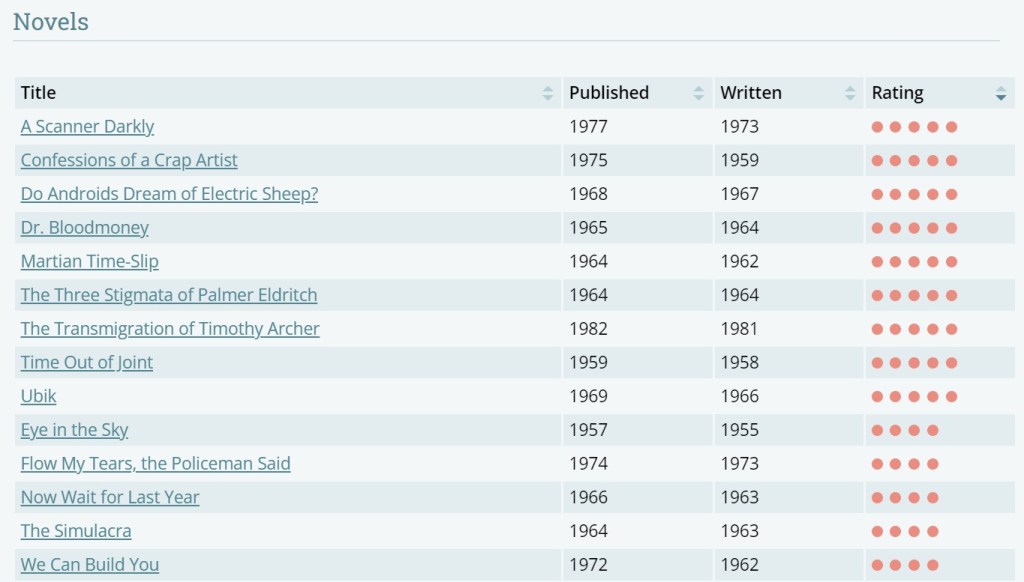
While researching We Can Build You I found all kinds of web pages that offer useful information. At the site The World Dick Made they had user sortable listing of PKD’s novels with star ratings, giving the data written and date first published. Here are the books that get 5 and 4 star ratings. We Can Build You gets 4 stars from this site. This certainly would be a nice link for Wikipedia. The link for the novel takes us to a page with more good information, including a long list of characters within the story.

Our own citation listing shows We Can Build You wasn’t very popular on recommended lists and fan polls, but that Josh Glenn put it on the list “75 Best New Wave Sci-Fi (1964-1983) Novels.” That would be another worthy link to include at Wikipedia.

Ultimately, what we want from an internet search is knowledge. Most of us use Google to gather data so we can assemble that data into our own version of knowledge. That’s what my review ended up being. However, my take was highly idiosyncratic. Most people searching on We Can Build You would want facts. Wikipedia does a decent job now, and it’s getting better all the time. However, some researchers would want to know about or even want to read the most common idiosyncratic takes on the novel. Right now, we have to use Google to track those down but it’s very inefficient. Scholar.google is better, but still returns to many results. The right links added to Wikipedia would make it a far superior search tool.

In the future, I can picture the volunteer editors at Wikipedia adding more and more information to each entry, and it will get into helping its users find those idiosyncratic views. This will be much more efficient than Google.

Right now I have several shelves of books about science fiction and its history. If I started with the main entry for Science Fiction in Wikipedia and pulled out all the content that is linked to it, I’d have the best book ever written on the subject, with the best illustrations. All the famous SF authors and their novels have entries in Wikipedia, as well as most of their famous short stories. Wikipedia also covers the editors, book publishers, and magazines. Eventually, Wikipedia could describe every SF stories ever written, and link to where they could be bought or read online, as well as links to everything we know about them. That’s why I believe Wikipedia should become the card catalog of the internet.

Of course, the next problem is making this knowledge permanent.

James Wallace Harris, 2/11/22