
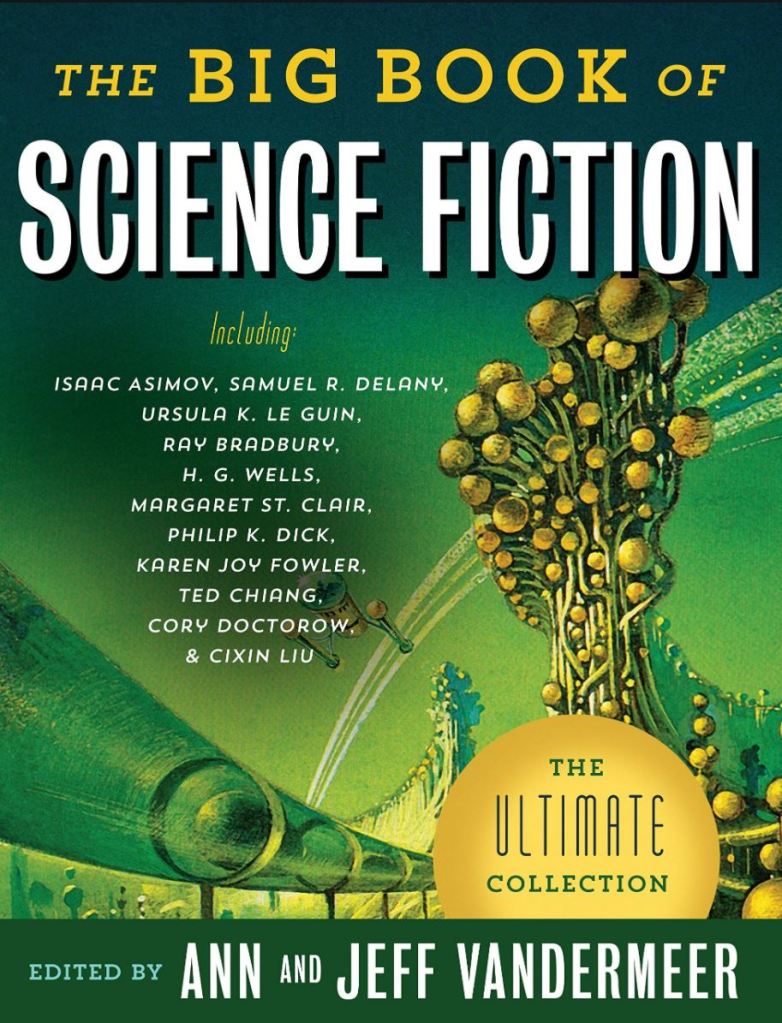
Group Read 27: The Big Book of Science Fiction
Story #35 of 107: “The Waves” by Silvina Ocampo
Silvina Ocampo might be an impressive writer but I couldn’t tell that from reading “The Waves.” Great writing is the accumulation of significant details, and “The Waves” was too vague and ethereal to convey any kind of greatness. To include this story because of Ocampo’s reputation, her gender, her nationality does not extend her literary legacy or expand the significance of science fiction in this anthology.
“The Waves” does imagine a science-fictional future, but it’s hardly a story. It could have been a story, but it hasn’t been fleshed out. There is no real characterization, no drama, no scenes, no settings, no details, it’s all telling and no showing. As it is, it’s just a sketch. Ocampo imagines that science will classify people by their wavelengths and separate two lovers. They falsify documents to be together, and when they are discovered they are separated, one to live on the Earth, and the other exiled to the Moon.
Ocampo imagines science will produce a dystopia and this little sketch is a protest against scientific progress. That’s the heart of many science fiction stories. Since I haven’t read anything else by Ocampo I don’t know her range in storytelling complexity. Is all her work so vague and slight? I remember reading stories like “The Waves” in fiction writing workshops. Those kinds of stories feel like they were written by people who want to be writers who don’t understand the current techniques for writing fiction. If this story was submitted by a 7th grader we would have considered her precocious. If an adult friend had given it to me, I would have been encouraging. But if I was told Jonathan Franzen had written it, I would have thought it was notes for a story he planned to write.
I’m curious now, what is Ocampo’s good stuff like? I could be completely wrong, and “The Waves” is typical of her writing, and its style is reflective of the style she established for herself. If that’s the case, she’s not for me.
James Wallace Harris, 10/25/21
 Classics of Science Fiction
That’s a good, concise review of a type of story that occurs repeatedly in the field. PS “slight” not “sleight”.
Sent from my iPad
>
LikeLike
I don’t ever remember knowing the distinction between slight and sleight before — I had to look it up. But then I may have merely forgotten it. Either way, I need all the help I can get. Thanks, Paul. I fixed it above.
LikeLiked by 1 person
Sorry, that was meant to be an email, not a comment—guess I learned something about WordPress!
LikeLike