Realism in Science Fiction

Our Facebook group, Best Science Fiction and Fantasy Short Fiction recently read “Wall of Crystal, Eye of Night” by Algis Budrys, originally published in the December 1961 issue of Galaxy Magazine. We’re group reading Galaxy: Thirty Years of Innovative Science Fiction edited by Frederik Pohl, Martin H. Greenberg, and Joseph D. Olander. Because of this I’ve been thinking about the legacy of Galaxy Magazine, science fiction from the 1950s and how realistically did science fiction fans see the future.

So far “Wall of Crystal, Eye of Night” hasn’t found many admirers in our group, although the anthologist Rich Horton considers it one of his all-time favorite stories. My taste in SF often overlaps with Rich. I found the story to be compelling, thought provoking, not quite a classic, but unbelievably unrealistic.

I’ve read many books about science fiction of the 1940s, which older fans call The Golden Age of Science Fiction. John W. Campbell, Jr. was given most of the credit for this golden age because as editor he discovered and nurtured Heinlein, Asimov, Van Vogt, Hubbard, and many other SF writers that became famous in the genre when Baby Boomers were growing up. Many young SF writers and readers today are rebelling against that era of science fiction, but I think even by the end of the 1940s the writers and readers of the day were also ready to change, and that’s why F&SF (1949) and Galaxy (1950) quickly became popular magazines. And I’ve been told by many readers of my Baby Boom generation that they considered the 1950s to be the real Golden Age of Science Fiction. Did science fiction become more realistic in that decade?

Even though “Wall of Crystal, Eye of Night” came out at the end of 1961, I’m considering it a reflection of 1950s science fiction. Like the two classic stories from 1950, “Scanners Live in Vain” by Cordwainer Smith and “Coming Attraction” by Fritz Leiber, they mark a new beginning by reacting to the previous decade.

I have written elsewhere that I felt 1940s science fiction could be characterized by a yearning for transcendence. Campbell, Heinlein, and others expected mankind to evolve in the future, gaining mental and psychic powers that would help them conquer the galaxy. Reading “Wall of Crystal, Eye of Night” provided a kind of epiphany for me. It was wild, full of vitality, but ultimately discomforting because its lack of realism. Handling the fantastic in the same way superhero comic books handle reality. Is that the real legacy of 1950s SF?

Fiction has always had a strange relationship with reality and realism. I suppose we could say fiction has different levels of realism. By the way, I don’t mean to imply any artistic criticism to these various levels – at least for now.

  • Level 1 – Greek myths, superhero comic books, Bible stories, talking animal stories
  • Level 2 – Young adult or adult fantasy, science fiction
  • Level 3 – Science fiction that tries to be scientific
  • Level 4 – Most mundane genre fiction
  • Level 5 – Serious literature that’s mimetic

Unfortunately, much of science fiction swings the needle towards Level 1 rather than towards Level 5, even though science is in its label. “Wall of Crystal, Eye of Night” slams the needle over to 1 on the gauge. Is this good or bad? The story is fun. It’s a thrill ride. Should we even worry about it’s over-the-top fantastic elements?

I should warn you, I read “Wall of Crystal, Eye of Night” just after reading “The Boys Is the End of the Superhero As We Know It. And it’s about time.” That essay begins with “After two seasons of The Boys, I can say with roughly 85 percent confidence that Dr. Fredric Wertham was right.” I’ve got to admit that my confidence level is even higher, but then I’m prejudice against superhero comics. If you don’t know who Fredric Wertham is, read this. For most of my life I’ve had to accept the studies that say fiction, especially violent fiction, has no impact on the development of children, even though I find such results hard to believe. However, the years 2016-2020 makes me strongly wonder if Fredric Wertham wasn’t right all along. But I go further than Wertham, and wonder if science fiction and fantasy is dangerous too.

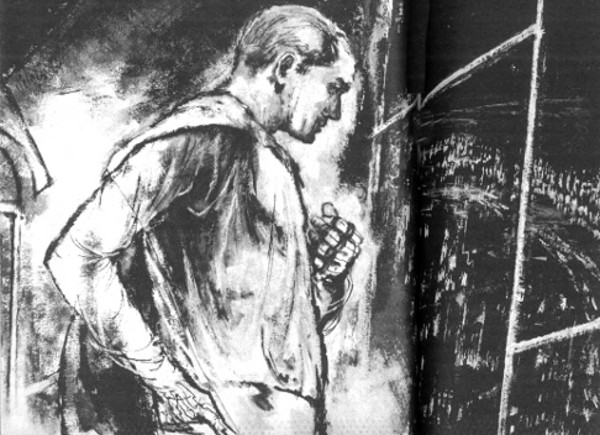
“Wall of Crystal, Eye of Night” opens in the skyscraper office of Rufus Sollenar, a entertainment business titan. He’s looking out a floor to ceiling window contemplating his success in life. He believes his new product, EmpaVid, will dominate the market and guarantee success and riches for the rest of his life. EmpaVid is a television system that manipulates the emotions of the viewers. Sollenar expects EmpaVid patents to allow him to dominate the entertainment industry.

Sollenar wears utilijem rings that allows him to operate everything in his office with a wave of his hand. Budrys describes the scene quite dramatically, with Sollenar conducting the machines of his office with simple hand gestures, like a magical superpower. Still, it’s technology, making the story science fiction. Sollenar is smug and feels like he dominates the world when looking out his window down on the city.

Eventually, a Mr. Ermine forces is way into Sollenar’s office. An ermine is a weasel, and even Mr. Ermine dresses in rust colored garments, the color of a weasel. This is rather obvious, too much like a comic book villain. Galaxy Magazine was aimed at adults, and from what Budrys says in his memoir of working there, Horace Gold wanted it to be read by a wider audience than just the average young science fiction fan. I feel this aspect of the story counters that goal. But maybe I’m being too harsh.

Mr. Ermine is from the IAB, the International Association of Broadcasters. At first you think of him as a toady but eventually we learn he’s far more powerful, like an enforcer for the mob. Over the course of the story the IAB becomes more sinister, and suggesting Budrys wants us to believe it’s a secret cabal that manipulates the entertainment business, and will go to any length to get what they want. Again, this is painting reality with comic book strokes. People who love conspiracies will love this aspect of the tale.

After some heavy-handed info-dumping we get down to the conflict of the story. Mr. Ermine tells Sollenar that Cortwright Burr, a competitor, has gone to Mars and had the Martian engineers make him a device. The implication being that the Sollenar corporation and IAB are threatened.

We next see Sollenar acting like Spiderman climbing on Cortwright Burr’s corporate skyscraper. We are given some razzle-dazzle about the machinery that allows Sollenar to do this, but once again the story falls into comic book mode. There were many SF stories in the 1950s and 1960s about titans of industry at war with one another. Alfred Bester aided his characters in The Demolished Man with psychic powers, and Philip K. Dick wrote many stories of business power figures battling with reality-bending drugs and technology. The most famous novel of this sub-type was The Space Merchants by Pohl and Kornbluth, first serialized in Galaxy.

In the early 1950s there were dozens of science fiction magazines on the market, and hordes of prolific writers to fill their pages. Business in America was booming, and like the ambitious said to one another, “The sky’s is the limit,” meaning nothing is impossible. Often it feels like these science fiction writers also felt there were no limits, and SF readers will believe anything. This is why critics of the genre claimed science fiction was for gullible young males. But on the other hand, the stories had an excitement and energy that fans loved.

Reading “Wall of Crystal, Eye of Night” both annoyed and excited me. I’m torn by admiring Budrys flamboyant imagination and insulted that he thinks so little of my intelligence.

Sollenar enters Burr’s office like Neo in a scene from The Matrix, diving through a window with his pistol aimed, hitting the ground, and popping up. Sollenar fires and hits Burr with a blast of energy from his gun, throwing Burr’s body against the wall. Burr had been holding a golden ball when shot and had yelled a command at it just before he was hit. Burr, now a sack of broken bloody bones holds the sphere up and Sollenar blasts him again. Burr drops the ball and Sollenar goes after it but sees that Burr is still animated even though his face is blown away. Sollenar shoots him again. He then gathers up the ball, but seeing Burr still moving fires all his remaining charges into the body. Sollenar is so freaked out he leaves the ball. He then climbs out the window and gets into his spiderman suit, but sees Burr still trying to come after him.

Why didn’t Burr die. How could his body be so destroyed yet still move? Later Sollenar is back at his building with his girlfriend on the balcony, and the body of Burr shows up climbing the outside of the building. WTF? Sollenar crushes the gripping hand on the rim of the outside wall, and the body falls down to crash below.

This is like some supernatural horror film, or an EC Comic. It reminds me of the Marvel films of today, and why I don’t like them. I hate films that show extreme violence with the reality of The Three Stooges or Wile E. Coyote. But I keep reading. How can Budrys explain this to me?

The next scene has Sollenar going to the TTV Executives’ Costume Ball. Guess what, Curt Burr is there, dressed as a gallows bird. Not only does Budrys go for obvious symbolism, but he just flat out tells us. And guess how Sollenar is costumed? As a Medici. Is this story supposed to be a comedy? Is this story supposed to be a mad parody of the genre like the first version of Casino Royale made fun of James Bond movies? Have I been taking it too seriously, when it was meant to be a gag all along?

One reason I can’t stand superhero comics and movies is I can’t buy into their reality, I can’t suspend my disbelief to accept their obviously unreal premises. Is Budrys trying to get his readers to believe his story or is he satirizing the genre? Galaxy Magazine was known for its satire and human. Am I taking things to literal? Sarcasm often flies over my head, and satire often just seems stupid. Is Budrys secretly sneering at his reader?
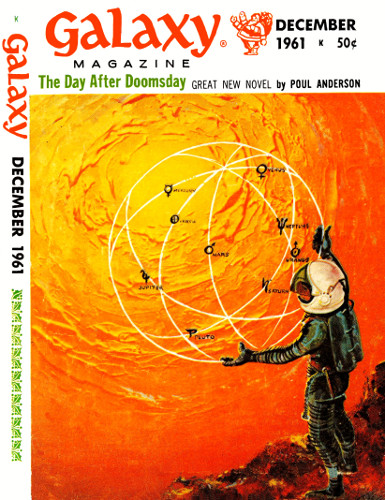
If “Wall of Crystal, Eye of Night” was filmed it would look a Marvel film. Do fans of such film see them as satire? What are they poking fun of?

Sollenar now accuses Burr of buying immortality from the Martians. But what a horrifying kind of immortality, becoming a walking bag of broken bones and torn up flesh that can’t die.
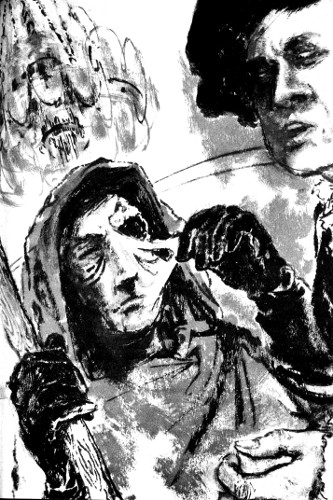
Ermine now returns, also in costume, one which no one would take him for a man. Ermine even proves how inhuman he is, by showing Sollenar he has no feelings from his nerves. He feels no pain.

Sollenar learns that he must succeed or IAB will kill him. He takes a rocket to Mars. The trip must have lasted no more than what jet plane takes to get to a nearby city. More unreality. More comic book realism. And I should say, the realism level of Star Wars.

Sollenar violently ditches Ermine on Mars and heads out to find the Martian engineers. I did like the whole description of Mars, both the human and Martian cities and the Martians. Maybe that’s because I’ve always been a sucker for stories about Mars.

Sollener bargains to buy immortality like Burr, but it turns out Martians don’t have immortality to sell. What the Martians are selling is an illusion machine. It can make the irrational rational.

Now this would be hilarious if Budrys intended all along to make this a recursive science fiction story, poking fun at the genre. Judith Merril did that “The Deep Down Dragon” another story in the Galaxy anthology. But am I seeing SF humor too often? I get the feeling Budrys does want us to believe this wild adventure story just like Philip K. Dick often used techniques in his serious stories by having his characters confused by reality. I think, but not sure, that Budrys is pulling a PKD here. In a way, Cort Burr prefigures Palmer Eldritch. So maybe PKD 1960’s work was inspired by Budrys?

If I read this story right, Cort Burr was never shot. Sollenar just believed he was. And to escape Ermine who is waiting to shoot him, he buys a Martian machine to give Ermine the illusion that his nerves function again, and that he killed and buried Sollenar.

Ultimately, this is a fun story, even though it mainly works at Level 1 reality. And as long as we accept it as creative fun there is no harm in playing make believe. But we still have to consider the article about the danger of superhero stories. Has generations absorbing anti-reality fiction from comics, science fiction, television, movies, video games affected them? Would society be saner and wiser if its citizens only consumed Level 4 and Level 5 fiction?

Contemplate all the news stories you’ve encountered in 2020. Too much of it feels like people are trying to live Level 1 reality as being real. Think about those men who planned to kidnap a governor believing they were freedom fighters. Think about Qanon believers. Think about all the crap stories people believe today. Did science fiction contribute to the current climate of anti-science? We aren’t living in a satire although it sure feels like one. And that’s painful!

Does consuming Level 1 fiction create a Level 1 society? We can claim Bible stories and Greek mythology proves we’ve been consuming such fiction for thousands of years. Would going cold turkey on such fiction help? Or do we consume Level 1 fiction because the average human can only comprehend reality with Level 1 thinking?

This is a lot of philosophical navel gazing to get from one minor SF story from 1961. But, I’ve got nothing better to do. It is 2020, you know.

Additional Reading

James Wallace Harris, 10/12/20

My Changing Attitudes Towards Science Fiction Over a Lifetime

“The Gift” by Ray Bradbury – illustration Esquire Magazine, Dec. 1952

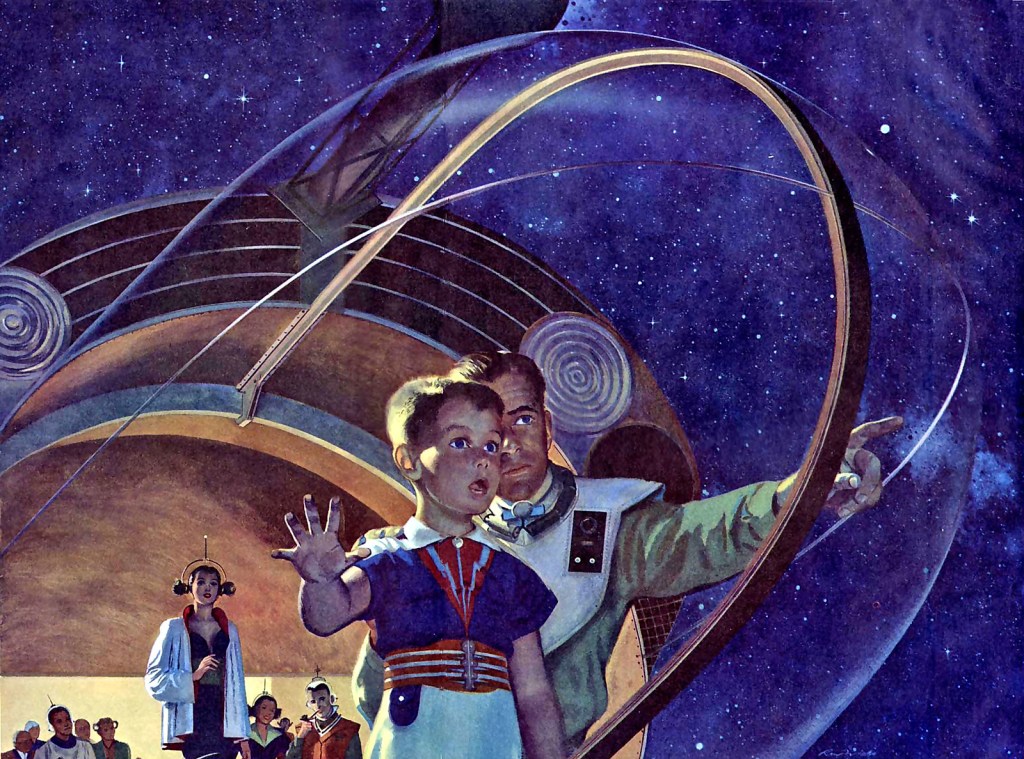
When I was young, science fiction was all about sense of wonder. This was back in the late 1950s and early 1960s. I didn’t even know the phrase science fiction – I was just mesmerized by the images of rockets and space travel. Science fiction was rare shows I’d stumbleupon on television. We think we can remember what it’s like to be a child, but we can’t because we have a lifetime of words and concepts that children don’t have. Remember when you thought you could fly?

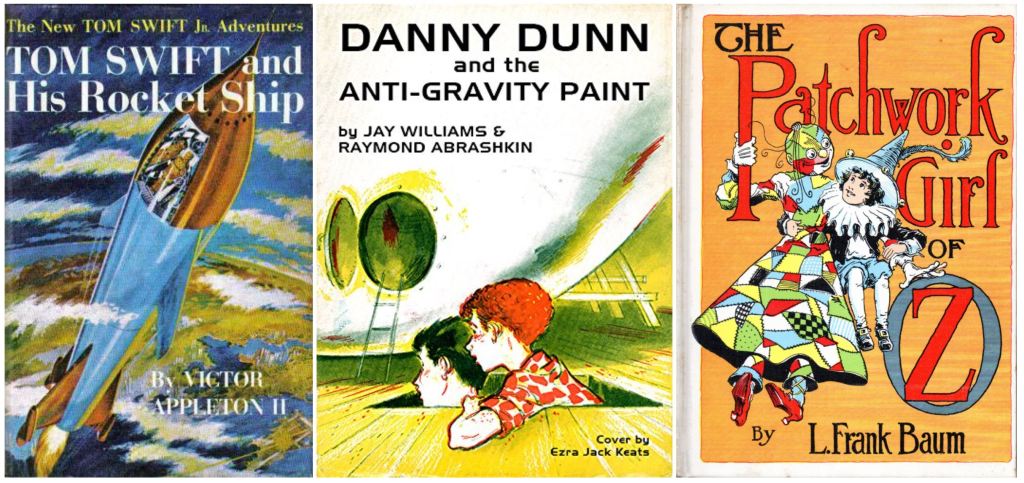
Then in 1961, when I was in the fifth grade I discovered Tom Swift Jr., Danny Dunn, and Oz books. This was just after the first Project Mercury mission. I also found nonfiction books about planes, rockets, and space, all at the Homestead Air Force Base Library. I knew more then, but didn’t really understand the concept of science. I recently read “People Soup” by Alan Arkin (yes, that Alan Arkin) in which he perfectly captured the attitude of ten-year-olds have towards science. Science and technology was magic that was real, and at ten I had unlimited faith in what science could do. So did Bob and Bonnie in Arkin’s story.

I’m not sure how aware of the world I was at age ten. I assume my vocabulary had grown since the late 1950s but was still quite small, and without the words to anchor ideas I’m not sure how much I could have understood conceptually about the science fiction I was consuming. Like I said, I didn’t even know that the fictional books, TV shows, and movies were even categorized by genre labels. Probably my awe and wonder was akin to ancient Greek children listening to the adventures of gods and goddesses. Isn’t it tragic that we believe the strongest in the fantasies we first encountered as children?

Then in the fall of 1964 I had an English teacher who gave me a recommended reading list. I was also taking science and math classes, and I loved reading popular science books. Still, I’m not sure how well I understood the concepts of science. That reading list included the writer Robert A. Heinlein, and I found his book Red Planet. I loved that novel and it inspired me to read astronomy books, especially books about Mars. It was then I knew I wanted to go to Mars in the same way Kip Russell wanted to go to the Moon in Have Space Suit-Will Travel.

By now I was in the eighth grade and my school was preparing us to think about the future of jobs, careers, and colleges. I knew immediately I wanted to become an astronaut. Within a year I had read most of what Heinlein had written, and his books were often inspirational about ambition, studying science, and space exploration. Then I read a career guide which gave the requirements for different kinds of jobs. I learned that astronauts needed 20-20 vision. I was devastated because I was a four-eyed nerd. After that I gave up considering careers and became a hedonist. I wished I had discovered computers back then, which is what I eventually got into. For the rest of junior and senior high I had to attend school, but I only applied myself at having fun – mostly reading science fiction and listening to rock and roll music. I did dabble in girls and drugs, but lacked talent to really pursue them properly.

For many years I just coasted. My parents were alcoholics and my family went through a long period of painful times. I used science fiction to ignore real life. Science fiction actually made me happy in a time when I should have been miserable. I’m quite thankful for that. Science fiction was a kind of virtual reality, one in which I escaped.

Then in the twelfth grade (1968/69) I took a creative writing course. I thought maybe I could become a professional science fiction writer. I wanted to be a prophet of space exploration, evening knowing I’d be like Moses and never reach the promised land. At the time I really thought the purpose of science fiction was to promote manned space travel. By then Star Trek mania had arrived and it seem to legitimize the idea that the final frontier was humanity’s destiny. Well, I believed it. I was quite naive and didn’t realize that the majority of population didn’t. Most SF fans and non-fans knew science fiction was merely entertainment.

I graduated high school just a couple months before the first Moon landing. If asked in the summer of 1969, I would have strongly predicted Americans would be on Mars by the 1980s, and humans would have explored most of the solar system by the year 2000. I hoped some kind of interstellar drive would be discovered and we’d be on to the stars before I died in the middle of the 21st-century. As we know I was as cracked as my crystal ball.

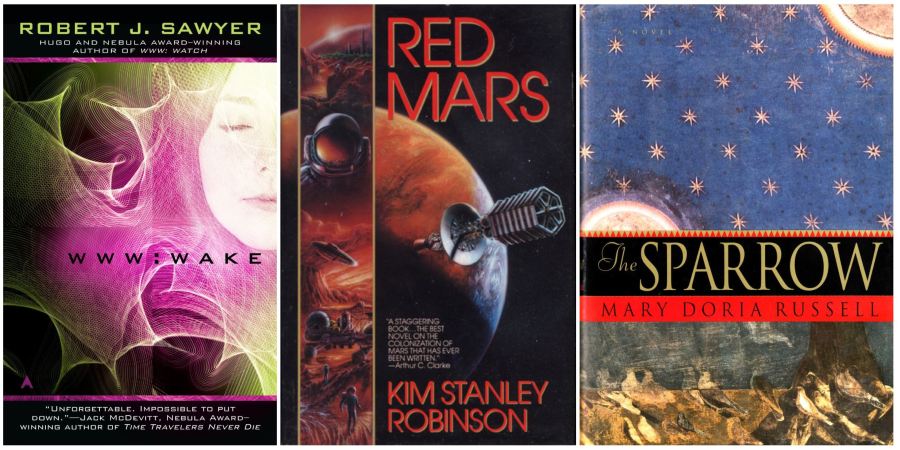
By the end of the 1970s I was married and working at a university that I’d stay at until I retired in 2013. For forty years I waited for us to go to Mars and we never did. Plenty of people wanted to go, but not enough to influence the politics involved. The will of the people never pushed for expanding into space. The high point of this period was Red Mars by Kim Stanley Robinson, and several other science fiction novels that tried to seriously imagine colonizing Mars. Then came Robert Zubrin’s nonfiction books, A Case for Mars. Our society had everything we needed to go to the red planet, we just didn’t want to go. I was a true believer in a religion that most people were atheists.

During the past 55 years I probably read close to two thousand science fiction books. I also read hundreds of popular science books. I slowly grew up and realized that space travel isn’t what I dreamed about as a kid. When I was young I would have sold my soul to become a space explorer. Now, you couldn’t pay me to go. Over the decades I slowly learned I didn’t have the right stuff, and never had. I hate being sick, and most people get space sick. I hate discomfort, and space travel is very uncomfortable. I won’t or can’t push myself to my limits. Even if they had allowed astronauts needing glasses back in the 1960s, I never could have gotten into the program. I’m a dreamer, not a doer.

Even though I came to realize I wasn’t suited for space travel, I still hoped that a branch of humanity would colonize the Moon and Mars, and eventually we’d find a way to the stars. Science fiction was still my religion. I put my faith in science fiction. I loved science fiction books that worked to imagine the full potential of the human race. By then I had given up on fun science fiction. I didn’t like Star Wars because it wasn’t realistic.

In the last ten years I’ve read many essays and books that suggest that human space exploration is probably not practical. To me, the most important science fiction novel of this era was Aurora by Kim Stanley Robinson. Robinson was one of a few science fiction writers who were considering the possibility we would never go to the stars. Oh, we’ll probably go to Mars someday. And we’ll develop bases on the Moon, but interstellar travel is about as likely as time travel. I’ve read many science books since 2000 that have added to the evidence against manned space travel.

If I tell young science fiction fans I don’t think it’s possible to go to the stars they get upset. The dream doesn’t die. Why? There’s something deep in that belief we don’t understand.

It’s not physically impossible to travel between the stars, but it’s just not probable or practical for humans. It might not even be practical for machines. My current science fiction faith is in artificial intelligence. Machines are perfect for space travel, but I’ve even begun to wonder if a superintelligent AI might find the distances too far to cross.

As my beliefs about science fiction grow more skeptical it’s became harder to enjoy science fiction. At least, enjoy it with the same attitude I had growing up. But I have a heavy science fiction habit. I know I need to either give up science fiction or find a new purpose for it.

After I discovered Audible.com in 2002, that purpose was nostalgia. I bought audiobook editions of all the science fiction books I loved reading during the previous forty years. I saw these stories in a new light. I was able to psychologically analyze my younger selves and realize a lifetime of delusional thinking.

I discovered science fiction had never been particularly serious to begin with. Sure, the final frontier true believers read science fiction, but most of them went on to become scientists and engineers. There was never much science to be learned in science fiction. If you really want humanity to explore space you need to become a rocket scientist or politician, not a science fiction fan or writer.

This brought about a new understanding of science fiction. It’s an art form. Sure, a rather minor art form. But I had invested a lifetime of studying this art and it was too late to take up another. My new attitude towards science fiction is studying its history. That makes me sometimes feels like an English major (which I was), and sometimes a scholar of religion or mythology. Other times, it feels like I’m an art historian. Science fiction writers craft stories, and a lot art and creativity goes into that craft.

My new attitude towards science fiction is admiring the craft of inventing science fictional ideas while embedding them into fiction. My reading has shifted away from novels. It just takes too much time to study novels, and there’s are too many SF novels to make a comprehensive study this late in life. I’ve found science fiction short stories to be just the right size to collect and analyze. I can read 300+ short stories a year. I have two bookcases of SF anthologies, mostly the annual best-of-the-year anthologies, but also lots of genre retrospective and theme anthologies. It’s a manageable amount of territory to explore, but I should probably specialize even more.

To get some idea of the scope of this microscopic patch of literary history read Mark R. Kelly’s site on SF anthologies. Now when I read a science fiction story I wonder how and why the author wrote it, and what readers could get out of it. I consider fiction a message in a bottle, from one lonely conscious mind to another. What are we really coding and decoding when we write and read science fiction?

I could live another ten, twenty, or even thirty years, although I tend to believe I’ll have a statistical average length of life. In any event, I might have enough time to change my mind one or more times about science fiction. I don’t think I can give it up. Years ago I saw a television news story about priests and preachers who have lost their faith. Many of them continued on in their jobs because it was too late to retrain. I’ve lost my faith in science fiction, but not my love. To keep that love going requires constantly repurposing my approach to the genre.

JWH

The Time Travelers Who Visit Jesus

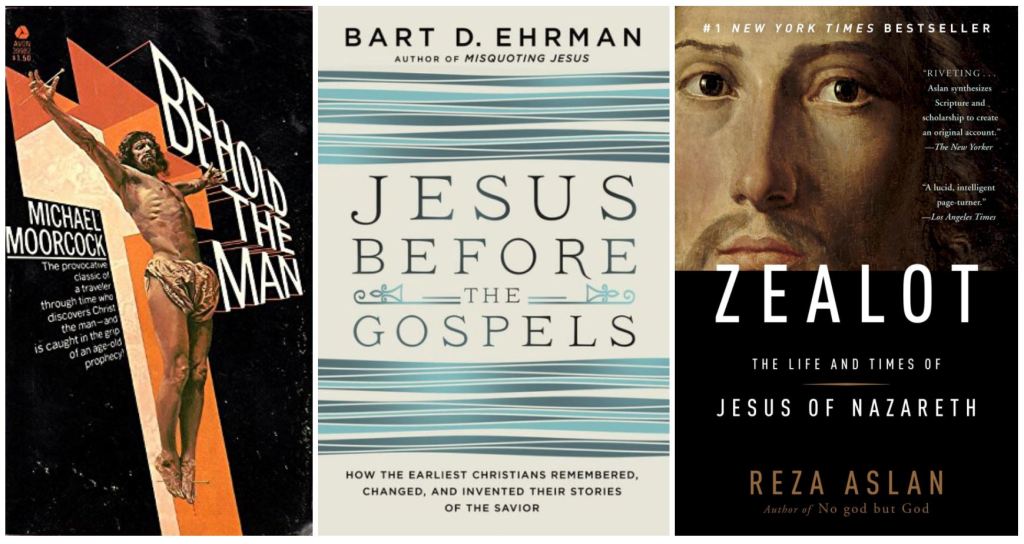
Our Facebook book club has just read the 1966 novella version of “Behold the Man” by Michael Moorcock which has made me wonder about time traveling back to A.D. 29 to find Jesus. Wouldn’t it be marvelous is we could study history with a time machine? Actually, what we really need is a time viewer, which was featured in an earlier story the group read, “E for Effort” by T. L. Sherred. That would eliminate any problem with temporal paradoxes.

Moorcock later expanded his story into a 1969 novel that I hope to read someday. I was impressed with the novella this reading because of how much history Moorcock put into the story. When I first read the novella back in the 1960s I didn’t know that history, but since then I’ve read eight books by Bart D. Ehrman about uncovering the historical Jesus through scholarship and not theology. I’ve also read Zealot by Reza Aslan that uses historical studies about Jesus to create a novel-like narrative of his life. Reading these nonfiction books is about as close as we can come to visiting Jesus with a time machine – and that’s only speculation. But then we have science fiction, which is another kind of speculation, a fun kind.

Between the time “Behold the Man” was published in 1966 and Behold the Man in 1969 another science fiction novel appeared about traveling back in time to visit Jesus, The Last Starship From Earth by John Boyd. This is pretty much a forgotten science fiction novel but one I keep remembering. What’s fascinating about reading these two stories is comparing Moorcock’s and Boyd’s science fictional approach to dealing with Jesus. However, I can’t tell you why without spoiling the story.

I wrote a long review for my personal blog back in 2012 that avoids spoilers up to a point, and then gives a warning not to read after that. I thought I’d just reprint it here. It might encourage people to try both books. I’m also curious how other science fiction writers used Jesus in a time travel tale. Post comments about the ones you’ve read.

Forgotten Science Fiction: The Last Starship From Earth by John Boyd

Every year thousands of SF and fantasy books get published, but few are reviewed, not many more become popular, and damn few get remembered.  Ten years out, most books are out-of-print and forgotten.  How many books can you remember from 2002?  And if we’re talking fifty years down the timeline, well it’s almost a miracle for a book that old to still be read, much less remembered and loved.

I discovered science fiction in the 1960s, in my teens, and like most people reading their first hundred SF titles, they all seemed so damn far out!  Now decades later, I doubt my memories of those first impressions.  So, when I have a little extra reading time, I order a book from ABE Books based on those dying memories and reread it.  I’ve now reread many of my teenage classics and a majority of them don’t hold up.

Most memories are fleeting, and my memory of The Last Starship From Earth was next to nothing.  All I remembered was a favorable impact.  Just a lingering sense of it being a standout read for 1968 or 1969.  To test that memory I recently bought and reread The Last Starship From Earth.  Sad to say, it was a discard from the Columbus Public Library, a common practice for books that don’t get checked out.  Not a good sign.  The last English reprint of this novel was in 1978.  It’s last edition was in French, in 1995.

The-Last-Starship-From-Earth-by-John-Boyd

The Review

The Last Starship From Earth is a dystopian novel set in 1968 and 1969, but not the 1968 and 1969 that I remember, or lived through.  In the world of this story, Jesus did not die on the cross, but was killed leading an assault on Rome.  He was the Messiah that people expected.  The government of John Boyd’s world is a global government run by Christians along “scientific” lines, where psychologists and sociologists in conjunction with the Church and an AI Pope rule the world.  People marry and mate because of their genes, sort of like the film Gattaca, and the hero of our story is Haldane IV, M-5, 138270, 3/10/46, a math student of great promise, being the fourth in line of great mathematicians.  Unfortunately Haldane gets the hots for Helix, a mere poet.  By law and social custom Haldane is expected to have nothing to do with her, but as you’d expect he falls in love with her.

Haldane concocts a ruse to justify more meetings with Helix by studying Fairweather I, a 19th century mathematician who also wrote poetry.  Much of the first half of the book deals with pseudo-academic studies from this alternate history.  Boyd is creative in his steady flow of ideas and concepts, but there’s little emotion in the story.  It’s somewhat Heinlein-esque, in it’s attitude and world building, but lacks the charm of Heinlein’s best prose.

Now, this quick summary is enticing, and I would like to report that The Last Starship From Earth is a forgotten classic, unfortunately, that’s probably not true.  I enjoyed the book, but only as a quick read.

Surfing the web I’ve found few other reviews of this novel, and although I’ve found people who claim it’s their favorite book, I also found people that thought it ho-hum.  Now, I’ve got to admit it has a humdinger of an ending, almost as startling as the film The Sixth Sense, but I’m not sure this last minute thrill pays for the reading the whole book.

I found the love affair of Haldane and Helix no more believable than Romeo and Juliet and far less exciting.  John Boyd does write well, but the plot is mostly intellectual, about the dystopian society, and its complications.  The book is only 182 pages, and the whole tale feels rushed.  Boyd staked out a solid gold claim but never mined it.

Analysis with Spoilers

The trouble with many SF novels, especially those written back in the 1950s and 1960s, was they were written very fast, and they were about ideas and not characters.  John Boyd has actually written a very ambitious novel by creating an alternative history of Jesus, but he never fleshes it out, and most of the story is a setup for the surprised ending.  The scope of the book is epic, the line by line writing reasonably entertaining, but the overall feel of the book is thin.

Haldane and Helix are discovered, and the middle part of the book is a trial that allows Boyd to work out the politics and legal system of this alternative reality, however, like the rest of this book, it’s rushed.  It’s padding.  That’s its downfall.  He has a big ending but it’s way bigger than the story.  To pad the story even more Haldane is sentence to exile on Pluto, which is called Hell.  There he meets Fairweather I and is reunited with Helix, who happens to be Fairweather’s granddaughter.  Fairweather needed a mathematician for his time machine, and Helix was sent to Earth to engineer the exile of a mathematician to pilot an experimental time machine.  In a very short time Fairweather makes Haldane immortal, tells him his new name is Judas Iscariot, and his mission is to go back in time to kill Christ.

Now if Boyd had spent a couple hundred pages recreating the Biblical world and shown how Haldane tracks down Jesus, we would have had a much better story.  But all of this was summed up in a short epilogue.  We are told Haldane captures Jesus and puts him in the time machine and sends him back, and the rest of the epilogue is about how he has relived the two thousand years to return to his own time and meet a girl that’s an awful lot like Helix, living in a future that’s much more like ours.  But did Haldane let Jesus die on the cross, or does he just disappear him from history?  Unless Haldane at least engineers a dying on the cross scene for history, we should not expect this timeline to be ours.

How do you plot a riveting novel with great characters based on the idea that Jesus didn’t die on the cross and the world became very different?  How do you tell the story twice?  Boyd really grabs a tiger by the tail and yells, “Look at me!”  And I think, “Cool!  Far out man!  But what are you going to do with him?”  He’s got to do more than just swing it around.  I’ll give Boyd a solid C for his world building, but they are only tantalizing sketches.

I really like this ending, but is it good enough to make The Last Starship From Earth a classic SF novel worth reading today?  I’ve linked several references to this book on the net and even though I can find fans of the book, I can find more people who think it sucks.  You’d think  Boyd Bradfield Upchurch, John Boyd’s real name, if he’s still alive, would arrange for his books to be reprinted as ebooks.  That certainly would make it easier for more readers to decide if The Last Starship From Earth is worth reading.

I’m afraid Boyd falls far short of classic standing.  The Last Starship from Earth is a good novel for science fiction historians to read, but it needed to be four or five times longer, more the size of Dune, to get the job done that Boyd outlined.  However, I’m not sure how he could have pulled off this big ambitious idea.

And is Boyd saying our history is the better timeline?  Why is his first timeline all that evil?  Is the freedom to fuck whoever you want the perfect ideal worth rewriting all of history?  Isn’t the more interesting story about a world where the promise of salvation and eternal life never happened?  Isn’t Boyd’s surprise ending really a cheat?

Time travel machines often ruins more stories than they’ve ever help.

Boyd has a three part story.  Life on Earth in an alternate timeline, life on Pluto, life on Earth in another timeline.  The story really isn’t about genetic breeding of humans like we see in Gattaca, or in Heinlein’s Beyond This Horizon or Huxley’s Brave New World.  It’s about an oppressive government.  But does it deserve to be wiped out by time travel?

Here’s the thing, our 1968 was a horrible time for America, but should we send a man back in time to wipe it out?  Boyd wasn’t writing a protest novel like Nineteen Eighty-Four.  Nor did he write a novel that truly explored a timeline with a different Christ, which would have been ambitious enough.

Would The Last Starship From Earth been a better novel is it hadn’t used the time machine gimmick?  Not as it stands, but it potentially could have been.  I believe it’s a grave mistake for any alternate history novel is have a do-over.  Time travel is really a very dangerous concept to use in fiction.  Time travel is very hard to pull off.  The beauty of an alternative history novel is the alternative history.  Don’t add time travel.  This would take away Boyd’s surprise ending, but it would have meant he would have been forced to write a better novel.

I felt cheated when Helix shows up so easily on Pluto, in what at first appears to be a happy romantic ending, but then we’re thrown for another loop.  Haldane loses her again, only to find her again 2,000 years later.  Oh come on man, this horny-at-first-sight love isn’t believable.  Weren’t there no math babes for Haldane?  This really is a case of what you can’t have makes the heart grow fonder.  And neither Haldane nor Helix are all that interesting – if you want a great love story you have to have great lovers.

The powerful driving motive in Gattaca is that Vincent wants to go into space.  He wants to prove that he’s as good any genetically selected human.  The driving force of The Last Starship from Earth is Haldane wants to screw Helix.  Boyd doesn’t make it believable why his world outlaws sex, nor does he make it believable that Haldane and Helix are in big time love.  Hell, even the prosecutors of the story wink at him, and say why didn’t you use a condom and just screw her, implying this world does overlooks recreational sex, just not casual genetic mixing.  But then Boyd never explains why his world requires genetic  fidelity to specialties like mathematics and poetry.   In Gattaca we have the justification that their world doesn’t want naturals to pass on bad traits, but in Boyd’s world there is no reason to breed pure bred mathematicians.  Also, how many math geniuses does one world need?

John Boyd wrote just enough alternate history world-building to set up his surprise ending.  In essence The Last Starship From Earth is a O’Henry type story, and we now use those type stories as examples as how not to write a story.  However, The Last Starship From Earth suggests two possible storylines I’d love to read.  First, I’d love to read an alternate history where Christ was the Messiah that everyone was expecting.  Second, I’d love to read a time travel story about people having to learn what it takes to live in ancient Israel and track down Jesus.  Both would require a tremendous knowledge of real history.

JWH –5/28/12

JWH – 9/28/20

Too Much To Read

I have a bad habit of starting too many books. I’m also inspired to write too many essays requiring too much reading to write. And I’m in too many online book clubs. You know that saying, “Your eyes were bigger than your stomach” for eating too much? I wish I could find one for reading too much. Here’s a partial list of books I’m currently in the middle of reading:

  • The Road to Science Fiction: From Gilgamesh to Wells edited by James Gunn
  • Two-Bit Culture: The Paperbacking of America by Kenneth C. Davis
  • New Atlantis: A Narrative History of Scientific Romance by Brian Stableford
  • War and Peace by Leo Tolstoy
  • Ring Around the Sun by Clifford D. Simak
  • New Review Volume XII (January-June 1895) edited by W. E. Henley
  • The Best Science Fiction of the Year #2 (1972) edited by Terry Carr
  • The Great SF Stories 16 (1954) edited by Isaac Asimov and Martin H. Greenberg
  • The Science Fiction Hall of Fame v. 2B edited by Ben Bova
  • The Fifth Head of Cerberus by Gene Wolfe
  • The Celestial Omnibus & The Eternal Moment by E. M. Forster
  • Caste: The Origins of Our Discontent by Isabel Wilkerson
  • The End of Expertise by Tom Nichols

There are more, but these are the books piled up around me just now. Awhile back I made a resolution to only read one book at a time. That lasted a couple of tortured months. My favorite regular activity right now is the Facebook group Best Science Fiction and Fantasy Short Fiction. We read two anthologies concurrently, discussing a new story every couple of days. We’re just about to finish the Carr and Bova anthologies and are voting in two new ones.

I’m reading Ring Around the Sun because of something someone said in the group about Simak. I’ve actually promised to look at a lot more novels, but that’s another story.

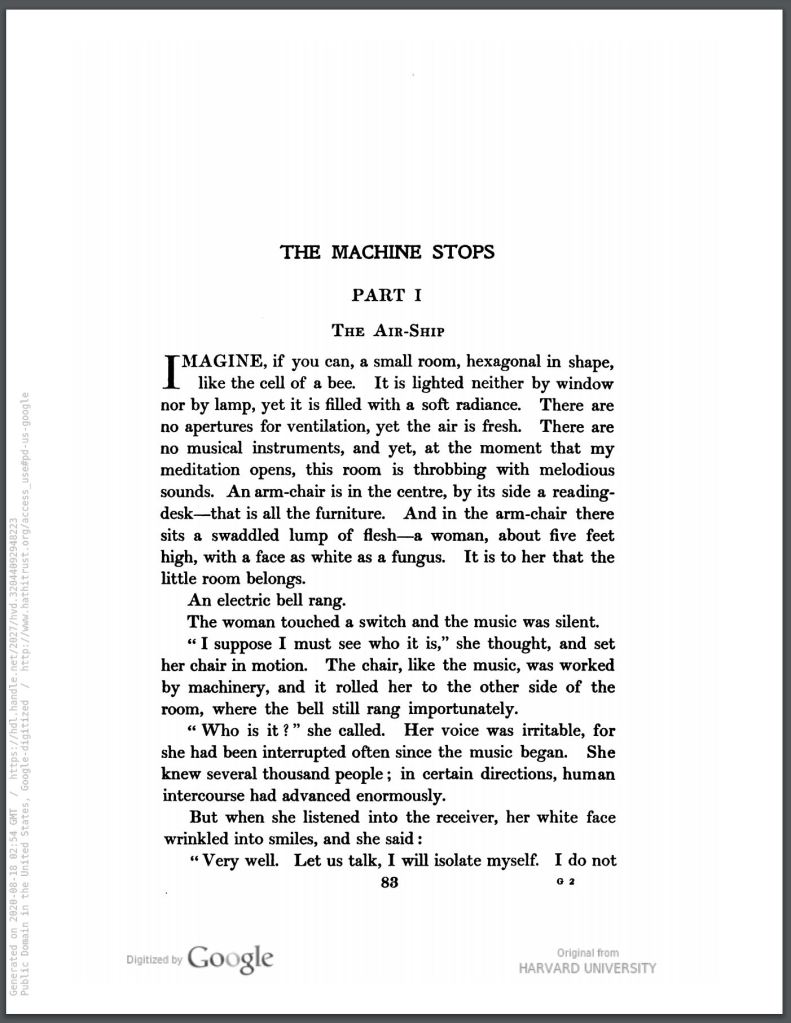
I’m reading the Forster short stories because we read “The Machine Stops” on the group and I got sidetracked wanting to know more about Forster and wondering about his other short stories since “The Machine Stops” was so fantastic.

I’m also reading the bound volume of the New Review because we read “The Time Machine” for the group and I got interested in it’s original publication which I started reading online. The other articles were so fascinating that when I discovered the entire volume was available from India in a leather bound reprint I ordered it.

I’m reading/listening to The Fifth Head of Cerberus because we read the novella in the Carr anthology and I bought the novel version. I’m reading it while listening to an audio version that’s on YouTube.

So this one Facebook group keeps me really busy.

I’m reading The Great SF Stories 16 (1954) on my own because for the last couple years I’ve been slowly reading through the entire 25 volumes that cover 1939-1963. My pace has slowed tremendously since joining the Facebook group.

I’m reading War and Peace because I thought it might be my 2020 classic novel. I try to read one big classic every year. I’m about a third of the way into it. I’ve been reading, and then listening, and also watching TV/movies versions. However, at the rate I’m going it might need to become my 2021 classic read.

I’m reading Caste because of my two-person book club I have with my friend Linda, but it’s going to be doing double duty because my online nonfiction book club just voted to read it next month. It was the first time that all the members voted for the same book among the list of nominees. But then we read Wilkerson’s previous book, The Warmth of Other Suns and all rated it a 10 – that book was one of the best books I’ve read in my lifetime. I believe it still holds the record for being our most highly rated monthly read. For September we’re reading The Death of Expertise.

I’m reading The Road to Science Fiction and New Atlantis because of research I want to do for this blog. Hopefully, the New Review might help in this project too.

Finally, I’m reading Two-Bit Culture because of a comment made by a member of an online discussion group I’m in devoted to pulp magazines. We’ve often discussed theories about why the pulps faded away in the 1950s, and this book was offered as one explanation because it describes the rise of reading paperback books. I always thought the pulps were killed off by television, but Two-Bit Culture makes a great case for paperbacks. (By the way, I do have a history of television in the 1950s started too, but I don’t know where I left it.)

I guess I’ve rationally explained why I’m reading so many books at once, but that doesn’t help me get them finished. It’s obvious while writing this essay that my Facebook group is generating most of my reading. I’m in another online book club, and I’m supposed to be reading A Deepness in the Sky by Vernor Vinge, but I’m not sure if I’m going to get to it. I feel bad that I neglect this book club the most. I can see belonging to three book clubs is what’s keeping me from my old resolution of only reading one book at a time. However, I don’t want to quit those groups.

I just remembered the books on my Kindle, like The Year’s Top Hard Science Fiction Stories 4 edited by Allan Kaster which I was reading and reviewing for this site. I’ve gotten completely sidetrack by that project and need to get back to it. Also, The Year’s Best Science Fiction Vol. 1: The Saga Anthology of Science Fiction 2020 edited by Jonathan Strahan comes out on the 8th and I’ll want to start it too. My Kindle reads would add more to the above list, and so would my Audible account. Damn, I’ve got too many books on my reading stand, Kindle, and iPhone!

The real trend in my reading is short stories. I’ve practically stopped reading novels. I’m reading around 300 short stories a year now, and this is my third year. Mostly it’s been science fiction, but I’m getting the urge to read literary stories too. That’s why I got sidetracked by the Forster collection.

The trouble is I can’t keep this pace up. If I want to really work on my project to find 19th-century science fiction fans, I need to focus. I can’t imagine how writers like Mike Ashley or Brian Stableford can focus on writing books about science fiction history and read all the content needed to write them. (I guess they don’t watch all the TV I do.)

The Tom Nichols’ book about the death of expertise is about how everyone claims to know stuff that few specialists know. I’m trying to write an essay about stuff that Ashley and Stableford are far better equipped to write. To write the essay I want will require doing a lot of research and reading. In other words I need to become an expert. That makes me realize that few people have expertise in anything. I certainly shouldn’t say anything about the endless subjects I talk about because I just don’t read enough.

I realize at this moment, most of my expertise is in reading about science fiction, and my current central interest is science fiction short stories. Since I’m in a Facebook group that also focuses on that topic, I know I’m far from being the expert much less an expert, but it is the subject I know the most about (at the moment). If I really want to become an expert in the history of science fiction short stories I’ll need to do a whole lot more reading. I should exclude reading anything that’s not within the territory I want to master. But that won’t happen.

People who become experts must be capable of amazing feats of reading. Isabel Wilkerson probably read a whole library of books to write Caste.

It’s weird to realize that my reading is leading me towards a very narrow subject – the history of reading science fiction short stories in the 19th century. I was focused on the 1939-1975 range, but if I want to understand where science fiction began I need to expand that back to 1800. That is indeed a lot to read.

It’s interesting that writing this essay help me realize that the pile of books I’m reading is connected by a web of related interests. What formerly seemed to be random reading is actually fairly focused. Maybe I’m not as scattered-brained as I imagined.

James Wallace Harris, 9/4/20

Tracking Down Pre-Fandom Science Fiction Readers

Ever since I’ve been reading 19th-century science fiction I’ve wondered what were the reactions to those stories by readers of the day. The term science fiction applied as a unique category of fiction didn’t exist before Hugo Gernsback began publishing Amazing Stories in 1926, and even then it took a number of years to get the label we have today. At first, Gernsback called the type of stories he wanted for his magazine scientifiction, but within a few years it was changed to science-fiction, and then to science fiction. (See “When Mainstream America Discovered Science Fiction.”)

Before that according to Brian Stableford in his 4-volume New Atlantis: A Narrative History of Scientific Romance, the French called stories like those written by Jules Verne roman scientifique, and the British called stories like those written by H. G. Wells scientific romances. I’ve yet to find what Americans called such stories. It’s doubtful in any country if the reading public thought those kind of stories represented a distinctive branch of literature.

During the 1930s American admirers of the science fiction story in pulp magazines began to communicate via letters, then meeting in person, eventually creating clubs and holding conventions. The first Worldcon was in 1939. Those organized science fiction readers called themselves fans, and collectively called their activities fandom. During the period 1930s-1950s is when the genre of science fiction slowly emerged — finally to be recognized by book publishers who marketed science fiction by that label, and libraries and bookstores began shelving it separately under that term too.

However, the kind of stories we now call science fiction existed well before the label, and I’m sure those stories resonated with a tiny segment of the reading public. How soon did those readers begin to seek out stories we call science fiction? We know this began for sure when Gernsback started publishing them together in a magazine, but when did publishers, editors, and readers recognize there was a type of fiction that wasn’t about what was but what could be? Stableford cites reviewers using the term scientific romances and roman scientifiques but how universal were those labels? Did readers intentionally track down those stories because of those descriptive phrases?

We’ve always had fantasy, but fantasy is fiction about events and places that could never be. When did readers start saying to themselves, “I like those stories about what could happen in the future?” Can I find published accounts of reader reactions to science fiction stories published before 1926. Starting in the 1930s fans of science fiction began publishing amateur magazines they called zines. There are several histories of these, and they do document how readers felt. What I’m looking for is pre-fandom documentation.

My first hunch was to wonder about book clubs. I found, “The evolution of American book clubs: A timeline” by Audra Otto that suggests Americans liked getting together to discuss books and have been for at least four hundred years. The kind of stories we call science fiction didn’t really begin to appear regularly until the 19th-century with tales like Frankenstein (1818) by Mary Shelley and “Rip Van Winkle” (1819) by Washington Irving. Did any reader in those days claim they were a different kind of fiction? When did readers who liked those kind of stories start noticing they were different?

And when did readers start saying to one another “I want to read more stories about traveling in time” or “I want to read more stories about amazing inventions” or “I love stories about traveling to other worlds?” Wouldn’t that be the first seeds science fiction fandom? For example, we know hundreds of Nationalist clubs were formed over Edward Bellamy’s utopian novel Looking Backward. That represents a kind of fandom, and they also had a national magazine. Could other book clubs have formed for fans of Edgar Allan Poe, Jules Verne, Fitz-James O’Brien, Edward Page Mitchell, or H. G. Wells?

What I would like is to find documentation of early interest in science fiction. I have no idea of how to go about it. Fanzines from the 1930s are the documented proof of fandom as we know it, but were there amateur publications before then that dealt with science fiction stories even though they didn’t have a universal label yet for those kinds of stories? There was amateur press associations in the 19th century, but can I find copies their publications online?

Conversations weren’t recorded in the 19th century, so letters and diaries should be the first kinds of lasting evidence. Did Jules Verne get fan letters? Are there any published diaries whose authors secretly wrote about their fondness for stories we’d now call science fiction? When did the letters to the editor columns begin? Did fans of Edgar Allan Poe’s stories ever write to the periodicals where his stories were published? I can’t believe readers of in 1895 couldn’t have been silent after having their minds blown with “The Time Machine” by H. G. Wells.

Here’s my problem. There are vast reservoirs of 19th-century publications out there, even on the net, but I’m not ready to devote the rest of my life to systematically sifting through them to answer this one idle question that keeps intriguing me. First, I’m going to look for books, probably scholarly books, that document science fiction back then. By blogging this essay, I hope readers that might know of books or articles that cover this topic will post a comment.

I’ll use the New Atlantis: A Narrative History of Scientific Romance by Brian Stableford to outline the main works that should have generated reviews and then begin to search for those reviews. Maybe reviews inspired letters to the editor or even counter-reviews or essays. I’ll also see if any of those authors had collected letters, memoirs, autobiographies, or biographies. A lot of this depends on finding periodicals and books online from 1830-1930.

After that I have an anthology The Rivals of H. G. Wells that collected short stories similar to H. G. Wells published in magazines from late 1800s to early 1900s. If I can find scans of those magazines online, I’m going to see if I can find any reader responses in later issues. I’ll also use the list of stories I generated for my essay “19th Century Science Fiction Short Stories” as starting points for similar research.

This will be a long term project. It’s doubtful I’ll find much evidence, but I’ll keep a subprogram running in the back of my head to interrupt me for when I do. And if anyone reading this finds any, please post a comment.

James Wallace Harris, 8/24/20

Update: 8/24/20SFFAudio pointed me to Vril, a concept in a science fiction like novel The Coming Race (1871) by Edward Bulwer-Lytton that led to legions of fans, mostly occult, and its implications in novels and works of occult beliefs. This inspired some science fiction writers, even Heinlein had his occult moments. I’m thinking both the Bellamy and Bulwer-Lytton followers and their organized activities might have been precursors to 20th-century fandom.

When Did E. M. Forster’s “The Machine Stops” Become Science Fiction?

In 1909 E. M. Forster’s story “The Machine Stops” was published in the November issue of The Oxford and Cambridge Review. It is a dystopian tale about a future society run by a machine. Forster was replying to H. G. Wells novel, A Modern Utopia serialized in the Fortnightly Review in 1904 and 1905. Neither writer thought they were writing science fiction because, first, the term did not yet exist, and second, because Wells was promoting scientific socialism and Forster was protesting it. However, both stories had all the trappings of science fiction.

A Modern Utopia is seldom remembered by science fiction fans, but “The Machine Stops” is considered one of the classics of the genre, and often reprinted in retrospective anthologies of science fiction short stories. When did science fiction fans first discover “The Machine Stops” and claim it for the science fiction genre? And did E. M. Forster who lived until 1970 ever know this?

Many within the genre consider science fiction originating with Hugo Gernsback’s Amazing Stories, first published in April 1926. Gernsback first called these stories scientifiction, but within a few years coined the term science fiction. That term “science fiction” didn’t become widely known outside of the genre until the late 1940s and early 1950s. See my essay, “When Mainstream America Discovered Science Fiction.”

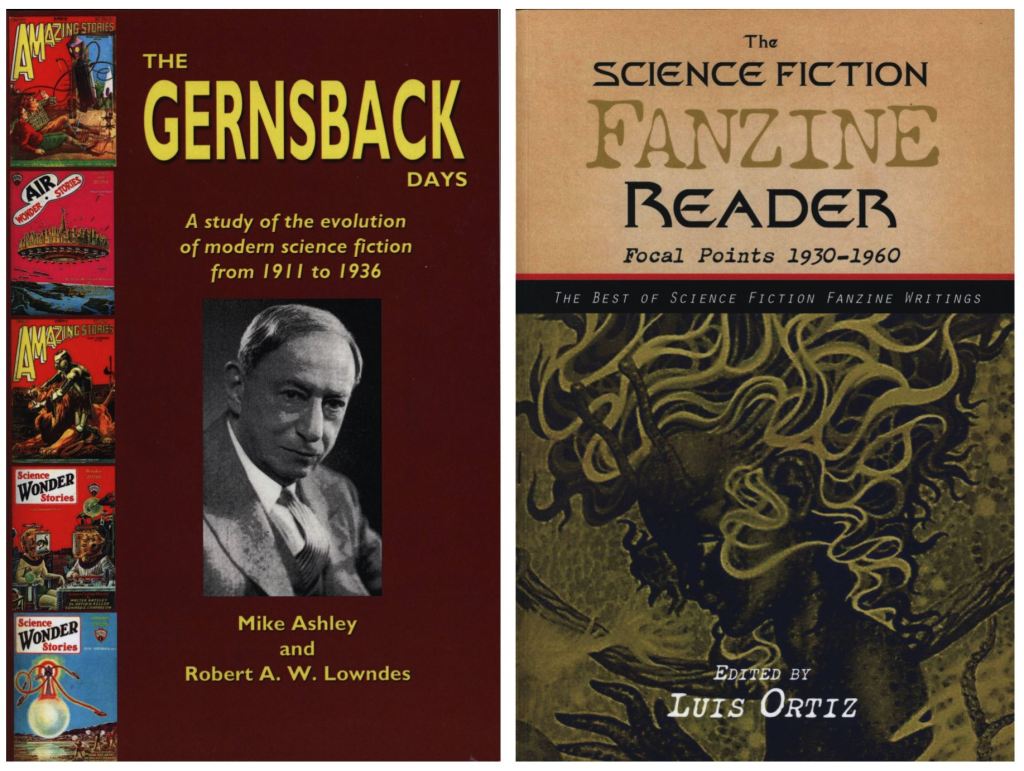
Hugo Gernsback is also credited with creating science fiction fandom by encouraging readers of the stories in his magazines to communicate in his letter column. Eventually, he organized the Science Fiction League in the April, 1934 issue of Wonder Stories. Throughout the 1930s and 1940s science fiction developed as a genre, and readers began calling themselves fans and developed a subculture they called fandom. You can read more about both in these two wonderful books.

However, what do you call stories that use the techniques and themes of science fiction published before Gernsback? What do you call readers who loved these kinds of stories before fandom? Science fiction has always been written by writers who work outside of the genre – before and after it was established. And there were readers before the genre existed that loved stories we now call science fiction.

Science fiction has been laying claim to these proto-SF stories for decades. Gernsback had to reprint Poe, Verne, and Wells in the early issues of Amazing Stories because he didn’t have enough new science fiction to start his magazine. Interestingly, he didn’t reprint “The Machine Stops.” Nor did any of the other pulps that eventually began reprinting classic fantasy and science fiction.

When I reread “The Machine Stops” for a Facebook group that discusses science fiction short stories, I noticed something interesting. Forster describes a future where humans have withdrawn from the surface of the Earth, but automatic aerodromes run by the machine keep the flying machines going on their old routes. This was very reminiscence of “Twilight” by John W. Campbell, Jr., where a time traveler visits a far future Earth and the people have abandoned cities that still function by automatic machinery, including air fields. This made me wonder if Campbell had read Forster’s story. It also made me wonder just when did science fiction fans discovered “The Machine Stops.”

The internet is a wonderful tool for doing such research. We know that “The Machine Stops” was originally published in a 1909 journal. I quickly found out it was reprinted in a collection of E. M. Forster’s stories called The Eternal Moment and Other Stories in 1928. “Twilight” was first published in 1934, so theoretically Campbell could have read it. However, I can find no evidence that he had, nor could any of my online chums who were helping me.

Then, when did fandom discover “The Machine Stops” and begin calling it science fiction? There is a wonderful tool called the Internet Science Fiction Database (ISFDB.org) that indexes all it can about published science fiction. It’s entry for “The Machine Stops” is quite revealing, giving a listing of all the times it was reprinted in works related to science fiction.

The first SF anthology that reprinted “The Machine Stops” is The Science Fiction Galaxy edited by Groff Conklin in 1950, and it just so happens I have a copy. It’s a tiny hardback the size of a paperback. Conklin was an early anthologist of science fiction, assembling over forty of them. And there is a clue here to our mystery. In his first three large anthologies most of the stories he collected were from the science fiction pulp magazines. In The Science Fiction Galaxy he begins with three stories that existed before the genre emerged, “The Machine Stops” (1909) and “As Easy as A. B. C.” (1912) by Rudyard Kipling, and “The Derelict” (1912) by William Hope Hodgson. In his previous anthology he had found two pre-genre stories. (Joshua Glenn in recent times has done extensive discovery of stories from this era which he calls Radium Age Science Fiction.)

Conklin never searched hard for these older stories, but other antologists did. See my essay “19th Century Science Fiction Short Stories.” There were plenty of stories published before science fiction was known as a genre that could be called science fiction. I’ve often wondered about the readers who read them. It’s one thing to get a sense of wonder from science fiction in the 20th century, because we had rockets, robots, and atomic bombs to validate our genre’s tales, but can you imagine what readers in the 19th and early 20th century felt when reading their version of science fiction stories?

Scholars have tracked down these old stories, but I’ve never read anything about the readers. I’d love to know the reactions. Did they ever write letters to the editors, or reviews, or even include their thoughts in memoirs and diaries? I can’t find them.

Had science fiction fans discovered “The Machine Stops” before Groff Conklin in 1950? That’s harder to track down but I’ve gotten some help from chums on the net. I believe the trail begins with The Eternal Moment and Other Stories published in 1928. One of those chums named Bill, found these reviews for me:

From an unsigned 13 May 1928 review in the Hartford Courant of The Eternal Moment:
"Here are six strange and striking tales by Mr. Forster, one of the most individual and distinguished of contemporary British novelists . . . "The Machine Stops," which opens the volume, is one of those prophetic fantasies belonging roughly in the same class with certain well-known stories of H. G. Wells. "The Machine Stops" is a ghastly conception, its period set at some immeasurably distant point in an assumed future, when the human race dwells in underground shelters and individuals very seldom see one another; horrible, fantastic and sinister as this story is, it simply follows out, at least along certain lines, the prophecies lately revealed to us in the blinding flash-lights of the Today and Tomorrow Series, and we have already, now in our own existent daily life, attained to some of the wonders which form the abhorrent commonplaces of life in Mr. Forster's fantasy. It may be noted that the fantasy is essential and bitter satire, and that "the machine" does not satisfy every man."
Frank Weir, reviewing in the Decatur IL Daily Review, 8 Jun 1928:
" "The Machine Stops" tells the story of a world inside the earth. Life is controlled by a machine. Forster turns ironical as he presents his travesty on what may be the final result of an age entirely dependent on mechanical genius. Fine writing around an exceptional idea marks this tale as a gem."
John F. Geis in The Brooklyn NY Times Union, 3 Jun 1928:
" "The Machine," which begins the book, is acknowledged an output of two decades ago and portrays the millennium of the electrical age even to the mechanical doctor, but doesn't it sound a bit as though it might be a travesty on birth control? At any rate, the machine, like man, is fallible, and only God reigns omnipotent."

None of those quotes suggest the story is science fiction, but then it was 1928 and the term didn’t really exist. But none of those quotes suggests the story is a different kind of story, or something experimental, or a unique kind of fiction in any way. However, sometime between 1928 and 1950 science fiction fans began to recognize this story as part of their genre.

There are a number of sites that preserve old fanzines digitally, including fanac.org, efanzines.com, and fiawol.org.uk. I’ve discovered that .pdf files at these sites that have been OCRed are indexed in Google. And I’ve also learned that some fanzines are indexed in the many indexes hosted at Galactic Central. Still, with all those sources, and my online helpers, we found very few references to “The Machine Stops.”

The best reference located was in The Acolyte #9 (Winter 1945), which had a column by Harold Wakefield devoted to finding old pre-genre SF/F fiction called “Little Known Fantasisistes.” The editors said Wakefield had found a copy of The Eternal Moment and Other Stories and would review it in the future. He never did.

We know British fans had a chance to read The Eternal Moment and Other Stories as early as 1937 because a mimeograph bibliography of available science fiction.

Finally, there were references to “The Machine Stops” in Pilgrims Through Space and Time: Trends and Patterns in Scientific and Utopian Fiction by J. O. Bailey, a 1947 book publication of his 1934 dissertation on proto-SF.

Of course, none of these clues proved that science fiction fans read “The Machine Stops” before Conklin’s The Science Fiction Galaxy in 1950 but I imagine that some did. After 1950 the story was reprinted in numerous anthologies, but most importantly in The Science Fiction Hall of Fame Volume 2B (1973) edited by Ben Bova. This was where members of the Science Fiction Writers of America voted for their favorite science fiction stories published before the advent of their Nebula Awards in 1965. To come in at the top of such a poll meant many of those writers knew the story, and probably most, if not all, had read “The Machine Stops” in anthologies since 1950. I can’t prove that though.

“The Machine Stops” has become even more famous since the emergence of the Internet because E. M. Forster in 1909 imagined humans isolating themselves and mainly communicating via a machine. It’s heroine is a kind of blogger. Read the BBC essay, “Did E. M. Forster predict the internet age” or Wired Magazine’s take on the subject.

The story feels like uncanny prophecy. Actually, it’s Forster’s fear about the industrial age completely taking over human society. If you’ve never read “The Machine Stops” you can read it online here or listen to it here:

“The Machine Stops” proves the qualities that define science fiction existed before the label, but I’m also curious if the specific love for such stories existed before fandom?

James Wallace Harris, 8/21/20

The SF Anthology Problem – Audiobooks

There are so few retrospective science fiction anthologies on audio that it’s not really practical to run Szymon’s program to solve for the SF Anthology Problem. I’ve decided to do the search manually.  Basically, I printed out the Classics of Science Fiction Short Stories list (ordered by author) and went looking for audiobook editions — mainly at Audible.com. For stories I couldn’t find there I tried online sources such as Escape Pod, Lightspeed, Clarkesworld, StarShipSofa, YouTube, LibriVox, etc.

The Science Fiction Hall of Fame Volume One is the one major anthology for SF short stories on audio, with 17 of the 101 Classics of Science Fiction Short Stories. Volumes 2A and 2B are also on audio, but they only get an additional three stories between them. I hope audiobook publishers will start producing more retrospective anthologies.

Stories by the same author grouped together are in the same collection/anthology.

“The Queen of Air and Darkness” Poul Anderson 1971
YouTube

“Nightfall” – Isaac Asimov (1941)
The Science Fiction Hall of Fame Volume One

“The Last Question” – Isaac Asimov (1956)
Robot Dreams

“The Bicentennial Man” – Isaac Asimov (1976)
Robot Visions

“The Voices of Time” – J. G. Ballard (1960)
The Complete Short Stories

“Blood Music” – Greg Bear (1983)
Best of Science Fiction and Fantasy

“Fondly Fahrenheit” – Alfred Bester (1954)
Science Fiction Hall of Fame Volume One

“Bears Discover Fire” – Terry Bisson (1990)
Bears Discover Fire and Other Stories

“Surface Tension” – James Blish (1952)
Science Fiction Hall of Fame Volume One

“There Will Come Soft Rains” – Ray Bradbury (1950)
The Martian Chronicles

“Arena” – Fredric Brown (1944)
Science Fiction Hall of Fame Volume One

“The Mountains of Mourning” – Lois McMaster Bujold (1989)
Borders of Infinity

“Speech Sounds” – Octavia E. Butler (1983)
“Bloodchild” – Octavia E. Butler (1984)
Bloodchild and Other Stories

“Who Goes There?” – John W. Campbell, Jr. (1938)
Science Fiction Hall of Fame Volume 2A

“Story of Your Life” – Ted Chiang (1998)
“Hell Is the Absence of God” – Ted Chiang (2001)
Stories of Your Life and Others

“The Merchant and the Alchemist’s Gate” – Ted Chiang (2007)
Exhalation

“The Sentinel” – Arthur C. Clarke (1951)
“The Nine Billion Names of God” – Arthur C. Clarke (1953)
Science Fiction Hall of Fame Volume One
“The Star” = Arthur C. Clarke (1955)
“A Meeting with Medusa” – Arthur C. Clarke (1971)
The Collected Stories of Arthur C. Clarke

“Snow” – John Crowley (1985)
StarShipSofa
Lightspeed

“Great Work of Time” – John Crowley (1989)

“Or All the Seas with Oysters” – Avram Davidson (1958)
Or All the Seas with Oysters

“The Star Pit” – Samuel R. Delany (1967)
1967 radio show

“Aye, and Gomorrah …” – Samuel R. Delany (1967)

“Time Considered as a Helix of Semi-Precious Stones” – Samuel R. Delany (1968)

“Second Variety” – Philip K. Dick (1953)
“We Can Remember It for You Wholesale” – Philip K. Dick (1966)
Minority Report and Other Stories

“”Repent, Harlequin!” Said the Ticktockman” – Harlan Ellison (1965)
YouTube

“I Have No Mouth, and I Must Scream” – Harlan Ellison (1967)
YouTube

“Jeffty Is Five” – Harlan Ellison (1977)
The Greatest Science Fiction Stories of the 20th Century

“A Boy and His Dog” – Harlan Ellison (1969)
The Beast that Shouted Love at the Heart of the World and Other Works

“Burning Chrome” – William Gibson (1982)
Burning Chrome

“The Cold Equations” – Tom Godwin (1954)
Science Fiction Hall of Fame Volume One

“All You Zombies—” – Robert A. Heinlein (1959)
All You Zombies (5 stories)
Escape Pod

“The Man Who Bridged the Mist” – Kij Johnson (2011)

“Think Like a Dinosaur” – James Patrick Kelly (1995)
“Think Like a Dinosaur”

“Flowers for Algernon” – Daniel Keyes (1959)
Science Fiction Hall of Fame Volume One
Escape Pod

“The Country of the Kind” – Damon Knight (1956)
Science Fiction Hall of Fame Volume One

“The Little Black Bag” – C. M. Kornbluth (1950)
Science Fiction Hall of Fame Volume One

“Beggars in Spain” – Nancy Kress (1991)

“Mimsy Were the Borogoves” Henry Kuttner, C. L. Moore (1943)
Science Fiction Hall of Fame Volume One

“Vintage Season” – C. L. Moore (1946)
Science Fiction Hall of Fame Volume 2A

“The Day Before the Revolution” – Ursula K. Le Guin (1974)

“Nine Lives” – Ursula K. Le Guin (1969)
The Unreal and the Real: Volume One
The Unreal and the Real: Volume Two

“Vaster Than Empires and More Slow” – Ursula K. Le Guin (1971)
“Buffalo Gals, Won’t You Come Out Tonight” – Ursula K. Le Guin (1987)
The Found and the Lost: The Collected Novellas of Ursula K. Le Guin

“Coming Attraction” – Fritz Leiber (1950)
Science Fiction Hall of Fame Volume One

“First Contact” – Murray Leinster (1945)
Science Fiction Hall of Fame Volume One

“A Song for Lya” – George R. R. Martin (1974)

“Sandkings” – George R. R. Martin (1979)
YouTube

“The Way of Cross and Dragon” – George R. R. Martin (1979)
Lightspeed

“Of Mist, and Grass, and Sand” – Vonda N. McIntyre (1973)

“That Only a Mother” – Judith Merril (1948)
Science Fiction Hall of Fame Volume One

“Rachel in Love” – Pat Murphy (1987)
Escape Pod

“Inconstant Moon” – Larry Niven (1971)

“Day Million” – Frederik Pohl (1966)
Drabblecast

“The Lucky Strike” – Kim Stanley Robinson (1984)
The Best of Kim Stanley Robinson

“When It Changed” – Joanna Russ (1972)

“Souls” – Joanna Russ (1982)

“Light of Other Days” – Bob Shaw (1966)
YouTube

“R & R” – Lucius Shepard (1986)

“Passengers” – Robert Silverberg (1968)
Escape Pod

“Born with the Dead” – Robert Silverberg (1974)

“Sailing to Byzantium” – Robert Silverberg (1985)
“Sailing to Byzantium”

“Desertion” – Clifford D. Simak (1944)
City

“Scanners Live in Vain” Cordwainer Smith (1950)
Science Fiction Hall of Fame Volume One
“The Game of Rat and Dragon” – Cordwainer Smith (1955)
The Best of Cordwainer Smith

“Swarm” – Bruce Sterling (1982)

“Lobsters” – Charles Stross 2001

“Microcosmic God” – Theodore Sturgeon (1941)
Science Fiction Hall of Fame Volume One

“Thunder and Roses” – Theodore Sturgeon (1947)

“The Man Who Lost the Sea” – Theodore Sturgeon (1959)
Escape Pod

“And I Awoke and Found Me Here on the Cold Hill’s Side” – James Tiptree, Jr. (1972)
“The Women Men Don’t See” – James Tiptree, Jr. (1973)
“The Girl Who Was Plugged In” – James Tiptree, Jr. (1973)
“Houston, Houston, Do You Read?” – James Tiptree, Jr. (1976)
“The Screwfly Solution” – James Tiptree, Jr. (1977)
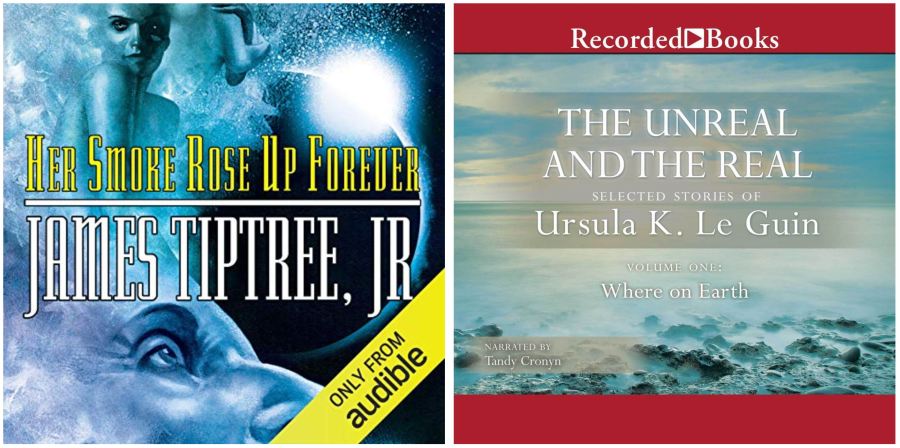
Her Smoke Rose Up Forever

“The Only Neat Thing to Do” – James Tiptree, Jr. (1985)

“The Moon Moth” – Jack Vance (1961)
Science Fiction Hall of Fame Volume 2B

“Black Destroyer” – A. E. van Vogt (1939)

“Air Raid” John Varley (1977)

“Press ENTER ■” – John Varley 1984
“Press ENTER ■”

“The Persistence of Vision” John Varley (1978)
“The Persistence of Vision”

“Harrison Bergeron” – Kurt Vonnegut, Jr. (1961)
Favorite Stories of Science Fiction v. 1

“The Ugly Chickens” – Howard Waldrop (1980)
Drabblecast

“The Island” – Peter Watts (2009)
StarShipSofa

“The Things” – Peter Watts (2010)
The Very Best of the Very Best edited by Gardner Dozois
Escape Pod
Clarkesworld

“A Martian Odyssey” – Stanley G. Weinbaum (1934)
Science Fiction Hall of Fame Volume One

“The Star” – H. G. Wells (1897)
Short Stories – Volume One

“Fire Watch” – Connie Willis (1982)
“The Last of the Winnebagos” – Connie Willis (1988)
“At the Rialto” – Connie Willis (1989)
Escape Pod
“Even the Queen” – Connie Willis (1992)
Escape Pod
The Best of Connie Willis (all 4)

“The Fifth Head of Cerberus” – Gene Wolfe (1972)

“The Death of Doctor Island” – Gene Wolfe (1973)

“Seven American Nights” – Gene Wolfe (1978)

“A Rose for Ecclesiastes” – Roger Zelazny (1963)
Science Fiction Hall of Fame Volume One

“For a Breath I Tarry” – Roger Zelazny (1966)

I hope audiobook producers see this list and get inspired to record science fiction short stories. They especially need to pay attention to Samuel R. Delany, Joanna Russ, and Gene Wolfe, but quite a few classic science fiction writers need short story collections on audio.

James Wallace Harris, 8/13/20

The SF Anthology Problem – Kindle Solution

The original Science Fiction Anthology Problem required finding anthologies that contained all the 101 stories from the Classics of Science Fiction Short Story list. Szymon Szott solved that problem, but then he wrote and told me since he lived in Poland that it was too expensive to buy physical books from overseas. He wanted to rerun the program but this time pick only anthologies that were available in ebook format.

His first effort could only find 80 of the 101 stories. There just weren’t that many science fiction anthologies available on the Kindle. I told him to break the original rule and include single-author collections.  That allowed him to bring the total stories to 94. It was especially surprising that he couldn’t find an ebook collection of James Tiptree, Jr. stories, however, Her Smoke Rose Up Forever that’s available on audio contains those stories. That suggests we should also do a Science Fiction Anthology Problem with an audiobook solution.

By the way, the two giant anthologies, Sense of Wonder and The Big Book of Science Fiction are so huge in print that I don’t like holding them to read, and Sense of Wonder has a typeface that demands perfect vision. They are better read as an ebook. In fact, I’m starting to want the Kindle edition as my primary format. My eyes still prefer reading off of paper pages but only if the font is large enough, otherwise my eyes like the Kindle e-ink page. My eyes do enjoy reading off my phone or tablet, but they tire more easily.

There is another reason to prefer the Kindle edition. All these books fit on one small device. And they can be read on my phone. It’s great to pull out my iPhone and read a science fiction short story whenever I have an idle moment.

Here are Szymon’s program results looking for Kindle editions:

Sense of Wonder

- "Arena" by Fredric Brown
- "Bears Discover Fire" by Terry Bisson
- "Black Destroyer" by A. E. van Vogt
- "Blood Music" by Greg Bear
- "Bloodchild" by Octavia E. Butler
- "The Cold Equations" by Tom Godwin
- "The Country of the Kind" by Damon Knight
- "Day Million" by Frederik Pohl
- "First Contact" by Murray Leinster
- "Fondly Fahrenheit" by Alfred Bester
- "The Game of Rat and Dragon" by Cordwainer Smith
- "Hell Is the Absence of God" by Ted Chiang
- "Jeffty Is Five" by Harlan Ellison
- "The Little Black Bag" by C. M. Kornbluth
- "Lobsters" by Charles Stross
- "The Lucky Strike" by Kim Stanley Robinson
- "A Martian Odyssey" by Stanley G. Weinbaum
- "Microcosmic God" by Theodore Sturgeon
- "The Mountains of Mourning" by Lois McMaster Bujold
- "Nightfall" by Isaac Asimov
- "The Only Neat Thing to Do" by James Tiptree, Jr.
- "Or All the Seas with Oysters" by Avram Davidson
- "Passengers" by Robert Silverberg
- "The Persistence of Vision" by John Varley
- "Rachel in Love" by Pat Murphy
- "A Rose for Ecclesiastes" by Roger Zelazny
- "The Sentinel" by Arthur C. Clarke
- "Seven American Nights" by Gene Wolfe
- "Souls" by Joanna Russ
- "Surface Tension" by James Blish
- "That Only a Mother" by Judith Merril
- "Think Like a Dinosaur" by James Patrick Kelly
- "The Ugly Chickens" by Howard Waldrop
- "Who Goes There?" by John W. Campbell, Jr.

Running story total: 34

The Big Book of Science Fiction: The Ultimate Collection

- ""Repent, Harlequin!" Said the Ticktockman" by Harlan Ellison
- "And I Awoke and Found Me Here on the Cold Hill's Side" by James Tiptree, Jr.
- "Aye, and Gomorrah …" by Samuel R. Delany
- "Desertion" by Clifford D. Simak
- "Sandkings" by George R. R. Martin
- "Snow" by John Crowley
- "Story of Your Life" by Ted Chiang
- "Swarm" by Bruce Sterling
- "The Last Question" by Isaac Asimov
- "The Man Who Lost the Sea" by Theodore Sturgeon
- "The Star" by Arthur C. Clarke
- "The Star" by H. G. Wells
- "The Voices of Time" by J. G. Ballard
- "Vaster Than Empires and More Slow" by Ursula K. Le Guin
- "When It Changed" by Joanna Russ

Running story total: 49

The Science Fiction Hall of Fame, Volume I

- "Coming Attraction" by Fritz Leiber
- "Flowers for Algernon" by Daniel Keyes
- "Mimsy Were the Borogoves" by Henry Kuttner, C. L. Moore
- "Scanners Live in Vain" by Cordwainer Smith
- "The Nine Billion Names of God" by Arthur C. Clarke

Running story total: 54

The Best of Connie Willis: Award-Winning Stories

- "At the Rialto" by Connie Willis
- "Even the Queen" by Connie Willis
- "Fire Watch" by Connie Willis
- "The Last of the Winnebagos" by Connie Willis

Running story total: 58

The Reel Stuff

- "Air Raid" by John Varley
- "Second Variety" by Philip K. Dick
- "We Can Remember It for You Wholesale" by Philip K. Dick

Running story total: 61

Modern Classic Short Novels of Science Fiction

- "Sailing to Byzantium" by Robert Silverberg
- "The Death of Doctor Island" by Gene Wolfe
- "The Star Pit" by Samuel R. Delany

Running story total: 64

Dreamsongs: GRRM: A RRetrospective

- "A Song for Lya" by George R. R. Martin
- "The Way of Cross and Dragon" by George R. R. Martin

Running story total: 66

Beyond the Rift

- "The Island" by Peter Watts
- "The Things" by Peter Watts

Running story total: 68

Future on Ice

- "Press ENTER ■" by John Varley
- "Speech Sounds" by Octavia E. Butler

Running story total: 70

The Wind's Twelve Quarters

- "Nine Lives" by Ursula K. Le Guin
- "The Day Before the Revolution" by Ursula K. Le Guin

Running story total: 72

The Top of the Volcano: The Award-Winning Stories of Harlan Ellison

- "A Boy and His Dog" by Harlan Ellison
- "I Have No Mouth, and I Must Scream" by Harlan Ellison

Running story total: 74

Masterpieces: The Best Science Fiction of the Twentieth Century

- "All You Zombies—" by Robert A. Heinlein
- "Inconstant Moon" by Larry Niven

Running story total: 76

Sisters of the Revolution: A Feminist Speculative Fiction Anthology

- "The Screwfly Solution" by James Tiptree, Jr.

Running story total: 77

The Best of C. L. Moore

- "Vintage Season" by Henry Kuttner, C. L. Moore

Running story total: 78

The Year's Best Science Fiction & Fantasy 2012

- "The Man Who Bridged the Mist" by Kij Johnson

Running story total: 79

The Best of Lucius Shepard

- "R & R" by Lucius Shepard

Running story total: 80

Born with the Dead

- "Born with the Dead" by Robert Silverberg

Running story total: 81

The Best of the Best Volume 2: 20 Years of the Best Short Science Fiction Novels

- "Beggars in Spain" by Nancy Kress

Running story total: 82

The Martian Chronicles

- "There Will Come Soft Rains" by Ray Bradbury

Running story total: 83

Exhalation

- "The Merchant and the Alchemist's Gate" by Ted Chiang

Running story total: 84

Hackers

- "Burning Chrome" by William Gibson

Running story total: 85

The Mammoth Book of 20th Century Science Fiction: Volume One

- "Great Work of Time" by John Crowley

Running story total: 86

The Last Defender of Camelot

- "For a Breath I Tarry" by Roger Zelazny

Running story total: 87

The Best of Gene Wolfe: A Definitive Retrospective of His Finest Short Fiction

- "The Fifth Head of Cerberus" by Gene Wolfe

Running story total: 88

The Collected Stories of Arthur C. Clarke

- "A Meeting with Medusa" by Arthur C. Clarke

Running story total: 89

Modern Classics of Fantasy

- "Buffalo Gals, Won't You Come Out Tonight" by Ursula K. Le Guin

Running story total: 90

The Science Fiction Hall of Fame, Volume Two B

- "The Moon Moth" by Jack Vance

Running story total: 91

Nebula Awards Showcase 2015

- "Time Considered as a Helix of Semi-Precious Stones" by Samuel R. Delany

Running story total: 92

The World Turned Upside Down

- "Thunder and Roses" by Theodore Sturgeon

Running story total: 93

Welcome to the Monkey House: The Special Edition

- "Harrison Bergeron" by Kurt Vonnegut, Jr.

Running story total: 94

Missing stories:

['"Houston, Houston, Do You Read?" by James Tiptree, Jr.', '"Of Mist, and Grass, and Sand" by Vonda N. McIntyre', '"The Women Men Don\'t See" by James Tiptree, Jr.', '"The Bicentennial Man" by Isaac Asimov', '"The Girl Who Was Plugged In" by James Tiptree, Jr.', '"The Queen of Air and Darkness" by Poul Anderson', '"Light of Other Days" by Bob Shaw']

Selected books:

Sense of Wonder
The Big Book of Science Fiction: The Ultimate Collection
The Science Fiction Hall of Fame, Volume I
The Best of Connie Willis: Award-Winning Stories
The Reel Stuff
Modern Classic Short Novels of Science Fiction
Dreamsongs: GRRM: A RRetrospective
Beyond the Rift
Future on Ice
The Wind's Twelve Quarters
The Top of the Volcano: The Award-Winning Stories of Harlan Ellison
Masterpieces: The Best Science Fiction of the Twentieth Century
Sisters of the Revolution: A Feminist Speculative Fiction Anthology
The Best of C. L. Moore
The Year's Best Science Fiction & Fantasy 2012
The Best of Lucius Shepard
Born with the Dead
The Best of the Best Volume 2: 20 Years of the Best Short Science Fiction Novels
The Martian Chronicles
Exhalation
Hackers
The Mammoth Book of 20th Century Science Fiction: Volume One
The Last Defender of Camelot
The Best of Gene Wolfe: A Definitive Retrospective of His Finest Short Fiction
The Collected Stories of Arthur C. Clarke
Modern Classics of Fantasy
The Science Fiction Hall of Fame, Volume Two B
Nebula Awards Showcase 2015
The World Turned Upside Down
Welcome to the Monkey House: The Special Edition

Number of selected books:  30

Szymon is still tweaking this program and the latest results can be found here. For example, he found “The Bicentennial Man” in Robot Visions.

This solution can be reconfigured easily with other options. For example, instead of buying The Best of C. L. Moore to get “Vintage Season,” you could purchase The Science Fiction Hall of Fame Volume 2A. You’d need to decide if you wanted more Moore or more other SF writers.

This effort shows the weak ebook support SF anthologies have. Retrospective and theme anthologies don’t seem to be as popular as they used to be, but then I’m not sure that reading short science fiction is as popular as it used to be.

Maybe anthologists will read this and be inspired to assemble an ebook anthology. I hope.

James Wallace Harris, 8/12/20

The SF Anthology Problem – Solved

Two years ago when we completed version 1 of The Classics of Science Fiction Short Story list I proposed a math challenge. Version 1 came up with 275 stories. I asked if there was any mathematically way to decide what were the fewest anthologies that contained all 275 stories using ISFDB.org as a reference database. Version 1 was generated using .csv files. Since then we updated the process to a database for version 2 of the list, which produced 101 stories — we believe that was a more practical reading list.

A science fiction fan could read the entire list over the summer by reading one story a day, or in a year by reading one story every three days, but where would they get the 101 science fiction short stories? It might be possible to track down many stories on the internet, but what if people wanted to read them in a printed book? What would be the minimum number of anthologies to buy to get all the stories? That seem like an fascinating mathematical problem to me.

Well, Szymon Szott just came up with a solution using version 2 of the list. The second link goes to GitHub for Szymon’s Python code and documentation. The first link goes to his bio. Even if you can’t read the programming code you should visit this page that explains his solution. Szymon was able to come up with 22 anthologies that collected the 101 stories on the v. 2 of The Classics of Science Fiction Short Stories list.

The photo above pictures eight anthologies that get 81 stories of the version 2 list. Of course, those eight anthologies gets you a lot more than 81 stories. I tried to figure out the solution myself by using a spreadsheet and the best I could do was find fifteen anthologies to cover 81 stories, and then gave up. I figured my eyeballing method might have gotten me to 30-35 anthologies.

Here’s what Szymon says about the project:

As a fan of science fiction and a compulsive completionist, Worlds Without End is one of my favorite sites on the Internet. It was there that I learned about Jim and Mike's work on the list of classic science fiction novels which I've been eagerly following. When the list of classic science fiction short stories was announced and Jim blogged about The Mathematics of Buying Science Fiction Anthologies, I knew this was an interesting problem to solve. But it wasn't until I started dabbling in Python that I realized that, along with the 2020 travel-restricted summer holidays, I now had the tools to start chipping away at this. Creating a story-to-anthology mapping using data from the Internet Speculative Fiction Database didn't take too long, but the underlying mathematical problem was harder than I initially thought: it turned out that a brute-force approach of checking all possible combinations is unfeasible. Still, the heuristic used has given us a solution which I'm satisfied with and I don't think there exists a much better global solution. I was most surprised that the Science Fiction Hall of Fame series did not make the list (as I've already read volume one). Thank you Jim for this challenge! Now, all this coding was fun, but it's time to get back to reading: Sense of Wonder is next!

This isn’t an easy problem. Szymon had to screenscrape the table of contents from 290 anthologies from ISFDB.org, which contained one or more of the 101 stories. Just look at this listing to see how often each of these stories was reprinted. Towards the end of his programming loops, he had to use eight anthologies to cover eight stories. If all those singletons had been in one anthology, Szymon’s finally anthology list would have been 15. Most of those singletons were newer stories and there haven’t been enough time for them to be collected into a retrospective anthology. One new anthology could shorten Szymon’s final list.

I know many people won’t follow links, so here is Szymon’s program results:

Sense of Wonder

- "Arena" by Fredric Brown
- "Bears Discover Fire" by Terry Bisson
- "Black Destroyer" by A. E. van Vogt
- "Blood Music" by Greg Bear
- "Bloodchild" by Octavia E. Butler
- "The Cold Equations" by Tom Godwin
- "The Country of the Kind" by Damon Knight
- "Day Million" by Frederik Pohl
- "First Contact" by Murray Leinster
- "Fondly Fahrenheit" by Alfred Bester
- "The Game of Rat and Dragon" by Cordwainer Smith
- "Hell Is the Absence of God" by Ted Chiang
- "Jeffty Is Five" by Harlan Ellison
- "The Little Black Bag" by C. M. Kornbluth
- "Lobsters" by Charles Stross
- "The Lucky Strike" by Kim Stanley Robinson
- "A Martian Odyssey" by Stanley G. Weinbaum
- "Microcosmic God" by Theodore Sturgeon
- "The Mountains of Mourning" by Lois McMaster Bujold
- "Nightfall" by Isaac Asimov
- "The Only Neat Thing to Do" by James Tiptree, Jr.
- "Or All the Seas with Oysters" by Avram Davidson
- "Passengers" by Robert Silverberg
- "The Persistence of Vision" by John Varley
- "Rachel in Love" by Pat Murphy
- "A Rose for Ecclesiastes" by Roger Zelazny
- "The Sentinel" by Arthur C. Clarke
- "Seven American Nights" by Gene Wolfe
- "Souls" by Joanna Russ
- "Surface Tension" by James Blish
- "That Only a Mother" by Judith Merril
- "Think Like a Dinosaur" by James Patrick Kelly
- "The Ugly Chickens" by Howard Waldrop
- "Who Goes There?" by John W. Campbell, Jr.

Running story total: 34

The Wesleyan Anthology of Science Fiction

- ""Repent, Harlequin!" Said the Ticktockman" by Harlan Ellison
- "Air Raid" by John Varley
- "All You Zombies—" by Robert A. Heinlein
- "And I Awoke and Found Me Here on the Cold Hill's Side" by James Tiptree, Jr.
- "Aye, and Gomorrah …" by Samuel R. Delany
- "Burning Chrome" by William Gibson
- "Coming Attraction" by Fritz Leiber
- "Desertion" by Clifford D. Simak
- "Nine Lives" by Ursula K. Le Guin
- "Speech Sounds" by Octavia E. Butler
- "The Star" by H. G. Wells
- "There Will Come Soft Rains" by Ray Bradbury
- "Thunder and Roses" by Theodore Sturgeon
- "We Can Remember It for You Wholesale" by Philip K. Dick
- "When It Changed" by Joanna Russ

Running story total: 49

Science Fiction: Stories and Contexts

- "At the Rialto" by Connie Willis
- "Flowers for Algernon" by Daniel Keyes
- "For a Breath I Tarry" by Roger Zelazny
- "The Girl Who Was Plugged In" by James Tiptree, Jr.
- "Mimsy Were the Borogoves" by Henry Kuttner, C. L. Moore
- "The Nine Billion Names of God" by Arthur C. Clarke
- "Second Variety" by Philip K. Dick
- "Story of Your Life" by Ted Chiang
- "Vaster Than Empires and More Slow" by Ursula K. Le Guin
- "Vintage Season" by Henry Kuttner, C. L. Moore

Running story total: 59

The Big Book of Science Fiction: The Ultimate Collection

- "Sandkings" by George R. R. Martin
- "Snow" by John Crowley
- "Swarm" by Bruce Sterling
- "The Last Question" by Isaac Asimov
- "The Man Who Lost the Sea" by Theodore Sturgeon
- "The Star" by Arthur C. Clarke
- "The Voices of Time" by J. G. Ballard

Running story total: 66

The Science Fiction Hall of Fame, Volume IV

- "A Meeting with Medusa" by Arthur C. Clarke
- "Born with the Dead" by Robert Silverberg
- "Of Mist, and Grass, and Sand" by Vonda N. McIntyre
- "The Day Before the Revolution" by Ursula K. Le Guin
- "The Death of Doctor Island" by Gene Wolfe
- "The Queen of Air and Darkness" by Poul Anderson

Running story total: 72

The Very Best of Fantasy & Science Fiction: 60th Anniversary Anthology

- "Harrison Bergeron" by Kurt Vonnegut, Jr.
- "The Merchant and the Alchemist's Gate" by Ted Chiang
- "The Women Men Don't See" by James Tiptree, Jr.

Running story total: 75

The Science Fiction Century

- "Beggars in Spain" by Nancy Kress
- "Fire Watch" by Connie Willis
- "Great Work of Time" by John Crowley

Running story total: 78

The Best of the Nebulas

- "A Boy and His Dog" by Harlan Ellison
- "Houston, Houston, Do You Read?" by James Tiptree, Jr.
- "Time Considered as a Helix of Semi-Precious Stones" by Samuel R. Delany

Running story total: 81

Armageddons

- "Inconstant Moon" by Larry Niven
- "The Screwfly Solution" by James Tiptree, Jr.

Running story total: 83

Survival Printout

- "I Have No Mouth, and I Must Scream" by Harlan Ellison
- "Scanners Live in Vain" by Cordwainer Smith

Running story total: 85

Modern Classic Short Novels of Science Fiction

- "Sailing to Byzantium" by Robert Silverberg
- "The Star Pit" by Samuel R. Delany

Running story total: 87

The Legend Book of Science Fiction

- "The Fifth Head of Cerberus" by Gene Wolfe
- "The Moon Moth" by Jack Vance

Running story total: 89

The Arbor House Treasury of Modern Science Fiction

- "Light of Other Days" by Bob Shaw
- "The Bicentennial Man" by Isaac Asimov

Running story total: 91

The Locus Awards: Thirty Years of the Best in Science Fiction and Fantasy

- "Even the Queen" by Connie Willis
- "The Way of Cross and Dragon" by George R. R. Martin

Running story total: 93

Hugo and Nebula Award Winners from Asimov's Science Fiction

- "Press ENTER ■" by John Varley

Running story total: 94

The Hugo Winners, Volume Three

- "A Song for Lya" by George R. R. Martin

Running story total: 95

The Best Science Fiction and Fantasy of the Year Volume Six

- "The Man Who Bridged the Mist" by Kij Johnson

Running story total: 96

The Best Science Fiction and Fantasy of the Year Volume Five

- "The Things" by Peter Watts

Running story total: 97

The Year's Best Science Fiction: Fourth Annual Collection

- "R & R" by Lucius Shepard

Running story total: 98

The Unreal and the Real: The Selected Short Stories of Ursula K. Le Guin

- "Buffalo Gals, Won't You Come Out Tonight" by Ursula K. Le Guin

Running story total: 99

The New Space Opera 2

- "The Island" by Peter Watts

Running story total: 100

The New Hugo Winners, Volume III

- "The Last of the Winnebagos" by Connie Willis

Running story total: 101

Selected books:

- Sense of Wonder
- The Wesleyan Anthology of Science Fiction
- Science Fiction: Stories and Contexts
- The Big Book of Science Fiction: The Ultimate Collection
- The Science Fiction Hall of Fame, Volume IV
- The Very Best of Fantasy & Science Fiction: 60th Anniversary Anthology
- The Science Fiction Century
- The Best of the Nebulas
- Armageddons
- Survival Printout
- Modern Classic Short Novels of Science Fiction
- The Legend Book of Science Fiction
- The Arbor House Treasury of Modern Science Fiction
- The Locus Awards: Thirty Years of the Best in Science Fiction and Fantasy
- Hugo and Nebula Award Winners from Asimov's Science Fiction
- The Hugo Winners, Volume Three
- The Best Science Fiction and Fantasy of the Year Volume Six
- The Best Science Fiction and Fantasy of the Year Volume Five
- The Year's Best Science Fiction: Fourth Annual Collection
- The Unreal and the Real: The Selected Short Stories of Ursula K. Le Guin
- The New Space Opera 2
- The New Hugo Winners, Volume III

Number of selected books: 22

Most of those 22 anthologies are out-of-print and you’ll need to shop ABEbooks.com or eBay.com to find them. I’ve added links to the final 22 anthologies so you can find the various editions of these books that have been published over the years. Clicking on links to individual editions will show you the table of contents and usually a photo of the book’s cover. Some anthologies have been published under multiple titles, and some of those are easier to find used. For Sense of Wonder, I highly recommend getting it in the Kindle edition, the paper edition is much too big to comfortably hold. Ditto for The Big Book of Science Fiction.

If you click on the story title in the Classics of Science Fiction Short Story list it will take you to its entry on ISFDB.org where you can see all the anthologies and collections where it’s been reprinted. This will let you find an alternative source for the story, or even let you try to beat Szymon’s results by coming up with another combination of anthologies.

Update: See The Science Fiction Anthology Problem – Kindle Edition for the solution using ebooks.

James Wallace Harris, 8/9/20


Which Will Come First?

Science fiction never predicts the future, but it often anticipates things to come. Of these three breakthrough visions of science fiction, which do you believe will happen first?

  1. The AI Singularity
  2. A self-sustain colony on Mars
  3. Humans leaving the solar system

It feels like the vast majority of science fiction has been about space travel, especially interstellar travel. Star Trek and Star Wars certainly suggest that’s what we hope will happen. Mars has always been a popular destination in science fiction, and in the old days, a common source of Earth invaders. And finally, robots are that other big science-fictional idea that has been kicking around for centuries.

I grew up with Mercury, Gemini, and Apollo space programs in the 1960s. When I graduated high school in 1969 I was predicting we’d land on Mars by the late 1970s or early 1980s, and by the 21st-century, be building a colony. That prediction failed miserably. Nor do I expect it will happen anytime soon, despite the successes of Elon Musk.

As a kid, I wanted the 1966 TV show Star Trek to herald the future of mankind. Since then I’ve learned to say humankind, which is another kind of progress. After a lifetime of reading science books, I realize interstellar travel will probably never happen — well not for us.

That leaves intelligent robots. Everything depends on the Technological Singularity. If it’s possible, and I believe it might be, even as early as 2030-2050, when a world full of intelligent robots might begin. Once our laboratories evolve one superintelligence, it will create the next, and after that, the robot transformation will happen fast. Who knows, AI robots could help us build a colony on Mars and even engineer interstellar spaceships. However, the long voyages into space will be better suited for silicon-based beings. Isn’t it becoming obvious that machines are perfectly suited for colonizing space, and we’re not?

My pick? Robots will happen first, and they will have all the space exploring fun.

Are we ready for that? Despite all the science fiction books and movies about robots becoming our evil overlords, are we ready to be the #2 intelligence on planet Earth? I’m not sure we’ve thought this through carefully. I’d say most science fiction hasn’t explored the idea of intelligent machines deeply enough. Too often, robot characters are just silly, or variations of ourselves. I do think Robert Sawyer did a good job with his WWW Trilogy, but we need more science fiction about a post-singularity world. Not Terminators are falling from the sky stories or more stories about fuckable robots that look exactly like humans. What if The Humanoids by Jack Williamson came true, but the humanoids actually made created a utopian society? Wouldn’t that even be scarier?

James Wallace Harris, 8/3/20