What Were Heinlein’s Best Short Stories?

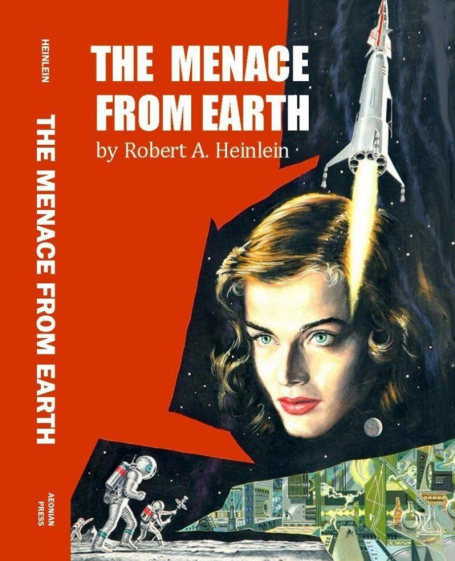
The Menace From Earth by Robert A. Heinlein

[You can use our Classics of Science Fiction Query Database to recreate this work, or test it with another author.]

We identify the best short stories by looking at which stories were most anthologized. Robert A. Heinlein was a prolific, well-loved writer, but one who might have hurt himself under our system because he charged so much to reprint his short stories that many anthologists couldn’t afford to include his work. Under our “citation” system, we include fan polls, awards, and even writer recommendation lists, as well as anthologies as our citation sources. Many Heinlein stories have multiple citations because of fan polls. Here’s our raw data – stories with at least 1 citation.

Heinlein Short Stories Citations 1

Heinlein had 59 short stories published in his lifetime, reprinted in 16 of his own collections. Which is probably one reason why he didn’t feel the need to have his stories anthologized by others. But the list above seems to include most of his famous stories. I’m surprised that “Jerry Was A Man” was never anthologized by a major retrospective anthology of the genre. (But it was made for a television anthology show.)

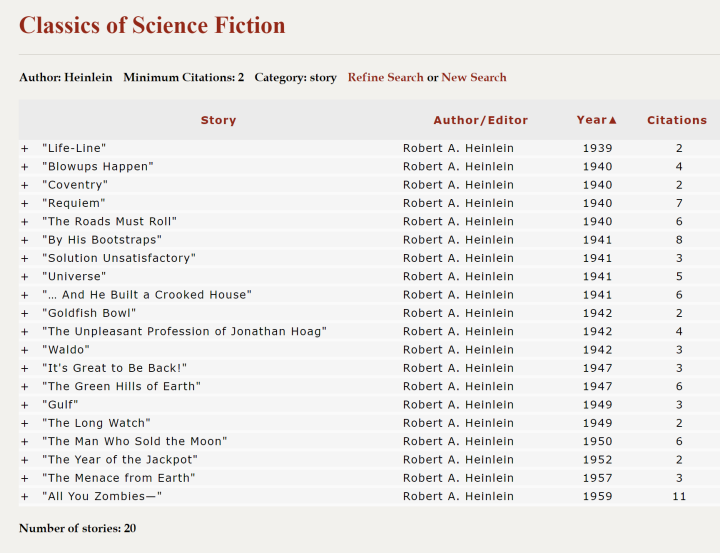
To get an idea which was his better stories, I’m going to show the stories that had at least 2 citations.
Heinlein Short Stories Citations 2

This list drops from 26 to 20 stories. That’s still a very long list of short stories. As we worked with our system, we saw we had to up the minimum citation cutoff to get a better idea which stories significantly stood out. By looking at the changes in the lists, we had to ask why about each story that fell out. For example, “Misfit” disappears here. It’s a fun story and might be considered Heinlein’s first juvenile, but ultimately, it is a weaker story. Look what happens when we up the cutoff to 3 citations.

Heinlein Short Stories Citations 3

This is a much better list. We lose five stories, such as the outrageous “The Year of the Jackpot,” which is one of my favorites. But is it really a standout story, or just one with a very neat idea? I personally rate it higher than “Gulf” and “It’s Great to Be Back.” If Heinlein had let it been anthologized more often I think it would be better remembered. Heinlein should have at least let Bleiler & Dikty include it in their annual best of the year collection. Or maybe those editors didn’t like it as much as I do. Terry Carr did include “The Year of the Jackpot” in Science Fiction for People Who Hate Science Fiction in 1966, and it did make it to Sci-Fi Lists Top 200 in 2018.

But let’s jump up the cutoff to 5, the one we used for our Classics of Science Fiction Short Stories list.
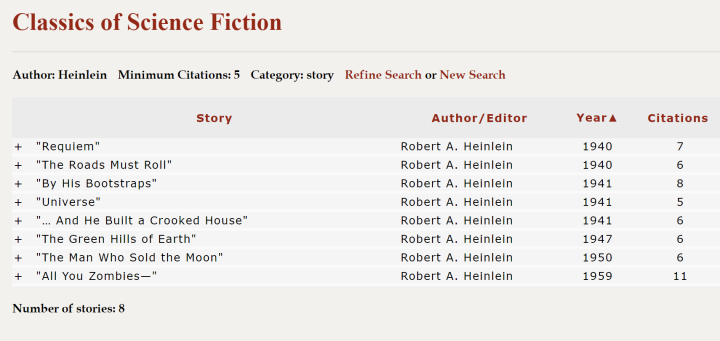
Heinlein Short Stories Citations 5

This list drops out my all-time favorite Heinlein short story, “The Menace From Earth.” I suppose I like that story so much because it came out in 1957 at the height of Heinlein’s career, was a young adult story, and I think Heinlein’s best novels were young adult novels, and it had a marvelous gimmick, human-powered flight on the Moon. Sadly, it doesn’t make the cut. Nor was it up for a Hugo. However, “The Menace from Earth” was eligible for Ted Dikty’s last annual collection, and Judith Merril’s third annual collection of best science fiction. Did Heinlein charge too much for it back in 1957, or did Dikty and Merril just not like the story? I can’t believe they wouldn’t have considered it one of the best short stories of the year. If they had anthologized “The Menace From Earth” it would have made our 5 citation cutoff.

But let’s look at just one more cutoff, 7.  These are Heinlein’s most popular stories using our system. This time I’ve opened the citation source list for each story.
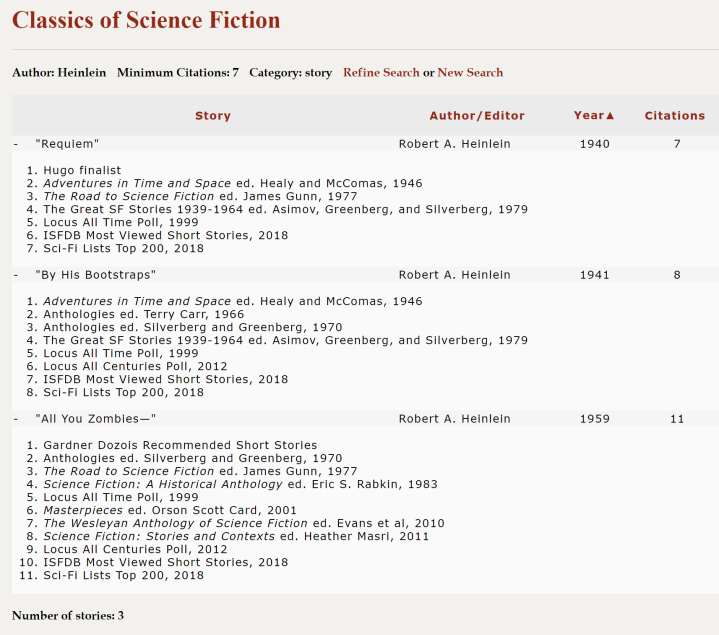
Heinlein Short Stories Citations 7

It’s the fan polls that put Heinlein over the top. Fans remember Heinlein, for example, “Requiem” was up for a Retro Hugo. Heinlein just wasn’t anthologized that much, at least by the major anthologies we included in our system. And the two citations from The Great SF Stories edited by Asimov and Greenberg are a kind of cheat. They leave a page for each story but say they couldn’t get the rights to include the actual stories. Probably meaning, Heinlein was charging too much. James Gunn did buy two Heinlein stories. And “All You Zombies–” got into three textbook anthologies. I guess they can afford to pay more.

“Requiem” is a beautiful story, and I consider a lovely tribute to our genre. “By His Bootstraps” is a razzle-dazzle plot story, but I’m not sure how much heart it contains. And “All You Zombies–” is another razzle-dazzle plotter, which is impressive, but on the other hand, is rather cynical. It’s very popular in the fan polls, and it’s one of few Heinlein stories that got made into a movie.

Ultimately, our system fails me. I love “The Menace from Earth.” It’s a positive story. It’s full of science fiction speculation. At its heart, it speaks to people who love science fiction. Maybe our system for identifying the best short stories works for telling me what the average reader thinks about Heinlein. No system is perfect. If you don’t agree with our statistical process, just assume your tastes run uniquely different from the average.

By the way, you can use our Classics of Science Fiction Query Database to analyze the popular stories for your favorite SF author.

James Wallace Harris, December 26, 2018

Not All Great Stories Are Remembered

A Logic Named Joe by Murray Leinster March 1946 Astounding.PNG

Our goal here at the Classics of Science Fiction is to discover analytical ways to remember science fiction. We describe our methods in “Remembering Science Fiction.” The trouble is, our methods don’t always work. For short stories, we collect annual anthologies, retrospective anthologies, textbook anthologies about science fiction, fan polls, awards, and a few recommendation lists from authors. We call each source of recognition a “citation” and we have over a 100 citation sources for short science fiction. To get on our final list of Classics of Science Fiction Short Stories a story had to have a minimum of 5 citations.

“A Logic Named Joe” by Murray Leinster from the March 1946 issue of Astounding Science Fiction is a definite classic in my mind, yet it only got 1 citation. It was collected in The Great SF Stories 8 (1946) edited by Isaac Asimov and Martina H. Greenberg. But if you look at the entry for “A Logic Named Joe” at ISFDB.org, you’ll see it’s never been collected in a major retrospective anthology of the science fiction genre. Yet, if you go read “A Logic Named Joe” online at Baen Book you’ll discover this 1946 story is very prescience about today’s computers, networking, and social media problems. For example, the illustration above shows kids looking at a film unsuitable for kids. In the story itself, kids are watching a film cannibals and their fertility dances. Leinster even imagined Nanny apps to keep kids from seeing what they shouldn’t, but in this case, Joe overrode that code.

The reason why people should read “A Logic Named Joe” today is for the same reason they should read “The Machine Stops” by E. M. Forster from 1909. Both are stories where the author has predicted our world and time to a fascinating degree. Science fiction was never meant to be a crystal ball, but sometimes it’s speculations about the future are eerily right. Both of these stories would just seem like nice stories if read before the internet era, but after that, we go, “Wait a minute! How could E. M. Forster in 1909 or Murray Leinster in 1946 imagine what’s happening now?”

“A Logic Named Joe” was written when the term “computer” meant a human that worked all day at a desk doing mathematics. Leinster used the word “logic” to mean what we call computers. I bet future retrospective anthologies will reprint “A Logic Named Joe.”

They will if the editors read it. How do keep short stories alive so readers will remember them? I’d say a majority of modern science fiction readers will never read even one of the anthologies we used to create our system for identifying the best short science fiction from the past. Sure, a few folks might take a science fiction course as an elective and have to read one of the textbook anthologies for their class. Or a small percentage might consume a current anthology like The Big Book Of Science Fiction (2016) edited by Jeff and Ann VanderMeer, but these readers are few and far between.

We’re hoping people will read our lists and track down the stories. We’ve even put all our research into a database that you can generate your own custom lists. But using our system you probably won’t notice “A Logic Named Joe.” Our system fails to recognize it. There have been no 1947 Retro Hugo Award for 1946 publications so far. This could happen in 2022. In 2018 the Retro Hugo Award voted for the 1943 Hugo awards that covered 1942 stories. In 2019 they’ll vote the 1944 awards. But even if “A Logic Named Joe” gets a Retro Hugo Award, will that be enough to make it into a classic story young readers will remember?

Murray Leinster is not very well remembered today, but he was once called the Dean of Science Fiction. Readers mostly remember him today for “First Contact” which was anthologized in The Science Fiction Hall of Fame.

If you use our database and set the min and max year to 1946, check the Story radio button, and put citations to 1, you’ll get all the stories our system found for 1946:

1946 Science Fiction Short Stories

The ones checked with a red mark are those collected by Asimov and Greenberg for The Great SF Stories 8 (1946). All the others came from other anthologies. 13 of the 22 stories are only remembered by one anthology. Using our cutoff of 5 citation minimum, these are the stories our system deems are the classics of 1946:

The Classics of Science Fiction Short Stories 1946

Few modern science fiction readers will even read these three stories, but because they’ve been anthologized so many times, their chances are better for being remembered as classics of the genre.

I believe “A Logic Named Joe” should be on that list, but how do we come up with a system that recognizes its worth? We could add Modern Masterpieces of Science Fiction (1965) edited by Sam Moskowitz. It’s a major retrospective anthology we missed. That would give “A Logic Named Joe” 2 citations. It would also reinforce the standing of the other stories in the anthology give giving them an additional citation.

We could also add the best theme anthologies. We aimed to pick major anthologies, either recognized as such or because they were large and definitive. Machines That Think (1984) edited by Asimov, Greenberg, and Warrick would be one such anthology. It collected 621 pages of great stories about thinking machines. That would bring “A Logic Named Joe” up to 3 citations. Of course, it’s given Asimov and Greenberg two votes.

I could assemble a committee of well-read specialists in short science fiction and give them each a vote. I’d give it my vote. That brings it up to 4 citations, still under the cutoff.

Are there any other sources of citations that recognize short science fiction? Being made into a television show or movie is a great form of recognition that helps keep a work of fiction in our pop culture memory. Unfortunately, “A Logic Named Joe” will never be filmed.

The gold standard for remembering short stories is being published in a major anthology. But how often do major anthologies get published? And when a large retrospective anthology is assembled, editors tend to look over the field and find exceptional stories that haven’t been well-anthologized before to now compete with the recognized classics. Would they now see “A Logic Named Joe” as one? The large genre remembering anthologies come out every few years, but they have page limits, and always more new stories to remember, and thus older stories that were once classics get left out.

Even among short stories, there’s a survival of the fittest. The question I always ask people, “How many short stories do you remember from the 19th-century?” The competition to become a classic is brutal.

“A Logic Named Joe” is a standout story because of how it anticipated the internet. But is that enough to make it a classic story worth remembering? It lacks the emotional depth to make it a literary classic. And it doesn’t have the beauty of “Vintage Season.” Maybe our system is working. Maybe “A Logic Named Joe” is a story I especially like, but not necessarily loved by others?

“A Logic Named Joe” by Will F. Jenkins (Murray Leinster’s real name because he had another story in the same issue) came in first place in The Analytical Laboratory. Readers liked it best, but it only got a 2.80 average rating, meaning it wasn’t that popular. A rating of 1.00 meant every reader picked it as their #1 story. A few rare stories back in the day managed that feat. So in 1946, “A Logic Named Joe” was only a slightly better than average story.

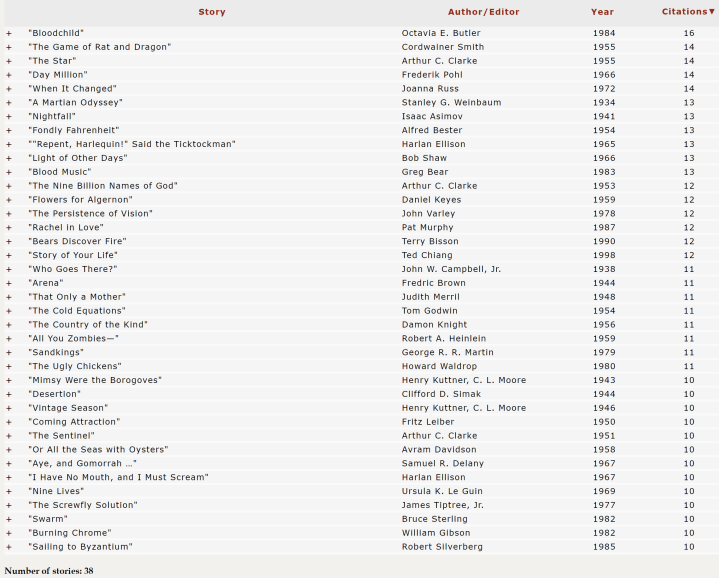
If you look at the list above of the 22 stories for 1946, only “Vintage Season” is a real classic. It had 10 citations. If we used a cutoff of 10, there are only 38 classic science fiction short stories that make the list. And even many of these are being forgotten. It’s hard to come up with a system that remembers everything that the average reader will encounter, or should read.

Classics of Science Fiction Short Stories 10 Citations

James Wallace Harris, December 25, 2018

New Feature: Build Your Own List


New feature

You can now build your own lists from our data. Be aware that our data is a very limited subset of science fiction books and short stories — just the most recommended and remembered stories.

You can always find this new feature under:

Home MenuBuild Your Own Classics of Science Fiction Lists

This landing page explains what you need to know and gives the link to the database system.

James Wallace Harris 12/18/18

Best of the Best Science Fiction 2018


Best 3 SF novels 2018

Wonder what great science fiction book you might have missed reading this year? Want to get ready to nominate books for the Hugo Awards next year?

I’m going to aggregate several Best-of-the-Year-2018 lists covering science fiction to see which books were mentioned the most often. Here are the lists I’m using:

Here are the results ordered by the number of lists they were on.

5 – Blackfish City by Sam J. Miller (B&N, BestSF, Chicago, Vulture, WP) *
4 – Severance by Ling Ma (B&N, Chicago, Goodreads, Vulture) *
4 – The Calculating Stars by Mary Robinette Kowal (B&N,  BestSF, Chicago, Goodreads)
3 – Rosewater by Tade Thompson (B&N, Chicago, Goodreads) *
3 – Semiosis by Sue Burke (BestSF, Chicago, Vulture) *
3 – Space Opera by Catherynne M. Valente (B&N, BestSF, Goodreads) *
3 – The Book of M by Peng Shepherd (B&N, BestSF, Chicago) *
3 – The Poppy War by R. F. Kuang (B&N, Vulture, WP) *
2 – Binti: The Night Masquerade by Nnedi Okorafor (BestSF, Goodreads) *
2 – Embers of War by Gareth L. Powell (B&N, BestSF)
2 – Empire of Silence by Christopher Ruocchio (B&N, BestSF)
2 – Foundryside by Robert Jackson Bennett (B&N, Vulture)
2 – Head On by John Scalzi (BestSF, Goodreads)
2 – Iron Gold by Pierce Brown (BestSF, Goodreads) *
2 – Medusa Uploaded by Emily Devenport (BestSF, Vulture) *
2 – Revenant Gun by Yoon Ha Lee (BestSF, Goodreads) *
2 – Senlin Ascends by Josiah Bancroft (B&N, WP) *
2 – Spinning Silver by Naomi Novik (B&N, Vulture) *
2 – State Tectonics by Malka Older (Chicago, BestSF) *
2 – Temper by Nicky Drayden (B&N, Vulture) *
2 – The Only Harmless Great Thing by Brooke Bolander (B&N, BestSF)
2 – The Oracle Year by Charles Soule (BestSF, Goodreads) *
2 – Vengeful by V. E. Schwab (B&N, Goodreads) *

* – Titles at Scribd.com

I’ve only read one title off this list, Semiosis by Sue Burke – it was quite impressive. That experience inspires me to try more of these titles.

James Wallace Harris, December 15, 2018