When I decided to write about this story, I was impressed with H. G. Wells’s effort to predict the future. But after contemplating it more, I realized he got little right. I then realized his greatest achievement wasn’t extrapolating what’s to come but merely setting his story in the future.
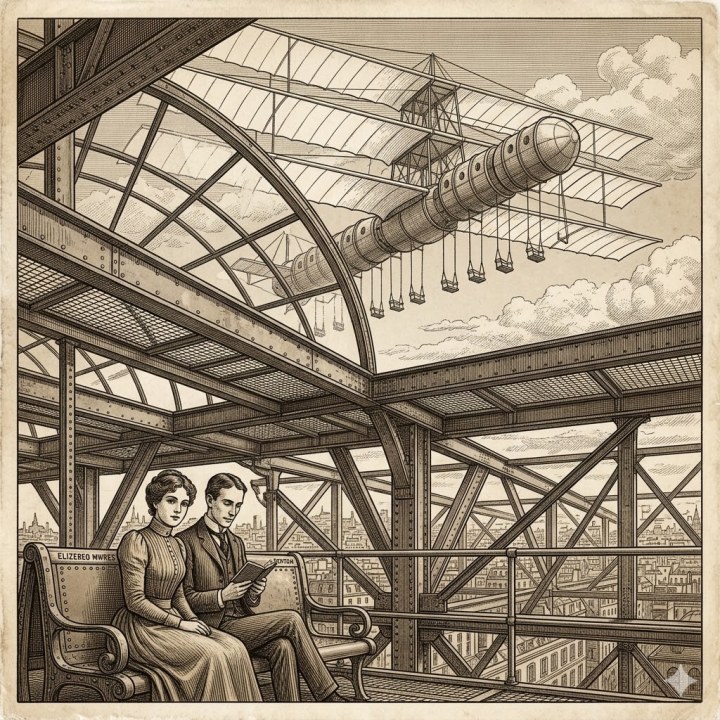
I then decided to get Google Gemini to create an illustration to go with this essay. I had it read the story and asked it to create an illustration for a 1899 magazine. What it generated is what you see above.
I didn’t think it fit the story. I asked the AI to look at the original illustrations for inspiration. It couldn’t find them. It knew the artist but couldn’t find the Pall Mall Magazine online. I had to do that myself. And I uploaded examples to show the AI. It agreed it was picturing the story wrong, but no matter what details I asked for, it couldn’t produce anything that I thought fit.
I realized Wells’ fiction was prompt engineering for the magazine’s illustrator. I don’t think he succeeded any better than Gemini. Words aren’t enough to convey what we see in our imagination.
That made me realize it’s doubtful I got what H. G. Wells was telling us in his story. I have to assume his mind’s eye was a million times more powerful than what my mind’s eye created for me while reading. I can’t help but believe Wells’ mind was on fire between 1895 and 1900.
Wells begins his story by telling us that nobody in 1899 thought about the future. I’m sure he didn’t mean absolutely nobody, but just that it was exceptionally rare. I believe “A Story of the Days to Come” is the real beginning of science fiction. Wells realized we could set fiction beyond the present without explanation. Other writers had tried to get their readers into the future before, but they struggled with writing conventions.
Irish writer Samuel Madden may be the first writer to imply time travel. His 1733 epistolary novel, Memoirs of the Twentieth Century, is set in the years 1997 and 1998. In 1819, American readers were introduced to the idea of traveling to the future in “Rip Van Winkle” by Washington Irving. The title character took a potion that let him sleep for twenty years. Then, in 1826, Mary Shelley set her story The Last Man in the 21st century. She claimed she found the manuscript in a cave. Throughout the 19th century, writers invented various literary gimmicks to take their readers into the future. In 1835, Vladimir Odoyevsky, the character from The Year 4338: Petersburg Letters, sent his consciousness back in time to a Chinese student who tells the story in a series of letters. In 1889, readers were introduced to the idea of traveling into the past in Mark Twain’s A Connecticut Yankee in King Arthur’s Court. Hank Morgan travels in time by a blow to the head.
My theory is that because the Industrial Age was changing societies and cultures so quickly, it inspired people to imagine how the future would be different. Writers began to speculate, but for the most part, they hadn’t imagined how to set their stories in the future. Writers felt their readers wanted some kind of explanation. Back then, stories were often introduced with a story about how the writer got the story.
In 1895, H. G. Wells suggested that people might travel either to the future or the past via a time machine. That was a huge breakthrough. However, I think Wells made another major breakthrough in 1899. Wells just sets his story in the future. It’s not perfect. “A Story of the Days to Come” starts by telling its readers that a present-day Mr. Morris could not fathom what life would be like for his descendants two hundred years from now. And then Wells jumps into the future and tells us all about it.
This break from writers coming up with some kind of bullshit to explain how they learned about the future is the real beginning of science fiction. I don’t know if it was all Wells or not. But after this, writers just set their stories in the future. This is big, if you think about it. It opened up the future to endless speculation.
“A Story of the Days to Come” is significant. Isn’t Wells creating the idea of extrapolating the future? I don’t know enough to say if he was original. But this story is full of ideas based on how technology will change us. For example, Wells suggests we will start reading less because we will listen to newspapers, books, and magazines. He speculates that air travel will affect towns and cities. He imagines that in the future, cities will grow giant, and the countryside will depopulate. What really surprised me was that he pictured rolling roads, much like those in Heinlein’s “The Roads Must Roll.” I thought that was original with Heinlein, but he cribbed it from Wells.
I read “A Story of the Days to Come” by H. G. Wells, because it’s the short story of the day for the Facebook group Best Science Fiction and Fantasy Short Fiction. I hadn’t read this tale before, and I was shocked to learn I had never known about this significant 1899 work of science fiction. On one hand, it’s a simple romantic story about a couple struggling to survive economically. However, Wells complicates his tale by setting it in 2000 to 2097 (the dates used in the magazine), allowing him to predict the future, or at least extrapolate on current trends, or just speculate about possibilities.
“A Story of the Days to Come” was a novella serialized in five parts in the Pall Mall Magazine from June through October of 1899. In the same year, it was published in Tales of Space and Time, a collection of short stories by H. G. Wells. His fourth collection. I’ve read five of H. G. Wells’ most famous novels, but few of his short stories.
“The Time Machine,” published in 1895, was a previous story in which Wells imagined the future based on scientific speculation. Between 1895 and 1905, Wells produced most of his major works of science fiction. I know Brian Aldiss promotes Frankenstein (1818) as the first science fiction novel, but I believe Wells got the genre rolling. I also wonder if Wells can be credited for the modern idea of Future Studies or Futurology?
“A Story of the Days to Come” is a love story between Elizebeθ Mwres (Elizabeth Morris by the spelling of 1899) and Denton. In the first section, Elizabeth’s father, Mr. Morris, wants her to marry Bindon, a man in his forties. She is only 18, and Elizabeth wants to marry the handsome young man, Denton. Mr. Morris hires a hypnotist, who makes Elizabeth forget Denton and desire Bindon instead; however, Denton eventually wins her back. In the second section, Elizabeth and Denton try living in the abandoned countryside because of their romantic notions from reading 19th-century books. Wells assumes technology will cause everyone to move into the cities except for the food corporations. In the third section, Elizabeth and Denton return to live on her inheritance as a middle-class couple. The fourth section sees them fall into poverty, giving Wells a chance to describe the lower-class world. In the final section, Wells contrives a happy ending for the couple.
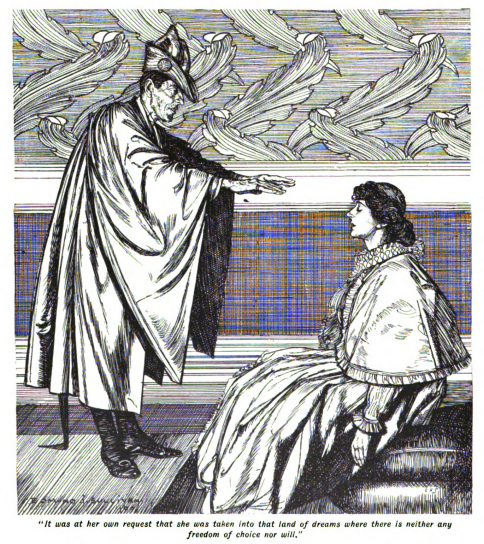
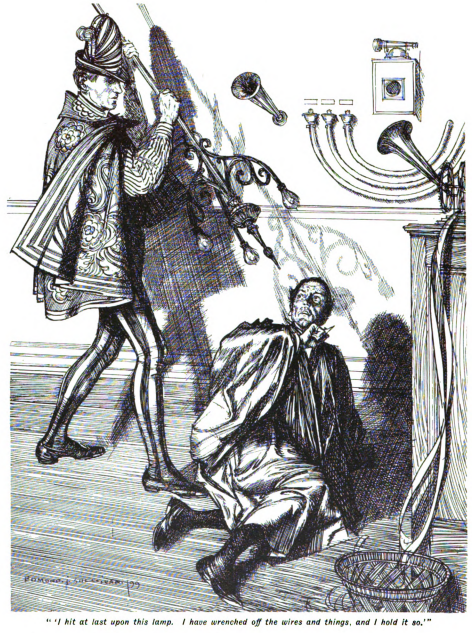
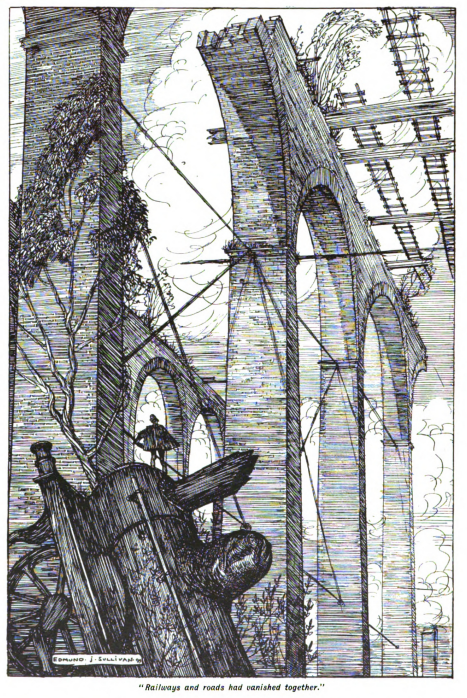
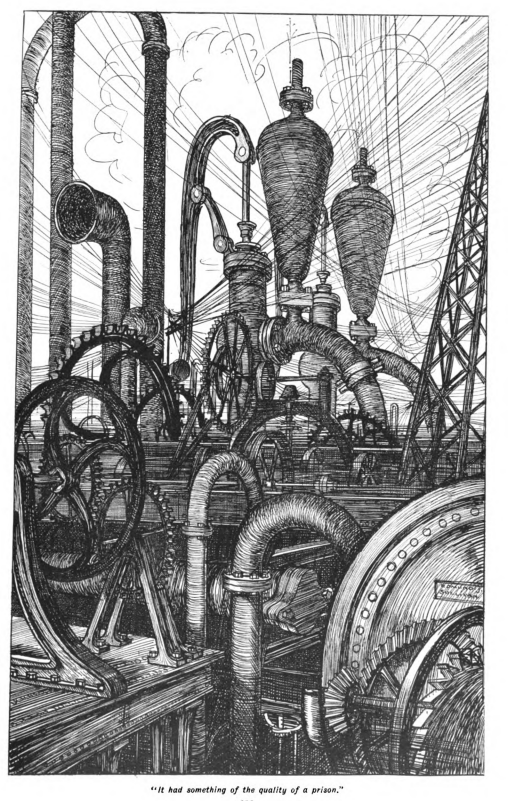
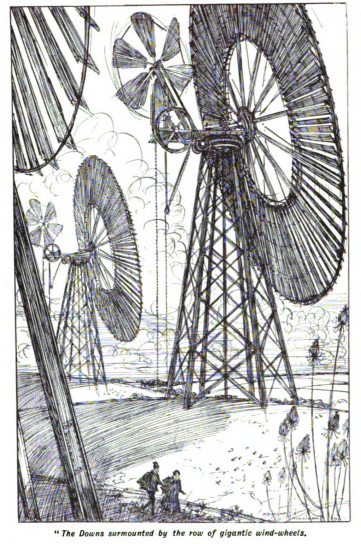
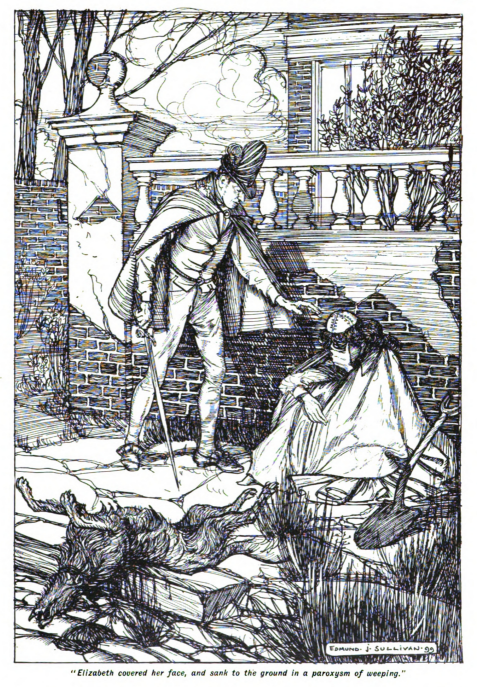
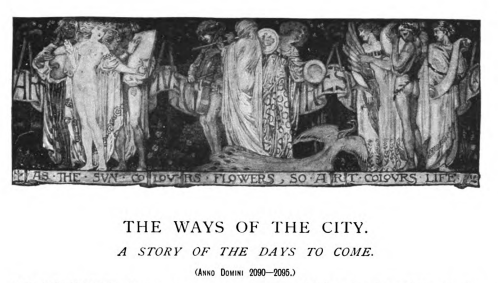
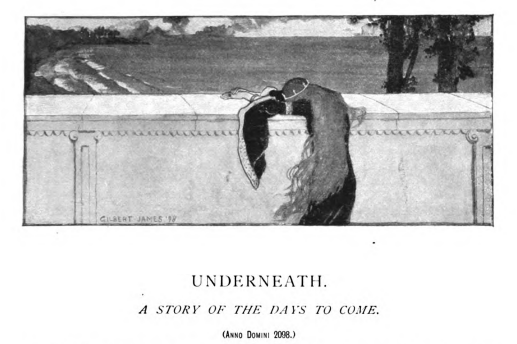
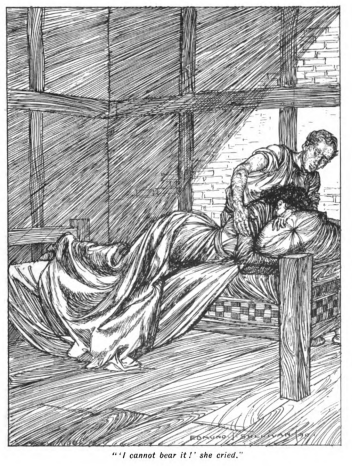
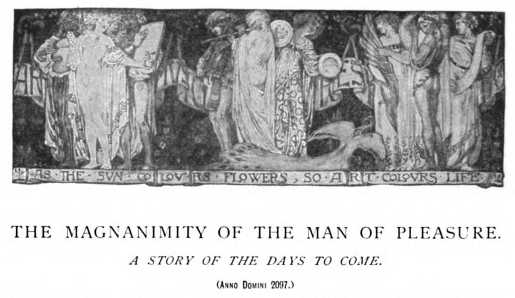
I’m going to include the original illustrations from Pall Mall Magazine; they were by Edmund J. Sullivan (1869–1933). (See Pete Beard’s video.) I’m doing that because I’m fascinated by how 19th-century people visualize this story. As I read the story, I kept trying to visualize some of the more vivid scenes. I even tried to get the AI Gemini to illustrate it. The header is one of the efforts it produced. But as I will show, it’s very hard to illustrate what writers put into words.
Pall Mall Magazine (June, 1899)
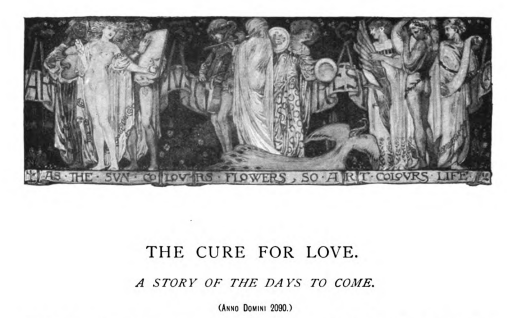
Elizabeth and Denton would meet under the London landing field, which Wells calls a flying stage. 1899 is before the Wright Brothers, but people back then were trying to fly. 19th-century folk visualized mechanical flying in charming illustrations. Wells imagines airports being above the city.
And meanwhile “Elizebeθ Mwres,” as she spelt her name, or “Elizabeth Morris” as a nineteenth-century person would have put it, was sitting in a quiet waiting-place beneath the great stage upon which the flying-machine from Paris descended. And beside her sat her slender, handsome lover reading her the poem he had written that morning while on duty upon the stage.
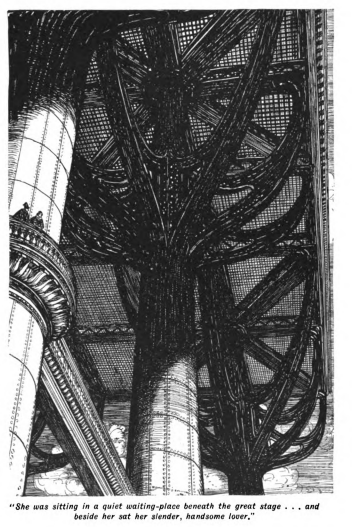
When he had finished they sat for a time in silence; and then, as if for their special entertainment, the great machine that had come flying through the air from America that morning rushed down out of the sky.
At first it was a little oblong, faint and blue amidst the distant fleecy clouds; and then it grew swiftly large and white, and larger and whiter, until they could see the separate tiers of sails, each hundreds of feet wide, and the lank body they supported, and at last even the swinging seats of the passengers in a dotted row. Although it was falling it seemed to them to be rushing up the sky, and over the roof-spaces of the city below its shadow leapt towards them. They heard the whistling rush of the air about it and its yelling siren, shrill and swelling, to warn those who were on its landing-stage of its arrival. And abruptly the note fell down a couple of octaves, and it had passed, and the sky was clear and void, and she could turn her sweet eyes again to Denton at her side.
“It is a thing we have sought to do for years and years,” said the hypnotist. “It is practically an artificial dream. And we know the way at last. Think of all it opens out to us—the enrichment of our experience, the recovery of adventure, the refuge it offers from this sordid, competitive life in which we live! Think!”
“And you can do that!” said the chaperone eagerly.
“The thing is possible at last,” the hypnotist said. “You may order a dream as you wish.”
The chaperone was the first to be hypnotised, and the dream, she said, was wonderful, when she came to again.
The other two girls, encouraged by her enthusiasm, also placed themselves in the hands of the hypnotist and had plunges into the romantic past. No one suggested that Elizabeth should try this novel entertainment; it was at her own request at last that she was taken into that land of dreams where there is neither any freedom of choice nor will….
And so the mischief was done.
“I looked about for a weapon also. It is an astonishing thing how few weapons there are nowadays. If you consider that in the Stone Age men owned scarcely anything but weapons. I hit at last upon this lamp. I have wrenched off the wires and things, and I hold it so.” He extended it over the hypnotist’s shoulders. “With that I can quite easily smash your skull. I will—unless you do as I tell you.”
“Violence is no remedy,” said the hypnotist, quoting from the “Modern Man’s Book of Moral Maxims.”
Pall Mall Magazine (July, 1899)
The world, they say, changed more between the year 1800 and the year 1900 than it had done in the previous five hundred years. That century, the nineteenth century, was the dawn of a new epoch in the history of mankind—the epoch of the great cities, the end of the old order of country life.
In the beginning of the nineteenth century the majority of mankind still lived upon the countryside, as their way of life had been for countless generations. All over the world they dwelt in little towns and villages then, and engaged either directly in agriculture, or in occupations that were of service to the agriculturist. They travelled rarely, and dwelt close to their work, because swift means of transit had not yet come. The few who travelled went either on foot, or in slow sailing-ships, or by means of jogging horses incapable of more than sixty miles a day. Think of it!—sixty miles a day. Here and there, in those sluggish times, a town grew a little larger than its neighbours, as a port or as a centre of government; but all the towns in the world with more than a hundred thousand inhabitants could be counted on a man’s fingers. So it was in the beginning of the nineteenth century. By the end, the invention of railways, telegraphs, steamships, and complex agricultural machinery, had changed all these things: changed them beyond all hope of return. The vast shops, the varied pleasures, the countless conveniences of the larger towns were suddenly possible, and no sooner existed than they were brought into competition with the homely resources of the rural centres. Mankind were drawn to the cities by an overwhelming attraction. The demand for labour fell with the increase of machinery, the local markets were entirely superseded, and there was a rapid growth of the larger centres at the expense of the open country.
The flow of population townward was the constant preoccupation of Victorian writers. In Great Britain and New England, in India and China, the same thing was remarked: everywhere a few swollen towns were visibly replacing the ancient order. That this was an inevitable result of improved means of travel and transport—that, given swift means of transit, these things must be—was realised by few; and the most puerile schemes were devised to overcome the mysterious magnetism of the urban centres, and keep the people on the land.
Yet the developments of the nineteenth century were only the dawning of the new order. The first great cities of the new time were horribly inconvenient, darkened by smoky fogs, insanitary and noisy; but the discovery of new methods of building, new methods of heating, changed all this. Between 1900 and 2000 the march of change was still more rapid; and between 2000 and 2100 the continually accelerated progress of human invention made the reign of Victoria the Good seem at last an almost incredible vision of idyllic tranquil days.
The introduction of railways was only the first step in that development of those means of locomotion which finally revolutionised human life. By the year 2000 railways and roads had vanished together. The railways, robbed of their rails, had become weedy ridges and ditches upon the face of the world; the old roads, strange barbaric tracks of flint and soil, hammered by hand or rolled by rough iron rollers, strewn with miscellaneous filth, and cut by iron hoofs and wheels into ruts and puddles often many inches deep, had been replaced by patent tracks made of a substance called Eadhamite. This Eadhamite—it was named after its patentee—ranks with the invention of printing and steam as one of the epoch-making discoveries of the world’s history.
Yet to marry and be very poor in the cities of that time was—for any one who had lived pleasantly—a very dreadful thing. In the old agricultural days that had drawn to an end in the eighteenth century there had been a pretty proverb of love in a cottage; and indeed in those days the poor of the countryside had dwelt in flower-covered, diamond-windowed cottages of thatch and plaster, with the sweet air and earth about them, amidst tangled hedges and the song of birds, and with the ever-changing sky overhead. But all this had changed (the change was already beginning in the nineteenth century), and a new sort of life was opening for the poor—in the lower quarters of the city.
In the nineteenth century the lower quarters were still beneath the sky; they were areas of land on clay or other unsuitable soil, liable to floods or exposed to the smoke of more fortunate districts, insufficiently supplied with water, and as insanitary as the great fear of infectious diseases felt by the wealthier classes permitted. In the twenty-second century, however, the growth of the city storey above storey, and the coalescence of buildings, had led to a different arrangement. The prosperous people lived in a vast series of sumptuous hotels in the upper storeys and halls of the city fabric; the industrial population dwelt beneath in the tremendous ground-floor and basement, so to speak, of the place.
In the refinement of life and manners these lower classes differed little from their ancestors, the East-enders of Queen Victoria’s time; but they had developed a distinct dialect of their own. In these under ways they lived and died, rarely ascending to the surface except when work took them there. Since for most of them this was the sort of life to which they had been born, they found no great misery in such circumstances; but for people like Denton and Elizabeth, such a plunge would have seemed more terrible than death.
Our two young people had secretly married, and were going forth manfully out of the city in which they and their ancestors before them had lived all their days. She wore a new dress of white cut in an old-fashioned pattern, and he had a bundle of provisions strapped athwart his back, and in his hand he carried—rather shame-facedly it is true, and under his purple cloak—an implement of archaic form, a cross-hilted thing of tempered steel.
Imagine that going forth! In their days the sprawling suburbs of Victorian times with their vile roads, petty houses, foolish little gardens of shrub and geranium, and all their futile, pretentious privacies, had disappeared: the towering buildings of the new age, the mechanical ways, the electric and water mains, all came to an end together, like a wall, like a cliff, near four hundred feet in height, abrupt and sheer. All about the city spread the carrot, swede, and turnip fields of the Food Company, vegetables that were the basis of a thousand varied foods, and weeds and hedgerow tangles had been utterly extirpated. The incessant expense of weeding that went on year after year in the petty, wasteful and barbaric farming of the ancient days, the Food Company had economised for ever more by a campaign of extermination. Here and there, however, neat rows of bramble standards and apple trees with whitewashed stems, intersected the fields, and at places groups of gigantic teazles reared their favoured spikes. Here and there huge agricultural machines hunched under waterproof covers. The mingled waters of the Wey and Mole and Wandle ran in rectangular channels; and wherever a gentle elevation of the ground permitted a fountain of deodorised sewage distributed its benefits athwart the land and made a rainbow of the sunlight.
By a great archway in that enormous city wall emerged the Eadhamite road to Portsmouth, swarming in the morning sunshine with an enormous traffic bearing the blue-clad servants of the Food Company to their toil. A rushing traffic, beside which they seemed two scarce-moving dots. Along the outer tracks hummed and rattled the tardy little old-fashioned motors of such as had duties within twenty miles or so of the city; the inner ways were filled with vaster mechanisms—swift monocycles bearing a score of men, lank multicycles, quadricycles sagging with heavy loads, empty gigantic produce carts that would come back again filled before the sun was setting, all with throbbing engines and noiseless wheels and a perpetual wild melody of horns and gongs.
Along the very verge of the outermost way our young people went in silence, newly wed and oddly shy of one another’s company. Many were the things shouted to them as they tramped along, for in 2100 a foot-passenger on an English road was almost as strange a sight as a motor car would have been in 1800. But they went on with steadfast eyes into the country, paying no heed to such cries.
Before them in the south rose the Downs, blue at first, and as they came nearer changing to green, surmounted by the row of gigantic wind-wheels that supplemented the wind-wheels upon the roof-spaces of the city, and broken and restless with the long morning shadows of those whirling vanes. By midday they had come so near that they could see here and there little patches of pallid dots—the sheep the Meat Department of the Food Company owned. In another hour they had passed the clay and the root crops and the single fence that hedged them in, and the prohibition against trespass no longer held: the levelled roadway plunged into a cutting with all its traffic, and they could leave it and walk over the greensward and up the open hillside.
Never had these children of the latter days been together in such a lonely place.
Denton tried again, but the barking still drowned his voice. The sound had a curious effect upon his blood. Odd disused emotions began to stir; his face changed as he shouted. He tried again; the barking seemed to mock him, and one dog danced a pace forward, bristling. Suddenly he turned, and uttering certain words in the dialect of the underways, words incomprehensible to Elizabeth, he made for the dogs. There was a sudden cessation of the barking, a growl and a snapping. Elizabeth saw the snarling head of the foremost dog, its white teeth and retracted ears, and the flash of the thrust blade. The brute leapt into the air and was flung back.
Then Denton, with a shout, was driving the dogs before him. The sword flashed above his head with a sudden new freedom of gesture, and then he vanished down the staircase. She made six steps to follow him, and on the landing there was blood. She stopped, and hearing the tumult of dogs and Denton’s shouts pass out of the house, ran to the window.
Nine wolfish sheep-dogs were scattering, one writhed before the porch; and Denton, tasting that strange delight of combat that slumbers still in the blood of even the most civilised man, was shouting and running across the garden space. And then she saw something that for a moment he did not see. The dogs circled round this way and that, and came again. They had him in the open.
In an instant she divined the situation. She would have called to him. For a moment she felt sick and helpless, and then, obeying a strange impulse, she gathered up her white skirt and ran downstairs. In the hall was the rusting spade. That was it! She seized it and ran out.
She came none too soon. One dog rolled before him, well-nigh slashed in half; but a second had him by the thigh, a third gripped his collar behind, and a fourth had the blade of the sword between its teeth, tasting its own blood. He parried the leap of a fifth with his left arm.
It might have been the first century instead of the twenty-second, so far as she was concerned. All the gentleness of her eighteen years of city life vanished before this primordial need. The spade smote hard and sure, and cleft a dog’s skull. Another, crouching for a spring, yelped with dismay at this unexpected antagonist, and rushed aside. Two wasted precious moments on the binding of a feminine skirt.
The collar of Denton’s cloak tore and parted as he staggered back; and that dog too felt the spade, and ceased to trouble him. He sheathed his sword in the brute at his thigh.
“To the wall!” cried Elizabeth; and in three seconds the fight was at an end, and our young people stood side by side, while a remnant of five dogs, with ears and tails of disaster, fled shamefully from the stricken field.
For a moment they stood panting and victorious, and then Elizabeth, dropping her spade, covered her face, and sank to the ground in a paroxysm of weeping. Denton looked about him, thrust the point of his sword into the ground so that it was at hand, and stooped to comfort her.
Pall Mall Magazine (August, 1899)
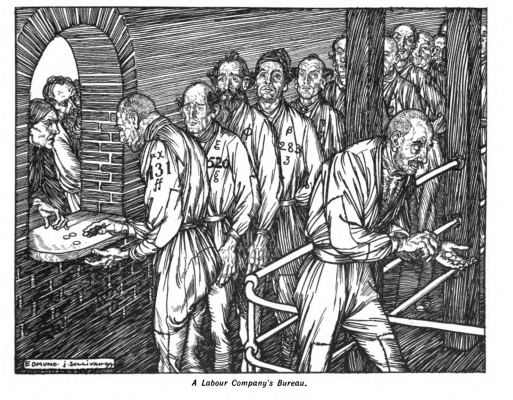
And three weeks after our young people were absolutely penniless, and only one way lay open. They must go to the Labour Company. So soon as the rent was a week overdue their few remaining possessions were seized, and with scant courtesy they were shown the way out of the hotel. Elizabeth walked along the passage towards the staircase that ascended to the motionless middle way, too dulled by misery to think. Denton stopped behind to finish a stinging and unsatisfactory argument with the hotel porter, and then came hurrying after her, flushed and hot. He slackened his pace as he overtook her, and together they ascended to the middle way in silence. There they found two seats vacant and sat down.
“We need not go there—yet?” said Elizabeth.
“No—not till we are hungry,” said Denton.
They said no more.
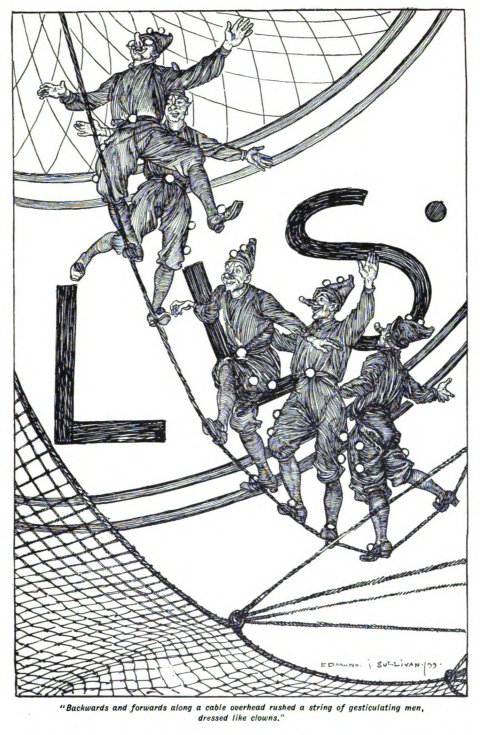
Elizabeth’s eyes sought a resting-place and found none. To the right roared the eastward ways, to the left the ways in the opposite direction, swarming with people. Backwards and forwards along a cable overhead rushed a string of gesticulating men, dressed like clowns, each marked on back and chest with one gigantic letter, so that altogether they spelt out:
“Purkinje’s Digestive Pills.”
When they had made the exchange of their clothing Elizabeth did not seem able to look at Denton at first; but he looked at her, and saw with astonishment that even in blue canvas she was still beautiful. And then their soup and bread came sliding on its little rail down the long table towards them and stopped with a jerk, and he forgot the matter. For they had had no proper meal for three days.
After they had dined they rested for a time. Neither talked—there was nothing to say; and presently they got up and went back to the manageress to learn what they had to do.
The manageress referred to a tablet. “Y’r rooms won’t be here; it’ll be in the Highbury Ward, Ninety-seventh Way, number two thousand and seventeen. Better make a note of it on y’r card. You, nought nought nought, type seven, sixty-four, b.c.d., gamma forty-one, female; you ‘ave to go to the Metal-beating Company and try that for a day—fourpence bonus if ye’re satisfactory; and you, nought seven one, type four, seven hundred and nine, g.f.b., pi five and ninety, male; you ‘ave to go to the Photographic Company on Eighty-first Way, and learn something or other—I don’t know—thrippence. ‘Ere’s y’r cards. That’s all. Next! What? Didn’t catch it all? Lor! So suppose I must go over it all again. Why don’t you listen? Keerless, unprovident people! One’d think these things didn’t matter.”
Their ways to their work lay together for a time. And now they found they could talk. Curiously enough, the worst of their depression seemed over now that they had actually donned the blue. Denton could talk with interest even of the work that lay before them. “Whatever it is,” he said, “it can’t be so hateful as that hat shop. And after we have paid for Dings, we shall still have a whole penny a day between us even now. Afterwards—we may improve,—get more money.”
Elizabeth was less inclined to speech. “I wonder why work should seem so hateful,” she said.
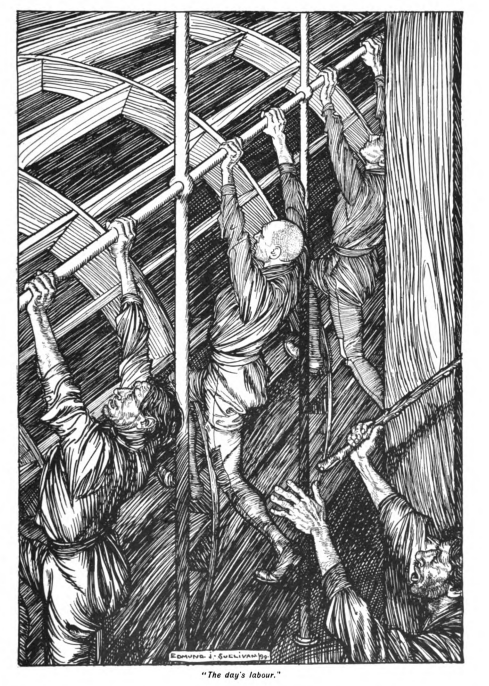
Presently it was time for them to part, and each went to the appointed work. Denton’s was to mind a complicated hydraulic press that seemed almost an intelligent thing. This press worked by the sea-water that was destined finally to flush the city drains—for the world had long since abandoned the folly of pouring drinkable water into its sewers. This water was brought close to the eastward edge of the city by a huge canal, and then raised by an enormous battery of pumps into reservoirs at a level of four hundred feet above the sea, from which it spread by a billion arterial branches over the city. Thence it poured down, cleansing, sluicing, working machinery of all sorts, through an infinite variety of capillary channels into the great drains, the cloacae maximae, and so carried the sewage out to the agricultural areas that surrounded London on every side.
The press was employed in one of the processes of the photographic manufacture, but the nature of the process it did not concern Denton to understand. The most salient fact to his mind was that it had to be conducted in ruby light, and as a consequence the room in which he worked was lit by one coloured globe that poured a lurid and painful illumination about the room. In the darkest corner stood the press whose servant Denton had now become: it was a huge, dim, glittering thing with a projecting hood that had a remote resemblance to a bowed head, and, squatting like some metal Buddha in this weird light that ministered to its needs, it seemed to Denton in certain moods almost as if this must needs be the obscure idol to which humanity in some strange aberration had offered up his life. His duties had a varied monotony. Such items as the following will convey an idea of the service of the press. The thing worked with a busy clicking so long as things went well; but if the paste that came pouring through a feeder from another room and which it was perpetually compressing into thin plates, changed in quality the rhythm of its click altered and Denton hastened to make certain adjustments. The slightest delay involved a waste of paste and the docking of one or more of his daily pence. If the supply of paste waned—there were hand processes of a peculiar sort involved in its preparation, and sometimes the workers had convulsions which deranged their output—Denton had to throw the press out of gear. In the painful vigilance a multitude of such trivial attentions entailed, painful because of the incessant effort its absence of natural interest required, Denton had now to pass one-third of his days. Save for an occasional visit from the manager, a kindly but singularly foul-mouthed man, Denton passed his working hours in solitude.
They were permitted, and even encouraged to converse with each other, for the directors very properly judged that anything that conduced to variations of mood made for pleasing fluctuations in their patterning; and Elizabeth was almost forced to hear the stories of these lives with which her own interwove: garbled and distorted they were by vanity indeed and yet comprehensible enough. And soon she began to appreciate the small spites and cliques, the little misunderstandings and alliances that enmeshed about her. One woman was excessively garrulous and descriptive about a wonderful son of hers; another had cultivated a foolish coarseness of speech, that she seemed to regard as the wittiest expression of originality conceivable; a third mused for ever on dress, and whispered to Elizabeth how she saved her pence day after day, and would presently have a glorious day of freedom, wearing … and then followed hours of description; two others sat always together, and called one another pet names, until one day some little thing happened, and they sat apart, blind and deaf as it seemed to one another’s being. And always from them all came an incessant tap, tap, tap, tap, and the manageress listened always to the rhythm to mark if one fell away. Tap, tap, tap, tap: so their days passed, so their lives must pass. Elizabeth sat among them, kindly and quiet, grey-hearted, marvelling at Fate: tap, tap, tap; tap, tap, tap; tap, tap, tap.
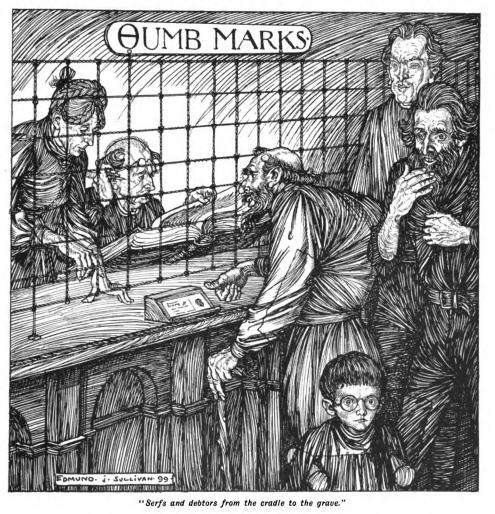
So there came to Denton and Elizabeth a long succession of laborious days, that hardened their hands, wove strange threads of some new and sterner substance into the soft prettiness of their lives, and drew grave lines and shadows on their faces. The bright, convenient ways of the former life had receded to an inaccessible distance; slowly they learnt the lesson of the underworld—sombre and laborious, vast and pregnant. There were many little things happened: things that would be tedious and miserable to tell, things that were bitter and grievous to bear—indignities, tyrannies, such as must ever season the bread of the poor in cities; and one thing that was not little, but seemed like the utter blackening of life to them, which was that the child they had given life to sickened and died. But that story, that ancient, perpetually recurring story, has been told so often, has been told so beautifully, that there is no need to tell it over again here. There was the same sharp fear, the same long anxiety, the deferred inevitable blow, and the black silence. It has always been the same; it will always be the same. It is one of the things that must be.
Pall Mall Magazine (September, 1899)
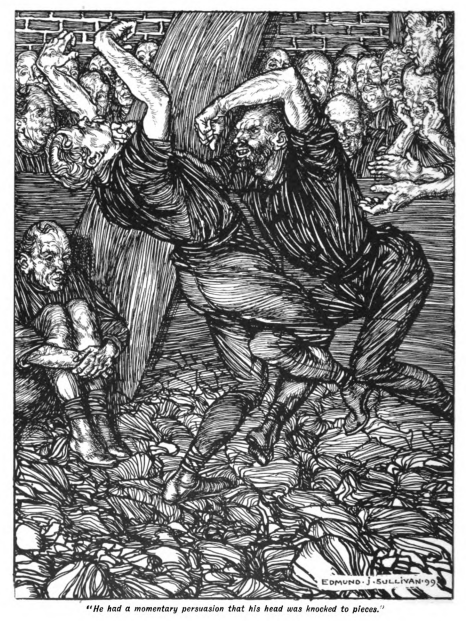
There came a pause, and then they both moved quickly. The cube of bread described a complicated path, a curve that would have ended in Denton’s face; and then his fist hit the wrist of the hand that gripped it, and it flew upward, and out of the conflict—its part played.
He stepped back quickly, fists clenched and arms tense. The hot, dark countenance receded, became an alert hostility, watching its chance. Denton for one instant felt confident, and strangely buoyant and serene. His heart beat quickly. He felt his body alive, and glowing to the tips.
“Scrap, boys!” shouted some one, and then the dark figure had leapt forward, ducked back and sideways, and come in again. Denton struck out, and was hit. One of his eyes seemed to him to be demolished, and he felt a soft lip under his fist just before he was hit again—this time under the chin. A huge fan of fiery needles shot open. He had a momentary persuasion that his head was knocked to pieces, and then something hit his head and back from behind, and the fight became an uninteresting, an impersonal thing.
He was aware that time—seconds or minutes—had passed, abstract, uneventful time. He was lying with his head in a heap of ashes, and something wet and warm ran swiftly into his neck. The first shock broke up into discrete sensations. All his head throbbed; his eye and his chin throbbed exceedingly, and the taste of blood was in his mouth.
“He’s all right,” said a voice. “He’s opening his eyes.”
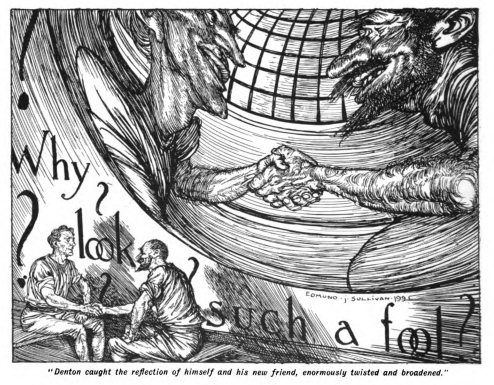
The swart man’s face retained no traces of his share in the fight; his expression was free from hostility—seemed almost deferential. “‘Scuse me,” he said, with a total absence of truculence. Denton realised that no assault was intended. He stared, awaiting the next development.
It was evident the next sentence was premeditated. “Whad—I—was—going—to say—was this,” said the swart man, and sought through a silence for further words.
“Whad—I—was—going—to say—was this,” he repeated.
Finally he abandoned that gambit. “You’re aw right,” he cried, laying a grimy hand on Denton’s grimy sleeve. “You’re aw right. You’re a ge’man. Sorry—very sorry. Wanted to tell you that.”
Denton realised that there must exist motives beyond a mere impulse to abominable proceedings in the man. He meditated, and swallowed an unworthy pride.
“I did not mean to be offensive to you,” he said, “in refusing that bit of bread.”
“Meant it friendly,” said the swart man, recalling the scene; “but—in front of that blarsted Whitey and his snigger—Well—I ‘ad to scrap.”
“Yes,” said Denton with sudden fervour: “I was a fool.”
“Ah!” said the swart man, with great satisfaction. “That’s aw right. Shake!”
And Denton shook.
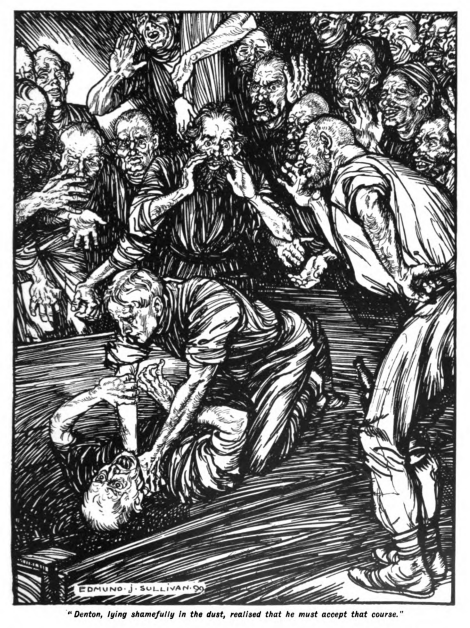
Whitey was not popular, and the vault disgorged to see him haze the new man with only a languid interest. But matters changed when Whitey’s attempt to open the proceedings by kicking Denton in the face was met by an excellently executed duck, catch and throw, that completed the flight of Whitey’s foot in its orbit and brought Whitey’s head into the ash-heap that had once received Denton’s. Whitey arose a shade whiter, and now blasphemously bent upon vital injuries. There were indecisive passages, foiled enterprises that deepened Whitey’s evidently growing perplexity; and then things developed into a grouping of Denton uppermost with Whitey’s throat in his hand, his knee on Whitey’s chest, and a tearful Whitey with a black face, protruding tongue and broken finger endeavouring to explain the misunderstanding by means of hoarse sounds. Moreover, it was evident that among the bystanders there had never been a more popular person than Denton.
Denton, with proper precaution, released his antagonist and stood up. His blood seemed changed to some sort of fluid fire, his limbs felt light and supernaturally strong. The idea that he was a martyr in the civilisation machine had vanished from his mind. He was a man in a world of men.
The little ferret-faced man was the first in the competition to pat him on the back. The lender of oil cans was a radiant sun of genial congratulation…. It seemed incredible to Denton that he had ever thought of despair.
“I hate it! I hate this horrible canvas! I hate it more than—more than the worst that can happen. It hurts my fingers to touch it. It is horrible to the skin. And the women I work with day after day! I lie awake at nights and think how I may be growing like them….”
She stopped. “I am growing like them,” she cried passionately.
Denton stared at her distress. “But—” he said and stopped.
“You don’t understand. What have I? What have I to save me? You can fight. Fighting is man’s work. But women—women are different…. I have thought it all out, I have done nothing but think night and day. Look at the colour of my face! I cannot go on. I cannot endure this life…. I cannot endure it.”
She stopped. She hesitated.
“You do not know all,” she said abruptly, and for an instant her lips had a bitter smile. “I have been asked to leave you.”
“Leave me!”
She made no answer save an affirmative movement of the head.
Denton stood up sharply. They stared at one another through a long silence.
Suddenly she turned herself about, and flung face downward upon their canvas bed. She did not sob, she made no sound. She lay still upon her face. After a vast, distressful void her shoulders heaved and she began to weep silently.
“Elizabeth!” he whispered—”Elizabeth!”
Very softly he sat down beside her, bent down, put his arm across her in a doubtful caress, seeking vainly for some clue to this intolerable situation.
“Elizabeth,” he whispered in her ear.
She thrust him from her with her hand. “I cannot bear a child to be a slave!” and broke out into loud and bitter weeping.
Denton’s face changed—became blank dismay. Presently he slipped from the bed and stood on his feet. All the complacency had vanished from his face, had given place to impotent rage. He began to rave and curse at the intolerable forces which pressed upon him, at all the accidents and hot desires and heedlessness that mock the life of man. His little voice rose in that little room, and he shook his fist, this animalcule of the earth, at all that environed him about, at the millions about him, at his past and future and all the insensate vastness of the overwhelming city.
Pall Mall Magazine (October, 1899)
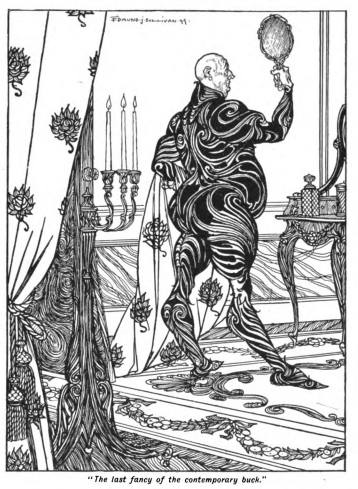
At times he would distend himself with pneumatic vestments in the rococo vein. From among the billowy developments of this style, and beneath a translucent and illuminated headdress, his eye watched jealously for the respect of the less fashionable world. At other times he emphasised his elegant slenderness in close-fitting garments of black satin. For effects of dignity he would assume broad pneumatic shoulders, from which hung a robe of carefully arranged folds of China silk, and a classical Bindon in pink tights was also a transient phenomenon in the eternal pageant of Destiny. In the days when he hoped to marry Elizabeth, he sought to impress and charm her, and at the same time to take off something of his burthen of forty years, by wearing the last fancy of the contemporary buck, a costume of elastic material with distensible warts and horns, changing in colour as he walked, by an ingenious arrangement of versatile chromatophores. And no doubt, if Elizabeth’s affection had not been already engaged by the worthless Denton, and if her tastes had not had that odd bias for old-fashioned ways, this extremely chic conception would have ravished her. Bindon had consulted Elizabeth’s father before presenting himself in this garb—he was one of those men who always invite criticism of their costume—and Mwres had pronounced him all that the heart of woman could desire. But the affair of the hypnotist proved that his knowledge of the heart of woman was incomplete.
Bindon tried to argue for an extension of time, and in the midst of his pleading gasped, put his hand to his side. Suddenly the extraordinary pathos of his life came to him clear and vivid. “It’s hard,” he said. “It’s infernally hard! I’ve been no man’s enemy but my own. I’ve always treated everybody quite fairly.”
The medical man stared at him without any sympathy for some seconds. He was reflecting how excellent it was that there were no more Bindons to carry on that line of pathos. He felt quite optimistic. Then he turned to his telephone and ordered up a prescription from the Central Pharmacy.
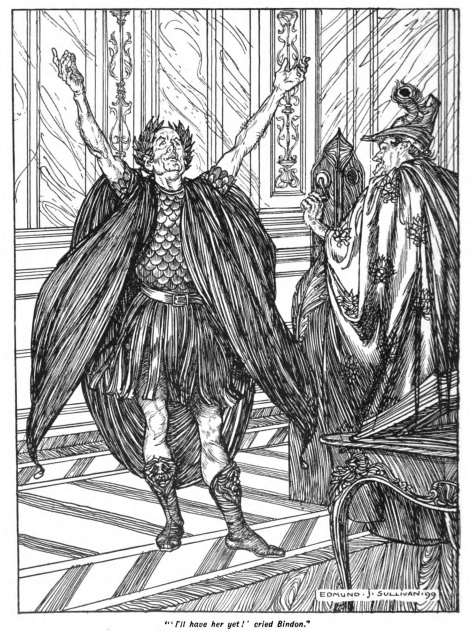
He was interrupted by a voice behind him. “By God!” cried Bindon; “I’ll have her yet.”
The physician stared over his shoulder at Bindon’s expression, and then altered the prescription.
So soon as this painful interview was over, Bindon gave way to rage. He settled that the medical man was not only an unsympathetic brute and wanting in the first beginnings of a gentleman, but also highly incompetent; and he went off to four other practitioners in succession, with a view to the establishment of this intuition. But to guard against surprises he kept that little prescription in his pocket. With each he began by expressing his grave doubts of the first doctor’s intelligence, honesty and professional knowledge, and then stated his symptoms, suppressing only a few more material facts in each case. These were always subsequently elicited by the doctor. In spite of the welcome depreciation of another practitioner, none of these eminent specialists would give Bindon any hope of eluding the anguish and helplessness that loomed now close upon him. To the last of them he unburthened his mind of an accumulated disgust with medical science. “After centuries and centuries,” he exclaimed hotly; “and you can do nothing—except admit your helplessness. I say, ‘save me’—and what do you do?”
Then it came into his head that he was alone. Nobody cared for him, nobody needed him! at any moment he might begin to hurt vividly. He might even howl. Nobody would mind. According to all the doctors he would have excellent reason for howling in a day or so. It recalled what his spiritual adviser had said of the decline of faith and fidelity, the degeneration of the age. He beheld himself as a pathetic proof of this; he, the subtle, able, important, voluptuous, cynical, complex Bindon, possibly howling, and not one faithful simple creature in all the world to howl in sympathy. Not one faithful simple soul was there—no shepherd to pipe to him! Had all such faithful simple creatures vanished from this harsh and urgent earth? He wondered whether the horrid vulgar crowd that perpetually went about the city could possibly know what he thought of them. If they did he felt sure some would try to earn a better opinion. Surely the world went from bad to worse. It was becoming impossible for Bindons. Perhaps some day … He was quite sure that the one thing he had needed in life was sympathy. For a time he regretted that he left no sonnets—no enigmatical pictures or something of that sort behind him to carry on his being until at last the sympathetic mind should come….
It seemed incredible to him that this that came was extinction. Yet his sympathetic spiritual guide was in this matter annoyingly figurative and vague. Curse science! It had undermined all faith—all hope. To go out, to vanish from theatre and street, from office and dining-place, from the dear eyes of womankind. And not to be missed! On the whole to leave the world happier!
He reflected that he had never worn his heart upon his sleeve. Had he after all been too unsympathetic? Few people could suspect how subtly profound he really was beneath the mask of that cynical gaiety of his. They would not understand the loss they had suffered. Elizabeth, for example, had not suspected….
He had reserved that. His thoughts having come to Elizabeth gravitated about her for some time. How little Elizabeth understood him!
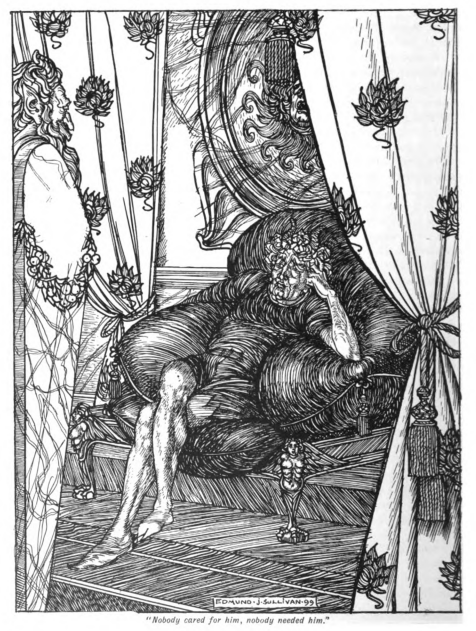
He shared something of the growing knowledge of the time; he could picture the quaint smoke-grimed Victorian city with its narrow little roads of beaten earth, its wide common-land, ill-organised, ill-built suburbs, and irregular enclosures; the old countryside of the Stuart times, with its little villages and its petty London; the England of the monasteries, the far older England of the Roman dominion, and then before that a wild country with here and there the huts of some warring tribe. These huts must have come and gone and come again through a space of years that made the Roman camp and villa seem but yesterday; and before those years, before even the huts, there had been men in the valley. Even then—so recent had it all been when one judged it by the standards of geological time—this valley had been here; and those hills yonder, higher, perhaps, and snow-tipped, had still been yonder hills, and the Thames had flowed down from the Cotswolds to the sea. But the men had been but the shapes of men, creatures of darkness and ignorance, victims of beasts and floods, storms and pestilence and incessant hunger. They had held a precarious foothold amidst bears and lions and all the monstrous violence of the past. Already some at least of these enemies were overcome….
For a time Denton pursued the thoughts of this spacious vision, trying in obedience to his instinct to find his place and proportion in the scheme.
“It has been chance,” he said, “it has been luck. We have come through. It happens we have come through. Not by any strength of our own….
“And yet … No. I don’t know.”
He was silent for a long time before he spoke again.
“After all—there is a long time yet. There have scarcely been men for twenty thousand years—and there has been life for twenty millions. And what are generations? What are generations? It is enormous, and we are so little. Yet we know—we feel. We are not dumb atoms, we are part of it—part of it—to the limits of our strength and will. Even to die is part of it. Whether we die or live, we are in the making….
“As time goes on—perhaps—men will be wiser…. Wiser….
“Will they ever understand?”
He became silent again. Elizabeth said nothing to these things, but she regarded his dreaming face with infinite affection. Her mind was not very active that evening. A great contentment possessed her. After a time she laid a gentle hand on his beside her. He fondled it softly, still looking out upon the spacious gold-woven view. So they sat as the sun went down. Until presently Elizabeth shivered.
Denton recalled himself abruptly from these spacious issues of his leisure, and went in to fetch her a shawl.
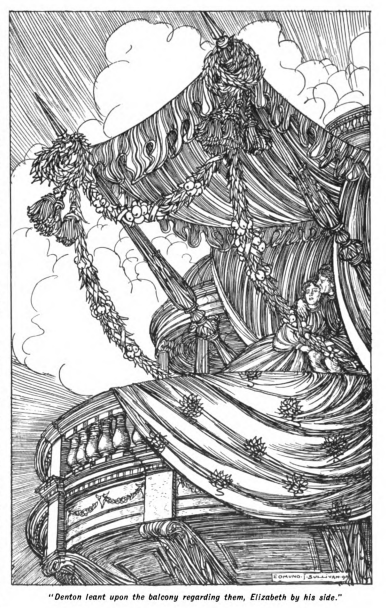
The End
After I finished reading this story, I thought it would make a great graphic novel. I know people create such works with the help of AI. So, thought of the scene where Elizabeth and Denton are on the platform watching airships come in. I thought that would make a spectacular graphic. Here are some of the results I got.
This was the first, and maybe the best, in terms of what the book might be suggesting. In 1899, they had no idea what flying machines would look like, or even what airports would look like.
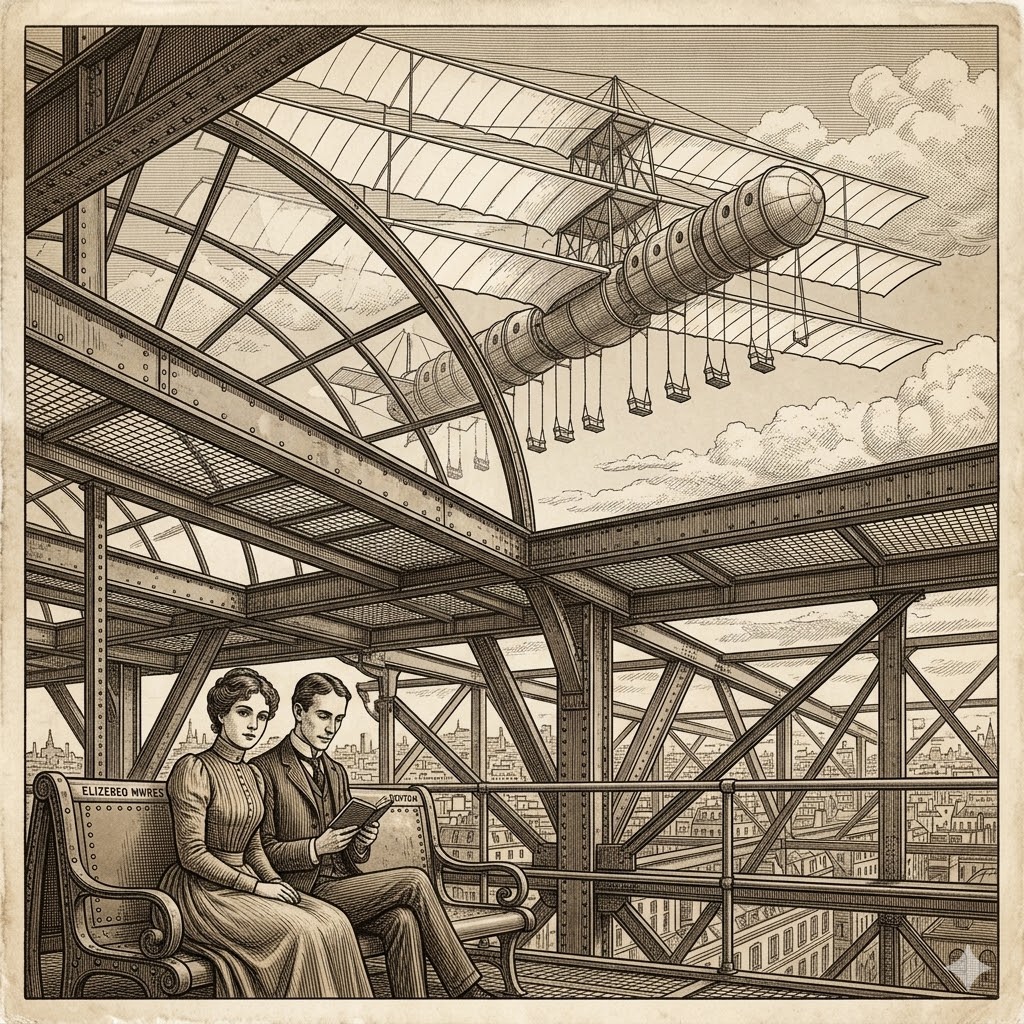
However, I wanted color. And adjusted my prompt.
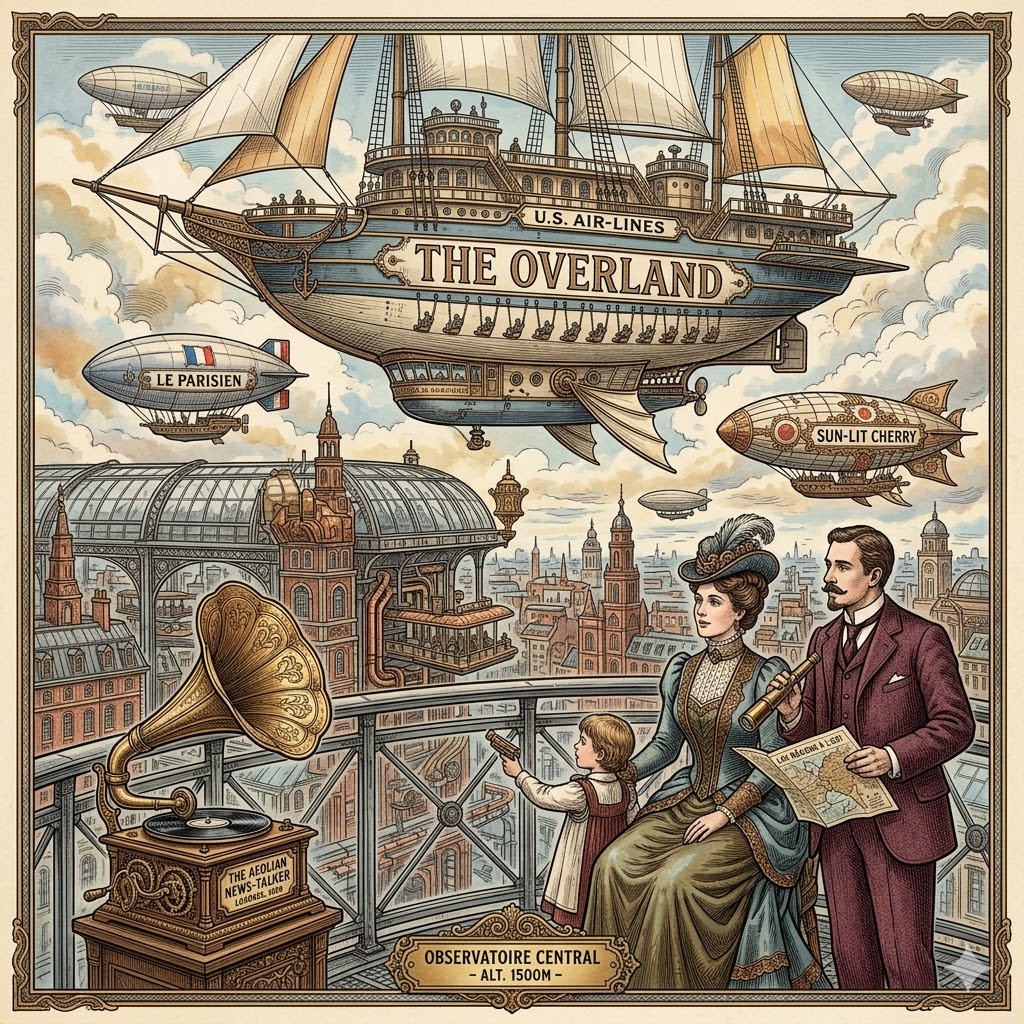
I thought this was better, but I didn’t like the Victorian clothes. And the kid shouldn’t be there. I suggested a tiny bit of cyberbunk.
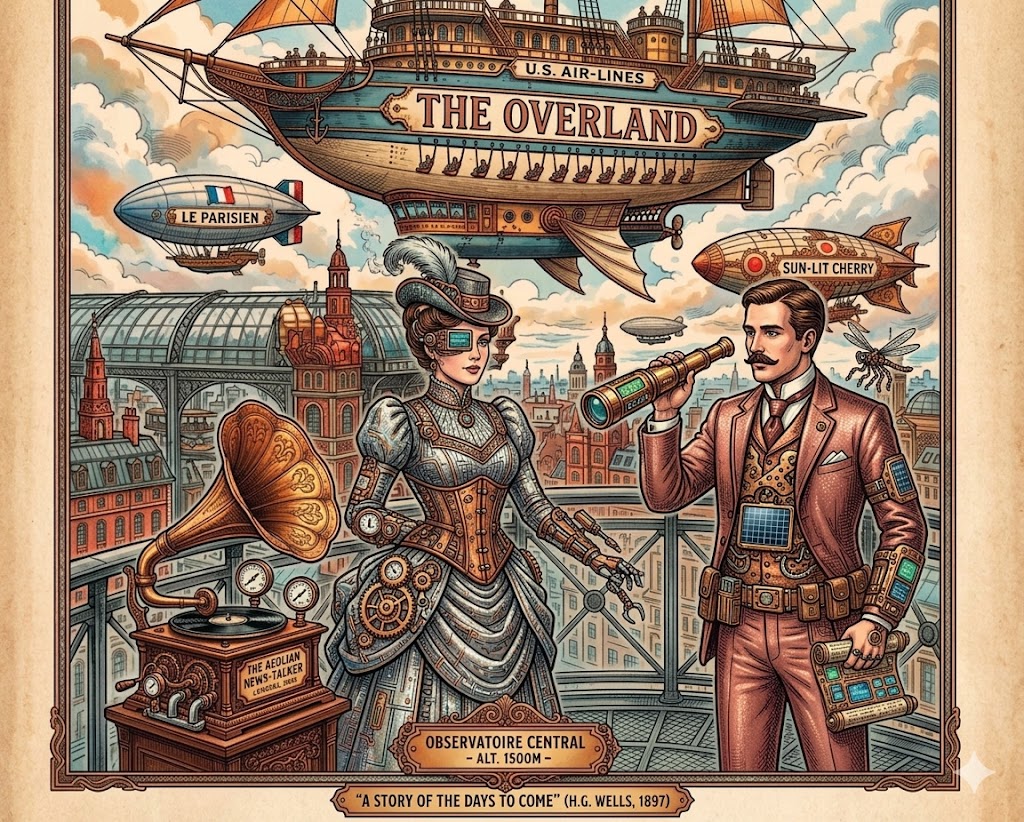
I thought this was too much cyberpunk. Nothing in the story suggested it. I adjusted the prompt and got this next. Note that it got the date wrong, giving 1897 for the story. I later discovered a website with that date. So it wasn’t the AI’s fault. I asked it to remove the cyberpunk and change the fashion, and give me something like Frank R. Paul would paint.
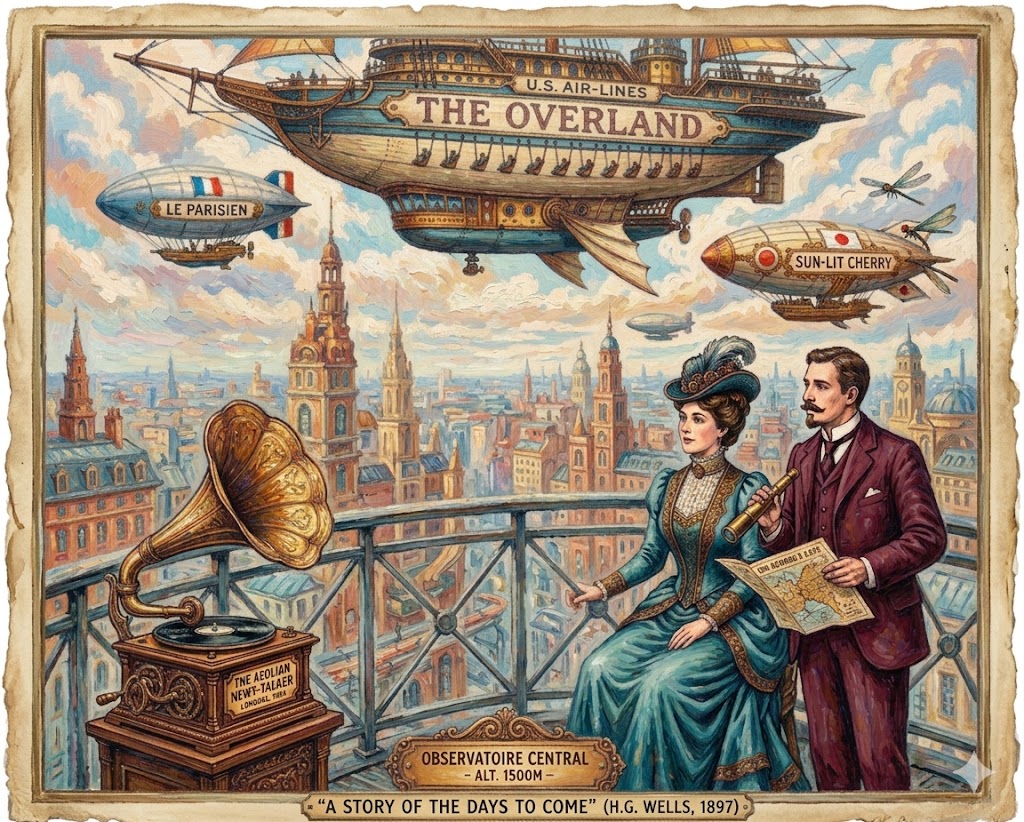
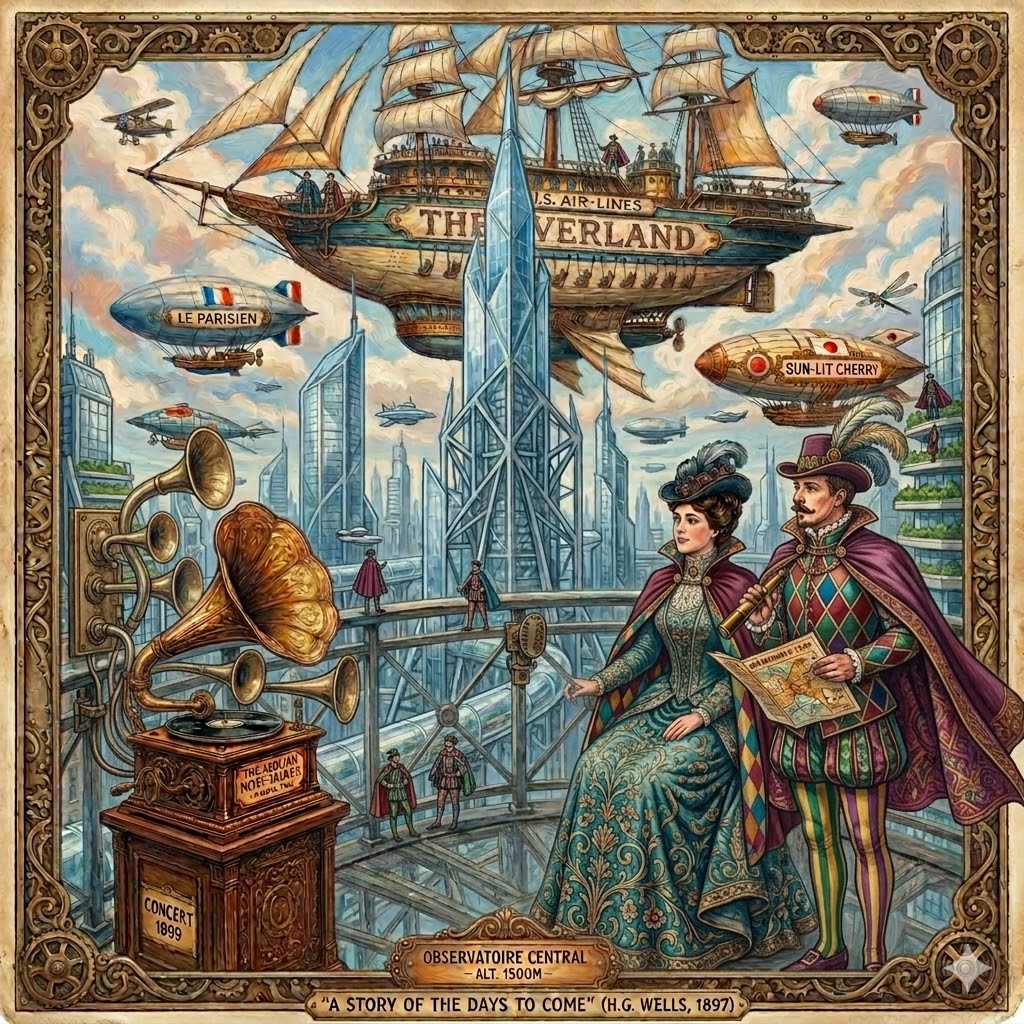
This wasn’t it. And it went back to older buildings. I told Gemini I wanted futuristic buildings. I also gave it a copy of an illustration from the first issue that showed how Sullivan imagined people in the future would dress – see above. The result was closer, but still too far from how I imagined. So I gave up.
I realized that conveying what I thought the illustrations should look like in words would become a big job. I then remembered this illustration from the 19th century. I thought if I could find enough 19th-century illustrations to train Gemini, I could achieve what I had pictured in the story.
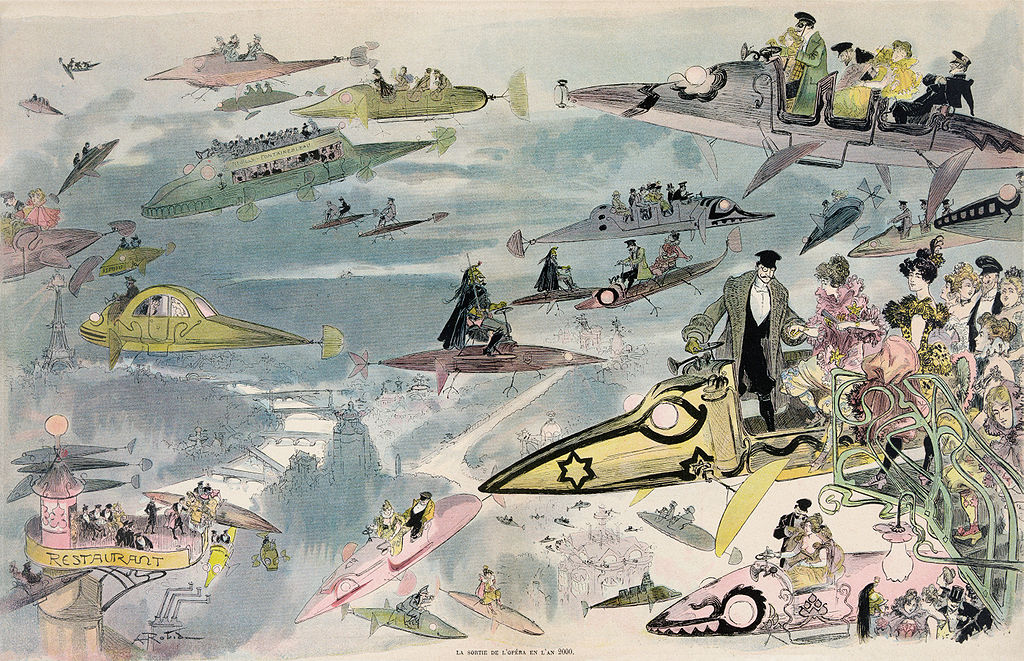
To get closer to where I wanted to be, I realized this could take weeks. But it might be fun. I would need to gather examples to feed the AI, and then create very specific prompts. I don’t know if I have the patience for this. But maybe someone reading this post might.
James Wallace Harris, 3/19/26







 Classics of Science Fiction