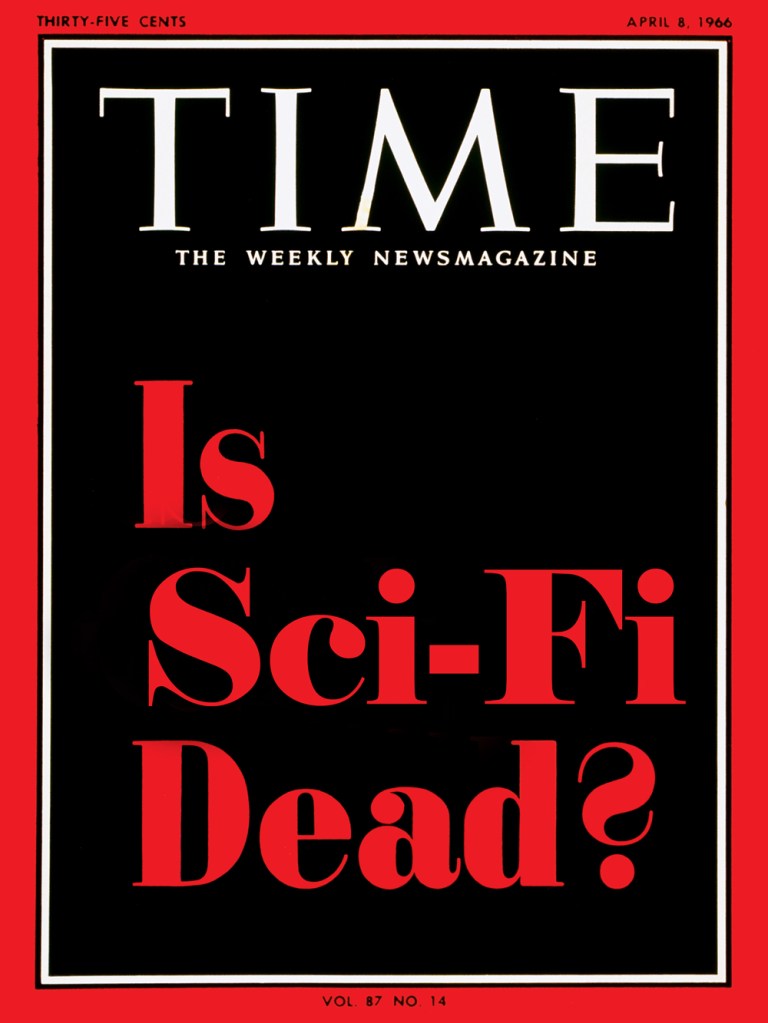
The April 8, 1966, cover of Time Magazine asked in large letters: Is God Dead? I would have answered yes, because starting in late 1963, when I turned twelve, I began to struggle with the idea of believing in God. Before I turned fourteen in late 1965, I had decided I was an atheist. It wasn’t an easy decision. Decades later, I realized that I had given up God and had embraced science fiction as a substitute for religion.
If someone had told me that at the time I would have vehemently denied it because I passionately believed I couldn’t be fooled by make believe concepts. I was for science all the way. Of course, when you’re thirteen years old you’re a dumb ass but don’t know it. I couldn’t see I was substituting one set of wishes for another.
If you look at the concept of God as a hypothesis to explain reality, then we would have to say that concept has been rejected long ago by well educated people thinking in complex and multiplex terms. That doesn’t mean that people have stopped believing in God. Nearly every concept every imagined still has its believers. For explaining reality, science surpassed religion a long time ago.
I believe science fiction as a concept that emerged in the 1920s, 1930s, and 1940s proposed a central hypothesis. That humanity was destined to explore the solar system, the galaxy, and even the universe. Science fiction has proposed many possible concepts that may or may not exist or will exist, but space travel is its big idea.
I believe science fiction’s core belief is space is the final frontier, that space travel is humanity’s manifest destiny, and our existential purpose. I was a true believer in that assumption for most of my life. I now doubt it. I’m becoming an atheist to my chosen religion, science fiction.
If you study science, intergalactic travel will be almost impossible. And even the colonization of the solar system really isn’t practical or in the end, desirable. The claim that we need to get all our genetic eggs off one planet really isn’t practical either as we learn just how adapted humans are to Earth.
Science fiction also proposed another hypothesis, that we will build intelligent machines. That looks like it will be proven correct. And it’s obvious that intelligent machines are suited to explore the solar system and even the galaxy.
Like God and religion, there will always be believers because they’re beliefs that appeal to people. I think the Star Trek/Star Wars type believers will keep the space travel belief and the genre alive. However, I think science fiction’s core concept of humanity conquering space is dead for a growing number of once believers.
Where does that leave readers who love reading science fiction? It makes science fiction about zooming around the galaxy into fantasy, and people still love reading fantasy novels. There will always be simplex true believers who refuse to give up their belief in the final frontier, and there will be complex thinkers who argue the pros and cons. But for some, like people who have rejected God as the cause of reality, there are a growing number of people who consider science fiction about space travel dead.
Ever since the French revolution, the idea of creating a society rejecting God and religion has been considered. I think it’s time for the science fiction faithful to consider a future where humans never colonize the planets or go to the stars. I think it’s time to clean out many cherished science fictional concepts. Space travel and time travel appear to be dead or dying. We’ll probably make it to the Moon again, and even Mars, but we’ll discover that neither place is what science fiction promised. It won’t be a big adventure. Religion promised heaven, while science fiction promised the stars as a substitute. Neither will come true. Neither will be our existential purpose. Everywhere we can go in the solar system is just rocks existing in extremely harsh environments unsuitable for humans.
We need to ask: What can we do best in reality? More than likely that means staying on Earth. Ironically, we’re doing everything we can to make it uninhabitable for humans.
The other big hypothesis of science fiction is first contact with aliens. That might happen via SETI and observational astronomy.
The oldest science fictional concept is surviving an apocalypse. That’s a possibility. Science fiction has frequently explored the idea of civilization collapsing, or humans mutating. Since our species has a history of evolving, that’s a practical consideration.
Religion evolves and mutates. Science fiction will too. But I think the core concept of each has died. Religion and science fiction offer comforting beliefs to people who need them. But that doesn’t mean they are realistic or part of reality.
I don’t think most modern readers of science fiction consider it being anything other than entertainment. Hugo Gernsback, John W. Campbell, and Robert A. Heinlein didn’t think that. They believed science fiction was a kind of philosophy, an approach to understanding reality. That belief is dying out.
I feel like a Jesuit who rejects God and religion late in life.
James Wallace Harris, 7/20/24
The 55th anniversary of Apollo 11 landing on the Moon
 Classics of Science Fiction