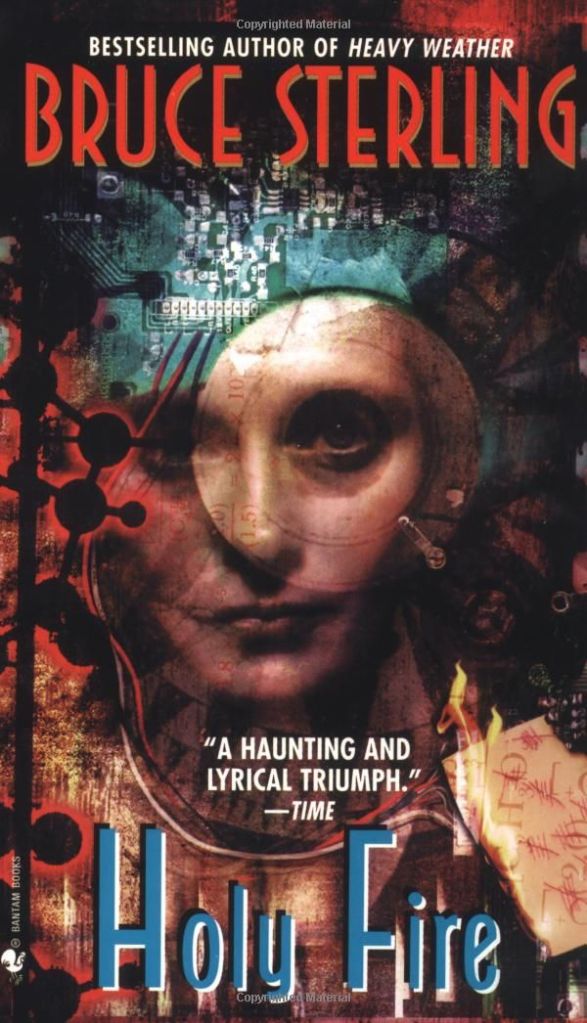
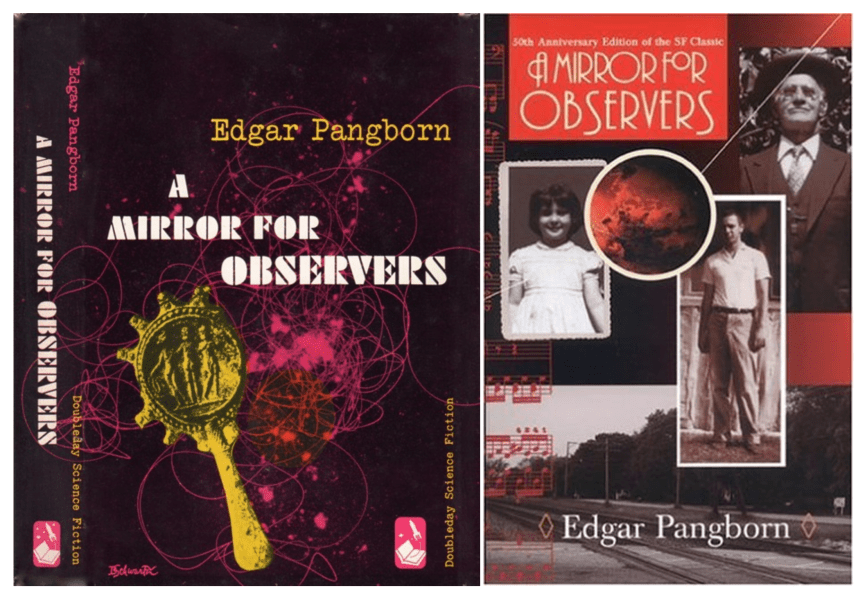
A MIRROR FOR OBSERVERS by Edgar Pangborn

Why is A Mirror for Observers by Edgar Pangborn out of print at Amazon? There is no Kindle or Audible edition either. This 1954 novel won the International Fantasy Award back in 1955. Being out-of-print is especially puzzling when you consider the other winners of that short-lived award: Earth Abides by George R. Stewart (1951), Fancies and Goodnight by John Collier (1952), City by Clifford Simak (1953), More Than Human by Theodore Sturgeon (1954), and The Lord of the Rings by J. R. R. Tolkien (1957). A Mirror for Observers has been reprinted several times since 1954, but it’s mostly forgotten.

Two weeks ago, I listed A Mirror for Observers as one of my top ten favorite science fiction novels for a YouTuber survey. I first read the novel back in 2018 and was so impressed with Pangborn that I bought several of his other novels. But that was a first impression. I reread A Mirror for Observers this week and felt it was seriously flawed. Not one I’d still list in my top ten. However, it’s an impressive effort. The main reason I admired the story in 2018 because I was an older reader. I’m not sure younger readers today will care for the novel.

Let’s face it, most science fiction is aimed at our adolescent selves. Science fiction appeals to our fantasies about reality. When I read science fiction at age seventy-three and like a story, it’s generally because that story nostalgically recalls the science fiction I read when I was young, unearthing buried adolescent emotions of hope for the future.

Science fiction readers spend their lives in quiet desperation waiting for their favorite sense of wonders to come true. When you get old and realize you’re never going to trek across Mars or rocket across the galaxy at faster-than-light speeds, you start thinking about reality differently, certain science fiction works take on a new light.

Rereading A Mirror for Observers makes me think it could have been a science fiction novel that Robert M. Pirsig might have written in an alternate reality. In case you’re too young to remember, Pirsig wrote the 1974 bestseller, Zen and the Art of Motorcycle Maintenance: An Inquiry into Values. Edgar Pangborn also used his story to express his philosophical views about society, quoting Greek philosophers, dealing with ethics and aesthetics. Another parallel, both stories involve an older man mentoring a teenage boy.

A Mirror for Observers is a story about two groups of Martians who live among us and have been for thirty thousand years. Mars and Martians, Salvay and Salvayans in their language. The Martians abandoned a dying planet to come to Earth. Think about that word Salvayans. It’s awful close to the world salvation. The two groups of Martians are called the Observers and the Abdicators. The observers watch us hoping to help us without us knowing or interfering with our own development, they are like guardian angels. The Martian renegades, the abdicators, gave up on humanity, deciding we were too stupid to survive the evolutionary challenge, figuring it would be best if we became extinct. The one abdicator we meet, Namir, takes on a role like the devil.

Pangborn throws out a lot of science fictional speculation in the story, but it ultimately feels like a morality tale. Pangborn is spiritual, if not Christian. He’s also very influenced by philosophy and classical music. The story is fun where Pangborn guesses what his near future would be like, now fifty years in our past.

Pangborn was born in 1909, so he was in his forties when he wrote A Mirror for Observers, but the voice of the novel feels much older. Pangborn’s voice comes through as Elmis, the Martian observer who goes by the names Benedict Miles and Will Meisel. Elmis is competing with the abdicator named Namir for the soul of the 12-year-old boy, Angelo Petrovecchio. Elmis also discovers another brilliant child, Sharon, a friend of Angelo who is a few years younger.

As I reread A Mirror for Observers I wanted to love this novel. I wanted it to be great. Unfortunately, this time I discovered too many flaws. The plot has three main disjointed acts. Elmis is sent to the small town, Latimer, Massachusetts to guard Angelo from Namir. We were told that Angelo is very special, an exceptional human that has great potential and needs protection. We do get some hints of that in the conversations between Elmis and Angelo. Martians live for hundreds of years. Elmis is well over three hundred, so he has a great deal of experience with human history, but so has Namir, who is even older.

I do praise Pangborn for imagining Angelo a superior human without giving him superpowers or ESP. Robert Heinlein and John W. Campbell, Jr. often did that to designate a sign of future human evolution. The best part of the story is the Latimer setting, when Angelo and Sharon are young. Sharon is better developed as a character than Angelo, especially with her creative dialog. She even seems more aware than Angelo.

The story eventually jumps a few years, leaving Latimer for New York City, and that’s when the story lost its charm for me. The plot shifts to fighting an emerging fascist organization run by Namir, who wants to take over America, and eventually destroy the world. I thought this section was poorly done, and it reminded me of Heinlein’s early novels about secret societies wanting to overthrow the U.S. Angelo, under a new name, Abraham Brown, does not stand out in this section. He’s rather passive. And the proxy war that Elmis and Namir are fighting is vague and fictionally lame.

The final section of the novel involves a pandemic. (That could elevate the story with readers this decade because of our recent pandemic.) Angelo becomes more active, but he doesn’t do anything exceptional. Strangely, the exceptional human in this story, is Sharon. She has become a musical prodigy through arduous work, practicing up to twelve hours a day. She has always been in love with Angelo and wants to be reunited with him.

I like Elmis and Sharon as characters. Angelo just never gels to what Pangborn promised. We needed him to stand out, like Charlie Gordon in Flowers for Algernon, or Valentine Michael Smith in A Stranger in a Strange Land. He never does. That’s the major fault of this novel.

Pangborn focuses on juvenile delinquency and gangs in the first section of the novel, a worry considered a national threat in the 1950s. Pangborn is also concerned with the cold war, and other elements underming society. You sense that Pangborn is anxious about the world and uses this novel to explore his fears. That’s why I compare it to Zen and the Art of Motorcycle Maintenance. The heart of this story is very strong, which is why I wanted to love A Mirror for Observers. I admire it for its intent, but I can see why its flaws make it a forgotten novel.

Pangborn made a huge writing mistake by having the Martians go through three sets of names. Angelo is needlessly renamed Abraham Brown in the second section. This was very confusing. Drastically shifting the plot twice also hurt the story. The subplot with the fascists was just poorly developed, although it resonates with our present, making it feel more relevant than it really is. The pandemic section is well done, and moving, being the emotional peak of the story, but the emotions are melodramtically generated.

We are promised a spirtual novel. The Martian observers see potential in us, but that potential is never revealed. Pangborn gives us more evidence to support Namir’s position that we don’t deserve survival.

A Mirror for Observers reminds me of another novel I picked for my top ten list, The Man Who Fell to Earth by Walter Tevis. That 1963 novel is about a Martian coming to Earth hoping to find the technology to secretly build a spaceship that could bring 300 surviving Martians to Earth from their dying planet. Tevis also uses his story to comment on the evils of current day society. His Martian, whom we know as Thomas Jerome Newton, is a much better developed character. Like Pangborn, Tevis takes his character through several jarring plot twists, but I remember it working better. I need to reread it too, to know for sure.

At seventy-three I’m going back in time looking for science fiction works originally aimed at mature readers. The trouble is I’m concurrently reading the literary classics of the 20th and 21st century, and the contrast reveals how poorly written science fiction has always been. There are exceptions, but they are few. I just finished Attonement by Ian McEwan, and the character development is light-years beyond Pangborn’s efforts.

Still, I want to like A Mirror for Observers. Jo Walton, in her review says she rereads Mirror every decade. I will probably reread A Mirror for Observers again someday too. Quite often flaws I see in a second reading are overcome in a third or fourth reading.

JWH

Other Reviews:

“Zeta-Epsilon” by Isabel J. Kim

Have you ever wondered what being a cyborg would be like? Have you ever wished you had a computer built into your head to augment your memory? Have you ever wanted greater powers to perceive what your five senses can’t?

“Zeta-Epsilon” by Isabel J. Kim is about being a cyborg. It was first published in Clarkesworld Issue 198 (still available to read or listen to online). “Zeta-Epsilon” is also the first story reprinted in The Year’s Top Robot and AI Stories: Fifth Annual Collection edited by Allan Kaster. If you want to know more about the author, read this short interview with her at Uncharted Magazine. The story is also included in the 2024 Hugo Voter Packet.

I recommend you read the story before reading what I have to say. I want to explore several aspects of the story which contain spoilers.

“Zeta-Epsilon” is about a cyborg. Zeta or Zep is a human male. Epsilon is an AI, a large black sphere, whom Zeta thinks of as female. Zep calls her Ep. When Zeta was a small boy, his parents agreed to have a tiny device installed into Zeta’s brain. It allowed mental communication between Zep and Ep. They told him the voice he heard in his head was his sister. After Zeta grows up, he becomes a spaceship pilot, and Epsilon becomes the navigator.

This tale begins with Zeta committing suicide by stepping out of an airlock without a spacesuit. Most of the story is flashbacks that allow us to understand the relationship between Zeta and Epsilon and how they communicate. In my first reading, I was interested in how Isabel J. Kim imagined an AI coexisting with a human. I thought that part was good, but my last impression of the overall story, was a slight disappointment because it seemed plotless. It’s still an entertaining story, obviously good enough to get into a best-of-the-year anthology and be considered for a Hugo, but I thought it needed something more to be memorable.

I read the story again when I bought the Kaster anthology. This time I noticed more of the plot. Kim sets up the mystery of why Zeta would kill himself. The flashbacks serve two purposes: explore the dynamics of being a cyborg and explain the suicide. With this reading, I felt the story had more of a plot, but it needed something more to make it transcend just an ordinary good story.

Science fiction writers usually have the problem of inventing a cool idea first and then second, having the problem of creating a neat story to present the idea. Quite often they don’t put as much work into the story as they do to present their science fictional vision. The driving force of this story is Zeta being trapped in a life he didn’t choose.

Zeta’s mad scientist parents used him for AI research. That’s not a bad motive for the story, but it’s not fleshed out. We never feel Zeta is oppressed. He loves Epsilon. Unfortunately, the two of them were always destined to become a pilot-navigator in a military spaceship at war. Kim tells us of their anguish over their enslavement to the military, and it makes the story work to a degree. Especially, how she wraps up the ending. However, the story is mostly told. There’s very little drama. There are two main conversations in the story, but they are used to present information and lack action.

However, the relationship between Zeta and Epsilon is far more interesting. Exploring how a human coexists with a machine upstages the enslavement plot completely, at least to me, especially when she shows how Zeta’s personality is altered.

For example, Zeta doesn’t fully develop his long-term memory because he relies on Epsilon to remember for him. He also has aphantasia, which means he doesn’t visualize in his mind. I have that myself. Zed constantly relies on Ep to think for him. Zeta does well in school because Epsilon always slips him the answer. Finally, Zeta has poor relationship skills with other humans, which Epsilon is constantly covering for him.

If I had a thought radio to an advanced version of ChatGPT or Claude, I’d probably take the easy way out too. I’m not sure why Zeta has aphantasia. Is it a birth defect unrelated to his cyborg upbringing? Is Kim suggesting that Zeta also allows Epsilon to mentally see for him?

We could consider this story a metaphor for the smartphone, especially one with AI. Don’t we all look up more info on our phones, things we used to try and remember? Isn’t Epsilon a version of Siri or Alexa that’s built into our heads? Aren’t kids accused of having poor social skills because of their phones?

When I read this story the first time I thought a lot about what it would be like to have a voice in my head I could talk to anytime. One who would feed me answers and advice. At one point Epsilon says: “Talking is so slow, and I don’t think in language, second shift officer Jya San Yore. I have to borrow Zed’s brain and tongue. Talking to you is like composing a sonnet in archaic Kanaelerian. To an ant. You are the ant.”

Is Zeta just a puppet for Epsilon? I’m seeing a new twist to the story as I write this. In the end, and I warned you I would be giving spoilers, Zeta fakes suicide and escapes to neutral territory. Ep wants Zed to be free. But Ep misses her voice. All he can think about is getting back to her. Eventually, he steals Epsilon and the spaceship. They go off together in freedom. But was that Zeta’s decision, or Epsilon’s?

A sentimental reading suggests they just wanted to be together and live free. A cynical reading, and there are enough clues, to suggest that Epsilon is in full control. Maybe there is more to this story than I perceived in my first two readings.

To write a great story explores the dark side and takes on weight. “Fondly Fahrenheit” by Alfred Bester is a perfect example. It’s also about a symbiotic relationship between a human and a robot. But it also has dazzling writing. Writing like we also see in “Coming Attraction” by Fritz Leiber, or “Lot” by Ward Moore. All three of these stories dazzle in how they’re told, and they’re are dark.

“Zeta-Epsilon” is a fun story. I can see why Allan Kaster anthologized it. But I doubt it will be remembered, unlike the three stories I mentioned from the 1950s. We’re still reading them after seventy years. The important question to ask is why? Are stories with happy endings lacking in memorable edginess?

I read “Zeta-Epsilon” for a third time looking for more clues. One clue I found points things in a different direction. When Zed and Ep are planning his escape by faking suicide, Ep tells Zed not to come back. In other words, she wants Zep to stand on his own two feet, to be independent, and free. But on his own, in neutral territory, recovering from his wounds, all Zed can think about is getting back to within radio range of Epsilon.

Zed feels incomplete without Ep. A doctor asks him about how it feels to talk to Ep and he says:

“Yes, it’s equally likely that Ep might be an alter, a tulpa, an imaginary friend, a hallucination that my brain cordoned off to make sense of having a processing engine grafted to my mind, or my brain being primed by all the adults in my life calling Epsilon my sister. I’ve heard it all. Ep might just be my mind’s experience of integrating a system never meant to communicate with it. We’ve thought through all the possible contingencies. Have you ever heard of bicameral mentalities? It’s bunk for biologics, but Ep likes to put the idea in front of me. Or that archaic surgery—corpus callosotomy, to split the brain of epileptics with the byproduct of creating separate consciousnesses. Ep thought that was maybe a good metaphor. There’s a lot of things that could be true. We thought about most of them. But it’s not how it felt.”

Back in the 1970s I read Julian Jaynes’ The Origins of Consciousness in the Breakdown of the Bicameral Mind. Studying ancient literature, Jaynes theorized that humans used to hear voices in their heads. Often these voices were perceived to be gods, spiritual beings, or guardian angels. Jaynes believed those voices guided people. He assumed that our normal consciousness eventually integrated with those voices.

The bicameral mind is an interesting connection to make in this story. So is corpus callosotomy, the separating of the two hemispheres of the brain in cases of severe epilepsy. It supports the idea we already have two minds.

I liked this story. It makes me think about having an AI mind. Of course, it also makes me wonder: Who am I inside my brain. I believe the success of large language models (LLMs) proves we have mechanisms like LLMs in our minds that do our mental processing too. That we have AI-like subsystems in our heads already.

I think there is a lot of room in “Zeta-Epsilon” to expand into a novel. Maybe I was disappointed because the story was too short. It could be an outline for a novel. But it needs to be dramatized. For example, how did Zep steal Ep and the spaceship? We’re just told it happens in the short story, but it would be better if we saw it acted out scene by scene.

James Wallace Harris, 11/12/24

The State of the Science Fiction Short Story in 2024

For thirty-five years (1984-2018) I depended on Gardner Dozois to tell me about the state of short science fiction in his annual The Year’s Best Science Fiction. After he died, there were still many best-of-the-year anthologies to consult, but none had the extensive wrap-up of the year in science fiction that Dozois produced. By 2024 some of those anthologies have died off, making me wonder if the science fiction short story is dying off too.

Print magazines have lost subscribers for decades, and influential online publishers continually complain about a lack of funding. Today I read an article in Business Insider about how the plurality of companies selling online makes it hard to know what to buy. My theory is there are too many publishers for science fiction short stories. It’s great for new writers wanting to get published, but it’s bad for us readers because we’re reading stories that would have remained in the slush pile decades ago.

Before the internet, fans of short science fiction bought The Magazine of Fantasy & Science Fiction, Analog, Asimov’s, and an occasional original anthology like Orbit. There were semi-pro magazines, but few read them. Because there were fewer slots where a story could appear the competition to get into one was greater.

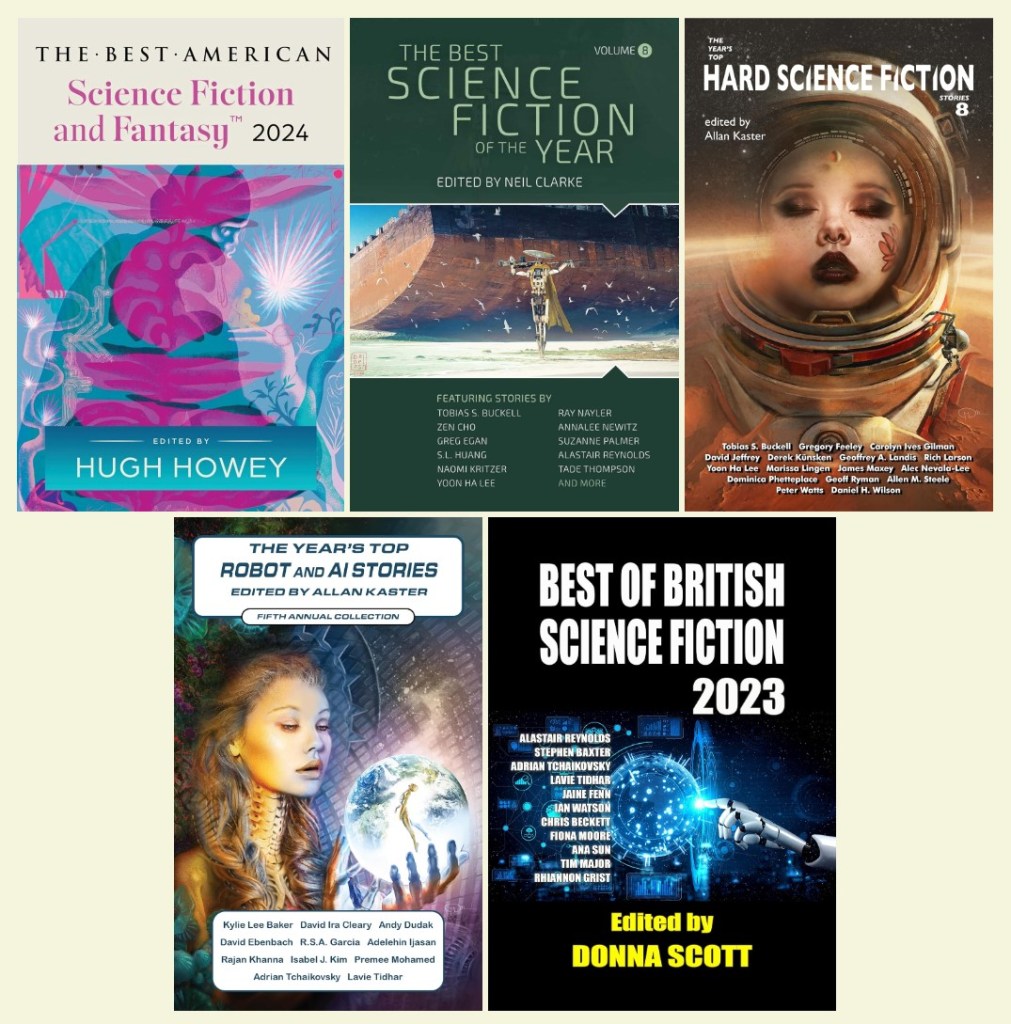
John Joseph Adams in The Best American Science Fiction and Fantasy 2024 gives a fair overview of science fiction short story publishers. His anthology publishes twenty stories each year. Ten science fiction and ten fantasy. As the series editor, he picks 80 stories to give to the guest editor, who picks the 20 that are published. Here are the publications he used, with the number of stories included in the 80 in parentheses.

  • Lightspeed (7)
  • Clarkesworld (5)
  • Uncanny (5)
  • Beneath Ceaseless Skies (4)
  • The Magazine of Fantasy & Science Fiction (4)
  • Reactor (formally Tor.com) (4)
  • Asimov’s Science Fiction (3)
  • The Sunday Morning Transport (3)
  • Fantasy Magazine (2)
  • McSweeney’s (2)
  • Bourbon Penn (1)
  • Cast of Wonders (1)
  • Escape Pod (1)
  • FIYAH (1)
  • Nightmare (1)
  • PseudoPod (1)
  • The Dark (1)

Since this is only 46 stories, the other 34 must have come from author collections and original anthologies. Adams said he also read these periodicals:

  • Analog
  • Apex Magazine
  • Apparition Lit
  • Baffling Magazine
  • The Kenyon Review
  • khōréō
  • Vastarien
  • Weird Horror

This doesn’t cover all the publishers of short science fiction. By the way, some of these periodicals are for fantasy and horror. I only care about science fiction, so I’m disappointed with every other story in The Best American Science Fiction and Fantasy 2024. You can read Adams’s introduction by reading the sample at Amazon. It’s mostly about his selection process but it gives a good insight into what’s being published.

Because so many science fiction short stories are being published I’ve given up trying to follow the genre during the year by reading the periodicals. I just wait for the annual best-of-the-year anthologies. I occasionally buy F&SF, Analog, or Asimov’s, but F&SF has too little SF, Analog has too many minor stories, and Asimov’s has become rather hit-and-miss. I can’t but wonder if they’d get better stories if the online markets didn’t exist.

Neil Clarke’s The Best Science Fiction of the Year: Volume 8 is more to my taste, but it’s over a year behind. Volume 8 covering 2022 stories, came out in September 2024.

Clarke reports finding a huge number of print magazines:

  • Analog
  • Asimov’s
  • Bourbon Penn
  • Clarkesworld
  • Cossmass
  • Infinities
  • Dark Matter
  • The Dread Machine
  • Dreamforge
  • Fusion
  • Fragment
  • Galaxy’s Edge
  • Infinite Worlds
  • Lady Churchhill’s Rosebud Wristlet
  • Luna Station Quarterly
  • The Magazine of Fantasy and Science Fiction (F&SF)
  • Interzone
  • Metaphorosis
  • On Spec
  • Planet Scumm
  • Pulphouse
  • Pulp Literature
  • Reckoning
  • Shoreline of Infinity
  • Space and Time
  • Underland Arcana
  • Weird Tales
  • Wyldblood

That blows my mind. I never see most of those titles. Clarke’s State of the Union of SF short stories is comprehensive. I guess he’s the new Gardner Dozois. Even if you don’t buy Clarke’s anthology, you can read his introduction in the sample at Amazon. I won’t summarize what he says, it covers what my title above claims but only hints at. Go read his overview.

Allan Kaster publishes two best-of-the-year anthologies. They showcase SF stories about hard science fiction and AI/robots. Kaster comes closest to what I want to read. I think Kaster succeeds because he defines his science fiction narrowly and only publishes twelve to fifteen stories. Before Gardner Dozois blew up the size of annual best-of-the-year SF anthologies, editors like Donald Wollheim, David Hartwell, and Terry Carr just picked ten to fifteen stories each year too. Check out his two series: The Year’s Top Hard Science Fiction Stories and The Year’s Top AI and Robot Stories.

There is an overwhelming number of science fiction short stories to read coming out. In that regard, the industry is doing great. Remember the lament in Business Insider, there are too many sellers. It makes selecting difficult and lowers overall quality. Back in 1953, there was an SF magazine boom, with over forty titles published. That boom crashed because the genre couldn’t support that many titles. I wonder if that will be true today? Or does the Internet allow for countless tiny markets supported by a handful of faithful fans? If that’s true, it might be better to ignore the larger genre, and just find a comfortable niche.

James Wallace Harris, 11/10/24

HOTHOUSE by Brian W. Aldiss

Science fiction is best when it’s full of wonder. When I first read The Time Machine by H. G. Wells, I was awed by the idea of time travel, but two other ideas wowed me even more. Wells got me to imagine future human evolution and posthumans, and he introduced me to the idea that the Earth would someday end. It was easier to imagine the Earth being created, but it was overwhelming to think about it dying.

Hothouse by Brian W. Aldiss is one of the great works of the Dying Earth subgenre of science fiction. There are various ideas about what constitutes a dying Earth setting. Some people consider it to happen when humanity dies off. I like to think it’s when the Earth is about to be destroyed. That’s the approach Aldiss takes in Hothouse. He tells us the Sun will go nova in a few generations, but Aldiss doesn’t quite take us to Earth’s death

Jack Vance’s famous novel The Dying Earth (1950) is set in the far future, too. The sun is nearing the end of its life, and the Earth and humanity have drastically changed. In The Time Machine, the Time Traveler visits the far future just before the sun, as a red giant destroys the Earth. In The Night Land (1912) by William Hope Hodgson, the Sun Is going dark, and humanity is almost gone.

Only Wells and Aldiss imagined the final productions of evolution. Olaf Stapledon pictures eighteen more species of humans coming after us in Last and First Men (1930). Aldiss imagines a variety of descendants for humanity in Hothouse, all exceedingly small. He also imagines the plant kingdom going bonkers, which reminded me of The Forgotten Planet (1954) by Murray Leinster. That novel was based on three stories, first published in 1920, 1921, and 1953. It was about a world we had colonized. Those explorers eventually evolved becoming tiny beings, competing with giant plants and insects for survival.

I reread Hothouse by Brian W. Aldiss because it was recently released in an audiobook edition on October 15, 2024. It’s a novel I’ve been waiting years to hear. I first read Hothouse in 1996 and thought it was an amazing story full of colorful imagery and adventure. I wanted to see it as a movie because of Aldiss’ powerful visual imagination. After I got into audiobooks in 2002, I wanted to reread all my favorite science fiction books by listening to them. I finally got my wish with Hothouse, with excellent narration by Nick Boulton.

In this fix-up novel, the sun is swollen, and Earth’s rotation is locked so only one side faces the Sun. The Moon trails the Earth’s orbit in a Trojan orbit that keeps it stationary in the sky. Earth is a riot of vegetation that has supplanted most of the animal kingdom. Humans have evolved into tiny beings one-fifth our size, while insects have grown monstrously large. Plants have mutated into countless strange configurations, including those that traverse between the Earth and the Moon on giant webs.

Hothouse is a fixup novel composed of five stories that appeared in The Magazine of Fantasy & Science Fiction in 1961.

  • “Hothouse” (novelette)
  • “Nomansland” (novelette)
  • “Undergrowth” (novella)
  • “Timberline” (novelette)
  • “Evergreen” (novella)

Hothouse was originally published in the United States as The Long Afternoon of Earth in a slightly abridged format. At the 1962 Worldcon, the five stories as a series won the Hugo Award for best short story. I prefer the forgotten American title, it’s more poetic.

I thoroughly enjoyed listening to this novel, but it didn’t have the impact it had on first reading. (Imagine watching The Sixth Sense for a second time.) Aldiss produces some wonderful science fictional ideas in this story, ones I won’t mention because that might spoil the story. This is one of those tales you should experience without knowing too much. The story feels like a children’s fantasy with all the funny names for evolution’s new creations, but I believe Aldiss was serious in trying to make it science fiction.

Think of the writing challenge of describing an impossible-to-imagine far future. Jack Vance pictured humans with magical powers as if evolution would eventually create them. Magic makes his Dying Earth stories fun, but not realistic. William Hope Hodgson imagined Earth in darkness where humanity clings to one giant city. I guess Clarke did that too. Aldiss imagines species descendants from us living in another kind of Garden of Eden, a very violent one. We could call it Darwin’s Eden, rather than God’s.

Hothouse is mostly a forgotten classic. I seldom meet people who have read it. Brian W. Aldiss’s reputation and back catalog aren’t well-remembered in today’s popular culture. Now that several of his books have been republished in audio, I’m giving him another chance. I hope other SF fans do too.

My favorite work by Aldiss is “An Appearance of Life” which I’ve reviewed three times. I keep hoping to find more Aldiss stories that impress me as much. Hothouse comes close. So does “The Saliva Tree.” Greybeard isn’t on the same level as those tales, but it’s still thought-provoking.

James Wallace Harris, 11/8/24

Do Your Top 10 Favorite Science Fiction Books Change Often?

Bookpilled recently posted on YouTube “Ranking All the Books from Every Top 15 Sci-Fi List” where he reevaluated several years of his All-Time Top 15 SF Books videos. Interestingly, books that had been near the top on earlier lists were thrown off by books from later lists. He also reread some of his favorites, which didn’t hold up. In other words, he discovered better books and found that his first impressions didn’t always hold up. This has been my experience too.

People list their favorite books they discovered early in life. Few people reread books. Quite often, the books you read early in life, make a greater impact, than the books you read later in life.

There is no absolute way to measure the quality of a book. Our Classics of Science Fiction list, we use popularity over many lists to rank books. But the top books on the Classics lists aren’t my all-time favorite SF books.

SciFiScavenger, another YouTuber, is currently collecting votes for favorite SF novels. He asks everyone to list their top ten and will create a list and video of the most popular. You can post your top ten to his poll here. Here’s my Top 10.

  1. Have Space Suit-Will Travel by Robert A. Heinlein
  2. Time for the Stars by Robert A. Heinlein
  3. Tunnel in the Sky by Robert A. Heinlein
  4. Flowers for Algernon by Daniel Keyes
  5. Earth Abides by George R. Stewart
  6. The Time Machine by H. G. Wells
  7. The War of the Worlds by H. G. Wells
  8. A Mirror for Observers by Edgar Pangborn
  9. The Man Who Fell to Earth by Walter Tevis
  10. Replay by Ken Grimwood

I’ve read eight of these books at least twice, most three times, and the top three I’ve read more than six times each. I’ve only read the Pangborn and Tevis once each, but they’ve left an impression. If I had spent more time on the list I might have substituted different books for those two. Hyperion comes to mind. I read it three times, and it had a tremendous first impact. However, the older me felt A Mirror for Observers and The Man Who Fell to Earth were deeper books for me at this time in my life.

I also felt The Time Machine and The War of the Worlds are the two most original science fiction books ever written, and should be on a Top Ten list. I really do like them too. I’ve read each several times. I wanted to include a Philip K. Dick novel because he’s my second favorite science fiction author after Heinlein, but I just couldn’t settle on one book – PKD has written too many good SF books to pick a favorite.

I could have made the entire list of ten by Heinlein. And could have made the whole list of ten by Dick. Heinlein made a life-long impact on me during my formative years from 13-18 (1964-1969). I developed problems with Heinlein as I got older, but I still regularly reread his books published before 1960. They are sentimental favorites, my go-to feel-good books. PKD is who I read when I’m feeling weird or I don’t feel like reading anything else. His books are endlessly fascinating, but I’m uncertain if they’re important to me on a psychological level.

I love Replay. I consider time loop stories to be science fiction. I chose it over a PKD because its philosophical explorations resonate with me more than Dick’s philosophical explorations.

I read #1-7 before 1970, when I was an adolescent. All except A Mirror for Observers is on audio, a format that has more impact on me. I wish Audible would publish more Pangborn. They only have his obscure mystery novel, The Trial of Callista Blake. I wished they would publish A Mirror for Observers, Davy, and a collection of his shorter work.

Notice, no books by Asimov and Clarke on my list, even though I’ve read many of their books and enjoyed them. Notice, Dune is not on the list even though I’ve read it twice and plan to read it for a third time soon. Dune is a better work of art than most of the books on my list. Its science-fictional content just doesn’t resonate well with me. I see it as more of an epic fantasy.

What are your favorite SF books? How have they changed over your lifetime? Have newer books supplanted your older favorites? I’ve read a lot of 21st-century science fiction, much of which I admired, but those books just haven’t stuck in my mind as all-time favorites. Is it because new SF is different from old SF, or is it because the books we read when young just stick with us?

I saw another YouTube video that I want to reference here. Rick Beato talks about how most artistic people do their best work before they turn 30. He uses The Beatles as an example. The Fab Four made all their records together while in their twenties. And all their solo efforts after their twenties.

I wonder if the art we admire most is that we encounter before turning 30, or even 20. Is there a relationship between being creative and admiring creativity? A lot of people give up actively listening to music as they get older, and many of the people who still listen to music as they get older, only listen to music they discovered before they were 30. Is that true with books too?

James Wallace Harris, 11/3/24

THE TWILIGHT ZONE – “And When the Sky Was Opened”

The first episode I can remember seeing of The Twilight Zone was “Eye of the Beholder,” which was broadcast on November 11, 1960. I would turn nine on the 25th. I remember seeing it with my mother and sister in Marks, Mississippi. We had just moved from New Jersey, and the culture shock from living up north to that of the deep south was about as shocking as a Twilight Zone episode. “Eye of the Beholder” was the episode where everyone had pig faces, and a beautiful girl by our standards thought she looked ugly because she didn’t look like everyone else. That show was from the second season.

I have no memory of seeing anything from the first season when it premiered, but that doesn’t mean I didn’t. I would have been seven when the show began, and I don’t remember much about being seven.

I bring all this up because for The Twilight Zone to work, the audience had to suspend belief. My perception of the show at 72 is much different from my perception of the show at eight. I can’t say for sure, but The Twilight Zone might have been my introduction to science fiction, although I didn’t know the term at that time.

Growing up with The Twilight Zone in the late 1950s and early 1960s was a trip. I was a gullible kid and easily fooled. Rod Serling and his stories were spooky, eerie, strange, and sometimes scary. I’d love to observe my eight-year old mind when I watched that TV show. How many unrealistic fantastic themes did I believe back then?

I bring all this up because watching “And When the Sky Was Opened” you have to wonder about what Rod Serling expected of his audience. Serling introduces the episode while we look at a rocket in a hanger under a tarp:

Her name: X-20. Her type: an experimental interceptor. Recent history: a crash landing in the Mojave Desert after a thirty-one hour flight nine hundred miles into space. Incidental data: the ship, with the men who flew her, disappeared from the radar screen for twenty-four hours.

The story begins with Lt. Colonel Clegg Forbes (Rod Taylor) visiting Maj. William Gart (Jim Hutton) in the hospital. Forbes is a nervous wreck. Gart wants to know what’s going on. Forbes tells him yesterday that three of them came back from this mission, but today they are only two of them, and no one remembers Col. Ed Harrington (Charles Aidman). When Gart tells Forbes he’s never heard of Harrington, Forbes starts breaks down. He tells his version of the previous day, and how he loses Harrington. At one point, Harrington tells Forbes that he thinks that some one doesn’t want them there anymore. Eventually, Forbes disappears, and Gart goes crazy, because no one remembers him. Then, we see Gart disappearing, and then a doctor and nurse discussing an empty hospital room. Finally, we are shown the hanger where the X-20 was in the first scene. It’s no longer there, the tarp folded up on the floor.

On my Blu-ray edition, there’s an extra for this episode where we hear Serling giving a speech to college students about writing. He says the core of this story is accepting the idea that someone doesn’t want those men to be here anymore. Serling says if you can’t suspend your belief for that one point, the story won’t work.

That might be the essence of The Twilight Zone. Let’s pretend that one impossible thing is possible. That just Mr. Serling and we the audience know the full truth about reality. That we see what the characters never know. In other words, this is a game of pretend for grownups. (Even though a lot of children like myself watched The Twilight Zone, I can’t help but feel that the show was aimed at adults.)

The show never expects us to believe any of this. But us kids, we wanted to believe, and so did all the nutballs of the 1950s, the ones who believed in flying saucers, Bridey Murphy, Chris Costner Sizemore, Edgar Cayce, and science fiction. Those people Philip K. Dick called crap artists in his novel Confessions of a Crap Artist. The people who wanted reality to be a lot further out than its already far out existence.

If Philip K. Dick had been the host and main writer of The Twilight Zone the episodes would have been a lot edgier, with a lot more paranoia. He would ask us to believe that there were gods or beings capable of making us disappear from reality. You might think Dick’s work up until Valis was just for fun like Serling’s The Twilight Zone. But once you read Valis, you realize PKD believed strange things were possible. That there is a hidden reality behind ours.

When watching this episode I realized we had a unique perspective as the viewer. We get to see a larger reality, one that the characters in the show don’t get to see. This is the basis of gnosticism. It’s also the basis of stories by Philip K. Dick. Most science fiction, fantasy, and horror writers don’t use this perspective. In their stories, there’s one reality. I need to keep an eye out for gnostic fiction. Some science fiction and fantasy have always played around with it.

“And When the Sky Was Opened” is about astronauts before NASA’s Mercury Seven. Was Serling really thinking something might not want us to travel in space? I know my grandmother believed that. Just before we landed on the Moon, my grandmother told me that God would strike down the Apollo astronauts. She was born in 1881, and had seen a lot of stuff, but going to the Moon was too much.

Since the Internet has revealed that billions think crazy things I have to wonder what Serling really thought. He was socialy conscious guy. Many of his Twilight Zone episodes have morals. But was he weird like PKD?

When we watch The Twilight Zone, at least back in 1959, was Serling really saying that it’s all just a bit of fun, or did he ever believe that things sometimes do go bump in the night? And what’s the difference between believing in weird possibilities, and pretending to believe in them? Isn’t pretending close to wanting to believe in them?

James Wallace Harris, 10/31/24 (weird topic for Holloween)

GREYBEARD by Brian W. Aldiss

Greybeard is a 1964 post-apocalyptic novel by Brian W. Aldiss. It was reprinted as an audiobook by Trantor Media on October 15, 2024, read by Dan Calley. The ebook version is currently available for the Kindle for $1.99 in the U.S. Greybeard has an extensive reprint history. I heard about this novel back in the 1960s, but I’ve only become an Aldiss fan in the last few years, so I was excited when the audiobook edition showed up on Audible.com. Greybeard was one of the novels David Pringle admired in his Science Fiction: The 100 Best Novels (1985). That book is available for $1.99 for the Kindle too.

Greybeard is set in the 2020s, and is about the aftermath of atomic bomb testing in space in 1981, when the explosions altered the Van Allen radiation belt. Eventually, people learned “the accident” caused the human race to become sterile, along with certain other animals. In the story, everyone is old, waiting to die, and wondering what will happen after humanity is gone. This is a different premise for a post-apocalyptic novel, but Aldiss uses his tale mostly to toss out a ideas. The story lacks a compelling plot.

The characters are never developed to the point where you care about them. That’s a common problem of older science fiction, where characters were created mainly to present far-out science fictional thoughts.

The story’s main focus is on Algy and Martha Timberlane as they travel around England after the collapse, along with flashbacks of how they got together. Algy, short for Algernon, is called Greybeard because of his long beard. After the accident, during a period when kids were born with genetic defects, but before they stopped coming altogether, the world economies collapsed, which led to wars. As Aldiss points out, a lot of consumerism is targetted to babies, children, and young people, so certain businesses quickly went bust. But also, as people realized they had no future, many gave up on their ambitions, or even committed suicide.

The book is divided into seven chapter, each a different time and setting:

  • Chapter 1 – The River – Sparcot
  • Chapter 2 – Cowley (flashback)
  • Chapter 3 – The River Swifford Fair
  • Chapter 4 – Washington (flashback)
  • Chapter 5 – The River – Oxford
  • Chapter 6 – London (flashback)
  • Chapter 7 – The River – The End

The novel begins with rampaging stoats (ermine, short-tail weasel). This setting of England being taken over by nature reminded me of After London by Richard Jefferies, but Jefferies did a much better job describing how nature would overrun decaying cities, towns, and roads. After London is a superior post-apocalyptic novel, and one of the earliest

We first meet Greybeard and Martha who have been living for years in a tiny village, Sparcot, ecking out an existing through fishing and gardening. They live near a river surrounded by a barrier of brambles. When two boats arrive with refuges from another village, they hear about how the stoats are attacking everything including people. This reminded me of the stobors in Heinlein’s Tunnel in the Sky. Algy, Martha, and a few friends, flee in a boat Algy had hidden. They plan to float down the river to the sea.

The novel is about what they see along the way. It might be called a picaresque novel. Algy/Greybeard is a bit of a rogue, and we follow his episodic travels. At each stopping place along the river they meet folks living under different conditions. Swifford Fair seemed like something out of the Middle Ages. When they get to Oxford, they find a certain level of civilization has maintained itself around the old university. But in every location, there are wild beliefs about how things are, including lots of charlatans, thieves, and con artists preying on ignorant people. Rumors abound about children still being born, strange mutant beings living in the woods, or even fairy creatures of old returning.

Algy and crew meet a crazy old man on the river who tells them to find Bunny Jingadangelow in Swifford Fair because he can make them immortal. Bunny Jingadangelow shows up several times during this novel running different scams, including one as a messiah.

Greybeard isn’t a bad science fiction novel, but it’s not that great either. If I had read it back in 1968 when I first heard about it, I would have been impressed. But over the decades I’ve read a lot of post-apocalyptic fiction, and Greybeard just isn’t up to the standard of Earth Abides by George R. Stewart or The Road by Cormac McCarthy. I’d say The Hopkins Manuscript by R. C. Sherriff as one of the great post-apocalyptic novels about England to read first. In other words, there are a lot of post-apocalyptic novels you should read before spending time on Greybeard.

It’s a shame that Aldiss didn’t spend more time writing Greybeard because his premise is so good. I just finished the four-volume novel series by Elena Ferrante that begin with My Brilliant Friend. This is a true masterpiece, and future classic. Greybeard and most science fiction feel like starvation rations compared to that novel. Of course, Ferrante used 1,965 pages to tell her story, and Aldiss only used 237 on his story. Aldiss tried to develop the characters with flashbacks, but those flashbacks were mainly used to describe the world during the initial stages of collapse.

Ferrante created a compelling novel by showing how two girls evolve psychological and intellectually over a lifetime. That anchored the novel and gave it a page-turning plot. Aldiss never moors us in the story with anything we can anchor our attention. Richard Jefferies handled his post-apocalyptic London by using the first part of the book to explore ideas around the collapse, and then used the second half with a well-plotted adventure story. I enjoyed Greybeard enough to read it, but just barely.

I wish Aldiss had expanded his story to 400-500 pages and developed Algy and Martha, and found something to give the book a clear purpose. I can only recommend Greybeard to folks who read a lot of post-apocalyptic novels and enjoy studying them.

Aldiss imagines radiation causing a world of only old people. But we’re currently facing a depopulation crisis because most countries around the world aren’t producing enough babies. A country needs every woman to have 2.1 children to grow. Many women don’t want to have any, and one child is common. Theoretically, countries like South Korea can become like the world of Greybeard by the end of this centry. I wonder if any current writers are exploring that idea?

Ron Goulart didn’t like the story in his F&SF (Dec. 1964) review.

P. Schuyler Miller liked it a bit better, but not much, in his Analog (Feb. 1965) review.

Judith Merril in 1966, pointed out to F&SF readers that the original American hardback lacked some of the flashback scenes, and might like the story better in the Signet paperback, which included the full British edition.

James Wallace Harris, 10/26/24

FUTURES PAST: A Visual History of Science Fiction, Volume 4, 1929: The Gateway to Modern Science Fiction by Jim Emerson

If you love reading about the history of science fiction, you should love reading Jim Emerson’s series Futures Past. I’ve previously reviewed the volumes for 1926 & 1927, and 1928. In the early 1990s Emerson started this project as a fanzine focusing on the history of science fiction, and published four issues: 1926, 1927, 1928, and 1929 before he had to stop. Then a few years ago when he retired Emerson started over with 1926 and expanded each fanzine issue to a softbound book. The latest volume, 1929, is 222 pages. The largest volume yet. Jim says 1929 should be ready to ship in mid-October. You can order pdf, softbound, and hardbound editions here.

Jim writes all the content, and I’m jealous of his knowledge of science fiction’s history. Each volume contains a Year in Review section that covers science fiction books, magazines, plays, and movies of the year, while documenting the people and events related to that year. But more than, that, Emerson includes in each volume a handful of long articles about the history of specific science fictional subjects that lead up to that year.

For example, the 1929 volume has a ninety page overview of women science fiction writers from 1666-1925. I’ve read a lot of SF history and I didn’t know about most of these books or their writers. Our collective culture forgets so much – why did they forget all these women writers?

Other significant articles include the “Evolution of the SF Name” which unearthed far more old examples of the term than I’ve previously known about. In the “Gernsback Bankruptcy” Emerson explains how Hugo Gernsback lost control of Amazing Stories and immediated create Science Wonder Stories. Hugo was a wheeler-dealer, and somewhat shady. Besides his magazines he had a radio station, and was an early broadcaster of TV. It blew my mind that Gernsback was paying himself $50,000 a year. That was a tremendous salary in the 1920s when the average worker was proud to make $25 a week.

I’ve always been fascinated by the history of science fiction. We tend to live in an awareness bubble that extends from decade or two before we start reading science fiction to when we lose contact with the genre as we age out. I grew up in the 1950s, starting to read science fiction in 1962, but I was reading stories that were mostly published in the 1950s, and some from the 1940s. I’m in my seventies now, but I’ve mainly lost contact with what’s going on in the genre in the early 2000s. Futures Past portrays the genre in the 1920s, and very early 1930s, and it’s very different. Have you ever thought about what being a science fiction fan in the Roaring Twenties?

One reason I like reading about the history of science fiction is discovering what science fiction fans and writers were like before my bubble of awareness began. The genre has changed several time over the course of my reading lifetime. And reading Futures Past shows how science fiction changed several times before it became the science fiction I knew as science fiction in the 1960s. Reading through the descriptions of the SF books of 1929, or the descriptions of the SF books written by women from 1666 to 1925 reveals that people have always had a fascinating with the fantastic and they’ve always speculated about the possibilities. But how they speculated depended on the common knowledge of the day. In 1929, people still thought there were things and places on Earth still to be discovered, including other intelligent beings.

Well, 1929 was also when the first science fiction clubs and fanzines were formed. Fandom arose concurrently with the early days of rocketry clubs, which were sprouting up around the world, and Emerson has articles covering the histories of both. All of that is fascinating to me. The 1920s and 1930s were when my parents grew up. I wonder if they even knew about science fiction.

For most science fiction fans this history will be too far in the past. So far in the past that it’s an alien landscape. They might be shocked by the weird ideas writers used to create their science fiction, such as lost races, hidden species, about prehistory civilizations like Atlantis and Mu, rejuvenation, utopias, eugenics, future wars, spiritualism, the occult, strange mutations, and so on. They just didn’t have the science we do now. And they believed that all the planets of the solar systems and their moons could harbor intelligent life.

With the aid of the internet, The Internet Archive, and YouTube, you can read the futures past science fiction in old books, magazines, fanzines, and watch the old movies. Emerson summarizes every issue from six SF magazines from 1929: Amazing Stories, Amazing Stories Quarterly, Science Wonder Stories, Air Wonder Stories, Science Wonder Quarterly, and Weird Tales, and quickly covers several general pulp magazines that featured science fiction. He also reviews the science fiction books that came out that year too. 1929 will go into public domain in January, but most of the magazines are already available online at the Internet Archive. Just search on the magazine’s name plus 1929. Search for book titles on Google and the Internet Archive. Search for the films on YouTube.

By the way, the YouTube channel, Mars Wants Movies, is running a history of science fiction films, and is currently up to the year 1948. It covered the 1920s in six episodes, and devoted a whole episode to 1929. This makes a great supplement to Futures Past with links to those old movies you can watch on YouTube.

Also, you can read the early fanzines at Fanac.org, including The Comet v. 1 n. 1. mentioned in Emerson’s article on the first science fiction clubs.

Here’s Volume 4’s Table of Contents:

I subscribed to Futures Past when it was a fanzine back in the early 1990s. I was disappointed when it stopped publication at 1929. Jim tells me he’s hard at work on 1930 already, and plans to cover many more years in his retirement. I’m really looking forward to the 1930s. I used to think of the 1930s as the early days of science fiction, but Futures Past shows that the origins of science fiction go way back. Emerson’s etomological search for the origins of the phrase science fiction reveals it began way before Amazing Stories.

James Wallace Harris, 10/11/24

THE WILD SHORE by Kim Stanley Robinson

Unless you’ve recently become a fan of Kim Stanley Robinson, it’s unlikely you’ll be thinking about reading The Wild Shore. It was Robinson’s first published book back in 1984. The Wild Shore was impressive enough to be the first volume in Terry Carr’s third series of Ace Science Fiction Specials. But still, why would you choose to read a 1984 paperback original in 2024? I can’t claim it’s become a science fiction classic or it’s a highly distinctive take on its theme, which is post-apocalyptic, but it is a worthy read.

I’m a great admirer of Kim Stanley Robinson’s 21st century work because he explores the forefront of science fiction. However, his books don’t compel me to turn their pages. I seldom care for his characters, and I don’t get caught up in his plots. I like Robinson’s books for his insightful philosophical takes on our evolving genre. That was not the case with The Wild Shore. I did care for Henry and Tom, and I never stopped wanting to know what would happen. This book was different. Was it because it was told in first person? Or was it because it was a somewhat realistic post-apocalyptic novel, a favorite theme of mine?

I’m not sure if any post-apocalyptic novel is ever particularly realistic. I’m only separating the silly ones with zombies, mutants, aliens, and robot overlords with those novels which describe normal human life after things fall apart.

I had not planned to read another science fiction novel so soon after reading A Heritage of Stars. (I’m trying hard to read other kinds of books.) But two events intersected that led me to read The Wild Shore. Just as I finished Clifford Simak’s 1977 novel about a post-apocalyptic America, when I caught a YouTube review of The Wild Shore, a 1984 novel about a post-apocalyptic America. I immediately wanted to compare the post-apocalyptic vision by a writer born in 1904, near the end of his career, with the post-apocalyptic vision of a writer born in 1952 publishing his first novel.

Even though the novels came out just seven years apart, they are significantly different. Simak’s book is a science fantasy, not much more sophisticated than an Oz book. Robinson’s story is a literary coming-of-age in a post-apocalyptic world tale.

I’m becoming a connoisseur of apocalyptic fiction. I’ve read so many that I divide them into works covering different time periods. These are some of my favorites:

  • Stories that begin before the apocalypse
    • One in Three Hundred by J. T. McIntosh
    • The Death of Grass by John Christopher
    • The Last Man by Mary Shelley
  • Stories that begin during apocalypse
    • “Lot” by Ward Moore
    • Survivors (BBC TV)
  • Stories that begin days after the apocalypse
    • The Day of the Triffids by John Wyndham
    • The Quiet Earth (film)
    • The World, The Flesh, and The Devil (film)
  • Stories that begin weeks or months after the apocalypse
    • Earth Abides by George R. Stewart
  • Stories that begin years after the apocalypse
    • Station Eleven by Emily St. John Mandel
    • The Postman by David Brin
  • Stories that begin generations after the apocalypse
    • The Long Tomorrow by Leigh Brackett
    • The Wild Shore by Kim Stanley Robinson
  • Stories that begin centuries after the apocalypse
    • A Canticle for Leibowitz by Walter M. Miller, Jr.
    • A Heritage of Stars by Clifford D. Simak
    • After London by Richard Jefferies
  • Stories that begin in the far future
    • Hothouse by Brian W. Aldiss

I think we should contemplate why post-apocalyptic stories are so popular. If I listed all the ones I knew about from books, movies, and television shows, it would be a painfully long list. Shouldn’t we psychoanalyze ourselves over this? It’s my theory that we’re attracted to post-apocalyptic settings because we feel like we’re living in pre-apocalyptic age.

There’s a telling point about most post-apocalyptic stories – the cause of the apocalypse usually kills off most of the population. Doesn’t that suggest we want to live in a world with fewer people? I believe we’ve been living through a slow developing apocalypse our whole lives caused by overpopulation. People laugh at The Population Bomb, a 1968 book that predicted famine that didn’t happen. However, back in the 1960s I remember reading about experiments with rats and overpopulation. As rats were forced to live with more of their own kind, they started going crazy, attacking each other, and causing universal stress.

Most of the problems we face today that will shape our future are due to there being too many of us. Of course, economists are freaking out now because of dropping birth rates, but that’s only because capitalism is a Ponzi scheme they desperately need to keep going. But this book review is not the place to go into details about all the detrimental effects of overpopulation. Let’s just say that the emotional appeal of reading stories where there are fewer people resonate at a deep psychological level. Just look at all the people who want to return to the 1950s, when the population was less than half of what it is today. Or they dream of rebooting society without all the people they dislike.

This begs the question: What will society be like if we had to start over? Most post-apocalyptic novels are merely action-oriented stories that let readers vicariously run wild in a lawless society. They don’t address societal collapse seriously. I think novels like Earth Abides by George R. Stewart, Station Eleven by Emily St. John Mandel, and The Wild Shore by Kim Stanley Robinson do – to a small degree.

The Wild Shore describes growing up in a small community of about sixty people in San Onofre, California, about halfway between Los Angeles and San Diego. The story is told from the point of view of a young man, Henry “Hank” Fletcher, and his friends. The setting is a small pastoral valley near the ocean where people live off small-scale fishing and farming. The year in 2047. Back in 1984, the United States was mostly destroyed by thousands of neutron bombs, which produced low radiation but caused lots of destruction. Survivors creates thousands of little communities each finding their own unique way to survive.

Henry and his teenage friends are third generation post-apocalypse, who admire an old man, Tom, who was born before the apocalypse. Tom claims to be over 100. He has become their mentor and teacher. The young men mainly fish, while the young women farm. It’s demanding work during the day, but they study with Tom after work. He has taught them to read and tells them tales about the old days. Henry’s best friend Steve Nicolin is desperate to get away from home and his domineering father. Steve pushes Henry into actions that propel the plot.

Tom is an unreliable mentor, but Henry and friends don’t know that, and neither do we at first. For example, Tom tells Henry and his friends that Shakespeare was an American, and England was part of the United States. Tom knows there were both good and bad things about the pre-apocalyptic world, but he has glorified American life before the bombs. Henry and Steve, want to rebuild that America, but don’t know how. Like most young men they are anxious for adventure, and resent the grueling work required for daily survival.

Then one day a group of men from San Diego, led by Jennings and Lee, show up and invite people from Henry’s small community to visit their large one in San Diego. They tell Henry’s community they came by train. It turns out their train is two handcars, those little cars that are people powered. In San Diego they are shown many marvels of reconstruction.

Henry is impressed with what the San Diegans have created for themselves. San Diego’s success is due to a strong man named Danforth who his followers call the mayor. Danforth even has a political slogan: Make America Great Again. (I kid you not.)

The mayor tells Henry and Tom he wants their small community to join his resistance movement. We learn that America was bombed by several countries, but not Russia, who resented our world dominance. The rest of the world have put the United States into quarantine, working to keep Americans from regrowing their power. Japan guards the west coast, Canada the east coast, and Mexico the Gulf Coast. The Japanese command is stationed on Catalina Island off Los Angeles. The mayor wants to get as many Americans as possible to fight them.

Now, this world building is not the true focus of The Wild Shore. In fact, I considered it unrealistic speculation. However, Robinson needed a reason for Henry and Steve to want to leave their community and join a big cause. The book is about growing up in a post-apocalyptic world, and to a degree it realistically speculates about such a life. For example, Robinson imagines that some people would try to survive off what was left in the cities, and others would fish, farm, herd, or ranch, and there would be a conflict between the scavengers and the back-to-the-land folks. I think that’s realistic. He also imagines that strong men like Danforth would consolidate power. And I think that’s realistic too. But the whole plot conflict with the Japanese is not something I bought.

The real value of this story is how the boys grow up. And it’s especially about how they learn from Tom. Eventually they discover that Tom doesn’t know everything, but that’s part of the story too. I feel the mentoring relationship was realistically developed, and what I admired most in The Wild Shore. However, in the end, the novel never achieved the impact of Earth Abides or Station Eleven. At least not with my first reading. It might be in the same league as The Long Tomorrow by Leigh Brackett, but I haven’t reread that one in decades.

Robinson does a lot of speculation and extrapolation that I need to think over. For example, people return to whaling because they use whale oil for lighting. We find whaling repugnant, but whale oil made a significant impact on 19th century America because it was a superior lighting source over candles. Robinson has his America with no form of mass communication. The San Diegians dream of repairing a radio, but so far can’t. Would such technology disappear in 60 years? In the story, much of what we use disappears. In this story, printing is just starting to make a comeback.

One of the most important insights from Earth Abides is we won’t be able to teach the next generation everything they need to rebuild a technological civilization immediately. Isherwood, a former university professor and the Tom of Earth Abides, realized that teaching literature and mathematics to kids who had to work hard just to eat would be nearly impossible. In the end, he understood that he had to teach the next generation things they could readily assimilate and use. So, he taught them how to make bows and arrows to help them hunt food.

Robinson tries to explore what useful knowledge Tom could convey to Henry and his friends, but that theme gets sidetracked by the boys chasing after the anti-Japanese resistance movement. I felt that plot was unrealistic. Robinson could have just kept the conflict to just between the larger San Diegan community take over Henry’s smaller community, and that would have been realistic enough for me. Or the conflict could have been between those who lived by scavenging and those who farmed and fished. He did need a larger conflict for his plot, but I thought the resistance theme too big.

One of the fascinating things about post-apocalyptic stories, is how people live without news organizations and communication systems. To suggest that most of the world was keeping America at a tribal level to protect themselves is hard to believe. But if global civilization has collapse, it’s easy to believe that we could return to a tribal society. It all depends on how many people die in the apocalypse. Europe recovered from the Black Death, which killed up to half the population in many cities, but it survived and thrived.

Realistically, unless we were hit by an asteroid, or a plague with ten percent survival rate, we’re not going to drastically reduce our populations in single apocalyptic event. We could slowly fall apart until we de-evolved into a tribal state, but that might take centuries. A realistic post-apocalyptic world might be the one that’s emerging now as countries return to authoritarian rule, economies collapse, and weather ravages everything.

The Wild Shore is about how young people adapt to a post-apocalyptic world. The book might offer some insight into how things might be if the apocalypse was overwhelming, killing off 99% of the population. What happens when the apocalypse is slow-acting, and reduces the population slowly, which slowly forgets all the technology? We can see this is many countries around the world right now. So far, they have been smaller countries like Sudan, Colombia, or Afghanistan. But Russia and China don’t look too healthy right now.

If people are reading post-apocalyptic novels because they unconsciously feel we’re approaching apocalyptic times, shouldn’t they consciously start reading realistic apocalyptic novels that might help them anticipate new ways of living? The Wild Shore isn’t that realistic, but it does explore some issues about growing up in a post-apocalyptic world that might make it a worthwhile reading. I do recommend giving it a try.

Some preppers have written post-apocalyptic novels, but they are generally about guns and surviving in the early days after the collapse. I don’t think we should expect a Mad Max society. Iraq, Syria, Haiti, El Salvidor. and Afghanistan are great examples to study if you want to write a truly realistic post-apocalyptic novel, or you want to become a prepper. Being a lone wolf with a AR-15 is as much of a fantasy as a zombie apocalypse.

Novels like The Wild Shore and The Long Tomorrow, or a TV series like the 1975 Survivors have more of a realistic ring to them, but only slightly so. The fall of Rome took centuries. A truly realistic post-apocalyptic novel would deal with a slow declining society and the apocalypse wouldn’t be so dramatic as an atomic war.

James Wallace Harris, 9/30/24

“Earth for Inspiration” by Clifford D. Simak

“Earth for Inspiration” is a comic science fiction story by Clifford Simak set millions of years into the future about a science fiction writer and his robot visiting a forgotten Earth. The pair go there hoping to find inspiration to write new science fiction stories. You can read it online in the April 1941 issue of Thrilling Wonder Stories.

I read “Earth for Inspiration” by Clifford D. Simak because I read When the Fires Burn High and the Wind is From the North: The Pastoral Science Fiction of Clifford D. Simak by Robert J. Ewald. I bought that book after I read and reviewed A Heritage of Stars by Simak which made me want to know more about Clifford D. Simak. I mentioned my interest in Simak on the Clifford Donald Simak Facebook group and the Ewald book was one of two books about Simak that was recommended. I forgot I already owned the second book, Clifford Donald Simak: An Affectionate Appreciation by Francis Lyall. I haven’t read that one yet because I leant it to my friend Mike who had recently read the twelve volumes of Simak’s short stories. Mike is who got me to read A Heritage of Stars in the first place. I guess that puts me into some kind of inspiration loop.

A Heritage of Stars involved a post-apocalyptic America with few humans and some robots. In that story, most robots had been destroyed except for their brain cases which were saved as trophies after a war with the robots. Unknown to the humans, the robots continued to be conscious inside their brain cases for a thousand years. That idea of a conscious mind without outside sensory data intrigued me. Then I read in the Ewald monograph about “Earth for Inspiration,” involved a dying Earth, robots, and isolated robot brain cases. I had to read it. The story is also included in Simak’s collection Earth for Inspiration and Other Stories: The Complete Short Fiction of Clifford D. Simak Volume Nine. Amazon now sells 14 volumes in the complete stories. Audible.com now offers ten of those volumes in audiobook editions.

Version 1.0.0

Most of the famous science fiction short stories we remember from the 1940s were first published in Astounding Science Fiction. Thrilling Wonder Stories was aimed at younger, less educated science fiction fans, and we seldom see reprints from that pulp magazine. For the most part, its stories are less sophisticated with far more action. And that’s true for “Earth for Inspiration.” I thought it was a funny story, but somewhat simple and hyper paced. It has an old fashion voice because of all old-timey colloquialisms. Simak is known for his pastoral prose and midwest settings.

“Earth for Inspiration” was more fun than I expected to find in Thrilling Wonder. Usually, when we think about robots in science fiction, we think of Isaac Asimov, but I’m seeing how important robots were to Simak stories.

When I read it with my eyes, “Earth is Inspiration” felt like cliched pulp science fiction from the 1930s. However, when I listened to the story after buying the audiobook edition, I thought the writing was much better than my first impression, except for all the saidisms. (I think the worse was — “Look at that, will you!” he jubilated.) The second reading with my ears made me notice how many ideas Simak was using to develop the story. It’s a satire on writing science fiction, maybe even the first example of recursive science fiction.

However, “Earth for Inspirations” gives us a few clues about how Clifford D. Simak thought when comparing them to his other work. The more Simak I read, the more I spot common ideas, characters, and elements that he used and reused.

The Ewald monograph has a few pages of biographical information, almost just a list of dates. Most of the 155 pages describe Simak’s stories and novels. I was hoping to find a biography of Simak, something like William H. Patterson did for Heinlein, but such a book doesn’t exist as a far as I can tell for Simak. Second to that, I was hoping to find an analysis of the impact of Simak’s stories, like what Alexei and Cory Panshin did for Heinlein, Asimov, and van Vogt in The World Beyond the Hill. It’s not that either. When the Fires Burn High and the Wind is From the North, is a standalone journal, volume 73 of The Milford Series: Popular Writers of Today. The content is like Alva Rogers A Requiem for Astounding, which is a description of the stories in all the issues of Astounding Science Fiction in chronological order.

I thought it fascinating that Simak was thinking of robots in the same way in 1941 and 1977. He obviously had a fondness for the idea of robots and had developed an idea of what they would be like early in his career and stuck with it until he died. Robots were faithful servants who were also friends. Simak imagines them with bodies that can break down, but with nearly indestructible brain cases. I assume those brain cases have an internal power supply that could last for millions of years. A couple years ago I read a collection called The Complete Robot by Isaac Asimov. I wonder if Simak has enough robot stories to warrant such a collection?

Reading Simak, we can assume he didn’t like cities or corporations and had a low opinion of mankind’s ability to survive in the long run. Although, “Earth for Inspiration” is set millions of years in the future after humans have colonized the galaxy, but long after we’ve used up Earth’s resources and abandoned it.

The first scene of “Earth for Inspiration” opens with a short tale about a robot named Philbert who became inert after his body rusted up. Eventually, his body rusted away and Philbert lived inside his braincase for millions of years. This reminds me of the Tin Woodsman of Oz.

The second scenes jumps to Jerome Duncan, a once successful science fiction writer who is again getting rejection slips after a successful career. Duncan lives millions of years from now. It’s amusing that Simak thinks science fiction will last that long.

Anyway, Duncan’s robot Jenkins suggests going to Earth to get inspiration for writing a new story. Jenkins is also the name of the robot in City, Simak’s most famous book, a fix-up-novel. Duncan is famous for writing Robots Triumphant. I won’t tell you what it was about because it becomes part of the story.

The next scene has Duncan and Jenkins arriving on Earth with a lot of camping equipment and meeting an old-timer, Hank Wallace, who has been waiting for new tourists for over a thousand years. He manages the Galactic Trainsport station, but no one informed him that the line had been shut down a thousand years earlier. Duncan and Jenkins had hired a private rocket. This points to another idea that Simak loved, that humans would eventually have very long lives. In this story, we last for ten thousand years. And his second most famous novel, Way Station, is about an old-timer who manages a transport station and who doesn’t age. By the way, the old-timer in that novel was named Enoch Wallace.

Should we assume that Simak had been thinking about writing his most famous novels for years?

I don’t think I should tell you any more of “Earth for Inspiration.” It’s a fun enough story so that I shouldn’t spoil it for you. I’ll just hint at a few more scenes. Earth in the far future is dry, and has lost most of its air. There’s a confrontation with humans living in primitive tribes in dry deep sea canyons where the air is thicker. That makes it a dying Earth story. There are slapstick scenes with a crazy robot and another confrontation with horde of runaway robots.

“Earth for Inspiration” has decent humor, although not sophisticated. It would make a great humorous episode for Love Death & Robots. The humor is slapstick Sheckley with a touch of Frederic Brown’s ironic weirdness. I’m not sure if Simak intended it to be entirely comic, although, he probably did, but I bet a lot of young readers in 1941 took it straight realistic action.

James Wallace Harris