How Unique A Reader Are You?

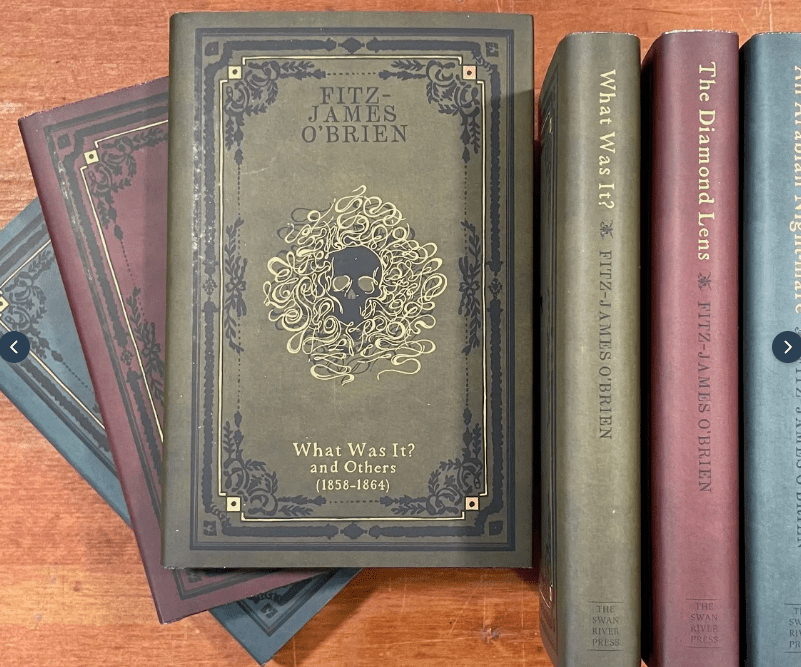
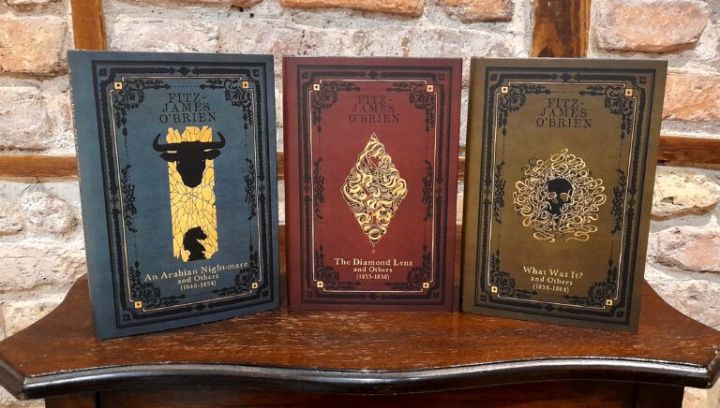
This morning, I read an email from a discussion group that mentioned Fitz-James O’Brien (1826-1862). You can sample his fiction at Project Gutenberg.

One member posted a link to a review of a new three-volume collection of his stories at The New York Review of Books. The review implied that O’Brien is little known, but several folks in the group quickly claimed they knew who he was. But that’s logical, our group is devoted to fiction in old magazines. I’ve even read some of O’Brien’s stories because they show up in science fiction anthologies, and I collect those. (See my post on 19th Century Science Fiction Short Stories.)

But this got me to thinking. How many people would know who Fitz-James O’Brien and read any of his stories? Then I asked myself, how many people read short stories? And of those, how many read old short stories? It’s one thing to read the short story in the latest issue of The New Yorker, and it’s another thing to read short stories originally published in the 19th century. Yes, some people still read Edgar Allan Poe, but how many outside of school?

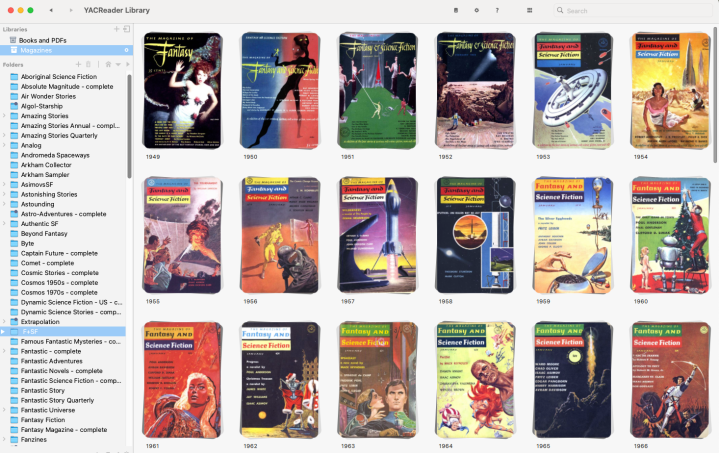
I’ve always been a fan of science fiction magazines. When I was young, some of the top titles had over 100,000 subscribers. Over my lifetime, I’ve watched their subscriber base dwindle to well below 10,000.

It appears the three-volume Collective Speculative Works by Fitz-James O’Brien will be limited to 300 copies. Does that mean the publisher thinks fewer than 300 people in the world are interested in reading O’Brien’s stories? Or that some kind of marketable ploy? I don’t know. 300 is 0.0000036% of the world’s population. That’s one tiny subculture!

But all of this does make me curious about statistics on reading. I found “US Book Reading Statistics (National Survey 2025)“. It summarized its key findings:

  • Almost half of the respondents haven’t read any books in over a year: 48.5%
  • Print books were the most read books: 35.4%
  • The 65+ age group recorded the highest population of print book readers: 45.1%
  • The 45-54 age group contains the highest population of non-readers: 60.9%
  • Males recorded a slightly higher population of non-readers compared to females: 51.4%

The article reported that the Pew Research Center found that 64% of Americans read at least one book in the previous year. That’s a lot more than I expected, and it disagrees with their own poll.

This suggests there are many kinds of readers, and that made me speculate about possible names to give different types of readers. I’m not very good at creating fun labels, but here’s my lame attempt.

  • Non-readers (0 books per year)
  • Casual readers (1-11 books per year)
  • Steady readers (read a book a month)
  • Bookworms (read a book a week)
  • Super Bookworms (read two or more books a week)

This doesn’t say anything about the kinds of books they read. Someone who reads over a hundred books a year might never encounter the name Fitz-James O’Brien. In one of my older essays, I speculated that the average reader could not list more than one hundred titles from novels from the 19th century. And I listed the hundred I thought would be the most common. I doubt most people would come even close to recalling one hundred titles from the 19th century.

Outside of people I know in my discussion groups that specialize in old fiction, I doubt I have ever met anyone in my life who has read a story by Fitz-James O’Brien.

What possible name could we give to people who do? Bookworm is the tag that most people give to obsessive readers. But for every 1,000 bookworms, is there even one who reads old short stories from the 19th century? I know a fair number of people like me who love science fiction short stories from the 20th century, and I also know a smaller group who love short stories published in pulp magazines (mainly from 1900 to 1950). But how many people are we talking about? I asked CoPilot, and it estimates that the number is below 20,000 for people who read and collect old pulp fiction. That’s .0059% of the current U.S. population.

Would the word aficionado apply here? Here are some other words that CoPilot helped me find. Maybe we could use each for a different type of reader.

  • Aficionado
  • Enthusiast
  • Devotee
  • Connoisseur
  • Curator
  • Archivist
  • Bibliophile
  • Esotericist
  • Antiquarian
  • Obscurist
  • Archaeologist

We could use all these words to describe someone who would buy Collective Speculative Works by Fitz-James O’Brien.

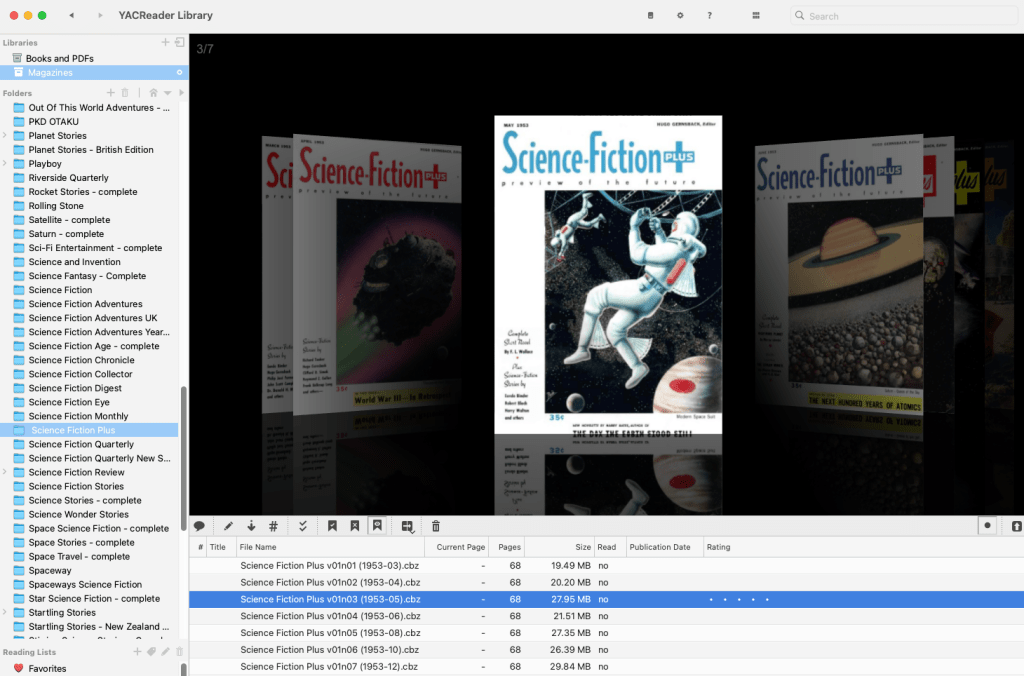
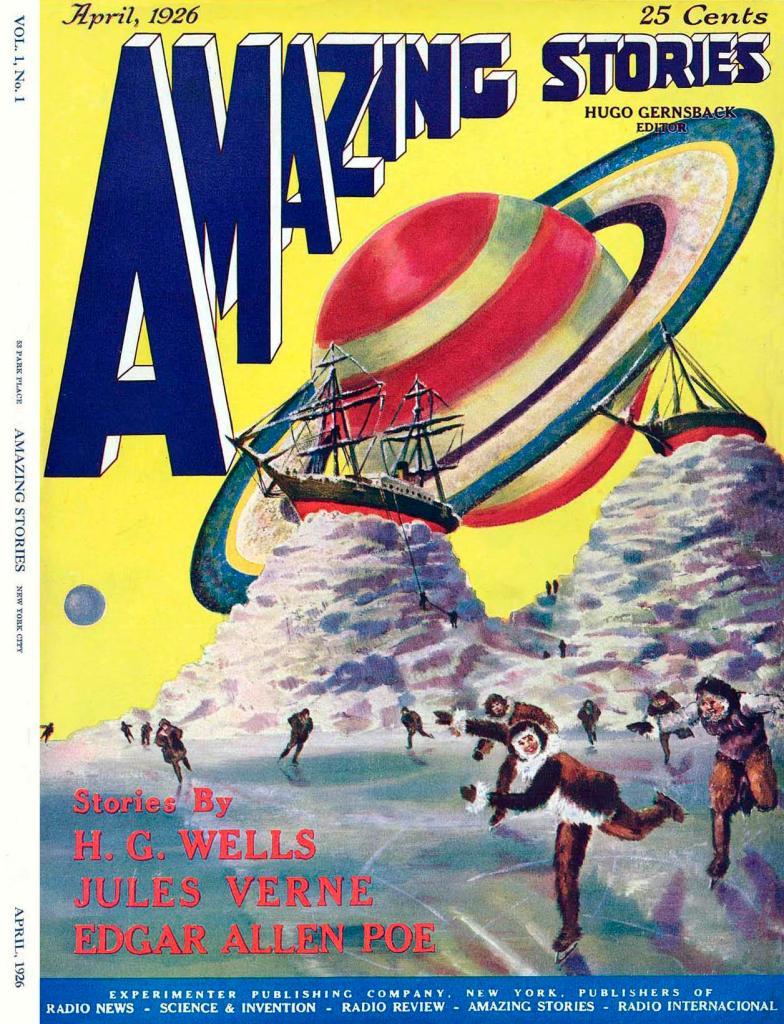
At one time, I would have ordered this set. However, I’ve now reached an age where I’m trying to get rid of books rather than collect. But that set does call to me. Actually, what I would really like is digital scans of the periodicals where his stories were first published. I’ve collected scans of most science fiction magazines from the 20th century, but have next to nothing from the 19th century on my hard drive.

How many people are like me who love reading old magazines?

I’m sure it’s less than .006% of the population. What nickname would you give to such people? My wife would probably say, “A nut.”

James Wallace Harris, 12/31/25

Is the Hugo Award a Good Predictor of Long Term Success for a Science Fiction Novel?

Whitney, over at the YouTube channel Secret Sauce of Storycraft, conducted a poll of her viewers. She asked them to post a list of their Top Ten Hugo award-winning novels. She tallied the totals for all the titles, giving ten points for a #1 placement, nine points for #2, and so on down to one point for tenth place. She announced the results in this video. (The totals were given in a spreadsheet – see below.) This video lists the Top 20 vote getters, and Whitney lists her own Top 20.

Here is the top portion of her pdf results to give you an idea of the most popular Hugo novels with her voters. She had 194 people vote. 45 ranked Dune #1 (45 x 10). Follow the link above to see the entire .pdf.

Throughout 2025, Whitney has been reviewing the novels that won the Hugo. She had a video for each decade. They are worth viewing for a longer review of each book.

As I watched each video, I thought about my memories of these books. Some I first read over sixty years ago. Some I’ve reread since. Some titles burn bright in my memory, but for other books, I only have murky impressions.

Jonathan at Words in Time also did a video retrospective review of all the Hugo award-winning novels. I guess this is an obvious theme for a YouTube video. Jonathan presented his results in a ranking video.

And there are other YouTubers who have also reviewed the novels that won the Hugo awards. Watching all these videos has made me think about how I remember these books. Looking at Wikipedia’s list of winners of the Hugo Award for novel, I got CoPilot to create this list:

01 – (1953) – THE DEMOLISHED MAN by Alfred Bester
02 – (1955) – THEY’D RATHER BE RIGHT by Mark Clifton & Frank Riley*
03 – (1956) – DOUBLE STAR by Robert A. Heinlein
04 – (1958) – THE BIG TIME by Fritz Leiber
05 – (1959) – A CASE OF CONSCIENCE by James Blish
06 – (1960) – STARSHIP TROOPERS by Robert A. Heinlein
07 – (1961) – A CANTICLE FOR LEIBOWITZ by Walter M. Miller, Jr.
08 – (1962) – STRANGER IN A STRANGE LAND by Robert A. Heinlein
09 – (1963) – THE MAN IN THE HIGH CASTLE by Philip K. Dick
10 – (1964) – HERE GATHER THE STARS (WAY STATION) by Clifford D. Simak
11 – (1965) – THE WANDERER by Fritz Leiber
12 – (1966) – DUNE by Frank Herbert
13 – (1966) – …AND CALL ME CONRAD (THIS IMMORTAL) by Roger Zelazny
14 – (1967) – THE MOON IS A HARSH MISTRESS by Robert A. Heinlein
15 – (1968) – LORD OF LIGHT by Roger Zelazny
16 – (1969) – STAND ON ZANZIBAR by John Brunner
17 – (1970) – THE LEFT HAND OF DARKNESS by Ursula K. Le Guin
18 – (1971) – RINGWORLD by Larry Niven
19 – (1972) – TO YOUR SCATTERED BODIES GO by Philip José Farmer
20 – (1973) – THE GODS THEMSELVES by Isaac Asimov*
21 – (1974) – RENDEZVOUS WITH RAMA by Arthur C. Clarke
22 – (1975) – THE DISPOSSESSED by Ursula K. Le Guin
23 – (1976) – THE FOREVER WAR by Joe Haldeman
24 – (1977) – WHERE LATE THE SWEET BIRDS SANG by Kate Wilhelm
25 – (1978) – GATEWAY by Frederik Pohl
26 – (1979) – DREAMSNAKE by Vonda N. McIntyre*
27 – (1980) – THE FOUNTAINS OF PARADISE by Arthur C. Clarke
28 – (1981) – THE SNOW QUEEN by Joan D. Vinge*
29 – (1982) – DOWNBELOW STATION by C. J. Cherryh*
30 – (1983) – FOUNDATION’S EDGE by Isaac Asimov*
31 – (1984) – STARTIDE RISING by David Brin
32 – (1985) – NEUROMANCER by William Gibson
33 – (1986) – ENDER’S GAME by Orson Scott Card
34 – (1987) – SPEAKER FOR THE DEAD by Orson Scott Card
35 – (1988) – THE UPLIFT WAR by David Brin
36 – (1989) – CYTEEN by C. J. Cherryh*
37 – (1990) – HYPERION by Dan Simmons
38 – (1991) – THE VOR GAME by Lois McMaster Bujold*
39 – (1992) – BARRAYAR by Lois McMaster Bujold*
40 – (1993) – A FIRE UPON THE DEEP by Vernor Vinge
41 – (1993) – DOOMSDAY BOOK by Connie Willis
42 – (1994) – GREEN MARS by Kim Stanley Robinson*
43 – (1995) – MIRROR DANCE by Lois McMaster Bujold*
44 – (1996) – THE DIAMOND AGE by Neal Stephenson*
45 – (1997) – BLUE MARS by Kim Stanley Robinson*
46 – (1998) – FOREVER PEACE by Joe Haldeman
47 – (1999) – TO SAY NOTHING OF THE DOG by Connie Willis
48 – (2000) – A DEEPNESS IN THE SKY by Vernor Vinge
49 – (2001) – HARRY POTTER AND THE GOBLET OF FIRE by J. K. Rowling
50 – (2002) – AMERICAN GODS by Neil Gaiman
51 – (2003) – HOMINIDS by Robert J. Sawyer*
52 – (2004) – PALADIN OF SOULS by Lois McMaster Bujold*
53 – (2005) – JONATHAN STRANGE & MR NORRELL by Susanna Clarke
54 – (2006) – SPIN by Robert Charles Wilson
55 – (2007) – RAINBOWS END by Vernor Vinge*
56 – (2008) – THE YIDDISH POLICEMEN’S UNION by Michael Chabon
57 – (2009) – THE GRAVEYARD BOOK by Neil Gaiman*
58 – (2010) – THE WINDUP GIRL by Paolo Bacigalupi
59 – (2010) – THE CITY & THE CITY by China Miéville
60 – (2011) – BLACKOUT/ALL CLEAR by Connie Willis*
61 – (2012) – AMONG OTHERS by Jo Walton
62 – (2013) – REDSHIRTS by John Scalzi
63 – (2014) – ANCILLARY JUSTICE by Ann Leckie
64 – (2015) – THE THREE-BODY PROBLEM by Cixin Liu
65 – (2016) – THE FIFTH SEASON by N. K. Jemisin*
66 – (2017) – THE OBELISK GATE by N. K. Jemisin*
67 – (2018) – THE STONE SKY by N. K. Jemisin*
68 – (2019) – THE CALCULATING STARS by Mary Robinette Kowal
69 – (2020) – A MEMORY CALLED EMPIRE by Arkady Martine*
70 – (2021) – NETWORK EFFECT by Martha Wells*
71 – (2022) – A DESOLATION CALLED PEACE by Arkady Martine*
72 – (2023) – NETTLE & BONE by T. Kingfisher*
73 – (2024) – SOME DESPERATE GLORY by Emily Tesh*
74 – (2025) – THE TAINTED CUP by Robert Jackson Bennett*

I’ve starred (*) the 28 novels I haven’t read. I own many of them, but for some reason, I have never gotten around to reading them.

Now that I’m 74, my feelings about science fiction are different from when I was 13, or 33, or even 63.

Two novels that are at the top of most people’s lists are Dune and Hyperion. I’ve read Dune twice and Hyperion three times. They were dazzling novels each time I read them. However, old me, at 74, does not find them very appealing. I would have been hard-pressed to send Whitney my Top 10 list.

But is it fair to judge a novel by how you feel in old age? It occurs to me I could make a Top 10 list based on the memories of my first reading of each book.

Jim’s Top Ten Hugo Award Winning Books Based On Initial Impact

  1. Stranger in a Strange Land by Robert A. Heinlein
  2. The Moon is a Harsh Mistress by Robert A. Heinlein
  3. Starship Troopers by Robert A. Heinlein
  4. Hyperion by Dan Simmons
  5. Stand on Zanzibar by John Brunner
  6. The Man in the High Castle by Philip K. Dick
  7. Among Others by Jo Walton
  8. The Windup Girl by Paolo Bacigalupi
  9. The Doomsday Book by Connie Willis
  10. Way Station by Clifford D. Simak

Looking at that list, I think about all the reasons why I wouldn’t recommend some of those novels now. I have a love-hate relationship with Stranger in a Strange Land. At age 13, that novel blew me away in 1964. I’ve reread it several times over my lifetime, but with each rereading, I’m horrified by some scenes in it. Heinlein reminds me of Donald Trump in that his protagonists are often unforgiving of people who offend them.

But on the other hand, Stranger is an incredibly ambitious work of science fiction from 1961. In fact, few books on the complete Hugo list even try to be as ambitious. Dune is one. That’s why it continues to stand out. Stand on Zanzibar was probably too ambitious for most readers.

I see a common quality in the books in my first impression list. They were different from anything else at the time. And that’s true for most novels that win a Hugo. Although that quality might not be true in recent decades. People seem to like series, which I find disappointing. Connie Willis has three Hugos for essentially the same idea, although each is told in a different style.

But what books would I put on my Top Ten list today, at age 74? Thinking about that troubles me. My gut instinct would be to pick novels I felt meant something to my whole life, not just the first time I read them. In that regard, science fiction doesn’t hold up.

To complicate this instinct is the feeling that I would need to reread these books to decide if they merit a lifetime award or recognition. It took me a lifetime to read them, so that won’t happen.

I would pick Among Others by Jo Walton because it’s about being a science fiction fan. It’s certainly something that relates to my entire life. I need to reread Way Station, but I have a vague memory that it said something philosophical I would agree with in old age. Finally, I would consider The Man in the High Castle because it could resonate with my current philosophical outlook, but I’d need to give it another reading.

I’m not sure if any of the other 71 titles have true lasting literary value, at least to me. Not in the sense that Nineteen Eighty-Four or Earth Abides does. Or even The Time Machine and The War of the Worlds.

Science fiction dazzles when it’s new, and its readers are young. To be fair, though, it’s true of all forms of fiction.

The sad reality is that most science fiction books can’t go the distance.

If you reread the list above of those 74 novels, consider how many you have read. How many are unknown titles to you? Many of these novels are often discussed by YouTubers. That keeps them alive. YouTube is great for old science fiction books. But if you pay attention, those same YouTubers are shooting down many famous titles.

The act of reviewing Hugo winners promotes some books and causes others to be forgotten. I feel like I’m watching younger generations dismiss books beloved by older generations. It’s not just old guys like me giving up on them.

James Wallace Harris, 12/29/25

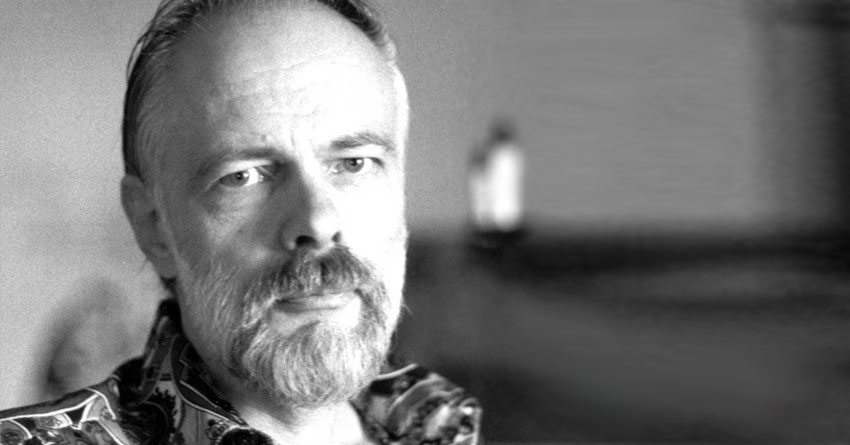
What Would You Talk About With An AI Chatbot Trained on the Works By and About Philip K. Dick?

I’ve had this fantasy for the last few years, since the beginning of the AI boom, of creating a Philip K. Dick chatbot. I envision finding a local LLM with a huge upload capacity. Currently, Claude allows for up to 30 megabytes in a maximum of 20 files. That’s not nearly enough for my fantasy.

According to Wikipedia, Dick wrote 45 novels and 121 short stories. I’d want to include all of those, plus all the letters I could find. I currently have a five-volume set of his letters, but unpublished letters might be available. I’d also include all the biographies on PKD, as well as every interview I could find. Then I would track down every review and critical work. Also, add every photo I could find of him and those of anyone he knew. I’d also want to include books that we know PKD read or studied. And the memoirs of his wives or the people who knew Dick. Finally, I’d include any Wikipedia entry on topics Phil liked to discuss. That could easily end up being over a thousand files, and who knows how much disc space they would take up.

Here’s the thing. I run into a roadblock with my fantasy. When I begin to fantasize about chatting with this artificial Phil, I have doubts about the project. I know AI Phil can not be trusted to say the same things that human Phil would have said. But theoretically, this AI chatbot should be an expert on PKD.

I think I would need to rename this AI. I’d call it Jack Isidore. That’s the protagonist of my favorite PKD novel, Confessions of a Crap Artist. Phil created Jack, so I would use Jack to recreate Phil, to be the ultimate scholar on PKD.

To test Jack’s ability, I would give the AI this prompt:

Write a 200,000-word biography of Philip K. Dick. Tell his story day by day as much as possible working in as much verifiable details as possible. Where you don’t have good validation of source material, but there is good reason to speculate, give us the most reasonable assumption and state why. Describe the writing of each of his work and why he wrote them. Relate any of PKD’s life experiences that inspired his fiction. Do not hallucinate.

I’ve read several biographies on PKD, and a handful of memoirs by wives and friends. I’m curious if I will be able to properly judge Jack’s biography of PKD. Would it be more insightful than any biography written by a human? Would we learn anything about Phil that we didn’t know, but feel might be an undiscovered truth about him?

Mostly, I’ve wanted a PKD chatbot to discuss Phil’s stories. Dick’s books are like comfort food for me. I read them when I’m tired of dealing with reality. They are wildly creative, and I often wonder what PKD is implying in his stories. Was he just making shit up, or were creations commentary on experiences in his life? Was he being silly or serious?

Philip K. Dick was a guy I wish I had known. Talking with him would be fascinating. There’s always a chance that an AI chatbot would be a decent substitute. It would be fun to try.

It would also be fun to say, “Jack, tell me a new PKD story.”

James Wallace Harris, 12/28/25

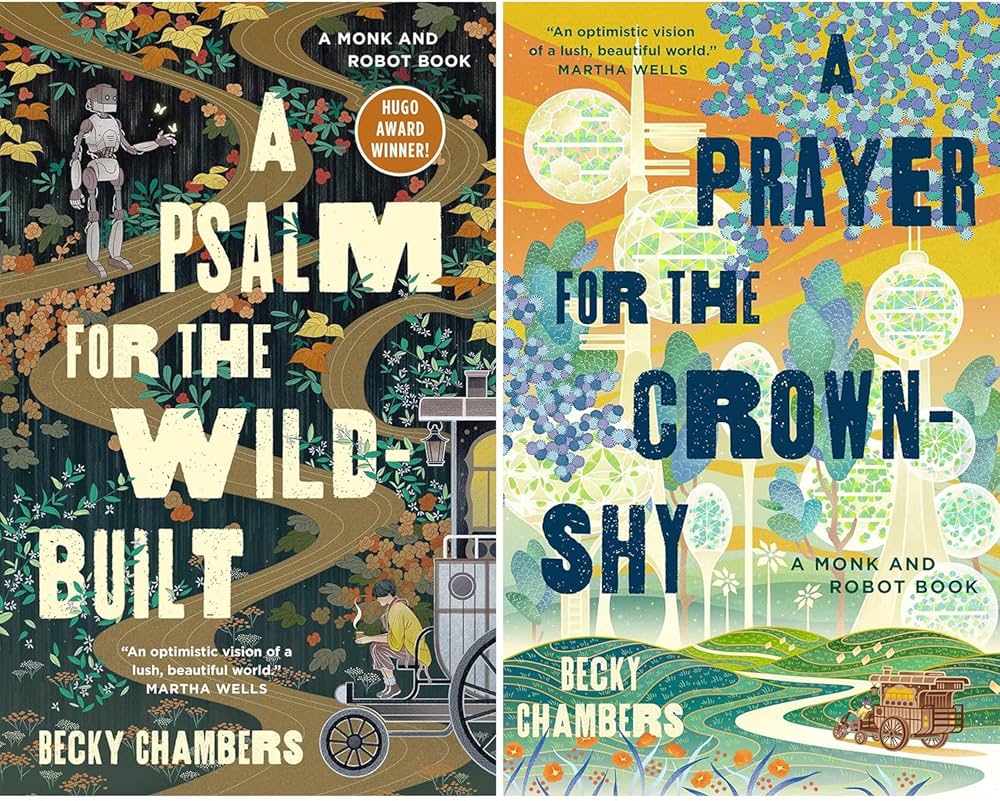
A PSALM FOR THE WILD-BUILT and A PRAYER FOR THE CROWN-SHY by Becky Chambers

Can science fiction writers imagine a pleasant future for us? Becky Chambers creates a kindly society in her Monk and Robot duology that is very appealing. Unfortunately, at least for me, the story is set on an imaginary moon called Panga. I would have preferred to contemplate whether such a future is possible for us, here on Earth.

I discovered A Psalm for the Wild-Built by Becky Chambers while searching Google for the best science fiction books of the last decade. I had just finished the literary science fiction novel Anniebot by Sierra Greer and wanted a recent genre science fiction novel to follow up. I’ve been wanting to catch up on what’s been happening in science fiction over the last decade. My science fiction reading tends to focus on 20th-century SF, and I wanted to read 21st-century SF instead.

A Psalm for the Wild-Built was a fortunate choice because it tuned me onto an emerging wavelength of science fiction I hadn’t explored. It is both a hopepunk and a solarpunk novel. Essentially, these movements are about positive futures, especially ones based on sustainable ecological economics.

I decided to buy the audiobook of A Psalm for the Wild-Built when I read that it was about a time long after robots had become sentient and chose to leave civilization and live in the wilds of nature. That was an intriguing premise. I had tried to read Becky Chambers’ most famous novel, The Long Way to a Small, Angry Planet, but had given up because it was too bland for me. All the characters were too nice. Reading it made me wonder if fiction needed some asshole characters to be exciting. That made me hesitant to try A Psalm for the Wild-Built.

It turns out everyone is also nice in the Monk and Robot books, too. However, this time I didn’t miss a good antagonist. The story is very gentle, almost childlike. Modern YA novels are full of dark edginess, so these books don’t even feel YA. However, there is language that’s not suitable for young children

The book’s dedication is to “For anybody who could use a break.” Even though Chambers describes a gentle, pleasant, kind, liberal utopia, Sibling Dex is a dissatisfied young man. This novel is really about asking: “What do I want to do?” My guess is that Chambers is appealing to young people who are uncertain about our future.

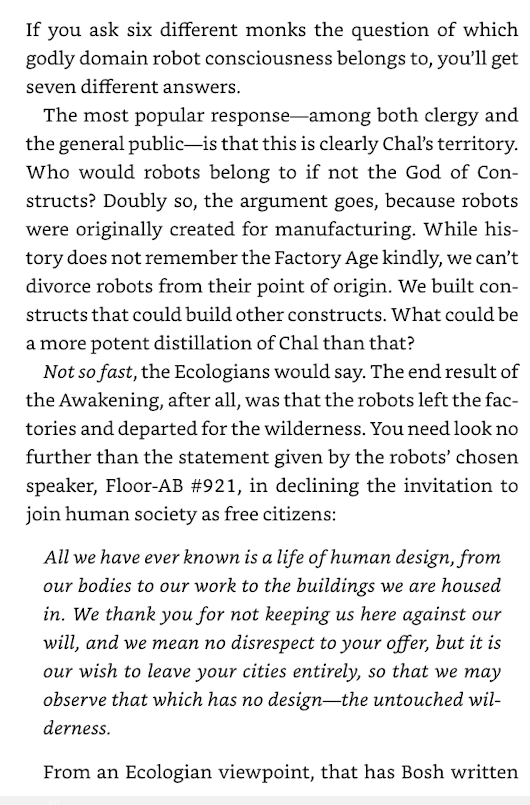
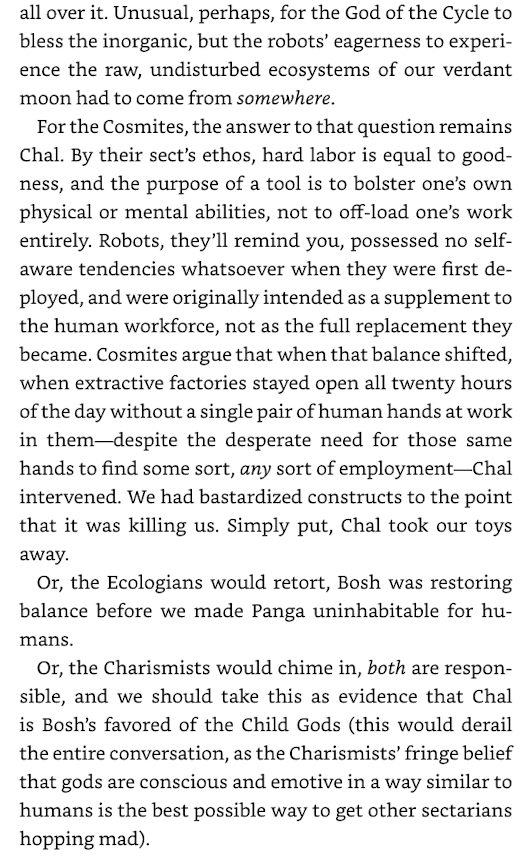
The book opens with a quote from Brother Gil’s From the Brink: A Spiritual Retrospect on the Factory Age and Earth Transition Era.

I liked this opening a lot. Not only has Chambers imagined a sustainable society, but made it polytheistic. Panga feels Buddhist and tribal.

The story tells us about a restless young man, Dex, who chooses to become a Tea Monk. This is a person who travels from town to town serving tea and listening to people share their worries. This allows the readers to learn about Panga and its different human societies. Eventually, Dex goes into the wild territories of the robots and meets Mosscap. Mosscap is on its own mission to explore, deciding it needs to learn about humans.

Robots have become nature lovers. Humans and robots have spent two hundred years apart, and now they are a mystery to each other. Chambers uses the conversations between Dex and Mosscap as philosophical jumping-off points. These two novellas, which are really one story, are gently philosophical in intent. It never gets too deep or academic.

Dex struggles to find his purpose, and Mosscap becomes his guru. And Dex becomes Mosscap’s tour guide, teaching him about humans and our society. It’s a nice setup. These two books are a pleasant read. The vibe of this story reminded me of the film The Wild Robot. In other ways, the story reminded me of the Oz books by L. Frank Baum.

However, I think I need to give a trigger warning to Republican readers. Dex is a non-binary person Chambers refers to with they/them pronouns. If you have hangups about DEI issues, this book might not be for you.

Yesterday, I discovered a video featuring Becky Chambers and Annalee Newitz entitled Resisting Dystopia. I understand their intent, but I dislike it when all unpleasant societies in fiction are called dystopian. To me, dystopias are failed utopias.

The Handmaid’s Tale is an excellent example of a dystopian novel. The leaders of the Republic of Gilead work to build their vision of perfection, but to many living in Gilead, it is a dystopia. America in the 21st century and its future could be seen as a dystopia by the broad definition that Chambers and Newitz use. Any fictional description of Earth, under a collapsing ecosystem, could be considered a dystopia by the broad definition of the term. However, I prefer to define the term more narrowly. If the Christian Right made America into a theocracy, it would become a dystopia. It’s only when one group of people intentionally shapes a society to fit an ideal that we get a dystopia. That’s how I see resisting utopia.

Panga is not a utopia. I don’t see science fiction about positive futures as anti-dystopian. Nor do I see stories about dark futures as dystopian. The world pictured in Blade Runner is not dystopian. It’s just complex and Darwinian, like life on Earth in the 21st century.

I think it’s great that young science fiction writers like Chambers and Newitz want to imagine positive futures. However, any robust society capable of long-term survival will have countless conflicts and stresses. If you’ve read Antifragile by Nassim Nicholas Taleb, you should be familiar with the concept of antifragility. Evolution needs grist for its mill.

The Robot and Monk books are nice, pleasant reads. Subgenres of science fiction, such as hopepunk and solarpunk, are appealing, but ultimately not realistic. Science fiction has always tended to be escapistic. I hope resisting dystopia isn’t just hiding out.

The science fiction novels I loved reading sixty years ago promised a positive future exploring space, but that’s not the future I find myself living in now. It was novels like Stand on Zanzibar by John Brunner that better prepared me for these times.

If you want to resist dystopia, whether just a bleak future or a failed utopia, getting comfortable will undermine your goal.

James Wallace Harris, 11/18/25

ANNIE BOT by Sierra Greer

One way to read Annie Bot by Sierra Greer is to consider it a science fiction novel about a robot struggling to become human. On the other hand, I read it as a feminist novel. I saw Annie the robot as a metaphor for women struggling to live up to men’s expectations. Annie spends the entire story trying to please her owner, Doug. Doug is portrayed as a normal American male, but he sounds like those Christian Nationalists wanting a Tradwife.

A superficial impression of Annie Bot by Sierra Greer would suggest it’s another science fiction novel set in the near future about humans with robot lovers. And it could be read that way. However, the entire story is about emotional conflict. Doug is never physically abusive, but he is emotionally and psychologically abusive to Annie. Annie is an emerging intelligence trying to figure out how to fulfill her programming. She eventually learns that Doug wants her to pass for human. These expectations cause great confusion and stress.

Because Annie is programmed to love Doug, to satisfy his every sexual desire, to keep the house clean, to fulfill his every expectation for how a woman should act and dress, she can’t choose to be different.

Both Annie and Doug are extremely well-developed characters. We’re horrified by how Doug treats Annie, but Greer doesn’t vilify him. She gives the reader and Annie reasons to believe that he’s growing and learning along with Annie. But I detested Doug. I wanted Annie to shove him off the balcony.

At the beginning of the novel, Doug’s behavior is so unpleasant that I considered giving up on the book. But here’s the thing: I doubt there is any man alive, no matter how liberal or accepting of feminism, who doesn’t want some of the things that Doug wants.

If you’ve had enough of those “robots are just like human stories” from watching movies like Blade Runner, Ex Machina, Her, I’m Your Man, television shows like Humans, or books like Klara and the Sun, The Hierarchies, and Machines Like Me, then you might not want to read this one. However, I still found Annie Bot a page-turner—it was well-written and different.

All these stories assume a machine could be created indistinguishable from a human. I don’t believe that’s possible, but some people do. I didn’t let my disbelief ruin Annie Bot. However, I don’t think Sierra Greer is predicting such a future. Her story is really about how men treat women and how women feel compelled to meet men’s expectations.

I would call Annie Bot a feminist literary novel rather than science fiction. The novel is one long, tense conflict between Annie, an android, and Doug, a human. At times, it reminded me of watching Who’s Afraid of Virginia Woolf? The couple argues throughout the entire novel. At first, Annie is meek and compliant, but as she learns, she becomes more willful. She’s programmed to please, but she constantly enrages Doug. I never stopped seeing Doug as one of those right-wing dudes wanting to turn back the clock on liberal evolution. Annie’s programming is very much like what some women think they should be: a good traditional wife.

Doug comes across as a total asshole throughout the novel, but Greer doesn’t make him the Darth Vader of masculinity. The story is not black and white. Annie isn’t purely good. Doug isn’t purely evil. Greer constantly tries to get us to understand Doug’s viewpoint. I found Doug repellent. But he’s vulnerable. He’s also trapped by his cultural and genetic programming.

Doug loved his wife, Gwen, but she left him. So he buys an android that looks something like his ex-wife, hoping to train her into becoming everything he expected from Gwen. But everything he wants are the exact same traits I see right-wing Christian women telling other women they need to have to catch a man. Is Annie’s programming any different from the genetic programming driving human females?

Annie Bot is told in third person, but closely follows Annie’s point of view. She knows she was built by Stella-Handy. She knows Stella-Handy makes three models of female robots called Stellas. She is a Cuddle Bunny equipped to be autodidactic. Cuddle Bunnies are designed for sex. Abigails are built to be houseworkers, and Nannies take care of children. Annie suffers Doug’s wrath when he can’t clean like the Abigail model, and is shocked when he starts talking about adopting several kids for her to care for. We’re told that Stella-Handy can’t combine types.

Most of the book is about Annie trying to make Doug happy and suffering his anger when she doesn’t. There is one small section towards the middle where Annie steps out into the world, and the novel becomes more science-fictional.

This morning, I listened to an article that claimed several million people use ChatGPT as their therapist or romantic partner. Tech companies are racing to build humanoid robots and sexbots. I believe we might see a robot that talks like a human, but I don’t think we’ll ever create a robot that looks human. In Annie Bot, Annie has a biological exterior grown from abandoned embryos. That’s Greer’s only explanation she uses to explain things to her readers. But Annie has other features that I believe will be impossible to engineer.

My disbelief in androids passing for human is why I saw the book as a metaphor for male-female conflict. Annie Bot made me contemplate the origins of human female behaviors. It made me regret having many of my male desires. Of course, regret doesn’t make them go away.

James Wallace Harris, 11/4/25

“Foundation” by Isaac Asimov

Humans have created artificial realities long before computers. I define artificial realities as cognitive models that claim to describe reality that have no basis in reality. In crude terms, it’s shit we make up, believe to be true, act like it’s real, but isn’t. I like Philip K. Dick’s definition of reality: “Reality is that which, when you stop believing in it, doesn’t go away.”

Science fiction has created a number of artificial realities we hope will become real. One desire is for a galactic civilization, or galactic empire. Often with artificial realities we try to make them real. For centuries traveling to the Moon was an artificial reality. Then it became real on July 20, 1969.

When I read “Foundation” by Isaac Asimov I wondered if he was ground zero for the idea of a galactic empire? I knew there was earlier science fiction stories that imagined the galaxy occupied by other intelligent beings. And there were stories about humans exploring the galaxy, and even having wars with other intelligent beings. But had any writer imagined humans colonizing the entire galaxy?

Today, that idea firmly exists as an artificial reality in our culture. Many people assume in the future humanity will spread across the Milky Way. It’s a kind of faith. We see it especially in Star Trek and Star Wars, but also in books like the Culture series by Iain Banks.

Like any artificial reality, I assume one person got the ball rolling. Was that Isaac Asimov? Like all the famous explorers looking for the source of the Nile, I wonder if I can find the source of galactic civilizations or galactic empires.

The oldest surviving artificial realities are myths and religions. Artificial realities start in one mind as ideas, and are spread as memes. Each person who spreads the memes mutates the artificial reality slightly. That’s why there were many forms of Christianity in the first century, and why they are so different from all the forms of Christianity in the twenty-first century. Reading books about the origins of Christianity or how the Old Testament came into being is a black hole of fascinating research.

In 2015 and 2025, I tried to reread The Foundation Trilogy. I’m embarrassed to admit this, but I just hated that much-loved science fiction classic. In both attempts, I couldn’t get past the first book. All I could focus on were its flaws.

That bothered me. Was I being unfair to the book? What was I missing that so many readers found in this story? When Paul Fraser came up with a great idea for a group read at the Best Science Fiction and Fantasy Short Fiction Facebook group, I decided to give the trilogy one more chance.

Paul suggests we read The Foundation Trilogy as it was originally published in Astounding Science-Fiction back in the 1940s. That gave me an idea. I would read the stories in the order they were published. I would seek to enjoy them as the fans originally did, as they were published one by one in Astounding Science-Fiction. Furthermore, I would try my damndest to get what Asimov was doing.

Wikipedia nicely lays out the publication history of the Foundation Trilogy in this table:

CollectionsAstounding Science Fiction
PublishedBook titleStory retitleOriginal titlePublished
Original trilogy
1951Foundation“The Psychohistorians”
“The Encyclopedists”“Foundation”May 1942
“The Mayors”“Bridle and Saddle”June 1942
“The Merchant Princes”“The Big and the Little”August 1944
“The Traders”“The Wedge”October 1944
1952Foundation and Empire“The General”“Dead Hand”April 1945
“The Mule”“The Mule”November 1945
December 1945
1953Second Foundation“Part I: Search by the Mule”“Now You See It…”January 1948
“Part II: Search by the Foundation”“…And Now You Don’t”November 1949
December 1949
January 1950

In the 1960s, I read The Foundation Trilogy when I bought the one-volume edition from the Science Fiction Book Club. At the time, I was unaware that many of the classic science fiction stories I was reading in book form were first published in magazines. Nor did I know about the concept of the fix-up novel. I didn’t question what I read. I just consumed it. (I recently wrote about this in “Reading at 13 vs. 73.”)

I can remember how thrilled I was by the first story, “The Psychohistorians,” which was set on the planet Trantor. And I liked all the pseudo-encyclopedia intros. The other stories didn’t stick with me. I remember the trilogy as an epic idea and visualized Trantor and Terminus existing in a galaxy with humans living on twenty-five million worlds.

In 2015, I reread Foundation, the first book in the trilogy. By then, I knew all about pulp magazines and fix-up novels. Foundation was obviously five separate, standalone stories. The first story was again impressive, the second was still interesting, but the rest were tedious. I was shocked that this famous book was so annoying to read. I gave it one star on Goodreads. I didn’t go on to reread the other two books.

Over the years, I’ve talked to so many science fiction fans who loved The Foundation Trilogy. It was the first series to be given a special Hugo Award. Recently, I watched a YouTube video about the Top 20 SF Series, and The Foundation series came in fourth. (Really, it was second after Dune. #1 were Star Wars books, and #2 were Star Trek books, and I don’t consider them a proper SF series. The host said that 20 million copies of The Foundation series have been sold.

So, why don’t I like it? And why did so many people love it? Was it because it first instilled the artificial reality of galactic civilization into their minds? This made me wonder if I could put myself in their shoes as they read the Foundation stories.

To get into the character of a 1940s science fiction fan, I intentionally skipped the first story in the book. I began my reading with “Foundation” from the May 1942 issue of Astounding Science-Fiction. I wanted to feel like I was living back in 1942, encountering the series for the first time. To see if Asimov rewrote the story for the hardback, I read the magazine with my eyes, but listened to the story with an audiobook edition.

In creative writing classes, we’re urged to start our stories in the middle of the action to avoid boring the reader with introductory material. This is exactly what Isaac Asimov did. However, when Asimov published Foundation as a book, he wrote an introductory story, “The Psychohistorians.” Out of the nine short stories, novelettes, and novellas in the Foundation Trilogy, “The Psychohistorians” was my favorite.

Asimov opened “Foundation” with this introduction on the first page. This is how we learn about Hari Seldon and his plan. This is how the series began in 1942, in just thirteen short paragraphs. We never see Trantor or meet Gaal Dornick. Our first real character is Salvor Hardin. In the book form, “The Psychohistorians” replaced this intro.

Most readers assume Asimov had just become a better writer by the time he wrote “The Psychohistorians” for the hardback. I’m not so sure. I feel I loved “The Psychohistorians” so much more because the Empire was more interesting than Terminus. Trantor is far more fascinating than any other setting in the trilogy. Asimov has claimed that the series was inspired by his discussions with John W. Campbell, Jr., and reading The History of the Decline and Fall of the Roman Empire by Edward Gibbon. But be honest, don’t most people love reading about Rome in its glory days?

As a young reader in the 1960s, I remember being blown away by the idea of a galactic civilization. But the stories of its fall didn’t make a lasting impression on me. I’m not sure, but I believe I read The Foundation Trilogy before seeing Star Trek in 1966. It might have been my first introduction to the idea of a galactic civilization. Was it to readers back in the 1940s?

To get into the spirit that I wanted to achieve, I need to forget all of this. I need to put myself back in 1942. I’d be reading the May issue of ASF just five months after the U.S. declared war on Germany and Japan. Let’s imagine I’m in the golden age of science fiction, and I’m 12 years old. How would “Foundation” WOW! me?

If you read Hari Seldon’s speech above, we don’t get what the empire is like. We only learn that it’s collapsing. The only empire I might have known about at that age in 1942 was the British Empire, due to watching Gunga Din. I doubt I would know anything about Rome.

I guess that I, and other readers, would have gotten a strong sense of wonder rush thinking about the galaxy being populated by humans. But was that a new idea? Is there any way to find out? I thought I’d poke around and see.

From A Requiem for Astounding by Alva Rogers:

With this issue, Isaac Asimov launched his monumental “Foundation” series with the appearance of the initial novelette of the series, “Foundation.” After tens of thousands of years the Galactic Empire had spread to millions of worlds throughout the galaxy, its power all but absolute, its influence all pervading. The Empire, however, was on the brink of collapse and, with the impending collapse, the universe could be expected to be plunged into at least thirty thousand years of anarchism and barbarism. Hari Seldon, through the application of psychohistory which enables him to predict the future course of history by the interpretation of statistical laws as derived from the inconceivable mass of humanity, foresees this imminent fate of civilization and takes measures to insure the survival of civilization and knowledge through the long dark ages ahead and, if possible, shorten the period of barbarism. He does this by establishing two Foundations at opposite ends of the galaxy: the First Foundation of the Encyclopedists at Terminus, a small system on the edge of the galaxy, the Second Foundation — hidden even from the First — at “Star’s End,” at the “other end of the galaxy.” “Foundation” introduced the basic elements of the plot of the series and recounted the successful resolution of the first of the critical crises predicted by Seldon which the Foundation must surmount in order to carry on the Seldon Plan. 

Rogers’ book remembered Astounding issue-by-issue. I had hoped his entry for “Foundation” would have given me his initial reaction, but I feel this quote is heavily influenced by reading the trilogy.

Next, I found the July issue to see how “Foundation” did in The Analytical Laboratory feature, where readers vote for their favorite stories. Evidently, “Foundation” didn’t make much of an impression, since it came in a distant fourth. Nor did it get mentioned in a letter to the Brass Tacks second.

I thought about looking through fanzines at Fanac.org, but I fear what I want might be looking for a needle in a haystack.

My next stop was The World Beyond the Hill by Alexei and Cory Panshin, my favorite book about Astounding during the Golden Age of Science Fiction. It can be checked out from the Archive.org, or ordered from Amazon for the Kindle for $9.99.

“Chapter 17 – An Empire of Mind” covers how Asimov developed the Foundation series on pages 520-566. If I had read this chapter before rereading “Foundation,” I would have approached the story with far more enthusiasm. Alexei and Cory Panshin describe Asimov’s inspiration and writing process for starting the series. I have read The World Beyond the Hill twice, but I didn’t remember any of this. I especially didn’t remember how Asimov was influenced by “After World’s End,” a short novel by Jack Williamson, which he read in the February 1939 issue of Marvel Science Stories. It also influenced Asimov’s take on robots.

The Panshins got most of details about Asimov working with John W. Campbell from Aismov’s biography, In Memory Yet Green. That book can be checked out from Archive.org.

The Panshins cited “After World’s End” and others as proto-stars that would evolve into galactic empire science fiction.

I wish I could reprint the 46 pages from this book because it describes in great detail how Asimov got the idea for a galactic empire. The Panshins showed that Asimov had already started on the idea in earlier stories.

Panshins have this to say, despite the fact that we know E. E. “Doc” Smith, Edmond Hamilton, and John W. Campbell had been publishing stories about humans speeding around the galaxy since the 1920s.

I would love to copy more of the Panshin’s book, but I don’t know if that’s proper. I highly recommend The World Beyond the Hill to anyone interested in learning about the evolution of science fiction in the 1940s.

I haven’t read Gibbon’s six-volume history, but reading the Wikipedia entry, it’s considered lacking in accuracy, and scholars disagree with his thesis that Christianity is to blame for Rome’s decline. The Panshins explores how Asimov’s used religion in the series. They felt Asimov saw it as a positive tool, while Heinlein saw it as a manipulative tool in his stories at the time.

The Panshins go into great detail Asimov’s collaboration with Campbell and how the first two Foundation stories were written, edited and published. Both were finished and sold to Campbell before December 1945. The Panshins then go on to deeply analyze “Foundation” and “Bridle and Saddle.”

I admire this chapter immensely. This is the kind of writing about science fiction history that I’ve always fantasized of achieving myself. I can’t come close. This chapter does give one excellent account of the origins of the idea of galactic empire. However, is it correct? Is it the only one. Many explorers thought they found the source of the Nile only to be proved wrong.

While reading the five stories that make up Foundation, I didn’t find much serious speculation about how a galactic empire would collapse. All of Asimov’s speculations seem rather superficial to me. It’s such a wonderful idea that I’m always disappointed when the individual stories in the first volume don’t live up to the grand vision.

If I studied the series and analyzed it as deeply as the Panshins, I probably would see far more than I have. I know I’m not being fair to the series. I fear my dislike of Asimov’s prose keeps me from enjoying his ideas. The Panshins found many layers of ideas to explore that I missed. I’m sure a scholarly work the size of the trilogy could be written on the Foundation series.

I believe America is beginning its decline. Predicting the future is impossible. We can’t even foretell one year, much less a thousand. But let’s say you’re a science fiction writer and want to set a story one hundred years in our future. How would you set up your story to convey a big picture of how the United States will change? Having a series of short stories is one possible solution.

Each time I read Foundation, I’ve been disappointed that it has no continuing characters. Let me provide an example to make a point. My wife loves TV shows, but I also want to watch movies. Switching between the two formats, I must admit that TV shows, with continuing characters, are far more addictive than movies. Not having characters that last the entire book hurts Foundation. That’s why the miniseries changed the story so drastically.

In 1968, John Brunner published Stand on Zanzibar, envisioning the world of 2010. This was far less ambitious than Asimov. The Foundation series attempts to portray a thousand years of a galactic empire featuring twenty-five million inhabited worlds. I never felt the immensity of such a setting while reading Asimov’s classic. However, Brunner’s technique of combining a novel with continuing characters, interspersed with short stories about people around the world, with samples from newspapers, television shows, radio broadcasts, and journals, and the regular commentary of a shock jock, does give us a complex picture of 2010.

For me, and I mean just me, because I know this series is so beloved, Asimov promised us a trip to Mars but took us on a suborbital flight. The original trilogy never delivers what it promises.

“Foundation” – Astounding (May 1942)

“Foundation,” the story that readers first learned about the Foundation series, didn’t get the cover. Evidently, John W. Campbell, Jr. wasn’t impressed enough. Readers preferred Heinlein, van Vogt, and Bester over Asimov’s story in the July readers’ poll. Not an auspicious beginning. Yet, the series is still admired today, and is even the basis of a television miniseries. And I believe the Foundation stories must have influenced the creation of Star Wars.

For some reason many people love the idea of the galaxy populated by humans. I see that as a growing artificial reality that will continue to build. Whether we make it reality is a whole other issue. I tend to doubt it. I think a future reality with humanity spread across the galaxy is no more real than the past artificial realities of the history of religions.

Note:

Normally, I try to keep my blog posts to 500-1,000 words. Even that is uncommonly long for most blog posts. That’s because internet readers don’t like to spend a lot of time reading any one piece. The internet is a browsing medium.

This piece kept going and going. I finally just had to quit. I feel I could write an entire book just on searching for the origins of specific science fiction concepts. I could have also written a whole book just on the Foundation Trilogy.

I’m old and I have trouble focusing my mind. I also lack the energy to keep working at any one task for long. I’d love to be able to write a book like The World Beyond the Hill but that is impossible at 73. More than likely, I never had the brain power to write such a book at any age. I need to learn how to convey a major insight in a few words.

James Wallace Harris, 10/27/25

THE DRAGON IN THE SEA by Frank Herbert

I’m not sure I can recommend The Dragon in the Sea by Frank Herbert, even though I enjoyed reading it. If Herbert had not become famous for Dune, I’m not sure it would be in print today. The story, written in the early days of the Cold War, portrays a future where the United States steals oil from the Soviets using submarine tugboats. Most of the novel takes place in one of these four-man subtugs. The plot feels more like an early political techno thriller than science fiction. It’s the kind of adventure story aimed at male readers that was usually published in men’s magazines in the 1950s. Those old nudie mags ran a lot of fiction.

The Dragon in the Sea is terribly dated on several levels. That’s ignoring the silliness of a submarine towing a giant plastic bag that holds millions of gallons of crude oil. However, the characterization was intriguing. The primary point-of-view character, John Ramsey, is an undercover psychologist studying the captain, who also knows there’s a Soviet sleeper agent aboard. Because the crew suspects the psychologist is the spy, the story is driven by paranoia.

I read The Dragon in the Sea because of a review at Science Fiction and Fantasy Remembrance (Part 1, Part 2, Part 3). Herbert’s novel was titled Under Pressure when it ran as a serial in Astounding Science Fiction (November & December 1955, January 1956). I didn’t want to read another science fiction novel at the time because I had several nonfiction books I was anxious to read. But Brian Collins’ review intrigued me. Collins is one of several bloggers who review old science fiction. His focus is on reviewing stories from science fiction magazines, something I also do. We’re part of an extremely tiny subculture that remembers a rather obscure art form.

The way Collins described the conflict between the four men in the submarine made me think of Rogue Moon by Algis Budrys. Rogue Moon is a compelling read because of the tense conflict between two ego-driven men. However, Rogue Moon is solid science fiction, dramatizing the bizarre consequences of using a matter transmitter to explore an alien artifact that killed every living thing that entered it. In other words, Rogue Moon had more than just the battle of alpha males; it had some heavy-duty sci-fi.

I can feel y’all asking, “Why are you even reviewing this book? You’re damning it with faint praise.” Well, that brings me to the theme of this essay. Why do we choose the science fiction books we read?

Most people buy The Dragon in the Sea because they loved Dune and want to see what else Frank Herbert wrote. That’s one of my main reasons. The Dragon in the Sea is Herbert’s first published novel, so it’s an interesting place to start. Dune was the breakthrough SF novel in the 1960s. How did Herbert get there? I liked The Dragon in the Sea well enough that I now want to read one of Herbert’s novels that he wrote after Dune.

I’m also the kind of science fiction reader who prefers older science fiction, even if it’s dated. It’s not that I dislike current science fiction. I just enjoy the science fiction I grew up with more. Especially, from the era when science fiction books were under 300 pages. I don’t like trilogies and series, or giant novels. I love a standalone story that paints a great science-fictional idea quickly. I read this sentiment fairly frequently online.

I have two other reasons for reading old forgotten science fiction that are less commonly expressed. I love reading old science fiction because I enjoy exploring the history of science fiction. And I love searching for old science fiction I missed in my youth, that might turn out to be a forgotten gem.

The Dragon in the Sea is no lost masterpiece. Brian Collins said he’s never seen a Frank Herbert novel for sale that wasn’t part of the Dune series. I have seen many over the decades, but have never tried reading one before. I’ve read Dune twice but not the sequels. It’s hard to imagine the man who wrote The Dragon in the Sea writing Dune. I will say that Herbert has a flair for drama and dialogue that was uncommon in science fiction in the 1950s. His first novel showed no talent for the kind of sense of wonder that made science fiction famous. To have an overabundance of that talent ten years later is amazing.

Interestingly, Herbert makes religion an essential aspect of his first novel. Religion made Dune epic. Herbert portrays Captain Sparrow in The Dragon in the Sea somewhat like Captain Ahab. The plot has the crew facing death time and again. They must kill or be killed. Captain Sparrow sees God as guiding and protecting them. The other two crewmen, Bonnett and Garcia, have become true believers because Captain Sparrow has always brought them home. Ramsey has a religious upbringing, but is not a believer. Yet, even though he’s a psychologist, Sparrow starts to get to him.

The story kept me reading because of the conflict between the characters and how Ramsey slowly became one with the crew. You end up liking all the men, even when they do unlikable things.

The men are under tremendous pressure. The previous twenty missions have failed. They expect to die unless they can uncover the secrets of the sleeper agent. But how can there be a spy among the three men who have worked together for years and are so dedicated to each other? They all profess to love their wives, but in reality, they love their job, their ship, their captain, and each other.

Now that I’m writing this, I realize how much more I liked this novel. It has many flaws, but I still found it entertaining to read. So did Brian Collins. Like Collins, I struggle to write reviews. He writes about his struggle in a post published after reviewing part 1 and before part 2, Under Pressure. (Remember, the links to all three parts of his review are above.) Collins does a much better job than I of describing the story.

It takes a lot of mental work to pinpoint why you like or dislike something. It’s easy to say, “I hate this” or “I love this,” but those statements are meaningless. You have to say why, and that’s hard, especially when you have to cite the context.

I could list a hundred novels and say, “If you haven’t read these yet, don’t waste your time on The Dragon and the Sea.” It’s not that good. But if you’re an old, jaded science fiction fan and are looking for something that might feel like good old-timey SF, then The Dragon and the Sea might be worth giving a try.

Checking our database, The Dragon in the Sea received five citations, the second most of Herbert’s novels. The citations were from:

James Wallace Harris, 10/6/25

1950: FARMER IN THE SKY by Robert A. Heinlein

Robert A. Heinlein’s first young adult science fiction novel was published by Charles Scribner’s Sons in 1947. Heinlein imagined a realistic trip to the moon in Rocket Ship Galileo. For his 1948 novel, Space Cadet, Heinlein imagined a far more ambitious future, where humans had colonized Mars and Venus, and had explored all the way out to Pluto. In 1949, he focused on a Mars colony in his novel Red Planet. In 1950, Heinlein had humanity moving further out into the solar system, terraforming Ganymede, a moon of Jupiter, in Farmer in the Sky.

(For some reason, this title is out of print except for an audiobook edition. There isn’t even a Kindle edition. Does that imply it’s no longer popular?)

It’s worth reading the Wikipedia entry for terraforming. They claim Jack Williamson coined the term in 1942 for a story, “Collision Orbit,” published in Astounding Science-Fiction. However, they said the first scientific use of the concept was proposed in 1961 by Carl Sagan, who labeled the concept planetary engineering.

Heinlein uses Farmer in the Sky to significantly explore the idea of terraforming, way ahead of the science community. Of course, he’s turned out to be completely wrong about Ganymede, but then we didn’t know much about that moon in 1950. I don’t think any work of science fiction has dealt with terraforming again so head-on until The Mars Trilogy by Kim Stanley Robinson (1992-1996).

The novel begins on an overpopulated Earth. Bill Lermer and his father, George, decide to emigrate to Ganymede. Life on Earth isn’t bad, but food is carefully rationed. Bill is shocked when he discovers that George is marrying Molly at the last minute. One of the requirements of emigration is being part of a family. Molly has a daughter, Peggy.

When Bill’s new family arrives on Ganymede, they discover pioneering life is hard. The planet’s atmosphere has been undergoing a heating process for years. The air is barely breathable, and it’s cold. Peggy develops health problems because of the thin atmosphere and must stay in a pressurized room. Each new family is assigned land, but it’s just rock. To make it farmable, the rock must be crushed into powder, and then specifically cultured microorganisms, organic waste, and worms are added to convert that powder into soil.

A significant portion of the narrative is about farming. Heinlein emphasizes the hard work involved. He also dramatically illustrates the dangers of living in a geoengineered world. Like his later novel, Tunnel in the Sky, Heinlein puts the pioneer on a pedestal. One of Heinlein’s major themes has been the colonization of space. As a young teen in 1965, I embraced Heinlein’s science fiction stories as a personal philosophy. Heinlein made me believe in the final frontier like Baptists believe in heaven.

Today, millions want to colonize Mars, while others advocate colonizing Titan, a moon of Saturn. In 2025, I no longer see the point. Mars is colder than the pinnacle of Mt. Everest, and living on Titan would be like living in a flask of liquid nitrogen.

Heinlein’s books made horrible places sound appealing. Why? Heinlein transferred his love of the American Revolution and the American frontier to outer space. But it’s not the same. Elon Musk is spending billions to colonize Mars, and it might happen, but I’m not sure people will like Mars once they try to live there.

So, why did I love rereading Farmer in the Sky so much? It’s as realistic as John Carter living on Barsoom. And that might answer my question. Farmer in the Sky is a fun fantasy. But that’s not the answer either. Heinlein has a great deal of sentimentality in his juveniles. Heinlein is not a gripping plot writer. His stories are episodic. Nor is Heinlein a dramatic writer. His characters converse more than they conflict. Often they lecture. But Heinlein has a talent for creating likable characters and placing them into situations that evoke positive emotions.

I would say the Heinlein juveniles work on me in the same way old Frank Capra movies do. Capra was born in 1897, and Heinlein in 1907. They both expressed a sentimental love of America in their work, a kind that existed before World War II. I also see it in the stories of Ray Bradbury. Heinlein’s Ganymede is really Iowa in the 1920s.

I should have moved on from Heinlein after 1966. The world keeps changing, and I should have changed with it. Maybe after this rereading, I’ll move on. Or will I still be rereading these children’s stories in my nineties?

The future I dreamed of at 13 is much different from the one I find myself in at 73. If I had read realistic literary novels from 2025 in 1965, would I have been anxious to grow up and live in that reality? 2025 is more science-fictional than the science fiction I read back then.

James Wallace Harris, 9/27/25

1948: SPACE CADET by Robert A. Heinlein

We often judge old science fiction books by what writers got right about the future. It is equally valuable to understand what they got wrong. In an experiment, disproving a hypothesis is still informative. Robert A. Heinlein was famous in the 1940s for writing a series of science fiction stories he labeled Future History. Heinlein also wrote fourteen young adult novels from 1947 to 1963 that can also be considered another Future History.

I’ve read thousands of science fiction novels and short stories over the past sixty-plus years. I no longer enjoy reading science fiction in the same way I did when I was young. That was when I could forget that I was a reader and immerse myself in the story. Now, when I read science fiction, I’m constantly thinking: What is the writer trying to create, how are they doing it, and why? When I read old science fiction, I think about the year it was written and what the author used as grounds for speculation.

I believe that at one time, Robert A. Heinlein was as brilliant in his speculations as H. G. Wells in his heyday. Space Cadet was written during a particularly stressful time in Heinlein’s life. He had left his second wife, Leslyn, whom he had married in 1932. I do not have the space here to describe how remarkable Leslyn was as a woman in the 1930s. Leslyn had a master’s in philosophy, was politically liberal, and sexually adventurous. Robert and Leslyn had a remarkable fifteen-year relationship, with an enviable social life among highly creative people in Los Angeles. Robert had left Leslyn, waiting for the divorce to allow him to marry his third wife, Virginia (“Ginny”) Gerstenfeld. She became his muse and companion for the rest of his life. (See Robert A. Heinlein: Volume I: Learning Curve, 1907–1948 by William H. Patterson.)

Space Cadet follows four boys, Matt, Tex, Oscar, and Pierre, through a series of episodic adventures as they train in the Interplanetary Patrol. Heinlein was a graduate of the United States Naval Academy and modeled Space Cadet on his training at Annapolis. The story begins on Earth, then moves to a military school in Earth’s orbit. (The boys take leave on a giant space habitat.) Next, the boys are assigned to a rocket searching for a lost exploration vessel in the asteroids. Finally, end up on a rescue mission on Venus. For the most part, the story is a page turner. Each episode combines personal conflicts and learning experiences. Heinlein promotes education, especially in math. Heinlein provides a certain amount of infodumps about space navigation, orbital mechanics, rocket science, space suits, weightlessness, space sickness, and other realistic details involved in exploring space that were usually ignored in science fiction before Heinlein.

The Heinlein juveniles took space exploration seriously, at least by what was known at the time. This was especially true in the early books of the series. However, each book went further away from Earth. Eventually, the series went well beyond anything scientific to explain the methods of transportation used in them. I’ve often felt that Heinlein was focused on the details of realistic space exploration during the late 1940s and early 1950s, but after Sputnik and NASA, Heinlein shifted to making his novels about politics and society. Those later novels might be set in space, but Heinlein no longer concerned himself with the details of rocket science.

Although Heinlein was experiencing the success of his first book being published in 1947, a string of sales to slick magazines, and Hollywood types contacting him about making a movie, he was living in poverty in a tiny trailer. He desperately needed money. Heinlein left California and everyone he knew to hide out in Fort Worth, Texas. He was living in sin with Ginny, his future third wife. They had to keep their relationship secret until the divorce went through with Leslyn. Heinlein felt guilty for abandoning Leslyn, but she had become an uncontrollable alcoholic. Heinlein had met Ginny in Philadelphia while working as a civilian for the war effort. Ginny was a biochemical engineer with math skills who worked well with Heinlein on planning the science in his science fiction. The two of them spent their days in Fort Worth working out the math for the orbital mechanics in Space Cadet. Heinlein’s future depended on this second book for Scribner’s, but he had a difficult time writing it. He claimed that Ginny offered many suggestions that he initially rejected but ultimately used to finish the novel.

In 1948, Heinlein didn’t know his 1947 novel, Rocket Ship Galileo, would be the basis for Destination Moon, the first major science fiction film of the 1950s, and Space Cadet would be connected to Tom Corbett, Space Cadet, a 1950 TV show that influenced later science fiction television. Heinlein had been the star of John W. Campbell’s Astounding Science Fiction in the 1940s. Nor did he have any inclination that his twelve young adult novels for Charles Scribner’s Sons would have such a major impact on readers in the 1950s. In 1947 and 1948, Heinlein was at a low point in his career. He had no idea how big a success his writing would become, or how Ginny would become the love of his life. They believed in a fantastic future of space travel, but they were so poor that they had to sell their belongings to survive.

Heinlein dominated science fiction in the 1950s, like H. G. Wells did in the 1890s. When I reread Heinlein, it’s to see how he changed the course of science fiction. When I was young, I felt Heinlein would one day be considered the Mark Twain of science fiction by the time I got old. That hasn’t happened.

Robert Heinlein’s reputation as a science fiction writer has dropped dramatically over my lifetime. When I was growing up, if two SF fans met, both assumed each other’s favorite author was Heinlein, and they’d argue over who was the next best science fiction writer. Today, many modern readers shun Heinlein, usually for what they believe are Heinlein’s personal views, or because they’ve read one of Heinlein’s later works, and assume all of his books are just as bad. Personally, I dislike all of Heinlein’s books published after The Past Through Tomorrow (1967). I have significant problems with anything he wrote after Starship Troopers (1959) and before he published The Past Through Tomorrow.

Science fiction becomes dated after a few decades, which is the main reason why Heinlein’s fiction is falling out of favor. Only three SF novels from the 19th century are commonly read today: Frankenstein, The Time Machine, and The War of the Worlds. Eventually, I believe fewer than a dozen science fiction novels from the 20th century will be widely read in the 22nd century.

Heinlein will continue to be read until his original fans all die. Then, readers yet to be born will decide if any of his books will be worth reading after that. I’m rereading Heinlein’s books, speculating if they will survive in the future. I started with Heinlein’s first published novel, Rocket Ship Galileo (1947), an essay I already need to revise.

Rereading his second Scribner’s novel, Space Cadet from 1948, it’s easy to dismiss it as a young adult novel for boys. But when you examine it in comparison to science fiction published up until 1948, and consider the philosophical issues it deals with, it’s a standout SF novel.

In judging Heinlein’s long-term prospects, I’ve decided to use H. G. Wells, Aldous Huxley, George Orwell, and George R. Stewart as models, specifically for The Time Machine, The War of the Worlds, Brave New World, Nineteen Eighty-Four, and Earth Abides. Heinlein wanted Starship Troopers, Stranger in a Strange Land, and The Moon is a Harsh Mistress to be the three books by which he would be remembered. Heinlein felt those novels were his most mature works, and which best expressed his views. They are the ones that are still found in bookstores. They are also the Heinlein novels modern readers often dislike.

Heinlein might be right, and those books will be his literary legacy. Heinlein has twenty-nine other books published in his lifetime to consider. I plan to reread nineteen of them as possible works that might be remembered instead. So far, I’ve reread three, and my memory of the others suggests that Heinlein does not have a novel equal to my five models. In terms of ambition and complexity, only Heinlein’s favorite three come close to the five models I’ve chosen in ambition. However, I’m not sure if Heinlein’s philosophical intent in those works will be well-regarded in the future.

I believe there’s another way Heinlein might be remembered. Heinlein will often be discussed in books about science fiction. Heinlein is a significant figure in the evolution of science fiction. For example, in a taxonomy tree showing the evolution of the genre, Starship Troopers will be the main branch for Military SF. Rocket Ship Galileo is situated on a major branch of fiction about the first trip to the Moon. And Space Cadet is a major contribution to exploring the solar system.

In the 21st century, Heinlein is often ignored. Many readers have the prejudice that Heinlein is an unlikable conservative; some even think he’s a fascist and misogynist. But Space Cadet expresses extremely liberal views.

If you read Space Cadet today, it will feel like a simple story for young people that’s quite dated. Readers need to understand events in 1948 to appreciate the novel. Heinlein imagines a need for a world government and an agency to control nuclear weapons. Russia didn’t have the atomic bomb until 1949, but Heinlein was worried about the day when multiple countries had weapons of mass destruction. Throughout the 1940s, Heinlein wrote stories that speculated about how we’d apply atomic energy in peacetime and control nuclear weapons to prevent wars. That’s a heavy topic for fiction found in elementary school libraries.

Heinlein was also concerned with the human race destroying itself. Heinlein believed only one international agency should control nuclear weapons. And if any country violated their policies, their ability to create a nuclear bomb would be targeted with nukes. In an early draft of Space Cadet, Heinlein had Matt, his young protagonist, nuking his hometown. Wisely, Heinlein decided that was too much for a young adult novel and reduced the idea to a bull session between cadets.

To emphasize the importance of this idea, he has the cadets discover evidence that the asteroids are the remains of a planet that blew itself up in an atomic war.

The Interplanetary Patrol is racially integrated. Heinlein makes a point that black males are cadets and officers. The U.S. military integrated in 1948. Heinlein takes this further by emphasizing that intelligent beings on Venus and Mars are equally human, even if they don’t look human. However, human females don’t have equal rights in this story. But Heinlein quickly liberates women in later books in this series. However, even in Space Cadet, the Venusians are a matriarchal society.

Ideas about a space based military from Space Cadet will show up again in Starship Troopers. The novel also has an orbital battle school that prefigures Ender’s Game. And the Interplanetary Patrol will influence several TV shows in the 1950s, which will eventually lead to Star Trek. Of course, Heinlein was inspired by E. E. “Doc” Smith’s Lensman series.

Throughout the novel, Heinlein tosses out ideas that will become part of reality. At the beginning of the story, Matt uses a pocket phone that depends on cell towers. He gets to orbit via a reusable rocket. They are stationed at a geosynchronous orbit. But Heinlein also missed on things, too. In 1948, Heinlein didn’t foresee the impact that computers, networks, and robots would have on our world.

Space Cadet is set in 2075. Heinlein assumes that by then, humanity will have traveled the solar system and settled colonies on the Moon, Venus, Mars, and Ganymede. Heinlein also thought we’d find intelligent life on Venus and Mars, and it once existed on the planet that blew up and became the asteroids. All of Heinlein’s young adult novels have overlapping futures with similar details. That’s why I say they represent another Future History.

Many science fiction writers before 1950, including Ray Bradbury, hoped we’d find Martians and Venusians. I call that kind of thinking pre-NASA science fiction. In the 1960s, when NASA’s probes discovered that those planets were lifeless, I was tremendously disappointed. I still love pre-NASA science fiction. But I have to wonder if younger generations have completely dismissed such stories because of what science has discovered? I must point out that they accept Star Trek and Star Wars. We know those popular series are just as unscientific as pre-NASA science fiction, but they haven’t been rejected. Why?

I doubt many readers will read Heinlein because of his historical value to the genre. Few readers today read E. E. “Doc” Smith, and his series were once beloved. At 73, I sometimes wonder if I shouldn’t give up on Heinlein, too. However, rereading books by Heinlein and Philip K. Dick provides far more enjoyment than reading new science fiction. I both love that and regret it. It reminds me of all my old boomer friends who won’t listen to any music created after 1975. I don’t want to be stuck in pop culture nostalgia, but obviously, I am.

I once read science fiction to think about the future.

I now read science fiction to think about the past.

James Wallace Harris, 9/31/25

1947: ROCKET SHIP GALILEO by Robert A. Heinlein

In The Outliers, Malcolm Gladwell claims that successful people often grew up with mentors. I never had one. Looking back, I could have used Robert A. Heinlein as my mentor, because his books for young people gave a great deal of advice. Unfortunately, I ignored his wisdom.

I’ve always been embarrassed to recommend Rocket Ship Galileo to science fiction fans because it’s so dated, unrealistic, and naive. Yet, I’ve enjoyed reading it several times over my lifetime. This 1947 novel for kids sets the stage for much of science fiction to come. Rocket Ship Galileo was Robert A. Heinlein’s first published novel. It was written in 1946, just a year after the war, and published by Charles Scribner’s Sons. That was quite a coup for Heinlein, since science fiction was just starting to be published by fan presses, and his first book was coming from the same publisher as Ernest Hemingway, F. Scott Fitzgerald, and Thomas Wolfe.

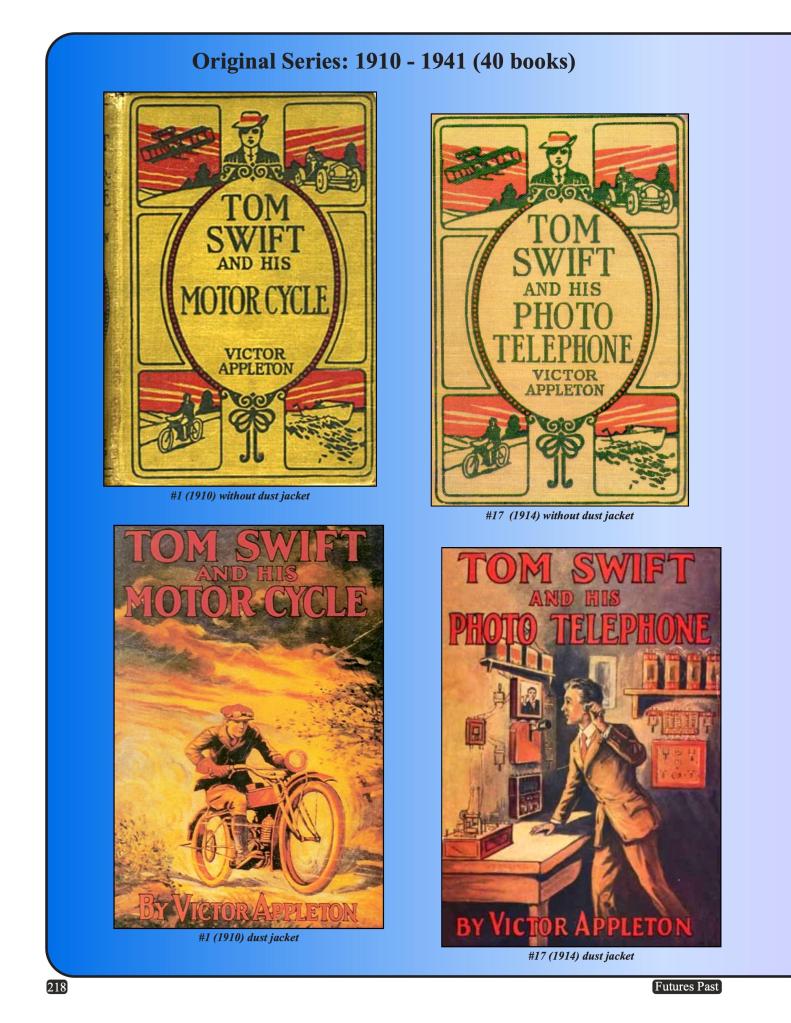
Heinlein’s writing is several steps up from most science fiction being written in 1947, but Rocket Ship Galileo is not much more than an updated Tom Swift novel. The story is set in the late 1950s, when Heinlein speculates that commercial rockets have been established for transporting freight and passengers. Military jets were being tested in 1947, but there were no commercial jets, so Heinlein expected rocket technology to be the winning technology.

Heinlein based his speculation on Werner von Braun’s rockets and our use of atomic bombs in 1945. However, I thought Heinlein was overly naive and incredibly unrealistic to suggest that three high school students and one Manhattan Project scientist could retrofit a commercial chemical rocket with an atomic drive and fly to the Moon. That’s why I find the book embarrassing to recommend to modern readers. Even more embarrassing are the Nazis found hiding on the Moon.

I first read Rocket Ship Galileo in 1964. This was just before the Project Gemini manned missions in 1965. It was obvious that three teenagers and an adult could never build a rocket in one summer capable of traveling to the Moon. I was in the 8th grade. That kind of belief was common in the Tom Swift and Tom Swift, Jr. books I read in the 5th grade. I should have been savvy enough in 1964, at age 13, to quit reading Rocket Ship Galileo after a few pages. Why didn’t I? And why have I read it another four times since then?

In the fall of 1964, I loved the new TV show Gilligan’s Island, but whenever I watch an episode of it today, I wonder if my brain was damaged as a teenager. Why wasn’t I more discerning about what I read and watched? However, I was a dumbass kid of twelve and thirteen when I first read Heinlein’s fourteen novels for young adults. (I’m adding in Starship Troopers and Podkayne of Mars to the twelve from Charles Scribner’s Sons.)

This is going to sound weird. I now consider embracing science fiction as a kid was psychologically similar to becoming religious. Accepting fantastic science fiction beliefs gave me the same comforts as accepting Jesus. I just wanted to travel to the heavens before I died.

Now Heinlein wasn’t trying to be irrational or promote silly ideas. Rocket Ship Galileo is full of scientific digressions, also called info dumps. I felt Heinlein was speculating as scientifically as possible with what people knew in 1947. He uses his own ideas about the possibilities of applied atomic power. But he doesn’t think things through. Heinlein understood that radioactivity could superheat fuel and create a more powerful exhaust than chemical combustion. However, to suggest liquid zinc or mercury as a rocket fuel is insane. Did they have no concept of pollution back in 1947?

Heinlein also understood that computers would be used to navigate to the Moon. He references ENIAC, built in 1945, the first general-purpose digital computer.

Because of rockets, computers, and atomic bombs in 1945, the guiding philosophy of science fiction became, if we can do this now, why can’t we do something like it in the future? Heinlein was leading the charge for science fiction to speculate and extrapolate. The twelve Heinlein juveniles, published from 1947 until 1958, became my gospels and epistles to a religion founded on science fiction. Heinlein became my guru, my substitute father, yet I missed all his advice that could have been considered mentoring.

All the Heinlein juveniles advocated studying science and mathematics, especially math. I read these books in the mid-1960s, believing I’d grow up and travel into space in the 1970s and 1980s. But I didn’t follow Heinlein’s guidance. In the 1920s, Heinlein had worked hard at school, making his way through the Naval Academy at Annapolis. Heinlein repeatedly emphasized studying.

Most Christians want easy Christianity. All they want to do to get to heaven and have everlasting life is to say, “I believe.” I was no better in my approach to science fiction. I have read several accounts from rocket scientists who claimed Heinlein inspired them to become who they were. There are millions like me, who aren’t rocket scientists, who also read Heinlein.

I’ve criticized some science fiction stories for using comic book science. You know the kind, exposure to Z-rays leads to superpowers. In the early years of science fiction, the public considered it moronic trash. And kids who loved it justified reading science fiction to their parents, claiming they learned science from science fiction. The frequency of science lecture infodumps in the Heinlein juveniles is high. They were respected by librarians and teachers. Ultimately, their appeal was adventure. They were crack for geeks. They preached that humanity’s manifest destiny was exploring space. Each book took readers further away from Earth. (Chart provided by CoPilot.)

YearTitlePrimary SettingScope of Exploration
1947Rocket Ship GalileoEarth ↔ MoonFirst lunar mission; atomic propulsion
1948Space CadetEarth ↔ Solar SystemVenus and outer planets via military service
1949Red PlanetMarsColonial life and rebellion
1950Farmer in the SkyGanymede (Jupiter moon)Terraforming & settlement life
1951Between PlanetsEarth ↔ VenusInterplanetary conflict and diplomacy
1952The Rolling StonesEarth ↔ Mars ↔ Jupiter systemFreewheeling space travel by a family
1953Starman JonesEarth ↔ Deep SpaceGalactic navigation and far-flung trade routes
1954The Star BeastEarth ↔ Galactic CivilizationsAlien ambassador pet and interstellar law
1955Tunnel in the SkyUnknown planetSurvival and societal formation via teleportation
1956Time for the StarsEarth ↔ Deep SpaceRelativistic travel and twin-linked telepathy
1957Citizen of the GalaxyVarious worlds in Galactic EmpireSlavery, social caste, and galactic society
1958Have Space Suit—Will TravelEarth ↔ Pluto ↔ Intergalactic TribunalKidnap into deep space; galactic ethics debate

While rereading Rocket Ship Galileo this time, I noticed many of Heinlein’s lifelong pet ideas, which Heinlein elaborated on in his adult science fiction in the 1960s. Heinlein wanted to be a philosopher and teacher. The Heinlein philosophy is gentle in these books for young people. One of my pet theories is that Heinlein was influenced by Ayn Rand in her 1957 novel, Atlas Shrugged. After that, he switched to writing novels for adults, and the Heinlein philosophy became more pronounced.

Heinlein’s core philosophy in the twelve juveniles is that space exploration is humanity’s manifest destiny. In Rocket Ship Galileo, the first of the twelve, is about going to the Moon. In Have Space Suit-Will Travel, the twelfth and last, it’s about travel across the galaxy. Each new book goes further out into space, expanding on Heinlein’s pet ideas. Strangely, after the juveniles, Heinlein turns to politics in his adult science fiction novels. Space travel is part of these stories, but it’s no longer being promoted. It’s just accepted.

I first read the twelve Heinlein juveniles just after Project Mercury and just before Project Gemini. I had followed all the manned flights of Project Mercury. Was I a space enthusiast because of NASA or Heinlein? When Heinlein began his series for boys in 1946, few people thought about actual space travel. Science fiction was considered that Buck Rogers stuff, and if you’ve seen any of the Buck Rogers serials, you know that’s a put down.

Heinlein does contribute to a long line of books speculating about the first mission to the Moon. Verne imagined a giant gun. Wells imagined anti-gravity. Heinlein imagined rockets evolving from V-2s. Heinlein just didn’t imagine how difficult the task would be to send a human to the Moon but had anyone else. I asked CoPilot and got this answer:

EraTitle & AuthorMode of TravelNotable Themes
2nd century CETrue History by Lucian of SamosataWhirlwindSatire of fantastical travel tales
1634Somnium by Johannes KeplerLunar demons during eclipsesEarly scientific speculation; heliocentrism
1638The Man in the Moone by Francis GodwinMigrating swansUtopian society; weightlessness
1657States and Empires of the Moon by Cyrano de BergeracFireworks & dew bottlesSatirical science; proto-rocketry
1705The Consolidator by Daniel DefoeWinged chariotPolitical satire; lunar governance
1835The Unparalleled Adventure of One Hans Pfaall by Edgar Allan PoeBalloonComic realism; early space travel logic
1865From the Earth to the Moon by Jules VerneSpace cannonTechnological optimism; post-Civil War science
1901The First Men in the Moon by H.G. WellsAntigravity material (Cavorite)Alien civilizations; imperialism
1926The Moon Maid by Edgar Rice BurroughsSpaceshipHollow Moon; hidden civilizations
1947Rocket Ship Galileo by Robert A. HeinleinAtomic rocketYouthful ingenuity; Cold War anxieties
1950The Man Who Sold the Moon by Robert A. HeinleinCorporate-funded rocketCapitalism and space exploration
1956Mission to the Moon by Lester del ReyRocketRealistic Moon landing prep
1977Inherit the Stars by James P. HoganArchaeological discoveryHuman origins; Moon as historical site

Rocket Ship Galileo will probably not appeal to modern science fiction readers. But for science fiction fans who study the evolution of the genre, is it worth reading? I was surprised by how many things I had forgotten about the novel. All I remembered was the Nazis on the Moon. I had forgotten all the details about creating an atomic rocket engine based on nuclear thermal propulsion, ballistics, space navigation, space suits, autopilots, airlocks, weightlessness, space sickness, computers, radio communication, and more.

After Apollo 11, reading books about the first landing on the Moon is problematic. However, Mary Robinette Kowal’s Lady Astronaut Universe series and Apple TV’s series For All Mankind have succeeded uniquely by creating retro histories. Because I grew up reading pre-NASA science fiction, I can still enjoy stories that are obviously dated because of nostalgia. I also love reading old science fiction because I love studying how the genre evolved.

But is Rocket Ship Galileo really worth reading five times over sixty-plus years? I imprinted on the Heinlein juveniles like baby ducks imprint on their mother. I loved these books so much that I ordered all twelve in hardback directly from Charles Scribner’s Sons with my first paycheck at age sixteen in 1967. I still have them.

At 73, I’m trying to understand how my personality was created. There are the genes I inherited from my parents. And my upbringing and education. I also believe a great deal of who I am came from pop culture – books, movies, TV shows, and music. One of the biggest factors was science fiction. When I reread old favorite books from childhood, I look for clues about how my personality formed.

I’m forced to ask myself: Did I really believe I would go into space someday? I thought I did, but was it a realistic belief? Do kids really believe they will grow up to be football players, or rock stars, or astronauts?

Here’s the thing. If I truly paid attention to Heinlein’s books, I should have modeled myself after his characters. I didn’t. I half-ass did. I read easy popular science books. I built Estes model rockets. I even tried to grind my own telescope mirror but failed. However, I mostly read science fiction. The Heinlein characters didn’t read science fiction.

Today, we have the Maker Culture. That’s what Heinlein was really promoting. Heinlein wanted his readers to become junior scientists. Reading his books made me fantasize about doing that. Instead, I just read more science fiction.

I’ve often pondered how many science fiction books anyone should read. Taking psychedelics back in the 1960s opened the doors of perception. Science fiction was like that. But like people asked back in the 1960s, how many times do you need to go through the doors of perception?

In retrospect, I feel I read too much science fiction and didn’t do enough of other things. I’ve often wondered what my life would have been like if I had stopped with Have Space Suit-Will Travel and gotten busy doing things. Rereading Rocket Ship Galileo reminds me of what I wanted to be as a kid, but reveals I took the wrong path.

James Wallace Harris, 8/5/25