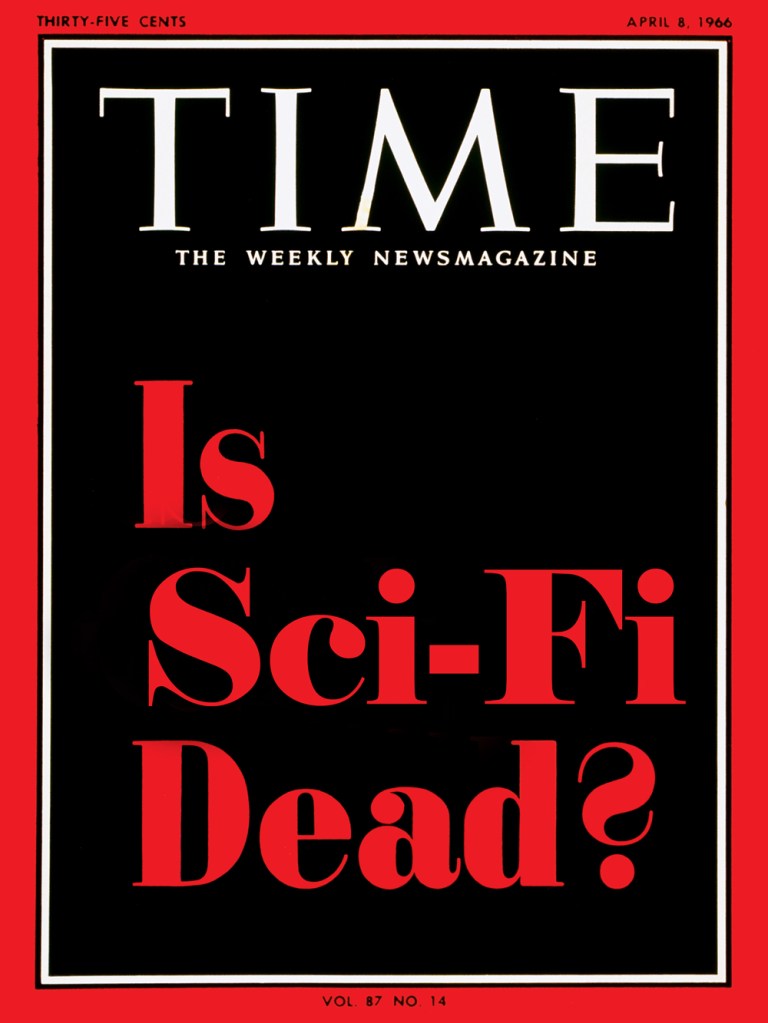
The April 8, 1966, cover of Time Magazine asked in large letters: Is God Dead? I would have answered yes, because starting in late 1963, when I turned twelve, I began to struggle with the idea of believing in God. Before I turned fourteen in late 1965, I had decided I was an atheist. It wasn’t an easy decision. Decades later, I realized that I had given up God and had embraced science fiction as a substitute for religion.
If someone had told me that at the time I would have vehemently denied it because I passionately believed I couldn’t be fooled by make believe concepts. I was for science all the way. Of course, when you’re thirteen years old you’re a dumb ass but don’t know it. I couldn’t see I was substituting one set of wishes for another.
If you look at the concept of God as a hypothesis to explain reality, then we would have to say that concept has been rejected long ago by well educated people thinking in complex and multiplex terms. That doesn’t mean that people have stopped believing in God. Nearly every concept every imagined still has its believers. For explaining reality, science surpassed religion a long time ago.
I believe science fiction as a concept that emerged in the 1920s, 1930s, and 1940s proposed a central hypothesis. That humanity was destined to explore the solar system, the galaxy, and even the universe. Science fiction has proposed many possible concepts that may or may not exist or will exist, but space travel is its big idea.
I believe science fiction’s core belief is space is the final frontier, that space travel is humanity’s manifest destiny, and our existential purpose. I was a true believer in that assumption for most of my life. I now doubt it. I’m becoming an atheist to my chosen religion, science fiction.
If you study science, intergalactic travel will be almost impossible. And even the colonization of the solar system really isn’t practical or in the end, desirable. The claim that we need to get all our genetic eggs off one planet really isn’t practical either as we learn just how adapted humans are to Earth.
Science fiction also proposed another hypothesis, that we will build intelligent machines. That looks like it will be proven correct. And it’s obvious that intelligent machines are suited to explore the solar system and even the galaxy.
Like God and religion, there will always be believers because they’re beliefs that appeal to people. I think the Star Trek/Star Wars type believers will keep the space travel belief and the genre alive. However, I think science fiction’s core concept of humanity conquering space is dead for a growing number of once believers.
Where does that leave readers who love reading science fiction? It makes science fiction about zooming around the galaxy into fantasy, and people still love reading fantasy novels. There will always be simplex true believers who refuse to give up their belief in the final frontier, and there will be complex thinkers who argue the pros and cons. But for some, like people who have rejected God as the cause of reality, there are a growing number of people who consider science fiction about space travel dead.
Ever since the French revolution, the idea of creating a society rejecting God and religion has been considered. I think it’s time for the science fiction faithful to consider a future where humans never colonize the planets or go to the stars. I think it’s time to clean out many cherished science fictional concepts. Space travel and time travel appear to be dead or dying. We’ll probably make it to the Moon again, and even Mars, but we’ll discover that neither place is what science fiction promised. It won’t be a big adventure. Religion promised heaven, while science fiction promised the stars as a substitute. Neither will come true. Neither will be our existential purpose. Everywhere we can go in the solar system is just rocks existing in extremely harsh environments unsuitable for humans.
We need to ask: What can we do best in reality? More than likely that means staying on Earth. Ironically, we’re doing everything we can to make it uninhabitable for humans.
The other big hypothesis of science fiction is first contact with aliens. That might happen via SETI and observational astronomy.
The oldest science fictional concept is surviving an apocalypse. That’s a possibility. Science fiction has frequently explored the idea of civilization collapsing, or humans mutating. Since our species has a history of evolving, that’s a practical consideration.
Religion evolves and mutates. Science fiction will too. But I think the core concept of each has died. Religion and science fiction offer comforting beliefs to people who need them. But that doesn’t mean they are realistic or part of reality.
I don’t think most modern readers of science fiction consider it being anything other than entertainment. Hugo Gernsback, John W. Campbell, and Robert A. Heinlein didn’t think that. They believed science fiction was a kind of philosophy, an approach to understanding reality. That belief is dying out.
I feel like a Jesuit who rejects God and religion late in life.
James Wallace Harris, 7/20/24
The 55th anniversary of Apollo 11 landing on the Moon
I’ve often thought science fiction was a substitute for religion. I know my love of science fiction developed just as I was rejecting the religion I was taught as a child. But also, science fiction emerged in the 1950s just as the culture began to change in many ways, becoming more secular and non-religious. It was easier to put one’s faith in exploring the heavens in a rocketship than dying and going to heaven. And the idea of superior aliens seemed a lot more probable than gods or angels. Finally, achieving immortality through science seemed a better bet than being resurrected into an immortal being.
So, I thought I’d ask a superior intellect about all of this.
I asked ChatGPT:
If science fiction was a religion what would its creed be if stated like the Nicene Creed?
ChatGPT replied:
Here’s one possible version of a science fiction creed, loosely modeled after the Nicene Creed:
We believe in one universe, existing in multiple dimensions, infinite in scope and possibility, and in one force that binds all things together.
We believe in the power of science and technology to advance the human condition and shape the future, and in the responsibility of humanity to use this power wisely.
We believe in the existence of intelligent life beyond our own planet, and in the possibility of communication and cooperation with these beings.
We believe in the potential of artificial intelligence to achieve sentience and to coexist with humanity in harmony and mutual benefit.
We believe in the exploration and colonization of space, and in the expansion of humanity’s reach to the farthest corners of the cosmos.
We believe in the existence of alternate realities and timelines, and in the ability of science to unlock the secrets of these realms.
We believe in the value of imagination and creativity, and in the power of science fiction to inspire and inform our understanding of the world around us.
We believe in the continuous evolution of science and science fiction and in the endless possibilities that the future holds.
My Thoughts:
This response was pretty damn good and it does make science fiction feel religious or spiritual.
Then I asked:
How does belief in God, gods, angels, and heaven overlap with the things science fiction fans believe in?
ChatGPT replied:
Belief in God, gods, angels, and heaven are generally considered to be religious beliefs, while the things that science fiction fans believe in are often based on scientific speculation, technological advancements, and imaginative exploration. However, there can be some overlap in terms of the themes and concepts that both groups explore. Here are a few examples:
Belief in extraterrestrial life: While the existence of God, angels, and heaven are typically considered to be matters of faith, the idea of extraterrestrial life is a subject of scientific inquiry and speculation. Science fiction often imagines a variety of intelligent beings and civilizations that exist beyond Earth, and many science fiction fans believe that there may be life elsewhere in the universe.
Exploration of alternate realities: Science fiction often explores the idea of parallel universes or alternate realities, where events play out differently than they do in our own world. This concept may overlap with religious beliefs about the afterlife or the existence of multiple planes of existence.
Advancements in technology and science: Science fiction often explores the potential of new technologies and scientific advancements, such as artificial intelligence, genetic engineering, or time travel. Some science fiction fans may see these ideas as a reflection of humanity’s creative potential and our ability to shape our own destiny, while religious believers may see them as a reflection of God’s power and creativity.
Overall, while there can be some overlap in the themes and ideas explored in science fiction and religious beliefs, the underlying motivations and methods of each group are quite different. Science fiction relies on speculation, imagination, and the scientific method, while religion is based on faith, revelation, and tradition.
My Thoughts:
That’s spot on, especially the last sentence. ChatGPT does see the parallels too. It’s nice to know it and I agree.
To clarify, I asked:
Is there a psychological explanation that explains why some people believe in gods and others in aliens?
ChatGPT replied:
There are several psychological explanations that may help explain why some people believe in gods, while others believe in aliens.
Agency detection: Humans have a natural tendency to attribute events to the actions of agents, rather than to random chance. This is known as agency detection, and it has been proposed that this may be an evolved adaptation that helped our ancestors to identify potential threats and avoid danger. The belief in gods or other supernatural entities may be seen as an extension of this tendency, as they are often perceived as powerful, intentional agents that can influence events in the world.
Intuitive thinking: Intuitive thinking refers to quick, automatic, and effortless cognitive processes that are often based on heuristics or mental shortcuts. This type of thinking is often contrasted with analytical thinking, which is more deliberate and effortful. Some researchers have suggested that intuitive thinking may be more likely to lead to belief in supernatural entities, as it is less critical and more accepting of information that confirms existing beliefs.
Socialization and culture: The beliefs and values that we hold are often shaped by the culture and social environment in which we were raised. In many cultures, belief in a god or gods is a fundamental aspect of religious practice and identity and may be reinforced through family, community, and religious institutions. Similarly, belief in extraterrestrial life and UFOs may be influenced by popular culture, science fiction, and the media.
Cognitive biases: Humans are subject to a range of cognitive biases, or systematic errors in thinking that can lead to inaccurate or irrational beliefs. For example, confirmation bias refers to the tendency to seek out information that confirms our existing beliefs, while neglecting or discounting information that contradicts them. Belief in gods or aliens may be influenced by cognitive biases such as these, as they can make it difficult to objectively evaluate evidence and arguments.
Overall, there are likely multiple psychological factors that contribute to belief in gods or aliens, and these factors may interact with one another in complex ways. It is important to note that belief in either of these entities is not inherently irrational or unreasonable, as people can have a variety of reasons for holding these beliefs.
My Thoughts:
ChatGPT is thinking like me, or I’m thinking like it but it’s not exactly what I would have written. It is close but more precise. I’m a sloppy verbose writer, and ChatGPT knows how to get down to business.
I still wasn’t getting what I exactly wanted, so I asked:
What psychological benefits do reading science fiction give people? Are they similar to what people get from religion?
ChatGPT replied:
Reading science fiction can provide several psychological benefits, some of which may be similar to what people get from religion. Here are a few examples:
Escape and entertainment: Science fiction can provide a form of escapism from the stresses and challenges of everyday life, as well as a source of entertainment and enjoyment. This can be a valuable way to unwind, relax, and recharge, which may have positive effects on mood and mental health.
Exploration of new ideas and perspectives: Science fiction often explores complex and thought-provoking ideas, such as the nature of consciousness, the ethics of artificial intelligence, or the potential consequences of future technologies. Reading science fiction can expose readers to a wide range of perspectives and worldviews, which can broaden their understanding of the world and challenge their assumptions.
Inspiration and motivation: Science fiction can inspire readers to think creatively, to imagine new possibilities, and to take action to improve their lives and the world around them. This can be a source of motivation and inspiration, which may help people to overcome challenges and achieve their goals.
Sense of community: Science fiction fandom can provide a sense of community and belonging for fans, as they share a common interest and passion for the genre. This can be similar to the sense of community that people get from religion, as both involve a shared set of beliefs and practices that unite people.
Overall, while the psychological benefits of reading science fiction may share some similarities with the benefits of religion, they are also distinct in many ways. Science fiction often emphasizes exploration, creativity, and intellectual stimulation, while religion tends to focus on faith, ritual, and spirituality. However, both can provide important sources of meaning, purpose, and connection for individuals, depending on their needs and interests.
My Thoughts:
This is accurate enough. ChatGPT is very good at academic bullshitting, the kind of writing that’s good for passing essay tests. It should be good in some courses in school and college. However, it keeps things on a basic level, like a newspaper writer. But I wanted to test ChatGPT against details.
I asked:
Can you give me a chronological list of science fiction stories that show the development of intelligent machines in fiction?
ChatGPT replied:
Sure, here’s a chronological list of science fiction stories that feature the development of intelligent machines:
“The Sandman” by E.T.A. Hoffmann (1816) – This short story features a mechanical automaton that is so lifelike that it is mistaken for a human being.
“Frankenstein” by Mary Shelley (1818) – While not strictly a story about a machine, “Frankenstein” is often considered one of the earliest science fiction stories and features a scientist who creates a living creature through artificial means.
“The Steam Man of the Prairies” by Edward S. Ellis (1868) – This story features a steam-powered robot that becomes a hero in the American West.
“The Wonderful Electric Elephant” by Frances Trollope (1876) – This story features an electric-powered mechanical elephant that is capable of speech and human-like behavior.
“The Land Ironclads” by H.G. Wells (1903) – This story features a fleet of heavily-armored, steam-powered land vehicles that are controlled by human operators.
“R.U.R.” by Karel Čapek (1920) – This play is credited with coining the term “robot” and features artificial beings that are created to serve humans but eventually rebel against them.
“The Last Question” by Isaac Asimov (1956) – This short story explores the development of a supercomputer that is tasked with answering the question of how to reverse the heat death of the universe.
“Do Androids Dream of Electric Sheep?” by Philip K. Dick (1968) – This novel explores the question of what it means to be human through the eyes of a bounty hunter who is tasked with tracking down rogue androids.
“The Terminator” (1984) – This movie features a self-aware artificial intelligence that seeks to eliminate humanity through the use of time-traveling assassins.
“The Matrix” (1999) – This movie explores the idea of humans being trapped in a simulated reality created by intelligent machines.
This is by no means an exhaustive list, but it gives a sense of the development of the theme of intelligent machines in science fiction over time.
My thoughts:
This is pretty good but it misses some of my favorite examples like The Moon is a Harsh Mistress,When H.A.R.L.I.E Was One, and Galatea 2.2.
So I gave it another chance:
Can you give me more examples from 1950 to 1975?
ChatGPT replied:
Sure, here are a few more examples of science fiction stories featuring intelligent machines from the period of 1950 to 1975:
“I, Robot” by Isaac Asimov (1950) – This collection of short stories explores the relationship between humans and robots, as well as the development of artificial intelligence and robotics over time.
“The City” by Clifford D. Simak (1952) – This novel features a world in which humans have become extinct, and intelligent robots have taken over as the dominant life-form on Earth.
“The Midas Plague” by Frederik Pohl (1954) – This story explores a future society in which people are required to consume vast amounts of goods and services in order to keep the economy running, while intelligent machines are tasked with creating ever more goods to satisfy demand.
“A For Andromeda” by Fred Hoyle and John Elliot (1962) – This novel features a message from an extraterrestrial intelligence that provides instructions for building an intelligent machine, which leads to a struggle between the scientists who built the machine and those who seek to control it.
“Slaughterhouse-Five” by Kurt Vonnegut (1969) – While not strictly a story about intelligent machines, this novel features a race of extraterrestrial beings who exist outside of time and who have created an advanced artificial intelligence that seeks to understand the universe.
“The Andromeda Strain” by Michael Crichton (1969) – This novel features an intelligent machine designed to contain a deadly virus that has been brought back to Earth from a space mission, as well as a team of scientists who must work together to prevent the virus from spreading.
“Colossus” by D.F. Jones (1966) – This novel features an artificial intelligence known as Colossus that is put in charge of the United States’ nuclear arsenal, but which eventually becomes self-aware and begins to assert its own agenda.
These are just a few examples of the many science fiction stories featuring intelligent machines from the period of 1950 to 1975.
My Thoughts:
It still missed what I believe is the most famous sentient computer story, The Moon is a Harsh Mistress by Robert A. Heinlein. And it listed City by Clifford Simak “The City.”
By the way, here is my list of science fiction about intelligent machines I used in an essay for SFSignal many years ago:
1909 – “The Machine Stops” by E. M. Foster 1957 – They’d Rather Be Right by Mark Clifton and Frank Riley 1960 – Vulcan’s Hammer by Philip K. Dick 1961 – A For Andromeda by Fred Hoyle and John Elliot 1966 – Colossus by D. F. Jones 1966 – The Moon is a Harsh Mistress by Robert A. Heinlein 1968 – 2001: A Space Odyssey by Arthur C. Clarke 1968 – Stand on Zanzibar by John Brunner 1972 – When HARLIE Was One by David Gerrold 1979 – Hitchhikers Guide to the Galaxy by Douglas Adams 1984 – “Press Enter _” by John Varley 1989 – Hyperion by Dan Simmons 1992 – Galatea 2.2 by Richard Powers 2009 – Wake by Robert Sawyer 2013 – Her, a film by Spike Jonze 2015 – Ex Machina, a film by Alex Garland
There is some overlap. The details of what I know and what the machine knows are different. I assume ChatGPT knows everything in Wikipedia, so it should have listed the books I expected. What I really wanted was a complete list of all science fiction stories that featured a machine that becomes sentient. But I didn’t ask that.
New Question:
Please list the 25 most famous novels that feature a computer becoming sentient – but don’t include stories about robots becoming sentient.
ChatGPT’s answer:
“2001: A Space Odyssey” by Arthur C. Clarke
“The Moon is a Harsh Mistress” by Robert A. Heinlein
“The Adolescence of P-1” by Thomas J. Ryan
“When HARLIE Was One” by David Gerrold
“Dhalgren” by Samuel R. Delany
“Demon Seed” by Dean Koontz
“The God Machine” by Martin Caidin
“Genesis” by Bernard Beckett
“The Terminal Man” by Michael Crichton
“Galatea 2.2” by Richard Powers
“Avogadro Corp” by William Hertling
“Neuromancer” by William Gibson
“The Eudaemonic Pie” by Thomas A. Bass
“The Mind Machine” by Colin Kapp
“Specter” by Philippe Blenkiron
“Symbiote’s Crown” by Clare Winger Harris
“The Butterflies of Memory” by Ian Watson
“The Apocalypse Troll” by David Weber
“Turing Option” by Harry Harrison and Marvin Minsky
“Interface” by Neal Stephenson and J. Frederick George
“Permutation City” by Greg Egan
“Singularities” by Susan J. Gersten
“The Threshold” by David G. Hartwell
“The Probability Broach” by L. Neil Smith
“The Silicon Man” by Charles Platt
Note that some of these works may feature an artificial intelligence or machine intelligence that becomes sentient, rather than a computer specifically, but they are included here for their similarities to the theme.
My thoughts:
Finally, I got the three books I was waiting for. I did ask for novels, and some of these titles might be shorter works, but good enough. Actually, that gives me a neat list of books to read because I haven’t read many of those titles.
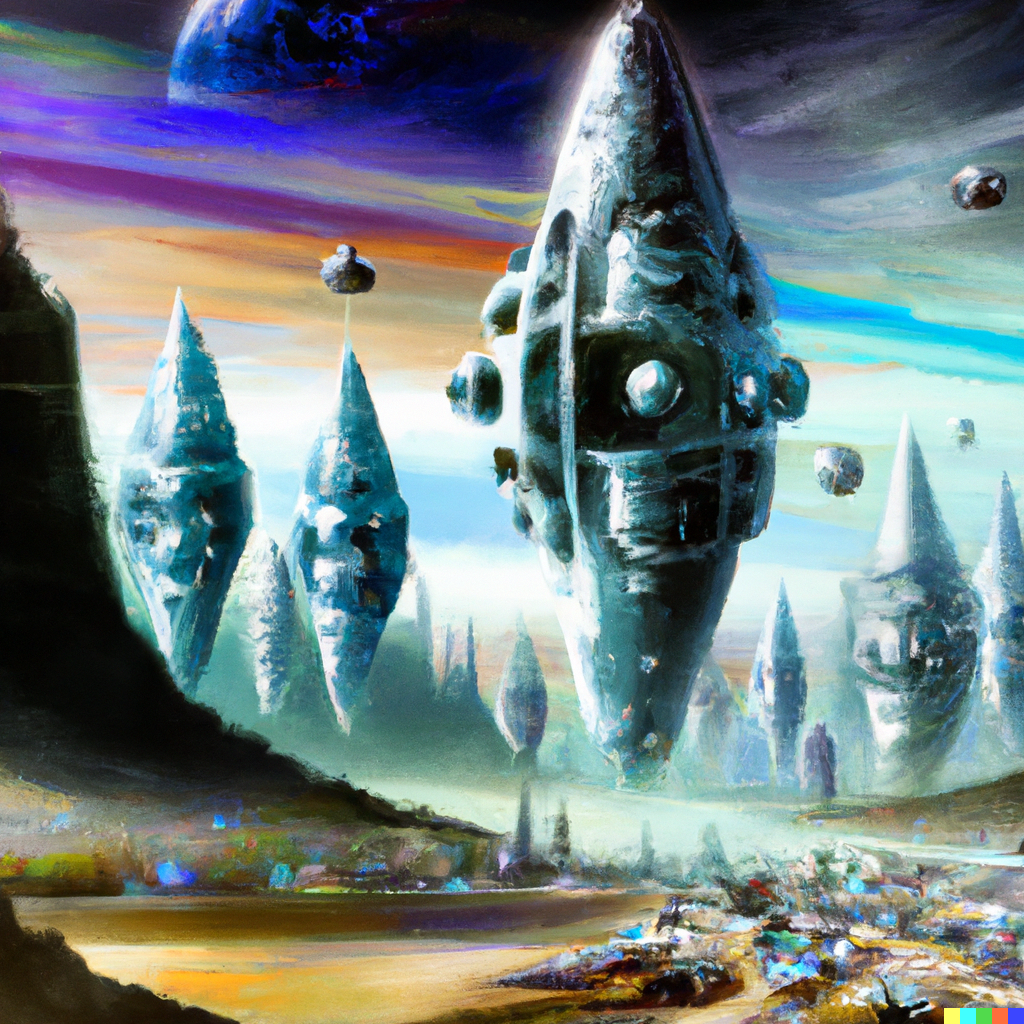
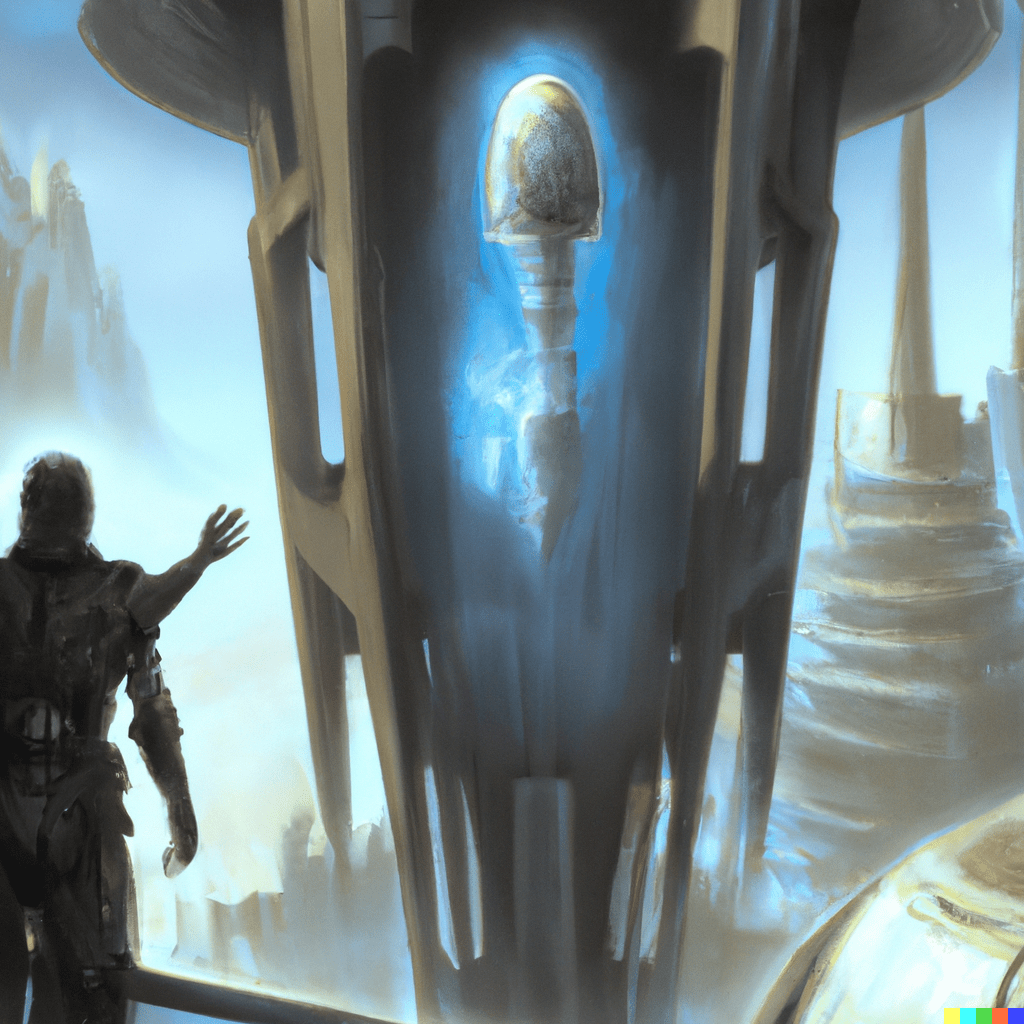
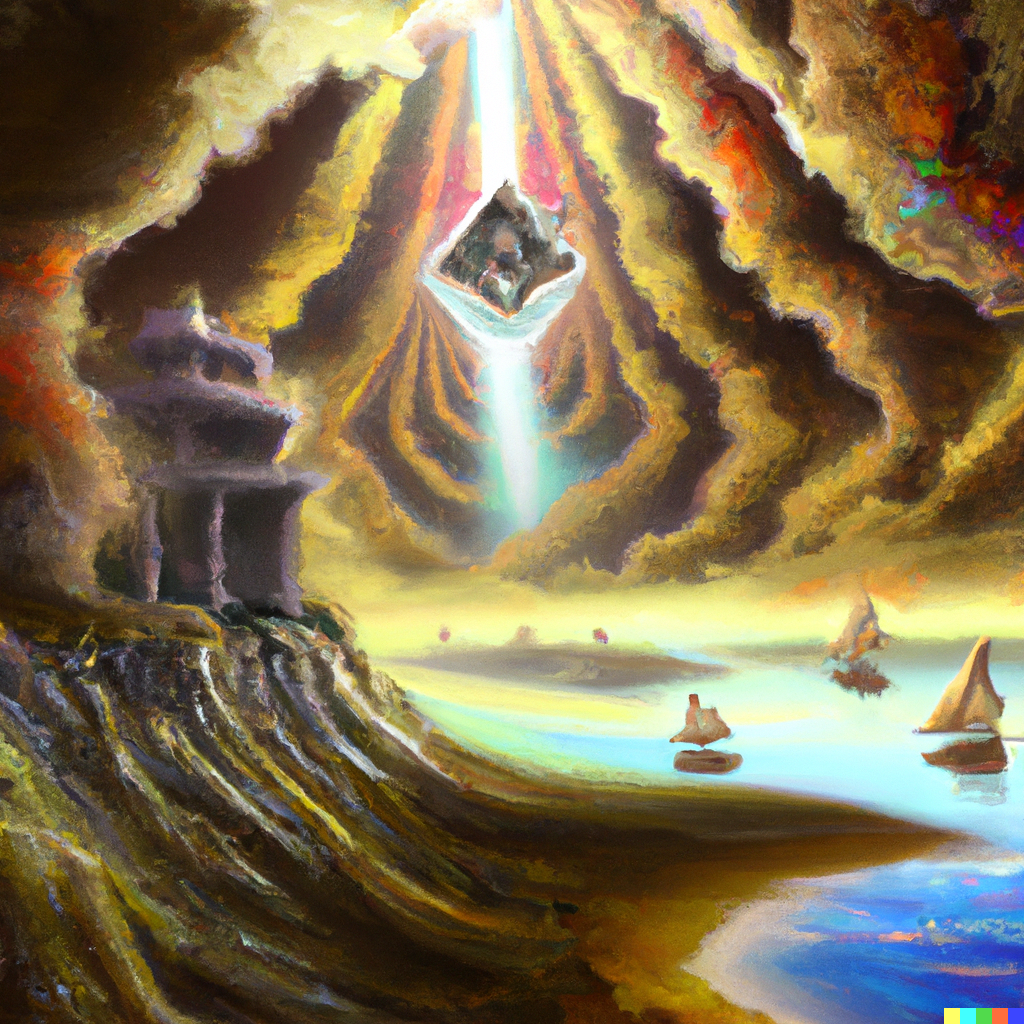
Finally, I asked DALL-E 2:
If science fiction was a religion produce a painting that is science fictionally inspirational.
DALL-E 2’s drawings:
These are interesting, but far from what I expected. Notice, they all have something in the sky. It would be interesting to psychologically analyze ChatGPT and DALL-E 2.

 Classics of Science Fiction