PARABLE OF THE SOWER by Octavia E. Butler

Parable of the Sowers by Octavia E. Butler is a classic post-apocalyptic science fiction novel from 1993. It’s one of the best stories to read if you want to contemplate America collapsing from economic inequality. Most post-apocalyptic novels begin during the collapse or a short time after and are about the characters struggling to survive. The Parable of the Sowers is different. It starts in the early stages of collapse, so it’s technically a pre-apocalyptic novel. The rich still have civilization, but chaos is moving up from the poor, into the middle class. It begins with the fear of the coming apocalypse.

The Parable of the Sowers should offer a great panel discussion topic at a preppers’s convention. Most preppers picture themselves surviving when others don’t. They imagine grabbing their bug-out bags and heading to the hills where they own a private redoubt to make their last stand. Many post-apocalyptic novels start with tens of millions dying, making more room for those struggling to survive. Octavia Butler’s book imagines a collapse without a huge population die-off. Her scenario has millions clogging the highways fleeing collapsing cities.

Owning an AR-15 and backpack stuffed with survival food and gear won’t get you far. In fact, anyone with anything will be a target. That was also true in Cormac McCarthy’s The Road. Reading Parable of the Sower is about as depressing as reading The Road. However, Butler adds one twist that’s different from other post-apocalyptic novels.

The Parable of the Sower is the journal of Lauren Olamina who wants a reason to survive when all around her are dying. She redefines God to explain the horrors she’s experiencing. In fact, she begins writing a book that will eventually be called Earthseed: The Books of the Living. Lauren quotes from Earthseed to head her journal entries. Lauren decides God is change and our purpose is to shape God. Don’t get turned off by the religious angle of the book, most of the story is about survival. There is a sequel called Parable of the Talents. The story was planned as a trilogy, with additional books, but Butler died before finishing it.

Parable of the Sower begins with Lauren a teenager living in a gated community. Her father is a black Baptist minister, and her mother is a deceased drug addict. Her father has remarried and Lauren has three step-brothers. The novel begins in 2024 when Lauren is 15 and ends in 2027 when she is 18. The first half of Parable of the Sowers is about how the people in Lauren’s gated community survive while watching the world outside their walls fall into chaos and violence.

Butler’s book was written thirty years before the time it describes, which happens to be our now. Butler describes living under a president named Donner who has many similarities with Donald Trump. The reason this novel is so powerful is because it feels relevant and all too relatable. It’s exactly the kind of science fiction I consider serious speculation.

Lauren’s father is a leader of the community populated by white, black, and Hispanic people. He teaches both spiritual hope and how to use guns. Lauren doesn’t believe in his God and creates a science fictional religion to give her hope for the future. By the time the poor finally overrun her gated community, Lauren is 18, and the sole survivor of her family. She must survive alone among the hordes fleeing southern California. People survive any way they can, often by robbing each other. The most desperate set fires to force people out of their homes, robbing and killing them as they flee.

Any successful work of science fiction must tell a compelling story about a character or characters we care about who overcome their limitations. The act of reading the story should feel transcendent. Butler succeeds very well at this level.

A great work of fiction will also have its own ontology and epistemology, and Butler puts that into her story. I’m just not sure how well it works. But I give her credit for trying. At least she recognizes that living through an apocalypse will inspire deep existential thoughts.

The best fiction is about surviving reality, but great fiction is about confronting God or the absence of God. I also believe Butler was aiming that high. Again, I’m not sure she succeeds. But it feels close.

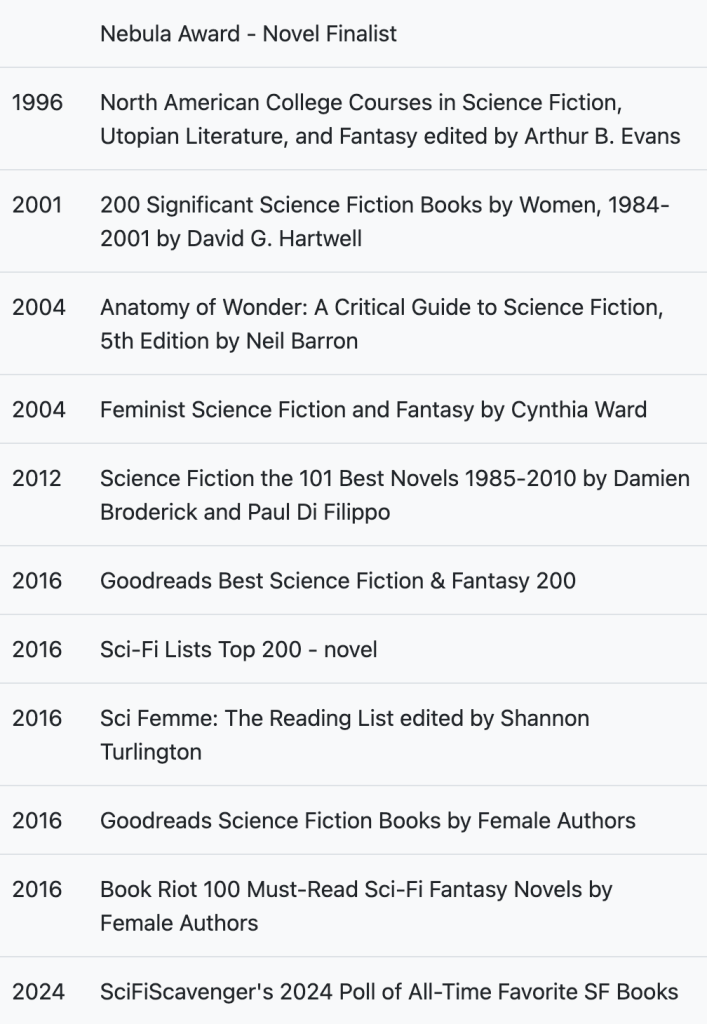
Parable of the Sower is on the Classics of Science Fiction List because of these 12 citations:
I do have one major disappointment with the novel. Lauren’s mother was a drug addict using one of many new designer drugs. As a byproduct of her addiction, Lauren is born with psychic empathy. That makes fighting to survive in a dog-eat-dog world difficult. This affliction jazzes up the plot but detracts from the realism Butler paints.

Octavia Butler spent an afternoon with our Clarion West class in 2002. At the time, I had not read anything by her, but I had read about her. I wish I had read the works I’ve since read so I could have asked her many questions. Just another regret on my giant pile of regrets.

James Wallace Harris, 2/6/25
Off My Feed

I haven’t been reading science fiction lately. After years of gorging on the genre, I’ve suddenly had enough. I still have the urge to read SF, but I’m having trouble finding science fiction I want to read. I have quite a large TBR pile but none of its titles interest me. I’m in the mood for something different, but after reading thousands of science fiction novels and short stories, finding something different isn’t easy.

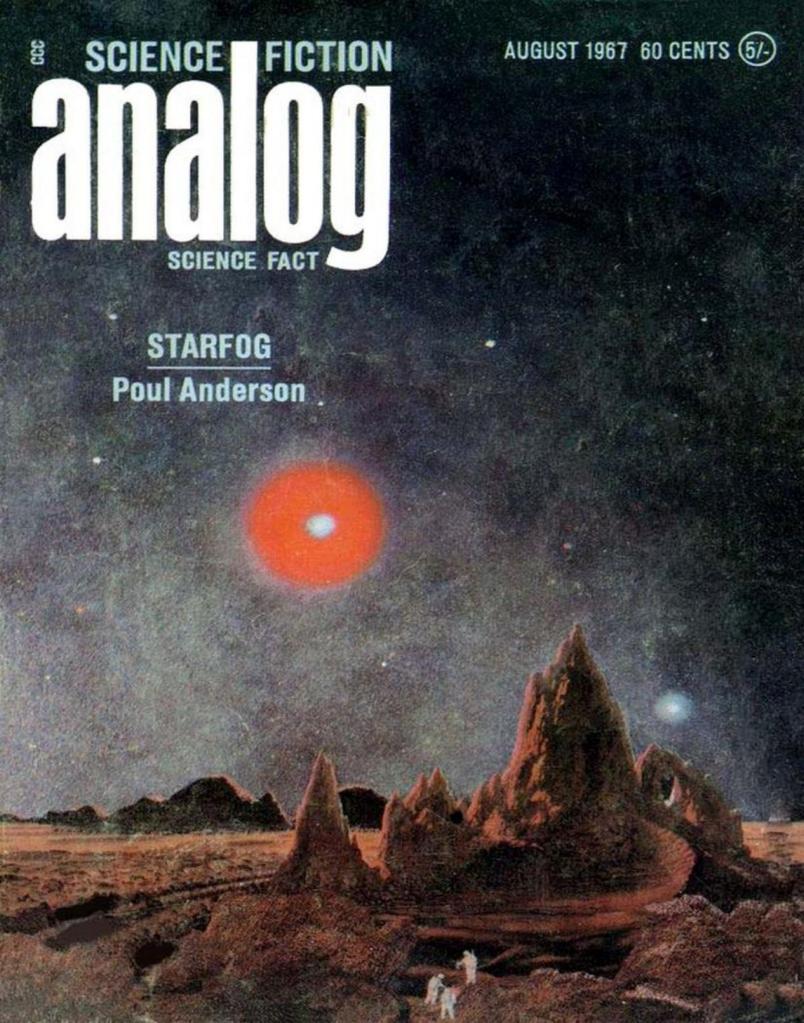
Has anyone read the Technic Civilization books by Poul Anderson? Yesterday, I was testing out a program to view old pulp magazines on my Mac and I randomly picked the August 1967 issue of Analog. It had a cover story for “Starfog” by Poul Anderson. I started reading it. I’ve only read a handful of Anderson’s novels and short stories and always avoided his book series. I avoid series books in general. I started reading “Starfog” and decided it was exactly something I’ve always avoided, so maybe it will be different.

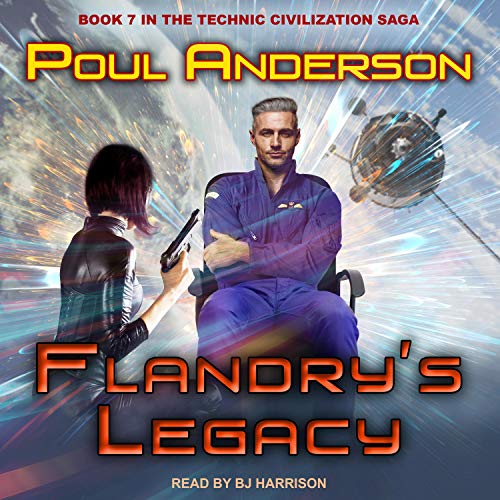
But I wanted to hear the story. After some research on ISFDB.org, I discovered “Starfog” was included in Flandry’s Legacy, Book 7, the last volume of the Technic Civilization series. I only had three Audible credits left, but what the heck, I decided to give it a try. “Starfog” is a novella, but Book 7 includes three novels, three novellas, and one novelette of stories in the series. This could be a tremendous bargain if I like the series.

I’ll let you know what I think — hopefully soon. The other inspiration I had to find something different came from a YouTube video. Bookpilled had a moving account of discovering the books of Barry Malzberg just before he died. I have read a couple of Malzberg books and they were so-so. But he was very prolific and Bookpilled has convinced me I should give Malzberg another try. So I’m reading about his novels. I did have a few emails from Barry, and he recommended his horse racing novels and a couple science fiction novels. I’ve always found Barry’s books about science fiction more interesting. He was a sharp-tongue critic.

File 770 has a nice tribute to Barry, “Curmudgeonly Breakfast: A Farewells-And-Learn-More-About Barry Malzberg (Last) Round-Up” that links to tons of resources about him. I’m hoping out of all that I will find a SF novel by him to read, hopefully, one that’s available on Audible.

Maybe between Anderson and Malzberg, I’ll get back into science fiction. But things might be slow around here for a while. To be honest, I think the real world has gotten more science fictional than science fiction.

If you’ve read a science fiction story you feel is radically different from any science fiction you’ve read before, leave a comment below.

James Wallace Harris, 1/27/25

THE CRYSTAL WORLD by J. G. Ballard

At a minimum, The Crystal World by J. G. Ballard was an entertaining cozy catastrophe that I was always anxious to get back to reading. What compels me to write this review is figuring out why. The prose is vivid, propelled by a moderately interesting mystery. However, its characters are rather bland but then so are ordinary people. In the end, the story faintly alludes to something, but what?

What elevates this novel is trying to understand how it works. Its Heart of Darkness vibe feels biblical, spiritual, or at least existential. Reading The Crystal World makes me ask why we read fiction. Why are humans addicted to fiction and how does that addiction affect our brains? I do this because I’m also reading Stephen Greenblatt’s The Rise and Fall of Adam and Eve, a nonfiction work that says a great deal about fiction.

Any hardcore bookworm will recognize The Book of Genesis as a genius work of fiction. I also think it’s a brilliant work of speculative fiction. Its author felt challenged to imagine how Earth and life on Earth began. Genesis was written well before the concepts of history or science. The author obviously knew of humans living in cities, and those that farmed and herded animals, the author could even have heard that there were places where humans were hunters and gatherers. And from that knowledge speculated that there was a time when humans lived like animals. The author of Genesis even realized there might be a time when humans didn’t have a language. The author pictured Eden where humans lived in harmony with nature before we became different. The obvious question became: What made us change? The obvious answer was, whatever made everything else. Then the question becomes how. Doesn’t eating from the Tree of Knowledge of Good and Evil make a lovely allegorical explanation?

Do you see why I consider The Book of Genesis an early example of speculative fiction? And isn’t the story of Noah and the Flood, an early apocalyptic tale? Stephen Greenblatt makes a good case that the author of The Book of Genesis cribbed his ideas from much older Babylonian tales. We’ve always had storytellers and writers who tried to explain reality. However, this makes me wonder about modern writers and storytellers. What are they trying to explain?

Billions of humans have believed in the literal story of Genesis. That story says a lot about fiction and its impact on us. The early fathers of the Christian Church tortured the Book of Genesis for centuries producing endless interpretations. That’s a great example of literary criticism gone wrong.

I bring up Greenblatt’s book because we must ask certain questions about the fiction we read. The first question is: Does it have anything to say? In most modern works of fiction, the answer is no, but not always. If the answer is yes, is the fiction allegorical, satirical, literal, comical, historical, romantic, academic, philosophical, speculative, etc. Of course, the last question: Shouldn’t we abandon fiction for nonfiction if we have something to say? Even when fiction is about saying something, it’s often indecipherable.

I’m getting old, and I worry I’ve wasted too much of my life on fiction. I fear that fiction has no value other than as an entertaining way of killing time, and since time is running out, that’s bad.

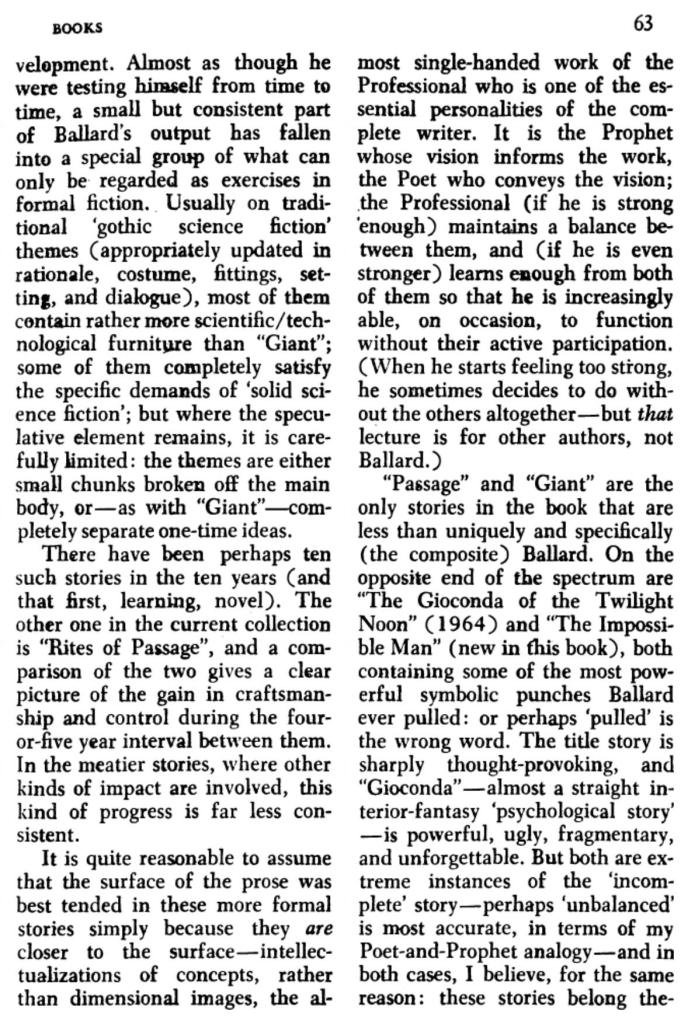
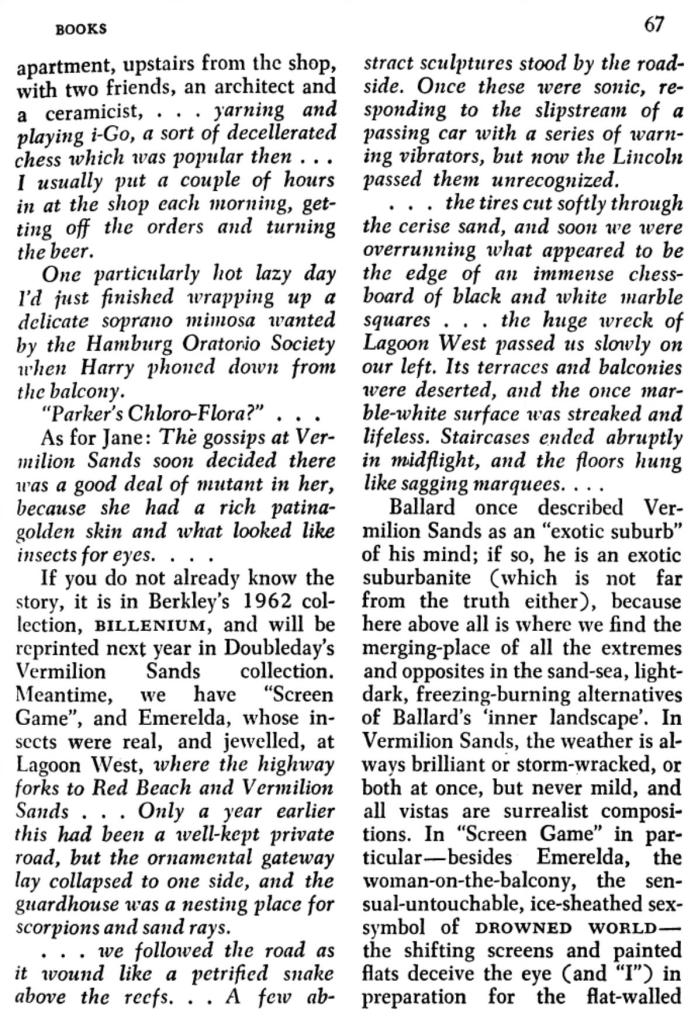
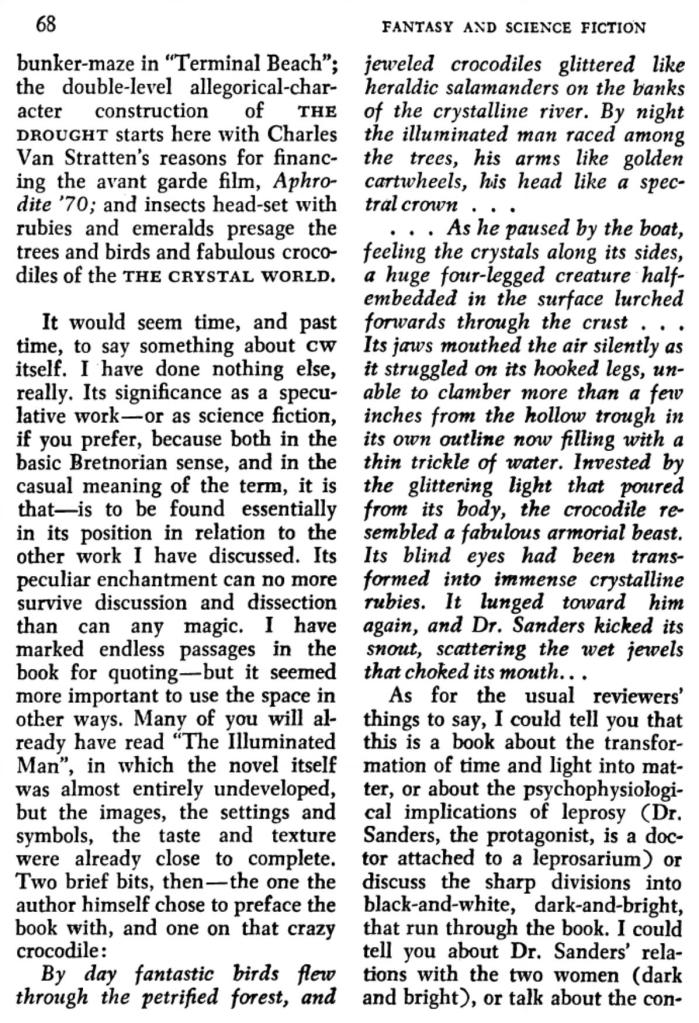
Reading The Crystal World made me wonder if J. G. Ballard had something to say, or was his novel was just meant to be entertaining? To complicate the answer, The Crystal World is an early work of New Wave science fiction, published before the term was coined.

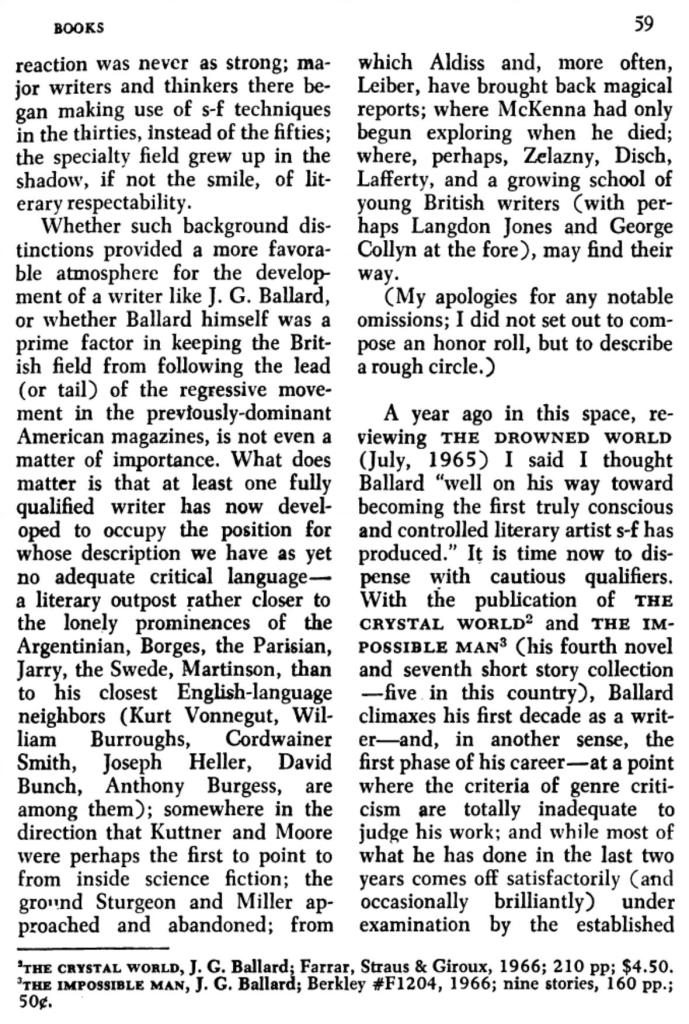
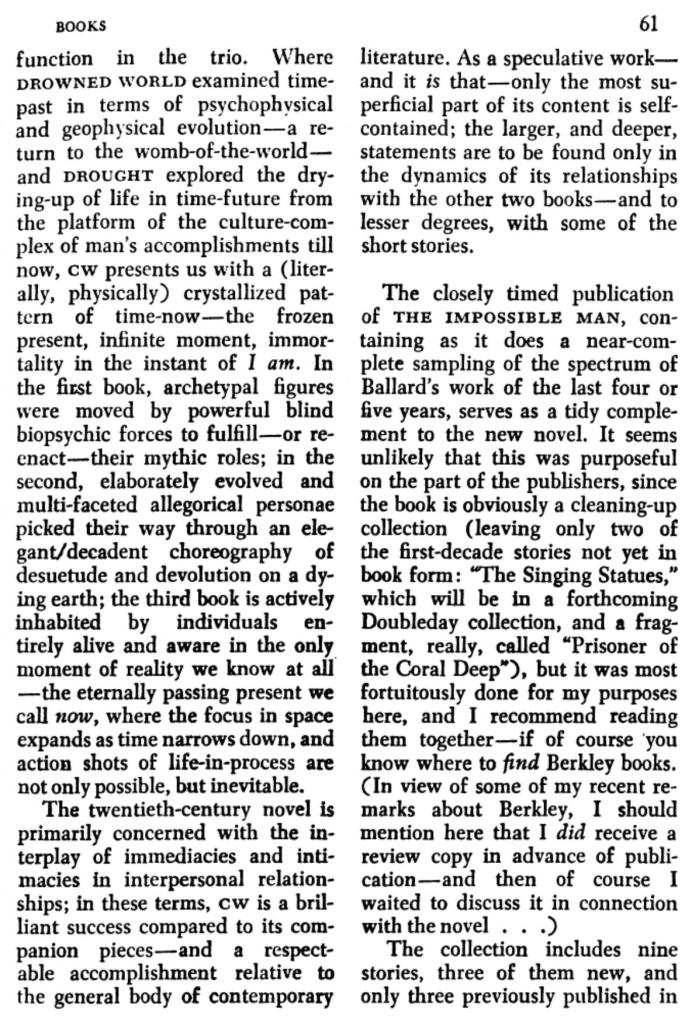
As evidence, I reprint below Judith Merril’s “Books” column from the August 1966 issue of The Magazine of Fantasy and Science Fiction. Merril recognizes that science fiction is changing in 1966, and has something to say, and that J. G. Ballard might be leading the way.

The older I get the harder it gets to find science fiction to read. I roam up and down the decades looking for worthy books I’ve missed. With each book that still succeeds on any level, I ask why? Such revelations help me squeeze every last drop of wonder I can out of the genre.

I sometimes wonder if reading fiction hasn’t been a wasted diversion. On the other hand, I wonder if processing fiction hasn’t been my life’s work.

Reading The Crystal World made me think about the power of fiction to temporarily suggest that a made-up story could be true. This isn’t true of all fiction. Some writers can use narrative techniques that convey a sense “that this really happened”
more than others. I’m not claiming that The Crystal World is a brilliant work of realism, but it does use such techniques. And I thought they were the same techniques H. G. Wells used with The War of the Worlds.

The primary technique is using an eyewitness POV. The second technique is telling the story in linear time. The third technique is avoiding fancy prose or embellishments. If the prose feels like reporting events the story will feel real.

The Crystal World is about a science-fictional infection that alters plants and animals. This infection has hit the Earth in several places, much like how the Martian canisters land around the globe in The War of the Worlds. But our narrator, Dr. Edward Sanders doesn’t know this. He learns about one site slowly, by word-of-mouth, as people did before being connected to the internet.

Dr. Sanders lands at Port Matarre on a riverboat steamer from Libreville, in the Cameroon Republic of Central Africa. Dr. Sanders wants to visit two friends, Max and Suzanne Clair, who run a leprosy clinic further upriver. Dr. Saunders works at a leper hospital in Fort Isabelle and is in love with Suzanne Clair.

The story feels like Joseph Conrad’s The Heart of Darkness. At Port Matarre, Dr. Sanders finds it difficult to go any further. The police and army have put up a blockade around the infected area but don’t explain why. At first, Dr. Sanders has no idea of what’s happening, but something mysterious is occurring in the jungle.

I’ve only read Ballard’s novel The Dround World and Vermillion Sands, a collection, and less than a dozen short stories from anthologies. Ballard is great at creating an atmosphere. The Crystal World suggests a plague infecting reality spreading across the galaxy, even the universe, which affects time and consciousness. It’s not much of an idea, as science-fictional ideas go, but it is different.

However, what if The Crystal World was the only text found from our times, thousands of years from now like The Book of Genesis is to us. Would future humans imagine it as an allegory for something that happened to us? Would some think it described a literal event? Would the author of Genesis ever imagine billions of future humans believing their speculation was absolutely literal?

Fiction is like dreams, they both feel like they’re about something. Dreams are supposed to serve some kind of biological/psychological function. Is that true of fiction too? The authors of The Bible intended it to mean something. But millions of books and sermons have been created to explain The Bible and we’ve never agreed on any of them. The Crystal World is entertaining because it triggers that mechanism in our brain that fools us into believing we’re making sense of reality, the same mechanism that processes religious works, political news, or even gossip.

If I were a Zen Master or an intelligent robot, I’d discipline myself to ignore that delusion. The ancient Church fathers decided that eating from the Tree of Knowledge of Good and Evil, was the origin of sin, and the downfall of mankind. I believe the allegory could also explain our addiction to fiction, and I include religion as a genre of fiction. Both drive us crazy. The faithful use scripture to explain reality, while we heathens use novels.

In Eden, we wouldn’t have needed novels or scriptures.

James Wallace Harris, 12/25/24

“Books” by Judith Merril (F&SF August 1966):