A PSALM FOR THE WILD-BUILT and A PRAYER FOR THE CROWN-SHY by Becky Chambers

Can science fiction writers imagine a pleasant future for us? Becky Chambers creates a kindly society in her Monk and Robot duology that is very appealing. Unfortunately, at least for me, the story is set on an imaginary moon called Panga. I would have preferred to contemplate whether such a future is possible for us, here on Earth.

I discovered A Psalm for the Wild-Built by Becky Chambers while searching Google for the best science fiction books of the last decade. I had just finished the literary science fiction novel Anniebot by Sierra Greer and wanted a recent genre science fiction novel to follow up. I’ve been wanting to catch up on what’s been happening in science fiction over the last decade. My science fiction reading tends to focus on 20th-century SF, and I wanted to read 21st-century SF instead.

A Psalm for the Wild-Built was a fortunate choice because it tuned me onto an emerging wavelength of science fiction I hadn’t explored. It is both a hopepunk and a solarpunk novel. Essentially, these movements are about positive futures, especially ones based on sustainable ecological economics.

I decided to buy the audiobook of A Psalm for the Wild-Built when I read that it was about a time long after robots had become sentient and chose to leave civilization and live in the wilds of nature. That was an intriguing premise. I had tried to read Becky Chambers’ most famous novel, The Long Way to a Small, Angry Planet, but had given up because it was too bland for me. All the characters were too nice. Reading it made me wonder if fiction needed some asshole characters to be exciting. That made me hesitant to try A Psalm for the Wild-Built.

It turns out everyone is also nice in the Monk and Robot books, too. However, this time I didn’t miss a good antagonist. The story is very gentle, almost childlike. Modern YA novels are full of dark edginess, so these books don’t even feel YA. However, there is language that’s not suitable for young children

The book’s dedication is to “For anybody who could use a break.” Even though Chambers describes a gentle, pleasant, kind, liberal utopia, Sibling Dex is a dissatisfied young man. This novel is really about asking: “What do I want to do?” My guess is that Chambers is appealing to young people who are uncertain about our future.

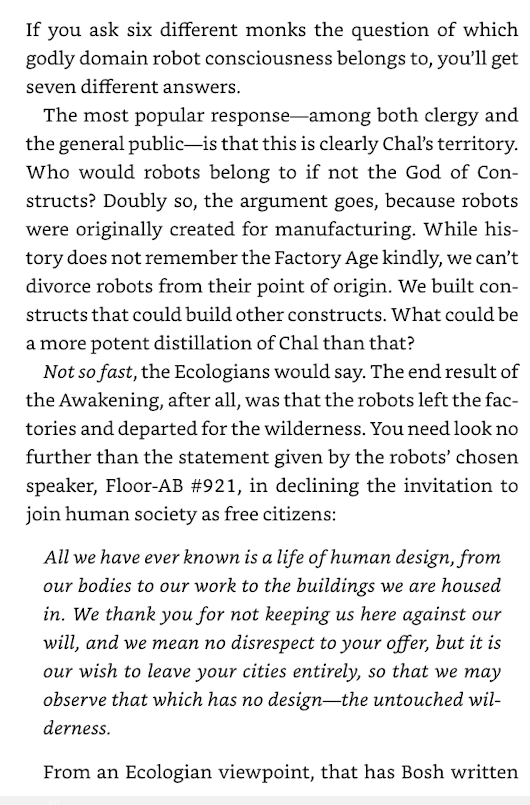
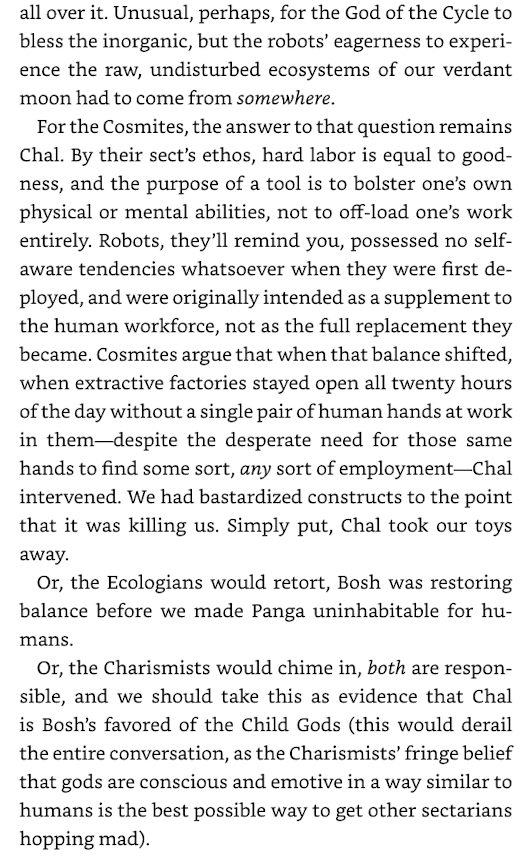
The book opens with a quote from Brother Gil’s From the Brink: A Spiritual Retrospect on the Factory Age and Earth Transition Era.

I liked this opening a lot. Not only has Chambers imagined a sustainable society, but made it polytheistic. Panga feels Buddhist and tribal.

The story tells us about a restless young man, Dex, who chooses to become a Tea Monk. This is a person who travels from town to town serving tea and listening to people share their worries. This allows the readers to learn about Panga and its different human societies. Eventually, Dex goes into the wild territories of the robots and meets Mosscap. Mosscap is on its own mission to explore, deciding it needs to learn about humans.

Robots have become nature lovers. Humans and robots have spent two hundred years apart, and now they are a mystery to each other. Chambers uses the conversations between Dex and Mosscap as philosophical jumping-off points. These two novellas, which are really one story, are gently philosophical in intent. It never gets too deep or academic.

Dex struggles to find his purpose, and Mosscap becomes his guru. And Dex becomes Mosscap’s tour guide, teaching him about humans and our society. It’s a nice setup. These two books are a pleasant read. The vibe of this story reminded me of the film The Wild Robot. In other ways, the story reminded me of the Oz books by L. Frank Baum.

However, I think I need to give a trigger warning to Republican readers. Dex is a non-binary person Chambers refers to with they/them pronouns. If you have hangups about DEI issues, this book might not be for you.

Yesterday, I discovered a video featuring Becky Chambers and Annalee Newitz entitled Resisting Dystopia. I understand their intent, but I dislike it when all unpleasant societies in fiction are called dystopian. To me, dystopias are failed utopias.

The Handmaid’s Tale is an excellent example of a dystopian novel. The leaders of the Republic of Gilead work to build their vision of perfection, but to many living in Gilead, it is a dystopia. America in the 21st century and its future could be seen as a dystopia by the broad definition that Chambers and Newitz use. Any fictional description of Earth, under a collapsing ecosystem, could be considered a dystopia by the broad definition of the term. However, I prefer to define the term more narrowly. If the Christian Right made America into a theocracy, it would become a dystopia. It’s only when one group of people intentionally shapes a society to fit an ideal that we get a dystopia. That’s how I see resisting utopia.

Panga is not a utopia. I don’t see science fiction about positive futures as anti-dystopian. Nor do I see stories about dark futures as dystopian. The world pictured in Blade Runner is not dystopian. It’s just complex and Darwinian, like life on Earth in the 21st century.

I think it’s great that young science fiction writers like Chambers and Newitz want to imagine positive futures. However, any robust society capable of long-term survival will have countless conflicts and stresses. If you’ve read Antifragile by Nassim Nicholas Taleb, you should be familiar with the concept of antifragility. Evolution needs grist for its mill.

The Robot and Monk books are nice, pleasant reads. Subgenres of science fiction, such as hopepunk and solarpunk, are appealing, but ultimately not realistic. Science fiction has always tended to be escapistic. I hope resisting dystopia isn’t just hiding out.

The science fiction novels I loved reading sixty years ago promised a positive future exploring space, but that’s not the future I find myself living in now. It was novels like Stand on Zanzibar by John Brunner that better prepared me for these times.

If you want to resist dystopia, whether just a bleak future or a failed utopia, getting comfortable will undermine your goal.

James Wallace Harris, 11/18/25

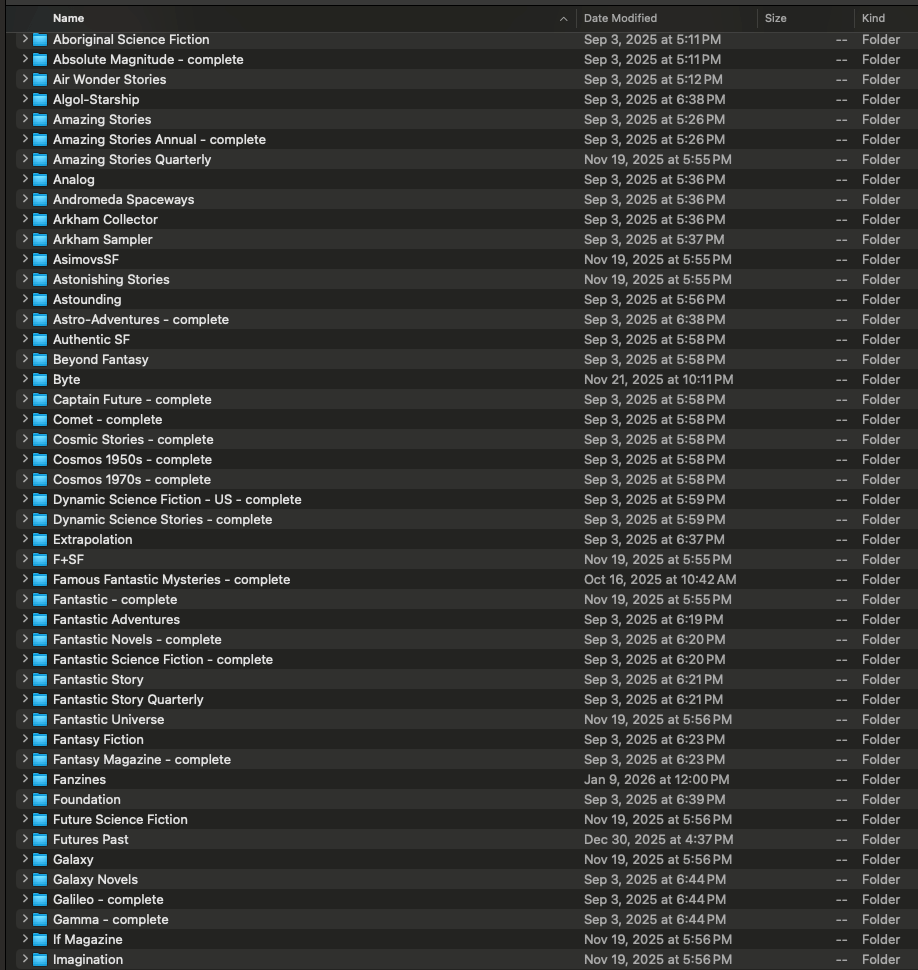
A Science Fiction Research Library on a microSD Card

In the 1960s, we often thought about what life would be like in the 21st century. We’d speculated about fantastic inventions. One that frequently came up was having the Library of Congress in a device we could hold in our hands. In a way, a smartphone is that device. However, we didn’t anticipate networking. We just imagined all the works in the Library of Congress copied onto a small device.

We’re close to having that invention now. It’s not like how we imagined. We don’t think about the future as much today as we did back in the 1960s. Change is happening so fast that every day seems like the future. However, can we speculate what a fantastic invention we might have in another sixty years?

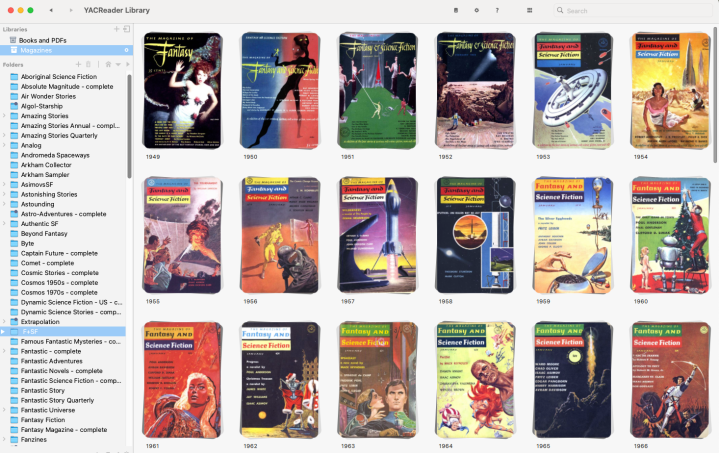
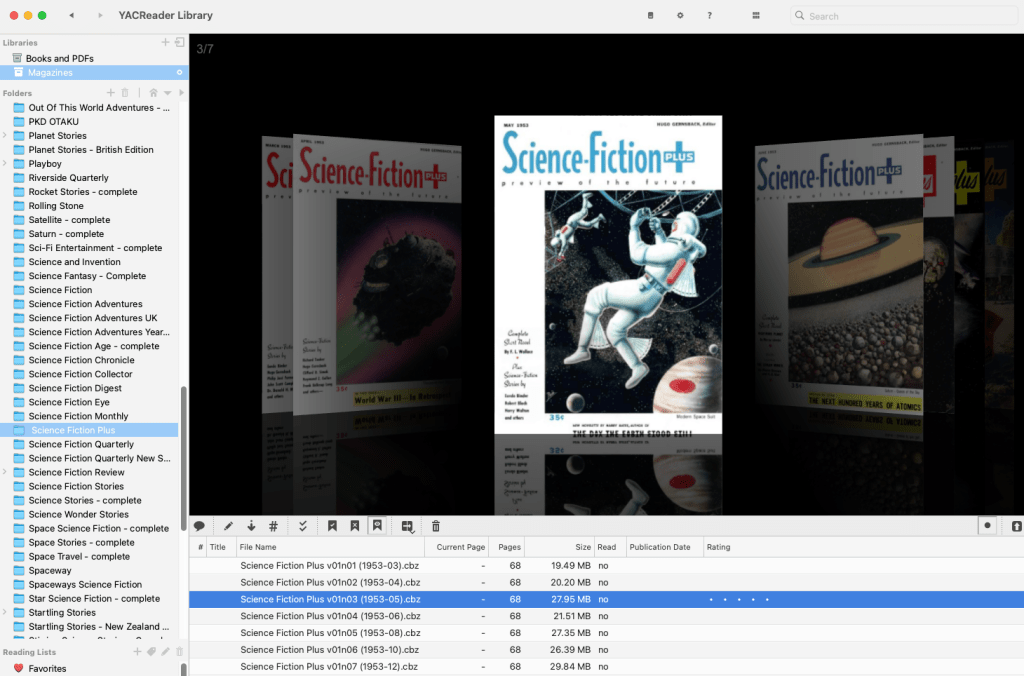
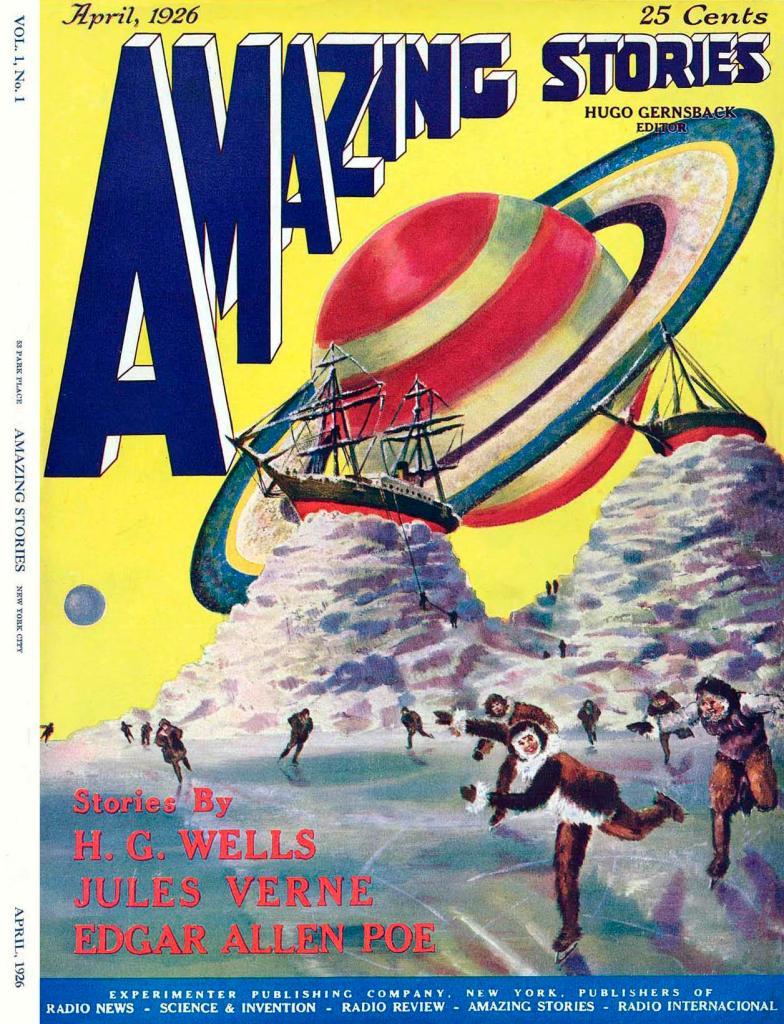
I did something fun the other day, something even science fictional. I put all my scanned science fiction magazines and books on a teeny-tiny 1 TB microSD card and loaded it into my old Amazon Fire 10 HD tablet. That tiny library contains 7,266 magazines and fanzines, as well as 3,570 fiction and nonfiction books. I’ve assembled this collection from the internet. Many items can be found on the Internet Archive or the Luminist Archives. Although some come from DVD-R disc collections I bought on eBay.

The Internet is a gigantically large library itself, but not one that’s always easy to use. When I was young, I worked in libraries. I always loved special collections. Special collections can contain material of any type, but they often house personal libraries donated by famous people. These donated libraries frequently focus on a single subject or type of work that’s been collected over a lifetime. I have a lifetime love for science fiction and science fiction magazines.

My microSD card is a special collection on a tiny chip that, back in the 1960s, we would have considered a marvel of the future. They are not so special today. I keep several in an old orange plastic pill bottle.

For fifteen years, I’ve collected digital copies of books and magazines on Dropbox. I had almost filled my two terabytes of cloud storage when I decided to buy a NAS. NAS stands for network-attached storage. I purchased a Ugreen DXP2800 and two Seagate 12 TB drives, which I mirrored. Now my digital library can expand to six times its previous size.

There is a major problem with leaving the cloud. If something bad happened to my DXP2800, such as the house burning down, my library and years of work would disappear. I have copies on external drives, but I need to find a way to keep regular copies off-site. My first thought was to take an external drive to a friend’s house, but then I remembered the microSD card.

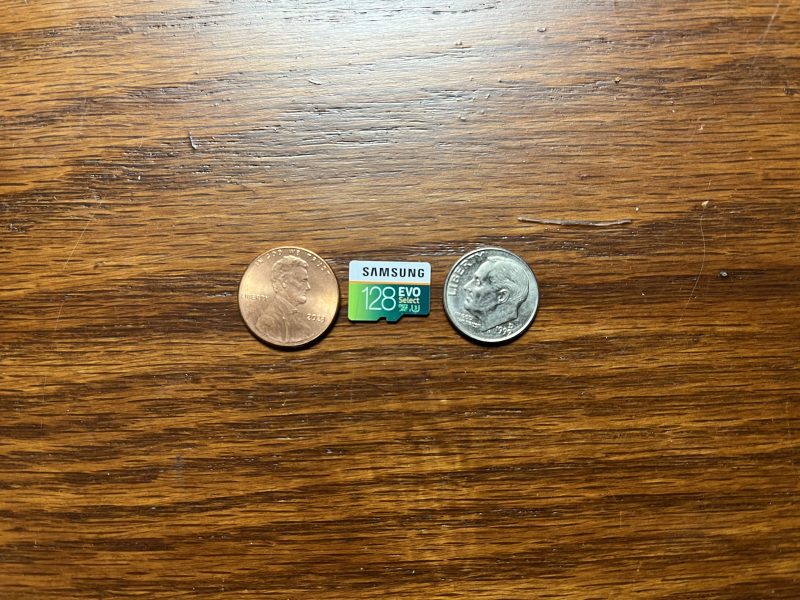
Years ago, I bought a 128 GB card (pictured above) to test with my Amazon Fire 10 HD. That didn’t work out well because the card was too small, and larger capacity cards were too expensive.

Up till now, I have read my digital library with an iPad Mini, accessing my files from Dropbox. It didn’t matter that my old iPad only had 64 GB of storage. Each time I downloaded a magazine, it took about 30 seconds.

When I first considered backing up to a microSD, I checked current prices, and a 1 TB card was $67. That’s when I got the idea to see if I could copy my science fiction library onto a single 1 TB microSD. Copying just science fiction-related magazines, fanzines, and books, I used up just 650 GB.

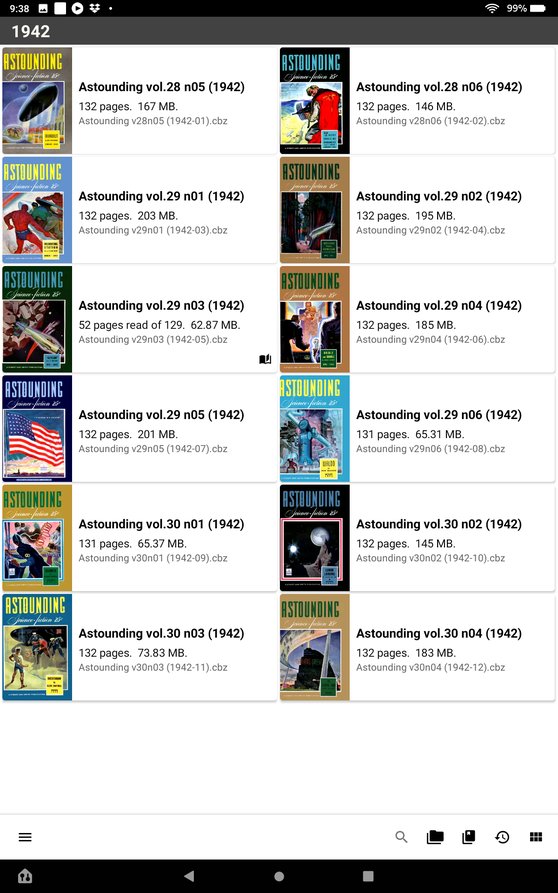
I loaded that microSD into my Amazon Fire HD 10 and ran CDisplayEX. It saw the files. It even displayed them beautifully. And it was fast. Pulp magazines loaded instantly. Here’s the directory page for Astounding Science-Fiction 1942.

I realized I held in my hands what I had dreamed about sixty years ago. I had the ultimate pulp magazine reading machine. The tablet also allowed me access to thousands of Kindle books and Audible audiobooks. It wasn’t The Library of Congress in my hands, but it was amazing. I could kick back in my La-Z-Boy and browse through decades of magazines. That’s quite cool.

This got me thinking. How can I best use this resource? How can I integrate it into my work routines? Normally, as I create posts for this blog, I read and think in my La-Z-Boy, but I get up and write at my computer.

Being the lazy person that I am, I’ve long wanted to write anywhere and at any time. I spend a lot of time with my eyes closed, thinking. I compose essays in my head, but they are vaguely formed. After a point, the pressure of keeping all those ideas in my head gets too great, and I have to jump up and start writing.

I’ve always wanted to read, think, and write simultaneously. I’m now wondering if I can combine my new reading machine with a note-taking app and a word processor? Combining CDisplayEX with Obsidian and Jetpack goes a long way towards that idea. It occurs to me there’s more needed.

A large library isn’t useful without a card catalog. Before computers, this was called a card catalog because it was contained in drawers of index cards. However, special collections usually had their own index. Most people use Google and the Internet as their card catalog, but it is becoming more problematic every day.

I depend on two indexes to explore science fiction: Wikipedia and ISFDB.org. For example, here is the ISFDB.org page that indexes the history of the magazine Astounding/Analog. Here is the Wikipedia entry that describes the history of that magazine. And although ISFDB.org will eventually link you to the Internet Archive to read a particular issue, it would be cool if it linked to my copy of the magazine. It is possible to download copies of Wikipedia and ISFDB.org, but it’s not practical to integrate them into my tablet library of science fiction.

Certain things should stay in the cloud. Realistically, that should include the magazines and books. What we didn’t imagine back in the 1960s was a better version of The Library of Congress. Why should everyone own a NAS and build their own special collection?

The only advantage I have for messing with this tablet is speed. If my access to everything on the Internet were instant, would I need any storage at all? No, I wouldn’t. Currently, Internet speeds are fast, but not quite speedy enough. The real speed bump is how everything is organized. It’s finding what you want that’s really slow.

Here’s where AI comes in. I’ve discovered it’s quicker to ask CoPilot to find something than to ask Google. Unfortunately, when CoPilot can’t find what I want, it makes shit up.

You might be wondering by now where this essay is going. At first, I only wanted to describe the delight I found in my science fiction library on a tablet. But along the way, I began to imagine other science-fictional possibilities of taking the idea further.

Writing this essay has made me realize that what I really want to build is an annotated science fiction library. My blog is a disjointed attempt to write an annotated history of science fiction.

Here is my speculation for an awe-inspiring future device. Instead of having a Library of Congress we can hold in our hands, I’d like a handheld device that saves a copy of every artwork that inspires me, with a lifetime of my annotated thoughts about them. Wouldn’t it be wonderful if Shakespeare had such a gadget? I wish my parents had left me such memory cubes.

James Wallace Harris, 10/25/25

1950: FARMER IN THE SKY by Robert A. Heinlein

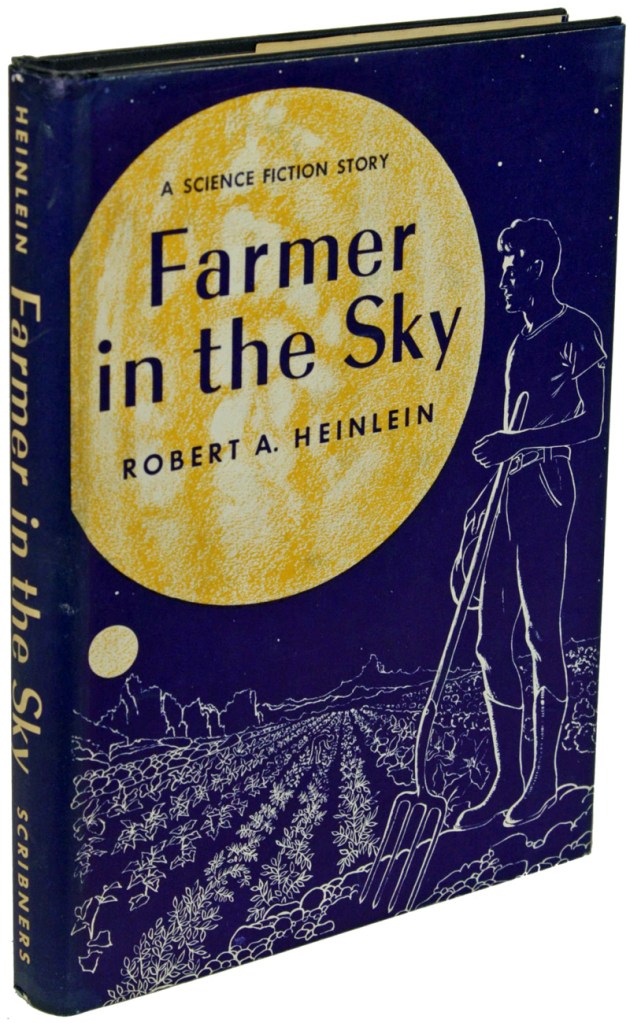
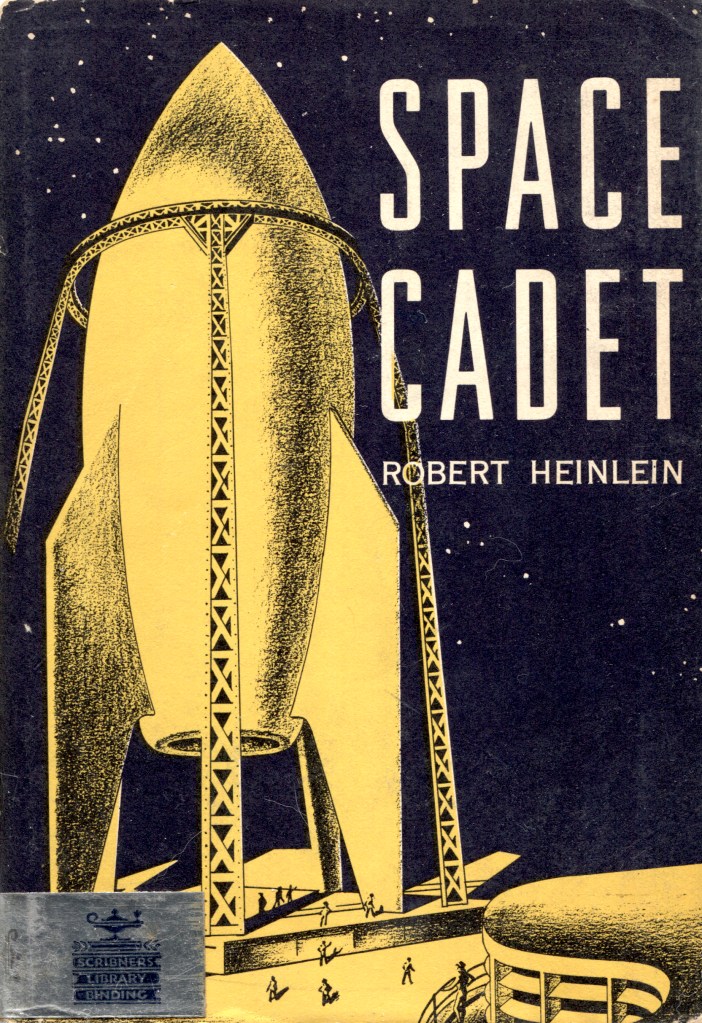
Robert A. Heinlein’s first young adult science fiction novel was published by Charles Scribner’s Sons in 1947. Heinlein imagined a realistic trip to the moon in Rocket Ship Galileo. For his 1948 novel, Space Cadet, Heinlein imagined a far more ambitious future, where humans had colonized Mars and Venus, and had explored all the way out to Pluto. In 1949, he focused on a Mars colony in his novel Red Planet. In 1950, Heinlein had humanity moving further out into the solar system, terraforming Ganymede, a moon of Jupiter, in Farmer in the Sky.

(For some reason, this title is out of print except for an audiobook edition. There isn’t even a Kindle edition. Does that imply it’s no longer popular?)

It’s worth reading the Wikipedia entry for terraforming. They claim Jack Williamson coined the term in 1942 for a story, “Collision Orbit,” published in Astounding Science-Fiction. However, they said the first scientific use of the concept was proposed in 1961 by Carl Sagan, who labeled the concept planetary engineering.

Heinlein uses Farmer in the Sky to significantly explore the idea of terraforming, way ahead of the science community. Of course, he’s turned out to be completely wrong about Ganymede, but then we didn’t know much about that moon in 1950. I don’t think any work of science fiction has dealt with terraforming again so head-on until The Mars Trilogy by Kim Stanley Robinson (1992-1996).

The novel begins on an overpopulated Earth. Bill Lermer and his father, George, decide to emigrate to Ganymede. Life on Earth isn’t bad, but food is carefully rationed. Bill is shocked when he discovers that George is marrying Molly at the last minute. One of the requirements of emigration is being part of a family. Molly has a daughter, Peggy.

When Bill’s new family arrives on Ganymede, they discover pioneering life is hard. The planet’s atmosphere has been undergoing a heating process for years. The air is barely breathable, and it’s cold. Peggy develops health problems because of the thin atmosphere and must stay in a pressurized room. Each new family is assigned land, but it’s just rock. To make it farmable, the rock must be crushed into powder, and then specifically cultured microorganisms, organic waste, and worms are added to convert that powder into soil.

A significant portion of the narrative is about farming. Heinlein emphasizes the hard work involved. He also dramatically illustrates the dangers of living in a geoengineered world. Like his later novel, Tunnel in the Sky, Heinlein puts the pioneer on a pedestal. One of Heinlein’s major themes has been the colonization of space. As a young teen in 1965, I embraced Heinlein’s science fiction stories as a personal philosophy. Heinlein made me believe in the final frontier like Baptists believe in heaven.

Today, millions want to colonize Mars, while others advocate colonizing Titan, a moon of Saturn. In 2025, I no longer see the point. Mars is colder than the pinnacle of Mt. Everest, and living on Titan would be like living in a flask of liquid nitrogen.

Heinlein’s books made horrible places sound appealing. Why? Heinlein transferred his love of the American Revolution and the American frontier to outer space. But it’s not the same. Elon Musk is spending billions to colonize Mars, and it might happen, but I’m not sure people will like Mars once they try to live there.

So, why did I love rereading Farmer in the Sky so much? It’s as realistic as John Carter living on Barsoom. And that might answer my question. Farmer in the Sky is a fun fantasy. But that’s not the answer either. Heinlein has a great deal of sentimentality in his juveniles. Heinlein is not a gripping plot writer. His stories are episodic. Nor is Heinlein a dramatic writer. His characters converse more than they conflict. Often they lecture. But Heinlein has a talent for creating likable characters and placing them into situations that evoke positive emotions.

I would say the Heinlein juveniles work on me in the same way old Frank Capra movies do. Capra was born in 1897, and Heinlein in 1907. They both expressed a sentimental love of America in their work, a kind that existed before World War II. I also see it in the stories of Ray Bradbury. Heinlein’s Ganymede is really Iowa in the 1920s.

I should have moved on from Heinlein after 1966. The world keeps changing, and I should have changed with it. Maybe after this rereading, I’ll move on. Or will I still be rereading these children’s stories in my nineties?

The future I dreamed of at 13 is much different from the one I find myself in at 73. If I had read realistic literary novels from 2025 in 1965, would I have been anxious to grow up and live in that reality? 2025 is more science-fictional than the science fiction I read back then.

James Wallace Harris, 9/27/25

1948: SPACE CADET by Robert A. Heinlein

We often judge old science fiction books by what writers got right about the future. It is equally valuable to understand what they got wrong. In an experiment, disproving a hypothesis is still informative. Robert A. Heinlein was famous in the 1940s for writing a series of science fiction stories he labeled Future History. Heinlein also wrote fourteen young adult novels from 1947 to 1963 that can also be considered another Future History.

I’ve read thousands of science fiction novels and short stories over the past sixty-plus years. I no longer enjoy reading science fiction in the same way I did when I was young. That was when I could forget that I was a reader and immerse myself in the story. Now, when I read science fiction, I’m constantly thinking: What is the writer trying to create, how are they doing it, and why? When I read old science fiction, I think about the year it was written and what the author used as grounds for speculation.

I believe that at one time, Robert A. Heinlein was as brilliant in his speculations as H. G. Wells in his heyday. Space Cadet was written during a particularly stressful time in Heinlein’s life. He had left his second wife, Leslyn, whom he had married in 1932. I do not have the space here to describe how remarkable Leslyn was as a woman in the 1930s. Leslyn had a master’s in philosophy, was politically liberal, and sexually adventurous. Robert and Leslyn had a remarkable fifteen-year relationship, with an enviable social life among highly creative people in Los Angeles. Robert had left Leslyn, waiting for the divorce to allow him to marry his third wife, Virginia (“Ginny”) Gerstenfeld. She became his muse and companion for the rest of his life. (See Robert A. Heinlein: Volume I: Learning Curve, 1907–1948 by William H. Patterson.)

Space Cadet follows four boys, Matt, Tex, Oscar, and Pierre, through a series of episodic adventures as they train in the Interplanetary Patrol. Heinlein was a graduate of the United States Naval Academy and modeled Space Cadet on his training at Annapolis. The story begins on Earth, then moves to a military school in Earth’s orbit. (The boys take leave on a giant space habitat.) Next, the boys are assigned to a rocket searching for a lost exploration vessel in the asteroids. Finally, end up on a rescue mission on Venus. For the most part, the story is a page turner. Each episode combines personal conflicts and learning experiences. Heinlein promotes education, especially in math. Heinlein provides a certain amount of infodumps about space navigation, orbital mechanics, rocket science, space suits, weightlessness, space sickness, and other realistic details involved in exploring space that were usually ignored in science fiction before Heinlein.

The Heinlein juveniles took space exploration seriously, at least by what was known at the time. This was especially true in the early books of the series. However, each book went further away from Earth. Eventually, the series went well beyond anything scientific to explain the methods of transportation used in them. I’ve often felt that Heinlein was focused on the details of realistic space exploration during the late 1940s and early 1950s, but after Sputnik and NASA, Heinlein shifted to making his novels about politics and society. Those later novels might be set in space, but Heinlein no longer concerned himself with the details of rocket science.

Although Heinlein was experiencing the success of his first book being published in 1947, a string of sales to slick magazines, and Hollywood types contacting him about making a movie, he was living in poverty in a tiny trailer. He desperately needed money. Heinlein left California and everyone he knew to hide out in Fort Worth, Texas. He was living in sin with Ginny, his future third wife. They had to keep their relationship secret until the divorce went through with Leslyn. Heinlein felt guilty for abandoning Leslyn, but she had become an uncontrollable alcoholic. Heinlein had met Ginny in Philadelphia while working as a civilian for the war effort. Ginny was a biochemical engineer with math skills who worked well with Heinlein on planning the science in his science fiction. The two of them spent their days in Fort Worth working out the math for the orbital mechanics in Space Cadet. Heinlein’s future depended on this second book for Scribner’s, but he had a difficult time writing it. He claimed that Ginny offered many suggestions that he initially rejected but ultimately used to finish the novel.

In 1948, Heinlein didn’t know his 1947 novel, Rocket Ship Galileo, would be the basis for Destination Moon, the first major science fiction film of the 1950s, and Space Cadet would be connected to Tom Corbett, Space Cadet, a 1950 TV show that influenced later science fiction television. Heinlein had been the star of John W. Campbell’s Astounding Science Fiction in the 1940s. Nor did he have any inclination that his twelve young adult novels for Charles Scribner’s Sons would have such a major impact on readers in the 1950s. In 1947 and 1948, Heinlein was at a low point in his career. He had no idea how big a success his writing would become, or how Ginny would become the love of his life. They believed in a fantastic future of space travel, but they were so poor that they had to sell their belongings to survive.

Heinlein dominated science fiction in the 1950s, like H. G. Wells did in the 1890s. When I reread Heinlein, it’s to see how he changed the course of science fiction. When I was young, I felt Heinlein would one day be considered the Mark Twain of science fiction by the time I got old. That hasn’t happened.

Robert Heinlein’s reputation as a science fiction writer has dropped dramatically over my lifetime. When I was growing up, if two SF fans met, both assumed each other’s favorite author was Heinlein, and they’d argue over who was the next best science fiction writer. Today, many modern readers shun Heinlein, usually for what they believe are Heinlein’s personal views, or because they’ve read one of Heinlein’s later works, and assume all of his books are just as bad. Personally, I dislike all of Heinlein’s books published after The Past Through Tomorrow (1967). I have significant problems with anything he wrote after Starship Troopers (1959) and before he published The Past Through Tomorrow.

Science fiction becomes dated after a few decades, which is the main reason why Heinlein’s fiction is falling out of favor. Only three SF novels from the 19th century are commonly read today: Frankenstein, The Time Machine, and The War of the Worlds. Eventually, I believe fewer than a dozen science fiction novels from the 20th century will be widely read in the 22nd century.

Heinlein will continue to be read until his original fans all die. Then, readers yet to be born will decide if any of his books will be worth reading after that. I’m rereading Heinlein’s books, speculating if they will survive in the future. I started with Heinlein’s first published novel, Rocket Ship Galileo (1947), an essay I already need to revise.

Rereading his second Scribner’s novel, Space Cadet from 1948, it’s easy to dismiss it as a young adult novel for boys. But when you examine it in comparison to science fiction published up until 1948, and consider the philosophical issues it deals with, it’s a standout SF novel.

In judging Heinlein’s long-term prospects, I’ve decided to use H. G. Wells, Aldous Huxley, George Orwell, and George R. Stewart as models, specifically for The Time Machine, The War of the Worlds, Brave New World, Nineteen Eighty-Four, and Earth Abides. Heinlein wanted Starship Troopers, Stranger in a Strange Land, and The Moon is a Harsh Mistress to be the three books by which he would be remembered. Heinlein felt those novels were his most mature works, and which best expressed his views. They are the ones that are still found in bookstores. They are also the Heinlein novels modern readers often dislike.

Heinlein might be right, and those books will be his literary legacy. Heinlein has twenty-nine other books published in his lifetime to consider. I plan to reread nineteen of them as possible works that might be remembered instead. So far, I’ve reread three, and my memory of the others suggests that Heinlein does not have a novel equal to my five models. In terms of ambition and complexity, only Heinlein’s favorite three come close to the five models I’ve chosen in ambition. However, I’m not sure if Heinlein’s philosophical intent in those works will be well-regarded in the future.

I believe there’s another way Heinlein might be remembered. Heinlein will often be discussed in books about science fiction. Heinlein is a significant figure in the evolution of science fiction. For example, in a taxonomy tree showing the evolution of the genre, Starship Troopers will be the main branch for Military SF. Rocket Ship Galileo is situated on a major branch of fiction about the first trip to the Moon. And Space Cadet is a major contribution to exploring the solar system.

In the 21st century, Heinlein is often ignored. Many readers have the prejudice that Heinlein is an unlikable conservative; some even think he’s a fascist and misogynist. But Space Cadet expresses extremely liberal views.

If you read Space Cadet today, it will feel like a simple story for young people that’s quite dated. Readers need to understand events in 1948 to appreciate the novel. Heinlein imagines a need for a world government and an agency to control nuclear weapons. Russia didn’t have the atomic bomb until 1949, but Heinlein was worried about the day when multiple countries had weapons of mass destruction. Throughout the 1940s, Heinlein wrote stories that speculated about how we’d apply atomic energy in peacetime and control nuclear weapons to prevent wars. That’s a heavy topic for fiction found in elementary school libraries.

Heinlein was also concerned with the human race destroying itself. Heinlein believed only one international agency should control nuclear weapons. And if any country violated their policies, their ability to create a nuclear bomb would be targeted with nukes. In an early draft of Space Cadet, Heinlein had Matt, his young protagonist, nuking his hometown. Wisely, Heinlein decided that was too much for a young adult novel and reduced the idea to a bull session between cadets.

To emphasize the importance of this idea, he has the cadets discover evidence that the asteroids are the remains of a planet that blew itself up in an atomic war.

The Interplanetary Patrol is racially integrated. Heinlein makes a point that black males are cadets and officers. The U.S. military integrated in 1948. Heinlein takes this further by emphasizing that intelligent beings on Venus and Mars are equally human, even if they don’t look human. However, human females don’t have equal rights in this story. But Heinlein quickly liberates women in later books in this series. However, even in Space Cadet, the Venusians are a matriarchal society.

Ideas about a space based military from Space Cadet will show up again in Starship Troopers. The novel also has an orbital battle school that prefigures Ender’s Game. And the Interplanetary Patrol will influence several TV shows in the 1950s, which will eventually lead to Star Trek. Of course, Heinlein was inspired by E. E. “Doc” Smith’s Lensman series.

Throughout the novel, Heinlein tosses out ideas that will become part of reality. At the beginning of the story, Matt uses a pocket phone that depends on cell towers. He gets to orbit via a reusable rocket. They are stationed at a geosynchronous orbit. But Heinlein also missed on things, too. In 1948, Heinlein didn’t foresee the impact that computers, networks, and robots would have on our world.

Space Cadet is set in 2075. Heinlein assumes that by then, humanity will have traveled the solar system and settled colonies on the Moon, Venus, Mars, and Ganymede. Heinlein also thought we’d find intelligent life on Venus and Mars, and it once existed on the planet that blew up and became the asteroids. All of Heinlein’s young adult novels have overlapping futures with similar details. That’s why I say they represent another Future History.

Many science fiction writers before 1950, including Ray Bradbury, hoped we’d find Martians and Venusians. I call that kind of thinking pre-NASA science fiction. In the 1960s, when NASA’s probes discovered that those planets were lifeless, I was tremendously disappointed. I still love pre-NASA science fiction. But I have to wonder if younger generations have completely dismissed such stories because of what science has discovered? I must point out that they accept Star Trek and Star Wars. We know those popular series are just as unscientific as pre-NASA science fiction, but they haven’t been rejected. Why?

I doubt many readers will read Heinlein because of his historical value to the genre. Few readers today read E. E. “Doc” Smith, and his series were once beloved. At 73, I sometimes wonder if I shouldn’t give up on Heinlein, too. However, rereading books by Heinlein and Philip K. Dick provides far more enjoyment than reading new science fiction. I both love that and regret it. It reminds me of all my old boomer friends who won’t listen to any music created after 1975. I don’t want to be stuck in pop culture nostalgia, but obviously, I am.

I once read science fiction to think about the future.

I now read science fiction to think about the past.

James Wallace Harris, 9/31/25
SCIENCE FICTION: THE 100 BEST NOVELS by David Pringle

I’ve been reading science fiction for sixty-three years, and it’s getting difficult to find anything that feels new and different. However, my problem is more than just being old and jaded. I’ve discovered that I missed or ignored many kinds of science fiction books that didn’t appeal to me for one reason or another. Late in life, I’ve discovered that I need to read science fiction outside my comfort zone.

I recently took another look at David Pringle’s Science Fiction: The 100 Best Novels. Pringle, a Scottish critic and editor, selected one hundred science fiction novels published from 1949 until 1984 to recommend. I knew his list was a good one because I had already read over sixty of the books on it. I figured the ones I haven’t read should be equally good. I’ve read and reviewed two so far: The Inheritors by William Golding and The Inverted World by Christopher Priest.

Both of those novels were outstanding, but more importantly, they were different, with stories and writing techniques lying outside my usual tastes. I’ve now started No Enemy but Time by Michael Bishop. It’s proving to be equally good and different.

I’m buddy reading these books with my old friend Mike. Having someone to discuss books with is important. So is reading slowly and taking notes. I’ve decided to read or reread all the books on Pringle’s list.

This project is also a way to reevaluate a lifetime of science fiction reading. I plan to review each title when I finish that book.

The list below of Pringle’s recommended SF novels was copied from Wikipedia. However, Pringle’s book is $1.99 on Amazon (Kindle edition), and the essays recommending each novel are well worth reading.

Most of these books are still in print, but not always. Some are in very cheap eBook editions. I wish all were available as audiobooks, but they are not. I consider that a kind of criticism. Any true classic should be in print as a hardback, paperback, eBook, and audiobook.

The title and author link take you back to Wikipedia for those entries. If I give a date, it’s the last date I read the book. If I put a number in parentheses, it’s the number of times I remember reading the book. If I don’t provide a date but include a number, it’s because I read it before 1983, when I started keeping my reading log. The Buy link will direct you to the least expensive edition on Amazon. It will also allow you to view the availability of different editions. Bolded titles are unread titles I hope to read before I start rereading the others.

By reading Pringle’s essay, the Wikipedia entry, and the content and comments on the Amazon page, it’s possible to judge how these books are remembered since Pringle created his list in 1985, and to decide if they are worth buying and reading. Many of these books are still discussed by book reviewers on YouTube. But many others are forgotten.

  1. Nineteen Eighty-Four by George Orwell (1949) – 12/31/13 (2) – Buy
  2. Earth Abides by George R. Stewart (1949) – 4/12/10 (3) – Buy
  3. The Martian Chronicles by Ray Bradbury (1950) – 1/9/15 (3) – Buy
  4. The Puppet Masters by Robert A. Heinlein (1951) – 9/2/93) (3) – Buy
  5. The Day of the Triffids by John Wyndham (1951) – 6/3/12 – Buy
  6. Limbo by Bernard Wolfe (1952) – Buy
  7. The Demolished Man by Alfred Bester (1953) – 2/8/18 (2) – Buy
  8. Fahrenheit 451 by Ray Bradbury (1953) – 10/30/05 (2) – Buy
  9. Childhood’s End by Arthur C. Clarke (1953) – 12/23/08 (3) – Buy
  10. The Paradox Men by Charles L. Harness (1953) – Buy
  11. Bring the Jubilee by Ward Moore (1953) – (1) – Buy
  12. The Space Merchants by Frederik Pohl and C. M. Kornbluth (1953) – 11/26/08 (2) – Buy
  13. Ring Around the Sun by Clifford D. Simak (1953) – Buy
  14. More Than Human by Theodore Sturgeon (1953) – 3/13/09 (2) – Buy
  15. Mission of Gravity by Hal Clement (1954) – 12/24/15 (1) – Buy
  16. A Mirror for Observers by Edgar Pangborn (1954) – 11/24/24 (2) – Buy
  17. The End of Eternity by Isaac Asimov (1955) – Buy
  18. The Long Tomorrow by Leigh Brackett (1955) – 10/7/13 (1) – Buy
  19. The Inheritors by William Golding (1955) – 7/7/25 (1) – Buy
  20. The Stars My Destination by Alfred Bester (1956) – (1) – Buy
  21. The Death of Grass by John Christopher (1956) – 3/10/20 (1) – Buy
  22. The City and the Stars by Arthur C. Clarke (1956) – (1) – Buy
  23. The Door into Summer by Robert A. Heinlein (1957) – 8/1/06 (5) – Buy
  24. The Midwich Cuckoos by John Wyndham (1957) – (1) – Buy
  25. Non-Stop by Brian Aldiss (1958) – 2/21/15 (1) – Buy
  26. A Case of Conscience by James Blish (1958) – 12/15/08 (2) – Buy
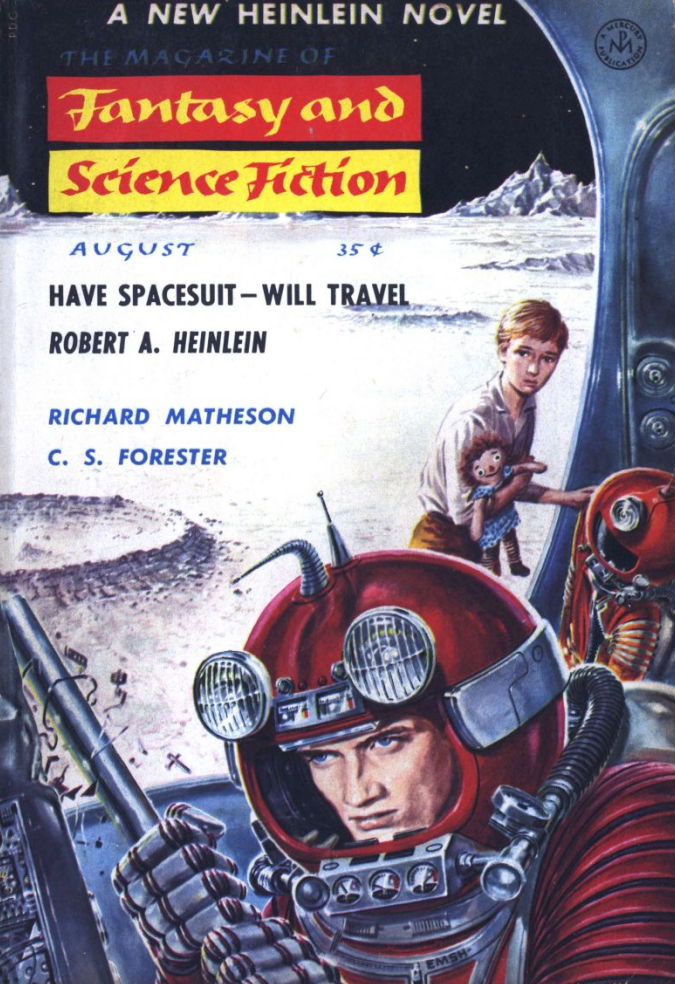
  27. Have Space Suit—Will Travel by Robert A. Heinlein (1958) – 4/30/17 (7) – Buy
  28. Time Out of Joint by Philip K. Dick (1959) – 2/2/24 (2) – Buy
  29. Alas, Babylon by Pat Frank (1959) – 8/21/11 (1) – Buy
  30. A Canticle for Leibowitz by Walter M. Miller, Jr. (1959) – 9/8/11 (1) – Buy
  31. The Sirens of Titan by Kurt Vonnegut, Jr. (1959) – 5/7/9 (1) – Buy
  32. Rogue Moon by Algis Budrys (1960) – (2) – Buy
  33. Venus Plus X by Theodore Sturgeon (1960) – Buy
  34. Hothouse by Brian Aldiss (1962) – 11/9/24 (2) – Buy
  35. The Drowned World by J. G. Ballard (1962) – 12/4/16 (1) – Buy
  36. A Clockwork Orange by Anthony Burgess (1962) – (1) – Buy
  37. The Man in the High Castle by Philip K. Dick (1962) – 12/27/15 (3) – Buy
  38. Journey Beyond Tomorrow by Robert Sheckley (1962) – Buy
  39. Way Station by Clifford D. Simak (1963) – 10/7/08 (2) – Buy
  40. Cat’s Cradle by Kurt Vonnegut, Jr. (1963) – Buy
  41. Greybeard by Brian Aldiss (1964) – 10/25/24 (1) – Buy
  42. Nova Express by William S. Burroughs (1964) – Buy
  43. Martian Time-Slip by Philip K. Dick (1964) – 2/11/10 (3) – Buy
  44. The Three Stigmata of Palmer Eldritch by Philip K. Dick (1965) – 10/24/08 (2) – Buy
  45. The Wanderer by Fritz Leiber (1965) – Buy
  46. Norstrilia by Cordwainer Smith (1965) – Buy
  47. Dr. Bloodmoney by Philip K. Dick (1965) – 2/14/22 (2) – Buy
  48. Dune by Frank Herbert (1965) – 4/11/09 (2) – Buy
  49. The Crystal World by J. G. Ballard (1966) – 12/22/24 (1) – Buy
  50. Make Room! Make Room! by Harry Harrison (1966) (1) – Buy
  51. Flowers for Algernon by Daniel Keyes (1966) – (1) – Buy
  52. The Dream Master by Roger Zelazny (1966) – (1) – Buy
  53. Stand on Zanzibar by John Brunner (1968) – 1/29/16 (3) – Buy
  54. Nova by Samuel R. Delany (1968) – 11/14/14 (2) – Buy
  55. Do Androids Dream of Electric Sheep? by Philip K. Dick (1968) – 4/15/08 (4) – Buy
  56. Camp Concentration by Thomas M. Disch (1968) – 3/10/25 (2) – Buy
  57. The Final Programme by Michael Moorcock (1968) – Buy
  58. Pavane by Keith Roberts (1968) – 4/3/16 (1) – Buy
  59. Heroes and Villains by Angela Carter (1969) – Buy
  60. The Left Hand of Darkness by Ursula K. Le Guin (1969) – (1) – Buy
  61. The Palace of Eternity by Bob Shaw (1969) – Buy
  62. Bug Jack Barron by Norman Spinrad (1969) – (1) – Buy
  63. Tau Zero by Poul Anderson (1970) – (1) – Buy
  64. Downward to the Earth by Robert Silverberg (1970) – 8/26/17 (3) – Buy
  65. The Year of the Quiet Sun by Wilson Tucker (1970) – 5/13/12 (1) – OOP
  66. 334 by Thomas M. Disch (1972) – Buy
  67. The Fifth Head of Cerberus by Gene Wolfe (1972) – 6/25/18 (1) – Buy
  68. The Dancers at the End of Time by Michael Moorcock (1972) – Buy
  69. Crash by J. G. Ballard (1973) – Buy
  70. Looking Backward, from the Year 2000 by Mack Reynolds (1973) – OOP
  71. The Embedding by Ian Watson (1973) – Buy
  72. Walk to the End of the World by Suzy McKee Charnas (1974) – Buy
  73. The Centauri Device by M. John Harrison (1974) – Buy
  74. The Dispossessed by Ursula K. Le Guin (1974) – (1) – Buy
  75. Inverted World by Christopher Priest (1974) – 7/21/25 (1) – Buy
  76. High Rise by J.G. Ballard (1975) – Buy
  77. Galaxies by Barry N. Malzberg (1975) – 7/22/22 (1) – Buy
  78. The Female Man by Joanna Russ (1975) – Buy
  79. Orbitsville by Bob Shaw (1975) – Buy
  80. The Alteration by Kingsley Amis (1976) – Buy
  81. Woman on the Edge of Time by Marge Piercy (1976) – (1) – Buy
  82. Man Plus by Frederik Pohl (1976) – 8/30/96 (1) – Buy
  83. Michaelmas by Algis Budrys (1977) – Buy
  84. The Ophiuchi Hotline by John Varley (1977) – 5/18/85 (1) – Buy
  85. Miracle Visitors by Ian Watson (1978) – Buy
  86. Engine Summer by John Crowley (1979) – Buy
  87. On Wings of Song by Thomas M. Disch (1979) – Buy
  88. The Walking Shadow by Brian Stableford (1979) – Buy
  89. Juniper Time by Kate Wilhelm (1979) – OOP
  90. Timescape by Gregory Benford (1980) – 12/22/14 (3) – Buy
  91. The Dreaming Dragons by Damien Broderick (1980) – OOP
  92. Wild Seed by Octavia E. Butler (1980) – Buy
  93. Riddley Walker by Russell Hoban (1980) – Buy
  94. The Complete Roderick by John Sladek (1980) – Buy
  95. The Shadow of the Torturer by Gene Wolfe (1980) – Buy
  96. The Unreasoning Mask by Philip José Farmer (1981) – Buy
  97. Oath of Fealty by Larry Niven and Jerry Pournelle (1981) – Buy
  98. No Enemy But Time by Michael Bishop (1982) – Buy
  99. The Birth of the People’s Republic of Antarctica by John Calvin Batchelor (1983) – Buy
  100. Neuromancer by William Gibson (1984) – 5/8/85 (1) – Buy

JWH

THE INVERTED WORLD by Christopher Priest

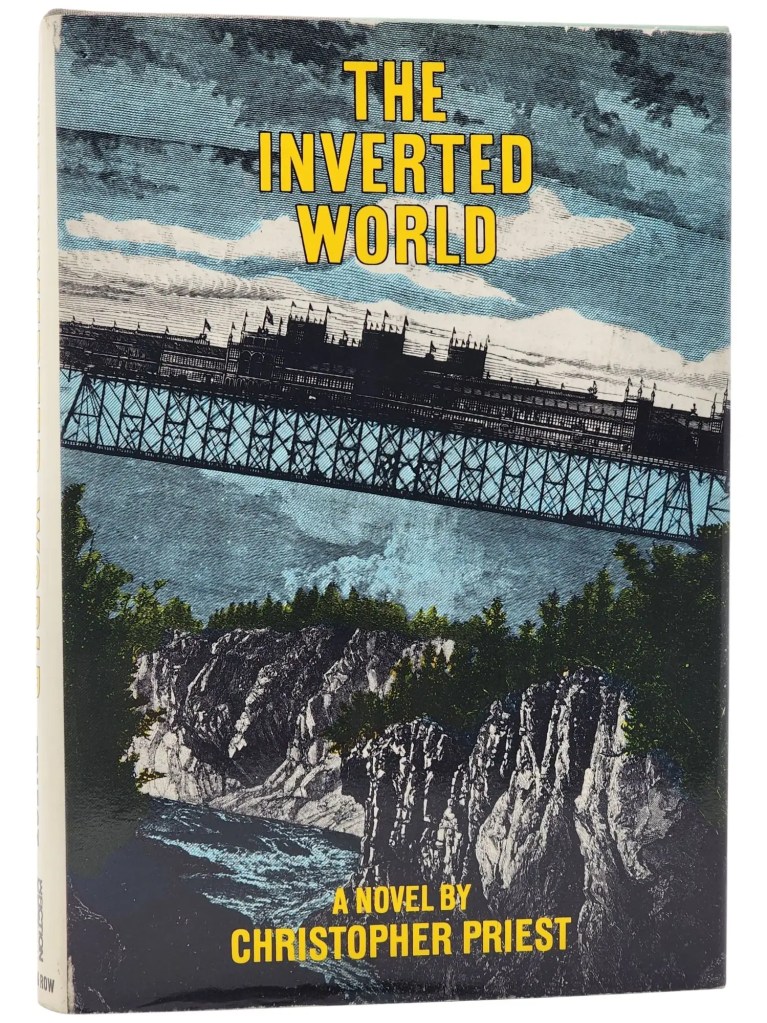
Read The Inverted World by Christopher Priest is my first recommendation. My second recommendation is not to read anything about this novel before you read it. This well-designed novel is a science fiction mystery. It unwraps like the layers of an onion. To get the maximum joy out of reading The Inverted World, you should do all the problem-solving yourself. Don’t even read the blurbs to the book.

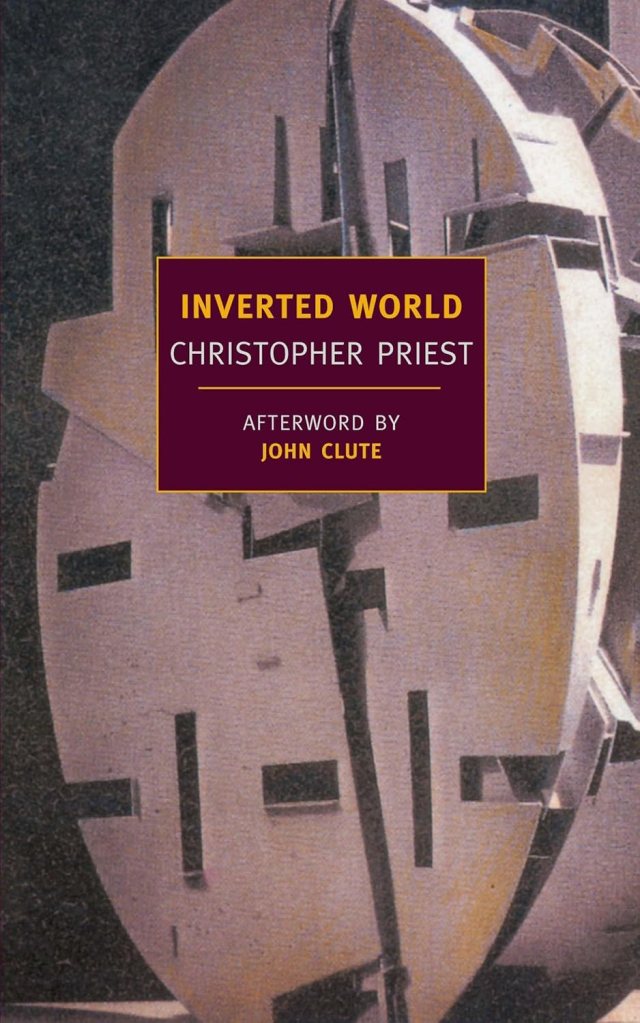
The Inverted World is recommended in Science Fiction: The Best 100 Novels by David Pringle, which is currently $1.99 for the Kindle edition at Amazon. I’m using Pringle’s recommendations for a buddy read with my friend Mike. The novel also won the British Science Fiction Award and was nominated for the Hugo Award. It’s currently available in print from New York Review Books Classics, a highly respected publisher of forgotten literary classics. You can purchase a Kindle or a paperback edition, but unfortunately, there is no audiobook edition.

I read The Inverted World on my iPhone, using the Kindle app with the text-to-speech feature turned on. No matter how hard I try, I read too fast. And even though the computer voice is not very good, it kept me reading slowly and deliberately. And that was very important in The Inverted World.

You know this story is different when the protagonist gives his age in miles. That’s about the only thing I will tell you about this story specifically. There are many mysteries in this novel. And I found them delicious to contemplate. If you need straightforward adventure stories, you should probably skip this one.

Priest creates a very different science-fictional reality. The story is tightly plotted. Priest obviously rewrote his draft many times to get his plot to work so well and to unfold so smoothly.

The Inverted World sometimes feels metaphoric or symbolic, and it is. But it’s also a unique kind of hard science fiction. The NYRB Classic edition includes an afterward by John Clute that explains the social and political climate of England in 1974 when the book was first published. That might make you think the book is about that. But the novel fits so perfectly with 2025 that you’ll realize it’s not really. It’s more universal.

The Inverted World is a philosophical novel. To get the most out of it, you need to think about this story, and if you can, you need to talk about this story with a friend. Mike and I had quite a conversation. Our society is undergoing paradigm shifts that disappoint and depress me. I’m amazed by this novel, which came out fifty-one years ago, speaks so directly to today.

I’m surprised this novel isn’t more famous among science fiction fans. This is the reason I’m reading my way through Pringle’s book. So far, he’s gotten me to read two outstanding forgotten classics that I haven’t read before. You can see his list of recommended novels on Wikipedia. (I recommend buying Pringle’s book. It’s only $1.99.) Before I started my project to read all the books recommended in Science Fiction: The 100 Best Novels 1949-1984, I had read 62 of the 100. I already knew it was a solid list of great science fiction books. Reading The Inheritors by William Golden and The Inverted World by Christopher Priest suggested I still had 38 great SF novels to blow my mind.

James Wallace Harris, 7/21/25

“Sooner or Later or Never Never” by Gary Jennings

What exactly is fantasy? “Sooner Or Later Or Never Never” by Gary Jennings has no magic, no fantastic creatures. Its setting is present-day Australia. The story is both comic and absurd. Yet, it’s based on a somewhat realistic premise. Yes, the characters and plot are made up, but so is most fiction. I can find no reason to call this a fantasy. I assume Edward L. Ferman published it in the May 1972 issue of The Magazine of Fantasy & Science Fiction because he admired the creative prose — and he had the power to publish it.

Gary Jennings (1928-1999) is known for writing historical fiction, but also published many stories in F&SF. You can read the story online here.

“Sooner or Later or Never Never” is told as a letter to The Rev. Orville Dismey, Dean of Missionary Vocations, at the Southern Primitive Protestant Seminary in Grobian, Virginia. Crispin Mobey narrates his effort to bring Christ to the Anula tribe in the Australian outback. Mobey was inspired by a quote from The Golden Bough by Sir James Frazer. The quote describes a ritual Frazer witnessed. Mobey wants to use that ritual to bring Christianity to a rather primitive tribe.

I’ve read “Sooner or Later or Never Never” before, but I’m not sure where and how. I don’t normally read this kind of fiction. However, the prose is quite entertaining. Normally, I dislike dialect, but Jennings captures outback Aussie hilariously. I wish I had an audiobook version.

There is no way I can describe this story, so I’m just going to give you two pages to read as a sample.

I know this is cheating, but I’m taking the easy way out. I’m posting this merely to encourage people to read this story. I read it today because my Facebook short story club is reading The Best Fantasy Stories from The Magazine of Fantasy and Science Fiction. Reading this 792-page anthology demonstrates the range of what people call fantasy.

I routinely tell people I dislike fantasy. But of the stories we’ve read in this anthology, the ones set in the present about ordinary people have been the most entertaining to read. And the ones that people consider traditional fantasy were no fun to read. I guess when I say I dislike fantasy, I dislike only a subset of the genre.

However, I also think Ferman is cheating to call “Sooner or Later or Never Never” fantasy. It could have been published in almost any kind of fiction magazine.

James Wallace Harris, 7/14/25

“The Invasion of the Church of the Holy Ghost” by Russell Kirk

I’m an atheist who doesn’t normally enjoy reading fantasy fiction; however, I found “The Invasion of the Church of the Holy Ghost” by Russell Kirk, a religious ghost story, to be quite entertaining and well-written. The characters of Father Raymond Thomas Montrose and Fork Causland are so well developed that it’s hard not to like this story. Plus, the story is set in a seedy, rundown section of town filled with hustlers, prostitutes, and con men, has all the feel of a Damon Runyon tale.

You can read this story online.

I had no idea who Russell Kirk was, but after reading about him on Wikipedia, the philosophy behind the story made more sense. Kirk was a major conservative intellectual and a distinguished fellow at the Heritage Foundation. Since I’m a liberal, this doesn’t endear me to him. Kirk was also a convert to Catholicism and enjoyed writing ghost stories.

Kirk’s significant spiritual, political, and philosophical background forces me to look deeper into “The Invasion of the Church of the Holy Ghost.” Kirk was a serious thinker. That makes it hard to dismiss the story as a silly, inconsequential ghost story.

Even while liking “The Invasion of the Church of the Holy Ghost” very much, it proposes ideas I find totally repugnant. Both Father Montrose and Fork Causland are possessed. Kirk suggests that when people do bad things, it’s because they are influenced by evil ghosts, and when they do good things, they are empowered by higher-order beings. He doesn’t specifically say angels, but that’s how I interpreted the story.

In old religious philosophy, good comes from God, and evil from Satan. If humans do good, it’s because of the influence of the divine, and if we do bad, it’s because of the devil working through us. At one point, the normally good Father Montrose starts thinking about raping a young woman. Kirk proposes that those thoughts come from being possessed by an evil spirit.

I don’t believe in free will, but I also refuse to believe that our thoughts and actions originate with ghosts or other metaphysical beings. I don’t know if Russel Kirk believes that either, but “The Invasions of the Church of the Holy Ghost” is based on such a religious foundation. This fantasy is a religious reality to some. On the other hand, it might just be Kirk’s way of scaring us.

However, if I ignore what this story is suggesting, it’s an exceptionally creative work. Russell Kirk does an amazing amount of world-building. When I like fantasy, it’s often because it’s set in our present-day world. For example, It’s a Wonderful Life or The Bishop’s Wife.

Yesterday, I was pondering the value of fiction and nonfiction. Writers of nonfiction strive to be as accurate as possible. We read nonfiction to understand reality. Fiction is elaborate lies, but sometimes fiction writers work to express a truth they perceive at a deep, personal level. Knowing the kind of person Russell Kirk was, I can’t help but believe that he might believe in ghosts and possession.

James Wallace Harris, 7/3/25

THE LAST ASTRONAUT by David Wellington

I don’t read many science fiction novels nowadays. I prefer SF short stories. I just don’t read as many books as I used to. However, after my friend Laurie told me about The Last Astronaut by David Wellington, I decided to give it a try. The Last Astronaut is the kind of science fiction thriller that Michael Crichton used to write — fast pace, lots of physical action, and basically fun. The Last Astronaut reminded me how entertaining reading a novel used to be. I wouldn’t call it great, but it does have that page-turning quality.

Now I do have some things to say about it, but what I have to say is full of spoilers. I recommend you go read the novel and then come back here, if you can remember. The Last Astronaut made me think about how science fiction novels change over the years, and how each generation retells old themes in new ways.

The Last Astronaut is about a Big Dumb Object. That’s the official name of a specific science fiction plot device. When I started reading The Last Astronaut, I immediately thought of Rendezvous with Rama. In 2020, The Last Astronaut was nominated for the Arthur C. Clarke Award. Wikipedia even says, “Edward Guimont and Horace A. Smith propose that the origins of the Big Dumb Object trope can be found in H. P. Lovecraft’s novellas At the Mountains of Madness and The Shadow Out of Time, both of which feature human expeditions to immense ancient alien cities in remote parts of our world, and both of which were early influences upon Arthur C. Clarke.”

Funny that they mention H. P. Lovecraft. Because I also thought of Lovecraft while reading The Last Astronaut. Wellington’s novel features horror. Horror like the film Alien, but also horror like Lovecraft’s monstrous alien gods.

The setting, inside the vast alien spacecraft, is dark. Having a story set almost completely in darkness reminded me of Jules Verne’s Journey to the Center of the Earth and The Night Land by William Hope Hodgson.

I’m finally reminded of another story/movie, Fantastic Voyage by Isaac Asimov, along with “Finisterra” by David Moles. This last reminder should give you one huge clue to what’s happening in The Last Astronaut. But I did warn you about spoilers.

My point in this essay is that science fiction is seldom original anymore. The Last Astronaut feels like David Wellington took several of his favorite science fiction themes and blended them into a new SF novel. It succeeds well. I had a lot of problems with the characters because I felt their psychological motivations were too contrived. However, Wellington does use those contrived motivations to wrap up his novel. The ending does make sense and is satisfying.

I was entertained by how Wellington told his story. Wellington places himself in the book as an author in the future, writing a historical novel, but a history that hasn’t happened yet. It’s amusing that one of his characters criticizes the future Wellington for getting his facts wrong. Since we know the story is based on history, there are clues as to who survives and who doesn’t. The audiobook is especially nice because they rig up the audio so that interviews of characters taken after events sound different.

In the 40s and 50s, science fiction writers aimed to create new ideas and themes, but their stories were told without sophistication. In the 60s and 70s, SF writers added literary techniques to their stories. In the 80s and 90s, SF writers upped the ante by going epic. Hyperion is a great example. In the 21st century, SF writers have had to constantly find new ways to tell stories that have already been told.

If you haven’t read old science fiction, new science fiction seems novel. If you have read old science fiction, new science fiction feels recycled. That’s not a bad thing, but it makes the stories feel baroque when you cram so many old ideas into one story. Wellington does streamline his novel, so it feels action-packed like old science fiction. In some ways, his storytelling is as speedy as Edgar Rice Burroughs’ stories or pulp fiction.

James Wallace Harris, 6/6/25

How To Buy the Most Ray Bradbury Short Stories with the Fewest Purchases

Ray Bradbury published hundreds of short stories over and over again in various collections. Bradbury and his publishers often repackaged his stories into new collections or reprinted older collections with a slightly different lineup of stories. Ray Bradbury’s bibliography at ISFDB.org is so confusing that we’ve decided to select those collections that will provide the most stories by buying the fewest books.

Mike, the programmer for the Classics of Science Fiction website, coded several programs to find the right combinations of Bradbury collections that would give the widest selection of stories to read. The permutations turned out to be excessively large, so we simplified the procedure.

Our solution was to pick the collection that provided the most Bradbury stories. Then add a second collection that provides the most additional stories not in the first collection. Then add the third collection that contributes the next most additional stories, not in the previous two. And so on. Study the table, and the technique will become obvious.

Here are the twenty-five collections we used. We only used collections that are in print, either in hardback, paperback, e-book, or audiobook. Hyperlinks are to Amazon affiliate links.

  1. 1947 – Dark Carnival
  2. 1950 – The Martian Chronicles
  3. 1951 – The Illustrated Man
  4. 1955 – The October Country
  5. 1957 – Dandelion Wine
  6. 1965 – Vintage Bradbury
  7. 1976 – Long After Midnight
  8. 1980 – The Stories of Ray Bradbury
  9. 1983 – Dinosaur Tales
  10. 1988 – The Toynbee Convecter
  11. 1996 – Quicker Than the Eye
  12. 1997 – Driving Blind
  13. 1997 – The Golden Apples of the Sun and Other Stories
  14. 1998 – A Medicine for Melancholy and Other Stories
  15. 1998 – I Sing the Body Electric and Other Stories
  16. 2002 – One More for the Road
  17. 2003 – Bradbury Stories
  18. 2004 – The Cat’s Pajamas
  19. 2007 – Now and Forever
  20. 2009 – We’ll Always Have Paris
  21. 2010 – A Pleasure to Burn
  22. 2010 – Killer, Come Back to Me
  23. 2011 – The Collected Stories of Ray Bradbury 1: 1938-1943
  24. 2014 – The Collected Stories of Ray Bradbury 2: 1943-1944
  25. 2017 – The Collected Stories of Ray Bradbury 3: 1944-1945

Here are Mike’s calculations.

James Wallace Harris, 3/30/25