“The Whole Town’s Sleeping” by Ray Bradbury

I have not been writing blogs or reading for a couple of weeks. I lost the habit of reading and writing because of a house guest, many visitors, and a more active social life. However, tonight I felt a wistful urge to read a short story. I chose “The Whole Town’s Sleeping” by Ray Bradbury. It was the first story in Ray Bradbury Stories. You can read a PDF copy online here. “The Whole Town’s Sleeping” is not science fiction or fantasy. And I wouldn’t call it horror, although its purpose is to scare. “The Whole Town’s Sleeping” was published in three magazines, McCall’s (1950), Argosy (1951), and Ellery Queen’s Mystery Magazine (1954), indicating its wide appeal. Finally, the story was incorporated into the fixup novel Dandelion Wine in 1957.

For me, “The Whole Town’s Sleeping” was pure nostalgia. It’s a story that made me think about memory and writing. Sure, Bradbury is trying to tell a scary story, like those he heard camping in the woods, but he’s also remembering his past.

Although the story came out in 1950, “The Whole Town’s Sleeping” is set much earlier, in the era of Bradbury’s youth, because Lavinia, Francine, and Helen go to the theater to see a Charlie Chaplin film. That unnamed film could have been Monsieur Verdoux from 1947, but the story’s mood makes me think it might be The Circus (1928) or City Lights (1931). Bradbury was born in 1920, the same year my father was born. I was born in 1951. It feels nostalgic to the small towns I lived in in the 1950s, but it would have been nostalgic to readers in 1950.

Many of Bradbury’s stories were inspired by his youth growing up in Waukegan, Illinois, which he later fictionalized as Green Town. I believe those little towns I lived in hadn’t changed much in twenty years. Back then, I remember walking with my friends to the theater and talking to people sitting on their porches, which made me identify with the story. I remember walking alone along deserted streets late at night like Lavenia and having the same fears as she did.

My past includes living in small towns where all the stores were set on the square or along Main Street, with all the connecting streets occupied by homes. I had a hard time visualizing the ravine that divides Green Town. Although I do remember living in a little town divided by a small lake. It had a tiny waterfall, which scared me at age nine.

There’s not much I want to say about “The Whole Town’s Sleeping,” because I want to talk about reading. Often in my life, I’ve substituted reading for living. There are times when life is uneventful, so reading is exciting. Life experiences are superior to reading, but idle times are great for reading.

However, there are times when life is full, and I wish I were idle reading. We have two worlds to live in, reality and fantasy. Ray Bradbury created a fantasy world for us to enjoy, and it’s fascinating to think about how and why he did that. On one hand, he’s given us a simple story built to scare us. We even know he’s doing it. Readers know the ending will shock them, but we didn’t know how Bradbury would pull it off. It’s the kind of story that we watched on the old TV show Alfred Hitchcock Presents. (It’s even reprinted in one of Hitchcock’s anthologies.)

But that’s only one level. Fiction usually works on multiple levels. Bradbury also works to describe the past, his past, in the kind of detail that will trigger memories in his readers. And there’s a level beyond that which Bradbury entertains us. It’s the writing.

I have had several intense experiences over the last two weeks. They will stay locked in my head because we seldom share intense experiences. If I were a writer, I would write a story about them. That story might even be read by readers who have had similar experiences.

Isn’t that what Ray Bradbury is doing? Do we read to learn about Bradbury’s experiences, or do we read to remember our own?

Often, we use fiction to escape from boredom. But doesn’t fiction work best when it triggers something inside us? When life is full, I shouldn’t crave reading, but I do. Why? Is reading an essential nutrient of the soul that causes us to fall ill if it goes lacking?

I wish I could fictionalize my experiences so I could understand them. Maybe because I don’t, I read other people’s efforts instead.

James Wallace Harris, 5/25/25

“The Million Year Picnic” by Ray Bradbury

Screenshot

“The Million Year Picnic” by Ray Bradbury is about as famous to science fiction readers as O’Henry’s “The Gift of the Magi” is to English majors. “The Million Year Picnic” was first published in the Summer 1946 issue of Planet Stories. (Read it online here.)

However, most readers know “The Million Year Picnic” as “October 2026: The Million-Year Picnic” from The Martian Chronicles. Most modern readers think The Martian Chronicles is so out of date scientifically that they don’t consider it science fiction but fantasy. But it is science fiction, and “The Million Year Picnic” is a classic, touching on several iconic themes of the genre.

“The Million Year Picnic” was published just one year after Hiroshima, making it one of the earliest stories about humanity destroying the Earth with atomic weapons. But we don’t know that right away. When we begin reading the story, Bradbury voices his story with a quaint tone, almost like a parable, sounding like Mr. Rogers’ Neighborhood. A father, mother, and their three sons have just landed on Mars. They decide to go fishing. The narrative pacing seems only a few steps up from “See Dick run.”

Back in the 1940s, throughout the 1950s, and even into the 1960s, it was popularly considered that there was life on Mars or had once been, even intelligent life. This is partly due to H. G. Wells and Giovanni Schiaparelli, an Italian astronomer who convinced the world that he saw canals on Mars. Until July 1965 when Mariner 4 showed us a couple dozen grainy pictures of Mars that looked like the Moon, we had so much hope for Mars.

Science fiction writers loved to imagine Mars occupied with all kinds of beings and ancient civilizations. The common belief was Mars was a cold dying cold world and Venus was a hot young jungle world. Ray Bradbury wrote many stories based on these assumptions. In 1950 Bradbury published a collection of his stories about Mars as The Martian Chronicles, a “fix-up” novel. (In 2009, Subterranean Press published The Martian Chronicles: The Complete Edition, which claimed to collect all of Bradbury’s stories about Mars. I’d love to have a copy, but the cheapest copy I can find online is $1,300.) Because “The Million Year Picnic” was so popular it had already been reprinted three times before The Martian Chronicles. And it has been extensively reprinted ever since.

Bradbury also reprinted “The Million Year Picnic” in his collection: S is for Space. Most of Bradbury’s science fiction was found in four collections when I was growing up: The Martian Chronicles, The Illustrated Man, S is for Space, and R is for Rocket. Bradbury quit writing science fiction for the most part in the 1950s and went on to write fantasy, horror, and mainstream fiction after that. I read “The Million Year Picnic” this week because the Facebook group Best Science Fiction and Fantasy Short Fiction is reading 12 science fiction stories by Ray Bradbury that they haven’t read before. Here’s the discussion schedule.

But back to the story. After the family sets out on a boat on a Martian canal to go fishing we slowly learn that “The Million Year Picnic” is a post-apocalyptic tale. But we don’t discover it right away. The three boys are all excited. Timothy, the oldest carefully watches his father, trying to learn what’s happening. As they travel down the canal they pass by countless old cities where Martians once lived. Some cities are just mounds, while others have grand skylines. The dad promises his boys he will show them the Martians, and they get excited.

Along the way, we discover “The Million Year Picnic” follows another hoary old science fiction theme, the retelling of Adam and Eve. This idea had become so overused that by the 1960s writer’s guidelines for magazines would state “no Adam and Eve stories.”

I don’t know how many times I’ve read “The Million Year Picnic.” But back in the early 1960s when I first discovered it, I still believed in Martians on Mars. I was so into Mars, that as a kid, I thought my goal in life was to get there. So when I read the story I focused on the dead Martian civilization. That’s what made the story exciting. I too wanted to see the Martians. And that’s how I always remember this story, especially the surprise ending, which was quite clever.

However, on this rereading, I realized that I had forgotten Bradbury’s serious point. Bradbury was a nostalgic writer, even as a young man. He grew up in the 1920s and 1930s and his stories often have the feel of that era, like watching old black and white Frank Capra movies. Many of his Martian stories transplant small midwestern downs to Mars. But Bradbury wrote “The Million Year Picnic” with an undercurrent of horror and even cynicism. The quaint family on Mars has fled an Earth where humanity has destroyed itself in a nuclear war.

When the Dad realizes the radio signals from Earth have gone silent he tells his boys that one day their grandchildren might hear radio signals again. When I read that I thought about Adam and Eve and their sons and how Biblical skeptics always asked “Where did the wives of Adam and Eve’s sons come from?”

I’m always amused and fascinated by what I remember and don’t remember from stories when I reread them. The gimmick ending of “The Million Year Picnic” overshadows all my memories. I had completely forgotten this was a post-apocalyptic story. In other words, I remembered the positive and forgot the negative. I also forgot how many Biblical allusions where were in the story.

Bradbury solves the wives’ problem. In the end, we learn that another family had also secretly prepared to go to Mars when armageddon began, this one had four daughters.

Now that number is interesting. Bradbury even tells us it will be a problem. I think he’s hinting at the old Cain and Abel conflict. Humans don’t change and even if we start over we’ll have violence and wars again. We know two if not three of the sons will want that extra wife.

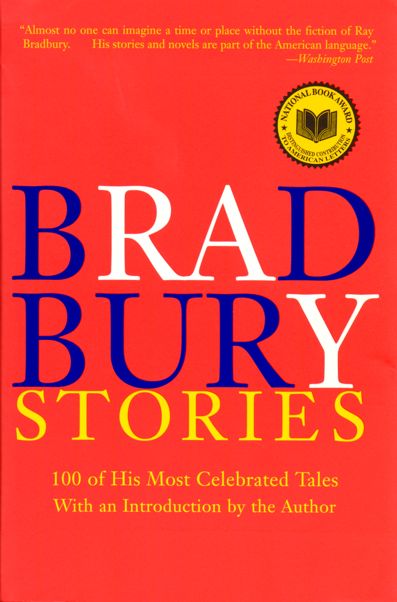
Every time I reread a Ray Bradbury story I tell myself I need to get into Ray Bradbury in a big way. I even bought three biographies of the man: Becoming Ray Bradbury and Ray Bradbury Unbound by Jonathan R. Eller, and The Ray Bradbury Chronicles by Sam Weller – but I haven’t read them yet. I also bought two giant collections of his stories for the Kindle: The Stories of Ray Bradbury and Bradbury Stories: 100 of His Most Celebrated Tales. And on audio, I bought The Martian Chronicles and The Illustrated Man, which I have listened to. I also bought Golden Apples of the Sun and Other Stories and A Medicine for Melancholy and Other Stories on audio which reprints much of what was in R is for Rocket and S is for Space.

The problem is I always go on to read other science fiction. Rereading “The Million Year Picnic” makes me want to delve into Bradbury once again, and read or reread all these books I’ve collected. Even though I’m retired and have all my time free, I can’t seem to find the time to pursue this project. I’m hoping the Facebook group reading of Bradbury will get me going.

If you’re a fan of listening to short stories, I recommend two giant collections of Ray Bradbury on audio that repackages four of Bradbury’s early collections. #1-32 is The Golden Apples of the Sun and Other Stories (1997), and #33-63 is A Medicine for Melancholy and Other Stories (1998). I wish Bradbury Stories: 100 of His Most Celebrated Stories (2003) were on audio, but it is not. (Table courtesy of Piet Nel.)

James Wallace Harris, 3/20/25