Humans have created artificial realities long before computers. I define artificial realities as cognitive models that claim to describe reality that have no basis in reality. In crude terms, it’s shit we make up, believe to be true, act like it’s real, but isn’t. I like Philip K. Dick’s definition of reality: “Reality is that which, when you stop believing in it, doesn’t go away.”
Science fiction has created a number of artificial realities we hope will become real. One desire is for a galactic civilization, or galactic empire. Often with artificial realities we try to make them real. For centuries traveling to the Moon was an artificial reality. Then it became real on July 20, 1969.
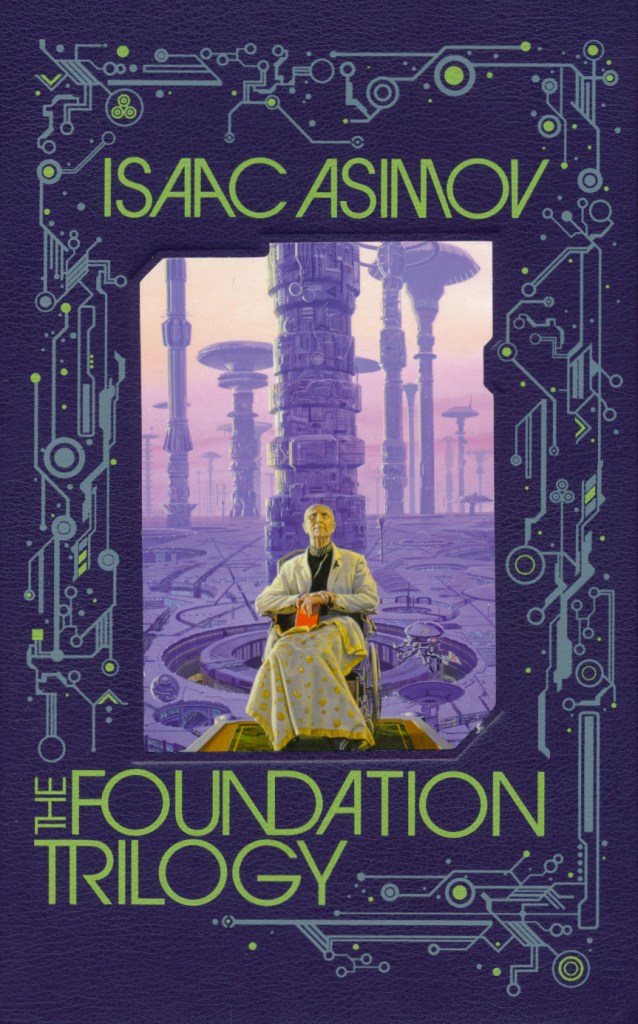
When I read “Foundation” by Isaac Asimov I wondered if he was ground zero for the idea of a galactic empire? I knew there was earlier science fiction stories that imagined the galaxy occupied by other intelligent beings. And there were stories about humans exploring the galaxy, and even having wars with other intelligent beings. But had any writer imagined humans colonizing the entire galaxy?
Today, that idea firmly exists as an artificial reality in our culture. Many people assume in the future humanity will spread across the Milky Way. It’s a kind of faith. We see it especially in Star Trek and Star Wars, but also in books like the Culture series by Iain Banks.
Like any artificial reality, I assume one person got the ball rolling. Was that Isaac Asimov? Like all the famous explorers looking for the source of the Nile, I wonder if I can find the source of galactic civilizations or galactic empires.
The oldest surviving artificial realities are myths and religions. Artificial realities start in one mind as ideas, and are spread as memes. Each person who spreads the memes mutates the artificial reality slightly. That’s why there were many forms of Christianity in the first century, and why they are so different from all the forms of Christianity in the twenty-first century. Reading books about the origins of Christianity or how the Old Testament came into being is a black hole of fascinating research.
In 2015 and 2025, I tried to reread The Foundation Trilogy. I’m embarrassed to admit this, but I just hated that much-loved science fiction classic. In both attempts, I couldn’t get past the first book. All I could focus on were its flaws.
That bothered me. Was I being unfair to the book? What was I missing that so many readers found in this story? When Paul Fraser came up with a great idea for a group read at the Best Science Fiction and Fantasy Short Fiction Facebook group, I decided to give the trilogy one more chance.
Paul suggests we read The Foundation Trilogy as it was originally published in Astounding Science-Fiction back in the 1940s. That gave me an idea. I would read the stories in the order they were published. I would seek to enjoy them as the fans originally did, as they were published one by one in Astounding Science-Fiction. Furthermore, I would try my damndest to get what Asimov was doing.
Wikipedia nicely lays out the publication history of the Foundation Trilogy in this table:
| Collections | Astounding Science Fiction | |||
|---|---|---|---|---|
| Published | Book title | Story retitle | Original title | Published |
| Original trilogy | ||||
| 1951 | Foundation | “The Psychohistorians” | — | |
| “The Encyclopedists” | “Foundation” | May 1942 | ||
| “The Mayors” | “Bridle and Saddle” | June 1942 | ||
| “The Merchant Princes” | “The Big and the Little” | August 1944 | ||
| “The Traders” | “The Wedge” | October 1944 | ||
| 1952 | Foundation and Empire | “The General” | “Dead Hand” | April 1945 |
| “The Mule” | “The Mule” | November 1945 December 1945 | ||
| 1953 | Second Foundation | “Part I: Search by the Mule” | “Now You See It…” | January 1948 |
| “Part II: Search by the Foundation” | “…And Now You Don’t” | November 1949 December 1949 January 1950 | ||
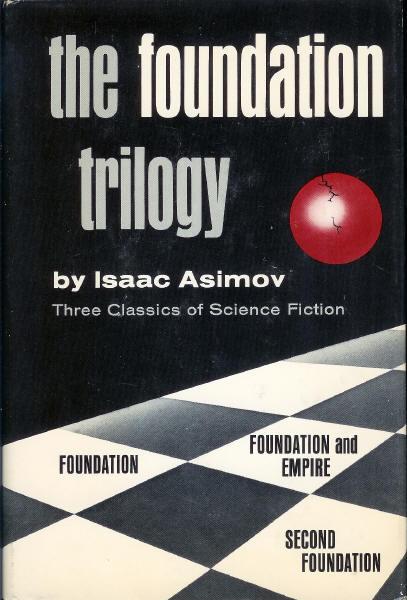
In the 1960s, I read The Foundation Trilogy when I bought the one-volume edition from the Science Fiction Book Club. At the time, I was unaware that many of the classic science fiction stories I was reading in book form were first published in magazines. Nor did I know about the concept of the fix-up novel. I didn’t question what I read. I just consumed it. (I recently wrote about this in “Reading at 13 vs. 73.”)
I can remember how thrilled I was by the first story, “The Psychohistorians,” which was set on the planet Trantor. And I liked all the pseudo-encyclopedia intros. The other stories didn’t stick with me. I remember the trilogy as an epic idea and visualized Trantor and Terminus existing in a galaxy with humans living on twenty-five million worlds.
In 2015, I reread Foundation, the first book in the trilogy. By then, I knew all about pulp magazines and fix-up novels. Foundation was obviously five separate, standalone stories. The first story was again impressive, the second was still interesting, but the rest were tedious. I was shocked that this famous book was so annoying to read. I gave it one star on Goodreads. I didn’t go on to reread the other two books.
Over the years, I’ve talked to so many science fiction fans who loved The Foundation Trilogy. It was the first series to be given a special Hugo Award. Recently, I watched a YouTube video about the Top 20 SF Series, and The Foundation series came in fourth. (Really, it was second after Dune. #1 were Star Wars books, and #2 were Star Trek books, and I don’t consider them a proper SF series. The host said that 20 million copies of The Foundation series have been sold.
So, why don’t I like it? And why did so many people love it? Was it because it first instilled the artificial reality of galactic civilization into their minds? This made me wonder if I could put myself in their shoes as they read the Foundation stories.
To get into the character of a 1940s science fiction fan, I intentionally skipped the first story in the book. I began my reading with “Foundation” from the May 1942 issue of Astounding Science-Fiction. I wanted to feel like I was living back in 1942, encountering the series for the first time. To see if Asimov rewrote the story for the hardback, I read the magazine with my eyes, but listened to the story with an audiobook edition.
In creative writing classes, we’re urged to start our stories in the middle of the action to avoid boring the reader with introductory material. This is exactly what Isaac Asimov did. However, when Asimov published Foundation as a book, he wrote an introductory story, “The Psychohistorians.” Out of the nine short stories, novelettes, and novellas in the Foundation Trilogy, “The Psychohistorians” was my favorite.
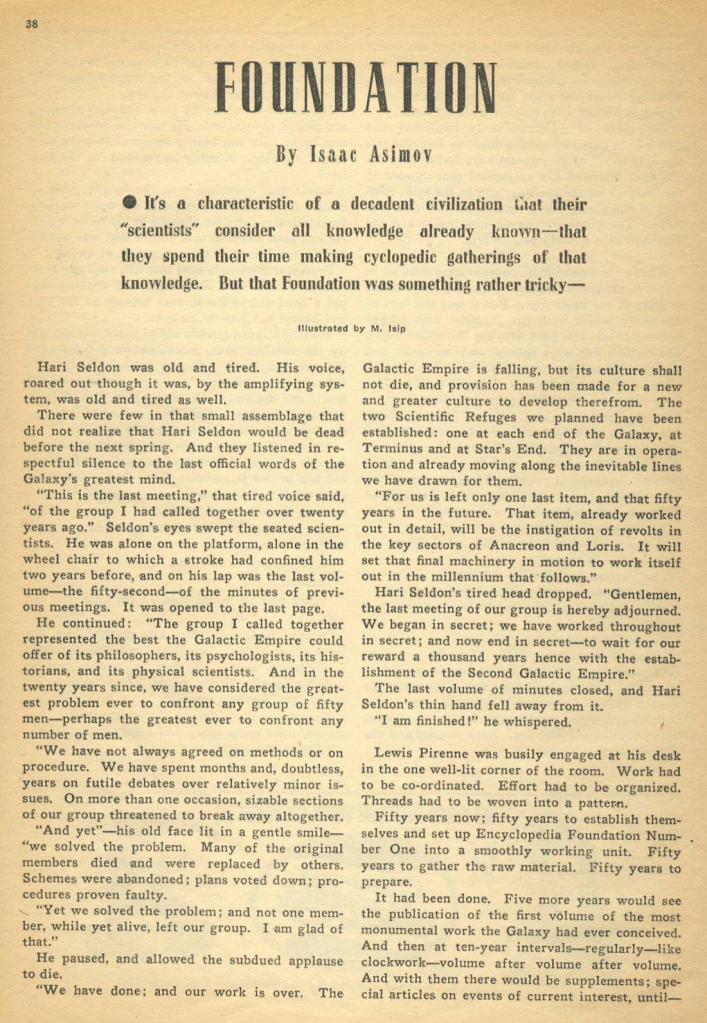
Asimov opened “Foundation” with this introduction on the first page. This is how we learn about Hari Seldon and his plan. This is how the series began in 1942, in just thirteen short paragraphs. We never see Trantor or meet Gaal Dornick. Our first real character is Salvor Hardin. In the book form, “The Psychohistorians” replaced this intro.
Most readers assume Asimov had just become a better writer by the time he wrote “The Psychohistorians” for the hardback. I’m not so sure. I feel I loved “The Psychohistorians” so much more because the Empire was more interesting than Terminus. Trantor is far more fascinating than any other setting in the trilogy. Asimov has claimed that the series was inspired by his discussions with John W. Campbell, Jr., and reading The History of the Decline and Fall of the Roman Empire by Edward Gibbon. But be honest, don’t most people love reading about Rome in its glory days?
As a young reader in the 1960s, I remember being blown away by the idea of a galactic civilization. But the stories of its fall didn’t make a lasting impression on me. I’m not sure, but I believe I read The Foundation Trilogy before seeing Star Trek in 1966. It might have been my first introduction to the idea of a galactic civilization. Was it to readers back in the 1940s?
To get into the spirit that I wanted to achieve, I need to forget all of this. I need to put myself back in 1942. I’d be reading the May issue of ASF just five months after the U.S. declared war on Germany and Japan. Let’s imagine I’m in the golden age of science fiction, and I’m 12 years old. How would “Foundation” WOW! me?
If you read Hari Seldon’s speech above, we don’t get what the empire is like. We only learn that it’s collapsing. The only empire I might have known about at that age in 1942 was the British Empire, due to watching Gunga Din. I doubt I would know anything about Rome.
I guess that I, and other readers, would have gotten a strong sense of wonder rush thinking about the galaxy being populated by humans. But was that a new idea? Is there any way to find out? I thought I’d poke around and see.
From A Requiem for Astounding by Alva Rogers:
With this issue, Isaac Asimov launched his monumental “Foundation” series with the appearance of the initial novelette of the series, “Foundation.” After tens of thousands of years the Galactic Empire had spread to millions of worlds throughout the galaxy, its power all but absolute, its influence all pervading. The Empire, however, was on the brink of collapse and, with the impending collapse, the universe could be expected to be plunged into at least thirty thousand years of anarchism and barbarism. Hari Seldon, through the application of psychohistory which enables him to predict the future course of history by the interpretation of statistical laws as derived from the inconceivable mass of humanity, foresees this imminent fate of civilization and takes measures to insure the survival of civilization and knowledge through the long dark ages ahead and, if possible, shorten the period of barbarism. He does this by establishing two Foundations at opposite ends of the galaxy: the First Foundation of the Encyclopedists at Terminus, a small system on the edge of the galaxy, the Second Foundation — hidden even from the First — at “Star’s End,” at the “other end of the galaxy.” “Foundation” introduced the basic elements of the plot of the series and recounted the successful resolution of the first of the critical crises predicted by Seldon which the Foundation must surmount in order to carry on the Seldon Plan.
Rogers’ book remembered Astounding issue-by-issue. I had hoped his entry for “Foundation” would have given me his initial reaction, but I feel this quote is heavily influenced by reading the trilogy.
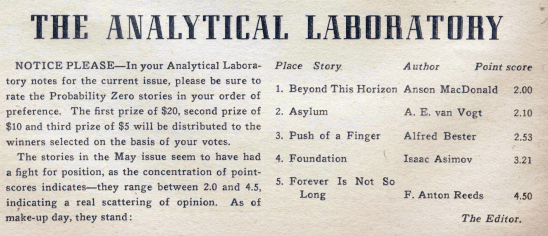
Next, I found the July issue to see how “Foundation” did in The Analytical Laboratory feature, where readers vote for their favorite stories. Evidently, “Foundation” didn’t make much of an impression, since it came in a distant fourth. Nor did it get mentioned in a letter to the Brass Tacks second.
I thought about looking through fanzines at Fanac.org, but I fear what I want might be looking for a needle in a haystack.
My next stop was The World Beyond the Hill by Alexei and Cory Panshin, my favorite book about Astounding during the Golden Age of Science Fiction. It can be checked out from the Archive.org, or ordered from Amazon for the Kindle for $9.99.
“Chapter 17 – An Empire of Mind” covers how Asimov developed the Foundation series on pages 520-566. If I had read this chapter before rereading “Foundation,” I would have approached the story with far more enthusiasm. Alexei and Cory Panshin describe Asimov’s inspiration and writing process for starting the series. I have read The World Beyond the Hill twice, but I didn’t remember any of this. I especially didn’t remember how Asimov was influenced by “After World’s End,” a short novel by Jack Williamson, which he read in the February 1939 issue of Marvel Science Stories. It also influenced Asimov’s take on robots.
The Panshins got most of details about Asimov working with John W. Campbell from Aismov’s biography, In Memory Yet Green. That book can be checked out from Archive.org.
The Panshins cited “After World’s End” and others as proto-stars that would evolve into galactic empire science fiction.
I wish I could reprint the 46 pages from this book because it describes in great detail how Asimov got the idea for a galactic empire. The Panshins showed that Asimov had already started on the idea in earlier stories.
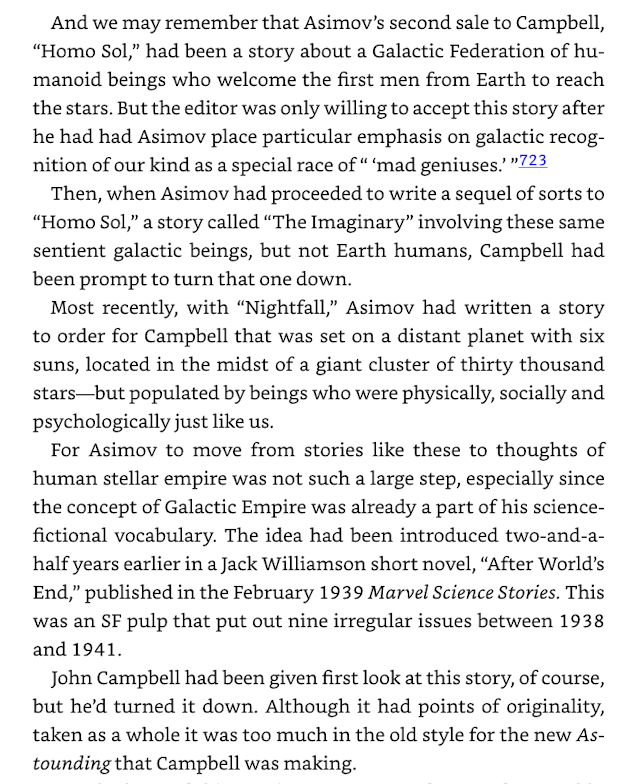
Panshins have this to say, despite the fact that we know E. E. “Doc” Smith, Edmond Hamilton, and John W. Campbell had been publishing stories about humans speeding around the galaxy since the 1920s.
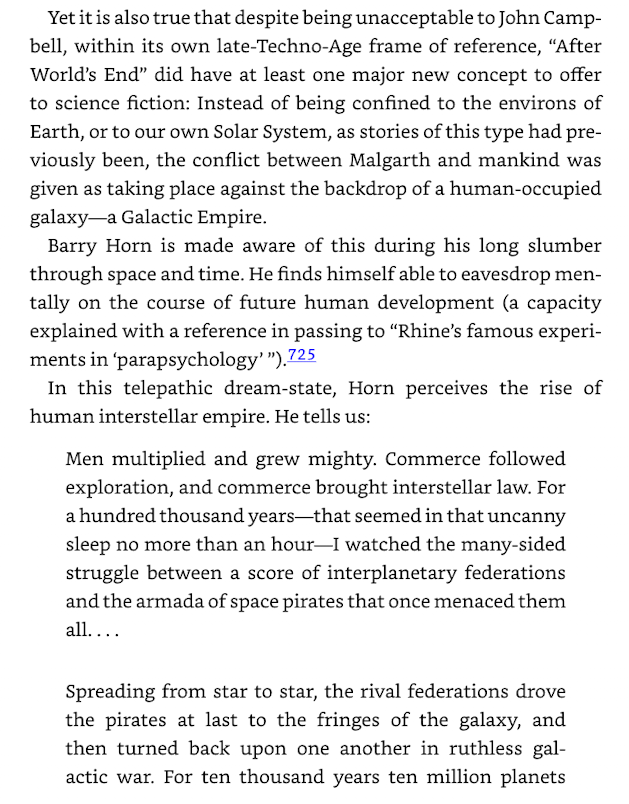
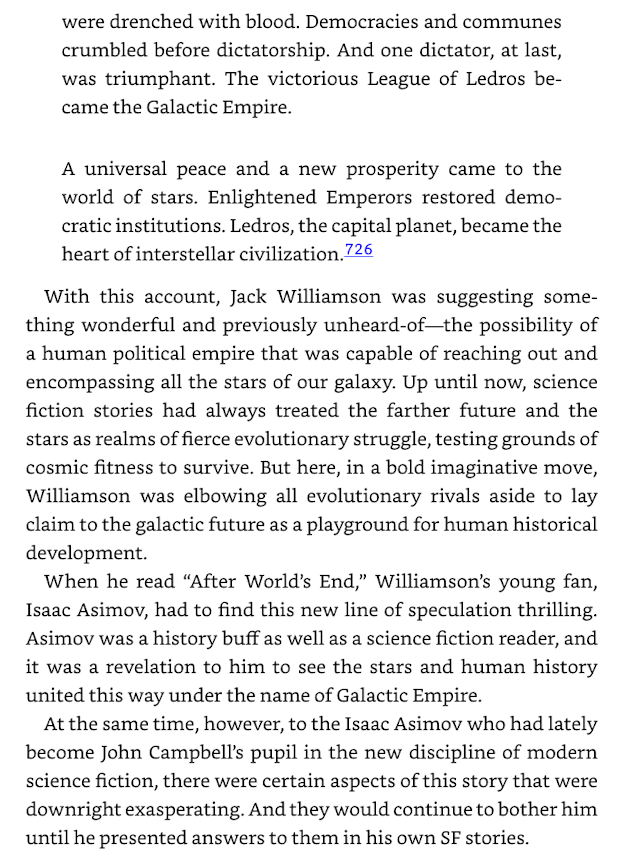
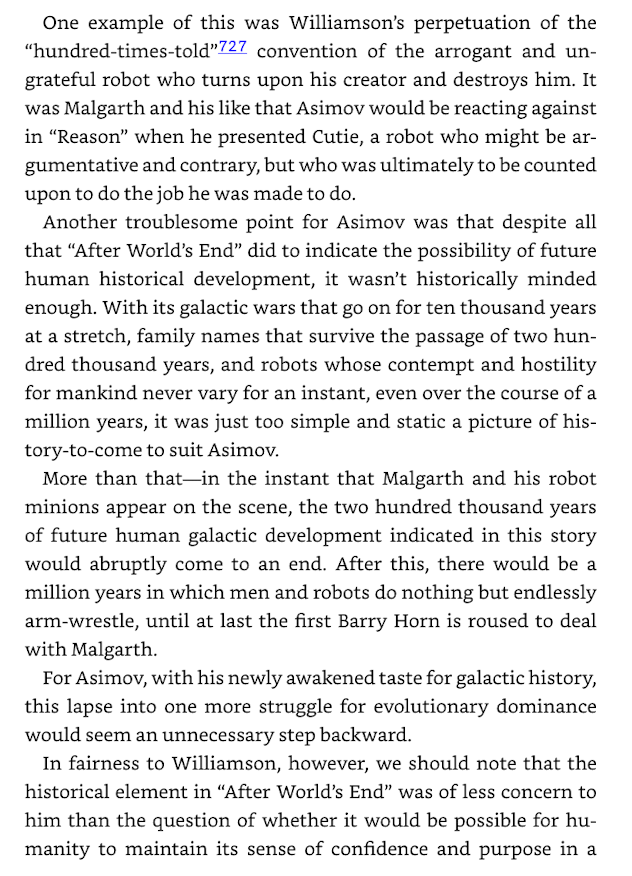
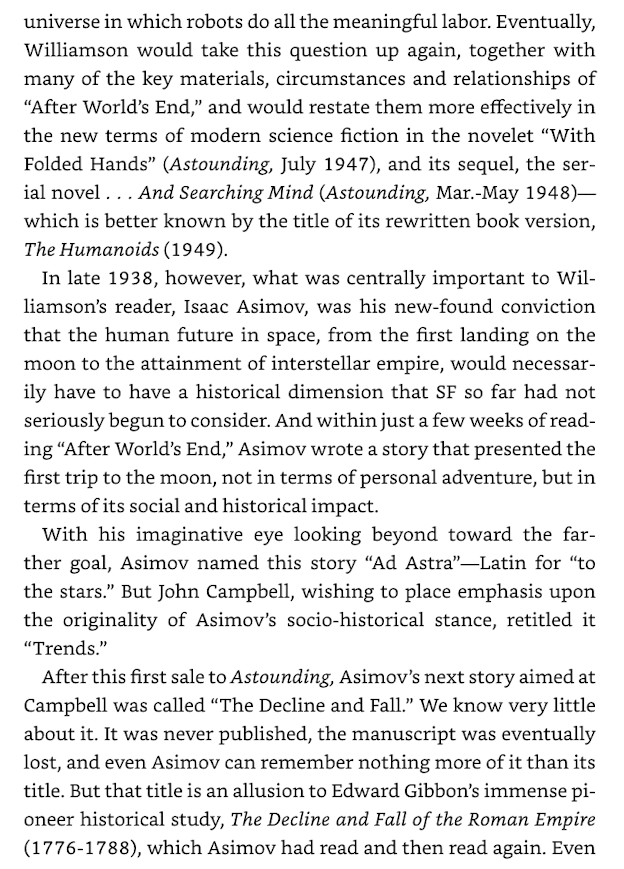
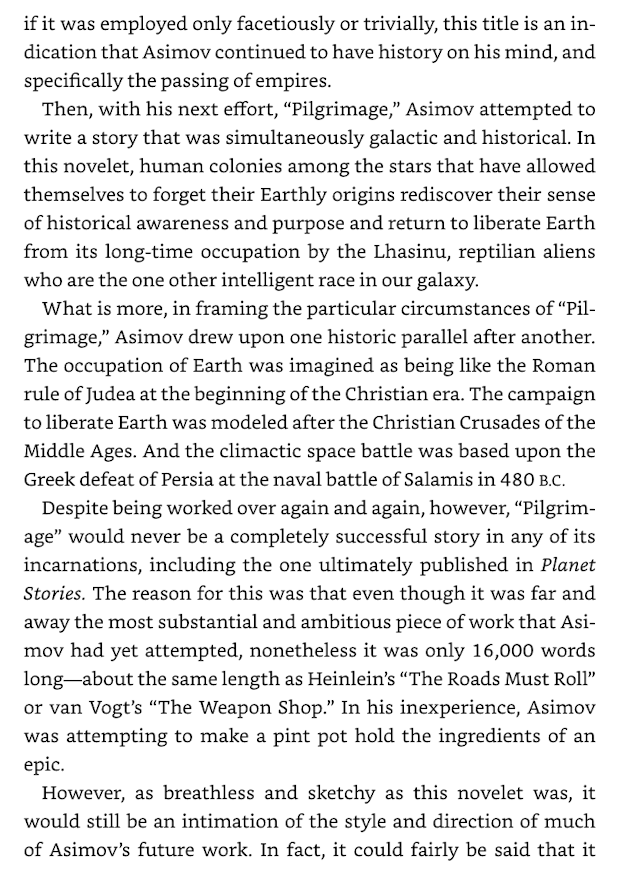
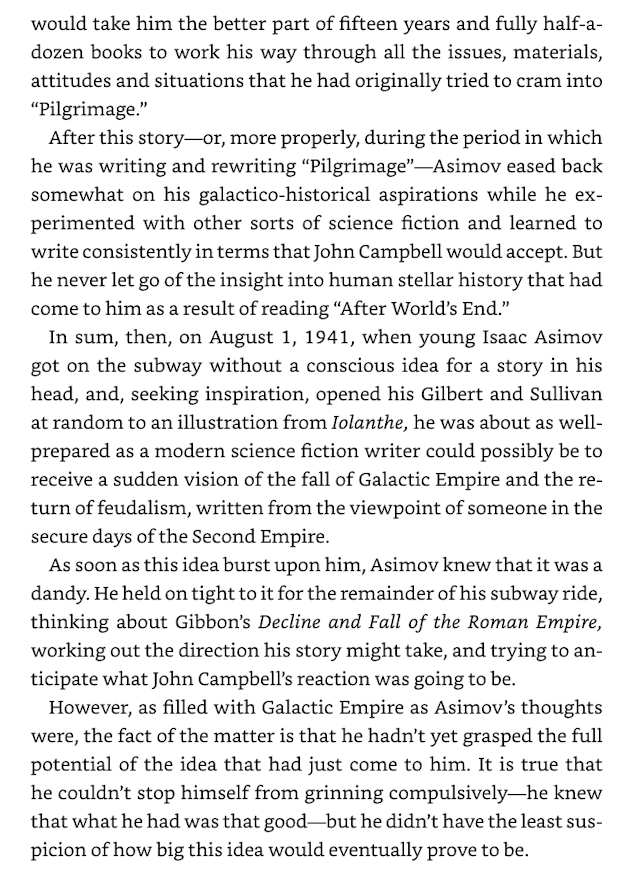
I would love to copy more of the Panshin’s book, but I don’t know if that’s proper. I highly recommend The World Beyond the Hill to anyone interested in learning about the evolution of science fiction in the 1940s.
I haven’t read Gibbon’s six-volume history, but reading the Wikipedia entry, it’s considered lacking in accuracy, and scholars disagree with his thesis that Christianity is to blame for Rome’s decline. The Panshins explores how Asimov’s used religion in the series. They felt Asimov saw it as a positive tool, while Heinlein saw it as a manipulative tool in his stories at the time.
The Panshins go into great detail Asimov’s collaboration with Campbell and how the first two Foundation stories were written, edited and published. Both were finished and sold to Campbell before December 1945. The Panshins then go on to deeply analyze “Foundation” and “Bridle and Saddle.”
I admire this chapter immensely. This is the kind of writing about science fiction history that I’ve always fantasized of achieving myself. I can’t come close. This chapter does give one excellent account of the origins of the idea of galactic empire. However, is it correct? Is it the only one. Many explorers thought they found the source of the Nile only to be proved wrong.
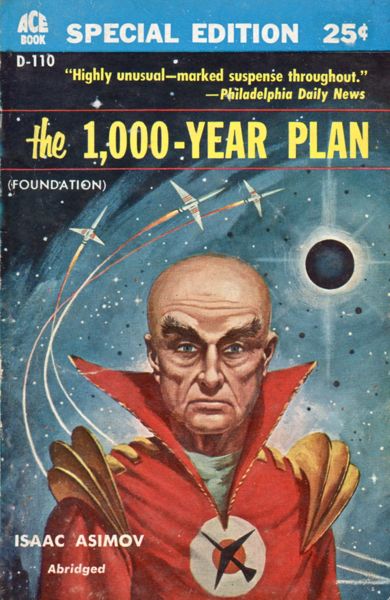
While reading the five stories that make up Foundation, I didn’t find much serious speculation about how a galactic empire would collapse. All of Asimov’s speculations seem rather superficial to me. It’s such a wonderful idea that I’m always disappointed when the individual stories in the first volume don’t live up to the grand vision.
If I studied the series and analyzed it as deeply as the Panshins, I probably would see far more than I have. I know I’m not being fair to the series. I fear my dislike of Asimov’s prose keeps me from enjoying his ideas. The Panshins found many layers of ideas to explore that I missed. I’m sure a scholarly work the size of the trilogy could be written on the Foundation series.
I believe America is beginning its decline. Predicting the future is impossible. We can’t even foretell one year, much less a thousand. But let’s say you’re a science fiction writer and want to set a story one hundred years in our future. How would you set up your story to convey a big picture of how the United States will change? Having a series of short stories is one possible solution.
Each time I read Foundation, I’ve been disappointed that it has no continuing characters. Let me provide an example to make a point. My wife loves TV shows, but I also want to watch movies. Switching between the two formats, I must admit that TV shows, with continuing characters, are far more addictive than movies. Not having characters that last the entire book hurts Foundation. That’s why the miniseries changed the story so drastically.
In 1968, John Brunner published Stand on Zanzibar, envisioning the world of 2010. This was far less ambitious than Asimov. The Foundation series attempts to portray a thousand years of a galactic empire featuring twenty-five million inhabited worlds. I never felt the immensity of such a setting while reading Asimov’s classic. However, Brunner’s technique of combining a novel with continuing characters, interspersed with short stories about people around the world, with samples from newspapers, television shows, radio broadcasts, and journals, and the regular commentary of a shock jock, does give us a complex picture of 2010.
For me, and I mean just me, because I know this series is so beloved, Asimov promised us a trip to Mars but took us on a suborbital flight. The original trilogy never delivers what it promises.
“Foundation” – Astounding (May 1942)
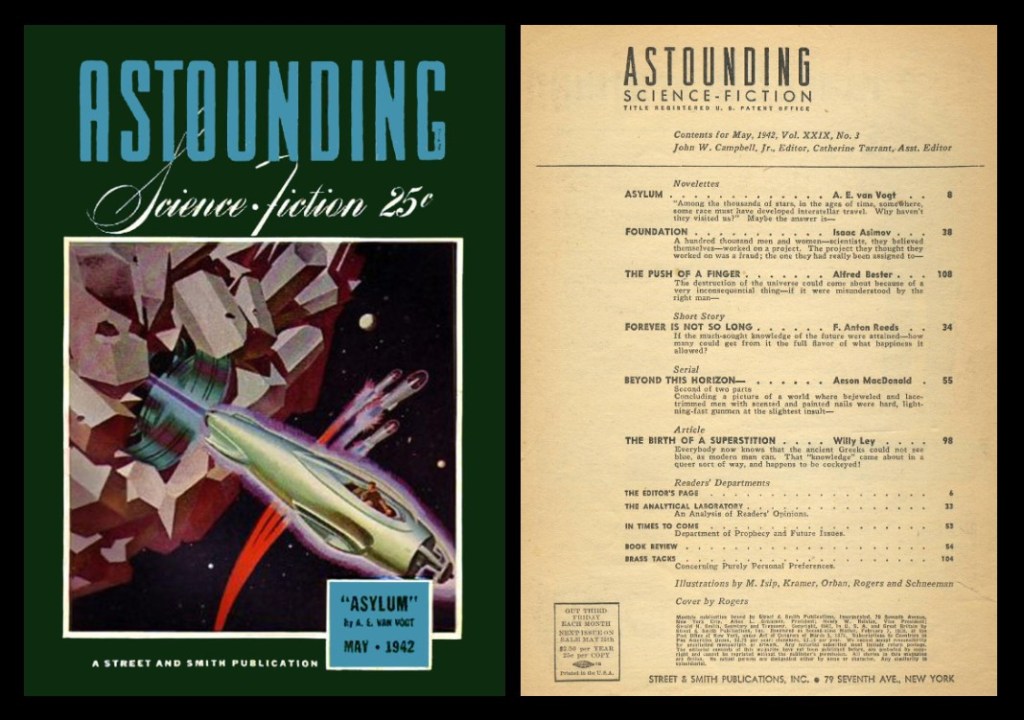
“Foundation,” the story that readers first learned about the Foundation series, didn’t get the cover. Evidently, John W. Campbell, Jr. wasn’t impressed enough. Readers preferred Heinlein, van Vogt, and Bester over Asimov’s story in the July readers’ poll. Not an auspicious beginning. Yet, the series is still admired today, and is even the basis of a television miniseries. And I believe the Foundation stories must have influenced the creation of Star Wars.
For some reason many people love the idea of the galaxy populated by humans. I see that as a growing artificial reality that will continue to build. Whether we make it reality is a whole other issue. I tend to doubt it. I think a future reality with humanity spread across the galaxy is no more real than the past artificial realities of the history of religions.
Note:
Normally, I try to keep my blog posts to 500-1,000 words. Even that is uncommonly long for most blog posts. That’s because internet readers don’t like to spend a lot of time reading any one piece. The internet is a browsing medium.
This piece kept going and going. I finally just had to quit. I feel I could write an entire book just on searching for the origins of specific science fiction concepts. I could have also written a whole book just on the Foundation Trilogy.
I’m old and I have trouble focusing my mind. I also lack the energy to keep working at any one task for long. I’d love to be able to write a book like The World Beyond the Hill but that is impossible at 73. More than likely, I never had the brain power to write such a book at any age. I need to learn how to convey a major insight in a few words.
James Wallace Harris, 10/27/25


 Classics of Science Fiction