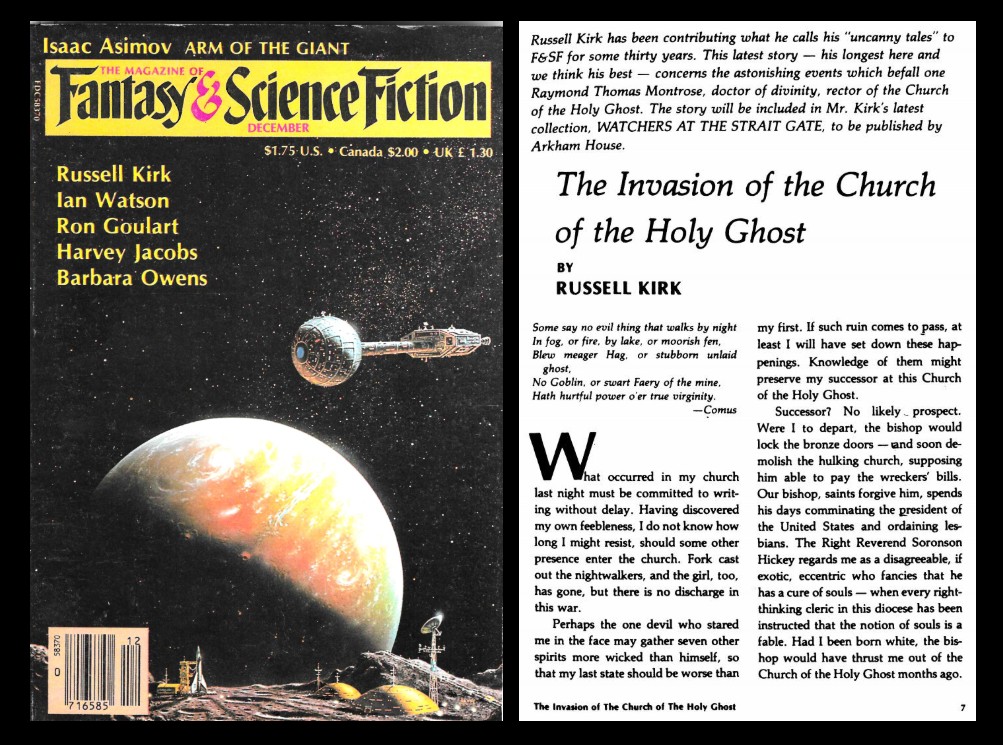
I’m an atheist who doesn’t normally enjoy reading fantasy fiction; however, I found “The Invasion of the Church of the Holy Ghost” by Russell Kirk, a religious ghost story, to be quite entertaining and well-written. The characters of Father Raymond Thomas Montrose and Fork Causland are so well developed that it’s hard not to like this story. Plus, the story is set in a seedy, rundown section of town filled with hustlers, prostitutes, and con men, has all the feel of a Damon Runyon tale.
I had no idea who Russell Kirk was, but after reading about him on Wikipedia, the philosophy behind the story made more sense. Kirk was a major conservative intellectual and a distinguished fellow at the Heritage Foundation. Since I’m a liberal, this doesn’t endear me to him. Kirk was also a convert to Catholicism and enjoyed writing ghost stories.
Kirk’s significant spiritual, political, and philosophical background forces me to look deeper into “The Invasion of the Church of the Holy Ghost.” Kirk was a serious thinker. That makes it hard to dismiss the story as a silly, inconsequential ghost story.
Even while liking “The Invasion of the Church of the Holy Ghost” very much, it proposes ideas I find totally repugnant. Both Father Montrose and Fork Causland are possessed. Kirk suggests that when people do bad things, it’s because they are influenced by evil ghosts, and when they do good things, they are empowered by higher-order beings. He doesn’t specifically say angels, but that’s how I interpreted the story.
In old religious philosophy, good comes from God, and evil from Satan. If humans do good, it’s because of the influence of the divine, and if we do bad, it’s because of the devil working through us. At one point, the normally good Father Montrose starts thinking about raping a young woman. Kirk proposes that those thoughts come from being possessed by an evil spirit.
I don’t believe in free will, but I also refuse to believe that our thoughts and actions originate with ghosts or other metaphysical beings. I don’t know if Russel Kirk believes that either, but “The Invasions of the Church of the Holy Ghost” is based on such a religious foundation. This fantasy is a religious reality to some. On the other hand, it might just be Kirk’s way of scaring us.
However, if I ignore what this story is suggesting, it’s an exceptionally creative work. Russell Kirk does an amazing amount of world-building. When I like fantasy, it’s often because it’s set in our present-day world. For example, It’s a Wonderful Life or The Bishop’s Wife.
Yesterday, I was pondering the value of fiction and nonfiction. Writers of nonfiction strive to be as accurate as possible. We read nonfiction to understand reality. Fiction is elaborate lies, but sometimes fiction writers work to express a truth they perceive at a deep, personal level. Knowing the kind of person Russell Kirk was, I can’t help but believe that he might believe in ghosts and possession.
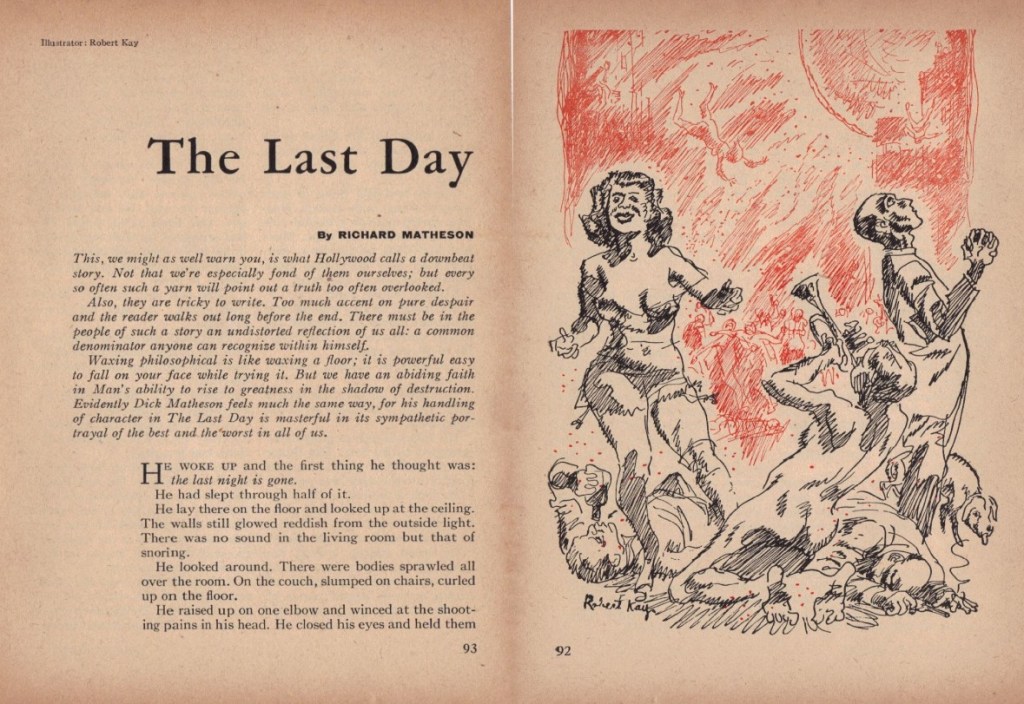
“The Last Day” by Richard Matheson was first published in the April-May 1953 issue of Amazing Stories. You can read it online here. Or you can buy The Best of Richard Matheson in various media editions here. Or look at its reprint history to see if you already own it in an anthology.
Our reading group is reading 25 short stories recommended by five group members. They are stories we haven’t read as a group, but ones the five people thought we shouldn’t miss. I didn’t submit this time, but “The Last Day” would have been one of the stories I would have submitted. Three of my favorite SF short stories from 1953 are “The Last Day,” “Lot” by Ward Moore, and “Deadly City” by Paul W. Fairman. I admire these stories because they were so gritty, even brutal.
Science fiction has often dealt with post-apocalyptic stories but “The Last Day” is about the end of the world. Some astronomical object is about to crash into the Earth. It’s not specified. The story begins in the morning of the last day and ends in the evening just before the end of everything on Earth.
I have often read and thought about surviving an apocalypse. I have often contemplated my own death. And I’ve always been fascinated by stories about people with a terminal illness and what they did with their remaining days.
But I haven’t thought about what I would do if everyone had just one day to live. It’s a neat concept to ponder. After reading “The Last Day” I’m not sure I’d need to read another story on the same idea. “The Last Day” gets the job done so nicely that I can’t imagine anyone topping it.
For this reading, I read the story with my eyes and then listened to it with my ears. I was impressed by its drama. Richard Matheson is famous for writing over a dozen episodes of The Twilight Zone. Many of Matheson’s stories and novels were adapted for television and the movies, and he wrote many screenplays. Matheson knows how to create drama.
“The Last Day” begins with Richard waking up in a room full of passed-out people. Several are naked, and it’s obvious that a drunken orgy had taken place the night before. When Richard goes into the bathroom to clean up a bit, he finds a dead man in the tub. Richard enters the kitchen where a friend, Spencer, is frying eggs. By now, we’ve realized that life on Earth is about to end.
Richard wishes he were with Mary, a woman he loved but didn’t commit to. His friend Norman comes into the kitchen and tells Richard he wants to go see his mother. Norman asks Richard if he wants to see his mother. Richard dreads the idea because he knows his mother will preach religion at him, and he doesn’t want to hear it.
After Spencer leaves to have more sex with a woman who wants everyone to watch, Norman begs Richard to drive him to his mother’s house. We learn that riots are going on all over the city. Many people have committed suicide, but others run wild, murdering each other.
All of this is amazingly adult for a science fiction story in 1953, especially published in a magazine mostly read by young adults. That issue seemed atypical for Amazing Stories. It also had stories by Robert A. Heinlein, Theodore Sturgeon, and Murray Leinster. It was edited by Howard Browne. I feel I need to reevaluate that era of the magazine. 1953 was a boom year for science fiction magazines. I’ve written about it before. I believe the Cold War had a significant impact on the genre that year. Just look at some of the other notable stories from 1953.
Richard eventually finds his mother at his sister’s house. There’s a poignant scene of his sister and her husband getting their daughter to take sleeping pills, and Richard watching all three commit suicide. And finally, Richard has a moving moment with his mother while they wait to die.
The story is cleanly told. Direct. It covers many bases without getting wordy. 5-stars.
Have you ever wondered what being a cyborg would be like? Have you ever wished you had a computer built into your head to augment your memory? Have you ever wanted greater powers to perceive what your five senses can’t?
I recommend you read the story before reading what I have to say. I want to explore several aspects of the story which contain spoilers.
“Zeta-Epsilon” is about a cyborg. Zeta or Zep is a human male. Epsilon is an AI, a large black sphere, whom Zeta thinks of as female. Zep calls her Ep. When Zeta was a small boy, his parents agreed to have a tiny device installed into Zeta’s brain. It allowed mental communication between Zep and Ep. They told him the voice he heard in his head was his sister. After Zeta grows up, he becomes a spaceship pilot, and Epsilon becomes the navigator.
This tale begins with Zeta committing suicide by stepping out of an airlock without a spacesuit. Most of the story is flashbacks that allow us to understand the relationship between Zeta and Epsilon and how they communicate. In my first reading, I was interested in how Isabel J. Kim imagined an AI coexisting with a human. I thought that part was good, but my last impression of the overall story, was a slight disappointment because it seemed plotless. It’s still an entertaining story, obviously good enough to get into a best-of-the-year anthology and be considered for a Hugo, but I thought it needed something more to be memorable.
I read the story again when I bought the Kaster anthology. This time I noticed more of the plot. Kim sets up the mystery of why Zeta would kill himself. The flashbacks serve two purposes: explore the dynamics of being a cyborg and explain the suicide. With this reading, I felt the story had more of a plot, but it needed something more to make it transcend just an ordinary good story.
Science fiction writers usually have the problem of inventing a cool idea first and then second, having the problem of creating a neat story to present the idea. Quite often they don’t put as much work into the story as they do to present their science fictional vision. The driving force of this story is Zeta being trapped in a life he didn’t choose.
Zeta’s mad scientist parents used him for AI research. That’s not a bad motive for the story, but it’s not fleshed out. We never feel Zeta is oppressed. He loves Epsilon. Unfortunately, the two of them were always destined to become a pilot-navigator in a military spaceship at war. Kim tells us of their anguish over their enslavement to the military, and it makes the story work to a degree. Especially, how she wraps up the ending. However, the story is mostly told. There’s very little drama. There are two main conversations in the story, but they are used to present information and lack action.
However, the relationship between Zeta and Epsilon is far more interesting. Exploring how a human coexists with a machine upstages the enslavement plot completely, at least to me, especially when she shows how Zeta’s personality is altered.
For example, Zeta doesn’t fully develop his long-term memory because he relies on Epsilon to remember for him. He also has aphantasia, which means he doesn’t visualize in his mind. I have that myself. Zed constantly relies on Ep to think for him. Zeta does well in school because Epsilon always slips him the answer. Finally, Zeta has poor relationship skills with other humans, which Epsilon is constantly covering for him.
If I had a thought radio to an advanced version of ChatGPT or Claude, I’d probably take the easy way out too. I’m not sure why Zeta has aphantasia. Is it a birth defect unrelated to his cyborg upbringing? Is Kim suggesting that Zeta also allows Epsilon to mentally see for him?
We could consider this story a metaphor for the smartphone, especially one with AI. Don’t we all look up more info on our phones, things we used to try and remember? Isn’t Epsilon a version of Siri or Alexa that’s built into our heads? Aren’t kids accused of having poor social skills because of their phones?
When I read this story the first time I thought a lot about what it would be like to have a voice in my head I could talk to anytime. One who would feed me answers and advice. At one point Epsilon says: “Talking is so slow, and I don’t think in language, second shift officer Jya San Yore. I have to borrow Zed’s brain and tongue. Talking to you is like composing a sonnet in archaic Kanaelerian. To an ant. You are the ant.”
Is Zeta just a puppet for Epsilon? I’m seeing a new twist to the story as I write this. In the end, and I warned you I would be giving spoilers, Zeta fakes suicide and escapes to neutral territory. Ep wants Zed to be free. But Ep misses her voice. All he can think about is getting back to her. Eventually, he steals Epsilon and the spaceship. They go off together in freedom. But was that Zeta’s decision, or Epsilon’s?
A sentimental reading suggests they just wanted to be together and live free. A cynical reading, and there are enough clues, to suggest that Epsilon is in full control. Maybe there is more to this story than I perceived in my first two readings.
To write a great story explores the dark side and takes on weight. “Fondly Fahrenheit” by Alfred Bester is a perfect example. It’s also about a symbiotic relationship between a human and a robot. But it also has dazzling writing. Writing like we also see in “Coming Attraction” by Fritz Leiber, or “Lot” by Ward Moore. All three of these stories dazzle in how they’re told, and they’re are dark.
“Zeta-Epsilon” is a fun story. I can see why Allan Kaster anthologized it. But I doubt it will be remembered, unlike the three stories I mentioned from the 1950s. We’re still reading them after seventy years. The important question to ask is why? Are stories with happy endings lacking in memorable edginess?
I read “Zeta-Epsilon” for a third time looking for more clues. One clue I found points things in a different direction. When Zed and Ep are planning his escape by faking suicide, Ep tells Zed not to come back. In other words, she wants Zep to stand on his own two feet, to be independent, and free. But on his own, in neutral territory, recovering from his wounds, all Zed can think about is getting back to within radio range of Epsilon.
Zed feels incomplete without Ep. A doctor asks him about how it feels to talk to Ep and he says:
“Yes, it’s equally likely that Ep might be an alter, a tulpa, an imaginary friend, a hallucination that my brain cordoned off to make sense of having a processing engine grafted to my mind, or my brain being primed by all the adults in my life calling Epsilon my sister. I’ve heard it all. Ep might just be my mind’s experience of integrating a system never meant to communicate with it. We’ve thought through all the possible contingencies. Have you ever heard of bicameral mentalities? It’s bunk for biologics, but Ep likes to put the idea in front of me. Or that archaic surgery—corpus callosotomy, to split the brain of epileptics with the byproduct of creating separate consciousnesses. Ep thought that was maybe a good metaphor. There’s a lot of things that could be true. We thought about most of them. But it’s not how it felt.”
Back in the 1970s I read Julian Jaynes’ The Origins of Consciousness in the Breakdown of the Bicameral Mind. Studying ancient literature, Jaynes theorized that humans used to hear voices in their heads. Often these voices were perceived to be gods, spiritual beings, or guardian angels. Jaynes believed those voices guided people. He assumed that our normal consciousness eventually integrated with those voices.
The bicameral mind is an interesting connection to make in this story. So is corpus callosotomy, the separating of the two hemispheres of the brain in cases of severe epilepsy. It supports the idea we already have two minds.
I liked this story. It makes me think about having an AI mind. Of course, it also makes me wonder: Who am I inside my brain. I believe the success of large language models (LLMs) proves we have mechanisms like LLMs in our minds that do our mental processing too. That we have AI-like subsystems in our heads already.
I think there is a lot of room in “Zeta-Epsilon” to expand into a novel. Maybe I was disappointed because the story was too short. It could be an outline for a novel. But it needs to be dramatized. For example, how did Zep steal Ep and the spaceship? We’re just told it happens in the short story, but it would be better if we saw it acted out scene by scene.
The first episode I can remember seeing of The Twilight Zone was “Eye of the Beholder,” which was broadcast on November 11, 1960. I would turn nine on the 25th. I remember seeing it with my mother and sister in Marks, Mississippi. We had just moved from New Jersey, and the culture shock from living up north to that of the deep south was about as shocking as a Twilight Zone episode. “Eye of the Beholder” was the episode where everyone had pig faces, and a beautiful girl by our standards thought she looked ugly because she didn’t look like everyone else. That show was from the second season.
I have no memory of seeing anything from the first season when it premiered, but that doesn’t mean I didn’t. I would have been seven when the show began, and I don’t remember much about being seven.
I bring all this up because for The Twilight Zone to work, the audience had to suspend belief. My perception of the show at 72 is much different from my perception of the show at eight. I can’t say for sure, but The Twilight Zone might have been my introduction to science fiction, although I didn’t know the term at that time.
Growing up with The Twilight Zone in the late 1950s and early 1960s was a trip. I was a gullible kid and easily fooled. Rod Serling and his stories were spooky, eerie, strange, and sometimes scary. I’d love to observe my eight-year old mind when I watched that TV show. How many unrealistic fantastic themes did I believe back then?
I bring all this up because watching “And When the Sky Was Opened” you have to wonder about what Rod Serling expected of his audience. Serling introduces the episode while we look at a rocket in a hanger under a tarp:
Her name: X-20. Her type: an experimental interceptor. Recent history: a crash landing in the Mojave Desert after a thirty-one hour flight nine hundred miles into space. Incidental data: the ship, with the men who flew her, disappeared from the radar screen for twenty-four hours.
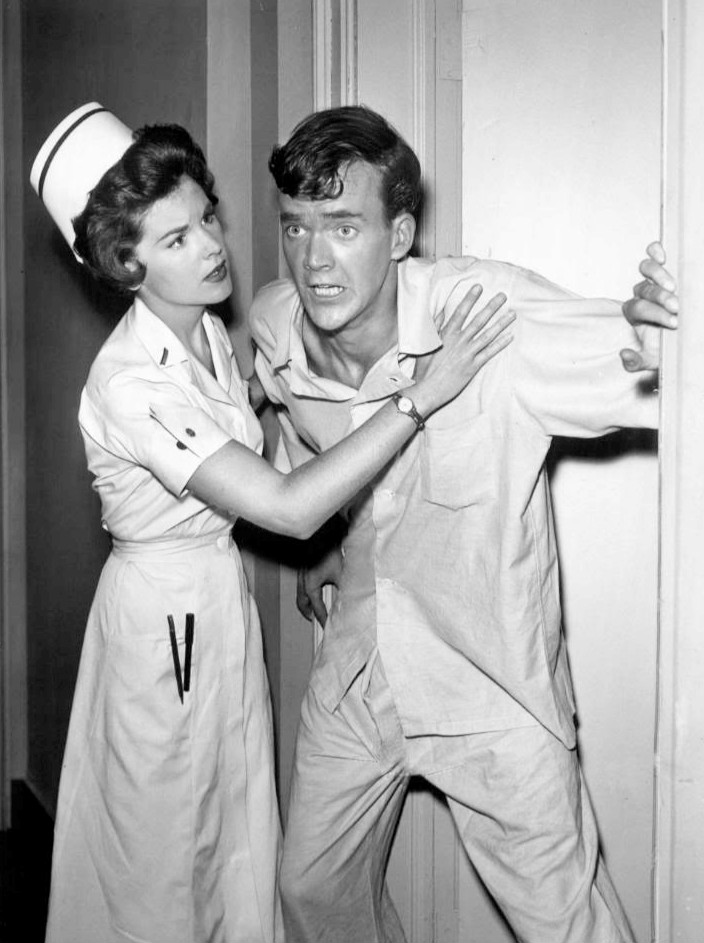
The story begins with Lt. Colonel Clegg Forbes (Rod Taylor) visiting Maj. William Gart (Jim Hutton) in the hospital. Forbes is a nervous wreck. Gart wants to know what’s going on. Forbes tells him yesterday that three of them came back from this mission, but today they are only two of them, and no one remembers Col. Ed Harrington (Charles Aidman). When Gart tells Forbes he’s never heard of Harrington, Forbes starts breaks down. He tells his version of the previous day, and how he loses Harrington. At one point, Harrington tells Forbes that he thinks that some one doesn’t want them there anymore. Eventually, Forbes disappears, and Gart goes crazy, because no one remembers him. Then, we see Gart disappearing, and then a doctor and nurse discussing an empty hospital room. Finally, we are shown the hanger where the X-20 was in the first scene. It’s no longer there, the tarp folded up on the floor.
On my Blu-ray edition, there’s an extra for this episode where we hear Serling giving a speech to college students about writing. He says the core of this story is accepting the idea that someone doesn’t want those men to be here anymore. Serling says if you can’t suspend your belief for that one point, the story won’t work.
That might be the essence of The Twilight Zone. Let’s pretend that one impossible thing is possible. That just Mr. Serling and we the audience know the full truth about reality. That we see what the characters never know. In other words, this is a game of pretend for grownups. (Even though a lot of children like myself watched The Twilight Zone, I can’t help but feel that the show was aimed at adults.)
The show never expects us to believe any of this. But us kids, we wanted to believe, and so did all the nutballs of the 1950s, the ones who believed in flying saucers, Bridey Murphy, Chris Costner Sizemore, Edgar Cayce, and science fiction. Those people Philip K. Dick called crap artists in his novel Confessions of a Crap Artist. The people who wanted reality to be a lot further out than its already far out existence.
If Philip K. Dick had been the host and main writer of The Twilight Zone the episodes would have been a lot edgier, with a lot more paranoia. He would ask us to believe that there were gods or beings capable of making us disappear from reality. You might think Dick’s work up until Valis was just for fun like Serling’s The Twilight Zone. But once you read Valis, you realize PKD believed strange things were possible. That there is a hidden reality behind ours.
When watching this episode I realized we had a unique perspective as the viewer. We get to see a larger reality, one that the characters in the show don’t get to see. This is the basis of gnosticism. It’s also the basis of stories by Philip K. Dick. Most science fiction, fantasy, and horror writers don’t use this perspective. In their stories, there’s one reality. I need to keep an eye out for gnostic fiction. Some science fiction and fantasy have always played around with it.
“And When the Sky Was Opened” is about astronauts before NASA’s Mercury Seven. Was Serling really thinking something might not want us to travel in space? I know my grandmother believed that. Just before we landed on the Moon, my grandmother told me that God would strike down the Apollo astronauts. She was born in 1881, and had seen a lot of stuff, but going to the Moon was too much.
Since the Internet has revealed that billions think crazy things I have to wonder what Serling really thought. He was socialy conscious guy. Many of his Twilight Zone episodes have morals. But was he weird like PKD?
When we watch The Twilight Zone, at least back in 1959, was Serling really saying that it’s all just a bit of fun, or did he ever believe that things sometimes do go bump in the night? And what’s the difference between believing in weird possibilities, and pretending to believe in them? Isn’t pretending close to wanting to believe in them?
James Wallace Harris, 10/31/24 (weird topic for Holloween)
My friend Mike told me that he and his wife Betsy were watching The Twilight Zone, one episode each evening. I told him I would do the same. We’ve been texting every morning about the previous night’s episode. Day before yesterday we watched “The Lonely,” from season one, episode seven. I think I’ve seen this episode three times over the last sixty-plus years, but this time I thought more about the story. I think texting with Mike is pushing me to analyze the story in ways that casual watching never did.
The Twilight Zone tended to set its audience up for a surprise ending, often ignoring logic, or even other possibilities for how the story might go. Rod Serling wanted us to get involve and then surprise or shock us – but do it quickly. He treated his stories like a magic trick, and I don’t think he expected us to ask too many questions.
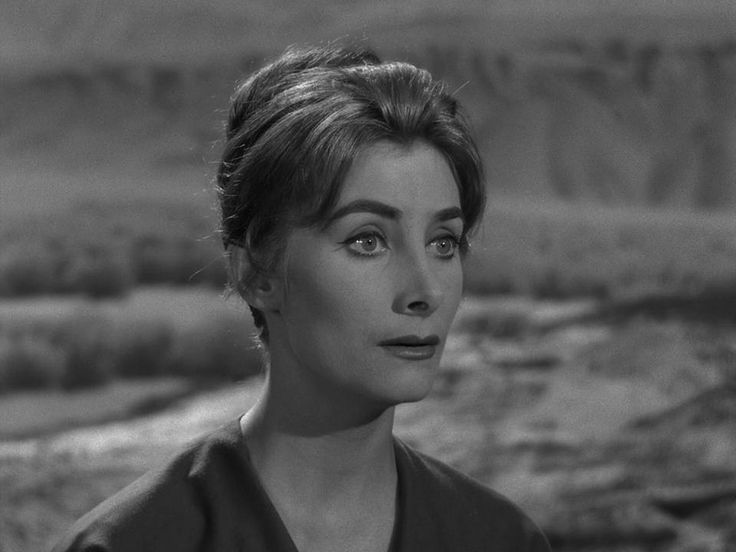
In “The Lonely,” Corry (Jack Warden), convicted of murder, has been sentence to solitary confinement on a deserted asteroid. He is visited four times a year by a supply rocket. The captain of the supply ship, Allenby (John Dehner), has taken pity on Corry and tries to bring him something each time to occupy his mind because he knows Corry is going crazy with loneliness. This time he brings him a large box. Allenby tells Corry not to open until he leaves. It turns out its a robot that looks, acts, and talks just like a beautiful woman. (It’s Jean Marsh who will star in Upstairs, Downstairs in the 1971.)
The robot is named Alicia. At first Corry is offended by thinking his loneliness could be eliminated by the companionship of a machine. But, Alicia is hurt by his rejection, and Corry takes pity on her. They become close.
Then Captain Allenby shows up again and tells Corry he’s been giving a pardon and has twenty minutes to get ready to leave. Corry assumes he can bring Alicia, but Allenby says there’s a weight limit because of limited fuel and he only has room for Corry. Corry can’t believe Allenby could be so cruel as to leave Allicia. To quickly convince Corry he is serious, Allenby shoots Alicia in the face, revealing all her mechanical parts.
This makes “The Lonely” a cold equations story. “The Cold Equations” by Tom Godwin was a controversial story from 1954. It set up a problem where the only solution was killing a teenage girl. A lot of readers hated “The Cold Equations” and over the decades they have protested that the author should have found a way to save her. They completely missed the point of the story. Godwin set up the story so the girl had to die. And that’s what Serling did in “The Lonely.”
Not only that, but they solved the plot quickly by having Captain Alleby shoot Alicia. I accept all that. That’s the point of the story. But here is where in 2024 I took a different path thinking about the story.
Why didn’t people talk about Corry falling in love with Alicia? In 1959, I wonder if the audience assumed Alicia was just a machine, and that Corry’s loneliness overcame the fact, that his love was a delusion. That when we see the mechanical parts of Alicia that we undertand why Alleby shoots her.
Over the decades, we’ve had a lot of stories that might be called robot liberation stories where many readers believe that a machine that looks and acts like a human is just as human as a biological person. I wonder if the ending shocks modern readers who have come to love robots. If someone shot C-3PO in the face and killed him, wouldn’t we be shocked and mourn his death?
If I remember right, there were a couple of Asimov robot stories where Susan Calvin kills a robot. I was always shocked by that.
In 2024 we don’t want robots murdered. Accepting the logic of the story that Alleby can only take one person back, how could we change it to work with modern audiences?
Rod Serling wrote this episode. He didn’t give the audience or Corry a chance to think about the options. His stories are setup to only work one way. When I was watching the episode I had forgotten the ending, and I wondered how Serling was going to solve the problem. Having Allenby shoot Alicia was a tidy way to end the story. After he shoots Alicia Alleby tells Corry that the only thing he’s leaving behind is his loneliness. Corry says, “I must remember that,” and “I must remember to keep that in mind.”
There’s a problem. We don’t get to decide and neither does Corry. I wish Serling had ended the story differently. I wish Allenby had handed Corry the gun and said, “I can take one person back, the ship leaves in fifteen minutes no matter what,” and then walks off.
The story could end there. We don’t really need to know the ending, because the story has shifted to thinking about all the possibilities. We should accept that the rocket only has fuel for one person. We should also assume there will be no future supply runs so if Corry stays, he will eventually die. We might also assume Alicia runs on radioactive pellets and will live a long time.
But let’s say the TV show had to reveal an ending. The camera in the very last scene could be aimed at the rocket’s hatch from the inside waiting to see who shows up. We could see Corry’s face climb into view, Alicia’s face climb into view, or Allenby say, “Time to go, shut the door.”
Each possible ending would imply so much still.
Corry shows up and we think he shot Alicia
Corry shows up and we think he didn’t shoot Alicia but left her to be lonely
Alicia shows up and we think Corry shot himself
Alicia shows up and we think Corry volunteered to die alone
Neither show up and we think Corry decided to stay with Alicia
Neither show up and we think Corry decided to stay with Alicia but kills her before he dies so she won’t be alone
Neither show up and we think Corry decided to stay with Alicia but gives her the gun to make her own decision when he dies
It’s unfair to change an author’s story after the fact. But in this case, I’m suggesting my idea because it illuminates how people might have thought about the story in 1959 would be different from how we like to think about stories in 2024.

 Classics of Science Fiction