Bookpilled recently posted on YouTube “Ranking All the Books from Every Top 15 Sci-Fi List” where he reevaluated several years of his All-Time Top 15 SF Books videos. Interestingly, books that had been near the top on earlier lists were thrown off by books from later lists. He also reread some of his favorites, which didn’t hold up. In other words, he discovered better books and found that his first impressions didn’t always hold up. This has been my experience too.
People list their favorite books they discovered early in life. Few people reread books. Quite often, the books you read early in life, make a greater impact, than the books you read later in life.
There is no absolute way to measure the quality of a book. Our Classics of Science Fiction list, we use popularity over many lists to rank books. But the top books on the Classics lists aren’t my all-time favorite SF books.
SciFiScavenger, another YouTuber, is currently collecting votes for favorite SF novels. He asks everyone to list their top ten and will create a list and video of the most popular. You can post your top ten to his poll here. Here’s my Top 10.
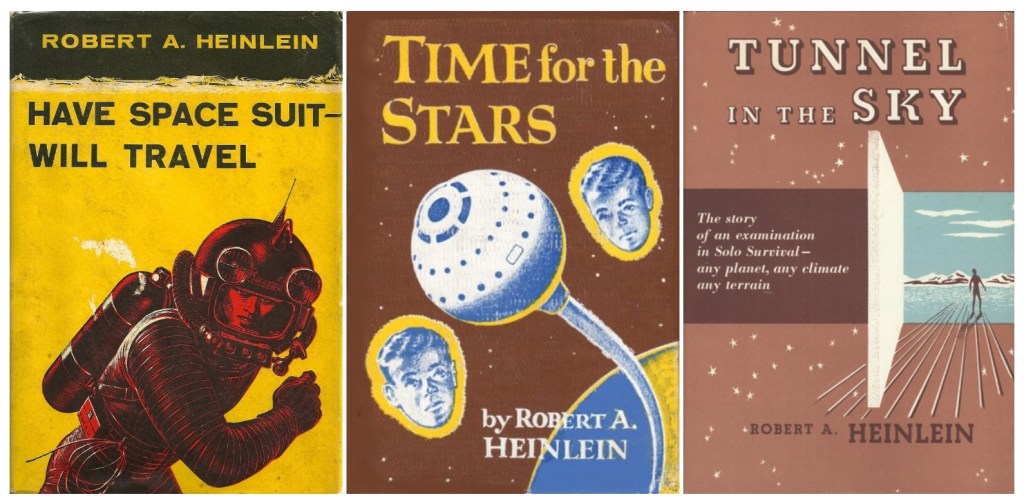
Have Space Suit-Will Travel by Robert A. Heinlein
Time for the Stars by Robert A. Heinlein
Tunnel in the Sky by Robert A. Heinlein
Flowers for Algernon by Daniel Keyes
Earth Abides by George R. Stewart
The Time Machine by H. G. Wells
The War of the Worlds by H. G. Wells
A Mirror for Observers by Edgar Pangborn
The Man Who Fell to Earth by Walter Tevis
Replay by Ken Grimwood
I’ve read eight of these books at least twice, most three times, and the top three I’ve read more than six times each. I’ve only read the Pangborn and Tevis once each, but they’ve left an impression. If I had spent more time on the list I might have substituted different books for those two. Hyperion comes to mind. I read it three times, and it had a tremendous first impact. However, the older me felt A Mirror for Observers and The Man Who Fell to Earth were deeper books for me at this time in my life.
I also felt The Time Machine and The War of the Worlds are the two most original science fiction books ever written, and should be on a Top Ten list. I really do like them too. I’ve read each several times. I wanted to include a Philip K. Dick novel because he’s my second favorite science fiction author after Heinlein, but I just couldn’t settle on one book – PKD has written too many good SF books to pick a favorite.
I could have made the entire list of ten by Heinlein. And could have made the whole list of ten by Dick. Heinlein made a life-long impact on me during my formative years from 13-18 (1964-1969). I developed problems with Heinlein as I got older, but I still regularly reread his books published before 1960. They are sentimental favorites, my go-to feel-good books. PKD is who I read when I’m feeling weird or I don’t feel like reading anything else. His books are endlessly fascinating, but I’m uncertain if they’re important to me on a psychological level.
I love Replay. I consider time loop stories to be science fiction. I chose it over a PKD because its philosophical explorations resonate with me more than Dick’s philosophical explorations.
I read #1-7 before 1970, when I was an adolescent. All except A Mirror for Observers is on audio, a format that has more impact on me. I wish Audible would publish more Pangborn. They only have his obscure mystery novel, The Trial of Callista Blake. I wished they would publish A Mirror for Observers, Davy, and a collection of his shorter work.
Notice, no books by Asimov and Clarke on my list, even though I’ve read many of their books and enjoyed them. Notice, Dune is not on the list even though I’ve read it twice and plan to read it for a third time soon. Dune is a better work of art than most of the books on my list. Its science-fictional content just doesn’t resonate well with me. I see it as more of an epic fantasy.
What are your favorite SF books? How have they changed over your lifetime? Have newer books supplanted your older favorites? I’ve read a lot of 21st-century science fiction, much of which I admired, but those books just haven’t stuck in my mind as all-time favorites. Is it because new SF is different from old SF, or is it because the books we read when young just stick with us?
I saw another YouTube video that I want to reference here. Rick Beato talks about how most artistic people do their best work before they turn 30. He uses The Beatles as an example. The Fab Four made all their records together while in their twenties. And all their solo efforts after their twenties.
I wonder if the art we admire most is that we encounter before turning 30, or even 20. Is there a relationship between being creative and admiring creativity? A lot of people give up actively listening to music as they get older, and many of the people who still listen to music as they get older, only listen to music they discovered before they were 30. Is that true with books too?
My friend Mike told me that he and his wife Betsy were watching The Twilight Zone, one episode each evening. I told him I would do the same. We’ve been texting every morning about the previous night’s episode. Day before yesterday we watched “The Lonely,” from season one, episode seven. I think I’ve seen this episode three times over the last sixty-plus years, but this time I thought more about the story. I think texting with Mike is pushing me to analyze the story in ways that casual watching never did.
The Twilight Zone tended to set its audience up for a surprise ending, often ignoring logic, or even other possibilities for how the story might go. Rod Serling wanted us to get involve and then surprise or shock us – but do it quickly. He treated his stories like a magic trick, and I don’t think he expected us to ask too many questions.
In “The Lonely,” Corry (Jack Warden), convicted of murder, has been sentence to solitary confinement on a deserted asteroid. He is visited four times a year by a supply rocket. The captain of the supply ship, Allenby (John Dehner), has taken pity on Corry and tries to bring him something each time to occupy his mind because he knows Corry is going crazy with loneliness. This time he brings him a large box. Allenby tells Corry not to open until he leaves. It turns out its a robot that looks, acts, and talks just like a beautiful woman. (It’s Jean Marsh who will star in Upstairs, Downstairs in the 1971.)
The robot is named Alicia. At first Corry is offended by thinking his loneliness could be eliminated by the companionship of a machine. But, Alicia is hurt by his rejection, and Corry takes pity on her. They become close.
Then Captain Allenby shows up again and tells Corry he’s been giving a pardon and has twenty minutes to get ready to leave. Corry assumes he can bring Alicia, but Allenby says there’s a weight limit because of limited fuel and he only has room for Corry. Corry can’t believe Allenby could be so cruel as to leave Allicia. To quickly convince Corry he is serious, Allenby shoots Alicia in the face, revealing all her mechanical parts.
This makes “The Lonely” a cold equations story. “The Cold Equations” by Tom Godwin was a controversial story from 1954. It set up a problem where the only solution was killing a teenage girl. A lot of readers hated “The Cold Equations” and over the decades they have protested that the author should have found a way to save her. They completely missed the point of the story. Godwin set up the story so the girl had to die. And that’s what Serling did in “The Lonely.”
Not only that, but they solved the plot quickly by having Captain Alleby shoot Alicia. I accept all that. That’s the point of the story. But here is where in 2024 I took a different path thinking about the story.
Why didn’t people talk about Corry falling in love with Alicia? In 1959, I wonder if the audience assumed Alicia was just a machine, and that Corry’s loneliness overcame the fact, that his love was a delusion. That when we see the mechanical parts of Alicia that we undertand why Alleby shoots her.
Over the decades, we’ve had a lot of stories that might be called robot liberation stories where many readers believe that a machine that looks and acts like a human is just as human as a biological person. I wonder if the ending shocks modern readers who have come to love robots. If someone shot C-3PO in the face and killed him, wouldn’t we be shocked and mourn his death?
If I remember right, there were a couple of Asimov robot stories where Susan Calvin kills a robot. I was always shocked by that.
In 2024 we don’t want robots murdered. Accepting the logic of the story that Alleby can only take one person back, how could we change it to work with modern audiences?
Rod Serling wrote this episode. He didn’t give the audience or Corry a chance to think about the options. His stories are setup to only work one way. When I was watching the episode I had forgotten the ending, and I wondered how Serling was going to solve the problem. Having Allenby shoot Alicia was a tidy way to end the story. After he shoots Alicia Alleby tells Corry that the only thing he’s leaving behind is his loneliness. Corry says, “I must remember that,” and “I must remember to keep that in mind.”
There’s a problem. We don’t get to decide and neither does Corry. I wish Serling had ended the story differently. I wish Allenby had handed Corry the gun and said, “I can take one person back, the ship leaves in fifteen minutes no matter what,” and then walks off.
The story could end there. We don’t really need to know the ending, because the story has shifted to thinking about all the possibilities. We should accept that the rocket only has fuel for one person. We should also assume there will be no future supply runs so if Corry stays, he will eventually die. We might also assume Alicia runs on radioactive pellets and will live a long time.
But let’s say the TV show had to reveal an ending. The camera in the very last scene could be aimed at the rocket’s hatch from the inside waiting to see who shows up. We could see Corry’s face climb into view, Alicia’s face climb into view, or Allenby say, “Time to go, shut the door.”
Each possible ending would imply so much still.
Corry shows up and we think he shot Alicia
Corry shows up and we think he didn’t shoot Alicia but left her to be lonely
Alicia shows up and we think Corry shot himself
Alicia shows up and we think Corry volunteered to die alone
Neither show up and we think Corry decided to stay with Alicia
Neither show up and we think Corry decided to stay with Alicia but kills her before he dies so she won’t be alone
Neither show up and we think Corry decided to stay with Alicia but gives her the gun to make her own decision when he dies
It’s unfair to change an author’s story after the fact. But in this case, I’m suggesting my idea because it illuminates how people might have thought about the story in 1959 would be different from how we like to think about stories in 2024.
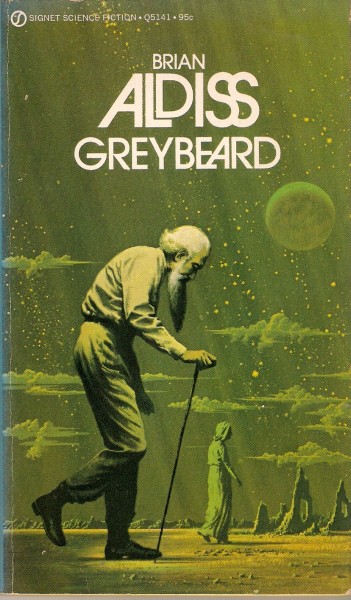
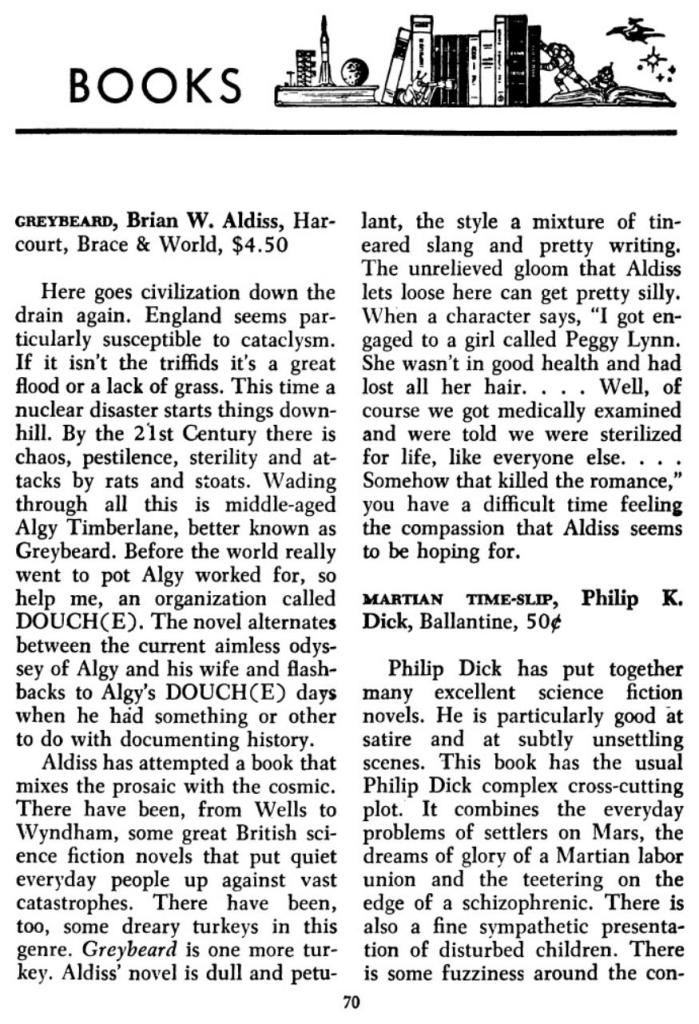
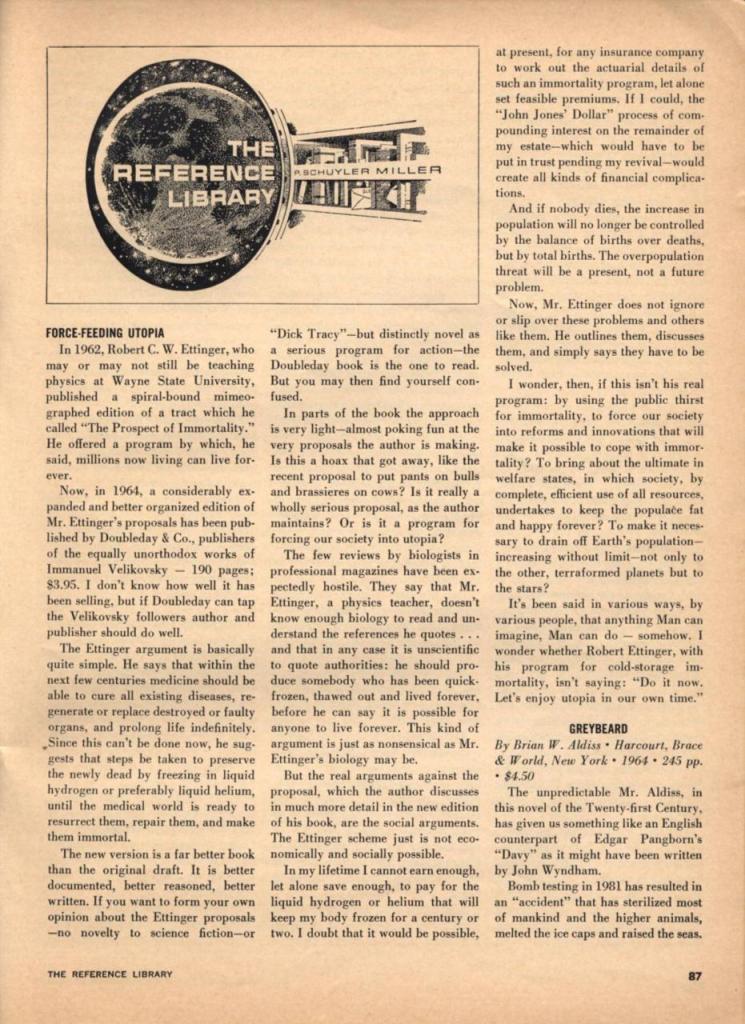
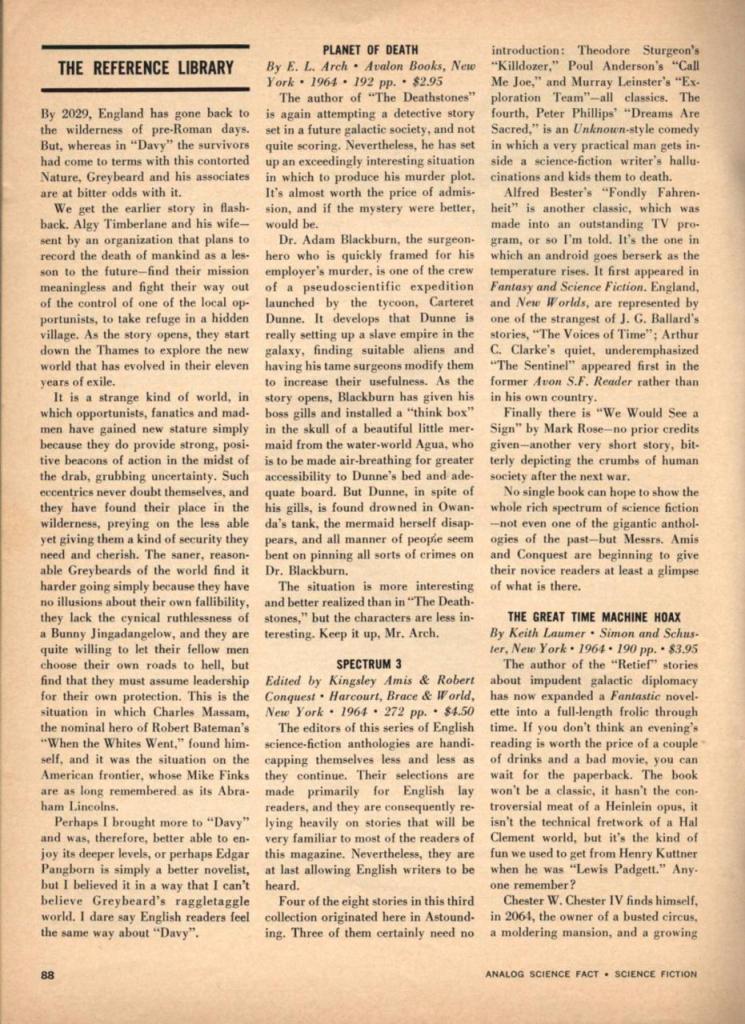
Greybeard is a 1964 post-apocalyptic novel by Brian W. Aldiss. It was reprinted as an audiobook by Trantor Media on October 15, 2024, read by Dan Calley. The ebook version is currently available for the Kindle for $1.99 in the U.S. Greybeard has an extensive reprint history. I heard about this novel back in the 1960s, but I’ve only become an Aldiss fan in the last few years, so I was excited when the audiobook edition showed up on Audible.com. Greybeard was one of the novels David Pringle admired in his Science Fiction: The 100 Best Novels (1985). That book is available for $1.99 for the Kindle too.
Greybeard is set in the 2020s, and is about the aftermath of atomic bomb testing in space in 1981, when the explosions altered the Van Allen radiation belt. Eventually, people learned “the accident” caused the human race to become sterile, along with certain other animals. In the story, everyone is old, waiting to die, and wondering what will happen after humanity is gone. This is a different premise for a post-apocalyptic novel, but Aldiss uses his tale mostly to toss out a ideas. The story lacks a compelling plot.
The characters are never developed to the point where you care about them. That’s a common problem of older science fiction, where characters were created mainly to present far-out science fictional thoughts.
The story’s main focus is on Algy and Martha Timberlane as they travel around England after the collapse, along with flashbacks of how they got together. Algy, short for Algernon, is called Greybeard because of his long beard. After the accident, during a period when kids were born with genetic defects, but before they stopped coming altogether, the world economies collapsed, which led to wars. As Aldiss points out, a lot of consumerism is targetted to babies, children, and young people, so certain businesses quickly went bust. But also, as people realized they had no future, many gave up on their ambitions, or even committed suicide.
The book is divided into seven chapter, each a different time and setting:
Chapter 1 – The River – Sparcot
Chapter 2 – Cowley (flashback)
Chapter 3 – The River Swifford Fair
Chapter 4 – Washington (flashback)
Chapter 5 – The River – Oxford
Chapter 6 – London (flashback)
Chapter 7 – The River – The End
The novel begins with rampaging stoats (ermine, short-tail weasel). This setting of England being taken over by nature reminded me of After London by Richard Jefferies, but Jefferies did a much better job describing how nature would overrun decaying cities, towns, and roads. After London is a superior post-apocalyptic novel, and one of the earliest
We first meet Greybeard and Martha who have been living for years in a tiny village, Sparcot, ecking out an existing through fishing and gardening. They live near a river surrounded by a barrier of brambles. When two boats arrive with refuges from another village, they hear about how the stoats are attacking everything including people. This reminded me of the stobors in Heinlein’s Tunnel in the Sky. Algy, Martha, and a few friends, flee in a boat Algy had hidden. They plan to float down the river to the sea.
The novel is about what they see along the way. It might be called a picaresque novel. Algy/Greybeard is a bit of a rogue, and we follow his episodic travels. At each stopping place along the river they meet folks living under different conditions. Swifford Fair seemed like something out of the Middle Ages. When they get to Oxford, they find a certain level of civilization has maintained itself around the old university. But in every location, there are wild beliefs about how things are, including lots of charlatans, thieves, and con artists preying on ignorant people. Rumors abound about children still being born, strange mutant beings living in the woods, or even fairy creatures of old returning.
Algy and crew meet a crazy old man on the river who tells them to find Bunny Jingadangelow in Swifford Fair because he can make them immortal. Bunny Jingadangelow shows up several times during this novel running different scams, including one as a messiah.
Greybeard isn’t a bad science fiction novel, but it’s not that great either. If I had read it back in 1968 when I first heard about it, I would have been impressed. But over the decades I’ve read a lot of post-apocalyptic fiction, and Greybeard just isn’t up to the standard of Earth Abides by George R. Stewart or The Road by Cormac McCarthy. I’d say The Hopkins Manuscript by R. C. Sherriff as one of the great post-apocalyptic novels about England to read first. In other words, there are a lot of post-apocalyptic novels you should read before spending time on Greybeard.
It’s a shame that Aldiss didn’t spend more time writing Greybeard because his premise is so good. I just finished the four-volume novel series by Elena Ferrante that begin with My Brilliant Friend. This is a true masterpiece, and future classic. Greybeard and most science fiction feel like starvation rations compared to that novel. Of course, Ferrante used 1,965 pages to tell her story, and Aldiss only used 237 on his story. Aldiss tried to develop the characters with flashbacks, but those flashbacks were mainly used to describe the world during the initial stages of collapse.
Ferrante created a compelling novel by showing how two girls evolve psychological and intellectually over a lifetime. That anchored the novel and gave it a page-turning plot. Aldiss never moors us in the story with anything we can anchor our attention. Richard Jefferies handled his post-apocalyptic London by using the first part of the book to explore ideas around the collapse, and then used the second half with a well-plotted adventure story. I enjoyed Greybeard enough to read it, but just barely.
I wish Aldiss had expanded his story to 400-500 pages and developed Algy and Martha, and found something to give the book a clear purpose. I can only recommend Greybeard to folks who read a lot of post-apocalyptic novels and enjoy studying them.
Aldiss imagines radiation causing a world of only old people. But we’re currently facing a depopulation crisis because most countries around the world aren’t producing enough babies. A country needs every woman to have 2.1 children to grow. Many women don’t want to have any, and one child is common. Theoretically, countries like South Korea can become like the world of Greybeard by the end of this centry. I wonder if any current writers are exploring that idea?
Ron Goulart didn’t like the story in his F&SF (Dec. 1964) review.
P. Schuyler Miller liked it a bit better, but not much, in his Analog (Feb. 1965) review.
Judith Merril in 1966, pointed out to F&SF readers that the original American hardback lacked some of the flashback scenes, and might like the story better in the Signet paperback, which included the full British edition.
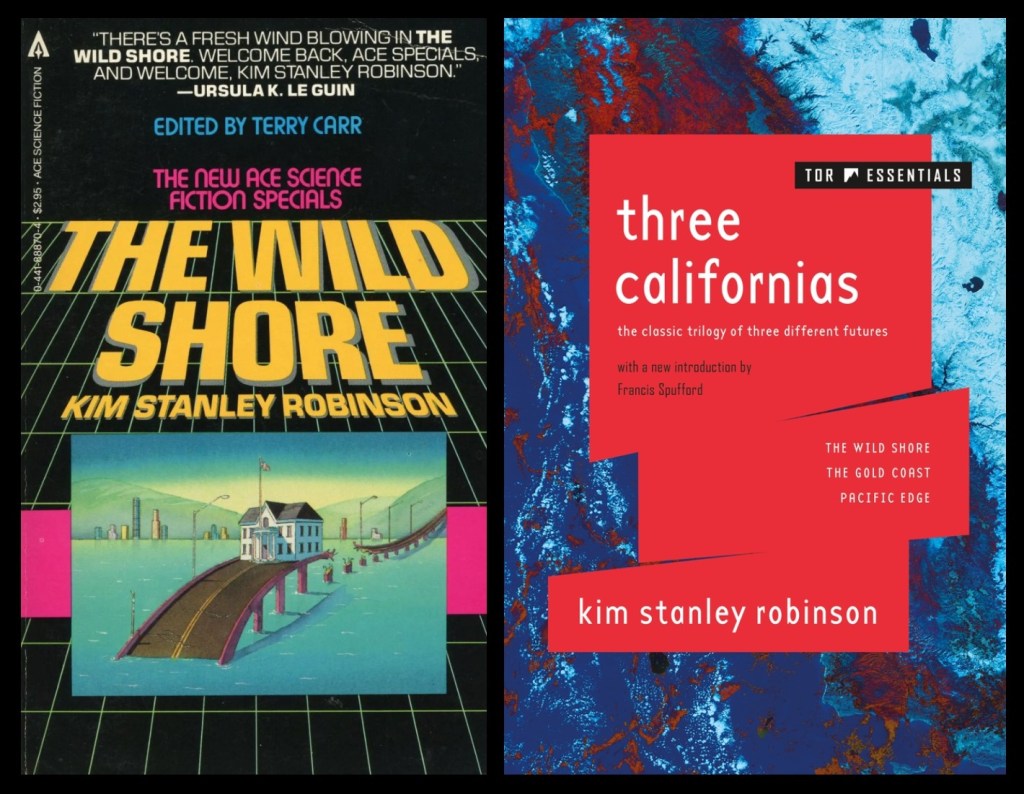
Unless you’ve recently become a fan of Kim Stanley Robinson, it’s unlikely you’ll be thinking about reading The Wild Shore. It was Robinson’s first published book back in 1984. The Wild Shore was impressive enough to be the first volume in Terry Carr’s third series of Ace Science Fiction Specials. But still, why would you choose to read a 1984 paperback original in 2024? I can’t claim it’s become a science fiction classic or it’s a highly distinctive take on its theme, which is post-apocalyptic, but it is a worthy read.
I’m a great admirer of Kim Stanley Robinson’s 21st century work because he explores the forefront of science fiction. However, his books don’t compel me to turn their pages. I seldom care for his characters, and I don’t get caught up in his plots. I like Robinson’s books for his insightful philosophical takes on our evolving genre. That was not the case with The Wild Shore. I did care for Henry and Tom, and I never stopped wanting to know what would happen. This book was different. Was it because it was told in first person? Or was it because it was a somewhat realistic post-apocalyptic novel, a favorite theme of mine?
I’m not sure if any post-apocalyptic novel is ever particularly realistic. I’m only separating the silly ones with zombies, mutants, aliens, and robot overlords with those novels which describe normal human life after things fall apart.
I had not planned to read another science fiction novel so soon after reading A Heritage of Stars. (I’m trying hard to read other kinds of books.) But two events intersected that led me to read The Wild Shore. Just as I finished Clifford Simak’s 1977 novel about a post-apocalyptic America, when I caught a YouTube review of The Wild Shore, a 1984 novel about a post-apocalyptic America. I immediately wanted to compare the post-apocalyptic vision by a writer born in 1904, near the end of his career, with the post-apocalyptic vision of a writer born in 1952 publishing his first novel.
Even though the novels came out just seven years apart, they are significantly different. Simak’s book is a science fantasy, not much more sophisticated than an Oz book. Robinson’s story is a literary coming-of-age in a post-apocalyptic world tale.
I’m becoming a connoisseur of apocalyptic fiction. I’ve read so many that I divide them into works covering different time periods. These are some of my favorites:
Stories that begin before the apocalypse
One in Three Hundred by J. T. McIntosh
The Death of Grass by John Christopher
The Last Man by Mary Shelley
Stories that begin during apocalypse
“Lot” by Ward Moore
Survivors (BBC TV)
Stories that begin days after the apocalypse
The Day of the Triffids by John Wyndham
The Quiet Earth (film)
The World, The Flesh, and The Devil (film)
Stories that begin weeks or months after the apocalypse
Earth Abides by George R. Stewart
Stories that begin years after the apocalypse
Station Eleven by Emily St. John Mandel
The Postman by David Brin
Stories that begin generations after the apocalypse
The Long Tomorrow by Leigh Brackett
The Wild Shore by Kim Stanley Robinson
Stories that begin centuries after the apocalypse
A Canticle for Leibowitz by Walter M. Miller, Jr.
A Heritage of Stars by Clifford D. Simak
After London by Richard Jefferies
Stories that begin in the far future
Hothouse by Brian W. Aldiss
I think we should contemplate why post-apocalyptic stories are so popular. If I listed all the ones I knew about from books, movies, and television shows, it would be a painfully long list. Shouldn’t we psychoanalyze ourselves over this? It’s my theory that we’re attracted to post-apocalyptic settings because we feel like we’re living in pre-apocalyptic age.
There’s a telling point about most post-apocalyptic stories – the cause of the apocalypse usually kills off most of the population. Doesn’t that suggest we want to live in a world with fewer people? I believe we’ve been living through a slow developing apocalypse our whole lives caused by overpopulation. People laugh at The Population Bomb, a 1968 book that predicted famine that didn’t happen. However, back in the 1960s I remember reading about experiments with rats and overpopulation. As rats were forced to live with more of their own kind, they started going crazy, attacking each other, and causing universal stress.
Most of the problems we face today that will shape our future are due to there being too many of us. Of course, economists are freaking out now because of dropping birth rates, but that’s only because capitalism is a Ponzi scheme they desperately need to keep going. But this book review is not the place to go into details about all the detrimental effects of overpopulation. Let’s just say that the emotional appeal of reading stories where there are fewer people resonate at a deep psychological level. Just look at all the people who want to return to the 1950s, when the population was less than half of what it is today. Or they dream of rebooting society without all the people they dislike.
This begs the question: What will society be like if we had to start over? Most post-apocalyptic novels are merely action-oriented stories that let readers vicariously run wild in a lawless society. They don’t address societal collapse seriously. I think novels like Earth Abides by George R. Stewart, Station Eleven by Emily St. John Mandel, and The Wild Shore by Kim Stanley Robinson do – to a small degree.
The Wild Shore describes growing up in a small community of about sixty people in San Onofre, California, about halfway between Los Angeles and San Diego. The story is told from the point of view of a young man, Henry “Hank” Fletcher, and his friends. The setting is a small pastoral valley near the ocean where people live off small-scale fishing and farming. The year in 2047. Back in 1984, the United States was mostly destroyed by thousands of neutron bombs, which produced low radiation but caused lots of destruction. Survivors creates thousands of little communities each finding their own unique way to survive.
Henry and his teenage friends are third generation post-apocalypse, who admire an old man, Tom, who was born before the apocalypse. Tom claims to be over 100. He has become their mentor and teacher. The young men mainly fish, while the young women farm. It’s demanding work during the day, but they study with Tom after work. He has taught them to read and tells them tales about the old days. Henry’s best friend Steve Nicolin is desperate to get away from home and his domineering father. Steve pushes Henry into actions that propel the plot.
Tom is an unreliable mentor, but Henry and friends don’t know that, and neither do we at first. For example, Tom tells Henry and his friends that Shakespeare was an American, and England was part of the United States. Tom knows there were both good and bad things about the pre-apocalyptic world, but he has glorified American life before the bombs. Henry and Steve, want to rebuild that America, but don’t know how. Like most young men they are anxious for adventure, and resent the grueling work required for daily survival.
Then one day a group of men from San Diego, led by Jennings and Lee, show up and invite people from Henry’s small community to visit their large one in San Diego. They tell Henry’s community they came by train. It turns out their train is two handcars, those little cars that are people powered. In San Diego they are shown many marvels of reconstruction.
Henry is impressed with what the San Diegans have created for themselves. San Diego’s success is due to a strong man named Danforth who his followers call the mayor. Danforth even has a political slogan: Make America Great Again. (I kid you not.)
The mayor tells Henry and Tom he wants their small community to join his resistance movement. We learn that America was bombed by several countries, but not Russia, who resented our world dominance. The rest of the world have put the United States into quarantine, working to keep Americans from regrowing their power. Japan guards the west coast, Canada the east coast, and Mexico the Gulf Coast. The Japanese command is stationed on Catalina Island off Los Angeles. The mayor wants to get as many Americans as possible to fight them.
Now, this world building is not the true focus of The Wild Shore. In fact, I considered it unrealistic speculation. However, Robinson needed a reason for Henry and Steve to want to leave their community and join a big cause. The book is about growing up in a post-apocalyptic world, and to a degree it realistically speculates about such a life. For example, Robinson imagines that some people would try to survive off what was left in the cities, and others would fish, farm, herd, or ranch, and there would be a conflict between the scavengers and the back-to-the-land folks. I think that’s realistic. He also imagines that strong men like Danforth would consolidate power. And I think that’s realistic too. But the whole plot conflict with the Japanese is not something I bought.
The real value of this story is how the boys grow up. And it’s especially about how they learn from Tom. Eventually they discover that Tom doesn’t know everything, but that’s part of the story too. I feel the mentoring relationship was realistically developed, and what I admired most in The Wild Shore. However, in the end, the novel never achieved the impact of Earth Abides or Station Eleven. At least not with my first reading. It might be in the same league as The Long Tomorrow by Leigh Brackett, but I haven’t reread that one in decades.
Robinson does a lot of speculation and extrapolation that I need to think over. For example, people return to whaling because they use whale oil for lighting. We find whaling repugnant, but whale oil made a significant impact on 19th century America because it was a superior lighting source over candles. Robinson has his America with no form of mass communication. The San Diegians dream of repairing a radio, but so far can’t. Would such technology disappear in 60 years? In the story, much of what we use disappears. In this story, printing is just starting to make a comeback.
One of the most important insights from Earth Abides is we won’t be able to teach the next generation everything they need to rebuild a technological civilization immediately. Isherwood, a former university professor and the Tom of Earth Abides, realized that teaching literature and mathematics to kids who had to work hard just to eat would be nearly impossible. In the end, he understood that he had to teach the next generation things they could readily assimilate and use. So, he taught them how to make bows and arrows to help them hunt food.
Robinson tries to explore what useful knowledge Tom could convey to Henry and his friends, but that theme gets sidetracked by the boys chasing after the anti-Japanese resistance movement. I felt that plot was unrealistic. Robinson could have just kept the conflict to just between the larger San Diegan community take over Henry’s smaller community, and that would have been realistic enough for me. Or the conflict could have been between those who lived by scavenging and those who farmed and fished. He did need a larger conflict for his plot, but I thought the resistance theme too big.
One of the fascinating things about post-apocalyptic stories, is how people live without news organizations and communication systems. To suggest that most of the world was keeping America at a tribal level to protect themselves is hard to believe. But if global civilization has collapse, it’s easy to believe that we could return to a tribal society. It all depends on how many people die in the apocalypse. Europe recovered from the Black Death, which killed up to half the population in many cities, but it survived and thrived.
Realistically, unless we were hit by an asteroid, or a plague with ten percent survival rate, we’re not going to drastically reduce our populations in single apocalyptic event. We could slowly fall apart until we de-evolved into a tribal state, but that might take centuries. A realistic post-apocalyptic world might be the one that’s emerging now as countries return to authoritarian rule, economies collapse, and weather ravages everything.
The Wild Shore is about how young people adapt to a post-apocalyptic world. The book might offer some insight into how things might be if the apocalypse was overwhelming, killing off 99% of the population. What happens when the apocalypse is slow-acting, and reduces the population slowly, which slowly forgets all the technology? We can see this is many countries around the world right now. So far, they have been smaller countries like Sudan, Colombia, or Afghanistan. But Russia and China don’t look too healthy right now.
If people are reading post-apocalyptic novels because they unconsciously feel we’re approaching apocalyptic times, shouldn’t they consciously start reading realistic apocalyptic novels that might help them anticipate new ways of living? The Wild Shore isn’t that realistic, but it does explore some issues about growing up in a post-apocalyptic world that might make it a worthwhile reading. I do recommend giving it a try.
Some preppers have written post-apocalyptic novels, but they are generally about guns and surviving in the early days after the collapse. I don’t think we should expect a Mad Max society. Iraq, Syria, Haiti, El Salvidor. and Afghanistan are great examples to study if you want to write a truly realistic post-apocalyptic novel, or you want to become a prepper. Being a lone wolf with a AR-15 is as much of a fantasy as a zombie apocalypse.
Novels like The Wild Shore and The Long Tomorrow, or a TV series like the 1975 Survivors have more of a realistic ring to them, but only slightly so. The fall of Rome took centuries. A truly realistic post-apocalyptic novel would deal with a slow declining society and the apocalypse wouldn’t be so dramatic as an atomic war.
“Earth for Inspiration” is a comic science fiction story by Clifford Simak set millions of years into the future about a science fiction writer and his robot visiting a forgotten Earth. The pair go there hoping to find inspiration to write new science fiction stories. You can read it online in the April 1941 issue of Thrilling Wonder Stories.
I read “Earth for Inspiration” by Clifford D. Simak because I read When the Fires Burn High and the Wind is From the North: The Pastoral Science Fiction of Clifford D. Simak by Robert J. Ewald. I bought that book after I read and reviewed A Heritage of Stars by Simak which made me want to know more about Clifford D. Simak. I mentioned my interest in Simak on the Clifford Donald Simak Facebook group and the Ewald book was one of two books about Simak that was recommended. I forgot I already owned the second book, Clifford Donald Simak: An Affectionate Appreciation by Francis Lyall. I haven’t read that one yet because I leant it to my friend Mike who had recently read the twelve volumes of Simak’s short stories. Mike is who got me to read A Heritage of Stars in the first place. I guess that puts me into some kind of inspiration loop.
A Heritage of Stars involved a post-apocalyptic America with few humans and some robots. In that story, most robots had been destroyed except for their brain cases which were saved as trophies after a war with the robots. Unknown to the humans, the robots continued to be conscious inside their brain cases for a thousand years. That idea of a conscious mind without outside sensory data intrigued me. Then I read in the Ewald monograph about “Earth for Inspiration,” involved a dying Earth, robots, and isolated robot brain cases. I had to read it. The story is also included in Simak’s collection Earth for Inspiration and Other Stories: The Complete Short Fiction of Clifford D. Simak Volume Nine. Amazon now sells 14 volumes in the complete stories. Audible.com now offers ten of those volumes in audiobook editions.
Version 1.0.0
Most of the famous science fiction short stories we remember from the 1940s were first published in Astounding Science Fiction. Thrilling Wonder Stories was aimed at younger, less educated science fiction fans, and we seldom see reprints from that pulp magazine. For the most part, its stories are less sophisticated with far more action. And that’s true for “Earth for Inspiration.” I thought it was a funny story, but somewhat simple and hyper paced. It has an old fashion voice because of all old-timey colloquialisms. Simak is known for his pastoral prose and midwest settings.
“Earth for Inspiration” was more fun than I expected to find in Thrilling Wonder. Usually, when we think about robots in science fiction, we think of Isaac Asimov, but I’m seeing how important robots were to Simak stories.
When I read it with my eyes, “Earth is Inspiration” felt like cliched pulp science fiction from the 1930s. However, when I listened to the story after buying the audiobook edition, I thought the writing was much better than my first impression, except for all the saidisms. (I think the worse was — “Look at that, will you!” he jubilated.) The second reading with my ears made me notice how many ideas Simak was using to develop the story. It’s a satire on writing science fiction, maybe even the first example of recursive science fiction.
However, “Earth for Inspirations” gives us a few clues about how Clifford D. Simak thought when comparing them to his other work. The more Simak I read, the more I spot common ideas, characters, and elements that he used and reused.
The Ewald monograph has a few pages of biographical information, almost just a list of dates. Most of the 155 pages describe Simak’s stories and novels. I was hoping to find a biography of Simak, something like William H. Patterson did for Heinlein, but such a book doesn’t exist as a far as I can tell for Simak. Second to that, I was hoping to find an analysis of the impact of Simak’s stories, like what Alexei and Cory Panshin did for Heinlein, Asimov, and van Vogt in The World Beyond the Hill. It’s not that either. When the Fires Burn High and the Wind is From the North, is a standalone journal, volume 73 of The Milford Series: Popular Writers of Today. The content is like Alva Rogers A Requiem for Astounding, which is a description of the stories in all the issues of Astounding Science Fiction in chronological order.
I thought it fascinating that Simak was thinking of robots in the same way in 1941 and 1977. He obviously had a fondness for the idea of robots and had developed an idea of what they would be like early in his career and stuck with it until he died. Robots were faithful servants who were also friends. Simak imagines them with bodies that can break down, but with nearly indestructible brain cases. I assume those brain cases have an internal power supply that could last for millions of years. A couple years ago I read a collection called The Complete Robot by Isaac Asimov. I wonder if Simak has enough robot stories to warrant such a collection?
Reading Simak, we can assume he didn’t like cities or corporations and had a low opinion of mankind’s ability to survive in the long run. Although, “Earth for Inspiration” is set millions of years in the future after humans have colonized the galaxy, but long after we’ve used up Earth’s resources and abandoned it.
The first scene of “Earth for Inspiration” opens with a short tale about a robot named Philbert who became inert after his body rusted up. Eventually, his body rusted away and Philbert lived inside his braincase for millions of years. This reminds me of the Tin Woodsman of Oz.
The second scenes jumps to Jerome Duncan, a once successful science fiction writer who is again getting rejection slips after a successful career. Duncan lives millions of years from now. It’s amusing that Simak thinks science fiction will last that long.
Anyway, Duncan’s robot Jenkins suggests going to Earth to get inspiration for writing a new story. Jenkins is also the name of the robot in City, Simak’s most famous book, a fix-up-novel. Duncan is famous for writing Robots Triumphant. I won’t tell you what it was about because it becomes part of the story.
The next scene has Duncan and Jenkins arriving on Earth with a lot of camping equipment and meeting an old-timer, Hank Wallace, who has been waiting for new tourists for over a thousand years. He manages the Galactic Trainsport station, but no one informed him that the line had been shut down a thousand years earlier. Duncan and Jenkins had hired a private rocket. This points to another idea that Simak loved, that humans would eventually have very long lives. In this story, we last for ten thousand years. And his second most famous novel, Way Station, is about an old-timer who manages a transport station and who doesn’t age. By the way, the old-timer in that novel was named Enoch Wallace.
Should we assume that Simak had been thinking about writing his most famous novels for years?
I don’t think I should tell you any more of “Earth for Inspiration.” It’s a fun enough story so that I shouldn’t spoil it for you. I’ll just hint at a few more scenes. Earth in the far future is dry, and has lost most of its air. There’s a confrontation with humans living in primitive tribes in dry deep sea canyons where the air is thicker. That makes it a dying Earth story. There are slapstick scenes with a crazy robot and another confrontation with horde of runaway robots.
“Earth for Inspiration” has decent humor, although not sophisticated. It would make a great humorous episode for Love Death & Robots. The humor is slapstick Sheckley with a touch of Frederic Brown’s ironic weirdness. I’m not sure if Simak intended it to be entirely comic, although, he probably did, but I bet a lot of young readers in 1941 took it straight realistic action.




 Classics of Science Fiction