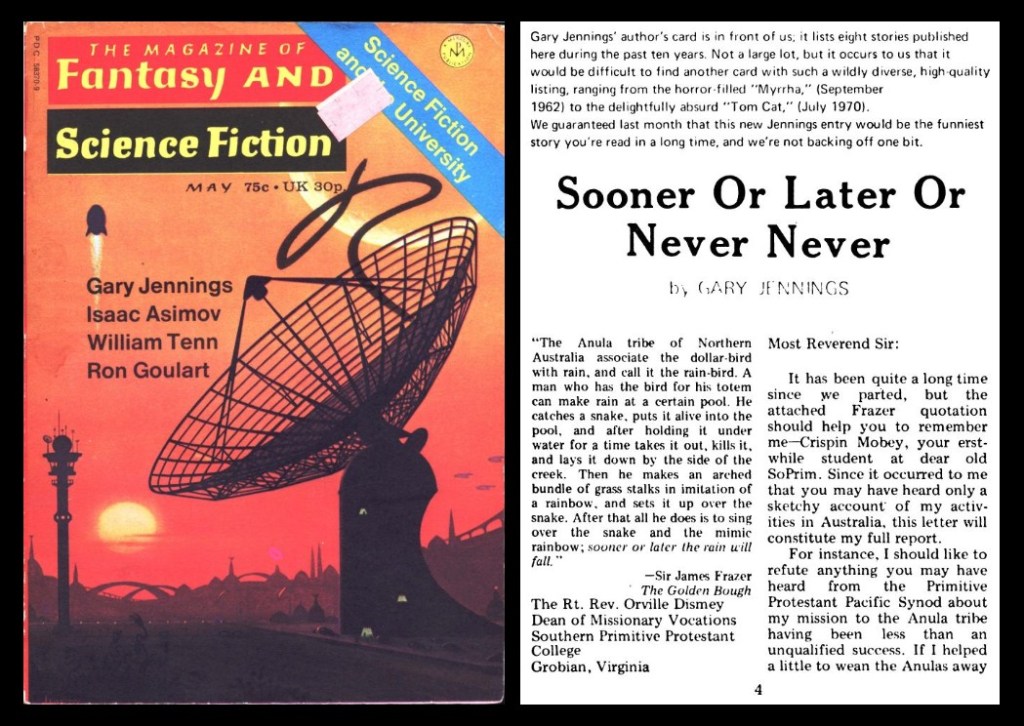
What exactly is fantasy? “Sooner Or Later Or Never Never” by Gary Jennings has no magic, no fantastic creatures. Its setting is present-day Australia. The story is both comic and absurd. Yet, it’s based on a somewhat realistic premise. Yes, the characters and plot are made up, but so is most fiction. I can find no reason to call this a fantasy. I assume Edward L. Ferman published it in the May 1972 issue of The Magazine of Fantasy & Science Fiction because he admired the creative prose — and he had the power to publish it.
“Sooner or Later or Never Never” is told as a letter to The Rev. Orville Dismey, Dean of Missionary Vocations, at the Southern Primitive Protestant Seminary in Grobian, Virginia. Crispin Mobey narrates his effort to bring Christ to the Anula tribe in the Australian outback. Mobey was inspired by a quote from The Golden Bough by Sir James Frazer. The quote describes a ritual Frazer witnessed. Mobey wants to use that ritual to bring Christianity to a rather primitive tribe.
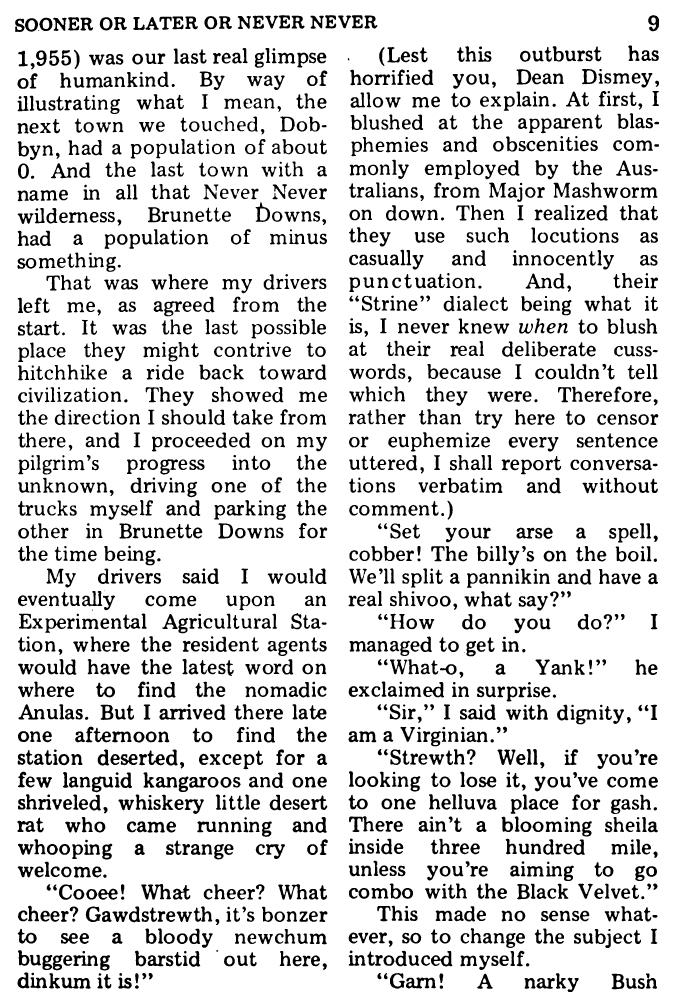
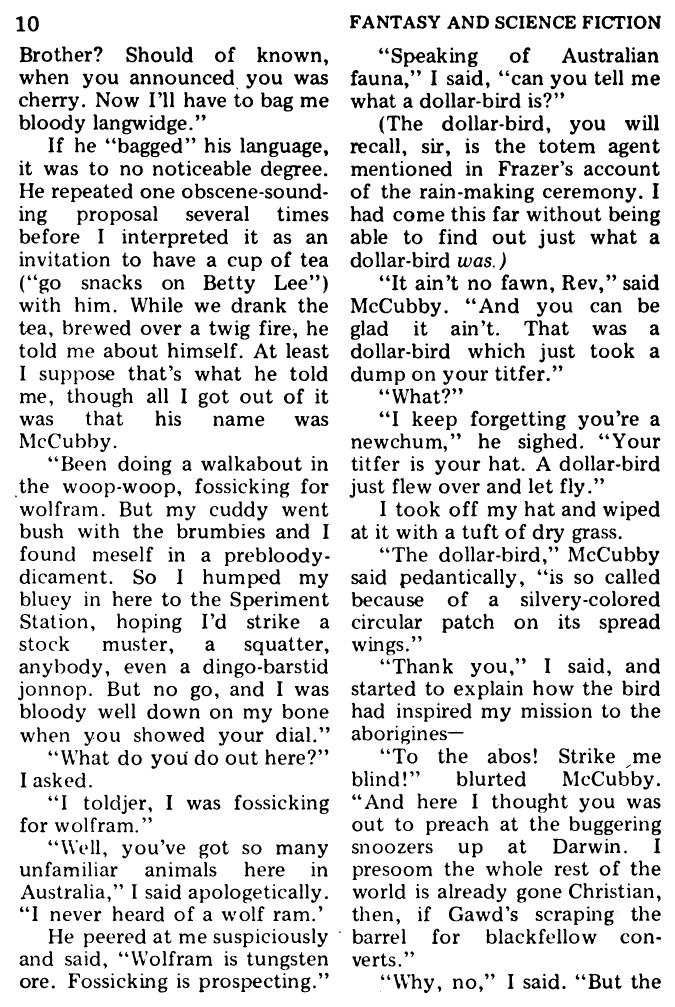
I’ve read “Sooner or Later or Never Never” before, but I’m not sure where and how. I don’t normally read this kind of fiction. However, the prose is quite entertaining. Normally, I dislike dialect, but Jennings captures outback Aussie hilariously. I wish I had an audiobook version.
There is no way I can describe this story, so I’m just going to give you two pages to read as a sample.
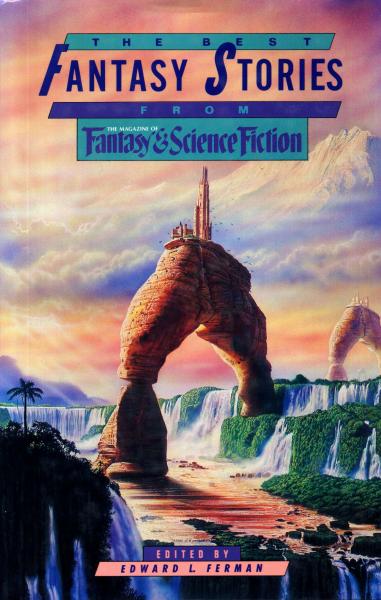
I know this is cheating, but I’m taking the easy way out. I’m posting this merely to encourage people to read this story. I read it today because my Facebook short story club is reading The Best Fantasy Stories from The Magazine of Fantasy and Science Fiction. Reading this 792-page anthology demonstrates the range of what people call fantasy.
I routinely tell people I dislike fantasy. But of the stories we’ve read in this anthology, the ones set in the present about ordinary people have been the most entertaining to read. And the ones that people consider traditional fantasy were no fun to read. I guess when I say I dislike fantasy, I dislike only a subset of the genre.
However, I also think Ferman is cheating to call “Sooner or Later or Never Never” fantasy. It could have been published in almost any kind of fiction magazine.
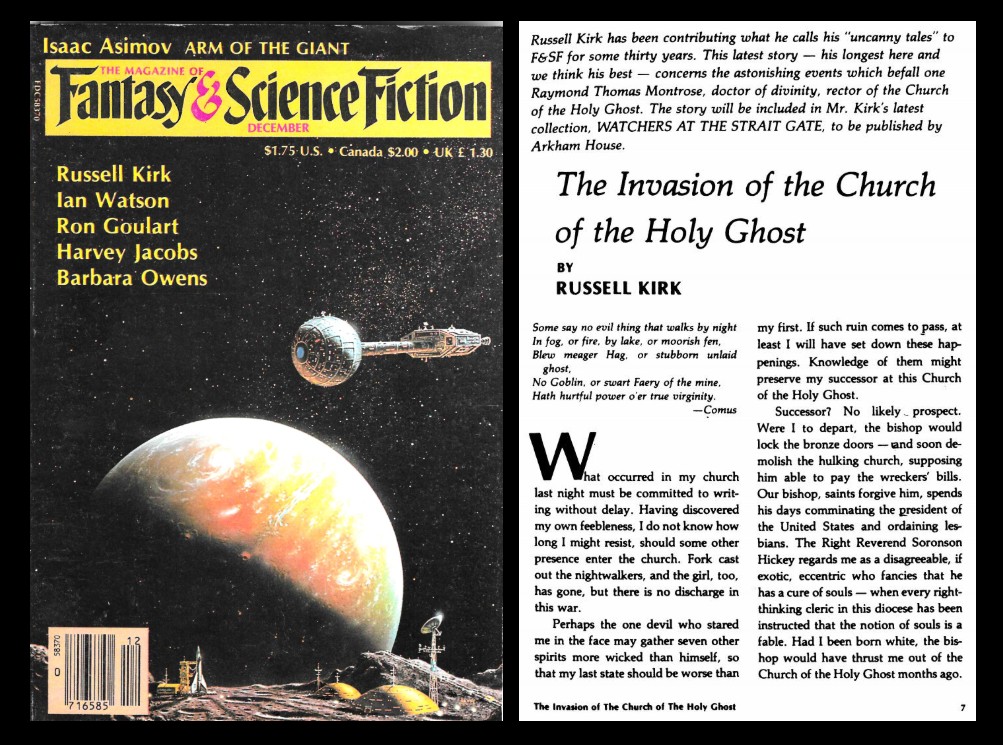
I’m an atheist who doesn’t normally enjoy reading fantasy fiction; however, I found “The Invasion of the Church of the Holy Ghost” by Russell Kirk, a religious ghost story, to be quite entertaining and well-written. The characters of Father Raymond Thomas Montrose and Fork Causland are so well developed that it’s hard not to like this story. Plus, the story is set in a seedy, rundown section of town filled with hustlers, prostitutes, and con men, has all the feel of a Damon Runyon tale.
I had no idea who Russell Kirk was, but after reading about him on Wikipedia, the philosophy behind the story made more sense. Kirk was a major conservative intellectual and a distinguished fellow at the Heritage Foundation. Since I’m a liberal, this doesn’t endear me to him. Kirk was also a convert to Catholicism and enjoyed writing ghost stories.
Kirk’s significant spiritual, political, and philosophical background forces me to look deeper into “The Invasion of the Church of the Holy Ghost.” Kirk was a serious thinker. That makes it hard to dismiss the story as a silly, inconsequential ghost story.
Even while liking “The Invasion of the Church of the Holy Ghost” very much, it proposes ideas I find totally repugnant. Both Father Montrose and Fork Causland are possessed. Kirk suggests that when people do bad things, it’s because they are influenced by evil ghosts, and when they do good things, they are empowered by higher-order beings. He doesn’t specifically say angels, but that’s how I interpreted the story.
In old religious philosophy, good comes from God, and evil from Satan. If humans do good, it’s because of the influence of the divine, and if we do bad, it’s because of the devil working through us. At one point, the normally good Father Montrose starts thinking about raping a young woman. Kirk proposes that those thoughts come from being possessed by an evil spirit.
I don’t believe in free will, but I also refuse to believe that our thoughts and actions originate with ghosts or other metaphysical beings. I don’t know if Russel Kirk believes that either, but “The Invasions of the Church of the Holy Ghost” is based on such a religious foundation. This fantasy is a religious reality to some. On the other hand, it might just be Kirk’s way of scaring us.
However, if I ignore what this story is suggesting, it’s an exceptionally creative work. Russell Kirk does an amazing amount of world-building. When I like fantasy, it’s often because it’s set in our present-day world. For example, It’s a Wonderful Life or The Bishop’s Wife.
Yesterday, I was pondering the value of fiction and nonfiction. Writers of nonfiction strive to be as accurate as possible. We read nonfiction to understand reality. Fiction is elaborate lies, but sometimes fiction writers work to express a truth they perceive at a deep, personal level. Knowing the kind of person Russell Kirk was, I can’t help but believe that he might believe in ghosts and possession.
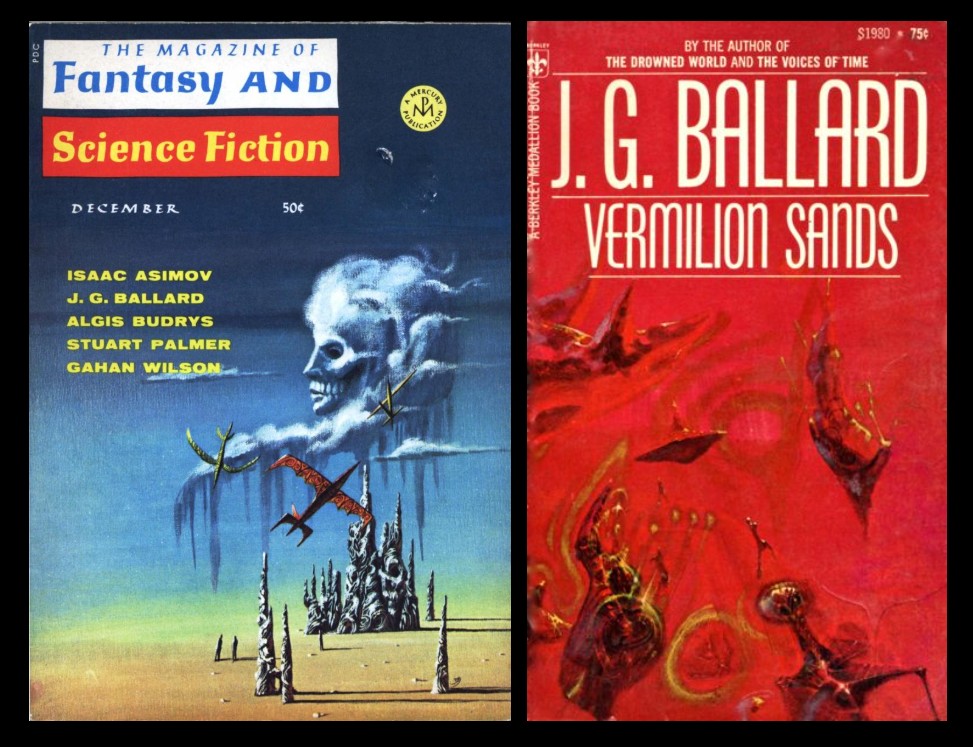
I reread “The Cloud Sculptors of Coral-D” by J.G. Ballard because my short story reading group is reading The Best Fantasy from The Magazine of Fantasy and Science Fiction. Inclusion in this volume suggests its fantasy. However, it was also included in The Great Science Fiction Series edited by Martin H. Greenberg, Joseph Olander, and Frederik Pohl. The story contains no magic, no dragons or elves, and it’s set in our present day, but in a fictional resort called Vermillion Sands.
Vermillion Sands feels like a decadent playground for the rich, which also features the many kinds of parasites that live off the wealthy. It’s also an artist and expat colony. We don’t know its location, but it feels like Palm Springs, California. Many worldly travelers come and go there.
“The Cloud Sculptors of Coral-D” was my first introduction to J. G. Ballard back in the 1960s. Other stories from that setting make up the series, collected into Vermillion Sands.
“Prima Belladonna” (Science Fantasy, December 1956)
“Venus Smiles” (Science Fantasy, June 1957)
“Studio 5, the Stars” (Science Fantasy, February 1961)
“The Thousand Dreams of Stellavista” (Amazing Stories, March 1962)
“The Singing Statues” (Fantastic Stories, July 1962) (not in original collection)
“The Screen Game” (Fantastic Stories, October 1963)
“Cry Hope, Cry Fury!” (F&SF, October 1967)
“The Cloud-Sculptors of Coral D” (F&SF, December 1967)
“Say Goodbye to the Wind” (Fantastic, August 1970)
Wikipedia provides an excellent overview of the stories, highlighting that each dealt with a different artistic medium being affected by technology.
When I first read “The Cloud Sculptors of Coral-D” as a teen, it felt very grown-up to me. The characters were the kinds of people I met growing up in Miami, not the typical heroes of science fiction stories I spent so much time reading. It never occurred to me to think of the story as fantasy, but it didn’t seem like science fiction either. At the time, I was just discovering British science fiction writers like Brian Aldiss and John Brunner and the New Wave SF. The stories were set in the present or near future and took place on Earth. No rockets or robots. Was this actual science fiction?
“The Cloud Sculptors of Coral-D” is about a band of glider pilots who shape clouds with silver iodide. At first, their audience and patrons are people who park their cars along the lagoon road to watch. Eventually, the Garbo-like Leonora Chanel hires them to perform for her party. Sculpting clouds is a neat idea, but far from realistic. Does that make the story science fiction? Ballard does throw in a creature called sand rays, which I suppose are like manta rays that live under the sand instead of the sea. Do they make the story a fantasy?
Science fiction has often been the dumping ground for any kind of weird story that can’t be classified. The Vermillion Sands stories would have been rejected by mainstream and literary magazines. They fit nicely in The Magazine of Fantasy & Science Fiction. They were also published in the British magazine Science Fantasy and the American Fantastic. Only one was published in a straight-ahead science fiction magazine, Amazing Stories. I doubt John W. Campbell would have accepted them in Astounding or Analog. Nor would he have published them in Unknown. I wonder if Rod Serling would have used “The Cloud Sculptors of Coral-D” for The Twilight Zone?
I’m not fond of traditional fantasy, and many of the stories in The Best Fantasy from The Magazine of Fantasy and Science Fiction aren’t enjoyable for me to read. But I did enjoy “The Cloud Sculptors of Coral-D.” The story has a pleasant, surreal feel. The setting is very close to this world, but just a smidge off. I love the artist colony atmosphere, the hint of decadence, the ever-so-slight sense of unreality. The story combines barnstorming, carny folks, and the ugly rich. I visualize it as a cross between early Faulkner and Fellini.
The shortest description would be to say the story has atmosphere.
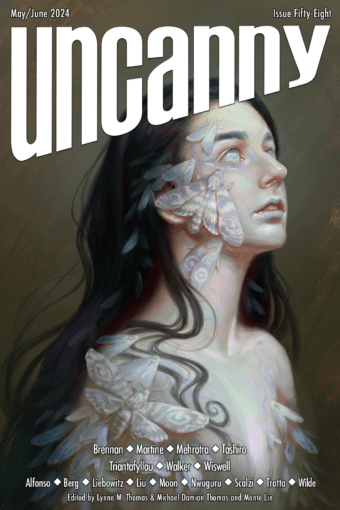
“Loneliness Universe” by Eugenia Triantafyllou appeared in Uncanny (#58, May/June 2024) and is a finalist for the 2025 Hugo Award in the Best Novelette category. You can read or listen to the story online. If you are a member of the 2025 Seattle Worldcon, you can vote for this story through July 23, 2025.
I first learned about the Hugo Awards back in the 1960s. I never attended a Worldcon but always wanted to. I did attend some regional conventions back in the 1970s. I kept up with the Hugo and Nebula awards for most of the 20th century, but slowly lost touch with science fiction and fandom in the 21st century. I discovered “Loneliness Universe” when I read Austin Beeman’s “Reviewing the 2025 Hugo Award Finalists: Best Novelettes” at his website www.shortsf.com.
I’m so impressed with “Loneliness Universe” that I will try to read all the finalists. I might even join the convention as a virtual member and vote. Members get a packet that includes many of the works up for voting. Membership is $50, and adding virtual attendance is another $35. There’s little chance I will physically attend a Worldcon, so that might be my best shot at achieving an old desire.
“Loneliness Universe” is not what I’d call science fiction. Nor would I categorize it as fantasy. One reason I let the science fiction genre pass me by is that it’s no longer what I thought it was supposed to be. That’s not a criticism. I just didn’t feel like keeping up with changing times. However, “Loneliness Universe” is an outstanding work of fiction.
The story begins with an email from Nefeli to Cara dated September 18, 2015. Throughout the story, we get to read email exchanges, but the next one is dated July 5, 2015. I don’t know if this is a spoiler, but the first email is the end of the story. I did not discover right away. In fact, I wouldn’t have discovered it at all if I hadn’t immediately reread the story by listening to it a second time.
I recommend you read this story the first time, then listen to it a second time.
I’m not going to spend much time describing this story. Read it. I will spend some time trying to explain what it’s doing.
There are infinite ways to understand fiction. One way is to think of fiction as a spectrum. At one end are stories where the author sends the readers a message. On the other end of that spectrum are stories where the author creates a story that is just a story.
Think of the first type as a message in a bottle from an individual stranded on a deserted island. And think of the second type as how some people describe God as an artist who created our existence but walked away.
In “Loneliness Universe,” Eugenia Triantafyllou has created a metaphor for our current cultural existence. In this story, Nefeli realizes she is losing physical contact with everyone she knows. She can only communicate with them through email and instant messages. They can leave evidence of their existence, but she no longer communicates with people face-to-face.
The setup for this story reminds me of an experience I had on LSD fifty-five years ago. I thought everyone was in an isolated universe by themselves, and our efforts to communicate in words were no better than writing a message, putting it in a bottle, and throwing it into the sea, hoping for a reply. That each of us was an isolated universe inside our heads. In Eugenia’s story, she imagines we’re all moving into separate universes of a multiverse, and for a while, can communicate via email and instant messages. This sounds science-fictional, but it’s probably more Kafkaesque.
The thing about metaphors is not that they are accurate, true, or valid, but that they make you think about a concept from a new perspective. In recent weeks, I’ve often woken in the middle of the night and thought about all the hundreds of people I’ve known in my lifetime and wondered about what has happened to them. And I ask myself, did we ever really communicate? This is what “Loneliness Universe” is about. Are we on the same wavelength?
Are we ever in the same room at the same time with someone else? If you truly understand this question, I will say those moments of being together are fleeting. Many people want to believe sex is a way to achieve such synchronicity, but that’s not true either. I don’t believe telepathy is possible, but sometimes, when two people have had the same life experiences, they can say just the right words, they know they have achieved a kind of psychic Venn diagram intersection for a fleeting moment.
“Loneliness Universe” is not a perfect story. It’s only as good as you can resonate with what Eugenia Triantafyllou is expressing. I don’t know how well her message in a bottle was decoded by my inner self. We will never be in the same room together. But I’d like to believe I know what she was trying to say.
“Brightness Falls from the Air” by Margaret St. Clair was first published in the April 1951 issue of The Magazine of Fantasy and Science Fiction as “?” F&SF ran it as a name-the-story contest. You can read it online here.
If I had been a reader in 1951, I would have submitted “The Plague.” If I had precognition, I would have submitted “The Ugly Terrans,” inspired by the 1958 bestseller, The Ugly American.
“Brightness Falls from the Air” shows writing development for Margaret St. Clair over her “The Listening Child,” published a year earlier. This story has bite. Humans occupy an alien planet where they treat the local intelligent life like the Romans treated conquered people. St. Clair instills this comparison in the first sentence, telling us her protagonist, Kerr, is in the tepidarium. Tepidarium was the name of a warm room positioned between the frigidarium and caldarium in Roman baths.
Kerr meets Rhysha, a bird person, and befriends her when she comes to claim the body of her brother, who died in a gladiatorial battle held by the humans. Throughout this short story, we learn humans have never curbed their population growth and have spread across the galaxy like a pandemic. We are not nice. Kerr tries to give Rhysha hope by telling her humans will one day change. Reading this story 73 years later, we know that’s unlikely.
I liked “Brightness Falls from the Air” so much more than “The Listening Child” (Group Read 92 #01 of 25) because it’s so dark. F&SF began as a light fantasy magazine, but as it included more science fiction, the overall tone of the magazine became heavier and darker. We’d entered the Cold War. Thoughts of nuclear annihilation become rampant.
Worrying about overpopulation in 1951, put Margaret St. Clair ahead of most other science fiction writers. Overpopulation wasn’t a major theme in SF until the 1960s – or so I thought until I read Joachim Boaz’s “Science Fiction Novels/Short Stories about Overpopulation.” Her story would be tied with “The Marching Morons” by C. M. Kornbluth as first since it was also published in April 1951, in Galaxy Magazine. Is it coincidence that both stories claim Homo sapiens are losers?
“Brightness Falls from the Air” could also fit into Boaz’s series concerning science fiction critical of space exploration. (I wish Joachim would put this series on the menu like his series on overpopulation, generation ships, and immortality.)
Even though I liked “Brightness Falls from the Air” much more than “The Listening Child,” they both have the same simple plot: a nice person sympathizes and befriends a tragic person who dies. In both stories, characterization is minimal. Each character is described by their relationship to the plot. None of these characters has their own agenda.
I admire “Brightness Falls from the Air” because it’s a vicious attack on humanity and says we shouldn’t colonize the galaxy. This feels even more valid in 2025. Yet, that’s not enough to make it a great story. It was included in David Hartwell’s The Science Fiction Century, so it’s better remembered than “The Listening Child.” However, it doesn’t have the lasting impact of “The Marching Morons.” It’s too slight.
“Brightness Falls from the Air” is a nice little story, but it’s not good enough to be great.
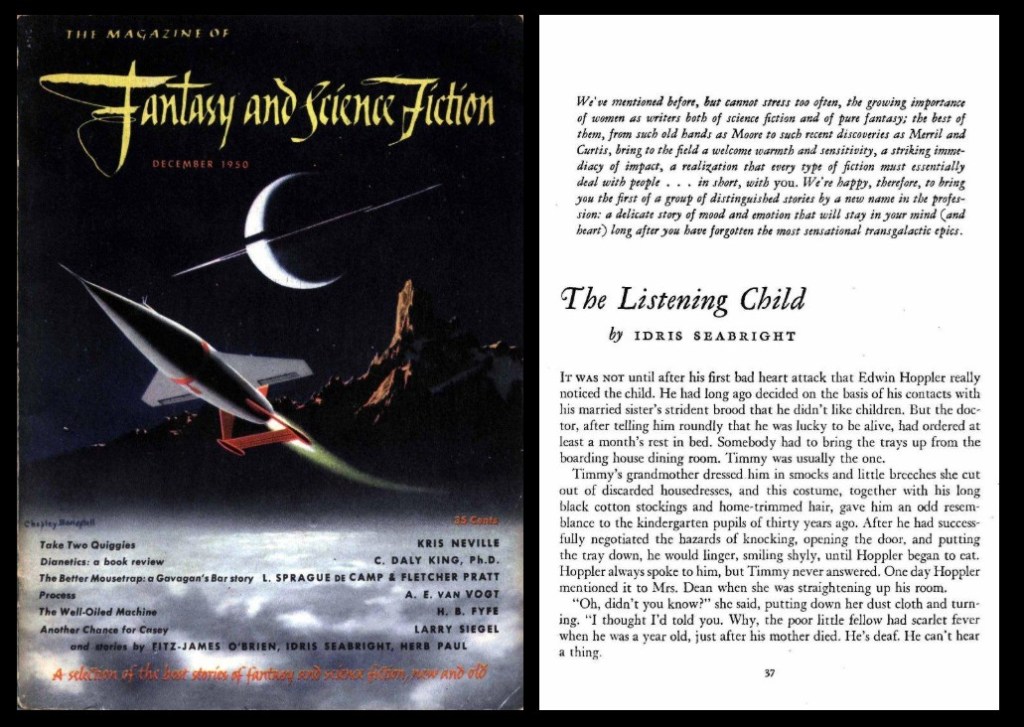
“The Listening Child” was first published in The Magazine of Fantasy and Science Fiction (December 1950) by Margaret St. Clair using the pseudonym Idris Seabright. You can read it online here. It is short story #1 of 25 that our Facebook group will be discussing as Group Read 92. (See the reading schedule at the end of this review.) Group Read 92 consists of 25 stories picked by five group members that we haven’t read before. That was a challenge since we’ve been discussing a short story daily for years. The group is public.
In the 1950s, extrasensory perception (ESP) was a popular theme in science fiction and fantasy magazines. It was often speculated that people with physical or mental abnormalities might have additional senses to compensate for the loss of one of their primary senses. I assume the assumption came from blind people who had keener hearing.
After Hiroshima, science fiction and comic book writers often used radiation as a cause of ESP. However, in the 1930s and 1940s, John W. Campbell was impressed by the Rhine experiments, and science fiction writers often supposed that advanced aliens had psychic powers. Arthur C. Clarke, who was normally a hard SF writer, proposed that the evolution of human development led to ESP in two of his most famous novels, Childhood’s End and 2001: A Space Odyssey. Soft science and fantasy writers leaned towards psi-powers in physically and mentally damaged humans, like Theodore Sturgeon’s More Than Human.
Margaret St. Clair imagines a deaf mute having a rather unique ESP talent. Timmy can “hear” when death is near. Many famous stories personify death, so this isn’t too out there, but it’s not as believable as other ESP talents, even though it is well proven that ESP does not exist. Still, hearing death makes for a nice story idea.
St. Clair’s setup for her story is rather quaint. Edwin Hoppler is 63 and suffers from a weak heart. He lives in a boarding house. Boarding houses have disappeared, but were common in old movies and science fiction short stories before the 1960s. Quite a few episodes of The Twilight Zone were set in boarding houses. It’s a shame they don’t still exist. Living with several other individuals who ate communal meals fixed by a nice old lady sounds pleasant.
Timmy is the landlady’s grandson, and Edwin feels sorry for him. Edwin befriends Timmy when he realizes that the other kids don’t play with Timmy. Edwin notices that Timmy “listens” intently at times, and eventually notices that these listening moments precede a person or animal dying. Edwin decides to use Timmy as the canary in a coal mine to detect his own impending heart episodes.
“The Listening Child” is a pleasant little story, but rather slight. Timmy and Edwin are only developed enough as characters to present the idea for the story. There’s little conflict or tension. The story also lacks color or voice. The idea is slight, but writers can flesh out simple ideas into complex characterization and plots. For example, compare it to “Jeffty is Five” by Harlan Ellison. Jeffty is a boy who is perpetually five, and always lives in the year he was five, with the popular culture never changing. Or read “Baby is Three” by Theodore Sturgeon; it’s tremendously dramatic for a boy with psychic powers talking to a psychiatrist.
I don’t want to tell you the ending, but I expected St. Clair thought her readers would find it emotional and poignant. It was presented too casually for me to be moved, but I’m curious if other members from our short story reading group will be moved. I wanted the ending to be like in Platoon when we see Elias still alive, and the emotional impact we felt watching him die.
I’m working on a project to find my all-time favorite science fiction stories I’ve read over the past sixty years. Identifying such stories means learning what makes a story work. Most published stories succeed at a basic three-star level, which is how I’d rate “The Listening Child.”
For this story to reach the four-star level, Timmy and Edwin would need to become vivid characters. To make it to a five-star story would require elevating the story gimmick of hearing death into something metaphorical and philosophical that I would want to contemplate over several readings.
James Wallace Harris, 4/21/25
Group Read 92 Schedule
01 (04/22/25) – The Listening Child, by Margaret St. Clair (ss) F&SF, December 1950 (DH)
02 (04/24/25) – Brightness Falls from the Air, by Margaret St. Clair (ss) F&SF, April 1951 (FP)
03 (04/26/25) – The Rose, by Charles L. Harness (na), Authentic Science Fiction, 15 March 1953 (PF)
04 (04/29/25) – The Last Day, by Richard Matheson (ss), Amazing, April/May 1953 (FP)
05 (05/01/25) – Watershed, by James Blish (ss), If, May 1955 (RH)
06 (05/03/25) – The Certificate, by Avram Davidson (ss), F&SF, March 1959 (FP)
07 (05/06/25) – To See the Invisible Man, by Robert Silverberg (ss), Worlds of Tomorrow, April 1963 (FP)
08 (05/08/25) – A Two-Timer, by David I. Masson (nv), New Worlds 159, February 1966 (PF)
09 (05/10/25) – The Adventuress, by Joanna Russ (nv), Orbit 2, ed. Damon Knight (Putnam, 1967) (RH)
10 (05/13/25) – No War, or Battle’s Sound, by Harry Harrison (nv), If, October 1968 (FP)
11 (05/15/25) – The Milk of Paradise, by James Tiptree, Jr. (ss), Again, Dangerous Visions, ed. Harlan Ellison (Doubleday, 1972) (RH)
12 (05/17/25) – Pale Roses, by Michael Moorcock (nv), New Worlds 7, ed. Hilary Bailey & Charles Platt (Sphere, 1974) (PF)
13 (05/20/25) – Concepts, by Thomas M. Disch (nv), F&SF, December 1978 (PF)
14 (05/22/25) – Gate of Faces, by Ray Aldridge (nv), F&SF, April 1991 (PF)
15 (05/24/25) – On Sequoia Time, by Daniel Keys Moran (ss), Asimov’s, September 1996 (PN)
16 (05/27/25) – Journey into the Kingdom, by M. Rickert (nv), F&SF, May 2006 (PN)
17 (05/29/25) – Roxie, by Robert Reed (ss), Asimov’s, July 2007 (PN)
18 (05/31/25) – 26 Monkeys, Also the Abyss, by Kij Johnson (ss), Asimov’s, July 2008 (DH)
19 (06/03/25) – Passage of Earth, by Michael Swanwick (ss), Clarkesworld 91, April 2014 (PN)
20 (06/05/25) – Cimmeria, by Theodora Goss (ss), Lightspeed 50, July 2014 (RH)
Most science fiction stories seem to go stale after a couple decades. This week, I listened to The Heads of Cerberus by Frances Stevens, initially published 106 years ago. The story had passed its expiration date decades ago, but I still found it mildly enjoyable as a historical curiosity.
If you’re not fascinated by the evolution of science fiction, I’ll understand you leaving this essay now. The Heads of Cerberus is not a forgotten classic. It gets points for being an early example of time travel and dystopian fiction written by a woman, but it’s not a good example. At best, it’s a sample from 1919, the kind that MIT Press is reprinting in its Radium Age science fiction series.
Gertrude Barrows Bennett (1884-1948) published several fantasy and science fiction stories between 1917 and 1923 as Francis Stevens. This makes her a pioneering author in the pre-Amazing Stories era, especially as a woman writer, but she is practically forgotten today. I just learned about Francis Stevens by reading a two-part review of “Sunfire” on Science Fiction and Fantasy Remembrance (Part 1, Part 2) by Brian Collins. That review inspired me to research her, and what I learned inspired me to read The Heads of Cerberus.
The Heads of Cerberus was first serialized in five 1919 issues of The Thrill Book. It was first printed in hardback in 1952. It’s been reprinted at least a dozen times since.
I listened to a free copy on LibriVox. There are several public-domain ebook editions available, here is one at Gutenberg Australia. Lisa Yaszek who edited The Future is Female! series for theLibrary of America recently published a collection of Francis Stevens’ stories at MIT Press Radium Age series called The Heads of Cerberus and Other Stories. Gertrude Barrows Bennett is getting rediscovered. However, she’s been rediscovered before, it just never sticks.
The Heads of Cerberus is about three people from 1918 Philadelphia traveling to Philadelphia in 2118. Bob Drayton is a disbarred lawyer. Terry Trenmore is his Irish friend who is a powerfully built giant. And Viola Trenmore, Terry’s beautiful little sister, and just seventeen. In 2118 they find a dystopian society run by a handful of weird characters. The story is painfully simple, although I enjoyed it somewhat. The fun in reading these old science fiction tales is not the storytelling, but seeing how people imagined science fictional ideas before the concept of science fiction was invented.
The 19th century had several tales of people traveling to the future that could have inspired Bennett, each with a unique method of time travel. In “Rip Van Wrinkle,” Washington Irving has his title character sleep for twenty years after drinking potent liquor. Edward Bellamy had Julian West sleep for 113 years via hypnosis in Looking Backward. Frances Stevens has her characters jump ahead two hundred years by sniffing grey dust from a vial of mysterious ancient origins. The vial’s stopper is shaped like Cerberus.
As I said, The Heads of Cerberus isn’t very sophisticated. Its tone reminded me of the Oz books by L. Frank Baum, which were for children. Those books were often about ordinary people meeting extraordinary beings in strange places. Bennett’s imagined future is minimalistic, and somewhat goofy, reminding me of Alice’s Adventures in Wonderland. However, Stevens lacks the creative imagination of Baum and Carroll.
Edward Bellamy created a complex economic system for his future society that inspired many readers in the 19th century to form over five hundred Nationalist Clubs based on socialist ideas in Looking Backward. Francis Stevens imagines an economy based on the number of hours worked. Her society was ruled by an elite called The Superlatives. Ordinary people didn’t have names but numbers, and the Superlatives had names based on cardinal virtues like the Loveliest, The Bravest, the Fastest, the Strongest, etc.
The main problem with Stevens’ science fiction is her future society isn’t a philosophical idea she believed in or promoted, but merely conjured up quickly to fit a plot. Bennett was a young widow, with a child and mother to support after her dad died. She was a stenographer but made extra money by writing for the pulps. She quit writing after her mother died. The Thrill Book that serialized The Head of Cerberus was a low-paying market, but Stevens sold three novels to Argosy, a much-admired pulp after it. They were Claimed, The Citadel of Fear, and Possessed: A Tale of the Demon Serapion. Even though they are dark fantasies, a genre I’m uninterested in, I should try one to see if her writing improved. Her first serial, The Labyrinth, was to All-Story in 1918, another legendary pulp.
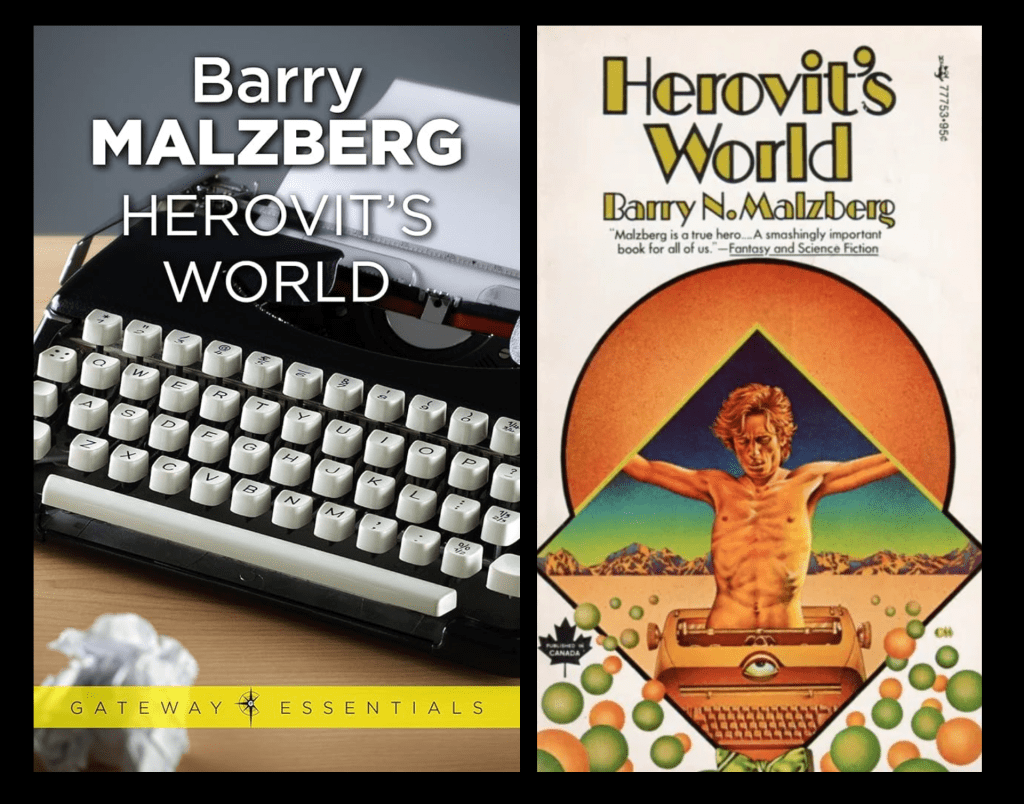
Back in the 1960s when other teens fantasized about becoming rock stars, playing for the NFL, or being seen on the silver screen, I dreamed about becoming a science fiction writer. After reading the 1973 satire on science fiction writers, Herovit’s World by Barry N. Malzberg, I see that I was much better off working with computers at a university for thirty-five years and retiring with a pension. You can currently buy the Kindle edition for $1.99. But read my review carefully before you risk even that little money. It’s a good read for only certain kinds of science fiction fans.
Barry N. Malzberg died on December 19, 2024, at 85. Although prolific, he was never a famous science fiction writer. Malzberg’s most successful books were written in the 1970s, and Barry is mostly forgotten today. He is getting some attention on YouTube as a few reviewers rediscovering him. Malzberg has a reputation as being the curmudgeon of science fiction. Malzberg often relies on satire, but his stories were never fun like the satires of Kurt Vonnegut. Malzberg wrote dark, edgy, and psychological fiction like Philip K. Dick, but he never developed a cult following.
Recently, Bookpilled on YouTube declared that Malazberg was his new favorite science fiction writer. Bookpilled skews towards literary and dark SF, often from the 1970s. But to be honest, Malzberg is very hit-and-miss. Joachim Boaz, a true connoisseur of seventies science fiction, found little to love in The Many Worlds of Barry Malzberg. Boaz considered most stories good but rated “Death to the Keeper” brilliant. Boaz also called Malzberg’s most notable novel Beyond Apollo brilliant, giving it a 5 out of 5 rating.
Be sure to read MPorcius’ extensive review who believes Herovit’s World was overpromoted by Robert Silverberg and Harlan Ellison, but he did like it a lot.
And if you pay attention, Malzberg is mentioned occasionally on YouTube, print reviews, blogs, and podcasts. Three years ago, the biographer Alec Nevala-Lee interviewed Malzberg for two hours.
Herovit’s World is a short novel, 160 pages in paperback, and just under six hours on audio. Jonathan Herovit, our protagonist, has written 92 science fiction novels in the past but struggles to finish his latest book. It’s overdue. He only has thirty pages and his editor is hounding him. His wife is hounding him. He’s stuck in a small apartment with a new baby who cries endlessly. Herovit is approaching forty, well on the road to being an alcoholic, depressed, delusional, and coming apart mentally.
Herovit wants to be like Mack Miller, the fictional action hero of his endless Survey Team novels. Herovit wants to be like the decisive Kirk Poland, his alter-ego and pen name for his books. Jonathan Herovit has turned Kirk Polan into an imaginary friend, one that’s become an abusive second personality.
Malzberg uses this novel to satirize editors, publishers, authors, readers, fans, conventions, writer conferences, writer associations, and the science fiction genre. We never know if Herovit’s World is autobiographical. Herovit is self-loathing. Is this Malzberg confessing his own feelings, or just creating a character. But if you read Malzberg’s three books of essays, The Engines of the Night: Science Fiction in the Eighties (1982), Breakfast in the Ruins (2007), or The Bend at the End of the Road (2019) you’ll get the feeling that he did use his own life for inspiration.
Malzberg is confusing. He has stated that he loves science fiction and the genre. Listen to the podcast above. But science fiction also depressed him, even tormented the poor guy. Herovit’s World is recursive science fiction. That is science fiction about science fiction. Often recursive science fiction is fun, even zany, like What Mad Universe by Fredric Brown or God Bless You, Mr. Rosewater by Kurt Vonnegut. Herovit’s World is full of creative ideas and psychological observations, but they’re not fun. Malzberg feels more like Kafka.
Malzberg and Herovit are hack writers. They pride themselves on cranking out any style or type of fiction and getting paid for first drafts. However, Herovit’s World reads quite well. It has its literary aspects and is full of fun experimentation. I’m glad I read it even though it’s about an unhappy man going down the tubes. And it does make you think about science fiction.
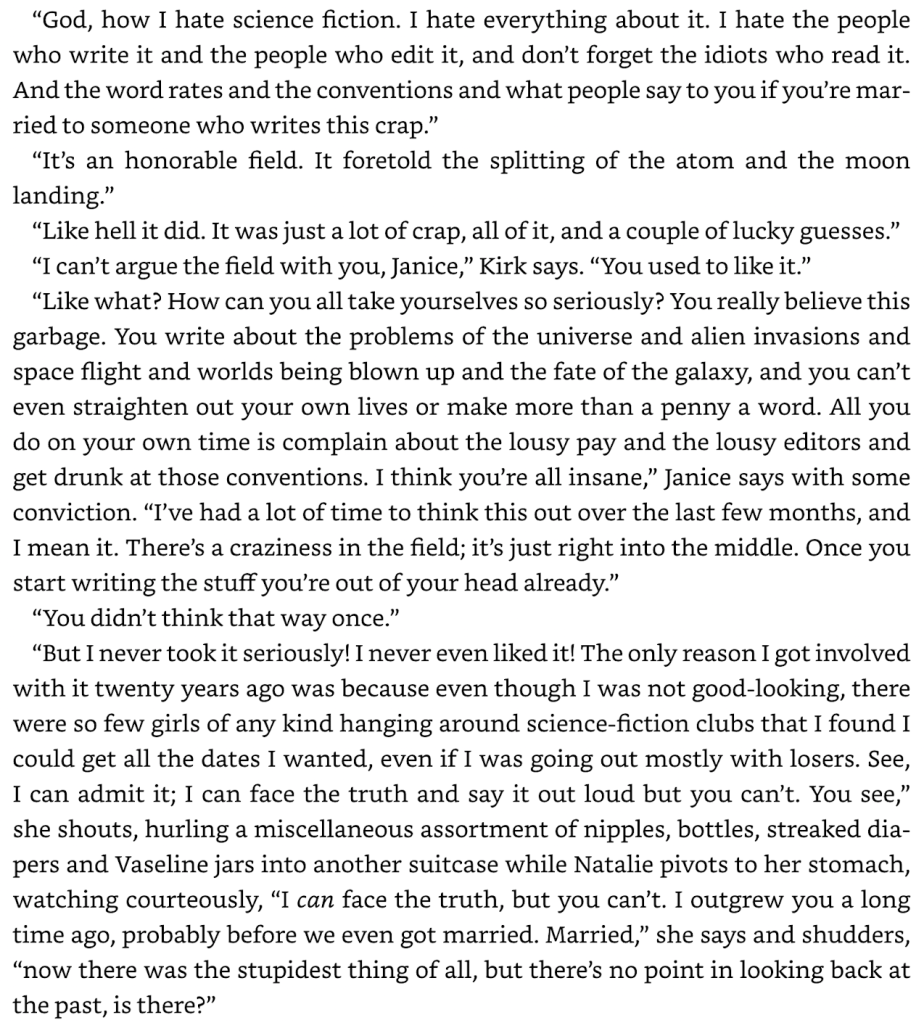
Malzberg was several years younger than Herovit. Herovit’s writing career began in the 1950s, while Malzberg started publishing in the 1960s. Herovit remembers the science fiction magazine boom of 1953. Herovit was a disciple of John Steele, who I assume is based on John W. Campbell. So is Malzberg really making fun of 1950s science fiction? At one point in an argument with his wife Janice, she gives a bit of a speech which might be the key to the whole story:
I also remember when there were very few females at science fiction clubs and conventions. Boy have things changed. We must acknowledge that Malzberg skewers SF of the 1950s or 1960s in Herovit’s World. But we should also ask: “How would a disgruntled SF writer skewer the genre today?”
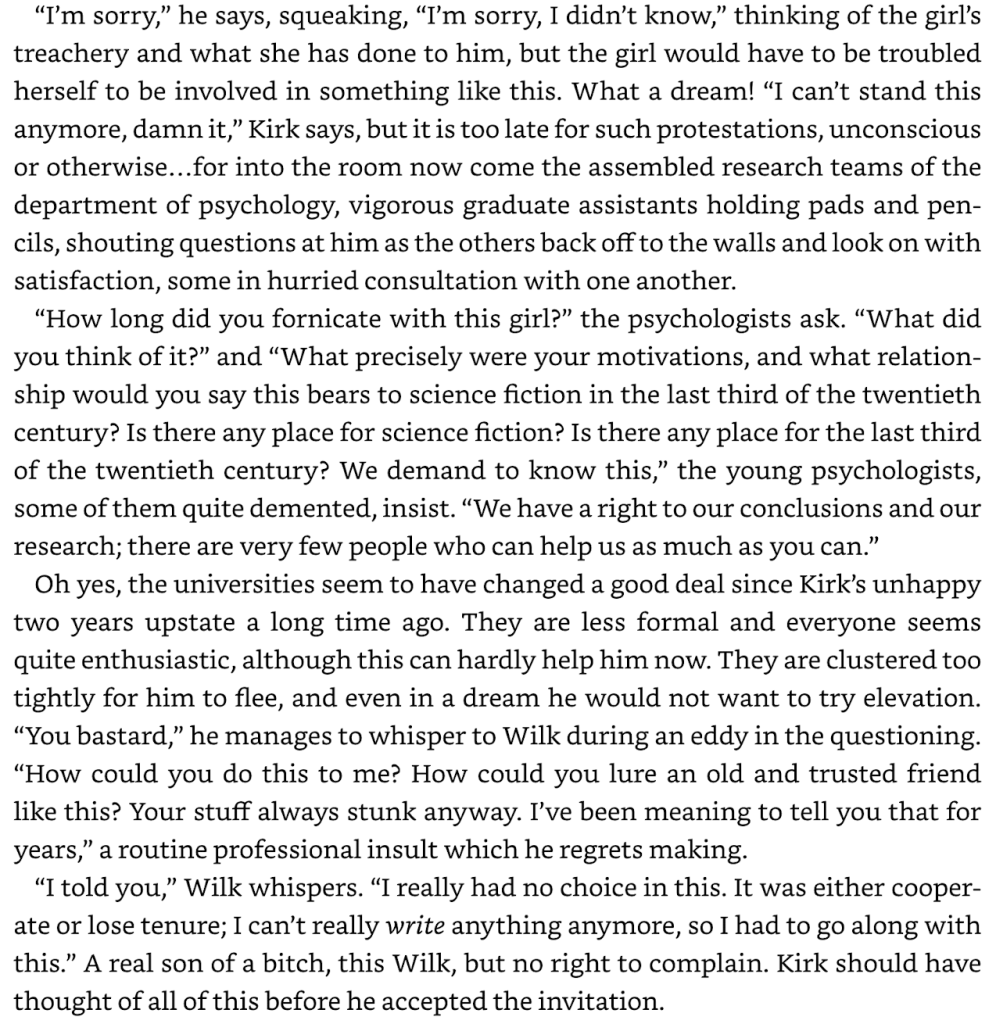
There is a dream sequence late in the novel where Herovit is having tremendous sex with a college coed. He had been invited to a conference and the coed approached him telling Herovit that Kirk Poland was her favorite writer. It turns out she was paid by the university to seduce Herovit so he could be studied for academia. Science fiction was getting noticed by the academic world in the early 1970s. Many writers and fans felt vindicated. However, other writers claimed science fiction was better left in the gutter. Malzberg uses this scene to give his opinion:
Herovit and Malzberg regretted giving so much of their creative effort to a genre that gets so little respect. They know they are writing escapism for adolescents. I think the genre has changed a lot since the 1970s. It does get more respect and it’s taken more seriously, probably because it deserves it. However, some of Malzberg’s criticisms might still be true, especially once you analyze why certain stories and themes are so popular with science fiction fans.
A good deal of Herovit’s World is about marriage. Herovit routinely cheats on his wife at science fiction conventions and neglects her at home. I’ve heard plenty of gossip about science fiction writers at conventions and conferences. But there is a non-SF connection here. There are many literary novels about blocked writers and failed marriages. I can’t tell if Malzberg is satirizing them too, or padding his SF novel. Both Herovit and Malzberg have bragged about being able to pad their fiction. My favorite novel on this theme is Wonder Boys by Michael Chabon, who writes in literary and SF genres.
Herovit’s World also contains a lot of sex. Malzberg got his start as a writer cranking out soft-core porn paperbacks. I don’t know if he’s saying that science fiction writers are sex obsessed, or sexually frustrated, or if he was merely padding his story because he didn’t have enough to say about science fiction to fill out the novel length. I do know that Portnoy’s Complaint by Philip Roth had come out a few years earlier and had become a bestseller dealing with sex honestly. As they say, “sex sells,” and Malzberg was hoping to break out of the science fiction ghetto.
Overall, Herovit’s World is mildly amusing. Most readers at Goodreads give it three stars, but a few love it giving it five stars. My rating would be ***+. I thought it was written well enough (***) and I liked it (+), but I wouldn’t ever reread it. That’s my main problem with Barry N. Malzberg. His books are interesting, but they never reach my next rating level. I give **** to books I know I’ll want to reread.
If Herovit’s World was less padded with sex scenes and had more satire about science fiction, it could have been a **** novel with me. If Malzberg had tried harder, gone beyond a first draft maybe, and really thought about the purpose of this novel, it could have been far better.
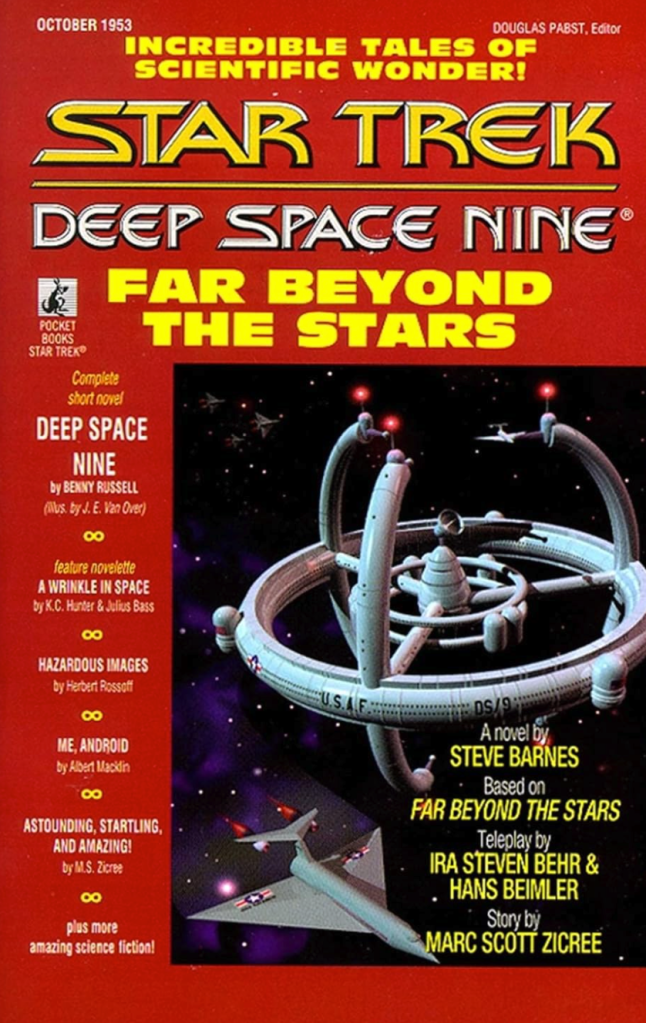
Malzberg focused on the pathetic without ever showing what we love about science fiction. His novel could have been elevated by showing Malzberg/Herovit’s passion for the genre. Far Beyond the Stars by Steven Barnes is a recursive science fiction novel that does just that. The story is a novelization of a Star Trek: Deep Space Nine episode where the DS9 crew are shown working at a 1950s science fiction magazine much like Galaxy Science Fiction. The story criticizes the racism in the genre back then yet still shows a love for science fiction.
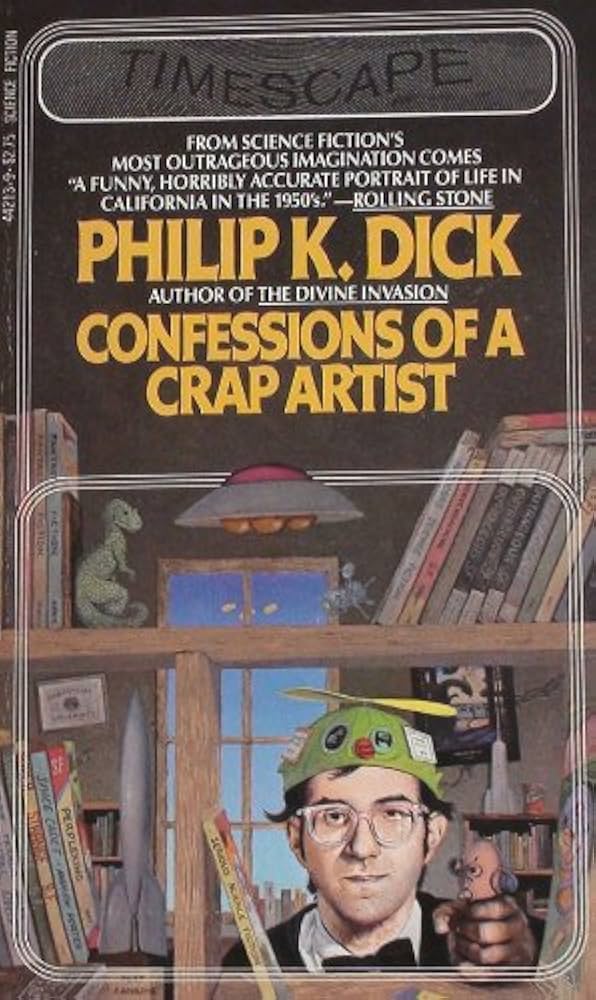
No matter how much I criticize science fiction, I can never forget how much Heinlein’s juveniles meant to me as a kid. I could write a satire on the genre, but I hope I wouldn’t do what Malzberg did in Herovit’s World, by making it all feel slimy and depressing. One reason why my favorite Philip K. Dick novel is Confessions of a Crap Artist is even though it criticizes science fiction fans, it does it with love. It’s a superior recursive science fiction novel.
For thirty-five years (1984-2018) I depended on Gardner Dozois to tell me about the state of short science fiction in his annual The Year’s Best Science Fiction. After he died, there were still many best-of-the-year anthologies to consult, but none had the extensive wrap-up of the year in science fiction that Dozois produced. By 2024 some of those anthologies have died off, making me wonder if the science fiction short story is dying off too.
Print magazines have lost subscribers for decades, and influential online publishers continually complain about a lack of funding. Today I read an article in Business Insider about how the plurality of companies selling online makes it hard to know what to buy. My theory is there are too many publishers for science fiction short stories. It’s great for new writers wanting to get published, but it’s bad for us readers because we’re reading stories that would have remained in the slush pile decades ago.
Before the internet, fans of short science fiction bought The Magazine of Fantasy & Science Fiction, Analog, Asimov’s, and an occasional original anthology like Orbit. There were semi-pro magazines, but few read them. Because there were fewer slots where a story could appear the competition to get into one was greater.
John Joseph Adams in The Best American Science Fiction and Fantasy 2024 gives a fair overview of science fiction short story publishers. His anthology publishes twenty stories each year. Ten science fiction and ten fantasy. As the series editor, he picks 80 stories to give to the guest editor, who picks the 20 that are published. Here are the publications he used, with the number of stories included in the 80 in parentheses.
Lightspeed (7)
Clarkesworld (5)
Uncanny (5)
Beneath Ceaseless Skies (4)
The Magazine of Fantasy & Science Fiction (4)
Reactor (formally Tor.com) (4)
Asimov’s Science Fiction (3)
The Sunday Morning Transport (3)
Fantasy Magazine (2)
McSweeney’s (2)
Bourbon Penn (1)
Cast of Wonders (1)
Escape Pod (1)
FIYAH (1)
Nightmare (1)
PseudoPod (1)
The Dark (1)
Since this is only 46 stories, the other 34 must have come from author collections and original anthologies. Adams said he also read these periodicals:
Analog
Apex Magazine
Apparition Lit
Baffling Magazine
The Kenyon Review
khōréō
Vastarien
Weird Horror
This doesn’t cover all the publishers of short science fiction. By the way, some of these periodicals are for fantasy and horror. I only care about science fiction, so I’m disappointed with every other story in The Best American Science Fiction and Fantasy 2024. You can read Adams’s introduction by reading the sample at Amazon. It’s mostly about his selection process but it gives a good insight into what’s being published.
Because so many science fiction short stories are being published I’ve given up trying to follow the genre during the year by reading the periodicals. I just wait for the annual best-of-the-year anthologies. I occasionally buy F&SF, Analog, or Asimov’s, but F&SF has too little SF, Analog has too many minor stories, and Asimov’s has become rather hit-and-miss. I can’t but wonder if they’d get better stories if the online markets didn’t exist.
Neil Clarke’s The Best Science Fiction of the Year: Volume 8 is more to my taste, but it’s over a year behind. Volume 8 covering 2022 stories, came out in September 2024.
Clarke reports finding a huge number of print magazines:
Analog
Asimov’s
Bourbon Penn
Clarkesworld
Cossmass
Infinities
Dark Matter
The Dread Machine
Dreamforge
Fusion
Fragment
Galaxy’s Edge
Infinite Worlds
Lady Churchhill’s Rosebud Wristlet
Luna Station Quarterly
The Magazine of Fantasy and Science Fiction (F&SF)
Interzone
Metaphorosis
On Spec
Planet Scumm
Pulphouse
Pulp Literature
Reckoning
Shoreline of Infinity
Space and Time
Underland Arcana
Weird Tales
Wyldblood
That blows my mind. I never see most of those titles. Clarke’s State of the Union of SF short stories is comprehensive. I guess he’s the new Gardner Dozois. Even if you don’t buy Clarke’s anthology, you can read his introduction in the sample at Amazon. I won’t summarize what he says, it covers what my title above claims but only hints at. Go read his overview.
Allan Kaster publishes two best-of-the-year anthologies. They showcase SF stories about hard science fiction and AI/robots. Kaster comes closest to what I want to read. I think Kaster succeeds because he defines his science fiction narrowly and only publishes twelve to fifteen stories. Before Gardner Dozois blew up the size of annual best-of-the-year SF anthologies, editors like Donald Wollheim, David Hartwell, and Terry Carr just picked ten to fifteen stories each year too. Check out his two series: The Year’s Top Hard Science Fiction Stories and The Year’s Top AI and Robot Stories.
There is an overwhelming number of science fiction short stories to read coming out. In that regard, the industry is doing great. Remember the lament in Business Insider, there are too many sellers. It makes selecting difficult and lowers overall quality. Back in 1953, there was an SF magazine boom, with over forty titles published. That boom crashed because the genre couldn’t support that many titles. I wonder if that will be true today? Or does the Internet allow for countless tiny markets supported by a handful of faithful fans? If that’s true, it might be better to ignore the larger genre, and just find a comfortable niche.
Science fiction is best when it’s full of wonder. When I first read The Time Machine by H. G. Wells, I was awed by the idea of time travel, but two other ideas wowed me even more. Wells got me to imagine future human evolution and posthumans, and he introduced me to the idea that the Earth would someday end. It was easier to imagine the Earth being created, but it was overwhelming to think about it dying.
Hothouse by Brian W. Aldiss is one of the great works of the Dying Earth subgenre of science fiction. There are various ideas about what constitutes a dying Earth setting. Some people consider it to happen when humanity dies off. I like to think it’s when the Earth is about to be destroyed. That’s the approach Aldiss takes in Hothouse. He tells us the Sun will go nova in a few generations, but Aldiss doesn’t quite take us to Earth’s death
Jack Vance’s famous novel The Dying Earth (1950) is set in the far future, too. The sun is nearing the end of its life, and the Earth and humanity have drastically changed. In The Time Machine, the Time Traveler visits the far future just before the sun, as a red giant destroys the Earth. In The Night Land (1912) by William Hope Hodgson, the Sun Is going dark, and humanity is almost gone.
Only Wells and Aldiss imagined the final productions of evolution. Olaf Stapledon pictures eighteen more species of humans coming after us in Last and First Men (1930). Aldiss imagines a variety of descendants for humanity in Hothouse, all exceedingly small. He also imagines the plant kingdom going bonkers, which reminded me of The Forgotten Planet (1954) by Murray Leinster. That novel was based on three stories, first published in 1920, 1921, and 1953. It was about a world we had colonized. Those explorers eventually evolved becoming tiny beings, competing with giant plants and insects for survival.
I reread Hothouse by Brian W. Aldiss because it was recently released in an audiobook edition on October 15, 2024. It’s a novel I’ve been waiting years to hear. I first read Hothouse in 1996 and thought it was an amazing story full of colorful imagery and adventure. I wanted to see it as a movie because of Aldiss’ powerful visual imagination. After I got into audiobooks in 2002, I wanted to reread all my favorite science fiction books by listening to them. I finally got my wish with Hothouse, with excellent narration by Nick Boulton.
In this fix-up novel, the sun is swollen, and Earth’s rotation is locked so only one side faces the Sun. The Moon trails the Earth’s orbit in a Trojan orbit that keeps it stationary in the sky. Earth is a riot of vegetation that has supplanted most of the animal kingdom. Humans have evolved into tiny beings one-fifth our size, while insects have grown monstrously large. Plants have mutated into countless strange configurations, including those that traverse between the Earth and the Moon on giant webs.
Hothouse is a fixup novel composed of five stories that appeared in The Magazine of Fantasy & Science Fiction in 1961.
“Hothouse” (novelette)
“Nomansland” (novelette)
“Undergrowth” (novella)
“Timberline” (novelette)
“Evergreen” (novella)
Hothouse was originally published in the United States as The Long Afternoon of Earth in a slightly abridged format. At the 1962 Worldcon, the five stories as a series won the Hugo Award for best short story. I prefer the forgotten American title, it’s more poetic.
I thoroughly enjoyed listening to this novel, but it didn’t have the impact it had on first reading. (Imagine watching The Sixth Sense for a second time.) Aldiss produces some wonderful science fictional ideas in this story, ones I won’t mention because that might spoil the story. This is one of those tales you should experience without knowing too much. The story feels like a children’s fantasy with all the funny names for evolution’s new creations, but I believe Aldiss was serious in trying to make it science fiction.
Think of the writing challenge of describing an impossible-to-imagine far future. Jack Vance pictured humans with magical powers as if evolution would eventually create them. Magic makes his Dying Earth stories fun, but not realistic. William Hope Hodgson imagined Earth in darkness where humanity clings to one giant city. I guess Clarke did that too. Aldiss imagines species descendants from us living in another kind of Garden of Eden, a very violent one. We could call it Darwin’s Eden, rather than God’s.
Hothouse is mostly a forgotten classic. I seldom meet people who have read it. Brian W. Aldiss’s reputation and back catalog aren’t well-remembered in today’s popular culture. Now that several of his books have been republished in audio, I’m giving him another chance. I hope other SF fans do too.
My favorite work by Aldiss is “An Appearance of Life” which I’ve reviewed three times. I keep hoping to find more Aldiss stories that impress me as much. Hothouse comes close. So does “The Saliva Tree.” Greybeard isn’t on the same level as those tales, but it’s still thought-provoking.







 Classics of Science Fiction