
by James Wallace Harris, 5/12/25
I’ve been getting back into Ray Bradbury again. I loved The Martian Chronicles and The Illustrated Man when I was young, but then I forgot about Ray Bradbury for a long time. I came late to Fahrenheit 451, and I’m embarrassed to admit it, but I loved the Truffaut film more than the book. In 2015, I reread The Martian Chronicles. I was dazzled. Yet again, I quickly moved on. Bradbury has a sweet quality that I can’t overindulge.
However, over the last five years, I’ve been gorging on science fiction short stories, and I’ve been surprised by how often his stories show up in anthologies. Then, a few weeks ago, I read The Bradbury Chronicles, a biography of Ray Bradbury by Sam Weller. Bradbury’s life was riveting, inspiring me to read more of his work. According to the Library of Congress, Bradbury published over 600 short stories. According to the Weller biography, by the late 1940s, Bradbury was writing and publishing a short story a week.
Piet Nel sent me a spreadsheet with 375 stories from all of Bradbury’s major collection. Piet also said, “Ray Bradbury: The Life of Fiction, by Eller & Touponce (2004), has a comprehensive story list, compiled with academic rigor, up to 2002. It runs to about 400 stories.” So, it’s hard to reconcile the 600 number from the Library of Congress. Piet also sent me the link to Phil Nichols’ site and his Short Story Finder.
Piet also emailed me this comment, which I will quote:
I think it's quite simple. If you read everything collected up to and including 1980, I think you've read as much Bradbury as all but serious experts need to read. The later collections get progressively weaker and the last ones are mostly leftovers. In saying all that, I am referring to the short fiction only. I've never liked the late detective novels because, for me, they seem a bit Nancy Drew-ish.

The short course is simply to read The Stories of Ray Bradbury (1980), which is more essential than Bradbury Stories: 100 of His Most Essential Tales.

The intermediate course is to read The Martian Chronicles, The Illustrated Man, The Golden Apples of the Sun, The October Country, Dandelion Wine (a disguised story collection), A Medicine for Melancholy, The Machineries of Joy, R Is for Rocket (without duplicates), S Is for Space (without duplicates), I Sing the Body Electric!, Long After Midnight, and The Stories of Ray Bradbury (again without duplicates, which leaves about five stories).

After that, it's expert level.
I just don’t want to read that many Ray Bradbury stories. I just want to read his best stories, but I’m unsure which ones are the best. I’m partial to his science fiction stories, but I’m willing to read any type as long as they are among his best. I started listening to Golden Apples of the Sun and Other Stories, and my response varied significantly. I own copies of Bradbury Stories: 100 of His Most Celebrated Tales and The Stories of Ray Bradbury, but they aren’t available on audio at Audible.com. Since I want audio editions, I will buy A Medicine for Melancholy and Other Stories next. After that, I’m not sure.
Piet Nel, in our short story reading group, created this graph showing the stories in The Golden Apples of the Sun and Other Stories (peach 1-32) and A Medicine for Melancholy and Other Stories (blue-gray 33-63). Those two collections reprinted many of the stories in the four previous collections (orange, blue, red, green). The numbers in the four earlier collections are the story’s position in the table of contents.
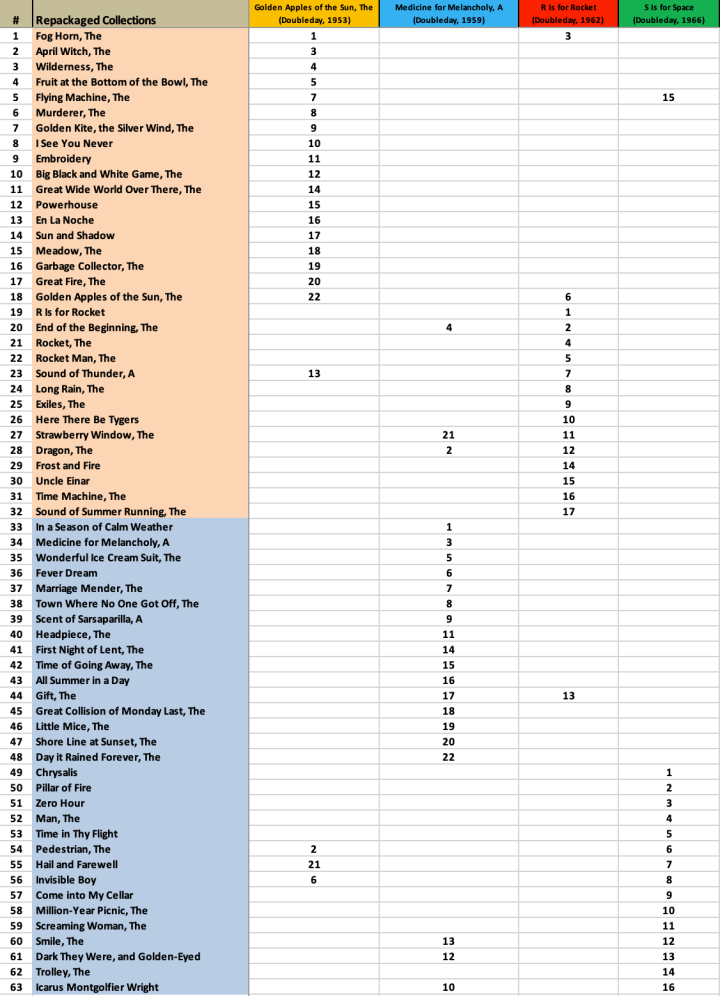
I told my friend Mike, a computer programmer, and he decided that comparing the collections of Ray Bradbury’s short stories is an interesting programming problem.
It all depends on what you want.
- All of his stories – would buying all his collections do that?
- The best stories – who knows how many collections.
- The fewest collections with the least duplicates.
- Just science fiction?
- Maybe add fantasy?
- Just the literary works. Mysteries.
- Just in ebook, or audiobook, or in print?
Mike might make this an interactive program if enough people are interested, but for now, he’s just testing the idea by generating reports. Here’s the latest one showing 30 of 1003 combinations generated so far.
As you can see, we’re only working with a handful of his collections, and the maximum number of stories is 256.
-------------------------------------------------------
Group 1

1: Bradbury Stories: 100 of His Most Celebrated Tales
2: Driving Blind
3: The Golden Apples of the Sun and Other Stories
4: I Sing the Body Electric and Other Stories
5: The Illustrated Man
6: The Martian Chronicles
7: A Medicine for Melancholy and Other Stories
8: The Stories of Ray Bradbury

Total unique stories:     256
Total duplicate stories:  100
-------------------------------------------------------
Group 2

1: Bradbury Stories: 100 of His Most Celebrated Tales
2: Driving Blind
3: The Golden Apples of the Sun and Other Stories
4: I Sing the Body Electric and Other Stories
5: The Illustrated Man
6: The Martian Chronicles
7: A Medicine for Melancholy and Other Stories
8: S is for Space
9: The Stories of Ray Bradbury

Total unique stories:     256
Total duplicate stories:  116
-------------------------------------------------------
Group 3

1: Bradbury Stories: 100 of His Most Celebrated Tales
2: Driving Blind
3: The Golden Apples of the Sun and Other Stories
4: I Sing the Body Electric and Other Stories
5: The Illustrated Man
6: The Martian Chronicles
7: A Medicine for Melancholy and Other Stories
8: R is for Rocket
9: The Stories of Ray Bradbury

Total unique stories:     256
Total duplicate stories:  117
-------------------------------------------------------
Group 4

1: Bradbury Stories: 100 of His Most Celebrated Tales
2: Driving Blind
3: The Golden Apples of the Sun and Other Stories
4: I Sing the Body Electric and Other Stories
5: The Illustrated Man
6: The Martian Chronicles
7: A Medicine for Melancholy and Other Stories
8: R is for Rocket
9: S is for Space
10: The Stories of Ray Bradbury

Total unique stories:     256
Total duplicate stories:  133
-------------------------------------------------------
Group 5

1: Bradbury Stories: 100 of His Most Celebrated Tales
2: Driving Blind
3: I Sing the Body Electric and Other Stories
4: The Illustrated Man
5: The Martian Chronicles
6: A Medicine for Melancholy and Other Stories
7: R is for Rocket
8: The Stories of Ray Bradbury

Total unique stories:     253
Total duplicate stories:  88

Group 4 stories that are not in Group 5:
	En la Noche
	The Murderer
	Sun and Shadow
-------------------------------------------------------
Group 6

1: Bradbury Stories: 100 of His Most Celebrated Tales
2: Driving Blind
3: I Sing the Body Electric and Other Stories
4: The Illustrated Man
5: The Martian Chronicles
6: A Medicine for Melancholy and Other Stories
7: R is for Rocket
8: S is for Space
9: The Stories of Ray Bradbury

Total unique stories:     253
Total duplicate stories:  104
-------------------------------------------------------
Group 7

1: Bradbury Stories: 100 of His Most Celebrated Tales
2: Driving Blind
3: The Golden Apples of the Sun and Other Stories
4: The Illustrated Man
5: The Martian Chronicles
6: A Medicine for Melancholy and Other Stories
7: The Stories of Ray Bradbury

Total unique stories:     252
Total duplicate stories:  75

Group 6 stories that are not in Group 7:
	Christus Apollo
	Drink Entire: Against the Madness of Crowds
	The Lost City of Mars
	One Timeless Spring

Group 7 stories that are not in Group 6:
	En la Noche
	The Murderer
	Sun and Shadow
-------------------------------------------------------
Group 8

1: Bradbury Stories: 100 of His Most Celebrated Tales
2: Driving Blind
3: The Golden Apples of the Sun and Other Stories
4: The Illustrated Man
5: The Martian Chronicles
6: A Medicine for Melancholy and Other Stories
7: S is for Space
8: The Stories of Ray Bradbury

Total unique stories:     252
Total duplicate stories:  91
-------------------------------------------------------
Group 9

1: Bradbury Stories: 100 of His Most Celebrated Tales
2: Driving Blind
3: The Golden Apples of the Sun and Other Stories
4: The Illustrated Man
5: The Martian Chronicles
6: A Medicine for Melancholy and Other Stories
7: R is for Rocket
8: The Stories of Ray Bradbury

Total unique stories:     252
Total duplicate stories:  92
-------------------------------------------------------
Group 10

1: Bradbury Stories: 100 of His Most Celebrated Tales
2: Driving Blind
3: The Golden Apples of the Sun and Other Stories
4: The Illustrated Man
5: The Martian Chronicles
6: A Medicine for Melancholy and Other Stories
7: R is for Rocket
8: S is for Space
9: The Stories of Ray Bradbury

Total unique stories:     252
Total duplicate stories:  108
-------------------------------------------------------
Group 11

1: Bradbury Stories: 100 of His Most Celebrated Tales
2: Driving Blind
3: The Golden Apples of the Sun and Other Stories
4: I Sing the Body Electric and Other Stories
5: The Martian Chronicles
6: A Medicine for Melancholy and Other Stories
7: The Stories of Ray Bradbury

Total unique stories:     251
Total duplicate stories:  85

Group 10 stories that are not in Group 11:
	The Concrete Mixer
	Epilogue (The Illustrated Man)
	The Highway
	The Other Foot
	Prologue: The Illustrated Man

Group 11 stories that are not in Group 10:
	Christus Apollo
	Drink Entire: Against the Madness of Crowds
	The Lost City of Mars
	One Timeless Spring
-------------------------------------------------------
Group 12

1: Bradbury Stories: 100 of His Most Celebrated Tales
2: Driving Blind
3: The Golden Apples of the Sun and Other Stories
4: I Sing the Body Electric and Other Stories
5: The Martian Chronicles
6: A Medicine for Melancholy and Other Stories
7: S is for Space
8: The Stories of Ray Bradbury

Total unique stories:     251
Total duplicate stories:  101
-------------------------------------------------------
Group 13

1: Bradbury Stories: 100 of His Most Celebrated Tales
2: Driving Blind
3: The Golden Apples of the Sun and Other Stories
4: I Sing the Body Electric and Other Stories
5: The Martian Chronicles
6: A Medicine for Melancholy and Other Stories
7: R is for Rocket
8: The Stories of Ray Bradbury

Total unique stories:     251
Total duplicate stories:  102
-------------------------------------------------------
Group 14

1: Bradbury Stories: 100 of His Most Celebrated Tales
2: Driving Blind
3: The Golden Apples of the Sun and Other Stories
4: I Sing the Body Electric and Other Stories
5: The Illustrated Man
6: The Martian Chronicles
7: R is for Rocket
8: S is for Space
9: The Stories of Ray Bradbury

Total unique stories:     251
Total duplicate stories:  107

Group 13 stories that are not in Group 14:
	The Headpiece
	In a Season of Calm Weather
	The Little Mice
	The Marriage Mender
	The Time of Going Away

Group 14 stories that are not in Group 13:
	The Concrete Mixer
	Epilogue (The Illustrated Man)
	The Highway
	The Other Foot
	Prologue: The Illustrated Man
-------------------------------------------------------
Group 15

1: Bradbury Stories: 100 of His Most Celebrated Tales
2: Driving Blind
3: The Golden Apples of the Sun and Other Stories
4: I Sing the Body Electric and Other Stories
5: The Martian Chronicles
6: A Medicine for Melancholy and Other Stories
7: R is for Rocket
8: S is for Space
9: The Stories of Ray Bradbury

Total unique stories:     251
Total duplicate stories:  118

Group 14 stories that are not in Group 15:
	The Concrete Mixer
	Epilogue (The Illustrated Man)
	The Highway
	The Other Foot
	Prologue: The Illustrated Man

Group 15 stories that are not in Group 14:
	The Headpiece
	In a Season of Calm Weather
	The Little Mice
	The Marriage Mender
	The Time of Going Away
-------------------------------------------------------
Group 16

1: Bradbury Stories: 100 of His Most Celebrated Tales
2: Driving Blind
3: I Sing the Body Electric and Other Stories
4: The Illustrated Man
5: The Martian Chronicles
6: A Medicine for Melancholy and Other Stories
7: The Stories of Ray Bradbury

Total unique stories:     250
Total duplicate stories:  74

Group 15 stories that are not in Group 16:
	En la Noche
	Here There Be Tygers
	The Murderer
	R is for Rocket
	Sun and Shadow
	The Time Machine

Group 16 stories that are not in Group 15:
	The Concrete Mixer
	Epilogue (The Illustrated Man)
	The Highway
	The Other Foot
	Prologue: The Illustrated Man
-------------------------------------------------------
Group 17

1: Bradbury Stories: 100 of His Most Celebrated Tales
2: Driving Blind
3: I Sing the Body Electric and Other Stories
4: The Illustrated Man
5: The Martian Chronicles
6: A Medicine for Melancholy and Other Stories
7: S is for Space
8: The Stories of Ray Bradbury

Total unique stories:     250
Total duplicate stories:  90
-------------------------------------------------------
Group 18

1: Bradbury Stories: 100 of His Most Celebrated Tales
2: Driving Blind
3: The Golden Apples of the Sun and Other Stories
4: I Sing the Body Electric and Other Stories
5: The Illustrated Man
6: The Martian Chronicles
7: S is for Space
8: The Stories of Ray Bradbury

Total unique stories:     250
Total duplicate stories:  91

Group 17 stories that are not in Group 18:
	The Gift
	The Headpiece
	In a Season of Calm Weather
	The Little Mice
	The Marriage Mender
	The Time of Going Away

Group 18 stories that are not in Group 17:
	En la Noche
	Here There Be Tygers
	The Murderer
	R is for Rocket
	Sun and Shadow
	The Time Machine
-------------------------------------------------------
Group 19

1: Bradbury Stories: 100 of His Most Celebrated Tales
2: Driving Blind
3: The Illustrated Man
4: The Martian Chronicles
5: A Medicine for Melancholy and Other Stories
6: R is for Rocket
7: The Stories of Ray Bradbury

Total unique stories:     249
Total duplicate stories:  63

Group 18 stories that are not in Group 19:
	Christus Apollo
	Drink Entire: Against the Madness of Crowds
	En la Noche
	The Lost City of Mars
	The Murderer
	One Timeless Spring
	Sun and Shadow

Group 19 stories that are not in Group 18:
	The Gift
	The Headpiece
	In a Season of Calm Weather
	The Little Mice
	The Marriage Mender
	The Time of Going Away
-------------------------------------------------------
Group 20

1: Bradbury Stories: 100 of His Most Celebrated Tales
2: Driving Blind
3: The Illustrated Man
4: The Martian Chronicles
5: A Medicine for Melancholy and Other Stories
6: R is for Rocket
7: S is for Space
8: The Stories of Ray Bradbury

Total unique stories:     249
Total duplicate stories:  79
-------------------------------------------------------
Group 21

1: Bradbury Stories: 100 of His Most Celebrated Tales
2: Driving Blind
3: I Sing the Body Electric and Other Stories
4: The Martian Chronicles
5: A Medicine for Melancholy and Other Stories
6: R is for Rocket
7: The Stories of Ray Bradbury

Total unique stories:     248
Total duplicate stories:  73

Group 20 stories that are not in Group 21:
	The Concrete Mixer
	Epilogue (The Illustrated Man)
	The Highway
	The Other Foot
	Prologue: The Illustrated Man

Group 21 stories that are not in Group 20:
	Christus Apollo
	Drink Entire: Against the Madness of Crowds
	The Lost City of Mars
	One Timeless Spring
-------------------------------------------------------
Group 22

1: Bradbury Stories: 100 of His Most Celebrated Tales
2: Driving Blind
3: I Sing the Body Electric and Other Stories
4: The Illustrated Man
5: The Martian Chronicles
6: R is for Rocket
7: S is for Space
8: The Stories of Ray Bradbury

Total unique stories:     248
Total duplicate stories:  78

Group 21 stories that are not in Group 22:
	The Headpiece
	In a Season of Calm Weather
	The Little Mice
	The Marriage Mender
	The Time of Going Away

Group 22 stories that are not in Group 21:
	The Concrete Mixer
	Epilogue (The Illustrated Man)
	The Highway
	The Other Foot
	Prologue: The Illustrated Man
-------------------------------------------------------
Group 23

1: Bradbury Stories: 100 of His Most Celebrated Tales
2: Driving Blind
3: I Sing the Body Electric and Other Stories
4: The Martian Chronicles
5: A Medicine for Melancholy and Other Stories
6: R is for Rocket
7: S is for Space
8: The Stories of Ray Bradbury

Total unique stories:     248
Total duplicate stories:  89

Group 22 stories that are not in Group 23:
	The Concrete Mixer
	Epilogue (The Illustrated Man)
	The Highway
	The Other Foot
	Prologue: The Illustrated Man

Group 23 stories that are not in Group 22:
	The Headpiece
	In a Season of Calm Weather
	The Little Mice
	The Marriage Mender
	The Time of Going Away
-------------------------------------------------------
Group 24

1: Bradbury Stories: 100 of His Most Celebrated Tales
2: Driving Blind
3: The Golden Apples of the Sun and Other Stories
4: I Sing the Body Electric and Other Stories
5: The Illustrated Man
6: The Martian Chronicles
7: R is for Rocket
8: The Stories of Ray Bradbury

Total unique stories:     248
Total duplicate stories:  94

Group 23 stories that are not in Group 24:
	Chrysalis
	Come Into My Cellar
	The Headpiece
	In a Season of Calm Weather
	The Little Mice
	The Marriage Mender
	Pillar of Fire
	The Time of Going Away

Group 24 stories that are not in Group 23:
	The Concrete Mixer
	En la Noche
	Epilogue (The Illustrated Man)
	The Highway
	The Murderer
	The Other Foot
	Prologue: The Illustrated Man
	Sun and Shadow
-------------------------------------------------------
Group 25

1: Bradbury Stories: 100 of His Most Celebrated Tales
2: Driving Blind
3: The Golden Apples of the Sun and Other Stories
4: The Martian Chronicles
5: A Medicine for Melancholy and Other Stories
6: The Stories of Ray Bradbury

Total unique stories:     247
Total duplicate stories:  60

Group 24 stories that are not in Group 25:
	Christus Apollo
	The Concrete Mixer
	Drink Entire: Against the Madness of Crowds
	Epilogue (The Illustrated Man)
	The Highway
	The Lost City of Mars
	One Timeless Spring
	The Other Foot
	Prologue: The Illustrated Man

Group 25 stories that are not in Group 24:
	Chrysalis
	Come Into My Cellar
	The Headpiece
	In a Season of Calm Weather
	The Little Mice
	The Marriage Mender
	Pillar of Fire
	The Time of Going Away
-------------------------------------------------------
Group 26

1: Bradbury Stories: 100 of His Most Celebrated Tales
2: Driving Blind
3: The Golden Apples of the Sun and Other Stories
4: The Martian Chronicles
5: A Medicine for Melancholy and Other Stories
6: S is for Space
7: The Stories of Ray Bradbury

Total unique stories:     247
Total duplicate stories:  76
-------------------------------------------------------
Group 27

1: Bradbury Stories: 100 of His Most Celebrated Tales
2: Driving Blind
3: The Golden Apples of the Sun and Other Stories
4: The Martian Chronicles
5: A Medicine for Melancholy and Other Stories
6: R is for Rocket
7: The Stories of Ray Bradbury

Total unique stories:     247
Total duplicate stories:  77
-------------------------------------------------------
Group 28

1: Bradbury Stories: 100 of His Most Celebrated Tales
2: Driving Blind
3: The Golden Apples of the Sun and Other Stories
4: I Sing the Body Electric and Other Stories
5: The Illustrated Man
6: The Martian Chronicles
7: The Stories of Ray Bradbury

Total unique stories:     247
Total duplicate stories:  78

Group 27 stories that are not in Group 28:
	Chrysalis
	Come Into My Cellar
	The Gift
	The Headpiece
	In a Season of Calm Weather
	The Little Mice
	The Marriage Mender
	Pillar of Fire
	The Time of Going Away

Group 28 stories that are not in Group 27:
	Christus Apollo
	The Concrete Mixer
	Drink Entire: Against the Madness of Crowds
	Epilogue (The Illustrated Man)
	The Highway
	The Lost City of Mars
	One Timeless Spring
	The Other Foot
	Prologue: The Illustrated Man
-------------------------------------------------------
Group 29

1: Bradbury Stories: 100 of His Most Celebrated Tales
2: Driving Blind
3: The Golden Apples of the Sun and Other Stories
4: The Illustrated Man
5: The Martian Chronicles
6: R is for Rocket
7: S is for Space
8: The Stories of Ray Bradbury

Total unique stories:     247
Total duplicate stories:  82

Group 28 stories that are not in Group 29:
	Christus Apollo
	Drink Entire: Against the Madness of Crowds
	The Lost City of Mars
	One Timeless Spring

Group 29 stories that are not in Group 28:
	Chrysalis
	Come Into My Cellar
	The Gift
	Pillar of Fire
-------------------------------------------------------
Group 30

1: Bradbury Stories: 100 of His Most Celebrated Tales
2: Driving Blind
3: The Golden Apples of the Sun and Other Stories
4: The Martian Chronicles
5: A Medicine for Melancholy and Other Stories
6: R is for Rocket
7: S is for Space
8: The Stories of Ray Bradbury

Total unique stories:     247
Total duplicate stories:  93

Group 29 stories that are not in Group 30:
	The Concrete Mixer
	Epilogue (The Illustrated Man)
	The Highway
	The Other Foot
	Prologue: The Illustrated Man

Group 30 stories that are not in Group 29:
	The Headpiece
	In a Season of Calm Weather
	The Little Mice
	The Marriage Mender
	The Time of Going Away
-------------------------------------------------------
 Classics of Science Fiction