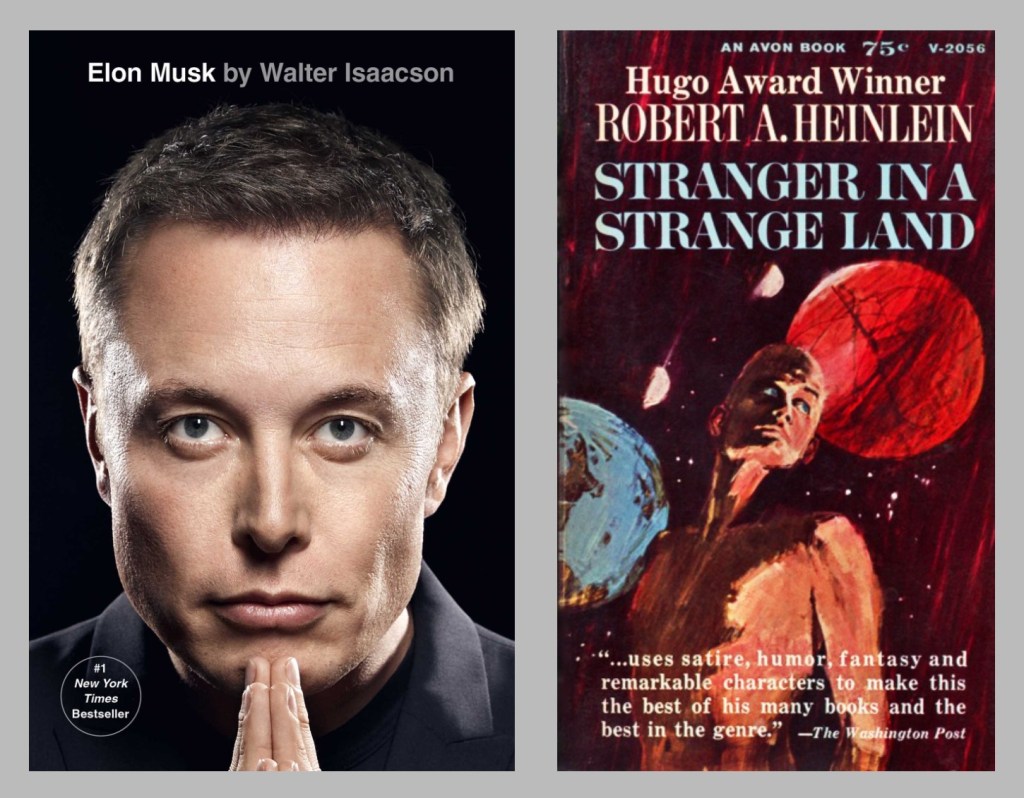
I’m reading Elon Musk by Walter Isaacson. I’m a big fan of Walter Isaacson, but I was going to skip this new book because I’m not a fan of Elon Musk. Then I saw the 92NY YouTube interview, between Michael Lewis and Walter Isaacson, and decided I should read it after all. Even though Musk has a repellant personality, and expresses political ideas I dislike, he is achieving many ambitions that science fiction has dreamed about for centuries.
Elon Musk and other tech billionaires use their wealth to make science-fictional concepts a reality. Walter Isaacson makes it absolutely clear it’s more than just having billions. Isaacson’s biography of Elon Musk shows Musk’s specific genius and drive were needed to create SpaceX, Tesla, and all those other technological enterprises. However, throughout the biography, we’re told that Musk was inspired by Heinlein and Asimov, by the Culture novels of Iain M. Banks, and by other science fiction books, movies, and games.
I read the same SF books as Musk. If I had billions to hire the best engineers in the world I couldn’t have created SpaceX. I lack Musk’s drive. If I had one one-hundredth of his drive, I would have achieved all the ambitions I ever dreamed about and never did. And if Musk has a million times more money than me, does that mean he has a million times more drive and intelligence?
Musk is Heinlein’s Delos D. Harriman, from the stories “The Man Who Sold the Moon” and “Requiem.” Heinlein would have loved Elon Musk, or at least his achievements. In an early SpaceX experiment, when the Grasshopper landed on its rocket thrust, Jerry Pournelle said it landed like “God and Robert Heinlein intended.” Heinlein believed a private enterprise would take us to the Moon, so it’s fitting that SpaceX and Musk might be the private company that takes humans to Mars.
The political philosophy of Musk and other tech billionaires also reflects the libertarian teachings of Heinlein’s The Moon is a Harsh Mistress and Starship Troopers. And Musk’s personality and marriages remind us of Stranger in a Strange Land.
Musk isn’t the only tech billionaire that works to make science-fictional concepts a reality. Jeff Bezos wants to create space tourism and orbital habitats, Peter Thiel wants to see AI and life extension, and Mark Zuckerberg wants to create an AR metaverse like we saw in Stephenson’s Snow Crash. (See “Tech Billionaires Need to Stop Trying to Make the Science Fiction They Grew Up on Real” by Charles Stross in Scientific American.)
I have to ask though: How important was science fiction as their inspiration? Wouldn’t they have created all this new technology if they had never read science fiction? Of course, we should also ask: Would America and Russia have built their 1960s space programs if science fiction had never existed? Humans have fantasized about traveling to the Moon and other planets for thousands of years. Doesn’t that mean it’s just a human desire? But then, did Robert H. Goddard and Konstantin Tsiolkovsky read science fiction as kids?
Is science fiction the John the Baptist of space exploration?
We must also remember that millions, if not billions of people are asking if going to Mars is worthwhile. Or if we should create artificial intelligence and robots. Musk believes creating robots could create an economy of abundance. But do people want to live on a guaranteed income while robots do all our work?
When I was young I would have given anything to live on Mars. That wish came from reading science fiction. But now that I’m old, and know what Mars is like, I’d consider living on Mars to be hell.
Musk believes electric cars will save the environment. But will they? One of the many insights Isaacson reveals about Musk is Musk’s ability to question assumptions. By challenging how rockets are manufactured Musk is leaving NASA in the dust. But shouldn’t we question whether or not colonizing Mars by launching thousands of giant rockets is a good idea?
I love science fiction. As a kid I wanted humanity to colonize the solar system and head to the stars. I wanted humanity to create intelligent robots, uplift animals, and build utopian cities. Science fiction inspired a science-fictional religion in me, instilling faith in certain futures. Evidently, if you have billions and the drive, it’s possible to pursue that faith. I admire Musk’s abilities but I question his faith. And doesn’t that mean questioning science fiction?
Isaacson’s biography of Elon Musk should be a riveting read for any science fiction fan because it reads like a science fiction novel, one Heinlein would have written.
James Wallace Harris, 1/7/25
 Classics of Science Fiction