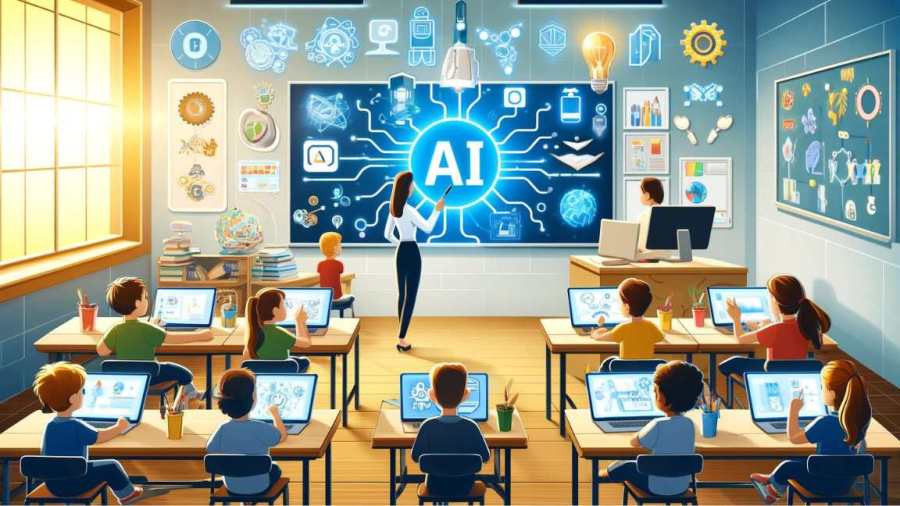
Yesterday I read “Everyone Is Cheating Their Way Through College” by James D. Walsh, which was quite eye-opening. AI programs like ChatGPT, Claude, and Gemini have made a massive and immediate impact on K-12 and high education. This essay is already being widely discussed. It says students are using AI to do their homework and that teachers have practically given in.
The essay is worth reading carefully, especially if you’re a parent, educator, or science fiction writer. I don’t think I’ve read a single science fiction story that’s even come close to imagining what’s happening today.
Try extrapolating this trend into the future.
Since the 17th century and the advent of public education, society has been working to develop a curriculum that defines a basic, well-rounded education. The way students use AI today throws all of this out the door. They want to rely on AI to know what needs to be known and use AI to get what they want.
In essence, school kids are making themselves into cyborgs. But what happened to the Borg when they were cut off from the Hive Mind?
The article profiled one kid who is using AI to invent ways to create wearable AI believing that someday that AI access will just be embedded in our heads. That has come up in science fiction before. But I’m not sure if any writer imagined how intelligent the human part would be on its own.
As the article points out, education isn’t about stuffing kids with knowledge. Education is about learning how to think and process information. AI bypasses that.
The article also implies we’ll never put the genie back in the bottle, so we’ll need to adapt. What we need is a science fiction novel that explores such adaptation on the level of Nineteen Eighty-Four or The Handmaid’s Tale. We need to imagine where this is going.
I don’t use AI to write my blogs, but I do use the realtime spelling and grammar checker that’s built into Microsoft Edge. Then I use the free version of Grammarly, but in a weird way. The free Grammarly constantly offers to rewrite my sentences but only if I pay them $129 a year. With the free version, it only shows me a blurred version of what it proposes. Because I’m too cheap to buy the full version of Grammarly, I just keep rewriting my sentences until Grammarly stops trying to sell itself to me.
I’m wondering if even that much AI help is bad for me. I could turn off all of Edge’s writing tools and depend solely on my own knowledge. I’d need to carefully proof everything I write and look up everything that looks suspicious. Of course, that means I need to know when something is wrong.
Advocates of AI in education claim that AI will offer every student their own personal tutor. And that’s probably a good thing. But tutors teach. I would probably be better helped by a program that just crosses out problems but gives me no solutions.
One of the insights I gained from reading Outliers by Malcolm Gladwell is standout successful people like Tiger Woods or Mozart achieved their great successes by early intervention of their fathers. That people who find a mentor or tutor early in life have a far better chance of achieving a major success.
In the Walsh article, one of the students profiled eventually dropped out of Columbia. He ended up inventing several programs and companies by using AI. That shows you can still succeed without getting a traditional education. However, most of what he created helped students cheat with AI. Would you want a tax accountant who skipped school and based their expertise on AI?
If students are going to cheat their way through the standard education system, why keep our current education system? Do kids need all twelve years of grammar and secondary education? Do they need four years of college?
Can any science fiction writer imagine what adults will be like in the 2040s who grew up with using AI in school in the 2020s? Science fiction has often imagined AI taking over human civilization. Has any writer imagined a symbiotic civilization based on human-AI cyborgs?
James Wallace Harris, 5/10/25
 Classics of Science Fiction