
I’ve forgotten why, but I was Googling around and found the image above. I was quite taken with it. I did a Google image search and discovered it came from Weird Tales #14 (July-Aug 1952) and the artist was Wally Wood. I know as close to nothing about comics as is possible without knowing anything at all. I have run across some interior illustrations by Wood in Galaxy Science Fiction and admired them too. I’d love to have a big art book of his work.

I know a little bit about EC Comics, mainly from reading about the congressional hearings in the 1950s and the famous book by Fredric Wetherm, Seduction of the Innocent.
Back in 1963, when I was twelve, my grandmother subscribed to four comic books for me for my birthday. I believe they were to Superman, The Justice League of America, Wonder Woman, and The Flash. I read them as I got them, and carefully saved all the issues before my cousins Bobby and Timmy borrowed my complete library of comics. They never returned them. It didn’t bother me. I much preferred reading science fiction. And I forgot about comic books until the 1970s when I discovered underground comics in a headshop. I tried one by Vaughn Bode and another by Robert Crumb.
Over the years I’ve tried comics periodically but never could get into them. This month I’m giving them one more try because of that Wally Wood cover illustration. I went looking for a scan of #14 of Weird Science on the internet because I wanted to read the story that goes with the illustration. Evidently, the copyright holders of EC Comics keep a sharp watch on copyright violators because I couldn’t find a digital scan.
I then went to eBay, ABEbooks, and Amazon looking for a copy and discovered The EC Archives: Weird Science Volume 1 had just been released. The paperback was $18.18 and the Kindle edition was $13.99. It claimed to collect #12–#15 and #5–6. I was all ready to press the buy button when I saw a mention I should try a free 30-day trial version of Comixology. What the hell. I did. I’m going to give comics one more try.
I quickly loaded the Archives on my tablet only to discover #14 looked different.

It took a bit of research but I discovered there was a 1950 series and a 1951 series, and Archives Volume 1 had the 1950 #14. I was disappointed. Back to Google. I eventually found comics.org and this very informative page. From there I learned there was a 1994 Gemstone annual that reprinted the 1951 #14. I found the cheapest copy on eBay and ordered it. The internet is a wonderful tool! I’ve never used comics.org before but it’s as useful as isfdb.org.
While I wait for the Gemstone Weird Science Annual, I’ve been looking at The EC Archives: Weird Science Volume 1. I can’t say I’ve gotten hooked on comics. In fact, I’m somewhat shocked by what I discovered. The stories and art are very — I wanted to say crude but I don’t want to offend people. Is simplistic a better word? Unsophisticated?
I once took a graduate course in the English department on humor, and we were taught there are many levels of sophistication in humor, although I’m not sure the professor claimed any form was superior to another. Chaplin’s slapstick humor might be as brilliant as Shakespeare’s humorous wordplay.
The 1950s science fiction stories Weird Science are similar in ideas to what was being published in the pulps in the 1920s and 1930s. Now I’m not trying to be superior. My favorite kind of science fiction is novels and short stories from the 1950s. They might only be a step up from science fiction in comic books as comic books are a step up in believability over books like Dr. Seuss or Goodnight Moon. I’m not offended when brilliant literary writers complain that science fiction is adolescent, because I agree with them.
At 70, I’m fully aware that my favorite kind of fiction to read in 2022 is as sophisticated as my mind was in high school (1966-1969). I was an English major in college, and I still read the literary classics, but usually only one per year. When I say science fiction that appeared in the science fiction magazines of the 1950s was more sophisticated than the science fiction appearing in the comics or funny papers, or on the big or little screens of that decade, I’m not claiming it was superior. I’m only saying the stories were more complex and richer in detail.
For example, compare “I Created A Gargantua!” or “Lost in the Microcosm” in Weird Science to The Shrinking Man (1956) by Richard Matheson, the book version of the 1957 film The Incredible Shrinking Man, or The Attack of the 50 Foot Woman (1958). None of these stories are realistic, all of them are basically stupid, and all of them are on the level of comic book science fiction. I guess I should up the ante some and also throw in “The Drowned Giant” by J. G. Ballard, as a literary comparison. And even mention that Alice in Wonderland played around with the idea of changing size.
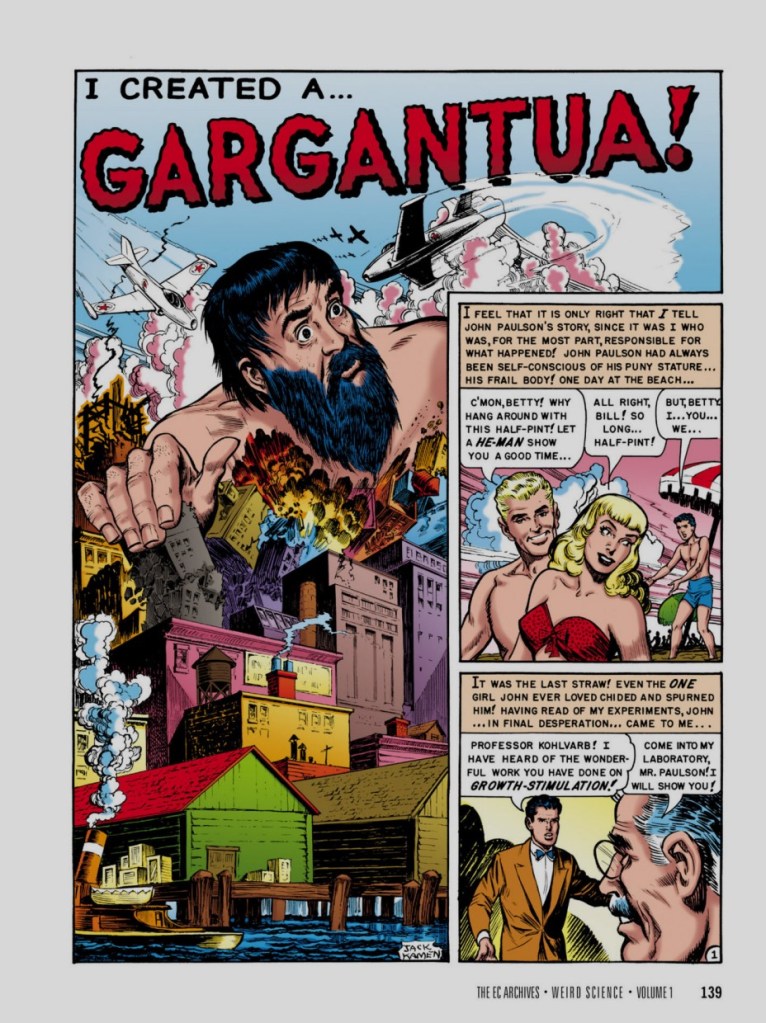
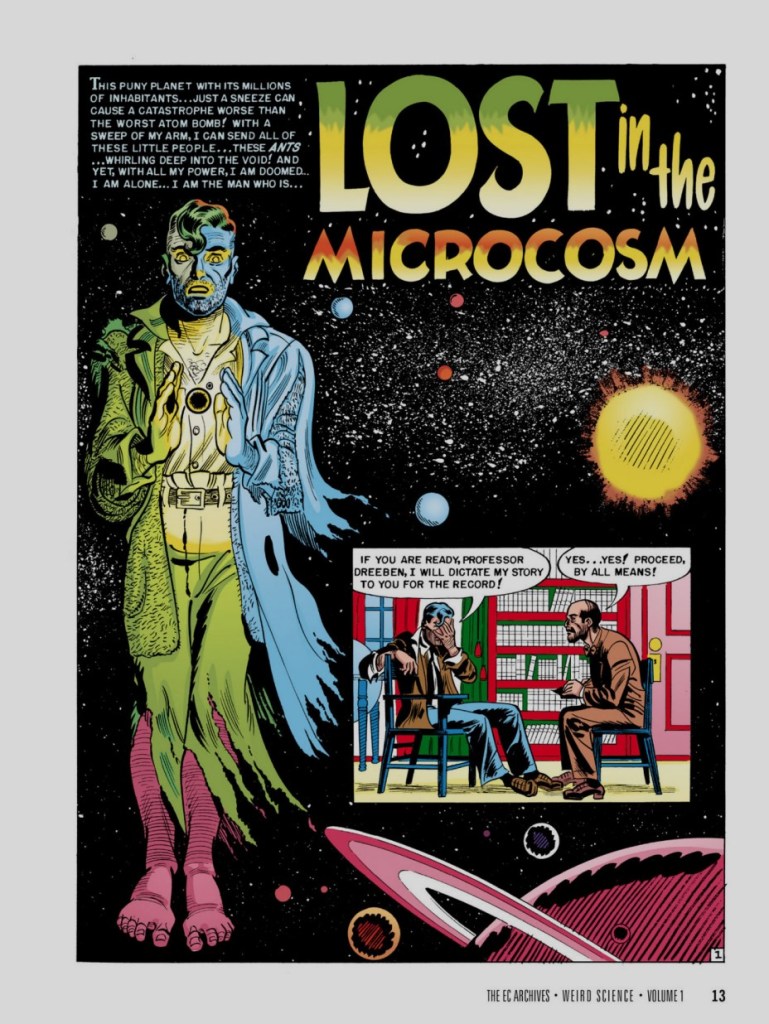
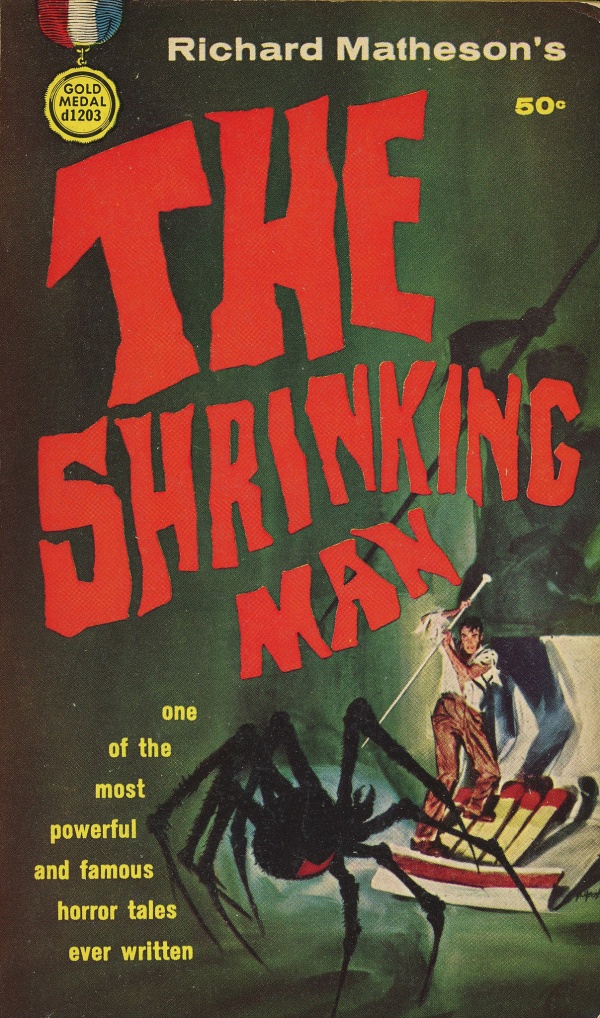
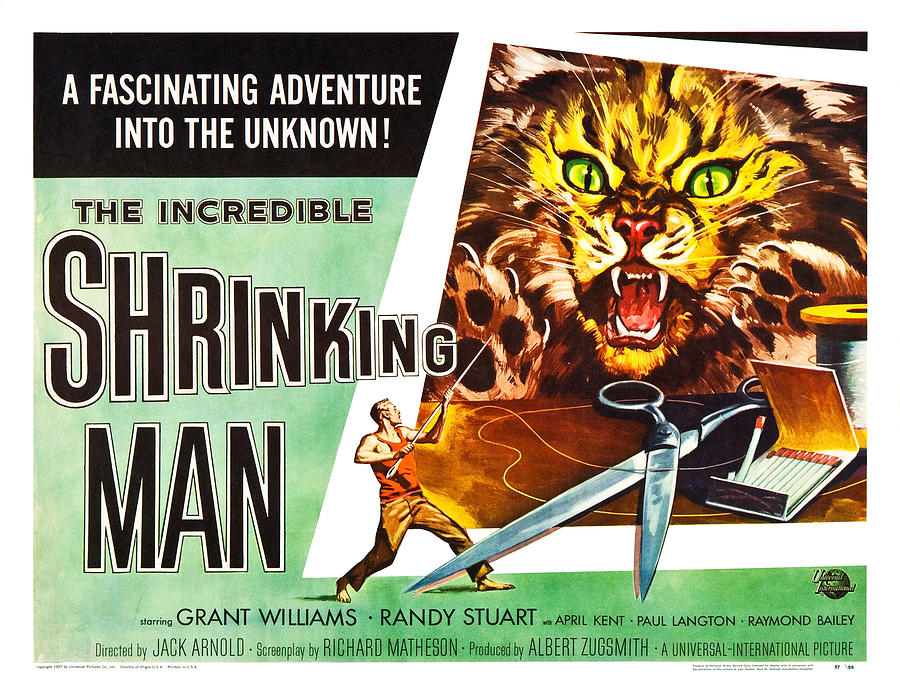

My point in mentioning all these stories is to support my argument that written science fiction in the 1950s was more sophisticated than comic books. Back in the 1950s comic books were aimed at kids who could read but probably didn’t read books. They were a step up from kids’ picture books. Galaxy Science Fiction was a step up from Amazing Stories, and The Magazine of Fantasy and Science Fiction offered more adult reading than Astounding Science Fiction. And the 1957 science fiction novel, On the Beach by Nevil Shute, was aimed at an even more adult audience.
It’s all about being in the target audience. As I read those collected issues of Weird Science from EC Comics I felt I was regressing back to age twelve. Every time I tried comics again since I was twelve I rejected them as being too young for me and immediately quit reading them after a few pages. This time I kept reading. I even somewhat enjoyed myself. But that scared me. Getting old and being anxious over growing memory loss, made me fear that enjoying a comic book might be the first sign that I’m regressing.
I’ve always considered Charlie Gordon’s rise and fall of intelligence in Flowers for Algernon was modeled the arc of normal aging and decay. Reading Weird Science made me feel like Charlie Gordon when he realized he was on the downward slope of his IQ arc. I’ve noticed this before. I’m starting to struggle with nonfiction and more sophisticated novels.
I can picture myself getting older and reading the Oz books I loved in the 5th grade. The science fiction I love to read now is the same as I loved back in the 8th grade. However, I’m reading it with 70 years of wisdom I didn’t have then, and I’m admiring it more. I still enjoy Austen, Dickens, Trollope, Tolstoy, Lawrence, or even Joyce, but I’m slowly gravitating more and more to the fiction of my adolescence. That doesn’t upset me. I’m glad I have those stories to welcome me home.
I’m not ready yet to read comic books again, or even return to the Oz books, but I can imagine a time when I might be.
James Wallace Harris 3/8/22
 Classics of Science Fiction