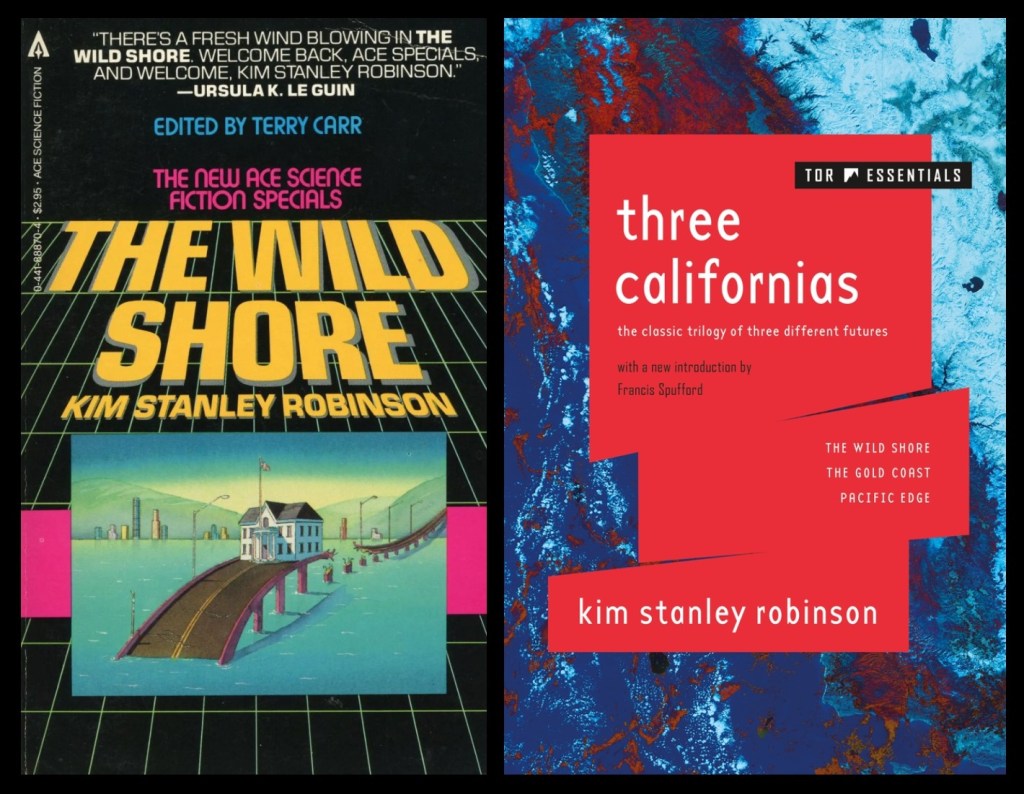
Unless you’ve recently become a fan of Kim Stanley Robinson, it’s unlikely you’ll be thinking about reading The Wild Shore. It was Robinson’s first published book back in 1984. The Wild Shore was impressive enough to be the first volume in Terry Carr’s third series of Ace Science Fiction Specials. But still, why would you choose to read a 1984 paperback original in 2024? I can’t claim it’s become a science fiction classic or it’s a highly distinctive take on its theme, which is post-apocalyptic, but it is a worthy read.
I’m a great admirer of Kim Stanley Robinson’s 21st century work because he explores the forefront of science fiction. However, his books don’t compel me to turn their pages. I seldom care for his characters, and I don’t get caught up in his plots. I like Robinson’s books for his insightful philosophical takes on our evolving genre. That was not the case with The Wild Shore. I did care for Henry and Tom, and I never stopped wanting to know what would happen. This book was different. Was it because it was told in first person? Or was it because it was a somewhat realistic post-apocalyptic novel, a favorite theme of mine?
I’m not sure if any post-apocalyptic novel is ever particularly realistic. I’m only separating the silly ones with zombies, mutants, aliens, and robot overlords with those novels which describe normal human life after things fall apart.
I had not planned to read another science fiction novel so soon after reading A Heritage of Stars. (I’m trying hard to read other kinds of books.) But two events intersected that led me to read The Wild Shore. Just as I finished Clifford Simak’s 1977 novel about a post-apocalyptic America, when I caught a YouTube review of The Wild Shore, a 1984 novel about a post-apocalyptic America. I immediately wanted to compare the post-apocalyptic vision by a writer born in 1904, near the end of his career, with the post-apocalyptic vision of a writer born in 1952 publishing his first novel.
Even though the novels came out just seven years apart, they are significantly different. Simak’s book is a science fantasy, not much more sophisticated than an Oz book. Robinson’s story is a literary coming-of-age in a post-apocalyptic world tale.
I’m becoming a connoisseur of apocalyptic fiction. I’ve read so many that I divide them into works covering different time periods. These are some of my favorites:
- Stories that begin before the apocalypse
- One in Three Hundred by J. T. McIntosh
- The Death of Grass by John Christopher
- The Last Man by Mary Shelley
- Stories that begin during apocalypse
- “Lot” by Ward Moore
- Survivors (BBC TV)
- Stories that begin days after the apocalypse
- The Day of the Triffids by John Wyndham
- The Quiet Earth (film)
- The World, The Flesh, and The Devil (film)
- Stories that begin weeks or months after the apocalypse
- Earth Abides by George R. Stewart
- Stories that begin years after the apocalypse
- Station Eleven by Emily St. John Mandel
- The Postman by David Brin
- Stories that begin generations after the apocalypse
- The Long Tomorrow by Leigh Brackett
- The Wild Shore by Kim Stanley Robinson
- Stories that begin centuries after the apocalypse
- A Canticle for Leibowitz by Walter M. Miller, Jr.
- A Heritage of Stars by Clifford D. Simak
- After London by Richard Jefferies
- Stories that begin in the far future
- Hothouse by Brian W. Aldiss
I think we should contemplate why post-apocalyptic stories are so popular. If I listed all the ones I knew about from books, movies, and television shows, it would be a painfully long list. Shouldn’t we psychoanalyze ourselves over this? It’s my theory that we’re attracted to post-apocalyptic settings because we feel like we’re living in pre-apocalyptic age.
There’s a telling point about most post-apocalyptic stories – the cause of the apocalypse usually kills off most of the population. Doesn’t that suggest we want to live in a world with fewer people? I believe we’ve been living through a slow developing apocalypse our whole lives caused by overpopulation. People laugh at The Population Bomb, a 1968 book that predicted famine that didn’t happen. However, back in the 1960s I remember reading about experiments with rats and overpopulation. As rats were forced to live with more of their own kind, they started going crazy, attacking each other, and causing universal stress.
Most of the problems we face today that will shape our future are due to there being too many of us. Of course, economists are freaking out now because of dropping birth rates, but that’s only because capitalism is a Ponzi scheme they desperately need to keep going. But this book review is not the place to go into details about all the detrimental effects of overpopulation. Let’s just say that the emotional appeal of reading stories where there are fewer people resonate at a deep psychological level. Just look at all the people who want to return to the 1950s, when the population was less than half of what it is today. Or they dream of rebooting society without all the people they dislike.
This begs the question: What will society be like if we had to start over? Most post-apocalyptic novels are merely action-oriented stories that let readers vicariously run wild in a lawless society. They don’t address societal collapse seriously. I think novels like Earth Abides by George R. Stewart, Station Eleven by Emily St. John Mandel, and The Wild Shore by Kim Stanley Robinson do – to a small degree.
The Wild Shore describes growing up in a small community of about sixty people in San Onofre, California, about halfway between Los Angeles and San Diego. The story is told from the point of view of a young man, Henry “Hank” Fletcher, and his friends. The setting is a small pastoral valley near the ocean where people live off small-scale fishing and farming. The year in 2047. Back in 1984, the United States was mostly destroyed by thousands of neutron bombs, which produced low radiation but caused lots of destruction. Survivors creates thousands of little communities each finding their own unique way to survive.
Henry and his teenage friends are third generation post-apocalypse, who admire an old man, Tom, who was born before the apocalypse. Tom claims to be over 100. He has become their mentor and teacher. The young men mainly fish, while the young women farm. It’s demanding work during the day, but they study with Tom after work. He has taught them to read and tells them tales about the old days. Henry’s best friend Steve Nicolin is desperate to get away from home and his domineering father. Steve pushes Henry into actions that propel the plot.
Tom is an unreliable mentor, but Henry and friends don’t know that, and neither do we at first. For example, Tom tells Henry and his friends that Shakespeare was an American, and England was part of the United States. Tom knows there were both good and bad things about the pre-apocalyptic world, but he has glorified American life before the bombs. Henry and Steve, want to rebuild that America, but don’t know how. Like most young men they are anxious for adventure, and resent the grueling work required for daily survival.
Then one day a group of men from San Diego, led by Jennings and Lee, show up and invite people from Henry’s small community to visit their large one in San Diego. They tell Henry’s community they came by train. It turns out their train is two handcars, those little cars that are people powered. In San Diego they are shown many marvels of reconstruction.
Henry is impressed with what the San Diegans have created for themselves. San Diego’s success is due to a strong man named Danforth who his followers call the mayor. Danforth even has a political slogan: Make America Great Again. (I kid you not.)
The mayor tells Henry and Tom he wants their small community to join his resistance movement. We learn that America was bombed by several countries, but not Russia, who resented our world dominance. The rest of the world have put the United States into quarantine, working to keep Americans from regrowing their power. Japan guards the west coast, Canada the east coast, and Mexico the Gulf Coast. The Japanese command is stationed on Catalina Island off Los Angeles. The mayor wants to get as many Americans as possible to fight them.
Now, this world building is not the true focus of The Wild Shore. In fact, I considered it unrealistic speculation. However, Robinson needed a reason for Henry and Steve to want to leave their community and join a big cause. The book is about growing up in a post-apocalyptic world, and to a degree it realistically speculates about such a life. For example, Robinson imagines that some people would try to survive off what was left in the cities, and others would fish, farm, herd, or ranch, and there would be a conflict between the scavengers and the back-to-the-land folks. I think that’s realistic. He also imagines that strong men like Danforth would consolidate power. And I think that’s realistic too. But the whole plot conflict with the Japanese is not something I bought.
The real value of this story is how the boys grow up. And it’s especially about how they learn from Tom. Eventually they discover that Tom doesn’t know everything, but that’s part of the story too. I feel the mentoring relationship was realistically developed, and what I admired most in The Wild Shore. However, in the end, the novel never achieved the impact of Earth Abides or Station Eleven. At least not with my first reading. It might be in the same league as The Long Tomorrow by Leigh Brackett, but I haven’t reread that one in decades.
Robinson does a lot of speculation and extrapolation that I need to think over. For example, people return to whaling because they use whale oil for lighting. We find whaling repugnant, but whale oil made a significant impact on 19th century America because it was a superior lighting source over candles. Robinson has his America with no form of mass communication. The San Diegians dream of repairing a radio, but so far can’t. Would such technology disappear in 60 years? In the story, much of what we use disappears. In this story, printing is just starting to make a comeback.
One of the most important insights from Earth Abides is we won’t be able to teach the next generation everything they need to rebuild a technological civilization immediately. Isherwood, a former university professor and the Tom of Earth Abides, realized that teaching literature and mathematics to kids who had to work hard just to eat would be nearly impossible. In the end, he understood that he had to teach the next generation things they could readily assimilate and use. So, he taught them how to make bows and arrows to help them hunt food.
Robinson tries to explore what useful knowledge Tom could convey to Henry and his friends, but that theme gets sidetracked by the boys chasing after the anti-Japanese resistance movement. I felt that plot was unrealistic. Robinson could have just kept the conflict to just between the larger San Diegan community take over Henry’s smaller community, and that would have been realistic enough for me. Or the conflict could have been between those who lived by scavenging and those who farmed and fished. He did need a larger conflict for his plot, but I thought the resistance theme too big.
One of the fascinating things about post-apocalyptic stories, is how people live without news organizations and communication systems. To suggest that most of the world was keeping America at a tribal level to protect themselves is hard to believe. But if global civilization has collapse, it’s easy to believe that we could return to a tribal society. It all depends on how many people die in the apocalypse. Europe recovered from the Black Death, which killed up to half the population in many cities, but it survived and thrived.
Realistically, unless we were hit by an asteroid, or a plague with ten percent survival rate, we’re not going to drastically reduce our populations in single apocalyptic event. We could slowly fall apart until we de-evolved into a tribal state, but that might take centuries. A realistic post-apocalyptic world might be the one that’s emerging now as countries return to authoritarian rule, economies collapse, and weather ravages everything.
The Wild Shore is about how young people adapt to a post-apocalyptic world. The book might offer some insight into how things might be if the apocalypse was overwhelming, killing off 99% of the population. What happens when the apocalypse is slow-acting, and reduces the population slowly, which slowly forgets all the technology? We can see this is many countries around the world right now. So far, they have been smaller countries like Sudan, Colombia, or Afghanistan. But Russia and China don’t look too healthy right now.
If people are reading post-apocalyptic novels because they unconsciously feel we’re approaching apocalyptic times, shouldn’t they consciously start reading realistic apocalyptic novels that might help them anticipate new ways of living? The Wild Shore isn’t that realistic, but it does explore some issues about growing up in a post-apocalyptic world that might make it a worthwhile reading. I do recommend giving it a try.
Some preppers have written post-apocalyptic novels, but they are generally about guns and surviving in the early days after the collapse. I don’t think we should expect a Mad Max society. Iraq, Syria, Haiti, El Salvidor. and Afghanistan are great examples to study if you want to write a truly realistic post-apocalyptic novel, or you want to become a prepper. Being a lone wolf with a AR-15 is as much of a fantasy as a zombie apocalypse.
Novels like The Wild Shore and The Long Tomorrow, or a TV series like the 1975 Survivors have more of a realistic ring to them, but only slightly so. The fall of Rome took centuries. A truly realistic post-apocalyptic novel would deal with a slow declining society and the apocalypse wouldn’t be so dramatic as an atomic war.
James Wallace Harris, 9/30/24


 Classics of Science Fiction