THE TWILIGHT ZONE – “Judgment Night”

“What was the first time-loop story?” my friend Mike asked me after watching “Judgment Night.”

“The first one I remember was Replay by Ken Grimwood.” But his question got me thinking.

Time looping became famous with the film Groundhog Day. Later, I learned that there were earlier examples and the theme has become somewhat popular.

“Judgment Night” is about a ship crossing the Atlantic Ocean in 1942, when Nazi submarines were hunting them. I can see how Mike could think this show is an early example of a time loop story but I didn’t think it was one exactly. However, “Judgment Night” suggests how the time loop story evolved.

If you haven’t seen “Judgment Night” you might want to stop reading here and go watch it. Several streaming sources offer The Twilight Zone. Try PlutoTV or freevee on Amazon Prime if you don’t mind commercials for free viewing. (Amazon has the complete series on DVD for under $30.)

“Judgment Night” opens with Nehemiah Persoff on the deck of a cargo ship on a foggy night. He looks scared. As he meets the other passengers and crew he acts very strange. They wonder if he has amnesia since he can only recall his name, Carl Lanser. When he eventually recalls that he was born in Frankfurt the others get worried that he might be a Nazi, especially since he also seems to know all about U-boat wolfpacks. Eventually, the ship is attacked, and we’re then shown a scene from a submarine. The captain is Carl Lanser. His first officer is Lt. Mueller (James Franciscus) tells him he feels remorse for sinking a ship with civilians, especially since they gave no warning. Captain Lanser shows no remorse, and Mueller suggests they will be condemned by God. Then we’re shown Nehemiah Persoff back on the ship again, and Rod Serling says:

The SS Queen of Glasgow, heading for New York, and the time is 1942. For one man it is always 1942—and this man will ride the ghost ship every night for eternity. This is what is meant by paying the fiddler. This is the comeuppance awaiting every man when the ledger of his life is opened and examined, the tally made, and then the reward or the penalty paid. And in the case of Carl Lanser, former Kapitan Lieutenant, Navy of the Third Reich, this is the penalty. This is the justice meted out. This is judgment night in the Twilight Zone.

I can see why Mike asked about time loops. Wikipedia reveals that the concept has been around for a while. I think “Judgment Night” is proto time loop for one reason, because Captain Lanser doesn’t know he’s in a time loop, and doesn’t discover it. It’s just his version of hell, a punishment like not unlike Sisyphus having to roll a rock up a hill forever.

Reoccurring dreams might be the inspiration for time loop stories. Also the wish to have a do over in life is common enough to inspire writers. However, I think the essence of a time loop story is a character discovering they are looping and then trying to get out of the loop.

My first encounter with the idea of a time loop was when I read Replay by Ken Grimwood in 1986. I saw a review in Time Magazine and went immediately to the bookstore and bought it new in hardback. The idea of living my life over totally intrigued me, and it’s a great novel. My next encounter with the theme was in an episode of Star Trek: The Next Generation called “Cause and Effect” from 1992. Of course, Groundhog Day from 1993 was dazzling. I’ve seen many movies, TV shows, and read plenty of books and short stories that use the theme since. So far, none have been as philosophically effective as Replay.

It’s a shame that Rod Serling, who wrote “Judgment Night” didn’t have Carl Lanser know he was in a time loop. Wouldn’t that have made the punishment more enlightening to Lanser? And more hellish? The episode was good, but not great.

Lanser only suffers eternally, and maybe that’s all Serling thought he deserved. The theme of time looping offers redemption, and even resurrection.

Maybe it wasn’t practical to tell such a tale in a 25 minute show. We have to learn the character is repeating, and that involves showing us the character going through the loop more than once. But if Serling could have pulled that off, I think “Judgment Night” would have been one of the great Twilight Zone episodes.

Time looping is very philosophical, even spiritual. It’s easy to see why it’s a punishment used by gods, but in Replay and Groundhog Day, we can see that it’s a tool for enlightenment. Time looping has a certain Zen quality to it.

Unfortunately, Serling just used part of the concept to allow his audience to hate Nazis. And to be an anti-war story. The Twilight Zone featured a number of those.

James Wallace Harris, 10/30/24

GREYBEARD by Brian W. Aldiss

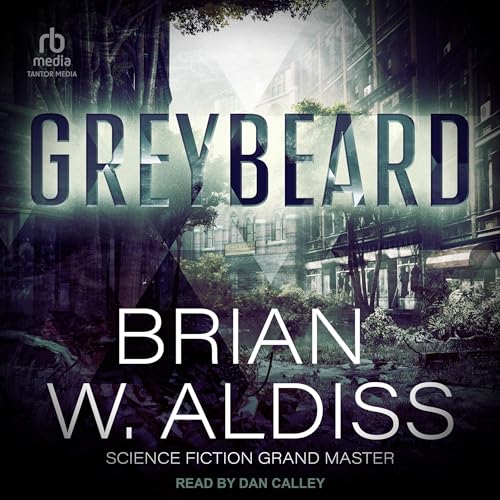
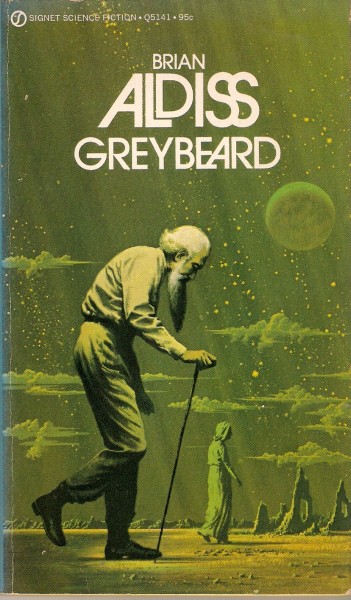
Greybeard is a 1964 post-apocalyptic novel by Brian W. Aldiss. It was reprinted as an audiobook by Trantor Media on October 15, 2024, read by Dan Calley. The ebook version is currently available for the Kindle for $1.99 in the U.S. Greybeard has an extensive reprint history. I heard about this novel back in the 1960s, but I’ve only become an Aldiss fan in the last few years, so I was excited when the audiobook edition showed up on Audible.com. Greybeard was one of the novels David Pringle admired in his Science Fiction: The 100 Best Novels (1985). That book is available for $1.99 for the Kindle too.

Greybeard is set in the 2020s, and is about the aftermath of atomic bomb testing in space in 1981, when the explosions altered the Van Allen radiation belt. Eventually, people learned “the accident” caused the human race to become sterile, along with certain other animals. In the story, everyone is old, waiting to die, and wondering what will happen after humanity is gone. This is a different premise for a post-apocalyptic novel, but Aldiss uses his tale mostly to toss out a ideas. The story lacks a compelling plot.

The characters are never developed to the point where you care about them. That’s a common problem of older science fiction, where characters were created mainly to present far-out science fictional thoughts.

The story’s main focus is on Algy and Martha Timberlane as they travel around England after the collapse, along with flashbacks of how they got together. Algy, short for Algernon, is called Greybeard because of his long beard. After the accident, during a period when kids were born with genetic defects, but before they stopped coming altogether, the world economies collapsed, which led to wars. As Aldiss points out, a lot of consumerism is targetted to babies, children, and young people, so certain businesses quickly went bust. But also, as people realized they had no future, many gave up on their ambitions, or even committed suicide.

The book is divided into seven chapter, each a different time and setting:

  • Chapter 1 – The River – Sparcot
  • Chapter 2 – Cowley (flashback)
  • Chapter 3 – The River Swifford Fair
  • Chapter 4 – Washington (flashback)
  • Chapter 5 – The River – Oxford
  • Chapter 6 – London (flashback)
  • Chapter 7 – The River – The End

The novel begins with rampaging stoats (ermine, short-tail weasel). This setting of England being taken over by nature reminded me of After London by Richard Jefferies, but Jefferies did a much better job describing how nature would overrun decaying cities, towns, and roads. After London is a superior post-apocalyptic novel, and one of the earliest

We first meet Greybeard and Martha who have been living for years in a tiny village, Sparcot, ecking out an existing through fishing and gardening. They live near a river surrounded by a barrier of brambles. When two boats arrive with refuges from another village, they hear about how the stoats are attacking everything including people. This reminded me of the stobors in Heinlein’s Tunnel in the Sky. Algy, Martha, and a few friends, flee in a boat Algy had hidden. They plan to float down the river to the sea.

The novel is about what they see along the way. It might be called a picaresque novel. Algy/Greybeard is a bit of a rogue, and we follow his episodic travels. At each stopping place along the river they meet folks living under different conditions. Swifford Fair seemed like something out of the Middle Ages. When they get to Oxford, they find a certain level of civilization has maintained itself around the old university. But in every location, there are wild beliefs about how things are, including lots of charlatans, thieves, and con artists preying on ignorant people. Rumors abound about children still being born, strange mutant beings living in the woods, or even fairy creatures of old returning.

Algy and crew meet a crazy old man on the river who tells them to find Bunny Jingadangelow in Swifford Fair because he can make them immortal. Bunny Jingadangelow shows up several times during this novel running different scams, including one as a messiah.

Greybeard isn’t a bad science fiction novel, but it’s not that great either. If I had read it back in 1968 when I first heard about it, I would have been impressed. But over the decades I’ve read a lot of post-apocalyptic fiction, and Greybeard just isn’t up to the standard of Earth Abides by George R. Stewart or The Road by Cormac McCarthy. I’d say The Hopkins Manuscript by R. C. Sherriff as one of the great post-apocalyptic novels about England to read first. In other words, there are a lot of post-apocalyptic novels you should read before spending time on Greybeard.

It’s a shame that Aldiss didn’t spend more time writing Greybeard because his premise is so good. I just finished the four-volume novel series by Elena Ferrante that begin with My Brilliant Friend. This is a true masterpiece, and future classic. Greybeard and most science fiction feel like starvation rations compared to that novel. Of course, Ferrante used 1,965 pages to tell her story, and Aldiss only used 237 on his story. Aldiss tried to develop the characters with flashbacks, but those flashbacks were mainly used to describe the world during the initial stages of collapse.

Ferrante created a compelling novel by showing how two girls evolve psychological and intellectually over a lifetime. That anchored the novel and gave it a page-turning plot. Aldiss never moors us in the story with anything we can anchor our attention. Richard Jefferies handled his post-apocalyptic London by using the first part of the book to explore ideas around the collapse, and then used the second half with a well-plotted adventure story. I enjoyed Greybeard enough to read it, but just barely.

I wish Aldiss had expanded his story to 400-500 pages and developed Algy and Martha, and found something to give the book a clear purpose. I can only recommend Greybeard to folks who read a lot of post-apocalyptic novels and enjoy studying them.

Aldiss imagines radiation causing a world of only old people. But we’re currently facing a depopulation crisis because most countries around the world aren’t producing enough babies. A country needs every woman to have 2.1 children to grow. Many women don’t want to have any, and one child is common. Theoretically, countries like South Korea can become like the world of Greybeard by the end of this centry. I wonder if any current writers are exploring that idea?

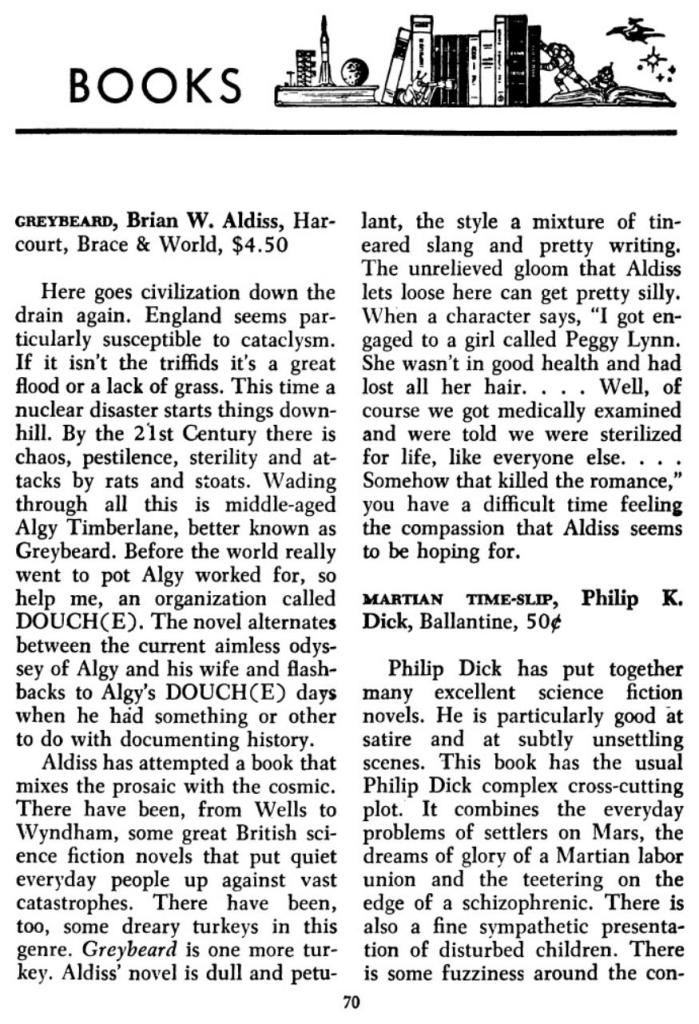
Ron Goulart didn’t like the story in his F&SF (Dec. 1964) review.

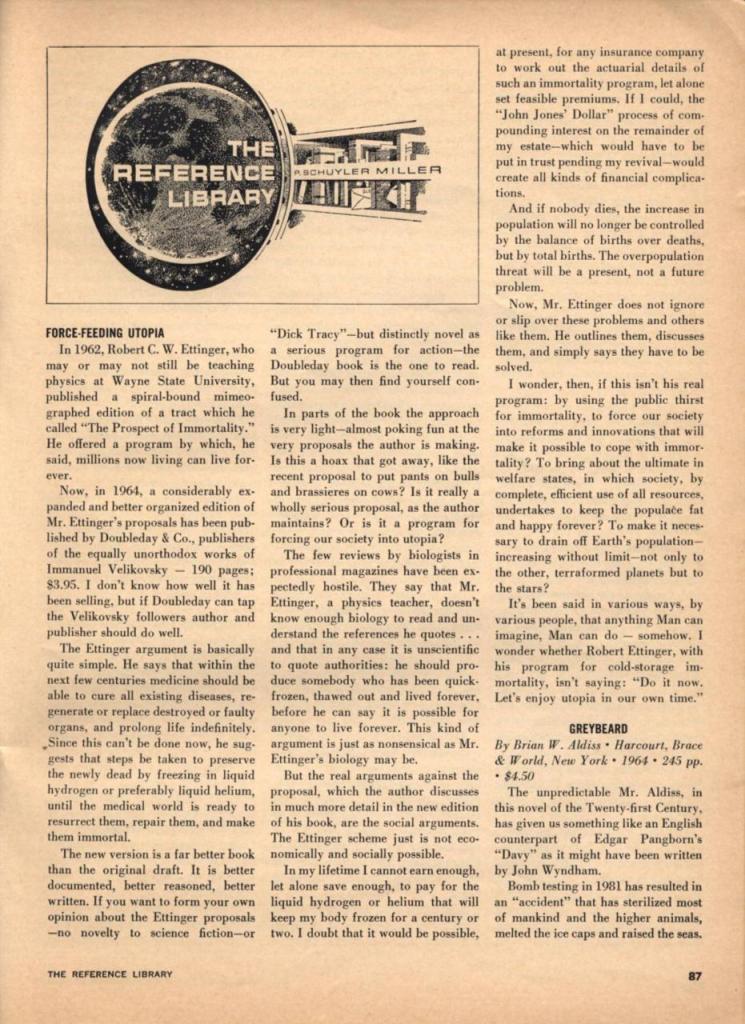
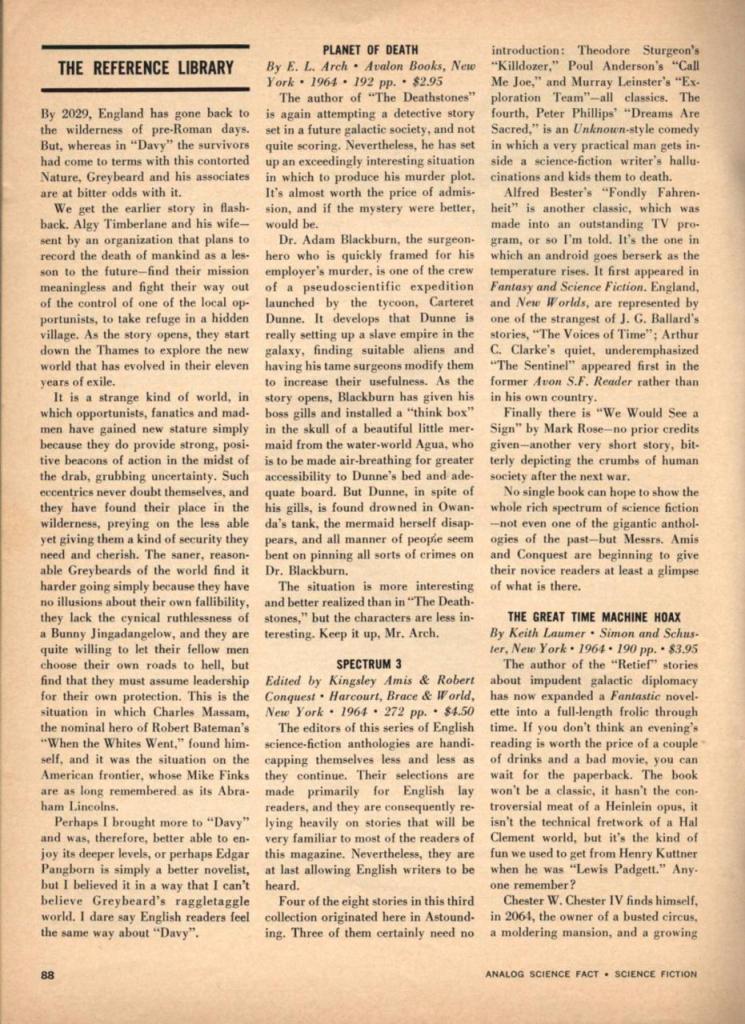
P. Schuyler Miller liked it a bit better, but not much, in his Analog (Feb. 1965) review.

Judith Merril in 1966, pointed out to F&SF readers that the original American hardback lacked some of the flashback scenes, and might like the story better in the Signet paperback, which included the full British edition.

James Wallace Harris, 10/26/24