“The Man Who Lost the Sea” by Theodore Sturgeon

My job is to get you to read stories if you haven't. I'll try to make it easy for you by linking to a copy on the web if the story is available. I'll also tell you about anthologies where you can find the story. Then I'll start talking about the story. At first I'll be vague so as not to spoil the story, but hopefully intriguing enough to get to you to go read the story before continuing. As I progress I'll give more and more away.

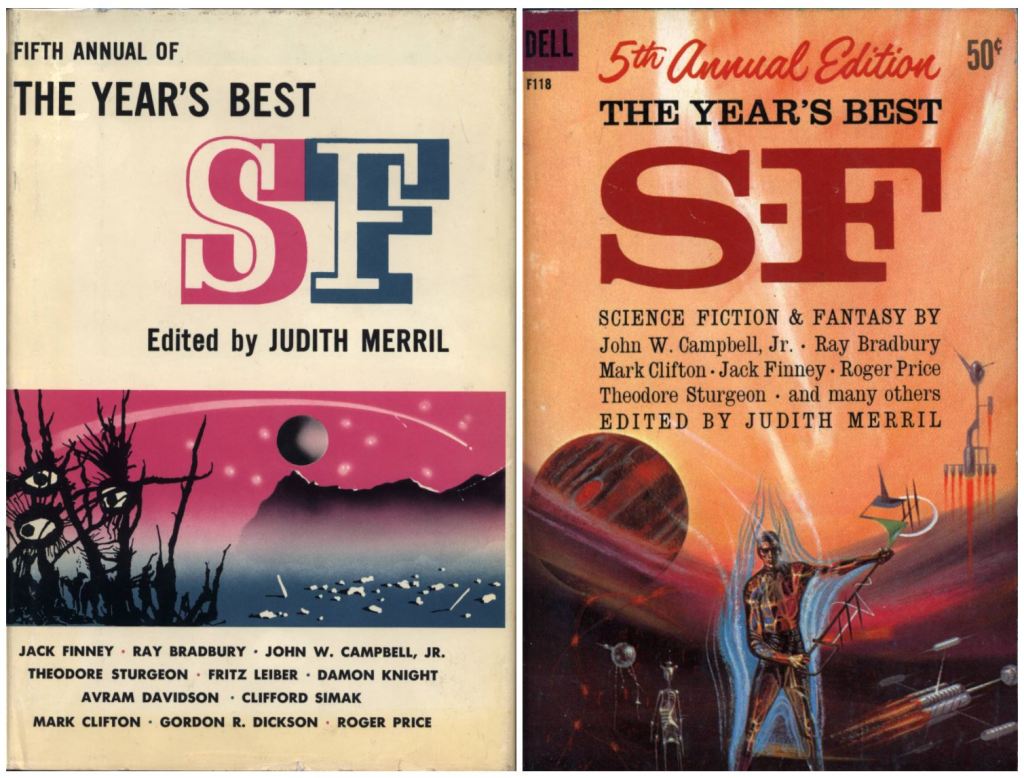
“The Man Who Lost the Sea” is a magnificent work of second person prose that is as confusing as a pile of jigsaw puzzle pieces without the box. As you read the story the picture is revealed with the placement of the last piece. “The Man Who Lost the Sea” was first published in October 1959 issue of The Magazine of Fantasy and Science Fiction. It was reprinted in Best American Short Stories 1960, The Best from Fantasy and Science Fiction (Ninth Series, 1960), and Judith Merril’s annual anthology,The Fifth Annual of the Year’s Best SF (1960) where I just read it. It was up for a Hugo in 1960 but lost to “Flowers for Algernon” by Daniel Keyes, but wouldn’t any story lose to that story? “The Man Who Lost the Sea” is currently available to read online at Strange Horizons. Or jump over to Escape Pod to listen to the story.

I’ll illustrate how admired this story is by showing you some of the retrospective anthologies it’s been reprinted in over the years:

  • 1968 – Towards Infinity edited by Damon Knight
  • 1969 – First Step Outward edited by Robert Hoskins
  • 1977 – Alpha 8 edited by Robert Silverberg
  • 1983 – The Arbor House Treasury of Science Fiction Masterpieces edited by Robert Silverberg and Martin H. Greenberg
  • 1989 – The World Treasury of Science Fiction edited by David G. Hartwell
  • 1990 – The Great SF Stories 21 (1959) edited by Isaac Asimov and Martin H. Greenberg
  • 1997 – A Century of Science Fiction (1950-1959) edited by Robert Silverberg
  • 2005 – My Favorite Science Fiction Story edited by Martin H. Greenberg
  • 2016 – The Big Book of Science Fiction edited by Ann and Jeff VanderMeer

I’m feeling guilty about not having read “The Men Who Lost the Sea” before now. How could I have missed it? To be honest, I’m not sure my younger self could have appreciated the story. The second person prose involving nonlinear events would have been difficult for my speed-reading younger self to comprehend. Just read the first paragraph:

Say you're a kid, and one dark night you're running along the cold sand with this helicopter in your hand, saying very fast witchy-witchy-witchy. You pass the sick man and he wants you to shove off with that thing. Maybe he thinks you're too old to play with toys. So you squat next to him in the sand and tell him it isn't a toy, it's a model. You tell him look here, here's something most people don't know about helicopters. You take a blade of the rotor in your fingers and show him how it can move in the hub, up and down a little, back and forth a little, and twist a little, to change pitch. You start to tell him how this flexibility does away with the gyroscopic effect, but he won't listen. He doesn't want to think about flying, about helicopters, or about you, and he most especially does not want explanations about anything by anybody. Not now. Now, he wants to think about the sea. So you go away.

What the hell is going on? Where are we? Who is the narrator? Sturgeon gives us the first clues in the second paragraph:

The sick man is buried in the cold sand with only his head and his left arm showing. He is dressed in a pressure suit and looks like a man from Mars. Built into his left sleeve is a combination time-piece and pressure gauge, the gauge with a luminous blue indicator which makes no sense, the clock hands luminous red. He can hear the pounding of surf and the soft swift pulse of his pumps. One time long ago when he was swimming he went too deep and stayed down too long and came up too fast, and when he came to it was like this: they said, "Don't move, boy. You've got the bends. Don't even try to move." He had tried anyway. It hurt. So now, this time, he lies in the sand without moving, without trying.

What can you say about this story so far? Later on when Sturgeon tries to give us more concrete clues can we really put them together yet?

Out and out the sick man forces his view, etching all he sees with a meticulous intensity, as if it might be his charge, one day, to duplicate all this. To his left is only starlit sea, windless. In front of him across the valley, rounded hills with dim white epaulettes of light. To his right, the jutting corner of the black wall against which his helmet rests. (He thinks the distant moundings of nausea becalmed, but he will not look yet.) So he scans the sky, black and bright, calling Sirius, calling Pleiades, Polaris, Ursa Minor, calling that . . . that . . . Why, it moves. Watch it: yes, it moves! It is a fleck of light, seeming to be wrinkled, fissured, rather like a chip of boiled cauliflower in the sky. (Of course, he knows better than to trust his own eyes just now.) But that movement . . .

Maybe it helps when Sturgeon lets us know the man is thinking about the past:

As a child he had stood on cold sand in a frosty Cape Cod evening, watching Sputnik's steady spark rise out of the haze (madly, dawning a little north of west); and after that he had sleeplessly wound special coils for his receiver, risked his life restringing high antennas, all for the brief capture of an unreadable tweetle-eep-tweetle in his earphones from Vanguard, Explorer, Lunik, Discoverer, Mercury. He knew them all (well, some people collect match-covers, stamps) and he knew especially that unmistakable steady sliding in the sky.

By now you should realize this story takes place in the guy’s head, but you still aren’t sure where the guy is or the identity of the annoying boy.

Have I gotten you interested? Have you gone back to the top of the page and followed the link to read the story? If not, let me give you a few more tantalizing clue. Have you read “An Occurrence at Owl Creek Bridge” by Ambrose Bierce – another often reprinted short story? “The Man Who Lost the Sea” belongs to very special tiny subgenre of fiction, one that has deeply personal significance to me, see my essay “Did The First Movie You Ever See Haunt You For The Rest Of Your Life?” about the novel High Barbaree by Charles Nordhoff and James Norman Hall. You probably don’t know these guys but they wrote The Mutiny on the Bounty. Or, have you ever seen the ending to the 1966 movie Seconds with Rock Hudson?

Jeez, if I haven’t hooked you by now I give up. I’ve always been fascinated about the nature of memory and consciousness. I love this Theodore Sturgeon because he explores those concepts in one impactful story.

James Wallace Harris, 3/16/21

Surviving Childhood By Reading Science Fiction

I love when I discover a short story that pushes all my buttons. I regret that I didn’t discover such wonderful tales when they were first published, but I do have the consolation as an old jaded reader of finding a story that still thrills me. “The Island of Doctor Death and Other Stories” by Gene Wolfe is one such story that I just read. It’s about a boy, Tackman Babcock, who survives a troubled “family life” by reading science fiction. Since I survived my bumpy upbringing by reading science fiction, I immediately bonded with Tackie.

I know, it has a confusing title. I’ve seen it collected in anthologies for years, and it always sounds like a collection of short stories by the author. When Gene Wolfe created his first short story collection the title became The Island of Doctor Death and Other Stories and Other Stories, as you can see above in the first edition, a 1980 paperback from Pocket Books. The 1997 edition is still available from Amazon. The original story, “The Island of Doctor Death and Other Stories” was first published in Orbit 7 (1970) edited by Damon Knight has been reprinted many times, so you might already own a copy. However, if you just want to quickly enjoy the story right now, it’s available online for free as an audio podcast from PodCastle, episode 171. Just click and take forty-five minutes to hear the story, it has wonderful narration.

Maybe now you’ll understand the confusing title, but you’re probably wondering what book Tackie was reading? If you’d like to read speculation about possible books read the entry for this story at a wiki devoted to Gene Wolfe. I tend to think Wolfe was trying to capture the feel of many novels, stories, and famous characters so readers would imagine the ones they have read. I definitely thought of The Island of Doctor Moreau by H. G. Wells, but I also thought of famous pulp stories, horror films, and cliff-hanging serials.

Wait, you didn’t go listen to the story? Or read it? Or remember reading it, and now you’re confused?

Tackie Babcock lives with his drug addicted mother in an old resort hotel. He isn’t supervised or well cared for, but his mother’s predatory boyfriend Jason, and a couple of aunts (May and Julie) keep an indifferent eye on him. We learn about Tackie’s inner life when Jason steals a paperback book that Tackie asked him to buy. The book has a lurid cover of a muscle bound man in rags battling a horrible half ape-half human creature. For the rest of the story, reality is interrupted by flashes from this novel. Captain Phillip Ransom adrift at sea for nine days arrives at a mysterious island and his captured by the mad Dr. Death, and his experimental creations. Eventually, we learn about other characters from Tackie’s real and imaginary world, including a beautiful native girl, Talar of the Long Eyes that Cpt. Ransom rescues from a fate worse than death. As the story progresses fiction and reality mix, so do who is good and who is bad.

If that doesn’t get you hooked, I don’t know what will. My parents were alcoholics, and we moved around a lot. From the time I started reading science fiction in the 5th grade until graduating, I attended nine different schools in three states. I forgot how many houses I lived in during that period, and I forgot how many times my parents split up. I’ve also forgotten how many drunken parental brawls I had to watch and hear, or how many times I was chauffeured around by drunk drivers. I survived all of that, and remember them as good times because I read science fiction. Without science fiction I’m not sure I would have had a happy childhood. I felt like Robert A. Heinlein was my father figure, Samuel R. Delany was my big brother, and Robert Sheckley was my crazy uncle.

I completely identified with Tackie Babcock. I wish I had read his story in 1970, but I’m thankful I finally found it in 2021.

James Wallace Harris, 3/5/21

p.s. Many of Gene Wolfe’s books including this one are available through Scribd.com, a subscription library. I mention it because I hope Scribd gets enough subscribers to survive. Think of it as Netflix for ebooks and audiobooks.

“The Colonists” by Raymond F. Jones

Raymond F. Jones has now hit two homers for me this week, with “The Colonists” flying out of the park. I was quite impressed with “The Memory of Mars” which I wrote about recently but I can’t decide if it’s a 4-star or 5-star story. I’d definitely give “The Colonists” a full 5-stars. The story is sophisticated in plot and science fictional speculation and is quite dramatic. I can’t understand why it isn’t a more famous science fiction story. Why didn’t Bleiler and Dikty or Asimov and Greenberg anthologize these stories in their best of the year annuals? Why haven’t they been anthologized is some of the big retrospective anthologies?

“The Colonists” was first published in the June 1954 issue of If. Follow the link to read it in a scan of the original magazine. Or you can read it various formats from Project Gutenberg. However, I highly recommend the excellent audio narrated version at YouTube.

I don’t want to say much about the story because I don’t want to spoil its surprises. The story examines the psychology of colonists immigrating to another world. Why would anyone give up everything on Earth to go live so far away? For a 1954 science fiction story, it considers the reality of space travel far more realistically than most of its peers.

Maybe this story impressed me because as a teenager I would have given anything to become a colonist on Mars. The idea of building a completely new society on the red planet was the most creative endeavor I could imagine for mankind. However, Jones suggests that most colonists in history were running away from something, and I have to admit that would have been true of my adolescent self.

I was also impressed with the complicated plotting in “The Colonists.” Jones does a great job, and I think this story would make an excellent film. It’s a novelette, and one hour and thirty-five minutes on audio, making it film length.

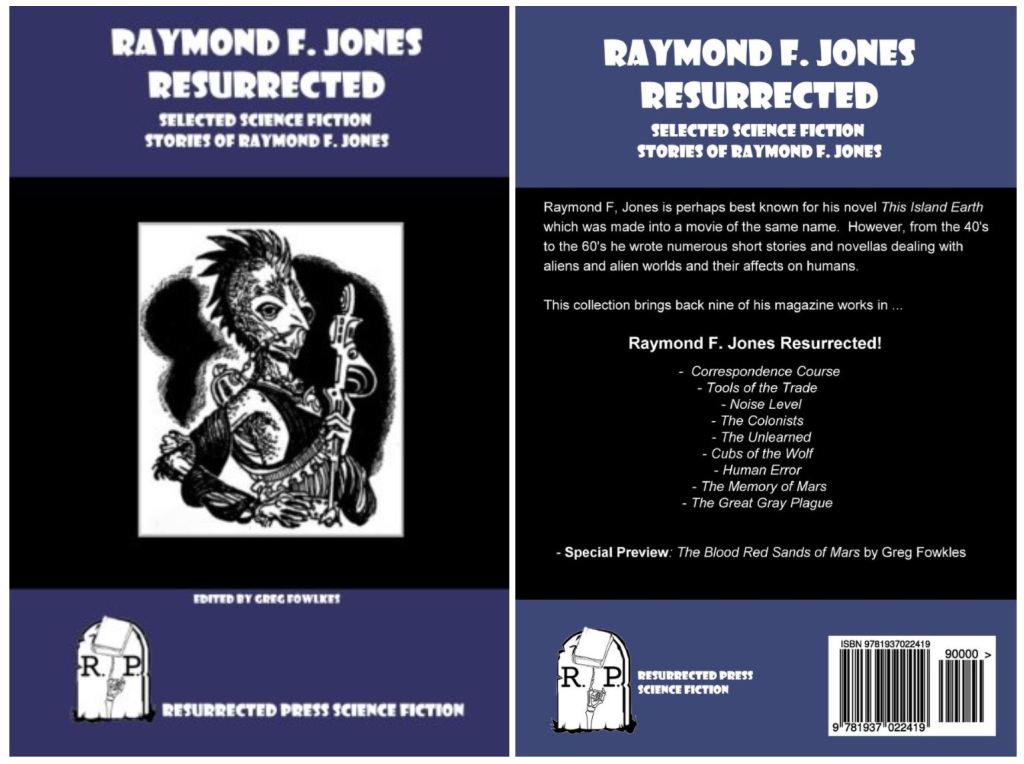
I wonder why Raymond F. Jones never made it big in the genre, or why he’s a mostly a forgotten SF writer? He gets a small write-up in Wikipedia that shows he was a prolific short story writer, but he did produce at least a dozen novels. I’m now anxious to read more of his work. I bought RAYMOND F. JONES RESURRECTED: SELECTED SCIENCE FICTION STORIES OF RAYMOND F. JONES after reading “The Memory of Mars.” (Kindle for $3.99 or paperback for $15.99)

ISFDB reveals I also need to track down two of his out-of-print collections, The Toymaker (1951), that collects stories from the 1940s, and The Non-Statistical Man (1964), that gathers stories from the 1950s. I have no idea if I’ll like those stories as much as the two I read this week.

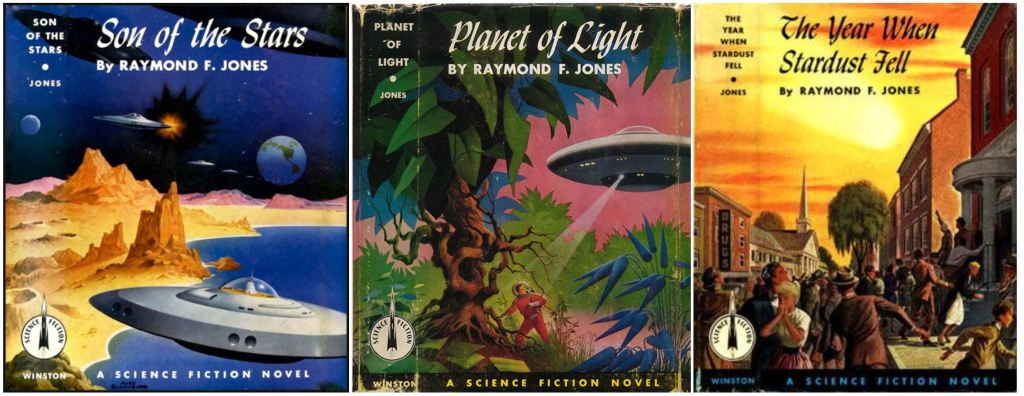
I do remember discovering Raymond F. Jones before, back in the 1960s when I was a young teenager reading all the Heinlein and Winston Science Fiction novels marketed for juveniles. Heinlein was tops, but Jones made a very good impression. I reread Son of the Stars and The Year When Stardust Fell last year. They were both fun, but not great. They didn’t jump out at me like “The Memory of Mars” and “The Colonists” did this week. I have no understanding of my critical judgement. Did I get excited about these stories because they’re actually good, the kind of good that other readers would recognize too, or was I just in the right mood for them at this moment in my life?

James Wallace Harris, 2/6/21

The Year’s Best S-F: 5th Annual Edition edited by Judith Merril

Our Facebook group is scheduled to read The Year’s Best S-F: 5th Annual Edition edited by Judith Merril in February and March. This presents a kind of scavenger hunt to find the stories because most of the members do not have a copy of this 1960 book. Probably out of the 400 members only a handful have a copy. Luckily we have ISFDB.org to tell us where these stories from 1959 and 1960 were originally published and reprinted (click on title).

It annoys me that Merril didn’t stay within the 1959 boundary and included four stories from 1960. That makes it hard to compare this best-of-the-year anthology against others – although in 1959-1960 Merril was the sole contemporary annual anthologist. But in 1990 Isaac Asimov and Martin H. Greenberg revisited 1959 in their anthology The Great SF Stories 21 (1959), which included these stories (I’ve bolded stories that Merril also picked):

I can’t believe Asimov and Greenberg left out “Flowers for Algernon.” In the 1960 volume Asimov and Green also chose Merril’s picks “Mariana” by Fritz Leiber and “The Handler” by Damon Knight. That means nine Merril stories overlap with Asimov/Greenberg out of nineteen in her 5th annual edition.

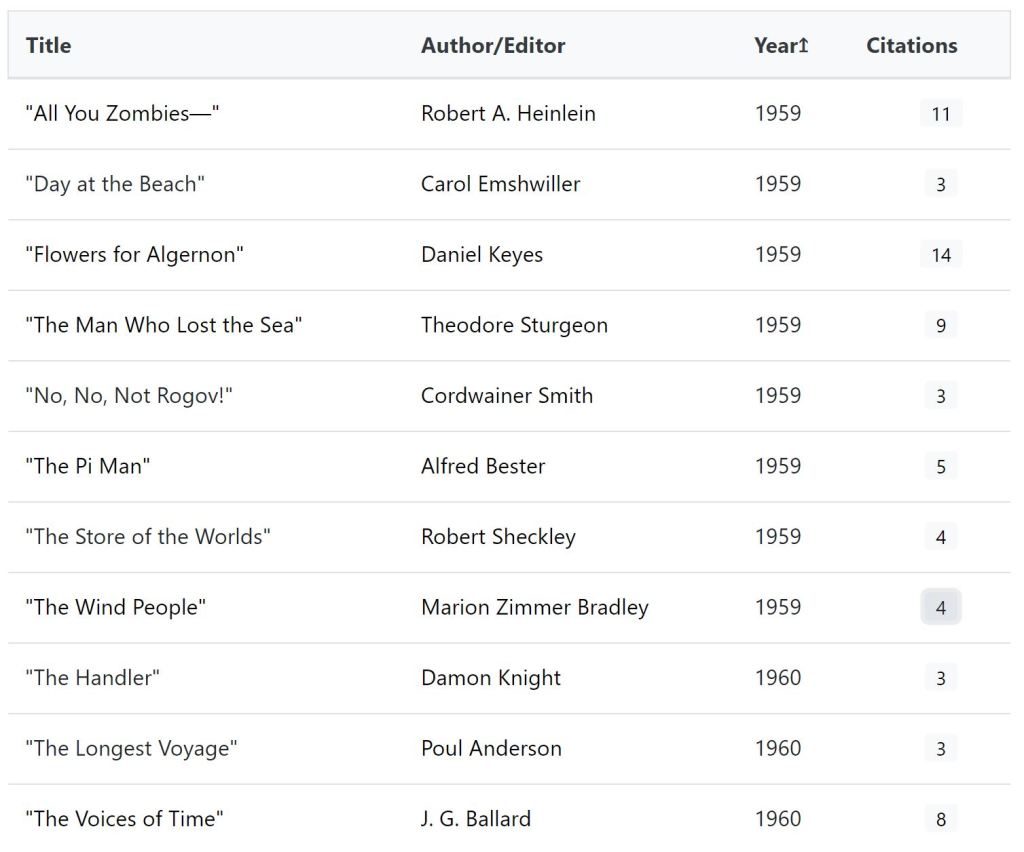
Our Classics of Science Fiction database showed these stories for 1959-1960 with three or more citations:

Both anthologies missed “All You Zombies—” but then Heinlein is notoriously absent in a lot of anthologies. I assume it was too expensive to reprint his stories.

The 1960 Hugo Award nominations for short fiction from 1959 were:

  • “Flowers for Algernon” by Daniel Keyes [F&SF Apr 1959] – winner
  • “The Alley Man” by Philip José Farmer [F&SF Jun 1959]
  • “The Pi Man” by Alfred Bester [F&SF Oct 1959]
  • “The Man Who Lost the Sea” by Theodore Sturgeon [F&SF Oct 1959]
  • “Cat and Mouse” by Ralph Williams [Astounding Jun 1959]

None of Merril’s 1960 stories were nominated for the Hugo, but Poul Anderson’s “The Longest Voyage” from 1960 was the winner in 1961. “Flowers for Algernon,” “All You Zombies—,” “The Man Who Lost the Sea,” and “The Pi Man” were in the The Best from Fantasy and Science Fiction: Ninth Series for 1959 stories, and it should be considered another good source of 1959 SF short stories.

James Wallace Harris, 2/6/21

“The Memory of Mars” by Raymond F. Jones

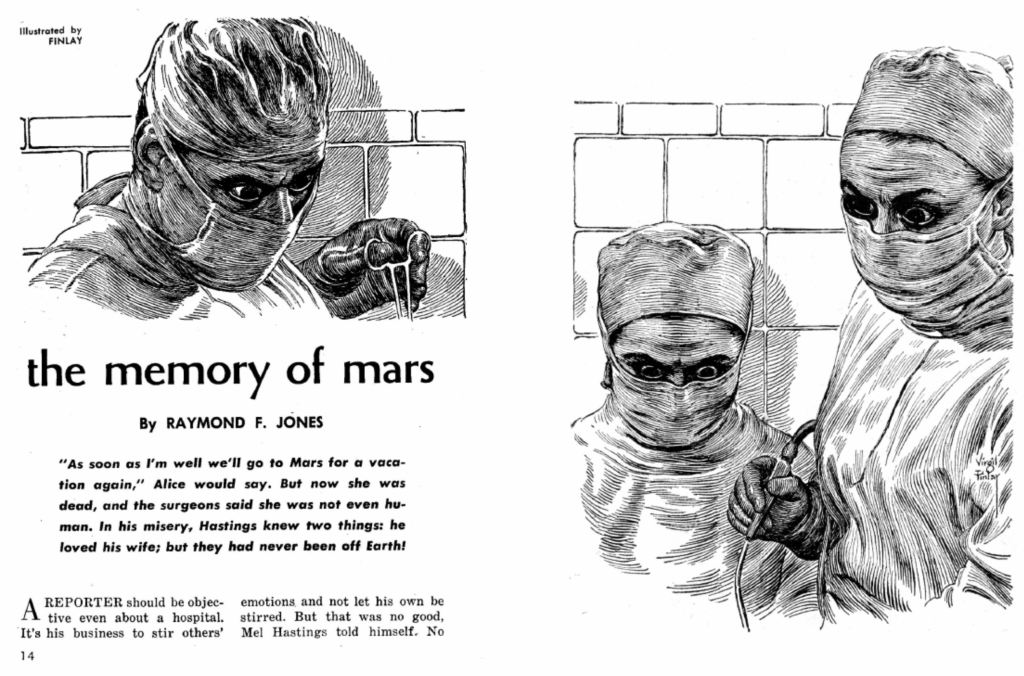
I love a gripping story that makes me anxious to find out what happens next. As soon as I started listening to “The Memory of Mars” by Raymond F. Jones I knew I was hooked. Mel Hastings, a reporter, is waiting to hear about his wife’s operation. But what was troubling him was what his wife Alice said before going into surgery: “As soon as I’m well again we’ll go to Mars for a vacation again, and then you’ll remember. It’s so beautiful there. We had so much fun—”

Mel Hastings knew they had never been to Mars. Mel’s mystery became my mystery, and I knew this story was going to be a ripping good yarn. But I also thought the story sounded like the beginning of “We Can Remember It For You Wholesale” by Philip K. Dick, a much more famous science fiction story from 1966, and known today by the title of the two movies that were based on it, Total Recall.

Before we go any further you might like to stop and read “The Memory of Mars.” It’s available in a scan of the original issue of Amazing Stories from December 1961. Or you can read it online at Project Gutenberg. But I recommend listening to this excellent audio production at YouTube. Or you can buy Raymond F. Jones Resurrected: Selected Science Fiction Stories of Raymond F. Jones for the Kindle for $3.99 or paperback for $15.99 which I did because I wanted to read more of his stories.

The mystery deepens when the surgeon tells Mel his wife has died and that she wasn’t human. Her internal organs were all different. Because Mel is a reporter he starts investigating his wife and was able to prove she was human until very recently with other medical records. Then he finds photos of Alice on Mars and souvenirs from a Martian vacation. Now, doesn’t that remind you of the PKD story? But it gets even more like “We Can Remember It For You Wholesale.”

Mel decides he must go to Mars to find out what happens but he has a deep phobia against space travel. He then goes to a medical specialist to erase that phobia and they discover Mel had gone on vacation to Mars with Alice. Now this is getting eerily like the PKD story. Could Dick have been inspired by “The Memory of Mars” to write his tale?

Mel Hastings has quite an adventure solving these mysteries with even more similarities to the PKD story. But I hope you’ll read “The Memory of Mars” to find out what happens.

I love finding old SF stories that are forgotten but still deserve to be read. “The Memory of Mars” was never reprinted in an anthology, and in only in one collection of stories by Raymond F. Jones mention above. You can see its reprint history here.

Raymond F. Jones had marginal success as a SF writer back in the 1940s, 1950s, and 1960s. His biggest claim to fame was the film This Island Earth based off his fix-up novel of the same title. I became acquainted with his work as a kid reading his young adult novels for the Winston Science Fiction series (Son of the Stars, Planet of Light, The Year When Stardust Fell). I definitely need to read more of his work.

James Wallace Harris, 2/6/21

Deadly Serious Science Fiction

What if we had a special streaming service that showed us television from the year 2050 so we could watch the future unfold on our HDTVs at night. Would we change the way we live in this present? Would we steer towards the news and shows we wanted to come true and away from those that frightened? And what if over time we could see the future change as we changed ourselves little by little. Wouldn’t that validate the reality of those 2050 TV shows from the future?

Hasn’t that been what we thought science fiction has been doing all along?

We avoid committing ourselves because half of us doubt any speculations about the future. What if there was no doubt? What if we knew the future for certain? Would we act decisively? I’m not sure we would. Then what’s the value of serious science fiction?

Science fiction has always encouraged us to rush towards sense-of-wonder tomorrows and run away from scary dystopias. However, most people don’t take science fiction all that seriously, and for that matter, most science fiction never tries to be serious. On the other hand, sometimes a science fiction writer cries wolf. Should we listen?

Back in 1968 John Brunner offered us the deadly serious science fiction novel Stand on Zanzibar. I read it in 1969 when I was 17 and I loathed the future Brunner envisioned for 2010. I did not want to grow up to live in John Brunner’s extrapolated timeline. What he foresaw horrified me with its relentless political unrest, ecological catastrophes, but worst of all were the portrayals of constant worldwide terrorism. Brunner’s scenes of senseless violence repulsed me bitterly. I wanted exciting stories about colonizing Mars, so his future wasn’t one I wanted. By the time 2010 rolled around forty-two years later, we all realized just how brilliant John Brunner’s novel had been at speculating about things to come.

No science fiction writer claims to predict the future. No science fiction book has predicted the future. But rereading Stand on Zanzibar in 2010 was goddamn eerie.

The Ministry for the Future is Kim Stanley Robinson’s deadly serious 2020 science novel about our near future, and it reminds me so much of Zanzibar.

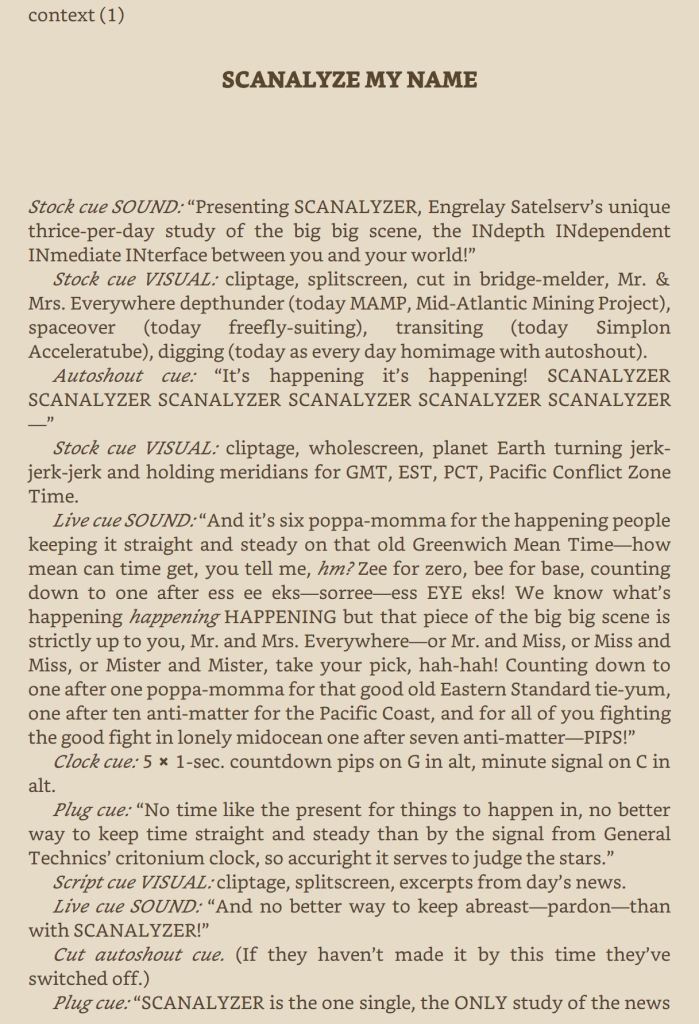
Both novels are hard to read on many levels even if you ignore their doom and gloom. Neither are traditionally structured fiction. Stand on Zanzibar offered a continuing narrative every fourth chapter, but between that narrative were imagined news programs, journals, bulletins, press releases, short stories, book quotes, and readings from a pop culture philosophy called The Hipcrime Vocab by one Chad C. Mulligan. Brunner coined a lot of slang to give his future a realistic flare, which required the reader to pick up the lingo as they read along. Stand on Zanzibar is 582 pages of dense reading. All this puts a strain on its page turning appeal. Nevertheless, this novel has always been the epitome of serious science fiction (at least to me). Now it has competition.

The Ministry for the Future is also hard to read because it does not read like a normal novel. I’d say about twenty percent is the ongoing storyline, while most of the 106 chapters are lessons/lectures in either monologues/soliloquies or Socratic dialogues. Robinson doesn’t try to create the barrage of future pop culture sources that Brunner did. Instead, he writes to educate his reader about the many dimensions of solving problems associated with climate change. It’s not thrilling action, but it is thought provoking. And Robinson works so hard to be optimistic. He wants us to believe we still have a chance.

Science fiction has always convinced its fans that it’s about the future, but it’s not. Science fiction is nearly always about escapism from the today, and sometimes, it gives the illusion that it’s saying something insightful about tomorrow. Every so often we get a SF writer who attempts to extrapolate today’s trends into tomorrow’s catastrophes or marvels. Brunner and Robinson are such writers. In both 1968 and 2020, Brunner and Robinson play Cassandra, warning us we’d better get our shit together because hell is on the horizon.

I want to recommend The Ministry for the Future to everyone, but I must be honest and admit it’s not a fun read. Science fiction has always had a problem with infodumping, and this book is mostly infodumps. I find them fascinating, but most readers won’t. There’s practically no story to this novel other than pondering how to change the world to avoid a climate apocalypse.

But here’s the thing. The first chapter, which is told in regular fiction style, was more effective at scaring me about climate change than anything I’ve ever read. You can read it here. I highly recommend you take the time to do so. If the entire novel had this emotional intensity maybe it would scare readers into changing their lives. Unfortunately, most of the chapters are like this one. Like in Zanzibar, we leave the plot narrative frequently. And when it does return, half the time, it’s more infodumping. The story does get more attention over time, just don’t expect it to entertain like The Expanse books or The Murderbot Diaries.

I am not trying to turn you off from buying and reading The Ministry of the Future, but I am trying to do an honest sales job. Stand on Zanzibar is extremely hard to read too, but I’ve read it twice and want to read it again. I believe both books are easier to listen to then read. Robinson’s book is read by multiple narrators. This helps make the infodumps more dramatic. And since many parts of Zanzibar is supposed to come from radio and TV audio, it’s more natural to hear them than to read them. See if your inner voice can handle this:

Don’t worry, Robinson’s prose isn’t like this, and neither is most of Brunner’s. But Brunner does make a valiant effort to simulate future dazzle. Robinson doesn’t. His work might be called a philosophical novel with lectures, maybe like Hermann Hesse. Thinking about both books I realize I have some questions about science fiction that challenge my lifelong assumptions about the genre.

First, should science fiction attempt to shape the future? Is it hubris to try? Back in the 1940s and 1950s true believers like Robert A. Heinlein wrote stories about the glories of space travel hoping they would inspire young people to grow up and build rockets that went to the Moon and Mars. Just because that happened doesn’t mean science fiction can claim it as a feather in its cap, but maybe it helped. I don’t know. But if you read memoirs by most rocket scientists you’ll find passages about growing up reading science fiction.

If in the future we do avoid climate change, will we look back and say science fiction had a hand in getting us to act sooner? There is a sub-genre emerging out of science fiction called Cli-Fi, and once you study its nature you’ll see it has a long history. But is it effective? Is Kim Stanley Robinson succeeding at inspiring his readers to aim at a different future? By the way, he’s written other Cli-Fi novels, so he’s been working at this task for a long time.

One area where Robinson does succeed is defining the problem, but you have to read The Ministry of the Future to see how he does that. Then we need to reconvene in 2050 and discuss whether or not The Ministry for the Future got us to take different paths to get to that future.

But one last confession. I’ve read thousands of science fiction stories and novels, and it has changed how I think, but I’m not sure it ever changed how I act.

James Wallace Harris, 1/23/21

Judging a Book by its Cover

The old advice is to never judge a book by its cover but I often ignore that advice. Especially when it comes to reading science fiction. Oh, I don’t assume a book’s contents or quality has any relation to the cover, but cover art does influence my book buying decisions.

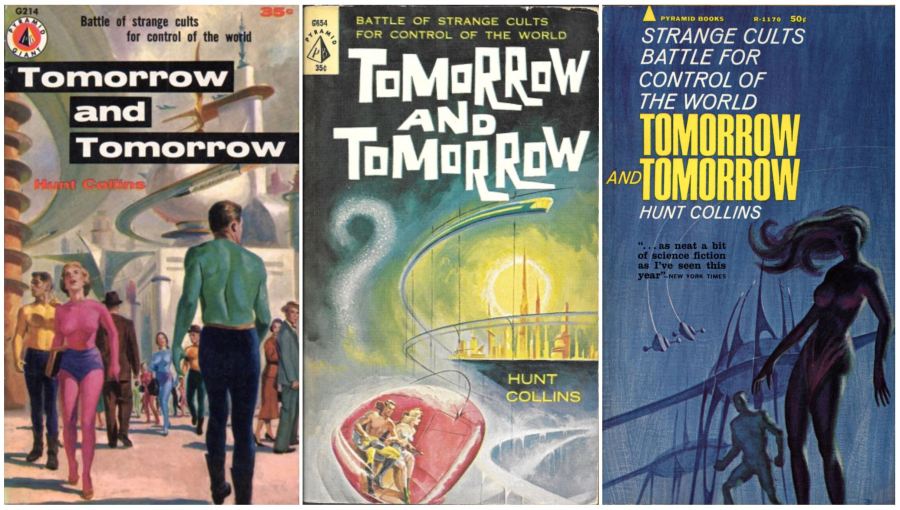
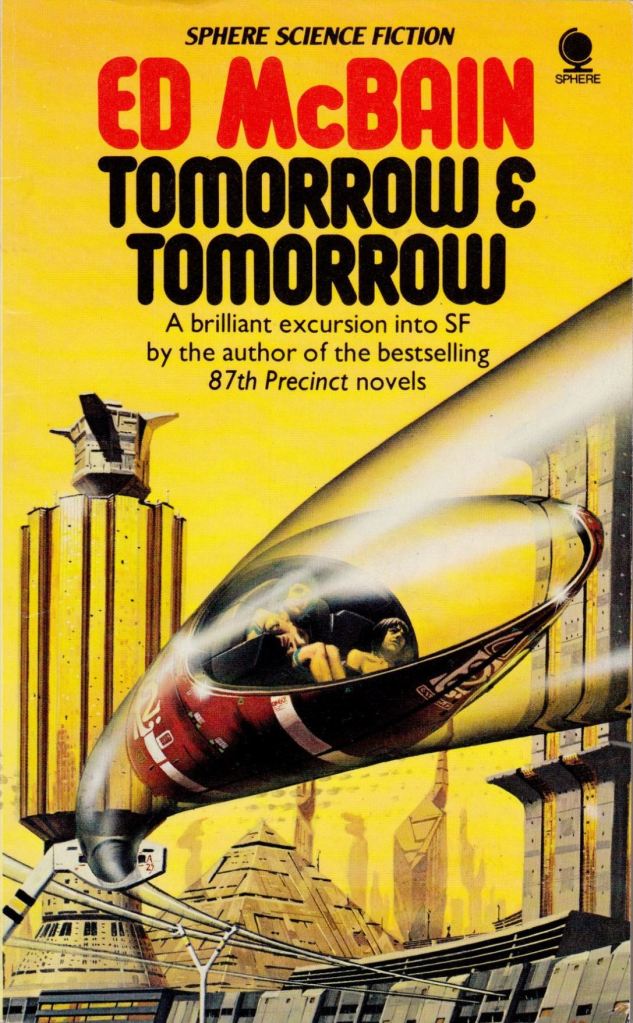
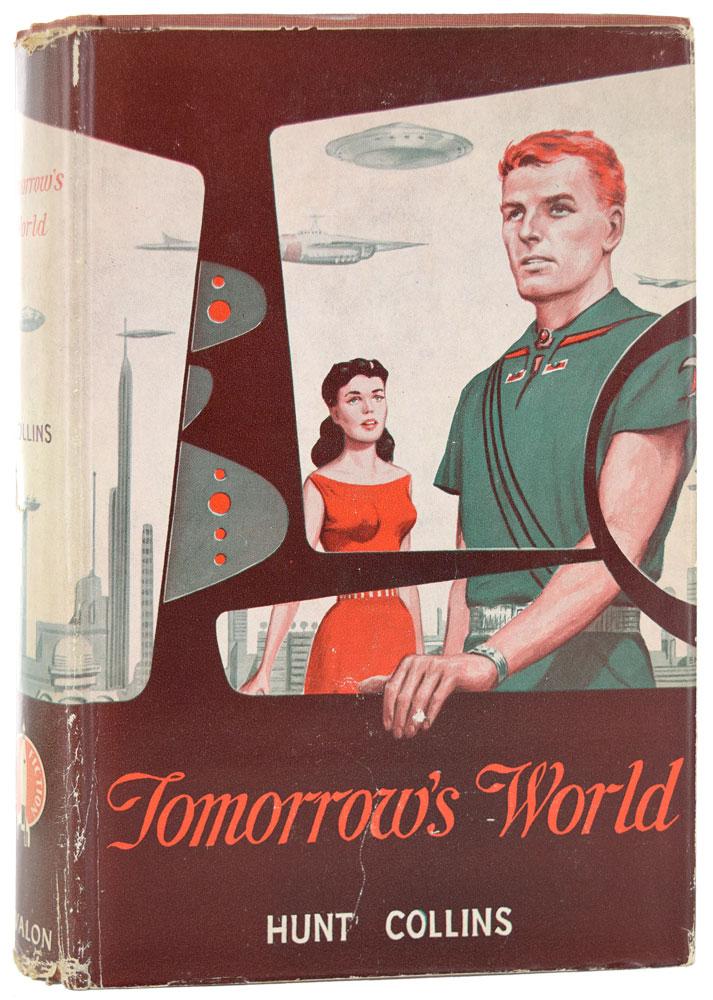
The other day on Facebook I saw the first cover above for Tomorrow and Tomorrow by Hunt Collins and immediately wanted to track down a copy. I had never heard of the book or the author, but I love finding old forgotten SF from the 1950s. I did a significant amount of research on ISFDB looking at the covers to all the editions, and ended up ordering the 3rd cover above. That Jack Gaughan cover from 1965 had just a little bit more appeal, although the first one, from 1956 captures the feel of 1950s SF wonderfully. The middle cover, which also has it visual allure, is from 1961. To be honest now, I wish I had ordered the 1956 edition. I haven’t read the story yet, but here are my thoughts on the covers.

Overall, I prefer the realistic look from the 1956 cover, but the 1965 cover screams 1960s science fiction, reminding me of Samuel R. Delany books I read as a teen. Jack Gaughan did covers to many of Delany’s paperbacks in the mid-1960s. Here’s the larger version from a 300dpi scan I made of the copy I bought. Because I started buying paperbacks back in 1965, the nostalgia triggered by this one ultimately decided my purchase.

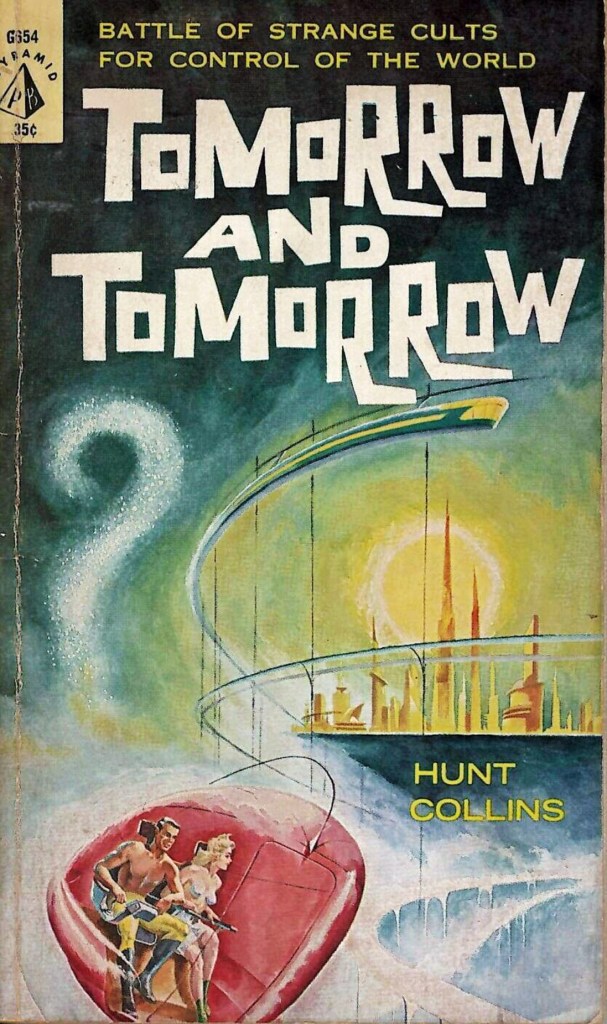
However, back in 1965 I was pawing through used bookstores and loved those covers from the 1950s paperbacks too. I really want a copy of the 1956 edition too but can’t convince myself to spend another $10 for a book I already have. But here’s the best scan I found from eBay. The artist is Bob Lavin and it’s his only work listed on ISFDB. But I did find a collection of his work here, including the art from this cover.

And I found this on Pinterest. I wonder why its reversed from the paperback cover?

There’s a lot going on in this painting. Some people are wearing skin tight clothing, while others dress like folks from the 1920s. The book is about two subcultures that vie for control of society. 1956 was the year before On the Road by Jack Kerouac came out, and America was introduced to the Beats (who the country started calling beatniks after Sputnik went up in October of 1957). Could Ed McBain/Evan Hunter/Hunt Collins known about the Beats before they were famous? The Vikes (Vicarions) in the story are hedonists and drug users, so could they have been inspired by the marijuana smoking Beats? Of course, the 1950s was well known for stories about juvenile delinquents and the evils of pots smoking. John Chellon Holmes had written about the beats in his 1952 novel Go, maybe Ed McBain read it.

The Jack Gaughan cover suggests a far future, a more psychedelic era. Although, this 1965 book cover predates psychedelic art I would think.

The middle book from 1961 whose cover is by James Mitchell. It’s his only cover art listed at ISFDB. Like the 1956 and 1965 covers it suggests a far future city, but unlike the 1956 cover, it doesn’t suggest the two subcultures in conflict.

There is another cover, from 1979 by Peter Elson that I didn’t like as well, but seems to capture some of the elements of the 1961 cover above.

All four covers have sweeping curves of a future city skyway. Looking at the covers from the 1961 and 1979 editions I’d imagine a much different story within than looking at the 1956 or 1965 covers, which imply other kinds of science fiction within. I’m hoping when I finally read Tomorrow and Tomorrow it will be like the 1956 cover. Mainly because I like stories about people and society.

I want to imagine a 1950s person imagining a science fiction future while reading it.

By the way, the original hardback, which had a different title, Tomorrow’s World, had the worst Emsh cover I’ve ever seen.

JWH

Wishes Inspired After Reading 400+ Short Stories in 2020

Besides all the anthologies pictured above I read parts of several other anthologies, many short stories from old and new magazines, and many stories off the internet. But this is nothing compared to what professional editors and anthologists read each year.

This experience has transformed the way I perceive and understand short fiction. There seems to be endless ways to construct a short story and just as many ways to give voice to the narrator(s). And although there seems to be a finite number of themes that science fiction explores there seems to be infinite ways of expressing them.

I’m in a short story reading group on Facebook with over three hundred members, and there is no consistent reaction to stories. One reader can claim a story changed their life while another reader will tell us the story is unreadable. Are stories completely subjective, or do some achieve some kind of artistic objectiveness?

All my short story reading has inspired a number of wishes. I know, I’m always wishing for something. Even if I can’t have my wishes come true, I do love formulating them carefully.

  1. I wish I could remember my favorite stories. After reading over 400 stories this year, and a 1,000 in the past three years wouldn’t it be great if I could tell you which ones I loved best? I can’t. All following wishes stem from this first wish.
  2. I wish I had the discipline of keeping a log of everything I read with comments and annotations. It would be an external memory. I know a number of people who do this and it really seems to pays off. However, such effort does require more discipline than I can muster. Can you imagine logging and summarizing 1,000 stories?
  3. I wish I could assemble my own anthologies of favorite stories if I can’t remember them or keep track of them. Unloved stories really aren’t worth remembering, are they? I’ve thought of photocopying my favorite stories and keeping them in a binder, folder, or box. That way I could could reread them easily, or sort them into different orderings – by themes, chronologies, or types. I also imagine myself scanning stories and saving them in CBR/PDF/Kindle collections, but I believe I would prefer holding physical copies.
  4. I wish I could read and write about stories in such a way that I get more out of them. I believe one reading only gets me 20-25% of what the author intended. Multiple readings and writing essays gets me more of what’s there. I doubt I’ll ever achieve 100% reading efficiency, but I could become more proficient than I am now.
  5. I hope I don’t burn out on reading short stories. I’m developing a tolerance, and that worries me. While some good stories are even more dazzling as I learn how to read better, other stories seem even more trivial. And there is a growing middle ground. Stories that are good, but not quite really good. My enjoyment might improve if I put some effort into discovery their hidden qualities. Do I spend more time with such stories, or search for newer stories that are immediately dazzling? There is a downside to constantly seeking more powerful fixes, I burn out churning through mediocre reading.

There is a dynamic to growing old that I’m becoming all too aware. That’s becoming jaded. There’s a wonderful essay I read in the The Guardian this morning, “The joys of being an absolute beginner – for life” that applies to what I’m saying here. It’s about maintaining the mind of being young when learning something new and then maintaining that attitude as you get old. That’s hard to do when you’re body is wearing out, and it’s also hard to do when you’ve done something a zillion times. But what’s the alternative if I give up trying?

Not only must I work on my wishes, but I must also work on the advice of this article.

James Wallace Harris, 1/7/21

From Let’s Pretend Literature

Why would a grown man write a short story for an adult science fiction magazine about toy people on a boy’s model railroad layout becoming alive and having their own thoughts? It’s one thing for Disney to create the Toy Story series for children that adults enjoy, but it’s really another thing to ask grownups to let’s pretend about toys having conscious minds. Or is it? Wasn’t The Twilight Zone in 1961 doing the same thing in its classic episode “Five Characters in Search of an Exit” about conscience toys hoping to escape an existential fate? And let’s not forget The Nutcracker or Babes in Toyland. The idea of toys having a secret life has been around a long time. Well, at least as long as kids have been playing let’s pretend, but why has the same theme survived for grownups in stories, novels, plays, operas, and ballets?

Chad Oliver, was an anthropologist who wrote “Transformer” for the November, 1954 issue of The Magazine of Fantasy & Science Fiction, a periodical that prided itself on having sophisticated adult readers. (Online copy here.) I read “Transformer” last night in The Great SF Stories 16 (1954) edited by Isaac Asimov and Martin H. Greenberg that was published in 1987. The story was reprinted again for Sci Fiction in 2005 (archived to read online). You can also listen an audio version at Radio Echos online. Finally, you can buy the Kindle edition of Far From This Earth: The Collection Short Stories of Chad Oliver Volume Two for $1.99 to get it and many other Chad Oliver short stories.

Chad Oliver is another dead science fiction writer whose work is slowly fading away. He barely gets a write-up in Wikipedia. A fair number of his books are still in print for the Kindle and most are only a $1.99. My only previous experience reading Oliver was his Mists of Dawn (1952) as a kid back in the middle 1960s, a title from the wonderful Winston Science Fiction series for young adults. I reread Mists of Dawn recently when I was fondly remembering those books.

“Transformer” is a strange little story. Isaac Asimov and Marty Greenberg didn’t want to use it for their anthology of science fiction stories because they didn’t consider it science fiction, but the story got to both of them so much that they had to include it. In my younger days I would have dismissed this story as fantasy because of my prejudice against fantasy fiction, but in my old age I’m more accepting of up front make believing. (That reminds me of a Bob Dylan line, “I’m younger than that now.”)

In “Transformer” an old woman is talking to a person named Clyde, but right at the beginning she also addresses us readers while talking to Clyde:

You might stick around for a minute and listen, you see—things might get interesting.

One more thing we might as well clear up while we're at it. I can hear you thinking, with that sophisticated mind of yours: "Who's she supposed to be telling the story to? That's the trouble with all these first-person narratives." Well, Clyde, that's a dumb question, if you ask me. Do you worry about where the music comes from when Pinza sings in a lifeboat? I feel sorry for you, I really do. I'll tell you the secret: the music comes from a studio orchestra that's hidden in the worm can just to the left of the Nazi spy. You follow me? The plain, unvarnished truth is that I get restless when the town's turned off for a long time. I can't sleep. I'm talking to myself. I'm bored stiff, and so would you be if you had to live here for your whole life. But I know you're there, Clyde, or this wouldn't be getting through to you. Don't worry about it, though.

This is strictly for kicks.

This is Chad Oliver way of saying he knows we’re adults and gives us a wink-wink. Knowing he’s an anthropologist makes me wonder if this story has some kind of subtext about primitive minds, but I don’t think so. I think Oliver is choosing to be an adult and saying, “Let’s pretend.” However, his story of ELM POINT, a crummy toy town on a cheap model train layout in Willy Roberts’ attic is neither fun nor playful, it’s more like an Edgar Allan Poe nightmare.

Here’s the thing, we adults, we grown-ups, we mature intellectual beings, play let’s pretend all the time. Just before I read “Transformer” I finished up watching Bridgerton on Netflix, an 8-part miniseries where adult viewers pretend Jane Austen wrote a story with sex and nudity. Our make believe train set town is a film recreation of Regency England, a favorite fantasyland for romance aficionados. That recreation is no more accurate to reality than Willy’s train layout on an old piece of plywood. But we still have fun, don’t we?

In other words, most adults never stop playing let’s pretend either. We just stop needing the toys to jump start our fantasies. That reminds of a Philip K. Dick novel, The Three Stigmatas of Palmer Eldritch, where colonists on Mars shift their let’s pretend from using Perky Pat dolls and layouts to enhance their hallucinations on the drug Can-D, to then use the new drug Chew-Z that doesn’t require toys to shape the hallucinations. I must reconsider what Dick’s novel is saying in regards to what I’ve learned from this Chad Oliver’s story.

Chad Oliver is asking us about our fantasy life being transformed.

Willy Roberts surveyed his model railroad without pleasure. He could remember the time when it had given him a real hoot, but after all he was thirteen years old now. He felt slightly ashamed that he should want to mess with it at all, but it was better than getting kicked around in football by all the big guys in the neighborhood. And Sally had said she was going to the show with Dave Toney, damn her.

I remember getting two train sets for Christmas in 1959, when I was eight. I loved those toy trains, but they were quickly forgotten by the time I was nine. It’s hard to believe Willy is still playing with his at thirteen, but then I watch YouTube videos about guys my age spending fortunes on their elaborate model train layouts.

At what age are we supposed to give up playing let’s pretend? How many people ever do?

I’ll let you read most of “Transformer” for yourself if you want to. This 1954 story reminds me so much of when I was a kid in the 1950s. But Chad Oliver also reminds us that there’s a troublesome side to reality that always intrudes on our pretending. ELM POINT if fake, and poorly made. It has rubber trees and cellophane rivers. Our narrator tells us:

It isn't much of a life, to my way of thinking. You do the best you can, and get up whenever some dumb kid hits a button, and then you get tossed in the wastebasket. It seems sort of pointless.

And later on says:

I don't want you to get the idea that I'm just a sour old woman, Clyde, a kind of juvenile delinquent with arthritis. I'm not, really. You know, a long time ago, when Willy was younger, even ELM POINT wasn't so bad.
...
I'll tell you, though—it's funny. Sometimes, a long time ago, I'd go and sit down by that silly cellophane river and I'd almost get to where I liked it here.

Our narrator and the other denizens of ELM POINT decide to rebel against the tyranny of Willy Roberts, but things don’t go according to plan. After the failed coup Willy decides to sell off his train, layout, and toy citizens. Our narrator ends up in the house of another boy for his train set, but things aren’t as good.

That's right. ELM POINT looks like Utopia from where I'm sitting. Mark Borden, the one that bought me, can't afford a real model railroad set-up, and his house doesn't even have an attic. So about once a week he takes us all out of his dirty closet, sets up his lousy circle of track, and starts up his wheezing four-car freight train. It isn't even a scale model. Big deal.

Things are relative in both reality and our make believe worlds. We hope for better times, and sometimes remember the bad times weren’t that bad after all. We all play let’s pretend when we watch TV or read novels or even just kick back in our La-Z-Boys and fantasize. Could Chad Oliver be asking us to compare our lives to living in a badly constructed model railroad layout?

I’m also reading a nonfiction book, Evil Geniuses by Kurt Andersen that’s about how our political economy was shaped by the fantasies of rich Milton Friedman worshipping libertarians over the last fifty years. I’m also reading The Ministry of the Future by Kim Stanley Robinson, a science fiction fantasy about the politics of the future after climate change starts killing people by the millions. Both books are deadly serious and ask us to stop playing let’s pretend and do something. But we don’t, do we? Why is playing let’s pretend so overwhelmingly alluring to us?

Am I reading too much into “Transformer?” Did you find something else? The story is haunting even though it’s a simply little fun tale for F&SF. More and more, I’m spending my let’s pretend time by reading old issues of F&SF. What does it say when I knowingly choose a cheap model railroad layout over reality?

Maybe the anthropologist in Chad Oliver is saying something in his story. Maybe it’s a neat little message in a bottle thrown on the ocean of fantasies.

James Wallace Harris, 1/5/21

Vintage SF Short Stories

Mark R. Kelly has come out with a new ranked list of well remembered science fiction short stories. You can view it here. I like to use the word remembered because some people get bent out of shape when seeing list titles with words like classics, great, best, in them. All of us who are in the business of creating lists try to come up with quantitative ways of recognizing which stories are remembered most, and that kind of implies the results are among the best or classics. Ultimately, it’s tracking reader memory. Kelly has an interesting system.

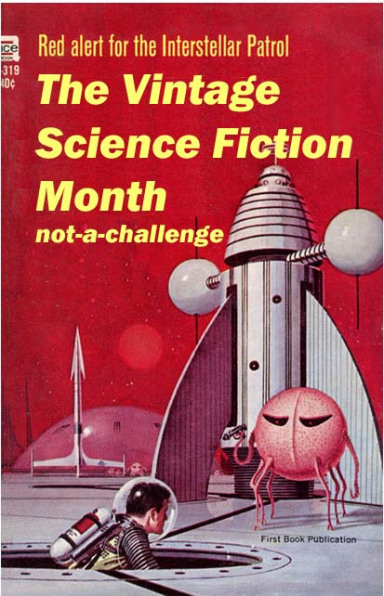
I love all these lists because I love reading old science fiction short stories. I thought I’d compare several just for the fun of it, and help remind people there are lists out there that help find old science fiction short stories to read. By the way, January is Vintage Science Fiction Not-a-Challenge month accord to the Little Red Reviewer blog, and reading short stories count. If you read and review old SF you might post links to their site.

Kelly has a nice feature for his list, a photo of a recent anthology and a link to Amazon where you can buy that anthology. See our “The SF Anthology Problem — Solved” essay for which anthologies have the most remembered stories.

Click on the heading link to see each site’s full list of stories.

Mark R. Kelly’s 10 Top SF Stories:

  1. “Bears Discover Fire” by Terry Bisson
  2. “Day Million” by Frederik Pohl
  3. “The Game of Rat and Dragon” by Cordwainer Smith
  4. “‘Repent, Harlequin!’ said the Ticktockman” by Harlan Ellison
  5. “The Star” by Arthur C. Clarke
  6. “The Nine Billion Names of God” by Arthur C. Clarke
  7. “Jeffty Is Five” by Harlan Ellison
  8. “Light of Other Days” by Bob Shaw
  9. “When It Changed” by Joanna Russ
  10. “I Have No Mouth, and I Must Scream” by Harlan Ellison

ISFDB Top 10 SF Stories:

  1. “Story of Your Life” by Ted Chiang
  2. “Flowers for Algernon” by Daniel Keyes
  3. “The Shadow Over Innsmouth” by H. P. Lovecraft
  4. “The Veldt” by Ray Bradbury
  5. “Dear Devil” by Eric Frank Russell
  6. “The Screwfly Solution” by James Tiptree, Jr.
  7. “Sandkings” by George R. R. Martin
  8. “Enemy Mind” by Barry B. Longyear
  9. “Jeffty Is Five” by Harlan Ellison
  10. “The Tell-Tale Heart” by Edgar Allan Poe

Sci-Fi Lists Top 10 SF Stories:

  1. “Flowers for Algernon” by Daniel Keyes
  2. “Nightfall” by Isaac Asimov
  3. “Story of Your Life” by Ted Chiang
  4. “The Nine Billion Names of God” by Arthur C. Clarke
  5. “The Ones Who Walk Away From Omelas” by Ursula K. Le Guin
  6. “Exhalation” by Ted Chiang
  7. “‘Repent, Harlequin!’ said the Ticktockman” by Harlan Ellison
  8. “Hell is the Absence of God” by Ted Chiang
  9. “A Rose for Ecclesiastes” by Roger Zelazny
  10. “I Have No Mouth and I Must Scream” by Harlan Ellison

The Classics of Science Fiction Short Stories Top 13 Stories (our list):

  1. “Bloodchild” by Octavia E Butler
  2. “The Star” by Arthur C. Clarke and “When It Changed” by Joanna Russ
  3. “Blood Music” by Greg Bear and “The Game of Rat and Dragon” by Cordwainer Smith

4th place ties made our list run longer than 10:

  • “Bears Discover Fire” by Terry Bisson
  • “Day Million” by Frederik Pohl
  • “Flowers for Algernon” by Daniel Keyes
  • “Fondly Fahrenheit” by Alfred Bester
  • “Light of Other Days” by Bob Shaw
  • “A Martian Odyssey” by Stanley G. Weinbaum
  • “‘Repent, Harlequin!’ said the Ticktockman” by Harlan Ellison
  • “The Story of Your Life” by Ted Chiang

Here is a list of all the lists we used to calculate our list, which include the ISFDB and Sci-Fi Top 100 lists.

So, consider reading some vintage SF short stories this month.

James Wallace Harris, 1/2/21