“The Jaguar Hunter” by Lucius Shepard The Magazine of Fantasy and Science Fiction (May 1985) The Year’s Best Science Fiction: Third Annual Collection edited by Gardner Dozois The Best of Lucius Shepard (2011)
In 1925 D. H. Lawrence wrote “The Woman Who Rode Away” while living in New Mexico. It was a story about a bored housewife who seeks to escape reality by riding into the mountains and offering herself to the shamans of the native people she found there. In 1968 Carlos Castaneda wrote The Teachings of Don Juan about revealing ancient knowledge from a modern day shaman of the Yaqui Indians. This book became a series that was embraced by the New Agers of the 1970s. In 1985 Lucius Shepard wrote from his experiences of living in Central America “The Jaguar Hunter” about a descendent of the Aztecs escaping the modern reality by similar shamanism.
Why does this theme keep showing up? What is the allure of the far past? The belief in ancient knowledge keeps showing up in both fiction and nonfiction. It’s the basis of religion, and a major tenet of fantasy fiction. Most modern works of fantasy are slowly moving towards make believe realities, but the classics of fantasy have always been built on aspects of the past. Haggard, Burroughs, Merritt, Lovecraft, Howard, Leiber, and other classic fantasy writers of the 19th and 20th centuries wanted their readers to believe magic and magical beings were once part of our reality. You might scoff at that, but don’t all the sacred books of religion claim it too? Is it so absurd to question fun fantasy when our society teaches our children ancient fantasies as facts? If you asked kids and teens where they’d really like to live, how many would say in fantasylands like they read about or see on TV?
“The Jaguar Hunter” by Lucius Shepard is not science fiction, but magic realism that suggests we can return to a past reality destroyed by modernity. The setting appears to be current day Honduras and the plot focuses on Esteban Caax, 44, a farmer. Esteban loves living in the country and pursuing a simple life. However, his life is complicated when his wife Incarnación, 41, buys a battery-powered TV on credit from Onofrio Esteves. Incarnación wants to move into town and take up modern ways.
Onofrio sold the TV to Incarnación to force Esteban into debt so he has to return to jaguar hunting. There is a rare black jaguar that’s keeping a tourist resort from being built, one that Onofrio and his son want to develop. When Esteban goes hunting the jaguar he finds a beautiful woman in the jungle who seduces him. He eventually learns she is the black jaguar and wants Esteban to return to an older, magical reality, part of his true heritage. At first, Esteban refuses, but ultimately, he’s forced to follow Miranda into an ancient reality that modern life and science was destroying.
Shepard’s writing is amazing and beautiful, yet I have to wonder about the intent of this story. The setup is realistic, probably inspired by experiences of living in Honduras. The conclusion of the story is fantasy, and like the intent of much fantasy, it’s a rejection of modern life.
I find it odd that Dozois included this and a few other fantasy stories in his anthology of the best science fiction of the year. But even back in 1985 science fiction was beginning to be overrun with fantasy. To readers who just enjoy a good story, making the distinction between the two genres isn’t important. But I find there’s a philosophical difference that matters. Fantasy longs for the past, while science fiction dreams about the future.
I enjoyed reading “The Jaguar Hunter” but I also find it offensive because it rejects both reality and science. When I was young I read most of the Oz books by L. Frank Baum. I loved them. When I was grown I read an article from the 1950s that said that some librarians stopped carrying the Oz books because it gave children unrealistic expectations toward life. I was horrified by the censorship, but I knew they were right. The Oz books had given me unrealistic expectations.
That Esteban can escape his petty mundane problems by running away into the past with a beautiful woman/jaguar is a fun conclusion to the story, but isn’t that an unhealthy message? You might think I’m being ridiculous laying such a heavy criticism on a slight bit of make-believe. But look at our world today. Half the population embraces a philosophy of denialism, rejecting science and reality. We live in a culture where people never grow up, and many never escape the brainwashing of religion or storytelling. Start paying attention to how off fantasy is embraced by the people around you.
I believe every good story, has a setup and an intent. I admire Shepard’s setup, but I don’t like his intent.
I’ve been dreaming to big for my age. I haven’t posted to this blog in over a month even though I’ve started many essays. I just never finish them. Today, realization finally came that the essays I dream of writing are too big for me to actually finish. For example, last night I began the third attempt to write a review an anthology with twenty-four stories in it, one I’ve been reading on all summer. This morning I realized to write the review I mentally picture writing would take days and days of work, even weeks, and it would be thousands of words long. Most readers browsing the internet are barely willing to consume a few dozen words. Well, I can’t write that short, but I’ve got to stop writing too long.
This reflects a change in my reading habits. I’ve practically stopped reading novels. I now read several hundred short stories a year. My mind is now too impatient for novels, and I realize it’s also too impatient to write long essays. So, I’ve decided my aim is to write succinct pieces about short stories. I wanted to write overviews of anthologies, or overviews of science fictional themes, but those ambitions are too grand for my current levels of energy and concentration.
My new goal for this blog is to create distilled insights into science fiction short stories. This site was created for version 4 of The Classics of Science Fiction, but we moved version 5 to a new site. We streamlined it so it’s mostly data, getting rid of all my wordy essays. Now it gets way more hits. I need to streamline this site too. Don’t expect a huge transformation quickly, I’m switching to old man steps.
I struggle to review and rate books. There are so many issues to consider. One important issue is reviewing against expectations. Sales blurbs, and even author’s opening chapters that you read at Amazon or at a bookstore can convince you to buy a book thinking it’s exactly what you want to read. But when you read the book, often the author takes it in another direction you didn’t anticipate. Should you judge the book by your disappointment? Of course not. But that’s hard not to do.
Here’s my review at Goodreads for A Gift of Time by Jerry Merritt:
I'm giving this book five stars because A Gift of Time is actually very readable and engaging. However, the book greatly disappointed me. I'd only give it three stars if I rated it by my expectations, but is it fair to rate a book poorly because the author didn't write the one you wanted?

When I read the blurb that said it was about an 80-year-old-man who got to live his life over again starting when he was a 10-year-old-boy I bought the book immediately. I loved that idea. And for a while, the story pursued that angle. But then it quit being about the lessons of living life over and became an action-oriented adventure with a time machine. That might please the average SF fan but I found it just a series of plot cliffhangers with no emotional depth. Luckily, it does have an emotionally satisfying ending. I just wanted it to be a different book. It could have been another Replay or The Midnight Library, and for a short while, it was.
First, the positives. I listened to this book and Christopher Lane’s narration was pitch-perfect. He’s the kind of audiobook narrator that does voices for the different characters and all the characters in this book sound like Merritt’s characterization. An author could not hope for more. Merritt is also an excellent storyteller. Micajah “Cager” Fenton is an old man driven by regrets. Aren’t we all. He is given a unique opportunity to live his life over starting at age ten. And for a while Merritt gives me exactly what I wanted. Can you imagine knowing what you know now and being back in your ten-year-old body? Cager’s first realization is how self-centered he was as a kid, and immediately changes his life by caring about other people.
Can you imagine a whole novel about someone reconsidering every point of their life with mature insight? That’s the story I wanted. And Merritt followed that plotline for a while. Then it switched to other directions, mainly ones driven by modern action-oriented plotting. I don’t want to go into specifics because that would spoil Merritt’s story. And many readers will like these new directions. I just didn’t care for them as much as the original story.
Part of my problem is time travel. It’s extremely hard to write a good time travel story. If you haven’t read many, then A Gift of Time might thrill you. But time travel can make plotting pointless. As a reader you realize the author can get away with anything. For me, that feels like cheap manipulation. I also feel the same about thrillers, which this novel also becomes. Some people love Disneyland, but I don’t. It’s all childish pretending to me. Thrillers are just fantasies about gunplay. A Gift of Time works through several genres. I suppose I should warn people one of them is like Law and Order: SVU. There’s also a bit of Southern Gothic which I loved quite a bit, but what I came for was the Ray Bradbury literary Sci-Fi. I wished the whole novel had been just those two.
Like I said, is it fair to wish that the writer wrote something else? This is Merritt’s book, and most readers at Goodreads loved this book. So take my laments with a grain of salt, especially if you’re young and not old and jaded. I did race through this novel because it’s an audiobook version of a page turner, and I’m seldom hooked by novels nowadays.
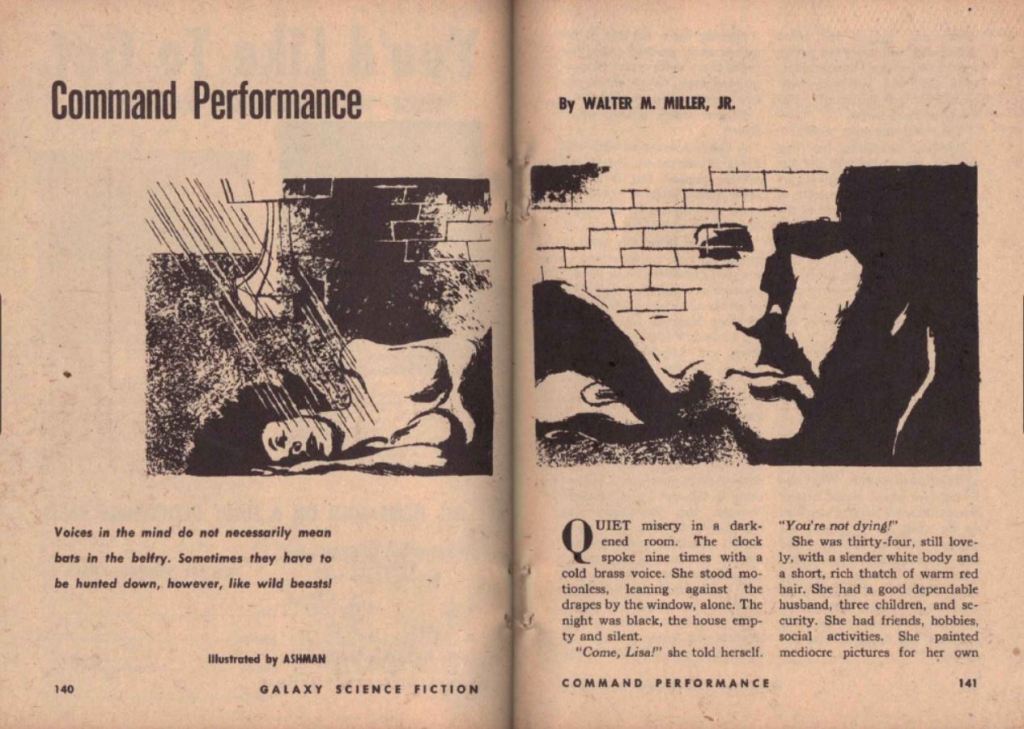
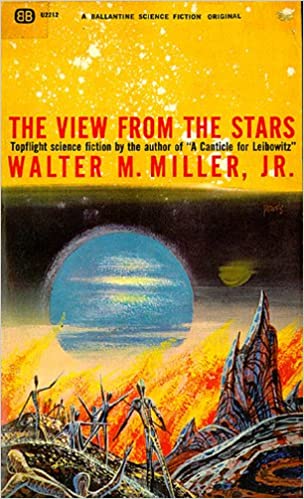
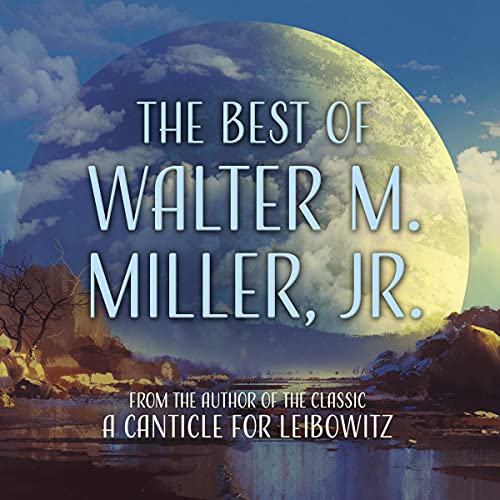
“Command Performance” by Walter M. Miller, Jr., was first published in Galaxy Science Fiction (November 1952) and was retitled in 1965 to “Anybody Else Like Me?” for Miller’s second collection The View from The Stars. This was my third reading of the story. Previously read in The Best Science-Fiction Stories: 1953 edited by Everett F. Bleiler and T. E. Dikty, and The Great Sf Stories 14 (1952) edited by Isaac Asimov and Martin H. Greenberg. I just listened to the story in The Best of Walter M. Miller, Jr. that was released on audio two weeks ago (June 2021).
Imagine you’re a science fiction writer and want to tell a story about a person who feels they are different from other people and one day they discover they’re a telepath when they finally meet someone like themselves. How would you plot such a story? I wouldn’t have done it like Walter M. Miller, Jr. did in “Command Performance,” and neither would you, but I was quite impressed with how he envisioned such an encounter playing out. Miller had an interesting take on how telepathy might work, and like many science fiction stories from the 1950s, it’s very psychological.
Most writers picture telepathy as people talking to each other without speaking aloud. Miller takes the concept much further. He has his characters, Lisa Waverly and Kenneth Grearly sharing thoughts, emotions, bodily sensations, fantasies, and inputs from all five senses. Much like that old saying about walking in someone else’s shoes.
I wish “Command Performance”/”Anybody Else Like Me?” was a novel instead of a short story, and Miller had worked out Lisa’s and Kenneth’s relationship at length. However, it appears Miller never finished a fully completed published novel. Miller’s most famous book, A Canticle for Leibowitz was a fix-up novel based on three previously published stories. ISFDB only lists one story in the novel section, “The Reluctant Traitor,” probably a novella, that appeared in the January 1952 issue of Amazing Stories. Saint Leibowitz and the Wild Horse Woman was a novel he almost completed before committing suicide, was finished by Terry Bisson, and published after his death.
According to ISFDB, Walter M. Miller, Jr. published 41 works of short fiction in the 1950s, and one in 1997, so evidently writing novels wasn’t his thing. I found this essay by Terry Bisson, “A CANTICLE FOR MILLER; or, How I Met Saint Leibowitz and the Wild Horse Woman but not Walter M. Miller, Jr.” to be quite interesting, revealing a few more tidbits about Miller. And now that I’m listening to The Best of Walter M. Miller, Jr. that just came out in audio, I’m finding each story makes me want to know more about Miller as a person. As Bisson points out, Miller did not want to meet people, and never even met his agent. That makes me even more curious about him.
I believe stories reveal details about their writers, even when writers desperately try to stay hidden. I’m only on the fourth story in this audiobook, and I’m guessing there will only be fourteen total if it’s based on the 1980 edition of the book of the same name. (Why haven’t his other stories been collected?)
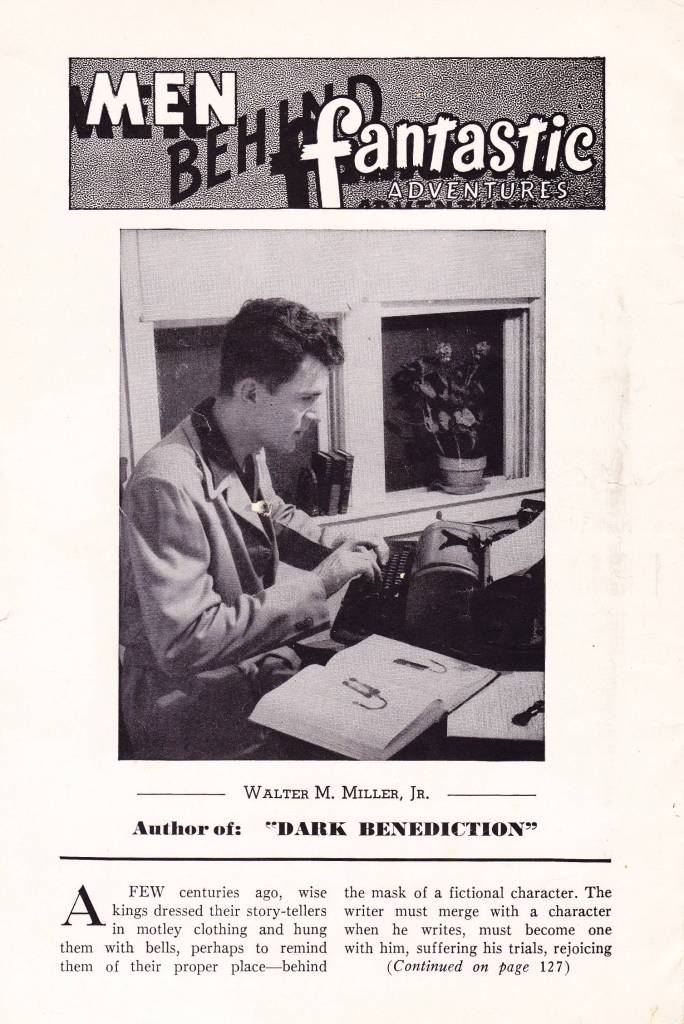
I can’t find much on Miller except his entries in Wikipedia and SF Encyclopedia. But at the beginning of his career, he wrote this profile about himself for the September 1951 issue of Fantastic Adventures:
I believe this provides us with a few additional clues. Miller became a recluse making himself enigmatic. I don’t think Miller was telepathic, but he might have felt himself different from other people. But as I listen to his stories I can’t help but wonder about the man who wrote them. They are a strange take on science fiction, focusing on humans, and less about aliens and spaceships. Miller seemed more interested in psychology, philosophy, religion and aspects about mundane life. One reason why I’m so fond of science fiction of the 1950s is because the characters were often ordinary, just ones who encountered the fantastic in strange little ways.
I’m really enjoying this collection and looking forward to hearing all 22 hours. I then hope to reread A Canticle for Leibowitz before trying Saint Leibowitz and the Wild Horse Woman.
James Wallace Harris, 7/8/21
Update:
A friend sent me a chapter from Better to Have Loved: The Life of Judith Merril by Judith Merril and Emily Pohl Weary where Merril recounts her affair with Walter M. Miller, Jr. while married to Frederik Pohl. It added many more puzzle pieces to my growing mental picture of Miller. I went to buy the book on Amazon and Amazon informed me I already had a copy. Now I need to read it.
Unfortunately, I don’t have a table of contents for the audiobook version of The Best of Walter M. Miller, Jr. but I’m hoping it’s the same as the 1980 hardback edition. That book seemed to combine the two previous paperback collections, Conditionally Human (1962) (3 novellas) and The View from the Future (1965) (9 stories and novelettes) and added two other stories for a total of 14. That leaves 27 stories uncollected. There were other collections of Miller’s stories, but they all seem to be reprinted from that same list of 14. Maybe they were all dogs, and not worth reprinting, but sometime I hope to read them too.
I know the short story is an obscure art form on the wane, and the minority of readers who still enjoy reading short stories mostly read new ones as they come out in online periodicals, but I’m concerned with remembering the best science fiction short stories from the past. Old novels, movies, and television shows have massive support systems for being remembered and introduced to new potential fans. Have you ever seen a book 1,001 Short Stories to Read Before You Die? YouTube is overrun with YouTubers devoted to their favorite books, movies, albums, and television shows, but has YouTube every offered to show you one devoted to short stories? And how often do you see a Top 100 list of all-time best short stories on the web where they live and die by Top 100 lists? Or even the equivalent of the Billboard Hot 100 for current short fiction releases?
About the best a short story can hope for is getting anthologized, and even then, damn few anthologies stay in print. Anthologies that reprinted science fiction short stories were common on twirling book racks in the drugstores of the 1950s through the 1970s, but they’ve about disappeared today. Of course, the science fiction magazines that published the stories originally, have faded into obscurity only loved by the last 10,000 subscribers. The internet has brought about a renaissance of online publication of short stories, and that’s reflected in the annual awards which pretty much ignore the printed magazines nowadays.
Science fiction short stories published in periodicals go back at least two hundred years, and there are fans who still read them too, just not that many. And those fans are dying off. There’s barely enough storyworms to keep the memory of classic short SF alive. (Which probably explains why so few anthologies are for sale.)
Last night I read “The Country of the Kind” by Damon Knight for the fourth time this century. And it wasn’t because the mood struck me to read it again. I’m reading The Great SF Stories 18 (1956) (1988) edited by Isaac Asimov and Martin H. Greenberg and it’s included in that anthology. It was also included in The Science Fiction Hall of Fame Volume One (1970) edited by Robert Silverberg which I listened to when it came out on audio in 2017, and then listened to again when the book club I’m in read it last year. I first read The Science Fiction Hall of Fame anthology back in the 1970s when it came out. I also read “The Country of the Kind” recently in Science Fiction of the Fifties (1979) edited by Martin H. Greenberg and Joseph Orlander.
I have this self-imposed rule that I don’t skip short stories I’ve read before when reading anthologies. I’ve discovered it takes multiple readings to fully appreciate a short story. “The Country of the Kind” has gotten better on every rereading.
This got me to thinking. How do average science fiction fans stumbleupon old science fiction short stories to read? I figure it’s the same way I discover older SF short stories, by reading anthologies. But like I said, anthologies aren’t as common as they once were. How often do young science fiction fans buy a SF anthology? Or a collection? Do they even know the difference between an anthology and collection? Many people selling them on eBay don’t. The collection is a book of short stories by a single author, and I believe this is the most common way that bookworms still read short stories today. It’s when they decide to consume everything by their favorite author that they finally turn to the short story.
An anthology is a book of short stories by multiple authors. Most readers today see them as annual best-of-the-year volumes that collect the top short stories from the previous year. About every five years a large retrospective anthology comes out that presents the best of the genre’s past. I hardly ever see them anymore, but some theme anthologies reprint short stories with similar subjects are still being published. Baen used to do this, but I haven’t seen any in a while. One exciting new anthology that just came out is The Best of World SF: Volume 1edited by Lavie Tidhar.
Yesterday I went looking for 21st-century anthologies that look back on science fiction of the 19th and 20th centuries. Here’s what I found currently in print. A few of these titles are aimed at the textbook market, reminding me that school reading is another way young readers encounter old SF stories.
Hyperlinks in the titles below are to the CSF database were you can see their table of contents by story in order by year published. That page also has additional links for more information about all the stories. If you don’t want to lose your place here, do a right-click and select Open in New Window, and then close that window after you’ve poked around.
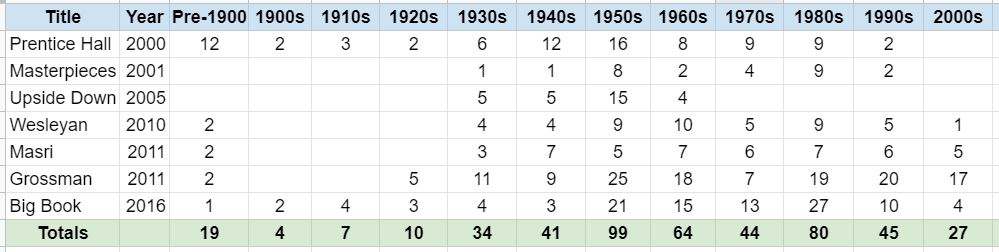
Here’s how these anthologies remember short stories by decades. Like I said, science fiction short stories have been around a very long time. But looking at the numbers below makes it look like something happened in the 1930s. Amazing Stories began in 1926, which some claim was the start of the genre, but others think it really began when John W. Campbell, Jr. became editor of Astounding Science-Fiction in the late 1930s. (See my essay “19th Century Science Fiction Short Stories” for an overview of a baker’s dozen of anthologies that remember that century.)
It’s interesting to see the distribution of stories by decades. Both The Prentice Hall Anthology of Science Fiction and The Big Book of Science Fiction have something from every decade. In terms of totals, the 1950s win, with the 1980s coming in second. The so-called Golden Age of the 1940s seems to be fading.
If you want to read some of the classics of SF anthologies, check out Mark R. Kelly’s Anthology page.
The Classics of Science Fiction Short Stories list, which is set to a minimum of 8 citations produces a list of 97 stories. It remembers stories from 1934-2010, which is a kind of a moving memory bubble. The entire database contains 4,554 stories from 1809-2010 with at least 1 citation. We currently believe that 7-8 citations represent a certain level of popularity or remembrance.
“The Country of the Kind” is reprinted in the Sense of Wonder (2011) anthology, so it’s still being remembered. Here’s the history of where it’s been anthologized since its original publication in 1956. The last major anthology it was in was The Very Best of Fantasy & Science Fiction, Volume 2 (2014) edited by Gordon Van Gelder.
If you’ve been paying attention, you’ll note “The Country of the Kind” gets reprinted every few years in an anthology. That’s how Damon Knight’s little classic stays alive. I doubt many young readers today read anthologies, so it’s probably just barely hanging on in our collective memory.
When I researched this story on Google, I did notice that several sites devoted to writing school papers offered an analysis of the story for a fee. Being taught in school is another way for a short story to survive. There are other ways. Getting made into a movie or TV show sometimes happens, but that mostly seems to happen to stories by Philip K. Dick. Several episodes of Love, Death & Robots were based on recently published SF stories. I’m also in a Facebook group that helps.
Speaking of reading science fiction short stories in school, I can tell from my stat pages that some are probably popular with teachers. I doubt that many Googlers would be searching on these stories unless they were forced to by a school assignment. Another indicator they are assigned reading is they get hits only during the school year.
It’s rather telling that “The Country of the Kind,” “The Veldt” by Ray Bradbury, and “The Ones Who Walk Away From Omelas” by Ursula K. Le Guin seem to be very popular in the classroom. And each of those stories deal with a particular incidence of violence. It’s almost as if controversial nastiness makes for teachability.
Finally, I’ve thought of one other new way that short stories are presented to help them be remembered: audiobooks. Both audiobook publishers and podcasters present audio productions short stories. For example, here’s one for “The Country of the Kind.” I noticed yesterday that Audible came out with The Best of Walter M. Miller, Jr. in June with over 20 hours of readings of Miller’s short stories. That made me very happy. Audible has some SF anthologies, but not many. The best way to find audio productions of short stories is to look for collections by your favorite author. For example, they have The Complete Short Stories by J. G. Ballard that runs over 63 hours, or five volumes of The Collected Short Stories of Philip K. Dick.
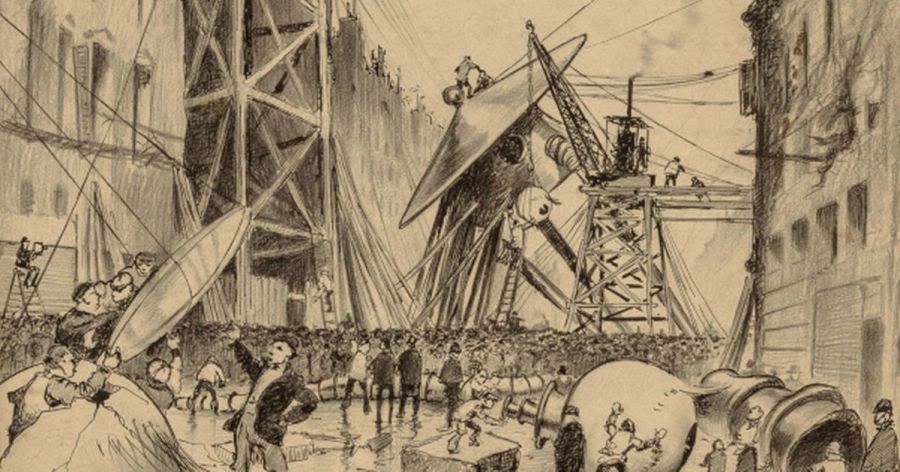
Has any science fiction writer from the 20th or 21st centuries ever done a better job exploring the science fictional themes than H. G. Wells covered in the 19th century? Has any novel or film ever gone any deeper into the idea of invaders from outer space than The War of the Worlds? Haven’t we been recycling the same speculations that H. G. Wells began way back then?
This is the third time I’ve read The War of the Worlds by H. G. wells since 1963. The first time I was in the seventh grade. I was too young to understand the novel and read too fast to really appreciate anything other than the basic plot. Back in 2005 I listened to an audiobook edition. I realized then that The War of the Worlds was far better than what I remembered, or any film or TV version I had seen over my lifetime. Reading it again this week, after rewatching the 1953 film, and seeing the 2019 British TV miniseries, I understand why we’re still reading this 1898 novel, and why people keep making filmed versions of it. There were three in 2005 and two in 2019. The War of the Worlds is truly a five-star classic.
I’m not sure young readers know how much credit we should be giving H. G. Wells for his contributions to science fiction. In one sense, the novels he published from 1895 to 1900 can almost be considered the foundation of the genre. Wells covered many of the main science fictional themes that writers are still tilling today. The trouble is, I haven’t read widely enough in earlier literature to know how much Wells borrowed and how much he created.
I do feel Wells brought new speculations and what ifs to the genre. We credit Wells for starting the space alien invasion theme, but Wells only took invasion literature that began in 1871 with The Battle of Dorking in a new direction. Instead of worrying about invaders from Germany or France, Wells asked, “What if invaders didn’t come from Earth?”
Once he proposed that one question, it generated all kinds of possible SF speculation. What if beings from other worlds were more advanced than us? Science fiction has explored that question over and other, but I’m not sure we’ve ever psychologically accepted any being could be superior to ourselves. Reading The War of the Worlds this time made me noticed just how much Wells thought about it. I would love to find reviews of his book published at the end of the 19th century to see if his readers significantly pondered Wells’ ideas. Here are some quotes:
No one would have believed in the last years of the nineteenth century that this world was being watched keenly and closely by intelligences greater than man’s and yet as mortal as his own; that as men busied themselves about their various concerns they were scrutinised and studied, perhaps almost as narrowly as a man with a microscope might scrutinise the transient creatures that swarm and multiply in a drop of water. With infinite complacency men went to and fro over this globe about their little affairs, serene in their assurance of their empire over matter. It is possible that the infusoria under the microscope do the same. No one gave a thought to the older worlds of space as sources of human danger, or thought of them only to dismiss the idea of life upon them as impossible or improbable. It is curious to recall some of the mental habits of those departed days. At most terrestrial men fancied there might be other men upon Mars, perhaps inferior to themselves and ready to welcome a missionary enterprise. Yet across the gulf of space, minds that are to our minds as ours are to those of the beasts that perish, intellects vast and cool and unsympathetic, regarded this earth with envious eyes, and slowly and surely drew their plans against us. And early in the twentieth century came the great disillusionment.

...

Yet so vain is man, and so blinded by his vanity, that no writer, up to the very end of the nineteenth century, expressed any idea that intelligent life might have developed there far, or indeed at all, beyond its earthly level. Nor was it generally understood that since Mars is older than our earth, with scarcely a quarter of the superficial area and remoter from the sun, it necessarily follows that it is not only more distant from time’s beginning but nearer its end.

...

And we men, the creatures who inhabit this earth, must be to them at least as alien and lowly as are the monkeys and lemurs to us.

...

And before we judge of them too harshly we must remember what ruthless and utter destruction our own species has wrought, not only upon animals, such as the vanished bison and the dodo, but upon its inferior races. The Tasmanians, in spite of their human likeness, were entirely swept out of existence in a war of extermination waged by European immigrants, in the space of fifty years. Are we such apostles of mercy as to complain if the Martians warred in the same spirit?

...

In three other points their physiology differed strangely from ours. Their organisms did not sleep, any more than the heart of man sleeps. Since they had no extensive muscular mechanism to recuperate, that periodical extinction was unknown to them. They had little or no sense of fatigue, it would seem. On earth they could never have moved without effort, yet even to the last they kept in action. In twenty-four hours they did twenty-four hours of work, as even on earth is perhaps the case with the ants.

...

“This isn’t a war,” said the artilleryman. “It never was a war, any more than there’s war between man and ants.”

...

I learned nothing fresh except that already in one week the examination of the Martian mechanisms had yielded astonishing results. Among other things, the article assured me what I did not believe at the time, that the “ Secret of Flying,” was discovered.

...

It may be that in the larger design of the universe this invasion from Mars is not without its ultimate benefit for men; it has robbed us of that serene confidence in the future which is the most fruitful source of decadence, the gifts to human science it has brought are enormous, and it has done much to promote the conception of the commonweal of mankind.

...

If the Martians can reach Venus, there is no reason to suppose that the thing is impossible for men, and when the slow cooling of the sun makes this earth uninhabitable, as at last it must do, it may be that the thread of life that has begun here will have streamed out and caught our sister planet within its toils.

...

Dim and wonderful is the vision I have conjured up in my mind of life spreading slowly from this little seedbed of the solar system throughout the inanimate vastness of sidereal space. But that is a remote dream. It may be, on the other hand, that the destruction of the Martians is only a reprieve. To them, and not to us, perhaps, is the future ordained.
Can we really imagine meeting a being that is as far above us as we’re above a dog? What if the gap is as large as between people and ants, another comparison Wells makes in the book. Actually, in several places, we’re no more important to the Martians than bacteria are to us under the microscope. Wells can imagine this possibility and he tries to illustrate it in the story, but I don’t think he really succeeds because it’s something impossible to imagine. But Wells, and science fiction written since have tried. Consider Roadside Picnic by Arkady and Boris Strugatsky.
We have to remember how Wells portrays the Martians and how readers of Pearson’s Magazine in 1897 imagined them. The Martians had weapons that used heat, light, gas, and biological agents that quickly dispatched the greatest military in the world. London, the most advanced city on the planet was quickly overrun, and millions had to flee. This is impressive, but does it really mean the Martians are intellectually superior to us? They are more advanced technologically. And that’s been the most common thread in alien invasion stories since, even though we keep gaining in our own technological prowess.
Martians treated us like animals. In fact, they treated us like cows or pigs, and used humans for food. Does this mean they’re superior? We assume we’re superior to farm animals, but we’ve never been a cow and can’t imagine what cows think of us.
The Martians invaded Earth like England invaded other countries, and the English felt superior because they could get away with it. But does it make them superior? Over and over again science fiction has tried to portray superior aliens. Usually, writers give them advance technology like Wells did in his novel. Writers often give aliens telepathy or other psychic powers to suggest a higher state of being, and at one point Wells speculated about this. Often, advanced aliens are described like gods in old religious texts. But just how realistic is that? Isn’t it really a lack of imagination? I’m not faulting Wells, because he did try, but I think he hit a wall, and so has every other SF writer since.
Notice that Wells gave the Martians the same power that Nancy Kress did in her story Beggars in Spain. Not needing sleep would indeed be a plus, but does it make a being superior? It is a very nice specific attribute. What other attributes make a superior being?
Are we incapable of imagining a realistic being more developed than humans? We consider ourselves superior to animals because we have language. In recent years, many science fiction stories have explored the idea of communication with beings from other stellar systems. The film Arrival, based on Ted Chiang’s “Story of Your Life” does suggest a possibility. What if a language isn’t based on linear time, and the structure of the sentence isn’t depended on word order? That’s a wonderful theory, but is it even possible? Imagining the impossible is impressive, but not as impressive as imagining the possible that hasn’t been discovered yet.
Can we imagine a process of communication that goes beyond language? We always fall back on telepathy. Would that be instantaneously sharing of words, or sharing sense organ input? If the Martians of Wells’ novel could read human minds, would they still kill and eat people, and destroy their civilization? Wouldn’t a superior alien have empathy and compassion for other beings? If we were really superior to animals would we eat them and kill them the way we do? Aren’t we just acting like animals that eat each other?
If you look at in the right light, Christianity was an effort to create a superior human. Unfortunately, few humans have ever achieved what Christian theory hoped to have achieved. Religions have routinely rediscovered compassion throughout history, but they’ve never been able to make humans compassionate. We see in Star Trek, at least in some episodes about the Prime Directive, how the Federation tried to codify a compassionate treatment of other beings, but often the plots don’t allow for it. Still, it’s a concrete example.
Science fiction writers keep trying to imagine a superior being and keep failing. I believe Heinlein tried with Stranger in a Strange Land, by giving his Martian named Smith superpowers. But Smith shows no compassion for lesser beings, and frequently vanishes them out of existence. Clarke tried with Childhood’s End and 2001: A Space Odyssey, but again he falls back on godlike powers, and a lack of compassion for lesser beings. Remember, Earth and humans were destroyed when a new species of humans emerged. Why do we continually believe superior beings have the right to destroy lesser beings?
We seem stuck in a Groundhog Day loop regarding invading aliens. Did anything new really show up in Independence Day (1996) a century after The War of the Worlds, or will show up in The Tomorrow War that’s coming out on Amazon Prime? Isn’t it logical to assume any alien that’s invading us can’t be superior because they’re invading us? Superior beings don’t go around exterminating other beings? Conversely, we can’t be all that superior to the other species on this planet. Unless the only definition of superior is the ability to destroy. And how often in science fiction are we the alien invader? Just recall the film Avatar for an easy example. Or think of how we treated the aliens in District 9.
There are two stories I’ve read this year that dealt with this issue, but sadly, I can’t remember the title and author of either one. The first suggested there were two types of beings in the galaxy. One type wants to conquer the galaxy because they are spreaders. The other type wanted to explore the galaxy because they are seekers, seekers of knowledge. We like to think humanity is a seeker species, but we’re really spreaders.
The other story was about species genocide. A character had the military power to destroy a whole species of alien invaders, but worried about using it. The justification given to her claimed the galaxy was full of violent species that acted no better than murderers or thieves, so it was either kill or be killed, so she killed the invading aliens. As long as we’re a product of evolution do we always assume we have to keep playing its game.
My idea of a superior alien is one that can step outside of their evolutionary upbringing and can act with compassion and empathy towards their fellow species. But I also imagine, this superior species would also develop the ability to communicate precisely, way beyond the power of words, and understand reality. We only perceive reality indirectly, with very limited senses, and usually interpret what we perceive with a lot of bullshit desires. I’m guessing a real superior space alien would avoid us like a dangerous pathogen or generator of gamma ray bursts.
In the end, I wondered if Wells didn’t model his Martians on the English in Africa and India. That implies any science fiction about aliens is really about looking at ourselves in a mirror. Shouldn’t science fiction writer ask how we could become superior beings?
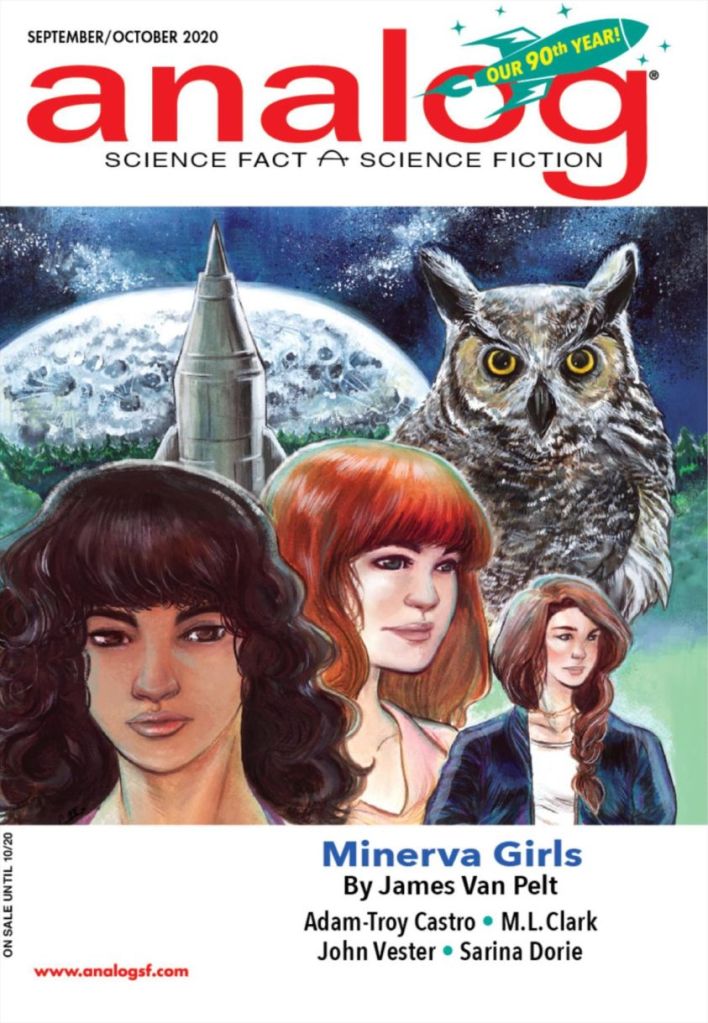
The Best Science Fiction and Fantasy Short Fiction group on Facebook has been reading through the Asimov’s Science Fiction and Analog Science Fiction reader award short fiction finalists. “Minerva Girls” by James Van Pelt is about three teenage girls who build their own spaceship and go to the moon. I thought the story was a lot of fun, but one of our members said he couldn’t get into it because it was too unbelievable. Well, that’s true, believing children can invented anti-gravity and build their own spaceship out of a gas tank unearth from a service station is beyond farfetched, but it’s still a fun idea for a SF story. Coincidently, that plot is how I got into science fiction in the fifth grade by reading Danny Dunn and the Anti-Gravity Paint.
Of course, it’s one thing to be a child and fantasize about of being a child space explorer, and being an old man believing a story about children inventing a spaceship. Obviously, realism didn’t get in my way of enjoying “Minerva Girls.” I started thinking about why and realized I’ve read a number of stories over my lifetime where kids build their own spaceship. It’s a neat little SF theme that doesn’t seem to ever go away.
Like I said in my last essay, cherished ideas acquired in childhood often have a habit of sticking with us for the rest of our lives, even if they have no possible reality. Most people learn the truth about Santa Claus at an early age yet keep the myth alive for the rest of their life. Who doesn’t love watching Miracle of on 34th Street every year?
Right after I read the Danny Dunn series I started in on the Tom Swift, Jr. books. These only reinforced the idea that kids could build anything that adults could.
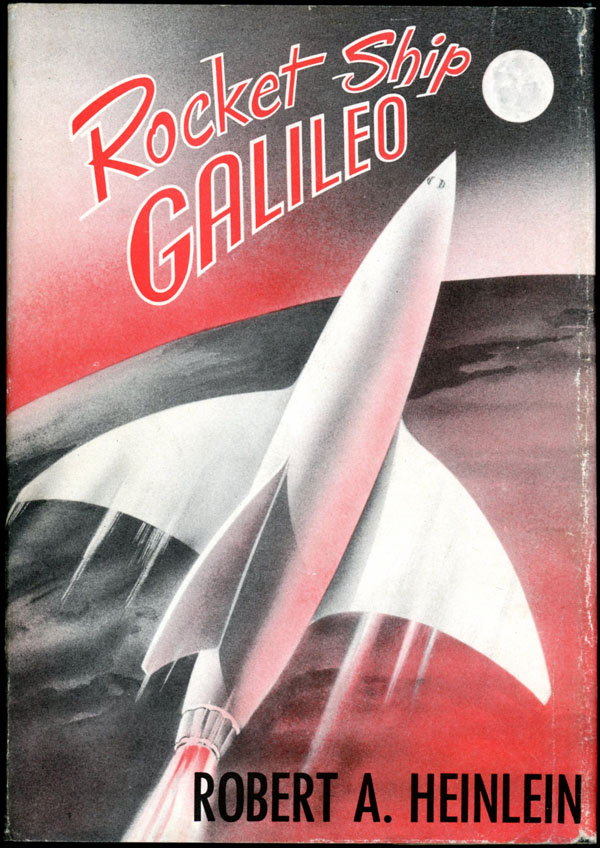
Then a few years later in 1964 I discovered the Heinlein juveniles. In each book a teenager had adventures in space. I was now twelve, about to turn thirteen, and I still wanted to believe it was possible for a kid to build a rocket, yet I was old enough to realize that Heinlein’s book Rocket Ship Galileo was unbelievable. I knew what it took to build a rocket because I had faithfully followed every launch of Project Mercury and was reading about Project Gemini that would begin the following year. Rockets required a big hunk of a national budget and tens of thousands of grownups to build.
Then in the summer of 1966 I read a serial in If Magazine called “The Hour Before Earthrise” by James Blish where a kid builds a spaceship out of wood, powers it with anti-gravity, and goes to Mars. It was later published in book form as Welcome to Mars. By then I knew this was an idea too ridiculous to contemplate, yet I still enjoyed reading the story. I wanted to believe still, but I felt like a kid feeling too old for Santa.
There wasn’t a lot of YA science fiction when I was growing up – actually, there wasn’t a lot of science fiction period. But the genre had a reputation for being targeted at pre-adults. Many SF writers resented this, but I think it was mostly true. Today YA science fiction and fantasy is big business, and it’s not just consumed by teenagers. Evidently, adults want to vicariously be teenagers again and fantasize about having great adventures.
Part of me wants to reject my love of juvenile SF literature. That part of me wants science fiction to grow up too, and deal with reality. In particular, science fiction should explore realistic futures where going to the stars is impractical, and humanity accepts its destiny on Earth before we destroy it. But what kid wants to read that kind of science fiction? And it’s pretty obvious few adults want to read it either.
Yes, “Minerva Girls” is an unbelievable fantasy, but it’s also one we want to keep believing. I don’t mean to offend anyone by this comparison, but I wonder if the desire to believe in the science fiction we discovered in childhood isn’t akin to people who maintain their childhood religious beliefs in adulthood? What percentage of our society can’t put away childish things? I’m guessing a large percentage. Maybe the reality is we hold onto things we want to be real in the face of a reality we reject?
And reality does intrude into “Minerva Girls.” Selena and her friends have to contend with mean girls, studying things in school they didn’t want to learn, and the heartache of losing each other. They did have to come down to Earth after visiting the moon. They accepted the painful reality that their lifelong friendship was going to be broken up by two of their families moving to new cities.
There was another new bit of reality in this fantasy, instead of a trio of boys building a spaceship on their own, it was a trio of girls. In fact, in all these stories, the characters had to face plot pitfalls based on realistic everyday life hurdles. Fiction, even fantasy fiction, doesn’t work without a certain amount of realism.
I guess these stories are still appealing because wouldn’t it be fun to live in a reality where building a jalopy spaceship in the backyard could happen? Or converting an old Camry into a time machine?
Have you ever spent time thinking about why you like a particular story, movie, television show, song, photograph, painting, etc.? I believe most of us assume the critical ingredient is in the artwork itself. What if that’s not altogether true? What if our admiration also depends on what’s inside ourselves too?
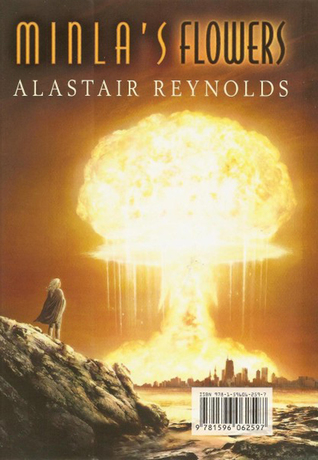
I just read “Minla’s Flowers” by Alastair Reynolds in The New Space Opera edited by Gardner Dozois and Jonathan Strahan. It was the eleventh story in the anthology and the first one that grabbed me. The other ten were well-told tales, but they just didn’t resonate with my Sci-Fi soul. And that’s a hint at what I’m talking about. “Minla’s Flowers” pushed my buttons, but which buttons, and where did they come from?
People turn to genealogy when they want to know how their body got here, but it doesn’t explain the programming that went into creating their personality. What if we use the Butterfly Effect to explain the lineage of our personality and show where all beliefs, opinions, likes, dislikes, prejudices, loves, hates, fears, etc. that went into making who we think we are. What if the Big Bang origin of all our traits can be traced back to specific triggers, whether huge emotional explosions or tiny seeds of inspiration? Can we ever trace specific emotions back to the first flutter of butterfly wings?
This theory started taking form a few years ago when I realized I didn’t enjoy modern science fiction short stories as much as I loved older SF stories. Had I changed, or science fiction? It’s been sixty years since I started reading SF. It seems obvious that both myself and the genre have changed, but have we? The macro aspects of my personality and the genre haven’t I don’t think. But how many micro details reveal any real change? Both are complex system not easily understood, so my Freudian-like analysis will only be guesswork.
One hypothesis I’ve considered deals with information density. I know a lot more in 2021 than I did in 1962, and so does science fiction. My mind reads with a greater density of relatable knowledge, and modern SF prose is often written with a greater density of information and science fictional speculation. Yet science fiction themes don’t seem to change over time. About the only new themes to emerge during my lifetime is digital worlds and brain downloading/uploading, and both probably had precursors if I researched it enough. Last night I watched the 2019 British miniseries of The War of the World, and then started rereading the novel. It only reminds me of how I’ve been seeing shadows of Wells my whole life.
When I grew up SF stories had basic plots that exposed ordinary humans to usually one far-out bit of speculation. Now SF stories are written with a Phil Spector-like Wall of Speculation approach, embedding the plot and far-from-ordinary-humans into narratives of greater information density, especially the New Space Opera stories about the far future.
First off, I didn’t feel “Minla’s Flowers” was a five-star story, but I did feel it deserved a solid four-stars, mainly because I knew I’d want to reread it someday. In fact, I’ve already reread parts of it to compose my comment for our reading group at Facebook. That’s when I realized something. I liked “Minla’s Flowers” because it reminded me of so many other science fiction stories. Here’s my comment to the group:
Alastair Reynolds begins "Minla's Flowers" with a lone adventurer, Merlin, and his AI spaceship, Tyrant, falling out of subspace, Waynet, to make repairs on a planet, Lecythus, only to discover it inhabited by humans who had colonized it thousands of years ago and are currently at war, where he befriends an old scientist, Malkoha, and his daughter Minla.

I have to say all this triggered memories of Flash Gordon/Buck Rogers, Dr. Zarkov/Dr. Huer, and Dale Arden/Wilma Deering. "Minla's Flowers" is the first story in this collection that feels like Old Space Opera, and it was a lot of fun.

I thought for sure Reynolds was going to arrange for Merlin and Minla to become lovers ala cold sleep (think THE DOOR INTO SUMMER), but that didn't happen. Minla became his rival, even the antagonist of the story. Eventually, the plot of "Minla's Flowers" turns into the plot of WHEN WORLDS COLLIDE, escaping a doomed planet by building a spacefaring nation in seventy years.

Since Merlin is needed for a future adventure by Reynolds, he undergoes a series of cold sleep timeouts, and only ages a few months during this story, while Minla reaches 80. That should remind me of several SF stories, but I can't recall any at the moment. (INTERSTELLAR?)

Reynolds extends this story time and again through philosophical and ethical issues of helping a civilization speed up its development. In this regard, Merlin's and Tyrant's roles remind me of Klaatu and Gort from the film THE DAY THE EARTH STOOD STILL.

Because Reynolds embeds so much of the science fiction mythos into his story it caused the science fiction region of my soul to resonate with it. I know I will reread this story in the future, and it might even resonate more, but for now...

Rating: ****
Science fiction speculates on a limited number of subjects. One of the reasons I didn’t enjoy many of the ten stories before this one in The New Space Opera is because they speculated about topics I either discount, or I believe are too overused. Many of the stories in this anthology assume in the far future humans will have colonized the galaxy, and we’ll share it with aliens, intelligent robots, androids that look like us, cyborgs, humans that have achieve immortality, posthumans, transhumans, and downloaded humans. Decades ago it was common to see one of these elements as the basis of a science fiction story, but now it seems science fiction writers assume they will all coexist in the future, and somehow they must all be mentioned whenever writing a story about the far future. Actually, I’d find it a reading thrill for a writer to challenge these assumptions. It’s why I loved Aurora by Kim Stanley Robinson.
New science fiction writers have to recycle old themes because developing new ones are next to impossible. And as a reader, at least for me, if I encounter too many stories using the same concepts, I get bored with them. I should probably avoid theme anthologies like The New Space Opera. Yet, I responded positively to “Minla’s Flowers” because it caused me to resonate with old SF I loved in adolescence. Freud was a big explorer of our subconscious mind, but did he ever suggest early sense of wonder experiences would create chimes in our personality that would ring in later years if we encounter similar wonders on the same wavelength?
Of course, I might need to be careful with line of self-analysis, or I might find out that everything I love and believe originated in old science fiction stories I first encountered in youth. I’ve often thought science fiction was my substitute for religion when it didn’t take when I was a kid.
“Minla’s Flowers” has one human, one AI spaceship, and an alien world populated by humans that colonized the planet so long ago they’ve forgotten how they got there. This simplicity of story elements reminds me of Old Space Opera. (Although Reynolds does keep trying to cram in even more science fictional elements I felt diluted the story.)
At the plot’s core, “Minla’s Flowers” is about a civilization that needs to flee its home planet to find a new world because their sun will be destroyed in seventy years. One of the first SF books I read with this theme was the omnibus When Worlds Collide and After Worlds Collide by by Edwin Balmer and Philip Wylie. Has that story I read at age twelve shaped my response to future fiction? All my life I’ve thought humanity should colonize space to protect itself from extinction. Did that too come from Balmer and Wylie? Thinking about it now, I’m not sure it’s a practical or realistic idea. We were evolved for living on Earth, and all our space exploring fantasies may just be that.
Merlin fits the archetype for the science fiction hero, as does his sidekick. Where Reynolds took his story in an anti-tradition was with Minla, and that also thrilled me too. Is the right mixture for entertaining new science fiction a good bit of the tried and true, with a touch of the contrary?
Fiction is still magical. I don’t know how it works its spells. But now that I’m much older, and have consumed vast quantities of the genre, I sense patterns that my unconscious mind likes. It’s almost as if my unconscious mind learns and evolves, and maybe even has its own logic. I’m old and tired, and have a difficult time finding stories I still love, but every once in a while, something clicks. It’s a weird unexplainable experience.
At our SF short story reading group on Facebook we’ve been discussing story rating systems. Everyone has a slightly different way to review and rate stories but a 5-star system is common. However, several people expand that basic 5 levels into 10 levels with half-stars or pluses, or to 100 levels with tenths of a point refinements. Personally, I can’t distinguish that finely between stories to organize them into ten levels, much less one hundred. However, I can say subjectively I like one story better than another, and compare them relative to each other.
After reading 1,000-2,000 stories over the last four years I’m starting to get an intuition about their quality. Some stories just stand out above all the others, and the group essentially agrees that 5-stars should be reserved for those very best stories, the stories that have become recognized classics or feel will become classic in the future. And I say essentially because we never agree on anything precisely in our group. And this relative system of rating doesn’t mean one reader’s 5-star classic can’t be some other member’s 3-star it’s okay story.
We discuss one story a day, and maybe a handful of members out of a near 500 membership will read and comment on the story. Those comments are enlightening about how we each read stories, and what reading pleasures and displeasures trigger their responses. A few of us have started leaving star ratings and that’s beginning to become illuminating too.
I’m slowly getting a feel for the short story form, at least regarding science fiction stories. If you haven’t read that many SF short stories, even an average story can trigger a “far out” or “great” response. But once you’ve logged your ten thousand hours of reading time, you realize truly great stories are few and far between. My guess is less than six 5-star level stories are published each year, and probably less than two dozen 4-star level stories. Most stories are good solid stories but they must be classed as 3-stars if you consider them relative to the 5-star and 4-star stories.
In other words, a 4-star story is a story that breaks out from the crowd by a significant measure. It’s like the Magnitude scale for earthquakes, logarithmic. It just feels like a big jump from 3-stars to 4-stars, and that’s why so many in the group want to rate stories ***+ or 3.5-stars, or even 3.2 or 3.7, because they feel the story is better than average but not quite up to that 4-star level. When you’ve read a lot of stories it intuitively feels like a 4-star stories is a quantum leap above a 3-star story but few people can explain why in details. And there’s another another tremendous leap from 4-stars to 5-stars. When you think of stories like “Flowers for Algernon” or “The Ones Who Walked Away From Omelas” you know very few stories come close to their magnitude in power.
I think many people want to rate fiction (or movies, or albums) like people rate their purchases on Amazon where 5-stars means you have no complaints. Which is why for some products on Amazon you see 80% 5-star ratings. When it comes to the artistic, 5-stars has to be for artwork that is 1 in 100 to 1 in 1,000 in quality.
But how can we understand this at a gut-reaction level? An idea came to me today that I think might help, so I’m trying it out here. Take any author you’ve read many of their short stories. How many stand out as your very favorites? How many are almost as good? And if you count the rest, how large is that number in relation to the first two groups?
Take for example Ray Bradbury. I consider these his obvious 5-star stories:
“There Will Come Soft Rains”
“Mars is Heaven!”
I consider his 4-star stories to be:
“The Million-Year Picnic”
“The Veldt”
“A Sound of Thunder”
“The Pedestrian”
And the first two I’d probably rate ****+ or 4.5-stars.
There might be other stories that I haven’t read by Bradbury that I would rate with a 5-star or 4-star, but for the most part I’ve read dozens of his hundreds of stories and they go into a vague 3-star pile. If I studied his work thoroughly, I’d probably find several more stories I love, but for now, this is how I remember Ray Bradbury.
For all my favorite authors I can remember stories that stand out as classic, and some that I don’t feel are quite as good. For example, with Clifford Simak, as much as I love “The Big Front Yard,” it’s not on the the save level as “Huddling Place” or “Desertion.” As much as I love “The Year of the Jackpot” by Heinlein, it’s not on the same level as “The Menace From Earth,” or “Requiem,” or “Universe.”
Another difference between 4-star and 5-star stories is how many times I will reread them. I can enjoy a 3-star story quite a lot, but I know I’ll never want to reread them. Whereas, when I read a story for the first time and know I want to reread again someday, that tells me the story is a 4-star story. Stories that I have read many times are the ones I think of as 5-star stories. In fact, I might not know a story is a 5-star story until I’ve read it two or three times.
There is no way to objectively and quantitatively rate a work of art, but using a system based on relative impact is somewhat helpful, don’t you think?
Using this relative system to read new stories, especially by authors I don’t know, can be troublesome. I have to rate the story against all the other stories I know by other writers. So if I’m reading a new story from the latest issue of Lightspeed Magazine it has to complete with all the 5-star and 4-star stories I’ve discovered over my lifetime.
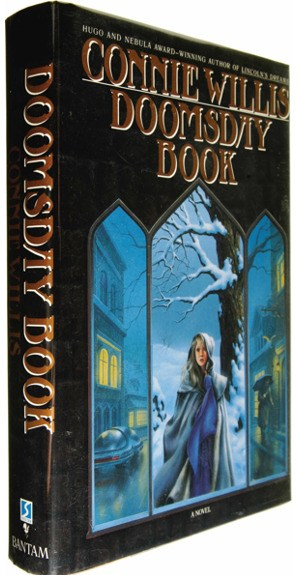
This is one of the finest science fiction novels I’ve ever read. It won both the Hugo and Nebula awards.
I listened to the audio edition, which runs 26 hours and 20 minutes. When I started listening I was immediately hooked, however, the pace of the plot is exceedingly slow. Several reviewers at Goodreads give it one star because they claim it needs severe editing. I thought that too — for a while.
I had read so many great reviews of this book that I felt compelled to stick with it. Around ten hours I thought about giving up because nothing was happening, but listening was still compelling. Around fifteen hours I said to myself I was glad I read this book but I’d never reread it. In the last few hours, I knew I would reread it again.
There are two kinds of history – the sweeping history usually found in school and textbooks, and the everyday living kind of history full of details about ordinary living found in books by a new breed of historians. This novel is an everyday life time-travel story. If you loved Timescape by Gregory Benford you should like Doomsday Book. I believe time travel is impossible but these two books are the Hard SF of time travel.
Doomsday Book shows the intricate plotting of a J. K. Rowling novel combined with a fine sense of drama. Be warned, this story ultimately feels like a boxer is using your heart for a punching bag. It is relentless in its realism. Now I understand why the story needed so many words to be told.
I feel sorry for people who can’t listen to the audiobook edition of Doomsday Book read by Jenny Sterlin. There is no way I could have experienced this novel so deeply with my own wimpy inner reading voice.










 Classics of Science Fiction