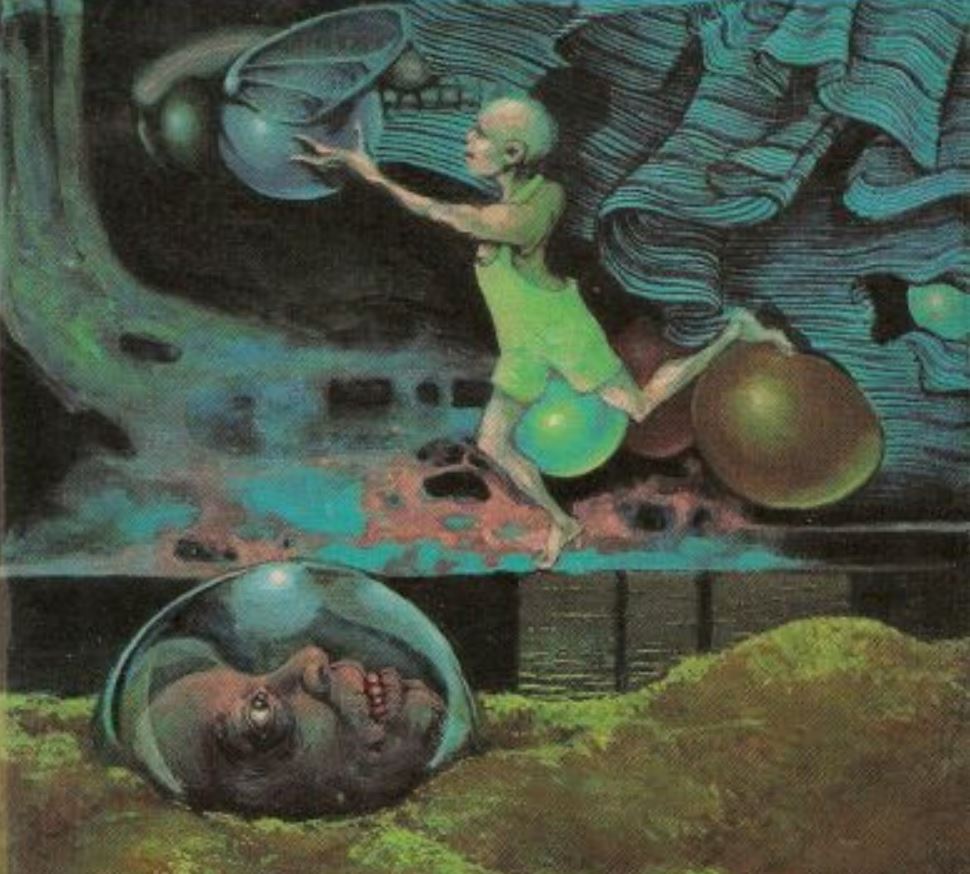
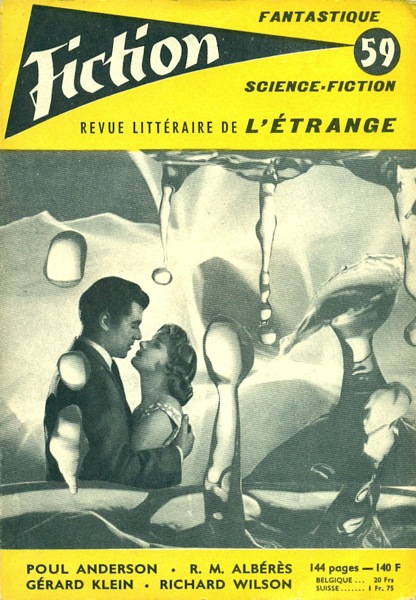
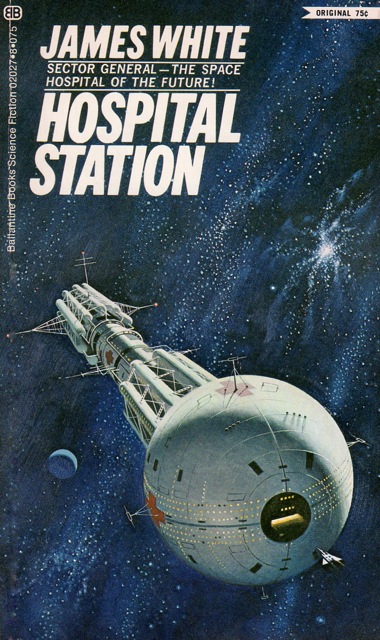
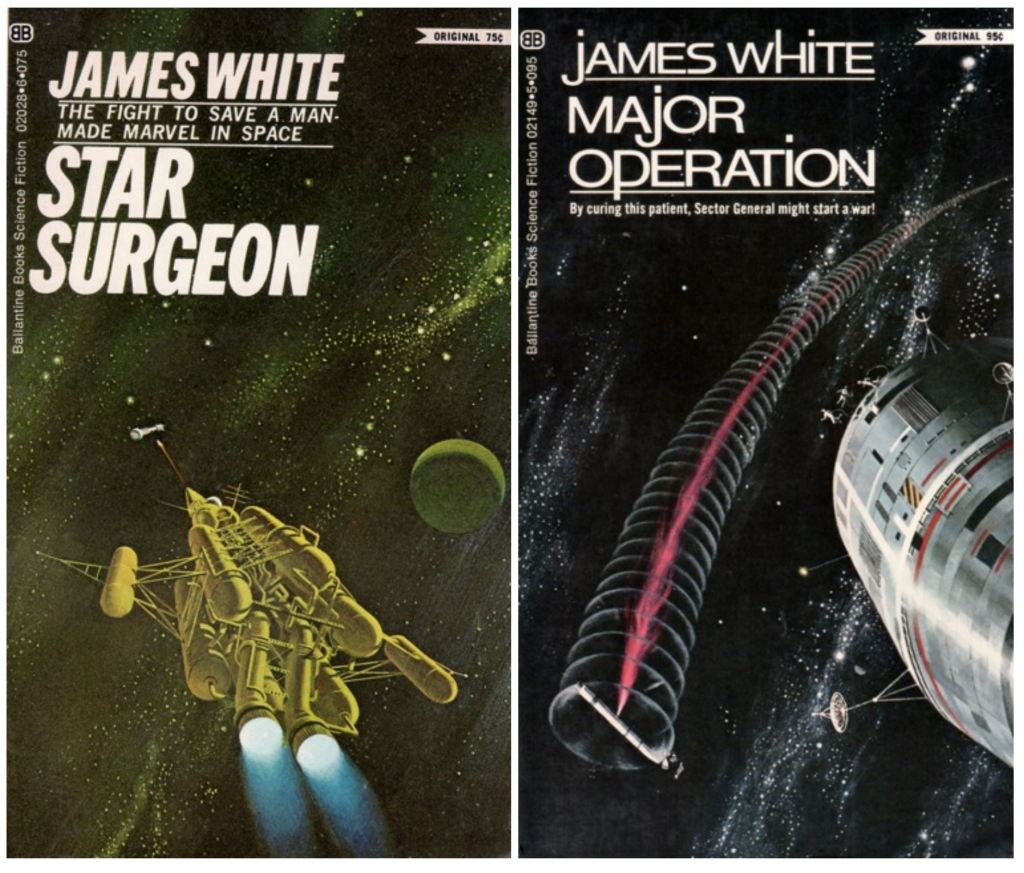
“Sector General” was first published in the November 1957 issue of New Worlds, and is the first story in the long running Sector General series. James White would eventually produce enough short stories and novels about his galactic hospital service that would span twelve books. “Sector General” was reprinted in the first book, Hospital Station.
As far as I can remember, this is the only story I’ve read by James White. “Sector General” is long, episodic, and ends rather abruptly. Dr. Conway is an idealistic young doctor with too many preconceived notions. In the course of the story, he’s forced to change his mind several times.
Most of the story is infodumping because White wants to world build his setup. The setting is a giant space station that serves as a hospital for any kind of alien species. Doctors can quickly acquire the needed biological knowledge for each species via education tapes downloaded into their brain.
If you love Star Trek and Star Wars you’ll probably love the Sector General series, it’s another galactic civilization. The writing in “Sector General” reminded me of a Star Trek novel, where the fun seems to be learning about an ever growing fictional universe.
“Sector General” did not work for me, although the series sounds interesting. It reminds me of other doctors in space stories by Murray Leinster and Alan E. Nourse. I find the premise of human doctors working on alien patients to be unrealistic, but still a neat idea. White chased after too many squirrels in “Sector General.” He was obviously more excited about all the ideas that came to him rather than focusing on storytelling structure. There was content for two good stories in “Sector General” if they had been worked out properly.
Story #29 of 107: “Stranger Station” by Damon Knight
“Stranger Station” by Damon Knight is not a story I’ve read before. It was first published in the December 1956 issue of The Magazine of Fantasy & Science Fiction, and was reprinted in Knight’s second collection, In Deep. It has also been reprinted in many significant anthologies. I own ten of them.
I’ve never read a novel by Knight, and I can count the number of short stories I remember reading by him on one hand: “To Serve Man,” “The Country of the Kind,” “Four in One,” “The Handler,” and now “Stranger Station.” I’ve been impressed with all of them except “To Serve Man.” It’s okay, but The Twilight Zone adaptation spoiled it for me. However, I feel a kind of kinship with Knight because he created the Clarion writers workshops, and I attended Clarion West in 2002. I mostly remember Knight because of his original anthology series Orbit.
“Stranger Station” is exactly the kind of story I was hoping to find in The Big Book of Science Fiction — something I haven’t read that I regret not having read. I bought the SF Gateway Omnibus of Knight’s four collections: Far Out, In Deep, Off Centre, and Turning On after I read “Four in One,” but I haven’t started reading it yet. “Stranger Station” makes me want to find the time.
As I read “Stranger Station” I kept thinking this 1956 story should have been in Harlan Ellison’s 1967 anthology Dangerous Visions. I thought it exceptionally disturbing. I don’t remember reading “Shall the Dust Praise Thee?” Knight’s story that was in that famous anthology. I barely remember reading Dangerous Visions in 1968, but can’t remember the specifics to any of the stories.
I didn’t think “Stranger Station” was disturbing because of daring content, but found it unsettling in the way Knight brought us into story, with Paul Wesson descending into madness, and leaving us with horrifying assessment of humans. Not only is the story well told, but it pushes the limits of science fiction for 1956.
Remember, these essays are not reviews. They’re my discussion for our group reads. There will be spoilers.
“Stranger Station” touches on several major science fiction themes: first contact, communication with aliens, ethnocentrism/xenocentrism, cultural humility, cultural shock, cultural imperialism, artificial intelligence, artificial gravity, and more. Knight guesses human spaceflight will take us to Titan by 1987. Of course, that’s wrong, but it could have been right if we had continued with Apollo era funding of space exploration and had not quit in 1972. Knight’s design of space station with artificial gravity is also very impressive for 1956, as his imagination for picturing an AI that reminded me of an evolved Alexa. If Knight had guessed at digitizing media I would have thought he had access to a time machine.
One reason I’m late posting my comments for this story is I’ve read it twice trying to figure it out. Philosophically it seems to be the opposite of “The Country of the Kind” where society has apparently found an exceptional cruel way to deal with lawbreakers with kindness. In “Stranger Station” Knight suggests the solution to fight an alien invasion is hate. But are they really what he’s saying in both cases? The man who considers himself King of the World in “The Country of the Kind” makes a case that society’s rebels deserve compassion too. But Paul Wesson’s solution to the alien’s invasion plan is an act of hate like the character in “The Country of the Kind.”
Science fiction writers seldom try to deal with the problem of alien contact. Most SF stories present aliens like Star Trek and Star Wars. Some aliens are friends, some are enemies, but being around them is no big deal. Knight imagines aliens that drive us insane and we drive them insane. In his story, one human and one alien meet every twenty years at a specially designed space station. They do not meet face-to-face, and they aren’t even supposed to see each other via video. Just being near each other causes psychic distress.
Knight has set up a story about contact between an advanced society and a backward society. In this case, we’re the backward society. It reminds me of stories about cargo cults. We have latched onto a biological byproduct from the aliens’ body that produces longevity and make a fetish of it like a crudely designed model plane. We almost worship the golden fluid, and set up a highly ritualized meeting place where we encounter the aliens, kowtow to their wonders.
In the story, Paul Wesson discovers the aliens are preconditioning us with love so that when we finally do attain interstellar travel we won’t destroy their culture with hate. Wesson resists this and fights back with hate, causing the giant alien the writhe in so much pain that it shakes apart the space station and dies.
What is Knight telling us? Is it a very dark judgment of the human race? At the end we’re told that the computer, Aunt Jane, is also expressing love. My current guess is Knight believes we’ll destroy AI minds too with our hate because of resentment. I currently can’t tell if Knight goes beyond cynicism in this story to any higher judgments.
This is another story that has taught me there were far more great science fiction writers back in the day than I discovered growing up. In the 1960s I barely got beyond the Big Three (Heinlein-Clarke-Asimov) by discovering Delany-Zelazny-Ellison and a couple other writers like Brunner and PKD. I’m having BIG FUN in my old age discovering other writers from the 1950s and 1960s that I should have discovered way back then.
I doubt I’ve even begun to fathom this story. I will need to reread it several times, but as if now:
Story #28 of 107: “The Last Question” by Isaac Asimov
Isaac Asimov was obviously aiming to tell the tallest tall tale he could imagine when he wrote “The Last Question” for the November 1956 issue of Science Fiction Quarterly. And what a whopper! No one has ever claimed to have caught a bigger fish. Hell, “The Last Question” is the most hubric statement ever made about mankind. Asimov was known for his ego, and he assumes our species is just as egotistical. But then, science fiction has never been timid about thinking big.
Asimov claimed “The Last Question” was his favorite story he ever wrote. See this quote I stole from Wikipedia:
Why is it my favorite? For one thing I got the idea all at once and didn't have to fiddle with it; and I wrote it in white-heat and scarcely had to change a word. This sort of thing endears any story to any writer. Then, too, it has had the strangest effect on my readers. Frequently someone writes to ask me if I can give them the name of a story, which they think I may have written, and tell them where to find it. They don't remember the title but when they describe the story it is invariably 'The Last Question'. This has reached the point where I recently received a long-distance phone call from a desperate man who began, "Dr. Asimov, there's a story I think you wrote, whose title I can't remember—" at which point I interrupted to tell him it was 'The Last Question' and when I described the plot it proved to be indeed the story he was after. I left him convinced I could read minds at a distance of a thousand miles.
“The Last Question” is stuffed full of science fictional ideas and has often been dramatically presented at planetarium shows. At ISFDB.org the story is also listed with quite a few topic tags for such a short story. Unfortunately, the tag system hasn’t been widely implemented yet. I’d love to know all the other SF stories that deal with “reboot” and “heat death of the universe.” I know Tau Zero by Poul Anderson was a reboot story, but it has a different topic tag for that concept – “big crunch.”
“The Last Question” reminds me of an old cartoon. Let’s see how well my memory works. The cartoon showed a giant mainframe computer and two men in lab coats in front of it. One scientist had typed in “Is there a God?” and on the printer the other scientist reads, “There is now.” I’ve always wondered if that cartoon inspired Asimov to write “The Last Question.” I can’t find a copy of that cartoon on the net, but if anyone has a copy, please post a link in the comments. On the other hand, the cartoonist may have gotten their idea from the Asimov story.
“The Last Question” is exceedingly popular and there’s many audio versions on the net, including this one read by Leonard Nimoy.
In 1956 when this story was written, computers were huge machines that filled large rooms and were only getting bigger. Most people had not seen one, but they were often discussed in pop culture, frequently within jokes. People considered them thinking machines. 1956 was also around the time that artificial intelligence became an academic discipline.
I thought it amusing that Asimov imagines a “Microvac” computer, but even then, his micro was quite large. Did science fiction writers ever imagine small personal computers before small personal computers were invented?
Overall, “The Last Question” is a gem of a story, and one that epitomizes the idea story in science fiction. Asimov quickly sketches in a series of characters at every temporal stage of the story, and even though they lack depth of characterization, they capture various stages of humanity that have been imagined before in science fiction. Jerrodd’s family reminds me of the family Stone in Heinlein’s The Rolling Stones. VJ-23X of Lameth was a common futuristic character type in 1930s science fiction, like the kind that Edmond Hamilton, Neil R. Jones, or Raymond Z. Gallun wrote, and Zee Prime recalls what Olaf Stapledon imagined in Last and First Men or Star Maker.
In other words, this is a very science fictional story. And to steal from Aldous Huxley, “The Last Question” reflects the Perennial Philosophy of Science Fiction, which believes humanity will go on no matter what. If our planet dies we’ll find another one. If we lose our star, we’ll build another one. If we outgrow this galaxy, we’ll take over all the rest. If the universe dies, we’ll create another. Nothing is going to stop us. It’s certainly a positive philosophy, but is it a healthy one?
Story #27 of 107: “The Game of Rat and Dragon” by Cordwainer Smith
At first, I was disappointed to see “The Game of Rat and Dragon” was the next story in The Big Book of Science Fiction. I was hoping for a story new to me, instead of another reread. “The Game of Rat and Dragon” seemed too fresh in my mind and I’ve lost count of how many times I’ve read it. But I have this thing about rereading stories. I’ve disciplined myself to always reread a work when encountering it again in another anthology. Experience has taught me it’s well worth the time and effort, and that was the case this time too.
Each time I forget why I love this story, but whenever I start rereading all the details I admired comes back to me. Cordwainer Smith has created a delicious tale for people who love cats and space travel, and I’m his perfect target audience.
I have to wonder why Smith wrote this story? It came out in the October 1955 issue of Galaxy Science Fiction, just before the dawn of the Space Age. The story speculates we’ll eventually discover dangers in interstellar space that we can’t fathom consciously. Unknown threats that will drive us mad. Eventually in Smith’s fictional universe, we’ll discover that people with telepathic powers partnered with cats with telepathic powers can overcome those dangers. Humans perceive those unknowable attackers as dragons, and cats see them as rats.
In the 1950s there were countless stories about telepathy, ESP, psionics, and other psychic superpowers. There were a fair number of stories about humans having psychic bonds with cats, with other Earthly animals, as well as all kinds of alien space creatures. Did people in the 1950s really believe the space was going to be full of psychological barriers, that humans were going to develop psi-powers in the future, and we’d communicate with animals and aliens with our minds? Or were those the futures we wanted?
As a kid I thought science fiction was speculation about possibilities just around the corner, maybe within my lifetime, but now as an old person, I wonder if I ever really believed that? I think I did. Or at least, I think I hoped. Was I just a gullible kid who wanted to believe in science fictional theories. Had I put my own hopes for the future into the hands of writers who were only making shit up to tell a neat story? Or is there an inbetween position, where writers were making stuff up, but they also kind of believed their own bullshit?
Paul Linebarger, the real person behind the byline “Cordwainer Smith” was quite a serious and well-educated dude, even writing a textbook Psychological Warfare. Since “The Game of Rat and Dragon” was written in the middle of Cold War, when psychological warfare and brainwashing were topical topics, it’s easy to see the inspiration of the story. But why blend that heavy subject with sentimental fluff about cats? Imagine The Manchurian Candidate with several cute cat scenes.
Do stories need to make sense? Do stories about serious topics need to be serious and logical? “The Game of Rat and Dragon” has been reprinted extensively, including four of the giant doorstop SF retrospective anthologies of this century. Why is that?
Why do science fiction readers keep reading this story? Is it just our love of cats? Do we still hope people will become psychic? Or fear space might have psychological barriers? Or is it merely a story, well told, that entertains us for a few minutes?
The obvious answer is yes, it’s just a little story. But time and time again, I have to wonder why science fiction resonates with us. Science fiction has become immensely popular. As a society we have a vast appetite for fiction and an unquenchable thirst for novelty. Are we bored with reality and need all the books, movies, television shows, and video games we can consume which features interesting fictional realities? Why am I spending so much of my remaining life reading science fiction?
And what about the ending? Isn’t it questioning another normalcy? Doesn’t Underhill love the cat, Lady May, just a little too much? A nurse shows interest in him, and then feels rebuffed because Underhill can only ask about a cat. Should we wonder about Underhill rejecting human company for feline? Or does that line up with our own preference for pet companions? Or is it symbolic for our preference for fiction over life?
Science fiction fans usually discover the genre when young, enchanted by its sense of wonder, even becoming addicted to the fantastic for the rest of their lives. I can understand why I was captivated by tall tales in my adolescence but why didn’t I ever outgrow them? After forty years of adult reality, why do I still enjoy children’s fantasies?
This is my second reading of “Grandpa” by James H. Schmitz during the past year. Last July I read it in The Great SF Stories 17 (1955) edited by Isaac Asimov and Martin H. Greenberg. “Grandpa” was first published in the February 1955 issue of Astounding Science Fiction, and it’s been well anthologized since. This was a great pick by the VanderMeers because “Grandpa” deserves preserving, and Schmitz deserves better recognition. And it allows me to bring up the topic of young adult (YA) literature in science fiction.
“Grandpa” has never been marketed as YA, but the protagonist is just 15. In 1955 there was quite a lot of YA science fiction being published. Literary critics considered the whole genre aimed at adolescents. Heinlein had his much-loved novels from Charles Scribner’s (the Heinlein Juveniles), Andre “Alice” Norton’s novels were popular, as were the Winston Science Fiction series, and Isaac Asimov had his Lucky Starr series. Plus quite a few SF writers were cranking out books intended for young readers. Most of the many SF magazines knew their audience ran young. The early days of television had a number of popular science fiction adventure shows aimed at kids. I’d say the 1950s and 1960s was a transition time for American childhood, as kids switched from dreaming of becoming cowboys when they grew up, to hoping to become spacemen. (I know I should say cowpeople and spacepeople but it just doesn’t sound right.)
YA lit is all about having young protagonists for young readers to identify. That’s why I call “Grandpa” YA fiction. “Grandpa” is an engaging adventure story that would be empowering to a teenage reader, the kind who cast themselves as action heros in their daydreaming. I’d also call Schmitz’s most famous story, “The Witches of Karres” YA too. And the Telzey Amberdon series is based on a female character who started out as a 15-year-old character.
“Grandpa” is part of The Hub series that ran mainly in Astounding and Analog, a science fiction magazine aimed at adults, but I believe most of its readers got hooked on it in their teens, I know I did. Grandpa, the title character, is a giant floating beast that’s usable as a watercraft. That’s incredibly cool. This world is full of strange symbiotic pairs, and that’s really neat too. And the biology and ecology of this world is rich and complicated and far from understood. Far out. Aren’t these elements the common denominator of science fiction? My favorite YA books of childhood were Heinlein’s juveniles, and they certainly had all these elements and more.
“Grandpa” has everything a teen reader loves about science fiction. Space explorers, colonists on an alien worlds, exotic animals that are both dangerous and pet worthy, freedom from parents, carrying a gun and getting to use it, life and death struggles, belonging to an elite organization while still being a rogue free thinker. This applies to most of the YA science fiction I read in junior high. It’s still the basis for many popular science fiction movies today.
We should ask ourselves: Why does this formula appeal so to us? It’s often been observed how YA fiction finds ways to get young protagonists free of their parents. Cord is just fifteen in this story, and I expect a lot of fifteen-year-olds would love to be out on their own like him. But at that age we really don’t want to join the 9-to-5 mundane world of work. Space is our fairyland. Mars would be great, but we really want a world teaming with endless lifeforms, but not many humans. A few intelligent aliens might be fun, but not too many of those either. We want a world where we can roam and explore without too many responsibilities, and especially without adult supervision.
As adult readers, we still want this kind of adventure too. But at 70, how can I identify with a 15-year-old protagonist? Why is this story still fun? Why am I even nostalgic for this type of fiction? Which I am. And if I crave such adventures why not just go have real adventures? When I was a teen growing up in Miami I would sometimes visit my Uncle Jack out at the Conservation Club in the Everglades. I got to ride swamp buggies and airboats and see giant alligators and other wildlife — not too different from Cord’s fictional adventures. But I preferred saying home and reading science fiction. What’s that all about? My only adventures in nature today are when I visit the Botanic Gardens for a walk. Why do I prefer imaginary worlds to the real world? What’s in fiction adventures that keep us addicted to them our whole life?
Now it’s one thing for a teenager to read “Grandpa,” but it should be a whole different experience for a old guy like me to read. It wasn’t. It made me wish I was fifteen again, and living Cord’s adventure. When I was a teenager I hoped when I grew up space travel would be common and I could have such adventures. That’s why the recent SpaceX Inspiration4 mission was so exciting to people.
However, I have to wonder, what would be age appropriate science fiction for me to read at seventy? I guess that’s why people are so excited about 90-year-old William Shatner going into space in a couple of weeks, we never want to give up that dream about the final frontier.
James H. Schmitz was popular at Astounding/Analog and often got the cover, but he is seldom remembered today. He did write a lot of books, many still in print, but I seldom meet people who talk about them. I wonder if they appeal to girls because he often used female protagonists? (And did boys like having those girl characters?) I found this essay by Mercedes Lackey writing about Schmitz in the introduction to Agent of Vega and Other Stories. I don’t know if it’s cool or legal to quote so much, but I she expresses exactly how we get captured by science fiction when young:
There's a commercial on cable stations lately that talks about moments of epiphany—moments when you understand something that changes your life.
I've had at least one of those moments—and when it was over, my life had been changed forever.
It was when, when I was eleven or thereabouts, I went looking in the living room for something to read.
Now, in my house, books were everywhere and there was very little my brother and I were forbidden to read. We both had library cards as soon as we got past "Run, Spot, run," and by the time I was nine I was coming home with armloads of books every week and still running out of things to read before the week was over. By the time I was ten, I had special permission to take books out of the adult section—yes, in those dark days, you needed a permission slip from your parents to read things that weren't in the children's section.
Now, the peculiar thing here is that although I read anything that looked like a fairy-tale and every piece of historical fiction I could find, I hadn't discovered classic juvenile science fiction. I can't think why—unless it was because my library didn't have any. It was a very small branch library, and I hadn't yet learned that you could request anything that was in the card-catalog for the whole county-wide system. It might also have been because my branch library had helpfully segregated the juvenile section into "Boys" and "Girls," and I wasn't brave enough to cross the invisible line-of-death dividing the two. I do recall reading two little books called Space Cat and Space Cat Meets Mars and loving them—and also something called City Under the Back Steps about a kid who gets shrunk and joins an ant colony—but that was in a different library, before we moved, and perhaps the books hadn't been so helpfully segregated there. Be that as it may, although I was knee-deep in the historical novels of Anya Seton and Rosemary Sutcliff by then, I hadn't ventured into the adult Science Fiction section. I hadn't fallen headfirst into Andre Norton's myriad worlds, I hadn't joined Heinlein's resourceful heroes, I hadn't discovered Anderson, Asimov, Clarke, Nourse, Simak. . . .
All that was about to change. Because my father had.
My father was a science fiction reader; in our house, where library books were everywhere, it was my father who bought the paperbacks. They were divided pretty equally in thirds—suspense (including spy-novels), war, and science fiction.
It was the start of summer vacation, I had already bored through my stack of nine books, and we weren't going back to the library for another two days. I was desperate. I ventured into the living room, and picked up James Schmidt's Agent of Vega.
I'm not sure why. It certainly wasn't the cover—in those days, science fiction books were sporting rather odd abstract paintings—possibly trying to divorce themselves from the Bug Eyed Monsters of the pulp covers so that they could be taken Seriously. That wasn't going to happen, not in the Sixties, but you couldn't fault the editors for trying. It wasn't the title—I hadn't a clue what, or who, Vega was, and I wasn't interested in the James Bond books (yet) that featured the only other "agent" I knew of. Perhaps it was just desperation. I asked politely if I could read it, was granted permission, and trotted away to my room with my prize.
Five minutes later, it was true love.
It was an epiphany.
Here was everything I had been looking for—exotic settings, thrills, adventure, heroines who were just as resourceful and brave as the heroes, and something more. There was a magic in the words, but there was more than that. It was imagination.
No one, no one, since my fairy-tales, had written like this. This James Schmitz fellow seemed as familiar with androids and alien planets as I was with the ice-cream man and the streets of my hometown.
And here, for the first time, I encountered psionics.
Psi! There was even an abbreviation for it! Telepathy! Telekinesis! Teleportation! Empathy! Precognition!
Oh, these were words to conjure with! Better than the magic of the fairy-tales, these were scientific which meant that someone, somewhere (oh let it be me! Me!) might find a way to get one of these powers for himself!
Much has been made of the "sense of wonder" that science fiction evokes, and believe me, there was nothing to evoke that sense quite like the worlds of James Schmitz. Especially for someone who had never read anything like this before. The man had the right stuff; no doubt of it. By the time that I was done with that book, I was well and truly hooked. And my life had just taken that irrevocable, epiphanal change.
“The Star” by Arthur C. Clarke appeared in the very first issue of Infinity Science Fiction in November 1955 and got top billing on the cover. Was Clarke famous in 1955? “The Star” won a Hugo for him in 1956, so did that make him famous? Clarke was quite prolific at writing short stories and getting them published in a wide variety of science fiction magazines since 1946. So when did Arthur C. Clarke become famous as a top science fiction writer? By 1955 he was known for “Nine Billion Names of God,” Against the Fall of Night, Childhood’s End, and for the nonfiction book, The Exploration of Space, which Wikipedia claims Wernher von Braun gave to John F. Kennedy to promote the idea of space exploration. I ponder all this because I recently read a query on Facebook asking when Clarke became famous enough to be considered integral to the Big Three of science fiction writers. (Although, a more interesting question might be: Who are the top three writers of science fiction in 2021? I could not even begin to answer that.)
I discovered Clarke in 1963 when I read Dolphin Island, first published that year. I then discovered Islands in the Sky (1953) around 1965. In March of 1967 I argued with my best friend over who was the greatest science fiction writer, me claiming Heinlein, but Connell claiming Clarke. So by the mid-1960s I knew who he was, but only vaguely. I believe I had also read The Exploration of Space by then. Still, I was only slightly familiar with Clarke, but Heinlein-Clarke-Asimov were already the Big Three of science fiction. I accepted that because it seemed so.
But when did Clarke become famous? When 2001: A Space Odyssey came out that seem to make him well known. In July 1969 he was interviewed on live television during the Apollo 11 moon launch and landing as if everyone knew him, not just SF fans. But when did he become a legendary science fiction writer to science fiction fans? Clarke was the Guest of Honor at the Worldcon in 1956, the year after Asimov. Heinlein was Guest of Honor in 1941, just two years after he began publishing, and again in 1961, 1976.
I bring all this up because I wonder if the success of stories is related to the success of their authors? How long does it take for a great story to be recognized as a classic? Members of the Worldcon voted “The Star” the best short story the year after it came out, but T. E. Dikty didn’t select it for his best of the year annual. Dikty did pick “The Game of Rat and Dragon” that competed with “The Star” for the Hugo.
Looking at the story’s ISFDB entry, we can see it’s been reprinted quite often. However, that ball didn’t start rolling until 1962 when “The Star” was included in The Hugo Winners edited by Isaac Asimov and A Century of Science Fiction edited by Damon Knight. Those two anthologies were often reprinted, and were selections for the SFBC. That spread the word far and wide. Plus “The Star” was included in Clarke’s third collection, The Other Side of the Sky that went through many editions. The list of reprints at ISFDB is quite long, and so is the list of languages its been translated into.
I’m surprised that the VanderMeers included “The Star” in The Big Book of Science Fiction, since they often seem to avoid the widely reprinted classics. I would have expected them to find a less famous Clarke to promote. They didn’t include a story by Heinlein because they couldn’t get the rights — and that omission really sticks out. The Asimov they picked was Asimov’s favorite I believe, but not mine. Both “The Star” and “The Last Question” are excellent stories, but not evidence that Clarke and Asimov were once part of a Big Three. Are there three stories that would stand as evidence?
When I go to bookstores I often check to see how many books are available by Heinlein, Clarke, and Asimov. Where once each of their titles would fill a shelf or two, they now take up inches with a few titles. Heinlein, Clarke, and Asimov are hardly the big three today. Will “The Star” survive if Clarke’s reputation doesn’t?
The story is rather slight, and can be read in 5-15 minutes, and I believe most people remember it because of its trick ending. Just to remind folks, I’m not reviewing stories, but discussing them, so I will spoil that surprise ending.
It’s rather interesting that Clarke’s two most famous short stories confirm the existence of God, and his two most famous novels, suggest that mankind will be resurrected into a higher state of being. That’s rather interesting since I believe Clarke was an atheist. Was he just going for a surprise ending, or was he making a philosophical statement. Maybe we should look closer at those two short stories.
In “Nine Billion Names of God,” the almighty dissolves the universe after Buddhist monks compile a list of all his possible names. In “The Star” God destroys a planet of advanced beings just to signal to our planet that his son had arrived. Was Clarke wanting his readers to consider that God is not nice? Or the ways of God are not fathomable by us? James Blish in A Case of Conscience and Mary Doria Russell in The Sparrow also use science fiction to question the nature of God.
In my opinion, Clarke was going for the cheap gasp. In both stories, he setup the story nicely. In “The Star” he does some astronomical infodumping, and covers a couple classic science fiction themes, one of which is a favorite of mine. I love stories about exploring the remains of extinct alien civilizations. Clarke even throws in a nice Jesuit character that I was getting to like. Then WHAM – the surprise.
When I reread these stories, and I do reread them because I have a personal rule to reread stories when I encounter them again in another anthology, I know what’s coming so I try to look for interesting bits along the way to the ending. This time I liked the Jesuit, and that he has a copy of Ruben’s engraving of Loyola in his cabin.
On the other hand, is this enough to keep reprinting “The Star?” If science fiction is mostly neat ideas and surprise endings is that enough for us to keep reading it. Shouldn’t we want more? What did Clarke give the science fiction world to make him famous?
I fear most science fiction has little lasting value. That’s why we see all its themes recycled for each new generation reclothed in current fashions. I wonder if “The Star” survives because no later generation has come up with this same trick ending?
If I was anthologizing SF stories from the 20th century and wanted to include an Arthur C. Clarke story, I’d use “Rescue Party.” I’ve read that Clarke was annoyed by the number of people who told him their favorite story of his was “Rescue Party” because it meant his career had been going down since his first professional sale. “The Star” is much better written, but if we’re going for unique ideas, “Rescue Party” has more. A race of aliens come upon the Earth but there’s no sign of humanity. The aliens poke about our remains wondering who we were. This is the inverse of the theme I like so much. A very nice twist. We have abandoned the solar system like the beings of “The Star” should have. Near the end of the story, the aliens discover we’d left monitoring equipment to record the end of our world, and followed the direction in which it was beaming data. The story ends with them going off to find us.
The science fiction theme that humanity must leave the Earth and solar system to survive is a strong one. It’s part of the drive behind Elon Musk’s effort to colonize Mars. It promotes the belief that no matter what God or Nature throws at us, we will hang on. That’s a much more powerful message for Clarke to leave his readers.
To answer my original query I’m guessing Clarke became famous when a certain percentage of science fiction readers thought his ideas and stories were among the best. I’m guessing that happened between Childhood’s End (1953) and The City and the Stars (1956), maybe as late as 2001: A Space Odyssey (1968), and definitely by Rendezvous with Rama (1973).
Update:
I found this quote in I, Asimov: A Memoir where Isaac Asimov claims Clarke was famous by 1949. But I find that hard to believe, because that was before any of his famous stories.
There was no question that by 1949 I was widely recognized as a major science fiction writer. Some felt I had joined Robert Heinlein and A. E. van Vogt as the three-legged stool on which science fiction now rested.
As it happened, A. E. van Vogt virtually ceased writing in 1950, perhaps because he grew increasingly interested in Hubbard’s dianetics. In 1946, however, a British writer, Arthur C. Clarke, began to write for ASF, and he, like Heinlein and van Vogt (but unlike me), was an instant hit.
By 1949, the first whisper of Heinlein, Clarke, and Asimov as “the Big Three” began to be heard. This kept up for some forty years, for we all stayed alive for decades and all remained in the science fiction field. In the end, we all three commanded large advances and found our books on the best-seller lists. (Who would have thought it in the 1940s?)
I, Asimov (pp. 140-141). Random House Publishing Group. Kindle Edition.
Story #24 of 107: “Let Me Live in a House” by Chad Oliver
Now that we’ve reached the 1950s in our group discussion of The Big Book of Science Fiction, I think we should try and remember the historical context that gave birth to our genre. Although science fiction was part of the pulp magazine tradition of the 1920s, 1930s, and 1940s, the American public at large hadn’t discovered science fiction yet. During WWII the atomic bomb and V-2 rockets opened their eyes. In the late 1940s the flying saucer mania got people thinking about invasions from space and aliens. Then around 1950 a flood of science fiction TV shows, movies, comics, paperbacks, magazines, and hardbacks hit pop culture causing the Baby Boomers to grow up with the genre. (I chronicled all this in “When Mainstream America Discovered Science Fiction.”)
Science fiction writers were in the unique position to prepare America and the world for the future. John W. Campbell Jr. was the prophet for the space age urging his disciples to write positive fiction about the potential of the future. Not everyone was so optimistic, but their stories usually appeared in the dozens of new digest size magazines that were part of a publishing boom in science fiction, which competed with Astounding Science Fiction.
“Let Me Live in a House” first appeared in the March 1954 issue of Universe Science Fiction, from a group of low-budget magazines edited by Raymond A. Palmer, former editor of Amazing Stories, and creator of Fate Magazine. Ray Palmer was major promoter of UFO fiction and nonfiction, and a legendary nut-ball in the SF world. In other words, Palmer was what Philip K. Dick called a Crap Artist. People now consider John W. Campbell a nut, but we should remember back in the 1950s and 1960s all science fiction readers were consider geeky, nerdy, nutty, and social zeroes. One reason I’m reviewing the BBofSF is to retrace the steps of my philosophical development from reading science fiction. Back then, I was a crap artist much like Jack Isidore in PKD’s Confessions of a Crap Artist, which is my favorite work by Philip K. Dick.
“Let Me Live in a House” by Chad Oliver is the kind of story I was hoping to find in The Big Book of Science Fiction — one that I hadn’t read and one that deserved to be rediscovered and preserved. Chad Oliver is an author I’ve been curious about lately. I read his The Mists of Dawn as a kid because it was part of the Winston Science Fiction series, and I reread that novel last year when I got nostalgic for those old YA SF novels. Recently, I was quite taken with his story “Transformer” and wrote about it in “From Let’s Pretend Literature.” Now with “Let Me Live in a House” I’m feeling a need to read more Oliver. Luckily, several of his novels and collections are available at Amazon for $1.99 each for the Kindle editions.
Chad Oliver is little known today, even Wikipedia doesn’t say much about him. Usually, when people mention him, they mention he was anthropologist. I did find this nice “Annotated Bibliography and Guide” to his work.
Oliver explores two major science-fictional themes in “Let Me Live in a House.” The first is about the brutality of space. This story was written well before Sputnik and the creation of NASA. I was impressed that Oliver predicted that only people with the Right Stuff would become astronauts. He also speculated that space would be psychologically hostile to humans, and the premise of this tale is astronauts will need to take their culture with them to survive. We’re shown four astronauts on Ganymede, living in twin track houses, with two married couples playing neighbors and best friends. This opening reminds me of the kind of stories Philip K. Dick was writing in the 1950s, where people live inside artificial delusions.
The two couples, Gordon and Helen Collier, and Bart and Mary Walters, have been conditioned to think they are living an ordinary suburban life of playing cards and watching TV. The men occasionally monitor conditions on Ganymede from a hidden room but they try not to think about where they are. Gordon is starting to crack, becoming aware that he’s pretending, becoming more and more paranoid. Then one night they hear a strange noise while playing cards:
Gordon Collier walked nervously out of the room, followed by Barton. He clenched his fists, feeling the clammy sweat in the palms of his hands, and fought to keep the fear from surging up within him. They walked into a small hall and Gordon pressed a button. A section of the wall slid smoothly back on oiled runners, and the two men walked into the white, brightly lighted equipment room.
Gordon kept his hand steady and flipped on the outside scanners. He couldn’t see a thing. He tried the tracer screen, and it was blank. Barton tried the radio, on the off chance that someone was trying to contact them. There was silence.
They checked the radar charts for the past hour. They were all quite normal—except the last one. That one had a streak on it, a very sharp and clear and unmistakable streak. It was in the shape of an arc, and it curved down in a grimly familiar way. It started far out in space and it ended. Outside—outside in the ice and the rocks and the cold.
“Probably a meteor,” Barton suggested.
“Probably,” Gordon agreed dubiously, and made a note to that effect in the permanent record.
“Well, what else could it have been?” Barton challenged.
“Nothing,” Gordon admitted. “It was a meteor.”
They swung the wall shut again, covering the tubes and screen and coils with flowered wallpaper and Gainsborough’s Blue Boy. They returned to the living room, where their wives still sat around the card table waiting for them. The room was as comfortable as ever, and the tri-di set was on again.
It was all just as they had left it, Gordon thought—but it was different. The room seemed smaller, constricted, isolated. The temperature had not changed, but it was colder. Millions and millions of miles flowed into the room and crawled around the walls….
“Just a meteor, I guess,” Gordon said.
They went on with their game for another hour, and then Barton and Mary went home to bed. Before they left, they invited Gordon and Helen to visit them the next night.
As Gordon becomes undone we slowly learn how Oliver predicts living in space will be a psychic burden. This reminds me of the brilliant story by Edmond Hamilton, “What’s It Like Out There?” that came out in 1952, two years before this story. Joachim Boaz has a review of that story which is part of a series about SF that shows the brutality of living in space. The 1950s was a time when psychiatry was a popular topic at parties and in fiction, so this makes sense, and besides Oliver was an anthropologist. Space was still a huge unknown, so such stories are an obvious speculation. However, they weren’t common in the genre because most science fiction fans were gung-ho to explore space. These were not the kind of stories that John W. Campbell Jr. would publish.
I grew up in the 1960s readily accepting the faith of a high frontier, a true believer in SPACE. As a kid, I loved Heinlein’s 1950 novel about Ganymede, Farmer in the Sky. Heinlein saw space like Americans in the 19th century thought of the West. His novel starkly contrasts with “Let Me Live in a House,” and had all the positive sentimentality of Little House on the Prairie. I’m not sure I could I would have enjoyed reading “Let Me Live in a House” when I was a teen.
Oliver adds a second SF theme in “Let Me Live in a House,” that was far more common, that of first contact. He applies that same kind of fear and paranoia he did about exploring space to it. It turns out the noise Gordon and Bart hear is a spaceship, and a few nights later there is a knock on their door. This reminds me of the classic Fredric Brown story, “Knock,” based on the the idea of the last man on Earth sits in a room alone and hears a knock upon the door.
When Gordon opens the door a man that looks like the portrait of Bart’s grandfather comes in. Of course, it’s an alien, and we eventually learn it projects a human image because its physical features are two horrible for the humans to witness. Gordon must escape this illusion and overcome the alien in a battle of logic.
In my post about “Prott” by Margaret St. Clair, I talked about the problem SF writers have with first contact stories. Oliver deals with those problems in a number of ways. The alien obviously has great mental powers, even telepathy, and can communicate in English. And we don’t get to know the alien because it disguises itself as a human. Gordon does get to see what the alien really looks like, which is so gruesome that it drives him mad. Remember how Greek philosophers said if we could see the face of God we’d go mad?
Oliver is predicting we won’t be able to live in space, and that we really won’t be able to handle aliens — other than our tried and true method of dealing with xenophobia. Is the reason why this story isn’t well known because of its negative attitude towards space exploration? And did the VanderMeers anthologize it because of its contrarian take? What’s interesting is three of their stories, “Prott,” “Let Me Live in a House,” and “The Microscopic Giants” were first anthologized in Science Fiction Terror Tales edited by Groff Conklin. I wonder if they read that anthology? We have to give both Conklin and the VanderMeers credit for mining stories out of the lesser science fiction magazines. In 1954, Astounding, Galaxy, and F&SF were the big three, but there were a couple dozen other science fiction magazines coming out at that time. Have anthologists read them all?
The science fiction short stories that appeared in the 1950s were ones I read in old anthologies I checked out of libraries in the 1960s. From now on, as we progress through the BBofSF, we’ll be reading stories I consumed over the last sixty years, as well as ones I missed. It’s time to reevaluate everything that went into the evolution of my thinking.
Collectively, I’d say people still believe in the John W. Campbell view of the future. We’re still gung-ho on space exploration. But there’s still a chance for Chad Oliver’s speculation to be valid. We might not survive space psychologically or biologically. But we should also ask: Why do we want to go into space? Did the romance of science fiction impregnate those desires into us? We have a lot of stories to read that might help us answer those questions?
Story #23 of 107: “The Liberation of Earth” by William Tenn
“The Liberation of Earth” was first published in the May 1953 issue of Future Science Fiction. It hasn’t been widely reprinted, but it’s been in all the versions of Brian Aldiss’s The Penguin Science Fiction Omnibus and it’s in The Wesleyan Anthology of Science Fiction. I believe I’ve only read it once before, in The Great SF Stories 15 (1953) edited by Isaac Asimov and Martin H. Greenberg. I owned a copy Of All Possible Worlds back in the 1960s and might have first read it then, but just can’t remember. For a short time in my adolescence I was into William Tenn because I had found an old copy of Galaxy Science Fiction with “Time Waits for Winthrop,” and that amused me. I remember seeking out his stories, but don’t remember what I read. I recently read Of Men and Monsters and loved it. In my review I made a case that people should try to read Tenn’s only novel without encountering any spoilers — don’t even read the blurbs on the book cover.
I am less taken with “The Liberation of Earth.” Oh, it’s good enough, and fun, I’m just not keen on satire in my old age. However, it might be a problem with presentation. My inner reading voice is not very impressive, especially for sarcasm and other forms of comic snideness. Comedy depends heavily on presentation. “The Liberation of Earth” is a long monologue describing the invasions and liberations by two groups of aliens, the Dendi and the Troxxt, who use the Earth like the U.S. and Russia fought over third world countries for their client states.
If I could have heard “The Liberation of Earth” read by a professional narrator I might have been wowed by all the relevant satire. The VanderMeers really tout its greatness, especially as an antiwar work that was originally inspired by the Korean War. And I do imagine if the people of Afghanistan read this story today they could relate to the “joys” of being liberated time and again.
I think there is another target for Tenn’s satire in this story — science fiction — especially the cherished notion that humanity would be welcomed as an equal partner into a wise galactic federation. “The Liberation of Earth” came out after The Day the Earth Stood Still, so I wondered if it was also harpooning it?
However, there is another issue I should mention. I believe I’ve come to want a certain kind of storytelling, and this narrowing of my tastes leaves me a bit closeminded about other kinds of storytelling. I like stories with characters I can get to know and care about. I don’t have to like them, but they have to involve me. “The Liberation of Earth” only has an unnamed narrator, and not someone we get to know. When Australia is turned to ash it was only an abstraction. If there had been an Australian character we had come to care about, it might have mattered. Like the Australians in the novel On the Beach. The one William Tenn story I do remember well and love, is the novel Of Monsters and Men, and that was because of Eric the Only. I followed Eric through many adventures, and we solved the mysteries of his world together.
I recently listened to The Best of Walter M. Miller Jr. on audiobook. Many of the stories in that collection were exactly the kind I love, with captivating characters, dramatic plots, presented by a very talented professional narrator. I’ve been listening to the Miller stories over the same weeks I’ve been reading The Big Book of Science Fiction, and the contrast is stark. Too many of the stories in the BBofSF just depend on ideas and cleverness, and that’s not enough for me. And to be honest, I can’t believe it’s enough for any reader. However, that’s another thing I’m learning from group reading these stories on Facebook. Everyone likes different kinds of science fiction.
Miller stories are just the right kind for me, even though they aren’t particularly famous in science fiction history, and some of them are a bit weird and strange, even for science fiction. But gosh, they’re great stories, with great storytelling — again, at least for me. Since this collection isn’t even in print at the moment maybe they aren’t the right kind of storytelling for a lot of SF fans. The audiobook I listened to is new, but narrates a collection last published back in 1980. My absolute favorite is “The Darfsteller.” It was first published in the January 1955 issue of Astounding Science Fiction. I believe it was the first novelette to win the Hugo Award even though it’s a novella. I’m guessing the magazine version was much shorter. After that three stories are tied for second place as my favorites: “The Lineman,” “Conditionally Human,” and “Dark Benediction.” Although if I listened to the book again I might pick other stories out of the 14 in this collection. And I should probably give a trigger warning that these stories might be offensive to modern readers who expect characters in the past to have 21st-century enlightened views.
I’d really wish the audiobook publishers of the Miller collection would do one for Tenn. In fact, there are many science fiction authors I love who mainly wrote short stories and there’s no audiobook editions of their work. Several of those authors are in print from NESFA Press, including William Tenn. Audible Studios has done one NESFA book that I know of, His Share of Glory by C. M. Kornbluth. I wish they’d do them all. With a good audio narrator I might even love “The Liberation of Earth.” I have found that audiobooks can often get me to enjoy books I don’t enjoy reading.
Many of the stories we’ve read in The Big Book of Science Fiction have been disappointing to some of our membership, but then others in the group have liked them. It’s really hard to judge fiction. It seems the VanderMeers prefer kinds of storytelling I don’t, but like I said, presentation matters. So does mood. I’ve changed my mind about stories because my mood had changed. And then there’s age. I think we resonate with stories differently depending on our age. I don’t remember if I read “The Liberation of Earth” back in the 1960s, but I’m pretty sure I would have liked it much better when I was young.
Story #22 of 107: “The Prott” by Margarett St. Clair
“Prott” by Margaret St. Clair was first published in the January 1953 issue of Galaxy Science Fiction, and later anthologized by Groff Conklin in Science Fiction Terror Tales in the U.S. and by Edmund Crispin in Best SF in Great Britain. I don’t remember reading anything before by Margaret St. Clair, or by her pen name Iris Seabright, but I have seen both names enough over the years to know she was around. Wikipedia says she published over 130 stories. St. Clair only has one book in print at Amazon, a 2019 collection of 17 stories, The Hole in the Moon and Other Tales, but “Prott” isn’t included. James Nicolls reviewsThe Best of Margaret St. Clair edited by Martin H. Greenberg that came out in 1985. That collection did include “Prott.”
“Prott” is a first contact story, and St. Clair worked hard to make her aliens alien, which is something I admire. She also focused on the problem of communication, which is another theme I like. The story is told in a frame of two men having drinks and one of them gives the other a diary to read which is the story. It’s from an unnamed academic who had gone out beyond the asteroid belt to study the sex life of the Prott, an alien race who lives in space that looks roughly shaped like poached eggs. We learn of his frustrating effort to communicate with the aliens via telepathy and a threat to humanity. The story is slightly humorous in tone, and the threat is a distant cousin to what Fredric Brown described in Martians, Go Home. It even shares a bit of the puzzle we saw in Murray Leinster’s “First Contact.”
The problem with “Prott” is it suffers the fate of all first contact stories. Writers can describe their aliens in various ways so that they look very alien, and make them very difficult to talk to, but once any kind of communication is establish, it’s hard to wrap up the story without resorting to a gimmick to distract us from the fact we can’t ever know the alien. One of the best first contact stories is “Story of Your Life” by Ted Chiang filmed as Arrival. That story wraps ups with a time paradox gimmick that is very satisfying. In the Leinster story, the gimmick involves trading spaceships. In The Sparrow by Mary Doria Russell we’re left with an spiritual conundrum of why would God do something so horrible to a Catholic priest. “Prott” leaves us with a bit of comic horror. Unfortunately, for me, it was an unsatisfying payoff.
St. Clair builds up a nice mystery about the Prott but leaves the ardent researcher with a frustrating problem he can’t solve. Readers are just as frustrated because we don’t know what —– the —- is either. The release of this up-to-now mostly serious story is to wrap things up with an O. Henry ending. That concluding gimmick wasn’t satisfying for me.
That’s the problem with first contact stories, it’s almost impossible to conclude them in a satisfying way. In the novel Contact by Carl Sagan there is a tremendously long build-up to create the mystery of the aliens until we’re finally dazzled by a show of their powers. In the end Ellie is returned to Earth at the same time she left with no evidence of the aliens’ existence. She’s like Dorothy waking up in the film version of The Wizard of Oz, or any Christian that must claim they know God exists because of their faith. In the film Close Encounters of the Third Kind we finally get to meet aliens, but before we learn anything real, Roy takes off with the aliens in their flying saucers. The gimmick is a sleight-of-hand bait and switch. We’re happy for Roy, but we’re left with nothing.
In fiction where we do get to know aliens they often become like us. In the novels Children of Time and Children of Ruin by Adrian Tchaikovsky the spider-like alien characters discovered in the first volume become more human in the second volume. Tchaikovsky retries to introduce alienness with uplifted octopi, and a new alien race and ends the second book before we get too chummy with those alien characters. Tchaikovsky does a good job of creating a sense of alienness but the more time we spend with these new creatures the more we have to relate to them in human terms. I believe these novels are popular because his gimmick is to end the story at the right moment.
In “Prott” the less we know about the Prott the more alien they seem. Yet, we never learn what they are, how they evolved, what kind of environment and ecology they live in, how they find meaning, or anything about their social structure. The conclusion is they become pests to us, which is relatable to the reader, and the gimmick. What I wanted was our Margaret Meade like protagonist to observe more customs. We were promised sex. You have to give Philip Jose Farmer credit for being explicit for his stories of alien encounters..
We have always wondered if we’re alone in the multiverse, and if we’re not, what strange beings could exist that we can’t comprehend? It’s an impossible task for the science fiction writer to describe the indescribable. Just look at all the versions of Star Trek and all the aliens we’ve encountered in countless episodes over the decades. In the end, most of the stories are about Klingons and Vulcans who are all too much like us. One reason I believe H. P. Lovecraft was so popular is he invented so many horrible alien monstrosities that we only know from awe and horror. But doesn’t religion use the same gimmick?
“Prott” is another nice try at creating an alien, but really just a minor effort. The reason why “The Martian Odyssey” was so successful, and so well anthologized is Tweel was such a great alien character. Stanley G. Weinbaum hit that one out of the park. The Prott aren’t that interesting. Neither was the structure of how St. Clair told her story, which was closer in style to the 19th century than what was innovative in the 1950s. I know I keep harping on this, but the competition at that time was “Coming Attraction” and “Fondly Fahrenheit.” St. Clair is doing a pale imitation of Poe.
Story #21 of 107: “The Snowball Effect” by Katherine MacLean
“The Snowball Effect” by Katherine MacLean first appeared in the September 1952 issue of Galaxy Science Fiction. It’s not a great story, but it’s not bad either. I believe other people must like it far more than I do because it’s been reprinted quite often.
This story has a problem that’s quite common in science fiction stories. Writers get a neat idea first, and then they invent a story to present their idea. Quite often the story is never as good as the idea. Superior science fiction stories have a great story with neat ideas that only decorate the story.
In this case MacLean wonders, what if we had a mathematically formula that could explain how an organization could grow at an exponential rate. What she imagines is a Ponzi scheme designed by a sociologist, and has two professors test it on a women’s sewing club. You can probably guess the ending. But can you guess how MacLean will dramatize this story with plot and characters?
If you’ve read much science fiction you might know where I’m going. Science fiction is full of stories that begin with two people talking about an idea, then we see the idea implemented in a cursory way, and finally, we have some kind of surprise ending. When done poorly, the story usually begins with two characters infodumping on the reader, and that’s the case here. Often such stories involves a contrived setup. In this case, an administrator is putting the screws to a sociology professor to justify his department’s existence. That’s still a relevant real-world problem in universities today, and not just for sociology departments. It’s actually a genuinely interesting problem that we should care about as readers – how do academic programs pay their way? Does society need their graduates? Is the program worth the cost to the university, state, and students? What does the discipline do for the community? I was hooked by this idea as a story problem, and I was anxious to read on.
Unfortunately, I wasn’t pleased with MacLean’s answer. She came up with a good setup, but she doesn’t have anything to say. I don’t mean a Western Union message. Good short stories elevate us with insights. At this point I’m expecting a dramatic story that shows me the value of sociology – something I can understand. We don’t get that. We neither get a true short story, or an understanding of sociology. What we get is a mildly pleasant joke.
Science fiction has produced countless stories like this. A pleasant setup to present a nifty idea. When I was younger being amused by an idea was enough, but I’m older and I don’t have much time left to live. I only want to read 5-star stories, or at least top-notch 4-star stories. “The Snowball Effect” is only a 3-star story. I believe it was perfectly fine for the September 1952 issue of Galaxy, but I’m surprised it was ever reprinted.
Maybe I can explain my harsh attitude with an analogy. I think of anthologies like a generation spaceship designed to save people from a dying Earth. Best-of-the-year annuals are constructed to rescue the best stories of the year. Retrospective anthologies are designed to save stories from specific periods. I believe the VanderMeers have a somewhat different approach. To them anthologies are like the starship Enterprise exploring the galaxy, looking for neat planets and interesting phenomena happening around the Milky Way. They want to make a wide survey that reveals the diversity of what’s going on. From my perspective only a few stories can be saved, so why not the best? For them, lets check out some interesting possibilities.
There’s a great SF story I can use here, “One in Three Hundred” by J. T. McIntosh. It first appeared in the February 1953 issue of The Magazine of Fantasy & Science Fiction. The setup has the world coming to an end and there’s only enough rockets to save one in three hundred people. Each rocket is assigned a person to pick those that will be saved. Bill Easson must decide who in his small town will go. He knows there are many personality factors to consider and he will make mistakes by picking people who won’t survive the mission, but he still has to pick.
For me, it’s important to pick science fiction stories that can survive the harsh climate of future readers. Like Bill picking people he feels has what it takes to survive on the new planet, anthologists pick stories that have qualities that make them survivalists. All the stories we’ve read so far in The Big Book of Science Fiction are still readable, I’m just that asshole we see in war movies that tell a squad member they don’t think they’ll make it.
I doubt many 20th-century science fiction stories will be loved by readers in the 22nd-century. I don’t believe “The Snowball Effect” will make it. It’s only marginal in 2021. What bothers me are the stories I believe have a better chance to survive the long haul that wasn’t pick by this anthology. Don’t get me wrong, I don’t believe I know any better than the VanderMeers. Nobody can predict the future – but we all keep trying.
It’s just there are stories I want to see saved, and to do that they need to be anthologized several more times before the year 2100. Every ship they miss reduces their chance to make it. To make matters more emotional for me, is the 1950s is my favorite decade for science fiction. The VanderMeers have chosen 20 stories from the 1950s, so they like that period too, unfortunately we only agree on two stories at the most. But I have to say I haven’t read all their selections so that number might go up. Four of those twenty stories were from 1952. Here are the 1950s SF stories from The Big Book of Science Fiction:
September 2005: The Martian • (1951) • short story by Ray Bradbury
Baby HP • short story by Juan José Arreola (trans. of Baby H. P. 1952)
Surface Tension • (1952) • novelette by James Blish
Beyond Lies the Wub • (1952) • short story by Philip K. Dick
The Snowball Effect • (1952) • short story by Katherine MacLean
Prott • (1953) • short story by Margaret St. Clair
The Liberation of Earth • (1953) • short story by William Tenn
Let Me Live in a House • (1954) • novelette by Chad Oliver
The Star • (1955) • short story by Arthur C. Clarke
Grandpa • (1955) • novelette by James H. Schmitz
The Game of Rat and Dragon • (1955) • short story by Cordwainer Smith
The Last Question • (1956) • short story by Isaac Asimov
Stranger Station • (1956) • novelette by Damon Knight
Sector General • (1957) • novelette by James White
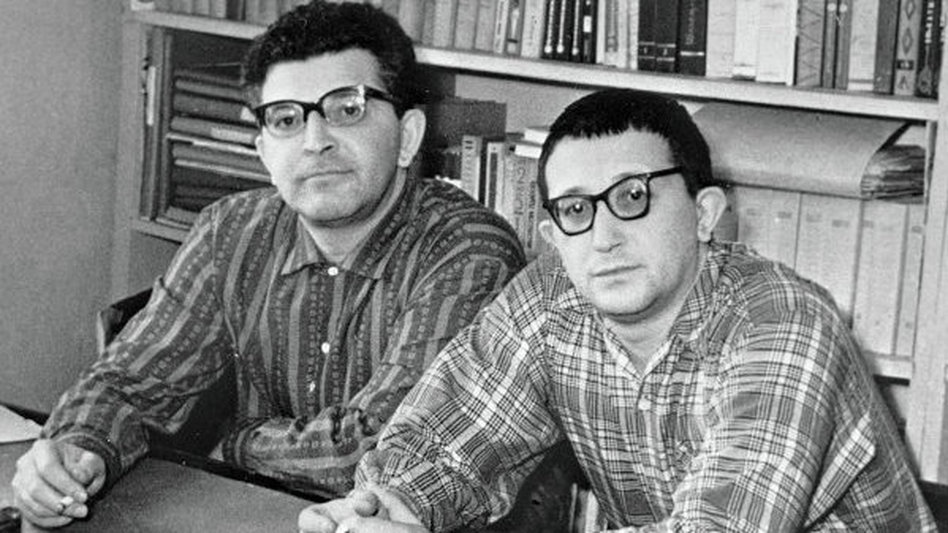
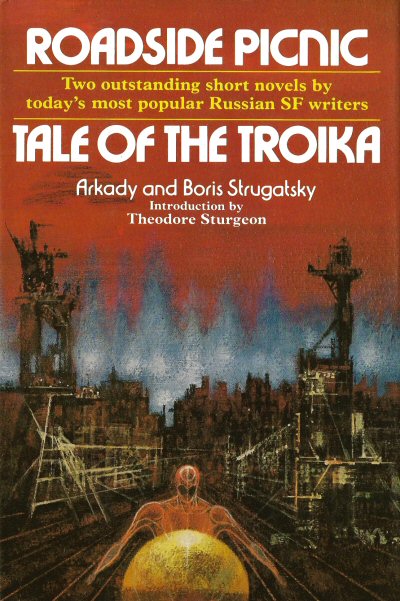
The Visitors • novelette as by Arkady Strugatsky and Boris Strugatsky
Pelt • (1958) • short story by Carol Emshwiller
The Monster • (1965) • short story by Gérard Klein? (trans. of Le monstre 1958)
The Man Who Lost the Sea • (1959) • short story by Theodore Sturgeon
The Waves • short story by Silvina Ocampo (trans. of Las ondas 1959)
Plenitude • (1959) • short story by Will Mohler
Here are 18 SF stories from the Classics of Science Fiction Short Story list from the 1950s. These stories were selected because they were most cited by a meta-list system. The number at the end is the total citations the story received. The bolded stories are those that overlap with The Big Book of Science Fiction. By the way, the BBofSF was one of the citation sources.
Coming Attraction by Fritz Leiber (1950) 11
The Little Black Bag by C. M. Kornbluth (1950) 8
Scanners Live in Vain by Cordwainer Smith (1950) 9
There Will Come Soft Rains by Ray Bradbury (1950) 8
The Sentinel by Arthur C. Clarke (1951) 9
Surface Tension by James Blish (1952) 9
The Nine Billion Names of God by Arthur C. Clarke (1953) 12
Second Variety by Philip K. Dick (1953) 8
The Cold Equations by Tom Godwin (1954) 12
Fondly Fahrenheit by Alfred Bester (1954) 13
The Game of Rat and Dragon by Cordwainer Smith (1955) 14
The Star by Arthur C. Clarke (1955) 16
The Country of the Kind by Damon Knight (1956) 11
The Last Question by Isaac Asimov (1956) 8
This list is closer to my tastes, but probably far from my final list. Below are the 1950s stories from The Science Fiction Hall of Fame Volume One that the SFWA membership remembered. Notice only one story, “Surface Tension” is remembered on all three lists. It would probably be on mine too.
Scanners Live in Vain • (1950) • novelette by Cordwainer Smith
The Little Black Bag • (1950) • novelette by C. M. Kornbluth
Born of Man and Woman • (1950) • short story by Richard Matheson
Coming Attraction • (1950) • short story by Fritz Leiber
The Quest for Saint Aquin • (1951) • novelette by Anthony Boucher
Surface Tension • (1952) • novelette by James Blish
The Nine Billion Names of God • (1953) • short story by Arthur C. Clarke
It’s a Good Life • (1953) • short story by Jerome Bixby
The Cold Equations • (1954) • novelette by Tom Godwin
Fondly Fahrenheit • (1954) • novelette by Alfred Bester
The Country of the Kind • (1956) • short story by Damon Knight
Flowers for Algernon • (1959) • novelette by Daniel Keyes
These Hall of Fame stories are much closer in agreement with the CSFquery list.
I’m not ready to compose my list of favorite 1950s science fiction stories. I’m still reading. But there is one problem with my focus on the 1950s. I’m discovering stories that I love that currently aren’t well remembered. That’s a bad sign for the survivability. There’s a good chance I could pick 20 stories that few people would even enjoy reading today, much less in 79 years.