“Student Body” by F. L. Wallace

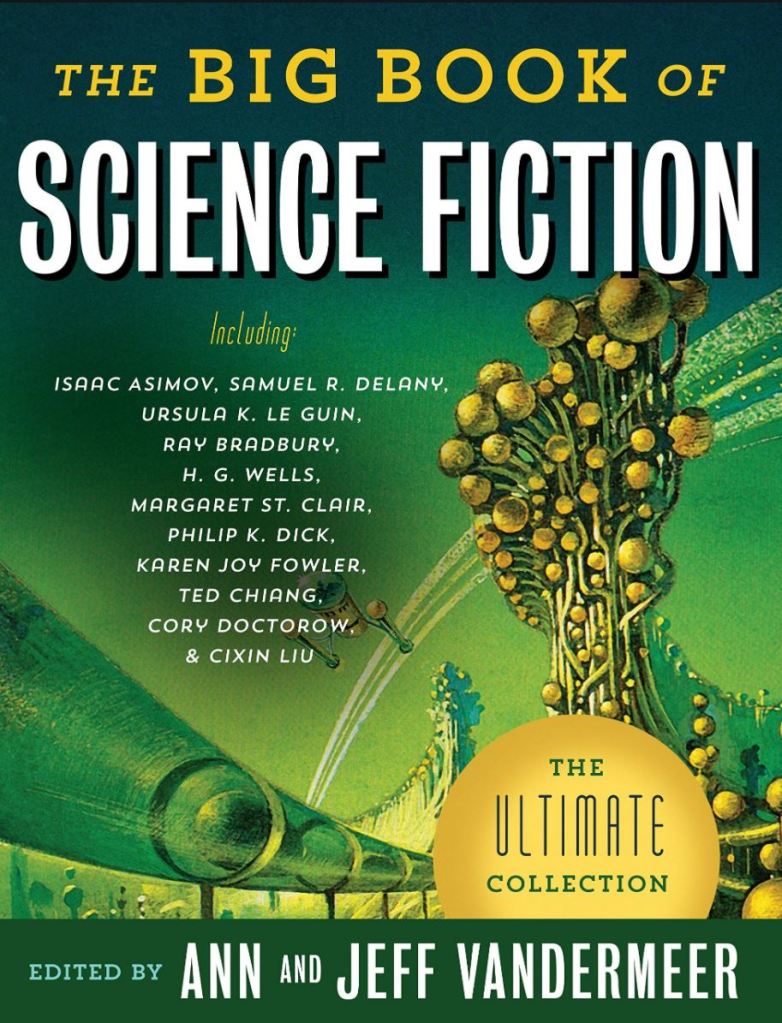
Group Read 27The Big Book of Science Fiction

Story #49 of 107: “Student Body” by F. L. Wallace

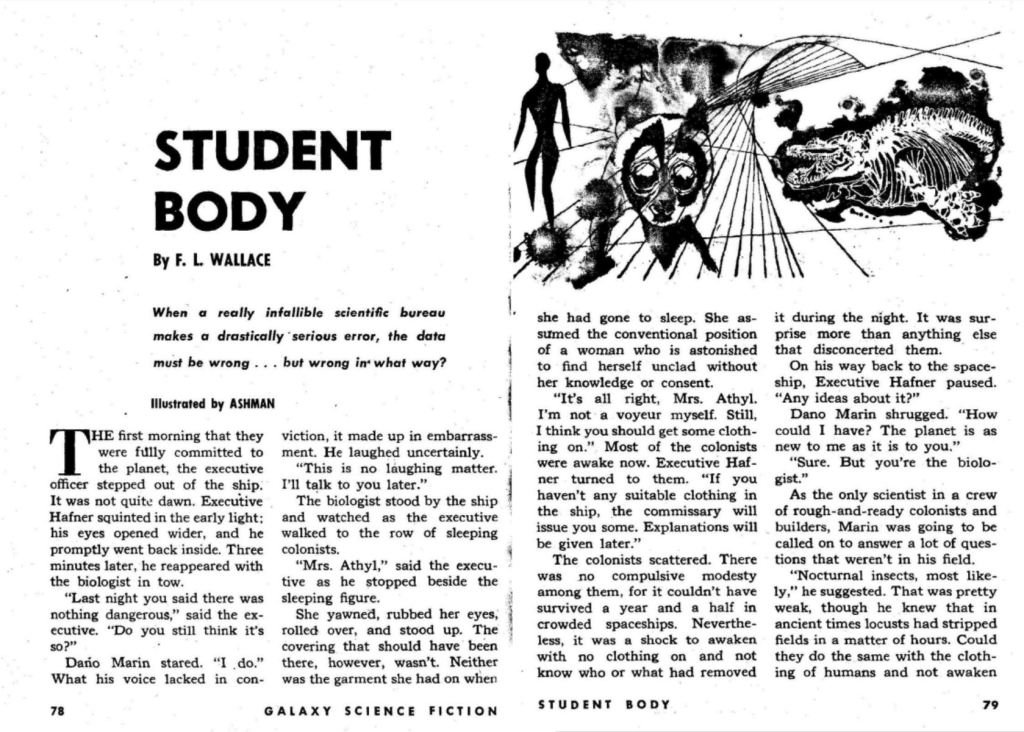
I’m curious why the VanderMeers jumped back to 1953 with “Student Body” by F. L. Wallace? Our last story, “Day Million” was from 1966, and we’ve been going pretty much in year order. And even though “Student Body” has a small level of popularity, it is a big step backward. Project Gutenberg reprints “Student Body” online probably because the copyright wasn’t renewed for the March 1953 publication in Galaxy Science Fiction.

F. L. Wallace, according to ISFDB, produced science Fiction from 1951 to 1961, mostly short stories in the magazines, with only one novel to his name, Address: Centauri, published by Gnome Press in 1955. F. L. Wallace is essentially a forgotten SF writer. ISFDB doesn’t even have a photo for him. Nine of his stories were reprinted in one of those cheap megapacks on Amazon, again probably from copyright neglect.

In their introduction to the story, the VanderMeers writes:

“Student Body” (Galaxy, 1953) showcases Wallace’s adroit handling of environmental issues in a manner more sophisticated than that of most writers of the era other than Frank Herbert (at novel length). Complex issues involving both alien contact and the impact of invasive species are housed within a tense plot. Although “Student Body” received no particular accolades upon publication, it endures as an example of a work ahead of its time—a future classic.

I’m sorry, but I didn’t find the story adroitly handling environmental issues or being more sophisticated on the topic than other writers. Neither is the plot tense or first contact complex. “Student Body” is a nice little magazine story based on a somewhat interesting idea. Like many SF stories from that era, Wallace gets an idea and clobbers together a minimal plot and characters to present the idea. Just compare it to “Grandpa” by James H. Schmitz, a story we read earlier from 1955. That story was no great shake of a story but deals with alien ecology far more adroitly, with more tension, complexity, and characterization.

“Student Body” has been reprinted in some decent anthologies, so it does have its fans, but I’m not one. The problem of the story, a constant threat of new animal life on the colony planet is somewhat interesting, unfortunately, its solution is unbelievable. Undermining what charm “Student Body” does offer, is spoiled by a plodding narrative structure. My hunch is Wallace was inspired by stories by Eric Frank Russell, especially “… And Then There Was None” from 1951, but “Student Body” lacks its charm and sophistication in dealing with an alien world.

I will admit the story starts out promising a load of fun. The colonists sleep outside the ship on the first night and wake up naked. That’s a promising premise for a potential funny story. Unfortunately, Wallace abandons that tack quickly, asking us to believe a small rodent-like creature gnawed the clothing off the people while they slept, and no one notices or woke up. If Wallace had solved that mystery in a different clever way, this could have been a fun story. But it’s like that old advice to writers, don’t show a gun unless you use it in the plot. Don’t titillate the reader with mass nudity unless you have a funny plot solution.

Rating: **+

Main Page of Group Read

James Wallace Harris, 11/21/21

“Day Million” by Frederik Pohl

Group Read 27The Big Book of Science Fiction

Story #47 of 107: “Day Million” by Frederik Pohl

“Day Million” by Frederik Pohl comes in at #25 on Dave Hook’s 125 Top SF Stories list. That’s pretty good for a story that appeared in a third-rate men’s magazine back in 1966. I was 14, so I wasn’t buying Rogue at the time, although I would have been mightily excited to have any men’s magazine back then. (Full nostalgic disclosure – I wouldn’t have read “Day Million” or any of the printed matter.) I did read World’s Best Science Fiction: 1967 edited by Wollheim and Carr, which reprinted the story, but I don’t remember reading “Day Million.” When I reread that anthology last year I remembered most of the stories, but not that one. Either I didn’t like it and skipped it, or it was so over my head that it made no impression.

When I finally got around to reading “Day Million” a few years ago I was impressed. And I’m still impressed. Pohl’s speculation about the far future and post-humans is quite nifty, and I think his philosophical points are still valid today. However, I’m not so sure it’s a short story. If the table of contents had listed it as nonfiction, and the editor introduced it as a speculative essay about future sex and romance I wouldn’t have quibbled.

Pohl tells us about Dora and Don in this hipster-voice that’s 50% of the entertainment value of the story. Of course, I don’t know if hipster would have been the right word for 1966. Playboy, the famous competitor of Rogue, promoted itself as the sophisticated guide for the swinging male, AKA, The Playboy Philosophy. I wonder if Pohl originally submitted “Day Million” hoping it would run right after the centerfold.

I thought Pohl’s idea of imagining day million was brilliant, although I’m not so sure humans will be around for our millionth day, and if we are, be that different. A lot of science fiction written since “Day Million” seems to assume we will — does that mean Pohl set the trend? Many modern stories have post-humans like those in “Day Million.” And Pohl seems pre-enlightened for our emerging acceptance of transexuals.

I’m not really attacking this story when I quibble about it sounding like an essay. Pohl knows how to tell a real story. Pohl is jazzing out by rifting on the structure of storytelling, but I also think he’s cheating. I’m talking about the old rule of show, don’t tell. Infodumping is telling a story. And this story is all infodumping. Pohl tells us that Dora and Don have a genuine relationship. It would have been masterful storytelling if Pohl have shown Dora and Don being in love so we truly felt and understood it, and not just told to us by a smart-alec narrator begging us to disbelieve him.

Pohl should have taken the time to give us The Crying Game, but revealing Dora’s lack of X-chromosome in some less crude but clever science-fictional way. And as we’ve already learned way sooner than day million, that a beautiful transexual female isn’t hard to accept. It would actually be much harder to make his readers believe an amphibious post-human would be attracted to cyborg post-human. Even harder to make believable, is showing people in the future being emotionally satisfied with a virtual mate.

Remember, Pohl only tells us these things will be true. Intellectually, we might want to believe the future will offer all these possibilities, but when it comes down to it, Pohl never even offers us any intellectual evidence, much less triggers emotional resonance through showing us dramatic evidence.

Main Page of Group Read

James Wallace Harris, 11/19/21

“Nine Hundred Grandmothers” by R. A. Lafferty

If my memory serves me right, and more and more I suspect it seldom does, “Nine Hundred Grandmothers” was the first story I ever read by R. A. Lafferty. I’m pretty sure I read it in World’s Best Science Fiction 1967. The last scenes. where Ceran Swicegood is winding his way down into the hill seeing smaller and smaller grandmothers is what stuck with me. I vaguely remember being somewhat charmed and feeling somewhat WTF. This was weird science fiction, but it was amusing. The next thing I read by Lafferty, was half of an Ace Double called Space Chantey. I passed this book to my friend Connell and George and the three of us got a lot of laughs out of it. After that, I read Lafferty’s stories but none of them were as much fun as these two. I often wanted to like them, and sometimes I was mildly amused or even somewhat impressed but never entirely loved.

This time when I read “Nine Hundred Grandmothers” I was far more taken with the story than any of the other times. Maybe it was because I was listening to When You See Yourself by the Kings of Leon and they were putting me into a receptive state. Music sometimes does that for me when I’m reading. Or maybe the story fairy sprinkled magic reading dust on me. Who knows, but this time I enjoyed “Nine Hundred Grandmothers” sentence by sentence, paragraph by paragraph. That’s always wonderful when it happens.

Check out these opening paragraphs to see if you’re charmed by Lafferty’s words:

Ceran Swicegood was a promising young Special Aspects Man. But, like all Special Aspects, he had one irritating habit. He was forever asking the question: How Did It All Begin? 

They all had tough names except Ceran. Manbreaker Crag, Heave Huckle, Blast Berg, George Blood, Move Manion (when Move says “Move,” you move), Trouble Trent. They were supposed to be tough, and they had taken tough names at the naming. Only Ceran kept his own—to the disgust of his commander, Manbreaker. 

“Nobody can be a hero with a name like Ceran Swicegood!” Manbreaker would thunder. “Why don’t you take Storm Shannon? That’s good. Or Gutboy Barrelhouse or Slash Slagle or Nevel Knife? You barely glanced at the suggested list.” 

“I’ll keep my own,” Ceran always said, and that is where he made his mistake. A new name will sometimes bring out a new personality. It had done so for George Blood. Though the hair on George’s chest was a graft job, yet that and his new name had turned him from a boy into a man. Had Ceran assumed the heroic name of Gutboy Barrelhouse he might have been capable of rousing endeavors and man-sized angers rather than his tittering indecisions and flouncy furies.

The Big Book of Science Fiction (p. 502). Knopf Doubleday Publishing Group. Kindle Edition. 

There are times in my life when I also tried to contemplate how it all began so I can’t help but identify with Ceran Swicegood’s quest. I’ve always thought there should be nothing — our existence should be impossible. I wish Lafferty could have given us the explanation. I’ve always concluded that because we’re here, that means never-existing-nothingness is an impossible state. From that assumption, I assume reality is the unfolding of every possible state of being. And that includes a dimension where a guy name Ceran Swicegood visits a planet where there’s an infinite number of grandmothers that might know the real reason.

R. A. Lafferty knows the pain of contemplating our existential origins and considers it a big joke.

“Tell me,” he pleaded in agony. “All my life I’ve tried to find out how it began, how anything began. And you know!” 

“We know. Oh, it was so funny how it began. So joke! So fool, so clown, so grotesque thing! Nobody could guess, nobody could believe.” 

“Tell me! Tell me!” Ceran was ashen and hysterical. 

“No, no, you are no child of mine,” chortled the ultimate grandmother. “Is too joke a joke to tell a stranger. We could not insult a stranger to tell so funny, so unbelieve. Strangers can die. Shall I have it on conscience that a stranger died laughing?” 

“Tell me! Insult me! Let me die laughing!” But Ceran nearly died crying from the frustration that ate him up as a million bee-sized things laughed and hooted and giggled: 

“Oh, it was so funny the way it began!” 

And they laughed. And laughed. And went on laughing…until Ceran Swicegood wept and laughed together, and crept away, and returned to the ship still laughing. On his next voyage he changed his name to Blaze Bolt and ruled for ninety-seven days as king of a sweet sea island in M-81, but that is another and much more unpleasant story.

The Big Book of Science Fiction (p. 507). Knopf Doubleday Publishing Group. Kindle Edition. 

I was only sixteen during this period in my life when I first read these stories. I attended Coral Gables High School in Miami, Florida, and worked at the Coconut Grove Kwik Chek bagging groceries. I was into science fiction, rock music, space exploration, and the counter culture. It was a time when I was discovering new science fiction as it was published after several years of reading old science fiction books I got from various libraries. Heinlein, Clarke, and Asimov were my big three during the 1964-1966 years. My next big three were Samuel R. Delany, Philip K. Dick, and Roger Zelazny. Plus I was discovering all kinds of new writers in the annual anthologies edited by Donald Wollheim and Judith Merril. It was during this period, I began subscribing to F&SF, Galaxy, and Analog, and joined the Science Fiction Book Club. By then I was a science fiction addict.

For over forty stories I’ve been waiting to reach this period in the VanderMeers’ anthology. And in just a few stories we’re going to zip right past this time period I love so much. I wish we could stay much longer. Plus, there are some other stories from 1966-1967 that people really should know:

  • “The Light of Other Days” by Bob Shaw
  • “Behold the Man” by Michael Moorcock
  • “For a Breath I Tarry” by Roger Zelazny
  • “The Keys to December” by Roger Zelazny
  • “The Last Castle” by Jack Vance
  • “Neutron Star” by Larry Niven
  • “We Can Remember It for You Wholesale” by Philip K. Dick
  • “Faith in Our Fathers” by Philip K. Dick
  • “Gonna Roll the Bones” by Fritiz Leiber
  • “The Star Pit” by Samuel R. Delany

And that’s not counting the memorable novels from those two years:

  • Babel-17 by Samuel R. Delany
  • Empire Star by Samuel R. Delany
  • The Crystal World by J. G. Ballard
  • The Dream Master by Roger Zelazny
  • Mindswap by Robert Sheckley
  • The Moon is a Harsh Mistress by Roberg A. Heinlein
  • Make Room! Make Room! by Harry Harrison
  • This Immortal by Roger Zelazny
  • Lord of Light by Roger Zelazny

Using Lafferty’s idea from this story, I wish humans made a little copy of themselves from each year of life. I’d love to have a shelf of little Jims that perfectly remembered each year. That way I could ask my former selves what really happened.

Main Page of Group Read

James Wallace Harris, 11/16/21

“‘Repent, Harlequin!’ Said the Ticktockman” by Harlan Ellison

Group Read 27The Big Book of Science Fiction

Story #45 of 107: “‘Repent, Harlequin!’ Said the Ticktockman” by Harlan Ellison

“‘Repent, Harlequin!’ Said the Ticktockman” by Harlan Ellison is #3 out of 125 on Dave Hook’s Recommended Reading List of SF short stories. That’s pretty impressive since Hook’s list is a meta-list generated from several lists. And we’ve finally reached the time period in The Big Book of Science Fiction when I began reading stories as they came out in the magazines. However, I didn’t catch this Ellison in the December 1965 issue of Galaxy, but in Wollheim’s World’s Best Science Fiction: 1966. (I did buy that issue of Galaxy a year or so later in a used bookstore, probably for about 10 cents. That’s when I first learn to love science fiction magazines.)

If you noticed, Ellison wasn’t mentioned on either cover nor did the story get any interior illustrations. Evidently, “‘Repent, Harlequin!’ Said the Ticktockman” wasn’t immediately recognized as a future classic. But it didn’t take long to become one of the most anthologized SF stories ever.

“‘Repent, Harlequin!’ Said the Ticktockman” won both the Hugo and Nebula awards in 1966.

But I don’t know why. Ellison’s razzle-dazzle prose to me is merely yelling, “Look at me! Look at me!” Sure, it’s a fun anti-establishment story from the 1960s. And I liked it a lot better back then. But now, I find its over-the-top wordy antics felt just like I felt watching the first episode of Batman back in 1966 — campy to the point of being embarrassing.

Like I said, when I was young Ellison’s stories impressed me with all their screaming and sneering and self-righteousness. Abbie Hoffman and Timothy Leary were cool too, in the sixties. But looking back through decades of hard-earned maturity, they now only look like clowns.

I got to see Ellison lecture twice, and both times I hung around afterward when young people tried to disagree with him. He was the fast draw that all the gunslingers wanted to take on. You didn’t want to be standing too close to them either because Ellison would roast them with his fire-breathing dragon replies. When I was young I enjoyed seeing Ellison’s skill with words, especially when he used his sharpest wit. Now, not so much.

That doesn’t mean I dislike this story or dislike Ellison. I will always love the guy who wrote: “Jeffty is Five.” I’m just burned out on all his famous pyromaniac-prose stories. I need to read through his collections and find some quiet tales suitable for my old age.

Besides, I like being on time and I get irked at having to wait for people that aren’t.

Main Page of Group Read

James Wallace Harris, 11/15/21

“Darkness” by André Carneiro

Group Read 27The Big Book of Science Fiction

Story #44 of 107: “Darkness” by André Carneiro

The VanderMeers made my reading expectations too high when they quoted A. E. van Vogt saying that “Darkness” by André Carneiro was one of the greatest science fiction stories ever written. It was good, very good indeed, but not great. Also, they misled me by saying it was a “depiction of a world where people are suddenly blind.” It is a story about everyone not being able to see, but they do not go blind. I read the story twice trying to discern exactly what happens and the best I can tell, light stopped working. The people could still see, but light from the sun slowly dimished, as did light from flashlights, matches, stoves, fires, etc. The world is thrown into darkness.

This is a disaster story with its usual plot arc. A man, Waldas comes home and begins saving water and gathering foodstuffs when he realizes that all sources of light are beginning to fade. Finally, when no one can see anything, people outside his apartment begin yelling for help. Waldas decides to share his resources with his neighbors with children but ignores all other pleas from other apartments and outside on the street. Eventually, Waldas realizes he must go out and search for food and plans to steal it from a nearby market, but when he gets there finds the shelves empty. On his way home be becomes lost and his finally rescued by a blind person, Vasco. Vasco is already skilled at getting around the city and takes Waldas back to the Institute for the Blind. Members there are helping a few people, and agree to help Waldas and his adopted family in exchange for water Waldas had saved in his bathtub. They bring back the water and family and live at the Institute until they realize the food is running out. The group then decides to go to a farm owned by the Institute, and the blind people lead the non-seeing people out of town. Eighteen days later light begins to seep out of light sources again, within a day or two, light returns to normal. Waldas returns to town to see how people have survived and found more people living than he assumed.

Near the end, we are told:

But, as their eager eyes took in every color, shade, and movement, they gave little thought to the mysterious magnitude of their universe, and even less to the plight of their brothers, their saviors, who still walked in darkness.

What is Carneiro telling us? Is he saying people are blind to the wonders of reality, even after they’ve been given a great object lesson? Is he saying people just adapt to any situation without wondering about the why of things? Maybe I’m taking this story too much for granted like Waldas and the people of his world took light for granted. Maybe I’ll appreciate this story more in the future.

Rating: ****

Main Page of Group Read

James Wallace Harris, 11/15/21

“The Hands” by John Baxter

Group Read 27The Big Book of Science Fiction

Story #43 of 107: “The Hands” by John Baxter

“The Hands” by John Baxter is a unique alien invasion story. I’m not sure I’ve ever read anything quite like it. Not that’s it’s experimental or strange, quite the contrary, it’s very readable and vivid. It is a horror story and kind of gross, but it’s also true blue science fiction.

The VanderMeers tag the story as New Wave, but I’m not sure why. Maybe because it originally appeared in New Writings in S-F 6 edited by Ted Carnell which came out in 1965. That’s two years before Judith Merril came up with The New Thing in a 1967 issue of F&SF, during the era when she anthologized a lot of British science fiction, but really before the term New Wave was popular with fans.

Back then I thought I knew what New Wave stories were on sight, but not anymore. The Tempest in Teapot fan wars over the New Wave was more real than any literary movement in our genre. There is nothing experimental or cutting edge about “The Hands” at all. It’s beautifully written for what it does, but what it does isn’t that much other than its trick idea for an alien invasion. Baxter’s prose and story idea remind me a lot of what Theodore Sturgeon wrote years earlier. I admired the prose and the way Baxter presented the story the whole time I was reading it. Good job. Not great. Rating: ***+

I’ll quote the first two paragraphs just to give y’all a taste of what the story was like.

They let Vitti go first because he was the one with two heads, and it seemed to the rest that if there was to be anything of sympathy or honour or love for them, then Vitti should have the first and best of it. After he had walked down the ramp, they followed him. Sloane with his third and fourth legs folded like the furled wings of a butterfly on his back; Tanizaki, still quiet, unreadable, Asiatic, despite the bulge inside his belly that made him look like a woman eight months gone with child; and the rest of them. Seven earth men who had been tortured by the Outsiders. 

When the crowd saw Vitti, they shouted, because that was what they had gathered there to do. Ten thousand sets of lungs emptied themselves in one automatic, unthinking cry. The sound was a wave breaking over them, a torrent of sound that made them want to fall on the ground and wait for its passing. But there was only one shout. By the time the cry was half over, the people had seen Vitti and the rest of them, and when their lungs were empty they had neither the will nor the ability to draw them full for another shout. There were some who did; a few standing at the back. But their shouts were like the cries of seabirds along the edge of the ocean. From the others, there was no sound but the susurrus of whispers like the melting of sea foam after a wave has receded. Nobody had anything to say. At that moment, Alfred Binns realized for the first time that he was a monster.

The Big Book of Science Fiction (p. 479). Knopf Doubleday Publishing Group. Kindle Edition. 

Main Page of Group Read

James Wallace Harris, 11/13/21 (Happy Birthday Becky)

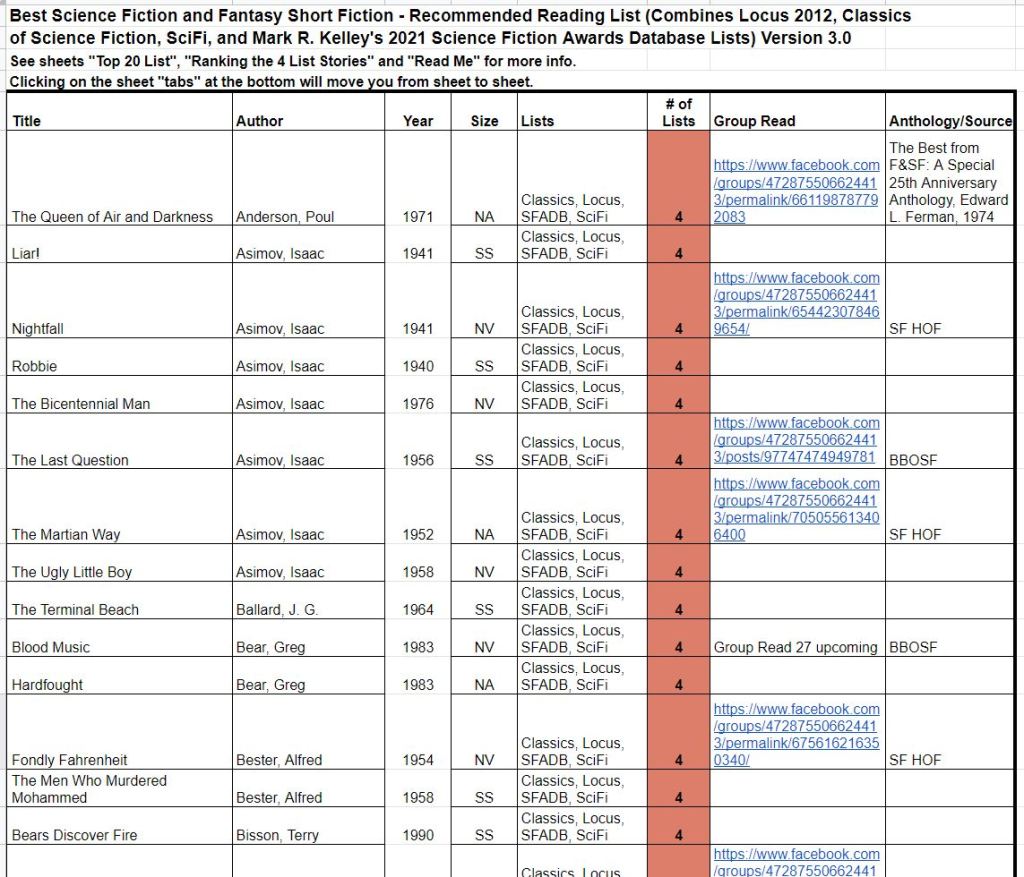
Dave Hook’s Recommended Reading List – Short Fiction 2.0

Click Here to See the List

Dave Hook thought it would be revealing to combine four lists that identify the most remembered science fiction short stories to see which stories are on the most lists. Be sure and review the tabs at the bottom of the spreadsheet for different versions of the data, links to the original lists, and a sheet where you can track your reading. Just save a copy of the spreadsheet to your own Google Drive, or download a copy in your preferred format if you want to track your reading history.

125 stories were on all four lists (Classics, Locus, SFADB, SciFi). Dave is a moderator for the Best Science Fiction and Fantasy Short Fiction group on Facebook and he also provides links to where the group has already discussed the story. Those stories have been read because the group has read over two dozen anthologies together. That’s just another validation of the popularity of these science fiction short stories.

Of course, we’re the creator of one of the lists, The Classics of Science Fiction Short Stories found at CSFquery. We know it’s dangerous to claim such lists reveal the best stories because tastes are so subjective. Most people look at lists on the internet to see what they’ve read and what stories they love that aren’t on the list. Quite often they accuse the list maker of making poor choices. None of these lists were chosen by their creators. Two were created through statistical analysis and two were created by fan polls. That’s why I like to say these lists track the most remembered stories. Claiming any kind of quality leads to trouble.

However, I will say that statistically, you have a better chance of liking these stories more than from any other method of identifying short fiction. I have read a large percentage of these stories and most of my favorite science fiction short stories are on this list. However, there are many stories I love that are missed by these lists. For example, my favorite Robert A. Heinlein short work is “The Menace From Earth.” It’s not here. Lists, no matter what the methodology used to create them, are never perfect. But I like Dave’s list. It’s a solid piece of work.

What’s even more interesting, is the number of stories that are on all four lists outnumber the stories that are only on three lists. That suggests the popularity of these 125 stories is quite significant.

If you look at the four lists Dave used to create his list you’ll see the stories are ranked, but the rankings differ from one list to the next. Dave used a statistical method to compare the rankings and produce a Top 20 list. I wish he had gone beyond 20, maybe 50. But even his rankings don’t match the rankings of the four original lists. There’s just no agreement for what are the best science fiction short stories to read.

One flaw in these methods is newer stories have had less opportunity to get recognized and remembered. That’s just how things work, but it does mean when a story from the last twenty years does show up it means it really stood out from the rest. Ted Chiang is a wonder.

James Wallace Harris, 11/10/21

“Day of Wrath” by Sever Gansovsky

Group Read 27The Big Book of Science Fiction

Story #42 of 107: “Day of Wrath” by Sever Gansovsky

Even though “Day of Wrath” is translated from Russian, it sounded completely American. The story is about two men riding on horseback into a backcountry settled by folks who work the land, live in cabins, and who fear people they don’t consider humans. I don’t know if Gansovsky intentionally wanted us to think of Native Americans but I did. There is one scene that reminds me of The Searchers.

“Day of Wrath” reminded me of stories I read in old issues of Astounding, Analog, or Galaxy from the 1950s and 1960s. Stories like those written by Poul Anderson, Gordon Dickson, or Jack Vance. Stories that began with two riders, sometimes on horses, and sometimes on strange alien mounts, with one rider who knows the country, and one rider who doesn’t. That setup lets us the reader learn the backstory with the newcomer. I assume we’re on Earth, but that might not be true.

The two characters are Meller, the forester, and Betly, the journalist. Betly wants to find out what people think of the otarks, superintelligent creatures that escape from a science lab years ago and are now populating that rural area. They are pushing out the humans. The city people have heard about the otarks and are fascinated by the fact they know advanced mathematics. But the local people only know the otarks as killers, and consider them inhuman. Gansovsky also tells us this society has intelligent machines but doesn’t make much of them.

“Day of Wrath” wants us to consider the old question: What is human? That’s a favorite science-fictional theme I enjoy. Like the androids in Do Androids Dream of Electric Sheep? by Philip K. Dick, we’re told the otarks have no empathy, no compassion. They do have brilliant analytical minds that do higher mathematics and understand the Theory of Relativity. But the otarks also kill wantonly. To portray them as the ultimate evil, Gansovsky has them eat humans and even each other. Does he do this so we’ll think they are worth exterminating? But then, does he tell us they understand Einstein as a reason to save them?

Gansovsky brings us these issues, but the ending suggests he’s on the side of extermination. I assume the ending is the day of wrath. That’s an interesting word to use since we usually associate it with God. We are the gods of the otarks, and it’s our wrath that will destroy them. It’s telling that Gansovsky begins his tale with this quote from a hearing:

The key to the story is deciding if humans have qualities the otarks don’t. This is my first reading of “Day of Wrath” and I expect to reread it because I believe it’s a deeper story than possible to understand from one reading.

But I have a question for Gansovsky: Does killing make us inhuman? Humans kill all the time. Sometimes we’re even cannibals. Maybe we lack that divine spark we think we see in ourselves. In Do Androids Dream of Electric Sheep? Dick does advocate extermination because the androids lack empathy. His novel focuses on what makes us inhuman. But the film version Blade Runner focuses on what makes the Replicants human. I tend to feel, that Gansovsky is positioning himself closer to PKD here, and not seeing the otarks as a Roy Batty who gives us a “Tears in the Rain” speech. But when I reread this story in the future I might change my mind.

Rating: ****

Main Page of Group Read

James Wallace Harris, 11/10/21

“A Modest Genius” by Vadim Shefner

Group Read 27The Big Book of Science Fiction

Story #41 of 107: “A Modest Genius” by Vadim Shefner

“A Modest Genius” by Vadim Shefner is another story in The Big Book of Science Fiction that I wouldn’t consider science fiction. Yes, it has an inventor of science-fictional gadgets, but those inventions are used as a fantasy writer would use them, not science fiction. “A Modest Genius” is told in a fable or parable-like style about a man and three women he’s interested in. I don’t know what to call this style, but it involves more telling than showing. We’ve seen this mode of storytelling mostly in the translated stories in this anthology. I wonder if it’s just a popular narrative approach in other countries?

Maybe this style of writing should be called the oral storytelling mode because it sounds like what you’d hear if the narrator was telling us the story out loud. Oral storytellers usually don’t have a lot of dialogs — probably because it would make them sound like they had multiple personalities. This technique is more common in fantasy stories because it conveys an old-timey feel. Unfortunately, I don’t like its use in science fiction, probably because it reminds me of 19th-century fiction, and I like to think of SF as future-oriented.

“A Modest Genius” is still a pleasant little tale but one I would never choose to anthologize. The story’s core insights are about picking the right kind of spouse for your personality. That’s hardly science-fictional. The crazy inventions just gives Sergei the patina of being an oddball, or add a bit of humor.

This disappoints me because I was looking forward to reading Soviet science fiction. I was hoping the translated stories would give us insights into the traditional themes of science fiction with unique perspectives from other cultures. All too often they’ve been about mundane topics with some science-fictional elements.

Science fiction is notoriously hard to define. Everyone has their own definition. But for me, it’s essential that the story is science-fiction at heart. “A Modest Genius” is about a lonely man trying to find the right woman. If the story had centered on his future vision gadget to solve his romance conundrum I would have considered it science fiction, but that idea was only tossed out and ignored.

Main Page of Group Read

James Wallace Harris, 11/8/21

“2 B R 0 2 B” by Kurt Vonnegut Jr.

Group Read 27The Big Book of Science Fiction

Story #40 of 107: “2 B R 0 2 B” Kurt Vonnegut Jr.

I believe we should talk about context — the context of when and why we read science fiction. I became addicted to science fiction during the 7th (63/64) and 8th (64/65) grades because I went to four different junior high schools during those two years. My parents’ marriage was coming apart, and my father had a heart attack, and we just kept having to move. It was a very stressful time and reading science fiction was how I coped. If my life had been stable I’m not sure I would have read so much. I would have been more involved with the real world. My consumption of sci-fi would have been moderate, maybe even casual.

I’m reading a lot of science fiction now because that’s about all I physically feel like doing. I turn 70 this month. Being retired, and discussing science fiction on the internet is something enjoyable to do, somewhat social, letting me interact with folks with a similar reading interest.

When I read a science fiction story today it has to mean something in my current context of life. I’ve been trying to explain that context as I’ve reviewed the stories in The Big Book of Science Fiction.

2 B R 0 2 B” by Kurt Vonnegut is a famous short story that’s often taught in schools. It’s fun. It’s slick. It’s entertaining. It has a surprise ending. However, I thought the story thin and expected more from the famous Kurt Vonnegut. Of course, when this story was published it was when he was selling to the science fiction magazines, and before he disavowed being a science fiction writer to become a major literary writer. That’s a kind of context too.

In one of my recent reviews, I talk about how I enjoyed a story because I was in the right mood. I had read the story just after getting up in the morning. That’s when I’m at my best. I read “2 B R 0 2 B” while feeling uncomfortable from an overactive bladder and a cranky prostate, while feeling pains in my ass from a recent flareup of the piles, and a stuffy head from the side effects of the drugs I have to take that makes it hard to think clearly. Maybe I would have liked “2 B R 0 2 B” more if I had felt better when I read it?

However, I felt just as bad when I raced through twenty hours of To Say Nothing of the Dog by Connie Willis, enjoying every minute of it. That book made me forget that I felt crappy. As soon as I finished that novel I started listening to Crossroads, the new novel by Jonathan Frazen, which is twenty-six hours on audio. I’m just as delighted with it, and it helps me to forget my yucky physical situation too. However, I tried reading Three Men in a Boat by Jerome K. Jerome, a book considered one of the funniest from the 19th century and the book that inspired Willis to write To Say Nothing of the Dog. Jerome K. Jerome didn’t work. It’s just a series of humorous sketches that aren’t that compelling as a page-turning novel.

Evidently, having an addictive plot is what I need. And Vonnegut’s little story about a man whose wife is having triplets in a world where the population is severely controlled doesn’t last very long or isn’t very diverting. But I’m not sure if the length is a necessity. “The Voices of Time” by J. G. Ballard drew me deeply into it.

There are aspects of “2 B R 0 2 B” that were more important back in the 1960s. Even before The Population Bomb (1968) and The Limits of Growth (1972) science fiction magazines ran essays and stories about the dangers of overpopulation. It was a popular topic for Arthur C. Clarke and Isaac Asimov, and Harry Harrison wrote a vivid 1966 novel Make Room! Make Room! about the problem. Vonnegut’s facetious treatment of the idea is a quick bit of satire, that really ignores the seriousness of the problem just to get a sick laugh. That’s another context. Now, almost sixty years later, overpopulation is a major factor in climate change, and it’s even more serious of an issue. Shooting people is not a very funny solution because we now live in a world where too many people are whipping out guns and shooting other people. That’s another context.

As a classic story “2 B R 0 2 B” probably desires 4-stars, but as a pleasant trifle, I feel like only giving it 3-stars. And each of those is a different context.

I’ve got 67 more stories to read and review in The Big Book of Science Fiction. The context of reading so much science fiction weighs on each story I read. After forty stories it’s getting harder and harder to impress me.

Supposedly, all the stories in the collection are exceptional. But reading them together shows something different. If I was in the 8th grade and “2 B R 0 2 B” was my only reading assignment, I would probably consider “2 B R 0 2 B” a really good story. It was easy to read and funny. It would also be easy to talk about in class, or a snap to write a paper on. In that context, I would have thought English class that day wasn’t the drag it usually is. Compared to the other 39 stories we’ve read so far, it would rank maybe 28.

But in my present context of annoying bodily sensations and having to read this story because I set my goal to review all the stories in a giant anthology, Vonnegut’s story was barely a blip.

Main Page of Group Read

James Wallace Harris, 11/7/21