Story #62 of 107: “The IWM 1000” by Alicia Yánez Cossío
“The IWM 1000” by Alicia Yánez Cossío is a story from 1975 that imagines a device that answers users’ questions. Think of a talking, portable Google. It’s not much of a story, but it does imagine a lot of interactions that are similar to what we use the internet for today.
Alan Kay imagined the Dynabook in the 1968-1972 era. And science fiction has been imaging machines with knowledge as far back as “The Machine Stops” by E. M. Forster in 1909. But I knew about neither in 1975, and I doubt I could have thought up the human uses the way Cossio did. Computers, networks, and social networking just didn’t occur to me before they existed. But dang, they sure have changed our lives.
Science fiction writers often imagine cool new machines, but they don’t often imagine how society will be changed by them. I give Cossio credit for that kind of thinking. Unfortunately, she’s not much of a storyteller here. This “story” is very close to an essay.
I wish I had an AI that knew of all books, magazines, journals, newspapers, diaries, internet threads, etc., and could tell me how certain science-fictional ideas evolved. On the other hand, that’s what I wish I could do myself — have all knowledge so I could see the currents of ideas ripple through history.
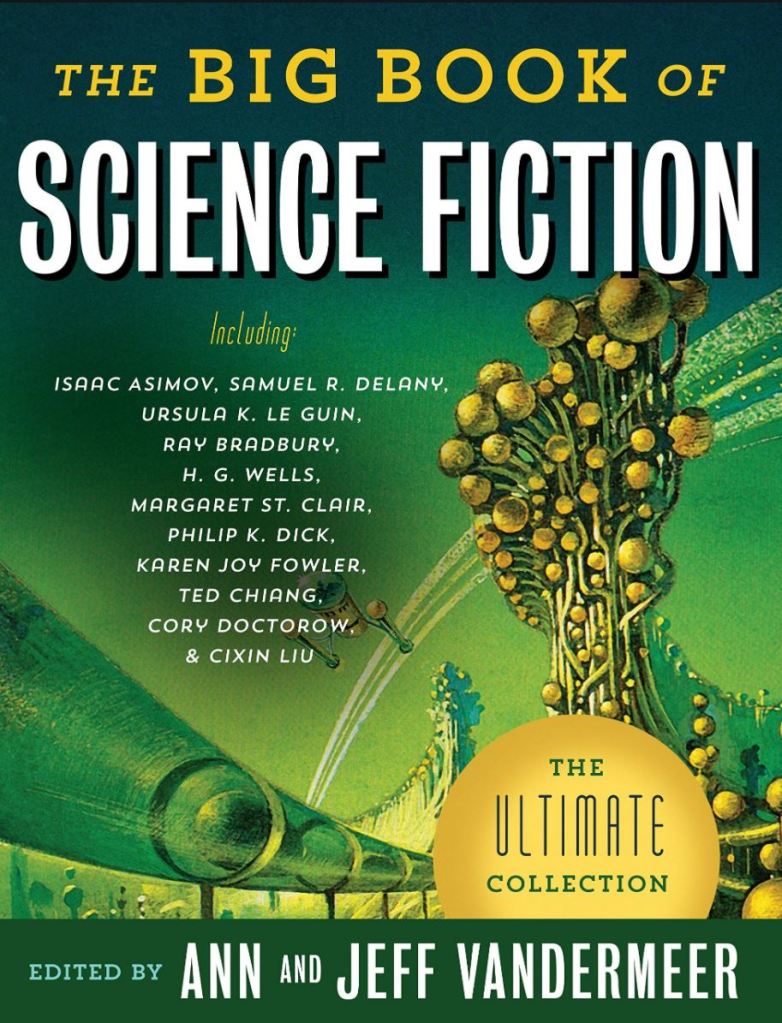
I’ve gotten behind with our group discussions of the stories in The Big Book of Science Fiction. I got distracted by reading the current issues of Analog and Asimov’s. Comparing the old SF stories with the new is quite a contrast. Forty-six years makes a big difference. 2021 is the future for the writers of 1975. We don’t have an IVM 1000, but we have things somewhat like it, and we use those things somewhat like she imagined. While I’m reading 2022 SF stories, I’ll have to think about what SF writers are imagining for 46 years into our future.
I also need to imagine what a future person like me will be, one who reads and thinks about science fiction. Will blogging exist in 2066? And if civilization collapses by then from climate change, mass extinctions, overwhelming pollution, and disappearing resources, will we still be reading science fiction? At my other blog, I wrote about reading in a post-doom world. In such a scenario, will we stop dreaming about the future, and fixate on the past?
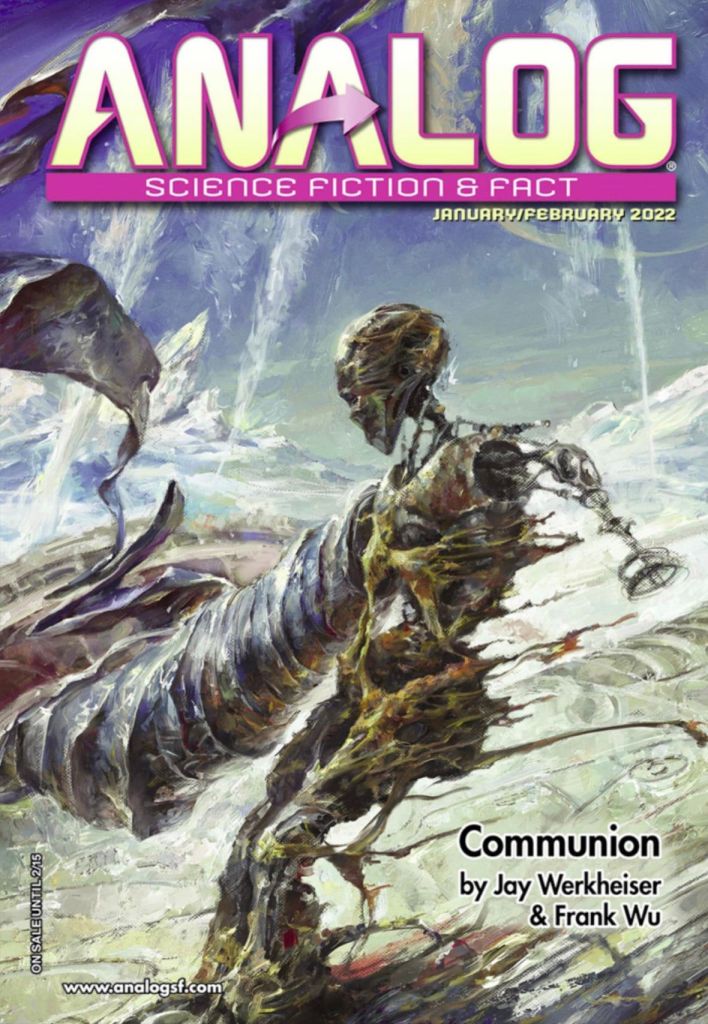
I haven’t read all the stories in a science fiction magazine in decades. I’ve always wanted to be a science fiction writer but I’ve never had what it takes. At seventy, I’m wondering if there’s any chance left of even getting even one short story published? I plan to read several different science fiction magazines to judge where short science fiction is at in 2022. I’m starting with Analog.
Reading and reviewing new science fiction is difficult for me. I have sixty years of reading science fiction and new fiction just doesn’t compete with all the classics I’ve discovered over my lifetime. I’m getting tired of reading average science fiction. Nor do I want to write it. Can I identify what makes a story anthology worthy, or award-winning worthy, but most of all, what makes a story successful over time? I’m afraid none of these stories were classics, and only a couple might deserve being collected in a best-of-the-year anthology. Although they all missed the magic I love to find in science fiction stories.
Several times over my life I’ve tried to write science fiction, including taking MFA writing courses and attending Clarion West. I’ve never been satisfied with my own work. When I read a story in a science fiction magazine, I think about the effort it took to write each story, so I hate to criticize them. On the other hand, if I’m going to use the last drops of my psychic energy to write a story, I don’t want to write anything that’s already been done over and over again. And that was always common in writing workshops.
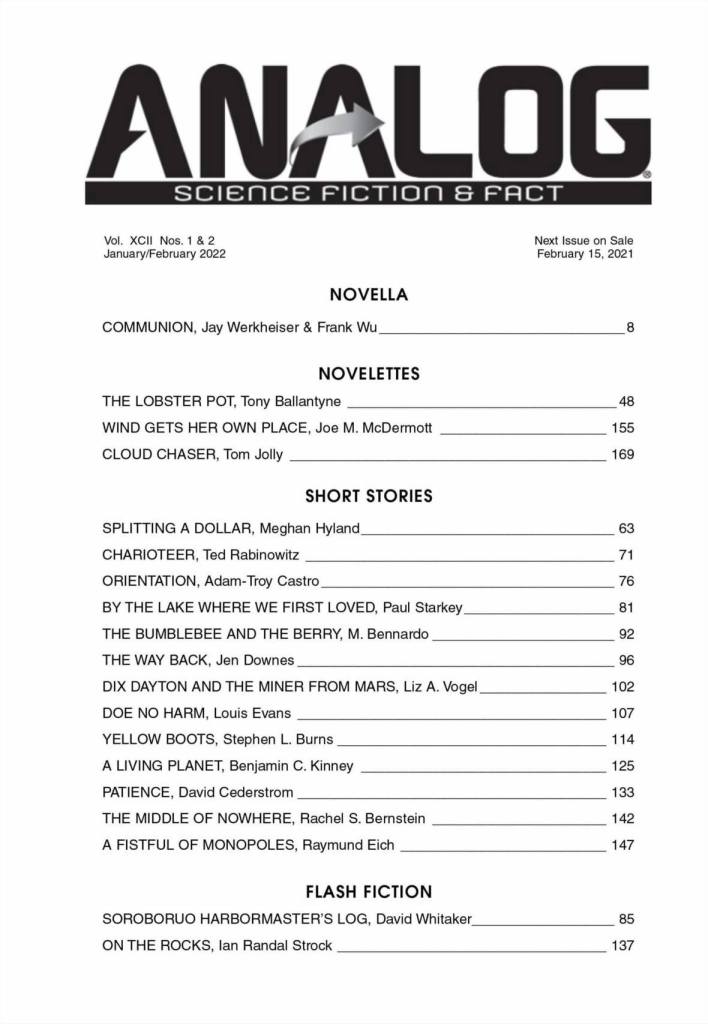
Finally, the comments on the stories in the Jan-Feb issue of Analog below are my memory notes. I thought maybe others might be interested in my notes as I read through different science fiction magazines.
My notes are mainly to help me remember what the story was about and how I felt about it. I’m also working on improving my memory by writing notes. I’m still refining this process. I try to summarize each story as a way to remember it or to get others to read the story. I’m still experimenting with my note-taking style, so they aren’t consistent yet.
To be blunt, most of these stories lack a sense of wonder. They are about far-out concepts, never transcend into the magical. And even though I’ve written dozens of unpublished stories in the past, I’ve never felt any of them had that magic either. That’s why I’ve always given up.
What makes “Vintage Season” or “Flowers for Algernon” or “The Star Pit” work? I’m sure all new writers aim to hit one out of the park with each new story. I remember at Clarion West hurting one guy’s feelings. He came to me after class and asked me which story was the best one that week. I didn’t think and mention the one I thought was the obvious best. It wasn’t his. And then I realized, he thought his story was the best and wanted affirmation. So I said I thought his story was among the better ones that week, although I didn’t believe it. It’s almost impossible to judge one’s own work.
Reviewing fiction often involves telling people their babies are ugly. I don’t like doing that. On the other hand, do you want to really believe your baby is beautiful when it’s not? I’m going to try and be honest in my notes, but not vicious. Hope I don’t hurt anyone’s feelings, but I’m just as harsh with myself.
The hard, cold, reality is most science fiction stories are just average stories, and that’s being excessively generous by some critics. The hard, cold, reality is only a few stories truly stand out each year. The hard, cold, reality is most writers produce dozens or even hundreds of short stories over their career, but just a handful of their stories are remembered.
Often these stories remind me of older science fiction stories. After reading thousands of science fiction stories, it gets very hard to find something that feels new and different. And all too often when I’m reading new science fiction magazines, I feel the writers were inspired by TV shows and movies rather than reading classic science fiction stories. I think they would be better served if they read the classics.
Choosing the right length is also very important. If you stretch your story, you can try the patience of the reader. If you tell it too quickly, it will diminish its impact. Novellas must be exceptionally good to justify the time they ask the reader to give up. Short stories must be extra potent to make any kind of impact in their short space. Personally, I find novelette length the best length for short science fiction.
I used to believe that television and movie science fiction wasn’t as evolved as written science fiction, but that’s changed. I can understand why new writers are influenced by television and movies. Unfortunately, the popularity of science fiction on television is so pervasive that all science-fictional ideas have been done to death
Most science fiction stories are meant to be entertaining. Some stories speculate about the future, revealing the author’s hope or fears. Most science fiction stories dwell in a fantasyland created by the momentum of past science fictional fantasies. In the real world, we’re on course for global civilization collapse. It’s too late to avert drastic climate change, and capitalism is about to self-destruct. Damn few science fiction stories deal with the future in any realistic way, revealing a bankruptcy of creative potential. Science fiction has become so close to fantasy fiction that any genre distinctions no longer matter. Still, I’m always looking out for what I consider real science fiction.
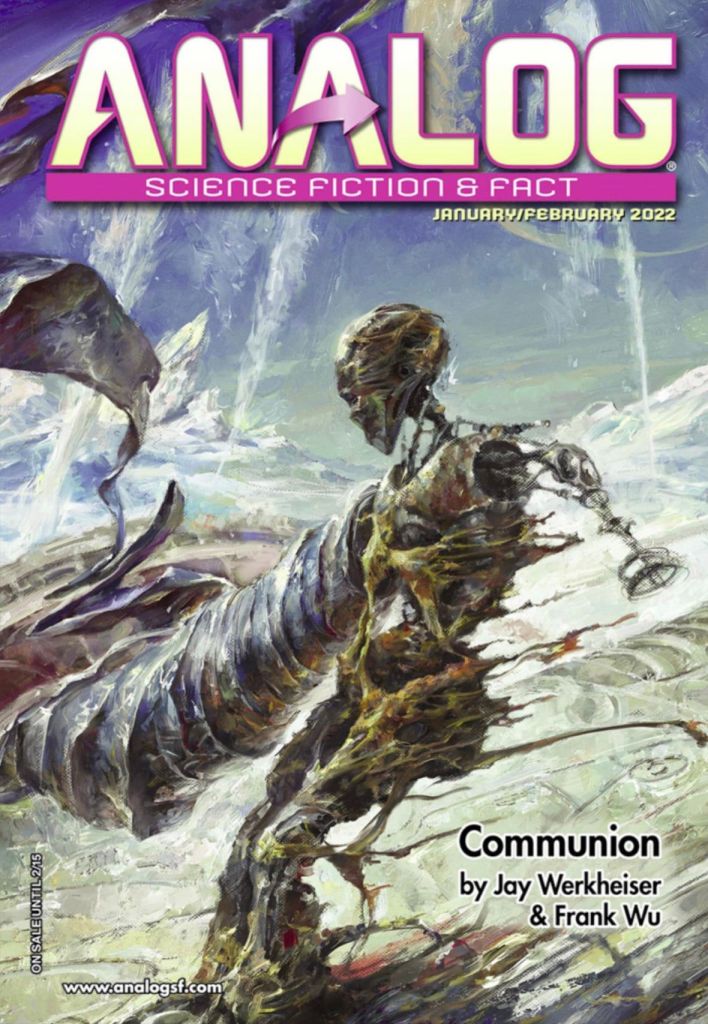
"Communion" by Jay Werkheiser & Frank Wu

Thread 1: Sentient organism struggles to survive when separated from its hive. It communicates with biochemistry.

Thread 2: Nes Mason and his robot Alex crash onto an icy moon. They communicate with language.

For each to be saved they must discover each other's existence. The story has a lot of organic chemistry.

Pleasant enough tale hurt by its novella length and excessive science.

However, it's a neat idea and reminds me of The Hidden Life of Trees by Peter Wohlleben.

===============

"The Lobster Pot" by Tony Ballantyne

"By His Bootstraps" meets GATEWAY and "Rogue Moon" wondering into THE MATRIX.

A fairly compelling tale. Four characters with no characterization other than different names.

===============

"Wind Gets Her Own Place" by Joe M. McDermott

Wind, a 17-year-old Tau Ceti colonist has a tough first year in this YA science fiction story. Her mother doesn't make it through cold sleep and Wind is forced to share a tiny room with her mother's boyfriend who she hates. The story is mostly teenage angst that could have been set on Earth. However, it's a well-told story.

One takeaway: colony life is dreary, although realistic. Few readers will fantasize about this adventure. I want to write something that's realistic, and maybe even deals with our depressing reality, but I want to add something new or transcendent. How can we make readers excited about the future when its so damn bleak? (Many writers in this issue try by writing essentially science fiction fantasies.)


===============

"Cloud Chaser" by Tom Jolly

Another story with twin storylines, but this one is the first in this issue to have any kind of storytelling finesse. It's a space opera but with a number of cliche elements, including space pirates, and feuding royal brothers. I enjoyed this one and it had fair degree of what's-going-happen tension in the second half. Yet, not quite good enough to believe I'll reread it.

One of my main measures of a better story is if after reading it I know I'll want to reread it in the future.


===============

"Splitting a Dollar" by Meghan Hyland

Amy and Brad are on the Moon in ancient spacesuits that have been in museums for two hundred years. Before our civilization collapsed, we left presents in a Lunar stockpile for the next civilization. This is Meghan Hyland’s first professionally published story, and the first I've read that's maybe anthology worthy. It's not a retread, and that impressed me. The title is based on the Ultimatum Game, a psychological experiment that makes a nice metaphor for the tale, unfortunately it's explained in the story. It shouldn't have beem. I think trying to make the title clever spoils the story. Just plot the story on the Ultimatum Game. The story has many weaknesses, even though I like the idea. Having Brad just be greedy for gold was too simplistic, making him a strawman. The story would have been better if Brad had a believable motivation. The lesson here is don't imagine routine scenes. Make each scene as good as the overall idea.

===============

"Charioteer" by Ted Rabinowitz

Short, tightly written tale of survival during a solar sail race. Sadly, the story's driving conflict was tired and cliche. Why didn't she get a name?

===============

"By the Lake Where We First Loved" by Paul Starkey

Moira Cohen, nee Ishikawa is on Titan to perform a ceremony to commemorate her dead husband. She looks back over her life and realized her husband's success separated him from her, and diminished her own success.

Not a bad little tale, but the sentiment was strained for me. Again, the problem with such short works of fiction is we don't get to be with them long enough to care. It's like meeting an interesting person in line at the post office.

Lesson here is be wary of the short story length. Too much was said and not shown.

===============

"The Bumblebee and the Berry" by M. Bennardo

Axel is the governor of generation ship, a hollow asteroid that's been traveling for 630 years. They have reached another star system, but for three attempts they have failed to plot a correct path to their destination, and are now on their fourth attempt. Within this brief story Axel has an epiphany as to why.

I'm partial to generation ship stories. This story is almost a mood piece it's so short, but the character struggles to figure something out. It brings up the problem of story length. It's hard to create a really good story that's short, and even when a writer succeeds, it feels like getting one spoon from a bowl of ice cream.


===============

"The Way Back" by Jen Downes

I thought this was a lovely story, and it's the closest I've come thinking I'd reread a story in the future. But not quite. It's so hard to judge a story from one reading. Reading new stories are like seeing a new baby and wondering what it will be like when it grows up.

TJ Marshall, or Teej dreams of going into space from age 7. And in this short story, we get to see their dream come true. I'm not sure if Teej is male or female -- I'd need to reread the story closely. What I really liked was the details of Rocklea, Teej's hometown next to the spaceport. It was a very literary beginning. The writing in this story reminded me of early Delany. The rest of the story is kind of cliche but still well done. It also reminds me of Heinlein's STARMAN JONES.

One reason I resonated with this story is it reminds me of how I wanted to go into space as a kid. However, when Teej realizes he needs to return to Earth, it reminds me of how I feel now. Better characterization really helps a story.

===============

"Dix Dayton and the Miner From Mars" by Liz A. Vogel

Dix Dayton gets wins weird device in poker game in a bar on the asteroid Euphrosyne. While asleep the device causes hole in pressured habitat. Hole is fixed. End of story.

Bland space opera that seemed inspired by the Expanse series. Felt like possible chapter out of planned novel. Didn't work as a standalone story. I think readers want more than just a bit of space opera. Also, I just don't believe in this future. It's television's idea of life in the asteroids, with stereotype characters. Heinlein did asteroid life better in THE ROLLING STONES.

===============

"Doe No Harm" by Louis Evans

A John Doe arrives at the ER in this short story set in the future where privacy laws are encoded into all computerized medical equipment. The patient is unidentifyable and their embedded ID chip with medical records is destroyed, thus the doctors don't know how to contact next of kin, or have ID directed permission to use their AI driven computerized medical equipment. Every piece of routine equipment shuts down because of automatic privacy lock. Thus, the ER doctor and nurse resort to old fashion methods.

This has been the most entertaining story so far in the issue. Dramatically extrapolating on current medical trends.

Solid story, worthy of being anthologized. Still, it's problem solving over characterization. But that seems to be the way in Analog.

===============

"Yellow Boots" by Stephen L. Burns

Stude, a robot, and Louis, a human who has had better jobs, work for an organized crime syndicate selling fresh water in a city flooded by rising oceans. They discover their water has been adulterated with sea water by the syndicate and want to help their customers avoid dying without being eliminated themselves.

Few science fiction stories deal with our inevitable future. That makes me appreciate "Yellow Boots" even though the story isn't ultimately inspiring. It's a readable enough story, unfortunately, like many Analog stories, the focus is on the problem rather than the people.

I wish science fiction writers would give us stories of people finding ways to thrive in a doomed world. That's a lot to ask. Stude and Louis solve a problem but their solution doesn't offer hope, just survival. I don't expect Pollyannish fantasies, but more stuff like Kim Stanley Robinson is doing. And I downright loath abandoning Earth for Space stories.

===============

"A Living Planet" by Benjamin C. Kinney

Ethan misses his wife Liza, who is on a mission to Mars. Worse yet, communication with her spacecraft has been lost. But that's not what this story is about, even though it's enough of an idea for a story. Next, the story shifts to how Ethan doesn't get along with coworkers and boss at JPL because of the way he likes to joke around. Another good conflict for a short story. But even this isn't what "A Living Planet" is about. Ethan's job is to write code for a satellite that gathers up space junk. The real story begins here when Ethan discovers small alien spacecrafts that are light-sail-driven.

This story would have been better if it got right down to the main story. Actually, I was most interested in the missing wife story.

==============

"Patience" by David Cederstrom

When I started reading "Patience" I was delighted -- it read just like something from a 1939 issue of Astounding Science Fiction. The first POV character is Antal, an intelligent creature waiting for a warm-blooded animal to kill. Starting off, I thought it was a past or future primitive human. Either before civilization or post-apocalyptic. I love such stories. But then it mentions its rear set of eyes, so we know it's not human. Through Antal's stream of consciousness, we know it's desperate for food, for blood.

Then the POV changes to a human and we see things completely differently. This was a short but effective story that sucked me in. My only criticism is it was too short. Very nice first science fiction story.

Makes me wonder if I shouldn't pattern my writing on older SF.

===============

"The Middle of Nowhere" by Rachel S. Bernstein

Bernstein gives us a grim view of the future, one where transporters are replacing old forms of transportation. The only problem is data snafus where travelers end up in limbo. Less bloody than plane crashes. Stephanie works for the Border Patrol monitoring illegal transporter traffic into the U.S. She intentionally routes bad guys and illegal aliens into the bit bucket. Too close to a final solution. (Did I read this story right?)

This is another first story, and Bernstein does an effective job of storytelling but I'm appalled what appears to be happening.

===============

"A Fistful of Monopoles" by Raymund Eich

The 'Winona from Pomona' is an interstellar salvage ship crewed by Barnet and Faraday McCandless in 2572. They come across a billion-year-old derelict alien spacecraft they hope will have magnetic monopoles they can salvage. Reminded me a bit of RENDEZVOUS WITH RAMA. Decent, but a minor story with an ending that solves one of the main limitations of first-person narratives.

===============

"Soroboruo Harbormaster's Log" by David Whitaker

At a distant interstellar outpost, the harbormaster logs in a growing list of new ship arrivals and the number of immigrants. Uses the idea that FTL ships will overtake generation ships, and thus the harbormaster ends up logging in older and older ships. A minor story based on an idea I first read in TIME FOR THE STARS by Heinlein.

===============

"On the Rocks" by Ian Randal Strock

Flash fiction that mixes ideas from old science fiction stories and highly theoretical science that doesn't work. Mildly amusing way to recall Asimov and Heinlein, but the story is a groaner.


James Wallace Harris, 12/20/21
Story #61 of 107: “Standing Woman” by Yasutaka Tsutsui
“Standing Woman” by Yasutaka Tsutsui was first published in Japan in 1974. Since it’s a protest story about freedom of speech, I have to wonder what politics was like in Japan back then. The VanderMeers said in their introduction, that Tsutsui was Japan’s answer to the New Wave and compared his absurd stories to the writings of Sheckley, Spinrad, and Vonnegut. “Standing Woman” was more wistful than funny to me, although, a tale about people being converted into trees for complaining about the government might have been culturally amusing back in 1974 Japan. The tone of the translation reminded me more of Bradbury’s “The Pedestrian.”
This story still works as a gentle story about a sad man, a writer, who misses his wife after she’s been planted. He risks punishment himself by talking to the human trees. His wife warns him not to, but he can’t help himself.
However, the sting of Tsutsui’s protest is no longer there for me. Like the Bradbury story protesting not being able to stroll after supper in a world taken over by cars and highways, “Standing Woman” is no longer seems relevant. I imagine much of the satire of Saturday Night Live will be dissipated in fifty years too.
I’m beginning to have trouble with my rating system. Normally I’d rate “Standing Woman” with ***+, meaning an average story that I liked. But if I don’t keep explaining my code, people will interpret it in different ways. However, the code was mainly meant to help me remember. I’m torn between keeping it for myself, and wondering what confusion it might cause.
For an absurdist tale, “Standing Woman” was likable enough. But in terms of seeking stories from the past that I consider worthy of discovery, then no, this doesn’t work for me. I could say: Good, but unwanted. But that might sound harsh or unkind.
In the past, I’ve thought of only writing about stories I love. But then I started this project to review all the stories from The Big Book of Science Fiction for our Facebook group. I’ve decided that was a mistake. I’m going to finish what I’ve started, but my current belief is I shouldn’t mention a story I don’t love unless it inspires me to write about a specific issue it brings up.
For now, maybe I should just say: Good, but not loved. Or maybe: Liked, but not loved. And that might be closest to what I’ve been struggling to put into words for all these essays. I’m constantly searching for stories to love but seldom find them. Why waste time writing about stories I don’t love? Do readers of this blog really want to know that? When I read blogs and reviews I respond to ones that enthusiastically praise a story. That makes me go read them. Anything else said is quickly forgotten.
Story #60 of 107: “Where Two Paths Cross” by Dmitri Bilenkin
“Where Two Paths Cross” is a science fiction story from the old Soviet Union by Dmitri Bilenkin. Future cosmonauts exploring a new planet are captured by bushes and nothing the humans do seems to outsmart the plants. Coincidently, this story reminds me of a novella in the new issue of Analog (Jan-Feb 2022), “Communion” by Jay Werkheiser and Frank Wu. It’s an encounter between an intelligent organism that communicates with biochemistry and human explorers.
Both stories are about science. “Where Two Paths Cross” focuses on evolution and adaptation and how it relates to intelligence, and “Communion” deals with biochemistry and how it can be used for communication.
Both of these stories focus on how things work, rather than human wants and desires. We might call them hard science fiction, or we could call them scientific puzzle stories. In both stories, learning what’s being communicated is the clue to resolving the plot. The plot is essentially the same too. Humans are threatened by animals we normally don’t consider intelligent, and the organisms are threatened by beings they don’t understand in terms of how they understand their environment.
Both were readable stories but neither turned me on. Nope, I don’t mean sexually. I’m talking about storytelling arousal. That doesn’t mean I don’t recommend them, I’m just not the kind of reader who responses to such puzzle stories. I need protagonists I care about, and generally that means a human I can relate to in some way. However, as I write this essay and think about these two stories, I might reconsider how much I liked them.
While reading “Communion” I was reminded of “Surface Tension” by James Blish about humans who become microscopic creatures. Now, this might reveal the child in me, but I liked the non-human microscopic creatures in “Surface Tension” because to a degree Blish anthropomorphized them. Although Werkheiser and Wu have their organism speak to the reader in the first person, the authors worked hard to keep it from having human qualities. That creature thinks in terms of organic chemistry. This is more realistic than Blish’s creatures, but it’s not believable like fantasy’s talking animals nor as something really possible in reality.
Bilenkin also worked to keep us from thinking of his alien bushes in any kind of cute way. Basically, the bushes reacted to humans in the same way they reacted to their normal predators — through reflexes conditioned through their environmental experience.
Both of these stories remind me of three other science fiction books, The Forgotten Planet by Murray Leinster, Hothouse by Brian Aldiss, and Dragon’s Egg by Robert L. Forward. They aren’t the same, but there are some similarities in flavor. All have unbelievable premises but we forget that because of the storytelling techniques used to make us believe. Werkheiser and Wu lay a lot of biochemistry on us to help us understand how communication works with organisms that communicate with chemicals. This biochemistry is fascinating, I really liked such details in the nonfiction book The Hidden Life of Trees by Peter Wohlleben, but there may have been a little too much of it in “Communion.” Unfortunately, Bilenkin probably didn’t know about such science when he wrote “Where Two Paths Cross,” but it would have added to his story.
My point of all this is my reader reaction depends more on storytelling than scientific accuracy or logical believability. I no longer think I should criticize a science fiction story for scientific accuracy or logic. I used to think that was important to science fiction story but I’ve come to realize that there are other qualities important to readers that override accuracy. Analog is known for presenting hard science fiction, but most of the stories I’ve read in the current could be severely trashed as unscientific, illogical, or just not believable. What really ignites a science fiction tale is not science, but what is it?
I’m waiting for others in the group to respond to these stories because I assume there will be readers who were turned on by them. I don’t want to say either of these stories are bad, but neither contained the magical ingredient that gets me high. They were interesting, they had ideas to think about, but they were missing something that would make them my kind of story.
I wish I could define the psychoactive element in fiction that pushes my buttons. We’ve still got plenty of stories in this anthology to read. Maybe it will be revealed.
Story #59 of 107: “And I Awoke and Found Me Here on the Cold Hill’s Side” by James Tiptree Jr
We’re now past the halfway point in The Big Book of Science Fiction, and I’ve written almost five dozen essays on science fiction, yet leaving so much unsaid. We’re at least six stories into the 1970s with “And I Awoke and Found Me Here on the Cold Hill’s Side” by James Tiptree Jr., first published in the March 1972 issue of F&SF, and we haven’t mentioned the changes in the decade. The seventies was a very distinctive time for science fiction, as was the sixties, fifties, forties, and thirties. Science fiction changes with the times, and has all the fashions of pop culture.
Our last story, “When It Changed” by Joanna Russ was about gender. This story was written by a woman posing as a man. This is much different from science fiction coming out in 1962 or 1952. After reading “When It Changed” I read a 1963 SF story by Joanna Russ. It was a bland mousy ghost story revealing nothing about the Joanna Russ of the 1970s. The nonfiction works of the second wave feminists had a great impact on the new wave of science fiction.
So Alice Sheldon writing as James Tiptree is quite revealing. And the POV of “And I Awoke and Found Me Here on the Cold Hill’s Side” to me was decidedly male. And reading about Sheldon’s life says a lot about gender and feminism too. But there were many other changes in the 1960s that allowed Seldon to write this story. There is content that would have been censored from mainstream magazines of the early 1960s much less the notoriously prudish science fiction magazines of that era. Philip José Farmer wrote graphic stories of humans having sex with aliens in the 1950s, but not with the language and frankness Tiptree uses in “And I Awoke and Found Me Here on the Cold Hill’s Side.” But then humping aliens wasn’t Triptee’s point either.
In March 1972 readers didn’t know that James was Alice. But did Alice assume that one day readers would know that he was a she? Did she write in the voice of a male to authenticate her cover, or because she wanted to break out of the gender stereotypes imposed on women writers? Joanna Russ wrote, “I love my body dearly and yet I would copulate with a rhinoceros if I could become not-a-woman.” Was Sheldon using Tiptree to escape being a woman? Or had her own experience of being a world traveler and succeeding in many careers not deemed for women during those times meant she didn’t give a damn about imposed gender roles?
The sex addict addicted to sex with aliens interviewed in this story has an aggressive point-of-view of a world-weary male. But is that really a factor in this story? Tiptree captures a conversation between two males about lust for aliens, with one man warning another not to fall into his addiction. But he keeps alluding to cargo cults and Polynesians, places ruined by advanced societies. That’s one kind of ruin. Sheldon was sexually attracted to women at a time (the 1930s and 1940s) that led to another kind of ruin. How much of this story is science fiction and how much is veiled experience?
“And I Awoke and Found Me Here on the Cold Hill’s Side” is not just a story about aliens. It’s not just science fiction. It’s a complex coded message from a complex person hiding who they were. It’s working on all kinds of levels.
And that’s something we haven’t been talking about yet. Science fiction grows up in the 1970s. The genre had a long childhood. For decades science fiction appealed to the young and was mostly childish and adolescent. The reason Heinlein blazed on the scene in the early 1940s is that his work was more mature. Most of the best science fiction from the 1950s we remember today were from writers who tried to adultify the genre. Science fiction fans want young adult content, and that’s what it mostly gets. But if you look at the stories we’re reading from the 1970s, it’s the stories that deal with mature awakenings that we’re remembering. The VanderMeers love the stories that remember science fiction’s social conscious awakenings. But there were many other kinds of literary awakenings too. The VanderMeers follow in the footsteps of Judith Merril anthologizing certain kinds of science fiction. But Wollheim, Carr, Harrison, Aldiss, Dozois, Hartwell, would be anthologizing other types of science fiction that reflected a growing maturity too. Are the stories we’re remembering giving science fiction an imposed identity?
As the decades progress, SF evolves, and this anthology is only touching upon some of that evolution. The trouble is the topic is too big. It hurts my head to think about it. I read through the 1970s in my twenties, and it seems like there was so much more than these few stories. But my head hurts struggling to remember those times. I’d have to spend weeks or months digging through that past to recover those stories, and I just don’t have the energy anymore. We have another six stories from the 1970s, and then we’re on to the 1980s. In the back of my mind, it feels like there should have been a hundred great stories from the 1970s we should be remembering. Stories with different identities.
Don’t get me wrong, “And I Awoke and Found Me Here on the Cold Hill’s Side” is a 5-star story, a classic, one I admire. But all these stories from the 1970s in The Big Book of Science Fiction have a certain flavor, and I vaguely remember other flavors. Or is that a false memory? Could it be I remember a time before growing up that I long for?
Story #58 of 107: “When It Changed” by Joanna Russ
“When It Changed” by Joanna Russ is a classic. It’s tied for 3rd place on our Classics of Science Fiction Short Story list. It was on all four lists for Dave Hook’s Recommended Reading list for SF short stories. It won the Nebula Award for Best Short Story and was nominated for a Hugo award in 1973.
The setup for this story is quite simple. On the planet Whileaway, a plague killed off all the males. For many generations, the women survived and prospered by merging their ova to produce female offspring with DNA from both parents. The story takes place on the day when four men show up from Earth. Russ gives us endless fuel for contemplation in a very short story.
It’s very hard to write about this story. Whenever I read it I want a different ending. I want an ending a man would have written. I wanted the women to kill the men. And Russ lets us know that was a consideration, but she gave us a wiser conclusion, not just philosophically within the story, but as a writer. However, Russ wasn’t above using the ending I wanted in her other stories. She once said, “I am not for human liberation; I am for liberating women.”
The best thing to read after reading “When It Changed” is Joanna Russ’s afterward in Again, Dangerous Visions, where the story first appeared. And I’m tempted to just reprint it here, but I’m afraid of the litigious ghost of Harlan Ellison. But let’s see how much I can sneak in without being haunted by him.
I find it hard to say anything about this story. The first few paragraphs were dictated to me in a thoughtful, reasonable, whispering tone I had never heard before; and once the Daemon had vanished—they always do—I had to finish the thing by myself and in a voice not my own.

The premise of the story needs either a book or silence. I’ll try to compromise. It seems to me (in the words of the narrator) that sexual equality has not yet been established on Earth and that (in the words of GBS) the only argument that can be made against it is that it has never been tried. I have read SF stories about manless worlds before; they are either full of busty girls in wisps of chiffon who slink about writhing with lust (Keith Laumer wrote a charming, funny one called “The War with the Yukks”), or the women have set up a static, beelike society in imitation of some presumed primitive matriarchy. These stories are written by men. Why women who have been alone for generations should “instinctively” turn their sexual desires toward persons of whom they have only intellectual knowledge, or why female people are presumed to have an innate preference for Byzantine rigidity I don’t know. “Progress” is one of the sacred cows of SF so perhaps the latter just goes to show that although women can run a society by themselves, it isn’t a good one. This is flattering to men, I suppose. Of SF attempts to depict real matriarchies (“He will be my concubine for tonight,” said the Empress of Zar coldly) it is better not to speak. I remember one very good post-bomb story by an English writer (another static society, with the Magna Mater literally and supernaturally in existence) but on the whole we had better just tiptoe past the subject.

Again, Dangerous Visions: Stories (p. 242). Open Road Media Sci-Fi & Fantasy. Kindle Edition.
Like Russ says, this story needs a book or silence. I have to say something, but I’m not going to write a book, but I’m sure everyone who loves this story could write a book. And I love this story. It’s definitely a 5-star story. That was the first two paragraphs of her afterward. Get the anthology to read the essay, but here are the last two paragraphs.
Meanwhile, my story. It did not come from this lecture, of course, but vice versa. I had read a very fine SF novel, Ursula Le Guin’s The Left Hand of Darkness, in which all the characters are humanoid hermaphrodites, and was wondering at the obduracy of the English language, in which everybody is “he” or “she” and “it” is reserved for typewriters. But how can one call a hermaphrodite “he,” as Miss Le Guin does? I tried (in my head) changing all the masculine pronouns to feminine ones, and marveled at the difference. And then I wondered why Miss Le Guin’s native “hero” is male in every important sexual encounter of his life except that with the human man in the book. Weeks later the Daemon suddenly whispered, “Katy drives like a maniac,” and I found myself on Whileaway, on a country road at night. I might add (for the benefit of both the bearded and unbearded sides of the reader’s cerebrum) that I never write to shock. I consider that as immoral as writing to please. Katharina and Janet are respectable, decent, even conventional people, and if they shock you, just think what a copy of Playboy or Cosmopolitan would do to them. Resentment of the opposite sex (Cosmo is worse) is something they have yet to learn, thank God.

Which is why I visit Whileaway—although I do not live there because there are no men there. And if you wonder about my sincerity in saying that, George-Georgina, I must just give you up as hopeless.

Again, Dangerous Visions: Stories (p. 243). Open Road Media Sci-Fi & Fantasy. Kindle Edition.
Now, this bit hints at something else, which is nicely continued in this essay from the January 30, 2020 issue of The New Yorker entitled, “Joanna Russ, The Science-Fiction Writer Who Said No.” (Includes a nice audio version.) Hardcore SF fans interested in the genre’s history should read/listen to this essay. A half-century later, we’re still dealing with this story in intense conversations.
Joanna Russ caused controversy within the genre and as a feminist outside of the genre. I’m not sure we can begin to understand “When It Changed” without many readings and a study of Russ herself. Do not dismiss it quickly. Listen to the New Yorker essay.
This morning I tried reading the latest issue of Analog on my iPhone, iPad Mini, Fire HD 10, and 7th generation Kindle Paperwhite. However, I’ve yet to buy the paper copy, but I have the Nov-Dec issue to compare electronic reading versus old-school reading. In terms of the size of the text and ease of reading, the paper copy is very similar to the Fire HD 10. Below are screenshots. I’ve tried to resize each to its approximate reading size. Of course, these images will look different on the screen you’re reading this on. So just consider the relative size. I’ve put the screen size for each device.
I couldn’t resize the Paperwhite without making the font look fuzzy, so it should be slightly smaller. All the screenshots were taken at the formatting I used to read. Each device can be adjusted in various ways. On the tablets, you can pinch and spread the image to different magnifications, but that means sliding the image around to read the entire page. That’s inconvenient, and why a reading mode is valuable.
Fire HD 10 – 10 inches
iPad Mini – 8 inches
Kindle Paperwhite – 6 inches
iPhone 13 – 6 inches but long narrow screen
The Fire HD 10 doesn’t seem to allow me to put it in a reading mode, so I have to look at each page like it’s formatted for the magazine. It’s very tiring on my eyes to read the paper magazine or the Fire HD 10. The iPad Mini is a lot easier to read because it offers a reading mode. I made the background beige to help read it at night. However, I don’t really like the double-column mode. The Kindle Paperwhite and iPhone 13 are the most enjoyable devices to read the electronic versions of science fiction magazines. The Kindle’s background doesn’t look nearly as white as the screenshot. The background is gray, and the typeface isn’t dark black but gray. The iPhone 13 is actually the easiest to hold and read, but I wish the text wasn’t quite so narrow. I wonder what it looks like on the iPhone 13 Pro Max?
The progress bar on the Kindle is for the novella I’m reading, “Communion” by Jay Werkheiser and Frank Wu. That’s a nice touch. The Kindle is easy to hold, but not as easy to hold as the iPhone 13. I do most of my reading on the iPhone simply because it’s always near me. However, I might make a great effort to use the Kindle Paperwhite. I generally use the iPad Mini for CBR and PDF files. I got the Fire HD 10 on the cheap hoping it would be great for reading old pulp magazines. I see the pulp pages better on it, but it’s heavy and bulky to hold.
Not only are my eyes getting old, and seeing difficult, but it’s also getting uncomfortable to hold a heavy book or tablet. I love real books, but my aging body prefers ebooks and audiobooks. Ebook reading has come a long way since my first ebook reader, which was a Rocket eBook Reader.
Story #57 of 107: “Good News from the Vatican” by Robert Silverberg
“Good News from the Vatican” by Robert Silverberg first appeared in Universe 1 edited by Terry Carr in 1971. The Universe series was the next big original anthology series after Damon Knights Orbit if I remember right. Original anthologies were just becoming a thing, and it seemed stories published in them were of a higher order than those that first appeared in the magazines. “Good News from the Vatican” also won the Nebula award for the best short story the following year. Oddly, Carr didn’t include it in his new best-of-the-year anthologies, Best Science Fiction of the Year, nor did Wollheim for The 1972 Annual World’s Best SF, but Lester del Rey did include it in his new best-of-the-year anthology series, Best Science Fiction Stories of the Year. 1972 was a big year for best-of-the-year volumes, and our Facebook group has read two of them.
This is a long roundabout way of wondering if “Good News from the Vatican” was the best SF short story from 1971. Why do we remember the stories we do? We just read another one, “Vaster Than Empires and More Slow” by Ursula K. Le Guin. And 1971 was famous for Larry Niven’s “In Constant Moon.” Don’t get me wrong, I like “Good News from the Vatican.” Silverberg is a skilled writer with worldly experience and a lot of acquired knowledge and it shows in the story. “Good News from the Vatican” is just as literary as something Graham Greene would have written at the time.
The VanderMeers picked two stories from 1971 to remember. I liked both choices, but they were not the stories I recall for remembering 1971 science fiction. I think of “Inconstant Moon” and “A Meeting with Medusa” by Arthur C. Clarke. I’m not disagreeing with the VanderMeers’ choices. And I’m not even considering that different people have different tastes in stories.
No, I want to explore the idea that there are different flavors of science fiction. And there might be fans that strongly prefer one over the other. I’m not sure what to call these flavors, but I believe I see two in the stories from 1971.
To “Good News from the Vatican” I’d group “No Direction Home” by Norman Spinrad and “All the Last Wars at Once” by George Alec Effinger, and probably “Gehenna” by Barry Malzberg and “How Can We Sink When We Can Fly?” by Alexei Panshin.
To “Inconstant Moon” and “A Meeting With Medusa” I would add “The Queen of Air and Darkness” by Poul Anderson. Now you might guess I would add “Vaster Than Empires and More Slow” but I’m not sure. It is a story involving outer space but it’s not quite the same, it’s more like the other group. Why?
If you’re familiar with the history of science fiction in 1971 you might say I’ve divided the stories up into New Wave and Old Wave. And that might be true, but I think my unconscious mind is getting at something else.
The first type allows the author to be clever, intellectual, opinionated, and philosophical. The plot or story takes a back seat, allowing the writer to become a commentator. The other type takes the reader on an adventure, giving them a virtual experience.
“Good News from the Vatican,” asks the reader: What would ordinary people, and religious professionals think about a robot being a spiritual leader? “Inconstant Moon,” asks the reader what they would do if they knew the world was about to end?
I don’t know if I’m conveying the insight I’m having, but it’s working for me. I’m zeroing in on why I like different stories and why.
I’ve written about the biographies of Philip K. Dick before. They each give a different view of PKD. Recently I discovered there were six volumes of his selected letters from Underwood-Miller/Underwood Books. I don’t know why I didn’t know about these before or think to search them out. I just didn’t. They are all currently out of print. I saw a quote from one letter recently and went to ABEbooks to buy it. Wowza. They were expensive. My buddy Mike who shares my interest in PKD and I bought five of the six volumes, but we just didn’t want to pay $350 for the first volume. What a mistake. I’ve seen four copies come up for sale lately, all over a $1,000, with two going for $1,500.
I’m not a book collector and won’t pay those prices. I just want to read them. The Selected Letters of Philip K. Dick Volume One covers the years from 1938-1971. MIke is reading in 1972 and finding some good stuff. I started with the sixth volume, 1980-1982, the last. Reading PKD’s letters gives a whole different feel for the guy that I didn’t get from the biographies. Mike sent me one letter I found particularly intriguing.
After I read that I had to read “Who Shall Dwell” by H. C. Neal. According to ISFDB it originally appeared in the July 1962 issue of Playboy, and then was reprinted three times in anthologies from Playboy about science fiction (1966, 1968, 1971). Then it was reprinted in two other anthologies, Themes in Science Fiction (1972) edited by Leo P. Kelley (where PKD read the story), and Look Back on Tomorrow (1974) edited by John Osborne and David Paskow. ISFDB offered no biographical information on H. C. Neal. But I found this introduction in The Playboy Book of Science Fiction and Fantasy.
Searching Google didn’t come up with anything until I added “newspaper writer” to his name. I then found his obituary.
I love discovering forgotten science fiction authors. It appears H. C. Neal wrote one science fiction short story, for Playboy no less. It was liked enough to be reprinted in five anthologies, the last being in 1974. In 1972, Philip K. Dick wrote a rather gushing fan letter. Reading PKD’s letters shows you he was often very sentimental, often wanting to help people. Dick did have mental problems, and he did do some drugs, but nothing like his reputation.
Why did PKD feel so strongly about Neal’s story? What did he think it was one of the finest stories the science fiction genre produced. Well, I had to track down a copy. I found two copies of Themes in Science Fiction for sale and ordered one. However, I later was able to find it online.
I don’t know how to ask H. C. Neal’s heirs for permission to reprint this story, so I’m going to take a chance they won’t sue me. I’ll gladly take it down if someone notifies me (classicsofsciencefiction at gmail dot com). I’m hoping it is out of copyright because the story came out during the era when writers had to renew their copyright, and maybe Mr. Neal never got around to doing that. And I hope it’s not a big deal to reprint this here since I only have about a dozen readers. But I do want to reprint it because I think it’s important to understand PKD’s letter.
This isn’t the finest science fiction story ever written, but it’s pretty good. Stories about bomb shelters were common back in the 1950s and 1960s. I wonder if Neal was inspired by the September 9, 1961 episode of The Twilight Zone called “The Shelter” because the stories are very similar, except for the endings. To me, Neal seems to be speaking directly to the TZ ending, offering an alternative ending that’s positive about humanity.
I have to assume Philip K. Dick admired Neal’s story because it’s pro-humanity and PKD felt science fiction was too cynical. But like his explanation to Mr. Neal, Dick was sad because he lost touch with his wife and son, and here was a story about a man who sacrificed himself for his children and others. Maybe he admired the story because it made him feel guilty.
This one letter shows us PKD’s sentimental side. Mike said that’s common in the letters he’s reading. The letters I’m reading are more about the writing business, but they also include letters to pen pals. Dick is often generous, asking his agent to send gifts to people.
If you’re fascinated by Philip K. Dick and have read some of the biographies, I’m sure you’ll want to read his selected letters. Unfortunately, they are priced out of reach of most fans. Let’s hope they are reprinted soon and stay in print next time. If Kindle editions were available for a reasonable price I’d buy them again because my old eyes prefer ebooks.
Story #56 of 107: “Vaster Than Empires and More Slow” by Ursula K. Le Guin
Our group has read this story before, and I reviewed it for my essay “What Makes a Great SF Short Story?” I had quite a lot to say, so I don’t see any reason to repeat myself. But I will say it’s a solid 5-star story and enjoyed rereading it. Again, it makes me want to read or reread Le Guin’s Hainish series of novels. I’m retired and I still can’t find time to read everything I want.
We’ve just passed the 50% counter on my Kindle edition of The Big Book of Science Fiction. What a long journey so far. What a long way to go. I’m no longer reading a short story a day for the group, but just reporting on stories every other day for this anthology. I’m taking that day off to read stories I find on my own.
Paul is doing Christmas-related science fiction stories on those alternate days. I feel bad about skipping out on his group read. However, after Christmas he wants me to lead the group read for The Great SF Stories 25 (1963) edited by Isaac Asimov and Martin Greenberg. I’m looking forward to that. I started reading The Great SF Stories 1 (1939) in 2018 and I’m currently up to The Great SF Stories 18 (1956). The group voted for volume 25, so I’ll jump ahead. Thus, I’ll be back to reading and reporting on a story a day for the group.
The Sinister Science blog just finished reading the Great SF series. That’s quite an accomplishment. George Kelley blogged about reading the series a couple years ago. If you’re into old science fiction and love short stories, The Great SF Stories is a fun reading project. Unfortunately, the books are out-of-print and they’re starting to get pricey on the used book market. All 25 are available in the pdf format on the web if you search around. I don’t link to them because that might cause a take-down. Here’s my list of the stories with links to ISFDB, and my review of The Great SF Stories 1 (1939). Austin Beeman is also reviewing the series.
I’m hoping our Facebook group will eventually discuss all 25 volumes.



 Classics of Science Fiction