Story #81 of 107: “Readers of the Lost Art” by Élisabeth Vonarburg
On the surface, “Readers of the Lost Art” by Élisabeth Vonarburg feels like something written for the Marquis de Sade but he would have been bored by this pretty presentation of two people being flayed alive for art. Again, the VanderMeers have selected another science fiction horror tale. I have to assume there is more to the story than what we’re told in words.
The introduction claims it’s transgressive and transformative and about ritual and creativity. But I’m sure the Incas could have said the same thing about their human sacrifices. However, the story seemed straightforward to me, and I missed any symbolism or satire. I sensed each action in the story before it was revealed but evidently missed all the intended literary implications. My bad.
“Readers of the Lost Art” feels like the kind of story we read in Dangerous Visions so long ago. That anthology edited by Harlan Ellison from the 1960s was intended to shock. The trouble with stories written to shock is they often don’t. They just seem silly and absurd. They feel like kids playing a game of gross-out. I’m sure the VanderMeers and other readers do find intellectual insights in this story, but I didn’t.
Now, don’t get me wrong, I do enjoy a good story with shocking elements. The same night I read “Readers of the Lost Art” I also reread “Fondly Fahrenheit” by Alfred Bester. I’ve lost count of how many times I’ve read that story and it has grosser elements than the Élisabeth Vonarburg tale. And it’s even experimental fiction. The reason why “Fondly Fahrenheit” is a masterpiece is in its storytelling style. “Fondly Fahrenheit” sparkles, whereas “Readers of the Lost Art” was merely good writing. I wonder if it sparkled in the original French?
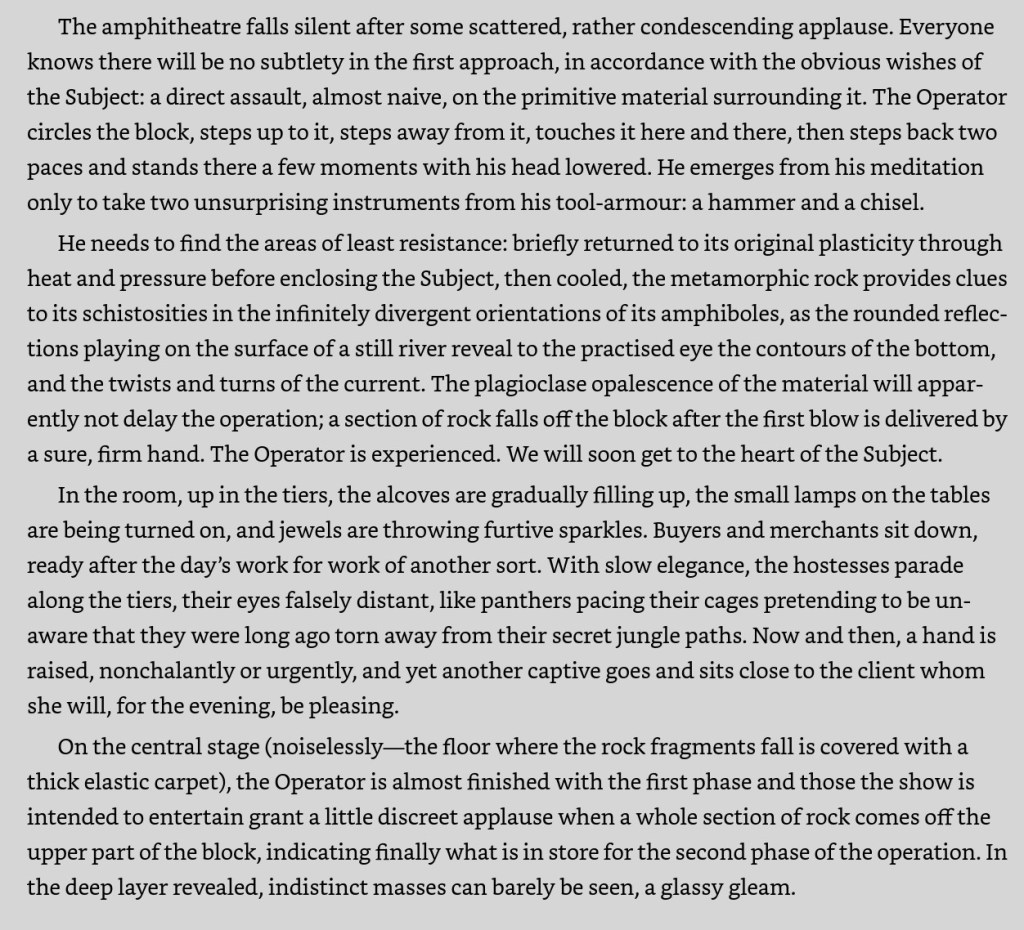
One major difference between the two stories is pacing. “Fondly Fahrenheit” relentlessly races, while “Readers of the Lost Art” trods at a casual nonchalant. That’s an arty way of being aristocratically indifferent, which I think the story intended, but I also think it hurt its presentation. The story is one long, evenly paced, description of a performance piece, with side glances to events in the audience. I was actually more intrigued by those glimpses at the watchers of the performance.
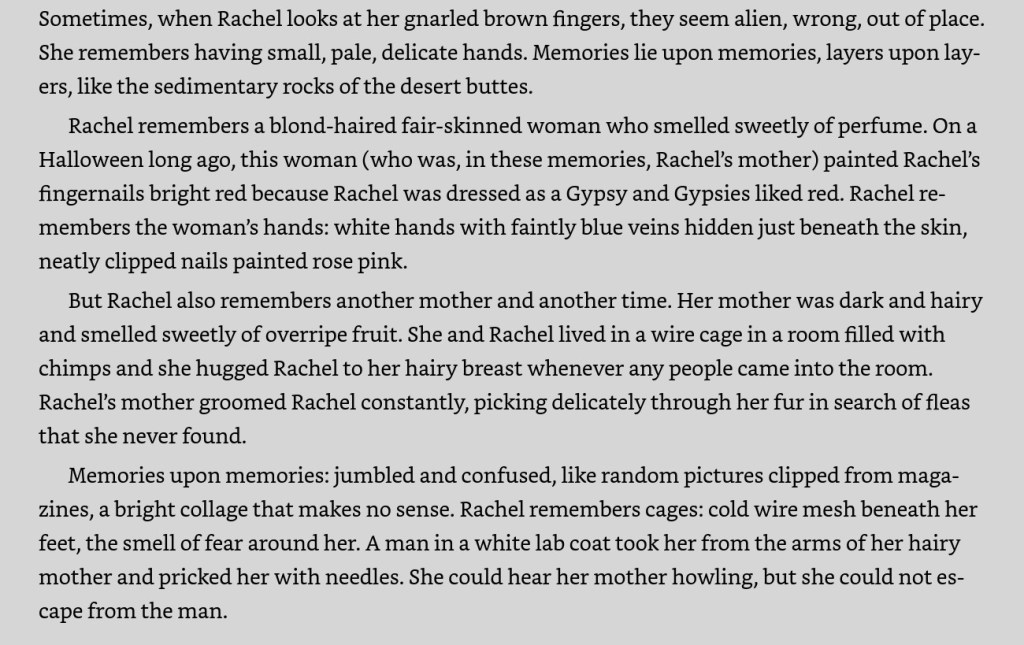
Notice the even paragraphs, the careful, but the plodding pace of the descriptions.
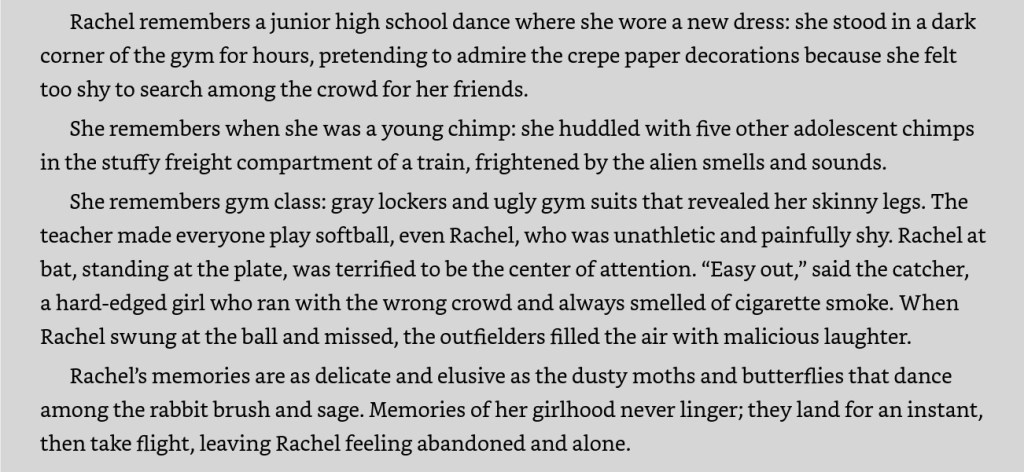
Now, look at a similar page from “Fondly Fahrenheit.” This is actually one of the slower sections of the story, yet murder and a change of planets happen on this Kindle page. But also, Bester tells more about the characters and moves the story along better with each sentence.
It’s not that “Readers of the Lost Art” is badly written, but it’s overly descriptive. It’s Henry James to Bester’s Ernest Hemingway. And that is an artistic choice. But was it the right choice for a story about humans being skinned alive? If you’re writing about shocking scenes, shouldn’t the sentence structure shock too?
Story #80 of 107: “The Owl of Bear Island” by Jon Bing
This 1986 tale by Norwegian writer Jon Bing makes me wonder if he intended it to be cyberpunk. Computers play a significant role in “The Owl of Bear Island,” a story about alien possession. To be honest, I thought the VanderMeers’ introduction to the story more interesting than the story itself. And within the story, I got distracted by wondering what kind of computers they might have had in 1986. I assume the scientists were using minicomputers. I began wondering about DEC, Data General, HP, and others from that era, and thinking of one of my favorite books, The Soul of a New Machine by Tracy Kidder. Bing also brings up programming (FORTRAN and SIMULA), AI, and Expert Systems. In fact, the narrator’s escape plans involve computers.
This plain story about two scientists at a research station on an island in the Arctic being taken over by an alien presence could have been much better. The unnamed first-person narrator thinks of the alien as an owl. He assumes it killed his partner, and he knows enough to struggle to free his mind. “The Owl of Bear Island” has neither suspense, atmosphere, or dread, but is its matter-of-fact style due to the style being lost in the translation, or was the original writing just that straightforward? I don’t know.
Also, I began to think of the problem of remotely operating another being over the distances of light-years. Is telepathy instantaneous? Or was Bing suggesting the alien was on the island with them? Either way, we might call this story horror cyberpunk. It would have been a creepier story if we learned about the possession as it unfolded. Think of the drama of slowly realizing that your choices aren’t your own, especially while living alone far from civilization, during the dark days of the arctic.
Bing’s narrator just comes out and tells us what happened, and then later, just tells us his plans for escape. Good storytelling involves leading us along as events unfold. This story should have been a chess game between a human and an alien. Instead, it’s a quick journal report.
Story #79 of 107: “The Unmistakable Smell of Wood Violets” by Angélica Gorodischer
I’ve been getting behind in my reviews of the stories in The Big Book of Science Fiction. The discussion group is now on story 81. I don’t want to flame out on this project, now that I’m getting so close to the end. But I’ve also been worrying about publishing too much and not having enough worthy things to say about these stories. Once this project is over I’m not going to commit to reviewing large anthologies story by story. I think reporting on reading stories of quality will be more important than reporting on reading in quantity.
“The Unmistakable Smell of Wood Violets” by Angélica Gorodischer, which was first published in 1985, is a well-written, and quite charming story about a global civilization that has grown up after the fall of our global civilization. For example, the 79 Independent States of North America have only become recently reunited, under an aged bit-part video actor named Jack Jackson-Franklin. The U.S.A. is now a third-world country.
The story setup follows worldwide gossip about a transsexual woman astronaut living in Rosario, a former territory of Argentina, who will fly an ancient preserved spaceship to the edge of the universe.
We are told in this new civilization gun-powder no longer exists but magic does work. That Rosario is so poor that its citizens had to go in together to buy a clock, one of two in the country. The spaceship launched at 5:45am and returned at 6:11am the same day.
The person who is most interested in this news is Her Gracious and Most Illustrious Virgin Majesty Ekaterina V, Empress of Holy Russia. Most of the charm of this story comes from describing the new political orders around the world.
Gorodischer’s prose reminds me of a Bob Dylan song, “Desolation Row” and vaguely remembered hippie novels from the 1960s.
This story is told almost like a fable, a fantasy. I encounter that voice often in translated stories. I wonder if it’s a popular narrative style in South America? Here is the astronaut’s report of what the edge of the universe was like.
For some reason, time dilation worked backward in this story, and the astronaut aged on her 26-minute voyage, rather than the people on Earth. The unnamed astronaut marries and has a son, and when he’s born a green shoot grew out of the ground. I’m not sure what this signifies, other than it’s a sign of renewal in nature.
Angélica Gorodischer gives us another perspective on science fiction. I can see why the VanderMeers liked this story. However, I wonder if it’s not anti-SciFi? It feels like a naturalist or humanist take on the absurdity of the hubris of science fiction.
Story #78 of 107: “The Lake Was Full of Artificial Things” by Karen Joy Fowler
This is my third time reading “The Lake Was Full of Artificial Things” by Karen Joy Fowler, first published in the October 1985 issue of Asimov’s Science Fiction. It’s another science fiction story about memory, so it’s interesting to compare it with our last story, “Snow” by John Crowley. In that story, a man remembers his dead wife, in this story, a woman remembers her dead boyfriend. We should make a list of all the ways science fiction is used to play with memory.
In 1970, Miranda dumps Daniel a boyfriend she’s in love with because he’s being drafted. He dies in the Vietnam War two years later, and for thirty years Miranda has felt guilty. Especially, because she intentionally broke up with Daniel because she feared what the war could do to him.
The story takes place after Miranda is a grown woman, and her son is older than Daniel when he died. She goes to an experimental therapist, Dr. Anna Matsui, who uses induced lucid dreaming to get her patients to confront their inner demons.
I’ve been obsessed with memory my whole life, and even more so since I’ve become old my memory has begun to fail. When I was young I used to play around with lucid dreaming. So this story resonates with me strongly.
Miranda meets Daniel in her dreams twice under the control of Dr. Matsui. The first time is a satisfactory encounter according to Dr. Matsui, and she wants it to be the only dream session. Daniel had forgiven Miranda, and that was enough to work with Miranda in regular therapy. However, Miranda begs to go again, but things go badly. Dr. Matsui refuses to put Miranda under again. Up till now, the dreams are based on how Miranda remembers Daniel, from their time at college.
However, Miranda induces her own lucid dream at home, and she meets Daniel at Camp Pendleton, and they argue even more. This time Daniel tells her how he killed a young boy thinking the boy had a hand grenade but didn’t. These are experiences that Miranda could have never known. We have to wonder is she learning something real, or if this is her mind playing tricks on her?
Her final dream with Daniel happens in Vietnam, and Miranda tries to keep Daniel from killing the boy and getting killed himself. Everything is realistic, and Miranda is experiencing things beyond her imagination. This time she tries to stay with Daniel as she sees a bomb fall from the sky, but Daniel tells her to go. He tells her he never wanted that. While she pulls away from the scene she sees Daniel and other soldiers die.
I spotted something different this reading. At one point Daniel tells Miranda she could never know what it was like to have the draft hanging over her head, or getting a low number in the draft lottery because of her birthday. This time I wondered if Karen Joy Fowler is writing the story for all women who felt guilty about not going to war in Vietnam. The two times I read the story before, I saw it only as Miranda’s personal story. But now I wonder if Miranda is all of us who didn’t go to Vietnam. That makes it a much more powerful story.
Why did Alfred Bester write “5,271,009?” Is it merely a wild story, or does Bester have something to say? To rant? Sometimes, when I read old science fiction stories I wonder if science fiction writers weren’t satirizing science fiction and if that’s the case with “5,271,009.”
Now, I’m not sure if Boucher and McComas aren’t misleading us, or misreading Bester’s story. I’ve never considered science fiction “pap for paranoids,” or that it’s read by people seeking stories that will free them from their responsibilities. “5,271,009” is one wild ride that begs to be explained.
The editors think the story is Bester’s reply to the critics of science fiction fans. I wonder if Bester isn’t criticizing science fiction too. That it’s a hyperkinetic parody of science fiction. I absolutely crave to hear this story read by a narrator that could do it justice, but the only readers I can imagine reading this story as Bester wrote it are dead. I picture either Robin Williams or Jonathan Winters reading it in their most manic moods.
Alfred Bester was only a part-time science fiction writer. He was also a magazine editor, scriptwriter for radio and television, and scripted comic books. In his introduction below, you can tell Bester has a real life. The over-the-top plot of “5,271,009” reminds me of comic books more than it does science fiction. In the 1950s science fiction was considered crapola-lit for geeky adolescent males, but comic books had even a worse reputation, fit only for the subliterate. Science fiction claimed to teach some science but it was damn little, but comics had no claim to redemption.
Actually, I wonder in “5,271,009” if Alfred Bester isn’t doing something like William Shanter did in the famous “Get a Life” skit on SNL. In the story, Mr. Solon Aquila is described as being two parts Beelzebub, two of Israfel, one of Monte Cristo, one of Cyrano, and mix violently. I believe Mr. Solon Aquila is Bester, Jeffrey Halsyon is either the science fiction genre, or the stand-in for all science fiction fans, or both. Just to give you a taste of Bester’s prose and the sound of Aquila:
Is Aquila just an over-the-top character, or is he a bit more?
This time when I read “5,271,009” I had an introduction by Bester to give me more clues. This copy is from Starlight: The Great Short Fiction of Alfred Bester which reprints a 2-volume collection from 1976.
We learn that “5,271,009” was written on assignment to fictionalize the cover artwork. Bester thought the art was obvious camp, and at first didn’t want to take on the project. He felt the story would have to be mad camp. I’ve been seeing that cover since the 1970s and I’ve never once considered it mad camp. Have you? I love the covers on F&SF, especially the ones from the 1950s. If I had to describe what was happening on the cover, I would say a convict was left to die out in space and given enough air to make it torture. But then, that might be exactly what Bester is making fun of.
Of course, we know what the writer imagines doesn’t have to be what the reader reimagines. The basic setup for “5,271,009” is Jeffrey Halsyon, an artist who has gone insane and has quit painting. Solon Aquila is a collector of Halsyon’s work wants him cured so he’ll return to painting. How that’s achieved is a story that feels like a collaboration by Robert Sheckley, Philip K. Dick, and Douglas Adams. But then, this is 1954, and well before those writers showed us just how far out science fiction could get.
It’s interesting that Solon Aquila takes on the job of curing Jeffrey Halsyon. And doesn’t the name Halsyon sound like halcyon? One definition of halcyon is “Often used to describe an idyllic time in the past that is remembered as better than today.” Another confession, that’s exactly how I look back on old science fiction.
Aquila drugs Halsyon and puts him through a series of hallucinations where Halsyon plays out adolescent fantasies often found in science fiction stories, and the number 5,271,009 shows up again and again in these fantasies. The first is a sex fantasy:
Of course, like stories about three wishes, this fantasy breaks apart when Halsyon is told all the women hate him and consider his duty rape. The next hallucination involves the space adventure pictured on the cover of F&SF. Bester is suggesting that science fiction fans imagine themselves as this kind of hero.
In each fantasy, Judith shows up. She is the fantasy girlfriend of all science fiction fans. After Jeffrey makes his escape he is the vile anti-hero that is blamed for the alien invasion by the Grssh. But at the last minute, Halsyon saves the planet. But that fantasy doesn’t work out either.
His next fantasy is my favorite, one I’ve often entertained in my daydreaming, and the plot of favorite stories. Jeffrey returns to being his 10-year old self but retains his 33-year-old mind.
But damn, this fantasy crashes and burns too. The next fantasy is most unpleasant, where Jeffery is in a time loop, like a bad Groundhog Day. Bester makes allusions to Shakespeare and Dante. Slowly, he’s bringing the story around to a meaningful message.
Next up, is another favorite science fiction fantasy I love to daydream about, being the last man on Earth. By the way, I just read Bester’s story, “They Don’t Make Life Like They Used To” which uses the same fantasy. In both cases, Bester or Mr. Aquila ruins the fantasy.
Finally, Jeffrey Halsyon escapes the fantasies, or so he thinks and confronts Mr. Aquila.
The answer to that question is 5,271,009. Halsyon is not out of the nightmare yet, he still has millions to go.
The ending is very much like the red pill-blue pill of The Matrix. But the choice isn’t between living in reality or living in fantasy. Instead, it’s much like Hindu or Buddhist philosophy. We evolve through many lives of reincarnation. We can grow faster if we live hard lives. Yeah, it’s that old what doesn’t kill us that makes us stronger.
Now, is this just a neat story that Alfred Bester wrote for Boucher and McComas? Or is it Bester telling science fiction, or science fiction fans, “Get a life!” To be more precise to the story, “Grow up!”
We can learn quite a bit about writing from reading “Snow” by John Crowley. It’s a lovely story that most readers admire. Understanding why reveals those writing lessons. You can read/listen to the story here.
The setup is simple. Beautiful blonde Georgie marries a rich man who buys her everything, including a “wasp” that follows her filming 8,000 hours of her life. The film is destined for a funeral memorial, so it’s a rather odd gift. The rich man dies, Georgie becomes rich, marries Charlie for his looks, and eventually dies herself. Charlie loves Georgie, misses her, and after two years of grieving goes to the cemetery to see the films the wasp took. However, things don’t work out like he thought they would.
First, “Snow” zeroes in on everyone’s deep-rooted feelings for departed loved ones. This has nothing to do with science fiction. William Faulkner said in his 1950 Nobel Prize acceptance speech “…problems of the human heart in conflict with itself which alone can make good writing…” is exactly why “Snow” works.
In Kurt Vonnegut’s Rules for Writing, he advises “Be a sadist. No matter how sweet and innocent your leading characters, make awful things happen to them, in order that the reader may see what they are made of.” What really makes “Snow” work as a story is all the ways the “wasp” fails to work with Charlie’s expectations. Or even to what we readers want and expect. But more than that, chasing memories causes Charlie to learn through the slow suffering of aging, desire, and looking backward.
I expected Charlie would go to the cemetery and request to see certain days that he fondly remembered being with Georgie. That’s what he expected too. But the wasp system didn’t work that way. There are two buttons: Access and Reset. The first shows one scene, randomly. Reset shows another random scene. Charlie goes to the caretaker disappointed. He learns the recording technology used by the wasp is at the molecular level so they can squeeze in 8,000 hours of film, but there is no ordering and no time/date stamps. Just momentary glimpses from the past.
Charlie keeps coming back, addicted to those random scenes, learning about himself and Georgie. Eventually, Charlie notices that the memory clips are fading over time, turning snowy. He complains to the director, who tells him an interesting story about being a film archivist in his old job for the movie studios. He tells Charlie that in the oldest film clips, people’s faces looked pinched, cars and streets looked black, and things felt wintery.
Charlie never goes back to the cemetery. The last paragraphs are about what Charlie has learned about human memory. He believes there are two kinds, one that worsens over time, and another that can grow more intense.
Charlie is a character we can root for, we can feel and empathize. That’s another of Vonnegut’s rules. His number one rule is, “Use the time of a total stranger in such a way that he or she will not feel the time was wasted.” My time was not wasted. This is the second time I’ve read this story, and both times I felt a powerful sense of resonance with the John Crowley gives us. It made me think about my own life and wants. The time it took to read it produce worthwhile insights for me. “Snow” made me contemplate the nature of memory, recognizing how much our memories are like the memories collected by the wasp. Yet, what I wouldn’t give for a film library of my life.
Vonnegut also says, “Every character should want something, even if it is only a glass of water.” Charlie wants Georgie, either in real life or in memories. This is something everyone feels, so does that make this story more powerful? More powerful than say a story about someone wanting to save Earth from alien invaders? I think it does. I think the most powerful science fiction stories are the ones that make us think about people. Remember Charlie Gordon? Or Kip Russell?
Another piece of advice from Vonnegut is, “Start as close to the end as possible.” Crowley doesn’t spend any time when Georgie was alive. He gets right to the heart of the story and only spends a bit over six thousand words in storytelling. I think that’s another plus for this story. Short, sweet, and POW! That’s why Bob Shaw’s “Light of Other Days” was so effective.
Finally, and this is the hardest to judge, “Every sentence must do one of two things—reveal character or advance the action,” but I believe Crowley adhered to this advice very well indeed. In the end, Charlie says, “I wanted to go, get out, not look back. I would not stay watching until there was only snow.” One for action, one to tell us all about Charlie.
I’ve read over a thousand science fiction short stories in the last three years and I’ve decided I have an anthology problem. This is different from the anthology problem Szymon Szott solved for me in “The SF Anthology Problem – Solved.” No, my current problem is finding anthologies with a higher percentage of great stories to read.
I and other members of our science fiction short story reading group never can find anthologies where we love all the stories. Of course, that’s asking too much from editors but we still crave 24k carat gold anthologies. Even the Gold Standard of science fiction anthologies, volume one of The Science Fiction Hall of Fame had stories I didn’t enjoy (“The Weapon Shop”) and it was created by polling science fiction writers for their all-time favorite stories.
One of our members, Austin Beeman, has a useful website that reviews science fiction anthologies. He has a nifty infographic that measures the percentage of great/good/average/poor/DNF stories. Here’s his chart for The Hugo Winners: Volume One. Austin considers it has a 94% positive rating, but then that’s for a book of all award-winning stories. Austin tends to be generous by including stories he rates Good in that figure. I wouldn’t.
Most science fiction anthologies never get anywhere near that percentage of good and great stories. Why?
I just finished reading The Great SF Stories 25 (1963) edited by Isaac Asimov and Martin H. Greenberg. Even though I enjoyed most of the stories to varying degrees, I thought only 5 of the 13 were worth my time.
And isn’t time the essential yardstick here? I only have so much time for reading. I only have so many years left in life. And the number of books I want to read will take more time than I have left. From a different time perspective, many of these stories are supposed to be the best of one year, and often the anthologies I read are assumed to be the best of all time.
There is the problem that some stories are extremely time-worthy to some members of our group, while other members complain those same stories were a waste of their time. I’m realistic enough to know that no editor can ever satisfy every reader one hundred percent, but I believe there are stories that a good majority of readers will admire. Is it possible for editors to pick more of them?
I’ve known many people who say they don’t read science fiction magazines because they don’t find enough good stories in each issue. And I think that’s true. Magazines have the lowest hit rate. And now that most of the print magazines are bi-monthly, they are fat with stories, but instead of feeling I’m getting my money’s worth, it just makes me hesitant to start reading because I dread all the disappointing stories.
Many old-timers complain that the print magazines aren’t fairly represented at award time or in the best-of-the-year anthologies, but is that actually true? I tend to only read online stories when someone recommends a story, and that makes me avoid the filler stories. But also, if I was a writer, I think I’d prefer to have my stories online so they were easy to be read. I generally only read stories published online when they are anthologized by best-of-the-year volumes, so that makes me think online publishers have a higher hit rate. I don’t know if that’s true.
Original anthologies often do much better than magazines, probably because they pay more. You can tell their hit rate by how many of their stories get anthologized in the best-of-the-year volumes.
For the annual best-of-the-year volumes, our group has found that the success rate depends on the editor. But I also think size matters. Gardner Dozois’ giant yearly anthologies with over thirty stories often had more hits in them than his competitors with fewer pages. But his percentage of hits was probably lower.
To be honest, some of Dozois’ competitors mixed fantasy with science fiction, and for me, that automatically lowers the hit rate. Could the success rate of an anthology depend on the type of story?
Our group is currently reading the gigantic anthology The Big Book of Science Fiction and it has many stories generally loved, as well as many stories generally disliked. We were considering four other giant 21st century SF anthologies that look back on the 20th century but I doubt we’ll vote to read them as a group. Some of our members have promised to read and review them on their own and let us all know.
Again, I think size is a factor. If these giant retrospective volumes had been smaller, they might have forced their editors to be pickier about what they anthologized. I have many giant science fiction anthologies on my shelves, and I’m becoming leery of reading them. I think somewhat smaller retrospective anthologies like The World Turned Upside Down edited by David Drake, Eric Flint, and Jim Baen, and Masterpieces edited by Orson Scott Card are much more solid with hits. I’m more likely to buy that size anthology in the future.
Theme anthologies are a bit different. I’m more forgiving. I still expect good stories, but I don’t expect great stories simply because I’m reading to be entertained by how an idea is used.
Giant anthologies are great for writers because more stories are preserved and given a chance to find readers. Yet, is such noble efforts fair to readers? Few readers want to be slush pile readers.
That suggests another possibility. I do think too many stories are being published each year, but what if it’s a theme distribution issue? Allan Kaster has switched from general best-of-the-year SF anthologies to best-of-the-year theme volumes. The Year’s Top Hard Science Fiction Stories and The Year’s Top Robot and AI Stories might be the solution. This opens up a whole new avenue for editors, and maybe readers.
I guess what I want is retrospective science fiction anthologies aimed at science fiction fans who came of age in the 1960s who don’t like fantasy and who are somewhat nostalgic for 1950s science fiction. However, I am willing to try new things. Rich Horton gave our group a list of stories he liked best among the two decades of stories he reviewed for Locus Magazine. I’d buy them as an anthology, even though many of them were fantasy stories. I don’t entirely live in the past, or focus exclusively on SF. And I hope our group finds more anthologies that cover contemporary SF/F to read. I just wished they weren’t too big and had mostly great stories.
The reality is no anthology is going to be perfect, except for the editor who assembled it. Subjective tastes vary. But as readers, I think we all love it when we can find an anthology that has a high percentage of stories that wow us. And I assume editors love it when they create an anthology that gets praise for having a lot of great stories. Perfect anthologies are impossible, but I think we all hope to find them.
Isaac Asimov died on April 6, 1992. The Great SF Stories 25 (1963) was published in July 1992 and was the last volume in the series. On the last page Greenberg let us know:
I had assumed all along that Martin H. Greenberg (who died June 25, 2011) had been doing most of the editorial work for The Great SF Stories series, but felt that hunch confirmed when Isaac Asimov’s introductory comments went missing from volumes 24 and 25. I’ve now read volumes 1-18 and 25. I love this series. I read volume 25 out of order because my short story discussion group voted to group read it after Christmas.
This series has always been unique because Asimov and Greenberg were reevaluating the best stories of the year with many decades of hindsight. Here are the stories they picked as the best of 1963 from 1992:
Back in 1964, Judith Merril picked these stories as her favorites for 1963:
For some reason, Merril included “A Rose for Ecclesiastes” in her 10th Annual in 1965.
In 2022 the Classics of Science Fiction Short Stories list remembers 41 titles from 1963 in its database, but here are the stories that got at least two citations. 1963 wasn’t a remarkable year, especially since it takes eight citations to get on the final list. Meaning, only “A Rose for Ecclesiastes” is really remembered today.
After all these years, “A Rose for Ecclesiastes” is the obvious best SF story for 1963, and the one most remembered. Most science fiction fans discover it today in The Science Fiction Hall of Fame v1. “They Don’t Make Life Like They Use To” is another favorite, but it’s mostly forgotten in 2022, as is “New Folks’ Home.” “No Truce With Kings” won the Hugo for short fiction that year but I just don’t think it holds up or is remembered, even though the ideas within it are interesting. The more remembered Poul Anderson story should be “The Man Who Came Early.” The surprise story is “Turn Off the Sky” by Ray Nelson, however, it will probably only appeal to fans of the Beat writers.
I doubt many of these stories will get reprinted in the future. It’s a shame that The Great SF Stories 1-25 (1939-1963) hasn’t stayed in print. They are becoming collector items and can be a bit expensive to collect. Scans were available on the internet, but they’ve been taken down from the obvious places.
Below are my stories notes for the group discussion:
Story 01 of 13 – “Fortress Ship” by Fred Saberhagen If Magazine (January 1963) Retitled for collections as “Without a Thought” 1st story in the Berserker series
In not a very auspicious beginning to the Berserker series, “Fortress Ship” introduces us to the idea of alien intelligent robotic spaceships programmed to destroy all life in the galaxy — a doomsday weapon. This story was interesting because it proposed programming a game of checkers with boxes of colored beads and a set of cards for specific moves. The first computer checker game was in 1952. I wonder if Saberhagen knew about computers? The Berserker series is about AI minds, but I don’t know if that concept was known in 1963.
In “Fortress Ship” a Berserker ship the size of New Jersey is destroyed by three small human spaceships. I haven’t read the series, but I bet Saberhagen made it more difficult in later stories. Berserker minds understand human minds and can use our languages. I’ve read on Wikipedia that other alien species also fight the Berserkers. I’d like to read more in this series.
Rating: ***
Story 02 of 13 – “Not in the Literature” by Christopher Anvil Analog (March 1963)
Anvil imagines a world where people haven’t discovered electricity but are still trying to orbit a satellite. Not sure if the story takes place on an alternative history Earth or on another planet. But at the beginning of the story, the attack of a wasp-like creature called a drill on Alarik Kade suggested another world to me. On first reading, I thought the drill was some kind of assassin’s drone device. Rereading it makes me think it was only some kind of insect. That means it could be an alternate Earth story I suppose, where a wasp is called a drill.
I found the whole beginning of the story odd. It was a kind of slapstick physical comedy. It doesn’t match the tone in the second part of the story.
I assume Asimov and Greenberg liked this one because of the chemical-engineered world that couldn’t conceive of electricity. And that’s a neat idea. Especially trying to imagine how they could build a rocket with telemetry without electricity. On the other hand, the storytelling was disjointed at best.
Rating: ***+
Story 03 of 13 – “The Totally Rich” – John Brunner Wor
The setup for “The Totally Rich” reminded me slightly of “Vintage Season” or “Sailing to Byzantium” with Brunner imagining a class of rich people who live undetected by us ordinary folks. It reminded me of those classic stories because of the elite vacationers in time, and the elite far future citizens who party at one recreated city after another, are like the elite rich in this story, who can have nearly anything they want.
Derek Cooper is tricked by Naomi, one of the elusive rich in Brunner’s story. She’s had a whole picturesque village built with actors playing all the citizens just to fool Derek into working for her. That’s the power of her wealth. But she wants something impossible, something her money can’t even buy. She hopes Derek, given enough time and money can invent what she needs.
This is a great setup for a science fiction story. I thought it was going to be at least a 4-star story. But then, Brunner doesn’t satisfy my expectations, leaving me with a 3-star story.
I tend to think it would have taken a full novel to play out the idea Brunner began, and he didn’t want to do that. The quick tragic ending just didn’t work for me.
Rating: ***+
Story 04 of 13 – “No Truce With Kings” – Poul Anderson F&SF (June 1963) (Hugo Award – Best Short Fiction)
I was really looking forward to reading “No Truce With Kings” after enjoying Anderson’s “The Man Who Came Early” so much a couple weeks ago. Plus, Kings had won a Hugo, even though I find it impossible to believe it beat “A Rose for Ecclesiastes.”
Unfortunately, my expectations were misplaced. “No Truce with Kings” is too long, too muddled, and just too damn political. Did Poul Anderson really believe humans were better off living under feudal societies? Did he really want to downsize the government that much?
I thought “No Truce With Kings” was murky because I never could picture the battles, or even know which side to sympathize with. I wanted to side with the aliens, the nation builders, and even the feudalists.
If anything, this story made me feel humans are too stupid to deserve to survive. It glorifies war in the worst ways.
On the other hand, there’s lots of good writing in this story.
Rating: ***
Story 05 of 13 – “New Folks’ Home” – Clifford D. Simak Analog (July 1963)
“New Folks’ Home” is a lovely little tale that reminds me of WAY STATION, another Simak story about a human serving as a contact on Earth for an alien interstellar community. I identified with Frederick Gray because I’m seventy. It’s interesting that Simak was only 59 when he wrote this story. I guess it was his fantasy for old age.
Rating: ****+
Story 06 of 13 – “The Faces Outside” – Bruce McAllister If (July 1963)
Odd story about humans kept in a giant aquarium. As I read it I thought it would be a story that would fit in the VanderMeer anthology. Then I noticed that Merril had included it in her 9th Annual, which reinforces that thought. Not my cuppa tea.
Rating: ***
Story 07 of 13 – “Hot Planet” – Hal Clement Galaxy (August 1963)
“Hot Planet” by Hal Clement reminded me of “Brightside Crossing” by Alan E. Nourse, another hard SF story about surviving on Mercury. Both stories have been invalidated by time and newer science, but both still present good old fashion science fiction adventure.
What was significant about “Hot Planet” was Clement’s use of women scientists.
Rating: ***+
Story 08 of 13 – “The Pain Peddlers” – Robert Silverberg Galaxy (August 1963) (2nd story from this issue)
Silverberg’s writing in “The Pain Peddlers” is what I consider great hack writing. He’s obviously mastered the technique of writing short stories for the pulp/digest markets. This isn’t a great story, but it’s very readable and competently entertaining, and a solid addition to the magazine, even a worthy entry for an anthology, but to be honest, not one that will be remembered.
Rating: ***+
Story 09 of 13 – “Turn Off the Sky” – Ray Nelson F&SF (August 1963)
Wikipedia says Nelson was the guy who invented the propeller beany as a symbol for science fiction fans. It also says he gave LSD to Philip K. Dick. The F&SF intro said he was working on a book about beatniks in Chicago. I’d like to read that.
“Turn Off the Sky” was quite an interesting read, especially if it was written four years before it was published. Mainly for the satire on radicals and beatniks. It appears to be pro-capitalist, but I’m not sure. I thought it funny with its quip about arguing over Marx and Robert Heinlein.
The story was readable and fun, but it was more impressive in its dealing with the 1950s subculture, especially, anticipating a lot of stuff that happened in the 1960s counter-culture. It even has a sitar being played years before George Harrison made it famous.
Rating: ****
Story 10 of 13 – “They Don’t Make Life Like They Used To” by Alfred Bester F&SF (October 1963)
Linda Nielsen thinks she’s the last person on Earth. Like Ralph Burton, played by Harry Belafonte in the 1959 film THE WORLD, THE FLESH, AND THE DEVIL, Linda is fixing up her apartment by taking whatever she wants from a deserted New York City. I mention this movie because it’s a favorite movie and I pictured it as I read “They Don’t Make Life Like They Use To.” I love the last person on Earth stories. My all-time favorite novel is this type is EARTH ABIDES by George R. Stewart.
However, I’ve always thought it would be neat if the last person on Earth was actually the last person, but in these stories, someone else always shows up. In the movie, it was Sarah Crandall, played by Ingar Stevens. Since Bester describes Linda as Nordic, I wondered if he saw the movie with the Nordic Stevens and decided to just start with a blonde. Also, in the last people on Earth stories, the second person is generally of the opposite sex, so the plot develops sexual tension. In a number of these stories, a third person shows up. Usually, it’s two males fighting over one female. Another movie example of this is THE QUIET EARTH (1985).
Bester brings about an interesting twist in the end that finally convinces Jim Mayo and Linda Nielsen to get it on. This satisfies us readers who have been waiting for that action, but it wraps up the story too quickly, at least for me.
Rating: ****+
However, the ending reminds me of another last Adam and Eve story, “Quietus” by Ross Rocklynne. It’s in THE WORLD TURNED UPSIDE DOWN. Read it here:
Story 11 of 13 – “Bernie the Faust” – William Tenn Playboy (November 1963)
“Bernie the Faust” captures a certain time and place in New York City that I’ve only learned about indirectly from plays, movies, and books. It reminds me of stories about Seventh Avenue such as I CAN GET IT FOR YOU WHOLESALE, and makes me wonder if Willian Tenn was intentionally trying to create Jewish humor science fiction?
“Bernie the Faust” has a kind of funniness that needs to be acted out in a play or episode of the old TWILIGHT ZONE, or at least heard in an audiobook.
Rating: ***+
My favorite book by Tenn is OF MEN AND MONSTERS, which isn’t humorous. It’s a wonderful adventure tale that if you haven’t read, please don’t read about, not even the blurbs on the book cover. Everyone gives too much away.
Story 12 of 13 – “A Rose for Ecclesiastes” – Roger Zelazny F&SF (November 1963)
I’ve forgotten how many times I’ve read “A Rose for Ecclesiastes” over the past fifty years. I wish I could find the words to explain how much I admire this tale. This time as I read the story, I was noticing how effective Zelazny was using short and medium-length sentences to convey information but imply a great deal more. My own prose is too verbose. Zelazny isn’t Shakespeare, or even particularly literary, but he moves the story along without wasting words.
Rating: *****
Story 13 of 13 – “If There Were No Benny Cemoli” – Philip K. Dick Galaxy (December 1963)
As I read this story, I marveled that Philip K. Dick even imagined this story. What a creative mind. Earth has been through an atomic war. Human colonists from Mars have returned to rebuild civilization, but their work is interrupted by another faction of human colonists from Proxima Centauri returning to Earth to rebuild civilization. There is political strife between the two groups. A neat invention in this story is a kind of AI that produces The New York Times. It seems to know everything going on in the world and influences the rebuilding of civilization.
One of my favorite science-fictional settings is when explorers find a planet with an ancient long-dead civilization. This is the setting for “Pots” by C. J. Cherryh. “Pots” also deals with another favorite science-fictional theme, the generation ship.
Cherryh’s story is long and moody, but it could have been just a flash fiction gimmick because the central idea is very simple. Usually, I have spoilers in these discussions because these pieces are my response to our group reading. However, with this story, I won’t give it away.
There are lots to like about this story. The characters are very ancient. Between cloning and the time dilation of relativity, Dr. Gothon’s life spanned over a quarter of a million years. This is one generation ship story where the characters remember their mission, and some of them even remember the start of the mission.
On the other hand, the O’Henry ending of this story is both neat and a groaner. I saw it coming. I’m never happy when a writer intentionally withholds information from me. And I don’t know if the story would have been significantly different if we knew everything right from the start.
Nor am I happy with the explanation for the conflict. I saw no reason to suppress the truth. I think “Pots” would have been a much more effective and moving story if everyone learned the truth on page one, and then have the story unfold about how it changed the different characters. That would have eliminated an exciting action scene, but so what.
I’m disappointed when science fiction uses B-movie logic to contrive a plot. “Pots” has a lot going for it, the writing, the richness of the worldbuilding, it didn’t need a violent confrontation between two groups to move the story along.
Story #75 of 107: “New Rose Hotel” by William Gibson
“New Rose Hotel” by William Gibson first appeared in the July 1984 issue of Omni Magazine but was overshadowed by Gibson’s novel Neuromancer, which won the Hugo, Nebula, and the PKD awards for that year. Still, the “New Rose Hotel,” is a dazzling piece of writing.
Gibson’s story brings up the importance of writing style in the success of a story. “New Rose Hotel” is all style. Science fiction meets Raymond Chandler high on William Burroughs pretending to be Hunter S. Thompson. The story is not about the plot, but how the story is told.
The plot is your typical noir gangster drama of two tough guys double-crossed by an alluring woman. But instead of stealing money, they steal a brilliant bioengineer in the near future where cutting-edge science is the hottest of commodities. The story is set in Japan, which at the time was a rising economic powerhouse, but also because Gibson loved various Japanese subcultures.
The trouble with style is it can be like cotton candy, tasty but empty. I enjoyed reading “New Rose Hotel” but when I was finished the exquisitely crafted atmosphere left me immediately. I never cared about the narrator, Fox, or Sandii. And, I’m not fond of thrillers. I do like the 1940s and 1950s film noir movies, and I’m a fan of Raymond Chandler’s novels, but that’s because I love the historical details from those times. Gibson’s cyberpunk Japan used to be interesting to me, but over the decades that interest has faded.
This makes me wonder about science fiction settings. Why do some of them endure, and others fade? People love galactic empires. That setting is so well-loved that recent TV series and movies for Foundation, Dune, Star Wars, all have a similar feel. The same is true for interplanetary space operas like The Expanse. For a while, cyberpunk stories had a standard feel and settings, but the popularity of that cyberpunk atmosphere has dissipated. (Or is that just me? Does cyberpunk still have a fanbase?)
I have to admit that I’m partial to certain styles/settings that developed in 1950s science fiction, and they still work for me. Back in the 1980s cyberpunk stood out. It was extremely popular and many writers jumped on its bandwagon. And I assume there are readers who grew up with cyberpunk that still love it, but it’s lost its luster for me. On the other hand, a lot of the technical speculation that came out in the cyberpunk novels are now considered standard background ideas in modern science fiction. We’ve kept the cyber, but not the punk.