Story #101 of 107: “Remnants of the Virago Crypto-System” by Geoffrey Maloney
“Remnants of the Virago Crypto-System” by Geoffrey Maloney is about aliens who have come to the Earth and leave. Their motives are mysterious. They leave behind crypto machines that look like large teletypes that print on ancient-looking paper. In the story, an unnamed narrator travels with his girlfriend who hopes to meet one of the last aliens before they leave. The narrator becomes petty and jealous for being ignored. Ultimately he finds out that his girlfriend has learned about what the aliens have said about us and it’s not very nice, but true.
The mood of this story reminds me of the Strugatsky brother’s novel, Roadside Picnic. The aliens in that story are completely unknowable. In Maloney’s story, we knew the aliens were here and got to know them some, but they and their mission were always a mystery. Back in the 1950s, there were two famous science fiction stories where aliens judged humanity, the film The Day the Earth Stood Still, and the novel Have Space Suit-Will Travel by Robert A. Heinlein. But the theme is reasonably common.
Quite often in science fiction, we hope aliens will save us from ourselves, a Christ-like role. But every so often, science fiction writes about aliens who judge us, an Old Testament God-like role. In this story, the aliens are more like Margaret Mead coming to live with us for a while. At the end of this short story, we learn one question that horrifies the aliens about us. The narrator worries that the aliens will be sending an executioner, but I get the feeling these aliens are more gentle, so they would probably only put up signs – Warning! Insane Creatures.
“Remnants of the Virago Crypto-System” is a nice science fiction story. Not great, but does the job and creates a neat mood. It’s part of a larger work called Tales from the Crypto-System. I’m slightly tempted to try the book, except that it’s too expensive at Amazon, and there is no Kindle edition. A $2.99 Kindle edition might rescue it from obscurity. Infinity Plus gave it a nice review back in 2005. Some of it can be read from Google Books, and I might try more of it when I have time.
I’ve forgotten why, but I was Googling around and found the image above. I was quite taken with it. I did a Google image search and discovered it came from Weird Tales #14 (July-Aug 1952) and the artist was Wally Wood. I know as close to nothing about comics as is possible without knowing anything at all. I have run across some interior illustrations by Wood in Galaxy Science Fiction and admired them too. I’d love to have a big art book of his work.
I know a little bit about EC Comics, mainly from reading about the congressional hearings in the 1950s and the famous book by Fredric Wetherm, Seduction of the Innocent.
Back in 1963, when I was twelve, my grandmother subscribed to four comic books for me for my birthday. I believe they were to Superman, The Justice League of America, Wonder Woman, and The Flash. I read them as I got them, and carefully saved all the issues before my cousins Bobby and Timmy borrowed my complete library of comics. They never returned them. It didn’t bother me. I much preferred reading science fiction. And I forgot about comic books until the 1970s when I discovered underground comics in a headshop. I tried one by Vaughn Bode and another by Robert Crumb.
Over the years I’ve tried comics periodically but never could get into them. This month I’m giving them one more try because of that Wally Wood cover illustration. I went looking for a scan of #14 of Weird Science on the internet because I wanted to read the story that goes with the illustration. Evidently, the copyright holders of EC Comics keep a sharp watch on copyright violators because I couldn’t find a digital scan.
I then went to eBay, ABEbooks, and Amazon looking for a copy and discovered The EC Archives: Weird Science Volume 1 had just been released. The paperback was $18.18 and the Kindle edition was $13.99. It claimed to collect #12–#15 and #5–6. I was all ready to press the buy button when I saw a mention I should try a free 30-day trial version of Comixology. What the hell. I did. I’m going to give comics one more try.
I quickly loaded the Archives on my tablet only to discover #14 looked different.
It took a bit of research but I discovered there was a 1950 series and a 1951 series, and Archives Volume 1 had the 1950 #14. I was disappointed. Back to Google. I eventually found comics.org and this very informative page. From there I learned there was a 1994 Gemstone annual that reprinted the 1951 #14. I found the cheapest copy on eBay and ordered it. The internet is a wonderful tool! I’ve never used comics.org before but it’s as useful as isfdb.org.
While I wait for the Gemstone Weird Science Annual, I’ve been looking at The EC Archives: Weird Science Volume 1. I can’t say I’ve gotten hooked on comics. In fact, I’m somewhat shocked by what I discovered. The stories and art are very — I wanted to say crude but I don’t want to offend people. Is simplistic a better word? Unsophisticated?
I once took a graduate course in the English department on humor, and we were taught there are many levels of sophistication in humor, although I’m not sure the professor claimed any form was superior to another. Chaplin’s slapstick humor might be as brilliant as Shakespeare’s humorous wordplay.
The 1950s science fiction stories Weird Science are similar in ideas to what was being published in the pulps in the 1920s and 1930s. Now I’m not trying to be superior. My favorite kind of science fiction is novels and short stories from the 1950s. They might only be a step up from science fiction in comic books as comic books are a step up in believability over books like Dr. Seuss or Goodnight Moon. I’m not offended when brilliant literary writers complain that science fiction is adolescent, because I agree with them.
At 70, I’m fully aware that my favorite kind of fiction to read in 2022 is as sophisticated as my mind was in high school (1966-1969). I was an English major in college, and I still read the literary classics, but usually only one per year. When I say science fiction that appeared in the science fiction magazines of the 1950s was more sophisticated than the science fiction appearing in the comics or funny papers, or on the big or little screens of that decade, I’m not claiming it was superior. I’m only saying the stories were more complex and richer in detail.
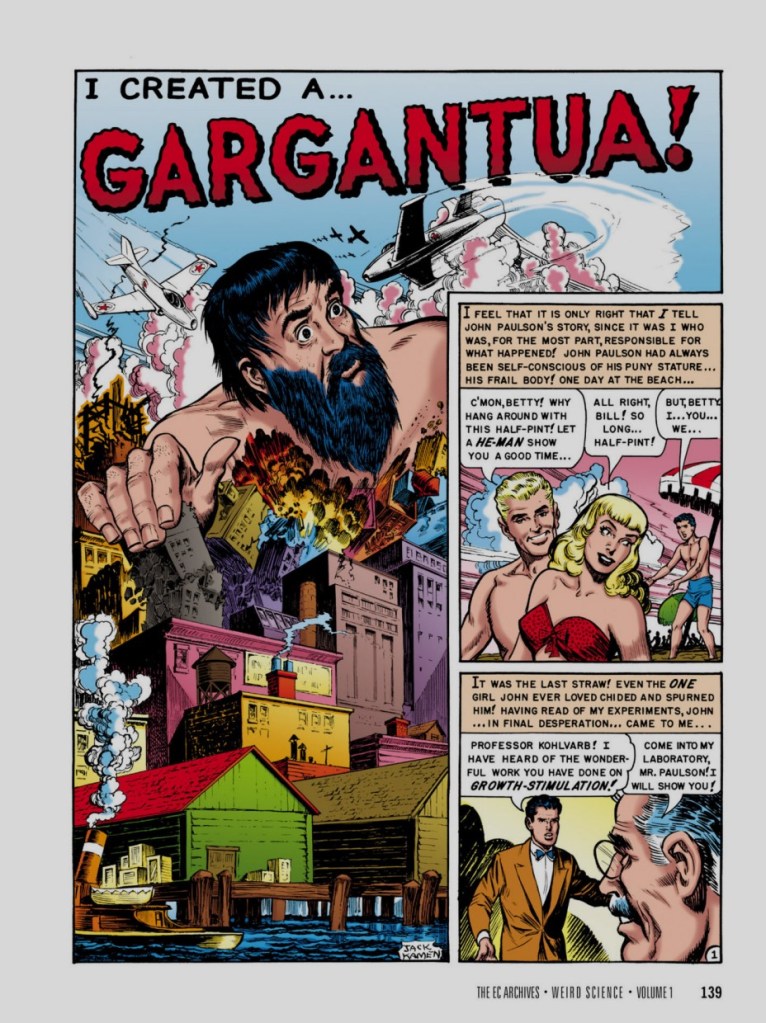
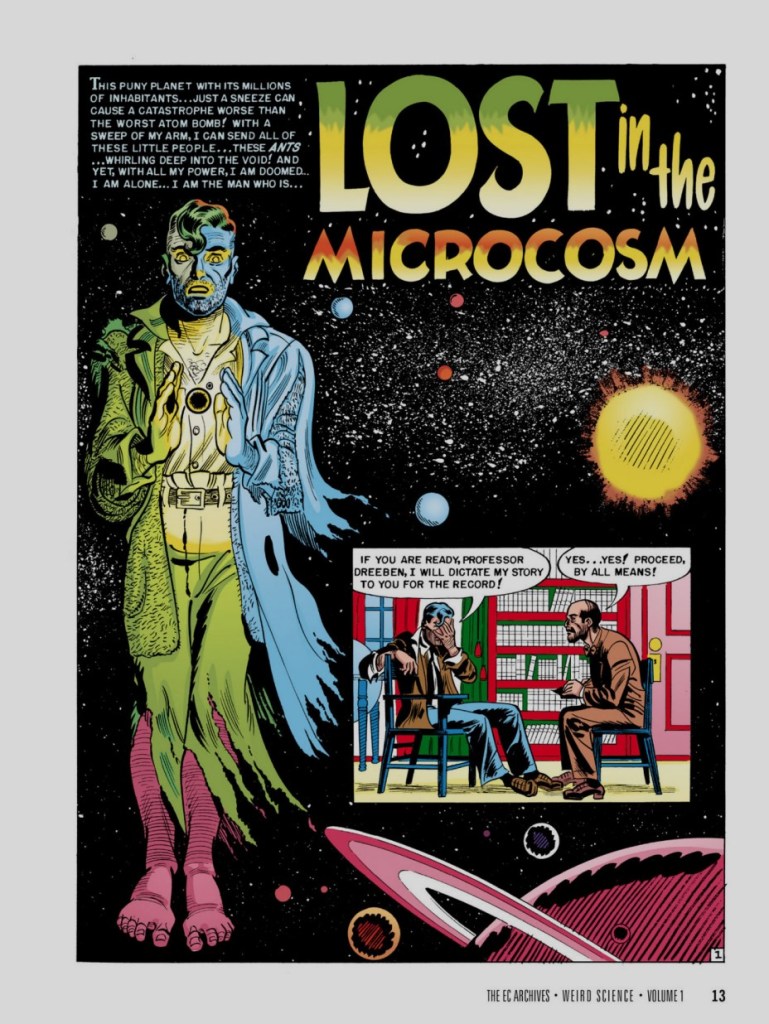
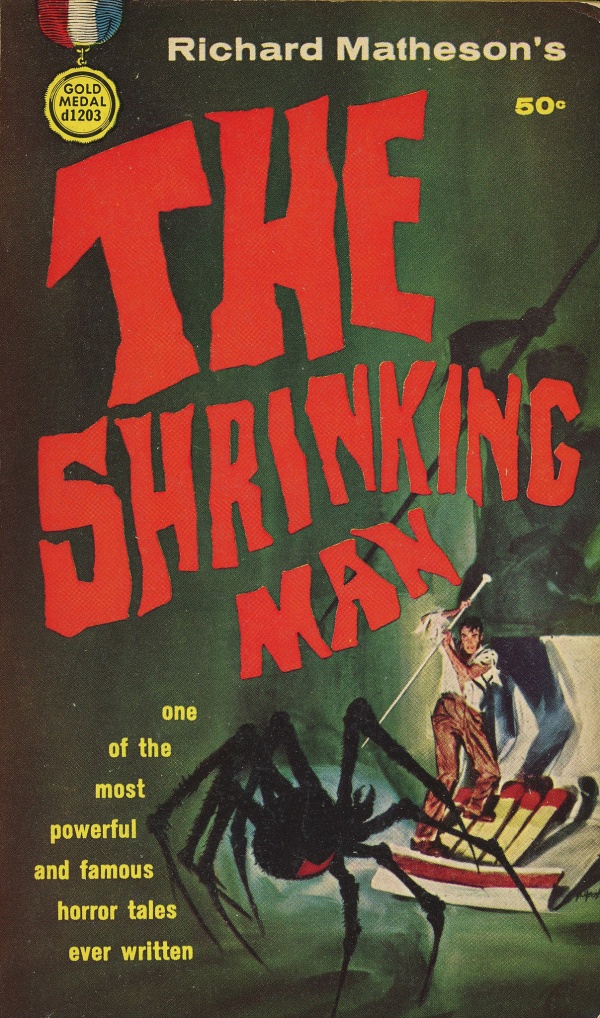
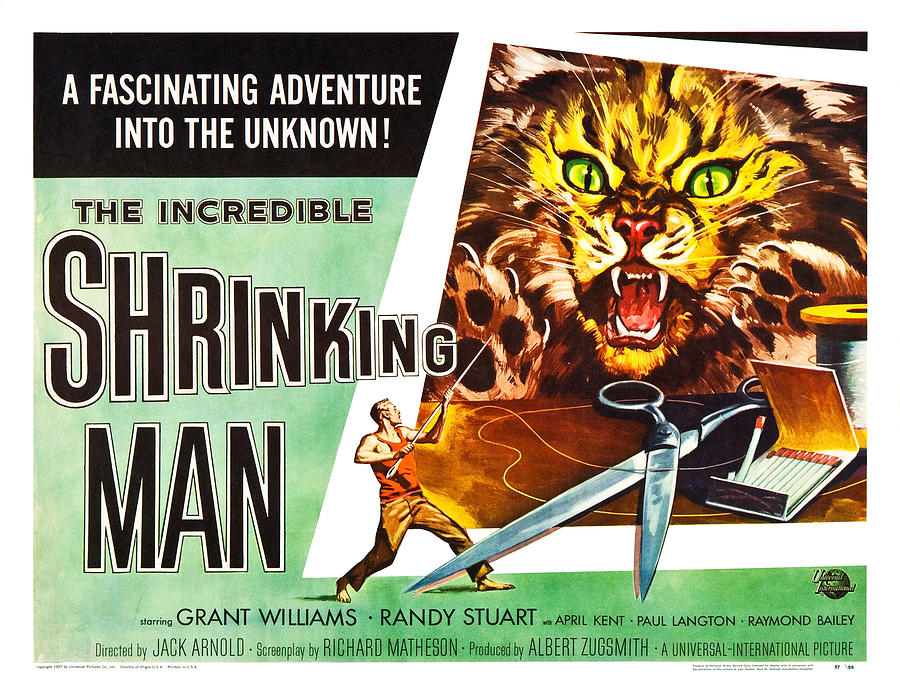
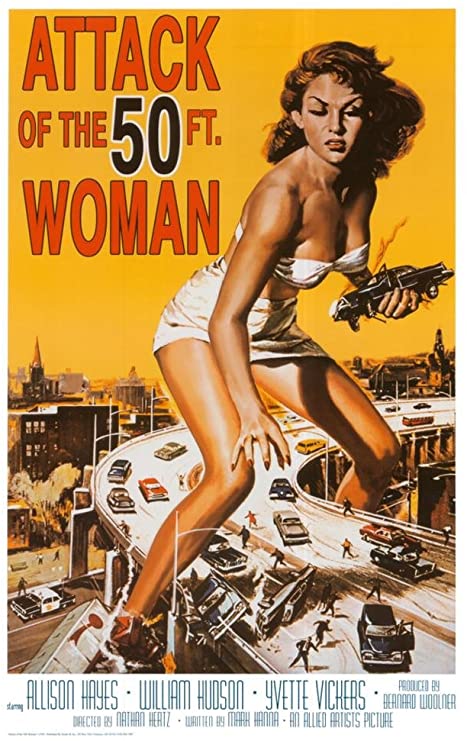
For example, compare “I Created A Gargantua!” or “Lost in the Microcosm” in Weird Science to The Shrinking Man (1956) by Richard Matheson, the book version of the 1957 film The Incredible Shrinking Man, or The Attack of the 50 Foot Woman (1958). None of these stories are realistic, all of them are basically stupid, and all of them are on the level of comic book science fiction. I guess I should up the ante some and also throw in “The Drowned Giant” by J. G. Ballard, as a literary comparison. And even mention that Alice in Wonderland played around with the idea of changing size.
My point in mentioning all these stories is to support my argument that written science fiction in the 1950s was more sophisticated than comic books. Back in the 1950s comic books were aimed at kids who could read but probably didn’t read books. They were a step up from kids’ picture books. Galaxy Science Fiction was a step up from Amazing Stories, and The Magazine of Fantasy and Science Fiction offered more adult reading than Astounding Science Fiction. And the 1957 science fiction novel, On the Beach by Nevil Shute, was aimed at an even more adult audience.
It’s all about being in the target audience. As I read those collected issues of Weird Science from EC Comics I felt I was regressing back to age twelve. Every time I tried comics again since I was twelve I rejected them as being too young for me and immediately quit reading them after a few pages. This time I kept reading. I even somewhat enjoyed myself. But that scared me. Getting old and being anxious over growing memory loss, made me fear that enjoying a comic book might be the first sign that I’m regressing.
I’ve always considered Charlie Gordon’s rise and fall of intelligence in Flowers for Algernon was modeled the arc of normal aging and decay. Reading Weird Science made me feel like Charlie Gordon when he realized he was on the downward slope of his IQ arc. I’ve noticed this before. I’m starting to struggle with nonfiction and more sophisticated novels.
I can picture myself getting older and reading the Oz books I loved in the 5th grade. The science fiction I love to read now is the same as I loved back in the 8th grade. However, I’m reading it with 70 years of wisdom I didn’t have then, and I’m admiring it more. I still enjoy Austen, Dickens, Trollope, Tolstoy, Lawrence, or even Joyce, but I’m slowly gravitating more and more to the fiction of my adolescence. That doesn’t upset me. I’m glad I have those stories to welcome me home.
I’m not ready yet to read comic books again, or even return to the Oz books, but I can imagine a time when I might be.
“The Remoras” by Robert Reed was first published in the May 1994 issue of The Magazine of Fantasy and Science Fiction and has been reprinted a number of times since then. “The Remoras” is set in the far future, on a spaceship as large as a planet, crewed by immortal humans and aliens, who are taking a grand tour around the Milky Way.
The story is part of Reed’s The Great Ship Universe series, but I’ve only read a few of its many entries. My favorite was “Good Mountain,” but it wasn’t set on the Great Ship. I’ve Googled around hoping to find an overview of the Great Ship stories but couldn’t find one. It includes the novels Marrow and The Well of Stars, as well as the collection The Great Ship, but there are other books in the series according to GoodReads.
“The Remoras” is a Quee Lee story, she is a passenger on the Great Ship that is on a 500,000-year voyage that will make one orbit of the Milky Way. This story imagines the far future, when posthumans live lives we can’t imagine.
We have to assume Reed’s goal with this story is to speculate about immortality and posthuman societies, yet the story starts off with a very contemporary-sounding situation. Quee Lee is lounging around in her luxury apartment when a person name Orleans comes to her door wanting 52,000 credits her husband Perri owes. That sounds like a 1940s film noir beginning. I have a pet peeve against plots that use cliche pulp fiction plot conflicts.
We are told we’re in a giant spaceship but we don’t feel it – yet. The person at the door is a man, but not like anyone now in existence. Orleans is a Remora, humans that have mutated themselves by exposure to radiation from working on the outside of the ship. They were tagged with the name Remoras after the fish that follow sharks and feed off their skin. The Remoras are also immortal, but to normal humans look grossly disfigured by cancers. For example, Orleans has an eye that looks like a sea anemone.
At first, Quee Lee mistrusts Orleans and tells him she will tell her husband and he will have to deal with his debt. All of this first part of the story disappointed me. I find the idea of a ship as big as a planet taking passengers on a half-million-year orbit of the Milky Way to be too unbelievable. I also find the idea of longevity extending to hundreds of thousands of years to be unbelievable. And I felt nothing Reed gave us helped me see the possibilities.
But in the second half of the story, when Quee Lee goes to visit Orleans and decides she wants to temporarily experience being a Remora, the story got good. For some reason, I could buy the idea that humans could mutate themselves by consciously directing cancers and genetic alterations. It’s not that I believe such actions are possible in our reality, but Reed made them believable in his story, and that’s what counts.
And to make his story even more fun, he takes us through several plot twists. There is a scene when Quee Lee is on the surface of the ship describing a tremendous light show of lasers destroying comets before they could hit the ship that reminded me of the “Tears in the Rain” speech by Roy Batty in Blade Runner. It goes like this: “I’ve seen things you people wouldn’t believe… Attack ships on fire off the shoulder of Orion… I watched C-beams glitter in the dark near the Tannhäuser Gate. All those moments will be lost in time, like tears in rain… Time to die.”
What Quee Lee saw wasn’t so eloquently and succinctly stated, but the imagery was just as impressive, like an experience Roy Batty would have seen in his short lifetime.
Reed’s story is super-science on a vast scale. Many writers of modern space opera try to imagine such far futures, but for me, they fail. I can imagine humans living for hundreds of years, but not hundreds of thousands of years. I can imagine humans traveling across the galaxy, but not in ships as big as planets. The Great Ship stories push the boundaries for what I consider credible science fiction. However, once this story zeroed in on one relationship that involves a very short period of time involving exact details I got into it.
“Gorgonoids” by Leena Krohn is not science fiction but a science fictional meditation on artificial life. If you are familiar with John Conway’s Game of Life then you might appreciate Krohn’s story even more. The title characters are an artificial lifeform created in a computer, and the narrator of the story philosophizes about them and other artificial life forms. Artificial life and cellular automaton are fascinating subjects in the real world that are very science-fictional in nature. Krohn’s narrator is really speculating about real artificial life in a fictional essay, not creating a fictional world about artificial life.
Ann VanderMeer obviously admires surreal literary stories that are philosophical and speculative but I don’t consider “Gorgonoids” science fiction. It is a great fictional essay, but to explain what I mean why it’s not science fiction, read “Beyond the Tattered Veil of Stars” by Mercurio D. Rivera. That story takes the idea of artificial life into the realm of science fiction.
The New Yorker did a profile on this Finnish writer, “Cracking the Codes of Leena Krohn,” by Peter Bebergal. If you enjoyed reading “Gorgonoids,” in The Big Book of Science Fiction then I recommend reading the essay about Krohn. In it Krohn is quoted about the science fiction label:
I like what Krohn is doing in “Gorgonoids,” because it inspires me to study more about artificial life. Her fictional essay involves all the questions people have when contemplating the subject of artificial life, but it lacks a story. Interestingly, her narrator takes the idea into extreme realms that science fiction explores, but only as idle navel-gazing. What makes science fiction science fiction is when a story brings those wild ideas alive in a conventional fictional structure. Science fiction can use experimental fiction techniques, but it still needs to convey a real fictional story.
Saying I don’t consider “Gorgonoids” science fiction isn’t knocking it. The VanderMeers are slowly wearing me down with all these quasi-SF stories. They need an anthology of their own – The Big Book of Experimental Fiction. That way readers could see all the ways writers push the boundaries of conventional fiction and science fiction.
You might not notice our new feature since it’s rather subtle, but we’ve added a column with links to reviews. If you look at the Classics of Science Fiction list (or related lists), you’ll see a new column: Reviews. Click on the number beside a title you’re interested in and we’ll show you the reviews we’ve found just for that title. Or if you want to see the reviews for all the titles, click on Show Reviews at the top. Click again and they will disappear. Clicking on a review will take you to the review. (I like to right-click links and choose “Show in new window” so I won’t lose my place in the list.)
It’s going to take Mike and me a long time to add reviews to all the titles in the database. We’re working on the titles in the main lists first. Mike is currently working on novels, and I’m working on short stories.
We’ve both discovered that searching for reviews to link is quite illuminating in many ways. The first revelation is one we already knew because it inspired the new feature in the first place. Google is terrible at finding good reviews. Actually searching for reviews to add to the database only reinforces this impression. Google is geared to selling stuff, and not necessarily to help you to find what you want to know. Google does offer the wonderful service scholar.google.com that indexes academic journals. A search using it will find exactly the kind of reviews I want to read, but sadly most of that content is behind paywalls.
Reviews of books and short stories on Google are limited mostly to professional publications that offer their content for free or content from bloggers. We try to find substantial and quality reviews, but that’s not always possible. We do include reviews from sites with paywalls if they offer a certain number of free reads. By the way, you can extend that number of free reads by switching computers or browsers. If you have a computer, tablet, and smartphone, each with two browsers, you can extend 4 free reads to 24.
What has been personally rewarding to us while gathering links is discovering the kind of reviews available. We don’t have time to read all of them closely, but we do read over them enough to judge them. That makes us both want to go back and just read reviews. It’s quite fascinating how one novel can inspire so many reactions, often opposing. Reading the reviews makes us want to read the stories. And reading the reviews of stories we’ve already read makes us want to reread some stories to look for the new perspectives we’ve found in the reviews.
Searching for these links is also revealing the junkiness of the internet. Most pages are horrors of graphical layouts. For a good portion of them, you’d think they were designed to discourage reading, especially those pages with tiny typefaces. Even more painfully revealing, is it’s all too obvious that in most cases sites are throwing up a little content just to get you to them. They want your clicks. They want you to click on their ads.
We’re also learning about the quality of reviewing. It makes me ask: What makes a great review? It also makes me ask: Are my reviews worth reading? And: What could I add to my reviews to make them more useful?
We hope we’re providing a service by helping readers find reviews of the stories we list by wading through all that internet crap for you. But more importantly, we want to help you decide on things to read. Offering lists of recommended books and short stories has its uses, but looking at lists can be dull. We thought of providing graphics and illustrations to spice up our site, but such eye candy is only a distraction. Mike came up with the idea of adding links to reviews, and I believe that will be truly helpful – a great addition.
Story #95 of 107: “The Brain of Rats” by Michael Blumlein
“The Brain of Rats” by Michael Blumlein is an excellent piece on gender, but not science fiction. Like Judith Merril did sixty years ago, the VanderMeers work to broaden the scope of the SF genre. But it’s like the judge’s proclamation about pornography – “I know when it when I see it.” The VanderMeers see science fiction and I don’t. There’s no way to draw a border around the genre and stake a claim. This isn’t science fiction to me, it’s genre gerrymandering.
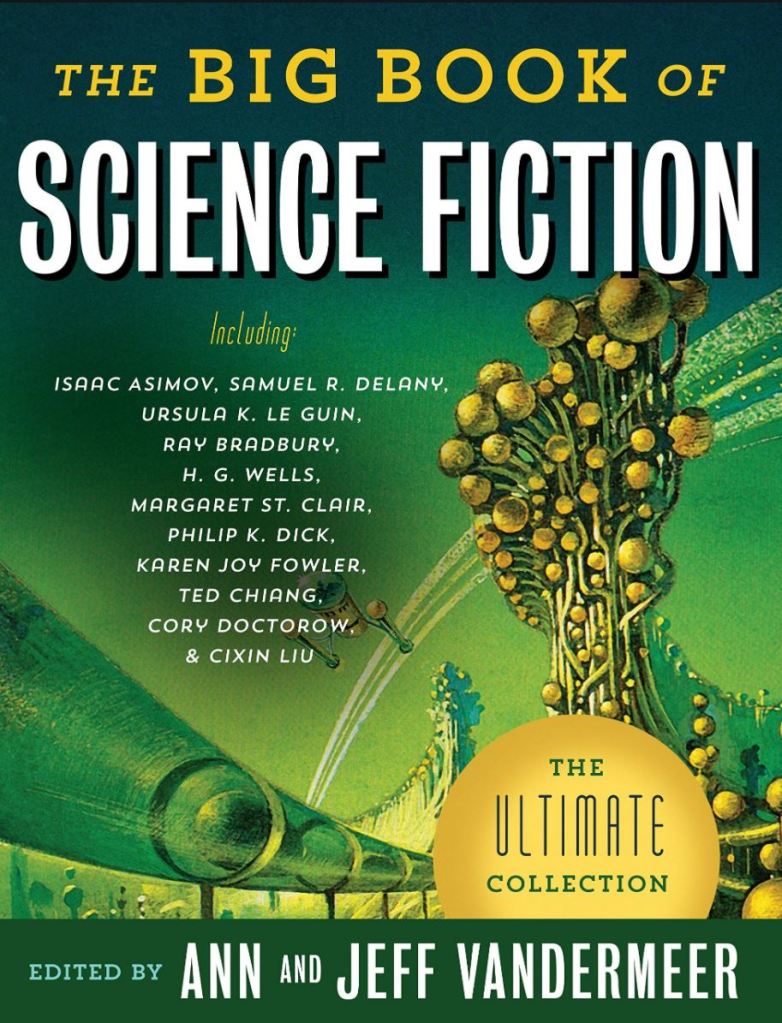
If I had read “The Brain of Rats” in The New Yorker I would have been impressed. Reading it in The Big Book of Science Fiction, I read it with interest but was annoyed that it was included. Genre is about marketing categories of fiction to readers seeking specific categories. Many of the stories in this anthology are not what I wanted to read when I bought a giant anthology called The Big Book of Science Fiction.
I know this is narrow-minded of me. Nor, does it matter what I want. Science fiction is whatever people want it to be because things do change with the times. I guess I’m just old and don’t want to change with them. I’m just a grumpy old fart. I’ve been annoyed ever since fantasy stories began invading science fiction magazines back in the 1960s. I realize I sound like a rabid Trump supporter ranting about the border and illegal aliens. I’m actually a liberal, and all for diversifying the real world, but when it comes to science fiction, I want a gated community. Is that narrow-minded? I do read fantasy and literary fiction, but when I’m in the mood.
I feel some writers and editors want to expand on the science fiction genre because that’s what they want to read and write and the science fiction market is easier to break into. Picking up a book or magazine to read science fiction and finding stories like this is something akin to tuning into the Olympics to watch curling and seeing one of the guys drop his broom and start figuring skating around on the ice. I’m sure readers of The New Yorker would be miffed to find a space opera tale in their mag.
There are a few lines in “The Brains of Rats” that could be interpreted as speculation, but those ideas aren’t developed. I assumed they were added so the story could be sold to a science fiction market. Michael Blumlein is an interesting writer, and I might pursue his work further, but I’ll actually be seeking it out for its literary and mainstream qualities.
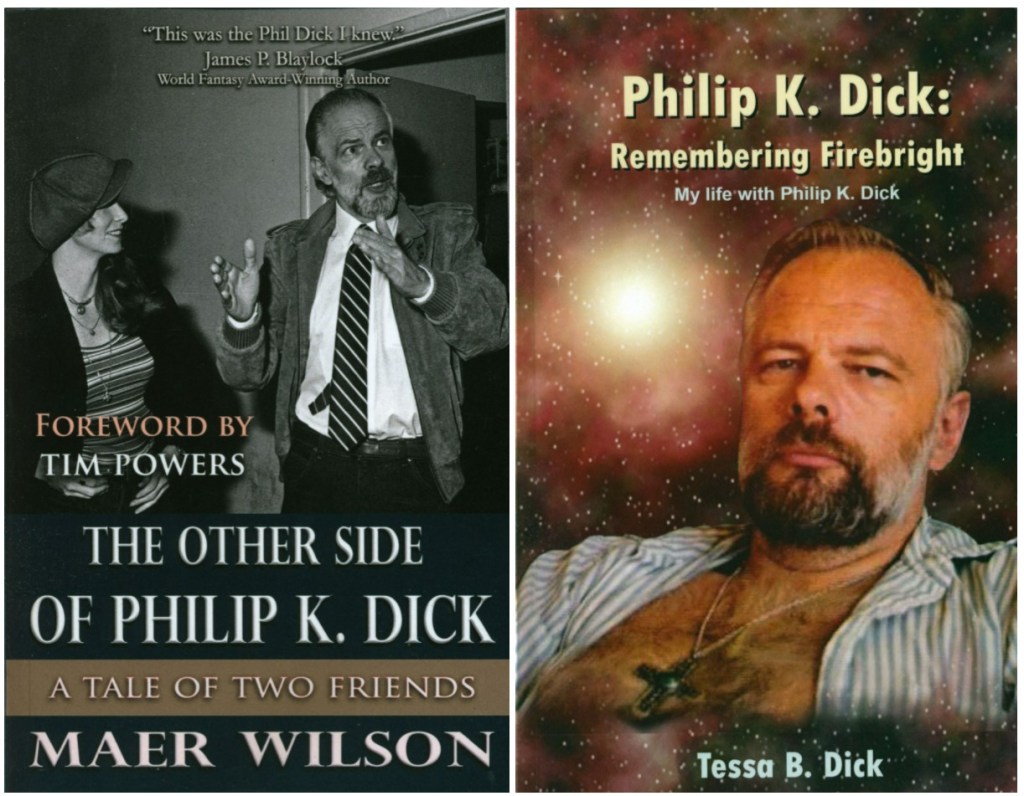
After reviewing We Can Build You and Dr. Bloodmoney on my personal blog, I thought I’d be through with PKD for a while. Nope, I’ve only fallen deeper into the PKDickian black hole. While shopping for deals on old PKD books on eBay I noticed The Other Side of Philip K. Dick (2016) by Maer Wilson, a biography I haven’t read. Turns out it was cheaper to buy new at Amazon. I got it and read it immediately. Wilson knew PKD from 1972 to 1982 – during the last decade of his life. Because I only vaguely remember reading Philip K. Dick: Remembering Firebright (2010) by Tessa B. Dick, his fifth and final wife, I decided to reread it. It’s still available at Amazon, so don’t pay inflated collector prices. Tessa Dick knew PKD over the same period of time, so we have two memoirs that remember PKD over the same time period.
Both books were published on CreateSpace, a self-publishing company owned by Amazon. Tessa Dick’s book is poorly edited and has a more basic layout, but it has more information about PKD. Wilson’s book looks better and is better written, but she spends more time talking about herself, so there’s less information about PKD. If you’re really into Philip K. Dick, you’ll want to read both. I’ve already written some about the major biographies on PKD, so I’m only going to focus on these two. I really need to do an in-depth comparison someday.
All the people writing about PKD tell a different story. Reading about PKD is like watching Rashômon. Besides the biographers that never knew PKD, there are several people that did who have written biographies, memoirs, and articles. My favorite of those is The Search for Philip K. Dick by Anne R. Dick, his third wife. She knew PKD while he was writing his mainstream novels and The Man in the High Castle. Tessa was married to PKD while he was writing A Scanner Darkly, VALIS, The Transmigration of Timothy Archer – all his last novels. Wilson knew him during the same time period but she writes little about him writing the novels. But Wilson went with him to see the early rushes of Blade Runner when Dick got to meet Ridley Scott. She also knew him before and after his marriage to Tessa. And she was supposed to go with him to Europe for five weeks and then see the premiere, but PKD died before all that. She was not his girlfriend, but just a friend. PKD was agoraphobic and depended on Wilson to keep him company and drive him places. PKD had several friends that helped him like this.
I should also mention there’s a documentary on Curiosity Stream, The World of Philip K. Dick that interviews Tessa Dick. Dick’s three children, Laura, Isa, and Christopher manage a joint trust of his works and legacy, but Tessa might be the person that publically remembers him most. From reading the two books, I don’t think Tessa and Wilson liked each other, and their two memoirs contradict each other in places. Wilson believed PKD was far saner than he is often portrayed, but from reading the two books I get the feeling Wilson saw Dick when he was being his public self, and Tessa saw PKD when he was letting all his inner self hang out.
Wilson’s book has a forward by Tim Powers, and a note by James B. Blaylock, also friends of PKD during his last decade. Their comments seem to gently endorse Wilson’s view, but Tessa Dick’s memoir is far more intimate. She got to live and work with PKD.
I don’t want to get into the details here, because they can be endless, but Philip K. Dick is known for writing very strange science fiction, but he’s also known for believing a lot of strange ideas. Some people considered him bonkers, while others believed he was putting us all on. Reading Tessa’s book leaves me believing PKD was insane. Wilson’s book left me thinking he was sane, but with some mental problems, but not major ones.
The reason I love reading about PKD is I’m looking for clues about why he wrote his stories. Tessa’s book is most revealing about that. Wilson’s book is more illuminating about being a writer and dealing with the outside world. She would go with him to interviews and try to keep him from saying things that would generate bad PR. Neither book is a quality biography. Both memoirs add information and confusion about the mystery of Philip K. Dick.
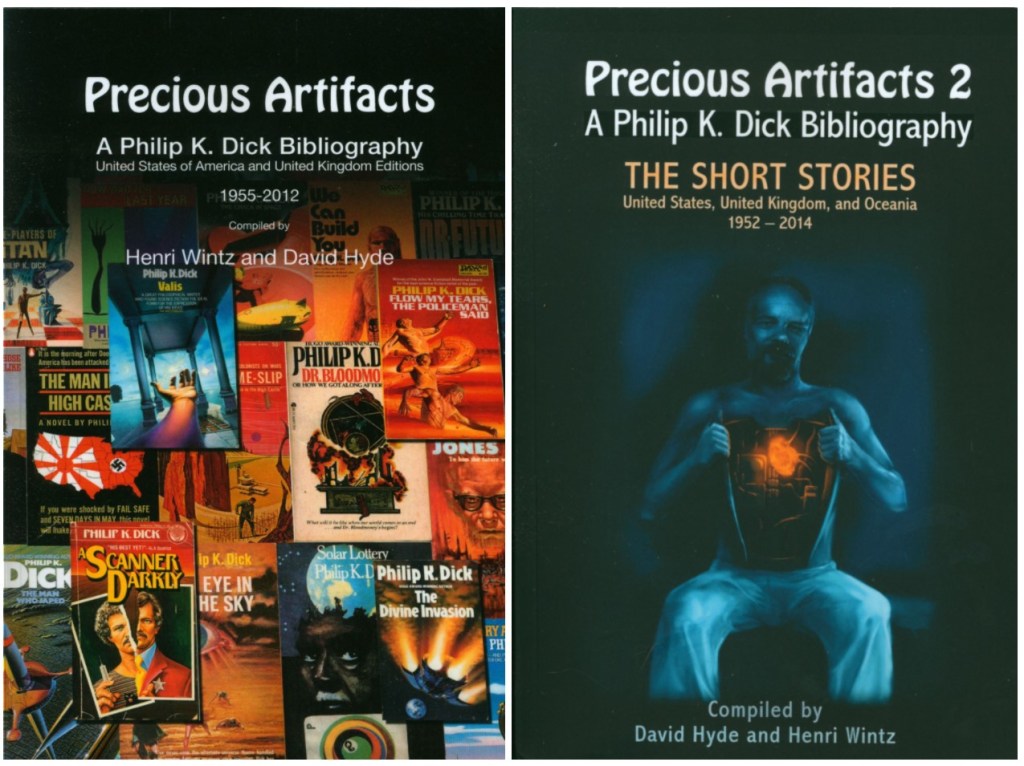
I also bought Precious Artifacts and Precious Artifacts 2 from Amazon even though the same content isonline at the Philip K. Dick Bookshelf. The first is a bibliography of his books, and the second covers his short stories. I don’t actually collect to collect, but my buddy Mike and I have gathered quite a bit of PKD material over the last forty years. We’re not completists, but I’m always looking out for stuff I haven’t read. And sometimes I like buying books because of their covers. Most of the information in these two books is available at the writers’ site, but also on ISFDB. However, I like holding these books. They are well illustrated with color images of the book and magazine covers.
Story #94 of 107: “Death is Static Death is Movement” by Misha Nogha
I wasn’t going to write about “Death is Static Death is Movement” by Misha Nogha because I’m tired of writing about stories I can’t resonate with as a reader. This was another horror story, an item on the fiction menu I just never select. Then one of the group members said I should keep my review streak going. They probably didn’t notice I had already skipped a couple stories, but I’ll go back and fill in those two also.
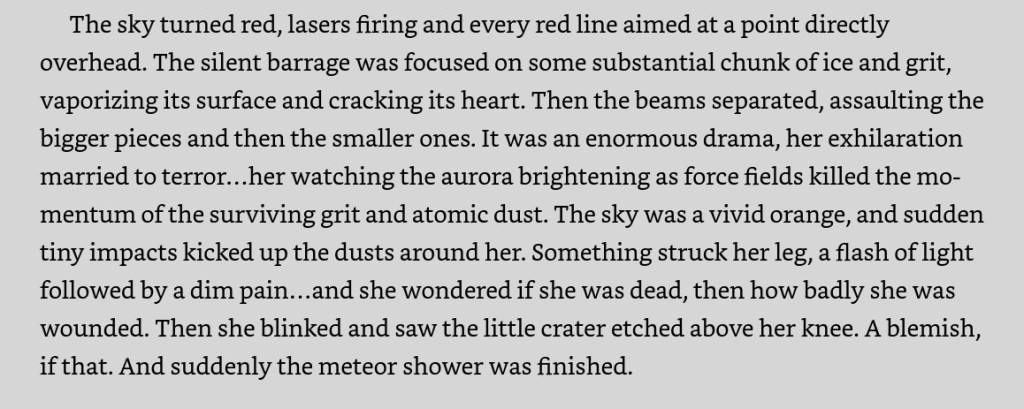
“Death is Static Death is Movement” isn’t a short story, but a novel excerpt, which reads like the author visualized it as a comic book or horror movie but had to put it into words. It’s full of colorful mayhem that includes quite a lot of vomit, shit, snot, and body parts. Here’s a typical sample, but not the grossest.
Who enjoys this stuff other than tweens? Putting Nogha’s words into my mind’s theater made me recall EC Comics, which were banned back in the 1950s because do-gooders thought they would corrupt children. But who but children would enjoy such ghoulish grossness?
This story would also appeal to aficionados of American International horror films. There are science-fictional elements in this novel excerpt, but the tone of the story is feminism meets H. P. Lovecraft if he had lived long enough to read William Gibson.
I know there are fans of this stuff. millions of them. I’m just not one. Sorry.
Story #93 of 107: “Before I Wake” Kim Stanley Robinson
Once again the VanderMeers give us a science fiction horror story.
Kim Stanley Robinson came up with a neat setup for “Before I Wake,” where humanity is trapped in uncontrolled sleep cycles with confusing dreams after the solar system moved into an interstellar dust cloud. Something in the dust put people to sleep and they struggle to stay awake for short moments. Civilization is collapsing and cities are burning.
In the story, Fred Abernathy, a scientist, and Winston, his lab administrator struggle to keep a group of a dozen researchers awake long enough to study the problem and seek a way to counter the dust’s effects. Their efforts are thwarted because they can’t tell reality from dreaming. Fred and Winston use amphetamines and the pain of acid drops on their skin to keep themselves awake to work on a helmet that magnetically repels the dust.
Of course, this plot reminds me of the classic 1954 Poul Anderson novel, Brain Wave, where the solar system moves out of a dust cloud and people and animals all become smarter. That was a bright take on the idea. The dust had been hindering all intellectual development on earth for thousands of years, and moving out of the cloud allowed all animal life to be smarter. Robinson takes the horror side of the idea, moving into the dust that ruins our natural sleep patterns.
Lately, I’ve been reading the stories in The Big Book of Science Fiction twice to make sure I get everything. For some of the stories, I need to read them twice because the intent of the story is unclear from a single reading. Robinson’s tale was easy enough to understand in one reading even though Fred goes in and out of dreams and Robinson expects his readers to feel like their experiencing a bad LSD trip. There were a couple of places in the story that did confuse me. I don’t know if they’re actual mistakes or intentional points to confuse us. For example, Fred goes to rescue Jill. At one point we’re told Jill is his wife, and another she’s his sister. In Fred’s confused state Jill could be neither.
I read “Before I Wake” the first time, and listened to it the second. I so much prefer the audio version.
“Before I Wake” is a fun read based on a neat idea however it has a bummer of an ending. Reading this story reminds me just how much I prefer happy endings and dislike horror. Because there are so many science fiction horror stories, satires, literary works of cleverness in this volume, its overall vibe is cynical. The nightmare ending of “Before I Wake” left me with a sense of hopelessness.
There are stories in the anthology that are uplifting and left me feeling good, such as “A Martian Odyssey,” “Desertion,” “Surface Tension,” “The Last Question,” “Rachel in Love,” and so on, but many did not. Now, some of the somber, even horror stories were philosophically uplifting, and quite brilliant, like “Snow,” “Bloodchild,” “When It Changed,” etc. But many of the stories were only intellectually interesting, or clever, like “Before I Wake.” I can admire them for the inspiration and execution of a creative idea, but they leave me emotionally wanting more.
I suppose it is childish of me to always want stories that leave me feeling good. But think about it, how many people take drugs to feel bad? Fiction is a drug to me. I read fiction for uplift. I have nonfiction for teaching me about reality. Great fiction needs great conflicts to move the story along, but in the end, I want epiphanies that make me feel good.
My initial reaction to “Burning Sky” was indifference. I have no background with comics, so I find stories inspired by superhero themes unappealing. But the coda to the story intrigued me.
I remember seeing a short documentary about William Moulton Marston who wrote as Charles Moulton and was the creator of Wonder Woman. I also remember reading reviews of The Secret History of Wonder Woman by Jill Lapore in 2014. So I know just enough of Wonder Woman’s literary origin story to know it had kinky aspects. Then I wondered if Rachel Pollack knew of that history in 1989? That meant I had to reread the story and do some research.
I then wished I had a copy of Burning Sky, the Pollack collection in which the title story is gathered with 26 other stories. That’s because I read that each story has an autobiographical afterward which would probably help me. As luck would have it, that collection is available at Amazon for $1.99 for the Kindle edition. However, you don’t need to buy a copy to read the afterward to “Burning Sky.” Just use the Look Inside feature. You can also read Samuel R. Delany’s introduction to the collection where he praises Pollack highly. Here are three key paragraphs from the afterward:
This isn’t very illuminating since I already got that much from the story. I was hoping Pollack would explain the Wonder Woman connection. Delany also explained that Pollack was an authority on Tarot cards. I can see why Delany admired Pollack because his stories often deal with sexuality, and Tarot cards were part of his novel Nova.
“Burning Sky” is told by Maggie in the first person, and tells us about two other women, Julia and Louise, and about a strange group of vigilante women called The Free Women. These women wear skintight blue plastic outfits that cover everything but their faces. They attack men who attack women. “Burning Sky,” tells two stories, Julia’s run-ins with The Free Women, and Louise helping Maggie find an orgasm. Neither story really interested me. Most of the imagery deals with S&M and fetishes.
“Burning Sky” is really feminist fiction and not science fiction. For the reread I had hoped it would provide allusions to the early days of Wonder Woman comics, but I didn’t find any that I understood. I just don’t have any real knowledge of comic book history. I assumed the ceremonial hall and Free Women connected with the comic’s past. And certainly, WW was full of S&M/fetish imagery. The story had a tiny bit of the Dangerous Visions vibe, but not really, especially for 1989. Maybe the story had a bite when it was first published, but it’s rather quaint now compared to feminist fiction today.
I believe this is just a case of me being the wrong reader. I’m curious what women who enjoy S&M and loved old Wonder Women comics got out of it?












 Classics of Science Fiction