“Compounded Interest” by Mack Reynolds

“Compounded Interest” was first published in The Magazine of Fantasy & Science Fiction, August 1956. You can read it on Archive.org. It is story #15 of 22 for The Best SF Stories of 1956 group read. “Compounded Interest” was a selection in both the Merril and Asimov/Greenberg anthologies devoted to the best SF of1956, but the story hasn’t been widely anthologized otherwise. I considered “Compounded Interest” an entertaining enough story for a magazine issue but considered it disappointing to read it in a best-of-the-year anthology. It’s a time travel story, yet it’s never been anthologized in any time travel themed anthology, and there have been many. That might tell us something.

The story is rather simple, a time traveler arrives back in the early days of Venice and deposits ten gold coins in a bank with special instructions. He returns every century with new instructions. If you wish to know what happens, read the story. The whole story is merely a fun little idea, with a somewhat punchy ending, so I won’t spoil it. However, the story does have a big “which came first, the chicken or the egg” problem.

“Compounded Interest” is so slight I almost didn’t write about it. Mack Reynolds was a rather prolific science fiction writer. Sadly, I’ve never read much of his work. I have a vague memory of reading a couple of his stories, and reading about Reynolds in Wikipedia, which I just did again. He sounds like an interesting guy, and I’d like to read more of his science fiction. It’s just that his work isn’t remembered. Like I said, I have a rather vague memory of reading one of his stories and sort of liking it, but just can’t remember what it was.

I’d want to think there were dozens of science fiction stories better than “Compounded Interest” published in 1956 yet to be discovered. I just don’t have the time to go read over a hundred issues of SF magazines to find them. And so far, no one else in our reading group has found any forgotten gems either. I’m tempted to go read the five other SF stories Reynolds published in 1956 just to test the waters:

  • “After Some Tomorrow” – If (June)
  • “The Triangulated Izaak Walton” – Fantastic (June)
  • “Case Rests” – Science Fiction Quarterly (August)
  • “Fair Exchange” – Fantastic (August)
  • “Dog Star” – Science Fiction Quarterly (November)

Maybe Reynolds didn’t hit his stride until the 1960s. I remember seeing him a lot in Campbell’s Analog during that decade. Even when I was subscriber back then, I passed over his stories. Reynolds never hooked me, but like I said, reading about him in Wikipedia shows he had a fascinating life and should have written at least a few interesting stories.

“Compounded Interest” is the kind of story that’s just okay. Evident Judith Merril and Asimov and Greenberg, but not T. E. Dikty found it just interesting enough to reprint in their best of 1956 anthologies. But is it padding? My guess, few years produce enough stories to fill an anthology with exceptional stories.

By the way, Mr. Mike wasn’t too kind to this story either, but he was less verbose than I in saying it:

Compounded Interest is a tissue paper thin story with a repetitive plot and uninteresting characters. 

As soon as Professor Alan Shirey is introduced toward the end of the story we realize that he must be the mysterious Mister Smith.
It's a nonsensical and tedious story.

James Wallace Harris, 12/31/23 – Happy New Year

UPDATE:

I just read “After Some Tomorrow” in the June If. Now, this is the Mack Reynolds story that Merril, Asimov/Greenberg, and Dikty should have collected as one of the best of 1956. Follow the link to read it online. It’s about gender role reversals after the apocalypse. And the plot has some nice twists. Plus, it’s quite gritty for a magazine aimed at young readers. Rating: ****+

“A Work of Art” by James Blish

“A Work of Art” was first published in Science Fiction Stories, July 1956 as “Art – Work.” You can read it on Archive.org. It is story #14 of 22 for The Best SF Stories of 1956 group read. Asimov and Greenberg picked “A Work of Art” for The Great SF Stories #18 (1956). It was widely reprinted. Its quality is inferred by the fact that I own “A Work of Art” in seven anthologies:

  • Science Fiction Showcase (1959) edited by Mary Kornbluth
  • The Worlds of Science Fiction (1963) edited by Robert P. Mills
  • The Best of James Blish (1979)
  • Science Fiction of the Fifties (1980) edited by Martin H. Greenberg and Joseph Olander
  • The Great SF Stories #18 (1956) (1988)
  • The Science Fiction Century (1997) edited by David G. Hartwell
  • Masterpieces: The Best Science Fiction of the Century (2001) edited by Orson Scott Card

“A Work of Art” is James Blish’s third most cited story in our database after “Surface Tension” and “Common Time.” James Blish isn’t very well known today, but he had a fair reputation when I was growing up in the 1960s. Among writers who knew Blish, he was remembered for being a scholarly intellectual writer. Older science fiction fans know him for the novel A Case of Conscience and the series Cities in Flight.

I first encountered Blish with his paperback series that converted the original Star Trek episodes into short stories. That was fun reading when I was a teen watching the show back in the 1960s, but it gave me the wrong impression that Blish was a hack writer. It took me decades to throw off that prejudice. “A Work of Art” offers me new hope for Blish.

It’s funny how we start off in our adolescence following a few writers as our favorites, and then years or even decades later, we learn that we should have read more of their contemporaries. Heinlein, Asimov, and Clarke dominated my formative years of science fiction reading. Now in my fading years, I’m discovering the 1950s and 1960s had other interesting science fiction writers — ones I should have been reading.

“A Work of Art” is the first story by Blish that backs the reputation I’ve gotten from reading about Blish. I’ve read A Case of Conscience twice, but I never considered it great, just particularly good. And I never liked the Cities in Flight stories. I keep hoping to discover more by Blish that matches the reputation he has with other readers. I’ve bought Black Easter and The Day After Judgment but haven’t read them yet. I’ve read “A Work of Art” twice and feel it’s closer to Aldiss and Ballard, which makes me want to try harder at finding the better Blish stories.

My friend Mike has been emailing me his thoughts on the Best SF Short Stories of 1956 and I’ll quote his comments to describe “A Work of Art” because I think he’s done a better job than I would have of summing up the story.

In James Blish's "A Work of Art," the mind sculptor Dr. Barkun Kris has "...superimposed memories..." of Richard Strauss onto Jerom Bosch, who "...had no talent for music at all..." 

At first, "A Work of Art" seems little more than Blish's satirical take on modern music. For Strauss (Bosch), "Music was, he quickly began to suspect, a dying art, which would soon have a status not much above that held by flower arranging back in what he thought of as his own century." Composers "...openly used a slide-rule-like device called a Hit Machine..."

Strauss composes a new opera with the intention to "...strike out afresh..." and not depend on his "...old tricks..."

During the opera's premiere, Blish introduces an epiphany for Strauss, who realizes during the performance that there "...was nothing new about the music. It was the old Strauss all over again--but weaker, more diluted than ever."

Strauss's anguish is palpable: "Being brought to life again meant bringing to life as well all those deeply graven reflexes of his style."

"His eyes filled; his body was young, but he was an old man, an old man. Another thirty-five years of this? Never."

The audience is ecstatic about the result of the mind sculpture. But Jerom Bosch has a depth of understanding that Dr. Kris never suspects. Bosch knows that the Strauss that Kris created "...was as empty of genius as a hollow gourd. The joke would always be on the sculptor, who was incapable of hearing the hollowness of the music..."

Bosch's moment of epiphany adds depth and dimension to the story by creating a nuanced character who will soon be returned to his regular life even though he feels that "I am Richard Strauss until I die, and will never be Jerom Bosch, who was unable to carry even the simplest tune." We feel his grief when Kris "...turned to him to say the word that would plunge him back into oblivion..."

One reason I like “A Work of Art” is it deals with an alternative to mind downloading that I think might be vaguely possible. Mind downloading/uploading has been a popular theme in SF for several decades, but I’ve never thought it possible. However, I’ve wondered if we could create an AI personality based on all the works of a famous person. In “A Work of Art” Dr. Kris sculpts minds in living people. I guess it’s a kind of temporary brainwashing. I don’t think that’s possible, but it’s a good enough idea for the story.

“A Work of Art” gives Blish the opportunity to show off his knowledge of classical music, something I know next to nothing about, but always wished I did. And Blish gets to speculate about the nature of personality, both real, and copied. Richard Strauss’ artificial personality struggles to create a new opera but is faced with two problems. The first is he’s old and has done everything already, so he tends to repeat himself. But the second, and the revelation of the story, is because he’s a copy his creativity is limited by what’s known about him. It begs the question: Can creative work be used to be creative? That’s pertinent today regarding LLM AIs.

Now Mike focuses on something I missed, or something Mike has added to the story. He sees Bosch as being a participant in this mind sculpting artwork. I didn’t. I assumed Bosch had temporarily left the building, so to speak, while the Strauss personality occupies it. Mike evidently saw mind art as a blend of the two. Mike assumes Bosch had the final epiphany, while I think the Strauss personality had it before it was erased.

Even though I disagree with Mike’s take, I like the idea of Bosch being there all along too, being part of the art. I’ll need to read “A Work of Art” for a third time to see if I see clues for that. That’s the fun thing about exceptional stories, that they can be interpreted in diverse ways.

James Wallace Harris, 12/28/23

“Horrer Howce” by Margaret St. Clair

“Horrer Howce” was first published in Galaxy Science Fiction, July 1956. You can read it on Archive.org. It is story #13 of 22 for The Best SF Stories of 1956 group read. Asimov and Greenberg picked “Horrer Howce” for The Great SF Stories #18 (1956) and it was also included in Galaxy: Thirty Years of Innovative Science Fiction, which was our Group Read #9. You can read our original discussion thread here.

I know nothing about Margaret St. Clair. Except for reading “Horrer Howce” before in the Galaxy anthology, I can’t recall reading any of her other stories. Wikipedia reports she wrote over 130 fantasy and science fiction stories, and ISFDB,org lists quite a few. She only has two books and five stories cited in CSF, with none getting more than two citations. I once owned a copy of this Ace Double, but I got it for the Philip K. Dick story. St. Clair has been reprinted in a several anthologies devoted to rediscovering women science fiction writers, such as The Future is Female! edited Lisa Yaszek, which I own, but haven’t read.

Unfortunately, I didn’t think much of “Horrer Howce.” The story is about a man named Freeman who tries to sell exhibits to amusement parks featuring haunted houses. He’s having trouble selling his exhibits because they drive his potential clients mad with fear, or even kills them. At first, I thought this might be an oddball fantasy like those Shirley Jackson wrote, but “Horrer Howce” appears to have a science fictional basis. Although, at one point, Freeman consults books like a conjurer. Even after two readings, I was never sure if Freeman was opening gateways to other dimensions or using magic to open fantasy portals. In either sense, I didn’t think such gateway/portals were suitable for amusement parks. The early ones were just scary dark holes, but Freeman expected visitors to enter the world of the Vooms, and it was much too big to be a fake thrill ride.

I can see where “Horrer Howce” has a certain appeal but just not to me. I thought it reasonably good enough for a magazine story, but I find it disappointing for a best of the year or retrospective anthology. My friend Mike summed it up nicely in an email:

Margaret St. Clair's "Horrer Howce" is an effective horror story. It invokes feelings of fear, dread, and dismay. 

We shouldn't ask "Horrer Howce" to be anything more. Examining the characters and plot seems like a fool's errand. We enjoy the creepiness of the Vooms and are left wishing that we could see Freeman's future tableau: A Horrer Howce for the Voom.

I didn’t feel fear, dread, or dismay. I could see how St. Clair worked to create those responses, but her efforts seemed too basic or simple to me. Because of the horror angle, it was out of place in Galaxy — at least for me. I thought it would have been more suited for F&SF, Fantastic, or Fantastic Universe.

I should give Margaret St. Clair another chance. Does anyone know of a better story of hers to recommend?

James Wallace Harris, 12/26/23

Leave the World Behind

I love post-apocalyptic science fiction, especially those stories that follow the collapse of civilization as it happens. My favorite SF novel of this type is Earth Abides by George R. Stewart from 1949 and the television show Survivors from the BBC in 1975. I’ve written about some of my favorite post-apocalyptic short stories here. I’ve also written about the theme many times because it’s one of my favorite science fictional themes in case you want to check out my fanatical interest.

So, when I watched Leave the World Behind on Netflix last night, I got overly excited because it’s a new and interesting take on this old theme. Every generation has their own philosophical thoughts about the possible collapse of civilization. What made Leave the World Behind even more relevant was I had just watched this YouTube video (watch below). I highly recommend you take the time to watch it too — it will add to your paranoid theories about what’s happening in Leave the World Behind.

Joe Scott explains how there’s a philosophical movement that believes we should hurry the collapse of civilization so we can get busy rebuilding everything. I think that’s insane. The philosophy is called accelerationism, and I don’t know if the producers of Leave the World Behind were using accelerationism as a cause or not, but it’s worth thinking about.

Amanda Sandford (Julia Roberts) wakes up and decides her New York City family should rent a house out on the island for the weekend. She doesn’t even ask her husband Clay (Ethan Hawke) but just wakes him up while she’s packing. They get their two kids (Rose and Archie) and drive to the rental house on Long Island. After they settle in, they head to the beach where they experience their first weird event. An oil tanker runs aground right in front of their beach umbrella. It’s quite an impressive special effect. The Sandford family just think it’s an odd, but startling accident.

That night, G. H. Scott (Mahershala Ali) and his daughter Ruth (Myhal’la) knocked on their door claiming to be the owners of the house. They ask if they can stay there that night too because the power has gone off in New York City. The house still has power, but it’s lost cable and the internet, so things are starting to feel weird.

The rest of the movie is about how these six people get along not knowing what’s happening. As the weekend progresses increasingly weird and strange things happen, but because they have no real news, the two families can only speculate. Clay tries to drive into a local town to find out what’s going on but gets lost without a GPS. Amanda, a businesswoman freely admits she hates people, has all kinds of paranoid theories. G. H. knows some extraordinarily rich people connected to the military and offers other theories. Poor Rose only wants to see the last episode of Friends after binge-watching ten years of the series and having just one episode to go. The Scotts are African Americans, and Ruth doesn’t trust the white Sandfords, especially the mother, Amanda.

There are some spectacular special effects scenes with deer and Tesla cars that made me think of other theories about what’s happening. The gathering of deer reminds me of Hitchcock’s The Birds.

One of the obvious points the movie makes is how terribly dependent we are on our smart phones. But if you pay closer attention, it’s interesting to know how different Leave the World Behind is from earlier stories like it. There is little survivalism in this film. Of course, this is just the first weekend of the apocalypse. I’d love to see a sequel about what the six experiences over the next coming months. Amanda assumes that everything will get back to normal soon, but we know that’s insane. Rose Sandford has the most positive approach. She decides she isn’t going to wait for things to get normal again, but goes off on her own to find a copy of Friends to watch.

There are a lot of preppers and survivalists in our society, but the six presented here don’t think that way. I assume the storytellers are saying most of us are going to be damn helpless. None of the six even say, “At least we have plenty of deer to eat.”

I really got into Leave the World Behind, but Susan, my wife, thought it was a big waste of two hours on Christmas Eve. I thought it justified the price of Netflix this month. The film is based on a book by Rumaan Alam. I haven’t read it, but now I’m tempted.

James Wallace Harris, 12/25/23

“The Man Who Came Early” by Poul Anderson

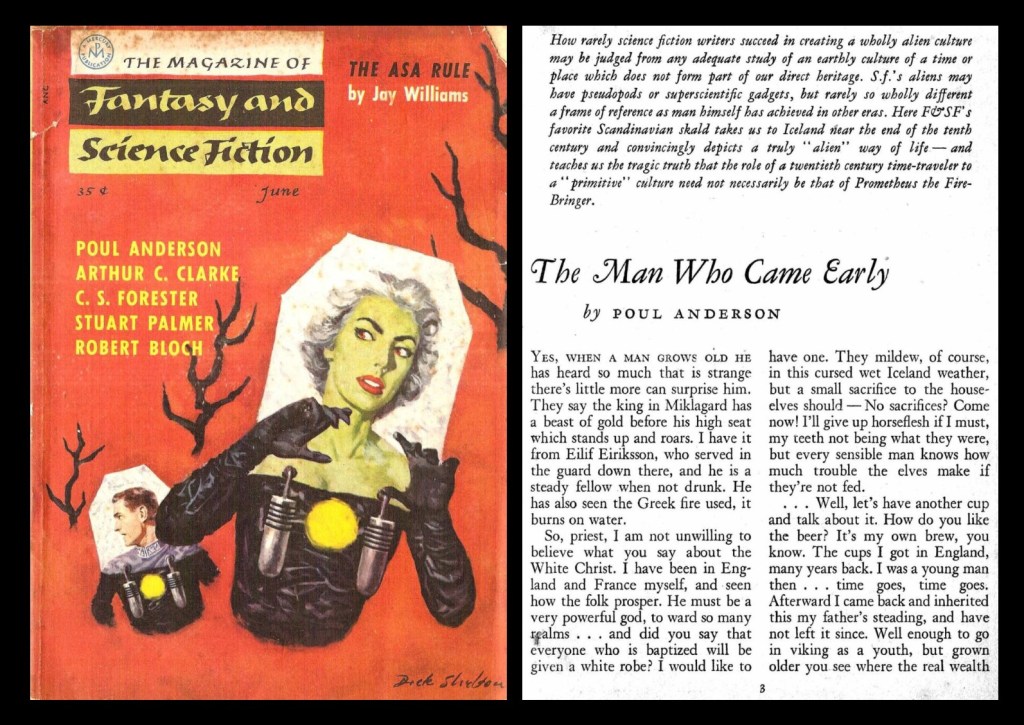
“The Man Who Came Early” was first published in The Magazine of Fantasy & Science Fiction, June 1956. You can read it on Archive.org. It is story #12 of 22 for The Best SF Stories of 1956 group read. Asimov and Greenberg picked “The Man Who Came Early” for The Great SF Stories #18 (1956) and in Richard Lupoff’s What If? Volume 1, his anthology that reevaluated the Hugo awards, thought “The Man Who Came Early” was the “single finest story” of 1956. “The Man Who Came Early” has been well anthologized.

Science fiction writers often reply to earlier science fiction writers in their fiction, and “The Man Who Came Early” is Poul Anderson’s reply to Mark Train’s A Connecticut Yankee in King Arthur’s Court and to L. Sprague de Camp’s Lest Darkness Fall. Both classic time travel novels are about men who are thrown into the past and use their scientific knowledge to gain power and success in less scientifically aware times. Anderson attacks the assumption that modern knowledge would give any time traveler an edge in the past.

Twain’s character, Hank Morgan, goes from the 19th century to the time of King Arthur via a knock on the head. De Camp’s Martin Padway travels to 535 A.D. Rome by being struck by lightning. Anderson’s Sergeant Gerald Roberts returns to about 1000 A.D. Iceland also via lightning strike.

Poul Anderson admired medieval societies, and often used them in his fiction. I’ve read where Anderson claimed such societies are about as complex as what he thinks humans could handle. What impressed me most about “The Man Who Came Early” was the historical details of ancient Iceland. I’m sure Anderson delighted in writing that part of the story.

The plot involving the hapless Gerald Roberts was less appealing to me, but I thought it made a good case for Anderson’s supposition that time travelers from the future will not have an advantage because they know more. If you’ve seen James Burke’s documentary television series Connections, you’ll know he’s right. Knowledge and skills are tied to time and culture.

I believe Anderson’s description of Gerald Roberts fate is spot on. And I was impressed with Anderson’s point of view character, Ospak. I do not know anything about Iceland, either current or past, but Ospak’s voice in the story felt very realistic. He was both wise and insightful. Ospak was also compassionate towards his daughter Thorgunna even though Ospak knew she fell in love with the useless man from the future. Ospak even believed Roberts was from the future, and vaguely perceived why he couldn’t adjust to living in the past. Anderson did a great job describing an alien culture to us.

I was impressed with “The Man Who Came Early” the first time I read it. I’ve never been a big Poul Anderson fan, but reading it made me want to read more of Anderson’s work. I was still impressed, maybe even more so, with this second reading. I find it hard to like most time travel stories because they are so hard to believe. Even if time travel was possible, I find it harder to believe people could overcome the language barrier. Anderson claims that Icelandic is one of the few languages that hasn’t changed much in a thouand years. That might be true, but I’m still skeptical. Kids just two or three generations younger than me already use so many words and phrases that I can’t decipher without checking my iPhone.

In some ways I wonder if “The Man Who Came Early” would have been a better story if told from Gerald Roberts point of view. Wouldn’t we identify more with the frustrations of surviving in the past if we followed the time traveler? I’m sure Anderson was enamored with creating Ospak’s character, but from a storytelling point of view, wouldn’t seeing the experience from Robert’s eyes have been more intense? I’m reminded of Thomas Jerome Newton, the Martian who came to our planet in The Man Who Fell to Earth by Walter Tevis. Newton’s experience of being a stranger in a strange land was emotionally gutwrenching.

I was surprised that my friend Mike didn’t like “The Man Who Came Early” when he emailed yesterday:

My problem with time travel stories is that the plots feel manufactured and synthetic. Character development is sacrificed on the altar of clever machinations.

I realize that "The Man Who Came Early" is a widely praised story, but it felt emotionally flat to me. Everything feels like a plot device, complete with a far-fetched love interest and a convenient adversary (red shirt).
I agree with Joachim Boaz: "There isn’t much redeemable about this stilted caper. Well, Poul Anderson’s pessimistic theme that the modern man is unable to function in the past despite his superior technology is somewhat interesting despite the story’s poor delivery."

I completely disagree with Boaz’s assessment that the story was poorly delivered. I thought Ospak’s tale exceedingly well done. It let us see an ancient Icelandic perspective that felt genuinely possible to me. I do believe if we followed Roberts’ perspective, we would have felt a greater sense of frustration and tragedy being a time traveler, much like what Karl Glogauer experienced in Behold the Man by Michael Moorcock.

I experienced several levels and kinds of emotions in the story, so my experience is much different from Mike’s. I’m curious how other people felt. If you’ve read the story, please say below in a comment.

The discussion on Facebook has been positive so far.

James Wallace Harris, 12/23/23

“The Dead Past” by Isaac Asimov

“The Dead Past” was first published in Astounding Science Fiction, April 1956. You can read it on Archive.org. It is story #11 of 22 for The Best SF Stories of 1956 group read. Even though this is one of Isaac Asimov’s better stories, it was not up for the Hugo award, nor was it selected for a best-of-the-year anthology. Of course, it was competing with “The Last Question” which many, including Asimov, considered one of his absolute best stories.

This is the fourth time I’ve read “The Dead Past,” the second time the group has discussed this story in 2023, and I previously reviewed it here. I like what I said in my previous review, so I’ll let it stand. For this essay, I want to talk about multiple readings of a story and reading reactions from different people. If you read a story only once, you’ll have only one perception of it. Reading a story again often produces a different perception. And reading what other people think of a story often produces perspectives different from our own experiences.

For example, my friend Mike is reading these stories along with the group, and here’s his reaction:

In "The Dead Past," Asimov presents the idea of chronoscopy or "time viewing." It's a method of viewing past events. In most stories, chronoscopy is simply a deus ex machina that allows the story's plot to unwind, but Asimov confounds our expectations by making chronoscopy the main "character" in the story. 

Arnold Potterly wants to use chronoscopy to view ancient Carthage.
Potterly's wife, Caroline, wants to use it to view her deceased daughter, pleading that "I want my child."
For Jonas Foster, the development of the chronoscope becomes "...a matter of important principle."
Thaddeus Araman is distraught because if the chronoscope becomes widely available then "There will be no such thing as privacy."
Asimov whipsaws us through conflicting emotions about the chronoscope. Would it be good to allow Potterly to peer into the everyday events of Carthage? Would allowing Caroline to view her long dead daughter bring her happiness or detach her from reality and result in madness? What about government control of chronoscopy? Araman laments the death of privacy, ignoring the fact that the government already uses chronoscopy to spy. Isn't privacy already dead?
Chronoscopy takes center stage and Asimov skillfully allows us to view its many facets. We are left to decipher our own feelings about how it should be used.
Araman's final words are stark and signal the impending dystopian future: "You have created a new world among the three of you, I congratulate you. Happy goldfish bowl to you, to me, to everyone, may each of you fry in hell forever. Arrest rescinded."

Even after reading the story four times myself, I feel Mike saw “The Dead Past” in ways I didn’t. Mike sums up the story nicely, somewhat like I did in my previous review, but leaving me feeling he liked the story more than I did and saw it with a different spin. But what’s interesting when I started rereading the story this time, was how I noticed things that weren’t in my last review, or memory, or in Mike’s comments, or in the comments on the Facebook group.

Even short stories are full of hundreds of details, details smaller than the plot. We might think of them as brushstrokes that paint the story. With each sentence Asimov gave us, we get something to think about, and each impression could take our vision of what’s going on in the story in a different direction. Just look at the first paragraph:

Arnold Potterley, Ph.D. was a Professor of Ancient History. That in itself, was not dangerous. What changed the world beyond all dreams was the fact that he looked like a Professor of Ancient History.

Knowing the rest of the story makes me wonder why did Asimov started the story this way? The word “looked” is italicized for emphasis. Even though I’ve read this story three times before I cannot recall anything in the plot that significantly deals with Potterley’s appearance. And the next paragraph is even more enigmatic.

Thaddeus Araman, Department Head of the Division of Chronoscopy, might have taken proper action if Dr. Potterley had been owner of a large, square chin, flashing eyes, aquiline nose and broad shoulders.

WTF! Did I miss something entirely in my first three readings? What is Asimov doing here? Is he just throwing out Araman’s prejudices to color the story’s opening? Did Asimov feel he personally wasn’t taken seriously because of his own looks, and just added this in as a story insight?

The story drops appearance and switches to the topic of chronoscopy and Carthage. In my previous readings I wondered about Carthage, and why Asimov was using it in this story. Asimov wrote many books on history, so I wondered if it was a pet topic of his. During previous reading I meant to research Carthage to see if what Asimov said about Carthage was true. Did it need defending and promoting?

The story then goes into Potterley’s academic frustration of being ignored and his desperation to use the time viewer. Now and in previous readings I wondered if in 1956 if Asimov had had similar academic tiffs with his superiors? Why is so much of the plot dealing with academic rejection? I especially ask this because I know the ending of the story takes us in a completely different direction to where the story had been taking us all along. In the end, we learn that the chronoscope (time viewer) can’t go back further than a century, so there was never a chance of seeing Carthage. And we learn there’s a reason the government keeps people from using the time viewer, and it abruptly changes the tone of the story.

I’ve often heard that there are two types of writers: pantsers and plotters. Pantsers are writers who sit down and start writing whatever comes to them through inspiration. They have no idea where the story is going but feel that their muse will guide them. Plotters are writers who carefully outline their stories ahead of time and know where they are going when they sit down to write each day. They believe everything must be consciously decided, structured, and interrelated.

I get the feeling Asimov was a pantser when writing “The Dead Past,” and with my every rereading of the story only confirms that impression.

If you only read a story once, you consume it like a pantser reader. But if you read it multiple times, you consume it like a plotter reader.

I assume Asimov’s original inspiration was an idea about a professor wanting to see the past with a time viewer. Asimov quickly decided Potterley wouldn’t get to see Carthage because he would have to turn the story into historical fiction and evidently Asimov didn’t want to go in that direction. He shifted the focus to frustration over not getting the funding to do research. Had that been happening to Asimov? I think Asimov saw this focus wouldn’t get him far, so he created the subplot of getting of the accomplice to add intrigue to the story. But even then, the story didn’t have much, so Asimov added the subplot with the wife. At some point he realized the story needed an ending and an insight and decided that examining the past was a bad idea after all. He then abruptly tied up the plots and subplots.

Even though Rich Horton picked this story as one of his all-time favorites, and “The Dead Past” got voted in on a Locus Poll of all-time favorite short stories, I’m not sure if “The Dead Past” is a good story. It was only in Volume Two of Asimov’s The Complete Stories, and not in any of Asimov’s other best of collections. I assume even Asimov later recognized it was clunky.

Multiple readings have revealed more problems with writing this short story. If Asimov knew when he started writing that time viewing was limited to the past one hundred years, would he have ever written about a professor wanting to view Carthage? My guess is Asimov added the subplot of the wife’s desire to see how her child died when he realized that the final insight showed time viewing dangerous to society because of privacy. I don’t know if he knew this on day one of writing, or several days later. Asimov was known to be a furiously fast writer. He was also famous for publishing hundreds of books. I doubt he spent a lot of time rewriting. I believe Asimov just doctored the story with the wife’s subplot.

If the time viewer had limitations and the government didn’t want to use it because it would cause privacy nightmares, there’s no reason this wouldn’t be made public knowledge. I can understand the government keeping a time viewer secret. But if the public knew time viewers existed, I don’t think there would be any need to keep its limits secret, or the fact that its invasion of privacy could shatter society.

Rereading the story reveals that Asimov liked to throw in interesting tidbits along the way. I won’t chronicle any more examples other than those I’ve given, but if you read the story again, look out for them. I’m fairly sure Asimov was a pantser, and things would come to him, and he’d throw little impressions and insights into his stories as he wrote them even if they don’t work consistently with the whole story. “The Dead Past” is like a snowball rolling downhill gathering more snow and other objects, and then it splatters apart when it hits a boulder. With one reading, following along with Asimov’s inspiration kind of works. But multiple readings make me see that “The Dead Past” was thrown together.

JWH

“Legwork” by Eric Frank Russell

“Legwork” was first published in Astounding Science Fiction, April 1956. You can read it on Archive.org. It is story #10 of 22 for The Best SF Stories of 1956 group read. “Legwork” was a finalist for the 1956 Hugo Award for novelette, but it was not collected into any of the best of the year anthologies even though I think it’s a four-star-plus story. It did get an honorable mention by Judith Merril.

“Legwork” was rarely anthologized, but Mike Ashley reprinted in Future Crimes in 2021 as part of his British Library Science Fiction Classics series. Here’s Ashley’s introduction for “Legwork.” It makes me want to read more Eric Frank Russell, but then I say that every time I review one of his stories. I need to do what I say.

Eric Frank Russell (1905–1978) was one of Britain’s leading sf writers in the 1950s, alongside Arthur C. Clarke and John Wyndham, but his reputation has faded since he more-or-less stopped writing in 1965. He honed his craft on reading American pulps in the 1930s and could muster a passable American idiom. He enjoyed pulp crime fiction. When he finalized his first novel, Sinister Barrier, which involves the investigation by a special government agent into a series of unusual and unexplained deaths, Russell modelled it on the American pulp G-Men. It clearly worked. John W. Campbell, Jr., bought it for the first issue of Unknown, and the novel, about aliens controlling humans, became instantly popular. Russell enjoyed creating strange mysteries investigated by the police in such early stories as “Shadow-Man” (1938) where the police try and find an invisible criminal, or “Seat of Oblivion” (1941) with the police trying to find a criminal who can possess other people. One of his last books, With a Strange Device (1964), issued in America as The Mindwarpers, was an expansion of a novella which first appeared in a detective pulp in 1956 and many critics argued it was not science fiction at all, but a Cold War thriller about the manipulation of scientists’ minds. I have no doubt Russell would have made a good crime-fiction writer had he put his mind to it. The following story, written and set in 1955, pits human ingenuity against alien ability.

Future Crimes: Mysteries and Detection Through Time and Space. British Library Publishing. Kindle Edition.

“Legwork” introduces us to Harasha Vanash, an invader from Andromeda, who can control minds for a radius of one mile. This allows him to pass as anything his victims can imagine. For all intents and purposes, Vanash is a shapeshifter. “Legwork” begins with Vanash landing his spaceship out in the middle of nowhere, sending the spaceship back up into a parking orbit, hiding the ship’s remote controller in a hollow stump, and heading out to invade Earth alone. Vanash has invaded fifty worlds and is quite confident he will quickly take over our planet. Vanash makes himself seen as a human to the people who see him, hitches a ride to a nearby city, gets a room in a boarding house, and starts studying our ways. Here’s how Russell’s prose sounds:

Once settled and observing that money is essential to our way of life, Vanash sets out to get a steady supply. The story then cuts to Edward G. Rider, a genuine human who works at the United States Treasury. Rider is a big guy, weighing two hundred and fifty pounds. He’s recently married and is quite annoyed by his boss assigning him to an out-of-town job investigating a rather strange bank robbery.

Wikipedia has a fascinating article about the long history of shapeshifting in myth and fiction. It’s a theme that comes up in science fiction often. In myth and fantasy, magic causes shapeshifting, but in science fiction, the writer must come up with a good explanation for it.

Who Goes There?” by John W. Campbell, Jr. is a famous 1938 science fiction shapeshifting story that might have inspired Russell. I especially wonder that after reading Ashley’s introduction. Campbell asks us to believe in “Who Goes There?” that an alien organism can restructure its body instantly, and the mystery is how to detect such an organism. In “Legwork” the shapeshifting is all illusion, and the humans don’t even know there is a shapeshifter. A good portion of the story is working out how mysterious bank robberies are taking place and coming up with a theory about a shapeshifting crook.

Eric Frank Russell’s “Legwork” could have been a great 1950s film noir movie because it’s about gritty routine detective work. Orson Welles was about the right size in 1956 to play Eddie Rider if you think about his 1958 film Touch of Evil. Russell does an excellent job of producing a police procedural in “Legwork.” In fact, it’s exactly the kind of police procedurals people saw in black and white movies of the 1950s. Imagine seeing The Asphalt Jungle, Odds Against Tomorrow and The Thing from Another World mixed into a slick film noir. I would love to see it. That’s how I imagined “Legwork” when I read it.

And thinking about shapeshifting science fiction and 1950s black and white films, I’m also reminded of Invasion of the Body Snatchers from 1956. It was a metaphorical take on shapeshifting, designed to make us think about communism. “Legwork” isn’t metaphorical, it’s straight-ahead science fictional alien invasion story. What’s weird is our short story reading group just read “Counterfeit” by Alan E. Nourse, another shapeshifting themed story, but not as good as “Legwork” because Nourse’s prose showed bad pulp fiction writing habits while Russell’s did a slick writing job with “Legwork.”

Russell has a light touch in this story, it’s not humorous like his two most famous SF stories, “Allamagoosa” and “… And Then There Were None,” but “Legwork” has just enough subtle sarcasm and faintly absurd situations that we know that Russell is making fun of Vanash’s overconfidence in conquering us humans. Russell also throws in some nice touches along the way. A teen who is an amateur astronomer with a home built 8″ reflector telescope discovers Vanash’s spaceship in orbit. Me and my buddies tried to grind an 8″ inch telescope mirror and failed when I was a teenager. There are two places where dogs start yelping and run off. That lets us know dogs that see what Vanash really looks like and it must be pretty damn scary.

“Exploration Team” by Murray Leinster won the novelette Hugo in 1956. I thought it a pretty good story, but until now in our group read 67, I thought “Brightside Crossing” by Alan E. Nourse should have gotten that Hugo. Now I’m thinking “Legwork” deserved the trophy. I wonder how many times I will change my mind when we read the next twelve stories?

My friend Mike also liked “Legwork” and sent me these comments:

“Legwork” is an interesting humans vs. aliens story, a well-worn science fiction trope that is skillfully manipulated by Eric Frank Russell.


Russell immediately introduces us to Harasha Vanash, an Andromedan thought-form whose “…natural power had been tested on fifty hostile worlds and found invincible.” Vanash is a menace to Earth when “…he’d discovered an especially juicy plum, a world deserving of eventual confiscation by the Andromedon horde.”

Russell’s genius is that he sets the stage for the impending confrontation by contrasting the Andromedon and human problem solving abilities.

The Andromedons depend upon “…flashes of inspiration that come spontaneously, of their own accord. They cannot be created to order no matter how great the need.”

Humans depend on hard work: “Variously it was called making the grade, slogging along, doing it the hard way, or just plain lousy legwork. Whoever heard of such a thing?”

As the story progresses, the humans work tirelessly to solve the problem of the mysterious bank robberies perpetrated by Vanash. Eddie Rider, a special investigator with the feel of a Sydney Greenstreet character, leads the investigation with aplomb.

The humans ultimately triumph and the alien is vanquished. Mankind is preserved. An entertaining and worthwhile story.

James Wallace Harris, 12/18/23

“A Gun for Dinosaur” by L. Sprague de Camp

“A Gun for Dinosaur” was first published in Galaxy Science Fiction, March 1956. You can read it on Archive.org. It is story #9 of 22 for The Best SF Stories of 1956 group read. “A Gun for Dinosaur” was a finalist for the 1956 Hugo Award for best novelette, and has been reprinted often. Read the Wikipedia entry for more details about the history of this story.

The first time I read “A Gun for Dinosaur” I thought it just another ho-hum story of big game hunters time traveling to the past to kill big dinosaurs. It lacked the surprise punch of “A Sound of Thunder” by Ray Bradbury, nor did it have the fun sneering satire of “Poor Little Warrior” by Brian Aldiss. This time around I liked “A Gun for Dinosaur” a lot more, mainly because I paid closer attention to the details L. Sprague de Camp used to paint his story.

It’s interesting that the three stories about time travel and dinosaurs involve big game hunting. Even in de Camp’s 1956 story, he thinks big game hunting has become less popular and must justify the sport in the story. Also, I’m sure de Camp wrote “A Gun for Dinosaur” in a kind of reply to Bradbury’s 1952 “A Sound of Thunder.” By the time Aldiss got around to writing about hunting dinosaurs in 1958, his “Poor Little Warrior” demolishes the theme with biting words. But if you read below, I found eight anthologies devoted to science fiction and dinosaurs. I can’t imagine how the theme could be covered uniquely every time.

“A Gun for Dinosaur” is told within a frame. Time-travel safari guide, Reginald Rivers starts the story by telling a Mr. Seligman why he can’t take him hunting for late-Mesozoic dinosaur. He explains to Seligman that he doesn’t weigh enough to handle a gun powerful enough to kill a dinosaur. First, Rivers goes into describing the kinds of guns needed and why Mr. Seligman is too small and light to use them. To further justify rejecting Mr. Seligman, Rivers tells the story about taking two men, Courtney James, and August Holtzinger, back to the past, and how Holtzinger’s failure to handle a large bore rifle cost him his life, and nearly ruined Rivers’ safari business.

Most of “A Gun for Dinosaur” is Rivers’ account of hunting with James and Holtzinger. It reminds me a bit of Hemingway’s “The Short Happy Life of Francis Macomber.” The story is about human personalities, rather than dinosaurs. De Camp could have written the same essential story set in Africa hunting elephants. I think that’s why I was somewhat bored with the story the first time I read it. Then I glazed over all the dinosaur information to follow the plot. This time I marveled more about the setting and was impressed with the details de Camp had to know to write the story. De Camp later revised the story for his collection Rivers of Time to update the science.

While reading “A Gun for Dinosaur” I kept thinking that I’ve read many science fiction stories about time travel back to the age of dinosaurs, but except for Dinosaur Beach by Keith Laumer and the Bradbury and Aldiss short stories, I couldn’t recall the names of any of the others. With the help of ISFDB.org I found eight anthologies devoted to dinosaurs in science fiction. Although, I don’t know if all of them involve time travel.

Click the links to see the table of contents:

Also, while poking around ISFDB.org I saw that “A Gun for Dinosaur” was first anthologized in The World That Couldn’t Be and 8 Other Novelets from Galaxy edited by H. L. Gold. It reprints nine stories from 1954-1959, three of which I’ve read, and two of which I especially love, “Brightside Crossing” by Alan E. Nourse and “The Music Master of Babylon” by Edgar Pangborn. Since I’ve been reviewing stories from this period, I decided I needed to track down a copy. Checking my Goodreads revealed I already own the paperback — cool!

My buddy Mike, who is reading these stories with me, didn’t really like “A Gun for Dinosaur.”

"A Gun for Dinosaur" is an insubstantial time travel story that reminds me of the Winston book Danger: Dinosaurs! by Richard Marsten (Evan Hunter), which was published a few years before.
Lots of action and dinosaurs and stock characters. It aims low and hits the target.

That could have been my reaction the first time I read “A Gun for Dinosaur.” And Mike is right, the story is full of action with stock characters. However, this time I thought more about how de Camp wrote the story. I believe the story is well told but its quality is not literary, but quality pulp fiction. I like how de Camp mixed African and Indian safari terms into the story. I know L. Sprague de Camp was a world traveler and was quite a scholar. I believe he wrote as much nonfiction as science fiction, and “A Gun for Dinosaur” reflects that. De Camp includes lots of facts without sounding like he’s info-dumping.

I figure I’ll reread “A Gun for Dinosaur” in the future. In the last third of my life, I’ve discovered that fiction, either printed or on screen, gets better on rereading and rewatching. I wonder what Mike would think if he reread “A Gun for Dinosaur” in ten years. I might like it even more in ten years — if I’m around. Come back in a decade and I’ll let you know.

James Wallace Harris, 12/15/23

“The Exploration Team” by Murray Leinster

“Exploration Team” was first published in Astounding Science Fiction, March 1956. You can read it on Archive.org. It is story #8 of 22 for The Best SF Stories of 1956 group read. “Exploration Team” won the 1956 Hugo Award for best novelette, and has been often reprinted.

In this future that Murray Leinster imagines, humans colonize the galaxy, but are unfairly restricted by intergalactic laws. Huyghens, our human protagonist, along with four Kodiak bears and an eagle, decides to illegally explore Loren Two. Huyghens knows he’s an outlaw but is also an idealist fighting for his way of life and against what he considers is unwise legal oppression. The story begins with a Colonial Survey officer, Roane, landing on Loren Two expecting to find a robot built approved colony but discovering Huyghens squatting illegally instead.

This is my second reading of “Exploration Team.” I liked it much better this time, but I don’t think it’s a classic or deserved a Hugo award. Of the stories we’ve read so far for group read 67, I’d have voted for “Brightside Crossing.” I’d rate the story ***+, meaning I thought it fun enough, but it’s not something I’d want to reread in the future.

Loren Two reminds me of the worlds in the Deathworld series by Harry Harrison, science fiction novels about planets where indigenous life is so violent survival is almost impossible. “Exploration Team” is more an adventure story with philosophy than speculative science fiction. Huyghens is against humanity depending on robots. He is out to prove that humans and their animal companions make better exploration teams. Leinster stacks the deck against robots because he never shows robots making a good effort. I think “Exploration Team” would have been a better story if robots were shown competing fairly within the story — instead they are Leinster’s straw bots.

Leinster has a limited vision of what robots can do. He imagines them being confined to specific programmed functions. Unfortunately, Leinster didn’t foresee robots learning like today’s large language models. Still, Leinster works hard to make a case against robots, and I believe it’s essential to the story. Personally, I believe robots will eventually surpass our abilities and make much better space explorers. They can endure a wider range of temperatures and don’t need to breathe, eat, or drink, nor will bacteria or animals want to eat them.

I guess science fiction fans back in 1956 really liked this story about Grizzly Adams in space. I think modern readers would be horrified by its solution of hunting threatening species to extinction. And Leinster never considers the possibility that Loren Two would evolve its own intelligent species, or even consider the intelligence of the existing species. Of course, this is the 1950s and colonialism is still in vogue, and it’s well before animal rights and ethical considerations for what other planets and evolutionary paths they might take.

What makes this story likable are the bears Sitka Pete, Sourdough Charley, Faro Nell, and the cub Nugget. Robert Heinlein and Andre Norton produced several successful juvenile science fiction novels in the 1950s that featured animal companions. That factor might have influenced Hugo voters.

Here’s what Mike emailed me about the story:

The only thing "Exploration Team" has going for it are the mutated Kodiak bears. Such an outrageous idea provides impetus to an otherwise rickety story.

The story centers on the ongoing battle against the native sphexes, cold-blooded belligerent carnivores.

The story suffers whenever Huyghens launches into his countless anti-robot screeds. "But you can't tame wilderness with 'em!" In the end, the humans defeat the sphexes by using modified robots, making Huygens seem like a bit of a bloviating dingbat.

The story is told with a certain breathless quality:

"And the sphex whirled. Roane was toppled from his feet. An eight-hundred-pound monstrosity straight out of hell--half wildcat and half spitting cobra with hydrophobia and homicidal mania added--such a monstrosity is not to be withstood when, in whirling, its body strikes on in the chest."

We are repeatedly reminded that sphexes "looked as if they had come straight out of hell."
And we learn that "...lustfully they fueled tracked flame-casters..." Really? Lustfully?

But it doesn't pay to scrutinize a story like "Exploration Team." Come for the action, stay for the bears.

One writing flaw I noticed while reading was that Leinster kept repeating himself. There are several places in the story where he would describe something, and then a few pages later describe it again with the same words. Plus, the story was too long. Unlike Mike, I accepted the criticism of the robots as the purpose of the story. Leinster promotes his character as an individualist, and protester. I thought Huyghens and the bears did make a good team. But I also can imagine a human and robots making an even better team. Unfortunately, I don’t want to imagine a future where we go around consuming all the planets in the galaxy like we’ve consumed our home world.

James Wallace Harris, 12/14/23

“The Assistant Self” by F. L. Wallace

“The Assistant Self” was first published in Fantastic Universe Science Fiction, March 1956. You can read it on Archive.org. It is story #6 of 22 for The Best SF Stories of 1956 group read. Even though “The Assistant Self” was a finalist for the Hugo Award, it’s never been reprinted.

I was somewhat intrigued when reading “The Assistant Self” but I wouldn’t call it a good science fiction story. I would call it fun pulp fiction with a wild plot. Fantastic Universe was a lesser market, and F. L. Wallace was never much of a writer, with just one novel and a couple dozen short stories listed in ISFDB, most of which is available at Project Gutenberg.

“The Assistant Self” follows Hal Talbot, a guy with an empathy index off the charts through a murder mystery. Even though he always knows how to please his boss, Talbot seldom can keep a job for more than two years. The story starts just after he loses his current job, and his girlfriend Laura dumps him. Talbot is approached by a man Evan Soleri, the Vice President in charge of Research at the TRANSPORTATION Corporation, a company working to develop a rocket engine that can reach most of light speed. Soleri has an exceptionally beautiful secretary, Randy Farrell, who works rather closely with Soleri, and knows all the secrets of the company.

On Talbot’s first day at work, a saboteur throws a bomb into their meeting, and Soleri is killed. Because Talbot is so empathetic, he’d come to work wearing exactly what Soleri had been wearing, and they had the same build. When Talbot regains consciousness, he’s in the hospital with burns and bandages. Randy thinks he’s Soleri. He decides to pretend to be Soleri and find Soleri’s killer. We’re asked to believe Talbot can pull this off, and that’s very hard to do. Talbot must also fool the rocket engine designer Fred Frescura, who Soleri worked closely for years. Wallace tries to get us to believe in the power of empathy.

“The Assistant Self” was readable, moved along at a good pace, and I wanted to know what happened, but I can understand why it’s never been reprinted. I can’t believe people nominated it for the Hugo Award. My friend Mike has been reading these 1956 SF stories with me and emailed me his reaction:

F. L. Wallace uses empathy as an awkward deus ex machina in the unremarkable whodunit "The Assistant Self." The journeyman prose is pedestrian and sometimes odd: "He lunched frugally, and tried to control his agitation." Did he eat an inexpensive lunch or did he eat a small lunch? And why do we need to know?


The characters are from Central Casting:
Hal Talbot, the troubled protagonist "...who couldn't even hold down a simple lousy job." His empathy is "...a dreadful handicap."
Evan Soleri, the concerned vice-president of TRANSPORTATION who is trying to figure out "What official or worker is trying to sabotage us?"
Fred Frescura, the mad scientist at TRANSPORTATION.
Randy Farrell, Soleri's beautiful secretary (who is secretly a psychologist). She provides our love interest.
The story has a Saturday afternoon matinee feel. It would be difficult to conjure up any metaphorical frameworks that would lend substance to this forgettable story.

I think I enjoyed the story more than Mike, but I would never recommend anyone to read it. After finishing “The Assistant Self” I started poking around in other March 1956 issues of science fiction magazines and found two Robert F. Young stories to read. They weren’t very good either, but I remember reading Young’s stories in the magazines in the 1960s. I enjoyed them enough to read his stories when I saw one. That’s the thing about reading science fiction magazines, most of the stories just aren’t that good, but if you’re not too picky, they can be mildly amusing. I have a feeling Wallace might have been good at writing decent and somewhat fun stories.

The April, 1957 issue of Science Fiction News reported there was 168 issues of science fiction and fantasy magazines published in 1956, in the United States and Great Britain. That’s a lot of short stories. If we figure 7 stories per 168 issues gives us 1,176 stories. I picked 22 for our group read as the best SF of 1956. And many of those stories are like “The Assistant Self,” — not really worth remembering or recommending.

Still, there appears to be market for old bad science fiction, and Armchair Fiction has reprinted Wallace’s one novel, packaging it as a faux Ace Double with an Algis Budrys novel. I got to say, I’m tempted, but not at $12.95.

James Wallace Harris, 12/8/23