“The Hurkle is a Happy Beast” by Theodore Sturgeon is story #29 of 52 from The World Treasury of Science Fiction edited by David G. Hartwell (1989), an anthology my short story club is group reading. Stories are discussed on Tuesdays, Thursdays, and Saturdays. “The Hurkle is a Happy Beast” appeared in the very first issue of The Magazine of Fantasy and Science Fiction (Fall 1949) when it had the title The Magazine of Fantasy.
“The Hurkle is a Happy Beast” is a cute story about a creature from another dimension thrown onto Earth. The Hurkle is blue, has six legs, and is kitten-like. It follows a theme of things discovered by humans in the present that come from other times and dimensions, however, it’s not up to the classics of this theme like “Mimsy Were the Borogoves,” “The Twonky,” or “The Little Black Bag.”
Even though “The Hurkle is a Happy Beast” is a slight effort by Sturgeon, it has been often reprinted. However, our discussion group wondered why Hartwell selected a second story by Sturgeon for The World Treasury of Science Fiction. It definitely wasn’t one of Sturgeon’s better efforts.
This listing from CSFQuery shows Sturgeon’s most recognized short stories. If Sturgeon deserved two stories in this monumental anthology, I would have picked “Thunder and Roses” or “A Saucer of Loneliness” because their lengths were close to “The Hurkle is a Happy Beast.” But why give Sturgeon two stories. Wasn’t there a better option from 1949?
Well, not exactly. However, my guess is Hartwell wanted to lighten things up by using Hurkle. To me, the obvious substitute for a cute science fiction story with an animal would be “Bears Discover Fire” by Terry Bisson, unfortunately, it came out the year after Hartwell’s anthology. Another possibility is “The Ugly Chickens” by Howard Waldrop, it came out in 1980, so it was available. Or maybe “The Star Mouse” by Fredric Brown?
“The Hurkle is a Happy Beast” is not a bad story. It’s cute enough, but it’s lightweight. This got me thinking about being a science fiction writer in 1949 and having to crank out short stories to make a living. Imagine sitting at a typewriter and knowing your survival depends on your writing a story that will impress editors and readers. I doubt Theodore Sturgeon was thinking he needed to hit one out of the park for future editors of retrospective anthologies. He just needed to sell a story to earn a penny or two a word. There were damn few science fiction writers who lived solely off selling fiction. Sturgeon may have been one since he was so prolific.
In 1949 Sturgeon sold ten short stories according to ISFDB:
“Farewell to Eden” – Invasion From Mars edited by Orson Welles (anthology)
“One Foot and the Grave” – Weird Tales (September 1949)
“The Hurkle is a Happy Beast” – The Magazine of Fantasy (Fall 1949)
“What Dead Men Tell” – Astounding Science Fiction (November 1949)
Is it really fair to judge “The Hurkle is a Happy Beast” at all? We think because a story is in Hartwell’s anthology it must be one of the best SF short stories from around the world from the 20th century. But should we think that?
After our reading group has plowed through many of these gigantic SF anthologies I’m starting to wonder about their value and their goals. The Big Book of Science Fiction turns out to be a very accurate title, and by that consideration, an honest one. My problem, and for my fellow group members, I believe, is the phrase “World Treasury” gives us great expectations.
“The Hurkle is a Happy Beast” is a pleasant enough story. I would have been fine reading it in any magazine in 1949. Even though Bleiler & Dikty and later Asimov & Greenberg picked it for their annual best-of-the-year anthologies, which I’ve both read, I don’t think Sturgeon’s story was even at that level. If I had read it in a theme anthology about cute alien creatures it might have been acceptable. It was in two of those, The Science Fiction Bestiary edited by Robert Silverberg, and Zoo 2000 edited by Jane Yolen.
If you follow the links to those two anthologies you’ll find lists of not-so-famous stories. Evidently, this theme isn’t a gold mine for classic SF stories. My favorite alien pet is Willis from Heinlein’s Red Planet. Heinlein and Norton often added cute aliens to their young adult books.
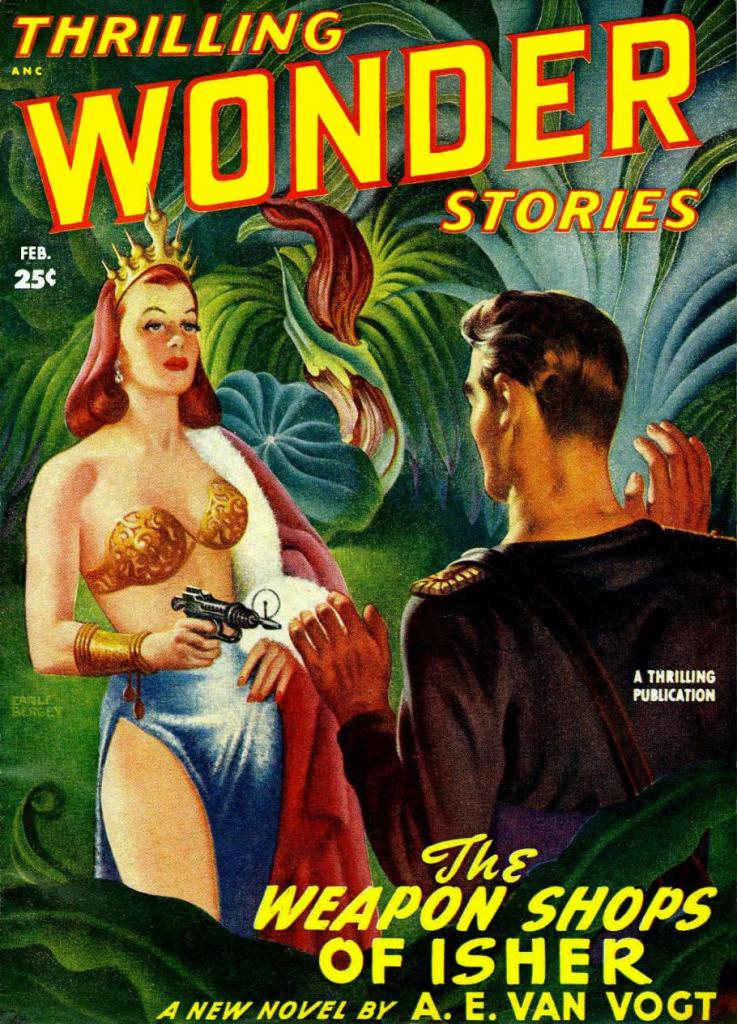
Just for grins, here are some of the covers for Sturgeon’s 1949 publications.
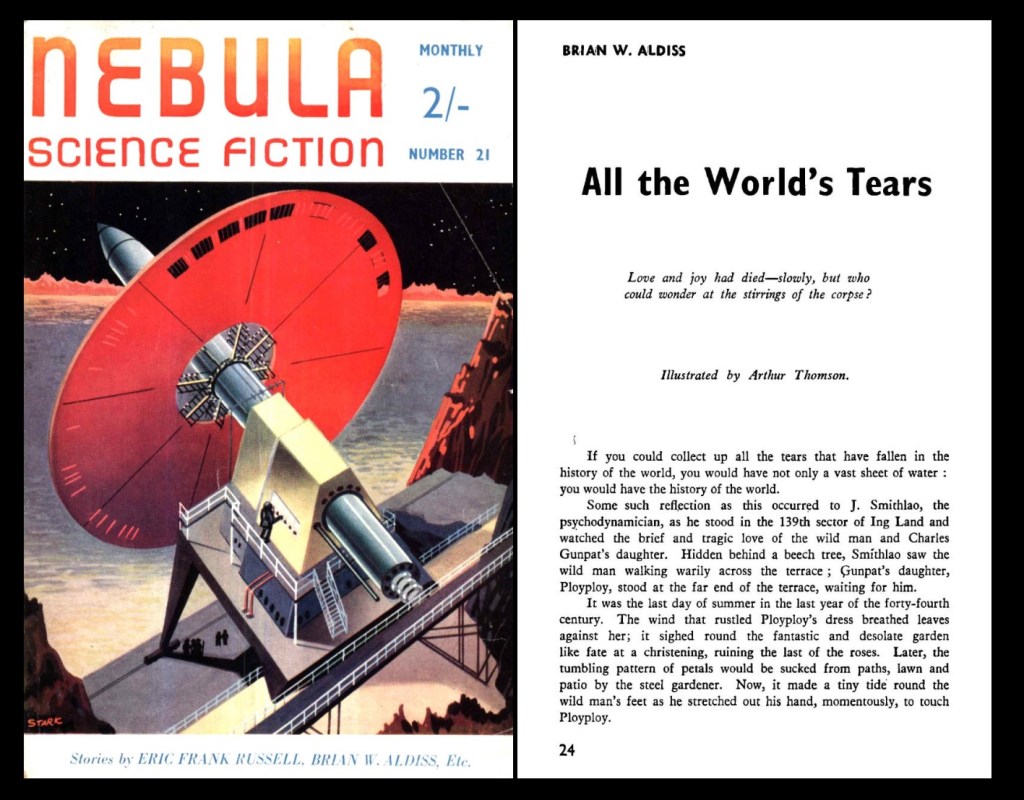
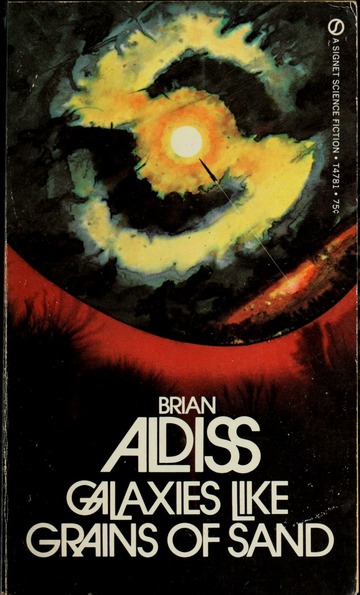
“All the World’s Tears” by Brian W. Aldiss was first published in Nebula Science Fiction 21 in 1957. It has been rarely anthologized, but frequently reprinted in collections of stories by Aldiss. Older American science fiction fans might remember reading it in Galaxies Like Grains of Sand (1960). However, that collection has been republished many times with varying numbers of stories. I don’t recommend the current Kindle edition because it leaves off the story titles, uses the theme titles instead, and runs the intros into the beginnings of the stories. It’s readable but annoying.
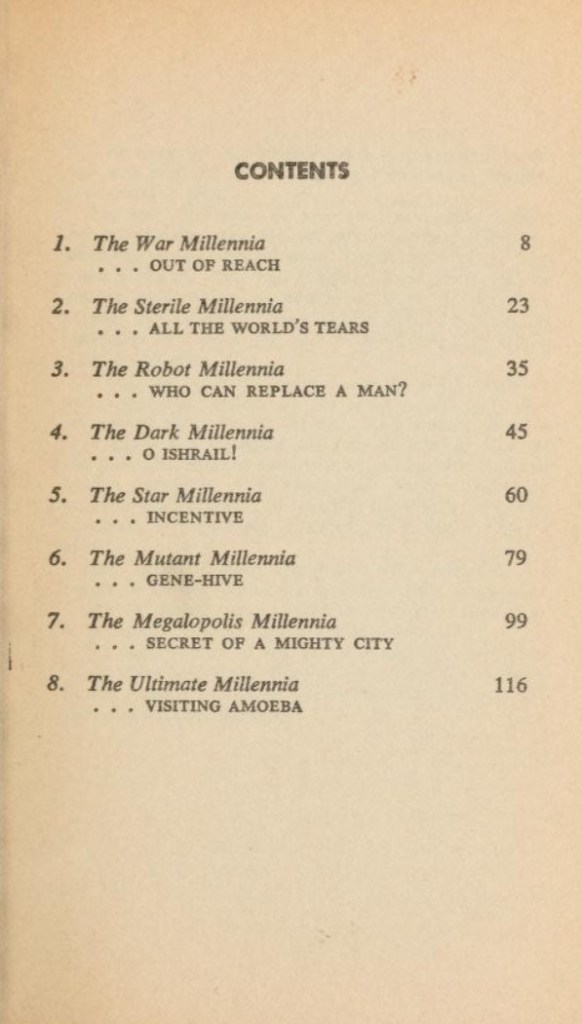
Galaxies Like Grains of Sand is a fixup novel with a mosaic story composed of eight or nine unrelated short stories glued together by imaginative introductions. Sort of like Simak’s City. It feels like a cross between Last and First Men and The Dying Earth.
“All the World’s Tears,” is the second story, under the theme “The Sterile Millennia.” For being such a short short story is dense with ideas, atmosphere, and imagery. The opening sequence, tells us the ending but we won’t know that until we get to the last page and read it. Aldiss has painted a future Earth of stark contrasts. The setting is the far future, the last day of summer of the 44th century. Earth no longer supports billions of humans, just hundreds remain, living in a high-tech society under the control of robots. No one is poor, but civilization is in decay.
Robots control every intent of peapods, bees, birds, and ants. The agricultural land is impoverished, yet wild mother nature is encroaching everywhere. I have to wonder if this is the mid-way point between the mid-20th century and the future of the Hothouse stories Aldiss would soon write.
Strangely, the robots do everything, yet are rather dumb. They monitor all activity, yet talk between each other in clumsy English and can be easily fooled. At one point, a man evades security robots by holding tree branches and telling the robots he’s a rose bush.
Aldiss’ prose suggests vivid scenes for paintings and films. Aldiss is quite imaginative. Both Hothouse and Galaxies Like Grains of Sand could be the basis for wonderful animated films for adults.
“All the World’s Tears” feature four human characters and several robots. The main character of focus of Ployploy. She is a young woman who is considered mentally deficient for being kind and barred from having children. However, Ployplay is well-loved by her father Charles Gunpat. She is judged a hereditary throwback because she is white and can’t express herself with hate and aggression. I can’t but wonder if Aldiss isn’t being racist here by suggesting non-white people are the genetic aggressors. Although he could also be suggesting that whiteness disappeared as the world’s population homogenized, and aggression was another trait that emerged after thousands of years of endless wars.
Observing Ployploy is a visitor, J. Smithloa, who is hired to visit Gunpat’s estate. He is a professional insulter, hired to fire up people’s aggression so they will mate and work to keep civilization going. The fourth character is a wild man sneaking onto Gunpat’s estate. He lives outside the control of the cyber-controlled state and wants Ployploy to run off with him.
Aldiss envisions the future as being extremely regulated, and high-tech, yet, falling into decay, near the end of mankind’s reign on Earth. Wild nature will soon overrun what is left of our civilization. Not only is Aldiss’ picture of our future bleak, but the couple we want to escape this horrible society die tragically.
Why did Aldiss write this story? Why is he so pessimistic? Over the past couple of years, I’ve become a fan of Brian W. Aldiss. Sometimes his works seem more adult, more mature than American science fiction. I assume in the 1950s, Aldiss extrapolated human aggression constantly evolving through natural selection into what he projects in “All the World’s Tears.” I have not read all the stories in Galaxies Like Grains of Sand, but the ones I have contain the same Darwinian cynicism about the future. In these stories, it’s a red tooth and claw existence.
I read this story years ago, and then yesterday, and again today. Each time I found more little nuggets of speculation. The story is both slight and deep. Aldiss included in his collection Man in His Times: The Best Science Fiction of Brian W. Aldiss, a collection I’m group reading on Facebook.
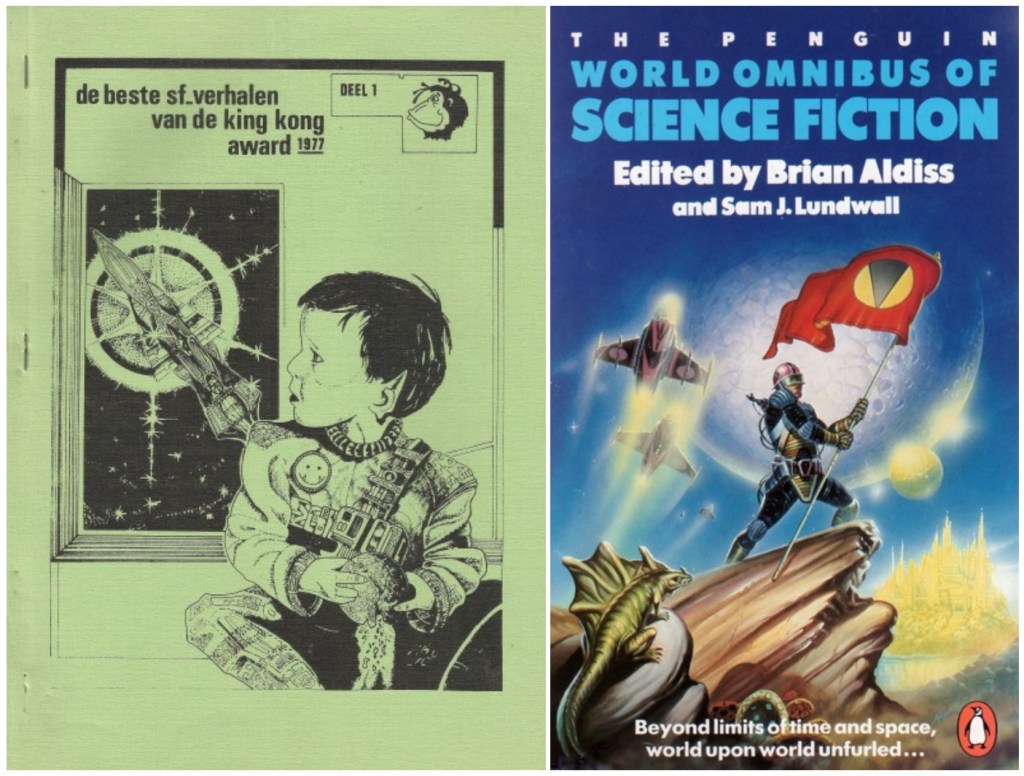
“The Lens” by Annemarie van Ewyck is story #28 of 52 from The World Treasury of Science Fiction edited by David G. Hartwell (1989), an anthology my short story club is group reading. Stories are discussed on Tuesdays, Thursdays, and Saturdays. “The Lens” first appeared in Dutch in De beste sf-verhalen van de King Kong award 1977, deel 1 (Dec. 1977/Jan. 1978). In 1986 it was reprinted in English in The Penguin World Omnibus of Science Fiction edited by Brian W. Aldiss and Sam J. Lundwall.
Annemarie van Ewyck was Annemarie Pauline van Ewijck (1943-2017). She only has three short stories listed in ISFDB and was mainly an editor and columnist. The periodical above where the story first appeared looks like a fanzine to me.
Once again, I find it interesting that my take on a story is different from Hartwell’s. More and more, I’m realizing that The World Treasury of Science Fiction (1989) seems like a precursor to The Big Book of Science Fiction (2016) and that I’m out of touch with both editors. I might just be out of touch with the genre in general. However, with “The Lens” I believe it’s a perfect story for this anthology, and it’s my kind of science fiction.
Here’s Hartwell’s intro:
I thought “The Lens” was quite a nice story, especially effective for being so short, but I didn’t think “The Lens” reflected the mood, tone, or concerns of 1950s science fiction. I don’t know if that era can be generalized, and I wonder if there really is a general style to post-Anglo-American post-New Wave works. “The Lens” doesn’t feel like Bradbury, Zelazny, or Sturgeon to me at all but it does remind me of James Tiptree, Jr., but also Ursula K. Le Guin.
In other words, “The Lens” reminds me of 1970s science fiction written by women, which it is, but can we generalize on that? Is there a common denominator? I don’t think so, other than a female character in an alien society feeling the shock of otherness after undergoing an alien rite. But isn’t that theme also explored by Jack Vance in “The Moon Moth” or Downward To the Earth by Robert Silverberg?
As the years go by, I’m less inclined to believe there was much of a New Wave in science fiction, despite the efforts of Michael Moorcock, Judith Merril, and J. G. Ballard. Yes, there were some experimental efforts, like the kind we saw in New Worlds, England Swings, and Dangerous Visions, but that kind of experimentation had been going on in the literary world for a long time. I believe by the 1960s and 1970s the genre was just getting more diverse writers, and better writers in general, writers who were willing to try different ways to tell a story. By then writing programs were flourishing everywhere.
I also know people get tired of me bellyaching about some stories in these anthologies not being science fiction. That’s not because of how they were written, or by who. I believe science fiction represents a state of mind, and “The Lens” is definitely science fiction, and fits within that state of mind.
The first-person narrator, Dame Ditja, a diplomat, is returning from Earth to Mertcha after visiting their dying mother. We know things are very different when we learn her mother died at age 286. I liked how Dame Ditja described her relationship with their mother and their interaction with the other passengers on the ship. She is returning to the city of Tiel where she is the Head of Cultural Liason.
On Mertcha, the aliens have three arms and three legs, and their architecture and philosophy reflect that difference. Dame Ditja has decided to request a permanent assignment to Mertcha, which she now thinks of as home. She expected to be met at the spaceport by Mik, a local who is her driver and friend, however, a substitute driver meets her instead. That driver thinks she is an ordinary tourist and takes her to a holy place that is a main tourist attraction for people from Earth.
At the Holy Place of Tiel, Dame Ditja has a transcendental experience, one of ecstasy, one that is usually experienced by certain believers in this alien culture. While having this experience, Dame Ditja realizes that radical monks of this faith have trapped some tourists from Earth to hold hostage, and Dame Ditja comes out of her trance and carefully, but forcefully, frees them in a diplomatic coup.
This achievement gets her offered more prestige assignments, and Dame Ditja changes her mind and plans to leave, even though all through the story she wanted to stay.
The ending is strange. Because of the incident at the Holy Place of Thiel, Dame Ditja no longer feels like Mertcha is her home, and thus feels compelled to leave. It appears Dame Ditja wants to die, and she feels she can only die in a place she considers home. I’m not sure why she wants to die or is ready to die, but I wonder if it’s because people live too long in this fictional future?
After reading this story twice I feel it’s closest in style and tone to some stories I’ve read by Brian W. Aldiss. On the first reading, I would have rated this story ***+ but on my second reading, I feel it’s a **** story.
The writer I feel the most philosophically in tune with at the moment is Barry N. Malzberg, especially while reading his 2018 collection of columns from Baen’s Universe (2007-2010) and Galaxy’s Edge (2010-2017) titled The Bend at the End of the Road. I woke up this morning thinking I would write an essay titled “The Skeptics of Science Fiction” about science fiction writers who have come to doubt their genre, or “Why I Read Science Fiction in My Seventies” about how I no longer read science fiction to enjoy the story but to study each story as part of a science fiction history.
Malzberg’s essays do both, and I might still write those essays even though I feel Malzberg has already blazed those trails thoroughly. I have not finished the over forty essays in the collection, but I’ve read enough to sense a common feeling that I think Malzberg and I share about science fiction. I’m going to try and describe that feeling. Malzberg is 12 years older than I am, far more knowledgeable about science fiction, and further down the road of experience.
What I say won’t be what Malzberg says, but I think we’re in the same club. There’s enough resonance that I must wonder if we aren’t in essential agreement. I am not paraphrasing his book, but I’m going to describe how I feel which I believe is how he might feel using different words. Which may be how you feel and convince you to buy his book.
Our reality does not come with a prescribed meaning or purpose. We are all existentialists who must create our own meaning in life. When I was twelve I rejected the religion that was being forced on me and embraced science fiction instead. It wasn’t conscious on my part, and only understandable in hindsight but it’s understandable for the times, 1963. Science fiction, if you understand how I read it makes a good substitution for religion. I thought science fiction was a roadmap to reality and it became my mentor and guidance counselor.
Over the decades I realized this was silly, but I never could shed my love of science fiction. It was my chosen compass and I couldn’t stop using it to guide me even though I eventually became an atheist of my chosen religion. Science fiction promised transcendence and I never forgot that hope. I am like the characters in Hermann Hesse’s Journey to the East who have fallen off the path of enlightenment but achingly and vaguely remember it, and who keep searching to find it again.
Now that I’m older and rereading the science fiction from the 1940s, 1950s, 1960s, and 1970s, the works that shaped my soul, I’ve discovered how I was programmed and have been deprogramming myself. However, I just can’t let my love of those works go. I no longer admire them for what they meant to me when I was young but find meaning in understanding them as a subject of literary scholarship.
Malzberg goes back again and again to examine old science fiction stories that we both read, admired, or disliked. He keeps finding new personal revelations in that effort, and that’s where I’m at too. I often share his insights in stories I’ve reread and am intrigued by the insights in the stories I haven’t, but now plan to.
An important part of the equation is aging. Malzberg and I revere old science fiction and feel modern science fiction has lost its way. But young readers have become the new faithful and reject old science fiction, the old faith. I grew up at a time when science fiction was the bible stories preaching the gospel of the final frontier. The reality of space travel and science fiction parted from each other decades ago. And what science fiction has become is something I can’t believe in.
So Malzberg, and I, and I imagine many others from our generations, have become scholars of science fiction. We’re non-believers like Bart D. Ehrman who specializes in Biblical studies. On one hand, we enjoy the storytelling techniques of a bygone era and we like to understand the stories in their historical context. On the other hand, we are self-psychoanalyzing our own youth and development.
We used to believe we were part of an important movement, but now realize it was very tiny. And that our movement was taken over by the entertainment industry and made into a new opium of the masses.
We all want to believe what we love to read. We all want to believe we have something in common with authors whose fiction and nonfiction we think we agree with. We can never know what something meant in their writing, but human nature makes us want to find people like ourselves. For a while, science fiction gave some of its fans hope of transcendence and a shared belief system. Like most beliefs in this reality, it was mostly illusions, if not all.
I don’t think I could ever write a proper review of The Bend at the End of the Road because Malzberg covers too many topics that I’d want to discuss in detail. I could probably write at least one essay, if not several from reading each of his essays.
“The Phantom of Kansas” by John Varley is story #21 of 52 from The World Treasury of Science Fiction edited by David G. Hartwell (1989), an anthology my short story club is group reading. Stories are discussed on Tuesdays, Thursdays, and Saturdays. “The Phantom of Kansas” first appeared in Galaxy Science Fiction (February 1976). It is currently available in The John Varley Reader: Thirty Years of Short Fiction. That collection is available on paper, as an ebook, and as an audiobook (18 stories — 26 hours and 36 minutes).
A science fiction writer is like an artist with a blank canvas, they can paint anything they can see or imagine. When you look at composing science fiction that way, you have to wonder why some authors put more on their canvas and others less, and where the images come from. With, “The Phantom of Kansas” John Varley decided to lay out his canvas with a series of related science-fictional scenes.
The setting is the Moon — after aliens have taken over the Earth and pushed humans out across the solar system — part of Varley’s Eight Worlds series. Now this image is enough to fill a whole canvas but is merely a small object in the background in this painting. Varley wisely chose not to do an elaborate alien invasion mural, those were old and tired even back in 1976. We are told it’s November 342, so I assume humanity restarted the clock when our home world was snatched away from us. This aspect of the painting does intrigue me, and I wish I could see that section of the canvas expanded.
The plot is a murder mystery. The protagonist, a woman named Fox, has just been revived in a clone body and learns she’s been murdered three times before. So she’s actually Fox 4. Because some murderers in this future like to permanently kill people, they must kill the person and destroy the memory cube that backs up their personality. This murderer has failed three times, why? Fox is told she should expect to be murdered again unless the police can find the murderer first. She doesn’t want to become Fox 5. This is a solid subject for a painting and I would have been satisfied if it was the subject of the whole canvas. However, I wouldn’t have been that impressed, not like I am with the additional imagery Varley squeezes in.
For Varley, this unique murder mystery wasn’t enough to dominate his canvas. We see Fox is an artist who engineers weather dramas. This requires quite a bit of world-building on Varley’s part. Humans who live on the Moon mainly live underground, but they crave being out in nature like humans did on Earth. So giant artificial environments are created that replicate various natural settings from old Earth. Varley calls disneylands. Fox is working on a giant storm symphony that spawns several tornadoes for a disneyland that’s a replica of the Kansas prairie.
The Kansas disneyland is a hollowed-out cylinder twenty kilometers beneath Clavius. It’s two-hundred and fifty kilometers in diameter, and five kilometers high. That’s a huge feat of super-science engineering.
Now this is interesting. Those pesky aliens got rid of humans and all our artifacts on Earth so they could enjoy nature. The human refugees in space long for the wonders of Mother Nature. What should we feel about that revealed in the painting? Back in 1976 when I was young I was dying to go into space, but now in 2023 and I’m old, you couldn’t pay me to go there. Mother nature is the place to be.
But Varley isn’t finished with adding subjects with his brush. He paints another character onto his canvas that vividly stands out, the Central Computer. Varley portrays the computer as it, which I like. Gender is a biological trait. And like Mike in The Moon is a Harsh Mistress, this computer is a quite charming and appealing image.
And there is one other aspect that reminds me of Heinlein. People can change gender. Fox has been a he in the past. And, at first, I thought this was just another added detail in Varley’s scene, but it turns out to be an essential plot element.
I’ve seen “The Phantom of Kansas” before, decades ago, and it impressed me then, except that it depends on one of my least favorite scenarios in science fiction, brain downloading and uploading. And I like that theme even less this time. However, it’s needed for the plot, so I begrudgingly accepted it.
In my judgment of art, science fiction scenes are somewhat realistic paintings, inspired by what we see in reality, whereas fantasy scenes are modern art, paintings inspired by inner visions. I liked this painting better this time because I viewed the painting as a fantasy. It’s a clever image of a murder mystery derived from an interesting series of what-if mental conjectures.
Ultimately, the painting, “The Phantom of Kansas” is elegantly symmetrical. Like any good mystery, all the clues were there, even if they were highly contrived.
I’ve recently reviewed two short stories by Alfred Bester lately where I wondered if Bester didn’t reveal an undercurrent of disdain for the science fiction genre within his brilliant science fiction. Those two stories were “The Men Who Murdered Mohammed” and “5,271,009.” But I also discovered an essay I wrote a few years ago that I’ve completely forgotten, “Blows Against The Empire: Alfred Bester’s 1953 Critique of Science Fiction.” This essay might duplicate what I said before, but I’m using new evidence.
Whenever I read a science fiction story by Alfred Bester I sense a sneer behind his dazzling storytelling. Almost like God chuckling at us behind his creation. Is that just me?
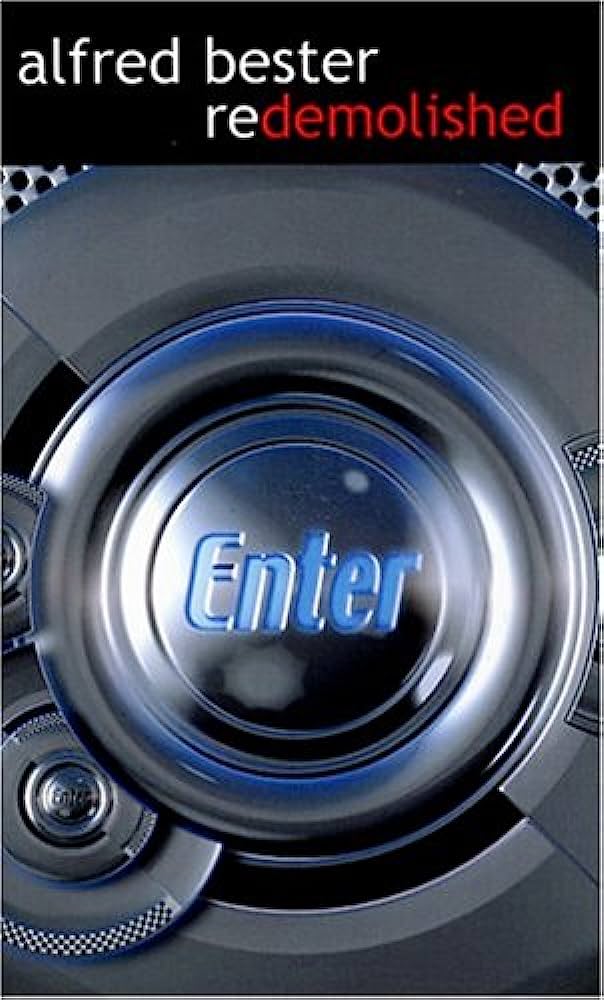
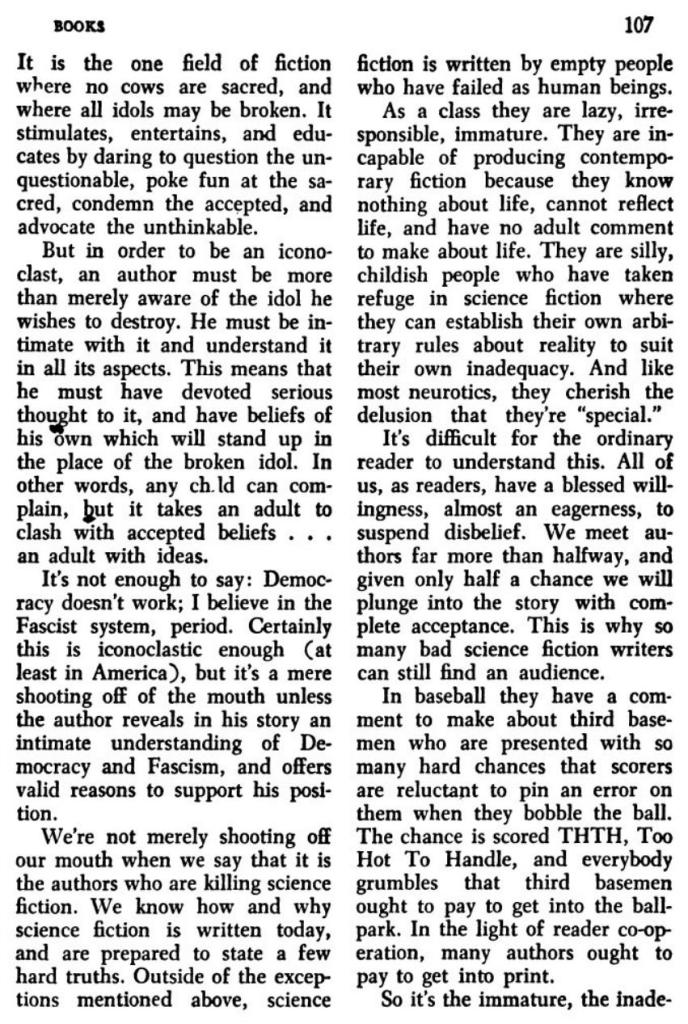
I went off to find out more about Bester and discovered what I needed in a forgotten volume on my shelf, Redemolished. It’s a collection of unreprinted short stories and essays. One essay that stood out for me was, “A Diatribe Against Science Fiction,” which reprints most of Bester’s February 1961 “Books” column from The Magazine of Fantasy and Science Fiction. (Redemolished says May 1961, but it’s wrong.) (The link above is to the collection on Amazon, and the Kindle edition is fairly cheap. I recommend it to fans of Bester.)
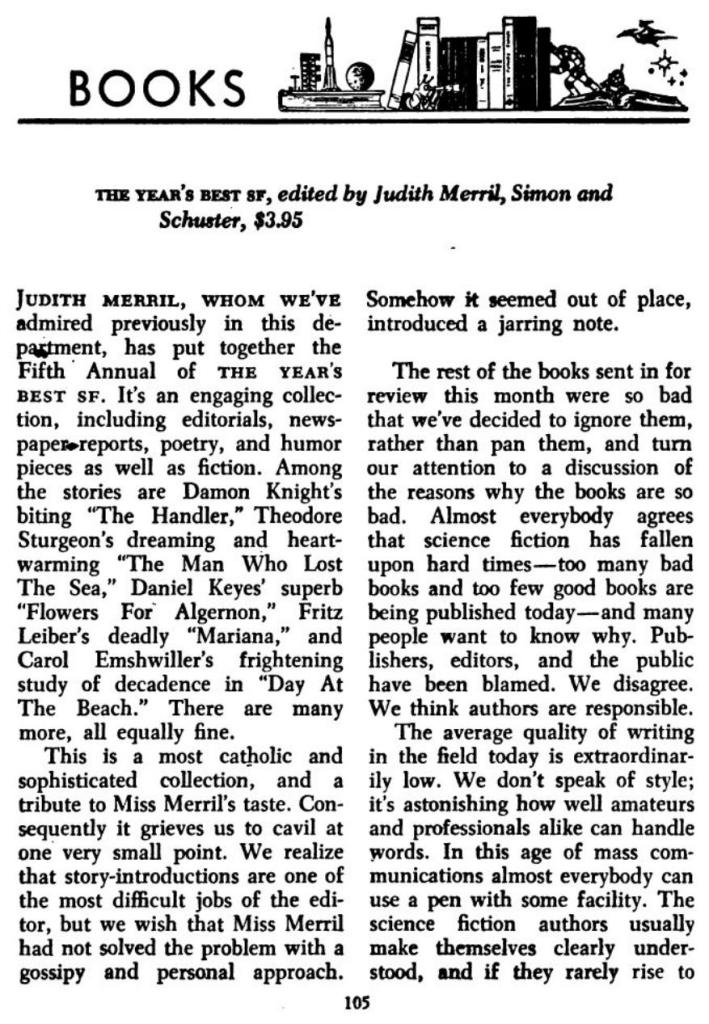
I’m going to post scans of pages from F&SF (and hope I won’t get into any copyright trouble) because I believe Bester’s real feelings about science fiction comes through in them. It’s less than four pages.
Ignore the first paragraph about Merril’s book, although it does point to some classic science fiction short stories that Bester admires, ones I admire too.
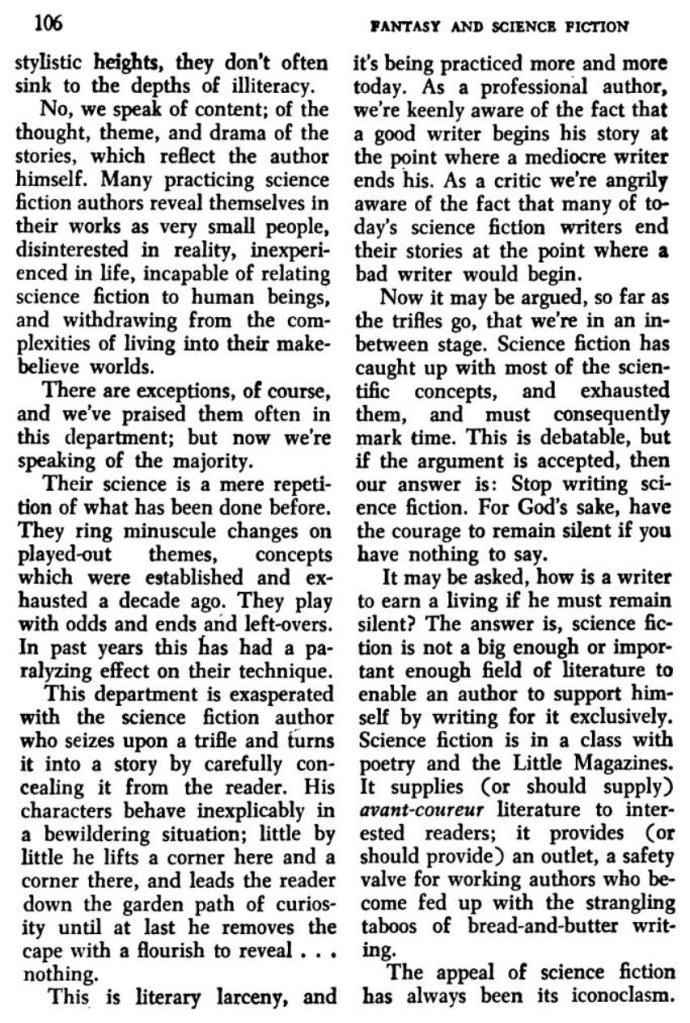
Notice that Bester puts the blame on science fiction writers. He does say that most writers, amateur or professional, can write, but that’s not the problem. And for my point, I’m not really concerned about Bester attacking writers. I’m suggesting you pay attention to his tone. It’s the same tone that comes through in his fiction — I think.
Note the line, “Many practicing science fiction authors reveal themselves in their works as very small people, disinterested in reality, inexperienced in life, incapable of relating science fiction to human beings, and withdrawing from the complexities of living into their make-believe worlds.” Ouch. Reminds me of that Saturday Night Live skit where William Shatner tells the Trekkies to get a life.
Now Bester does make criticisms of writing that I agree with but again, that’s not my point here. I’m trying to gather evidence for how Bester felt when writing his stories. Bester’s stories are extremely clever, so I can’t help but feel that Bester felt he was a giant among the pygmies.
Note the dig where Bester says good writers begin their stories where mediocre writers end their stories, but science fiction writers end their stories where bad writers begin. This could be valid criticism but it’s also pretty dang harsh. Few writers come close to ever writing something as good as “Fondly Fahrenheit.” Who knows, maybe Bester is trying to give new writers some tough love — that he wants to help them out. But his next two paragraphs are equally harsh, even telling potential writers to stop writing science fiction.
Bester then goes into describing science fiction as a genre for writers to be iconoclasts – “It is one field of fiction where no cows are sacred, and where all idols can be broken. It stimulates, entertains, and educates by daring to question the unquestionable, poke fun at the sacred, condemn the accepted, and advocate the unthinkable.”
Wow, is that what Bester thinks he’s doing? His stories are bitter satires. And here’s where I often detect an attack on the genre. Satire has to have an object to attack, and sometimes I think Bester is attacking science fiction. Evidently, even our genre can’t be a sacred cow.
Is he just attacking science fiction writers? Or is it also the readers?
Bester says, “We’re not merely shooting off our mouth when we say that it is the authors who are killing science fiction. We know how and why science fiction is written today, and are prepared to state a few hard truths. Outside of the exceptions mentioned above, science fiction is written by empty people who have failed as human beings.” Damn, now that’s one helluva of a zinger.
But then we get to this attack on science fiction writers – and readers.
Finally, we finish up with an ending that reminds me that Bester left the genre not long after this, and wrote and edited Holiday from 1963 to 1971 when it folded. He then returned to write science fiction. However, the novels written after this, never gain the fame of The Demolished Man and The Stars My Destination.
There are several more essays in Redemolished where Bester attacks science fiction. One, “The Perfect Composite Science Fiction Author” claims to praise seven science fiction writers, but damn, if that’s praise, I’m not sure any of those writers would want it. It’s in the March 1961 issue of F&SF, in case you have a copy.
I plan to read all of Redemolished, and Bester’s two collections I own, Starlight, an old SFBC omnibus that reprints two early paperback collections, and Virtual Unrealities, which is currently in print. However, that will take some time.
“Special Flight” by John Berryman is story #3 of 52 from the anthology The World Treasury of Science Fiction edited by David G. Hartwell (1989) that my short story club is group reading. Stories are discussed on Tuesdays, Thursdays, and Saturdays.
Editors assembled anthologies to reprint and promote stories they believe people should read — stories they feel should be kept alive. I have to wonder why Hartwell selected “Special Flight” because to most modern readers, or even readers in 1989, the story is a clunker. Kingsley Amis and Robert Conquest selected “Special Flight” for their anthology Spectrum in 1961, but other than those two anthologies no other editors have wanted to save this story from oblivion.
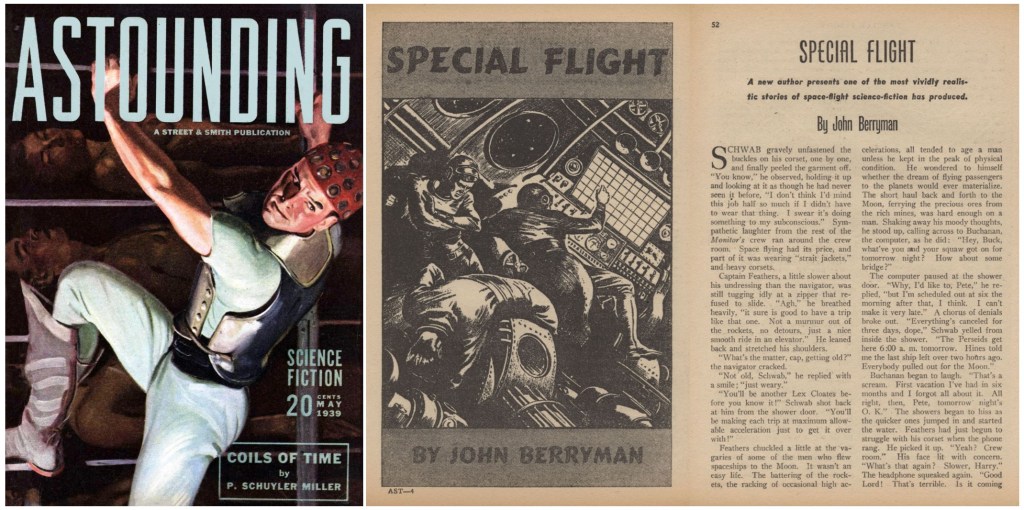
John Berryman, according to ISFDB, only published 21 science fiction stories, and some of them were occasionally reprinted. However, John Berryman is not a name I remember. He is a forgotten author. So why read his story in 2023? I’ve never read “Special Flight” before, or even heard of it, but it’s an impressive science fiction for 1939 if you think about it in a certain way. “Special Flight” was first published in the May 1939 issue of Astounding, just months before the July issue that many consider the first issue of the Golden Age of Science Fiction. Then why didn’t Hartwell choose one of the more famous stories from that year?
Reading “Special Flight” brings up a long queue of questions. The sole quality that makes this story impressive is it tries to scientifically imagine routine space flight in 1939 in a realistic manner. So, do I recommend you track it down and read it? Not really, because it gets the science all wrong. However, if you happened to have an academic bent and like to study science fiction as a subject, then “Special Flight” is an interesting read.
If you’ve ever wondered how people in 1939 imagined space flight actually working, and not just being silly Buck Rogers stuff, “Special Flight” can provide some answers. Berryman was trying to imagine a near future where we mined the Moon for minerals and rocketships were much like merchant ships or cargo aircraft. “Special Flight” reminds me of what Heinlein was trying to do in the 1950s and it also reminds me of the original Star Trek.
Shouldn’t we forgive “Special Flight” for its mistakes if it was solid scientific speculation in 1939? Jules Verne got nothing right scientifically in Journey to the Center of the Earth but it’s still a well-loved story today. Why? Because the storytelling is fun. Then what about the storytelling in “Special Flight?” It’s not bad but it’s not great either. It’s about the level of a science fiction B-movie from 1953. Remember all those old black-and-white movies where the big danger of space flight was meteors? That’s what happens in “Special Flight”
“Special Flight” is action-packed. It’s about an emergency rocket flight to the Moon to save the lives of over a hundred miners. Everything possible that could go wrong does, including a giant tank of milk busting and flowing all over the rocket ship. Berryman spends a lot of his wordage on math and navigation and not that much on characterization. The crew is often knocked around like Captain Kirk and his crew — remember how the actors threw themselves around on the sets of Star Trek? In other words, the action is cheesy. But on the other hand, the focus is on getting to the Moon, and quite a lot of detail that Berryman imagined feels realistic. For instance, Berryman imagines that spaceflight causes tiny blood clots in the brain that produces a list of effects that can make operating a spaceship difficult. He talks about the three-body problem, something I didn’t know about until I read the Cixin Liu book. He imagines an automatic pilot and system that controls chemical rockets to maneuver in space while atomic rockets provide the main thrust using water as fuel. He talks about orbital velocities, g-forces, and take-off speeds. Stuff that just wasn’t in science fiction in the 1930s.
If you like to chart how science fiction evolved or are curious about how people before WWII imagined realistic space travel, then read “Special Flight.” If you’re used to modern well-told science fiction stories, you’ll probably want to skip it.
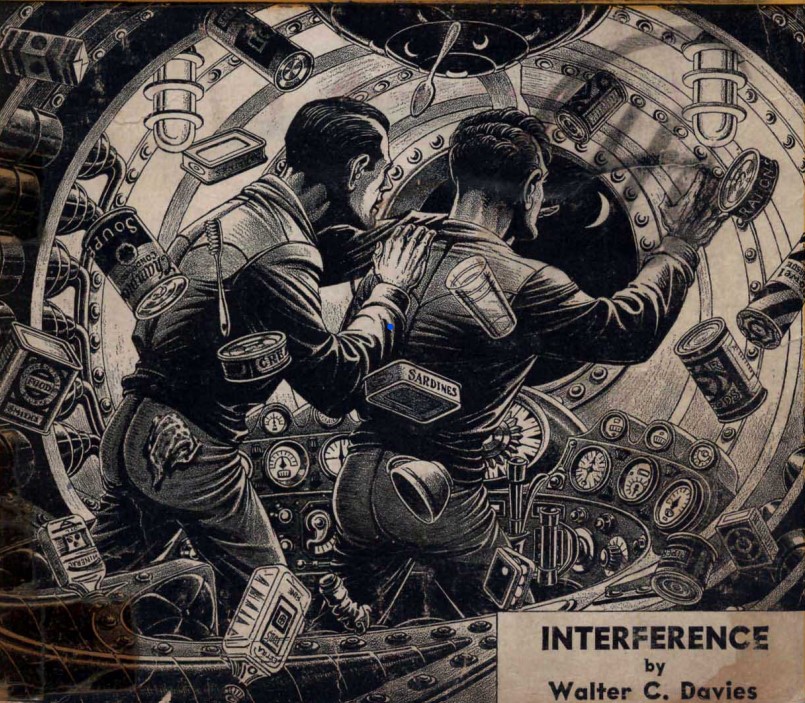
By the way, here’s an illustration from the cover of Cosmic Stories (July 1941) that imagines being in space in a rather realistic way for the time. I do like picturing how people imagined space travel before NASA. That’s why I enjoyed “Special Flight.”
“Harrison Bergeron” is a political satire set in the year 2081. Kurt Vonnegut imagines everyone is not only equal under the law but handicapped to be made equal in all ways. Stronger people are weighed down, talented people are made less talented, and intelligent people have to wear earplugs that make various kinds of noises to distract them from thinking deeply. In this rather short story, George and Hazel Bergeron are watching a ballet on television. They have forgotten their 14-year-old son Harrison has been arrested for being too handsome, too smart, and too strong. During the course of the TV show, their son appears on the ballet stage having escaped to start a rebellion. (You can read it here, or read a detailed synopsis on Wikipedia.)
“Harrison Bergeron” is not a subtle satire, instead it goes for the absurd. It’s a very likable story. Vonnegut tells it in simple language with vivid details. You immediately agree with him that this dystopian world is wrong. This short story has become quite famous, having been adapted to the screen four times. National Review, the conservative magazine founded by William F. Buckley even reprinted the story. The National Review keeps using “Harrison Bergeron” – here’s it being used again in 2015 against economic inequality in “Inching Towards ‘Harrison Bergeron.’“
Usually, satire attacks something, and I have to wonder what Vonnegut was attacking. While reading it I thought maybe he was protesting laws designed to create equal opportunity. Then when I read about National Review and that Supreme Court Justice Antonin Scalia quoted the story in PGA Tour, Inc. v. Martin then I began to wonder even more. And it’s referenced in academic papers, including a 2013 one about transgender athletes. I thought Vonnegut was liberal. Wikipedia did say he wasn’t against his story being used in a Kansas court situation, he didn’t agree with their interpretation.
So why have conservatives embraced “Harrison Bergeron” so thoroughly? Are they using its satire the way Vonnegut intended? A site called What So Proudly We Hail promotes the story with a very pointed introduction:
Central to the American creed is the principle of equality, beginning with the notion that all human beings possess certain fundamental rights and equal standing before the law. Our concern for equality has expanded over the past half century to focus also on inequalities in opportunities, wealth, achievement, and social condition. What good is an equal right to pursue happiness if one lacks the native gifts or the social means to exercise it successfully? In this satirical story (1961), set in a future time in which “everybody was finally equal . . . every which way,” Kurt Vonnegut Jr. (1922–2007) challenges our devotion to equality and invites us to consider the costs of pursuing it too zealously. Although the story is not explicitly about racial, ethnic, or gender equality, the questions it provokes about the kind of equality we should want, and the costs of pursuing it, are relevant also to campaigns to eliminate inequalities among racial and ethnic groups or between the sexes. Does the society portrayed here represent a fulfillment of the ideal of equality in the Declaration of Independence, or rather a perversion of the principle? Does opposing invidious distinctions, envy, and feelings of inferiority require reducing all to the lowest common denominator, and is this the true path to “social justice”? Would homogeneity attained by artificially raising up the low, producing a nation of Harrisons rather than a nation of Hazels—a prospect offered by biotechnological “enhancement”—be any more attractive?
The story does resonate with conservative thinking and even more so today. Are there other ways to read it? On the surface, the bad guys in the story are the government and laws that try to make everyone equal in every way. However, was that what Vonnegut was protesting. Was he all fired up and wrote this story the way the conservatives have used it?
I have no idea, but I do wonder about something. Vonnegut’s story is silly, absurd, and far from real. Vonnegut was often silly and absurd. I wonder if he just didn’t get the idea of a government taking the idea that everyone should be equal, and imagining how they could go about making it happen. It was published in a science fiction magazine. If Vonnegut was serious about his satire, why didn’t he publish it in a serious magazine? And back then, bizarre speculation on social change was common in SF stories.
The story came out in 1961, well before the liberal sixties. Eisenhower was probably president when he wrote it. A similar idea about making everyone equal had been used in the 1959 novel, The Sirens of Titan. In the 1950s the main political push to make people equal was providing equal education to African Americans. And that effort was to make people better educated, not dumber. My guess is “Harrison Bergeron” is based on a silly idea that came to Vonnegut and he wrote a story to illustrate it. Conservatives have just run with it.
What’s also interesting is Hazel, the wife, has no handicapping applied to her. She’s average. Was Vonnegut saying something about women? 1961 was also before the Second Wave of feminism in the 1960s. Was he being liberal to make the Handicapper General of the United States, a woman? She had the funny name Diana Moon Glampers? Was this a dig at women?
I don’t think I’ve read “Harrison Bergeron” before. Its basic idea is so memorable that I can’t believe I’d forget it. I could have since it’s been around since the October 1961 issue of The Magazine of Fantasy and Science Fiction. It’s also been reprinted quite often and I could have read it and thought it so absurd as to be completely minor, and did forget it. “Harrison Bergeron” has 9 citations in The Classics of Science Fiction Short Stories v. 2. I just read it because our short story club has just started reading The Treasury of World Science Fiction edited by David G. Hartwell. That anthology is a monster of over one thousand pages of classic science fiction where Hartwell also introduces science fiction from around the world.
Despite its fame, I still think “Harrison Bergeron” is a silly story. I’d only rate it ***+ in my system – three stars mean well-written, and a + means I liked it a lot. Four stars would mean it’s a story I’ll want to reread now and then, and I don’t feel that.
I’m going to try and review as many of the stories as possible from The Treasury of World Science Fiction. I haven’t given up on my Heinlein project, but after gorging on his work for months, I’ve been taking a break. I’ve wanted to get into a science fiction novel I never read but I’m still on a short story kick.
The primary value of science fiction is introducing readers to new concepts. Take time travel – it’s a mind-blowing concept. But how many stories about time travel do we have to read before the concept loses its sense of wonder, or even becomes boring? When do we say: “Hey, I get the idea!”
My mother spent her whole life reading who-done-its, but I got burned out on the concept in my twenties. On the other hand, I’ve been reading about certain science fictional concepts my whole life. Why don’t I get burned out? I think I did, but I just keep reading science fiction hoping to find new concepts that will reignite those old thrills. Along the way, I’ve had to read mouldy concepts so many times that they’ve become boring.
However, let me clarify something. Fiction can approach a theme in two ways. First, the theme can be the focus of the story, or second, it can be the setting. When a theme is new, writers tend to explore it, but when it’s old, they use it for the background of their plot.
After finishing Beyond Armageddon edited by Walter M. Miller, Jr., and Martin H. Greenberg, an anthology of twenty-one post-apocalyptic stories about atomic warfare, I realized I’m burned out on that theme even though it’s always been one of my favorites? Why? That’s hard to say, but some stories overcame the problem of overexposure by focusing instead on the storytelling and characters and using the theme as a background. Others were original classics that I exempt from aging.
Walter M. Miller, Jr. is famous for writing A Canticle For Leibowitz, an uber-classic SF novel on the theme of a post-apocalypse caused by nuclear war. However, he had disappeared from the genre in the 1960s and 1970s. Evidently, he saw the 1984 British film, Threads, about surviving a nuclear war winter and it inspired him to edit this anthology. He mentions Threads several times in his main introduction and in the introductions to the stories. Miller said the main focus of the anthology was nuclear wars, especially a large-scale conflict which he called megawar.
It’s possible to read one post-apocalyptic novel or short story every so often and keep the theme interesting. You just don’t notice that writers seem to find a limited number of insights into that concept. Reading twenty-one stories in a row only emphasizes the finite number of subthemes. Miller chose to only focus on nuclear war apocalypses but I’m not sure how civilization is destroyed that matters for some of the subthemes.
I’m going to try and define those subthemes by citing the different stories. And I’m going to point out how some stories stand above the theme and why.
Because Beyond Armageddon is out of print I’ll link the first mention of the story titles to ISFDB.org to show where the story has been reprinted. You might already have another anthology or collection that has it. If there’s a significant article about the story in Wikipedia or elsewhere, I’ll link it in the second mention of the title. This anthology is being discussed on Facebook and if you’d like to read the threads about each story follow this link.
#1 – “Salvador” by Lucius Shepard (F&SF April 1984)
“Salvador” doesn’t involve nuclear war, but it’s about the dangers of escalating wars on civilian life and civilization. The protagonist, Dantzler, is a soldier in the near future fighting in Central America. Remember, this was written during Reagan’s administration and our secret war in Nicaragua. In the story, the Army uses powerful mind drugs to make soldiers super-aware, aggressive, and brave. The story feels like a cross between Carlos Casteneda’s books and the film Platoon.
I don’t think “Salvador” fits the theme of Beyond Armageddon, but it was an extremely popular story that came out during the time the book was being edited. I think it resonated with Miller’s anti-war feelings so he included it. It’s also the second newest story in the anthology. It doesn’t deal with the subject of this essay either. I would have left it out and picked another story that did. However, “Salvador” is an impressive story.
“The Store of the Worlds” is a story that at first doesn’t seem to fit the theme of the anthology either, however, Robert Sheckley is brilliant at tricking us into seeing a philosophical insight about nuclear war. When our reading group discussed “The Store of the Worlds” it was highly admired.
This story is one that focused on the theme of a nuclear war post-apocalypse and is squarely aimed at the theme, but I believe “The Store of the Worlds” should have been the last story in the anthology.
Rating: *****
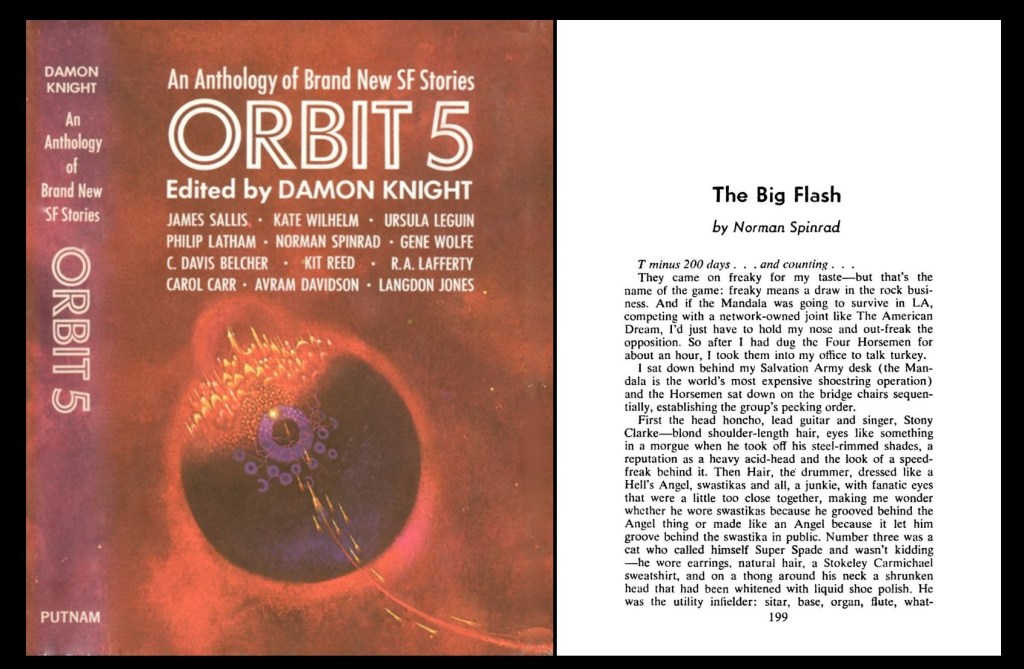
#3 – “The Big Flash” by Norman Spinrad (Orbit 5, 1969)
“The Big Flash” is about a rock and roll band that has explosive success. Its satirical humor reminds me of the film Dr. Strangelove, and the storytelling outshines the theme. Like the movies Dr. Strangelove and Fail Safe, the story is pre-apocalyptic. The first three stories in this anthology are really about our madness. Science fiction does two things. It promotes futures we’d like to see, and warns us about futures we should avoid. The first three stories in this anthology are all warnings about humanity being insane.
I’m not sure Spinrad wrote this story to protest nuclear bombs. It’s a gonzo story about rock and roll.
“Lot” is the story that should have been first in this anthology. It came out in 1953, probably during the peak era of atomic war paranoia. “Lot” is completely focused on the theme and defines many of the standard attributes of post-apocalyptic fiction. “Lot” is a wet dream for survivalists and preppers, defining their key philosophical creed. Once civilization falls, survival of the fittest is everything. Mr. Jimmon and his family flee Los Angeles just after it’s been nuked. Mr. Jimmon instantly embraces survivalist thinking while his family can’t stop thinking with a civilized mindset even as they race away from the mushroom clouds.
“Lot” is one of my all-time favorite science fiction short stories. It’s brutal. It’s a story of cold equations before the classic Tom Godwin story. It’s one of my prime pieces of evidence that 1953 was the peak year for short science fiction.
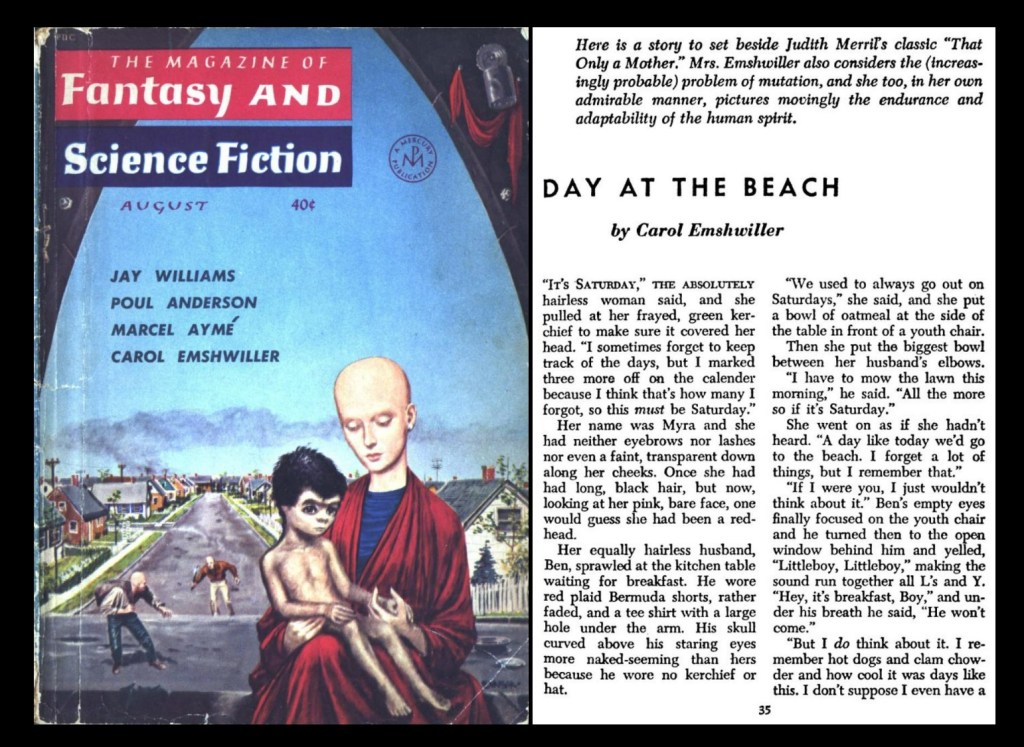
“Day at the Beach” is another story that focuses beautifully on the theme. Carol Emshwiller describes life after the bomb, living with radiation. Like many science fiction stories in the 1950s, it speculates about mutations as a consequence of radioactive fallout. Myra and her husband Ben, who are bald, take their son, Littleboy, who has lots of hair, for a day out at the beach. Littleboy is a mutant. Life is grim, but people keep on living.
This story features two of the main subthemes of a nuclear post-apocalypse. The primary one is survival after the bomb and the second is mutants.
Rating: ****
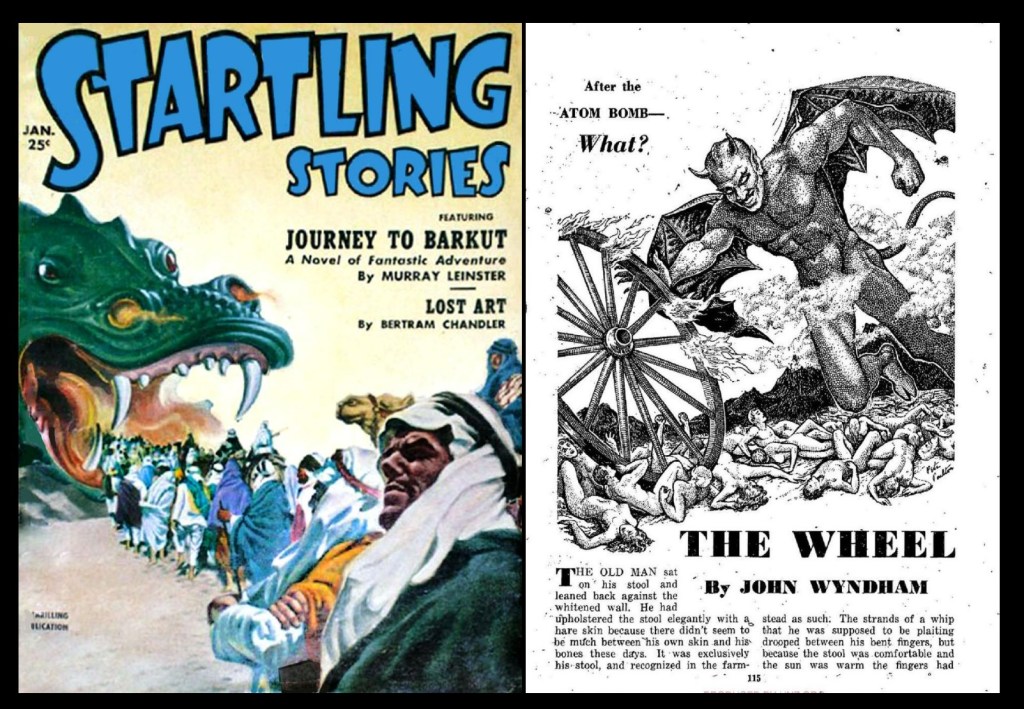
#6 – “The Wheel” by John Wyndham (Startling Stories, January 1952)
“The Wheel” introduces us to another classic subtheme of post-apocalyptic fiction. It suggests that after civilization collapses society will revert to earlier social constructs. I’ll call that subtheme, a devolved society. In this case, a superstitious society like early America and the Puritans. This was common speculation about post-apocalyptic life in the 1950s. A classic example is The Long Tomorrow by Leigh Brackett. “The Wheel” is tightly focused on painting the theme. The concepts are in the foreground, although there’s a good story.
Interestingly, “The Wheel,” “The Store of the Worlds,” and “Lot” have surprise endings. I wonder if that’s a factor in them being remembered and reprinted. All these stories are jammed with ideas about how post-apocalyptic life will be different. Yet, they all use good storytelling techniques to express these ideas. In other words, they have a message, but it doesn’t dominate the story.
As we progress through Beyond Armageddon these speculative ideas get repeated and newer writers elaborate on them. But eventually, I believe it gets harder to come up with fresh perspectives.
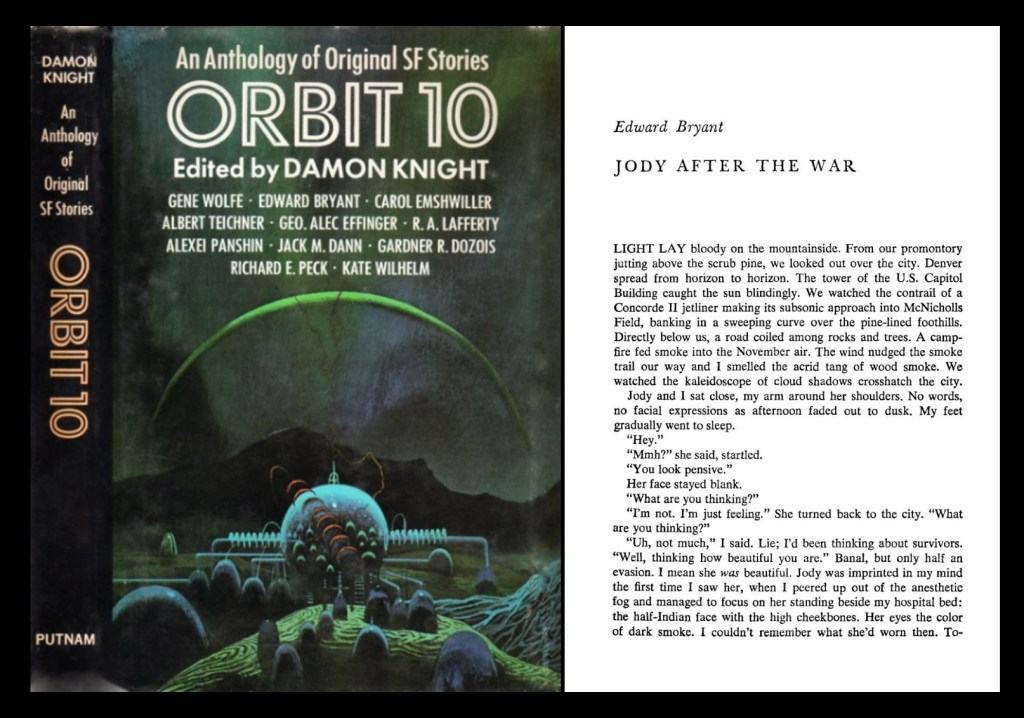
“Jody After the War” is where the theme shifts from the focus of the story to the background. The eastern U.S. has been destroyed in a nuclear war, and the capital is now in Denver. Paul and Jody are up in the hills and are having a day outside like Myra and Ben, but they have no child. Jody can’t have children because she’s a survivor of an atomic bomb explosion. This story is more about their relationship and less about the post-apocalypse. Civilization hasn’t been destroyed, but it’s been wounded and suffers from PTSD.
In “The Terminal Beach,” Traven, a deeply depressed man sneaks onto an island where they’ve been testing atomic bombs. This surreal tale is one of my favorites in the anthology. Because I’ve been reading and watching documentaries about South Pacific atom bomb tests, this story was exceedingly vivid to me. This is another story that’s not post-apocalyptic, at least for the whole world, but Traven inhabits a post-apocalyptic landscape. I feel “The Terminal Beach” captures the psychic horror we felt back in the 1960s.
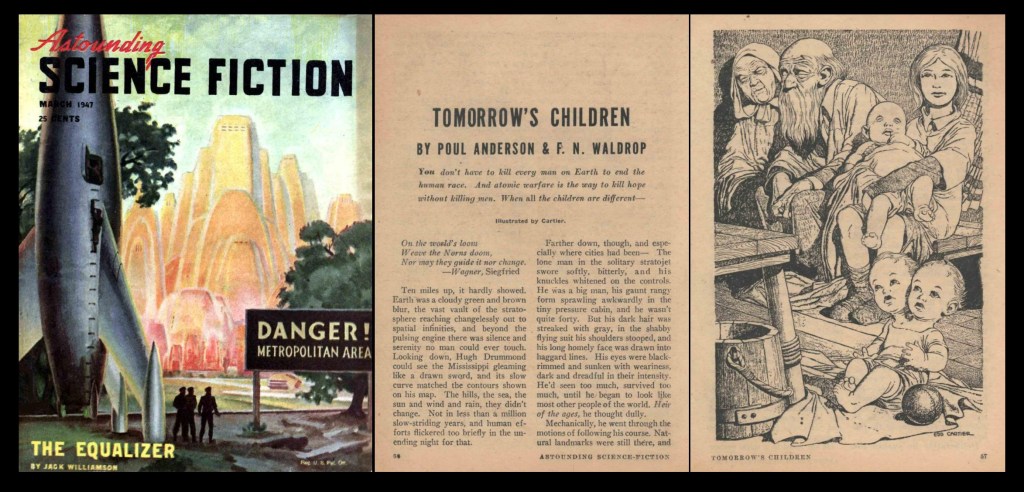
“Tomorrow’s Children” is another story about mutants. There’s quite a bit of scientific talk in this story. Coming just two years after Hiroshima I’m sure the world was full of such speculation. Interestingly, the focus of this story is anti-prejudice. Anderson’s message tells people to ignore what people look like and accept everyone for being human.
Rating: ***+
#10 – “Heirs Apparent” Robert Abernathy (F&SF, June 1954)
In “Heirs Apparent,” Robert Abernathy puts his American protagonist, Leroy Smith, a visiting scientist, in Russia after a nuclear war has destroyed both countries. Russia has been bombed back to serfdom. Smith helps survivors trying to restart agriculture with his professional knowledge. Unfortunately, for a small village, a survivor, Bogomazov arrives there. He’s a member of the Communist party and demands to be the leader forcing everyone to work collectively. Smith goes along. He has no choice. Abernathy uses this story for a lot of infodumping and speculation, but the main gist of the story is capitalism and communism will be useless after the apocalypse.
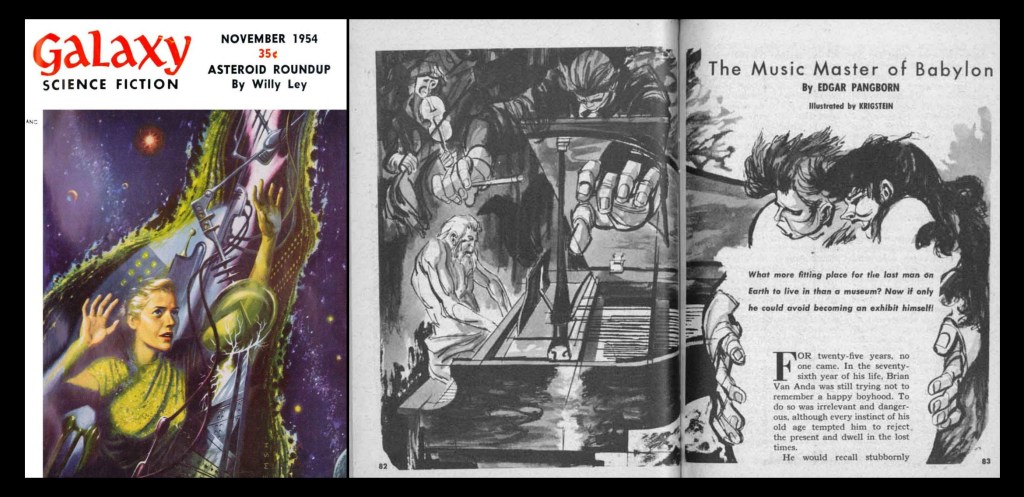
This is another old favorite of mine, but an ideal form of post-apocalyptic fiction for me too. 76-year-old Brian Van Anda survives the apocalypse alone, living in a flooded New York City in the Hall of Music museum. I love post-apocalyptic stories about the last man on Earth, but as usual, they are never the very last person. Van Anda survives inside the decay of the city, scourging food the best he can. Weather permitting, he doesn’t even wear clothes. His only regard to civilization is playing the piano, working to learn a very complicated piece he wanted to perform before the bombs. Eventually, two young people find him. They live like primitive nomads. They had a leader, an old person who guided them, that’s died. They are out searching for a replacement old person because they need guidance. They also want to get married and that requires an old person.
The two major subthemes are living alone after the apocalypse and society reverting to tribal hunting and gatherers.
Rating: *****
#12 – “Game Preserve” by Rog Phillips (If, October 1957)
“Game Preserve” is another story of mutants, but a rather sad, painful one. It’s told by Elf, a child who lives in a strange tribe of human-like creatures. Their cognitive abilities are about equal to chimpanzees, but they all have a fetish. I don’t want to spoil the story, but it’s brutal. It’s another cold equations story.
“Game Preserve” takes the theme and uses it for a rather unusual setting. The focus is no longer the post-apocalypse, but something deep and psychological. I don’t know if Phillips was merely being sensational, or if he wanted to bring up a philosophical conundrum.
Rating: ****+
#13 – “By the Waters of Babylon” by Stephen Vincent Benét (Saturday Evening Post, July 31, 1937)
“By the Waters of Babylon” is a classic. If Stephen Vincent Benét had read and known about “The Scarlet Plague” by Jack London and After London by Richard Jefferies then his story is an update of those classic post-apocalyptic tales. If he hadn’t read those classics, then it’s a case of rediscovery of a classic concept. I don’t know how old the idea is that if civilization collapsed it would revert to a tribal society. I’d love to read a literary study of that idea.
I’ve seen this reversion theme over and over again. Sometimes it’s back to a hunting and gathering, sometimes the apocalypse knocks us back to a tribal society, and sometimes to a feudal society. And sometimes just to the 19th century. It’s very logical when you think about it.
I love “By the Waters of Babylon.” It has a tremendous sense of wonder. However, over the decades I feel subtheme has been overused. I sometimes wonder if writers merely want a setting that’s pre-modern and use an apocalypse to get them there.
This subtheme demands two other themes. First, why don’t we see new forms of society? And second, why don’t we see more stories about a healed, mutated, or changed modern civilization. “Jody After the War” was one possible example, but it didn’t work out the ideas of the subgenre in the way I’m suggesting. Think about it, what if a nuclear war killed 50% of current Americans but left the other 50% to rebuild. Wouldn’t we just patch up the broken parts and keep going the way we were? Japan and Germany rebuilt and became better than ever. Why don’t we see that in this post-apocalyptic tales?
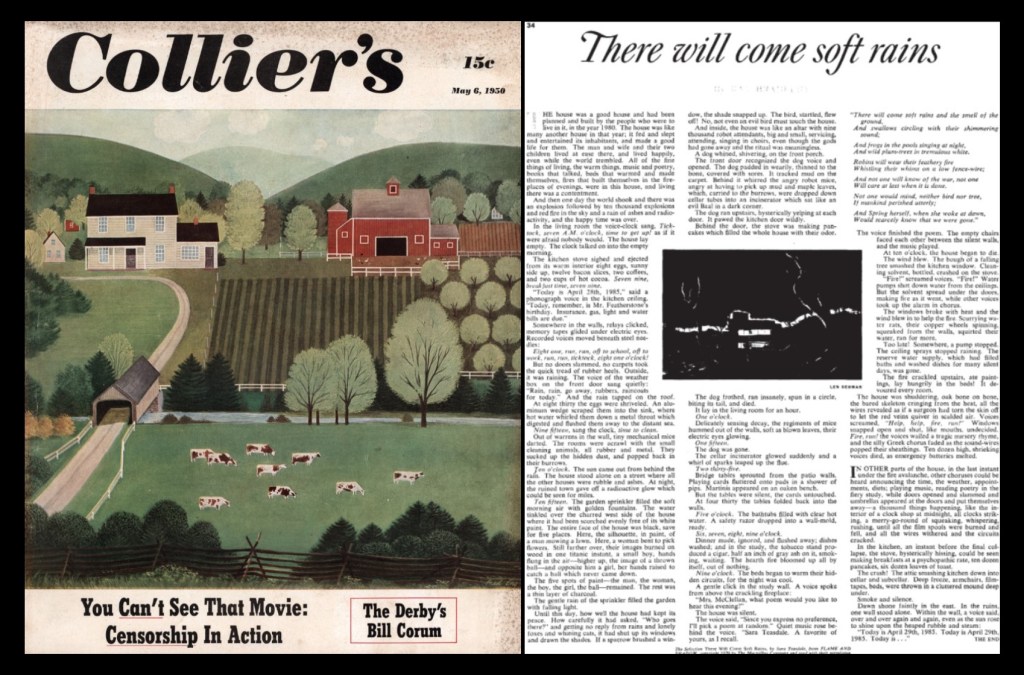
“There Will Come Soft Rains” is another classic. Ray Bradbury imagines people completely gone, and our automated civilization working without us – for a while. We don’t know if this is world-wide or just in the city that got bombed. This rare subtheme, life after people, is one I love to contemplate. Bradbury anticipates the book The World Without Us by Alan Weisman, a nonfiction book about what would the world be like if people suddenly disappeared. It inspired two television shows. Follow the link to read more.
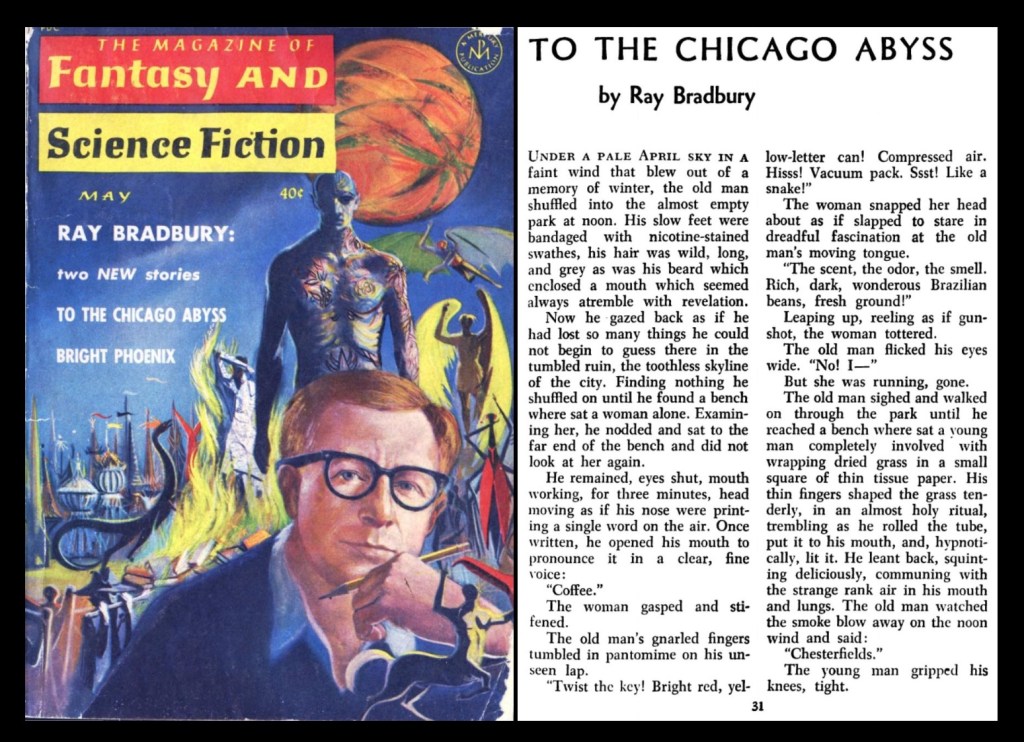
“To the Chicago Abyss” reminds me of the Sheckley story. In it an old man annoys people in a post-apocalyptic world by constantly reminding them of things that no longer exist. Since we have two stories in this anthology on this topic I guess that makes a subtheme – what we’ll miss.
Rating: ***+
#16 – “Lucifer” by Roger Zelazny (Worlds of Tomorrow, June 1964)
“Lucifer” is another story about what we’ll miss. It feels like a last man on Earth story. Carlson, the protagonist returns to a dead city to repair generators and get the lights going. The light flare up for a few seconds, and then go out again. But it’s enough to remind Carlson of what life was once like. This story reminds me of the 1959 Harry Belafonte film, The World, The Flesh, and the Devil.
Rating: ***+
#17 – “Eastward Ho!” by William Tenn (F&SF, October 1958)
William Tenn cleverly unwinds the clock on Europeans settling North America. He imagines Native Americans reestablishing control of the continent after a nuclear war. The title, “Eastward Ho!” is a play on the famous saying “Go west, young man.” The story really isn’t focused on the post-apocalypse theme, but instead it’s a satire on American hubris. It’s a fun story. It really belongs to the subtheme of what will we build next. That subtheme gave authors a chance to imagine all kinds of societies.
The thing is, no civilization lasts for long, The history of our species is trying out all the possible combinations of societies. So apocalypses just the way we start over and try something new.
“The Feast of Saint Janis” is the second story in this anthology that uses the apocalypse to create an exciting rock and roll story. I guess the subtheme could be called rebuilding America, but like Spinrad and Ellison, Swanwick is using the postapocalyptic setting to stage a gonzo story. And I consider this one superior to the other two. Swanwick imagines a situation where a woman volunteers to become the reembodiment of Janis Joplin. It’s a striking story.
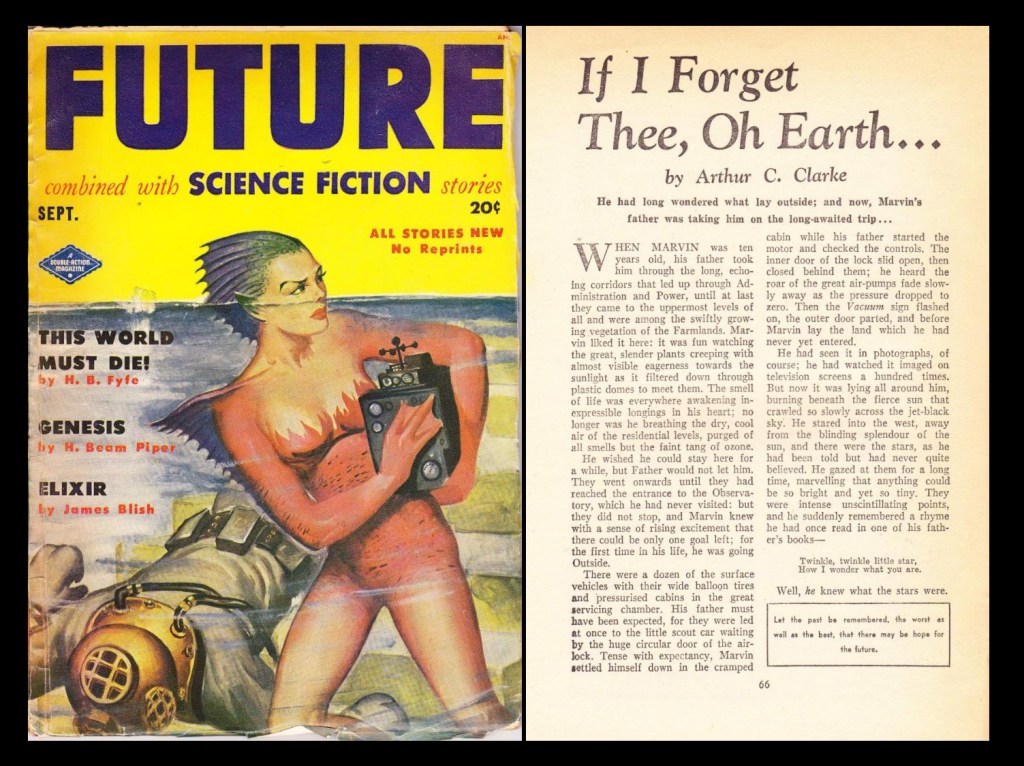
“If I Forget Thee, Oh Earth…” is a different take on the nuclear post-apocalypse, although to tell you why would spoil the story. This is both early and minor Clarke, but it’s still readable.
Rating: ***
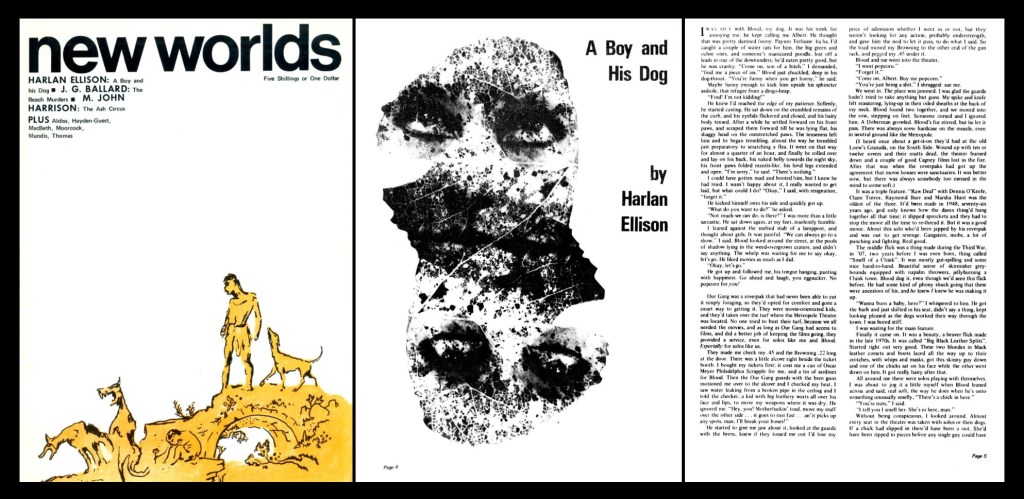
#20 – “A Boy and His Dog” by Harlan Ellison (New Worlds, April 1969)
“A Boy and His Dog” is a famous novella by Harlan Ellison that earned a Nebula award and was made into a movie in 1975. The setting is a post-apocalyptic America where on the surface men live like a Mad Max movie, but in silos beneath the surface, the good and righteous exist in clean and orderly cities. This is a perfect example where Ellison uses the post-apocalypse as a setting for his story about sex and violence. It has nothing to say about the theme, and its real goal is to be sensational. And boy is it sensational. It’s an exciting and classic science fiction story but I don’t think it fits in this anthology.
Miller maintains an outrage about politics throughout all his introductions, and he’s seriously protesting against nuclear war. I don’t see this story as a protest, nor is it a serious take on his theme. And it will be problematic for modern readers because Vic, the protagonist is a serial rapist who uses a mutant dog to find women to attack. The story is misogynistic through and through.
Rating: **** (but it’s definitely politically incorrect, even I might want to cancel culture it)
“My Life in the Jungle” by Jim Aiken is another story that doesn’t fit the theme of our anthology. It’s about a man, a mathematics professor, who suddenly finds himself in the body of a chimpanzee. The story is a surreal fantasy that symbolizes the tragic stupidity of our species. The ending can be seen as a post-apocalypse, but it’s more of an analogy for ecological self-destruction than nuclear self-destruction.
However, “My Life in the Jungle” is a powerful story and the newest of the anthology. My guess is Miller read it while editing Beyond Armageddon and just wanted to promote a new writer. This anthology is its only reprint.
Rating: ****+
I may have had my fill of post-apocalyptic fiction, at least for stories about nuclear war. However, I’m tempted to read other anthologies on the subject to see if anyone found something uniquely different to say. I do have several of them. See my post on “End of the World Anthologies.”
What I really need to decide is if I just like vicariously living in post-apocalyptic worlds. That’s kind of sick when you think about it, and if true, maybe I need psychoanalysis. I’ll have to contemplate that. I’ve always loved tales like Robinson Crusoe. On the other hand, I need to consider that there’s nothing new to be learned from reading speculations about nuclear war. That I should go on to other topics. Time is limited in this life, especially now that I’m 71, so why waste so much reading time on such a narrow subject when there’s zillions of interesting other subjects to explore?
We’re living through times changing so fast that it seems ridiculous to imagine the future. Over the past year, I’ve developed an addiction to watching YouTube. It’s an easy way to take the pulse on a lot of topics and subcultures. I watch between one and two dozen short videos a day, as well as read several kinds of news feeds on my computer. During the past two weeks, since the announcements of GPT4 and MidJourney 5, my YouTube feed has been overwhelmed with AI stories. Possibilities are exploding like a-bombs.
I believe we’re in the middle of a societal paradigm shift. It’s already possible to write science fiction with the aid of an AI, but creators can also create SF graphic novels and comics, SF videos, and movies with AI creating all the visuals including the actors, SF audiobooks using AI-created voices, and even newer SF art forms. Already, it was possible with technology for a writer to create and book via their own artistic skills and self-publish it, now they can use an AI cowriter, or even an AI ghostwriter.
There’s one barrier that AI can’t cross, as of now. And that’s creating new science fictional concepts. The writer who can take in everything that’s going on now and speculate about the near future in any coherent way has the edge – for the moment. AIs based on current training models are essentially limited to rearranging the deck chairs on the Carnival Cruise’s Mardi Gras. What’s disappointing, is that’s exactly what most current human science fiction writers are doing too.
Everyone is freaking out over AI being more creative than humans, but right now AIs are becoming more and more creative like humans. They take old art and rearrange it to suit themselves. Both humans and AI are recyclers.
Even when a human does do something startlingly different, like Nineteen Eighty-Four by George Orwell, it’s still possible to deconstruct most of it to stock off-the-shelf parts. William Shakespeare is rated number one as a creative writer, but look how brilliant he was at recycling.
We don’t actually want 100% original creativity. How many people read Finnegans Wake, a work where Joyce tried to be uniquely original?
Although it has fallen out of favor, Heinlein’s Stranger in a Strange Land was vastly different from anything science fiction had produced before it. So was Frank Herbet’s Dune. More recent examples would be Hyperion by Dan Simmons and The Three-Body Problem by Cixin Liu. But all those novels were black swans, weren’t they? So how could we predict them?
Right now we have more science fiction of all kinds being produced than ever before. That production is going into overdrive with AI. And the percentage of it that’s readable and entertaining is increasing. That’s also part of the problem – there’s too much science fiction – at least for any one work to become widely known. Good science fiction novels have almost become a generic product line, in white boxes with black letter labeling.
What we need is a writer who has a holistic perspective of our time that can write a Nineteen Eighty-Four or The Handmaid’s Tale about what we’re experiencing in the 2020s. Kim Stanley Robinson keeps trying but doesn’t quite hit the mark. His novel The Ministry for the Future was impactful like Brunner’s Stand on Zanzibar was back in the 1960s, but both books were too experimental, too intellectual, and not emotionally moving. I’m not sure AIs will ever be genuinely emotionally moving, but they will be able to fake it.
Is anyone ever original on their own? Don’t we all stand on the shoulders of others? As Newton pointed out, the goal is to stand on the shoulders of giants.


















 Classics of Science Fiction