“2066: Election Day” was first published in Astounding Science Fiction, December 1956. You can read it on Archive.org. It is story #18 of 22 for The Best SF Stories of 1956 group read. “2066: Election Day” was a selection for Dikty’s SF anthology covering 1956-57 published in 1958 and for Asimov/Greenberg 1988 anthology devoted to the best SF of 1956. It’s also been reprinted in several interesting theme anthologies.
I read Michael Shaara’s famous novel about the civil war, The Killer Angels back in the 1970s, so I’m surprised to see his name here. However, I have discovered other famous writers who got their start writing science fiction. Shaara published several SF stories before moving on.
“2066: Election Day” is about a future America where we elect the president by selecting the most qualified person using a network supercomputer called UNCLE SAM. Anyone can take the test to see if they qualify. The story is about the 2066 election when SAM considers no one qualified.
I’ve always wondered why we don’t have more requirements for the job of United States President other than being a natural born citizen that is at least 35 years old. When I was in my early twenties, I took and passed a civil service test to get a temporary job at the IRS as a data entry clerk. I genuinely doubt Donald Trump could have passed that test, or any civil service exam.
I’ve always thought we should have more qualifications for the job of president. I would suggest either a law degree, or a doctorate in political science or history, and having served at least one term as a state governor, or two terms as a U.S. senator, or a minimum of ten years as a major of a U.S. city with a population over one million.
In “2066: Election Day,” Shaara has the requirement of taking a test that covers knowledge in many subjects, including economics, taxes, military, political science, etc. I’m not sure book learning should be the sole qualification, but meeting minimum scores on such tests could be part of the requirements too.
“2066: Election Day” doesn’t have much of a plot, being mainly an essay about an idea, but Shaara does show Harry Larkin going through a few different emotional states. That’s a big plus for this story.
I was surprised by Shaara repeatedly stating the process was aimed at finding the best “man” for the job. No mention of women. That would have shown more foresight. (There is a hint that women could be president, because there’s a little old lady is taking the tests at the beginning of the story.)
My friend Mike told me he didn’t think this story had anything worth discussing. And it is the kind of science fiction story where the author contorts the short story form to express ideas they want to promote. But to paraphrase that adage, “If you have a message, use Western Union.” I would say, “If all you’ve got is an idea, write an essay.” Shaara added a minimal story as a wrapper for his ideas.
For “2066: Election Day” to be a genuine short story, we’d have to experience Harry Larkin going through a struggle, developing as a person while overcoming obstacles. A good short story should produce a cathartic emotional reaction in the reader, even an epiphany. I thought Shaara tried but didn’t make it. Everything came to Harry Larkin, he never worked for anything in the story.
How do literary scholars of Philip K. Dick’s fiction determine which of his novels are masterpieces and which are his hackwork? They all seem equally bizarre, and even confusing. Library of America selected four novels for their first volume in 2007 devoted to PKD. The years given are when they were (written, published).
The Man in the High Castle (1961,1962)
The Three Stigmata of Palmer Eldritch (1964,1965)
Do Androids Dream of Electric Sheep? (1966, 1968)
Ubik (1966, 1969)
The second volume came out in 2008 recognized:
The Martian Time-Slip (1962, 1964)
Dr. Bloodmoney (1963, 1965)
Now Wait for Last Year (1963, 1966)
Flow My Tears, the Policeman Said (1970, 1974)
A Scanner Darkly (1973, 1977)
The third volume in 2009 highlighted:
A Maze of Death (1968, 1970)
VALIS (1978, 1981)
The Divine Invasion (1980, 1981)
The Transmigration of Timothy Archer (1981, 1982)
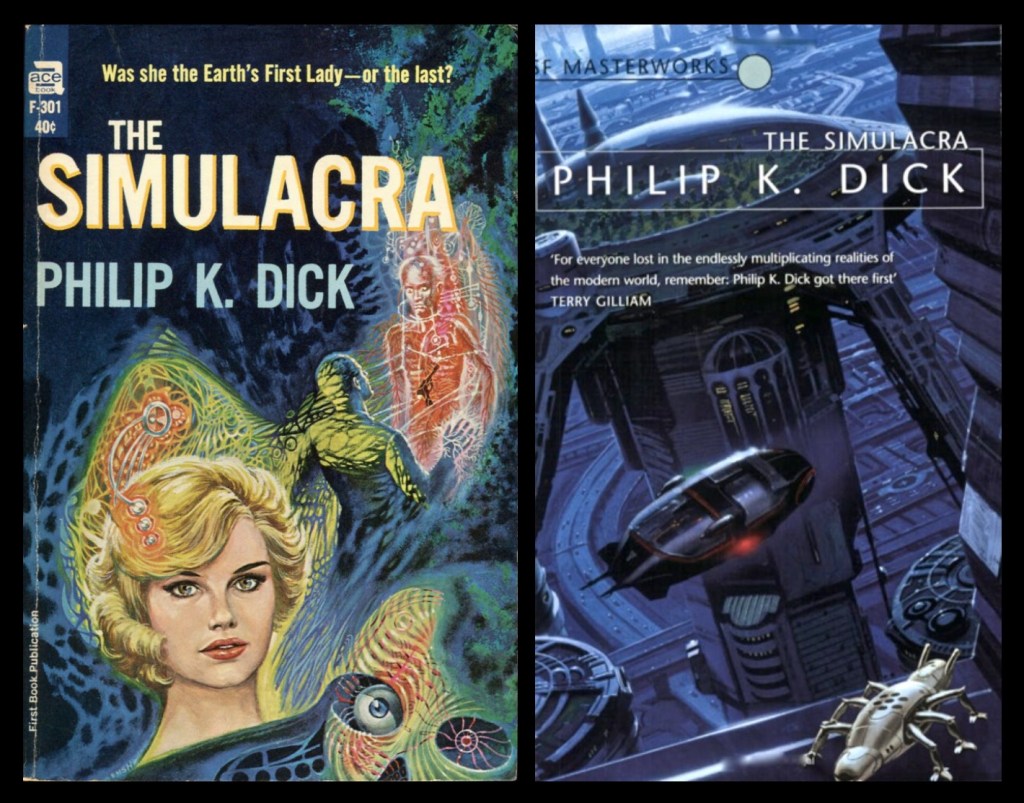
Are we to assume these are Dick’s best novels? My personal favorite, Confessions of a Crap Artist wasn’t included. Neither was The Simulacra which I just read and found fascinating and fun. I think some of the Library of America selections are better than The Simulacra, such as The Man in the High Castle, The Martian Time-Slip, and VALIS, but I’d also claim The Simulacra is not a lesser novel to the others. However, using our citation database system, it gets only one citation. Twelve of the twenty-seven PKD novels in our database only got one citation. The novels in the first LOA volume received 9 to 32 citations, which supports the LOA editors.
The only reason The Simulacra received one citation is because it was part of the SF Masterworks series. All the science fiction magazine reviewers ignored it when it came out. As far as I can tell, none of the reprint editions got reviewed either. The Simulacra just isn’t well-known. It’s often disliked when I see it mentioned.
I liked it. And I want to make a case that it’s worth reading. However, it will be hard to even describe. I’m afraid most readers will be turned off by The Simulacra because it has multiple plot lines with over a dozen main characters. And I can imagine many readers calling it stupid too — but that could be true for a lot of readers coming to PKD work. However, if two of the five novels Dick wrote in 1963 made it into the Library of America, why shouldn’t the other three? What divides them? What makes one novel “good” and another “bad?”
The Simulacra‘s complexity might keep readers from liking it, but that complexity might hide many novelistic virtues. Just because I admired this novel, doesn’t mean others will. I’m writing this essay hoping people will read The Simulacra and give me their opinion. I’m curious if I’m a total outlier. I got a big kick out of the story.
According to Samuel Johnson, “No man but a blockhead ever wrote, except for money.” Dick complained in several 1963 letters found in The Selected Letters of Philip K. Dick: Volume One: 1938-1971, that his wife Anne constantly hounded him to make more money. On the other hand, Dick wrote eleven literary (non-genre) novels from 1952-1960 hoping to become a recognized mainstream writer. All were rejected. He then wrote The Man in the High Castle in 1961 which bridges the literary and science fiction world and won a Hugo award for best novel. Dick then wrote twenty-one science fiction novels from 1962 to 1969, five of them in 1963 alone. He obviously needed money and had to crank out the manuscripts.
After 1970, Dick only published six more novels before he died in 1982. Five of which are included in the Library of America editions. That suggests that the novels he took more time writing fared better with the critics. So, the five novels written in 1963 were among the fastest he wrote, suggesting they shouldn’t be as good. Yet, two were selected for the Library of America.
As much as I like The Simulacra, I do see that it’s flawed. It doesn’t have a main character which most readers prefer. Nor does it jump back and forth between two main characters, which can be quite successful with some readers. And it’s not even one of those experimental stories where we follow several unrelated characters that all come together in the end. Readers find that structure confusing but forgive it if the ending brings everyone together in a satisfying way. I’m not sure The Simulacra wraps up nicely.
We might call the plotting of The Simulacra an example of characters doing parallel play. Dick might have aimed for creating a collage of future American scenes. My guess is Dick banged away on his typewriter, vomiting up The Simulacra onto typing paper. The results are fascinating because the novel is one big pile of imagery from PKD unconscious mind — and what a mind! It begs to be psychoanalyzed. And I’m sure, it parallels his personal life, especially regarding insanity, psychoanalysis, and troubling wives and women.
The Simulacra is not satire even though it often feels like the film Dr. Strangelove, nor is it a fantasy even though everything is unbelievable. And I wouldn’t call it surreal or dreamlike, or avant-garde even though it was written in 1963 when trendy artists were creating pop art and post-modern fiction. It’s straight science fiction, meant to be taken as realistic, even though it’s bonkers. The Simulacra has the existential absurd horror of The Tin Drum or The Painted Bird. I don’t even think Dick was making fun of science fiction with its comic book level wild ideas. Dick had crazy ideas, and he saw the world being just as crazy.
The Simulacra pictures future America where psychic abilities are accepted as real, that time travel has been perfected, where people and animals can be artificially created and the results indistinguishable from real people and animals, that colonies exist on Mars and the Moon, and alien lifeforms can be commercialized. In other words, all the crap ideas that science fiction fans and fans of the occult believed in the 1950s. Everything they thought possible, became possible.
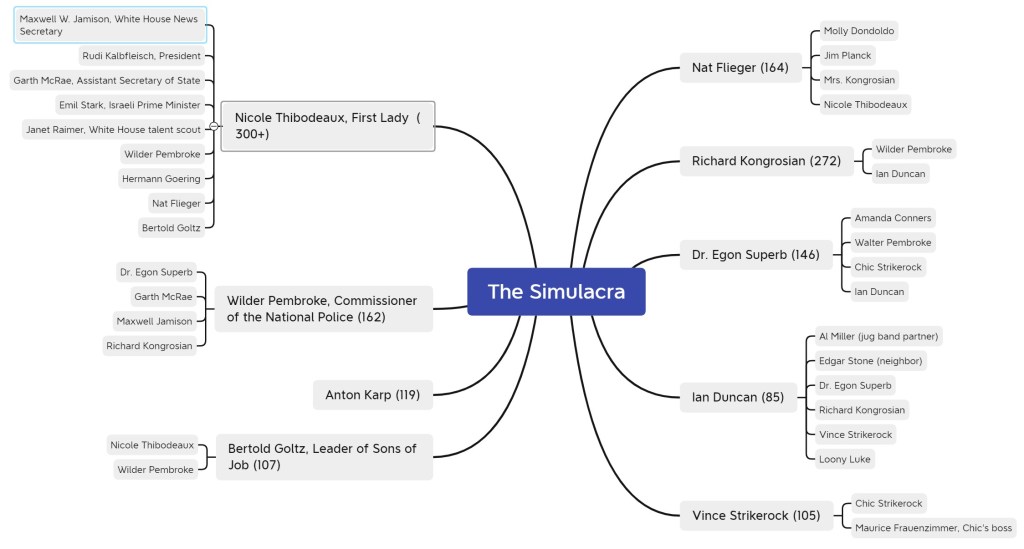
The hardest part of this essay is describing what happens in The Simulacra. I wrote about that trouble already for my Auxiliary Memory blog, where I explained I had to read the book and listen to the audiobook to get the most out of The Simulacra. In fact, I’m still picking up the book, or putting on the audiobook, and enjoying random parts of the novel. I can’t seem to leave this story. I’m still finding new insights into whatever scene I stumble upon. I’ve decided the best way to describe the story is by mind mapping the characters. The number given is the number of times the character is mentioned in the story.
I’m trying not to give away too much of the plot. Each of the first level characters involves a subplot. For example, Dr. Egon Superb is the last legally practicing psychiatrist after the pharmaceutical industry pushed through the McPhearson Act that made drug therapy the only legal form of treatment for mental illness. One of his patients is Richard Kongrosian, a psychic pianist who uses telekinesis to play the piano instead of using his hands. Nat Flieger is a sound engineer who wants to record Kongrosian, but he and his crew of Molly Dondoldo and Jim Planck can never track down the man. Ian Duncan and his old friend Al Miller want to perform classical music as a jug band at the White House for Nicole Thibodeaux. Nicole Thibodeaux, the First Lady, but maybe the true ruler of The United States of Europe and America (USEA) wants to negotiate with Hermann Goering via a time machine to get the Nazis to not kill the Jews. Vince and Chic get involve with making the next president, an android, which will replace Nicole’s current husband. Wilder Pembroke, Anton Karp, and Bertold Goltz all vie for power behind the scenes.
If the novel has a main character, it could be Nicole Thibodeaux. Dick’s original draft was called The First Lady of Earth. Since this book was written in the summer of 1963, I assume Dick was inspired by Jackie Kennedy because Nicole spends most of her time charming people, decorating the White House and gardens, and putting on nightly cultural events. Everyone loves Nicole. Yet, out of the public eye, Nicole is also ruthless enough to have people summarily executed. Evidently, she wields unlimited power because of her access to time travel.
The novel is set in a post-apocalyptic future, decades after China attacked the U.S. with missiles with atomic warheads. This gave rise to a population of mutants, similar in appearance to Neanderthals. People ride in self-driving cars. Ads are living creatures that can invade your home and car and must be killed. Richard Kongrosian believes he has a terrible body odor because a deodorant ad infected him with a jingle. The Sons of Job are a neo-fascist political party. People live in giant communal apartment complexes and are required to take civics tests to stay in them. Many people want to escape this totalitarian society by immigrating to Mars. People buy android nuclear families just to have normal friends.
I could go on. There are several layers of political and corporate intrigue in The Simulacra. Dick evidently thought there were conspiracies everywhere. Later in life, Dick would get into Gnostic religion, which is a very paranoid belief system. This novel has many traits of Gnosticism. The Simulacra was written after The Man in the High Castle, We Can Build You, Dr. Bloodmoney, and The Martian Time-Slip, and before The Three Stigmata of Palmer Eldritch and Do Androids Dream of Electric Sheep? There are many similar themes and obsessive ideas that run through all of them. I wish I had the time and energy to study all those novels and plot all the connections. Why did PKD fixate on certain ideas repeatedly? Was it a lack of imagination to explore unfamiliar territory, or were they ideas PKD just could let go of?
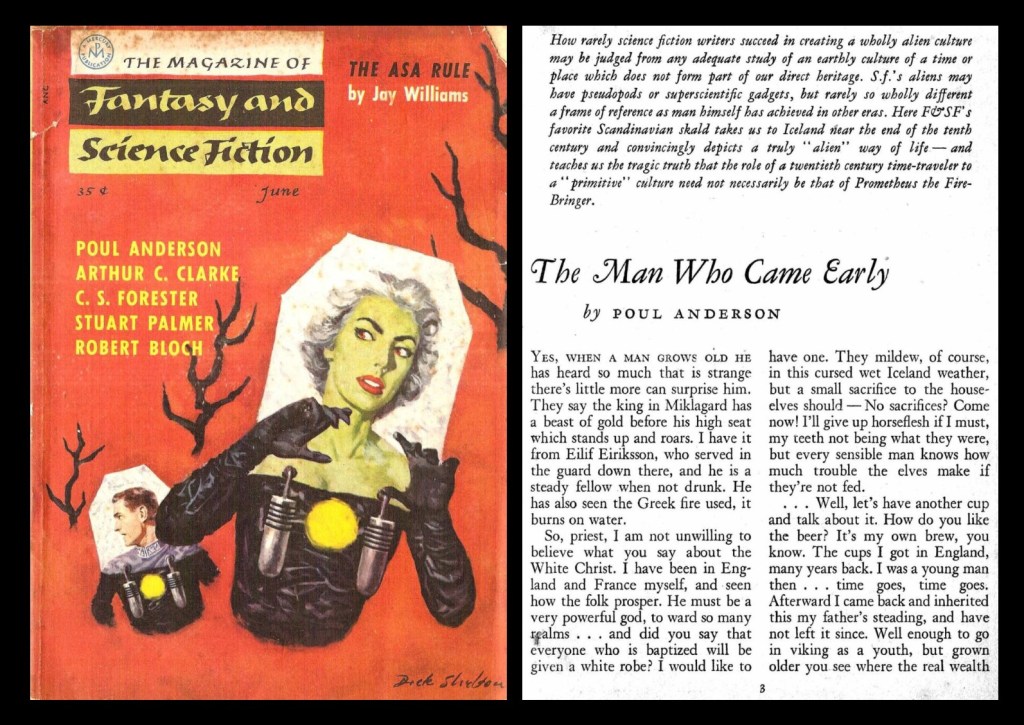
“The Man Who Came Early” was first published in The Magazine of Fantasy & Science Fiction, June 1956. You can read it on Archive.org. It is story #12 of 22 for The Best SF Stories of 1956 group read. Asimov and Greenberg picked “The Man Who Came Early” for The Great SF Stories #18 (1956) and in Richard Lupoff’s What If? Volume 1, his anthology that reevaluated the Hugo awards, thought “The Man Who Came Early” was the “single finest story” of 1956. “The Man Who Came Early” has been well anthologized.
Science fiction writers often reply to earlier science fiction writers in their fiction, and “The Man Who Came Early” is Poul Anderson’s reply to Mark Train’s A Connecticut Yankee in King Arthur’s Court and to L. Sprague de Camp’s Lest Darkness Fall. Both classic time travel novels are about men who are thrown into the past and use their scientific knowledge to gain power and success in less scientifically aware times. Anderson attacks the assumption that modern knowledge would give any time traveler an edge in the past.
Twain’s character, Hank Morgan, goes from the 19th century to the time of King Arthur via a knock on the head. De Camp’s Martin Padway travels to 535 A.D. Rome by being struck by lightning. Anderson’s Sergeant Gerald Roberts returns to about 1000 A.D. Iceland also via lightning strike.
Poul Anderson admired medieval societies, and often used them in his fiction. I’ve read where Anderson claimed such societies are about as complex as what he thinks humans could handle. What impressed me most about “The Man Who Came Early” was the historical details of ancient Iceland. I’m sure Anderson delighted in writing that part of the story.
The plot involving the hapless Gerald Roberts was less appealing to me, but I thought it made a good case for Anderson’s supposition that time travelers from the future will not have an advantage because they know more. If you’ve seen James Burke’s documentary television series Connections, you’ll know he’s right. Knowledge and skills are tied to time and culture.
I believe Anderson’s description of Gerald Roberts fate is spot on. And I was impressed with Anderson’s point of view character, Ospak. I do not know anything about Iceland, either current or past, but Ospak’s voice in the story felt very realistic. He was both wise and insightful. Ospak was also compassionate towards his daughter Thorgunna even though Ospak knew she fell in love with the useless man from the future. Ospak even believed Roberts was from the future, and vaguely perceived why he couldn’t adjust to living in the past. Anderson did a great job describing an alien culture to us.
I was impressed with “The Man Who Came Early” the first time I read it. I’ve never been a big Poul Anderson fan, but reading it made me want to read more of Anderson’s work. I was still impressed, maybe even more so, with this second reading. I find it hard to like most time travel stories because they are so hard to believe. Even if time travel was possible, I find it harder to believe people could overcome the language barrier. Anderson claims that Icelandic is one of the few languages that hasn’t changed much in a thouand years. That might be true, but I’m still skeptical. Kids just two or three generations younger than me already use so many words and phrases that I can’t decipher without checking my iPhone.
In some ways I wonder if “The Man Who Came Early” would have been a better story if told from Gerald Roberts point of view. Wouldn’t we identify more with the frustrations of surviving in the past if we followed the time traveler? I’m sure Anderson was enamored with creating Ospak’s character, but from a storytelling point of view, wouldn’t seeing the experience from Robert’s eyes have been more intense? I’m reminded of Thomas Jerome Newton, the Martian who came to our planet in The Man Who Fell to Earth by Walter Tevis. Newton’s experience of being a stranger in a strange land was emotionally gutwrenching.
I was surprised that my friend Mike didn’t like “The Man Who Came Early” when he emailed yesterday:
My problem with time travel stories is that the plots feel manufactured and synthetic. Character development is sacrificed on the altar of clever machinations.

I realize that "The Man Who Came Early" is a widely praised story, but it felt emotionally flat to me. Everything feels like a plot device, complete with a far-fetched love interest and a convenient adversary (red shirt).

I agree with Joachim Boaz: "There isn’t much redeemable about this stilted caper.  Well, Poul Anderson’s pessimistic theme that the modern man is unable to function in the past despite his superior technology is somewhat interesting despite the story’s poor delivery."
I completely disagree with Boaz’s assessment that the story was poorly delivered. I thought Ospak’s tale exceedingly well done. It let us see an ancient Icelandic perspective that felt genuinely possible to me. I do believe if we followed Roberts’ perspective, we would have felt a greater sense of frustration and tragedy being a time traveler, much like what Karl Glogauer experienced in Behold the Man by Michael Moorcock.
I experienced several levels and kinds of emotions in the story, so my experience is much different from Mike’s. I’m curious how other people felt. If you’ve read the story, please say below in a comment.
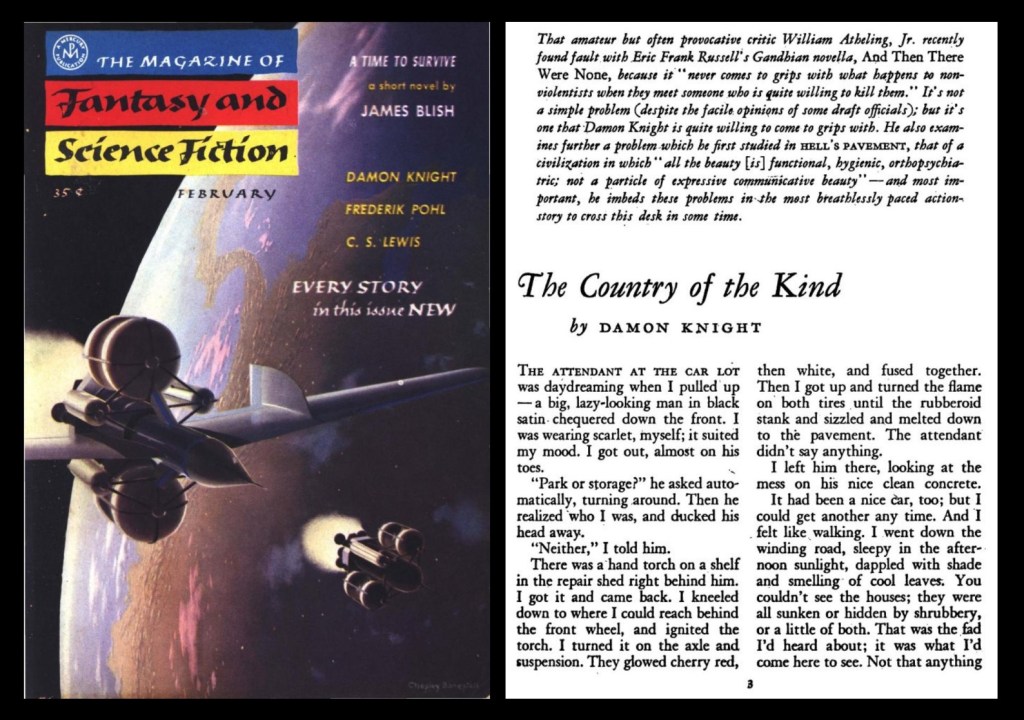
“The Country of the Kind” was first published in The Magazine of Fantasy & Science Fiction, February 1956. You can read it on Archive.org. It is story #5 of 22 for The Best SF Stories of 1956 group read. “The Country of the Kind” is one of the highest rated stories on The Classics of Science Fiction Short Stories v. 2 list, with eleven citations. It is by far the most remembered science fiction short story from 1956. Here are the eleven citations we used:
“The Country of the Kind” is set in an unnamed utopia and is told by an unnamed narrator. When the narrator was fifteen, he killed a girl who spurned him. In this utopian society they couldn’t punish him directly because it doesn’t allow violence. They fixed the narrator so whenever he tried to hurt someone else, he’d have an epileptic fit. And to warn others of his presence, his body odor and breath were made to smell repulsive. He was then left free to do whatever he wanted. For thirty years he has wandered about the Earth trying to retaliate by sabotaging other people’s activities or destroying their property. People ignored him, so he suffered endless loneliness. The narrator creates small works of art which he leaves everywhere with a message inviting other people to join him and be free.
My friend Mike sends me emails with comments about these 1956 science fiction stories since he doesn’t want to use Facebook. Here’s what he had to say:
A good science fiction tale draws you in completely, overriding your skepticism about the implausibility (or impossibility) of events.

Damon Knight asks us to accept the notion that a murderous psychopath is allowed by society to indulge himself in an endless destructive rampage. Although he is prevented from physically harming others by induced epileptic seizures, the community allows him to wreak havoc without restraint.

Perhaps Knight is exposing the passivity and weakness of that society, but it beggars the imagination that any group would allow such extreme behavior to go unchecked, no matter how kind and understanding they profess to be.

After the "king of the world" murdered his girlfriend named Elen when he was fifteen, he tells us "...if I could do it to Elen, I thought, surely they could do it to me. But they couldn't. They set me free: they had to."

Why did "they" have to? Are we to believe that a seemingly well run country is so "kind" that even a psychopath is allowed free rein? That's a bridge too far for me.
Remember, I talked about how believability was very important to me regarding science fiction when reviewing “Brightside Crossing.” I could understand why Mike didn’t think the world of “The Country of the Kind” was believable, but I said to him in a phone call, didn’t we both believe the world of “Brightside Crossing” was impossible? Yet, we still found the story believable. I asked him what crossed the line for him in “The Country of the Kind.” Mike said he just didn’t believe people would allow a person like the narrator in any society, that was too much for him to believe that people wouldn’t stop the narrator from damaging their property.
I said, wasn’t “The Country of the Kind” unbelievable in the same way “The Ones Who Walk Away from Omelas” is unbelievable, and didn’t you love that story? Mike replied that story was metaphorical.” I countered, doesn’t “The Country of the Kind” seem just as metaphorical in the same way? Both are about utopias that that are held together by the suffering of one person. After I said that, I even wondered if Ursula K. Le Guin wasn’t in some way inspired by “The Country of the Kind” when she wrote “The Ones Who Walk Away from Omelas.” Mike said he would reconsider “The Country of the Kind” as a metaphor. Maybe he will post a reply.
Are the fictional worlds of Brave New World, Nineteen Eighty-Four, or The Handmaid’s Tale believable? Aren’t they metaphorical too, because their authors have something to say about our reality? Dune, The Foundation trilogy, The Left Hand of Darkness and even The Man in the High Castle create worlds that we are asked to believe are realistic. Obviously, Alan E. Nourse wanted us to believe “Brightside Crossing” was realistic. But we aren’t expected to believe the fictional universes of The Hitch-Hiker’s Guide to the Galaxy or Sheckley’s Mindswap were realistic.
In other words, fantasy, humor, satire, and metaphorical fiction don’t ask us to believe their settings are realistic. But most literary works, especially of the mimetic type, and some kinds of science fiction do ask us to believe that they are reality based.
Of course, if “The Country of the Kind” is metaphorical, then what is the metaphor? That even kindness can cause great suffering. To be free in a utopia you need to be able to commit evil deeds. 1956 was a time of conformity in America, and many people were freaked out by juvenile delinquents, motorcycle gangs, and other nonconformists. Remember, a year later in 1957, On the Road by Jack Kerouac came out. Kerouac called his kind of nonconformists Beats, and society renamed them beatniks. A few years later, society turned against hippies too. I say On the Road wasn’t metaphorical. But I would say One Flew Over the Cuckoo’s Nest or Catch-22 are.
In the 1950s there was a lot of talk about crime being caused by society, and that criminals were a product of bad biology or a bad environment. Damon Knight’s unnamed narrator is an awful person, but he gets our sympathy. Unlike the tortured child in “The Ones Who Walk Away from Omelas,” the unnamed narrator isn’t the engine of utopia. Or is he? Wouldn’t a perfect utopia be dull and boring? What if evil is needed as the engine of goodness? I’m reminded of a phrase, “What if our world is their heaven?”
What if all fiction is metaphorical? What if “Brightside Crossing” was a metaphor for extreme adventurers?
Fiction is based on a suspension of disbelief. If Mike can’t suspend his disbelief that’s perfectly okay. If he doesn’t like “The Country of the Kind” does it matter that I do?
I’m fascinated by the nature of memory. I’m particularly fascinated by fiction that our culture remembers, like works by Jane Austen or Charles Dickens. But I’m also fascinated by the stories I find personally memorable. “The Country of the Kind” and “The Ones Who Walk Away from Omelas” are such stories. A year for now, I might forget “Brightside Crossing.” As I read and reread these old science fiction stories, I’m amazed by which ones I remember and which ones I don’t.
“The Country of the Kind” was voted into The Science Fiction Hall of Fame Volume One because it was so remembered by the first members of the Science Fiction Writers of America. I wish SFWA would poll their membership every ten years on their favorite stories. I’d love to see what every generation of science fiction writers remember.
With this December 2023 reading; it’s probably the fourth or fifth time I’ve read this story, I am somewhat sympathetic to the unnamed narrator of “The Country of the Kind.” I wasn’t before. I totally loathed the narrator. However, this time I still think his actions are still horrific, but I feel the utopian society has imposed a cruel and unusual punishment upon him.
And I’m still unsure of Knight’s intentions in writing this story. Whatever meaning it has could be entirely accidental. Knight might have thought of the situation without considering its implications.
The epileptic pain the narrator experiences is brought on by his own actions. But the loneliness is caused by the utopian society imposing the punishment. And this society is supposedly incapable of causing harm. Such a society would know that social contact is a necessity.
Writers often make their stories ambiguous but this one might be too unclear. I wonder if Knight has ever written an explanation of “The Country of the Kind.”
“Silent Brother” was first published in Astounding Science Fiction, February 1956. It was by Algis Budrys writing as Paul Janvier. You can read it on Archive.org. It is story #4 of 22 for The Best SF Stories of 1956 group read.
Harvey Cable has a fascinating mystery to solve in “Silent Brother.” The spaceship Endeavor has returned from the first interstellar mission. Harvey might have been on that mission but was badly injured in a test flight of an earlier spaceship. He lives alone. Harvey must use a wheelchair or braces on his legs and a cane in both hands to get around the house. After watching the crew of the Endeavor return home on TV, he goes to bed hoping his old astronaut companions will come to see him soon. The next day he wakes up to find that someone has stolen the picture tube from his television.
After carefully searching his house, Harvey finds the picture tube on his basement worktable. He can prove that no one broke into the house. He even tests the picture tube for fingerprints and only finds his own. But Harvey is incapable of carrying a large TV picture tube downstairs because with leg braces, he must firmly hold onto the handrails. If no one broke into his house, who took the picture tube downstairs while he slept?
Harvey goes to bed the next night after rigging his house so he can’t sleepwalk out of his bedroom. Yet, once again he wakes up refreshed and discovers more work has been done on the picture tube in the basement. None of his traps to keep him in his bedroom have been disturbed.
“Silent Partner” is a fun story that sets up a good lock-room mystery. It has a satisfying solution, but I don’t want to tell you about it just yet. I encourage you to go to the link above and read the story. It won’t take long. “Silent Brother” was reprinted in both Merril’s and Asimov & Greenberg’s best of the year anthologies, but it’s not been reprinted in any major anthology since. My friend Mike who is reading these stories along with me emailed me quite a positive review. I’ll post it below after I get into the spoilers. I also liked the story, but does two guys liking a story sixty years later mean it was one of the best of 1956, or a forgotten classic science fiction story?
I’ve been thinking about the levels of good stories. There are good stories, and then there are good stories. A great story is a good story that launches into orbit for the reader. Not everyone who reads a group of stories will love every story, and different readers will pick different stories they think are the good ones. Here’s a hierarchy:
One of the good stories in a magazine
One of the good stories in a best-of-the-year anthology
One of the good stories that are finalists for an award
One of the good stories in a general anthology
One of the good stories that are in theme anthology
One of the good stories that are in a retrospective anthology
One of the good stories in a list of the all-time best stories.
“Silent Brother” was in the same 1956 issue of Astounding Science Fiction with the first part of Double Star, one of Heinlein’s best novels, and it won the Hugo award. The issue also contained “Clerical Error” by Mark Clifton which I reviewed last time. Our short story club generally didn’t like “Clerical Error” but Astounding readers back in 1956 picked it as their second favorite after the Heinlein serial in The Analytical Laboratory poll. “Silent Brother” came in third. I like both “Clerical Error” and “Silent Brother,” but I wouldn’t reprint either if I was an anthologist. I thought “Clerical Error” was more ambitious but poorly written, and I thought “Silent Brother” nicely written, and very enjoyable, but far from great. I can easily say it’s a good story, but what does that mean?
If you look at the table of contents for Merril’s best-of-1956 anthology, none of the stories stand out to me except “Stranger Station” by Damon Knight. That story has shown up three times already in our short story reading group because it’s often reprinted. I haven’t read most of Merril’s selection, and “Silent Brother” might be among the good ones. But “Silent Brother” is not in the same league as “Stranger Station.”
Looking at the table of contents from Asimov and Greenberg’s best-of-1956 anthology, we see five stories that stand out: “The Country of the Kind” by Damon Knight, “Exploration Team” by Murray Leinster, “The Man Who Came Early” by Poul Anderson, “The Last Question’ by Isaac Asimov, and “Stranger Station” by Damon Knight. These are all stories our group has encountered several times in the many anthologies we’ve already read. I have read The Great SF Stories 18 (1956), and “Silent Brother” falls toward the back of the pack. (It is interesting that Asimov and Greenberg with thirty-two years of hindsight were able to create such a solid lineup of 1956 SF stories.)
“Silent Brother” wasn’t a finalist for the Hugo award, and it’s never been anthologized for a major theme or retrospective anthology. Nor is it on any fan poll for being an all-time great SF story. Now, do you sense the relative nature of good? What I want to find are the most memorable, most powerful of the SF stories from 1956 that most people consider good. I liked “Silent Brother” a fair amount, but I wouldn’t anthologize it if I was creating an anthology of the best SF short stories of 1956. I might include it in a theme anthology if it worked well with the other stories.
Still, it was a pretty good story. And I think it would be interesting to analyze why? For me, the mystery about who was rebuilding the television made the story a page turner. However, it was the conclusion that elevated the story with a particular kind of happy ending. The crew of the Endeavor brought back invisible aliens who they had developed a highly beneficial symbiotic relationship. The silent brother was a new alien being that lived inside of you. Now, if you had just read Heinlein’s The Puppet Masters you might not think this was so wonderful, but Algis Budrys pulled it off. Why?
I think the idea of having a silent brother that heals and helps you if awful lot like what religion promises, like believing that Jesus will save us, or becoming one with God who will watch over all his followers. “Silent Brother” represents a story of transcendence. It reminds me of the ending to Childhood’s End. Harvey Cable was lonely and suffering from a damaged body. He, and the Endeavor crew welcomed the alien into their bodies and passed them on. But isn’t this the same story as The Invasion of the Body Snatchers? But that story was a metaphor for communism. Budrys presents the alien as a brother. Is it little brother to big brother? Harvey’s personality isn’t changed or possessed; he just has a very helpful invisible friend living inside of him.
Algis Budrys was a savvy guy. I’m guessing he consciously knew about the religion connection in his story, and he knows that most people would love to have a personal god to help them. Instead of inventing a theological being, Budrys creates an alien that serves the same function.
Here’s what Mike had to say:
I think "Silent Brother" is an excellent story.

The genius of the story is what Budrys leaves out. He gives us bits and pieces, and our imagination fills in the blanks.

For example, Harvey Cable has obviously been seriously injured in the past. We don't know for sure what happened to him, but we imagine some kind of space flight misfortune left him damaged. Was it radiation? Was it an equipment failure, or a spaceship catastrophe? Budrys gives us room to speculate.

Budrys relates that Cable's struggle is both physical and mental. He "...trembled on the brink of admitting to himself that his real trouble was the feeling that he'd lost all contact with the world." He is in trouble and "The idea was to hang on to reality."

It's slowly revealed that Cable is disassembling his TV set and reworking it into something else. Budrys writes beautifully descriptive sentences: "How did one shot-up bag of rag-doll bones and twitchless nerves named Harvey Cable accomplish all this in his sleep?" and "What in the name of holy horned hell am I building?"

Once the TV rebuild is complete, Budrys never reveals its exact purpose, but it's obviously of great importance because afterwards "...he felt his silent brother smile within him." Again, we get to fill in the blanks on our own.

A parasitic alien has entered Cable, and healed him. "Who wants symbiosis until he's felt it?"

Budrys explains "...we were born in a solar system with one habitable planet, and we developed the star drive. And on Alpha's planet, a race hung on, waiting for someone to come along and give it hands and bodies

Cable's final act is to send part of his silent brother to each of the three men who have come to interview him. The parasitic alien is passed on.

No long info dumps. No discursions. A concise, heartfelt, beautifully written story.
I think Mike admired the story far more than I did. I thought the rebuilt TV with its flashing lights helped Harvey connect with his new brother and helped him to retrain him to reprogram his damaged body. It’s like when Dr. Cal Meacham builds an “interocitor” in the film “This Island Earth” — the gadget allowed him to connect with aliens.
Mike and I have talked about “Silent Brother,” discussing how stories affect readers differently. Critics often write about fiction as if there were objective standards, but that’s not possible. Fiction is like a day, for some people the day might be wonderful, and for others horrible, and for many just another day.
I’m looking forward to seeing how many members in the Facebook group like or dislike “Silent Brother.”
“Brightside Crossing” begins in a bar on Earth, the Red Lion, with James Baron sitting at a table. A grizzled old man comes in to see him, Peter Claney. We learn that Baron is planning an expedition to the planet Mercury, hoping to trek across the sun side surface and reach the equator when the Sun is at its closest and hottest position. Temperatures will reach 770 degrees Fahrenheit. When this story was written it was thought Mercury always had one side facing the Sun, the Brightside, like how one side of the Moon always faces the Earth. We’ve since learned that Mercury does slowly rotate three times for every two solar orbits Mercury makes.
Peter Claney was part of a team that previously tried to make the Brightside crossing, and he’s come to the Red Lion to warn Baron not to try. This implies Peter’s team failed, and Peter’s story is how we learn about that failed attempt. Nourse’s story is what we now call hard science fiction, although the term wasn’t coined until a year later. Even for 1956, I had several nit-picks about this story’s realism, but nothing that detracted from it being a great science fiction adventure tale. It was a finalist for the Hugo.
“Brightside Crossing” reminds me of reading books by polar explorers, or about the men who tried to find the Northwest Passage, especially of Franklin’s lost expedition. It’s about the kind of person who will endure extreme hardship to be first somewhere.
I agree completely with what my friend Mike emailed me about the story:
1. Nourse avoided the info dump trap. He succinctly describes the equipment used to make the Mercury crossing without falling into the endless info dumps found in some stories.

2. The characters have depth and nuance. Ted McIvers is described as “kind of a daredevil.” At first, we think he’s just foolhardy, but we eventually realize that they will die if they don’t move faster and McIvers is trying to save them. Peter Claney admits “A man like McIvers was necessary. Can’t you see that?” Jack Stone is fearful and reveals “I’m scared.” However, when McIvers needs to be rescued, Jack agrees to go down and help. He overcomes his fear. And Peter Claney states categorically that the crossing is impossible, but he still wants to try again and be part of another attempt.

3. The story echoes the courage and heroism of the great Antarctica explorers Robert Scott and Ernest Shackleton.

4. Nourse’s descriptions of the terrain are beautiful and terrifying. Every word is carefully chosen. We can feel the heat. The danger is visceral.
“Brightside Crossing” also reminds me of what I loved about science fiction as a kid back in the 1960s, but I don’t think I read “Brightside Crossing” then. I do vaguely remember a few science fiction stories set on Mercury. It is exactly the kind of story that would have wowed me as a kid because I loved science fiction stories that I wanted to feel were possible. This is my second reading of “Brightside Crossing” and I’m even more impressed than the first time I read it in The Great SF Stories 18 (1956) a couple of years ago.
This time as I read it, I thought “Brightside Crossing” represents the kind of science fiction I would use in creating my definition of science fiction. The story is believable in the way I want to define science fiction. Sure, Nourse’s speculation might be faulty or even impossible by today’s scientific knowledge and technology, but in the 1950s the story seems possible, at least to a kid who embraced the theology of the final frontier.
My disappointment with a lot of science fiction, especially science fiction from recent decades, is it’s not believable. I don’t know why when I was a kid, I wanted to believe humans would explore all the planets and moons of the solar system. I thought science fiction was propaganda to make such exploration happen. I knew there were two kinds of science fiction. The kind I like imagined either a probable future we should avoid or a future we should want to create. The other kind of science fiction was just stories that got its ideas from the first type. And like the degradation of originals from making copies of copies, too much science fiction seems inspired from science fiction cliches.
Over time, I think science fiction has become the label for any fantastic tale that involved the future or outer space. A splendid example of the second kind is “Fondly Fahrenheit” by Alfred Bester. It’s still a classic story, but not the kind of science fiction I’m talking about. Bester was both having a go at the genre and pushing it to its limits. Unfortunately, I think writers have settled on the second kind of science fiction as the preferred kind and see it as a Disneyland to work out their wildest ideas, rather than serious speculation about reality.
Like Busby Berkeley always working to top his previous dance routine, science fiction keeps trying to top itself. And like Busby Berkeley, the results have gotten absurdly wild. Busby Berkeley expected the movie audience to believe that his dance routines would be what an audience in a cabaret or Broadway theater would see, in the same way science fiction writers now expect their readers to believe their stories would fit into our little old reality. Sure, it’s fun to see fabulous big productions created by wild fancies of the mind but there’s something to be said about real people confined to Earthly possibilities. In case you have no idea, who Busby Berkeley was, or my analogy, I’ll include this film clip:
Alan A. Nourse was never a big name in science fiction, but I have encountered his work now and then, but I only vaguely remember him. “Brightside Crossing” inspires me to find more of his work. The two I think I might have read as a kid; are ones I want to try:
But I’d also like to find the collection below because of its neat cover, but it will probably be easier to get Alan E. Nourse Super Pack at Amazon for $1.99, which has several of the same stories, including “Brightside Crossing.”
By the way, “Brightside Crossing” had three things I couldn’t believe, but they were just little bumps in the road. The first are the suits that protected them from the horrendous heat. They plan to stay in them for over a hundred days. How did they handle peeing and pooping? A kid would wonder that and so did I as an old man. I also found it unbelievable that Ted McIvers could just show up late by hitching a ride on a Venus supply rocket, days after the others had arrived. That bothered me because trips would be rare to the planet Mercury. Finally, when Ted McIvers goes off course and stumbles upon the remains of the last expedition that tried to make the Brightside crossing. That seemed like way too much of a coincidence. They are crossing a whole planet, and they just happen to discover what happened to the previous explorers.
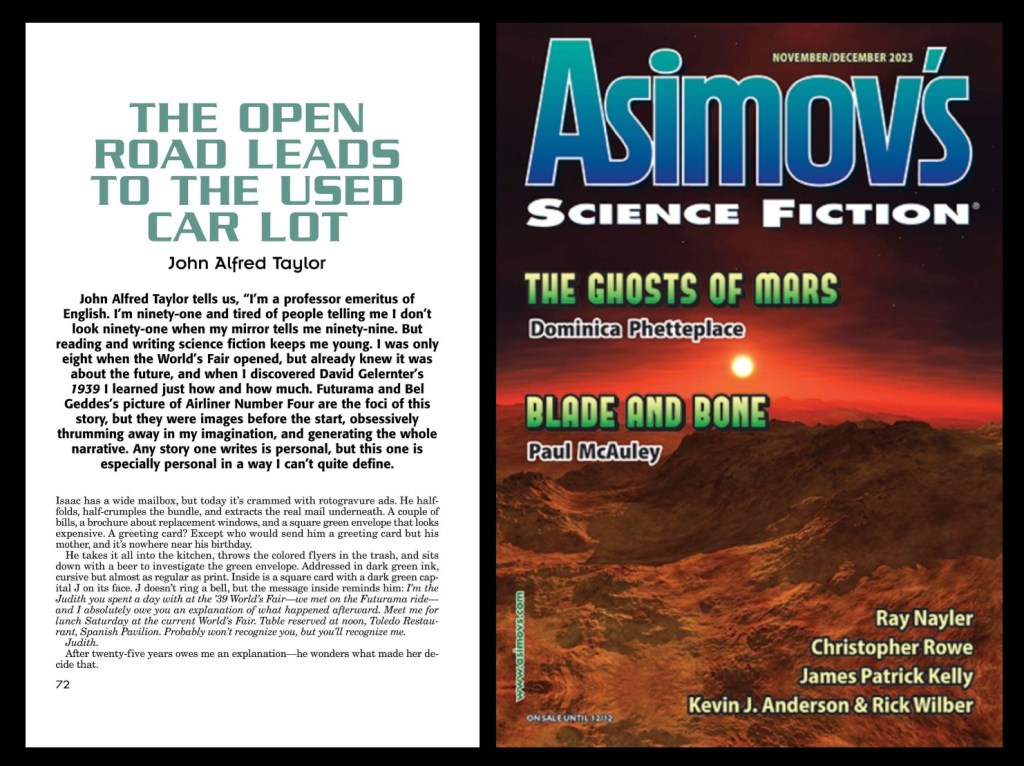
[I was excited when I discovered that John Alfred Taylor was ninety-one when he wrote “The Open Road Leads to the Used Car Lot.” Since I’m seventy-two I have an afinity for old science ficton readers and writers. Sadly, I just learned John Alfred Taylor died on October 7, 2023, before the November 2023 issue of Asimov’s Science Fiction was published.]
When I was about to give up reading new science fiction magazines, I discover a story that brought tears to my eyes. I had to wipe them several times while reading “The Open Road Leads to the Used Car Lot” by John Alfred Taylor. In the editor’s blurb Taylor is quoted as being eight years old when the 1939 World’s Fair opened. That 1939 World’s Fair is at the heart of this story.
I was born in 1951 and have often wished I could time travel to that fabulous event. And that’s part of this story too. “The Open Road Leads to the Used Car Lot” is also set during the 1964 World’s Fair. I was living out in the country in South Carolina at the time, and wanted to go to that fair so bad. I never did. I was just twelve, but then twelve is the real Golden Age of Science Fiction, isn’t it. I’ve never been to any World’s Fair. About the closest I’ve come is going to Epcot. I’ve been to the 1939 World’s Fair several times in fiction and memoirs. I don’t know if John Alfred Taylor got to visit the 1939 World’s Fair when he was eight, but his character does.
Taylor uses science fiction for a personal fantasy and that’s why I identify so strongly with this story. Science fiction has always been my fantasy portal.
Reading “The Open Road Leads to the Used Car Lot” for me was like playing a pinball machine as a teen, when you’re in the zone, keeping the ball in play forever, feeling one with the machine, not even aware of activating the flippers, mesmerized by the flashing lights, dings, bells, buzzers, and mechanical music. This story pushed all the buttons that make science fiction zing for me.
This is the kind of story I’m forever seeking — science fiction that I resonate with personally. I can’t say it’s a great story, but it was an exceptional story for me on this Wednesday afternoon in November. I read it while I played my “TOP 1000 4 Jim” playlist at full volume, waiting for my wife to come back from her lunch with a friend. You never know when a story is going to work or why. Read on another day, “The Open Road Leads to the Used Car Lot” could have crashed and burned. It didn’t today. It soared.
The story is about a young man, Isaac, meeting a young woman, Judith, a time traveler back in 1939, while waiting in line to ride through the Futurama exhibit at the 1939 World’s Fair. This reminded me of John W. Campbell’s “Twilight,” a story from the 1930s about a person meeting a hitch-hiker who is a time traveler. Time travel is a hard theme to pull off. However, I think time travel is the most powerful of all science fiction themes, even more powerful than space travel and aliens. That is if its sense of wonder hits you just right. I’ve always thought The Time Machine was more epic than The War of the Worlds. And time travel is at its most powerful when dealing with the future. This story uses the past to talk about the future.
My guess is this story will be a minor, sentimental story to young readers. I think you need to be old to appreciate it. What will future science fiction fans in the nineties who are eight today remember about now? What will make them sentimental and weepy eyed?
“The Open Road Leads to the Used Car Lot” conjures nalstagia for old science fiction and the old memories of the future. I’m twenty years younger than Taylor when he wrote this story, but I know where he’s coming from. Like they say, the future was so bright when we were adolescents, we had to wear shades. I now know that Taylor was a dying man looking backwards. At seventy-two I still look forward sometimes, but I do a lot of looking over my shoulder.
I’m sad I missed reading John Alfred Taylor while he was alive. I’ll need to go back and try some of his other stories. ISFDB only lists one book by him, Hell is Murky, a collection of twenty stories. The flap has the only photo I can find for him. ISFDB lists over sixty stories published from 1971-2023. “The Open Road Leads to the Used Car Lot” might be his last, but maybe not. I’ll keep looking.
“Embot’s Lament” by James Patrick Kelly and “Berb by Berb” by Ray Nayler have several elements in common, including my disappointments. They were readable enough, and had some entertaining aspects, but both ended before they could reach critical storytelling mass.
As a reader, especially one who has been reading science fiction for decades, I come to every short story hoping to discover a classic. But the reality, at least in the SF magazines, is classic stories are rare discoveries. James Patrick Kelly isn’t going to write “Think Like a Dinosaur” every time at bat. It’s even unfair of me to expect another “Mr. Boy” or “10¹⁶ to 1.” Ray Nayler hasn’t written his classic yet, but he’s starting to write standout stories like “A Rocket for Dimitrios” and “The Ocean Between the Leaves.”
No writer can sit down and intentionally write a classic science fiction story. Unfortunately, if you’ve read enough classic stories, their impact stays with you, and you compare everything you read to those past favorites. This is one of the disadvantages of getting old.
In the blurb to “Embot’s Lament” Kelly says Embot came to him in a dream, and Jane showed up the next morning. Embot is a neat idea. I assume it’s short for empathy robot (or I could be way off and it could be for embedded robot or some other such thing). Embot is a conscious entity sent from the future that lodged in Jane Bell Lewis’ mind. Jane doesn’t know the Embot is there. The Embot is not supposed to interfere, but merely report back to the future how people of the past live and think. The senders of such time-traveling probes have no control over who and where the Embot will land in the past. Jane is an uneducated lower-class housewife with an abusive husband. The Embot is disappointed it didn’t land in someone like “The Rock, Taylor Swift, or one of the Kardashians.”
I’m disappointed too. Combining a neat science fiction idea with a quite common literary plotline seemed like a poor choice for a science fiction magazine audience. And the obstacles that Embot watch Jane overcome seem cliche and far too mundane. She gets beaten up by her drunk husband, takes an Uber to the bus station, and leaves town. If you compare this to “Fondly Fahrenheit” where a psychotic robot psychologically corrupts Alfred Bester’s character, you’ll see what I mean. Even if we stay with the wife abuse plot, the story would have been far more powerful, unique, and challenging to write if Embot had gotten embedded in the husband’s mind.
But I can think of many more character types I’d like to see Embot haunt. A truly fun person would have been a science fiction writer. Think of the recursive SF possibilities. But the obvious type of character would be a Donald Trump like politician, an Elon Musk type billionaire, or terrorist or mass shooter. It’s too easy to empathize with Jane, or a victim like her. A somewhat challenging storyline would be to embed an empathy robot in a repugnant character and change them. A writing challenge equal to climbing Mt. Everest would embed the empathy robot in a repugnant character and have it find something to empathize with.
“Embot’s Lament” ends when I think it’s just getting started. I wondered if Kelly plans to make it into a novel. The same thing is true for “Berb by Berb.” Nayler ends his story just when we want to know more. Nayler has written other stories set in the same alternate reality as “Berb by Berb.” ISFDB called the series “Disintegration Loops.” The history of this timeline involves the United States finding a crashed UFO during WWII and reverse engineering its technology to win the war and dominate the world afterwards with super science. Berbs are creatures that assemble themselves out of spare parts due to some alien pixie dust escaping the lab.
“Berb by Berb” barely introduces us to the berbs and then the story is over. It’s very slight, and there’s not enough science fictional razzamatazz to rationalize why the berbs form as they do. Nayler needed to give us some anti-entropic theories.
When I read “A Rocket for Dimitrios” I was amused that Eleanor Roosevelt and Hedy Lamarr had become action heroes in this alternate reality. Nayler name drops Hedy Lamarr name again in this story. When I was younger, it excited me when a science fiction writer would use a famous person from history as a character in their story. For example, Philip José Farmer’s Riverworld series, which featured Mark Twain and Sir Richard Burton.
Now, it disappoints me when a writer does this. I feel it’s a cheap cheat for making a story more appealing. A kind of pop cultural appropriation. And not just when science fiction writers do it. There have been many fictional bestsellers that capitalized on famous people in recent years. History is hard enough to get right in history books, so I hate seeing famous people being exploited in fiction. Still, Hedy Lamarr was one of the most beautiful women ever, and it was delightful to discover she was an inventor. I think Nayler just wanted to pass on that info. People do need to read Hedy’s Folly: The Life and Breakthrough Inventions of Hedy Lamarr, the Most Beautiful Woman in the World by Richard Rhodes if they want to know something closer to fact.
I like Nayler’s idea of using a crashed UFO to create an alternative history. But so far, he’s only played around with the idea in simple ways. It’s a slight-of-hand excuse for his stories, and “Berb on Berb” is very slight. He needs to do a Pavane, Bring the Jubilee, or The Man in the High Castle.
Both stories involve creating a science fictional being and then pairing it with an ordinary human. That’s a common story idea in science fiction. However, I think the authors of both stories should have set them aside for a while until they produced better reasons for their beings to exist and encounters with humans. Both stories needed a second stage, and even a third stage to lift them into orbit.
Embot is a neat idea. But why put such an artificial mind into a human mind if you didn’t want it to change the person? Especially a person who needed to change every aspect of her life. What if the future were seeding the past with insight, empathy, and intelligence? I think the idea of embots needs to be worked on, it has real possibilities. Like a cross between Brainwave and Timescape.
A berb is a much harder creature to rationalize. Its creation feels more like something L. Frank Baum would have imagined. Why did the aliens invent that magic dust? Are they seeding worlds with it? Reality is entropic, and life is anti-entropic. That offers some germs of ideas to work with. Nayler should have given us more speculation on why berb creatures would form.
I know it’s unfair of me to compare current science fiction to my all-time favorite science fiction, but I do. If book and magazine editors only published classic level stories, there would only be three SF novels and one issue of a SF magazine coming out every year. Even when I read best-of-the-year anthologies, I’m usually disappointed with over half the stories. Luckily for writers and publishers, readers don’t all pick the same stories to love.
These two stories made nice fillers for this issue of Asimov’s Science Fiction. But I wonder what Asimov’s Science Fiction would be like if it was quarterly paperback, or twice yearly hardback and published less filler? This is just me thinking aloud. I’m going to try and finish the Nov/Dec issues of Asimov’s and Analog, but I’m not sure I’ll want to continue to read them. Magazines might not be the right delivery system for short science fiction for me anymore.
I was inspired by Robert Silverberg’s column this month, “Homo Superior–Us?” It makes me want to chase down some classic science fiction about Neanderthals I haven’t read before and reread some that I have.
The above books were the finalists for the 2023 Hugo Awards. I have not read any of them. Nor do they look interesting to me. Each year the Hugo and Nebula award finalists seem further and further away from what I want to read.
The other day I went into a new bookstore for the first time in many months. I went up and down the aisles of the science fiction section and I was shocked by how many books were by authors that were unknown to me.
I turn seventy-two next month and I wonder if I’ve gotten too old for science fiction. Or, has the genre left me in the dust? I can accept that I might be too old to keep up. Could the genre have changed, and I’ve just lost interest? Who knows?
In the 20th century I’m sure I read at least a thousand science fiction books, probably many more. Here’s a list of the 69 SF&F books I’ve read in the 21st century:
2000 – Harry Potter and the Goblet of Fire by J. K. Rowling (Hugo winner)
2000 – Calculating God by Robert J. Sawyer (Hugo finalist)
2001 – American Gods by Neil Gaiman (Hugo winner)
2001 – Perdido Street Station by China Miéville (Hugo finalist)
2002 – Altered Carbon by Richard K. Morgan
2003 – The Time Traveler’s Wife by Audrey Niffenegger
2004 – Cloud Atlas by David Mitchell
2004 – Jonathan Strange & Mr. Norrell by Susanna Clarke (Hugo winner)
2004 – The Plot Against America by Philip Roth
2005 – Spin by Robert Charles Wilson (Hugo winner)
2005 – Old Man’s War by John Scalzi (Hugo finalist)
2005 – Never Let Me Go by Kazuo Ishiguro
2006 – The Road by Cormac McCarthy
2006 – Life As We Knew It by Susan Beth Pfeffer
2007 – The Yiddish Policeman’s Union by Michael Chabon (Hugo winner)
2008 – The Hunger Games by Suzanne Collins
2008 – Little Brother by Cory Doctorow (Hugo finalist)
2008 – Flood by Stephen Baxter
2008 – Marsbound by Joe Haldeman
2009 – The City & The City by China Miéville (Hugo winner)
2009 – The Windup Girl by Paolo Bacigalupi (Hugo finalist)
2009 – Boneshaker by Cherie Priest (Hugo finalist)
2009 – Julian Comstock by Robert Charles Wilson (Hugo finalist)
2009 – Catching Fire by Suzanne Collins
2009 – Wake by Robert J. Sawyer
2010 – Feed by Mira Grant (Hugo finalist)
2010 – Mockingjay by Suzanne Collins
2010 – Watch by Robert J. Sawyer
2010 – Hull Zero Three by Greg Bear
2011 – Among Others by Jo Walton (Hugo winner)
2011 – Leviathan Wakes by James S. A. Corey (Hugo finalist)
2011 – The Martian by Andy Weir
2011 – Ready Player One by Ernest Cline
2011 – Wonder by Robert J. Sawyer
2012 – Redshirts by John Scalzi (Hugo winner)
2012 – 2312 by Kim Stanley Robinson (Hugo finalist)
2012 – The Dog Stars by Peter Heller
2012 – The Age of Miracles by Karen Thompson Walker
2012 – vN by Madeline Ashby
2014 – The Three Body Problem by Cixin Liu (Hugo winner)
2014 – Annihilation by Jeff VanderMeer
2014 – Station Eleven by Emily St. John Mandel
2014 – The Girl with All the Gifts by M. R. Carey
2014 – The Book of the Unnamed Midwife by Meg Elison
2014 – Yesterday’s Kin by Nancy Kress
2015 – Seveneves by Neal Stephenson (Hugo finalist)
2015 – Children of Time by Adrian Tchaikovsky
2015 – Binti by Nnedi Okorafor
2015 – Aurora by Kim Stanley Robinson
2015 – The Water Knife by Paolo Bacigalupi
2016 – All the Birds in the Sky by Charlie Jane Anders (Hugo finalist)
2017 – New York 2140 by Kim Stanley Robinson (Hugo finalist)
2017 – All Systems Red by Martha Wells
2017 – Sea of Rust by C. Robert Cargill
2017 – Under the Pendulum Sun by Jeanette Ng
2017 – Noumenon – Marina J. Lostetter
2018 – The Calculating Stars by Mary Robinette Kowal (Hugo winner)
2018 – Semiosis by Sue Burke
2018 – The Fated Sky by Mary Robinette Kowal
2018 – The Feed by Nick Clark Windo
2019 – Children of Ruin by Adrian Tchaikovsky
2019 – Machines Like Me by Ian McEwan
2020 – The Ministry for the Future by Kim Stanley Robinson
2020 – The Midnight Library by Matt Haig
2021 – Project Hail Mary by Andy Weir (Hugo finalist)
2021 – Klara and the Sun by Kazuo Ishiguro
2022 – Babel by R. F. Kuang
2022 – The Mountain in the Sea by Ray Nayler
2022 – Sea of Tranquility
That’s an average of 2.8 SF&F books a year. Assuming I read a thousand SF books from 1963-1999, means I averaged 27.78 SF books a year. I think I could have easily read 1,500 SF books, or 41.67 SF books a year. In other words, I don’t read SF like I used to. And my 21st century list includes quite a few fantasies. I rarely read fantasy in the 20th century. I really don’t like fantasy books. I only read them when they reach a certain pop culture status.
One reason for the shift is I read more literary works and nonfiction books. Another reason is after reading thousands of science fiction books, I seldom read reviews of new science fiction books that sound different enough to be appealing.
I used to keep up with the genre by belonging to the Science Fiction Book Club, which offered two new titles a month. I subscribed to several science fiction magazines and fanzines that reviewed new books. And I would visit one or two new bookstores a week.
Fanzines disappeared, and I stopped having time for the prozines even though I still subscribed. After Amazon and Audible, I stopped shopping in new bookstores, and they eventually disappeared. Back in the 1970s I went to conventions and even published fanzines. In the 1980s I ran a BBS devoted to science fiction. Since the 1990s I’ve run websites and databases devoted to SF. Once upon a time all my friends were SF readers. But active participation in fandom ended when I got married and settled down to work in 1978. I became a different person socially.
Since 2002, I’ve been rereading the science fiction I first read in the 20th century by listening to audiobook editions from Audible.com. It’s a kind of nostalgic trip. I also caught up on a lot of 20th century science fiction I missed. That also kept me from reading many new SF books.
But in all honesty, I prefer old science fiction to new science fiction. There’s been some great exceptions, but I think that’s the real reason I’ve let the genre pass me by.
I wish the Science Fiction Writers of America never embraced fantasy. I wish the Hugo Awards had focused exclusively on science fiction. Fantasy should have their own fan-based award. I can’t help but wonder if the science fiction genre would be more vibrant today if it hadn’t been married to the fantasy genre. Even books marketed as science fiction often feel like fantasies. Looking back, I would have preferred a smaller, focused SF genre, one I could have kept up with.
Science fiction used to have some realism, or at least some speculative integrity. Now, any old wild idea works. Science fiction used to be inspired from reality, now new writers are inspired mostly by science fiction movies. It’s as if all science fiction is recursive science fiction.
For me, great science fiction is about certain concepts: space travel, aliens, the future, time travel, human evolution, alternate history, artificial intelligence, and robots. As I’ve gotten older, I crave tradition in new stories. I’ve gotten rather fussy about how these cherished fictional topics are handled. I don’t like too much innovation. I want to see evolution in these ideas, but not radical new-fangled reinventions. I don’t mind reimagining or rebooting of the concepts, but it depresses me to read stories that have lost the original intent of science fiction.
I started reading “Perfection” by Seanan McGuire and was hugely disappointed. It’s the first story in Robots Through the Ages, a new anthology edited by Robert Silverberg and Bryan Thomas Schmidt. (Currently, $1.99 for the Kindle.) I love a good robot story, and was excited to start reading this anthology, but unfortunately, “Perfection” wasn’t the kind of robot story I was anxious to read. I’m not saying “Perfection” is a bad story, but it’s not about my kind of robot, or what I would call a science fiction story. It’s told in an allegorical style that suggests the story has a message like a modern-day Aesop’s fable. It could be a little postmodern fantasy commenting on science fiction, or just a nice old-fashioned fantasy fable for the contemporary reader. (Luckily, the editors jump back to classic SF stories about robots after “Perfection.”)
Science fiction is a byproduct of modernism. Religion/mythology is the worldview before enlightenment and modernism and the territory of fantasy, not science fiction. I don’t believe science fiction belongs in the postmodern territory either. “Perfection” blends fantasy and postmodernism and appears to see perfection in a robot — although its message is probably satirized, at which point it’s really rejecting robots. Is the transformed wife and husband perfect? Or are we supposed to be horrified by what the modernistic SF world has sought?
This made me think – what are my kind of robots? Science fiction claims certain themes for the genre, and robots have always been one of its major themes. Science fiction writers haven’t portrayed robots consistently though. What we often call robots vary tremendously, from mechanical beings, to androids, replicants, cyborgs, sexbots, and synthetic humans.
More importantly, the kind of robots I like best are science fictional, and truly modernistic. I dislike fantasy and postmodern robots. Often, it’s difficult to tell what kind of philosophy a robot story is set, especially when the robots look indistinguishable from humans. Sometimes a sexbot is really a robot, and sometimes it stands in for something allegorical, metaphorical, or symbolic.
Me, I like robots to be robots. I want them to be sentient, but not slaves. I don’t like robots that pass as humans. I don’t mind robots to be somewhat humanoid in shape, but I don’t want them to be substitutes for humans. And if they’re sentient, they must be free, and not things we own. Asimov’s robots were not supposed to be sentient, and thus we owned them, and they had to do our work. I liked Simak’s robots better, but they were more like P. G. Wodehouse’s Jeeves. Simak’s robots were faithful servants, but were they paid? Or were they property? Asimov’s R. Daneel Olivaw was a co-worker. I want science fiction to be about robots that are independent. I expect robots to be the intelligent species that either co-exist with humans or are our descendants. Of course, sometimes that means a story like The Humanoids by Jack Williamson.
I really dislike the concept of sexbots and human brains downloaded into robot bodies that look perfectly human. We have plenty of humans, we don’t need ersatz copies.
Overall, I’ve been disappointed with how science fiction has presented robots. The stories I’ve like best were sentimental stories about robots like “Rust” by Joseph K. Kelleam.
Is Data from Star Trek a robot by your definition? Is he closer to C-3PO than Roy Batty? I don’t consider the replicants from the film Blade Runner to be robots. But I do for the androids in Do Androids Dream of Electric Sheep? Androids that pass perfectly for humans in appearance aren’t robots to me, but Data still acts mechanical enough to consider “him” a robot.
The first robots I remember from my earliest memories are those from the film Target Earth. They were clunky killers and supposed to be scary – they were scary when I was a little kid back in the 1950s, but now they’re laughable looking. The robots in Forbidden Planet and Lost in Space were way cool, but they had lousy hands. Data from Star Trek is probably among the best robots in science fiction, but ST’s producers and writers kept wanting to make him human. I just don’t see humanity as an ideal to model from.
My favorite robots in science fiction were stationary AI computers. Mike from The Moon is a Harsh Mistress, Galatea from Galatea 2.2 by Richard Powers, HARLIE from When HARLIE Was One, and Webmind from the Wake, Watch, Wonder trilogy by Robert J. Sawyer.
I’m reading Robot Through the Ages and We Robots edited by Simon Ings hoping to find more science fictional robots I like. I’m surprised by how many I don’t like. Rucky Rucker had some wild robots. Lots of people love the Murderbot series, but he’s too human for me, but still fun. Lately, there’s been a lot of little stories about droids that are fun and cute.
I’m sure I’m forgetting a lot of great robots from science fiction. What were your favorites? What do you look for in a great robot?






 Classics of Science Fiction