I’ve been trying to lay off science fiction for a while, but I haven’t gone completely cold turkey. Every once in a while I’ll open an anthology and try reading a story to see if any are worth returning to my addiction. Time after time I’ve only found watery beer and went back to literary fiction and nonfiction. Today I read “The Alley Man” by Philip José Farmer. That story is pure SF heroin, you can shoot it up here.
“The Alley Man” is a masterpiece. What’s ironic is it may not even be science fiction or fantasy. Like most great fiction, it’s ambiguous. Old Man Paley may or may not be a Neanderthal. He may or may not be immortal. He is one ugly dude who lives in a shanty at a dump with two old women way past their prime. The June 1959 cover illustration of the story in The Magazine of Fantasy and Science Fiction is misleading. Paley only has one arm, having lost the other arm in an epic battle with Cro Magnon men, or a railroad accident.
“The Alley Man” is lovely character development and storytelling. The story has a prose density that most science fiction stories lack. There is great complexity in Old Man Paley. I remember reading this story decades ago, when I was a science fiction true believer, so I assumed Old Man Paley was immortal. But with this reading I realized that Farmer had something far more multiplex in mind. I consider “The Alley Man” on par with “Fondly Fahrenheit” by Alfred Bester, “Coming Attraction” by Fritz Leiber, and “The Moon Moth” by Jack Vance.
Why did I like this story so much, when so many other science fiction stories have been a disappointment to me? I really enjoyed the characterization and prose. But I also liked the fact it was set on Earth and in the present. Even though it was published in 1959, it still felt like it could have happened in 2024. It wasn’t about the future, space travel, aliens, or robots, which I feel are themes that have been over-explored in SF.
“The Alley Man” makes me want to read more short fiction by Philip José Farmer.
But for now, I’m going back to the short novel I was reading, Gentlemen Prefer Blondes by Anita Loos, a 1925 comic novel. I’m not ready to go back to a steady diet of science fiction just yet, but I will sample it from time to time.
I got the idea to read Gentlemen Prefer Blondes from this YouTuber.
There are certain science fictional concepts that are worth a lifetime of contemplation. The apocalypse is one of the oldest. It often involves humanity facing a population collapse, usually along with the fall of civilization, and on rare occasions it explores the idea of the extinction of homo sapiens. Thinking about apocalypses is older than history, with God or gods usually being the cause, but since the Enlightenment we’ve speculated more often about nature destroying us and our societies, and in recent times, we’ve imagined self-destruction on a global level.
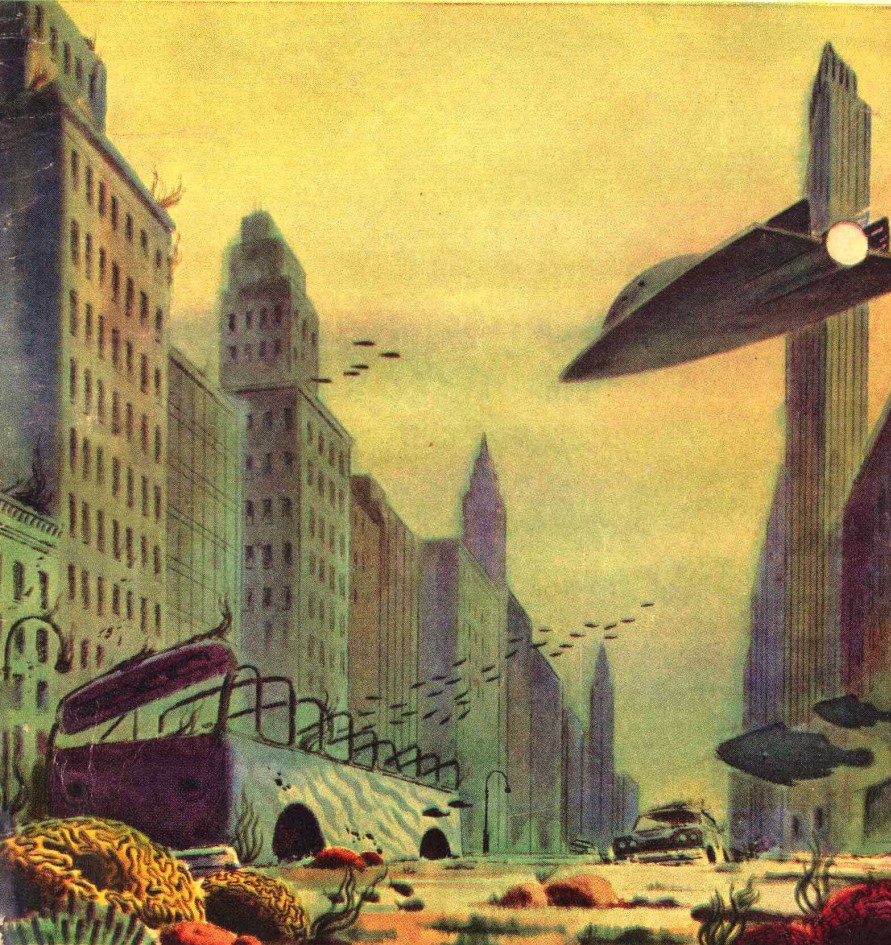
I’ve been wondering when the idea of humanity dying off and life marching on without us was first imagined. Humans have always been rather egocentric and assumed we were the crown of creation, and the center of the universe. But 20th century science fiction has sometimes pictured Earth without people. Maybe we’re replaced by mutants, post-humans, robots, intelligent animals, or even imagining life on Earth without sentience.
After London by Richard Jefferies was first published in 1885 that comes near to imagining life on Earth without us in its first five chapters. You can read After London online, download an ebook edition, or listen to an audiobook edition. After London is one of the earliest examples of a post-apocalyptic novel. Set in England hundreds of years after the collapse of civilization, it imagines nature and human society transformed.
Over the past few months, I’ve been reading books about the history of reading. I’m currently listening to Pamela by Samuel Richardson which was first published in 1740. It’s considered by some to be the first English novel. It was the first novel published in America, by Ben Franklin no less, in 1745. This study makes me want to study the earliest examples of science fiction and its major concepts.
The novel has evolved over the centuries, but also, what readers want from novels has evolved too. Before fiction was popular, reading religious texts was popular. Then came what might be called speculative moralizing, which blended storytelling with moral instruction. Eventually, writers and readers dropped most of the sermonizing, and went to straight storytelling.
However, there were writers who liked to speculate about society and the future, which often included philosophy and morality. Utopian novels became a vogue, especially in the 19th century. Some of these novels we’d call science fiction today, but that term didn’t exist when they were written. My theory is science fiction evolved out of certain kinds of fictional speculation in the 19th century.
Richard Jefferies (1848-1887) was a nature writer and novelist, who liked to focus on rural life, and had a bit of a mystic streak. He was also fascinated by catastrophes, which inspired After London. And I assume he read Charles Darwin. Jefferies didn’t like what industrialization was doing to nature so it might be obvious that he fantasized about a world without it. Jefferies could have read The Last Man (1826) by Mary Shelley or read earlier poetry on the subject, especially Le Dernier Homme by Jean-Baptiste Cousin de Grainville, or “Darkness” by Lord Byron.
I’d love to see a history of the idea of the last man on Earth. Even more, I’d love to see a history of speculation about life on Earth after humans are gone. If you know of any, leave a comment below.
Part I (chapters 1-5) of After London is called “The Relapse into Barbarism,” and is the most profound part of the novel. In this section Jefferies imagines what will happen to plant and animal life after the collapse of civilization. He comes close to describing a world without people, but ultimately brings in humanity so he can tell a traditional story. Part 1 is quite detailed about how nature will react when people leave.
By the thirtieth year there was not one single open place, the hills only excepted, where a man could walk, unless he followed the tracks of wild creatures or cut himself a path. The ditches, of course, had long since become full of leaves and dead branches, so that the water which should have run off down them stagnated, and presently spread out into the hollow places and by the corner of what had once been fields, forming marshes where the horsetails, flags, and sedges hid the water.
You can listen to more of this elegant description with the audiobook reading on YouTube:
The first part of After London reminded me of The World Without Us by Alan Weisman, a 2007 nonfiction work that imagined what life on Earth would be like if suddenly all humans disappeared. The book inspired three television series: Life After People, Aftermath: Population Zero, and The Future is Wild. All are available to watch on YouTube. Or read more from the book online.
“Part II: Wild England” is twenty-eight chapters that tell a story set in this future world. It’s about a young man named Sir Felix who goes on an adventure, allowing Jefferies to describe an aristocratic feudal society in a post-apocalyptic England. It’s a fun story, but not philosophically great. Felix is a nerdy guy in a macho society. However, chapters 22-24 have Felix exploring the remains of a decayed city from our civilization. Again, this has become a standard feature in modern post-apocalyptic science fiction. I assume this was inspired by 19th century explorations of ancient Egypt.
Descriptions of dead human or alien civilizations are among my favorite themes in science fiction. There’s something about walking through ancient dead cities that creates a profound sense of wonder in me. I believe that’s why “By the Waters of Babylon” (1937) by Stephen Vincent Benet was so evocative and why “There Will Come Soft Rains” by Ray Bradbury is so beautiful. Of course, Bradbury was inspired by Sara Teasdale’s 1918 poem “There Will Come Soft Rain.” It was composed at the end of WWI and the beginning of the Spanish Flu.
“There Will Come Soft Rains”
There will come soft rains and the smell of the ground, And swallows circling with their shimmering sound;
And frogs in the pools singing at night, And wild plum-trees in tremulous white;
Robins will wear their feathery fire Whistling their whims on a low fence-wire;
And not one will know of the war, not one Will care at last when it is done.
Not one would mind, neither bird nor tree If mankind perished utterly;
And Spring herself, when she woke at dawn, Would scarcely know that we were gone.
I find it utterly serene to meditate on images of Earth without us, which is why I liked the beginning of After London so much, and why I love the book The World Without Us and all the documentaries made from it. If we self-destruct it will be our own fault, and I think we are in the process of doing away with ourselves. I doubt we will go extinct anytime soon, but I do think science fiction should imagine what we might become more realistically. We need more post-apocalyptic novels that moralize, philosophize, and instruct rather than use after-the-collapse settings for adventure stories.
When I was younger, I pictured humans spreading out across the galaxy. I realize that’s as naive as imagining we’ll all go to heaven or flying reindeer. We might get as far as Mars, but I doubt we’ll ever go further. I can imagine us creating a new sentient species of intelligent machines that will explore space. Machines are perfect for space, we’re not.
Richard Jefferies just couldn’t imagine Earth without people. He pictures us regressing to a feudal society. We can read After London and use Sir Felix as a stand in for modern man, or even the average science fiction fan trying to live in that new world. Poul Anderson often wrote about how he believes humanity couldn’t handle complex societies, and that feudal societies were about as complex as we could manage. We’re certainly heading there. It’s a shame we couldn’t build a sustainable global humanistic society.
Richard Jefferies pictures us falling back toward medieval England. If you look around the world right now, just examine what’s happening to the poor in failed states. That’s our future. It’s rather scary. You’d think we’d try to do more to avoid such a fate.
Like I said at the beginning of this essay, contemplating apocalypses is a worthwhile pursuit for a whole lifetime. It’s a shame we’ve turned contemplating the apocalypse into silly escapisms, such as imagining civilization being brought down by zombies, vampires, and sightless aliens. Sure, such stories are fun, but we’re all sitting in deck chairs on the Titanic, shouldn’t authors write stories about how to avoid icebergs? We don’t need to think about zombies getting us, but to live with extreme heat, killer storms, and economic collapses. (Just imagine the United States without home insurance.)
Before people started reading fiction, they read religious speculation that advocated moral living. The earliest forms of fiction included lessons in how to live properly. We might need to go back to that. In the early days of novels, some people wanted to ban frivolous storytelling for the same reason people wanted to keep kids from playing on smartphones. But having fun won out, and fiction jettisoned the instructive element. When I was young, I used to think it absurd that fiction could be considered bad for people. But getting old living in a self-destructive society, I’m changing my mind.
If you know of any science fiction stories that imagine life on Earth without humans leave a comment. Olaf Stapledon’s Last and First Men imagined several post human species. Many science fiction writers have imagined robots replacing us. Clifford Simak’s City uses conversations between intelligent dogs and robots to introduce stories about our species who is no longer on Earth.
Also, if you know of any histories of speculation about the end of the world or human extinction, let me know in the comments too.
I’ve realized that I’ve been overindulging in science fiction, so I’ve decided to take a vacation from the genre. Science fiction has been a life-long addiction that I don’t think I can ever give up, but I do need to go into rehab for a while. I don’t know for how long.
I’ve read about fifteen hundred science fiction short stories in the last five years, and I feel like a kid who has snuck off with a whole bag of Oreos. To continue the comparison, science fiction is mostly dessert, and I need to fill up on some real food for a while.
I’m not sure how much I will be posting here in the coming months. I’ll probably still think about science fiction as a topic, and who knows, I might fall off the wagon from time to time.
I’ve been hoping to find a new kind of science fiction. Science fiction is geared to the young, and I’m getting old enough where I can’t pretend that I’m young anymore. I need to find science fiction aimed at people in their social security years. I’ve even thought about trying to write a science fiction novel that’s age appropriate for myself.
Looking back, I rediscovered science fiction in 2002 when I joined Audible.com. It became all too apparent I was reliving my youth by listening to all my favorite science fiction stories I read growing up. Then about five years ago I got into short science fiction and collecting old science fiction magazines and fanzines. Hell, I was then trying to relive my past.
In my youth, science fiction was about the future. Now in my old age, science fiction is about the past. But I’ve burnt out on nostalgia. Living in the 2020s, the future has become hyper-real. There’s too much going on. Reading old science fiction is like being an ostrich sticking its head in a hole in the ground. For years now I’ve been trying to find new science fiction that was relevant to now, but it’s just not there. Modern science fiction merely recycles old science fiction or recapitulates old science fiction. The genre really needs another New Wave.
I’ve thought about creating a taxonomy of science fiction themes and writing a history about how each theme has been rediscovered many times over the last two centuries. But I need some vacation time even before I consider that project.
I own over a thousand nonfiction and literary novels I haven’t read. That’s where I’m heading for my vacation. I’ll report on them at Auxiliary Memory blog.
Too much is happening in the real world right now. Strangely, life is more science fictional than science fiction. Between AI, a shakeup in cosmology, climate change, robots, space exploration, wars, fascism, sexual revolutions, and many possible apocalyptic scenarios, who needs to read science fiction anymore?
Things are about to get heavy in the next few decades. I’m guessing science fiction and fantasy are so damn popular right now because they are a great hideout from reality.
I was going to take a break from reading Dangerous Visions because it was depressing me, but I found “A Toy for Juliette” a fitting inspiration for a sermon I wanted to write. I’ve been reading Golden Multitudes: The Story of Best Sellers in the United States by Frank Luther Mott, which inspired me to buy and start reading The Sentimental Novel in America 1789-1860 by Herbert Ross Brown. Both books give impressions about how Americans, and I presumed other people around the world, got into reading fiction.
Printing began in the 15th century at a time when most people didn’t read. Storytelling has been around since we lived in caves. Although there were works in Japan and China that could be called novels long before the printing press, in Europe and America, the novel seemed to emerge with Don Quixote in 1605. What we think of as the modern novel matured in the 18th century.
Frank Luther Mott’s book, Golden Multitudes describes the kind of books people read in America before Ben Franklin printed Pamela by Samuel Richardson in 1745. Some considered Pamela, first published in England in 1740, to be the first English novel. Before this novel, Americans mostly read books on morality. The colonies were settled by various religious groups, so that’s kind of logical. Mott says the first American bestseller was The Day of Doom by Rev. Michael Wigglesworth. It was written in verse, and it was all about the horrible things that would happen to people in hell. The excerpts and quotes Mott gave from this poem made me think early Americans were fixated on horror.
To keep this sermon short, I need to cover the following decades quickly. Fiction slowly emerged out of all this moralistic reading. Another bestseller was The Pilgrim’s Progress from This World, to That Which Is to Come by John Bunyan in 1678. This book is an allegory that begins with a dream. But the point is, Bunyan spiffed up moralizing with a story and characters.
Pamela became a huge bestseller in America and Europe after 1740 because Richardson made moralizing every more entertaining. One reason Pamela is given credit for being one of the first English novels is because Richardson invents a lot of storytelling techniques we use today. After the success of Pamela countless imitators began producing similar type stories, and the focus on moralizing became less, and the shift to pure storytelling became common.
At that time, many intellectuals began protesting, claiming fiction was corrupt and corrupting. Magazines and newspapers ran articles about how fiction was ruining young people’s minds, especially young girls. That made me think about how people worry about smartphones and video games corrupting young people today. But those fiction protesters were crushed by bookworms wanting more fiction.
By the time the 19th century rolled around, especially after Edgar Allan Poe, many stories became free of moralization. Kids and adults devoured fiction about violence, horror, the supernatural, and other evil things in the world. Which is why Robert Bloch is a popular writer, and why people enjoy stories like “A Toy for Juliette.”
The problem is I don’t. I don’t like horror. And I can’t understand why other people do. Although Susan and I are currently watching Why Women Kill, which could be described as comic horror. Fiction writers have a tough time producing stories that don’t involve the horrible aspects of life. Fiction is often an art form about the ugliness of humanity, but isn’t the best fiction about transcendence of those horrors?
I quite enjoy reading Pamela. I’m only about half finished, but then the book is over forty hours long on audio. I admire Richardson for embedding his moral lessons into his story. The story is about 15-year-old girl servant efforts to avoid being raped by her employer. On one hand, the novel could be considered a handbook for girls warning them about all the ways guys will trick them into having sex. On the other hand, it’s rather entertaining to read about all the schemes Mr. B used to seduce Pamela. The novel is also entertaining because I’m watching Richardson invent plotting and characterization.
When reading “A Toy for Juliette” I was seeing the refinement of centuries of storytelling. But Bloch completely ignores moralizing. He returns to the purity of telling gruesome stories around a campfire. However, I miss moralizing. Bloch makes no effort to explain the psychology of Jack or Juliette. He makes no moral judgments on their actions. He just accepts that those kinds of people exist.
Sociologists claim there is no correlation between the consumption of violent entertainment and committing violence, but I find that hard to believe. But then, from Harlan Ellison’s introduction about Robert Bloch, he seems like a very nice guy — kind, considerate, and generous.
Maybe, “A Toy for Juliette” depresses me because it reminds me that there are people like that in this world. And it bothers me that people find stories about such people entertaining. But as I admitted, Susan and I found a comedy about murder fun. And even the Puritans, with all their emphasis on living a pure life, sure did love to read about the gruesome aspects of going to hell.
Back in the 1960s, I learned from health food nuts, “You are what you eat.” And from computer school I learned GIGO – garbage in garbage out. I can’t help but wonder if those 18th and 19th century pundits who attacked fiction weren’t right. Why should we pollute our mind with a story about a sadist being sadistically killed by another sadist? I guess I could claim Bloch was preaching that we reap what we sow, but I don’t think it’s true. I think people enjoy seeing Juliette get ripped by the Ripper.
Still, I find “A Toy for Juliette” a virus in my mind. I find reading nonfiction about the horrors of humanity enough of an education about the reality of humanity. Why do we want reminders of such horrors in our escapism? But we do. Think about all the fiction you consume. How much of it involves acts we’d be terrified of if they happened to us? Why do we dwell on the horrible?
It’s becoming increasingly difficult finding science fiction that thrills me. This feels like a crisis of faith since I’ve been a lifelong science fiction reader. I keep asking myself: Is it me or science fiction?
One of the theories I’m working with suggests that I’ve just read too much science fiction. Either I’m old and jaded because I’ve read every variation on a science fictional theme, or I’ve pigged out on the genre for so long that I’m finally made myself sick. Another theory makes me wonder if I’ve just gotten too old and can’t believe in the far-out ideas of science fiction anymore. Aging has made me skeptical. One fear I have is it might be the Williamson effect. I had a friend that before he died lost interest in everything, but it took years, losing interest with the things he loved one by one.
Too disprove I’m infected the Williamson effect; I’ve been scrambling around trying to find a science fiction story that still thrills me. It’s getting harder and harder to find any science fiction story that turns me on. I still find other kinds of fiction thrilling, and I still get intellectually excited over nonfiction. That suggests it might not be the Williamson effect, but I’ve just used up science fiction.
After reading thousands and thousands of science fiction short stories and novels, which shouldn’t be a surprise. Can any genre be infinite in its appeal and scope? Science fiction has always been exciting because it offered ideas I never imagined. Now that I’m 72, it seems like current science fiction is just recycling older science fiction, and that’s getting tiring. And since I’ve lately been reading 19th and early 20th century science fiction, I’ve discovered that the Golden Age of science fiction from the 1940s, 1950s, and 1960s used recycled science fiction concepts too, I’m starting to doubt there are any new science fictional concepts left to thrill me.
For years I’ve been depending on how a story was written to make a science fiction novel feel new and different. For example, The Hopkins Manuscript by R. C. Sherriff, a cozy catastrophe from 1939 charmed me because of its down-to-Earth storytelling. I remember reading Hyperion or Neuromancer when they came out, and how fresh they felt because of their prose style.
For several years I’ve been digging through forgotten authors and their works hoping to find something new and different that’s been neglected by time. For example, I just read Sex and the High Command by John Boyd. Boyd wrote eleven science fiction novels from 1968 to 1978, with the most successful being his first, The Last Starship from Earth. I found that novel tremendously exciting back in the 1960s, so I thought I’d try Sex and the High Command this week, to see if it could rekindle some science fictional thrills. It hasn’t.
Boyd based his story on the classical Greek play, Lysistrata, about Athenian women trying to end the Peloponnesian War by refusing to have sex with men. In Sex and the High Command, women of the world try to bring about world peace when they discover that an anti-aging face cream applied to their genitals rejuvenates their whole body, causes orgasms, and in some cases sets off parthenogenesis. It was later fashioned into a more convenient pill/suppository for widespread use. Women begin thinking they don’t need men, and other women feel this will give them the edge to take over world power and stop war.
The novel is told from the point of view of the panic men of the U.S. military, especially the high command and the White House. Their primary concern is getting laid. I feel this 1970 novel is meant to be a satire in the vein of Dr. Strangelove. The writing style seems inspired by Heinlein serious respect for the Navy blended with Eric Frank Russell’s spoofs on military hierarchy. Like Heinlein, Boyd had served in the Navy.
I tried hard, but Sex and the High Command never catches fire. Is it me, or is it the novel? I don’t know. I wished I had an audiobook edition with a great narrator. I felt Boyd’s prose should be hilarious, but my own inner reading voice just can’t do it justice. If it was produced by Stanley Kubrick, Sex and the High Command might be as funny as Dr. Strangelove.
This suggests another theory about my fading interest in science fiction. I’ve lost interest in science fiction before. The Cyberpunk movement rekindled it in the 1980s. And in 2002, joining Audible let me listen to science fiction, and that gave me twenty years of rediscovering all my old favorite science fiction. Maybe I’m in a down cycle, and after a fallow period, I’ll get back into the genre.
I don’t think so, though. Could Audible have just fueled twenty years of nostalgia for the genre that’s run its course? Getting old has been weird. I feel like I’m going through psychological changes that I never imagined when I was younger. Science fiction appears increasingly to me aimed at youthful minds, and my mind is getting too old for it.
But I have one last theory. The older I get the more I’m getting into the now. Each individual day seems more important. The past and future are becoming less important. The past is all about reconstruction, and the future is all about speculation. Both are abstractions. I have noticed that when I do like science fiction, it’s set closer to the present, like the film Leave the World Behind. One reason I read Sex and the High Command, is because it felt contemporary, although that was marred by pre-1960s attitudes toward women. Boyd was born in 1919.
I’ve discovered that science fiction set in the far future, or far away from Earth has much less appeal to me. Now that I think of it, all the reading I’m still excited with offers some kind of relevance to now. Maybe, this preoccupation with now has made me feel science fiction is irrelevant.
For me, the most rewarding pages of Dangerous Visions were the introductions by Harlan Ellison and the afterwards by the authors. When I first read this anthology back in the late 1960s, I felt those introductions gave me insight into the family of science fiction writers, one I wanted to join. At the time I was sixteen and I totally bought Ellison’s enthusiasm and promises. Fifty-six years later, I reacted to this anthology and its stories very differently.
Ellison honors del Rey by putting his story in the pole position, and he praises his friend and mentor Lester for being a giant of the genre. Back in 1968, Lester del Rey was not a major figure to me. I had read some of his Winston Science Fiction juveniles, but unknowingly, because they were published under his pen names. However, one had his name on the cover, Marooned on Mars. It wasn’t a standout, and I didn’t remember he wrote it. Lester del Rey was not a giant in the field to me. Later on, I’d discover he wrote “Helen O’Loy” and “Nerves” when I read The Science Fiction Hall of Fame anthologies. I don’t think Lester del Rey was ever a great writer of science fiction, but he became a great editor and publisher.
Ellison hyped Dangerous Visions for publishing stories that editors couldn’t or wouldn’t because they contained ideas that challenged the norms of society, or were too mature for the typical youthful science fiction reader, or were written in creative styles that average science fiction reader would reject.
“Evensong” is about hunting down a fugitive. That fugitive was God. At sixteen that excited my young atheist mind. But at seventy-two, it felt like Mad Magazine’s Alfred E. Neuman saying, “What, me believe?”
Was that really a dangerous vision that no publisher would accept? Then how could Fred Pohl publish del Rey’s “For I Am a Jealous People!” in Star Short Novels in 1954? In that story, mankind is fighting aliens and learns that God has sided with the enemy, so humans declares God is their enemy too. In other words, del Rey gave Ellison a dangerous vision that he’d already used years earlier.
That’s something I keep finding as I reread Dangerous Visions. Ellison was wrong that science fiction publishers wouldn’t take them. It made me wonder if Ellison could have assembled a reprint anthology called Dangerous Visions and collected all the science fiction stories that were published that had been quite startling for the times. Many classics come to mind that I think had more impact than those in Dangerous Visions, such as “Fondly Fahrenheit” by Alfred Bester and “Lot” by Ward Moore. I also think “For I Am a Jealous People!” is a better story than “Evensong.”
Ellison quotes del Rey’s letter to him about the afterward he wrote for the anthology. I thought this part was rather telling:
The afterword isn’t very bright or amusing, I’m afraid. But I’d pretty much wrapped up what I wanted to say in the story itself. So I simply gave the so-called critics a few words to look up in the dictionary and gnaw over learnedly. I felt that they should at least be told that there is such a form as allegory, even though they may not understand the difference between that and simple fantasy.
I was bothered that del Rey didn’t think critics wouldn’t know what an allegory was and couldn’t tell it from fantasy. That suggests del Rey felt a naive self-importance about his writing. But I also felt that Ellison showed a naive sense of self-importance about Dangerous Visions.
Allegory always seemed to me to be lazy way to tell a story in modern times. And I don’t think “Evensong” is total allegory either because we’re told God’s thoughts and perspective. Would John W. Campbell (Analog), Frederik Pohl (Galaxy), or Edward L. Ferman (F&SF) have rejected “Evensong” in 1967 because it was too dangerous? My guess is they would have run it because of del Rey’s name, although they might have rejected it for being too bland and simple in construction. It’s not a very sophisticated story and comes across as something a precocious student would write who was trying to be daring.
In 1967 revolution and rebellion were in the air. The youth of the 1960s were revolting against the status quo. Looking back, I feel Ellison was trying to do the same thing in the science fiction genre. Ellison was loud, outrageous, and pugnacious, so we might consider him the Abbie Hoffman of the science fiction counter-culture.
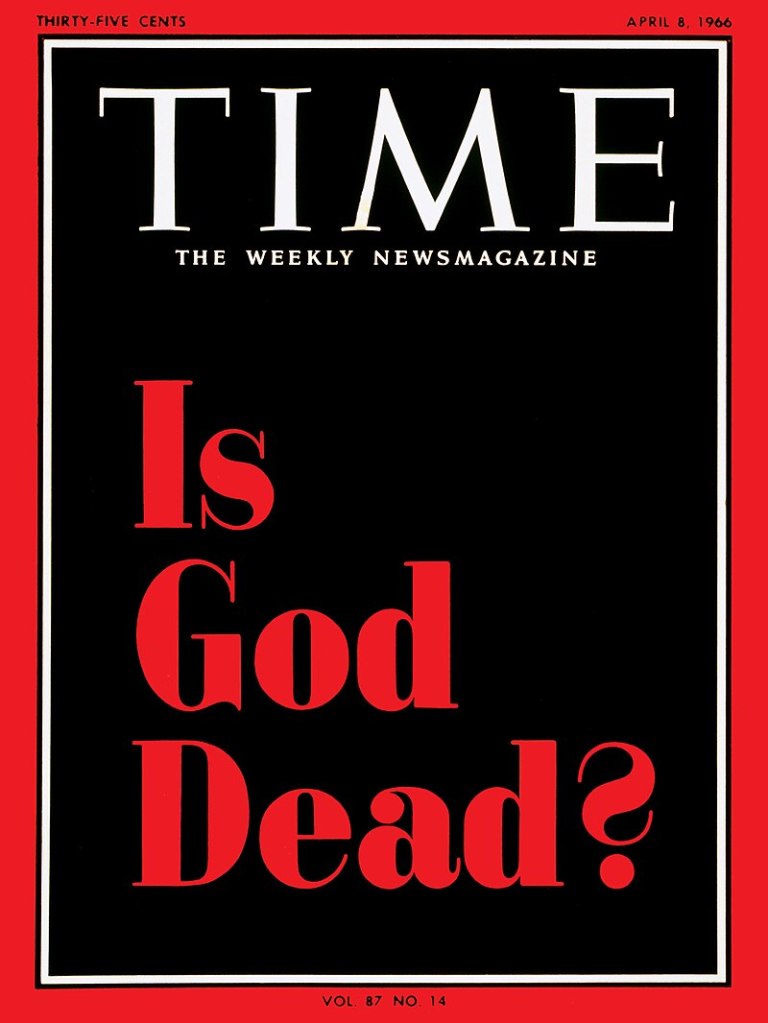
As I go through the stories in Dangerous Visions I’m expecting to find psychological snapshots of Ellison, the genre, the writers, and the times. The April 8, 1966, cover of Time Magazine asked if God was dead. Had del Rey forgotten his earlier story and “Evensong” was merely a science fiction riff on the Time cover?
Were the writers in Dangerous Visions thinking about old science fiction, or current events? Was Dangerous Visions anticipating the future, or reacting to an already fading pop culture rebellion?
Rereading “Flight to Forever” made me realize something about the core of my personality. There are a limited number of science fictional ideas that I resonate with that I like to regularly recall.
I consider “The Time Machine” the epitome of science fiction because it explored so many new science fiction themes. New to me at age twelve, and maybe new to the world in 1895. Poul Anderson’s “Flight to Forever” recalls many of those same ideas. “Flight to Forever” was first published in Super Science Stories, the November 1950 issue. You can read it here, or listen here. I first read it in Year’s Best Science Fiction Novels: 1952 edited by Bleiler and Dikty. I just read it in The Last Man on Earth edited by Asimov, Greenberg, and Waugh. Here’s a listing of other reprintings.
“Flight to Forever” also reminds me of Last and First Men by Olaf Stapledon and Tau Zero, also by Poul Anderson. The writing style, pace, and plotting feels like science fiction from the 1930s. I’m trying to give you enough hints to get you to go read the story before I give spoilers. This cover might also entice you to go read it too, especially if you discovered science fiction before Star Trek.
While reading “Flight to Forever” I kept thinking how it contained several scenes that inspired the kind of sense of wonder I loved experiencing as an adolescent when I first started reading science fiction. I know as an adult that all those mind-blowing concepts are completely unrealistic, just complete bullshit fantasy, but I still love encountering them over and over. Why?
Am I a 72-year-old kid still being enchanted by fairy tales? I like to think of myself as finally growing up and accepting reality for what it is, but I keep retreating into science fiction. Why? Could a good psychiatrist explain the psychology to me? Is it a neurosis? I will admit that science fiction was a coping mechanism for a turbulent adolescence in the 1960s, and maybe it helps me escape the constant chaos in the news of 2020s. Still, that doesn’t explain the specific appeal of science fiction and the way this story triggers my endorphins.
The story begins with Martin Saunders and Sam McPherson setting off in a time machine to travel one hundred years into the future to see why their automatic test time machines haven’t returned. Martin assures his lovely girlfriend Eve Lang that he will return quickly.
Having one’s own time machine is a wonderful fantasy, especially if it’s one you built yourself in your home laboratory. That’s why “The Time Machine” was so appealing. As a kid, I wanted to be Danny Dunn and have access to wonderful time machines and spaceships. It’s why Back to the Future was so much fun in the 1980s even though I was an adult.
Martin and Sam arrive one hundred years into the future without a problem, but when they try to return to their own time, they discover it takes ever more energy to go back in time. They eventually calculate that the amount of energy needed approaches infinity around the seventy-year mark. Poul Anderson has imagined a natural way for time to protect itself from paradoxes. It’s a neat idea.
Martin and Sam decide to head further into the future to see if they can find a time when scientists might know how to break through the going back in time barrier. This is where the story parallels Wells’ unnamed time traveler, stopping now and then to see how society and mankind has changed. This portion of the story also reminds me of Stapledon’s Last and First Men and many science fiction stories about speculated societies.
Sam is soon killed off, so Martin becomes a lone time traveler hoping to find his way back to his beautiful Eve. He acquires another companion, Belgotai, a mercenary from the year 3000 AD. Together they keep going further and further into the future, meeting society after society. They encounter humans that colonize the galaxy, and aliens that conquer Earth. This gives Anderson a chance to dazzle the reader with all kinds of science fictional speculation.
Eventually, Martin and Belgotai join a deposed monarch fighting a renegade galactic empire. That’s when the story becomes an epic space opera. Martin falls for a regal redhead, Empress Taurey. You’d think Martin will settle here, but Anderson has many other adventures for Martin to experience before the story ends. Martin goes further into the future than the time traveler in Wells’ classic story. Like that story, “Flight to Forever” could be considered a dying Earth tale, and it becomes a last man on Earth story too.
I got the feeling Anderson wanted to include every science fictional cliche he could cram into “Flight to Forever.” I won’t tell you anymore. It’s not an exceptional story, but it is appealing. I must wonder if Anderson wasn’t trying to understand the underlying siren song of science fiction when he wrote this story. Of course, he sold it to a cheap market, so he could have been just hacking out a quick novella to thrill kids and pay his rent.
Reading “Flight to Forever” made me wonder if I could collect a small set of stories that pushed all my sense-of-wonder buttons and just reread them whenever I needed therapy. Sort of like what Kip’s father does in Have Space Suit-Will Travel by always rereading Three Men in a Boat by Jerome K. Jerome. I could create a highly distilled tincture of science fiction to consume when needed, sort of like the playlist of my all-time favorite songs on Spotify.
If I did create a playlist of favorite science fiction stories, would I include “Flight to Forever?” I guess not, because I would keep “The Time Machine” instead. That suggests something to me. Haven’t I been reading one science fiction story after another my whole life just to push the same buttons again? Shouldn’t I explore other stimuli to discover other buttons?
“Flight to Forever” is a nice reminder that certain concepts within my brain like to be remembered, at least every now and then. I’m finding a lot of them in the anthology, The Last Man on Earth. It’s amusing to think about, but I have six large bookcases of science fiction that I could probably reduce to a handful of anthologies that would trigger every type of sense of wonder science fiction ever discovered.
I had a friend that died back in the 1990s. Before he died, he lost interest in the many things he cared about over his lifetime. They went one by one, until he only had two loves left, Benny Goodman and Duane Allman. I call this The Williamson Effect. At 72, I feel I’m in the beginning stages of The Williamson Effect. I’m starting to shed interests. I have a long way to go because I’ve collected an exceedingly long list of interests over my lifetime. I don’t count science fiction as just one interest. Rereading “Flight to Forever” made me see science fiction really is many interests, although a finite set.
“Let’s Be Frank” by Brian W. Aldiss #08 of 20 (Read)
Fantasy and science fiction are two genres where writers can imagine anything, but strangely we seldom see stories with first-of-their-kind concepts. As The Bible says, there’s nothing new under the sun. However, I think Brian Aldiss has produced a unique idea in “Let’s Be Frank.” If I’m wrong, I’d love to read other takes on this concept.
I’m never sure how much of a story I should give away. “Let’s Be Frank” isn’t an all-time top short story, or even a best of the year story. There’s a reason writing teachers advise their students “Show don’t tell.” Aldiss tells this story. There’s no tension, no drama, no mystery. Aldiss produced his idea and explained how the billions of people on Earth end up with two conscious minds. Maybe that’s enough of a tease to get you to read the story. (Follow the link above.)
It’s a shame that Aldiss didn’t spend more time with his idea and created a version of the story that showed us what it was like to be a consciousness with multiple bodies. You might think I’m talking about a hive mind, but I don’t think I am. “Let’s Be Frank” does suggest a clever kind of telepathy. Can you imagine being in two bodies at once, one in England and one in Spain, with four legs, four arms, four eyes, and two heads?
If ChatGPT was conscious, it might experience something like this. Imagine being in a million bodies having a million conversations simultaneously? ChatGPT does that.
“Let’s Be Frank” isn’t a memorable short story either. Our group is working to identify the best science fiction stories of 1957. I don’t think “Let’s Be Frank” is one. But it is neat. The act of looking for exceptional stories makes me think about what makes a standout work of short fiction. I haven’t read all twenty we’re going to discuss, but I do know that “Call Me Joe” by Poul Anderson, “Omnilingual” by H. Beam Piper, and “The Menace from Earth” by Robert A. Heinlein are the great science fiction stories of 1957. They are the ones to read, reread, and remember.
Yet, what makes those stories great? What’s missing from “Let’s Be Frank” that’s in those stories? Each of those stories have original ideas too, especially Heinlein’s human powered flying on the Moon. They do have drama and characterization. I’m not sure Aldiss could have dramatized “Let’s Be Frank,” but if he could, it would have made all the difference in the world.
“The Cage” by A. Bertram Chandler #07 of 20 (Read, Listen)
“The Cage” is a fun story, although I’m not sure I would have included it in a best-of-the-year anthology. It’s a puzzle story. Bertram Chandler had a theoretical problem he wanted to present fictionally. How does one intelligent species recognize another intelligent species? It’s a reasonable question, but how do you propose it in a story?
Chandler had to spend most of the short story setting up the problem. If humans arrived on another planet, we’d assume any intelligent alien species would recognize our abilities. Chandler needed to put humans into a situation where our abilities wouldn’t seem obvious at all.
Chandler begins his story by having the interstellar liner Lode Star go off course and land on a young planet with just primitive life forms. The ship must be abandoned when its reactor goes into a runaway chain reaction, and it eventually blows up leaving no trace of the spaceship.
On this planet it mainly rains. The planet’s ecology has evolved some trees and plants, a froglike creature, and lots of fungi. Some fungi provide healthy food for the humans, but other forms of the fungi eat all their clothes and metals, so the castaways end up buck-naked. They can’t even start a fire because of the constant rain.
That’s when another spaceship lands and captures the humans in nets and takes them to another planet. The humans are put into something like a zoo. Finally, the story gets to the problem: How do they let the aliens know they are an advanced intelligent space faring species?
I’ll let you read the story and find out for yourself. But puzzle stories are intended to inspire readers to think of their own solutions.
I thought the aliens would eventually recognize the humans speak a complex language. But I also assume the humans could have made sign language gestures. Their cage had the same environment as the rainy planet, so they couldn’t make a fire, or build anything.
Puzzle stories are rare in science fiction, at least memorable ones. I can’t recall any others at this moment. I vaguely remember a story where a spaceship couldn’t see outside. I think the crew were trying figure out if they were in orbit around a planet.
I asked Copilot to list science fiction stories that proposed a problem. None of the stories it offered are what I was thinking of as a SF problem story. AIs are impressive right now, but they don’t seem to understand science fiction. I guess I’m assuming Copilot is unintelligent because it’s unaware of science fiction plots. But then, Copilot might not recognize me as an intelligent being either.
When you read thousands of science fiction stories you realize just how hard it is to produce an outstanding story. “The Cage” is decent enough. I would have been satisfied if I had read it in the June 1957 issue of The Magazine of Fantasy and Science Fiction. Personally, if I were an editor, I wouldn’t have selected it for any kind of anthology, but it’s been widely anthologized.
I keep waiting for us to discover another SF story with the impact of “Fondly Fahrenheit” or “Coming Attraction” or “Flowers for Algernon.”
While my Facebook group is reading twenty stories selected as the best short science fiction of 1957, I’m also searching for other stories from that year that also deserve to be remembered. I think I found one with “Between the Thunder and the Sun” by Chad Oliver, from the May 1957 issue of F&SF.
The trouble is I can find no other recognition for this story. That makes me doubt my own interest in the story. I want to advocate “Between the Thunder and the Sun” not because it’s an exceptional story but because it tackles a serious subject, one that might be new to science fiction in 1957. If you know of early stories on this theme, leave a comment.
Chad Oliver was an anthropologist who worked at the University of Texas. He wrote a fair amount of science fiction, but I only remember him for Mists of Dawn, a 1952 Winston Science Fiction juvenile I read as a kid. Oliver had more success as a western writer. “Between the Thunder and the Sun” was only anthologized in one notable anthology, The Best from Fantasy and Science Fiction, Seventh Series edited by Anthony Boucher, which is essentially the best of 1957 from F&SF, so it’s picking its own children to praise. Still, I need to remember that anthology in my search for other standout SF stories from 1957.
What makes “Between the Thunder and the Sun” significant is it’s a Prime Directive story, a concept that emerged from Star Trek: The Original Series. Evan Schaefer is a professor contacted secretly about a mission to a planet where the population of intelligent beings were dying off on one continent. Because those beings have not reached a stage where they could survive the culture conflict of meeting a technologically superior species from Earth, it is against all our laws to even contact them, much less help them. However, a secret group wants to break those laws and save those beings. Their method of helping the aliens is to get them to understand ecology, because their current practices are self-destructive. And even still, their altruistic efforts only reinforced the Prime Directive laws.
What made this story stand out to this afternoon was I had just watched a YouTube review of Hard to Be a God by Arkady and Boris Strugatsky, a 1964 Russian novel that was translated into English in 1973 that is also about the Prime Directive. This made me wonder when the concept first appeared in science fiction or as a public concept. I can’t answer that question, but I hope readers of this blog can, and will comment below.
“Between the Thunder and the Sun” is a pleasant enough story to read, but it lacks suspense, drama, tension, and when conflict does arrive near the end, it just happens. Oliver wrote the story as an unfolding narrative. There’s lot of interesting ideas in the story, lots of imaginative details, but the story just doesn’t zing.
Should we remember a science fiction story just for its ideas? If you look at a list of the most remembered SF short stories, they are often based on remarkable ideas. But nearly all of them have remarkable storytelling too.
Neither Judith Merril, T. E. Dikty, or Asimov and Greenberg included “Between the Thunder and the Sun” in their anthologies of the best science fiction stories of 1957. That’s striking out three times. However, Merril did include the story in her honorable mentions.
If you get a chance, read “Between the Thunder and the Sun” and let me know what you think. Here’s the link again.








 Classics of Science Fiction