“The Last Day” by Richard Matheson

Group Read 92 (#04 of 25)

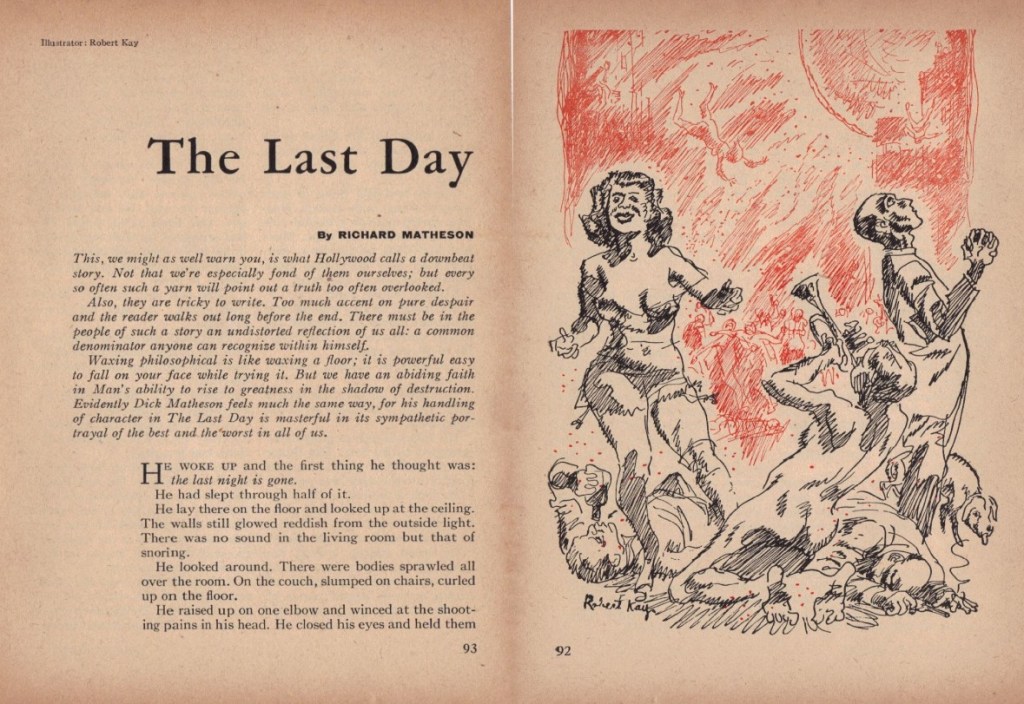
“The Last Day” by Richard Matheson was first published in the April-May 1953 issue of Amazing Stories. You can read it online here. Or you can buy The Best of Richard Matheson in various media editions here. Or look at its reprint history to see if you already own it in an anthology.

Our reading group is reading 25 short stories recommended by five group members. They are stories we haven’t read as a group, but ones the five people thought we shouldn’t miss. I didn’t submit this time, but “The Last Day” would have been one of the stories I would have submitted. Three of my favorite SF short stories from 1953 are “The Last Day,” “Lot” by Ward Moore, and “Deadly City” by Paul W. Fairman. I admire these stories because they were so gritty, even brutal.

Science fiction has often dealt with post-apocalyptic stories but “The Last Day” is about the end of the world. Some astronomical object is about to crash into the Earth. It’s not specified. The story begins in the morning of the last day and ends in the evening just before the end of everything on Earth.

I have often read and thought about surviving an apocalypse. I have often contemplated my own death. And I’ve always been fascinated by stories about people with a terminal illness and what they did with their remaining days.

But I haven’t thought about what I would do if everyone had just one day to live. It’s a neat concept to ponder. After reading “The Last Day” I’m not sure I’d need to read another story on the same idea. “The Last Day” gets the job done so nicely that I can’t imagine anyone topping it.

For this reading, I read the story with my eyes and then listened to it with my ears. I was impressed by its drama. Richard Matheson is famous for writing over a dozen episodes of The Twilight Zone. Many of Matheson’s stories and novels were adapted for television and the movies, and he wrote many screenplays. Matheson knows how to create drama.

“The Last Day” begins with Richard waking up in a room full of passed-out people. Several are naked, and it’s obvious that a drunken orgy had taken place the night before. When Richard goes into the bathroom to clean up a bit, he finds a dead man in the tub. Richard enters the kitchen where a friend, Spencer, is frying eggs. By now, we’ve realized that life on Earth is about to end.

Richard wishes he were with Mary, a woman he loved but didn’t commit to. His friend Norman comes into the kitchen and tells Richard he wants to go see his mother. Norman asks Richard if he wants to see his mother. Richard dreads the idea because he knows his mother will preach religion at him, and he doesn’t want to hear it.

After Spencer leaves to have more sex with a woman who wants everyone to watch, Norman begs Richard to drive him to his mother’s house. We learn that riots are going on all over the city. Many people have committed suicide, but others run wild, murdering each other.

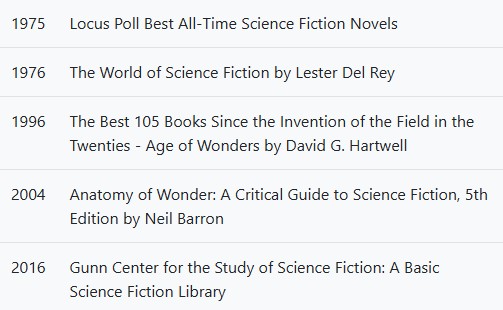
All of this is amazingly adult for a science fiction story in 1953, especially published in a magazine mostly read by young adults. That issue seemed atypical for Amazing Stories. It also had stories by Robert A. Heinlein, Theodore Sturgeon, and Murray Leinster. It was edited by Howard Browne. I feel I need to reevaluate that era of the magazine. 1953 was a boom year for science fiction magazines. I’ve written about it before. I believe the Cold War had a significant impact on the genre that year. Just look at some of the other notable stories from 1953.

Richard eventually finds his mother at his sister’s house. There’s a poignant scene of his sister and her husband getting their daughter to take sleeping pills, and Richard watching all three commit suicide. And finally, Richard has a moving moment with his mother while they wait to die.

The story is cleanly told. Direct. It covers many bases without getting wordy. 5-stars.

James Wallace Harris, 4/29/25

“The Rose” by Charles L. Harness

Group Read 92 (#03 of 25)

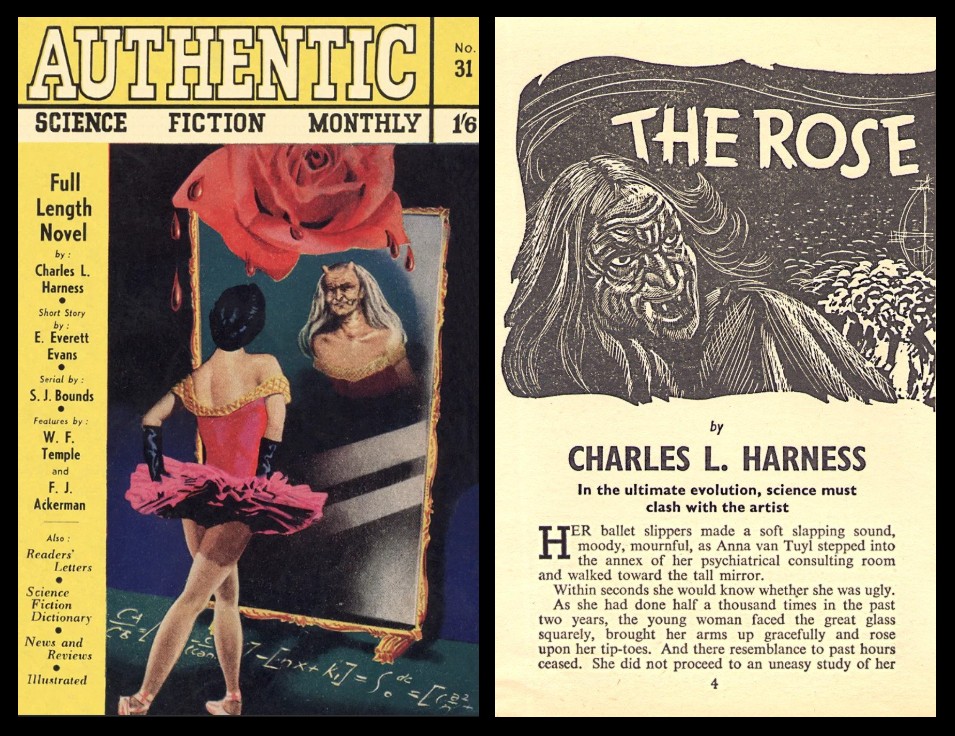
“The Rose” by Charles L. Harness was first published in Authentic Science Fiction Monthly (No. 31, March 1953). You can read it online here. Our Facebook group is discussing 25 stories suggested by five members that we haven’t discussed before. Paul Fraser has recommended “The Rose” in comments, but it’s never been up for a group discussion. I’ve tried to read “The Rose” twice before but got bogged down. The story is long, a novella, and it’s dense.

“The Rose” is one of the most ambitious science fiction novellas I’ve ever read. I’m glad that I finally finished it. This is exactly what I was hoping for from our member-recommended group read, a standout science fiction work I haven’t read. One good enough to merit rereading.

The story reminds me of what other writers explored in the years after 1953, works by Theodore Sturgeon, J. G. Ballard, Robert Silverberg, Jack Vance, and Roger Zelazny. “The Rose” has seldom been reprinted, but the most significant anthology to remember it is The Science Fiction Century, edited by David G. Hartwell.

“The Rose” is available as The Rose, a standalone Kindle novel for 99 cents. They say it’s 192 pages, but I can’t tell if it’s expanded from the novella. The UK edition says it’s just 88 pages, so it’s probably the same as the novella.

But for $1 more, you can get the Kindle edition of The Ornament of His Profession for $1.99, which includes “The Rose” and several other stories by Harness. I just discovered I already own that edition in my Kindle Library. Probably, I bought it when Paul recommended “The Rose” the first time.

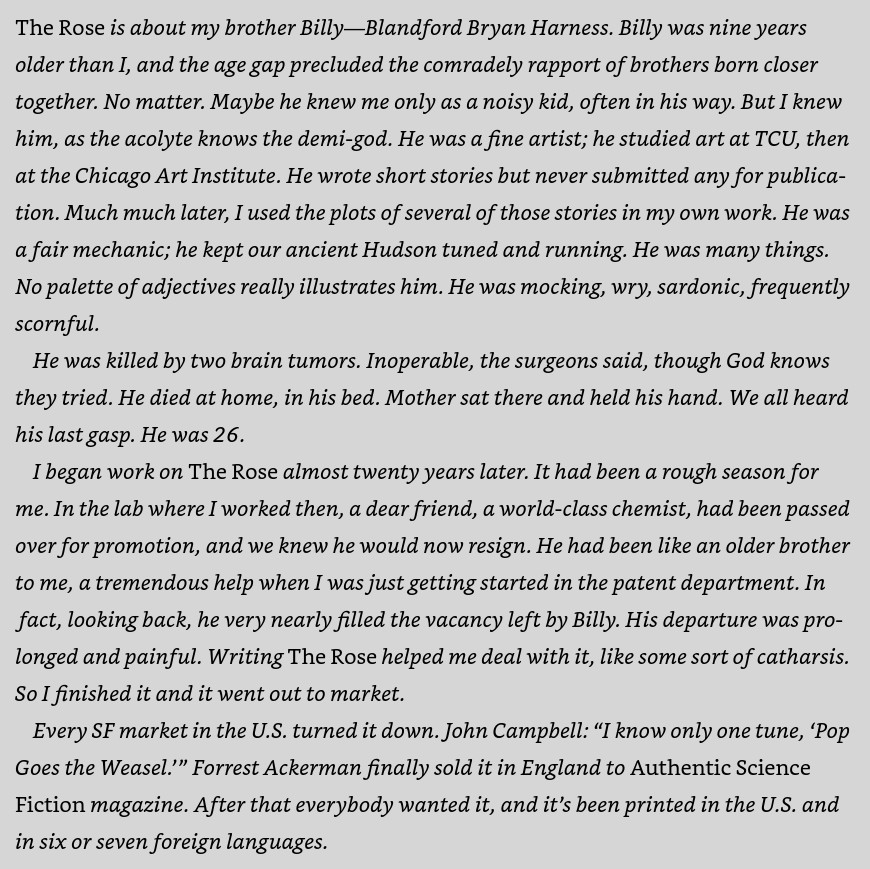
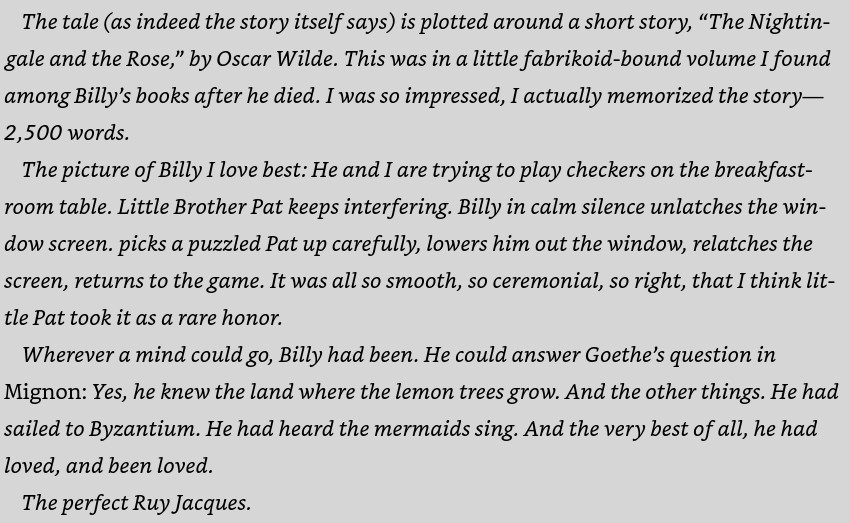
Both have the same introduction to “The Rose:”

Because “The Rose” appeared in Authentic Science Fiction Monthly, I thought Harness was British, but his Wikipedia page says he was American. I recommend taking the time to read his entry because it made me want to read more of what Charles L. Harness wrote. His science fiction sounds fascinating, but I’ve only read a couple of his shorter works. I may, or may not have read Flight Into Yesterday/Paradox Men. I also recommend reading “The Novels of Charles Harness” by Rich Horton.

Describing “The Rose” is going to be difficult. Anna van Tuyl is a psychiatrist. She’s also a ballet dancer, composer, and choreographer. Anna was once beautiful, but now she is hunched back and has two horn-like structures growing from her forehead. The story is about Anna’s efforts to finish the score for a ballet called Nightingale and the Rose. As the introduction tells us, it’s plotted around a short story, “The Nightingale and the Rose” by Oscar Wilde. Anna is mentally blocked from composing the score’s climax.

Anna’s friend, Max Bell, a psychogeneticist, recommends Anna to Martha Jacques, wife of Ruy Jacques. Martha is a brilliant scientist working on an advanced weapon, and Ruy is an artist. Ruy has also become disfigured by a hump and horns, and recently lost the ability to read and write. Max Bell tricks Anna into meeting Ruy Jacques, where she falls in love with him. Ruy is an over-the-top, outrageous character — narcissistic, insane, and brilliant to the nth degree.

It turns out that Martha is obsessively jealous of Ruy and is hesitant to hire Anna. Throughout the story, Martha and Ruy have one never-ending argument about art versus science. This is one of the many reasons “The Rose” is so dense to read. Harness throws out all kinds of ideas and theories about art and science. Ruy believes artists have long known everything scientists eventually discover.

To complicate the story further, Ruy and Anna are emerging supermen, or examples of Homo superior. They are developing psychic powers, but these are strange powers. Harness has taken on the task of showing how advanced humans will think. Much of his speculation is psychobabble and pseudo-science, but there’s a kind of elegance to his thinking. Harness uses 1953 art theory, combined with a fair knowledge of classical music, ballet, and other arts, to contrast with scientific and mathematical ideas of the time. Reading Charles L. Harness suggests he was a cultured man, better educated than the average science fiction writer. But then, science fiction writers are often great autodidatics and bullshitters. Harness had degrees in chemistry and the law and worked as a patent attorney.

Harness also complicates his story by paralleling the plot of the novella with the plot of the fictional ballet. And Ruy and Anna work to live out their own artistic creation.

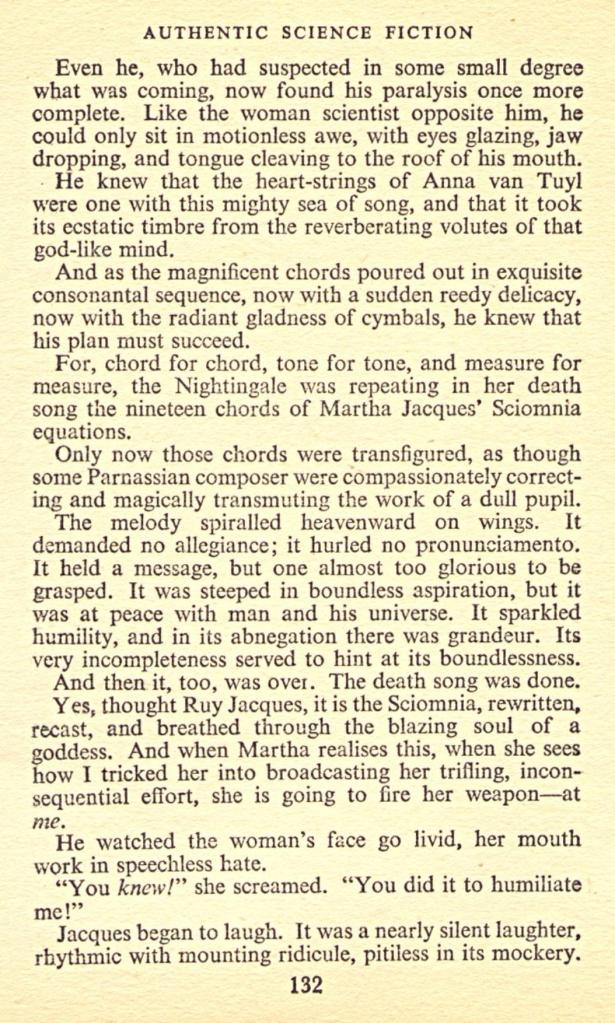
It took me a while to embrace Harness’s prose. You have to read it slowly because he intends so much with each sentence. Here’s one sample.

“The Rose” is definitely a story I look forward to rereading someday. I’d love to hear a professional narrator read it in an audiobook. “The Rose” doesn’t emotionally enchant me like “The Star Pit” by Samuel R. Delany or “A Rose for Ecclesiastes” by Roger Zelazny does. It’s about as intellectually impressive as “The Darfsteller” by Walter M. Miller, Jr., another long science fiction story about artists and performers I admire but don’t quite love.

My opinion might change with another reading of “The Rose.” Right now, it doesn’t quite make the five-star rating. I think the density of the prose keeps me from embracing the characters. I never liked Anna or Ruy, only admired them as interesting characters. This might be due to the story being too tightly plotted. Harness wanted his characters to act out a ballet they were creating, and you get the feeling that Anna and Ruy are acting for Harness, not themselves.

James Wallace Harris, 4/26/25

“Brightness Falls from the Air” by Margaret St. Clair

Group Read 92 – #02 of 25

“Brightness Falls from the Air” by Margaret St. Clair was first published in the April 1951 issue of The Magazine of Fantasy and Science Fiction as “?” F&SF ran it as a name-the-story contest. You can read it online here.

If I had been a reader in 1951, I would have submitted “The Plague.” If I had precognition, I would have submitted “The Ugly Terrans,” inspired by the 1958 bestseller, The Ugly American.

“Brightness Falls from the Air” shows writing development for Margaret St. Clair over her “The Listening Child,” published a year earlier. This story has bite. Humans occupy an alien planet where they treat the local intelligent life like the Romans treated conquered people. St. Clair instills this comparison in the first sentence, telling us her protagonist, Kerr, is in the tepidarium. Tepidarium was the name of a warm room positioned between the frigidarium and caldarium in Roman baths.

Kerr meets Rhysha, a bird person, and befriends her when she comes to claim the body of her brother, who died in a gladiatorial battle held by the humans. Throughout this short story, we learn humans have never curbed their population growth and have spread across the galaxy like a pandemic. We are not nice. Kerr tries to give Rhysha hope by telling her humans will one day change. Reading this story 73 years later, we know that’s unlikely.

I liked “Brightness Falls from the Air” so much more than “The Listening Child” (Group Read 92 #01 of 25) because it’s so dark. F&SF began as a light fantasy magazine, but as it included more science fiction, the overall tone of the magazine became heavier and darker. We’d entered the Cold War. Thoughts of nuclear annihilation become rampant.

Worrying about overpopulation in 1951, put Margaret St. Clair ahead of most other science fiction writers. Overpopulation wasn’t a major theme in SF until the 1960s – or so I thought until I read Joachim Boaz’s “Science Fiction Novels/Short Stories about Overpopulation.” Her story would be tied with “The Marching Morons” by C. M. Kornbluth as first since it was also published in April 1951, in Galaxy Magazine. Is it coincidence that both stories claim Homo sapiens are losers?

“Brightness Falls from the Air” could also fit into Boaz’s series concerning science fiction critical of space exploration. (I wish Joachim would put this series on the menu like his series on overpopulation, generation ships, and immortality.)

Even though I liked “Brightness Falls from the Air” much more than “The Listening Child,” they both have the same simple plot: a nice person sympathizes and befriends a tragic person who dies. In both stories, characterization is minimal. Each character is described by their relationship to the plot. None of these characters has their own agenda.

I admire “Brightness Falls from the Air” because it’s a vicious attack on humanity and says we shouldn’t colonize the galaxy. This feels even more valid in 2025. Yet, that’s not enough to make it a great story. It was included in David Hartwell’s The Science Fiction Century, so it’s better remembered than “The Listening Child.” However, it doesn’t have the lasting impact of “The Marching Morons.” It’s too slight.

“Brightness Falls from the Air” is a nice little story, but it’s not good enough to be great.

James Wallace Harris, 4/24/25

“The Listening Child” by Margaret St. Clair

“The Listening Child” was first published in The Magazine of Fantasy and Science Fiction (December 1950) by Margaret St. Clair using the pseudonym Idris Seabright. You can read it online here. It is short story #1 of 25 that our Facebook group will be discussing as Group Read 92. (See the reading schedule at the end of this review.) Group Read 92 consists of 25 stories picked by five group members that we haven’t read before. That was a challenge since we’ve been discussing a short story daily for years. The group is public.

In the 1950s, extrasensory perception (ESP) was a popular theme in science fiction and fantasy magazines. It was often speculated that people with physical or mental abnormalities might have additional senses to compensate for the loss of one of their primary senses. I assume the assumption came from blind people who had keener hearing.

After Hiroshima, science fiction and comic book writers often used radiation as a cause of ESP. However, in the 1930s and 1940s, John W. Campbell was impressed by the Rhine experiments, and science fiction writers often supposed that advanced aliens had psychic powers. Arthur C. Clarke, who was normally a hard SF writer, proposed that the evolution of human development led to ESP in two of his most famous novels, Childhood’s End and 2001: A Space Odyssey. Soft science and fantasy writers leaned towards psi-powers in physically and mentally damaged humans, like Theodore Sturgeon’s More Than Human.

Margaret St. Clair imagines a deaf mute having a rather unique ESP talent. Timmy can “hear” when death is near. Many famous stories personify death, so this isn’t too out there, but it’s not as believable as other ESP talents, even though it is well proven that ESP does not exist. Still, hearing death makes for a nice story idea.

St. Clair’s setup for her story is rather quaint. Edwin Hoppler is 63 and suffers from a weak heart. He lives in a boarding house. Boarding houses have disappeared, but were common in old movies and science fiction short stories before the 1960s. Quite a few episodes of The Twilight Zone were set in boarding houses. It’s a shame they don’t still exist. Living with several other individuals who ate communal meals fixed by a nice old lady sounds pleasant.

Timmy is the landlady’s grandson, and Edwin feels sorry for him. Edwin befriends Timmy when he realizes that the other kids don’t play with Timmy. Edwin notices that Timmy “listens” intently at times, and eventually notices that these listening moments precede a person or animal dying. Edwin decides to use Timmy as the canary in a coal mine to detect his own impending heart episodes.

“The Listening Child” is a pleasant little story, but rather slight. Timmy and Edwin are only developed enough as characters to present the idea for the story. There’s little conflict or tension. The story also lacks color or voice. The idea is slight, but writers can flesh out simple ideas into complex characterization and plots. For example, compare it to “Jeffty is Five” by Harlan Ellison. Jeffty is a boy who is perpetually five, and always lives in the year he was five, with the popular culture never changing. Or read “Baby is Three” by Theodore Sturgeon; it’s tremendously dramatic for a boy with psychic powers talking to a psychiatrist.

I don’t want to tell you the ending, but I expected St. Clair thought her readers would find it emotional and poignant. It was presented too casually for me to be moved, but I’m curious if other members from our short story reading group will be moved. I wanted the ending to be like in Platoon when we see Elias still alive, and the emotional impact we felt watching him die.

I’m working on a project to find my all-time favorite science fiction stories I’ve read over the past sixty years. Identifying such stories means learning what makes a story work. Most published stories succeed at a basic three-star level, which is how I’d rate “The Listening Child.”

For this story to reach the four-star level, Timmy and Edwin would need to become vivid characters. To make it to a five-star story would require elevating the story gimmick of hearing death into something metaphorical and philosophical that I would want to contemplate over several readings.

James Wallace Harris, 4/21/25

Group Read 92 Schedule

  • 01 (04/22/25) – The Listening Child, by Margaret St. Clair (ss) F&SF, December 1950 (DH)
  • 02 (04/24/25) – Brightness Falls from the Air, by Margaret St. Clair (ss) F&SF, April 1951 (FP)
  • 03 (04/26/25) – The Rose, by Charles L. Harness (na), Authentic Science Fiction, 15 March 1953 (PF)
  • 04 (04/29/25) – The Last Day, by Richard Matheson (ss), Amazing, April/May 1953 (FP)
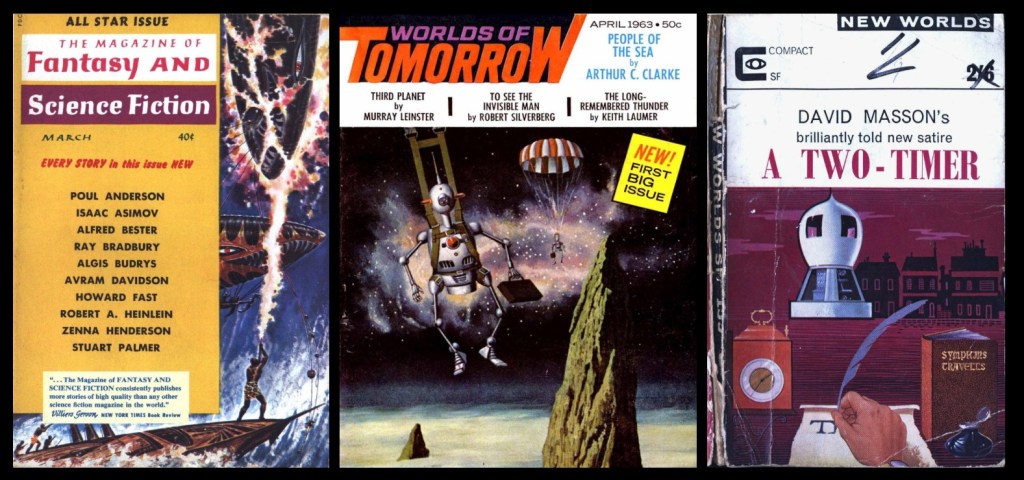
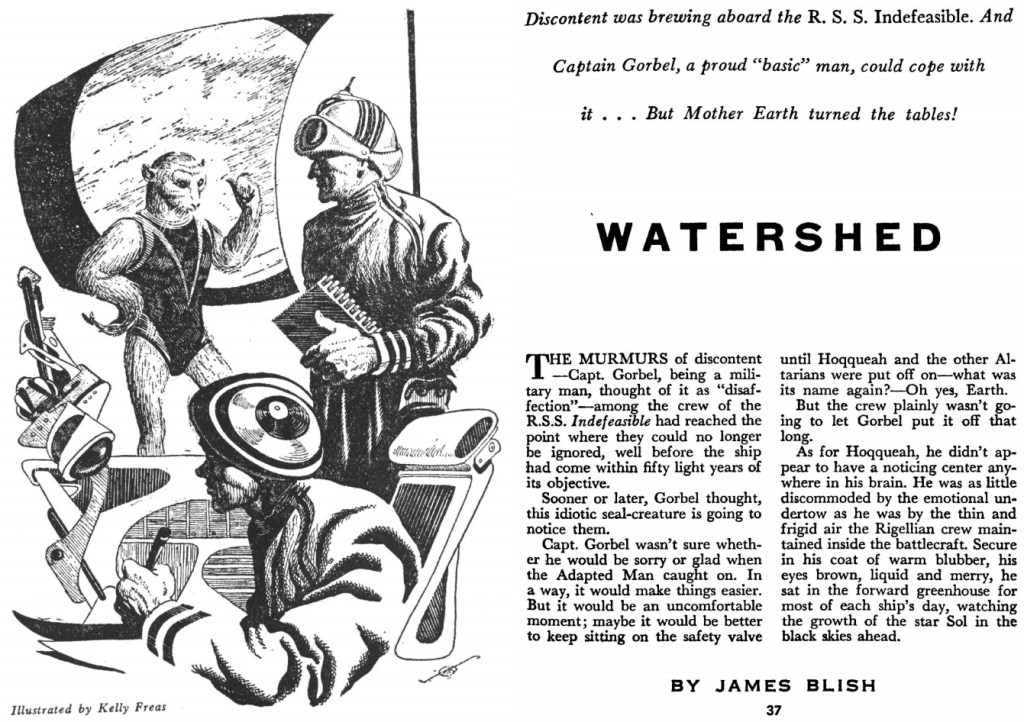
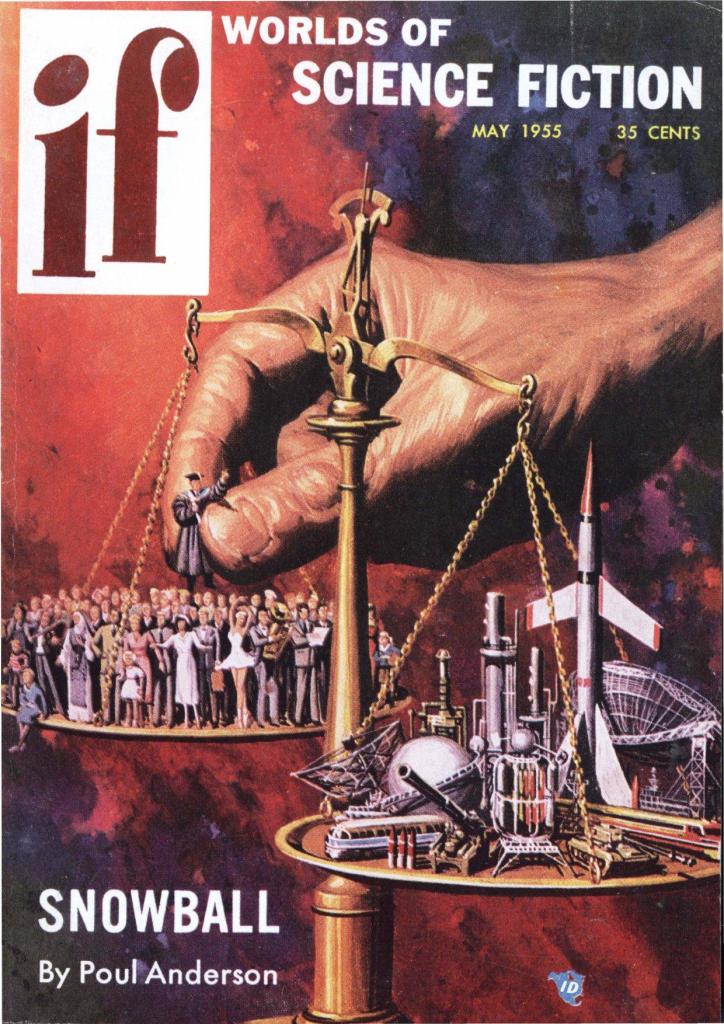
  • 05 (05/01/25) – Watershed, by James Blish (ss), If, May 1955 (RH)
  • 06 (05/03/25) – The Certificate, by Avram Davidson (ss), F&SF, March 1959 (FP)
  • 07 (05/06/25) – To See the Invisible Man, by Robert Silverberg (ss), Worlds of Tomorrow, April 1963 (FP)
  • 08 (05/08/25) – A Two-Timer, by David I. Masson (nv), New Worlds 159, February 1966 (PF)
  • 09 (05/10/25) – The Adventuress, by Joanna Russ (nv), Orbit 2, ed. Damon Knight (Putnam, 1967) (RH)
  • 10 (05/13/25) – No War, or Battle’s Sound, by Harry Harrison (nv), If, October 1968 (FP)
  • 11 (05/15/25) – The Milk of Paradise, by James Tiptree, Jr. (ss), Again, Dangerous Visions, ed. Harlan Ellison (Doubleday, 1972) (RH)
  • 12 (05/17/25) – Pale Roses, by Michael Moorcock (nv), New Worlds 7, ed. Hilary Bailey & Charles Platt (Sphere, 1974) (PF)
  • 13 (05/20/25) – Concepts, by Thomas M. Disch (nv), F&SF, December 1978 (PF)
  • 14 (05/22/25) – Gate of Faces, by Ray Aldridge (nv), F&SF, April 1991 (PF)
  • 15 (05/24/25) – On Sequoia Time, by Daniel Keys Moran (ss), Asimov’s, September 1996 (PN)
  • 16 (05/27/25) – Journey into the Kingdom, by M. Rickert (nv), F&SF, May 2006 (PN)
  • 17 (05/29/25) – Roxie, by Robert Reed (ss), Asimov’s, July 2007 (PN)
  • 18 (05/31/25) – 26 Monkeys, Also the Abyss, by Kij Johnson (ss), Asimov’s, July 2008 (DH)
  • 19 (06/03/25) – Passage of Earth, by Michael Swanwick (ss), Clarkesworld 91, April 2014 (PN)
  • 20 (06/05/25) – Cimmeria, by Theodora Goss (ss), Lightspeed 50, July 2014 (RH)
  • 21 (06/07/25) – Sadness, by Timons Esaias (ss), Analog, July/August 2014 (RH)
  • 22 (06/10/25) – Ten Poems for the Mossums, One for the Man, by Suzanne Palmer (nv), Asimov’s, July 2016 (PN)
  • 23 (06/12/25) – The Secret Lives of the Nine Negro Teeth of George Washington, by P. Djèlí Clark (ss), Fireside Magazine, February 2018 (DH)
  • 24 (06/14/25) – The Virtue of Unfaithful Translations, by Minsoo Kang (nv), New Suns, ed. Nisi Shawl (Solaris, 2019) (DH)
  • 25 (06/17/25) – One Time, a Reluctant Traveler, by A. T. Greenblatt (ss), Clarkesworld 166, July 2020 (DH)

How and Why to Assemble an Anthology of Your Favorite Science Fiction Short Stories

I’ve decided to assemble an anthology of my favorite science fiction short stories. I’m not going to publish it. This book will be just for me to read. Before personal computers I would have created such an anthology by xeroxing all my favorite stories and putting them into a big folder, binder, or box. Now, with computers I can create a digital file that I can read with my iPad. I’ve discovered I can convert digital magazines, e-book pages, web pages, or even scan physical books to .pdf files that are easy to read on my iPad.

This project is only practical if you’re savvy with computers.

You can read .pdf files with almost any device, but for fiction reading, it’s best to read on a tablet. My method doesn’t work well with Kindles, other e-ink readers, or smartphones because the .pdf files are a collection of .jpg images. This system works great with both iOS and Android tablets.

The next step for this project to be practical is to have a convenient way to load files onto your tablet. I save .pdf versions of stories to a folder on Dropbox and read them with the Dropbox application on my tablets. Dropbox has a built-in reader for common file formats like .pdf files.

I create the .pdf files using Abbyy Finereader 15, but you can use any program that will convert a collection of images to a .pdf file. The free PDFgear works great on Windows. However, the Mac version doesn’t allow for no margins and centers all images on a white background. That works but annoys me.

There are other cloud storage providers that work with tablets if you don’t use Dropbox. Dropbox has a free basic account with 2GB’s of space that will hold hundreds of stories. If you’re a tablet user, you probably already know which cloud drive works well with it.

If you have these technical solutions solved, the next step is to find stories to read on your computer. They can be from an ebook, web pages, or a page you scan yourself. If you look around, many old science fiction magazines have been digitized in the CBR/CBZ format. I use a CBR reader call YACreader. YACreader allows me to right-click on any page and save it to a .jpg. I name each page by the title of the story – author – page number of the original publication.

You can also use your screenshot utility to capture what you see on screen from a web page, ebook, or any program that displays stories to save as a .jpg file. I put all the .jpg pages in a folder that I name after the story. Here’s my folder for “Deadly City” by Paul W. Fairman from the March 1953 issue of If Magazine.

I then launch Abbyy Finereader (or PDFgear) and tell it to covert those pages to .pdf. I save the resulted file to a folder called “My Favorite SF Short Stories” and name the file by the title and author. Here are my first 27 stories. I just convert stories as I reread them and determine they are a favorite. Here’s my current folder on Windows:

Here’s what my directory of favorite stories looks like in Dropbox on my iPad mini. The directory is on the left, and the preview is on the right. It’s very nice.

And here’s what the story looks like in the reader view of Dropbox:

As you can see, I’ve copied the story from a scan of the original magazine. You can find scans of old magazines all over the web, such as archive.org. However, sellers on eBay and Facebook are now selling complete collections of digitized old magazines fairly cheap. I bought DVDs years ago with complete runs of my favorite SF magazines.

I do own several hundred of hardback, paperback, ebook, and audiobook science fiction anthologies. I also own several hundred physical issues of science fiction magazines from the 20th century. And I can call up nearly every issue of any science fiction magazine published in the 20th century on my iPad. So, why would I want to take the trouble to make my own anthology of favorite SF stories?

I’ve read thousands of science fiction short stories over the last sixty-three years. Some I’ve read several times. Since I’ve gotten older, I’ve discovered that there’s a depth to fiction that’s only revealed through rereading and study. I’m working to get beyond just reading and pursue understanding. Creating this anthology is my way of narrowing down the list of stories I want to study. I will add and delete to “My Favorite SF Stories” folder for the rest of my life. It’s becoming a project.

I’m focusing on the science fiction short story because I’ve always believed the science fiction magazine was the true heart of science fiction. And besides, novels are too long.

Think of fiction as a symbolic message from another person. How often in day-to-day interaction with your friends would you let one of them talk to you for hours without stopping? Usually, it’s no more than a few seconds. If your friend went on for minutes, you’d get annoyed. But we listen to what the author of fiction says for hours on end because they tell entertaining stories.

When you read a story one time it feels like you got the message and you’re done. But if you reread that story, you’ll often discover that you missed many parts of the message. Sometimes the author is saying something that requires reading the story several times before it’s understandable. You’ll discover there was a lot more to the story than you imagined. Great fiction has great depths to explore. Authors of great fiction often have many things to say but don’t say it directly. Words have severe limitations, so writers must communicate with imagery, symbolism, poetry, psychology, philosophy, and in ways that have no label.

I had a friend who died a long time ago, his name was Williamson. Before Williamson died, he started rejecting everything he loved in life until he had only two interests that kept his interest. I didn’t talk to him just before he died, but I’ve always wondered if he chose his final favorite before leaving this existence.

I’ve notice this process in others who have died. Now that I’m getting old, I understand that process. Our psychic energy dwindles away, and we can’t hang onto everything we once loved, so we start triaging out passions. I call this The Williamson Effect.

I’m in the process of identifying the science fiction stories I still care about and want to remember. My ability to remember is fading. I forget new fiction as fast as I consume it, but some older fiction has lasting power. Like Williamson, I realize I’m letting things go to focus on what I loved best. However, I’m not down to two things yet. I can still hold onto to about a hundred stories. I know the number of stories in my anthology will dwindle over time as I let some stories go.

I have several goals in mind for assembling this anthology:

  1. To decide on my all-time favorite science fiction short stories
  2. To reread short remembered stories to see if they still hold up
  3. To read recommended stories I haven’t read
  4. To collect stories I will regularly reread and study
  5. To collect stories that exhibit the best qualities of science fiction
  6. To collect stories that convey a sense of genre history and evolution
  7. To collect stories that were the most groundbreaking
  8. To collect stories that cover all the essential themes
  9. Hopefully find audio editions of all these stories
  10. To collect stories to psychoanalyze as to why I liked them
  11. To collect stories I feel had special messages in them by the authors

Currently, I’m contemplating how to organize this anthology. My first inclination is by date, like The Science Fiction Hall of Fame Volume One. It also occurs to me I should organize the stories by science fictional themes. Groff Conklin did that in The Best of Science Fiction.

Then, I’ve also had some ambitious ideas. Could I find a program where I could write a memoir of reading science fiction and provide links to all the stories where I could read the full text? Could a wiki or Obsidian handle that? What about feeding all my memories and texts into an AI? I once fed Google’s Notebook LM “The Star Pit” by Samuel R. Delany and it produced a podcast of two people talking insightfully about the story. That was damn neat.

One reason I’m inventing this project is because my memory is becoming unreliable. I’m hoping that working on the project will stenghten my mind. But I’m also running out of energy, so I need to keep things simple enough to get things done. Putting all my favorite stories in one anthology will be the easiest and quickest solution. Right now I remember too many favorite stories. I’ll need to create multiple volumes of this anthology at first, probably by decade.

Ultimately, my anthology of favorite stories will start to shrink as I distill the table of contents to my absolute favorites. I’m hoping, even assuming, that I will discover new insights about myself and my life-long addiction to fiction.

James Wallace Harris, 4/20/25

“All Summer in a Day” by Ray Bradbury

Screenshot

I’ve been rereading Ray Bradbury short stories, and I’m amazed at how well they hold up even when the science is beyond dated. Ray Bradbury is quite cruel to us readers in “All Summer in a Day.” In fact, I had to stop reading when I knew where the story was going, I just didn’t want to go there. I waited a couple of days to finish this fifteen-minute story on audio.

At first the kids in “All Summer in a Day” reminded me of Charles Schultz’s Peanuts characters, but then it was obvious they associated with bad kids from stories by Charles Beaumont or Shirley Jackson.

Remember when Lou Grant told Mary Richards she had spunk? And then Lou said, “I hate spunk.” Well, “All Summer in a Day” has a punch in the gut, and I should say “I hate a punch in the gut,” but when it comes to short stories, a punch in the gut is a good thing. Isn’t that weird. Why do we admire a great punch in the gut from a short story? Why is it so satisfying?

“All Summer in a Day” is set on Venus where it rains continuously except for a two-hour window of clear weather and sunshine every seven years. In a classroom the kids are talking about the impending summer. One girl, Margot, was born on Earth and didn’t come to Venus until she was four. She could remember sunshine and tried to describe it to her classmates who didn’t remember the sun because they were born on Venus. They were just two the previous summer day. They didn’t believe Margot. They resented that she knew something special. So, just before the sun was to come out, they locked Margot in a closet. All the other kids got to see the sun, and it was everything and more that Margot had tried to describe to them.

The children completely forgot about Margot while they cavorted through their brief summer day. When the rain and clouds returned, they remembered Margot and let her out.

This is a simple story about how children are cruel to each other. It’s about being the nail that sticks up. It’s about knowing the undescribable. Does the setting on Venus really matter? It makes the story science fiction so Ray Bradbury can sell it to a science fiction magazine, but does it really matter to the story? Charles Schultz could have done such a story about how the Peanuts gang mistreated Charlie Brown, and may have many times, I just can’t cite a specific panel.

I’m in the process of rereading my favorite science fiction stories and trying to understand why they are my favorites. Writing ability accounts for some of the reasons, but triggered emotions count for many too. I wish I could say I understood every cog in this story, but I don’t. What I do recognize is Ray Bradbury has a set of skills to tell a story in a way that makes it stand out. Not only that, but his stories also endure.

As I reread this story I didn’t remember the details, but either I guessed or remembered what was going to happen to Margot. That’s why I stopped listening to it. But when I returned to the story, I kept thinking to myself: “How is Margot going to react?” I was surprised that Bradbury didn’t give us Margot’s reaction. He left that up to us. That’s another tool in his writing toolbox. Writers don’t have to tell us everything. Bradbury does tell us this about Margot:

Because I just finished reading a biography of Ray Bradbury I know he was an odd child that stood out to his classmates. He also like to write poetry. Bradbury doesn’t have to tell us that this story is for us loners and oddballs, the ones other kids considered weird. When I was growing up, I didn’t know anyone else who read science fiction. Science fiction was like the sun appearing on Venus to me. I tried to explain its appeal to other kids, but they just thought I was a zero. I didn’t make a science fiction reading friend until the tenth grade when I met James Joseph Andrew Connell, III. The experience of meeting another science fiction fan is why Among Others by Jo Walton won the Hugo, Nebula, and British Fantasy Award. Zenna Henderson made a whole writing career out of telling stories about oddballs.

Even in the 1940s Ray Bradbury knew that being labeled a science fiction writer would hurt his career. Bradbury authored stories for all kinds of markets and genres, but when he wrote science fiction, he knew he had to be different. Back in the 1950s he might have been the best-known science fiction writer in America, but many science fiction readers didn’t consider his work science fiction. Bradbury wanted to be a writer like Sherwood Anderson, Ernest Hemingway, or Thomas Wolfe, someone who was just called a writer.

The reason “All Summer in a Day” is good is because of the parts that aren’t science fiction. The reasons why some science fiction fans dismissed him was for the science fiction parts. The obvious lesson here for would-be science fiction writers, is don’t worry about the science fictional aspects but focus on the universal human appeal.

James Wallace Harris, 4/11/25


How to Judge Hack Writing?

My friend Mike recently told me an anecdote from Here Comes Civilization: The Complete Science Fiction of William Tenn Volume 2. It was in the afterward to the story “The Human Angle.” It seems Ted Sturgeon invited William Tenn over for dinner with a hidden agenda. When Tennn arrived, Sturgeon told him that Mary Gnaedinger, the editor of Famous Fantastic Mysteries needed three short stories by tomorrow and they would write two of them that night. Ray Bradbury was going to write the third and air mail it special delivery to Mary from California. (See the “Afterward” below for the full tale.)

Tenn, Sturgeon, and Bradbury did come through in twenty-four hours and their stories were printed in the October 1948 issue of Famous Fantastic Mysteries. You can read that issue at Archive.org.

There were many legendary science fiction writers (and pulp writers) who bragged they could crank out a short story in a day, or a novel in a weekend. But is this hack writing any good? That’s hard to say. What is good? All three stories, “The Women,” “The Human Angle,” and “That Low” were readable stories and even entertaining. However, they are also quite forgettable. But not completely forgettable. Follow the links to view their reprint histories.

Men and women who wanted to make a living writing science fiction back in the 1930s, 1940s, and 1950s had to produce a lot of content. Many science fiction writers made a half-ass living churning out short stories for magazines. But are these speedy productions worth your time to read today? That depends.

Short stories can achieve several levels of quality and recognition. Getting published in a magazine is the first rung up in a ladder of publishing success. The next step up in recognition of quality is being nominated for an award or getting reprinted in an anthology, especially an annual best-of-the-year anthology. Winning an award is another step up. After that, recognition comes slowly. Having an author include a story in one of their short story collections at least says the author is proud of that story. But having a story reprinted in a retrospective or theme anthology means the story stands out over the other stories that came out in the year it was first published. Even greater recognition is when a short story is used in a textbook and taught in school or optioned for a film or television show.

The Bradbury and Tenn were anthologized in a few minor theme anthologies as well as a few author collections. Bradbury included “The Women” in his famous I Sing the Body Electric collection. Tenn used “The Human Angle” for the title of a collection. Sturgeon’s story was reprinted in Mary Kornbluth’s Science Fiction Showcase, which was a special anthology probaby to help the widow of C. M. Kornbluth. “That Low” was only reprinted in Sturgeon’s complete stories series, suggesting that Sturgeon never liked it much. They were not major stories. However, these stories were sold several times, and they are in print today.

But back to my title question: How to judge hack writing. First, we must consider what kind of reader you are. Are you an indiscriminate reader, like someone who comes home from work and turns on the television and quickly finds something to watch by flipping through the channels? Or, are you the kind of person who Googles to find the critically admired shows that just came out this month? Maybe, you’re the person who looks at lists of the best TV series of all-time hoping to find something amazing to watch.

The Bradbury, Tenn, and Sturgeon stories are perfectly good stories if you’re capable of being entertained by an average episode of an average TV series. And that might be good enough for most people. But if you’re the kind of person who thinks in terms of the “Ten Best Episodes of The Twilight Zone,” these stories don’t even come close. And, if you compare them to “Fondly Fahrenheit” by Alfred Bester, or “The Story of Your Life” by Ted Chiang, or “The Ones Who Walked Away from Omelas” by Ursula K. Le Guin, then they aren’t even in the same galaxy.

I’ve developed a rating system I sometimes use in group discussions about short stories. One star is an amateur effort, and two stars is a story that still needs work and shouldn’t have been published. I seldom even mention these stories. Three stars to me is a professional story acceptable for magazine publishing. Four stars is a story that is good enough for me to look forward to rereading. Five stars is a story I’ve read many times and consider a classic.

Hack writers can routinely crank out three-star stories. The stories by Bradbury, Tenn, and Sturgeon are all three-star stories. I didn’t mind reading them, but at my age, they are a waste of my precious reading time – a commodity that’s dwindling. They were fun to look up and read because of Tenn’s anecdote about how and why they got written, but that’s about all.

When I’m restless, I still enjoy reading old science fiction anthologies. I have trouble watching TV, but I can still read for fun. I enjoy looking for gems. The trouble is I seldom find stories like “The Star Pit” by Samuel R. Delany or “Flowers for Algernon” by Daniel Keyes. But that’s what I’m really hoping to find, stories that work at that level.

I also want to know why and how stories work at the highest level of short story writing. I assume there must be definable qualities I can list, but I can’t list those qualities now. I plan to study my favorite 5-star stories and make a list in the future.

I will say the Bradbury story had the most writing qualities of the three stories. It had the most emotional tension. It had the most vivid details. It had the most poetic imagery. I cared for the wife in the black bathing suit. And it was the least predictable of the three stories.

The Tenn story was a vampire story. It has an unusual setting for a vampire story, which was a plus, and it had a different kind of vampire, another plus. But it was the most predictable of the three stories, and the least developed. Bradbury just had way more tension and conflict in his story. Sturgeon’s ending was the most surprising, but it wasn’t a very insightful surprise.

The obvious thing I can say about hack writing is it needs more drafts. Many hack stories could have been far better if they had baked longer in the oven. Writers who are proud of their first-draft writing might regularly sell their work, but it will never be considered great. A good example is Barry Malzberg. Some of his stories and novels are quite appealing, but none of them are books I want to reread. The absolute measure of great fiction is how often readers reread such work.

Robert Silverberg at the beginning of his career cranked out science fiction. Some of it was readable, but neither memorable nor something I’d want to reread. Then at the end of the sixties he changed. I assume he spent more time rewriting, although in some of those same years he cranked out four novels. But Downward to the Earth was different. I’ve read it twice and look forward to rereading it again.

I’m currently reading book 20 of The Great SF Stories 1-26 (1939-1964) edited by Isaac Asimov and Martin H. Greenberg with Robert Silverberg doing #26 with Greenberg after Asimov died. I’ve been reading them in order, along with the other best of the year anthologies that covered the same year. For any given year, I’d say there were less than five stories that I’d rate 5-stars. On average I’d say it’s two 5-star stories in each year. Most of the other stories are 3-stars and 4-stars.

I’m not sure if there are even three hundred 5-star stories in all the years of science fiction. Most would-be science fiction writers who achieve some success publish a handful of stories before starting on novels. I’m not sure if hack writers still exist. There are bestselling writers who crank out one or two novels a year who might be considered hack writers because of their productivity, but I don’t know if they are hack writers like Philip K. Dick, Ray Bradbury, Clifford Simak, Harlan Ellison, Robert Silverberg, and Theordore Sturgeon were early in their career when they could publish a dozen short stories and a couple of novels in a year. Ray Bradbury was quite proud of selling one short story a week pace, and he published in both the pulps and slicks.

Just because a story was written fast, doesn’t mean it’s bad. But the odds of it being great are low. I’m in a handful of online groups whose members love short fiction. There are many readers out there who appreciate good hack writing, especially those old readers who love pulp fiction. I don’t want to criticize such stories and their fans. I have often enjoyed a fun average story, but I’ve forgotten thousands of them.

James Wallace Harris, 4/9/25

“The Rocket Man” by Ray Bradbury

Did science fiction brainwash us into wanting to go to space? I can remember being a little kid in the 1950s and thinking the most exciting thing I could do in life was to go Mars. Before that I wanted to be a cowboy. If you’re old enough to remember television in the 1950s, most of the shows were westerns. That’s why most little boys back then had Santa bring them a six-gun and cowboy outfit for Christmas. But then we discovered science fiction and Project Mercury, and we traded in our cowboy hat for a space helmet.

My most common daydreams in adolescence after the XXX kind, were about going to Mars. Fantasies about becoming a rockstar came in a distant third. Looking back, I realize how unrealistic my teenage hopes for the future were. I was completely clueless as to what girls wanted, couldn’t carry a tune, and I most definitely didn’t have the right stuff. At seventy-three I see the absurdity of my childhood fantasies, so why didn’t I see them then?

Ray Bradbury is often accused of not being a true science fiction writer. Even as he started selling short stories to science fiction magazines in the 1940s, he knew he didn’t want to be labeled a science fiction writer. Yet, somehow, his very unscientific science fiction from back then has the heart and soul of science fiction, especially his stories collected in The Martian Chronicles and The Illustrated Man.

The Rocket Man” first appeared in The Illustrated Man and Maclean’s in early 1951. It’s about a 14-year-old boy who cherishes the few days his father is home from space. The father is always going off for three-month tours of duty as a rocket man. He tells the boy and his mother that when he’s in space he can’t wait to get home, but when he’s home, he can’t wait to get back to space. “The Rocket Man” deglamarizes space travel. In fact, the dad eventually asks his son to promise to never go into space.

The main reason Bradbury’s science fiction stories are great is because he sees both the fantasy and reality of science fiction. Bradbury is obviously obsessed with remembering childhood, but somehow, he was wise when young too.

You can read “The Rocket Man” online here.

By the way, the essence of the story is captured wonderfully in Elton John’s song “Rocket Man.” My favorite version of that song is this bluegrass cover:

But the question I want to explore is why did we all want to go into space? What’s so hot about outer space, the Moon, Mars, etc.? Why did we buy into those dreams that science fiction was selling?

My fantasy was always Mars. But Mars is only a planet that a geologist could love. There ain’t nothing there but rocks and cold. Why did reading The Red Planet by Robert A. Heinlein make me think the best place in existence was Mars? Why does rereading The Martian Chronicles elicit so much intense nostalgia? And why do I think “A Rose for Ecclesiastes” is the epitomy of Martian fantasies?

Over the decades I’ve come to realize that the fantasies we embrace as young children are ones we seldom give up. That’s why kids who embrace religion when little seldom give up God and Heaven no matter how convincing science and logic are at invaliding their faith. Some people never let go of their Christian fantasies, and I never gave up science fiction fantasies. We’re all delusional.

Brian Collins at Science Fiction & Fantasy Remembrance seemed depressed in his current post. His solution is to read old science fiction and fantasy. That’s been my solution too when I think about the state of the world and U.S. politics. Even as a kid, I never really believed I would go into space, but thinking about it was a wonderful way to soothe the stresses of growing up. And now reading science fiction is the balm for growing old.

James Wallace Harris, 4/1/25

THE CRYSTAL WORLD by J. G. Ballard

At a minimum, The Crystal World by J. G. Ballard was an entertaining cozy catastrophe that I was always anxious to get back to reading. What compels me to write this review is figuring out why. The prose is vivid, propelled by a moderately interesting mystery. However, its characters are rather bland but then so are ordinary people. In the end, the story faintly alludes to something, but what?

What elevates this novel is trying to understand how it works. Its Heart of Darkness vibe feels biblical, spiritual, or at least existential. Reading The Crystal World makes me ask why we read fiction. Why are humans addicted to fiction and how does that addiction affect our brains? I do this because I’m also reading Stephen Greenblatt’s The Rise and Fall of Adam and Eve, a nonfiction work that says a great deal about fiction.

Any hardcore bookworm will recognize The Book of Genesis as a genius work of fiction. I also think it’s a brilliant work of speculative fiction. Its author felt challenged to imagine how Earth and life on Earth began. Genesis was written well before the concepts of history or science. The author obviously knew of humans living in cities, and those that farmed and herded animals, the author could even have heard that there were places where humans were hunters and gatherers. And from that knowledge speculated that there was a time when humans lived like animals. The author of Genesis even realized there might be a time when humans didn’t have a language. The author pictured Eden where humans lived in harmony with nature before we became different. The obvious question became: What made us change? The obvious answer was, whatever made everything else. Then the question becomes how. Doesn’t eating from the Tree of Knowledge of Good and Evil make a lovely allegorical explanation?

Do you see why I consider The Book of Genesis an early example of speculative fiction? And isn’t the story of Noah and the Flood, an early apocalyptic tale? Stephen Greenblatt makes a good case that the author of The Book of Genesis cribbed his ideas from much older Babylonian tales. We’ve always had storytellers and writers who tried to explain reality. However, this makes me wonder about modern writers and storytellers. What are they trying to explain?

Billions of humans have believed in the literal story of Genesis. That story says a lot about fiction and its impact on us. The early fathers of the Christian Church tortured the Book of Genesis for centuries producing endless interpretations. That’s a great example of literary criticism gone wrong.

I bring up Greenblatt’s book because we must ask certain questions about the fiction we read. The first question is: Does it have anything to say? In most modern works of fiction, the answer is no, but not always. If the answer is yes, is the fiction allegorical, satirical, literal, comical, historical, romantic, academic, philosophical, speculative, etc. Of course, the last question: Shouldn’t we abandon fiction for nonfiction if we have something to say? Even when fiction is about saying something, it’s often indecipherable.

I’m getting old, and I worry I’ve wasted too much of my life on fiction. I fear that fiction has no value other than as an entertaining way of killing time, and since time is running out, that’s bad.

Reading The Crystal World made me wonder if J. G. Ballard had something to say, or was his novel was just meant to be entertaining? To complicate the answer, The Crystal World is an early work of New Wave science fiction, published before the term was coined.

As evidence, I reprint below Judith Merril’s “Books” column from the August 1966 issue of The Magazine of Fantasy and Science Fiction. Merril recognizes that science fiction is changing in 1966, and has something to say, and that J. G. Ballard might be leading the way.

The older I get the harder it gets to find science fiction to read. I roam up and down the decades looking for worthy books I’ve missed. With each book that still succeeds on any level, I ask why? Such revelations help me squeeze every last drop of wonder I can out of the genre.

I sometimes wonder if reading fiction hasn’t been a wasted diversion. On the other hand, I wonder if processing fiction hasn’t been my life’s work.

Reading The Crystal World made me think about the power of fiction to temporarily suggest that a made-up story could be true. This isn’t true of all fiction. Some writers can use narrative techniques that convey a sense “that this really happened”
more than others. I’m not claiming that The Crystal World is a brilliant work of realism, but it does use such techniques. And I thought they were the same techniques H. G. Wells used with The War of the Worlds.

The primary technique is using an eyewitness POV. The second technique is telling the story in linear time. The third technique is avoiding fancy prose or embellishments. If the prose feels like reporting events the story will feel real.

The Crystal World is about a science-fictional infection that alters plants and animals. This infection has hit the Earth in several places, much like how the Martian canisters land around the globe in The War of the Worlds. But our narrator, Dr. Edward Sanders doesn’t know this. He learns about one site slowly, by word-of-mouth, as people did before being connected to the internet.

Dr. Sanders lands at Port Matarre on a riverboat steamer from Libreville, in the Cameroon Republic of Central Africa. Dr. Sanders wants to visit two friends, Max and Suzanne Clair, who run a leprosy clinic further upriver. Dr. Saunders works at a leper hospital in Fort Isabelle and is in love with Suzanne Clair.

The story feels like Joseph Conrad’s The Heart of Darkness. At Port Matarre, Dr. Sanders finds it difficult to go any further. The police and army have put up a blockade around the infected area but don’t explain why. At first, Dr. Sanders has no idea of what’s happening, but something mysterious is occurring in the jungle.

I’ve only read Ballard’s novel The Dround World and Vermillion Sands, a collection, and less than a dozen short stories from anthologies. Ballard is great at creating an atmosphere. The Crystal World suggests a plague infecting reality spreading across the galaxy, even the universe, which affects time and consciousness. It’s not much of an idea, as science-fictional ideas go, but it is different.

However, what if The Crystal World was the only text found from our times, thousands of years from now like The Book of Genesis is to us. Would future humans imagine it as an allegory for something that happened to us? Would some think it described a literal event? Would the author of Genesis ever imagine billions of future humans believing their speculation was absolutely literal?

Fiction is like dreams, they both feel like they’re about something. Dreams are supposed to serve some kind of biological/psychological function. Is that true of fiction too? The authors of The Bible intended it to mean something. But millions of books and sermons have been created to explain The Bible and we’ve never agreed on any of them. The Crystal World is entertaining because it triggers that mechanism in our brain that fools us into believing we’re making sense of reality, the same mechanism that processes religious works, political news, or even gossip.

If I were a Zen Master or an intelligent robot, I’d discipline myself to ignore that delusion. The ancient Church fathers decided that eating from the Tree of Knowledge of Good and Evil, was the origin of sin, and the downfall of mankind. I believe the allegory could also explain our addiction to fiction, and I include religion as a genre of fiction. Both drive us crazy. The faithful use scripture to explain reality, while we heathens use novels.

In Eden, we wouldn’t have needed novels or scriptures.

James Wallace Harris, 12/25/24

“Books” by Judith Merril (F&SF August 1966):

A MIRROR FOR OBSERVERS by Edgar Pangborn

Why is A Mirror for Observers by Edgar Pangborn out of print at Amazon? There is no Kindle or Audible edition either. This 1954 novel won the International Fantasy Award back in 1955. Being out-of-print is especially puzzling when you consider the other winners of that short-lived award: Earth Abides by George R. Stewart (1951), Fancies and Goodnight by John Collier (1952), City by Clifford Simak (1953), More Than Human by Theodore Sturgeon (1954), and The Lord of the Rings by J. R. R. Tolkien (1957). A Mirror for Observers has been reprinted several times since 1954, but it’s mostly forgotten.

Two weeks ago, I listed A Mirror for Observers as one of my top ten favorite science fiction novels for a YouTuber survey. I first read the novel back in 2018 and was so impressed with Pangborn that I bought several of his other novels. But that was a first impression. I reread A Mirror for Observers this week and felt it was seriously flawed. Not one I’d still list in my top ten. However, it’s an impressive effort. The main reason I admired the story in 2018 because I was an older reader. I’m not sure younger readers today will care for the novel.

Let’s face it, most science fiction is aimed at our adolescent selves. Science fiction appeals to our fantasies about reality. When I read science fiction at age seventy-three and like a story, it’s generally because that story nostalgically recalls the science fiction I read when I was young, unearthing buried adolescent emotions of hope for the future.

Science fiction readers spend their lives in quiet desperation waiting for their favorite sense of wonders to come true. When you get old and realize you’re never going to trek across Mars or rocket across the galaxy at faster-than-light speeds, you start thinking about reality differently, certain science fiction works take on a new light.

Rereading A Mirror for Observers makes me think it could have been a science fiction novel that Robert M. Pirsig might have written in an alternate reality. In case you’re too young to remember, Pirsig wrote the 1974 bestseller, Zen and the Art of Motorcycle Maintenance: An Inquiry into Values. Edgar Pangborn also used his story to express his philosophical views about society, quoting Greek philosophers, dealing with ethics and aesthetics. Another parallel, both stories involve an older man mentoring a teenage boy.

A Mirror for Observers is a story about two groups of Martians who live among us and have been for thirty thousand years. Mars and Martians, Salvay and Salvayans in their language. The Martians abandoned a dying planet to come to Earth. Think about that word Salvayans. It’s awful close to the world salvation. The two groups of Martians are called the Observers and the Abdicators. The observers watch us hoping to help us without us knowing or interfering with our own development, they are like guardian angels. The Martian renegades, the abdicators, gave up on humanity, deciding we were too stupid to survive the evolutionary challenge, figuring it would be best if we became extinct. The one abdicator we meet, Namir, takes on a role like the devil.

Pangborn throws out a lot of science fictional speculation in the story, but it ultimately feels like a morality tale. Pangborn is spiritual, if not Christian. He’s also very influenced by philosophy and classical music. The story is fun where Pangborn guesses what his near future would be like, now fifty years in our past.

Pangborn was born in 1909, so he was in his forties when he wrote A Mirror for Observers, but the voice of the novel feels much older. Pangborn’s voice comes through as Elmis, the Martian observer who goes by the names Benedict Miles and Will Meisel. Elmis is competing with the abdicator named Namir for the soul of the 12-year-old boy, Angelo Petrovecchio. Elmis also discovers another brilliant child, Sharon, a friend of Angelo who is a few years younger.

As I reread A Mirror for Observers I wanted to love this novel. I wanted it to be great. Unfortunately, this time I discovered too many flaws. The plot has three main disjointed acts. Elmis is sent to the small town, Latimer, Massachusetts to guard Angelo from Namir. We were told that Angelo is very special, an exceptional human that has great potential and needs protection. We do get some hints of that in the conversations between Elmis and Angelo. Martians live for hundreds of years. Elmis is well over three hundred, so he has a great deal of experience with human history, but so has Namir, who is even older.

I do praise Pangborn for imagining Angelo a superior human without giving him superpowers or ESP. Robert Heinlein and John W. Campbell, Jr. often did that to designate a sign of future human evolution. The best part of the story is the Latimer setting, when Angelo and Sharon are young. Sharon is better developed as a character than Angelo, especially with her creative dialog. She even seems more aware than Angelo.

The story eventually jumps a few years, leaving Latimer for New York City, and that’s when the story lost its charm for me. The plot shifts to fighting an emerging fascist organization run by Namir, who wants to take over America, and eventually destroy the world. I thought this section was poorly done, and it reminded me of Heinlein’s early novels about secret societies wanting to overthrow the U.S. Angelo, under a new name, Abraham Brown, does not stand out in this section. He’s rather passive. And the proxy war that Elmis and Namir are fighting is vague and fictionally lame.

The final section of the novel involves a pandemic. (That could elevate the story with readers this decade because of our recent pandemic.) Angelo becomes more active, but he doesn’t do anything exceptional. Strangely, the exceptional human in this story, is Sharon. She has become a musical prodigy through arduous work, practicing up to twelve hours a day. She has always been in love with Angelo and wants to be reunited with him.

I like Elmis and Sharon as characters. Angelo just never gels to what Pangborn promised. We needed him to stand out, like Charlie Gordon in Flowers for Algernon, or Valentine Michael Smith in A Stranger in a Strange Land. He never does. That’s the major fault of this novel.

Pangborn focuses on juvenile delinquency and gangs in the first section of the novel, a worry considered a national threat in the 1950s. Pangborn is also concerned with the cold war, and other elements underming society. You sense that Pangborn is anxious about the world and uses this novel to explore his fears. That’s why I compare it to Zen and the Art of Motorcycle Maintenance. The heart of this story is very strong, which is why I wanted to love A Mirror for Observers. I admire it for its intent, but I can see why its flaws make it a forgotten novel.

Pangborn made a huge writing mistake by having the Martians go through three sets of names. Angelo is needlessly renamed Abraham Brown in the second section. This was very confusing. Drastically shifting the plot twice also hurt the story. The subplot with the fascists was just poorly developed, although it resonates with our present, making it feel more relevant than it really is. The pandemic section is well done, and moving, being the emotional peak of the story, but the emotions are melodramtically generated.

We are promised a spirtual novel. The Martian observers see potential in us, but that potential is never revealed. Pangborn gives us more evidence to support Namir’s position that we don’t deserve survival.

A Mirror for Observers reminds me of another novel I picked for my top ten list, The Man Who Fell to Earth by Walter Tevis. That 1963 novel is about a Martian coming to Earth hoping to find the technology to secretly build a spaceship that could bring 300 surviving Martians to Earth from their dying planet. Tevis also uses his story to comment on the evils of current day society. His Martian, whom we know as Thomas Jerome Newton, is a much better developed character. Like Pangborn, Tevis takes his character through several jarring plot twists, but I remember it working better. I need to reread it too, to know for sure.

At seventy-three I’m going back in time looking for science fiction works originally aimed at mature readers. The trouble is I’m concurrently reading the literary classics of the 20th and 21st century, and the contrast reveals how poorly written science fiction has always been. There are exceptions, but they are few. I just finished Attonement by Ian McEwan, and the character development is light-years beyond Pangborn’s efforts.

Still, I want to like A Mirror for Observers. Jo Walton, in her review says she rereads Mirror every decade. I will probably reread A Mirror for Observers again someday too. Quite often flaws I see in a second reading are overcome in a third or fourth reading.

JWH

Other Reviews: