Group Read 92 (#04 of 25)
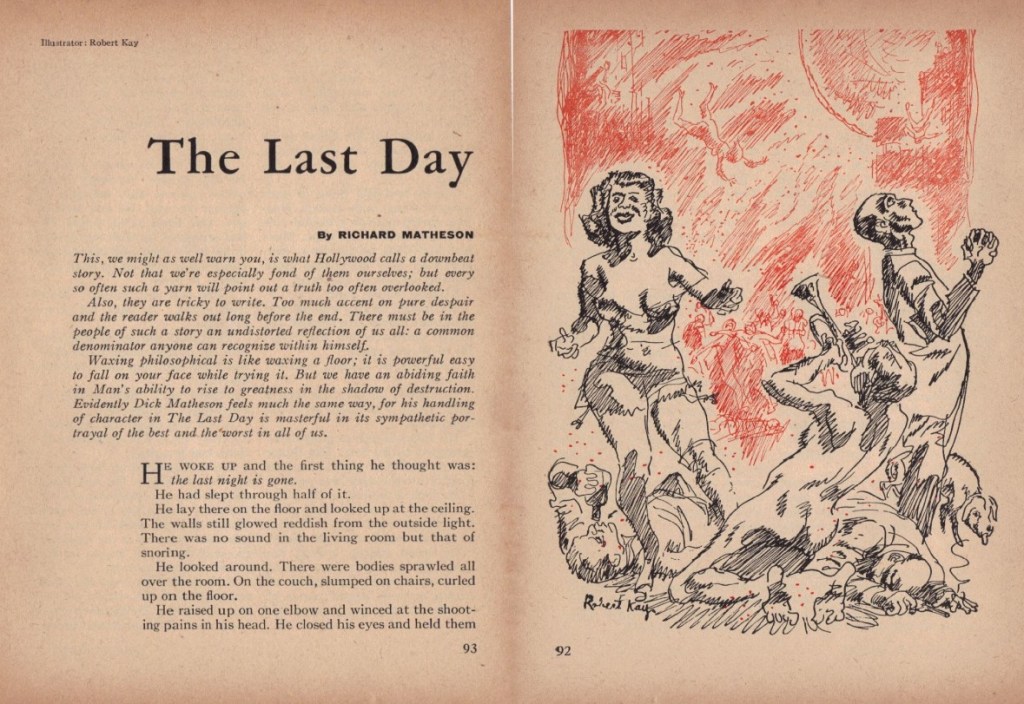
“The Last Day” by Richard Matheson was first published in the April-May 1953 issue of Amazing Stories. You can read it online here. Or you can buy The Best of Richard Matheson in various media editions here. Or look at its reprint history to see if you already own it in an anthology.
Our reading group is reading 25 short stories recommended by five group members. They are stories we haven’t read as a group, but ones the five people thought we shouldn’t miss. I didn’t submit this time, but “The Last Day” would have been one of the stories I would have submitted. Three of my favorite SF short stories from 1953 are “The Last Day,” “Lot” by Ward Moore, and “Deadly City” by Paul W. Fairman. I admire these stories because they were so gritty, even brutal.
Science fiction has often dealt with post-apocalyptic stories but “The Last Day” is about the end of the world. Some astronomical object is about to crash into the Earth. It’s not specified. The story begins in the morning of the last day and ends in the evening just before the end of everything on Earth.
I have often read and thought about surviving an apocalypse. I have often contemplated my own death. And I’ve always been fascinated by stories about people with a terminal illness and what they did with their remaining days.
But I haven’t thought about what I would do if everyone had just one day to live. It’s a neat concept to ponder. After reading “The Last Day” I’m not sure I’d need to read another story on the same idea. “The Last Day” gets the job done so nicely that I can’t imagine anyone topping it.
For this reading, I read the story with my eyes and then listened to it with my ears. I was impressed by its drama. Richard Matheson is famous for writing over a dozen episodes of The Twilight Zone. Many of Matheson’s stories and novels were adapted for television and the movies, and he wrote many screenplays. Matheson knows how to create drama.
“The Last Day” begins with Richard waking up in a room full of passed-out people. Several are naked, and it’s obvious that a drunken orgy had taken place the night before. When Richard goes into the bathroom to clean up a bit, he finds a dead man in the tub. Richard enters the kitchen where a friend, Spencer, is frying eggs. By now, we’ve realized that life on Earth is about to end.
Richard wishes he were with Mary, a woman he loved but didn’t commit to. His friend Norman comes into the kitchen and tells Richard he wants to go see his mother. Norman asks Richard if he wants to see his mother. Richard dreads the idea because he knows his mother will preach religion at him, and he doesn’t want to hear it.
After Spencer leaves to have more sex with a woman who wants everyone to watch, Norman begs Richard to drive him to his mother’s house. We learn that riots are going on all over the city. Many people have committed suicide, but others run wild, murdering each other.
All of this is amazingly adult for a science fiction story in 1953, especially published in a magazine mostly read by young adults. That issue seemed atypical for Amazing Stories. It also had stories by Robert A. Heinlein, Theodore Sturgeon, and Murray Leinster. It was edited by Howard Browne. I feel I need to reevaluate that era of the magazine. 1953 was a boom year for science fiction magazines. I’ve written about it before. I believe the Cold War had a significant impact on the genre that year. Just look at some of the other notable stories from 1953.
Richard eventually finds his mother at his sister’s house. There’s a poignant scene of his sister and her husband getting their daughter to take sleeping pills, and Richard watching all three commit suicide. And finally, Richard has a moving moment with his mother while they wait to die.
The story is cleanly told. Direct. It covers many bases without getting wordy. 5-stars.
James Wallace Harris, 4/29/25
 Classics of Science Fiction