Beginning, Tuesday November 28th, I’ll be moderating Group Read 67 “The Best SF Short Stories of 1956” on the Facebook group Best Science Fiction and Fantasy Short Fiction. We’ll start reading and discussing one story every Tuesday, Thursday, and Saturday. People leave comments whenever they want after the start date, sometimes that day, sometimes a day later, a week, or even a year later. Here’s the schedule:
I chose the stories based on the number of citations each 1956 short received in the Classics of Science Fiction database. I started by selecting all stories from 1956 that received at least three citations using the list builder function.
For our Classics of Science Fiction Short Stories v. 2 list, we use a cutoff of eight citations, which meant only two stories got on that list: “The Country of the Kind” by Damon Knight and “The Last Question” by Isaac Asimov. Stories with 3-7 citations are somewhat remembered, but I also wondered about possibly good stories that never got much recognition. It’s always a thrill to rediscover a forgotten great story.
I then looked at the stories with just one or two citations to see if any stood out for consideration. I picked any story that had been reprinted in two best-of-the-year anthologies, or one best-of-the-year and significant retrospective anthology or was a Hugo award finalist that year. I also included a famous Philip K. Dick story, “The Minority Report” and one of Rich Horton’s recommended stories that had only gotten one citation each. I figured the following stories might contain a forgotten gem that the group should consider.
“And Now the News …” by Theodore Sturgeon [Rich Horton favorite]
“Clerical Error” by Mark Clifton [Dikty, Asimov/Greenberg]
“Compound Interest” by Mack Reynolds [Merril, Asimov/Greenberg]
“The Doorstop” by Reginald Bretnor [Merril, Asimov/Greenberg]
“Horrer Howce” by Margaret St. Clair [Galaxy 30 Years, Asimov/Greenberg]
“Silent Brother” by Algis Budrys (Merril, Asimov/Greenberg]
“The Assistant Self” by F. L. Wallace [Hugo finalist]
“The Dragon” by Ray Bradbury [Hugo finalist]
“Legwork’ by Eric Frank Russell [Hugo finalist]
“The Minority Report” by Philip K. Dick [ISFDB Most Viewed Short Stories]
So, join us on Facebook. I’m going to try and review each of the stories individually on this blog, so if you don’t like Facebook, you can comment here. I also plan to talk about science fiction and 1956 in general.
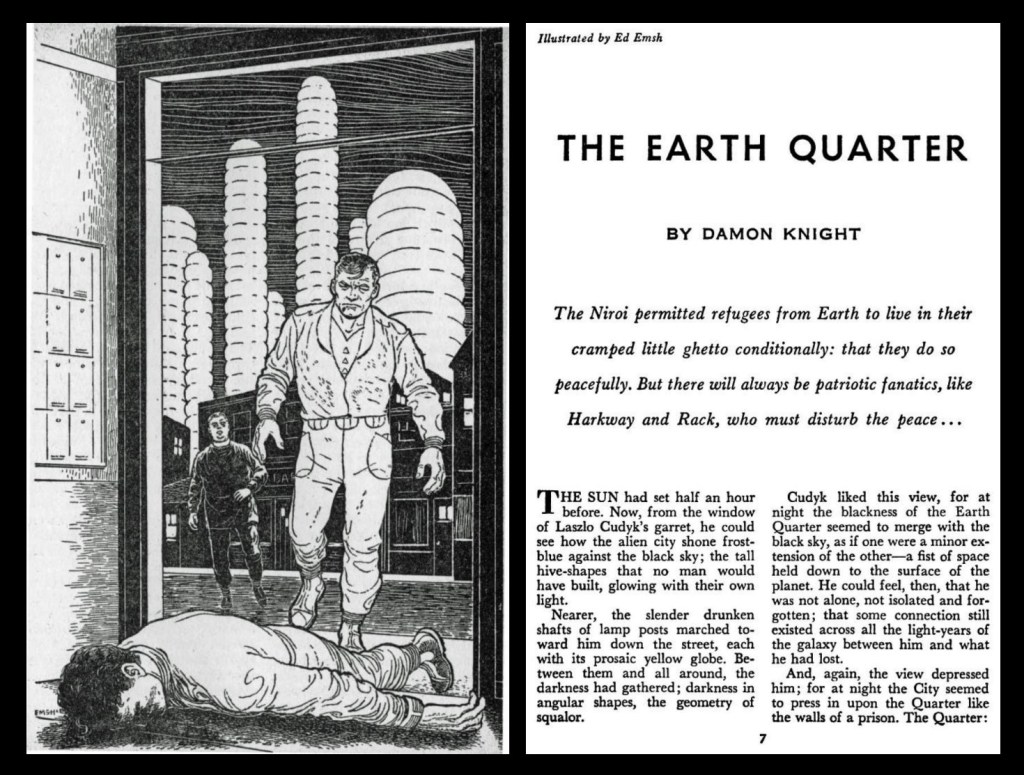
Starting September 7th, our science fiction short story group will be discussing the best short science fiction of 1955. Read about the details here if you want to participate. We used CSFquery to identify twenty-two stories to read and discuss. However, I put a challenge to the group to find worthy stories that have gone mainly unrecognized. I found my first forgotten classic today, “The Earth Quarter” by Damon Knight. The only recognition I could find that remembers this story is in a list of 50 SF short stories that were Gardner Dozois personal favorites. (I’m going to have to read more of the stories from that list that aren’t famous.)
I thought “The Earth Quarter” was one of the most cynical science fiction stories I’ve ever read. You know how Campbell and Heinlein were so pro-human? Well, Knight takes the opposite stance. I don’t want to say too much — and you might want to go read the story here before you read on.
Knight sets up the story where a group of humans live in a ghetto on another planet, one they call Earth Quarter. He pictures humans attaining interstellar flight and spreading out across the galaxy, but discovering it’s well occupied by intelligent beings more advanced than us. Humans can’t handle this. Earth itself falls back into barbarism, while enclaves of humans on various planets bicker amongst themselves.
“The Earth Quarter” is told from the point-of-view of Laszlo Cudyk, a fifty-year old man who tries to stay neutral among several highly polarized political factions. Liberals want to find a way to live peaceably with the aliens, while various conservative groups want to bring back the glory of Earth and conquer the galaxy.
The Earth Quarter is roughly sixteen square city blocks, containing 2,300 humans of three races, four religions, and eighteen nationalities. The human ghetto is sanctioned by a race of aliens called the Niori, but only if they live peaceably, which humans can’t seem to do. Knight makes a case that humans just can’t get along no matter what.
Life in the Earth Quarter reminds me of the prisoner of war camp in J. G. Ballard’s Empire of the Sun, but the Niori are enlightened beings who are kind rather than cruel. In another way, the story reminds me of Katherine Anne Porter’s Ship of Fools.
What I really liked about this story was the characterization — sure it’s pulp fiction, but I think good pulp fiction. Knight creates many distinctive characters who are vivid from little description. Sure, he employs stereotypes, but not too offensively. I can easily picture “The Earth Quarter” being made in a 1950’s noir sci-fi flick with all the standard noir actors like Humphrey Bogart, Robert Ryan, Robert Mitchem, Peter Lorre, Sidney Greenstreet, Barten MacLane, Elisha Cook, Jr. — and it would have to be filmed in black and white.
My guess was Damon Knight got disgusted with humans in 1955 when he wrote this story. We were in the middle of the cold war and humanity was providing just the right inspiration.
UPDATE – 9/4/23
It turns out that Rich Horton also likes “The Earth Quarter.” See his essay about his picks for the 1956 Hugo awards (which cover 1955). But he also reviewed the story when it was expanded and renamed into one-half of an Ace Double called The Sun Saboteurs.
The World Beyond the Hill by Alexei and Cory Panshin and Astounding Alec Nevala-Lee were two huge histories of science fiction in the 1940s. Both books focused on the magazine Astounding Science-Fiction, where John W. Cambell was a genre-shaping editor. The Panshins concentrated on three writers: Heinlein, Asimov, and van Vogt, while Nevala-Lee dwelt on Heinlein, Asimov, and L. Ron Hubbard. The Panshins volumes were more about the stories, with some biographical details. Nevala-Lee spent more words on the biographies of the four men, with less prose about their stories. Combined, the two volumes make a great overview of Astounding Science-Fiction in the 1940s.
What if a similar group biography/history was written about science fiction in the 1950s? I already own a bookcase full of books about science fiction but they aren’t the kind I want. The book I ache to read is a biography/history on the impact of science fiction in the 1950s that’s as impressive as biographies/histories written by Walter Isaacson, Robert A. Caro, or Doris Kerns Goodwin. I want to read a biography/history that would make the subject interesting to the general reader. I just finished Tune In by Mark Lewisohn, a giant history of The Beatles that only covered their career until 1962. That’s the kind of high-quality biography/history of 1950s science fiction I want to read.
Alec Nevela-Lee’s biographies approach that league. He could write the book I want, but I don’t think he would because he probably knows the market for such a volume isn’t very big. And I wonder if science fiction fans would want a history of science fiction in the 1950s by him. His books Astounding and Inventor of the Future were hard on his subjects. I thought them honest appraisals, but he may have done in John W. Campbell’s reputation, and he didn’t help Heinlein’s or Asimov’s. I ended up feeling Buckminister Fuller was brilliant but not very successful, and a bit of a nut or crank after reading Inventor of the Future. However, any honest biography of the influential science fiction writers of the 1950s is going to unearth some worms.
The whole phenomenon of science fiction in the 1950s could be fascinating to the general reader if it was written in the right way. Look how pervasive science fiction has become. Science fiction as a subculture actually had a far more lasting cultural impact than The Beats in the 1950s and The Hippies in the 1960s, yet those movements are more studied and written about. Organized science fiction fandom has since inspired many other forms of organized fandoms. There are connections between science fiction and the space program and computers, both of which also started in the 1950s. And as a pop culture art, science fiction might be bigger than rock. Rock music is fading, while science fiction is still big business.
So, who were the movers, shakers, and creators of 1950s science fiction? I don’t think the major players are as obvious as they were in the 1940s.
As a science fiction fan back in the 1960s I was commonly told that Heinlein, Asimov, and Clarke were the Big Three Authors of science fiction. Looking at our CSFquery database, which uses various forms of citations to remember short stories and novels, I’m not sure it backs up that common knowledge. Look at the results. I’ve set the citation level at 3 or more citations. (Short stories are within double quotes, and novels are italicized. Clicking on the number of citations will show you the individual citations.)
The three writers with the most citations were Heinlein with eleven, and Bradbury and Asimov with eight each. However, some of those cited stories first appeared in the 1940s. After that, three authors have six titles on the list: Alfred Bester, C. M. Kornbluth, and Fritz Leiber.
Before looking at this data, I would have said Philip K. Dick, Alfred Bester, John Wyndham, and Walter M. Miller, Jr. were the breakout science fiction authors of the 1950s. Another indication of their popularity is how many photographs I can find of these men, especially ones taken in the 1950s. I’m guessing since photographs are hard to find, then details about their lives will be just as hard to find. That suggests any history of science fiction that focuses on anyone other than Heinlein, Bradbury, and Asimov will be covering events in the shadows of history.
If we alter the search to allow any work with two or more citations we see other authors standing out, but I’m not sure if it would change the overall apparent rankings. Thirteen women writers are on this list, but none have very many stories listed. I’m afraid the 1950s was still a male-dominated decade for science fiction.
And what about editors? Many histories of science fiction claim that John W. Campbell wasn’t as influential in the 1950s. But who was then? H. L. Gold at Galaxy is often mentioned. Anthony Boucher, and maybe J. Francis McComas at The Magazine of Fantasy and Science Fiction. There were dozens of science fiction magazines published during the 1950s, and I’m not sure if any other editor stood out. But then I haven’t researched it. However, I would say the 1950s were still a magazine-driven era for science fiction.
The Panshins and Nevala-Lee had Astounding Science-Fiction to anchor their history/biographies of the 1940s. The Magazine of Fantasy and Science Fiction, Galaxy, and Astounding Science Fiction dominated the 1950s, but there were many other magazines that published significant science fiction and influenced the genre. I don’t know if a history of science fiction of the 1950s could be as focused as The World Beyond the Hill and Astounding. The genre just exploded in too many different directions.
The small press or fan press science fiction publishers of the 1950s are legendary, especially to collectors, but I don’t know if any of their editors had that much influence. I would think the editors at Doubleday and the Science Fiction Book Club could be a consideration if I knew who they were. Another consideration is Donald A. Wollheim. His work at Ace Books was both influential and widespread.
If a single volume could be written about science fiction in the 1950s it might need to be divided into twelve chapters, one for each year, or into 120 chapters, based on the months. A linear progression through the decade might be the best way to capture the history of science fiction in the 1950s. And the book would have to be big, maybe a thousand pages.
There is one significant book about science fiction history in the 1950s that I know about, Transformations: The Story of the Science Fiction Magazines – From 1950 to 1970 by Mike Ashley. I have quite a few other books that cover that era in science fiction, but none are of the scope I’m talking about. I wish Ashley’s books were available in cheap Kindle editions so more people would read them.
And should we also add the impact of the movies and television? Should we consider George Pal and Rod Serling as movers and shakers of 1950s science fiction, for this book I want to read? An Astounding-like biography/history of science fiction in the 1960s would include Gene Roddenberry and one for the 1970s would have to include George Lucas and Steven Spielberg.
I wish I had the skill and stamina to write a history of science fiction in the 1950s. I’m in awe of the work done by the Panshins and Nevala-Lee. I would love to read a book about 1950s science fiction like I’ve described, so if you’re a writer looking for a topic, here’s one. I don’t know how many copies it would sell. Sadly, the audience for such a history is getting old and dying. I wrote this essay to gauge interest in such a book, but I’m not finding much so far. However, a good biographer can make any person or topic into a page-turner.
“The Hurkle is a Happy Beast” by Theodore Sturgeon is story #29 of 52 from The World Treasury of Science Fiction edited by David G. Hartwell (1989), an anthology my short story club is group reading. Stories are discussed on Tuesdays, Thursdays, and Saturdays. “The Hurkle is a Happy Beast” appeared in the very first issue of The Magazine of Fantasy and Science Fiction (Fall 1949) when it had the title The Magazine of Fantasy.
“The Hurkle is a Happy Beast” is a cute story about a creature from another dimension thrown onto Earth. The Hurkle is blue, has six legs, and is kitten-like. It follows a theme of things discovered by humans in the present that come from other times and dimensions, however, it’s not up to the classics of this theme like “Mimsy Were the Borogoves,” “The Twonky,” or “The Little Black Bag.”
Even though “The Hurkle is a Happy Beast” is a slight effort by Sturgeon, it has been often reprinted. However, our discussion group wondered why Hartwell selected a second story by Sturgeon for The World Treasury of Science Fiction. It definitely wasn’t one of Sturgeon’s better efforts.
This listing from CSFQuery shows Sturgeon’s most recognized short stories. If Sturgeon deserved two stories in this monumental anthology, I would have picked “Thunder and Roses” or “A Saucer of Loneliness” because their lengths were close to “The Hurkle is a Happy Beast.” But why give Sturgeon two stories. Wasn’t there a better option from 1949?
Well, not exactly. However, my guess is Hartwell wanted to lighten things up by using Hurkle. To me, the obvious substitute for a cute science fiction story with an animal would be “Bears Discover Fire” by Terry Bisson, unfortunately, it came out the year after Hartwell’s anthology. Another possibility is “The Ugly Chickens” by Howard Waldrop, it came out in 1980, so it was available. Or maybe “The Star Mouse” by Fredric Brown?
“The Hurkle is a Happy Beast” is not a bad story. It’s cute enough, but it’s lightweight. This got me thinking about being a science fiction writer in 1949 and having to crank out short stories to make a living. Imagine sitting at a typewriter and knowing your survival depends on your writing a story that will impress editors and readers. I doubt Theodore Sturgeon was thinking he needed to hit one out of the park for future editors of retrospective anthologies. He just needed to sell a story to earn a penny or two a word. There were damn few science fiction writers who lived solely off selling fiction. Sturgeon may have been one since he was so prolific.
In 1949 Sturgeon sold ten short stories according to ISFDB:
“Farewell to Eden” – Invasion From Mars edited by Orson Welles (anthology)
“One Foot and the Grave” – Weird Tales (September 1949)
“The Hurkle is a Happy Beast” – The Magazine of Fantasy (Fall 1949)
“What Dead Men Tell” – Astounding Science Fiction (November 1949)
Is it really fair to judge “The Hurkle is a Happy Beast” at all? We think because a story is in Hartwell’s anthology it must be one of the best SF short stories from around the world from the 20th century. But should we think that?
After our reading group has plowed through many of these gigantic SF anthologies I’m starting to wonder about their value and their goals. The Big Book of Science Fiction turns out to be a very accurate title, and by that consideration, an honest one. My problem, and for my fellow group members, I believe, is the phrase “World Treasury” gives us great expectations.
“The Hurkle is a Happy Beast” is a pleasant enough story. I would have been fine reading it in any magazine in 1949. Even though Bleiler & Dikty and later Asimov & Greenberg picked it for their annual best-of-the-year anthologies, which I’ve both read, I don’t think Sturgeon’s story was even at that level. If I had read it in a theme anthology about cute alien creatures it might have been acceptable. It was in two of those, The Science Fiction Bestiary edited by Robert Silverberg, and Zoo 2000 edited by Jane Yolen.
If you follow the links to those two anthologies you’ll find lists of not-so-famous stories. Evidently, this theme isn’t a gold mine for classic SF stories. My favorite alien pet is Willis from Heinlein’s Red Planet. Heinlein and Norton often added cute aliens to their young adult books.
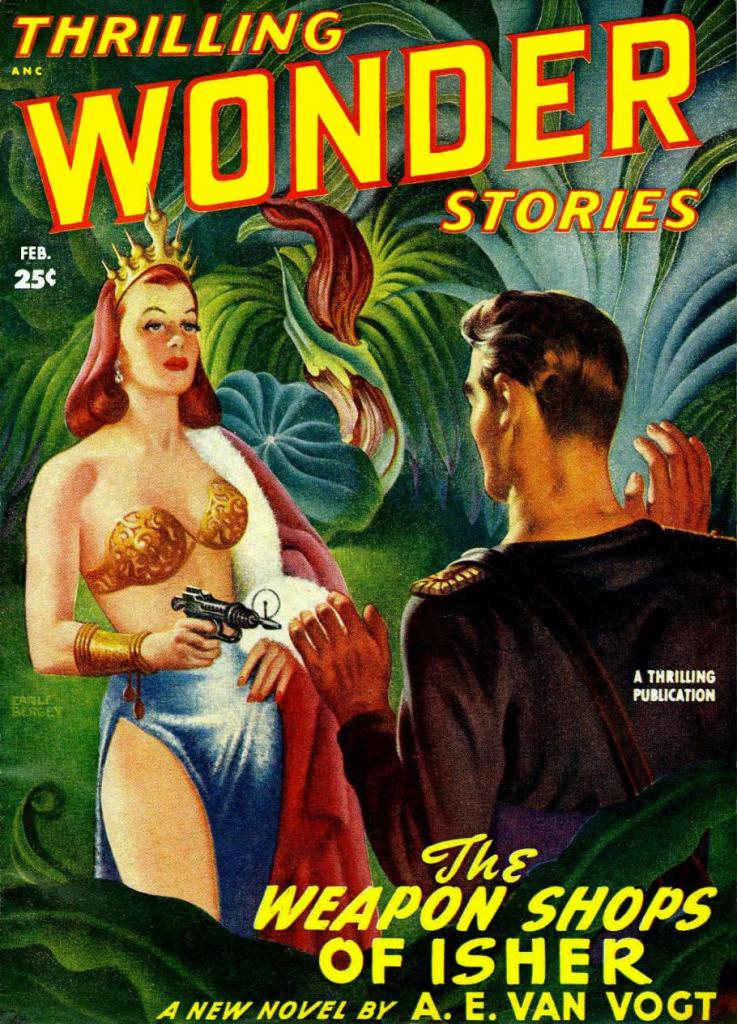
Just for grins, here are some of the covers for Sturgeon’s 1949 publications.
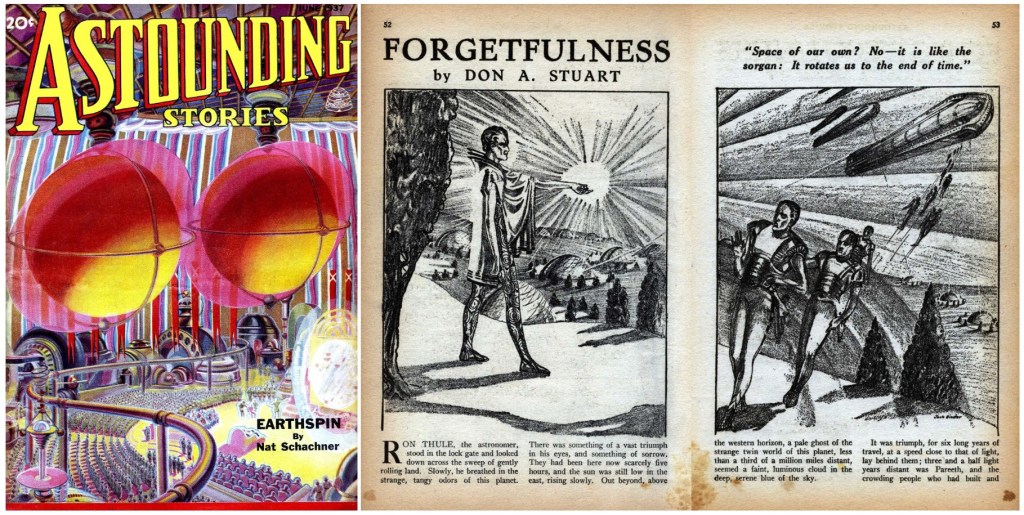
“Forgetfulness” by John W. Campbell, Jr. is story #2 of 52 from the anthology The World Treasury of Science Fiction edited by David G. Hartwell (1989) that my short story club is group reading.
Instead of counting all the titles and authors of science fiction books I’ve read, I’m starting to tally all the far-out concepts science fiction has given me. In “Forgetfulness” John W. Campbell took one of my favorite concepts, walking in ancient dead alien cities, which was probably an old SF concept even in 1937, and gave it a couple twists. It’s going to be impossible to talk about this story without giving spoilers so think of this essay as an analysis of SF concepts and not a review. You can read the story online here, or buy it in a $2.99 Kindle edition of Campbell’s collection Cloak of Aeshir. However, I don’t recommend buying unless you’re a big fan of John W. Campbell.
“Forgetfulness” begins with a spaceship landing on the planet Rhth, one of nine planets in the system. The main point-of-view character is Ron Thule, an astronomer, from the planet Pareeth. They have traveled for six years, in a spaceship 2,500 feet long and 400 feet in diameter, covering 3.5 light-years, traveling at nearly the speed of light. These people from Pareeth are looking for a world to colonize, and are disappointed that Rhth is already inhabited. They hope to settle in the remains of a majestic city that was built by spacing-faring race millions of years ago and discover its secrets.
Try and pronounce Rhth. If nine planets weren’t a giveaway, the name Rhth should be. There they meet Seun, a very tall, graceful human-shaped being, clothed in a golden outfit, with a beautiful colored cape. All the people of Rhth wear gold suits and colored capes and live in opalescent domes twenty to thirty feet in diameter situated under giant green trees near the dead city. The buildings of that titanic city are three thousand feet high, but the winds have filled the streets with five hundred feet of dirt.
Seun has told Ron Thule and the commander of the Pareeth mission, Shor Nun, that the builders of the city had once visited their world. And that their world, Pareeth, once orbited the same sun as Rhth, but had been torn away by a rogue star. This hints that maybe the builders had conducted a kind of panspermia across the galaxy. As the story progresses the achievements of the builders become greater and greater. However, the people of Pareeth eventually discover secrets that can shatter their minds and their hopes.
Most of us find a great sense of wonder reading about the rediscovery of lost cities. So, it’s not a remarkable feat of creativity for a science fiction writer to imagine humans finding long-dead alien cities. Still, it’s one that sets off a powerful sense of wonder and has been used time and again in science fiction.
Campbell puts a twist on this concept, by having aliens discover a city from a long-dead civilization of mankind. John W. Campbell has a reputation that claims he wanted humans to be the galactic crown of creation, and this story supports that. In his earlier story, “Twilight” he had a human time traveler discover a far future deserted human civilization. That gave him a chance to imagine the engineering marvels of what we could achieve someday. In “Forgetfulness” he has aliens discover dead human civilization, but this time, Campbell imagined an even more impressive future for us built by super-science. You should read both stories to see just how hopeful Campbell was for the human race.
Both “Twilight” and “Forgetfulness” could be considered Dying Earth stories, although H. G. Wells in “The Time Machine,” William Hope Hodgson in The Night Land, and Olaf Stapledon in Last and First Men, took that idea, even much further.
Unfortunately, “Forgetfulness” is hard to read. Part of that is due to a dated writing style, but also because Campbell didn’t really have much of a story to tell. They came, they discovered wonders, they were frightened, they were disappointed. There’s no drama or revealed emotions. “Forgetfulness” was reprinted in the classic 1946 anthology Adventures in Time and Space but has been mostly forgotten since. Damon Knight remembered it in his 1966 anthology Cities of Wonder, and Brian Aldiss and Harrison brought it back again in 1973 for The Astounding-Analog Reader. Both are very minor anthologies. The second contained just seven stories from Astounding covering 1937-1941, a rather odd collection.
It’s interesting that a story about remembering has been forgotten. The big concept in “Forgetfulness” is visiting the remains of an astonishing civilization millions of years after its citizens have gone. Campbell puts his own twist on it by having that civilization be a future version of ours. However, there’s another important concept he wanted to get across, and that’s how we forget the past. Shor Nun and Ron Thule can’t understand why Seun doesn’t understand how the city works. But then Campbell reminds us we couldn’t explain the technology of cavemen, or from other periods of human civilization. Remember all the discussions about how did the Egyptians build the pyramids? Well, it turns out Seun has even newer technologies that are even further advanced than the builders and they have merely forgotten earlier primitive technology.
I have to wonder if Arthur C. Clarke’s story “Rescue Party” wasn’t inspired by “Forgetfulness” and “Twilight.” Or that the screenwriters for Forbidden Planet hadn’t read “Forgetfulness” too. Or were their ideas independently invented?
That’s the thing about science fiction. Concepts keep getting reused. Are they forgotten and then reinvented? Or does science fiction evolve over time as concepts merge and mutate? Will some young writer in the 2020s come up with a story about a far-future space race discovering a future Earth and finding the ruins of what our civilization will become? How will this writer imagine the pinnacle of our success? Campbell wanted to believe that humanity will evolve until it has god-like powers. That idea has shown up in science fiction over and over again. But do we still believe that? Right now the peak of our civilization might end this century.
“Harrison Bergeron” is a political satire set in the year 2081. Kurt Vonnegut imagines everyone is not only equal under the law but handicapped to be made equal in all ways. Stronger people are weighed down, talented people are made less talented, and intelligent people have to wear earplugs that make various kinds of noises to distract them from thinking deeply. In this rather short story, George and Hazel Bergeron are watching a ballet on television. They have forgotten their 14-year-old son Harrison has been arrested for being too handsome, too smart, and too strong. During the course of the TV show, their son appears on the ballet stage having escaped to start a rebellion. (You can read it here, or read a detailed synopsis on Wikipedia.)
“Harrison Bergeron” is not a subtle satire, instead it goes for the absurd. It’s a very likable story. Vonnegut tells it in simple language with vivid details. You immediately agree with him that this dystopian world is wrong. This short story has become quite famous, having been adapted to the screen four times. National Review, the conservative magazine founded by William F. Buckley even reprinted the story. The National Review keeps using “Harrison Bergeron” – here’s it being used again in 2015 against economic inequality in “Inching Towards ‘Harrison Bergeron.’“
Usually, satire attacks something, and I have to wonder what Vonnegut was attacking. While reading it I thought maybe he was protesting laws designed to create equal opportunity. Then when I read about National Review and that Supreme Court Justice Antonin Scalia quoted the story in PGA Tour, Inc. v. Martin then I began to wonder even more. And it’s referenced in academic papers, including a 2013 one about transgender athletes. I thought Vonnegut was liberal. Wikipedia did say he wasn’t against his story being used in a Kansas court situation, he didn’t agree with their interpretation.
So why have conservatives embraced “Harrison Bergeron” so thoroughly? Are they using its satire the way Vonnegut intended? A site called What So Proudly We Hail promotes the story with a very pointed introduction:
Central to the American creed is the principle of equality, beginning with the notion that all human beings possess certain fundamental rights and equal standing before the law. Our concern for equality has expanded over the past half century to focus also on inequalities in opportunities, wealth, achievement, and social condition. What good is an equal right to pursue happiness if one lacks the native gifts or the social means to exercise it successfully? In this satirical story (1961), set in a future time in which “everybody was finally equal . . . every which way,” Kurt Vonnegut Jr. (1922–2007) challenges our devotion to equality and invites us to consider the costs of pursuing it too zealously. Although the story is not explicitly about racial, ethnic, or gender equality, the questions it provokes about the kind of equality we should want, and the costs of pursuing it, are relevant also to campaigns to eliminate inequalities among racial and ethnic groups or between the sexes. Does the society portrayed here represent a fulfillment of the ideal of equality in the Declaration of Independence, or rather a perversion of the principle? Does opposing invidious distinctions, envy, and feelings of inferiority require reducing all to the lowest common denominator, and is this the true path to “social justice”? Would homogeneity attained by artificially raising up the low, producing a nation of Harrisons rather than a nation of Hazels—a prospect offered by biotechnological “enhancement”—be any more attractive?
The story does resonate with conservative thinking and even more so today. Are there other ways to read it? On the surface, the bad guys in the story are the government and laws that try to make everyone equal in every way. However, was that what Vonnegut was protesting. Was he all fired up and wrote this story the way the conservatives have used it?
I have no idea, but I do wonder about something. Vonnegut’s story is silly, absurd, and far from real. Vonnegut was often silly and absurd. I wonder if he just didn’t get the idea of a government taking the idea that everyone should be equal, and imagining how they could go about making it happen. It was published in a science fiction magazine. If Vonnegut was serious about his satire, why didn’t he publish it in a serious magazine? And back then, bizarre speculation on social change was common in SF stories.
The story came out in 1961, well before the liberal sixties. Eisenhower was probably president when he wrote it. A similar idea about making everyone equal had been used in the 1959 novel, The Sirens of Titan. In the 1950s the main political push to make people equal was providing equal education to African Americans. And that effort was to make people better educated, not dumber. My guess is “Harrison Bergeron” is based on a silly idea that came to Vonnegut and he wrote a story to illustrate it. Conservatives have just run with it.
What’s also interesting is Hazel, the wife, has no handicapping applied to her. She’s average. Was Vonnegut saying something about women? 1961 was also before the Second Wave of feminism in the 1960s. Was he being liberal to make the Handicapper General of the United States, a woman? She had the funny name Diana Moon Glampers? Was this a dig at women?
I don’t think I’ve read “Harrison Bergeron” before. Its basic idea is so memorable that I can’t believe I’d forget it. I could have since it’s been around since the October 1961 issue of The Magazine of Fantasy and Science Fiction. It’s also been reprinted quite often and I could have read it and thought it so absurd as to be completely minor, and did forget it. “Harrison Bergeron” has 9 citations in The Classics of Science Fiction Short Stories v. 2. I just read it because our short story club has just started reading The Treasury of World Science Fiction edited by David G. Hartwell. That anthology is a monster of over one thousand pages of classic science fiction where Hartwell also introduces science fiction from around the world.
Despite its fame, I still think “Harrison Bergeron” is a silly story. I’d only rate it ***+ in my system – three stars mean well-written, and a + means I liked it a lot. Four stars would mean it’s a story I’ll want to reread now and then, and I don’t feel that.
I’m going to try and review as many of the stories as possible from The Treasury of World Science Fiction. I haven’t given up on my Heinlein project, but after gorging on his work for months, I’ve been taking a break. I’ve wanted to get into a science fiction novel I never read but I’m still on a short story kick.
I have a guest columnist for y’all, Szymon Szott. Szymon worked out a computer program to find the minimum number of anthologies to buy that had the most stories from the Classics of Science Fiction Short Story list. The results were presented in these three columns:
Szymon was the first reader to tell me they’ve read all the novels on the novel list, and now he’s read all the short stories on the short story list. I still haven’t finished either list. Here’s his report on the short story reading experience.
Hi, Szymon here again. Last time I wrote that “you won’t love every work of classic science fiction” and that was after reading all the books from the list of classic SF books. Now I’m back with some thoughts after reading all the works from the classics of SF short stories. Currently, the list consists of 110 novellas, novelettes, and short stories. I read these works over a period of about four years although 80% in the last twelve months.
It was great fun to read these outstanding works, I enjoyed most of them, and those that weren’t as good at least ended quickly. The brevity of these works makes them more accessible: a short story doesn’t require the same commitment as a novel. Also, if you’re an obsessive checklist completist like I am, then you’ll be making faster progress through short stories than through the list of classic SF novels.
I rated each story on a 1-5 scale (5 being ‘excellent’) and the average of all my ratings was 3.5 which confirms my overall positive experience. I gave 19 stories a score of 5, but if I were to recommend my top 10 favorite stories (at this moment) they would be the following.
Title
Author
Year
Review
Nightfall
Isaac Asimov
1941
Grand tale, memorable idea (but I don’t want to spoil it).
Arena
Fredric Brown
1944
Like a Star Trek episode, a timeless classic!
Second Variety
Philip K. Dick
1953
A movie (Screamers) was based on this tale. Similar themes to Blade Runner, vintage PKD.
The Last Question
Isaac Asimov
1956
At least my third read. A great look into the possible future of any sentient life in the universe.
Flowers for Algernon
Daniel Keyes
1959
I knew the novel, which I prefer, but the story is still outstanding!
Inconstant Moon
Larry Niven
1971
Last day on Earth. Apocalypse/catastrophe story. Great fun, I love this kind of tale!
Vaster Than Empires and More Slow
Ursula K. Le Guin
1971
Colonists on a forest world find that it is conscious (as a whole planet/biosphere). Perfectly done!
Jeffty Is Five
Harlan Ellison
1977
Very nostalgic and a bit on the horror side (well, it is Ellison). Memorable!
The Mountains of Mourning
Lois McMaster Bujold
1989
I first thought it was great, but then the denouement hitched it up a notch. Worthy of the Hugo and Nebula that it won!
Story of Your Life
Ted Chiang
1998
Hard SF. The perfect marriage of story, plot, and physics (Fermat’s principle).
Surprisingly, only one story from the 90s made it to the above list even though the 90s were on average my highest-rated decade (with a score of 4.0). I was in my teens then, which is in line with the theory that “the golden age of science fiction is thirteen.” Meanwhile, the true Golden Age of SF (the 40s and 50s) are my next favorite decades, both with an average rating of about 3.8.
One of the coolest aspects of completing this list was finding sources (books, podcasts, etc.) from which to read the stories. For each story, I looked to see if it was available online for free, in any of the books I already own, in any of the book services I subscribe to, and, finally, in my local library. The Internet Speculative Fiction Database was an indispensable resource in this regard. Ultimately, I didn’t follow my own advice but rather worked with what I had available. I used a total of 48 unique sources to find the stories, but two of them stand out in terms of the number of stories: Sense of Wonder and The Science Fiction Hall of Fame. They’re both great anthologies and I’ll be reading the other stories they include as well.
Looking at the per-source average rating, these were my favorite, which I’ve arranged by type:
Anthologies: Future On Fire (80s stories, edited by Orson Scott Card)
Finally, I’d like to share two stories that aren’t on the list. The first one is a classic: “The Colony” by Philip K. Dick. It doesn’t have enough citations to make the list. The second one is too new to have been included: “The Ocean Between the Leaves” by Ray Nayler (which Jim has blogged about). Both have what I love most about SF stories: a sense of wonder and high “readability”.
Overall, I think the Classics of Science Fiction Short Stories v2 list is just as great a resource as the novel list. And it’s even better if you want to read all the stories from beginning to end: it’s not that long a project and you can find the best that SF has to offer in compact form. Highly recommended!
Emily St. John Mandel’s Sea of Tranquility is straight-ahead science fiction but it doesn’t feel like a genre novel. Explaining why will be hard. Science fiction has always avoided clear definition and trying to discern the difference between hardcore genre science fiction and literary science fiction might prove equally elusive. For most readers, it doesn’t even matter.
Sea of Tranquility was both entertaining and well-written. I liked it quite a lot. Many readers at Goodreads loved this short novel and gave the story five stars. However, the story was missing something for me. It lacked the intense impact I get from classic genre science fiction I love, even ones not as well told as Sea of Tranquility.
Most modern science fiction aims to be as dashing as Hans Solo but Sea of Tranquility was as mundane as a computer programmer. I considered that a positive but I have to admit the story had a certain blandness even though it dealt with many big science fictional concepts.
I do not want to tell you about those concepts because the way Mandel rolls them out makes it fun to explore the plot clue by clue. If you don’t want to read the novel but want to know a precise summary, Wikipedia has a blow-by-blow overview. However, I do want to tell you enough to want to read it. In the year 2401 Gaspery-Jacques learns about three anomalies in history. In the years 1912 a man named Edwin, in 2020 a woman named Mirella, and in 2203 a woman named Olive had the same bizarre experience that they’ve recorded in various ways in their own times. Historians in the 25th century find those records and decide they might be clues to an amazing hypothesis. Gaspery-Jacques decides he wants to be the person that solves the mystery even though he’s only an uneducated house detective for a hotel in a colony on the Moon. Lucky for Gaspery-Jacques, his sister is a brilliant scientist with connections.
BEWARE – Spoilers Ahead
To get into my discussion of mainstream science fiction versus genre science fiction will require giving away the story. The structure of Sea of Tranquility is much like another mainstream science fiction novel, Cloud Atlas by David Mitchell. Cloud Atlas was far richer and more intense than Sea of Tranquility, more like a genre novel. Both deal with epic concepts, but only Cloud Atlas felt epic in the storytelling. Mandel gives us a much quieter story and that’s often a trait of mainstream science fiction. Its tone is like two other recent mainstream science fiction novels, Klara and the Sun by Kazuo Ishiguro and Machines Like Me by Ian McEwan.
Sea of Tranquility explores the idea that our reality is a simulation. In the 25th century, scientists have a very carefully controlled type of time travel. They theorize the anomalies experienced by Edwin, Mirella, and Olive might be glitches in the simulation software. After five years of training, they send Gaspery-Jacques back to interview each of these people. We don’t know that right away, because Mandel at first tells each of their stories chronologically in time. I’m thinking of reading the book again to see if knowing that they are being interviewed by a time traveler changes how I experience the story. I guessed this might be happening because loose-lips by some reviewers said the book is a time travel novel. It would have been more fun not knowing that.
That’s another difference between mainstream science fiction and genre science fiction. Their stories often begin ordinarily and feel mundane and the science-fictional concepts creep into the tale. Genre science fiction often begins like the opening of a heavy metal concert, while mainstream science fiction begins with a quiet chamber quartet before a cerebral symphony.
Genre science fiction writers love to crank the volume to 11 and keep it there, while mainstream science fiction unfolds gently at volume 4 and politely increases to 6 or 7 at carefully chosen moments. If you compare Hyperion by Dan Simmons to Sea of Tranquility you’ll know what I mean.
Sea of Tranquility is science fiction for PBS Masterpiece. Station Eleven was Mandel’s polar opposite of Mad Max: Fury Road. Even though Sea of Tranquility explores such a deafening concept as the simulation hypothesis it does so in a whisper. A genre novelist writing the same story would have had epic rents in the fabric of reality, killing millions while its heroes save the universe at the last minute. Mandel’s hero eerily validates the hypothesis with a kind of “Ummm, that’s weird.”
Sea of Tranquility is also a pandemic novel about a writer writing a novel about a pandemic just before a pandemic hits. Olive Llewellyn is a novelist who lives on the Moon but tells of her publicity tour on Earth just before a brutal plague spreads across Earth in 2203. I assume Olive’s details and feelings about promoting a book came from Mandel’s own experience. Some of the characters in this novel were in Mandel’s previous novel, The Glass Hotel, and Edwin’s full name is Edwin St. John St. Andrew. Since he shares a middle name with Mandel I have to wonder if he was an ancestor of hers? Now I have to read The Glass Hotel. One of my favorite writers, Larry McMurty liked to recycle characters in other novels.
Finally, I wonder if fans of science fiction by Margaret Atwood, Hilary St. John Mandel, or Kazuo Ishiguro would also be fans of Dan Simmons, Iain M. Banks, and James S. A. Corey? Or vice versa? Let me know how you feel.
James Patrick Kelly gives a plug for our Classics of Science Fiction database site (csfquery.com) in his column “On the Net” in the July-August 2022 issue of Asimov’s Science Fiction. He mentions us as a jumping-off point to talk about famous science fiction stories made into movies. In passing, Kelly says our v.5 list is skewed to older works. I’ve worried about that myself, and I’ve tried to come up with a system configuration that would promote newer works.
However, I’m starting to think that our memories naturally skew towards older books. Our lists are generated from a system. We’ve collected all the ways we can find where people remember books – awards, fan polls, recommended lists, anthologies, books used in schools, lists created by magazines and websites, etc. Each one we call a citation. There are two lists of citations, one for books and one for short stories. Older books have more citations than newer books because they’ve been around longer. Our citation lists go back to 1943, but most of them have been from the past 25 years. But even when we come up with systems to give newer books a little edge, older novels and stories still have more citations.
Pop culture has just found more ways to remember The Left Hand of Darkness since 1969 than Ancillary Justice since 2013. 49 ways to 13. Even when I limited citations from the 21st century it’s still 33 to 13. This makes me wonder if collectively we just remember older books better. Although, if we could get 1,000 college students to read The Left Hand of Darkness and Ancillary Justice would they still favor the book from 1969 over the 2013 novel?
At our site, we avoid saying books with more citations are better – because there’s no way to prove that. But what if some books are better than others at being remembered? The Left Hand of Darkness has never been one of my favorite SF novels, but it is one I admire for its ideas and writing, and maybe that’s why it’s remembered. Many English professors will tell you, that Ulysses by James Joyce is the #1 novel in the English language. I’ve tried to read it several times but never could finish it. But I’m willing to admit that it’s legendary.
A while back we came up with a solution to help people find newer novels and stories to read. We created the List Builder. If you want the most remembered SF novels published since 2000 just use that tool. Here’s a list of 51 21st Century SF Novels with at least 5 citations.
On the other hand, if you are in the mood for something from the fifties just put in 1950 to 1959. If you think our cutoffs are too stringent, lower them. I’m still thinking of adding a feature to the List Builder that would allow our users to delimit the citations by date. Would citation sources only from the 1990s pick different books from the 1940s than citation sources from the 1960s?
We’re trying to keep CSFquery as simple to use as possible yet offer the maximum flexibility for generating lists that users might want. Our v.5 and v.2 lists are just canned lists based on our cutoffs of 12 and 8 citations for novels and short stories. We chose those cuff-offs to produce lists of around 100 titles. The List Builder lets the user decide if they want more or less but pop culture has decided what to remember.
We’re open to suggestions. If you know of other citation sources that we don’t use, let us know.
With building our database, Classics of Science Fiction, we love to find data sources from the past so we can show how science fiction novels and short stories are remembered over time. We call each source a citation. It’s much harder to find data on the popularity of short stories, so I was very happy when Ken Papai posted to Facebook about P. Schuyler Miller’s discussion of a 1971 poll on the best SF short stories of all time. The poll was featured in Miller’s column, The Reference Library in the October and November 1971 issues of Analog Science Fiction. The poll was conducted for Miller by Michael Shoemaker for the Washington Science Fiction Association (WSFA). Ken found this mention while reading Wikipedia.
Ken’s post inspired a web hunt for me. Miller’s two essays summarized the poll, but I wanted to see Shoemaker’s results. I went to Google but it was no help. Then I went to Fanac.org, the archive of fanzines hoping to find a fanzine from that period that printed the results. I had no luck because it has so many fanzines from 1971. Then Dave Hook in our group thought of looking up Shoemaker in ISFDB.org and found that Shoemaker had published the results in the WSFA Journal #77 for June-July 1971. I then went back to Fanac.org and found that issue to read, and the article by Shoemaker. Then Piet Nel sent me a Word document with the results taken from an SFADB page he saw long ago. Finally, I think it was Dave who found the old SFADB listing on the Wayback Machine. The SFADB listing is the easiest to read. However, I have compiled Shoemaker’s WSFA article with Miller’s two articles into a pdf if you want to read the originals.
I write about all this to show the value of the internet, and especially tools like ISFDB, SFADB, and Fanac.org. But it also shows the value of making friends on Facebook and belonging to a group devoted to reading science fiction short stories. I love these internet treasure hunts for information.
I will add this citation source to the database. It will help reflect how readers in 1971 remembered the science fiction short stories they loved. That’s why I find fascinating about this work, how novels and stories are remembered and forgotten. I’ve been thinking about getting Mike to program our system so we can show what stories were popular for any given year. Right now our results are cumulative for all citation source years. You can use the List Builder feature to show what stories were popular up to 1971, but that reflects all the citation sources through now. What I think would be cool is to pick a year, or range of years, and show what people remembered for just that time period.
Mike Shoemaker’s article shows what short stories were remembered in 1971. You can pick any single citation source now to see what short stories were remembered for the year the citation was created. But it would be cool to compare what readers in 1972 remembered versus what readers in 2022 remembered.
By the way, even if you’re not interested in how I found this poll, you might find Shoemaker’s opinion of it interesting. He was distressed that certain stories were popular, stories I love. That’s the thing about polls and meta-lists. They don’t always reflect our opinions. Shoemaker also noted that the recent Science Fiction Hall of Fame probably had a lot of impact on the voting.
Finally, one last nod to Fanac.org. It has the fanzine Lan’s Lantern #30 that ran my article that was the origin of our Classics of Science Fiction database.










 Classics of Science Fiction