“The Ones Who Walk Away from Omelas” by Ursula K. Le Guin

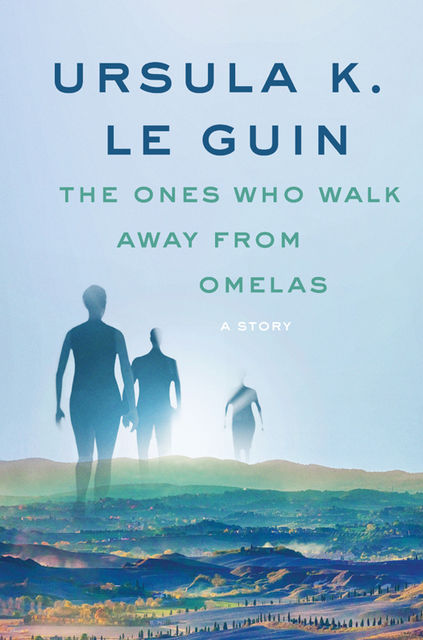
Today our group, Best Science Fiction and Fantasy Short Fiction, is discussing “The Ones Who Walked Away from Omelas” by Ursula K. Le Guin. It’s part of “Group Read 69 – Previously Unread Hugo Winners.” I can’t believe out of all our previous sixty-eight group reads we haven’t read this 5-star story before. I have written about “The Ones Who Walk Away from Omelas” before in the essay “A Philosophical Conversation Between Two Short Stories.”

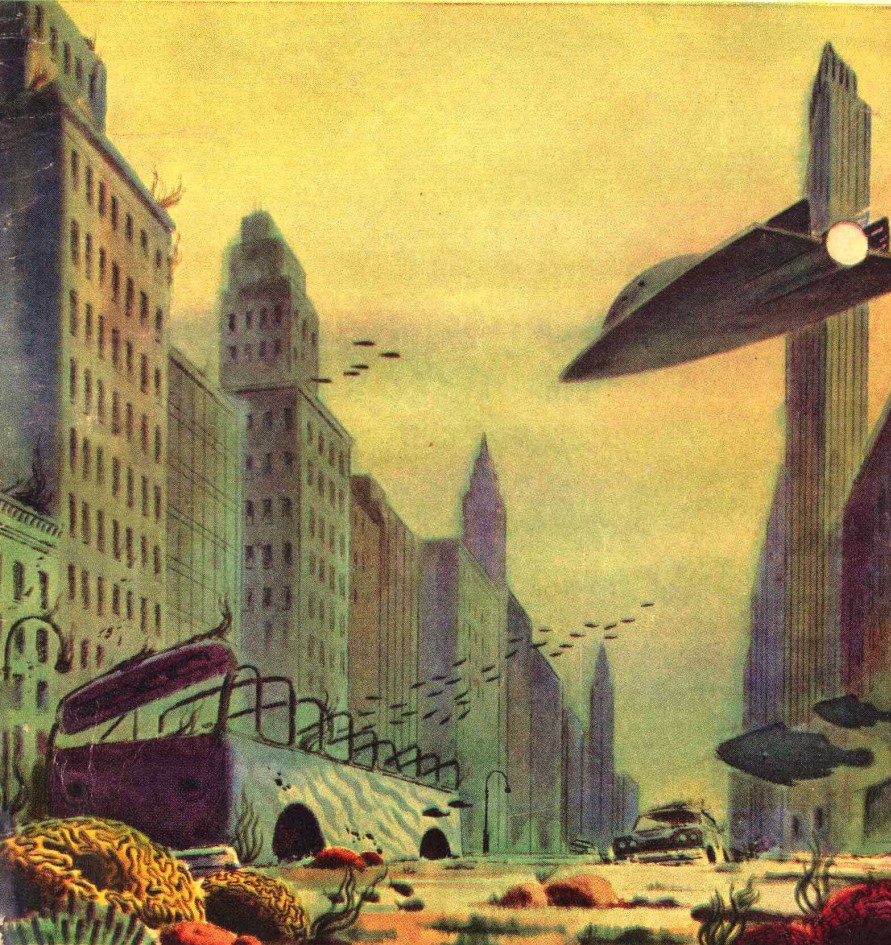
“The Ones Who Walk Away from Omelas” is perfect for generating classroom discussions about philosophy. It’s short, only seventeen minutes on audio, and is told as an allegory. Le Guin presents a tiny utopian country where everything is wonderful except for one detail. Happiness in this land depends on the suffering of one child. Nearly everyone in Omelas accepts they must allow one ten-year-old child to suffer horribly, because that suffering allows everyone else living in Omelas to be happy. Of course, as you can guess from the title, some citizens can’t accept this and walk away.

Is Le Guin’s story questioning Christianity and asking why did Jesus suffer for all of us? I don’t think so. Is Le Guin pointing a finger at Capitalism, where the happiness of many depends on the suffering of the economic losers? Maybe. Do you worry about the losers in your society when you’re one of the winners? Is the story also asking how can we have a perfect society if even one person must pay a price? Isn’t it true that in every society some must suffer? Where can those who walk away from Omelas go?

Most people who read “The Ones Who Walk Away from Omelas” focus on the ending, the problem of the suffering child. But in the story’s buildup Le Guin describes what she thinks is a utopian society. Le Guin is challenging her readers to imagine a perfect society too. Le Guin says she doesn’t want clergy or the military, but figures she’ll have to accept orgies and drugs. What would you reject and accept?

I think Le Guin started writing this story wanting to speculate about creating a perfect society, but then realized it couldn’t go anywhere, and then came up with the idea for the suffering child, which led to the idea about those who walk away.

I sense the brilliance of this story wasn’t planned. It’s like my recent discussion of Slaughterhouse-Five. Sometimes a writer accidentally produces a story that works perfectly as a mirror. In my essay, I talked about reading Vonnegut’s classic when I was 18, 55, and 72. With each reading I saw something different about myself. I believe this is also true with “The Ones Who Walk Away from Omelas.” Le Guin has created a mirror for her readers.

However, I do believe there is a universal psychological theme that deals with the suffering of a few that allows for the benefit of the many. I thought that theme was explored twice in 1956 by Damon Knight with “Stranger Station” and “The Country of the Kind.” I even wondered if Le Guin was inspired to write “The Ones Who Walked Away from Omelas” after reading “The Country of the Kind.”

On my other blog, I produced a theory about ChatGPT, and similar AI programs. I’m wondering if our unconscious minds work in the same way AIs based on large language models. Those AI models are trained on millions of pages of text and images using neural networks. We can query those AI models with a prompt. Imagine all the books Ursula K. Le Guin read in her lifetime before writing “The Ones Who Walked Away from Omelas.” Now imagine Le Guin asking herself, “How would a functional utopia work?” Isn’t that the same as prompting an AI model? Her unconscious mind then generated “The Ones Who Walked Away from Omelas.”

Readers add the story to their own mental model and then prompt themselves with a question: “What does this story mean?” Their answers will depend on what they’ve read during their lifetime and how their unconscious mind processed that content.

Instead of asking, “What did Le Guin mean by “The Ones Who Walked Away from Omelas,” we should ask instead: “Why did I interpret the “The Ones Who Walked Away from Omelas” the way I did?”

I’m guessing great writers don’t intend to mean anything specific but aim to excite our unconscious minds into a kind of creativity. In other words. “The Ones Who Walked Away from Omelas” is a bit of prompt engineering, aimed at readers, knowing they each have a mental model that will generate a unique personalized output.

James Wallace Harris, 2/13/24

10 Titles Added to the Classics of Science Fiction List

I added several best science fiction book lists to our database of citations. See the List of Lists to see the kind of lists we use. The new lists were from 2022, 2023, and even a few from 2024. Whenever I do this, some titles reach a total of 12 citations. We call all forms of lists citations. 12 citations is the minimum number for getting on the Classics of Science Fiction List v. 5. Before I started there were 127 titles on the list, now there are 137. With version 5 of the list, an online database, I can add new lists anytime and the totals are recalculated. If any book reaches 12 citations, it automatically gets on the list.

This is how newer books eventually get remembered and recognized. We now have two titles from 2014, the most recently published on the list. That suggests it takes about a decade to be remembered well enough to make it to the Classics of Science Fiction List. Here are the new titles with links to Wikipedia in case you want to know more about them:

If you look at the Classics of Science Fiction List, be sure to click on the citation number to show where the citations come from. Or you can click on “Show Citations” at the top of the list to see the citations for all the books. The CSF list has been in production since 1989. See our About page.

It’s interesting that only one old novel finally made it onto the list, Hothouse by Brian W. Aldiss. The YouTube book reviewer Bookpilled put it on his “15 Best Sci-Fi Books I’ve Ever Read” video. That one citation was all Hothouse needed. Bookpilled is my favorite YouTube reviewer. He’s young, but he’s quickly reading all the classics of science fiction and he’s very discerning about what are still credible reads today.

I try to use only lists created by people who are well read in science fiction, or lists made from polls. Younger readers tend to know the most recent books or the most famous science fiction books of all time. So, when I add new lists, the standard classics get more citations, while some newer titles get more recognition. For example, The Left Hand of Darkness now has 52 citations, the most of any title.

Of the ten new titles, I haven’t read Oryx and Crake or Blindsight. That increases my list of books I need to finish reading the entire list. My TBR of CSF now includes the titles below. Their current number of total citations is in brackets.

  1. I Am Legend – Richard Matheson (1954) [15]
  2. Solaris – Stanislaw Lem (1970) [34]
  3. The Gods Themselves – Isaac Asimov (1972) [19]
  4. Roadside Picnic – Arkady & Boris Strugatsky (1972) [16]
  5. The Female Man – Joanna Russ (1975) [28]
  6. Dreamsnake – Vonda N. McIntyre (1978) [12]
  7. Kindred – Octavia Butler (1979) [13]
  8. The Snow Queen – Joan D. Vinge (1980) [15]
  9. The Book of the New Sun – Gene Wolfe (1980-1987) [23]
  10. Downbelow Station – C. J. Cherryh (1981) [16]
  11. Helliconia Spring – Brian W. Aldiss (1982) [12]
  12. Consider Phlebas – Iain M. Banks (1987) [12]
  13. The Player of Games – Iain M. Banks (1988) [15]
  14. Grass – Sheri S. Tepper (1989) (13)
  15. Barrayar – Lois McMaster Bujold (1991) [14]
  16. Synners – Pat Cadigan (1991) [13]
  17. The Diamond Age – Neal Stephenson (1995) [18]
  18. A Deepness in the Sky – Vernor Vinge (1999) [14]
  19. Revelation Space – Alastair Reynolds (2000) [12]
  20. Oryx and Crake – Margaret Atwood (2003) [14]
  21. Blindsight (2006) by Peter Watts [12]
  22. World War Z – Max Brooks (2006) [12]
  23. Anathem – Neal Stephenson (2008) [12]

You can use List Builder to create a custom list. You can control the date ranges, the citation minimum, or even zero in on an individual author.

If you’re curious about titles not listed, here’s the list configured for a minimum of one citation. That lists all the titles in the dataase, 2527 titles.

James Wallace Harris, 1/30/24

Ammonite by Nicola Griffith

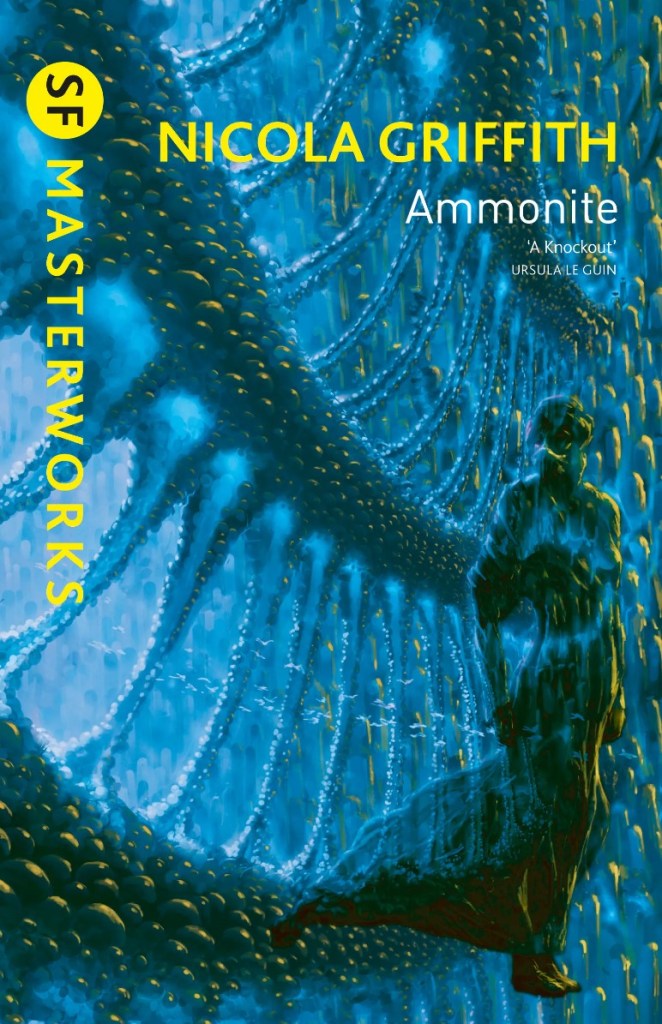
Ammonite by Nicola Griffith is one of the books from the Classics of Science Fiction list I hadn’t read. It’s on that list because of these citations:

Otherwise Award
2001200 Significant Science Fiction Books by Women, 1984-2001 by David G. Hartwell
2003The Cambridge Companion to Science Fiction edited by Edward James and Farah Mendlesohn
2004Feminist Science Fiction and Fantasy by Cynthia Ward
2005ISFDB Top 100 Books (Balanced List)
2012Science Fiction the 101 Best Novels 1985-2010 by Damien Broderick and Paul Di Filippo
2014Mistressworks by Ian Sales
2016SF Masterworks
2016Sci Femme: The Reading List edited by Shannon Turlington
2016Goodreads Science Fiction Books by Female Authors
2016Gunn Center for the Study of Science Fiction: A Basic Science Fiction Library
2019The Best Sci-Fi Books of All Time – Penguin Random House
2019100 Best Sci-Fi Books of All Time – Reedsydiscovery
2021Worlds Without End: Award Winning Books by Women Authors
2022The 50 Best Sci-Fi Books of All Time – Esquire Magazine

Ammonite won the Lambda Literary Award for Lesbian Science Fiction and Fantasy in 1993. Nicola Griffith has won the award three times and been nominated six times. Ammonite also won the Otherwise Award (originally, the James Tiptree Jr. Award) in 1993. It’s a well-respected novel, critically and academically acclaimed.

Interestingly, I didn’t think of Ammonite as a lesbian novel even though all the characters are women, and some of them are in relationships. I listened to the Audible edition, and Griffith makes a statement about the novel in an afterward where she says she didn’t want Ammonite to be a women’s utopia, or an Amazon adventure tale. She wanted her characters to be normal ordinary people, and that’s how it worked out. Sex wasn’t emphasized in the story, and I didn’t really think about gender roles while reading it.

I thought Ammonite was a straight-ahead science fiction problem story. Human explorers discover Grenchstom’s Planet, nicknamed Jeep, where all the males and many of the females die from a virus. They discover that the planet had been previously colonized by humans, with various tribes of women now living on the planet apparently not remembering they how they got there.

Marghe Taishan, an anthropologist volunteers to test a vaccine against the Jeep virus, so she can go down to the planet and visit the various tribes. Each tribe has a different culture depending on the geography and weather of their location. I pictured it pretty much like North America before Columbus, or early civilizations in the Himalayas.

There is a parallel story about a military unit, again all women survivors, which has a base on the planet. They hope to return to Earth if the vaccine proves successful. Marghe has reason to believe that the Durallium Company that commissioned the explorers will destroy all the humans no matter what happens with the vaccine because they fear the Jeep virus will spread across the galaxy. (I thought of the film Aliens, and the phrase, “nuke them from orbit.”)

I had problems with the novel. Problems unique to me. If you read about the novel at Wikipedia, you’ll see it’s highly regarded. I’d compare it to The Left Hand of Darkness and A Woman of the Iron People by Eleanor Arnason. And the science fictional setup reminds me of “The Longest Voyage” by Poul Anderson from 1960 which won a Hugo award in 1961. For most readers, Ammonite should be an excellent tale.

Ammonite has a great setup for a science fiction story. But here’s my problem. That’s about all the science fiction we get. Most of the story is about Marghe struggling to survive among various native societies of the original colonists. It’s fictional Margaret Mead. I’m sure this kind of extended worldbuilding is what modern science fiction readers love, but I’m discovering I prefer shorter novels with a higher concentration of science fiction.

The extra length gives Griffith a chance to describe female only cultures and deal with cultural differences. This didn’t feel like science fiction, but fictionalized substitutes of our own world’s tribal customs.

Griffith doesn’t pontificate like a lot of bad science fiction writers, so we don’t have to wade through long speculating info dumps. Griffith works by throwing Marghe into various situations where she must quickly learn to survive. The story reminds me of the movies Little Big Man or Dances with Wolves. Both of those films were about plains Indians, but on Griffith’s cold world, I pictured cultures like the Innuit in North America, or nomadic people from historical Tibet or Mongolia.

Reading both “The Longest Voyage” by Poul Anderson and Ammonite in the same week is what inspired me to write this review. In both stories, a planet was colonized by humans in the distant past and then forgotten. Then these planets are rediscovered by a new civilization of star-faring humans. They discover the old humans have forgotten they ever traveled in space. In Anderson’s story, the forgotten colonists evolved their civilization to about the time of our 1500s. But in Griffth’s world, the colonists have evolved into tribal societies like we saw in Canada, Siberia, Mongolia, and Tibet before the voyages of Columbus.

Like I said, the story is compelling, but feels long, especially after several years of mostly reading science fiction short stories. When I got into science fiction in the mid-1960s, most science fiction novels were 200-250 pages and often less. Ammonite is 416 pages. By comparison, The Left Hand of Darkness (1969) runs around 280 pages in most editions. Science fiction novels have only gotten longer on average since 1992.

Science fiction used to be fast paced, with lots of far out ideas. The evolution of the science fiction novel has been towards extending its length by evolving the complexity of plot and character. I assume this chunkiness is what younger readers prefer. They love dwelling in elaborate world buildings efforts to older science fiction’s thrill rides. I just don’t enjoy these longer novels, but if you do, this shouldn’t be a problem with Ammonite. But I also wonder if the aim of science fiction has changed, and it’s not really about the number of pages. Have I lived long enough that the appeal of science fiction has mutated?

Griffith increases her action midway through her novel, but then switches back to slow pace with Marghe learning about a second society. It’s at this point that Griffith gets into the psychological development of Marghe’s character. In the four Philip K. Dick novels I read before Ammonite, Dick went through dozens of plot twists and characters in less than half the number of pages for each of those novels. Dick’s approach is to throw out a science fictional idea every few paragraphs, while Griffith gave us all her science fiction at the beginning and then coasts for hundreds of pages with character interactions. And like I said, Griffith’s science fiction framework is an old idea. The story is really about Marghe becoming more evolved spiritually.

About two thirds of the way into Ammonite, the plot quickens again as the military base becomes threatened on two fronts, but again switches back to Marghe’s story which is much slower. However, this is where we learn how the female only society makes babies.

Most of the book is less about science fiction and more about imagined tribal cultures and New Age spiritualism and healing practices. There are a couple of women characters who like killing both people and animals. I wondered if Griffith was saying even women can have male traits, or that male traits aren’t exclusively male. I’ve always thought if there were only women, there would be no war or vicious kinds of hunting.

I’m not picking on Nicola Griffith for writing a longer novel. Most modern science fiction is getting longer and longer. New writers recycle an old science fictional concept, adding long complex plots. They spend their time developing an interesting cast of characters. It’s more about story and storytelling than science fiction. There’s nothing wrong with this. And modern science fiction is often better written than older science fiction. The trouble for me is I got hooked on the amphetamine type of science fiction.

I don’t know if I can fairly review modern science fiction. I wonder if my taste in science fiction suffers from arrested development. I wonder if I’m stuck in 1950-1979 science fiction, music, movies, and other pop culture.

Ammonite was a pleasant read. It was a somewhat compelling story. But it didn’t excite me. And I have no urge to reread it, which is my main indicator of a great novel.

James Wallace Harris, 1/27/24

“Stranger Station” by Damon Knight – Fourth Reading

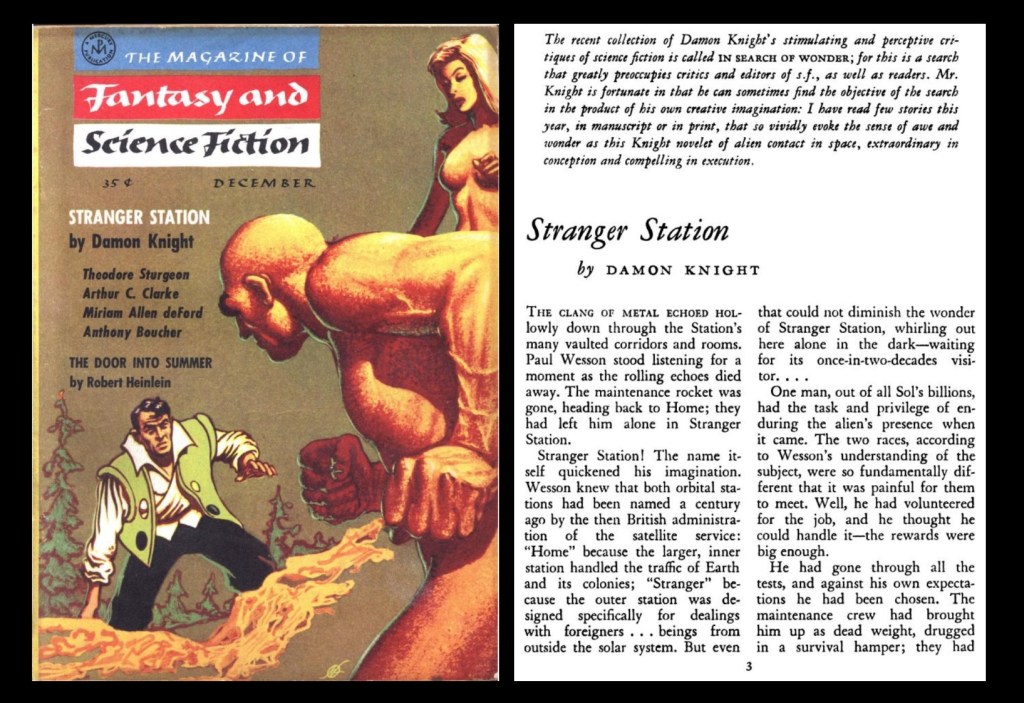
“Stranger Station” was first published in The Magazine of Fantasy & Science Fiction, December 1956. You can read it on Archive.org. It is story #20 of 22 for The Best SF Stories of 1956 group read. “Stranger Station” was a selection for Judith Merril’s SF:’57: The Year’s Greatest Science Fiction and Fantasy and Asimov/Greenberg’s 1988 anthology The Great SF Stories # 18 (1956). It’s often reprinted. This is my fourth reading of the story, and the third for the Facebook SF short story reading group. It was tied for fourth place for the most cited SF short story of 1956 in our citation database.

I’ve reviewed “Stranger Station” before.

I think it’s important to note that Damon Knight published two of the most remembered science fiction short stories of 1956: “The Country of the Kind” and “Stranger Station.” I think it’s also important we should note that both were about hate. We must ask, “Were they positive or negative?”

I’m a big believer in rereading fiction, but can a story be reread too much? With this fourth reading, I got even closer to what Knight was creating. In the first half of the story, I marveled at Knight’s hard science setup. The story was more vivid than my previous readings. I admired everything Knight wrote, and I was quite impressed. The second half of the story, especially the ending, still puzzles me. Had Paul Wesson truly figured out the motives of the aliens from Titan? Was his reaction, right? Was Wesson’s solution supposed to leave us feeling ambiguous about what Wesson figured out?

The basic plot is Paul Wesson, an astronaut working on a space station near Earth volunteers to spend months on a distant space station, called Stranger Station, reserved for meeting an alien from Titan every twenty years. Both aliens and humans have trouble being near each other. Nearness causes a deep sense of psychological dread in each species. However, it also causes the aliens to exude a golden liquid from their bodies that humans have discovered has life extending properties for our species. The aliens agree to meet every two decades at a space station far from earth. Just one human and one alien. The fear of being around humans causes the alien to sweat longevity chemicals which they freely give to the humans. But what do the aliens get in return? That’s a mystery.

There is a cost to the human who volunteers for this mission. They go crazy, losing the ability to communicate, and change physically in horrible ways. It might be a form of adapting to the aliens. But Wesson doesn’t know that. It’s another mystery. But all of humanity gets to live another twenty years longer. This reminds me of Le Guin’s “The Ones Who Walk Away from Omelas.”

Paul Wesson’s only companion is an AI he calls Aunt Jane. The creation of Aunt Jane was brilliant speculation by Damon Knight in 1956. Paul tries to learn as much as possible about his fate from Aunt Jane, but she is restricted by what she can tell. This relationship slowly reveals the mysteries, and maybe the solutions. However, in the end, we’re not sure what happened to Paul. It appears he’s about to die. And he’s killed the alien. It also implies that humanity’s longevity serum supply will be cancelled. Was Paul Wesson, right? Did he save humans from a fate worse than death, or merely act on his own hatred and xenophobia?

Wesson believes the aliens are fighting us with love because they know we’ll eventually overrun the solar system, go interstellar, and destroy them in the process. Paul believes the aliens give the humans their golden sweat to make us addicted, thus protecting themselves. Wesson then assumes hate is the only way to fight back.

I’m still not sure what philosophical stance Knight makes in this story? Is he saying xenocide is ethical? Or that cooperation or even a symbiotic relationship with aliens is evil? Is he promoting human purity, a kind of interstellar racism? Up until the arrival of the alien at the station, the story is very pro-space, pro-technology, pro-future. Then it gets weird. Is hate the solution, or just Wesson’s solution, or even Knight’s solution?

My friend Mike didn’t have much to say about the story, but he sums it up precisely:

“Stranger Station” has a pervasive underlying element of apprehension and dread. I think Knight is forcing us to confront the stark reality of alien contact. He discards the facile Hollywood model and thrusts us into the bewilderment and dread and menace that will surround an alien contact event. The stakes will be enormous; our survival as a species will be at risk.

Personally, I don’t believe we can have contact with aliens of any kind. I assume that each evolved planetary biological ecosystem will be deadly to all other planetary ecosystems. That was the same conclusion as The World of the Worlds by H. G. Wells and more recently by Kim Stanley Robinson in his novel Aurora. Knight doesn’t seem to be worried about deadly microbes, only of hating each other. Knight is suggesting that there will be psychic barriers that will keep us separate from beings from other worlds. But again, is that Paul Wesson, or Damon Knight?

I tend to think it’s not Knight, but Knight suggesting it’s true about us.

James Wallace Harris, 1/11/23

“The Country of the Kind” by Damon Knight

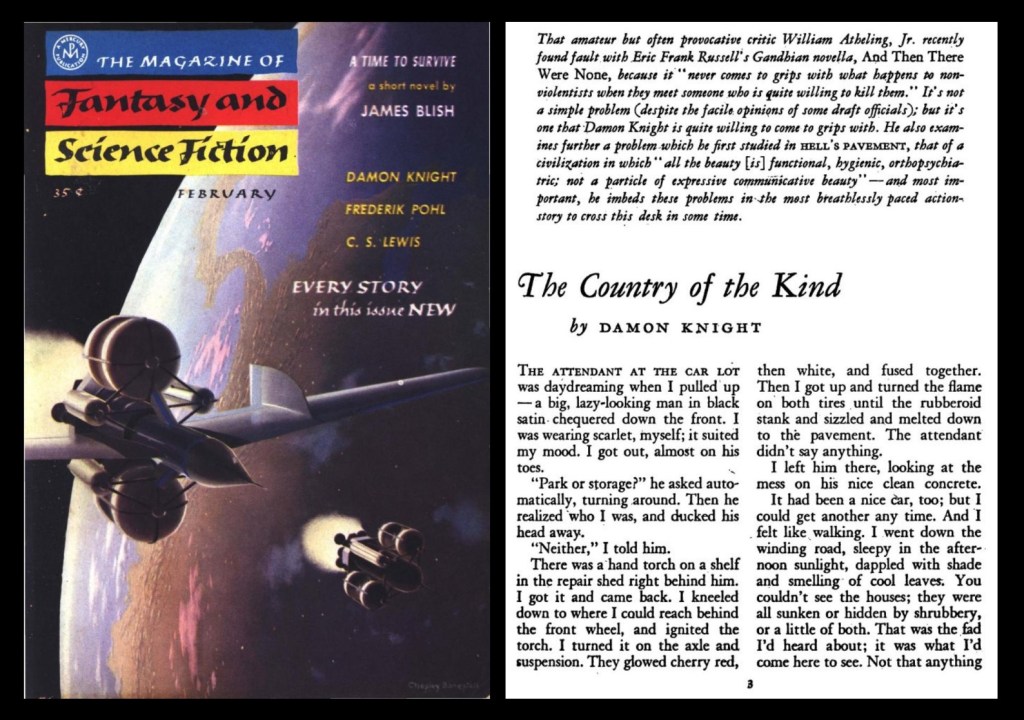
“The Country of the Kind” was first published in The Magazine of Fantasy & Science Fiction, February 1956. You can read it on Archive.org. It is story #5 of 22 for The Best SF Stories of 1956 group read. “The Country of the Kind” is one of the highest rated stories on The Classics of Science Fiction Short Stories v. 2 list, with eleven citations. It is by far the most remembered science fiction short story from 1956. Here are the eleven citations we used:

“The Country of the Kind” is set in an unnamed utopia and is told by an unnamed narrator. When the narrator was fifteen, he killed a girl who spurned him. In this utopian society they couldn’t punish him directly because it doesn’t allow violence. They fixed the narrator so whenever he tried to hurt someone else, he’d have an epileptic fit. And to warn others of his presence, his body odor and breath were made to smell repulsive. He was then left free to do whatever he wanted. For thirty years he has wandered about the Earth trying to retaliate by sabotaging other people’s activities or destroying their property. People ignored him, so he suffered endless loneliness. The narrator creates small works of art which he leaves everywhere with a message inviting other people to join him and be free.

My friend Mike sends me emails with comments about these 1956 science fiction stories since he doesn’t want to use Facebook. Here’s what he had to say:

A good science fiction tale draws you in completely, overriding your skepticism about the implausibility (or impossibility) of events.

Damon Knight asks us to accept the notion that a murderous psychopath is allowed by society to indulge himself in an endless destructive rampage. Although he is prevented from physically harming others by induced epileptic seizures, the community allows him to wreak havoc without restraint.

Perhaps Knight is exposing the passivity and weakness of that society, but it beggars the imagination that any group would allow such extreme behavior to go unchecked, no matter how kind and understanding they profess to be.

After the "king of the world" murdered his girlfriend named Elen when he was fifteen, he tells us "...if I could do it to Elen, I thought, surely they could do it to me. But they couldn't. They set me free: they had to."

Why did "they" have to? Are we to believe that a seemingly well run country is so "kind" that even a psychopath is allowed free rein? That's a bridge too far for me.

Remember, I talked about how believability was very important to me regarding science fiction when reviewing “Brightside Crossing.” I could understand why Mike didn’t think the world of “The Country of the Kind” was believable, but I said to him in a phone call, didn’t we both believe the world of “Brightside Crossing” was impossible? Yet, we still found the story believable. I asked him what crossed the line for him in “The Country of the Kind.” Mike said he just didn’t believe people would allow a person like the narrator in any society, that was too much for him to believe that people wouldn’t stop the narrator from damaging their property.

I said, wasn’t “The Country of the Kind” unbelievable in the same way “The Ones Who Walk Away from Omelas” is unbelievable, and didn’t you love that story? Mike replied that story was metaphorical.” I countered, doesn’t “The Country of the Kind” seem just as metaphorical in the same way? Both are about utopias that that are held together by the suffering of one person. After I said that, I even wondered if Ursula K. Le Guin wasn’t in some way inspired by “The Country of the Kind” when she wrote “The Ones Who Walk Away from Omelas.” Mike said he would reconsider “The Country of the Kind” as a metaphor. Maybe he will post a reply.

Are the fictional worlds of Brave New World, Nineteen Eighty-Four, or The Handmaid’s Tale believable? Aren’t they metaphorical too, because their authors have something to say about our reality? Dune, The Foundation trilogy, The Left Hand of Darkness and even The Man in the High Castle create worlds that we are asked to believe are realistic. Obviously, Alan E. Nourse wanted us to believe “Brightside Crossing” was realistic. But we aren’t expected to believe the fictional universes of The Hitch-Hiker’s Guide to the Galaxy or Sheckley’s Mindswap were realistic.

In other words, fantasy, humor, satire, and metaphorical fiction don’t ask us to believe their settings are realistic. But most literary works, especially of the mimetic type, and some kinds of science fiction do ask us to believe that they are reality based.

Of course, if “The Country of the Kind” is metaphorical, then what is the metaphor? That even kindness can cause great suffering. To be free in a utopia you need to be able to commit evil deeds. 1956 was a time of conformity in America, and many people were freaked out by juvenile delinquents, motorcycle gangs, and other nonconformists. Remember, a year later in 1957, On the Road by Jack Kerouac came out. Kerouac called his kind of nonconformists Beats, and society renamed them beatniks. A few years later, society turned against hippies too. I say On the Road wasn’t metaphorical. But I would say One Flew Over the Cuckoo’s Nest or Catch-22 are.

In the 1950s there was a lot of talk about crime being caused by society, and that criminals were a product of bad biology or a bad environment. Damon Knight’s unnamed narrator is an awful person, but he gets our sympathy. Unlike the tortured child in “The Ones Who Walk Away from Omelas,” the unnamed narrator isn’t the engine of utopia. Or is he? Wouldn’t a perfect utopia be dull and boring? What if evil is needed as the engine of goodness? I’m reminded of a phrase, “What if our world is their heaven?”

What if all fiction is metaphorical? What if “Brightside Crossing” was a metaphor for extreme adventurers?

Fiction is based on a suspension of disbelief. If Mike can’t suspend his disbelief that’s perfectly okay. If he doesn’t like “The Country of the Kind” does it matter that I do?

I’m fascinated by the nature of memory. I’m particularly fascinated by fiction that our culture remembers, like works by Jane Austen or Charles Dickens. But I’m also fascinated by the stories I find personally memorable. “The Country of the Kind” and “The Ones Who Walk Away from Omelas” are such stories. A year for now, I might forget “Brightside Crossing.” As I read and reread these old science fiction stories, I’m amazed by which ones I remember and which ones I don’t.

“The Country of the Kind” was voted into The Science Fiction Hall of Fame Volume One because it was so remembered by the first members of the Science Fiction Writers of America. I wish SFWA would poll their membership every ten years on their favorite stories. I’d love to see what every generation of science fiction writers remember.

With this December 2023 reading; it’s probably the fourth or fifth time I’ve read this story, I am somewhat sympathetic to the unnamed narrator of “The Country of the Kind.” I wasn’t before. I totally loathed the narrator. However, this time I still think his actions are still horrific, but I feel the utopian society has imposed a cruel and unusual punishment upon him.

And I’m still unsure of Knight’s intentions in writing this story. Whatever meaning it has could be entirely accidental. Knight might have thought of the situation without considering its implications.

The epileptic pain the narrator experiences is brought on by his own actions. But the loneliness is caused by the utopian society imposing the punishment. And this society is supposedly incapable of causing harm. Such a society would know that social contact is a necessity.

Writers often make their stories ambiguous but this one might be too unclear. I wonder if Knight has ever written an explanation of “The Country of the Kind.”

James Wallace Harris, 12/6/23

“Clerical Error” by Mark Clifton

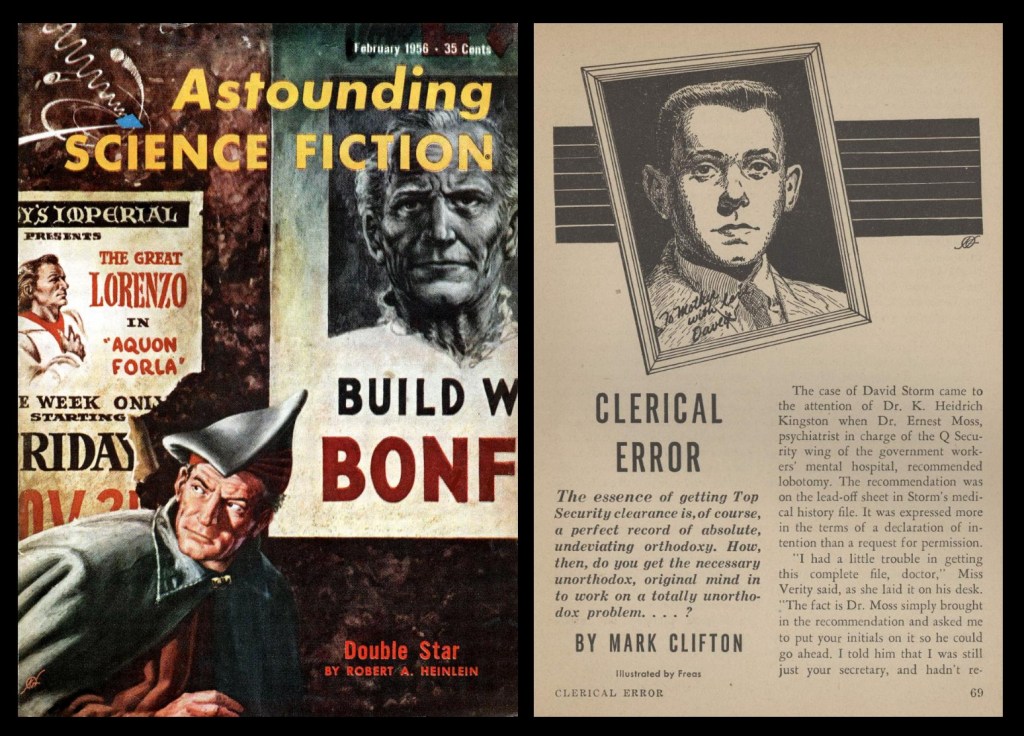
“Clerical Error” was first published in Astounding Science Fiction, February 1956. You can read it on Archive.org. It is story #3 of 22 for The Best SF Stories of 1956 group read. I selected “Clerical Error” for our best SF stories of 1956 group read because Asimov and Greenberg, and T. E. Dikty selected this story for their best-of-1956 anthologies, and Judith Merril listed it in her anthology for 1956 as an honorable mention.

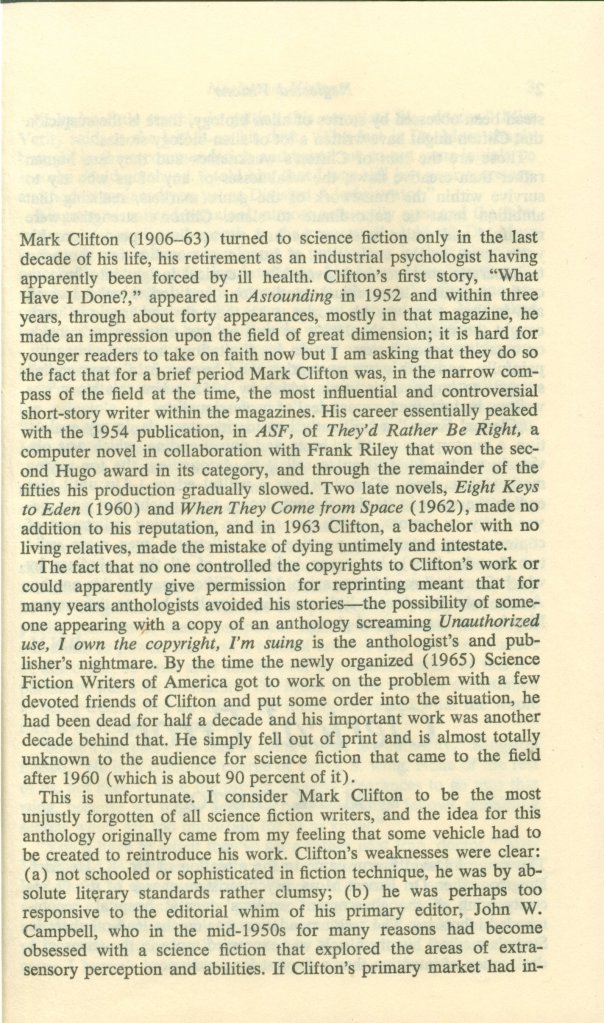
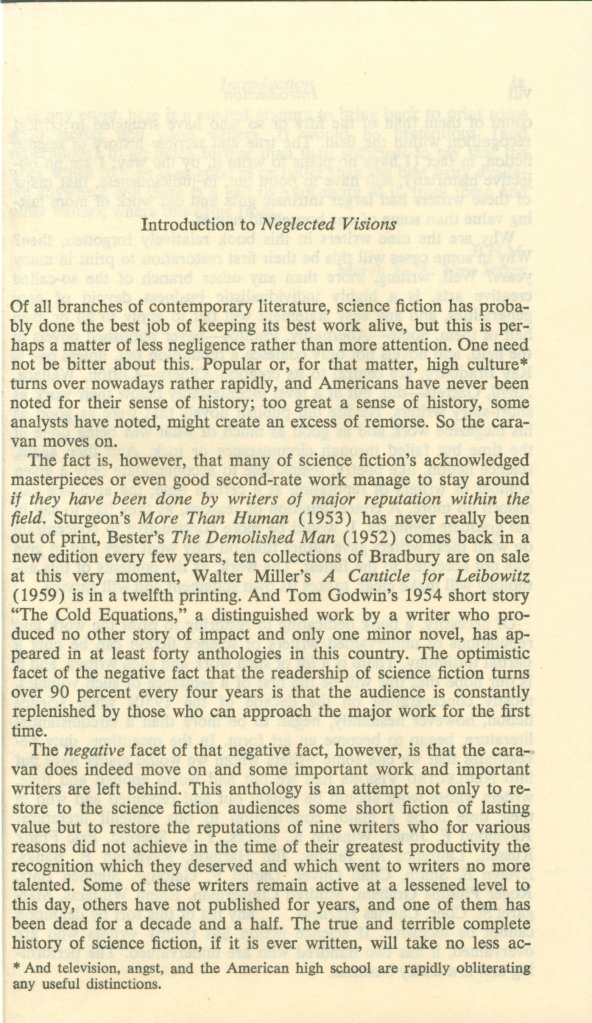
The only significant anthology that reprinted the story was Neglected Visions (1979) edited by Barry Malzberg, Martin H. Greenberg, and Joseph Olander, whose goal was “an attempt to restore the reputations of eight writers who did not achieve the recognition they deserved.” “Clerical Error” was also reprinted at SciFiction.com in 2002, an early internet effort to reprint classic science fiction online. Barry Malzberg also edited The Science Fiction of Mark Clifton back in 1980. Long out of print, but copies are available on ABEbooks.

In other words, “Clerical Error” has its fans who have tried to save it over the years, but the first time I read it, I found the whole beginning muddled, too full of info dumping. This time I also found the first part impenetrable and stopped reading. I then gave it a rest and started researching the story online. I could tell Clifton was trying to do several things at once in the first half of the story. He was setting up the much simpler second half, but he was also using the story to expound on science, scientists, and the perception of science, among other things.

Clifton also worked hard to develop his characters, and convey them psychologically, and even have us understand the psychological understanding of the psychiatrist. But this requires close reading.

I then read Barry Malzberg’s introduction to “Clerical Error” where he gives us some background on Mark Clifton. After reading that, and thinking about what I had read so far, I went back and started the story for a third time. For some reason I was in the right mood, and I zoned in on what Clifton was doing. This time the story worked great. Here’s Malzberg’s introduction.

I really wanted to hear this story too, but I couldn’t find any audiobook narration of the story. I even downloaded a pirated copy of a Mark Clifton collection in .pdf format and loaded it into the Edge browser which has a very good text to speech function. It works to a degree, but ultimately, I had to give up.

The story’s set up involves a scientist, David Storm, going insane. Because Storm works for the government in a high security job, the government doesn’t want to release him to outside doctors. He babbles about technology that will change the world. Dr. Ernest Moss, the psychiatrist with security clearance in charge of Storm requests that Storm be given a lobotomy. Dr. Kingston, the psychiatrist administrator over Dr. Moss doesn’t want to allow the lobotomy until he understands the case, but he doesn’t have top level security.

Dr. Kingston tries several end-runs around bureaucracy desperately to save Storm. Each step gives Clifton a chance to pontificate about science versus the government. Since Malzberg points out that Clifton was an industrial psychologist, this means his insights have some weight.

One reason why the story is so hard to get into is it digresses in so many directions. Clifton focuses on Dr. Kingston and his secretary Miss Verity. She is the top secretary in the psychiatric division, and Clifton represents them as the two most powerful people in the story. Miss Verity has a mind of her own concerning how things should be done. She wants to protect her boss Dr. Kingston. Dr. Moss tries to bypass Dr. Kingston by trying to get Miss Verity to sign off on the lobotomy for Kingston. That’s when she alerts Kingston to the problem. The rest of the story is Kingston trying to get help for David Storm, which would require sending him to doctors without security clearances.

This is all straightforward. Clifton complicates things by using the power struggle between Kingston and Moss to comment on psychiatry and science. This is why the story is in Astounding, because John W. Campbell Jr. loved these kind of discussion stories that challenge how people think, how they contend with authority, and how the status quo should be questioned.

I can understand how an insane scientist who babbles about government secrets could be a problem, but would a lobotomy even stop him from talking? It could quiet his constant anxiety and rage, but would it erase what he knows? I’m not sure how lobotomies work. Storm has also gone through a series of electroshock treatments that hasn’t shut him up.

Clifton uses “Clerical Error” to promote psychiatry as a science. But he also develops each character with a lot of psychological insight. This adds another layer to the story. And it’s why I said the story is hard to get into. Clifton is doing three things at once. Expressing politics, showcasing psychiatry and psychology, and telling a story. Along the way he also gives several reasons for the title of the story.

Like I said, it all came together for this third reading. I think if I read “Clerical Error” a fourth or fifth time, I’d get even more out of it. There’s a lot to it. It’s a shame that Clifton’s stories aren’t in print. But that’s why we’re doing this group reading for The Best SF Stories of 1956, to find forgotten classics that deserve more attention. I really like what Barry Malzberg said in his introduction to Neglected Visions. I hope he doesn’t mind me reprinting it here.

Unfortunately, Mark Clifton seems to be mostly out of print. You can find his original magazine publications using ISFDB and Archive.com. However, Amazon does have The Second Golden Age of Science Fiction MEGAPACK ®: Mark Clifton for 99 cents. It doesn’t have “Clerical Error,” but it does have a handful of stories and a couple of serials. In 2020 Dover published What Have I Done?: The Stories of Mark Clifton. The paperback is currently $7.48 for 288 pages, but the ebook is $3.99 but claims to only have 21 pages. That worries me. It appears to only be the first story.

James Wallace Harris 11/30/23

“The Minority Report” by Philip K. Dick

The Minority Report” was first published in Fantastic Universe Science Fiction, January 1956. You can read it on Archive.org or listen to it on YouTube. (Or even listen and read at the same time.) It is story #2 of 22 for The Best SF Stories of 1956 group read. Wikipedia has a rather informative entry for “The Minority Report” that I highly recommend reading.

“The Minority Report” did not meet any of the criteria I used for selecting the best SF short stories of 1956, but I included it because it’s a famous Philip K. Dick story, and because it inspired a movie and television miniseries. It’s interesting that neither Judith Merril, T. E. Dikty, nor the team of Isaac Asimov and Martin H. Greenberg picked the story for their best of the year anthologies. Obviously, they were not precogs to the story’s big success in the future, but ultimately, I think they made the right choice.

The premise of “The Minority Report” is built on the idea that the future can be predicted, and murders can be prevented by arresting murderers before they kill. The plot arises when the head of Precrime, John A. Anderton, sees his own name on a computer card stating that he will kill Leopold Kaplan. Anderton immediately figures it’s a frame-up by Ed Witwer to take over his job.

The story is weird because the future is predicted by three mentally and physically damaged people kept in a kind of permanent dream state. They are called precogs. Because the future is always in flux, each precog is monitored by a computer. To convict a person of a precrime requires two of the three computers analyzing the dreams of their precogs predicting the same future, and that’s called the majority report. A single computer produces a minority report.

Most of the story involves Anderton going on the run hoping to prove himself innocent and maintain the validity of precrime as a principle of law enforcement. The story is quite dramatic. I can see why they chose to produce it as a movie. “The Minority Report” is full of action and ideas. Along the way, the story produces quite a bit of PKD weirdness, paranoia, offbeat philosophical questions, and a disloyal wife. Unfortunately, there are so many plot twists that the story breaks down in confusion.

Information about the sale and publication of “The Minority Report” can be found at philipdick.com. It was reprinted in Dick’s 1957 collection The Variable Man and Other Stories, but it was never anthologized in a major anthology. According to the way stories are remembered in the science fiction publishing world, “The Minority Report” was never a respected story. Fantastic Universe was not a top tier publication. This was PKD’s 91st story, and 85th short story. (See philipdick.com for numbering his worksl) Dick cranked them out, and it shows. “The Minority Report” could have been a much better story if Dick had thought about the plot carefully and rewritten it several times. But he had to eat and sold it for little money. Philipdick.com suggests it earned only a little more than $12.95, but don’t say exactly.

Here is the review my friend Mike emailed me.

I think "The Minority Report" is one of Dick's weaker efforts. 


I've never been a fan of hocus-pocus stories, and the idea of Precrime has so much hand-waving magic about it that Penn and Teller would be proud. We never get a plausible explanation why or how precogs manage to predict the future. Good science fiction gets you to believe the unbelievable, but Precrime feels like a story gimmick.
I've also never been a fan of mysteries, because the author typically drops critical details into the narrative at the last minute. We're supposed to marvel at the perspicacity of the protagonist, but I just feel manipulated. Dick drops this important bit of information on us:
"Jerry's vision was misphased. Because of the erratic nature of precognition, he was examining a time-area slightly different from that of his companions."
We discover that precognition, which is the foundation of Precrime, has an "erratic nature" and precogs can examine different time-areas. Doesn't that collapse the entire Precrime house of cards?
You know a story is flawed when the author has to stop and explain for pages why Anderton's name was generated by the Precrime system. PKD finally throws in the towel when he has Anderton announce "Each report was different...Each was unique. But two of them agreed on one point. If left free, I would kill Kaplan. That created the illusion of a majority report. Actually, that's all it was--an illusion."
The whole story feels like an illusion, a magic trick. The characters are subservient to an arcane plot, stock performers in a magic show.

I agree with Mike. I dislike thrillers and mysteries where the author jerks us around contriving plot twists by whatever whim hits them at the moment. They never feel believable or real. Like I said in my previous review. I want to believe what I’m reading, and I have too much distaste for precognition.

Now, if PKD had come up with another system for identifying potential murderers I might have bought the idea of precrime. I don’t think this is possible, but if they had a brain implant that measured various kinds of emotional states and they could identify one that people experience before committing a murder, then that would have been acceptable to me. Dick’s precogs are mutants with ESP. I have problems with psi stories in SF. Too often they feel like comic book plots.

There are a few psychic power stories in science fiction that succeed with some readers. There’s telepathy in The Demolished Man and teleportation in The Stars My Destination, two much admired novels by Alfred Bester. But they are not my favorites. PKD played with ESP in some of his stories, and I’m a big fan of his work, and I can sometimes buy such weirdness as part of his stories because Dick was so weird himself. I’m afraid the precog stuff in “The Minority Report” didn’t work for me this time.

Alfred Bester came up through comics, and I’ve always felt he felt superior to both comics and science fiction. As much as I admire Bester’s writing ability, I’ve always thought he was sneering at science fiction. Writing stories about psionics was his way of saying SF fans would believe anything. But I think Dick was different. He was into thinking about the supernatural and any possible explanation for reality. He played with weirdness.

I need to think about the use of ESP in SF. Let’s see if any more of the 1956 stories deal with psychic powers. I’m not sure it’s a legitimate theme for science fiction.

James Wallace Harris, 11/29/23

“Brightside Crossing” by Alan E. Nourse

Brightside Crossing” was first published in Galaxy Science Fiction, January 1956. You can read it on Archive.org or Gutenberg.org or listen to it on YouTube. It is story #1 of 22 for The Best SF Stories of 1956 group read.

“Brightside Crossing” begins in a bar on Earth, the Red Lion, with James Baron sitting at a table. A grizzled old man comes in to see him, Peter Claney. We learn that Baron is planning an expedition to the planet Mercury, hoping to trek across the sun side surface and reach the equator when the Sun is at its closest and hottest position. Temperatures will reach 770 degrees Fahrenheit. When this story was written it was thought Mercury always had one side facing the Sun, the Brightside, like how one side of the Moon always faces the Earth. We’ve since learned that Mercury does slowly rotate three times for every two solar orbits Mercury makes.

Peter Claney was part of a team that previously tried to make the Brightside crossing, and he’s come to the Red Lion to warn Baron not to try. This implies Peter’s team failed, and Peter’s story is how we learn about that failed attempt. Nourse’s story is what we now call hard science fiction, although the term wasn’t coined until a year later. Even for 1956, I had several nit-picks about this story’s realism, but nothing that detracted from it being a great science fiction adventure tale. It was a finalist for the Hugo.

“Brightside Crossing” reminds me of reading books by polar explorers, or about the men who tried to find the Northwest Passage, especially of Franklin’s lost expedition. It’s about the kind of person who will endure extreme hardship to be first somewhere.

I agree completely with what my friend Mike emailed me about the story:

1. Nourse avoided the info dump trap. He succinctly describes the equipment used to make the Mercury crossing without falling into the endless info dumps found in some stories. 

2. The characters have depth and nuance. Ted McIvers is described as “kind of a daredevil.” At first, we think he’s just foolhardy, but we eventually realize that they will die if they don’t move faster and McIvers is trying to save them. Peter Claney admits “A man like McIvers was necessary. Can’t you see that?” Jack Stone is fearful and reveals “I’m scared.” However, when McIvers needs to be rescued, Jack agrees to go down and help. He overcomes his fear. And Peter Claney states categorically that the crossing is impossible, but he still wants to try again and be part of another attempt.

3. The story echoes the courage and heroism of the great Antarctica explorers Robert Scott and Ernest Shackleton.  

4. Nourse’s descriptions of the terrain are beautiful and terrifying. Every word is carefully chosen. We can feel the heat. The danger is visceral.

“Brightside Crossing” also reminds me of what I loved about science fiction as a kid back in the 1960s, but I don’t think I read “Brightside Crossing” then. I do vaguely remember a few science fiction stories set on Mercury. It is exactly the kind of story that would have wowed me as a kid because I loved science fiction stories that I wanted to feel were possible. This is my second reading of “Brightside Crossing” and I’m even more impressed than the first time I read it in The Great SF Stories 18 (1956) a couple of years ago.

This time as I read it, I thought “Brightside Crossing” represents the kind of science fiction I would use in creating my definition of science fiction. The story is believable in the way I want to define science fiction. Sure, Nourse’s speculation might be faulty or even impossible by today’s scientific knowledge and technology, but in the 1950s the story seems possible, at least to a kid who embraced the theology of the final frontier.

My disappointment with a lot of science fiction, especially science fiction from recent decades, is it’s not believable. I don’t know why when I was a kid, I wanted to believe humans would explore all the planets and moons of the solar system. I thought science fiction was propaganda to make such exploration happen. I knew there were two kinds of science fiction. The kind I like imagined either a probable future we should avoid or a future we should want to create. The other kind of science fiction was just stories that got its ideas from the first type. And like the degradation of originals from making copies of copies, too much science fiction seems inspired from science fiction cliches.

Over time, I think science fiction has become the label for any fantastic tale that involved the future or outer space. A splendid example of the second kind is “Fondly Fahrenheit” by Alfred Bester. It’s still a classic story, but not the kind of science fiction I’m talking about. Bester was both having a go at the genre and pushing it to its limits. Unfortunately, I think writers have settled on the second kind of science fiction as the preferred kind and see it as a Disneyland to work out their wildest ideas, rather than serious speculation about reality.

Like Busby Berkeley always working to top his previous dance routine, science fiction keeps trying to top itself. And like Busby Berkeley, the results have gotten absurdly wild. Busby Berkeley expected the movie audience to believe that his dance routines would be what an audience in a cabaret or Broadway theater would see, in the same way science fiction writers now expect their readers to believe their stories would fit into our little old reality. Sure, it’s fun to see fabulous big productions created by wild fancies of the mind but there’s something to be said about real people confined to Earthly possibilities. In case you have no idea, who Busby Berkeley was, or my analogy, I’ll include this film clip:

Alan A. Nourse was never a big name in science fiction, but I have encountered his work now and then, but I only vaguely remember him. “Brightside Crossing” inspires me to find more of his work. The two I think I might have read as a kid; are ones I want to try:

But I’d also like to find the collection below because of its neat cover, but it will probably be easier to get Alan E. Nourse Super Pack at Amazon for $1.99, which has several of the same stories, including “Brightside Crossing.”

By the way, “Brightside Crossing” had three things I couldn’t believe, but they were just little bumps in the road. The first are the suits that protected them from the horrendous heat. They plan to stay in them for over a hundred days. How did they handle peeing and pooping? A kid would wonder that and so did I as an old man. I also found it unbelievable that Ted McIvers could just show up late by hitching a ride on a Venus supply rocket, days after the others had arrived. That bothered me because trips would be rare to the planet Mercury. Finally, when Ted McIvers goes off course and stumbles upon the remains of the last expedition that tried to make the Brightside crossing. That seemed like way too much of a coincidence. They are crossing a whole planet, and they just happen to discover what happened to the previous explorers.

James Wallace Harris, 11/27/23

The Best SF Short Stories of 1956

Beginning, Tuesday November 28th, I’ll be moderating Group Read 67 “The Best SF Short Stories of 1956” on the Facebook group Best Science Fiction and Fantasy Short Fiction. We’ll start reading and discussing one story every Tuesday, Thursday, and Saturday. People leave comments whenever they want after the start date, sometimes that day, sometimes a day later, a week, or even a year later. Here’s the schedule:

I chose the stories based on the number of citations each 1956 short received in the Classics of Science Fiction database. I started by selecting all stories from 1956 that received at least three citations using the list builder function.

For our Classics of Science Fiction Short Stories v. 2 list, we use a cutoff of eight citations, which meant only two stories got on that list: “The Country of the Kind” by Damon Knight and “The Last Question” by Isaac Asimov. Stories with 3-7 citations are somewhat remembered, but I also wondered about possibly good stories that never got much recognition. It’s always a thrill to rediscover a forgotten great story.

I then looked at the stories with just one or two citations to see if any stood out for consideration. I picked any story that had been reprinted in two best-of-the-year anthologies, or one best-of-the-year and significant retrospective anthology or was a Hugo award finalist that year. I also included a famous Philip K. Dick story, “The Minority Report” and one of Rich Horton’s recommended stories that had only gotten one citation each. I figured the following stories might contain a forgotten gem that the group should consider.

  • “And Now the News …” by Theodore Sturgeon [Rich Horton favorite]
  • “Clerical Error” by Mark Clifton [Dikty, Asimov/Greenberg]
  • “Compound Interest” by Mack Reynolds [Merril, Asimov/Greenberg]
  • “The Doorstop” by Reginald Bretnor [Merril, Asimov/Greenberg]
  • “Horrer Howce” by Margaret St. Clair [Galaxy 30 Years, Asimov/Greenberg]
  • “Silent Brother” by Algis Budrys (Merril, Asimov/Greenberg]
  • “The Assistant Self” by F. L. Wallace [Hugo finalist]
  • “The Dragon” by Ray Bradbury [Hugo finalist]
  • “Legwork’ by Eric Frank Russell [Hugo finalist]
  • “The Minority Report” by Philip K. Dick [ISFDB Most Viewed Short Stories]

So, join us on Facebook. I’m going to try and review each of the stories individually on this blog, so if you don’t like Facebook, you can comment here. I also plan to talk about science fiction and 1956 in general.

James Wallace Harris, 11/22/23

“The Earth Quarter” by Damon Knight

Starting September 7th, our science fiction short story group will be discussing the best short science fiction of 1955. Read about the details here if you want to participate. We used CSFquery to identify twenty-two stories to read and discuss. However, I put a challenge to the group to find worthy stories that have gone mainly unrecognized. I found my first forgotten classic today, “The Earth Quarter” by Damon Knight. The only recognition I could find that remembers this story is in a list of 50 SF short stories that were Gardner Dozois personal favorites. (I’m going to have to read more of the stories from that list that aren’t famous.)

I thought “The Earth Quarter” was one of the most cynical science fiction stories I’ve ever read. You know how Campbell and Heinlein were so pro-human? Well, Knight takes the opposite stance. I don’t want to say too much — and you might want to go read the story here before you read on.

Knight sets up the story where a group of humans live in a ghetto on another planet, one they call Earth Quarter. He pictures humans attaining interstellar flight and spreading out across the galaxy, but discovering it’s well occupied by intelligent beings more advanced than us. Humans can’t handle this. Earth itself falls back into barbarism, while enclaves of humans on various planets bicker amongst themselves.

“The Earth Quarter” is told from the point-of-view of Laszlo Cudyk, a fifty-year old man who tries to stay neutral among several highly polarized political factions. Liberals want to find a way to live peaceably with the aliens, while various conservative groups want to bring back the glory of Earth and conquer the galaxy.

The Earth Quarter is roughly sixteen square city blocks, containing 2,300 humans of three races, four religions, and eighteen nationalities. The human ghetto is sanctioned by a race of aliens called the Niori, but only if they live peaceably, which humans can’t seem to do. Knight makes a case that humans just can’t get along no matter what.

Life in the Earth Quarter reminds me of the prisoner of war camp in J. G. Ballard’s Empire of the Sun, but the Niori are enlightened beings who are kind rather than cruel. In another way, the story reminds me of Katherine Anne Porter’s Ship of Fools.

What I really liked about this story was the characterization — sure it’s pulp fiction, but I think good pulp fiction. Knight creates many distinctive characters who are vivid from little description. Sure, he employs stereotypes, but not too offensively. I can easily picture “The Earth Quarter” being made in a 1950’s noir sci-fi flick with all the standard noir actors like Humphrey Bogart, Robert Ryan, Robert Mitchem, Peter Lorre, Sidney Greenstreet, Barten MacLane, Elisha Cook, Jr. — and it would have to be filmed in black and white.

My guess was Damon Knight got disgusted with humans in 1955 when he wrote this story. We were in the middle of the cold war and humanity was providing just the right inspiration.

UPDATE – 9/4/23

It turns out that Rich Horton also likes “The Earth Quarter.” See his essay about his picks for the 1956 Hugo awards (which cover 1955). But he also reviewed the story when it was expanded and renamed into one-half of an Ace Double called The Sun Saboteurs.

James Wallace Harris, 9/3/23