This morning, I read an email from a discussion group that mentioned Fitz-James O’Brien (1826-1862). You can sample his fiction at Project Gutenberg.
One member posted a link to a review of a new three-volume collection of his stories at The New York Review of Books. The review implied that O’Brien is little known, but several folks in the group quickly claimed they knew who he was. But that’s logical, our group is devoted to fiction in old magazines. I’ve even read some of O’Brien’s stories because they show up in science fiction anthologies, and I collect those. (See my post on 19th Century Science Fiction Short Stories.)
But this got me to thinking. How many people would know who Fitz-James O’Brien and read any of his stories? Then I asked myself, how many people read short stories? And of those, how many read old short stories? It’s one thing to read the short story in the latest issue of The New Yorker, and it’s another thing to read short stories originally published in the 19th century. Yes, some people still read Edgar Allan Poe, but how many outside of school?
I’ve always been a fan of science fiction magazines. When I was young, some of the top titles had over 100,000 subscribers. Over my lifetime, I’ve watched their subscriber base dwindle to well below 10,000.
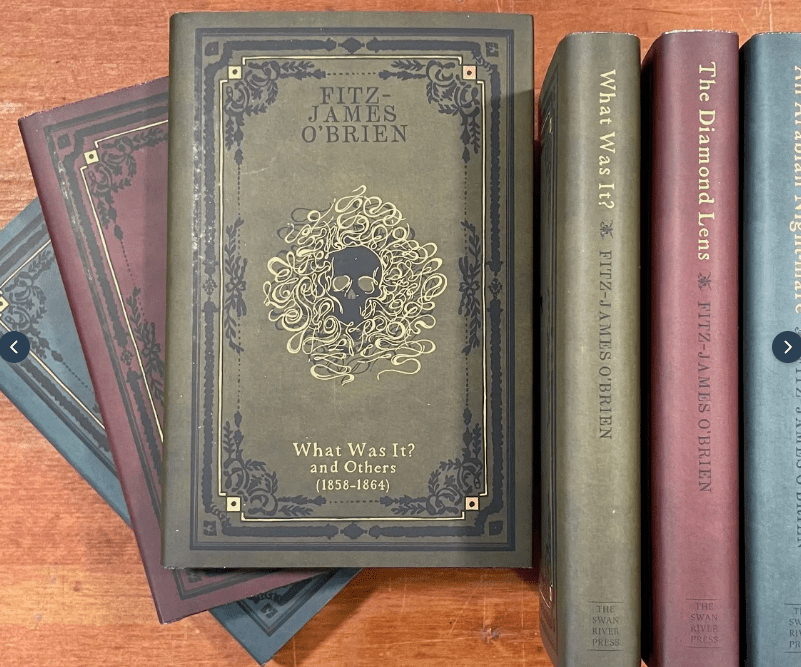
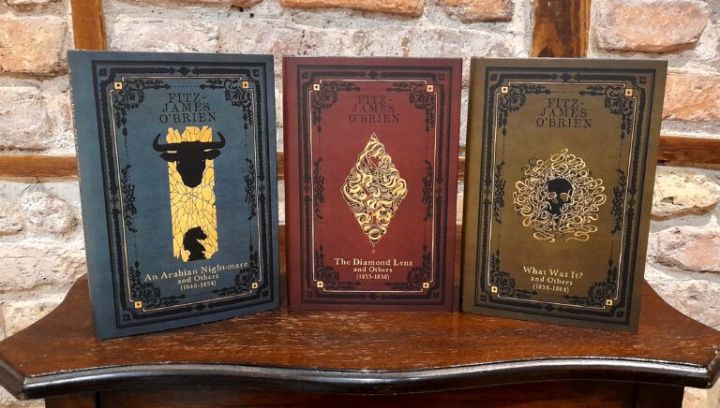
It appears the three-volume Collective Speculative Works by Fitz-James O’Brien will be limited to 300 copies. Does that mean the publisher thinks fewer than 300 people in the world are interested in reading O’Brien’s stories? Or that some kind of marketable ploy? I don’t know. 300 is 0.0000036% of the world’s population. That’s one tiny subculture!
Almost half of the respondents haven’t read any books in over a year: 48.5%
Print books were the most read books: 35.4%
The 65+ age group recorded the highest population of print book readers: 45.1%
The 45-54 age group contains the highest population of non-readers: 60.9%
Males recorded a slightly higher population of non-readers compared to females: 51.4%
The article reported that the Pew Research Center found that 64% of Americans read at least one book in the previous year. That’s a lot more than I expected, and it disagrees with their own poll.
This suggests there are many kinds of readers, and that made me speculate about possible names to give different types of readers. I’m not very good at creating fun labels, but here’s my lame attempt.
Non-readers (0 books per year)
Casual readers (1-11 books per year)
Steady readers (read a book a month)
Bookworms (read a book a week)
Super Bookworms (read two or more books a week)
This doesn’t say anything about the kinds of books they read. Someone who reads over a hundred books a year might never encounter the name Fitz-James O’Brien. In one of my older essays, I speculated that the average reader could not list more than one hundred titles from novels from the 19th century. And I listed the hundred I thought would be the most common. I doubt most people would come even close to recalling one hundred titles from the 19th century.
Outside of people I know in my discussion groups that specialize in old fiction, I doubt I have ever met anyone in my life who has read a story by Fitz-James O’Brien.
What possible name could we give to people who do? Bookworm is the tag that most people give to obsessive readers. But for every 1,000 bookworms, is there even one who reads old short stories from the 19th century? I know a fair number of people like me who love science fiction short stories from the 20th century, and I also know a smaller group who love short stories published in pulp magazines (mainly from 1900 to 1950). But how many people are we talking about? I asked CoPilot, and it estimates that the number is below 20,000 for people who read and collect old pulp fiction. That’s .0059% of the current U.S. population.
Would the word aficionado apply here? Here are some other words that CoPilot helped me find. Maybe we could use each for a different type of reader.
Aficionado
Enthusiast
Devotee
Connoisseur
Curator
Archivist
Bibliophile
Esotericist
Antiquarian
Obscurist
Archaeologist
We could use all these words to describe someone who would buy Collective Speculative Works by Fitz-James O’Brien.
At one time, I would have ordered this set. However, I’ve now reached an age where I’m trying to get rid of books rather than collect. But that set does call to me. Actually, what I would really like is digital scans of the periodicals where his stories were first published. I’ve collected scans of most science fiction magazines from the 20th century, but have next to nothing from the 19th century on my hard drive.
How many people are like me who love reading old magazines?
I’m sure it’s less than .006% of the population. What nickname would you give to such people? My wife would probably say, “A nut.”
Whitney, over at the YouTube channel Secret Sauce of Storycraft, conducted a poll of her viewers. She asked them to post a list of their Top Ten Hugo award-winning novels. She tallied the totals for all the titles, giving ten points for a #1 placement, nine points for #2, and so on down to one point for tenth place. She announced the results in this video. (The totals were given in a spreadsheet – see below.) This video lists the Top 20 vote getters, and Whitney lists her own Top 20.
Here is the top portion of her pdf results to give you an idea of the most popular Hugo novels with her voters. She had 194 people vote. 45 ranked Dune #1 (45 x 10). Follow the link above to see the entire .pdf.
Throughout 2025, Whitney has been reviewing the novels that won the Hugo. She had a video for each decade. They are worth viewing for a longer review of each book.
As I watched each video, I thought about my memories of these books. Some I first read over sixty years ago. Some I’ve reread since. Some titles burn bright in my memory, but for other books, I only have murky impressions.
Jonathan at Words in Time also did a video retrospective review of all the Hugo award-winning novels. I guess this is an obvious theme for a YouTube video. Jonathan presented his results in a ranking video.
And there are other YouTubers who have also reviewed the novels that won the Hugo awards. Watching all these videos has made me think about how I remember these books. Looking at Wikipedia’s list of winners of the Hugo Award for novel, I got CoPilot to create this list:
01 – (1953) – THE DEMOLISHED MAN by Alfred Bester 02 – (1955) – THEY’D RATHER BE RIGHT by Mark Clifton & Frank Riley* 03 – (1956) – DOUBLE STAR by Robert A. Heinlein 04 – (1958) – THE BIG TIME by Fritz Leiber 05 – (1959) – A CASE OF CONSCIENCE by James Blish 06 – (1960) – STARSHIP TROOPERS by Robert A. Heinlein 07 – (1961) – A CANTICLE FOR LEIBOWITZ by Walter M. Miller, Jr. 08 – (1962) – STRANGER IN A STRANGE LAND by Robert A. Heinlein 09 – (1963) – THE MAN IN THE HIGH CASTLE by Philip K. Dick 10 – (1964) – HERE GATHER THE STARS (WAY STATION) by Clifford D. Simak 11 – (1965) – THE WANDERER by Fritz Leiber 12 – (1966) – DUNE by Frank Herbert 13 – (1966) – …AND CALL ME CONRAD (THIS IMMORTAL) by Roger Zelazny 14 – (1967) – THE MOON IS A HARSH MISTRESS by Robert A. Heinlein 15 – (1968) – LORD OF LIGHT by Roger Zelazny 16 – (1969) – STAND ON ZANZIBAR by John Brunner 17 – (1970) – THE LEFT HAND OF DARKNESS by Ursula K. Le Guin 18 – (1971) – RINGWORLD by Larry Niven 19 – (1972) – TO YOUR SCATTERED BODIES GO by Philip José Farmer 20 – (1973) – THE GODS THEMSELVES by Isaac Asimov* 21 – (1974) – RENDEZVOUS WITH RAMA by Arthur C. Clarke 22 – (1975) – THE DISPOSSESSED by Ursula K. Le Guin 23 – (1976) – THE FOREVER WAR by Joe Haldeman 24 – (1977) – WHERE LATE THE SWEET BIRDS SANG by Kate Wilhelm 25 – (1978) – GATEWAY by Frederik Pohl 26 – (1979) – DREAMSNAKE by Vonda N. McIntyre* 27 – (1980) – THE FOUNTAINS OF PARADISE by Arthur C. Clarke 28 – (1981) – THE SNOW QUEEN by Joan D. Vinge* 29 – (1982) – DOWNBELOW STATION by C. J. Cherryh* 30 – (1983) – FOUNDATION’S EDGE by Isaac Asimov* 31 – (1984) – STARTIDE RISING by David Brin 32 – (1985) – NEUROMANCER by William Gibson 33 – (1986) – ENDER’S GAME by Orson Scott Card 34 – (1987) – SPEAKER FOR THE DEAD by Orson Scott Card 35 – (1988) – THE UPLIFT WAR by David Brin 36 – (1989) – CYTEEN by C. J. Cherryh* 37 – (1990) – HYPERION by Dan Simmons 38 – (1991) – THE VOR GAME by Lois McMaster Bujold* 39 – (1992) – BARRAYAR by Lois McMaster Bujold* 40 – (1993) – A FIRE UPON THE DEEP by Vernor Vinge 41 – (1993) – DOOMSDAY BOOK by Connie Willis 42 – (1994) – GREEN MARS by Kim Stanley Robinson* 43 – (1995) – MIRROR DANCE by Lois McMaster Bujold* 44 – (1996) – THE DIAMOND AGE by Neal Stephenson* 45 – (1997) – BLUE MARS by Kim Stanley Robinson* 46 – (1998) – FOREVER PEACE by Joe Haldeman 47 – (1999) – TO SAY NOTHING OF THE DOG by Connie Willis 48 – (2000) – A DEEPNESS IN THE SKY by Vernor Vinge 49 – (2001) – HARRY POTTER AND THE GOBLET OF FIRE by J. K. Rowling 50 – (2002) – AMERICAN GODS by Neil Gaiman 51 – (2003) – HOMINIDS by Robert J. Sawyer* 52 – (2004) – PALADIN OF SOULS by Lois McMaster Bujold* 53 – (2005) – JONATHAN STRANGE & MR NORRELL by Susanna Clarke 54 – (2006) – SPIN by Robert Charles Wilson 55 – (2007) – RAINBOWS END by Vernor Vinge* 56 – (2008) – THE YIDDISH POLICEMEN’S UNION by Michael Chabon 57 – (2009) – THE GRAVEYARD BOOK by Neil Gaiman* 58 – (2010) – THE WINDUP GIRL by Paolo Bacigalupi 59 – (2010) – THE CITY & THE CITY by China Miéville 60 – (2011) – BLACKOUT/ALL CLEAR by Connie Willis* 61 – (2012) – AMONG OTHERS by Jo Walton 62 – (2013) – REDSHIRTS by John Scalzi 63 – (2014) – ANCILLARY JUSTICE by Ann Leckie 64 – (2015) – THE THREE-BODY PROBLEM by Cixin Liu 65 – (2016) – THE FIFTH SEASON by N. K. Jemisin* 66 – (2017) – THE OBELISK GATE by N. K. Jemisin* 67 – (2018) – THE STONE SKY by N. K. Jemisin* 68 – (2019) – THE CALCULATING STARS by Mary Robinette Kowal 69 – (2020) – A MEMORY CALLED EMPIRE by Arkady Martine* 70 – (2021) – NETWORK EFFECT by Martha Wells* 71 – (2022) – A DESOLATION CALLED PEACE by Arkady Martine* 72 – (2023) – NETTLE & BONE by T. Kingfisher* 73 – (2024) – SOME DESPERATE GLORY by Emily Tesh* 74 – (2025) – THE TAINTED CUP by Robert Jackson Bennett*
I’ve starred (*) the 28 novels I haven’t read. I own many of them, but for some reason, I have never gotten around to reading them.
Now that I’m 74, my feelings about science fiction are different from when I was 13, or 33, or even 63.
Two novels that are at the top of most people’s lists are Dune and Hyperion. I’ve read Dune twice and Hyperion three times. They were dazzling novels each time I read them. However, old me, at 74, does not find them very appealing. I would have been hard-pressed to send Whitney my Top 10 list.
But is it fair to judge a novel by how you feel in old age? It occurs to me I could make a Top 10 list based on the memories of my first reading of each book.
Jim’s Top Ten Hugo Award Winning Books Based On Initial Impact
Stranger in a Strange Land by Robert A. Heinlein
The Moon is a Harsh Mistress by Robert A. Heinlein
Starship Troopers by Robert A. Heinlein
Hyperion by Dan Simmons
Stand on Zanzibar by John Brunner
The Man in the High Castle by Philip K. Dick
Among Others by Jo Walton
The Windup Girl by Paolo Bacigalupi
The Doomsday Book by Connie Willis
Way Station by Clifford D. Simak
Looking at that list, I think about all the reasons why I wouldn’t recommend some of those novels now. I have a love-hate relationship with Stranger in a Strange Land. At age 13, that novel blew me away in 1964. I’ve reread it several times over my lifetime, but with each rereading, I’m horrified by some scenes in it. Heinlein reminds me of Donald Trump in that his protagonists are often unforgiving of people who offend them.
But on the other hand, Stranger is an incredibly ambitious work of science fiction from 1961. In fact, few books on the complete Hugo list even try to be as ambitious. Dune is one. That’s why it continues to stand out. Stand on Zanzibar was probably too ambitious for most readers.
I see a common quality in the books in my first impression list. They were different from anything else at the time. And that’s true for most novels that win a Hugo. Although that quality might not be true in recent decades. People seem to like series, which I find disappointing. Connie Willis has three Hugos for essentially the same idea, although each is told in a different style.
But what books would I put on my Top Ten list today, at age 74? Thinking about that troubles me. My gut instinct would be to pick novels I felt meant something to my whole life, not just the first time I read them. In that regard, science fiction doesn’t hold up.
To complicate this instinct is the feeling that I would need to reread these books to decide if they merit a lifetime award or recognition. It took me a lifetime to read them, so that won’t happen.
I would pick Among Others by Jo Walton because it’s about being a science fiction fan. It’s certainly something that relates to my entire life. I need to reread Way Station, but I have a vague memory that it said something philosophical I would agree with in old age. Finally, I would consider The Man in the High Castle because it could resonate with my current philosophical outlook, but I’d need to give it another reading.
I’m not sure if any of the other 71 titles have true lasting literary value, at least to me. Not in the sense that Nineteen Eighty-Four or Earth Abides does. Or even The Time Machine and The War of the Worlds.
Science fiction dazzles when it’s new, and its readers are young. To be fair, though, it’s true of all forms of fiction.
The sad reality is that most science fiction books can’t go the distance.
If you reread the list above of those 74 novels, consider how many you have read. How many are unknown titles to you? Many of these novels are often discussed by YouTubers. That keeps them alive. YouTube is great for old science fiction books. But if you pay attention, those same YouTubers are shooting down many famous titles.
The act of reviewing Hugo winners promotes some books and causes others to be forgotten. I feel like I’m watching younger generations dismiss books beloved by older generations. It’s not just old guys like me giving up on them.
Humans have created artificial realities long before computers. I define artificial realities as cognitive models that claim to describe reality that have no basis in reality. In crude terms, it’s shit we make up, believe to be true, act like it’s real, but isn’t. I like Philip K. Dick’s definition of reality: “Reality is that which, when you stop believing in it, doesn’t go away.”
Science fiction has created a number of artificial realities we hope will become real. One desire is for a galactic civilization, or galactic empire. Often with artificial realities we try to make them real. For centuries traveling to the Moon was an artificial reality. Then it became real on July 20, 1969.
When I read “Foundation” by Isaac Asimov I wondered if he was ground zero for the idea of a galactic empire? I knew there was earlier science fiction stories that imagined the galaxy occupied by other intelligent beings. And there were stories about humans exploring the galaxy, and even having wars with other intelligent beings. But had any writer imagined humans colonizing the entire galaxy?
Today, that idea firmly exists as an artificial reality in our culture. Many people assume in the future humanity will spread across the Milky Way. It’s a kind of faith. We see it especially in Star Trek and Star Wars, but also in books like the Culture series by Iain Banks.
Like any artificial reality, I assume one person got the ball rolling. Was that Isaac Asimov? Like all the famous explorers looking for the source of the Nile, I wonder if I can find the source of galactic civilizations or galactic empires.
The oldest surviving artificial realities are myths and religions. Artificial realities start in one mind as ideas, and are spread as memes. Each person who spreads the memes mutates the artificial reality slightly. That’s why there were many forms of Christianity in the first century, and why they are so different from all the forms of Christianity in the twenty-first century. Reading books about the origins of Christianity or how the Old Testament came into being is a black hole of fascinating research.
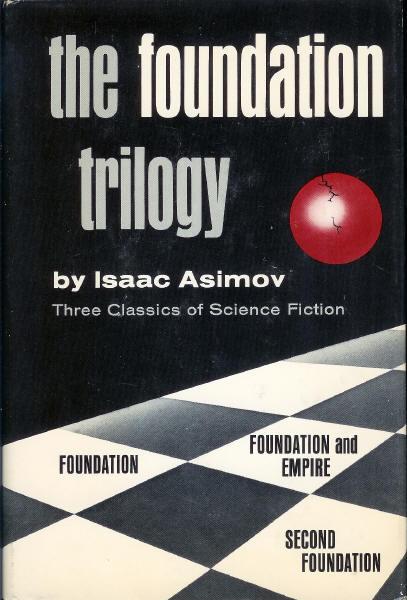
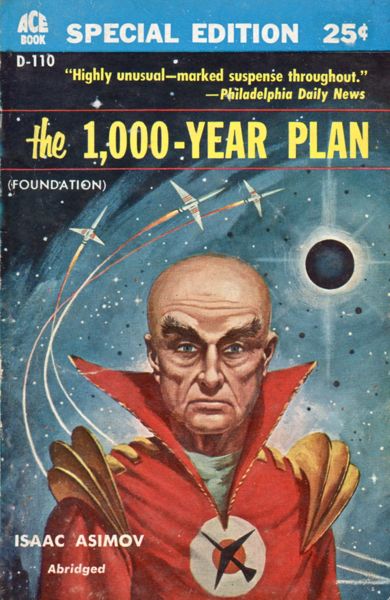
In 2015 and 2025, I tried to reread The Foundation Trilogy. I’m embarrassed to admit this, but I just hated that much-loved science fiction classic. In both attempts, I couldn’t get past the first book. All I could focus on were its flaws.
That bothered me. Was I being unfair to the book? What was I missing that so many readers found in this story? When Paul Fraser came up with a great idea for a group read at the Best Science Fiction and Fantasy Short Fiction Facebook group, I decided to give the trilogy one more chance.
Paul suggests we read The Foundation Trilogy as it was originally published in Astounding Science-Fiction back in the 1940s. That gave me an idea. I would read the stories in the order they were published. I would seek to enjoy them as the fans originally did, as they were published one by one in Astounding Science-Fiction. Furthermore, I would try my damndest to get what Asimov was doing.
Wikipedia nicely lays out the publication history of the Foundation Trilogy in this table:
Collections
Astounding Science Fiction
Published
Book title
Story retitle
Original title
Published
Original trilogy
1951
Foundation
“The Psychohistorians”
—
“The Encyclopedists”
“Foundation”
May 1942
“The Mayors”
“Bridle and Saddle”
June 1942
“The Merchant Princes”
“The Big and the Little”
August 1944
“The Traders”
“The Wedge”
October 1944
1952
Foundation and Empire
“The General”
“Dead Hand”
April 1945
“The Mule”
“The Mule”
November 1945 December 1945
1953
Second Foundation
“Part I: Search by the Mule”
“Now You See It…”
January 1948
“Part II: Search by the Foundation”
“…And Now You Don’t”
November 1949 December 1949 January 1950
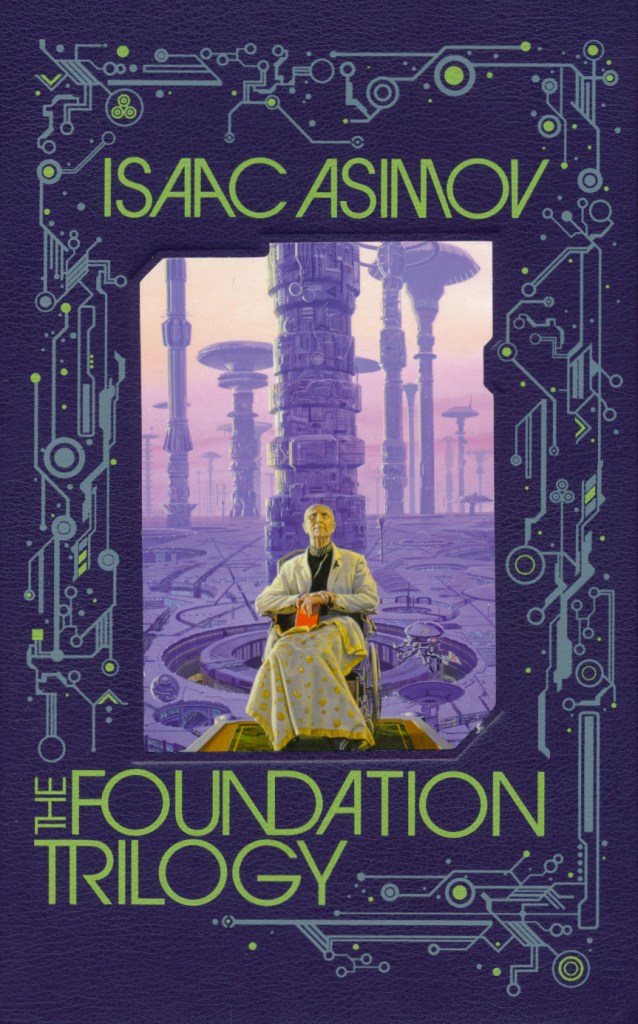
In the 1960s, I read The Foundation Trilogy when I bought the one-volume edition from the Science Fiction Book Club. At the time, I was unaware that many of the classic science fiction stories I was reading in book form were first published in magazines. Nor did I know about the concept of the fix-up novel. I didn’t question what I read. I just consumed it. (I recently wrote about this in “Reading at 13 vs. 73.”)
I can remember how thrilled I was by the first story, “The Psychohistorians,” which was set on the planet Trantor. And I liked all the pseudo-encyclopedia intros. The other stories didn’t stick with me. I remember the trilogy as an epic idea and visualized Trantor and Terminus existing in a galaxy with humans living on twenty-five million worlds.
In 2015, I reread Foundation, the first book in the trilogy. By then, I knew all about pulp magazines and fix-up novels. Foundation was obviously five separate, standalone stories. The first story was again impressive, the second was still interesting, but the rest were tedious. I was shocked that this famous book was so annoying to read. I gave it one star on Goodreads. I didn’t go on to reread the other two books.
Over the years, I’ve talked to so many science fiction fans who loved The Foundation Trilogy. It was the first series to be given a special Hugo Award. Recently, I watched a YouTube video about the Top 20 SF Series, and The Foundation series came in fourth. (Really, it was second after Dune. #1 were Star Wars books, and #2 were Star Trek books, and I don’t consider them a proper SF series. The host said that 20 million copies of The Foundation series have been sold.
So, why don’t I like it? And why did so many people love it? Was it because it first instilled the artificial reality of galactic civilization into their minds? This made me wonder if I could put myself in their shoes as they read the Foundation stories.
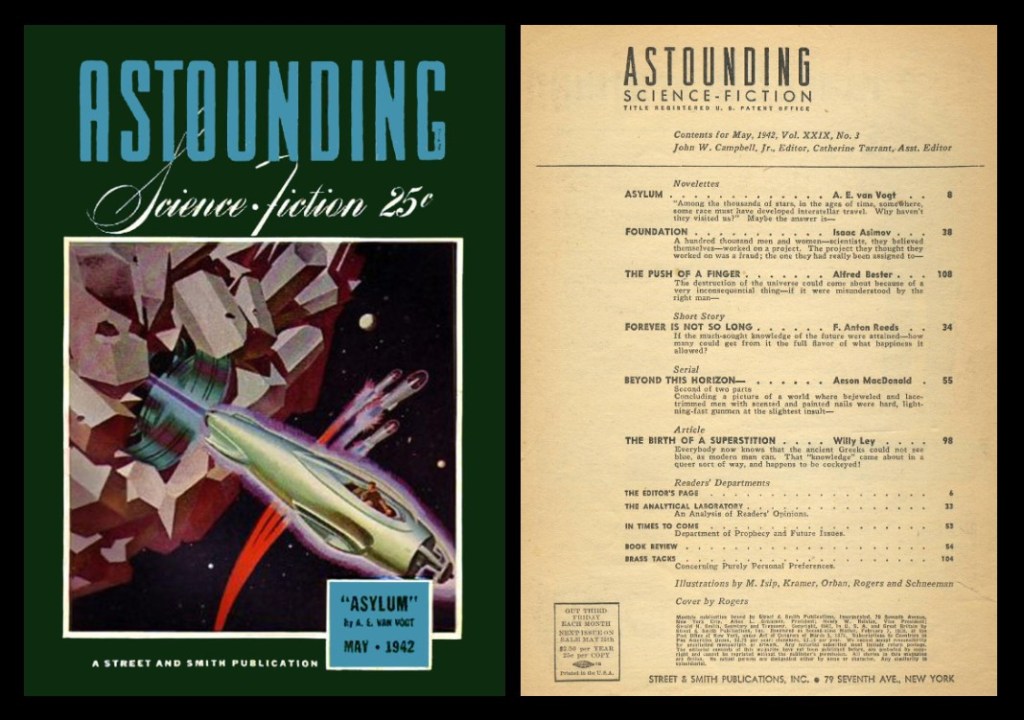
To get into the character of a 1940s science fiction fan, I intentionally skipped the first story in the book. I began my reading with “Foundation” from the May 1942 issue of Astounding Science-Fiction. I wanted to feel like I was living back in 1942, encountering the series for the first time. To see if Asimov rewrote the story for the hardback, I read the magazine with my eyes, but listened to the story with an audiobook edition.
In creative writing classes, we’re urged to start our stories in the middle of the action to avoid boring the reader with introductory material. This is exactly what Isaac Asimov did. However, when Asimov published Foundation as a book, he wrote an introductory story, “The Psychohistorians.” Out of the nine short stories, novelettes, and novellas in the Foundation Trilogy, “The Psychohistorians” was my favorite.
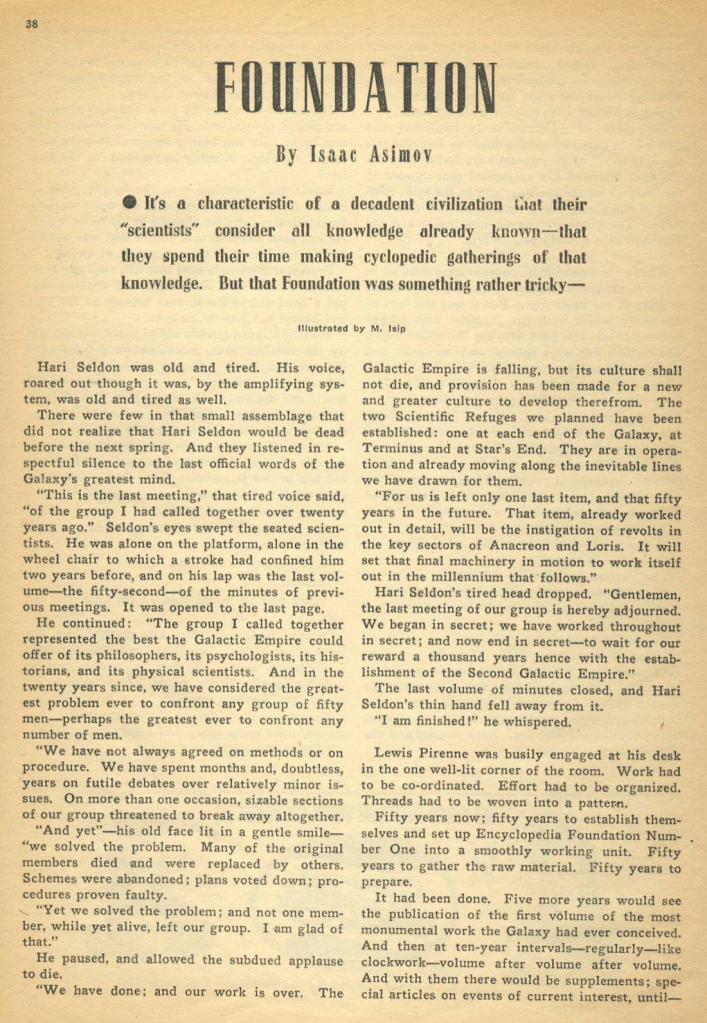
Asimov opened “Foundation” with this introduction on the first page. This is how we learn about Hari Seldon and his plan. This is how the series began in 1942, in just thirteen short paragraphs. We never see Trantor or meet Gaal Dornick. Our first real character is Salvor Hardin. In the book form, “The Psychohistorians” replaced this intro.
Most readers assume Asimov had just become a better writer by the time he wrote “The Psychohistorians” for the hardback. I’m not so sure. I feel I loved “The Psychohistorians” so much more because the Empire was more interesting than Terminus. Trantor is far more fascinating than any other setting in the trilogy. Asimov has claimed that the series was inspired by his discussions with John W. Campbell, Jr., and reading The History of the Decline and Fall of the Roman Empire by Edward Gibbon. But be honest, don’t most people love reading about Rome in its glory days?
As a young reader in the 1960s, I remember being blown away by the idea of a galactic civilization. But the stories of its fall didn’t make a lasting impression on me. I’m not sure, but I believe I read The Foundation Trilogy before seeing Star Trek in 1966. It might have been my first introduction to the idea of a galactic civilization. Was it to readers back in the 1940s?
To get into the spirit that I wanted to achieve, I need to forget all of this. I need to put myself back in 1942. I’d be reading the May issue of ASF just five months after the U.S. declared war on Germany and Japan. Let’s imagine I’m in the golden age of science fiction, and I’m 12 years old. How would “Foundation” WOW! me?
If you read Hari Seldon’s speech above, we don’t get what the empire is like. We only learn that it’s collapsing. The only empire I might have known about at that age in 1942 was the British Empire, due to watching Gunga Din. I doubt I would know anything about Rome.
I guess that I, and other readers, would have gotten a strong sense of wonder rush thinking about the galaxy being populated by humans. But was that a new idea? Is there any way to find out? I thought I’d poke around and see.
With this issue, Isaac Asimov launched his monumental “Foundation” series with the appearance of the initial novelette of the series, “Foundation.” After tens of thousands of years the Galactic Empire had spread to millions of worlds throughout the galaxy, its power all but absolute, its influence all pervading. The Empire, however, was on the brink of collapse and, with the impending collapse, the universe could be expected to be plunged into at least thirty thousand years of anarchism and barbarism. Hari Seldon, through the application of psychohistory which enables him to predict the future course of history by the interpretation of statistical laws as derived from the inconceivable mass of humanity, foresees this imminent fate of civilization and takes measures to insure the survival of civilization and knowledge through the long dark ages ahead and, if possible, shorten the period of barbarism. He does this by establishing two Foundations at opposite ends of the galaxy: the First Foundation of the Encyclopedists at Terminus, a small system on the edge of the galaxy, the Second Foundation — hidden even from the First — at “Star’s End,” at the “other end of the galaxy.” “Foundation” introduced the basic elements of the plot of the series and recounted the successful resolution of the first of the critical crises predicted by Seldon which the Foundation must surmount in order to carry on the Seldon Plan.
Rogers’ book remembered Astounding issue-by-issue. I had hoped his entry for “Foundation” would have given me his initial reaction, but I feel this quote is heavily influenced by reading the trilogy.
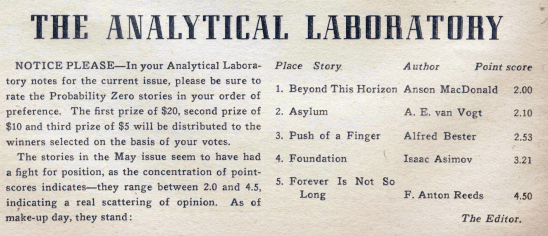
Next, I found the July issue to see how “Foundation” did in The Analytical Laboratory feature, where readers vote for their favorite stories. Evidently, “Foundation” didn’t make much of an impression, since it came in a distant fourth. Nor did it get mentioned in a letter to the Brass Tacks second.
I thought about looking through fanzines at Fanac.org, but I fear what I want might be looking for a needle in a haystack.
My next stop was The World Beyond the Hill by Alexei and Cory Panshin, my favorite book about Astounding during the Golden Age of Science Fiction. It can be checked out from the Archive.org, or ordered from Amazon for the Kindle for $9.99.
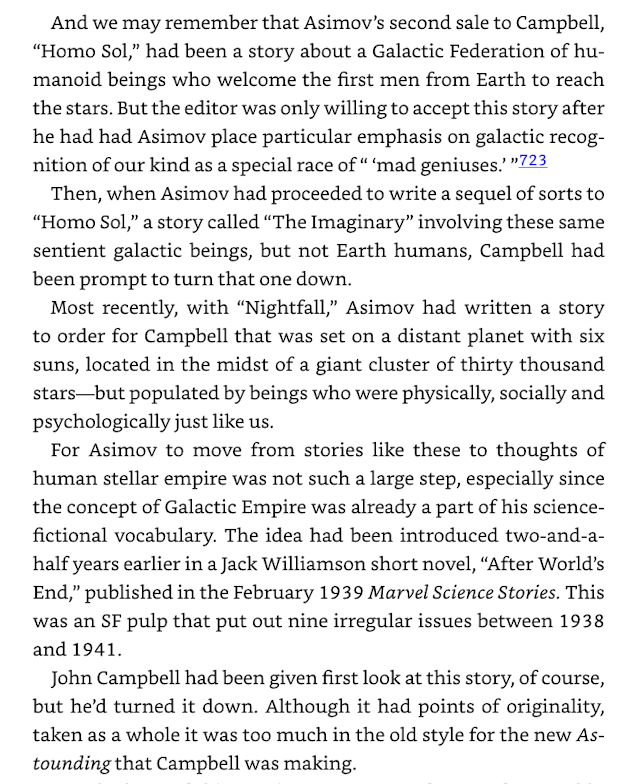
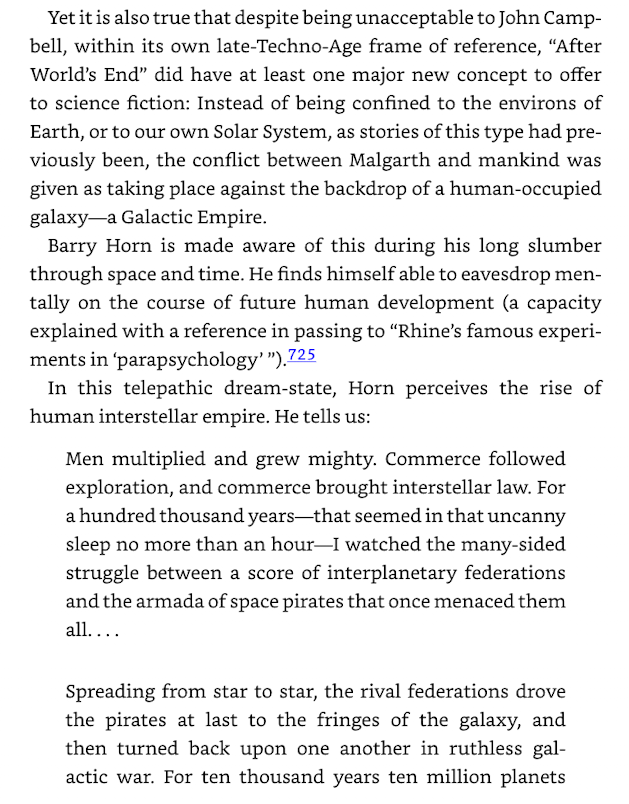
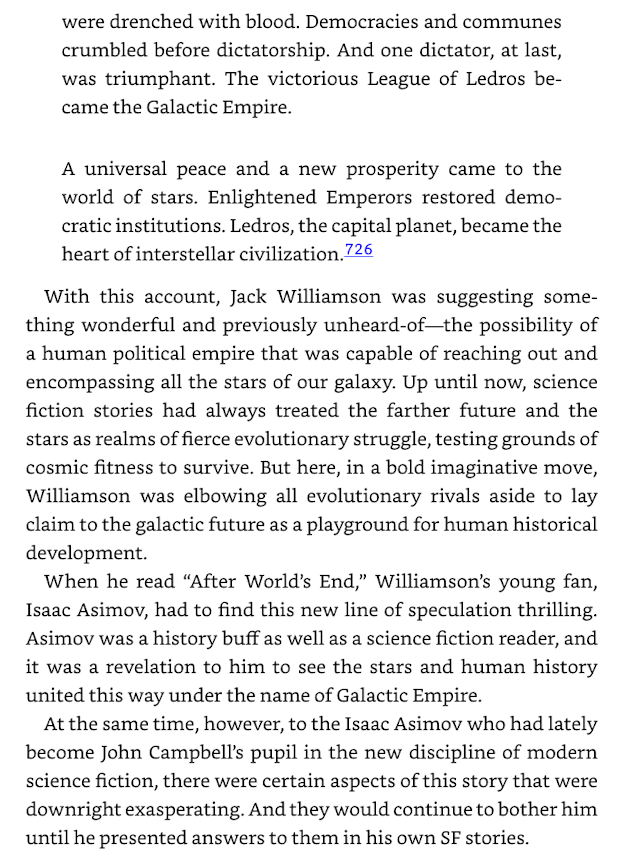
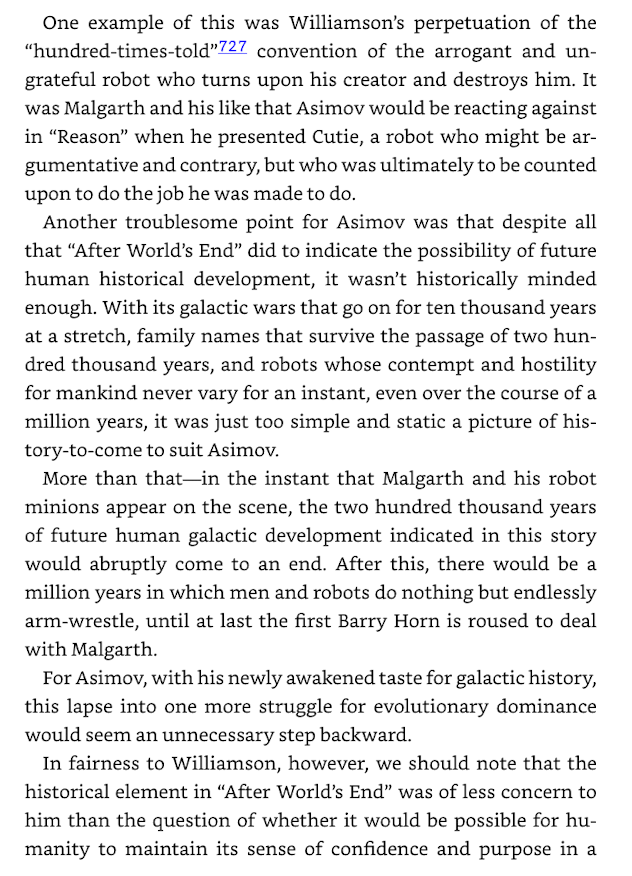
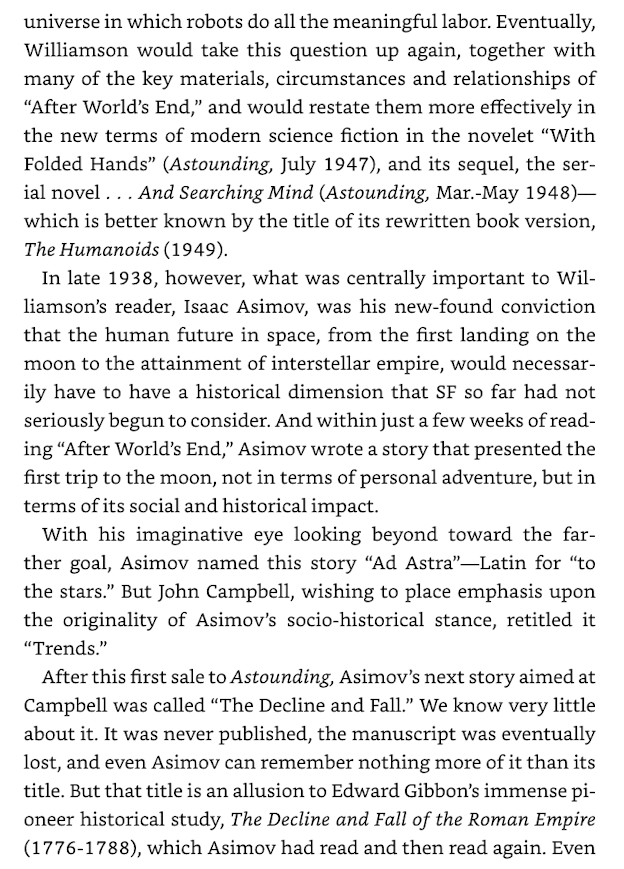
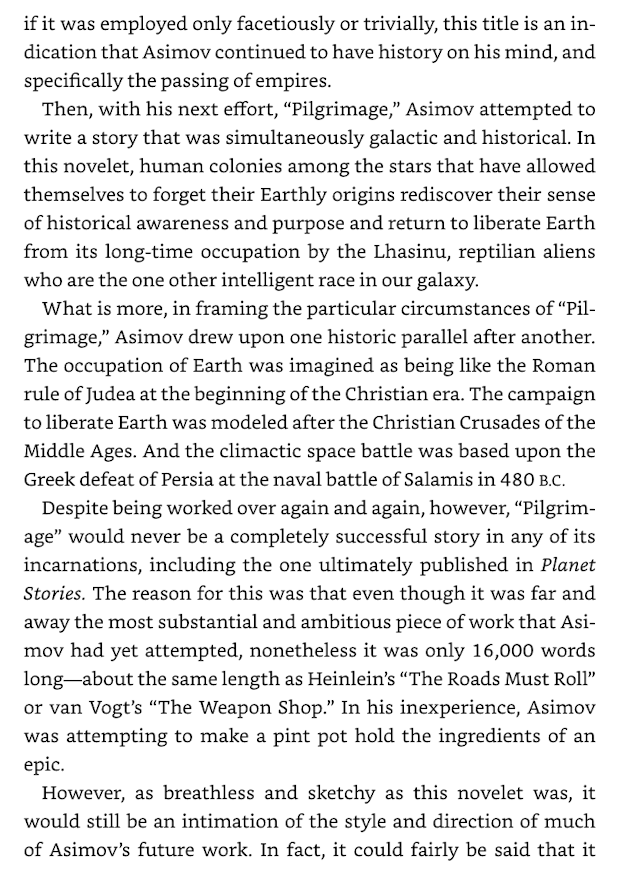
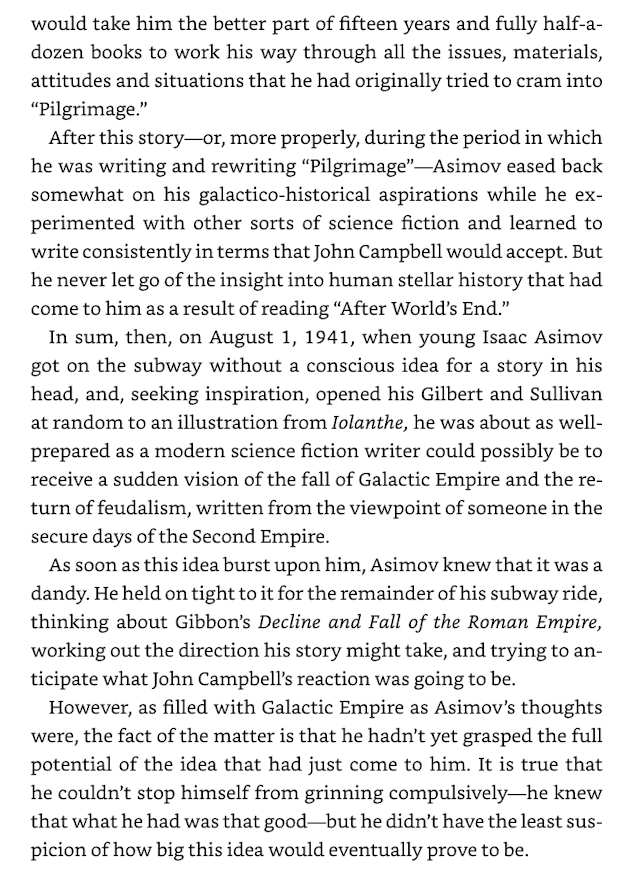
“Chapter 17 – An Empire of Mind” covers how Asimov developed the Foundation series on pages 520-566. If I had read this chapter before rereading “Foundation,” I would have approached the story with far more enthusiasm. Alexei and Cory Panshin describe Asimov’s inspiration and writing process for starting the series. I have read The World Beyond the Hill twice, but I didn’t remember any of this. I especially didn’t remember how Asimov was influenced by “After World’s End,” a short novel by Jack Williamson, which he read in the February 1939 issue of Marvel Science Stories. It also influenced Asimov’s take on robots.
The Panshins got most of details about Asimov working with John W. Campbell from Aismov’s biography, In Memory Yet Green. That book can be checked out from Archive.org.
The Panshins cited “After World’s End” and others as proto-stars that would evolve into galactic empire science fiction.
I wish I could reprint the 46 pages from this book because it describes in great detail how Asimov got the idea for a galactic empire. The Panshins showed that Asimov had already started on the idea in earlier stories.
Panshins have this to say, despite the fact that we know E. E. “Doc” Smith, Edmond Hamilton, and John W. Campbell had been publishing stories about humans speeding around the galaxy since the 1920s.
I would love to copy more of the Panshin’s book, but I don’t know if that’s proper. I highly recommend The World Beyond the Hill to anyone interested in learning about the evolution of science fiction in the 1940s.
I haven’t read Gibbon’s six-volume history, but reading the Wikipedia entry, it’s considered lacking in accuracy, and scholars disagree with his thesis that Christianity is to blame for Rome’s decline. The Panshins explores how Asimov’s used religion in the series. They felt Asimov saw it as a positive tool, while Heinlein saw it as a manipulative tool in his stories at the time.
The Panshins go into great detail Asimov’s collaboration with Campbell and how the first two Foundation stories were written, edited and published. Both were finished and sold to Campbell before December 1945. The Panshins then go on to deeply analyze “Foundation” and “Bridle and Saddle.”
I admire this chapter immensely. This is the kind of writing about science fiction history that I’ve always fantasized of achieving myself. I can’t come close. This chapter does give one excellent account of the origins of the idea of galactic empire. However, is it correct? Is it the only one. Many explorers thought they found the source of the Nile only to be proved wrong.
While reading the five stories that make up Foundation, I didn’t find much serious speculation about how a galactic empire would collapse. All of Asimov’s speculations seem rather superficial to me. It’s such a wonderful idea that I’m always disappointed when the individual stories in the first volume don’t live up to the grand vision.
If I studied the series and analyzed it as deeply as the Panshins, I probably would see far more than I have. I know I’m not being fair to the series. I fear my dislike of Asimov’s prose keeps me from enjoying his ideas. The Panshins found many layers of ideas to explore that I missed. I’m sure a scholarly work the size of the trilogy could be written on the Foundation series.
I believe America is beginning its decline. Predicting the future is impossible. We can’t even foretell one year, much less a thousand. But let’s say you’re a science fiction writer and want to set a story one hundred years in our future. How would you set up your story to convey a big picture of how the United States will change? Having a series of short stories is one possible solution.
Each time I read Foundation, I’ve been disappointed that it has no continuing characters. Let me provide an example to make a point. My wife loves TV shows, but I also want to watch movies. Switching between the two formats, I must admit that TV shows, with continuing characters, are far more addictive than movies. Not having characters that last the entire book hurts Foundation. That’s why the miniseries changed the story so drastically.
In 1968, John Brunner published Stand on Zanzibar, envisioning the world of 2010. This was far less ambitious than Asimov. The Foundation series attempts to portray a thousand years of a galactic empire featuring twenty-five million inhabited worlds. I never felt the immensity of such a setting while reading Asimov’s classic. However, Brunner’s technique of combining a novel with continuing characters, interspersed with short stories about people around the world, with samples from newspapers, television shows, radio broadcasts, and journals, and the regular commentary of a shock jock, does give us a complex picture of 2010.
For me, and I mean just me, because I know this series is so beloved, Asimov promised us a trip to Mars but took us on a suborbital flight. The original trilogy never delivers what it promises.
“Foundation” – Astounding (May 1942)
“Foundation,” the story that readers first learned about the Foundation series, didn’t get the cover. Evidently, John W. Campbell, Jr. wasn’t impressed enough. Readers preferred Heinlein, van Vogt, and Bester over Asimov’s story in the July readers’ poll. Not an auspicious beginning. Yet, the series is still admired today, and is even the basis of a television miniseries. And I believe the Foundation stories must have influenced the creation of Star Wars.
For some reason many people love the idea of the galaxy populated by humans. I see that as a growing artificial reality that will continue to build. Whether we make it reality is a whole other issue. I tend to doubt it. I think a future reality with humanity spread across the galaxy is no more real than the past artificial realities of the history of religions.
Note:
Normally, I try to keep my blog posts to 500-1,000 words. Even that is uncommonly long for most blog posts. That’s because internet readers don’t like to spend a lot of time reading any one piece. The internet is a browsing medium.
This piece kept going and going. I finally just had to quit. I feel I could write an entire book just on searching for the origins of specific science fiction concepts. I could have also written a whole book just on the Foundation Trilogy.
I’m old and I have trouble focusing my mind. I also lack the energy to keep working at any one task for long. I’d love to be able to write a book like The World Beyond the Hill but that is impossible at 73. More than likely, I never had the brain power to write such a book at any age. I need to learn how to convey a major insight in a few words.
My library constantly discards science fiction from its holdings. I know that because I see those books in the Friends of the Library book sale stamped DISCARD. Often, they are books I would consider SF blasts from the past. Evidently, if they aren’t checked out for a certain period, they get discarded. I used to believe libraries were supposed to preserve the past, but I don’t think that’s true anymore.
But that’s not my only clue that science fiction has a shelf life. At the used bookstore I visit every week I see the same old books week after week – no one is buying them. It’s the newer books that come and go so quickly.
For years now, I’ve been watching people review science fiction books on YouTube. I can sense that many authors and their books are falling out favor over time. A major example is Robert A. Heinlein. When I was growing up, he was considered the #1 science fiction author. He was my favorite SF writer. I still love his books published before 1960, but the ones after that haven’t aged well with me. Reviewers generally pan Heinlein nowadays. I often see critical comments about Heinlein on Facebook. He’s just not popular anymore. I see many of his books at the used bookstore, but only a couple at the new bookstore.
Whitney at the YouTube channel Secret Sauce of Storycraft has been reviewing old Hugo winning novels by decades. She didn’t like over half of the winners. Five of the ten (The Wanderer, Stranger in a Strange Land, The Moon is a Harsh Mistress, This Immortal, and Lord of Light) have stopped working for me too.
If I gave the Hugo Award now for the 1960s, my list would be:
1960 – STARSHIP TROOPERS by Robert A. Heinlein
1961 – ROGUE MOON by Algis Budrys ( for A CANTICLE FOR LEIBOWITZ)
1962 – STRANGER IN A STRANGE LAND by Robert A. Heinlein
1963 – THE MAN IN THE HIGH CASTLE by Philip K. Dick
1964 – THE MAN WHO FELL TO EARTH by Walter Tevis (for WAY STATION)
1965 – THE MARTIAN TIME-SLIP by Philip K. Dick (for THE WANDERER)
1966 – DUNE by Frank Herbert
1967 – FLOWERS FOR ALGERNON by Daniel Keyes (THE MOON IS A HARSH MISTRESS)
1968 – no award
1969 – STAND ON ZANZIBAR by John Brunner
I thought there would be hundreds of science fiction books that would be Hugo worthy from the 1960s, but there weren’t. I used CSFquery.com and ISFDB.org to look at each year 1960-1969 and there just was’t that many older books that’s being read today that people still admire.
I love A Canticle for Leibowitz still, but it’s a fixup novel, and I mostly love it for the first story. And reviewers aren’t as wowed as they used to be for it. I kept Stranger on the list even though I no longer like it, because it’s so ambitious for the times, and historically, it is the standout novel of the year. I love Way Station, but I don’t think people still read it much. The Man Who Fell to Earth has grown in popularity since 1963. The Martian Time-Slip is way better than The Wanderer, and people still read it. I definitely think Flowers for Algernon has aged better than Mistress. I’d give No Award over Lord of Light, or any other novel I remember from 1967.
All the books on my list are in print, and all are available as audiobooks. That’s a good indicator that they are still being read.
I was shocked by how few science fiction books from the 1960s I still admire. Twelve years ago I wrote a series about the best SF books from each decade. Looking at my essay for the 1960s shows damn few books that people still read.
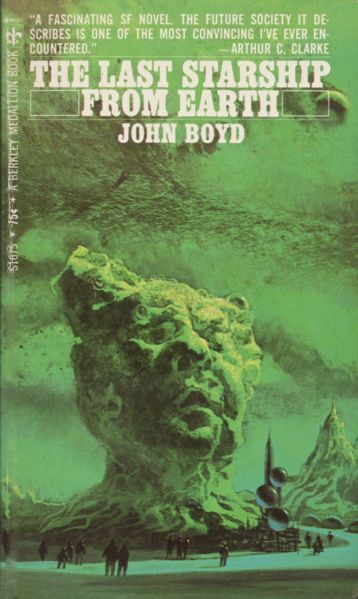
I remember back in the 1960s when old guys would gush about E. E. “Doc” Smith books from the 1920s and 1930s. I tried them, and they were horrible. I guess today’s young readers would feel the same about most of the books I loved back in the 1960s. Is anyone still reading Keith Laumer, John Boyd, Mack Reynolds, A. Bertram Chandler, etc.
What are the best science fiction books from the 1960s that you still read and think young people should try?
You might like to read An Information History of the Hugo Awards by Jo Walton. This was first published at Tor.com and many of the comments from readers are included.
“The Million Year Picnic” by Ray Bradbury is about as famous to science fiction readers as O’Henry’s “The Gift of the Magi” is to English majors. “The Million Year Picnic” was first published in the Summer 1946 issue of Planet Stories. (Read it online here.)
However, most readers know “The Million Year Picnic” as “October 2026: The Million-Year Picnic” from The Martian Chronicles. Most modern readers think The Martian Chronicles is so out of date scientifically that they don’t consider it science fiction but fantasy. But it is science fiction, and “The Million Year Picnic” is a classic, touching on several iconic themes of the genre.
“The Million Year Picnic” was published just one year after Hiroshima, making it one of the earliest stories about humanity destroying the Earth with atomic weapons. But we don’t know that right away. When we begin reading the story, Bradbury voices his story with a quaint tone, almost like a parable, sounding like Mr. Rogers’ Neighborhood. A father, mother, and their three sons have just landed on Mars. They decide to go fishing. The narrative pacing seems only a few steps up from “See Dick run.”
Back in the 1940s, throughout the 1950s, and even into the 1960s, it was popularly considered that there was life on Mars or had once been, even intelligent life. This is partly due to H. G. Wells and Giovanni Schiaparelli, an Italian astronomer who convinced the world that he saw canals on Mars. Until July 1965 when Mariner 4 showed us a couple dozen grainy pictures of Mars that looked like the Moon, we had so much hope for Mars.
Science fiction writers loved to imagine Mars occupied with all kinds of beings and ancient civilizations. The common belief was Mars was a cold dying cold world and Venus was a hot young jungle world. Ray Bradbury wrote many stories based on these assumptions. In 1950 Bradbury published a collection of his stories about Mars as The Martian Chronicles, a “fix-up” novel. (In 2009, Subterranean Press published The Martian Chronicles: The Complete Edition, which claimed to collect all of Bradbury’s stories about Mars. I’d love to have a copy, but the cheapest copy I can find online is $1,300.) Because “The Million Year Picnic” was so popular it had already been reprinted three times before The Martian Chronicles. And it has been extensively reprinted ever since.
Bradbury also reprinted “The Million Year Picnic” in his collection: S is for Space. Most of Bradbury’s science fiction was found in four collections when I was growing up: The Martian Chronicles, The Illustrated Man, S is for Space, and R is for Rocket. Bradbury quit writing science fiction for the most part in the 1950s and went on to write fantasy, horror, and mainstream fiction after that. I read “The Million Year Picnic” this week because the Facebook group Best Science Fiction and Fantasy Short Fiction is reading 12 science fiction stories by Ray Bradbury that they haven’t read before. Here’s the discussion schedule.
But back to the story. After the family sets out on a boat on a Martian canal to go fishing we slowly learn that “The Million Year Picnic” is a post-apocalyptic tale. But we don’t discover it right away. The three boys are all excited. Timothy, the oldest carefully watches his father, trying to learn what’s happening. As they travel down the canal they pass by countless old cities where Martians once lived. Some cities are just mounds, while others have grand skylines. The dad promises his boys he will show them the Martians, and they get excited.
Along the way, we discover “The Million Year Picnic” follows another hoary old science fiction theme, the retelling of Adam and Eve. This idea had become so overused that by the 1960s writer’s guidelines for magazines would state “no Adam and Eve stories.”
I don’t know how many times I’ve read “The Million Year Picnic.” But back in the early 1960s when I first discovered it, I still believed in Martians on Mars. I was so into Mars, that as a kid, I thought my goal in life was to get there. So when I read the story I focused on the dead Martian civilization. That’s what made the story exciting. I too wanted to see the Martians. And that’s how I always remember this story, especially the surprise ending, which was quite clever.
However, on this rereading, I realized that I had forgotten Bradbury’s serious point. Bradbury was a nostalgic writer, even as a young man. He grew up in the 1920s and 1930s and his stories often have the feel of that era, like watching old black and white Frank Capra movies. Many of his Martian stories transplant small midwestern downs to Mars. But Bradbury wrote “The Million Year Picnic” with an undercurrent of horror and even cynicism. The quaint family on Mars has fled an Earth where humanity has destroyed itself in a nuclear war.
When the Dad realizes the radio signals from Earth have gone silent he tells his boys that one day their grandchildren might hear radio signals again. When I read that I thought about Adam and Eve and their sons and how Biblical skeptics always asked “Where did the wives of Adam and Eve’s sons come from?”
I’m always amused and fascinated by what I remember and don’t remember from stories when I reread them. The gimmick ending of “The Million Year Picnic” overshadows all my memories. I had completely forgotten this was a post-apocalyptic story. In other words, I remembered the positive and forgot the negative. I also forgot how many Biblical allusions where were in the story.
Bradbury solves the wives’ problem. In the end, we learn that another family had also secretly prepared to go to Mars when armageddon began, this one had four daughters.
Now that number is interesting. Bradbury even tells us it will be a problem. I think he’s hinting at the old Cain and Abel conflict. Humans don’t change and even if we start over we’ll have violence and wars again. We know two if not three of the sons will want that extra wife.
The problem is I always go on to read other science fiction. Rereading “The Million Year Picnic” makes me want to delve into Bradbury once again, and read or reread all these books I’ve collected. Even though I’m retired and have all my time free, I can’t seem to find the time to pursue this project. I’m hoping the Facebook group reading of Bradbury will get me going.
If you’re a fan of listening to short stories, I recommend two giant collections of Ray Bradbury on audio that repackages four of Bradbury’s early collections. #1-32 is The Golden Apples of the Sun and Other Stories (1997), and #33-63 is A Medicine for Melancholy and Other Stories (1998). I wish Bradbury Stories: 100 of His Most Celebrated Stories (2003) were on audio, but it is not. (Table courtesy of Piet Nel.)
The YouTube channel SciFiScavenger recently conducted a poll of their viewers’ favorite science fiction novels. Viewers were asked to submit their Top 10 SF novels in order. SciFiScavenger received around two hundred submissions. They assigned point values, with ten points for #1, nine points for #2 down to one point for #10 to determine the final ranking of the Top 75 books. Watch the video to see the results and hear comments on each book.
I thought this was a good survey and added it as a citation list to the Classics of Science Fiction database. We like to regularly add new polls, lists, and awards to the database because our two lists are generated on the fly listing the most popular novels and short stories. Keeping up with the times reflects the changes in readers’ tastes. Each list, poll, award, scholarly recommendation, etc. is considered a citation. To get on the Classics of Science Fiction v. 5 requires receiving at least 12 citations. Currently, the book with the most citations is The Left Hand of Darkness by Ursula K. Le Guin with 53 citations. As of today, we have 138 books with 12 or more citations.
SciFiScavenger’s results overlap well with our list. Of the 75 books ranked, 56 were already on our list. One title, Parable of the Sowers was pushed onto the list because of this poll. The novel only had 11 citations before the poll, so with SciFiScavenger’s citation, it now had the minimum 12 to be on v. 5 of the list.
We do have one ongoing problem with our system. Some famous series books get on lists by the name of the series, and sometimes by the name of individual titles. For example, Foundation by Isaac Asimov was voted onto SciFiScavenger’s list. We put the vote with The Foundation Trilogy since most people think of the trilogy as one work, and its sometimes even published in one volume. We put The Shadow of the Torturer with The Book of the New Sun.
By continually adding more citation lists we reveal the most popular books over time. We don’t think of our system as recognizing the absolute best books but recognizing the most remembered books and short stories. You can read about the history of the project here. If v. 5 of the list gets too long, we’ll up the minimum citations. This way books that are being forgotten over time drop off. We like to keep the list in the 100-150 range. For v. 6 we’ll probably make the cutoff 14 citations. If you look at the v. 5 list, you’ll see books with 12 and 13 citations will get knock off unless they get additional citations. If you click on the citation number in the v. 5 list, you will see which citations put it on the list.
Here is a list of all our current book citations. If you scroll down to the bottom, you will see SciFiScavenger’s 2024 Poll. Click here to see it. You will see the 75 books on the survey. Each book in bold is on our v. 5 list. Because there is so much overlap, it suggests that SciFiScavenger’s survey correlates well with the aggragation of all the other citation lists.
You can use our List Builder feature to set your own requirements.
Bookpilled recently posted on YouTube “Ranking All the Books from Every Top 15 Sci-Fi List” where he reevaluated several years of his All-Time Top 15 SF Books videos. Interestingly, books that had been near the top on earlier lists were thrown off by books from later lists. He also reread some of his favorites, which didn’t hold up. In other words, he discovered better books and found that his first impressions didn’t always hold up. This has been my experience too.
People list their favorite books they discovered early in life. Few people reread books. Quite often, the books you read early in life, make a greater impact, than the books you read later in life.
There is no absolute way to measure the quality of a book. Our Classics of Science Fiction list, we use popularity over many lists to rank books. But the top books on the Classics lists aren’t my all-time favorite SF books.
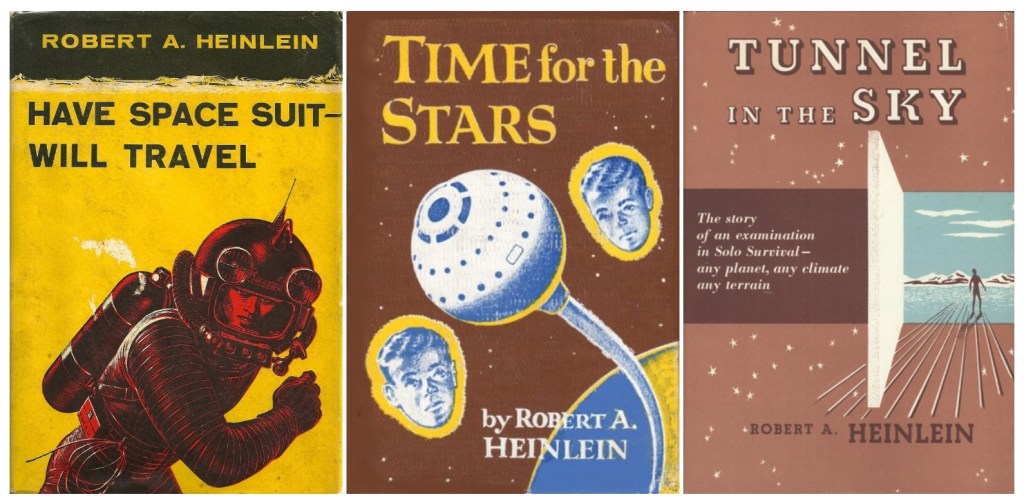
SciFiScavenger, another YouTuber, is currently collecting votes for favorite SF novels. He asks everyone to list their top ten and will create a list and video of the most popular. You can post your top ten to his poll here. Here’s my Top 10.
Have Space Suit-Will Travel by Robert A. Heinlein
Time for the Stars by Robert A. Heinlein
Tunnel in the Sky by Robert A. Heinlein
Flowers for Algernon by Daniel Keyes
Earth Abides by George R. Stewart
The Time Machine by H. G. Wells
The War of the Worlds by H. G. Wells
A Mirror for Observers by Edgar Pangborn
The Man Who Fell to Earth by Walter Tevis
Replay by Ken Grimwood
I’ve read eight of these books at least twice, most three times, and the top three I’ve read more than six times each. I’ve only read the Pangborn and Tevis once each, but they’ve left an impression. If I had spent more time on the list I might have substituted different books for those two. Hyperion comes to mind. I read it three times, and it had a tremendous first impact. However, the older me felt A Mirror for Observers and The Man Who Fell to Earth were deeper books for me at this time in my life.
I also felt The Time Machine and The War of the Worlds are the two most original science fiction books ever written, and should be on a Top Ten list. I really do like them too. I’ve read each several times. I wanted to include a Philip K. Dick novel because he’s my second favorite science fiction author after Heinlein, but I just couldn’t settle on one book – PKD has written too many good SF books to pick a favorite.
I could have made the entire list of ten by Heinlein. And could have made the whole list of ten by Dick. Heinlein made a life-long impact on me during my formative years from 13-18 (1964-1969). I developed problems with Heinlein as I got older, but I still regularly reread his books published before 1960. They are sentimental favorites, my go-to feel-good books. PKD is who I read when I’m feeling weird or I don’t feel like reading anything else. His books are endlessly fascinating, but I’m uncertain if they’re important to me on a psychological level.
I love Replay. I consider time loop stories to be science fiction. I chose it over a PKD because its philosophical explorations resonate with me more than Dick’s philosophical explorations.
I read #1-7 before 1970, when I was an adolescent. All except A Mirror for Observers is on audio, a format that has more impact on me. I wish Audible would publish more Pangborn. They only have his obscure mystery novel, The Trial of Callista Blake. I wished they would publish A Mirror for Observers, Davy, and a collection of his shorter work.
Notice, no books by Asimov and Clarke on my list, even though I’ve read many of their books and enjoyed them. Notice, Dune is not on the list even though I’ve read it twice and plan to read it for a third time soon. Dune is a better work of art than most of the books on my list. Its science-fictional content just doesn’t resonate well with me. I see it as more of an epic fantasy.
What are your favorite SF books? How have they changed over your lifetime? Have newer books supplanted your older favorites? I’ve read a lot of 21st-century science fiction, much of which I admired, but those books just haven’t stuck in my mind as all-time favorites. Is it because new SF is different from old SF, or is it because the books we read when young just stick with us?
I saw another YouTube video that I want to reference here. Rick Beato talks about how most artistic people do their best work before they turn 30. He uses The Beatles as an example. The Fab Four made all their records together while in their twenties. And all their solo efforts after their twenties.
I wonder if the art we admire most is that we encounter before turning 30, or even 20. Is there a relationship between being creative and admiring creativity? A lot of people give up actively listening to music as they get older, and many of the people who still listen to music as they get older, only listen to music they discovered before they were 30. Is that true with books too?
I’ve become overly critical of science fiction lately, and that worries me. Too much of what I read feels childish, simplistic, and obvious. I mentioned this to my friend Mike, and he pointed out that most of science fiction isn’t particularly good, and that’s true of all forms of literature, not just science fiction. That reminded me of Sturgeon’s Law — “ninety percent of everything is crap.”
I started thinking about that. When you’re a kid, the first ten science fiction books you read are all fantastic. But as you get older, you start encountering books that aren’t as exciting. As we age, we become more discerning, and eventually jaded. That’s my problem, I’m old, jaded, and have read too much science fiction. Every new story I read must live up to all the best science fiction stories I’ve ever read.
I think we need to amend Sturgeon’s Law. It needs a sliding scale. When you’re young, 10% is crap. In middle age, it might be 50%. However old Sturgeon was when he made his law, it was 90%. But at 72, I feel it’s 99%. And that’s depressing me.
Mike also gave me the solution. He said he and his wife are rewatching their favorite movies because many films they were trying were disappointing.
Because I’m in a short story reading group on Facebook, I’ve read about fifteen hundred stories in the last four years. I’ve just ODed on SF. Obviously, I need to cut way back on my sci-fi reading, explore other kinds of reading, and when I do read science fiction, read, or reread, the classics. Focus on what’s good and stop trying to read everything in the genre.
The reality is I’m getting old and don’t have that much reading time left, so why not concentrate on the best? I also need to explore new reading territory. I’m currently reading Volume 11 of The Story of Civilization by Will and Ariel Durant. I started with the last volume simply because it was on sale at Audible. I know practically nothing about European history, so it’s extremely fascinating. I’m supplementing the book with The Great Courses lecture series: Living the French Revolution and the Age of Napoleon, taught be Suzanne M. Desan, Ph.D. Professor, University of Wisconsin, Madison. I access The Great Courses Plus through Amazon Prime for $7.99 a month.
What I’m learning is blowing my mind, kind of how I felt when I first discovered science fiction. The I-should-have-had-a-V8-slap-to-the-head takeaway here is “It’s new ideas stupid.”
And that’s my real problem with being old and having read too much science fiction. I seldom find something new in the genre anymore. I need to give it a rest. I can’t give it up completely, so I’m going to concentrate on studying the classics. Go deep instead of chasing novelty.
This will have a positive side effect. I need to thin out my book collection. That’s another thing about getting old. A lifetime accumulation of junk starts to become a burden. I’ll keep the classics and jettison the rest. This reminds me of Destination Moon, an old science fiction film from the early 1950s. A crew on the first rocket ship to the Moon uses up too much fuel on landing and can’t take off again. The solution is to jettison everything they can, including space suits, and even the radio to reduce their mass to match the fuel that is left. That’s a great metaphor for getting old. It gets harder and harder to take off. The solution is to lighten the load.
Alex’s podcast has a lot of great interviews with people who love science fiction, and he’s going to interview Robert Silverberg next, one I’m anxious to hear.
However, I thought I would mention something else I learned while answering questions for a podcast. I don’t think I’ve ever been able to easily explain, verbally or in print, how we produce the list. I believe it’s because I don’t have the right term to describe our list-building method. One may exist, but I just don’t know it.
Our system collects any reasonably authoritative list that remembers science fiction books and creates a resultant list by selecting the books which were on the most lists. Is that a frequency distribution? A meta-list? A tabulation list? An accumulation list? I don’t know. If you know, leave a comment.
I wish this system of compiling a list had a name that people knew and understood. No matter how often I explain our system I get people accusing me of personally picking the books for the list, especially when their most cherished read isn’t on the list.
Two wonderful examples of this system of list making are The Greatest Books of All Time that currently builds from 305 lists, and the Ultimate Reading Lists by Literary Hub, especially their end of the year list. For 2023 Emily Temple used sixty-two lists from forty-eight publications, resulting in a final list of ninety-four books that had been on at least five of the sixty-two lists. For example, The Heaven & Earth Grocery Story by James McBride had been on twenty best-of-the-year lists in 2023. I read that novel because of that recognition.
My assumption is, “Why read any book when you can read a great book.”
When I began this blog years ago, I theorized that there were three ways to identify all the best science fiction short stories. The first was to read all the science fiction magazines and decide for yourself. The second was to read all the annual best-of-the-year volumes and see if you agreed with those editors. And finally, I suggested just reading a handful of retrospective anthologies that collect the best science fiction of all time. It was all about how much you wanted to read. There are thousands of magazines, between a hundred and two hundred annual volumes, or you could get by with maybe just a handful of retrospective volumes.
After collecting over a thousand issues of old science fiction magazines, most of the annuals and most of the major retrospective anthologies, and reading thousands of stories, I think I can answer the title question.
Just read the retrospective anthologies. But there’s a problem. They still haven’t done the best job of identifying the best stories, and they are mostly out of print.
I’ve loved science fiction magazines my whole life, but the sad truth is they seldom contain classic level stories, and you’re damn lucky if you find one story you love. Usually, you’ll find a couple stories you like, and the rest will be so-so or DNFs. For me, I generally find four or five standout stories in an annual anthology, and the rest are okay. If I’m lucky, there will be one or two great SF stories in a year. Even with the best retrospective anthologies, it’s hard to like every story, but if you find the right editor, maybe half the stories they pick will be your favorites too.
The Classics of Science Fiction Short Stories v. 2 list at CSFquery has been the most effective overall at identifying the most remembered science fiction short stories, 110 stories in all. I’ve had the best luck with this list compared to any other method.
However, v. 2 leaves off a lot of my favorite stories. Using the List Builder function and setting the minimum citations to six creates a list of 220 stories. Many of those extra 110 stories do identify stories I love, but also identify more stories I don’t like. But if we use List Builder to set the cutoff to ten citations, it produces a list of 50 stories. Anyone who reads those fifty stories should have a solid feel for the history of the SF short story. If you click on “Show Citations” you’ll see which anthologies collected those stories.
Szymon Szott wrote a computer program to analyze all the retrospective anthologies we used to create CSFquery to find the minimum number of books to buy to read the most stories from v. 2 of the list. See “The Science Fiction Anthology Problem – Solved” which identifies twenty-two anthologies needed to read all the stories on the original list. The list has been updated with additional stories, so it’s no longer perfect.
The trouble is most of these retrospective anthologies are now out of print. Mark R. Kelly has a wonderful history of science fiction anthologies that’s worth studying. I’ve collected most of them. They aren’t hard to find used, nor are they particularly expensive. The problem is finding just three to five that have most of the stories from v. 2 of the list.
And there’s another problem. Science fiction stories don’t always age well, even the classics. So many of these anthologies will have stories that modern readers will find clunky. For example, Sense of Wonder edited by Leigh Ronald Grossman has thirty-six of the stories on the v. 2 list, the most of any anthology, but it has over a hundred more stories that may not have aged well. (Definitely don’t get the physical book, it’s too heavy to hold and has extremely tiny unreadable print.) The Kindle edition is $29, and that might be too expensive for most people.
You can look at the list of citations we used to create the Classics of Science Fiction Short Stories v. 2 list, and it gives the number of stories that make the final list for each citation. As you will see, anthologists don’t have a great hit rate. We correlate the best with fan polls like SF Lists (98 stories) or Locus 2012 All Century (88 stories). The Hugo award process identified 80 stories on our list, and the Nebula process identified 59.
All this suggests that retrospective anthologies aren’t the best way to survey the classic short stories of the science fiction genre. I wish we could publish an anthology of the top 50 stories from our list, but I have no idea how to go about doing that.
Luckily, many of the stories on the v. 2 list are also available for free online. It takes work to find them, and the online versions aren’t always easy to read. If you really want to find these stories, use our list, and click on the titles. That will take you to the story’s ISFDB listing, which will show all the places the story has been reprinted. With some effort you should be able to track down all the stories.






 Classics of Science Fiction