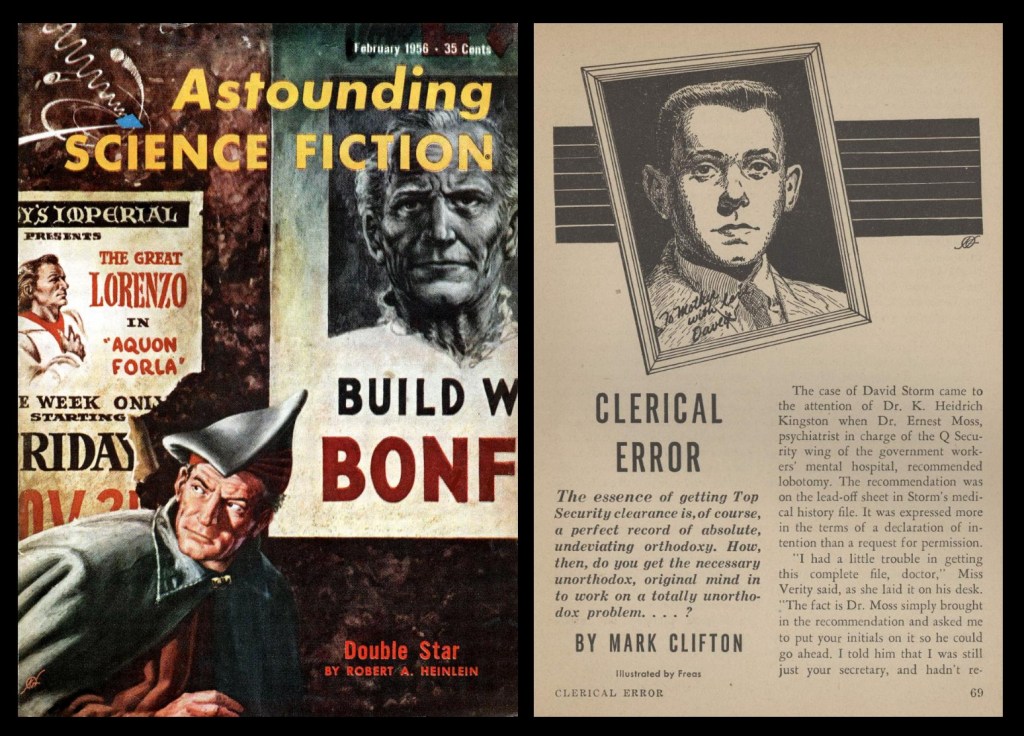
“The Dead Past” was first published in Astounding Science Fiction, April 1956. You can read it on Archive.org. It is story #11 of 22 for The Best SF Stories of 1956 group read. Even though this is one of Isaac Asimov’s better stories, it was not up for the Hugo award, nor was it selected for a best-of-the-year anthology. Of course, it was competing with “The Last Question” which many, including Asimov, considered one of his absolute best stories.
This is the fourth time I’ve read “The Dead Past,” the second time the group has discussed this story in 2023, and I previously reviewed it here. I like what I said in my previous review, so I’ll let it stand. For this essay, I want to talk about multiple readings of a story and reading reactions from different people. If you read a story only once, you’ll have only one perception of it. Reading a story again often produces a different perception. And reading what other people think of a story often produces perspectives different from our own experiences.
For example, my friend Mike is reading these stories along with the group, and here’s his reaction:
In "The Dead Past," Asimov presents the idea of chronoscopy or "time viewing." It's a method of viewing past events. In most stories, chronoscopy is simply a deus ex machina that allows the story's plot to unwind, but Asimov confounds our expectations by making chronoscopy the main "character" in the story.

Arnold Potterly wants to use chronoscopy to view ancient Carthage.

Potterly's wife, Caroline, wants to use it to view her deceased daughter, pleading that "I want my child."

For Jonas Foster, the development of the chronoscope becomes "...a matter of important principle."

Thaddeus Araman is distraught because if the chronoscope becomes widely available then "There will be no such thing as privacy."

Asimov whipsaws us through conflicting emotions about the chronoscope. Would it be good to allow Potterly to peer into the everyday events of Carthage? Would allowing Caroline to view her long dead daughter bring her happiness or detach her from reality and result in madness? What about government control of chronoscopy? Araman laments the death of privacy, ignoring the fact that the government already uses chronoscopy to spy. Isn't privacy already dead?

Chronoscopy takes center stage and Asimov skillfully allows us to view its many facets. We are left to decipher our own feelings about how it should be used.

Araman's final words are stark and signal the impending dystopian future: "You have created a new world among the three of you, I congratulate you. Happy goldfish bowl to you, to me, to everyone, may each of you fry in hell forever. Arrest rescinded."
Even after reading the story four times myself, I feel Mike saw “The Dead Past” in ways I didn’t. Mike sums up the story nicely, somewhat like I did in my previous review, but leaving me feeling he liked the story more than I did and saw it with a different spin. But what’s interesting when I started rereading the story this time, was how I noticed things that weren’t in my last review, or memory, or in Mike’s comments, or in the comments on the Facebook group.
Even short stories are full of hundreds of details, details smaller than the plot. We might think of them as brushstrokes that paint the story. With each sentence Asimov gave us, we get something to think about, and each impression could take our vision of what’s going on in the story in a different direction. Just look at the first paragraph:
Arnold Potterley, Ph.D. was a Professor of Ancient History. That in itself, was not dangerous. What changed the world beyond all dreams was the fact that he looked like a Professor of Ancient History.
Knowing the rest of the story makes me wonder why did Asimov started the story this way? The word “looked” is italicized for emphasis. Even though I’ve read this story three times before I cannot recall anything in the plot that significantly deals with Potterley’s appearance. And the next paragraph is even more enigmatic.
Thaddeus Araman, Department Head of the Division of Chronoscopy, might have taken proper action if Dr. Potterley had been owner of a large, square chin, flashing eyes, aquiline nose and broad shoulders.
WTF! Did I miss something entirely in my first three readings? What is Asimov doing here? Is he just throwing out Araman’s prejudices to color the story’s opening? Did Asimov feel he personally wasn’t taken seriously because of his own looks, and just added this in as a story insight?
The story drops appearance and switches to the topic of chronoscopy and Carthage. In my previous readings I wondered about Carthage, and why Asimov was using it in this story. Asimov wrote many books on history, so I wondered if it was a pet topic of his. During previous reading I meant to research Carthage to see if what Asimov said about Carthage was true. Did it need defending and promoting?
The story then goes into Potterley’s academic frustration of being ignored and his desperation to use the time viewer. Now and in previous readings I wondered if in 1956 if Asimov had had similar academic tiffs with his superiors? Why is so much of the plot dealing with academic rejection? I especially ask this because I know the ending of the story takes us in a completely different direction to where the story had been taking us all along. In the end, we learn that the chronoscope (time viewer) can’t go back further than a century, so there was never a chance of seeing Carthage. And we learn there’s a reason the government keeps people from using the time viewer, and it abruptly changes the tone of the story.
I’ve often heard that there are two types of writers: pantsers and plotters. Pantsers are writers who sit down and start writing whatever comes to them through inspiration. They have no idea where the story is going but feel that their muse will guide them. Plotters are writers who carefully outline their stories ahead of time and know where they are going when they sit down to write each day. They believe everything must be consciously decided, structured, and interrelated.
I get the feeling Asimov was a pantser when writing “The Dead Past,” and with my every rereading of the story only confirms that impression.
If you only read a story once, you consume it like a pantser reader. But if you read it multiple times, you consume it like a plotter reader.
I assume Asimov’s original inspiration was an idea about a professor wanting to see the past with a time viewer. Asimov quickly decided Potterley wouldn’t get to see Carthage because he would have to turn the story into historical fiction and evidently Asimov didn’t want to go in that direction. He shifted the focus to frustration over not getting the funding to do research. Had that been happening to Asimov? I think Asimov saw this focus wouldn’t get him far, so he created the subplot of getting of the accomplice to add intrigue to the story. But even then, the story didn’t have much, so Asimov added the subplot with the wife. At some point he realized the story needed an ending and an insight and decided that examining the past was a bad idea after all. He then abruptly tied up the plots and subplots.
Even though Rich Horton picked this story as one of his all-time favorites, and “The Dead Past” got voted in on a Locus Poll of all-time favorite short stories, I’m not sure if “The Dead Past” is a good story. It was only in Volume Two of Asimov’s The Complete Stories, and not in any of Asimov’s other best of collections. I assume even Asimov later recognized it was clunky.
Multiple readings have revealed more problems with writing this short story. If Asimov knew when he started writing that time viewing was limited to the past one hundred years, would he have ever written about a professor wanting to view Carthage? My guess is Asimov added the subplot of the wife’s desire to see how her child died when he realized that the final insight showed time viewing dangerous to society because of privacy. I don’t know if he knew this on day one of writing, or several days later. Asimov was known to be a furiously fast writer. He was also famous for publishing hundreds of books. I doubt he spent a lot of time rewriting. I believe Asimov just doctored the story with the wife’s subplot.
If the time viewer had limitations and the government didn’t want to use it because it would cause privacy nightmares, there’s no reason this wouldn’t be made public knowledge. I can understand the government keeping a time viewer secret. But if the public knew time viewers existed, I don’t think there would be any need to keep its limits secret, or the fact that its invasion of privacy could shatter society.
Rereading the story reveals that Asimov liked to throw in interesting tidbits along the way. I won’t chronicle any more examples other than those I’ve given, but if you read the story again, look out for them. I’m fairly sure Asimov was a pantser, and things would come to him, and he’d throw little impressions and insights into his stories as he wrote them even if they don’t work consistently with the whole story. “The Dead Past” is like a snowball rolling downhill gathering more snow and other objects, and then it splatters apart when it hits a boulder. With one reading, following along with Asimov’s inspiration kind of works. But multiple readings make me see that “The Dead Past” was thrown together.
JWH











 Classics of Science Fiction