“Time Waits for Winthrop” by William Tenn

Group Read 72: The Best Science Fiction Stories of 1957

“Time Waits for Winthrop” by William Tenn #16 of 20 (Read)

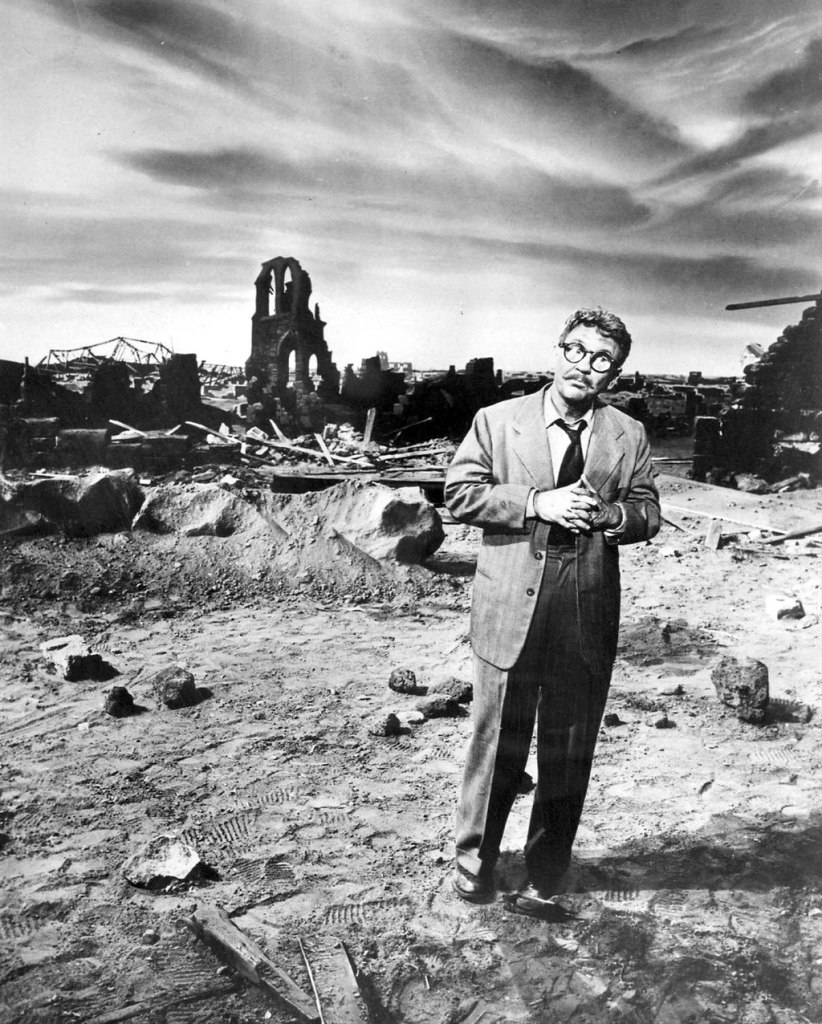
Virgil Finlay usually created drawings and paintings that featured beautiful or fantastic subjects, but the interior illustration for “Time Waits for Winthrop” is hideous to see. But then, the 25th-century future William Tenn describes is supposed to be hideous to people from the 20th century, and the title character’s personality is downright hideous too, so Finlay does an excellent job preparing us for the story.

“Time Waits for Winthrop” is a plodding piece of fiction that speculates about the future in ways that make it worth reading, but just barely. That same statement could be made about much of science fiction. It’s a shame that “Time Waits for Winthrop” wasn’t better told because it could have been a genre classic.

The setup for “Time Waits for Winthrop” involves five people from 1958 swapped with five people from 2458 for two weeks. Tenn’s science fictional hypothesis is the future will be so different to us that we’ll find it repulsive. Tenn then plots the story around a clock driven conflict. At the appointed hour of return, all five people from both groups must return to the time travel depo to make the exchange possible. The kicker is Winthrop who loves the 25th century and doesn’t want to return to the 20th century. And the 25th century has one cardinal rule, you can’t make anyone do anything they don’t want to.

This means Dave Pollock, Mrs. Brucks, Mary Ann Carthington, and Oliver T. Meed will be stuck in the future that unnerves them, and the time travelers from the future will be stranded in the past.

“Time Wait for Winthrop” is a rather long story, a novella, and the plot involves the four 20th century people who desparately want to go home each trying to convince Winthrop or someone else to make Winthrop want to return to the 20th century. This gives Willian Tenn a chance to describe the 25th century. Sure, it’s pure speculation from the vantage of 1957, but I thought Tenn imagined some neat possibilities.

The first time I read this story over fifty years ago, I was under twenty, and I didn’t tune into what Tenn was trying to do in his story. I thought “Time Waits for Winthrop” was a somewhat funny potboiler. For my 2024 reading, I saw the story in a completely different light. In my first reading “Time Waits for Winthrop” came across as lame Sheckley. In this reading, “Time Waits for Winthrop” came across as Heinlein trying to be funny.

Winthrop and Mrs. Brucks were the old folks of the five 20th century travelers, and the group of four who wanted to return picked Mrs. Brucks to visit Winthrop and appeal to his moral decency. The other three thought since she was about the same age as Winthrop he would understand her best. Mrs. Brucks was a grandmother of two, and mother of six, and kind and genteel. Everything Winthrop was not.

Winthrop is the only person from the past who embraces all the new ways. It’s a rather wild future where clothes and floors appear to be alive and inanimate objects respond to human needs. You’ll need to read the story to get all the gosh-wow details. Winthrop relishes the opportunities offered and takes advantage of them all. He feels his companions from the past are rigid and scared. After Mrs. Brucks polite pleas, he still refuses. Winthrop says he’s obviously better off as a person in the future than he was in the past. Mrs. Brucks fails in her mission.

Next, Mr. Oliver T. Mead then agrees to plead their case with Mr. Storku, The Chief of Protocol for the State Department. This is where the story took off for me. Mead must track down Storku, but he’s at Shriek Field. In the future, humans are very well adjusted but that’s because they regularly visit Shriek Field or Panic Stadium to experience psychological release and transcendence. This 2024 reading now reminds me of many of the New Age therapies from the 1970s. I didn’t know of their existence the first time I read this story around 1969. Were such techniques already emerging in the 1950s?

Mr. Meads experience at Shriek Field is so prophetic that I decided to reprint those pages. How did Tenn guess this in 1957?

Doesn’t that sound like Primal Scream therapy? I believe Tenn also anticipates therapies like Erhard Seminars Training (EST) and other similar New Age personal development programs. This section of the story goes on for several more pages, and I felt begins the real purpose of the story.

Mr. Mead gets nowhere too.

Next up, the group decides Mary Ann Carthington, a pretty young woman, should try to convince Edgar Rapp from the Temporal Embassy to help them make Winthrop go back. She ultimately locates Rapp, but he’s in a microscopic world battling tiny cellular creatures. This section allows Tenn to explain what individual freedom means in the future. It was here that I was sure I knew what the ending would be, but I was wrong. This is the most fantastic part of the story, because Edgar Rapp can shrink himself down to thirty-five microns. This section reminded me of “Surface Tension” by James Blish, and Fantastic Voyage by Isaac Asimov.

I’ve tried to read “Time Waits for Winthrop” one or two times between 1969 and 2024, and in each case, I thought the story was over long and dragged. I again thought that this reading, but I liked the story a whole lot more this time and was more forgiving. If that trend continues, one day I might actually love “Time Waits for Winthrop.”

The story is episodic. It’s a shame that it wasn’t fleshed out into a short novel and told with more realistic drama that tied the sections together better. Tenn is mainly known for writing short stories, but I absolutely loved his novel Of Men and Monsters, see my review, and heed my warning. Don’t read anything about the book or even the blurbs on the cover, because the book is so much more fun coming to it cold. But my point, that novel is also episodic, but it has a well-integrated plot with lots of drama.

All too often, science fiction writers hacked out their stories. Probably most are just tweaked first drafts. “Time Waits for Winthrop” feels like Tenn sat down one day and came out with the setup, then for four days in a row used four characters to describe a different aspect of an imagined future, then on the last day produced a quick solution to the plot. Now, I might be unfairly damning Tenn because I didn’t experience everything Tenn intended. There’s a whole lot to “Time Waits for Winthrop,” especially when you consider the last section.

Dave Pollock is a young guy who is a science teacher in the 20th century. The group gives him the unpleasant task of consulting the Oracle Machine about their problem. Pollock finds that distasteful because he feels it’s beneath his scientific mind to consult anything with the trappings of primitive religion. I’m guessing Tenn imagined the Oracle Machine as a kind of AI. Tenn even mentions chess in his story and predicts that machines will outplay humans in the future. He also predicts that humans will continue to enjoy playing chess and will even work together with machines to play. And this is what has happened, just sixty years into the future, not five hundred.

Again, the Dave Pollock section gives Tenn another platform to speculate about the future. And like the other three sections, speculation about the future also means commentary on the present. “Time Waits for Winthrop” is a wonderful contrivance for William Tenn to express himself on many topics. Each time he stops to philosophically tap dance, the plot freezes and the story’s momentum slows to a crawl. However, if readers enjoy the philosophical tap dancing, then they might forget the plot is about how to get back to the 20th century.

James Wallace Harris, 4/21/24

“Flight to Forever” by Poul Anderson

Rereading “Flight to Forever” made me realize something about the core of my personality. There are a limited number of science fictional ideas that I resonate with that I like to regularly recall.

I consider “The Time Machine” the epitome of science fiction because it explored so many new science fiction themes. New to me at age twelve, and maybe new to the world in 1895. Poul Anderson’s “Flight to Forever” recalls many of those same ideas. “Flight to Forever” was first published in Super Science Stories, the November 1950 issue. You can read it here, or listen here. I first read it in Year’s Best Science Fiction Novels: 1952 edited by Bleiler and Dikty. I just read it in The Last Man on Earth edited by Asimov, Greenberg, and Waugh. Here’s a listing of other reprintings.

“Flight to Forever” also reminds me of Last and First Men by Olaf Stapledon and Tau Zero, also by Poul Anderson. The writing style, pace, and plotting feels like science fiction from the 1930s. I’m trying to give you enough hints to get you to go read the story before I give spoilers. This cover might also entice you to go read it too, especially if you discovered science fiction before Star Trek.

While reading “Flight to Forever” I kept thinking how it contained several scenes that inspired the kind of sense of wonder I loved experiencing as an adolescent when I first started reading science fiction. I know as an adult that all those mind-blowing concepts are completely unrealistic, just complete bullshit fantasy, but I still love encountering them over and over. Why?

Am I a 72-year-old kid still being enchanted by fairy tales? I like to think of myself as finally growing up and accepting reality for what it is, but I keep retreating into science fiction. Why? Could a good psychiatrist explain the psychology to me? Is it a neurosis? I will admit that science fiction was a coping mechanism for a turbulent adolescence in the 1960s, and maybe it helps me escape the constant chaos in the news of 2020s. Still, that doesn’t explain the specific appeal of science fiction and the way this story triggers my endorphins.

The story begins with Martin Saunders and Sam McPherson setting off in a time machine to travel one hundred years into the future to see why their automatic test time machines haven’t returned. Martin assures his lovely girlfriend Eve Lang that he will return quickly.

Having one’s own time machine is a wonderful fantasy, especially if it’s one you built yourself in your home laboratory. That’s why “The Time Machine” was so appealing. As a kid, I wanted to be Danny Dunn and have access to wonderful time machines and spaceships. It’s why Back to the Future was so much fun in the 1980s even though I was an adult.

Martin and Sam arrive one hundred years into the future without a problem, but when they try to return to their own time, they discover it takes ever more energy to go back in time. They eventually calculate that the amount of energy needed approaches infinity around the seventy-year mark. Poul Anderson has imagined a natural way for time to protect itself from paradoxes. It’s a neat idea.

Martin and Sam decide to head further into the future to see if they can find a time when scientists might know how to break through the going back in time barrier. This is where the story parallels Wells’ unnamed time traveler, stopping now and then to see how society and mankind has changed. This portion of the story also reminds me of Stapledon’s Last and First Men and many science fiction stories about speculated societies.

Sam is soon killed off, so Martin becomes a lone time traveler hoping to find his way back to his beautiful Eve. He acquires another companion, Belgotai, a mercenary from the year 3000 AD. Together they keep going further and further into the future, meeting society after society. They encounter humans that colonize the galaxy, and aliens that conquer Earth. This gives Anderson a chance to dazzle the reader with all kinds of science fictional speculation.

Eventually, Martin and Belgotai join a deposed monarch fighting a renegade galactic empire. That’s when the story becomes an epic space opera. Martin falls for a regal redhead, Empress Taurey. You’d think Martin will settle here, but Anderson has many other adventures for Martin to experience before the story ends. Martin goes further into the future than the time traveler in Wells’ classic story. Like that story, “Flight to Forever” could be considered a dying Earth tale, and it becomes a last man on Earth story too.

I got the feeling Anderson wanted to include every science fictional cliche he could cram into “Flight to Forever.” I won’t tell you anymore. It’s not an exceptional story, but it is appealing. I must wonder if Anderson wasn’t trying to understand the underlying siren song of science fiction when he wrote this story. Of course, he sold it to a cheap market, so he could have been just hacking out a quick novella to thrill kids and pay his rent.

Reading “Flight to Forever” made me wonder if I could collect a small set of stories that pushed all my sense-of-wonder buttons and just reread them whenever I needed therapy. Sort of like what Kip’s father does in Have Space Suit-Will Travel by always rereading Three Men in a Boat by Jerome K. Jerome. I could create a highly distilled tincture of science fiction to consume when needed, sort of like the playlist of my all-time favorite songs on Spotify.

If I did create a playlist of favorite science fiction stories, would I include “Flight to Forever?” I guess not, because I would keep “The Time Machine” instead. That suggests something to me. Haven’t I been reading one science fiction story after another my whole life just to push the same buttons again? Shouldn’t I explore other stimuli to discover other buttons?

“Flight to Forever” is a nice reminder that certain concepts within my brain like to be remembered, at least every now and then. I’m finding a lot of them in the anthology, The Last Man on Earth. It’s amusing to think about, but I have six large bookcases of science fiction that I could probably reduce to a handful of anthologies that would trigger every type of sense of wonder science fiction ever discovered.

I had a friend that died back in the 1990s. Before he died, he lost interest in the many things he cared about over his lifetime. They went one by one, until he only had two loves left, Benny Goodman and Duane Allman. I call this The Williamson Effect. At 72, I feel I’m in the beginning stages of The Williamson Effect. I’m starting to shed interests. I have a long way to go because I’ve collected an exceedingly long list of interests over my lifetime. I don’t count science fiction as just one interest. Rereading “Flight to Forever” made me see science fiction really is many interests, although a finite set.

James Wallace Harris, 4/15/24

“Small World” by William F. Nolan

Group Read 72: The Best Science Fiction Stories of 1957

“Small World” by William F. Nolan #15 of 20 (ReadListen)

I’ve always loved post-apocalyptic novels about the last man on Earth, or at least, the last few people on Earth. I’m not saying I want everyone else to die, but if flying saucers hauled y’all all away, I wouldn’t complain. Ever since I was a kid, the thought of being the only kid in a deserted city was a fun fantasy for fueling daydreaming. The idea that I could roam around and survive by plundering anything I needed from abandoned stores and houses was deliciously appealing. I bet Henry Bemis implanted this idea in me via the 1959 episode of The Twilight Zone, when I was eight.

William F. Nolan imagines a man named Lewis Stillman left alone in Los Angeles after aliens invade in the August 1957 issue of Fantastic Universe. I remember when I first read this story I was genuinely surprised by the ending. If you don’t want me to spoil it, follow your chosen link above before reading any more of this essay.

In 1967 Harlan Ellison edited Dangerous Visions because he claimed science fiction writers couldn’t get certain kinds of science fiction stories published. I call bullshit on that idea. I think his hypothesis was wrong. Nolan produces a nice little gritty dangerous vision in “Small World” in 1957. Of course, he had to write a few thousand words of character development and setting to entertain us before he could pop the surprise.

Stillman hides out in the storm drains of Los Angeles avoiding the invaders. He only comes out at night, and has collected a nice arsenal of weapons, but he survives by going unnoticed. There have been several movies that used those famous storm drains, so I imagined scenes from Them as I read the story.

One night Stillman fondly recalls a three-volume set of medical textbooks that belonged to his father. Stillman had gone to medical school in southern California but had dropped out to become a laborer and work with his hands. Sitting alone in his hideaway, he remembered seeing those books at a used bookstore and decided he wanted to see them again. That night he arms himself and heads out. He finds the books, but they find him.

He was attacked not by aliens, but by children. The aliens had killed everyone over the age of six, so they cities were swarming with feral children. Picture Lord of the Flies. And the children would kill any surviving adult they could find. All along, Nolan had us believing Stillman was hiding from little green men, but he was really hiding from hordes of rugrats.

In the end Stillman starts shooting the tykes to get away. I pictured him blowing away Jerry Mathers, and little Billy Mumy and Angela Cartwright, as well as Jay North. Of course, I would have been the right age too in 1957 if I had lived in LA. Eventually, the children overwhelm Stillman and I assume he was torn apart. But he must have killed a pile of youngsters before they got him.

I wonder why Nolan wrote this story. It’s sick if you think about it, especially since I read it the first time after Sandy Hook. Was he just trying to gross us out? Or did Nolan secretly hate kids? Lord of the Flies came out in 1954, and that could have inspired him. The 1950s was full of public fear regarding juvenile delinquents, so maybe the story was symbolic. And the age group also applied to the early Baby Boomers, so maybe Nolan was trying to be prophetic.

Yes, Ellison was wrong. Science fiction writers often got dangerous visions published. Two of my favorites were “Lot” by Ward Moore, and “The Last Day” by Richard Matheson, both from 1954.

Also from 1954 was “The Good Life” by Jerome Bixby. Maybe it inspired “Small World.” I’ve always found that story too creepy, maybe Nolan was providing us psychological release for that story.

James Wallace Harris, 4/13/24

“The Men Return” by Jack Vance

Group Read 72: The Best Science Fiction Stories of 1957

“The Men Return” by Jack Vance #12 of 20 (ReadListen)

My initial reaction to “The Men Return” was “WTF! Far Out!” It’s not a great SF story, but Vance does produce a different idea.

I’ve often wondered why SF/F writers don’t imagine more far out possibilities when writing fantasy and science fiction because those genres allow for imagining anything. Well, Jack Vance does just that in “The Men Return.” We are told early in the story:

This reminds me of Poul Anderson’s Brain Wave, where our solar system moves into an area of the galaxy with different energy fields and all animal life on Earth becomes five times smarter. It also triggered the memory of Vernor Vinge’s A Fire Upon the Deep and its sequels that features the idea of Zones of Thought, where there are four different regions in the Milky way, each with a different kind of physics. Finally, “The Men Return” made me remember Hothouse by Brian W. Aldiss, and its far future beings.

And until just before the end of “The Men Return,” I thought the story could have been another of Vance’s Dying Earth tales, one closer to the end of humans. It also fits into the Dying Earth theme. Amazon is selling the Kindle edition of The Jack Vance Treasury for $4.99. It collects “The Men Return” and many classic Vance stories, including “Liane the Wayfarer” a classic story from The Dying Earth.

I read “The Men Return” today, and then listened to it, and I’m still not sure what’s happening. There are two groups of beings that talk, but each considers the other group a source of food. The Organisms are named Alpha and Beta. While the Relicts are Finn, our main point-of-view character, two females, Gisa and Reak, and two ancient males, Boad and Tagart. Both groups constantly search for food in a surreal landscape where physics and gravity don’t seem to be working. I might need to read this story several times before I get what Jack Vance was painting in this picture.

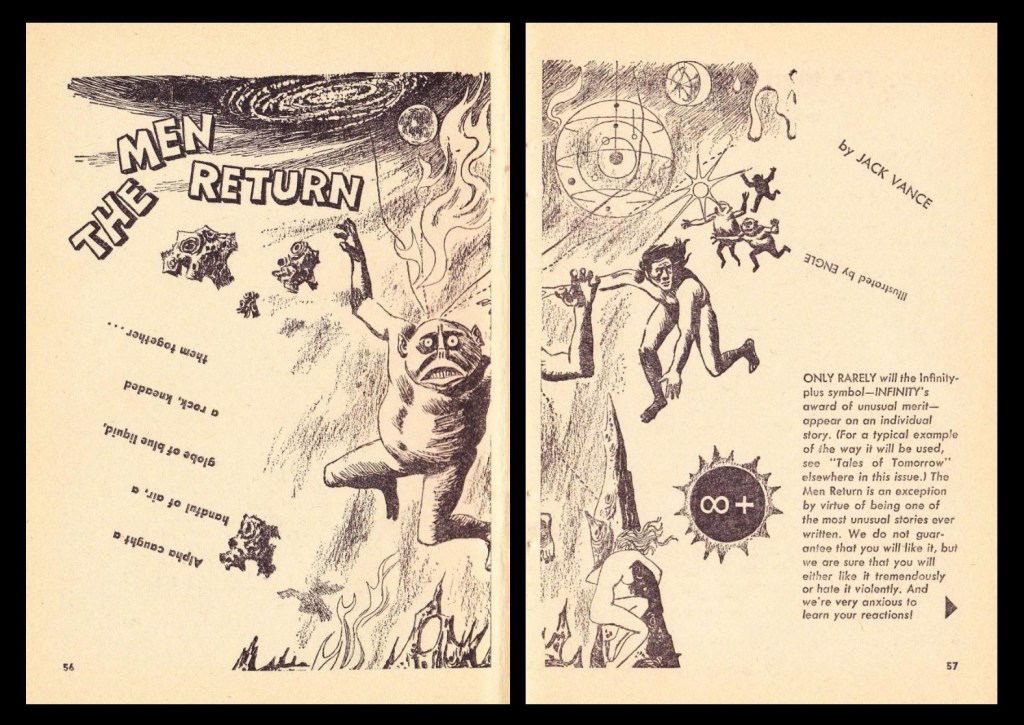
From the story I can’t tell if the two groups are simply different tribes of humans, or if in the far future, humans have evolved into two separate species, or if one of the groups is aliens. The artwork suggests one group is different looking than the other group. I assume the Organisms are either aliens or mutants.

Larry T. Shaw, the editor of Infinity Science Fiction presents “The Men Return” with a new designation, the Infinity + symbol.

Infinity Science Fiction was published from November 1955 through November 1958, and even though it was a second-string SF magazine, it published quite a lot of good science fiction from major names in the genre. The classic SF story, “The Star” by Arthur C. Clarke was published in its first issue.

Shaw’s Infinite + designation reminds me of F. Orlin Tremaine, Astounding Science Fiction second editor, Thought Variant designation for special stories. Asimov wrote “Nightfall” as an imagined Thought Variant story. John W. Campbell later tried to do the same thing with his NOVA designated stories.

Here are the comments Shaw received on “The Men Return” from the October issue.

Finally, here’s the cover from the July 1957 issue of Infinity Science Fiction where “The Men Return” appears.

James W. Harris 4/6/24

“Profession” by Isaac Asimov

Group Read 72: The Best Science Fiction Stories of 1957

“Profession” by Isaac Asimov #11 of 20 (ReadListen)

“Profession” isn’t one of Asimov’s well-known stories. It’s not a Foundation or Robot story. The setting is Earth. “Profession” is an SF idea story, and unfortunately, not a particularly exciting one. The idea of writing knowledge directly to the brain is interesting, but how and why it’s used in “Profession” isn’t believable.

Asimov usually wrote idea stories. He seldom developed stories with drama or humor or even satire. I seldom felt anything for most of his characters. “Profession” is about George Platen who wants to become a computer programmer and be sent to another planet. He lives in the future where Earth has colonized many star systems, and they need professionally trained people. Earth has developed a way to educate people by writing directly to the brain, and they export people with extremely specific technical skills. Evidently, Earth has a monopoly on this brain writing technology.

The problem is, one person in 10,000 have a brain that can’t be written to, and they are sent to special institutions where they are told to read and study whatever they want. George is one of these people and is crushed that he can’t achieve his professional dream.

Unfortunately, “Profession” is a short novella, much too long for the solution Asimov eventually gives us. I won’t spoil it though, but I will say Asimov has to stack the deck to pull it off. It’s an unsatisfying ending because the original plot logic is now seen as faulty. In this future, the only education people get is by mind writing. No one wants to put years of studying into any subject because they hate it when they can’t learn instantly.

In other words, Asimov assumes humans will act differently in the future and I don’t think they will, and that spoils his whole premise for the story.

I don’t even remember why I put this story on the list. It did not have even one citation of CSFquery. I just checked and I added “Profession” because Rich Horton picked it in his Hugo nominations for 1957. He even says, “My vote in this category goes to Asimov’s ‘Profession,’ really a quite strong novella.” Just goes to show you how people’s reading reactions are different.

Of the possibilities Rich lists, I would have picked “The Lineman” by Walter M. Miller, Jr. It has some modern-day political correctness problems, but it’s exciting and dramatic. “The Lineman” is about construction crews on the Moon being distracted by a rocket full of prostitutes. You can read it here. Here’s all the novellas that Rich was considered for 1957:

  • “Profession”, by Isaac Asimov (Astounding, July)
  • “The Night of Light”, by Philip José Farmer (F&SF, June) 
  • “The Last Canticle”, by Walter M. Miller, Jr. (F&SF, February) 
  • “The Lineman”, by Walter M. Miller, Jr. (F&SF, August) 
  • “Lone Star Planet”, by H. Beam Piper and John J. McGuire (Fantastic Universe, March)
  • “Get Out of my Sky”, by James Blish (Astounding, January, and February)
  • “Nuisance Value”, by Eric Frank Russell (Astounding, January)

For sheer storytelling, I like all those other writers far better than Asimov. When I was young, Asimov was very appealing because of his ideas, but I never realized how unexciting his stories were back then. He does create interesting setups, but his characters are just chess pieces he moves around to act out an idea. And now that I’m older, I realize most of those ideas weren’t particularly good. Very few of Asimov’s stories had any kind of emotional punch. The one that I remember that does is “The Ugly Little Boy.” It has quite a punch. I also felt some sympathy for the characters in The Naked Sun, but that’s because I read it when I was going through an agoraphobic phase due to a heart arrythmia.

“Profession” does have some neat ideas, but they are tortured to create its plot.

The thing I like best about “Profession” is the Kelly Freas cover. If you loved “Profession” please say so in a comment. Or comment if you agree with me.

James Wallace Harris, 4/5/24

“The Education of Tigress Macardle” by C. M. Kornbluth

Group Read 72: The Best Science Fiction Stories of 1957

“The Education of Tigress Macardle” by C. M. Kornbluth #10 of 20 (ReadListen)

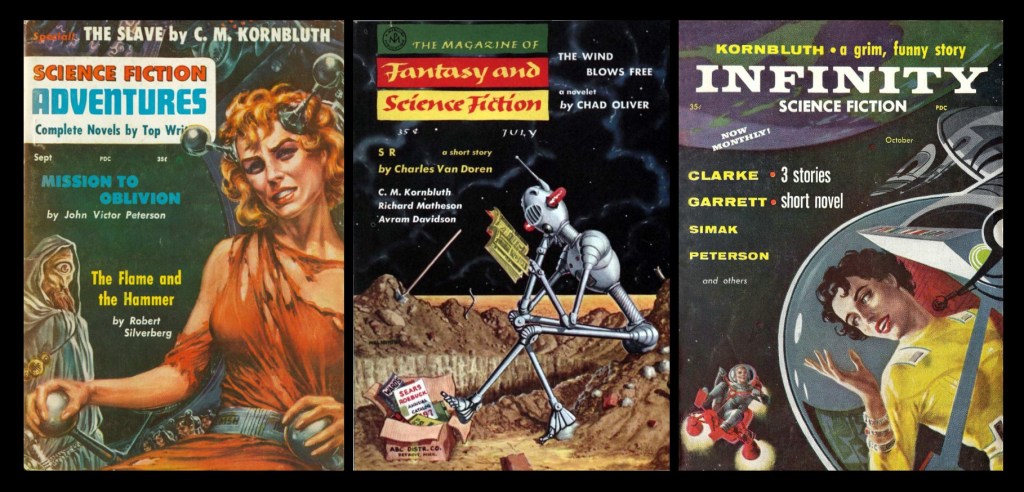
C. M. Kornbluth came out with four short stories in 1957 – “MS. Found in a Chinese Fortune Cookie,” “The Education of Tigress Macardle,” “The Slave,” and “The Last Man Left in the Bar.” None of them stood out as an obvious favorite among readers, with each story having its fans. Isaac Asimov and Martin H. Greenberg couldn’t decide between “The Education of Tigress Macardle” and “The Last Man Left in the Bar” so they published both in The Great SF Stories 19 (1957). Kornbluth died in early 1958, at age 34, so these were the last of his short stories that Kornbluth got to see in print.

I picked “The Education of Tigress Macardle” for the best of 1957 because it had two citations in CSFquery, and the others only had one. However, I’ve had people tell me they preferred either “The Last Man Left in the Bar” or “MS. Found in a Chinese Fortune Cookie.” After reading all three, I feel CSFquery was right, but what do you all think? Follow the links to read the two other stories. I don’t have a link to “The Slave” but it was a novella promoted as a short novel.

Kornbluth was famous for his sharp satire. His brutal wit stabs at several topics in “The Education of Tigress Macardle.” The bit that amused me the most was a throwaway paragraph about the Civil War Book-of-the-Week Club. I chuckled at Mightier than the Sword: A Study of Pens and Pencils in the Army of the Potomac, 1863-1865. There really is a seemingly endless amount published about the Civil War.

“The Education of Tigress Macardle” begins by informing its readers that in the future, a popular personality was elected President, and he got the 28th Amendment passed that made him King Purvis I. (I hope that’s not prophetic.) King Purvis inspired a guy name Gerald Wang to play at Dr. Fu Manchu and unfold a sneak attack on the United States. We learn all of this because the story is told from the year 2756 A.D. in a class at Columbia University called Chronoscope History Seminar 201. The students of this class watch what happens to George and Diana “the Tigress” Macardle on a chronoscope.

You must read between the lines to pick up all the well-hidden sexual innuendo, and if you miss what little there is, the story might lose a lot of its charm. Kornbluth is aiming at humor, but I’m not sure how many of his jokes I get. George thought he had achieved bachelor nirvana when the Tigress would have sex with him on his bear skin rug in his downtown bachelor pad. Then she whined that she wanted to get married. Then she whined she wanted to have a house in the suburbs. Evidently, George kept getting all the sex he wanted because he kept giving in. Then the Tigress whined to have a baby.

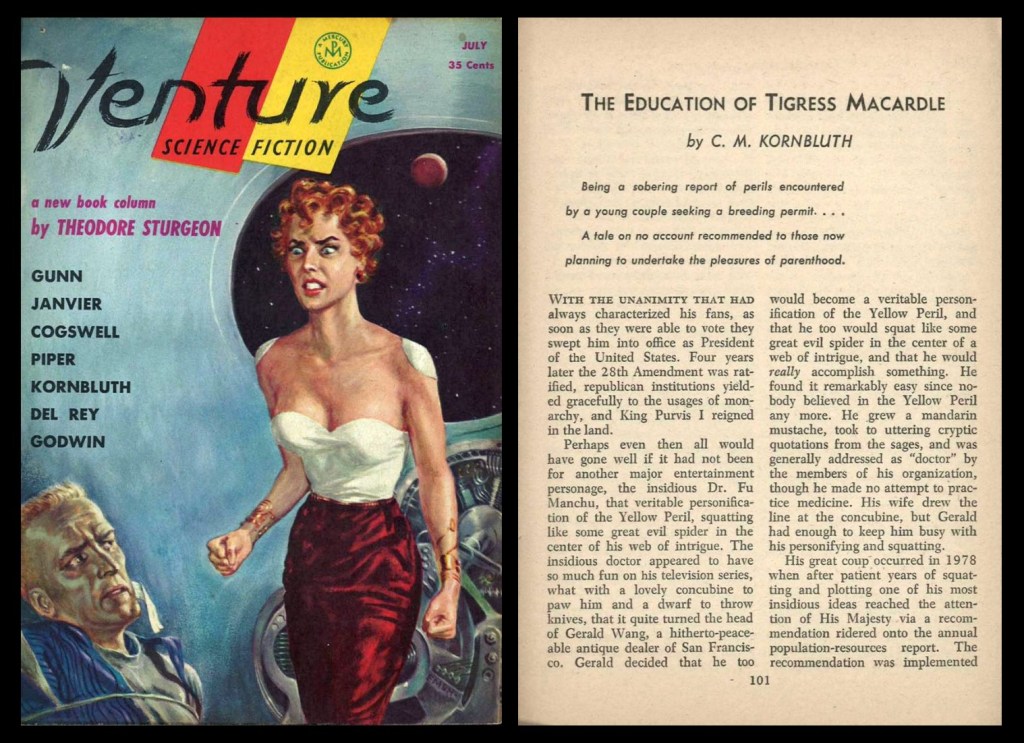
Now here’s where the fun starts. King Purvis degreed that all Americans who wanted to have children must pass a Parental Qualifications Program (P.Q.P.). And Dr. Wang devises a doozy of a potential parent exam that secretly works at his plan to take over America. Parents are given a robotic toddler to take care of for three months. If it’s black box records proper care George and the Tigress will get a permit to breed.

You can imagine the fun Kornbluth provides with this setup. You might not guess the surprise ending. I didn’t.

Another reason I preferred “The Education of Tigress Macardle” over the other two Kornbluth short stories, is because the story is more to the point and clearer. I’m not saying it’s perfectly clear. Kornbluth writing style includes a constant flourish of asides. His prose is baroque with allusions that he hopes will make us smile or admire his wit.

But those filigrees also make it hard to read Kornbluth. Kornbluth relies heavily on things from the future, or beings from other dimensions, or observers from the future. They’re usually a gimmick, a foundation, a diving board, for him to riff with his clever wordiness. Usually, his stories are fun, but seldom have much impact. He has twenty-four stories in CSFquery, but most of them don’t have many citations. I wonder if Kornbluth would have been a good standup comedian. It helps to hear his stories read by a narrator that does voices.

Personally, I believe “The Education of Tigress Macardle” would have been a far superior story if Kornbluth would have hacked off the sections with King Purvis, Gerald Wang, and students from the future. He should have focused entirely on George and the Tigress and spent all his energy making the story subtle, funny, and insightful. The setup with the tryout toddler is great by itself. And he should have worked on the characterizations of George and the Tigress. In 1957 the Playboy bachelor and the emerging liberated woman were ripe for satire.

James Wallace Harris, 4/2/24

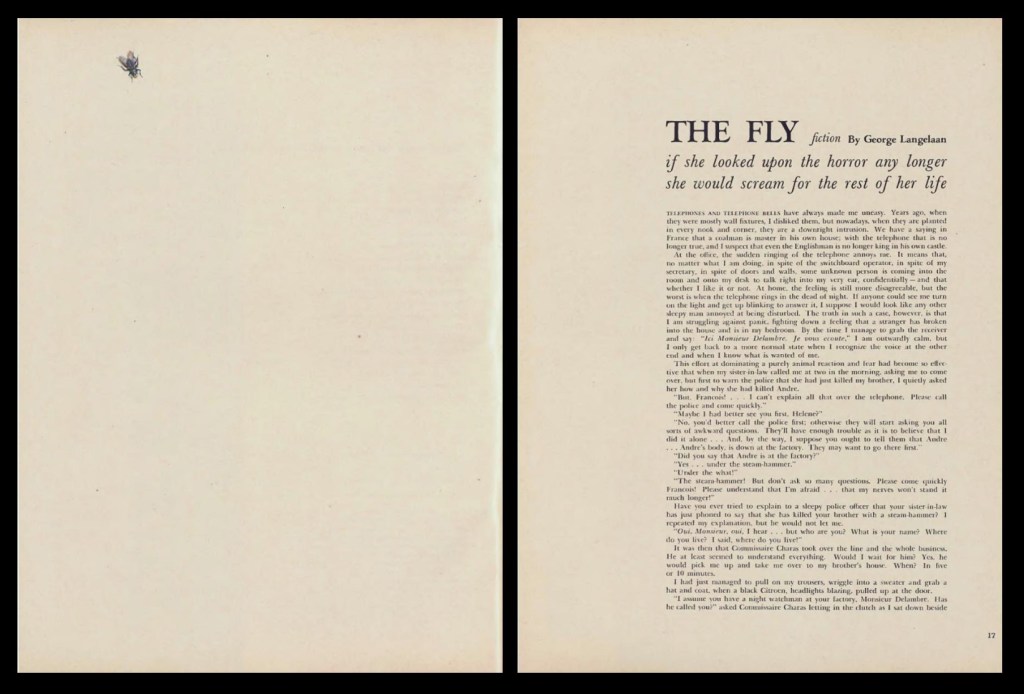
“The Fly” by George Langelaan

Group Read 72: The Best Science Fiction Stories of 1957

“The Fly” by George Langelaan #09 of 20 (Read, Listen)

“The Fly” by George Langelaan is far more famous as a horror movie than as a science fiction story, but it’s a novelette about a mishap with a matter transmitter, obviously putting it into the territory of science fiction. Judith Merril did include it in her collection of the best SF of 1957, but it’s mostly remembered in horror story anthologies.

I rewatched the original 1958 version of The Fly about a year ago, so it was reasonably fresh in my mind. While reading “The Fly” today I was surprised how well the film stuck to Langelaan’s original story. The film grossed reviewers out back in 1958, but since then it’s become somewhat of a classic. Back in the day, me and my school friends talked quite a lot about the movie version. I’m surprised the original story doesn’t get more recognition.

“The Fly” explores two common science fictional ideas, the matter transmitter, and the mad scientist. I thought the story was well told, but it seemed a bit archaic in its storytelling style. That might be because it’s a translation from the French. I often feel translated stories sound like they are from 19th century Europe. But then, that might be due to most of the translated stories I’ve read were from 19th century Europe. “The Fly” also feels a bit like Edgar Allan Poe to me too. Then again, it might reflect a storytelling style favored by non-English speaking writers. I don’t know since I use no other language but English.

I’m not going to repeat the plot of the story because it’s so famous, and if you haven’t read it, I don’t want to spoil it. Even the concept of a matter transmitter comes up late in the tale. Like many 19th century stories, “The Fly” takes a roundabout way to get to the point. It’s told after the action has happened. I have a theory about that. I believe old timey writers liked to tell stories with an “as heard by” structure. We used to believe that eyewitnesses were the gold standard of implying validity. Francois, tells the story about Helene, his sister-in-law, confessing she murdered his brother. The tale takes a winding path before it gets to the science fictional element.

Matter transmitters were made famous by Star Trek and its transporter. That show has dealt with transmitter mishaps too. But my all-time favorite matter transmitter story is Rogue Moon by Algis Budrys. It works out several fascinating aspects to the concept. Some of those aspects were later made famous in “Think Like a Dinosaur” by James Patrick Kelly. But there is one other story I’d like to mention, that’s a variation of the matter transmitter idea. In “The Four Sided Triangle” by William F. Temple, which uses a matter transmitter as a matter duplicator — an unintended side-effect to avoid in some matter transmitter stories. “The Four Sided Triangle” is a neat little love story that was made into a decent film.

André Delambre in “The Fly” is also a splendid example of a mad scientist in a science fiction. Like many Sci-Fi mad scientists, he works alone and invents something that should require all the resources of creating fusion power. Mad scientists and lone inventors now belong in the realm of fantasy, but there’s something heartwarming about mad scientists to folks who used to wear propeller beanies. I believe that appeal is why we had Doc Brown in Back to the Future. (The mad scientist is a popular idea in children’s stories still.)

In 2019, “The Fly” was reprinted in Promethean Horrors: Classic Tales of Mad Science. I thought that an apt title for anthologizing this story. Unfortunately, the table of contents was disappointing. I was expecting a big anthology full of mad scientist stories. That’s a shame because I would have bought a large retrospective anthology that highlighted the evolution of the mad scientist in science fiction.

I kept thinking about the classics of mad scientist stories and went looking for anthologies that might collect them. I found two.

I went ahead and took a chance on The Mad Scientist Megapack since it was only ninety-nine cents. The Mad Scientist’s Guide to World Domination edited by John Joseph Adams is more money, $11.99 for the Kindle edition. However, there’s an audiobook version, and I might get that. I was disappointed that neither volume collected “The Fly.” If ever there was a mad scientist in science fiction, André Delambre is one. There is one story I know well in the table of contents to The Mad Scientist Megapack, “The Man Who Evolved” by Edmond Hamilton. I hope all the others I haven’t read are in that vein.

James Wallace Harris, 3/30/24

“Let’s Be Frank” by Brian W. Aldiss

Group Read 72: The Best Science Fiction Stories of 1957

“Let’s Be Frank” by Brian W. Aldiss #08 of 20 (Read)

Fantasy and science fiction are two genres where writers can imagine anything, but strangely we seldom see stories with first-of-their-kind concepts. As The Bible says, there’s nothing new under the sun. However, I think Brian Aldiss has produced a unique idea in “Let’s Be Frank.” If I’m wrong, I’d love to read other takes on this concept.

I’m never sure how much of a story I should give away. “Let’s Be Frank” isn’t an all-time top short story, or even a best of the year story. There’s a reason writing teachers advise their students “Show don’t tell.” Aldiss tells this story. There’s no tension, no drama, no mystery. Aldiss produced his idea and explained how the billions of people on Earth end up with two conscious minds. Maybe that’s enough of a tease to get you to read the story. (Follow the link above.)

It’s a shame that Aldiss didn’t spend more time with his idea and created a version of the story that showed us what it was like to be a consciousness with multiple bodies. You might think I’m talking about a hive mind, but I don’t think I am. “Let’s Be Frank” does suggest a clever kind of telepathy. Can you imagine being in two bodies at once, one in England and one in Spain, with four legs, four arms, four eyes, and two heads?

If ChatGPT was conscious, it might experience something like this. Imagine being in a million bodies having a million conversations simultaneously? ChatGPT does that.

“Let’s Be Frank” isn’t a memorable short story either. Our group is working to identify the best science fiction stories of 1957. I don’t think “Let’s Be Frank” is one. But it is neat. The act of looking for exceptional stories makes me think about what makes a standout work of short fiction. I haven’t read all twenty we’re going to discuss, but I do know that “Call Me Joe” by Poul Anderson, “Omnilingual” by H. Beam Piper, and “The Menace from Earth” by Robert A. Heinlein are the great science fiction stories of 1957. They are the ones to read, reread, and remember.

Yet, what makes those stories great? What’s missing from “Let’s Be Frank” that’s in those stories? Each of those stories have original ideas too, especially Heinlein’s human powered flying on the Moon. They do have drama and characterization. I’m not sure Aldiss could have dramatized “Let’s Be Frank,” but if he could, it would have made all the difference in the world.

James Wallace Harris, 3/28/24

“The Cage” by A. Bertram Chandler

Group Read 72: The Best Science Fiction Stories of 1957

“The Cage” by A. Bertram Chandler #07 of 20 (Read, Listen)

“The Cage” is a fun story, although I’m not sure I would have included it in a best-of-the-year anthology. It’s a puzzle story. Bertram Chandler had a theoretical problem he wanted to present fictionally. How does one intelligent species recognize another intelligent species? It’s a reasonable question, but how do you propose it in a story?

Chandler had to spend most of the short story setting up the problem. If humans arrived on another planet, we’d assume any intelligent alien species would recognize our abilities. Chandler needed to put humans into a situation where our abilities wouldn’t seem obvious at all.

Chandler begins his story by having the interstellar liner Lode Star go off course and land on a young planet with just primitive life forms. The ship must be abandoned when its reactor goes into a runaway chain reaction, and it eventually blows up leaving no trace of the spaceship.

On this planet it mainly rains. The planet’s ecology has evolved some trees and plants, a froglike creature, and lots of fungi. Some fungi provide healthy food for the humans, but other forms of the fungi eat all their clothes and metals, so the castaways end up buck-naked. They can’t even start a fire because of the constant rain.

That’s when another spaceship lands and captures the humans in nets and takes them to another planet. The humans are put into something like a zoo. Finally, the story gets to the problem: How do they let the aliens know they are an advanced intelligent space faring species?

I’ll let you read the story and find out for yourself. But puzzle stories are intended to inspire readers to think of their own solutions.

I thought the aliens would eventually recognize the humans speak a complex language. But I also assume the humans could have made sign language gestures. Their cage had the same environment as the rainy planet, so they couldn’t make a fire, or build anything.

Puzzle stories are rare in science fiction, at least memorable ones. I can’t recall any others at this moment. I vaguely remember a story where a spaceship couldn’t see outside. I think the crew were trying figure out if they were in orbit around a planet.

I asked Copilot to list science fiction stories that proposed a problem. None of the stories it offered are what I was thinking of as a SF problem story. AIs are impressive right now, but they don’t seem to understand science fiction. I guess I’m assuming Copilot is unintelligent because it’s unaware of science fiction plots. But then, Copilot might not recognize me as an intelligent being either.

When you read thousands of science fiction stories you realize just how hard it is to produce an outstanding story. “The Cage” is decent enough. I would have been satisfied if I had read it in the June 1957 issue of The Magazine of Fantasy and Science Fiction. Personally, if I were an editor, I wouldn’t have selected it for any kind of anthology, but it’s been widely anthologized.

I keep waiting for us to discover another SF story with the impact of “Fondly Fahrenheit” or “Coming Attraction” or “Flowers for Algernon.”

James Wallace Harris, 3/26/24

“The Language of Love” by Robert Sheckley

Group Read 72: The Best Science Fiction Stories of 1957

“The Language of Love” by Robert Sheckley #06 of 20 (Read)

I added “The Language of Love” by Robert Sheckley to the list of best science stories of 1957 because me and my high school buddies loved this story back then, and it has stuck with me for over fifty years. I’ve often talked about it to other people. “The Language of Love” is a silly humorous piece that also offers interesting philosophical insights. I won’t talk about them right away because I hope you will go read the story, but I will eventually spoil the ending by explaining the story.

Robert Sheckley is becoming a forgotten science fiction writer and I think that’s sad. Everyone recalls The Hitchhiker’s Guide to the Galaxy when the topic of humor and science fiction comes up, but they should be using Robert Sheckley as the poster boy for funny Sci-Fi instead of Douglas Adams. And don’t get me wrong. I like Douglas Adams too, but Sheckley mined the funny bone of science fiction far deeper and wider.

Sheckley wrote a lot of short stories in the 1950s and 1960s and they just aren’t remembered. Probably he’s remembered, if he’s remembered at all, for two novels, Dimension of Miracles and Mindswap. Both are available on audiobook, and that’s how you should read them. Neil Gaiman introduces the audiobook version of Dimension of Miracles where he tells a funny/sad anecdote about Sheckley. Gaiman produced several audiobooks for Audible where he promotes forgotten titles and authors. You might like to look at that page.

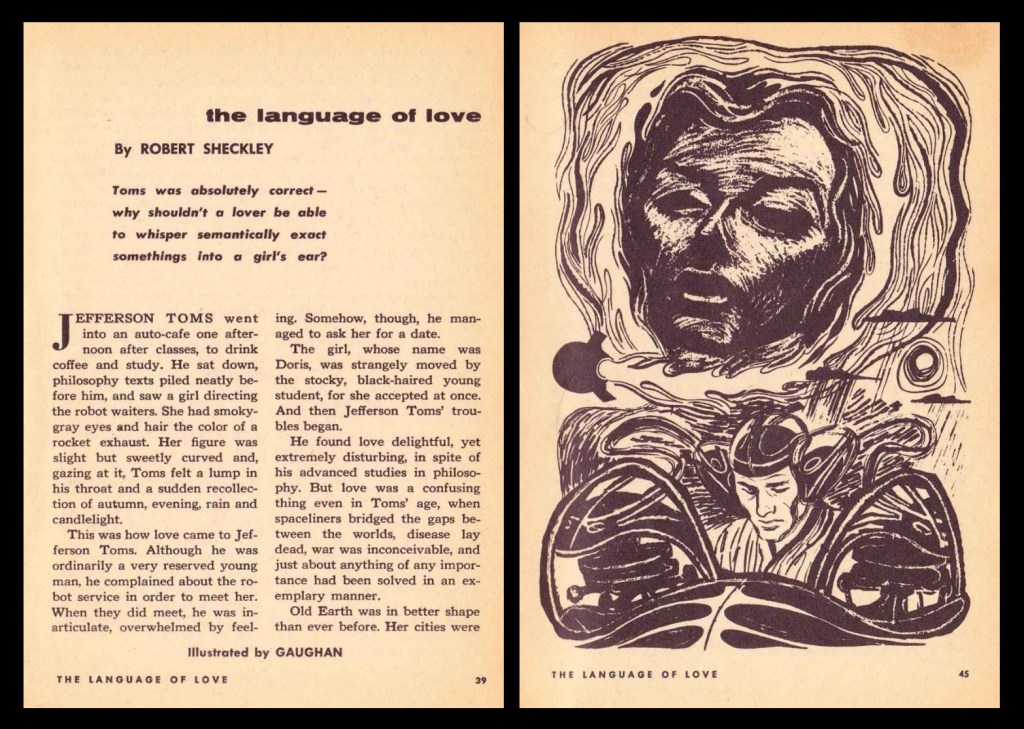
“The Language of Love” is about a young Earth man, Jefferson Toms, who falls for a girl named Doris. He was overwhelmed by what he felt for her, but when Doris expected Jefferson to tell her he loved her he couldn’t. Jefferson wanted to find the perfect words to express exactly what he felt for her. So, he went on a quest across the galaxy to learn everything he could about love and language.

To get you to click on the read link above, I thought I would post the first two pages of the story. Sheckley has a wonderful writer’s voice, and I think you need to hear a bit of it. Maybe that will convey what I mean more than my own words trying to describe it.

When Jefferson returns to Doris and utters the precise words that express his feelings for her, poor Doris is upset. I changed my mind. I won’t give you those words. Or explain the double surprise ending. Just go read the story.

I think “The Language of Love” also captures one of the dominant flavors of Galaxy Science Fiction back in the 1950s. Galaxy loved satire. Often stories in Galaxy were light, jaunty, and sometimes biting. It wasn’t a hard science fiction magazine like Astounding. I’m not sure the type of science fiction Galaxy presented in the 1950s has survived well. H. L. Gold was a much different editor than Frederik Pohl in the 1960s. Only three of the twenty stories our group is reading as the best of 1957 are from Galaxy, I added two of them, “The Language of Love” and “Time Waits for Winthrop” by William Tenn. I added them by abusing my power as moderator. I hope it just isn’t me that fondly remembers this kind of science fiction from the 1950s. I’m looking forward to seeing how the others react.

James Wallace Harris, 3/23/24