“The Voices of Time” by J. G. Ballard

Group Read 27The Big Book of Science Fiction

Story #37 of 107: “The Voices of Time” by J. G. Ballard

Whenever I read stories by J. G. Ballard I feel like I’m reading science fiction for grownups. This is my second reading of “The Voices of Time” and it has very adult vibes. Sure, the story ideas are the same old science-fictional bullshit, but they feel literary and serious. Maybe because the theme is death and decay. That’s very heavy. There’s a mature acceptance of death in this story. Youthful science fiction is always about rejecting and defying mortality. However, J. G. Ballard was only around thirty when he wrote “The Voices of Time.” Could Ballard’s upbringing under the conditions described in the autobiographical Empire of The Sun explain his wiser-than-his-years outlook?

Is it me, or do Ballard’s stories from the 1960s focus on decay and decline? Was that just a schtick he developed or personal philosophy? Or should we tag that as his entropic period? When I was young I didn’t dig Ballard that much. I admired him, especially the Vermillion Sands stories, but his end-of-the-world novels didn’t have the violence and excitement as American end-of-the-world novels. They felt decadent. I also associated them with how I imagined the British felt about the decline of their empire. Now that I’m older, Ballard’s stories resonate with my current moods. One of those moods is the belief that the American empire is in decline.

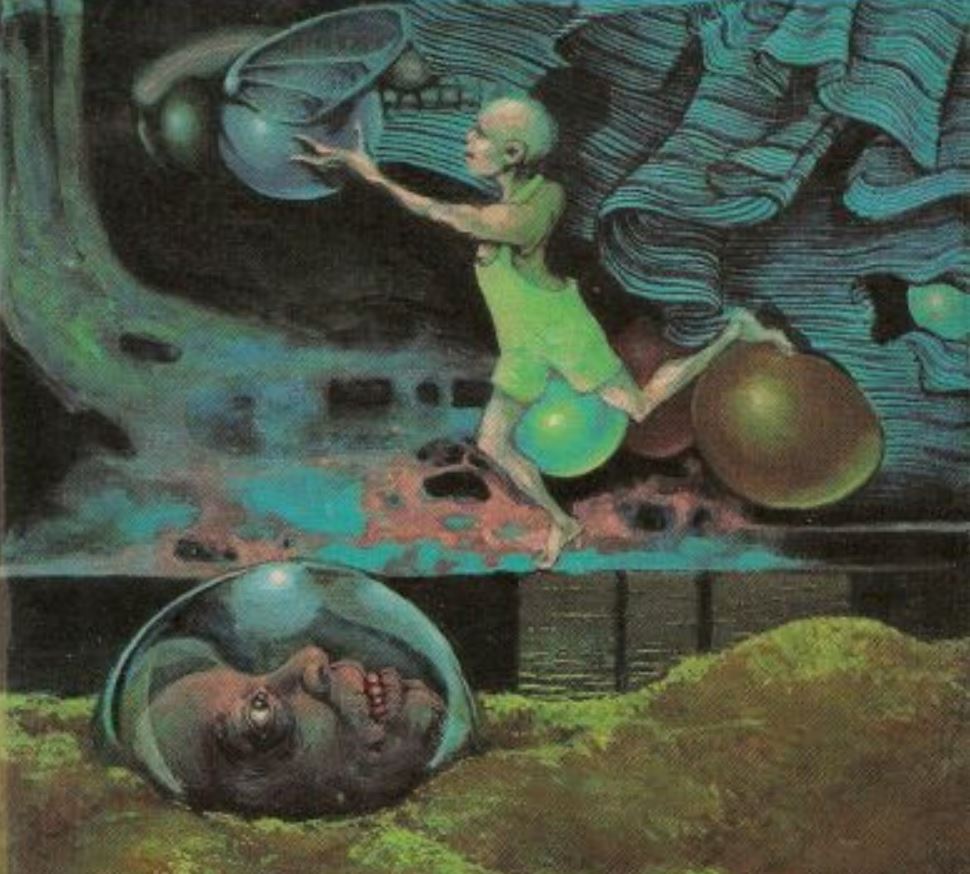
The story begins with a doctor named Powers contemplating the suicide of a colleague who had spent his last days carving a giant symbol at the bottom of an empty pool. Powers knows he’s about to die too and has his own compulsions to leave a message. Powers knows he’s been infected with a plague that makes people comatose. He is sleeping more each day and plots his remaining hours of consciousness to wrap up his affairs. This lets us readers observe a world undergoing bizarre changes. Earth is experiencing a rise in radiation from space, and animals are starting to mutate and adapt, including some plants and animals absorbing lead to produce protective shielding.

Initially, however, Powers was too preoccupied with completing his work at the Clinic and planning his own final withdrawal. After the first frantic weeks of panic he had managed to accept an uneasy compromise that allowed him to view his predicament with the detached fatalism he had previously reserved for his patients. Fortunately he was moving down the physical and mental gradients simultaneously—lethargy and inertia blunted his anxieties, a slackening metabolism made it necessary to concentrate to produce a connected thought-train. In fact, the lengthening intervals of dreamless sleep were almost restful. He found himself beginning to look forward to them, and made no effort to wake earlier than was essential.

“The Voices of Time” is a 4-star story for me that I look forward to reading, again and again, it might even become a 5-star story if I can ever decipher what Ballard is doing. I can’t yet tell if Ballard has accidentally included enough elements to make this story into a philosophical mystery, or if it was intentional. It’s the kind of story that college students analyze and write papers about.

There is a beautiful epic passage towards the end that explains the title.

Like an endless river, so broad that its banks were below the horizons, it flowed steadily towards him, a vast course of time that spread outwards to fill the sky and the universe, enveloping everything within them. Moving slowly, the forward direction of its majestic current almost imperceptible, Powers knew that its source was the source of the cosmos itself. As it passed him, he felt its massive magnetic pull, let himself be drawn into it, borne gently on its powerful back. Quietly it carried him away, and he rotated slowly, facing the direction of the tide. Around him the outlines of the hills and the lake had faded, but the image of the mandala, like a cosmic clock, remained fixed before his eyes, illuminating the broad surface of the stream. Watching it constantly, he felt his body gradually dissolving, its physical dimensions melting into the vast continuum of the current, which bore him out into the centre of the great channel, sweeping him onward, beyond hope but at last at rest, down the broadening reaches of the river of eternity.

Why did Ballard imagine this immense view of time? Was he smoking dope or meditating and this vision appeared to him? Or did some classic poem or writer inspire it? For whatever reason, he worked it into a lovely science fiction story. It justifies creating a dying character, even a dying Earth.

Main Page of Group Read

James Wallace Harris, 10/31/21

“Plenitude” by Will Worthington

Group Read 27The Big Book of Science Fiction

Story #36 of 107: “Plenitude” by Will Worthington

[I’ve gotten a complaint about my hyperlinks being hard to see. I’m going to bold them to see if that helps. Let me know what you think.]

Who the hell was Will Worthington? According to ISFDB.org, he was the pen name for Will Mohler, and they list just twelve short stories by him, published in the SF magazines from 1958-1963. His name only appeared on a cover twice, and according to the VanderMeers in the introduction of “Plenitude” Mohler’s identity is still quite a mystery. But ISFDB is full of people like Mohler, would-be writers who had a few publications and then disappeared. Forgotten writers intrigue me. I even maintain a webpage for Lady Dorothy Mills, a forgotten writer from the 1920s. Most days, that site gets no hits.

Plenitude” appeared in the November 1959 issue of The Magazine of Fantasy & Science Fiction, and then was reprinted by Judith Merril twice, first in her annual for 1959, and then again in her The Best of the Best, which was her favorite stories from the first five years of the annual. For some reason, it was reprinted in two different forgotten anthologies in 1974. Four of his other stories were reprinted, but none of them ever made it into a major anthology until The Big Book of Science Fiction. And I’m not sure it belongs there. Evidently, the VanderMeers like forgotten writers too.

“Plenitude” is a pretty good SF story, but not a classic. It’s the second time I’ve read it. The VanderMeers reprint twenty stories from the 1950s and none of them were about post-apocalyptic times after the bomb, a very favorite theme from that decade. However, Mohler’s story is about a family, a dad, a wife, and two kids living out in the woods after a major change in society — so it’s kind of post-apocalyptic.

Actually, it’s anti-utopian, or post-technology. The dad has moved his family back to nature to escape the modern life of living in a pod jacked into artificial reality. I picture this future somewhat like The Matrix, but the inhabitants know what they are doing, and can still see the real world if needed.

Mohler was doing exactly what Silvina Ocampo was doing in “The Waves,” protesting a future designed by science and technology. However, Mohler took the time to work up a real story with decent characterization. The dad in this story comes across like a proto-hippy or 20th-century Luddite. He makes his family work hard at farming and is proud of his son for being a good bow hunter. This family is part of a small mountain community that has rejected techno-life. I pictured these people being the kind who joined communes in the 1960s and 1970s and read Mother Earth News, CoEvolution Quarterly, Communities, and the Whole Earth Catalog. Oh wait, I read those mags. I guess that’s why I feel a kinship with Mohler. Mohler was ahead of his time in 1959, but maybe not, because there are back-to-nature folks in every era. But he predates the back to the land movement of the 1960s.

The F&SF editorial blurb that introduced “Plenitude” said of Mohler, “As of this writing, Will Worthington is living on a wild island off the coast of Maine, where he is leading a Thoreau-like existence which will inspire him, it is to be hoped, to more stories like the following.” I’m tempted to read Mohler’s other eleven stories to see if I can guess more about what he might have been like. A few years later, another blurb says he’s living in Washington, DC.

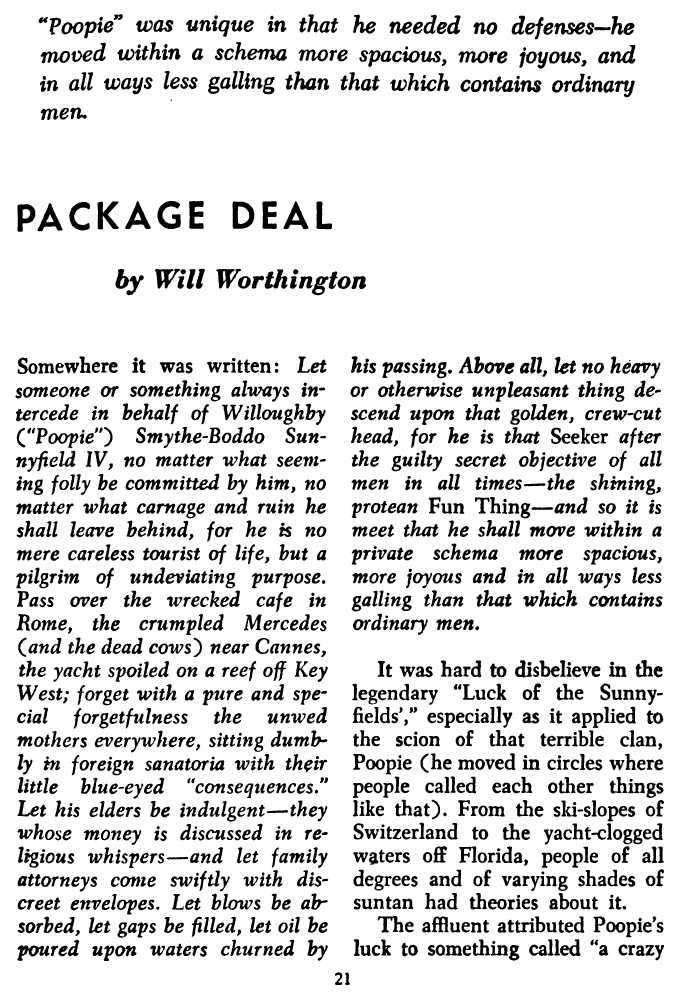
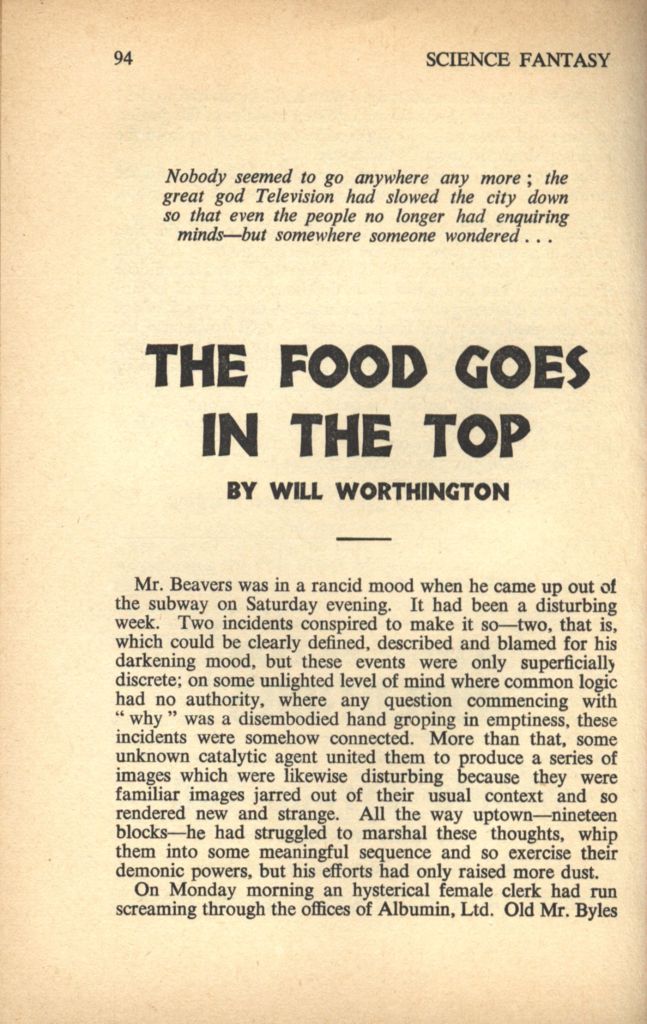
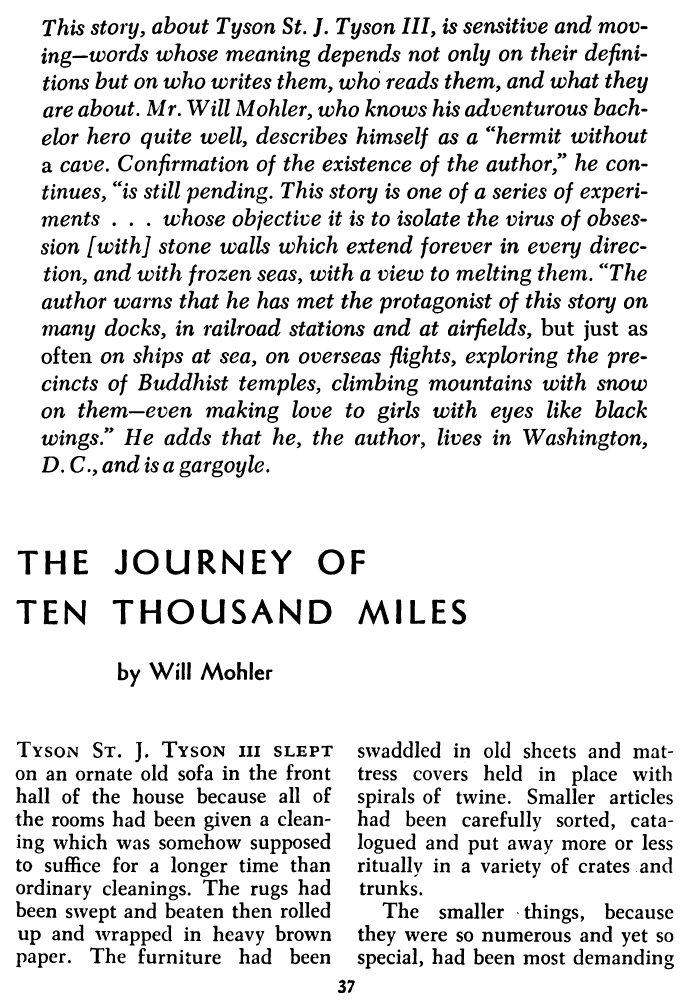
Since I don’t have time to read those other stories I thought I’d post the first page of each of them to see if they give any more clues about Mohler. But I’m also posting links to where you can read the stories online, just in case you’re like me and wonder about forgotten authors.


If, December 1958


Fantastic, June 1959


The Magazine of Fantasy & Science Fiction, November 1959


Fantastic, January 1960


The Magazine of Fantasy & Science Fiction, February 1960


The Magazine of Fantasy & Science Fiction, June 1960


The Magazine of Fantasy & Science Fiction, November 1960


The Magazine of Fantasy & Science Fiction, July 1961


Science Fantasy, August 1961


The Magazine of Fantasy & Science Fiction, March 1963


Galaxy Science Fiction, December 1963

I can’t say any of these beginnings grabbed my interest, nor was much revealed about Mohler. When I get time I want to read all the stories. I’m curious about Mohler. He seemed to disappear just as the 1960s got going. Did he drop out, or begin his real career? I bet he loved the 1960s though, at least from the vibes I get from reading “Plenitude.”

Main Page of Group Read

James Wallace Harris, 10/28/21

“The Waves” by Silvina Ocampo

Group Read 27The Big Book of Science Fiction

Story #35 of 107: “The Waves” by Silvina Ocampo

Silvina Ocampo might be an impressive writer but I couldn’t tell that from reading “The Waves.” Great writing is the accumulation of significant details, and “The Waves” was too vague and ethereal to convey any kind of greatness. To include this story because of Ocampo’s reputation, her gender, her nationality does not extend her literary legacy or expand the significance of science fiction in this anthology.

“The Waves” does imagine a science-fictional future, but it’s hardly a story. It could have been a story, but it hasn’t been fleshed out. There is no real characterization, no drama, no scenes, no settings, no details, it’s all telling and no showing. As it is, it’s just a sketch. Ocampo imagines that science will classify people by their wavelengths and separate two lovers. They falsify documents to be together, and when they are discovered they are separated, one to live on the Earth, and the other exiled to the Moon.

Ocampo imagines science will produce a dystopia and this little sketch is a protest against scientific progress. That’s the heart of many science fiction stories. Since I haven’t read anything else by Ocampo I don’t know her range in storytelling complexity. Is all her work so vague and slight? I remember reading stories like “The Waves” in fiction writing workshops. Those kinds of stories feel like they were written by people who want to be writers who don’t understand the current techniques for writing fiction. If this story was submitted by a 7th grader we would have considered her precocious. If an adult friend had given it to me, I would have been encouraging. But if I was told Jonathan Franzen had written it, I would have thought it was notes for a story he planned to write.

I’m curious now, what is Ocampo’s good stuff like? I could be completely wrong, and “The Waves” is typical of her writing, and its style is reflective of the style she established for herself. If that’s the case, she’s not for me.

Main Page of Group Read

James Wallace Harris, 10/25/21

“The Man Who Lost the Sea” by Theodore Sturgeon

Group Read 27The Big Book of Science Fiction

Story #34 of 107: “The Man Who Lost the Sea” by Theodore Sturgeon

Why do we read science fiction? Maybe that’s too big of a question to answer. Why do we love the stories that we do? What’s qualities does a story have that pushes our buttons? That might be getting closer to where I want to go. The last lines of “The Man Who Lost the Sea” by Theodore Sturgeon misted my eyes as I read them. But it wasn’t because our unnamed narrator was dying. I wasn’t moved either in our last story, “The Monster” when Marion and Bernard were about to die.

No, I’m moved because our astronaut protagonist says: “‘God,’ he cries, dying on Mars, ‘God, we made it!'”

That’s one reason I love this story. I believe many of us who read science fiction have an affinity for Mars, and a desire to go there. And subset of those readers would even be happy to die there. Sturgeon knew that and hooked us.

But Sturgeon couldn’t have written just that last line to win us over. There is a long build up that makes that last line work. The dying astronaut is visited by hallucinations of his younger selves. One is a boy playing with a model, a boy like many of us who used to play with models. Those of us who love this story can remember being young and pestering older folks with our enthusiasm for newly acquired knowledge.

The dying astronaut has a vivid memory of skin diving and nearly drowning. I admire the story even more because I can remember skin diving a couple of times when I thought I was drowning. I was always a terrible swimmer and shouldn’t have even been trying the things I did. I remember the first time I used a snorkel, mask, and fins, and how I also swallowed water and thrashed in the water. I can remember trying to swim further than I was capable. I remember what it felt like to make it back to the beach, the relief. Those experiences resonated with Sturgeon’s character, and I imagined they were based on his own experiences. Such embedded connections make a story succeed.

However, we don’t have to have shared experiences with Sturgeon and his fictional character. We all wonder what it’s like to die. Maybe we’ve even been sick enough to think we’re dying. There is something special about that last moment, a moment we wait our whole life to experience. How will we handle it?

The first work of fiction I remember from childhood is about a man’s last thoughts when dying. I didn’t know that then. I was seeing the movie version of High Barbaree when I was about six. Later on, I learned it was based on a novel by Charles Nordhoff and James Norman Hall. In the movie, Alec doesn’t die. In the book he does. But I’ve been intrigued by the idea of last thoughts my whole life. That also makes me love “The Man Who Lost the Sea.”

This is the second time this year that I’ve written about “The Man Who Lost the Sea.” I had already forgotten that. I had to use the search feature on my blog to check. The story was even better this second time. I’m not about to die, but I’m old enough that I think about it often. Because I’ve spent so much of my life reading science fiction my last thoughts might be haunted by science-fictional themes. My last thoughts could recall all those far-out ideas I loved by reading science fiction. I might even judge my time on Earth by how many became real?

I do know as I age, what I value in a science fiction story changes. Reading through the stories in The Big Book of Science Fiction is revealing what I still care about and what I don’t. “The Man Who Lost the Sea” still resonates, but so many of the stories don’t. If I was sitting across the table from the stories I’m breaking up with I should tell them, “It’s me, not you.”

I had a friend who died in middle age. His name was Williamson, and before he died he kept rejecting things he once loved. Towards the end, he only cared about two things in life, the music of Duane Allman and Benny Goodman. This dwindling of interests before death I call the Williamson Effect. As I progress through my seventies, and maybe beyond, I imagine I’ll reject most of the science fiction stories I once loved. They will just stop working. I tend to think “The Man Who Lost the Sea” will continue to work for a long time, maybe not to the bitter end, but close.

Main Page of Group Read

James Wallace Harris, 10/25/21

“The Monster” by Gérard Klein

Group Read 27The Big Book of Science Fiction

Story #33 of 107: “The Monster” by Gérard Klein

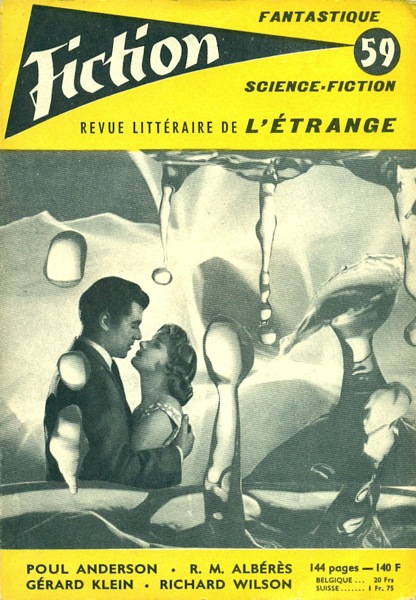
“The Monster” by French writer Gérard Klein was first published in October 1958 in Fiction #59, but later translated and reprinted in the September 1961 issue of The Magazine of Fantasy & Science Fiction. Later on it was collected in Thirteen French Science-Fiction Stories edited by Damon Knight. According to the VanderMeers in their introduction to the story in The Big Book of Science Fiction, Klein is quite a prolific science fiction writer in France. ISFDB lists five translations and a decent number of reprints for “The Monster.”

I found “The Monster” a compelling story until the ending. Marion, the stay-at-home wife of Bernard anxiously awaits her husband return from work. When she hears that an alien from space has been cornered in the park she begins to fret because she knows Bernard walks home through that park. The story tightens by Marion listening to radio broadcasts, and then by her efforts to get into the park which has been cordoned off by the police. The tension Klein builds is quite effective. We slowly learn that Bernard has been the one viction of the alien, and now the alien keeps calling out “Marion” in the voice Marion knows as Bernard’s.

The buildup for this story was quite nice, but the resolution was disappointing. We are shown how Marion has always been dependent on Bernard, but in the end we’re also told that too. The story isn’t about the alien, but Marion. I’m going to quote a significant part of the story from near the ending to explain my disappointment, and to discuss the nature of reading science fiction.

“I’m coming, Bernard,” said Marion, and she dropped the microphone and threw herself forward. She dodged the hands that tried to stop her and began running down the graveled path. She leaped over the copper-meshed web and passed between the gleaming tongues of the flamethrowers. 

“It’s a trap,” called a deep voice behind her. “Come back. The creature has absorbed some of your husband’s knowledge—it’s using it as a lure. Come back. That isn’t human. It has no face.” 

But no one followed her. When she turned her head, she saw the men standing up, grasping their lances and looking at her, horrified, their eyes and teeth gleaming with the same metallic light as the buttons of their uniforms. 

She rounded the pond. Her feet struck the cement pavement with soft, dull sounds, then they felt the cool, caressing touch of the grass again. 

She wondered even as she ran what was going to happen, what would become of her, but she told herself that Bernard would know for her, that he had always known, and that it was best that way. He was waiting for her beyond that black doorway through which his voice came with so much difficulty, and she was about to be with him. 

A memory came suddenly into her mind. A sentence read or heard, an idea harvested and stored away, to be milled and tasted now. It was something like this: men are nothing but empty shells, sometimes cold and deserted like abandoned houses, and sometimes inhabited, haunted by the beings we call life, jealousy, joy, fear, hope, and so many others. Then there was no more loneliness. 

And as she ran, exhaling a warm breath that condensed into a thin plume of vapor, looking back at the pale, contracted faces of the soldiers, dwindling at every step, she began to think that this creature had crossed space and searched for a new world because it felt itself desperately hollow and useless in its own, because none of those intangible beings would haunt it, and that she and Bernard would perhaps live in the center of its mind, just as confidence and anxiety, silence and boredom live in the hearts and minds of men. And she hoped that they would bring it peace, that they would be two quiet little lights, illuminating the honeycombed depths of its enormous, unknown brain. 

She shuddered and laughed. “What does it feel like to be eaten?” she asked herself. 

She tried to imagine a spoonful of ice cream melting between her lips, running cool down her throat, lying in the little dark warmth of her stomach. 

“Bernard,” she cried. “I’ve come.” She heard the men shouting behind her. “Marion,” said the monster with Bernard’s voice, “you took so long.” 

She closed her eyes and threw herself forward. She felt the cold slip down her skin and leave her like a discarded garment. She felt herself being transformed. Her body was dissolving, her fingers threading out, she was expanding inside that huge sphere, moist and warm, comfortable, and, she understood now, good and kind. 

“Bernard,” she said, “they’re coming after us to kill us.” 

“I know,” said the voice, very near now and reassuring. 

“Can’t we do anything—run away?” 

“It’s up to him,” he said. “I’m just beginning to know him. I told him to wait for you. I don’t know exactly what he’s going to do. Go back out into space, maybe? Listen.”

This is almost the end of the story, yet not the complete ending, but the part that’s worth discussing. The ending could be interpreted in several ways, but that’s true of most good stories. But I’m not particularly concerned about that at the moment. What I want to talk about is the difference between story and metaphor.

Story is the artificial world created by the writer. Metaphor is what the writer wants you to contemplate. I’m not against metaphor, but what I really love is story. As I read “The Monster” I got caught up in Marion’s worry for her husband, and wondering what kind of alien was trapped in the park. I assumed it was a real alien. At least a real story alien. What I got was a metaphor alien. And that disappointed me.

Klein had set up realistic situation and turned it into a page-turning story. But he didn’t give me a realistic story ending. This is the only story I’ve read by Gérard Klein. I have no idea what his work is like. But for my purposes I’m going to use “The Monster” as my example for science fiction in general.

Most science fiction writers are just storytellers. They might also include philosophical insights, metaphors, political messages, religious preaching, satire, etc., but their main goal is to tell a story. Think of it this way. We create all kinds of lies to convince children to believe that Santa Claus is real. That’s storytelling. But if we sat a kid down and said, Santa Claus is a metaphor to teach you about the goodness of giving I believe most kids will say, “Cut the crap. I knew you were lying to me. I loved the lies. Don’t spoil them now with some cheesy moral lesson.”

I wanted a real alien at the end of “The Monster.” Marion felt real. The story felt real up to the end. Why didn’t I get a real alien? All I got was some cheesy metaphor. I can accept Marion is dependent on Bernard. I can accept that people are hollow and lonely shells without other people. I can even accept that some belief, philosophy, religion will provide a shell to bind lonely people together. And I can even accept that Klein uses the alien to present his meaningful messages. I can even accept such messages don’t have to be true for the story to work. But where’s my fucking monster from space? How did it get here? What’s it like? How does it survive? What kind of environment does it need to live? What kind of technology does it use? Why would the police want to kill such a unique being? Where’s its spaceship? Why isn’t the alien as real as Marion?

In my old age I’ve come to love science fiction that immerses me into a fully-developed fictional world. Metaphors bridge fiction worlds with reality, and that’s fine if you like that kind of thing. But story comes first. And I want a whole story. Don’t lead me up to a point and yell, “Surprise!” Don’t break the goddamn fourth wall (unless it integrated into a much deeper story).

I know, I’m getting to be a grumpy all guy whining for his 100% science fiction stories.

Main Page of Group Read

James Wallace Harris, 10/22/21

arris 10/22/21

“Pelt” by Carol Emshwiller

Group Read 27The Big Book of Science Fiction

Story #32 of 107: “Pelt” by Carol Emshwiller

“Pelt” first appeared in the November 1958 issue of The Magazine of Fantasy & Science Fiction. However, it was more recently recognized in the Library of America’s anthology, The Future is Female. LOA has a web page about Carol Emshwiller and a copy of the story to read online. Judith Merril included “Pelt” in her 1959 volume of the best SF stories of 1958, and again in her Best of the Best volume that collected her favorite stories from the first five years of her annual anthologies. However, “Pelt” only has a modest history of being reprinted.

“Pelt” is another variation of the first contact story, but with a nice twist. The story is told from the point of view of a dog, a companion to a human hunter on a new planet, Jaxa, hoping to make a killing in fur trading. I enjoyed watching how Emshwiller presented the dog’s point of view, but overall I didn’t really enjoy the story. It wasn’t bad, but it didn’t sparkle. The insight of the story, its moral compass you might say, points to the evil we humans do. It felt modeled on mountain men from out west in the 1830s who were fur trappers and traders. Instead of killing a native American, the hunter kills a native Jaxan.

Like I said, seeing how a writer presents a dog’s POV was fun. I don’t think Emshwiller intended for her doggy protagonist to be uplifted or enhanced even though we’re shown a stream-of-conscience observation of events by the dog. The man is known to the dog as the master, and she is called many endearing names, including the Queen, and Aloora.

Emshwiller has the problem of revealing both the thoughts of the dog and alien to us.

The thing spoke to her then, and its voice was a deep lullaby sound of buzzing cellos. It gestured with a thick, fur-backed hand. It promised, offered, and asked; and she listened, knowing and not knowing.

The words came slowly. This…is…world. 

—

Here is the sky, the earth, the ice. The heavy arms moved. The hands pointed. 

We have watched you, little slave. What have you done that is free today? Take the liberty. Here is the earth for your four shoed feet, the sky of stars, the ice to drink. Do something free today. Do, do. 

Nice voice, she thought, nice thing. It gives and gives…something. 

Her ears pointed forward, then to the sides, one and then the other, and then forward again. She cocked her head, but the real meaning would not come clear. She poked at the air with her nose. Say that again, her whole body said. I almost have it. I feel it. Say it once more and maybe then the sense of it will come. 

But the creature turned and started away quickly, very quickly for such a big thing, and disappeared behind the trees and bushes. It seemed to shimmer itself away until the glitter was only the glitter of the ice and the black was only the thick, flat branches.


The alien even sounds like he could be Chief Joseph. Aloora knows the being is intelligent before the human, or at least that’s how it appears. But the human does see that the alien is holding something. Animals don’t usually hold objects in the wild.

The tiger thing held a small packet in one hand and was peering into it and pulling at the opening in it with a blunt finger. Suddenly there was a sweep of motion beside her and five fast, frantic shots sounded sharp in her ear. Two came after the honey-fat man had already fallen and lay like a huge decorated sack. 

The master ran forward and she came at his heels. They stopped, not too close, and she watched the master looking at the big, dead tiger head with the terrible eye. The master was breathing hard and seemed hot. His face was red and puffy looking, but his lips made a hard whitish line. He didn’t whistle or talk. After a time he took out his knife. He tested the blade, making a small, bloody thread of a mark on his left thumb. Then he walked closer and she stood and watched him and whispered a questioning whine. 

He stooped by the honey-fat man and it was that small, partly opened packet that he cut viciously through the center. Small round chunks fell out, bite-sized chunks of dried meat and a cheesy substance and some broken bits of clear, bluish ice. 

The master kicked at them. His face was not red anymore, but olive-pale. His thin mouth was open in a grin that was not a grin. He went about the skinning then. 

He did not keep the flat-faced, heavy head nor the blunt-fingered hands.

The master skins the alien but doesn’t take the head or hands, which has meaning in the ending. The hunter leaves the meat like buffalo hunters did in the old west. Why is Emshwiller telling us this story? Is she saying humans don’t change. That they will always exploit every frontier they conquer?

I have mentioned this before. But I believe some stories are good enough for a magazine publication. Then a few of them are worth republishing in an annual best-of-the-year collection, and then a fewer still are worthy of being remembered in a retrospective anthology. For me, “Pelt” is a 3-star story that I would have been happy to read in a magazine, but would have been disappointed to find in Merril’s annual anthology.

I think the story was well told, but I’m disappointed with its message and speculation. Even though the story is protesting awful aspects of humanity, it also assumes those aspects will be a part of us in the future. I believe much of the world has already turned against killing for fur, colonialism, and exploiting indigenous people. Sure, it still goes on, but we have changed a lot since 1958.

I’m not for censorship or cancel culture, but we need to think why we remember stories. It has often been said that science fiction isn’t about the future, but the present. And to a degree that’s true. But remembered science fiction is also a message from the past to the future, our present. And in that regard, I find “Pelt” a bit depressing, and even insulting. Emshwiller is suggesting that humans don’t change, that 19th century attitudes will exist in the future when interstellar space travel is possible. One of the reasons I dislike The Expanse series on television because it assumes we’ll carry 20th century attitudes towards war and diplomacy into the age of interplanetary travel.

Now I understand storytellers need conflict for their stories, but I’m disappointed when they use outdated conflicts, and I think this is the case in “Pelt.” I want to believe in the future we’ll no longer be killing for furs, or murdering indigenous beings, but who knows, maybe Emshwiller will be right. More than likely, Emshwiller modeled her conflict without thinking much about it, and I’m making too much out of it. In other words, it was just a little story she knocked out for F&SF, and I should just read it as such. But still, it was depressing. Imagine reading a story where humans enslave aliens, wouldn’t you find that offensive and depressing?

Main Page of Group Read

James Wallace Harris, 10/21/21

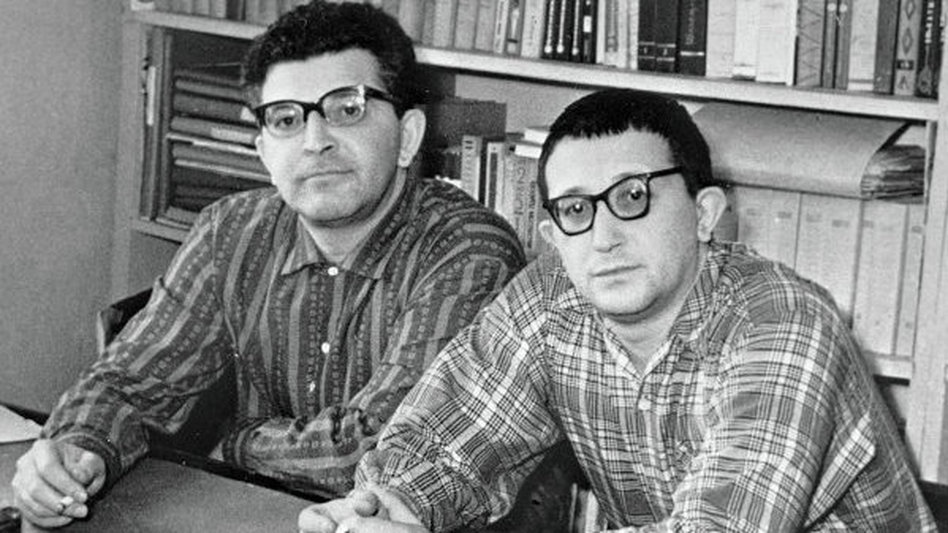
“The Visitors” by Arkady and Boris Strugatsky

Group Read 27The Big Book of Science Fiction

Story #31 of 107: “The Visitors” by Arkady and Boris Strugatsky

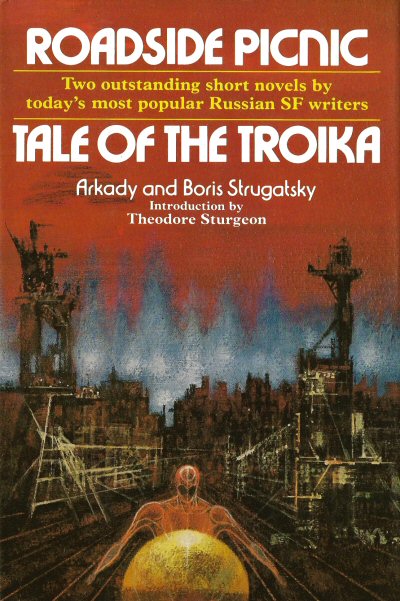
“The Visitors” by Arkady and Boris Strugatsky appears to have been written in 1958 according to ISFDB.org, but it gives no original Russian publication source. This older story feels like a trial run for the Strugatskys famous 1972 novel Roadside Picnic. However, the Wikipedia entry for that novel makes no mention of this earlier story about the visitors.

“The Visitors” is yet another first contact story. I’ve lost count of the number we’ve read so far in The Big Book of Science Fiction. “The Visitors” lacks the originality that we discover in Roadside Picnic, but is still a good story. It’s a matter-of-fact account by one observer, K. N. Sergeyev, an archaeologist, who tells a first person story of meeting an alien, and then later quotes from his boss’s diary left at the landing site which describes a close encounter of the third kind. His boss, Boris Yanovich Lozovsky, ultimately volunteers for an encounter of the fourth kind by becoming a storaway on the alien’s ship. “The Visitors” was written during the height of UFO mania, but the story structure and description of events reminds me of The War of the Worlds.

In “The Visitors” we have a very simple account of aliens landing and two humans observing them gather cars, sheep, cows, and other odd bits, before leaving. Boris Yanovich gets to interact with them, but there is no real communication. All their activities are a mystery. Boris thinks they are intelligent machines, but Sergeyev describes them as looking like dog size spiders. I couldn’t help but think of an eight-legged version of the Boston Dynamics robot called Spot.

I enjoy first contact stories, even after reading hundreds of them over the last sixty years. You’d think I’d be burnt out by now. It’s doubtful we’ll ever meet aliens, so science fiction will reimagine the first encounter an infinite number of times. In some ways that’s very frustrating.

Shouldn’t we examine our unquenching thirst for science fiction, especially regarding specific ideas like first contact? Once we thoroughly understand the concept of first contact wouldn’t it be more efficient if we got on with other things? There is so much to learn about reality, why waste all this time with repeating endless speculations on what is essentially is a one sense-of-wonder insight. I’ve often thought we should replace science fiction with a set of concise nonfiction books, each volume covering one science fictional concept, revised and updated every five or ten years.

I have my own ideas of how we’ll make first contact. Someday humans will make a SETI connection with alien beings, and eventually we’ll start sending each other selfies. It might take decades or centuries to even work out a common language and communication standards. I believe most science fiction is overly optimistic in first contact SETI novels by having us intercepting pictures or video right from the start, decoding strange messages in days. I doubt that will happen. I should write a novel about how I picture it happening.

There seems to be a resurgence in UFO interest. Many books were written in the 1950s and 1960s about first encounters, and ufologists worked through all the ideas that science fiction writers have done. I sense the Strugatsky brothers were into UFOs, or they knew about that subculture because “The Visitors” feel more like a UFO report than SF a story.

Evidently, many of us have a strong desire to know we’re not alone in the universe. I’d like to read a novel where the focus is on how human societies change when that finally happens. Any recommendations?

Main Page of Group Read

James Wallace Harris, 10/19/21

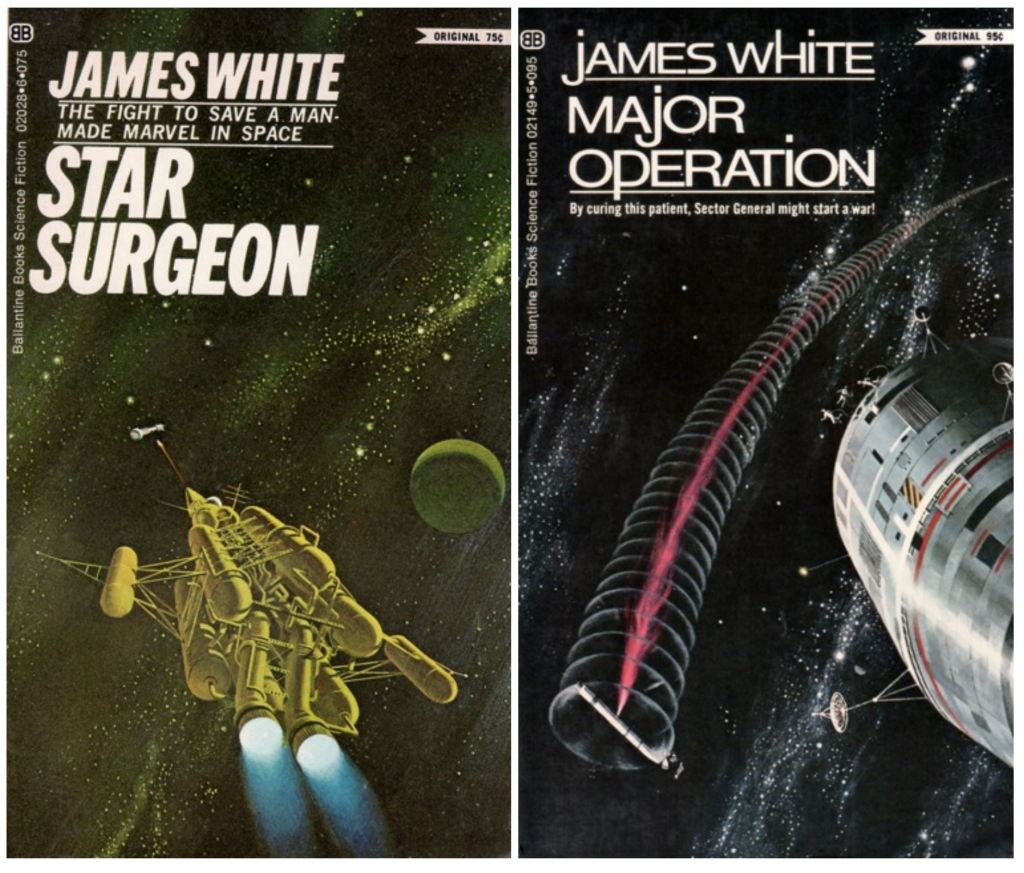
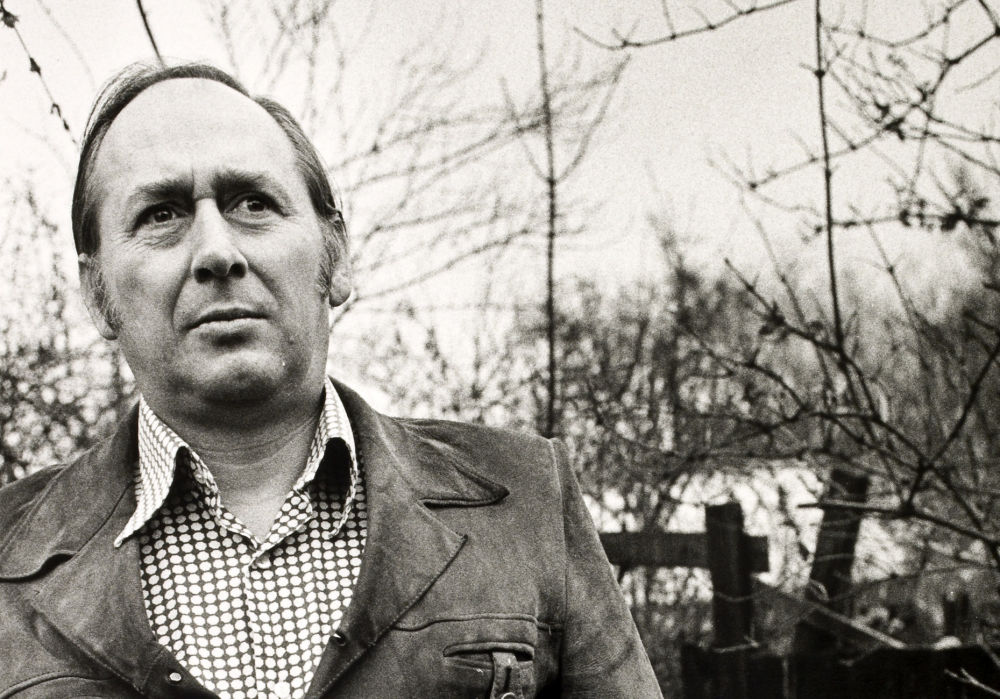
“Sector General” by James White

Group Read 27The Big Book of Science Fiction

Story #30 of 107: “Sector General” by James White

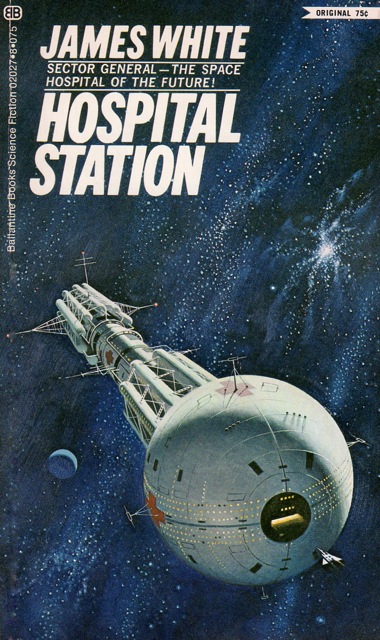
“Sector General” was first published in the November 1957 issue of New Worlds, and is the first story in the long running Sector General series. James White would eventually produce enough short stories and novels about his galactic hospital service that would span twelve books. “Sector General” was reprinted in the first book, Hospital Station.

As far as I can remember, this is the only story I’ve read by James White. “Sector General” is long, episodic, and ends rather abruptly. Dr. Conway is an idealistic young doctor with too many preconceived notions. In the course of the story, he’s forced to change his mind several times.

Most of the story is infodumping because White wants to world build his setup. The setting is a giant space station that serves as a hospital for any kind of alien species. Doctors can quickly acquire the needed biological knowledge for each species via education tapes downloaded into their brain.

If you love Star Trek and Star Wars you’ll probably love the Sector General series, it’s another galactic civilization. The writing in “Sector General” reminded me of a Star Trek novel, where the fun seems to be learning about an ever growing fictional universe.

“Sector General” did not work for me, although the series sounds interesting. It reminds me of other doctors in space stories by Murray Leinster and Alan E. Nourse. I find the premise of human doctors working on alien patients to be unrealistic, but still a neat idea. White chased after too many squirrels in “Sector General.” He was obviously more excited about all the ideas that came to him rather than focusing on storytelling structure. There was content for two good stories in “Sector General” if they had been worked out properly.

Rating: ***

Main Page of Group Read

James Wallace Harris, 10/16/21

“Stranger Station” by Damon Knight

Group Read 27The Big Book of Science Fiction

Story #29 of 107: “Stranger Station” by Damon Knight

“Stranger Station” by Damon Knight is not a story I’ve read before. It was first published in the December 1956 issue of The Magazine of Fantasy & Science Fiction, and was reprinted in Knight’s second collection, In Deep. It has also been reprinted in many significant anthologies. I own ten of them.

I’ve never read a novel by Knight, and I can count the number of short stories I remember reading by him on one hand: “To Serve Man,” “The Country of the Kind,” “Four in One,” “The Handler,” and now “Stranger Station.” I’ve been impressed with all of them except “To Serve Man.” It’s okay, but The Twilight Zone adaptation spoiled it for me. However, I feel a kind of kinship with Knight because he created the Clarion writers workshops, and I attended Clarion West in 2002. I mostly remember Knight because of his original anthology series Orbit.

“Stranger Station” is exactly the kind of story I was hoping to find in The Big Book of Science Fiction — something I haven’t read that I regret not having read. I bought the SF Gateway Omnibus of Knight’s four collections: Far Out, In Deep, Off Centre, and Turning On after I read “Four in One,” but I haven’t started reading it yet. “Stranger Station” makes me want to find the time.

As I read “Stranger Station” I kept thinking this 1956 story should have been in Harlan Ellison’s 1967 anthology Dangerous Visions. I thought it exceptionally disturbing. I don’t remember reading “Shall the Dust Praise Thee?” Knight’s story that was in that famous anthology. I barely remember reading Dangerous Visions in 1968, but can’t remember the specifics to any of the stories.

I didn’t think “Stranger Station” was disturbing because of daring content, but found it unsettling in the way Knight brought us into story, with Paul Wesson descending into madness, and leaving us with horrifying assessment of humans. Not only is the story well told, but it pushes the limits of science fiction for 1956.

Remember, these essays are not reviews. They’re my discussion for our group reads. There will be spoilers.

“Stranger Station” touches on several major science fiction themes: first contact, communication with aliens, ethnocentrism/xenocentrism, cultural humility, cultural shock, cultural imperialism, artificial intelligence, artificial gravity, and more. Knight guesses human spaceflight will take us to Titan by 1987. Of course, that’s wrong, but it could have been right if we had continued with Apollo era funding of space exploration and had not quit in 1972. Knight’s design of space station with artificial gravity is also very impressive for 1956, as his imagination for picturing an AI that reminded me of an evolved Alexa. If Knight had guessed at digitizing media I would have thought he had access to a time machine.

One reason I’m late posting my comments for this story is I’ve read it twice trying to figure it out. Philosophically it seems to be the opposite of “The Country of the Kind” where society has apparently found an exceptional cruel way to deal with lawbreakers with kindness. In “Stranger Station” Knight suggests the solution to fight an alien invasion is hate. But are they really what he’s saying in both cases? The man who considers himself King of the World in “The Country of the Kind” makes a case that society’s rebels deserve compassion too. But Paul Wesson’s solution to the alien’s invasion plan is an act of hate like the character in “The Country of the Kind.”

Science fiction writers seldom try to deal with the problem of alien contact. Most SF stories present aliens like Star Trek and Star Wars. Some aliens are friends, some are enemies, but being around them is no big deal. Knight imagines aliens that drive us insane and we drive them insane. In his story, one human and one alien meet every twenty years at a specially designed space station. They do not meet face-to-face, and they aren’t even supposed to see each other via video. Just being near each other causes psychic distress.

Knight has set up a story about contact between an advanced society and a backward society. In this case, we’re the backward society. It reminds me of stories about cargo cults. We have latched onto a biological byproduct from the aliens’ body that produces longevity and make a fetish of it like a crudely designed model plane. We almost worship the golden fluid, and set up a highly ritualized meeting place where we encounter the aliens, kowtow to their wonders.

In the story, Paul Wesson discovers the aliens are preconditioning us with love so that when we finally do attain interstellar travel we won’t destroy their culture with hate. Wesson resists this and fights back with hate, causing the giant alien the writhe in so much pain that it shakes apart the space station and dies.

What is Knight telling us? Is it a very dark judgment of the human race? At the end we’re told that the computer, Aunt Jane, is also expressing love. My current guess is Knight believes we’ll destroy AI minds too with our hate because of resentment. I currently can’t tell if Knight goes beyond cynicism in this story to any higher judgments.

This is another story that has taught me there were far more great science fiction writers back in the day than I discovered growing up. In the 1960s I barely got beyond the Big Three (Heinlein-Clarke-Asimov) by discovering Delany-Zelazny-Ellison and a couple other writers like Brunner and PKD. I’m having BIG FUN in my old age discovering other writers from the 1950s and 1960s that I should have discovered way back then.

I doubt I’ve even begun to fathom this story. I will need to reread it several times, but as if now:

Rating: *****

Main Page of Group Read

James Wallace Harris, 10/15/21

“The Last Question” by Isaac Asimov

Group Read 27The Big Book of Science Fiction

Story #28 of 107: “The Last Question” by Isaac Asimov

Isaac Asimov was obviously aiming to tell the tallest tall tale he could imagine when he wrote “The Last Question” for the November 1956 issue of Science Fiction Quarterly. And what a whopper! No one has ever claimed to have caught a bigger fish. Hell, “The Last Question” is the most hubric statement ever made about mankind. Asimov was known for his ego, and he assumes our species is just as egotistical. But then, science fiction has never been timid about thinking big.

Asimov claimed “The Last Question” was his favorite story he ever wrote. See this quote I stole from Wikipedia:

Why is it my favorite? For one thing I got the idea all at once and didn't have to fiddle with it; and I wrote it in white-heat and scarcely had to change a word. This sort of thing endears any story to any writer. Then, too, it has had the strangest effect on my readers. Frequently someone writes to ask me if I can give them the name of a story, which they think I may have written, and tell them where to find it. They don't remember the title but when they describe the story it is invariably 'The Last Question'. This has reached the point where I recently received a long-distance phone call from a desperate man who began, "Dr. Asimov, there's a story I think you wrote, whose title I can't remember—" at which point I interrupted to tell him it was 'The Last Question' and when I described the plot it proved to be indeed the story he was after. I left him convinced I could read minds at a distance of a thousand miles.

“The Last Question” is stuffed full of science fictional ideas and has often been dramatically presented at planetarium shows. At ISFDB.org the story is also listed with quite a few topic tags for such a short story. Unfortunately, the tag system hasn’t been widely implemented yet. I’d love to know all the other SF stories that deal with “reboot” and “heat death of the universe.” I know Tau Zero by Poul Anderson was a reboot story, but it has a different topic tag for that concept – “big crunch.”

“The Last Question” reminds me of an old cartoon. Let’s see how well my memory works. The cartoon showed a giant mainframe computer and two men in lab coats in front of it. One scientist had typed in “Is there a God?” and on the printer the other scientist reads, “There is now.” I’ve always wondered if that cartoon inspired Asimov to write “The Last Question.” I can’t find a copy of that cartoon on the net, but if anyone has a copy, please post a link in the comments. On the other hand, the cartoonist may have gotten their idea from the Asimov story.

“The Last Question” is exceedingly popular and there’s many audio versions on the net, including this one read by Leonard Nimoy.

In 1956 when this story was written, computers were huge machines that filled large rooms and were only getting bigger. Most people had not seen one, but they were often discussed in pop culture, frequently within jokes. People considered them thinking machines. 1956 was also around the time that artificial intelligence became an academic discipline.

I thought it amusing that Asimov imagines a “Microvac” computer, but even then, his micro was quite large. Did science fiction writers ever imagine small personal computers before small personal computers were invented?

Overall, “The Last Question” is a gem of a story, and one that epitomizes the idea story in science fiction. Asimov quickly sketches in a series of characters at every temporal stage of the story, and even though they lack depth of characterization, they capture various stages of humanity that have been imagined before in science fiction. Jerrodd’s family reminds me of the family Stone in Heinlein’s The Rolling Stones. VJ-23X of Lameth was a common futuristic character type in 1930s science fiction, like the kind that Edmond Hamilton, Neil R. Jones, or Raymond Z. Gallun wrote, and Zee Prime recalls what Olaf Stapledon imagined in Last and First Men or Star Maker.

In other words, this is a very science fictional story. And to steal from Aldous Huxley, “The Last Question” reflects the Perennial Philosophy of Science Fiction, which believes humanity will go on no matter what. If our planet dies we’ll find another one. If we lose our star, we’ll build another one. If we outgrow this galaxy, we’ll take over all the rest. If the universe dies, we’ll create another. Nothing is going to stop us. It’s certainly a positive philosophy, but is it a healthy one?

Main Page of Group Read

James Wallace Harris, 10/11/21